|

|
|
AGENDA
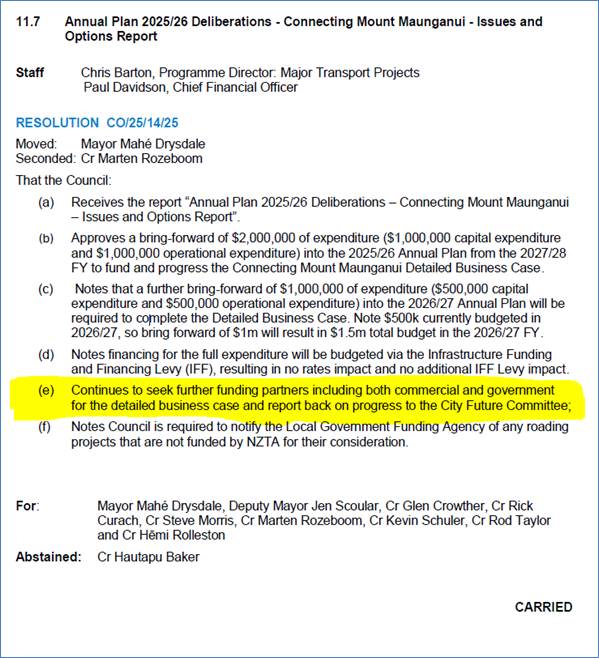
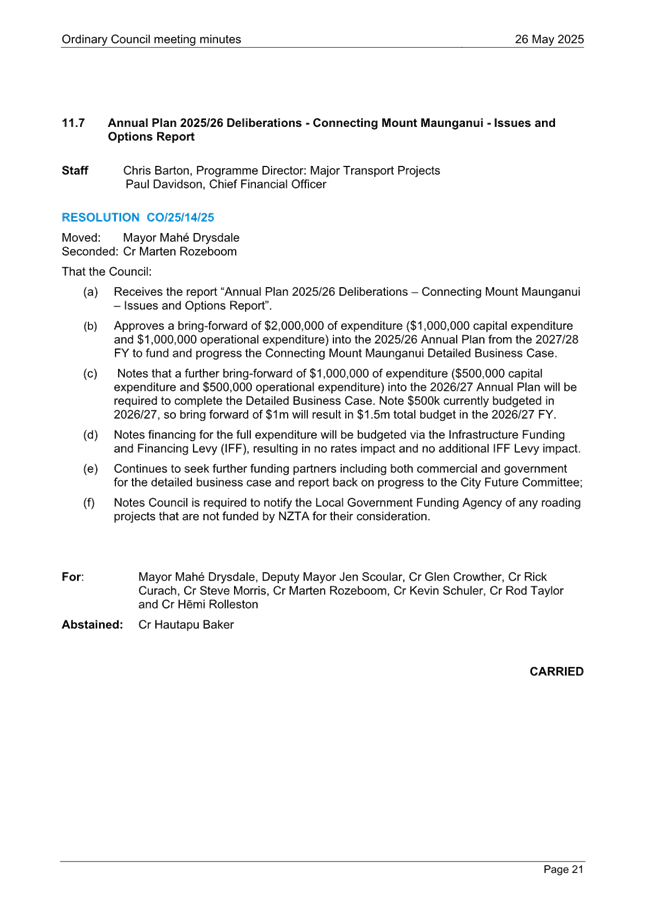
Ordinary Council meeting
Wednesday, 29 October 2025
|
|
I hereby give notice that an Ordinary meeting of
Council will be held on:
|
|
Date:
|
Wednesday, 29
October 2025
|
|
Time:
|
9.30am
|
|
Location:
|
Tauranga City Council Chambers, Mareanui
Level 1 - 90 Devonport Road
Tauranga
|
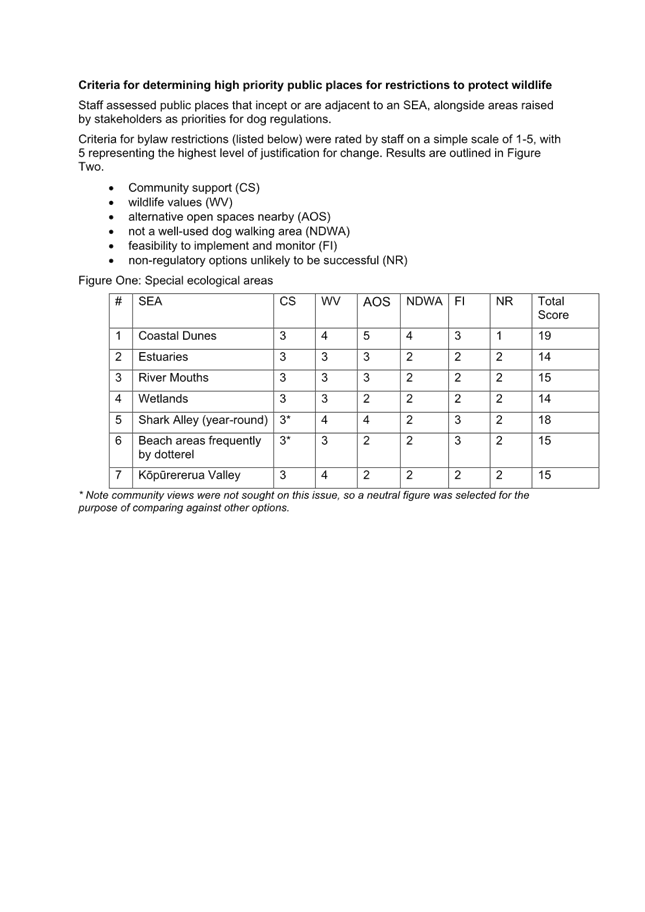
|
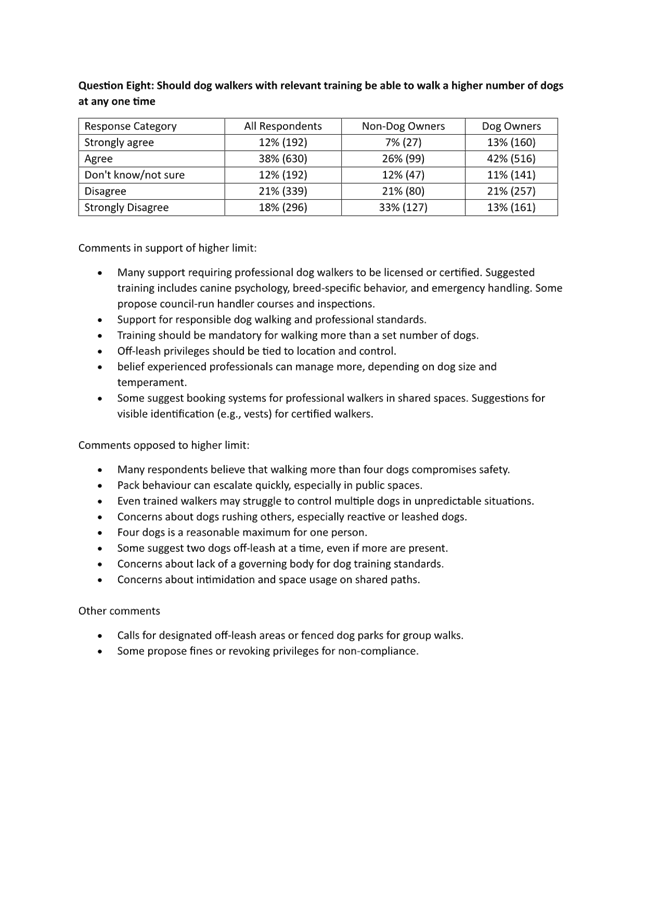
Please
note that this meeting will be livestreamed and the recording will be
publicly available on Tauranga City Council's website: www.tauranga.govt.nz.
|
|
Marty Grenfell
Chief Executive
|
Terms of reference –
Council
Membership
|
Chair
|
Mayor Mahé Drysdale
|
|
Deputy Chair
|
|
|
Members
|
|
|
Quorum
|
Half of the members present, where the number of members (including
vacancies) is even; and a majority of the members present,
where the number of members (including vacancies) is odd.
|
|
Meeting
frequency
|
Three weekly or
as required
|
Role
·
To ensure the effective and efficient governance
of the City.
·
To enable leadership of the City including
advocacy and facilitation on behalf of the community.
·
To review and monitor the performance of the
Chief Executive.
Scope
·
Oversee the work of all committees and
subcommittees.
·
Exercise all non-delegable and non-delegated
functions and powers of the Council.
·
The powers Council is legally prohibited from
delegating include:
○
Power to make a rate.
○
Power to make a bylaw.
○
Power to borrow money, or purchase or dispose of
assets, other than in accordance with the long-term plan.
○
Power to adopt a long-term plan, annual plan, or
annual report
○
Power to appoint a chief executive.
○
Power to adopt policies required to be adopted
and consulted on under the Local Government Act 2002 in association with the
long-term plan or developed for the purpose of the local governance statement.
○
All final decisions required to be made by
resolution of the territorial authority/Council pursuant to relevant
legislation (for example: the approval of the City Plan or City Plan changes as
per section 34A Resource Management Act 1991).
·
Council has chosen not to delegate the
following:
○
Power to compulsorily acquire land under the
Public Works Act 1981.
·
Make those decisions which are required by
legislation to be made by resolution of the local authority.
·
Authorise all expenditure not delegated to
officers, Committees or other subordinate decision‑making bodies of
Council.
·
Make appointments of members to the
council-controlled organisation Boards of Directors/Trustees and
representatives of Council to external organisations.
·
Undertake statutory duties in regard to
Council-controlled organisations, including reviewing statements of intent,
with the exception of the Local Government Funding Agency where such roles are
delegated to the City Delivery Committee. (Note that monitoring of all
Council-controlled organisations’ performance is undertaken by the City
Delivery Committee. This also includes Priority One reporting.)
·
Consider all matters related to Local Water Done
Well.
·
Consider any matters referred from any of the
Standing or Special Committees, Joint Committees, Chief Executive or General
Managers.
·
Review and monitor the Chief Executive’s
performance.
·
Develop Long Term Plans and Annual Plans
including hearings, deliberations and adoption.
Procedural matters
·
Delegation of Council powers to Council’s
committees and other subordinate decision-making bodies.
·
Adoption of Standing Orders.
·
Receipt of Joint Committee minutes.
·
Approval of Special Orders.
·
Employment of Chief Executive.
·
Other Delegations of Council’s powers,
duties and responsibilities.
Regulatory matters
Administration, monitoring and enforcement of all
regulatory matters that have not otherwise been delegated or that are referred
to Council for determination (by a committee, subordinate decision‑making
body, Chief Executive or relevant General Manager).
1 Opening
karakia
2 Apologies
|
Ordinary Council meeting Agenda
|
29 October 2025
|
3 Public
forum
3.1 John Heaphy -
Department of Conservation
Attachments
Nil
3.2 Anna Wentsch -
Western Bay Wildlife Trust
Attachments
Nil
|
Ordinary Council meeting Agenda
|
29 October 2025
|
11 Business
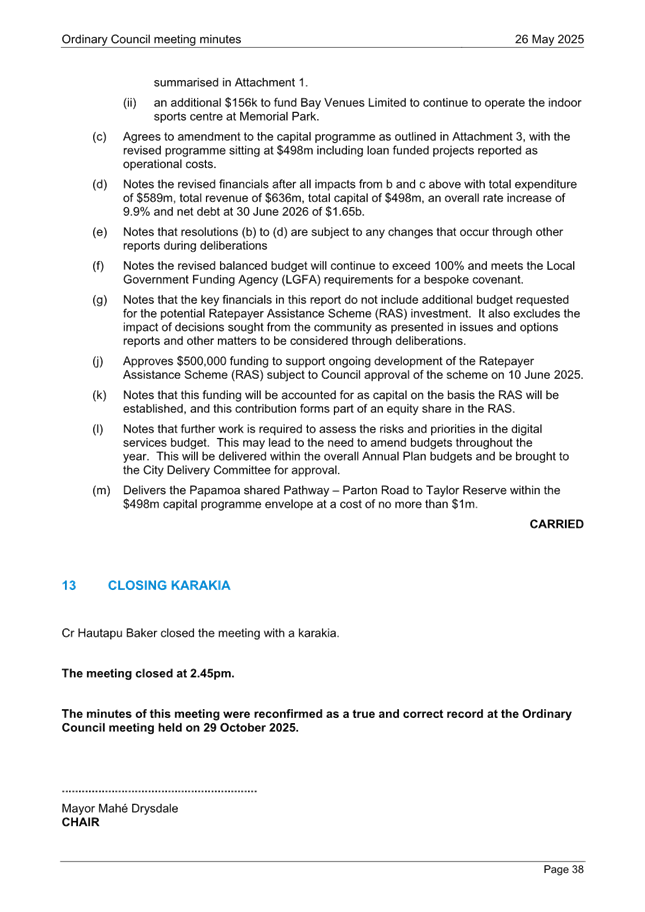
11.1 Confirmation of updated
minutes of the Council meeting held on 26 May 2025
File Number: A18888643
Author: Anne Payne, Principal Strategic Advisor
Jeremy
Boase, Head of Strategy, Governance & Climate Resilience
Authoriser: Christine Jones, General Manager: Strategy, Partnerships &
Growth
Purpose of the Report
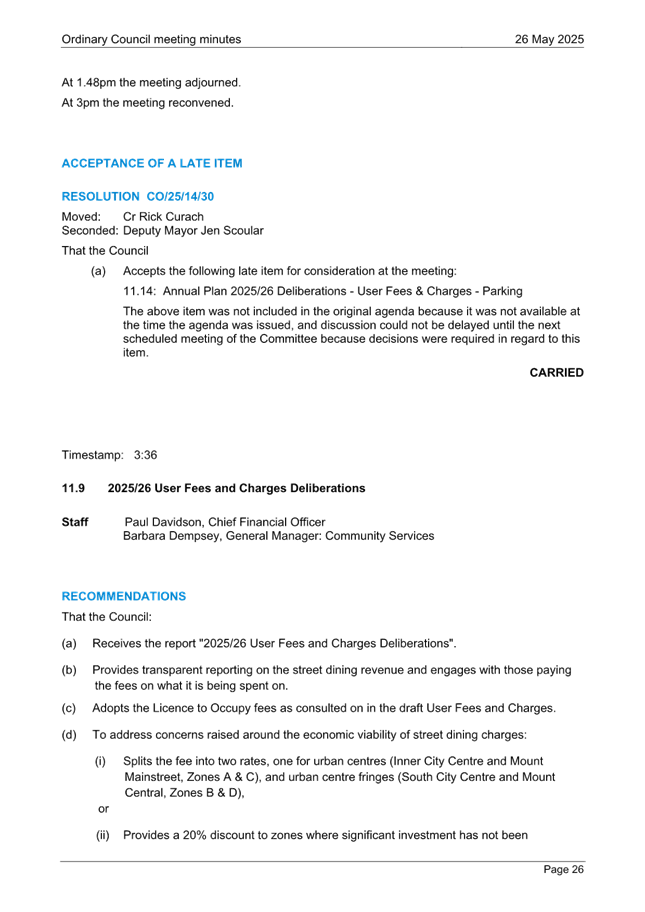
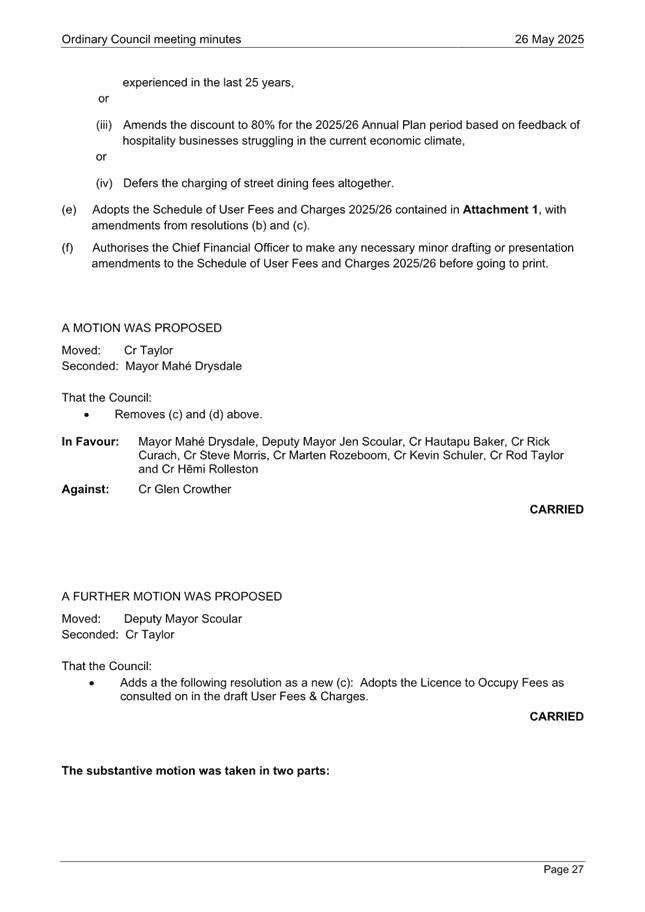
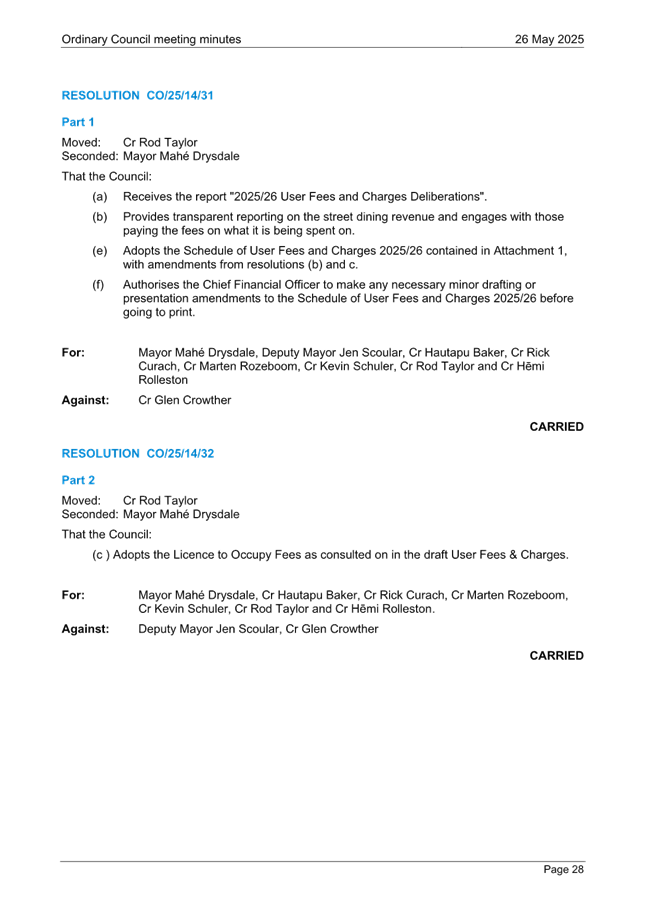
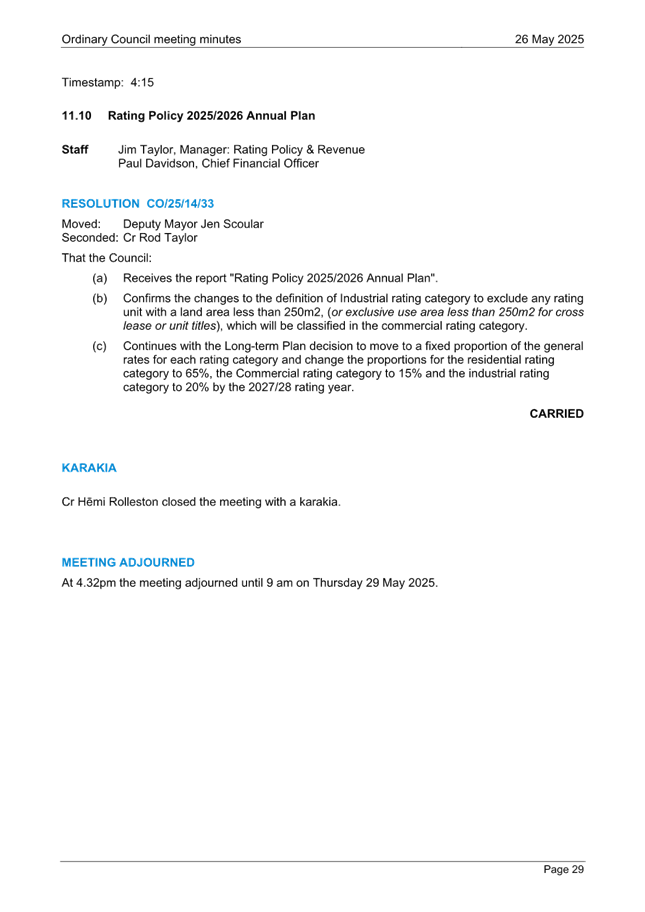
1. This
report notes a correction required to one resolution in the confirmed Council
meeting minutes of 26 May 2025 (Annual Plan 2025/26 Deliberations), and seeks
Council confirmation of the updated minutes.
|
Recommendations
That
the Council:
(a) Receives the
report "Confirmation of updated minutes of the Council meeting held on
26 May 2025".
(b) Confirms the
updated minutes (provided as Attachment 1 to this report) as the true and
correct record of the Council meeting held on 26 May 2025.
|
Discussion
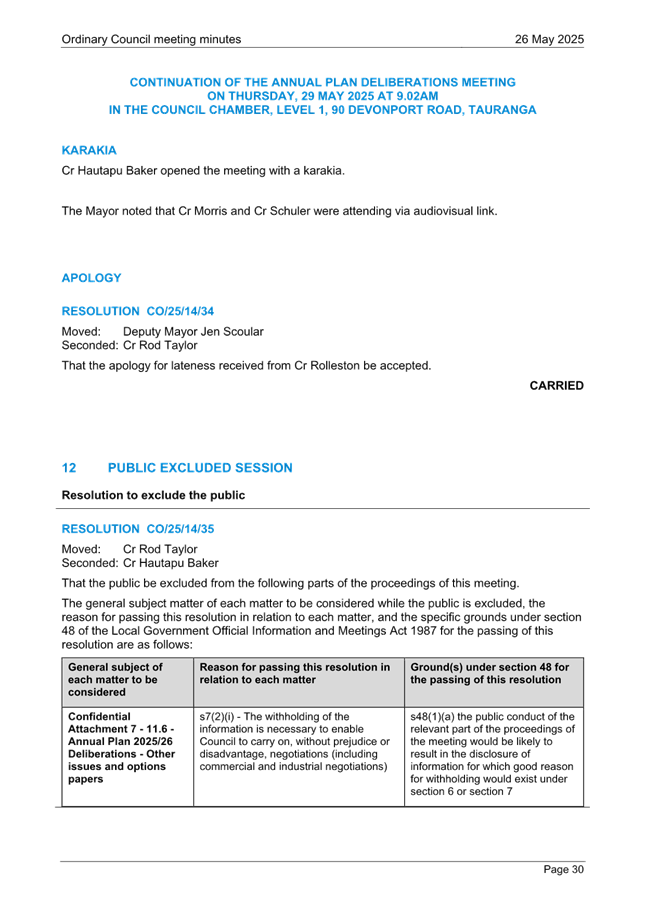
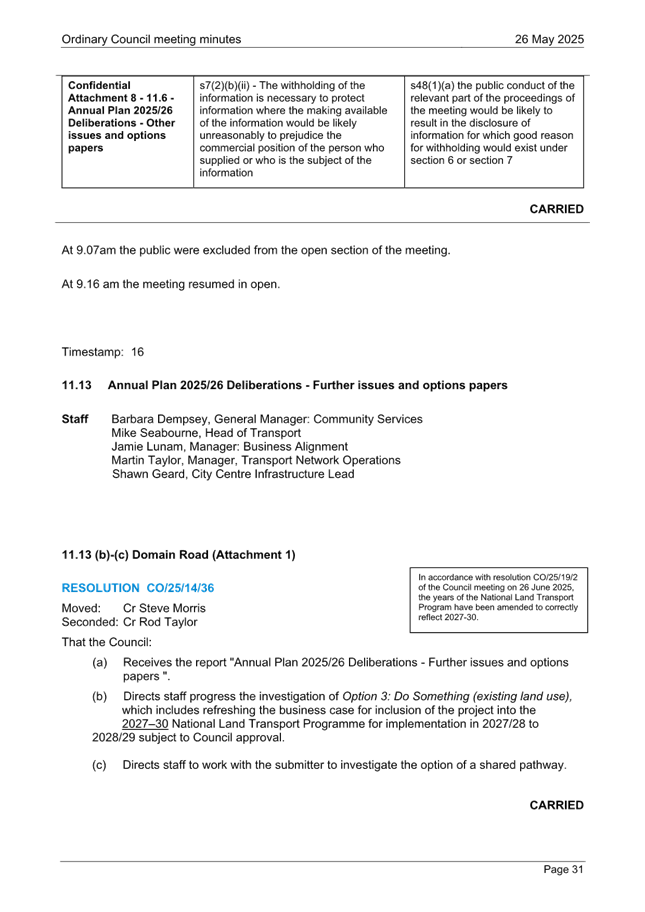
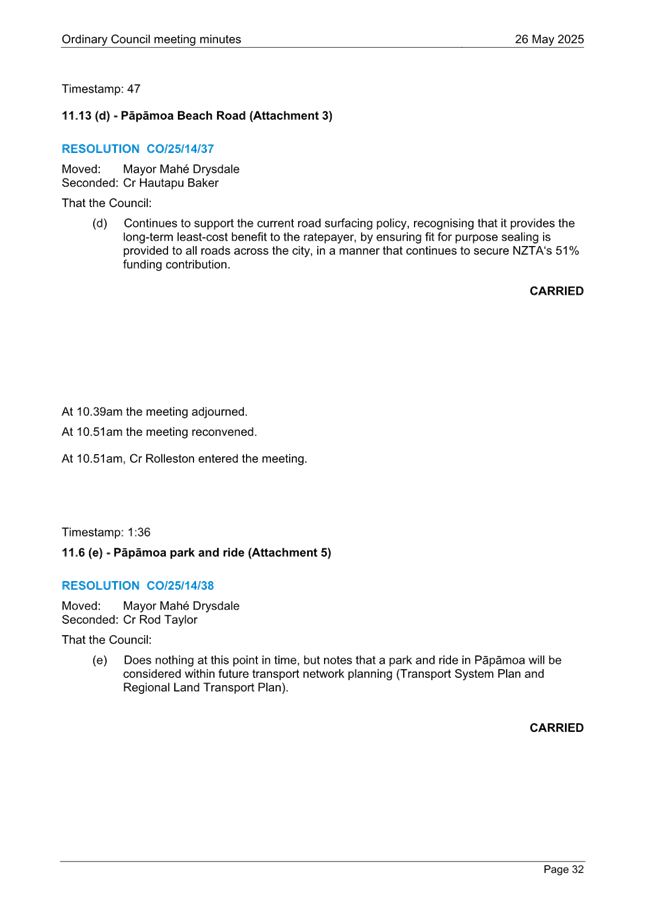
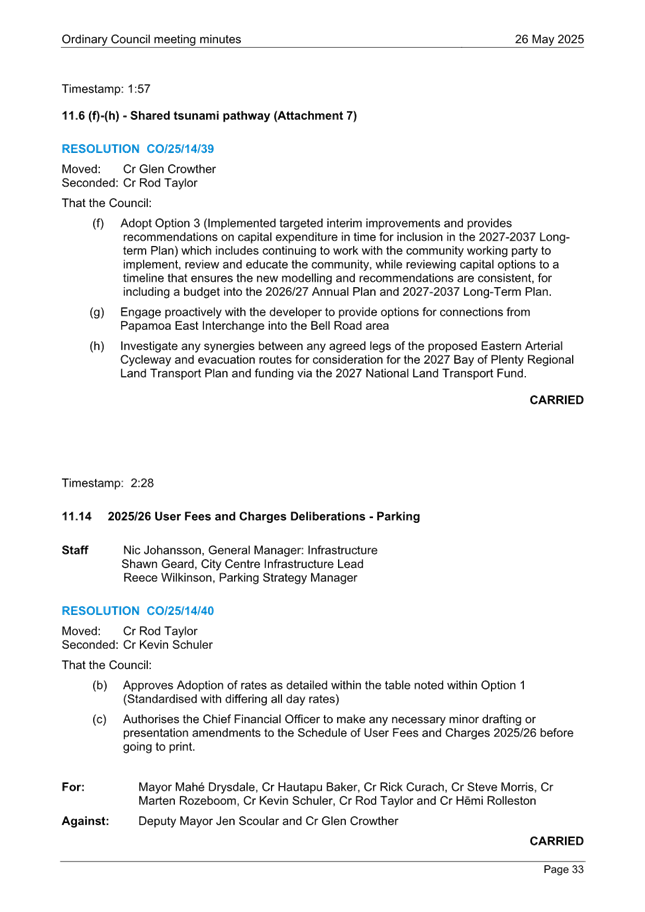
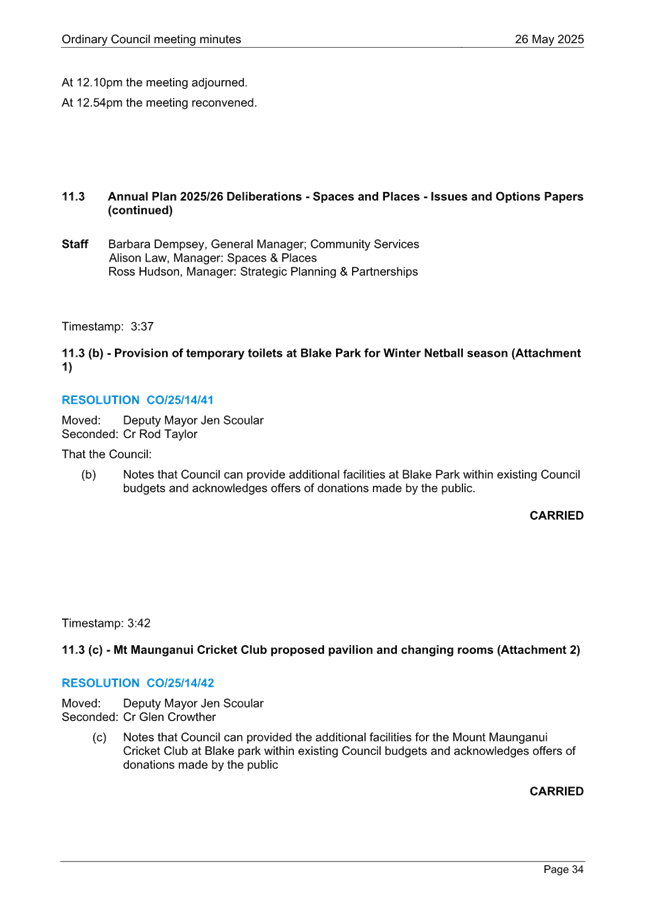
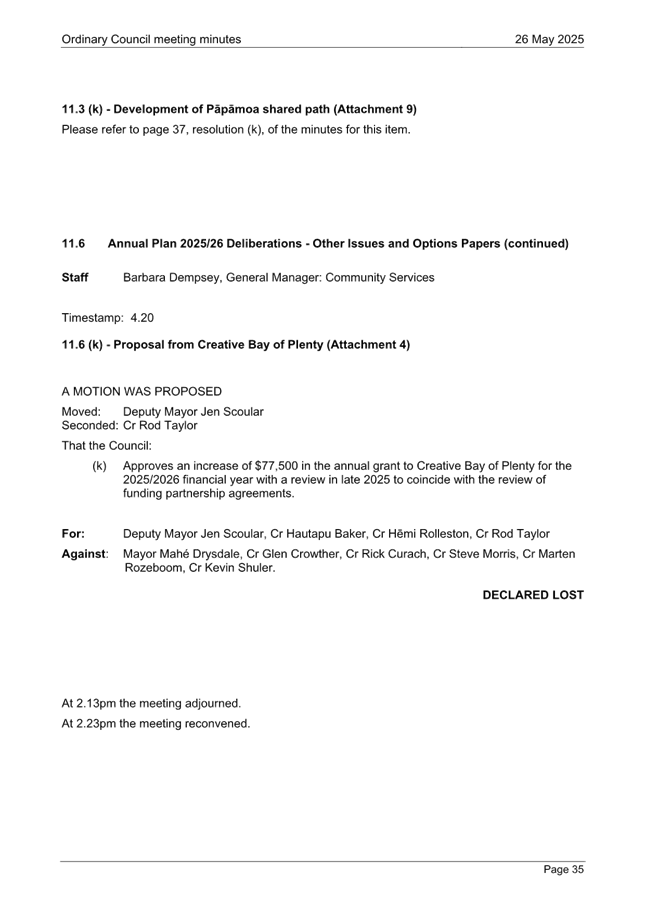
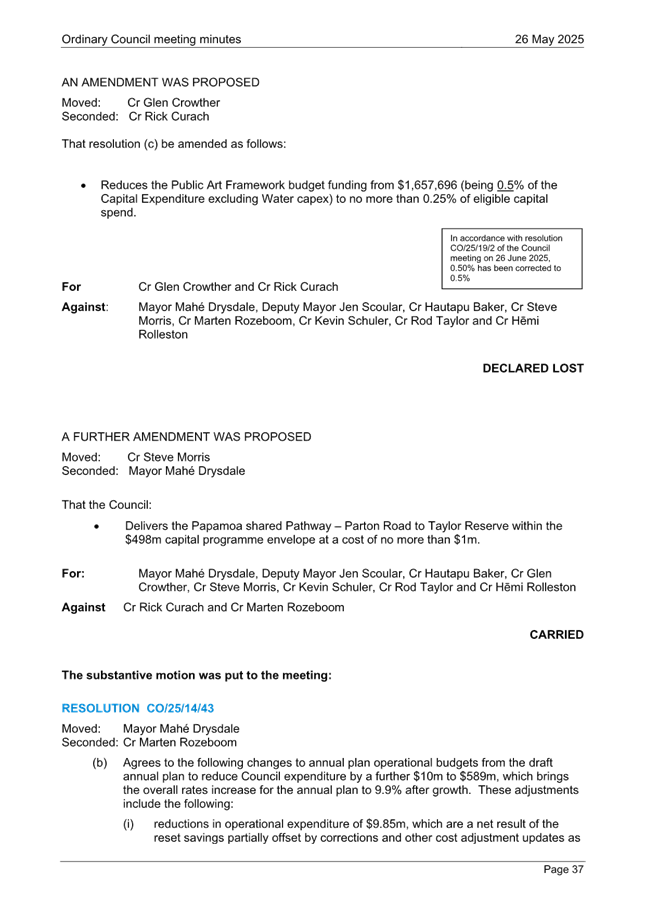
2. The
Annual Plan 2025/26 Deliberations meeting of Council ran from 26 to 29 May
2025, and was recorded in the Council meeting minutes of 26 May 2025. These
minutes were confirmed by Council at the meeting of 26 June 2025, and are
currently available on the Council Meetings page of the Tauranga City Council
website.[1]
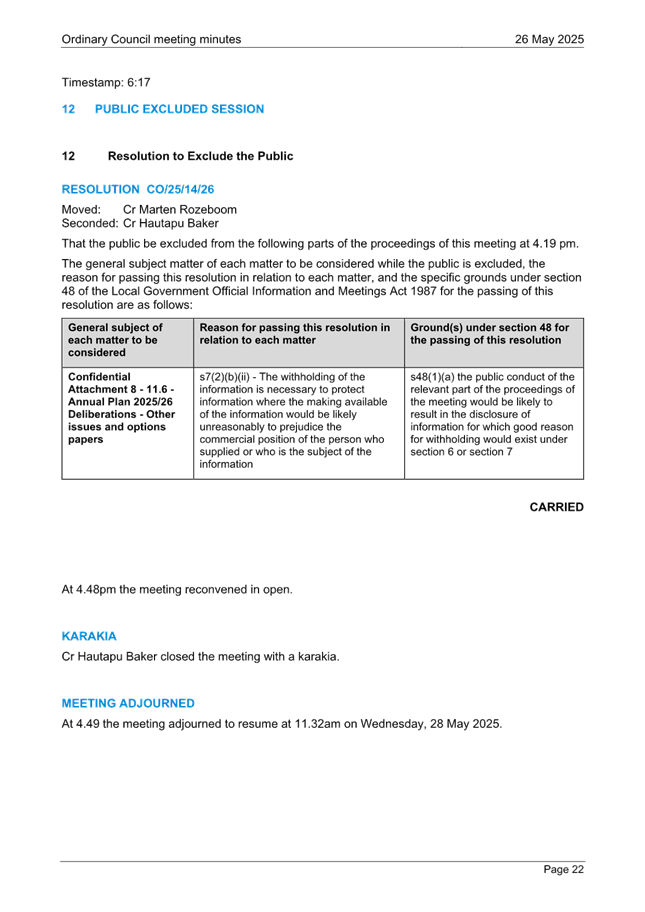
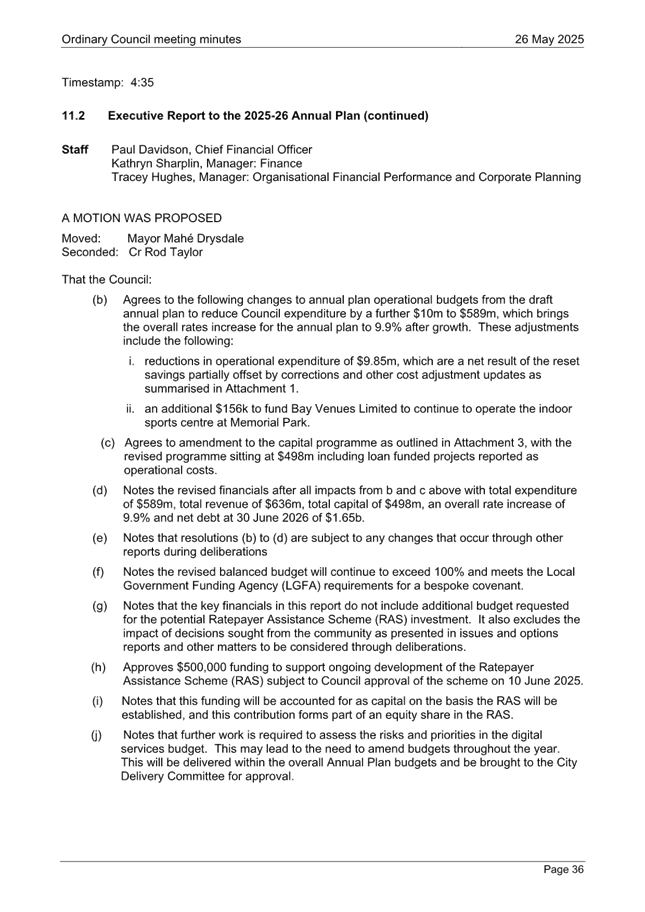
3. On
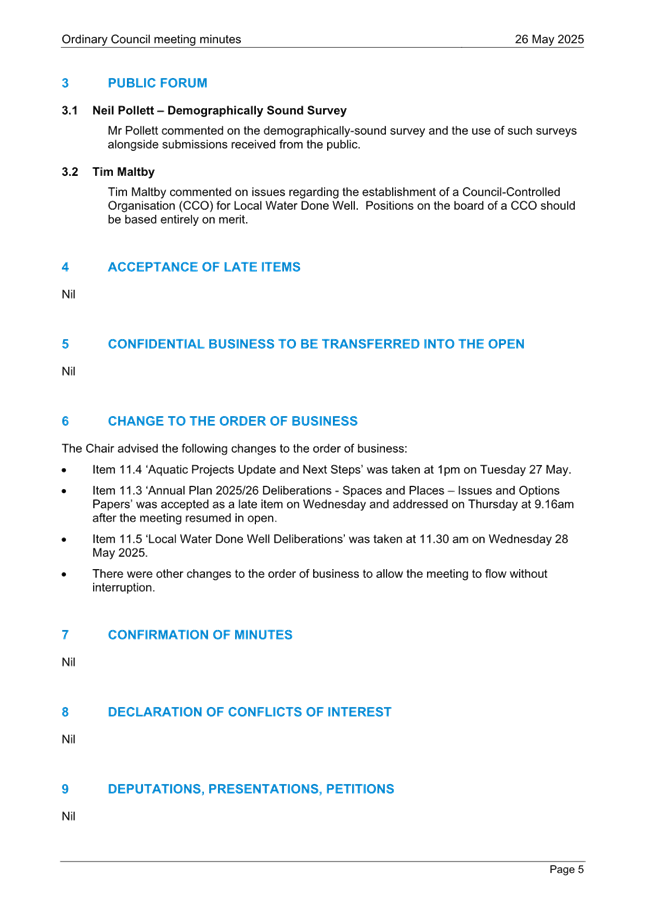
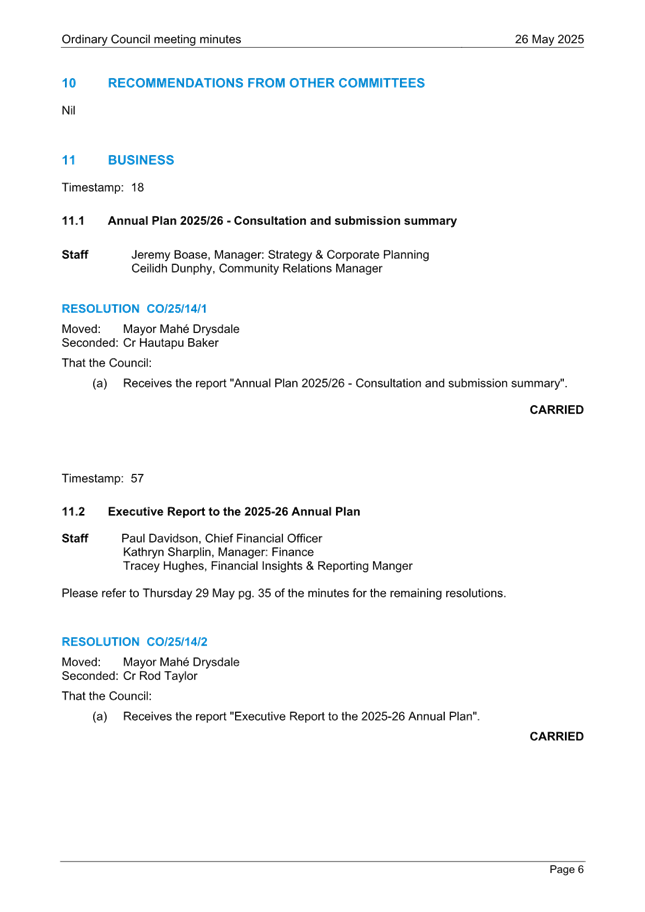
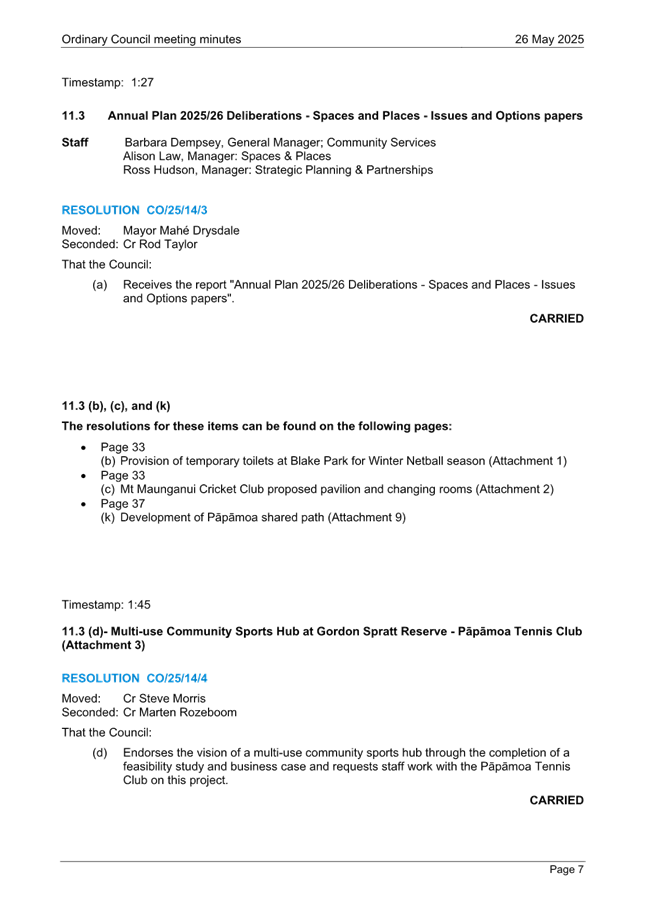
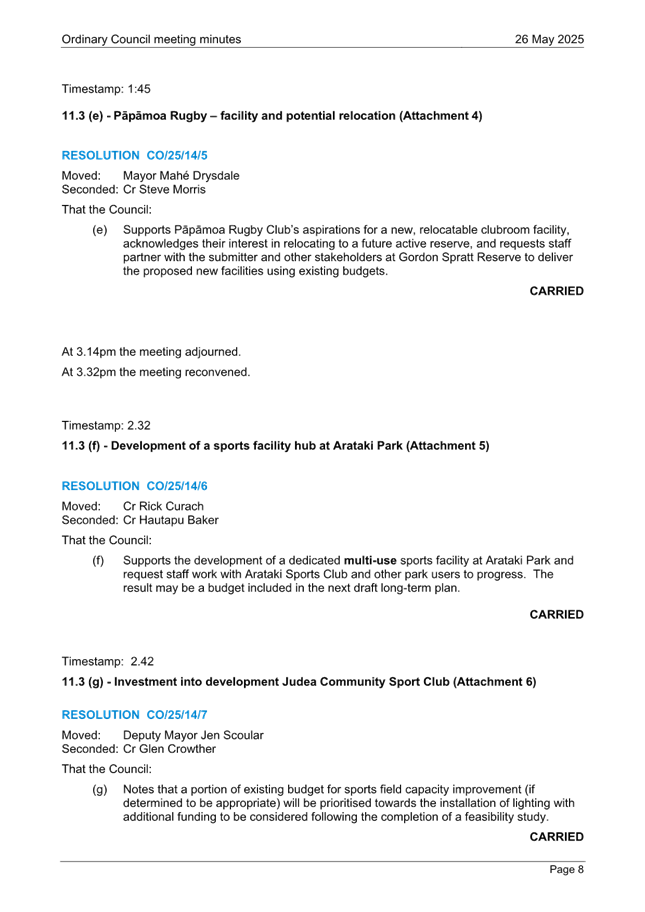
further quality assurance review, council staff identified an error in one part
of one resolution of the confirmed minutes, as detailed below:
4. Agenda
item 11.7 Annual Plan 2025/26 Deliberations - Connecting Mount Maunganui -
Issues and Options Report, Resolution CO/25/14/24 part (e) (confirmed minutes
page 26), currently contains the report recommendation, being:
e) Notes
decisions for the Detailed Business Case development to proceed will be subject
to decisions of the City Futures Committee following further reporting on
external funding commitments and further confirmation of IFF financing
eligibility, and; new e as on proforma
5. During
the meeting, Council replaced the recommended resolution part (e) (above) with
a new statement. This new part (e) was recorded by staff in a separate
document, the ‘pro forma’ minutes referenced above, but was not
transferred into the draft meeting minutes presented to Council for
confirmation on 26 June.
6. The
full corrected resolution is provided below, with the corrected part (e)
highlighted:
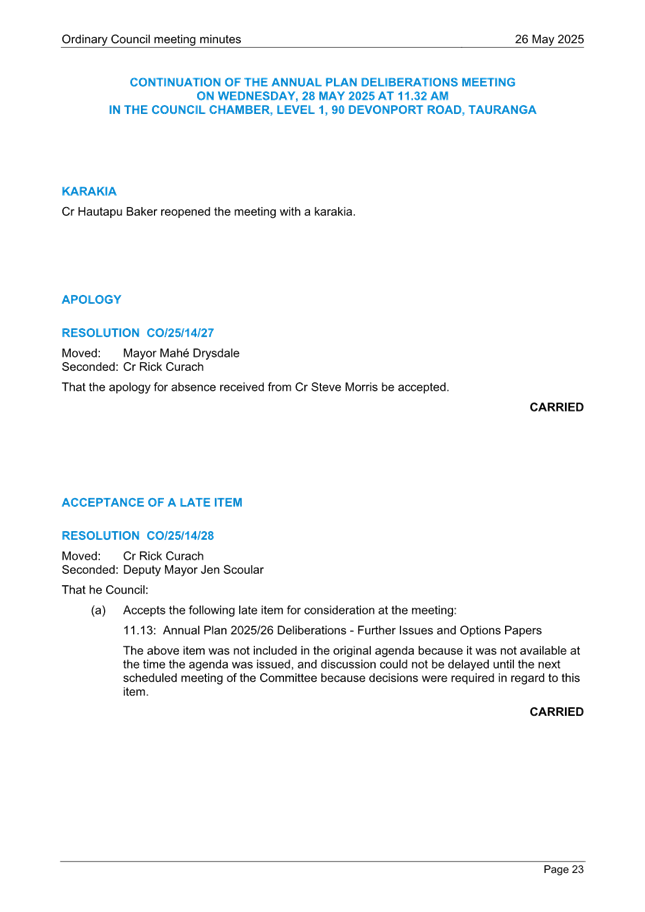
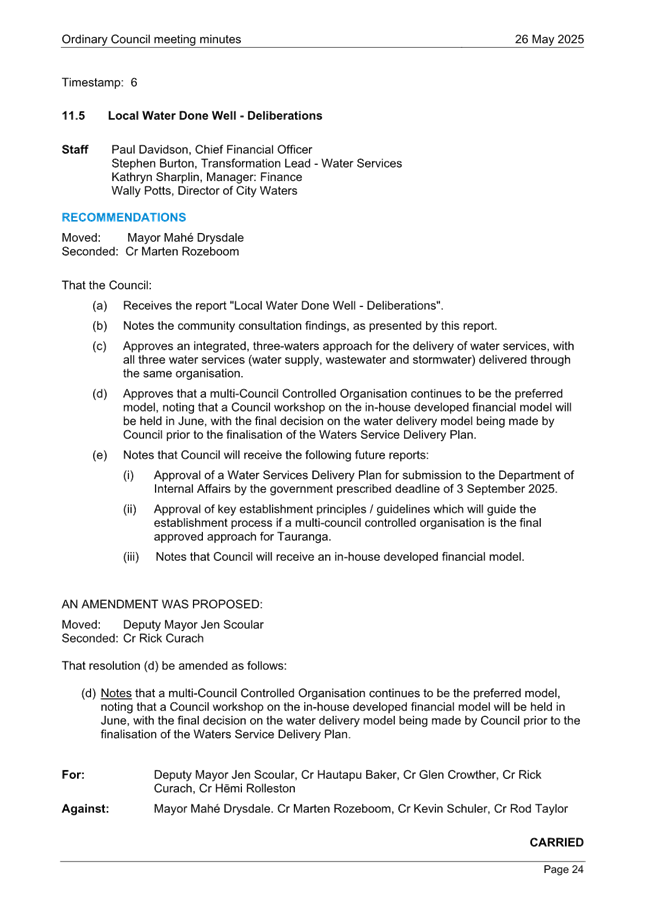
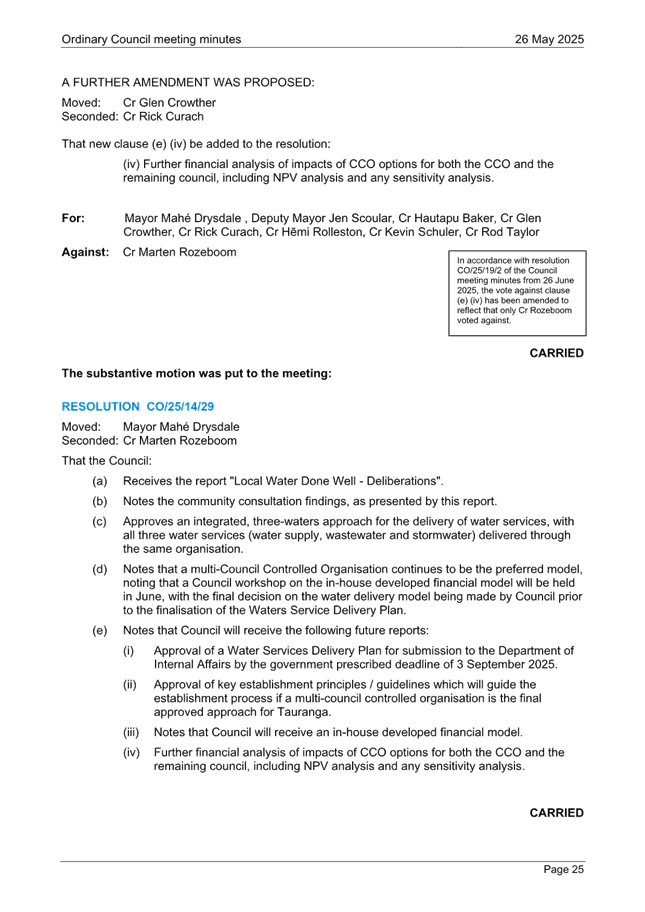
7. This
corrected resolution is included on page 21 of the full set of updated minutes,
which are provided as Attachment 1 to this report. Staff sincerely
apologise for this oversight.
8. To
improve readability, some minor formatting changes have also been made within
the updated minutes document. None of these minor formatting changes affect the
substantive content of the minutes.
9. Please
note that the updated minutes do not contain an ‘unconfirmed’
watermark because they are intended to replace the already-confirmed minutes.
10. Council is now
asked to confirm the updated minutes (Attachment 1 to this report) as
the true and correct record of the Council meeting of 26 May 2025.
Next Steps
11. Once
confirmed, the updated minutes (Attachment 1 to this report) will
replace the currently available confirmed minutes on the council website.
Attachments
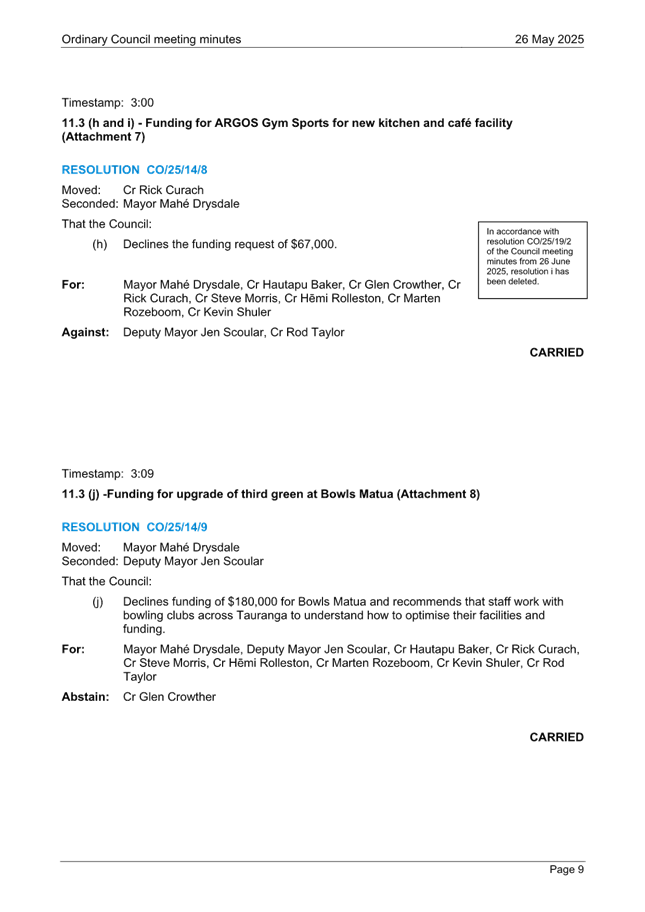
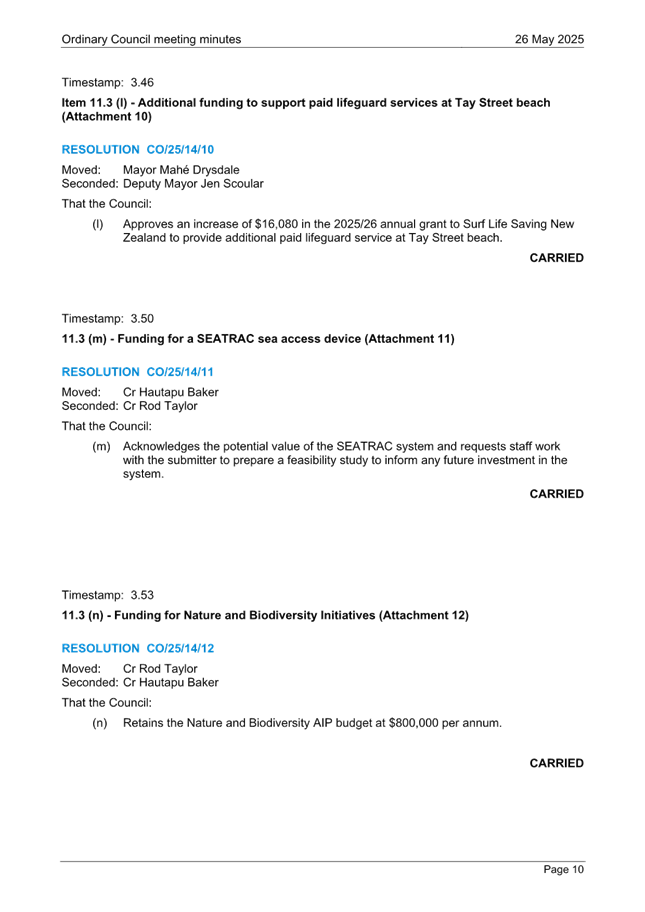
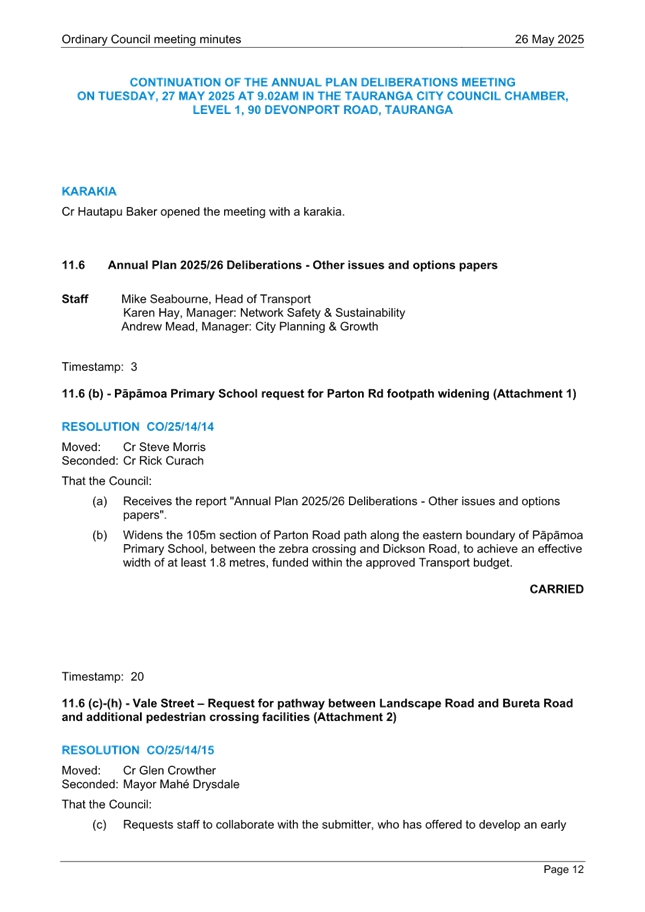
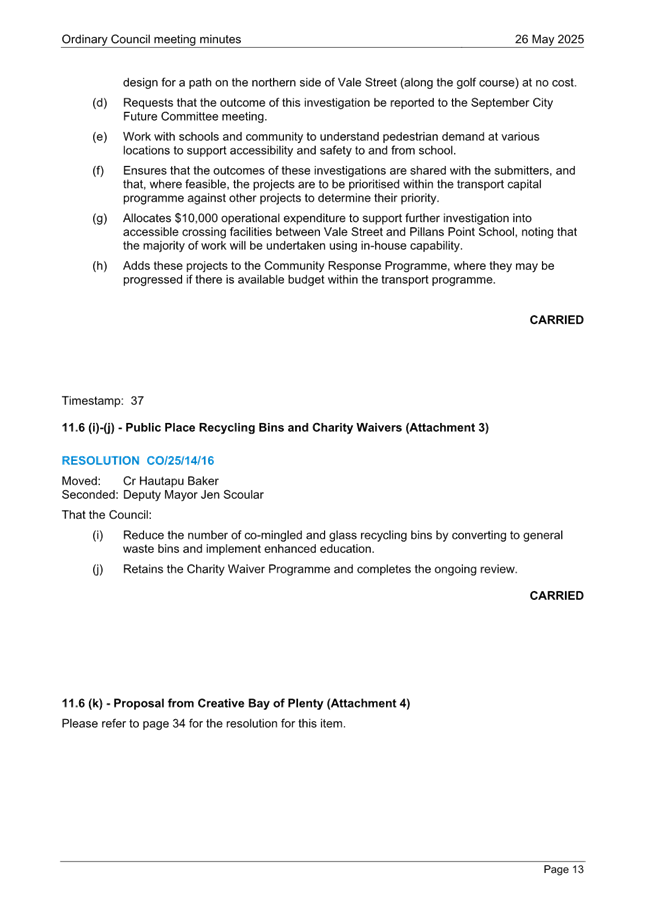
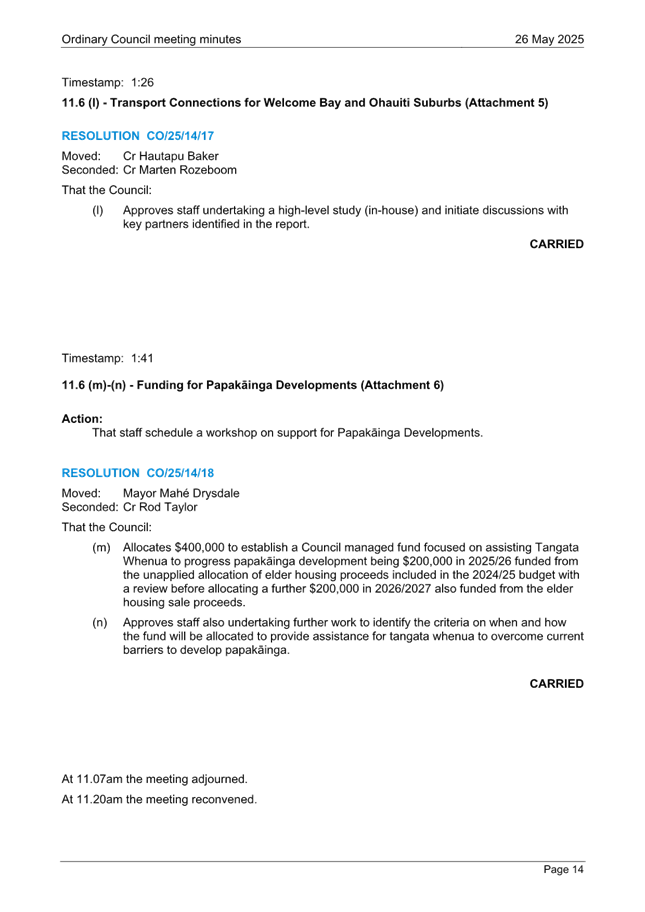
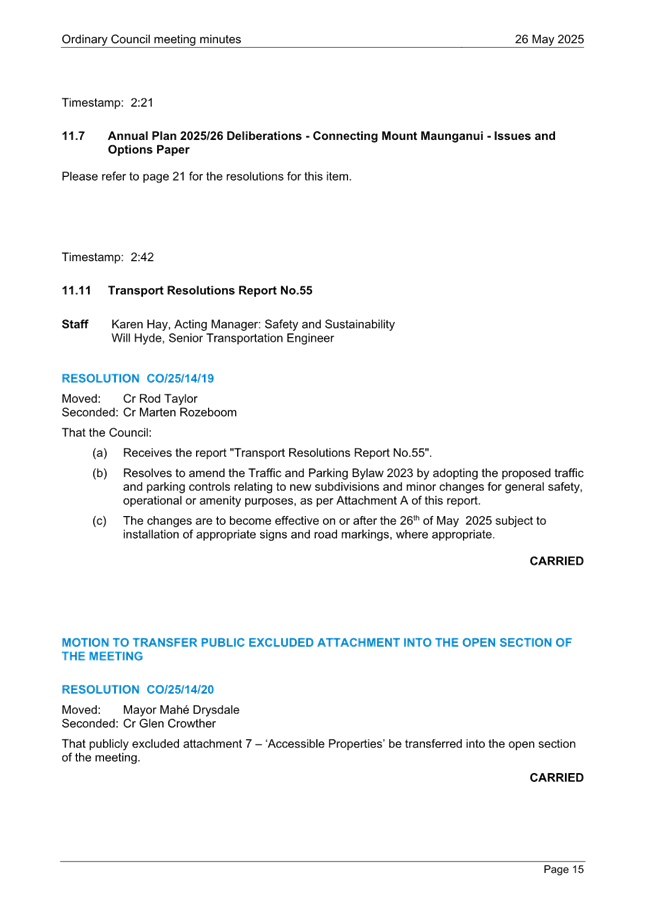
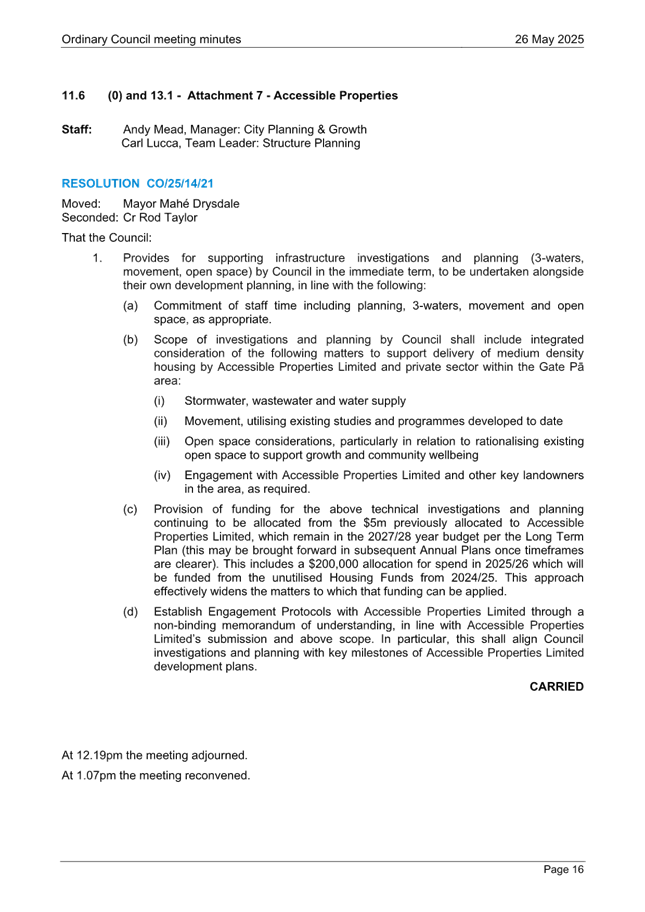
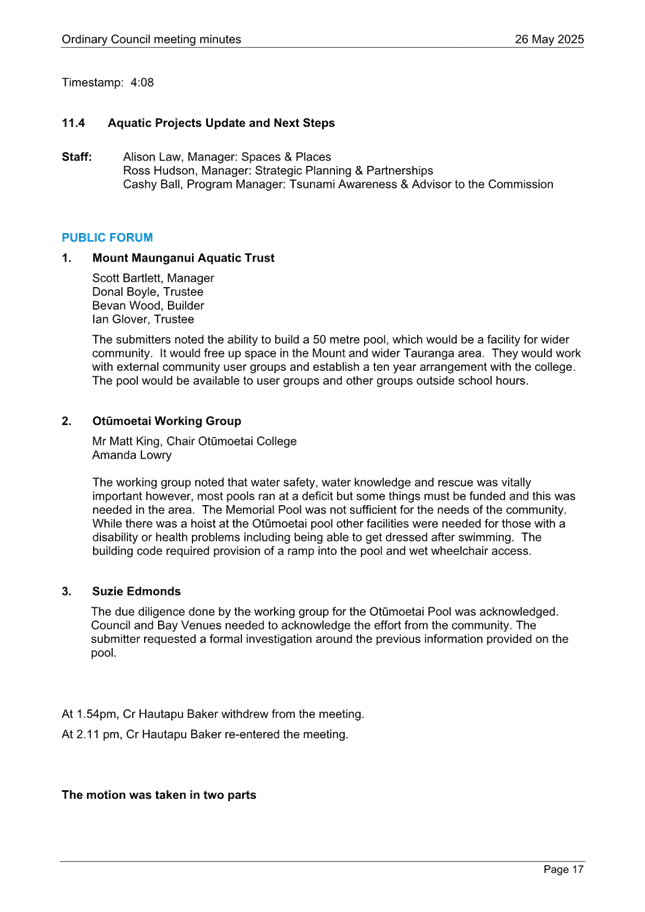
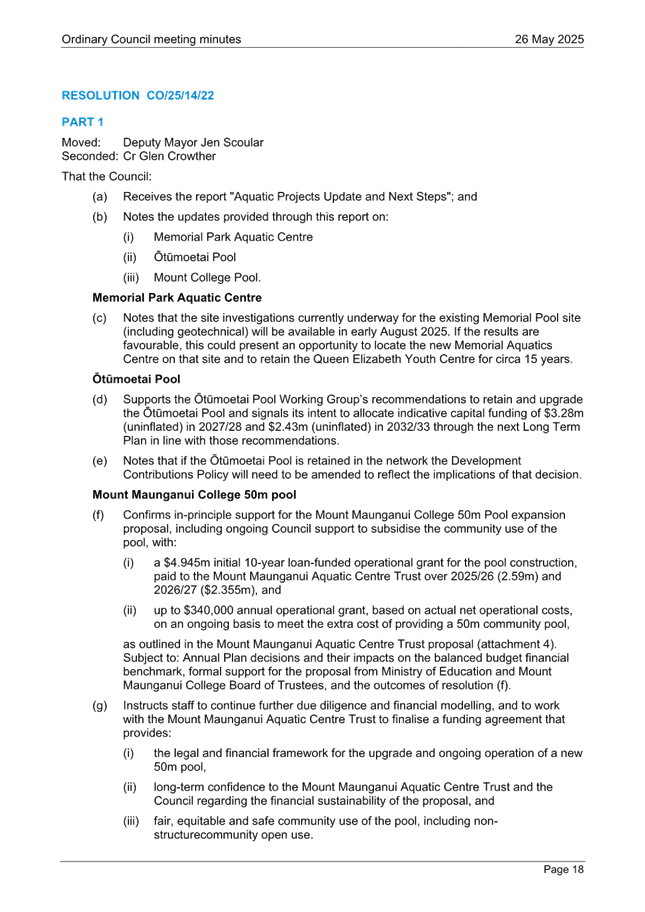
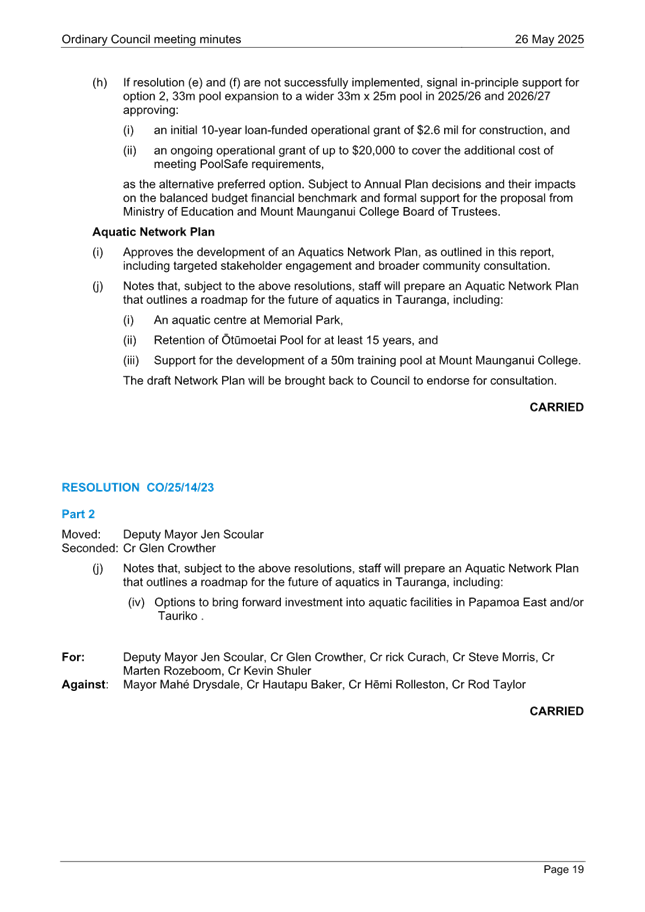
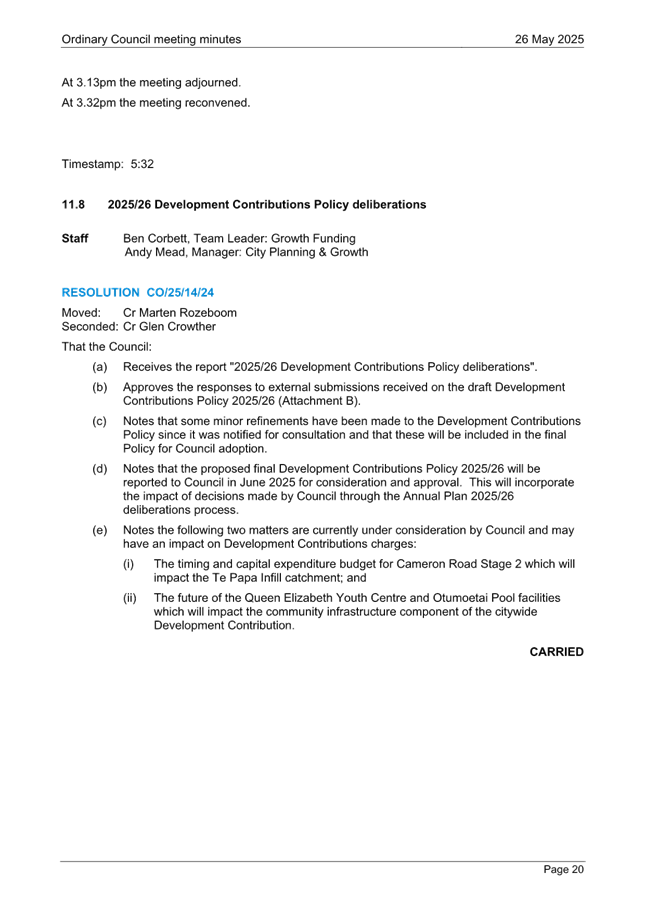
1. Minutes of Council meeting
Monday, 26 May 2025 (updated) - A18995882 ⇩ 
|
Ordinary
Council meeting Agenda
|
29
October 2025
|


|
Ordinary
Council meeting Agenda
|
29
October 2025
|
11.2 Issues
and Options for Dog Management Policy and Bylaw and Keeping of Animals Bylaw
Review
File Number: A18204388
Author: Vicky Grant-Ussher, Policy Analyst
Brent
Lincoln, Team Leader: Animal Services
Authoriser: Sarah Omundsen, General Manager: Regulatory and Community Services
Purpose of the Report
1. To consider the issues arising from the review of council policies
and bylaws associated with dogs and animals and to provide direction on the
issues and options presented in the report.
|
Recommendations
That
the Council:
(a) Receives the
report "Issues and Options for Dog Management Policy and Bylaw and
Keeping of Animals Bylaw Review".
(b) Provides
direction on the following issues for the purpose of developing draft policy
and bylaws:
(i) retain
existing approach to dog management in public places but review the
resourcing of education and enforcement through the Long Term Plan (Issue
1: Option C)
(ii) make
targeted changes to dog restrictions at public places containing or adjacent
to special ecological areas identified as high priority (for example, coastal
dunes, and Shark Alley) (Issue 2: Option B)
(iii) require
dogs to be on leash in urban city centre spaces (including Red Square,
Masonic Park, the waterfront) (Issue 3: Option B)
(iv) require dogs to
be on leash on selected shared paths (for example Marine Parade Coastal
Pathway, the Beach Road walkway and the Papamoa Shared Path) (Issue 3:
Option F)
(v) clarify the
definition of play spaces and exercise equipment to include active recreation
equipment (for example, skate parks and basketball courts) (Issue 3:
Option H)
(vi) prohibit dogs
from parks that are fenced for accessibility and inclusion purposes (Issue
3: Option I)
(vii) prohibit dogs in all
cemeteries and burial grounds (unless permitted by the cemetery manager) and
require dogs to be on leash in heritage reserves where dogs are not otherwise
prohibited (Issue 3: Option L)
(viii) include bylaw
provisions to address issues with cats (Issue 4: Option A)
OR
(ix) do not include
bylaw provisions to address issues with cats (Issue 4: Option B)
(x) add a
maximum number of dogs per property (in addition to the current per person
limit) (Issue 4: Option C)
(xi) add an ability
for dog walkers with relevant training to request a licence from Tauranga
City Council to walk more than four dogs at a time (Issue 4: Option D)
OR
(xii) retain the current
limit allowing up to four dogs to be walked at a time (Issue 4: Option E)
(xiii) reduce the number of
poultry that can be kept in the residential zone without a licence to 6. (Issue
4: Option F)
(xiv) require a licence to keep
poultry other than chickens in the residential zone. (Issue 4: Option G)
(xv) add a general
requirement for those keeping animals in Tauranga to abide by the direction
of an authorised officer (Issue 4: Option H)
(c) Notes that
draft policy and bylaws will be prepared based on the direction provided and
then provided to Council for consideration prior to adoption for consultation
early next year.
|
Executive Summary
2. This report presents the findings of a comprehensive review of
Tauranga City Council’s Dog Management Policy and Bylaw, alongside the
Keeping of Animals Bylaw. The review was initiated in response to Action 23 of
the Nature and Biodiversity Action and Investment Plan, to update the Dog
Management Bylaw for Tauranga City to review existing, and include additional,
dog prohibited areas to protect threatened species. The review also aims to
ensure alignment with statutory obligations under the Dog Control Act 1996 and
the Local Government Act 2002, while responding to community feedback and
operational challenges.
3. The review identifies several key issues requiring Council
direction. These include the overall approach to dog management in public
spaces, the protection of Special Ecological Areas (SEAs), the regulation of
dogs in urban and shared spaces, the potential introduction of cat-related
provisions, and various licensing and registration matters. Data collected from
Tauranga City Council records and ACC statistics indicate that while
dog-related incidents have increased in absolute terms, the rate of incidents relative
to the dog population has remained stable. Information from external agencies
such as the Department of Conservation (DOC), Forest and Bird and Western Bay
Wildlife Trust (WBWT) suggests that wildlife incidents involving dogs and cats
remain a concern.
4. Council staff recommend a number of targeted changes to address
these issues. These include:
· Retaining the existing approach to dog management in public places
but review the approach to enforcement including the revenue and finance
funding needs assessment for dog management through the LTP
· Permanent dog restrictions be introduced in high-priority Special
Ecological Areas such as Shark Alley and coastal dunes, where seasonal
restrictions have proven ineffective.
· In urban city centre spaces, including Red Square, the Waterfront
and Masonic Park, dogs should be required to be on leash to reflect community
preferences and mitigate risks associated with transport corridors.
· On selected shared paths, such as the Marine Parade Coastal Pathway
and Papamoa Shared Path, require dogs to be leashed to reduce conflicts between
users.
· Updates to the definition of play spaces and exercise equipment to
prohibit dogs on active recreation features, and fenced parks designed for
accessibility and inclusion purposes.
· Prohibiting dogs from all cemeteries and burial grounds unless
permitted by the cemetery manager and requiring dogs to be leashed in heritage
reserves where they are not otherwise prohibited.
5. The report also considers whether to introduce bylaw provisions for
cats, such as requiring microchipping, desexing, and registration. While DOC,
SPCA, and WBWT support such measures, enforcement under the Local Government
Act is limited, and staff do not make a recommendation at this stage. Instead,
continued support for desexing initiatives through community grants is proposed
as an alternative.
6. Additional licensing recommendations include introducing a maximum
number of dogs per property, requiring a licence to keep poultry other than
chickens in residential zones, and reducing the number of poultry allowed
without a licence to six. A general requirement for animal owners to comply
with directions from authorised officers is also recommended to support
responsive management of emerging issues.
7. Council is asked to provide direction on these options to enable
staff to begin to prepare draft bylaws and policies, along with the required
Statements of Proposal and section 155 analysis, for Council consideration in
early 2026. This stage will include further advice on exact boundaries for
areas subject to change based on the direction provided from this report. These
drafts will be subject to public consultation via the Special Consultative
Procedure, reflecting the high significance of the proposed changes.
Background
8. The current Dog Management Policy and Bylaw and Keeping of Animals
Bylaw were last reviewed in 2018[2].
This review is an action from the Nature and Biodiversity Action and Investment
Plan to update the Dog Management Bylaw for Tauranga City to review existing,
and include additional, dog prohibited areas to protect threatened species. An
early review also helps to better balance the bylaws work programme.
9. To best meet regulatory requirements the Dog Management Policy and
Bylaw should be reviewed together. The Keeping of Animals Bylaw has been
included in the review given the similar subject matter. To support the review
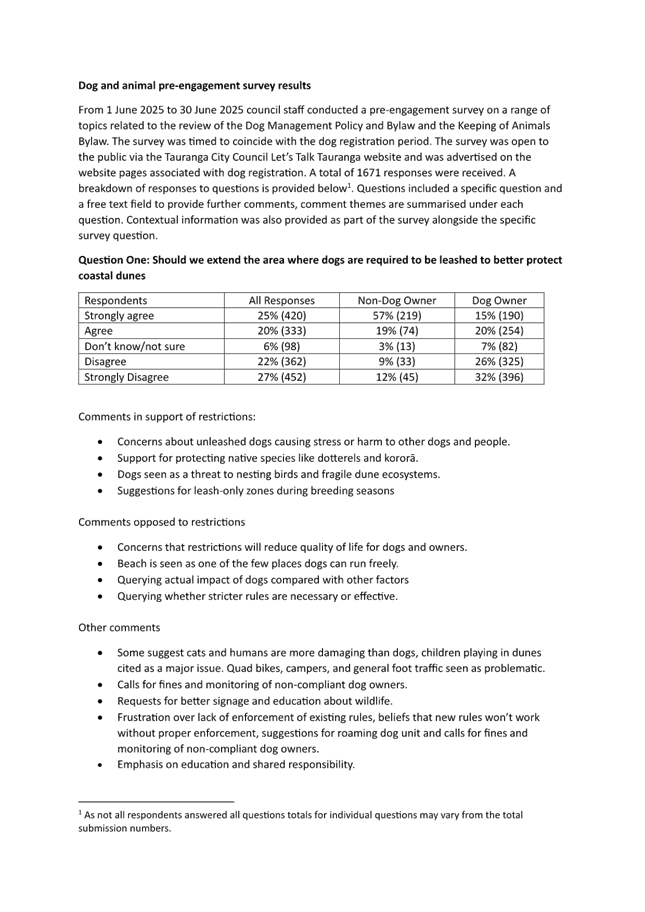
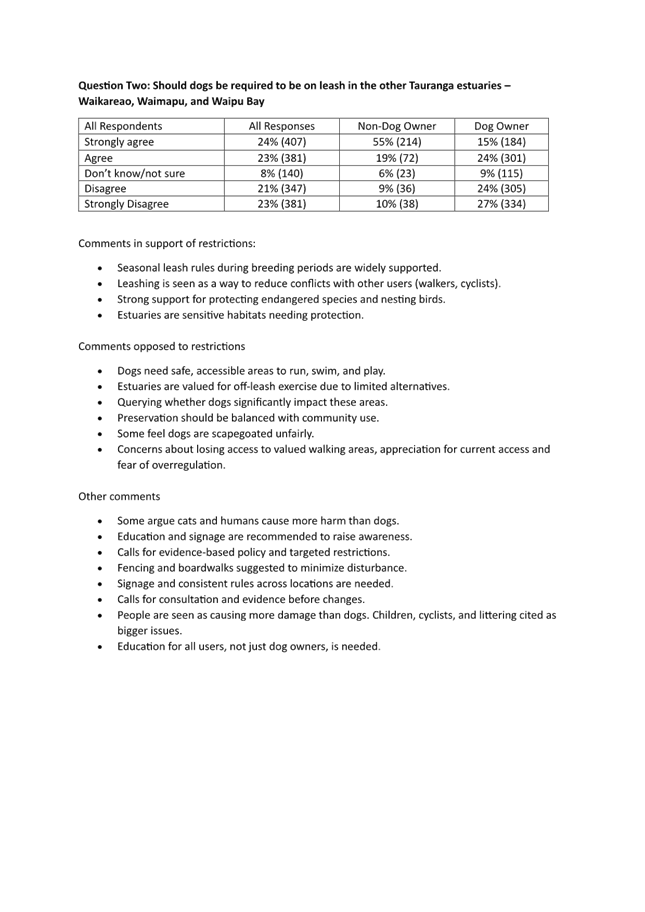
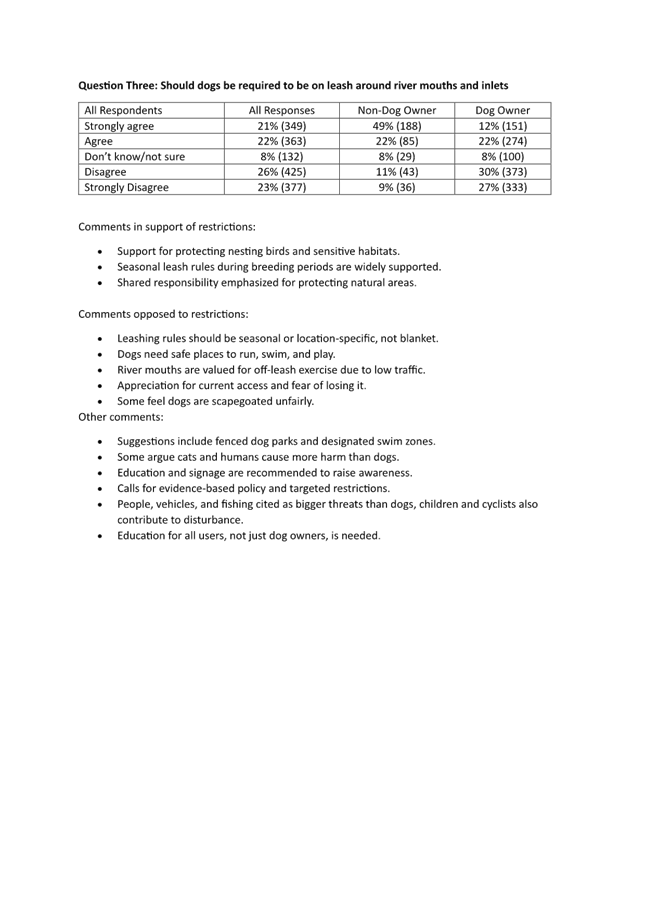
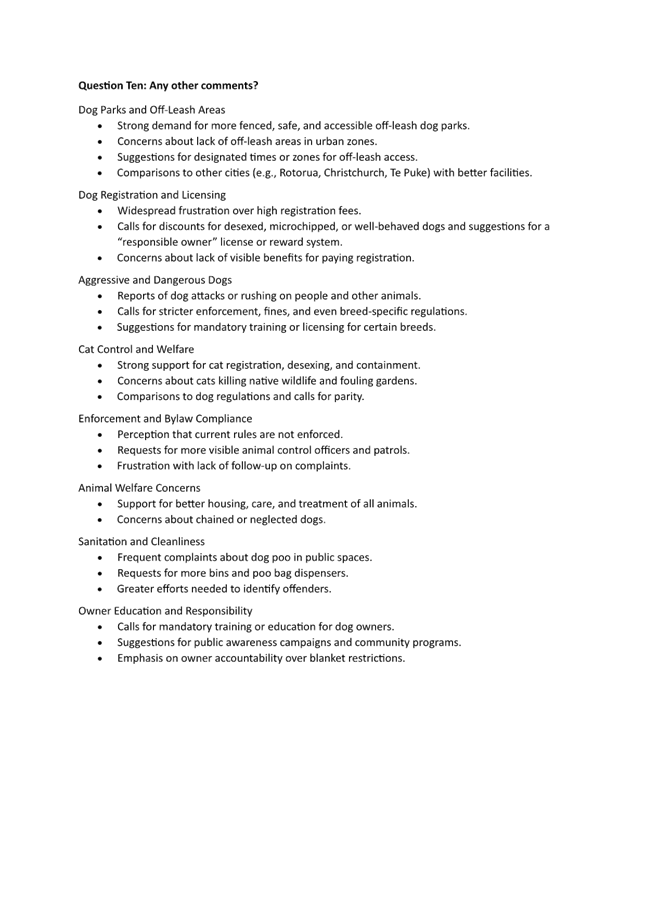
a pre-engagement survey was conducted from 1 June - 30 June 2025, gathering
community views on a range of topics. A summary of responses is provided in
Attachment 1.
10. In 2025 there is around 1 dog for every 10 people in Tauranga. There
are several sources of information on dog related incidents (for example
Tauranga City Council tracking, ACC information, DOC reported incidents and,
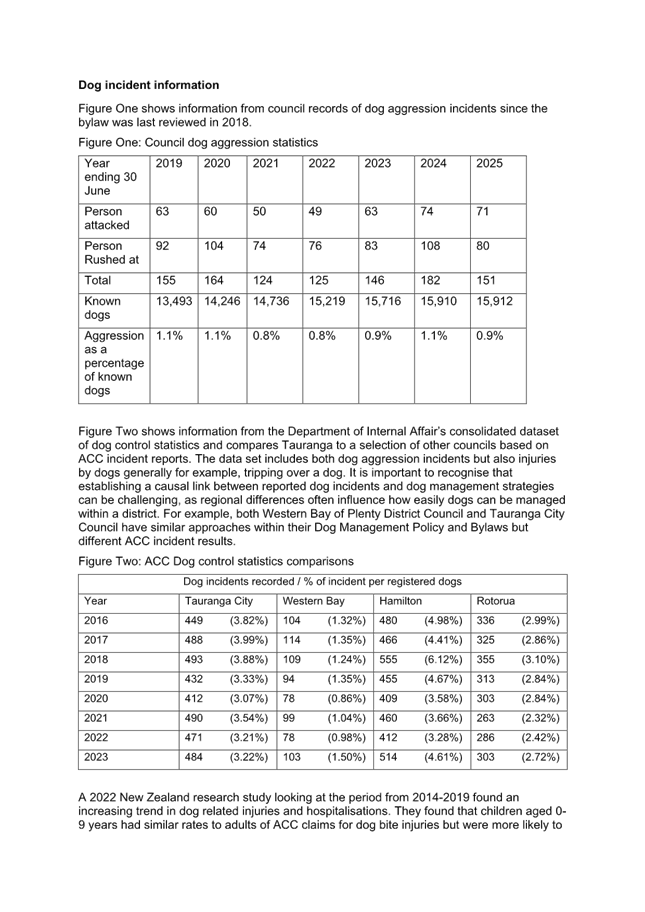
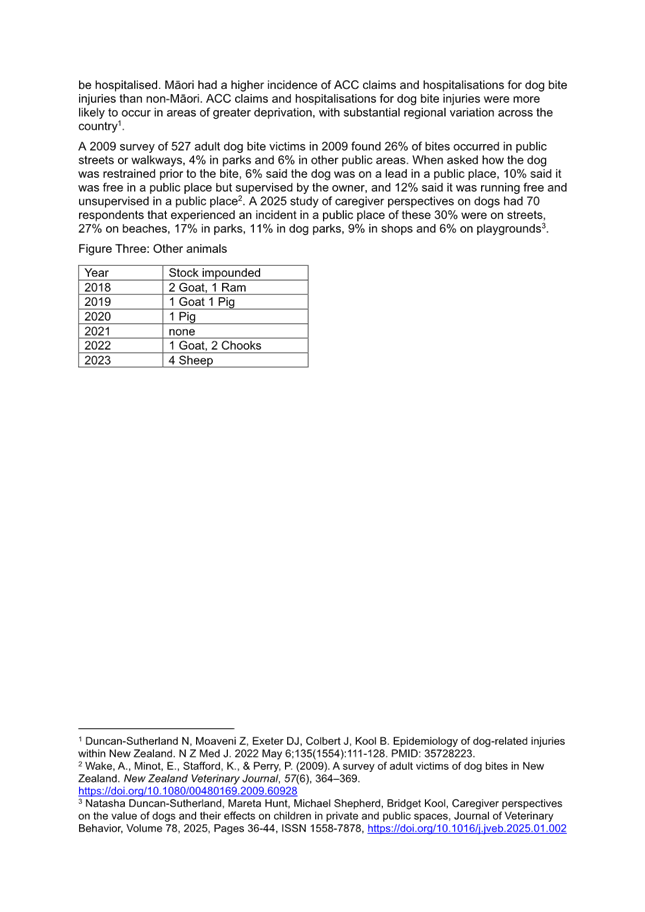
research reports). A summary of information on dog incidents is provided in Attachment
2. Key insights include:
· Wildlife incidents noted by DOC, WBWT and Forest and Bird over the
term of the bylaw include fatal dog attacks on a juvenile fur seal and a
penguin, and evidence of cats killing diving petrel and rock pigeon.
· Tauranga City Council records show the annual number of people
attacked by dogs has slightly increased over the period of the bylaw (63
– 71) however when compared with the number of dogs the proportion has
remained relatively static. The rate of people rushed at has declined (92
– 80). There was an outlier in rushing incidents in the 2024 year, with a
significant increase in dog rushing complaints made to Tauranga City Council
(108) which has now stabilised in 2025.
· ACC dog related incidents and Tauranga City Council records of dog
incidents have increased over the term of the bylaw, however when compared with
the number of dogs the proportion has remained relatively static. It is
important to note that this data includes aggression related incidents but also
incidental dog injuries for example, tripping over a dog. Tauranga has a
relatively high number of ACC incidents (3.22% in 2023) relative to registered
dogs when compared to the national average of territorial authorities (2.37% in
2023) however as noted earlier this includes non-aggression related injuries.
· Dog related incidents occur in both public and private settings. One
research study found around 64% of dog bite incidents happened in private
settings and 36% of dog bites happened in public settings[3]. Public
places highlighted as most likely to have a dog-related incident for adults
were public streets or walkways. Another source noted streets, beaches and
parks as also having a high level of dog related incidents for children[4].
· Research on dog bites in public places found the majority occurred
when a dog was off leash prior to the incident, with a smaller portion still
occurring while a dog was on leash.
11. Issues involving animals other than dogs are relatively rare (1-2
per year) and generally involve animals escaping, likely reflecting the
primarily urban character of Tauranga. A summary of these incidents is provided
in Attachment 2.
Statutory Context
12. The Dog Management Bylaw is made under the Dog Control Act 1996 and
Local Government Act 2002. Offences under the Bylaw can result in infringement
fines or prosecution. Section 20 of the Dog Control Act sets out the purposes
for which a council may make a bylaw, which includes setting rules for dogs in
public places, setting standards for animal welfare, limiting the number of
dogs, confining dogs, impounding and desexing dogs in certain circumstances.
13. The Dog Management Policy is required under the Dog Control Act 1996
and compliments the Dog Management Bylaw. There are certain features required
in a Dog Management Policy that are outlined in Section 10 of the Dog Control
Act 1996. When adopting a Dog Management Policy, the Council must have regard
to:
· the need to minimise danger, distress, and nuisance to the community
generally; and
· the need to avoid the inherent danger in allowing dogs to have
uncontrolled access to public places that are frequented by children, whether
or not the children are accompanied by adults; and
· the importance of enabling, to the extent that is practicable, the
public (including families) to use streets and public amenities without fear of
attack or intimidation by dogs; and
· the exercise and recreational needs of dogs and their owners.
14. The Keeping of Animals Bylaw is made under the Local Government Act
2002 which does not permit infringement fines, prosecution is the only recourse
to offences under this bylaw.
15. Note that any prohibition of dogs in public places do not apply to
disability assist dogs as defined within section 2 and Schedule 5 of the Dog
Control Act 1996.
STRATEGIC ALIGNMENT
16. This
contributes to the promotion or achievement of the following strategic
community outcome(s):
|
Contributes
|
|
We are an inclusive city
|
ü
|
|
We value, protect and enhance the
environment
|
ü
|
|
We are a well-planned city
|
ü
|
|
We can move around our city easily
|
☐
|
|
We are a city that supports
business and education
|
☐
|
17. Effective dog and animal management ensures that dogs and animals do
not cause distress or nuisance to the community (particularly children),
wildlife and the environment.
18. Action 23 in the Nature and Biodiversity Action and Investment Plan
is to update the Dog Management Bylaw for Tauranga City to review existing, and
include additional, dog prohibited areas in order to protect threatened
species. The Tauranga Reserves Management Plan management statements for the
Kōpūrererua Valley notes to “consider excluding dogs from
significant habitat value areas in the valley”.
Options Analysis
Issue 1: Overall approach to dog
management in public places
19. The current Dog Management Policy sets out the general approach that
dogs can be exercised unleashed in public places so long as, when circumstances
require, the dog can be leashed. There are exclusions to this which include:
· streets and footpaths (leashed)
· Pilot Bay, Mauao, Mount Maunganui (main) beach, Moturiki, and
Ōtūmoetai Pa Reserve (prohibited)
· on or 10m around play or exercise equipment (prohibited)
· specific coastal dunes areas (leashed)
· near surf life-saving clubs and flagged lifeguard areas (prohibited).
· temporary restrictions for events or protecting wildlife (leashed or
prohibited).
1.
20. This approach
is intended to maximise opportunities for dogs and their owners to socialise
and exercise, while minimising any potential danger, distress, or nuisance
from, or caused by, dogs. This approach also allows flexible use of available
open space, which is particularly useful in areas of the city with gaps in open
space provision (for example, Te Papa South) and to take advantage of multiple
uses of open space (for example, grass sports fields, stormwater reserves,
coastal reserves).
21. The current
approach to enforcing restrictions on dogs in public places relies on most
residents adhering to the rules. Enforcement of breaches of the bylaw are
targeted to reported incidents and through occasional proactive patrols.
Infringement fines can be issued for those not adhering to rules, however
resourcing constraints limit the level of active enforcement possible. Feedback
through the pre-engagement survey noted that enforcement was a key concern,
particularly for non-dog owners. This feedback was echoed by DOC, Forest and
Bird, and the WBWT who noted that active education and enforcement would help
support wildlife protection.
22. Currently,
Animal Services resources aimed at dog management are primarily funded through
user fees and charges (approximately 90%), with a small contribution from
general rates (approximately 10%)[5].
At present animal services use a modern regulatory approach to compliance
focussing on responding to highest risk areas and leveraging community
partners, education and outreach to influence wider behaviour. Survey responses
suggest that compliance measures are important to non-dog owners and dog owners
alike. Greater education and enforcement is also important to support
environmental outcomes outlined in paragraphs 25 to 30. At present the
resourcing of dog related education and enforcement is restricted by the
difficulties in raising additional fee revenue to cover the cost. Reviewing
Tauranga City Council’s Funding Needs Assessment to consider the
appropriate balance of user fee revenue to rates revenue for the activities may
allow for additional resourcing for education and enforcement to be further
considered[6].
23. The animal
services team also provides education and awareness raising events throughout
the year to help encourage responsible dog ownership and reduce dog related
incidents. In the 2024/25 year Tauranga City Council delivered bite prevention
education to 260 students across four schools. Through community grant funding
Tauranga City Council funds the SPCA to provide desexing vouchers to those in
hardship. Twelve dogs were desexed between October 2024 and March 2025. This
included several situations where an applicant was living with a dog in a
vehicle.
24. In the
workshop on user fees and charges on 9 October 2025 the Council asked for
further advice on a responsible dog ownership scheme. Depending on the design
of such a scheme this may help address dog management issues. Although there is
little evidence of the effectiveness of such schemes, desexing dogs has been
linked to lower aggression and roaming behaviour. Both the SPCA and the NZ
Veterinary Society support a responsible dog ownership scheme. The existing
bylaw and policy drafting would enable Council to introduce a responsible dog
ownership scheme.
Table One: General approach to dog
management
|
Options
|
Advantages
|
Disadvantages
|
|
Option
A: Retain existing approach to dog management in
public places
|
· Avoids additional costs and resources required to change approach
(e.g. signage, communication campaigns).
· Community is aware of the existing rules.
· Uses education programmes and targeted funding to help reduce dog
related incidents.
· Maximises opportunities for dogs and their owners to socialise
and exercise off leash.
· Continues to provide some dog free spaces to the community
(Mount, Main Beach, Pilot Bay etc) and parts of spaces (e.g. play spaces).
|
· Research suggests public dog related incidents were with off
leash and unsupervised dogs so default off-leash approach may be
contributing to incidents.
|
|
Option
B: Consider classifying dog access rules to
every open space as permitted, leash control or prohibited
|
· May give more certainty to open space users as to whether dogs
will be present in open space and/or leashed.
· Research suggests public dog related incidents were with off
leash and unsupervised dogs so reducing off-leash opportunities may reduce
incidents.
· May reduce conflicts between dogs and other users.
|
· Is a significant change in approach and requires planning to
identify permitted, leash and prohibited areas and significant
communications to the community.
· Likely to limit opportunities for dogs and their owners to
socialise and exercise off leash (which is important to manage dog behaviour
and support activity goals).
· May still have issues where people do not follow the rules.
|
|
Option
C: Retain existing approach to dog management in
public places but review the resourcing of education and enforcement through
the LTP
(recommended)
|
· Opportunity to reconsider the Funding Needs Assessment given the
survey results suggesting dog management is important to non-dog owners and
dog owners alike.
· Greater funding for enforcement could result in better awareness
and compliance with existing rules and support overall compliance through
perceptions of enforcement.
· Would support any changes to further educate or enforce
restrictions put in place for wildlife.
· Supported by DOC.
|
· Greater enforcement may not fully address conflicts with other
users as enforcement is still unlikely to be present at all times.
|
Issue 2: Special Ecological Areas
25. A Special Ecological Area (SEA), is a protected geographic area
identified in the City Plan for its significant ecological value, such as
indigenous vegetation, fauna habitats, and biodiversity. SEAs may be on private
or public land. Several SEAs within Tauranga intercept public land and open
spaces where dogs can be exercised.
26. Currently a
range of non-regulatory approaches are being used to enhance and protect
wildlife values in Special Ecological Areas. These include:
· providing information that raises awareness of the value of these
areas
· pest control, including smart traps that target feral cats
· community funding grants to the SPCA to implement desexing vouchers
to low-income households (from October 2024 to March 2025 12 dogs and 41 cats
were neutered)
· temporary restrictions under the bylaw during breeding seasons.
27. The current temporary restrictions are used to prohibit dogs in
Shark Alley[7]
during the dotterel breeding season (1 August - 31 January). Both DOC and WBWT
have indicated that the current seasonal restrictions are not effective in
changing dog owner behaviour and given that wildlife such as seals and penguins
are present year-round, would like to see permanent restrictions in this area
and a buffer area around the location. They would like this to be supported by
signage and enforcement and an alternative additional accessibility pathway
further along Marine Parade.
28. In the Nature and Biodiversity Action Plan, Action 23 is to update
the Dog Management Bylaw for Tauranga City to review existing, and include
additional, dog prohibited areas in order to protect threatened species.
Legislation already exists that prohibits the killing, injury, pursuing or
disturbing of wildlife by dogs, however the presence of dogs in an area can
also impact wildlife. When dogs chase birds, this can impact birds’
energy reserves and ability to feed and can detrimentally impact nesting success.
Even the presence of dogs (without direct interference) has been shown to
impact feeding rates of coastal/estuary birds due to the need to maintain
surveillance which can have implications for weight gain and therefore
successful migration[8].
The issue of cats and their impact on wildlife is discussed separately in
paragraph 37-39.
29. Complicating the protection of SEAs from dogs, is that many are
existing popular dog walking locations. These areas are often substantial
walkways that offer a natural setting and therefore are sought out by residents
for their wellbeing benefits. Some also provide water access areas for dogs to
cool off. This includes areas such as the Waikareao Estuary, the
Kōpūrererua Valley, Matua Salt Marsh, the Waimapu Estuary among
others. Spaces were assessed against criteria as outlined in Attachment 3, with
priority areas for change outlined in Option 2 in the table below.
30. WBWT, Forest and Bird, SPCA and commentary from the public survey
advocated for creating alternative dog exercise areas to balance areas where
dogs are prohibited. Given the permissive nature of our current bylaw council
staff do not consider there is a need for alternative dog exercise areas. In
Tauranga, almost all parks and reserves welcome dogs (for example Miles Lane,
Greerton Park, and Bayfair Reserve are commonly known as areas popular for
exercising dogs). Public requests for fenced dog parks are also common. At TECT
Park (located in Western Bay of Plenty but part-funded by Tauranga City
Council) there is a 1-hectare dog exercise area available for residents to
exercise their dogs in a fenced location. Council staff have previously
investigated the possibility of creating designated dog exercise areas within
the city boundaries. However, this has been unsuccessful due to difficulties
identifying a suitable location that was of a sufficient size and would not
result in a neighbourhood losing the amenity of their local reserve[9].
Table
Two: Special Ecological Areas
|
Options
|
Advantages
|
Disadvantages
|
|
Option
A: do not make changes to dog restrictions in
public places containing or adjacent to SEAs but use an education approach in
tandem with community partners to encourage behaviour change in these spaces.
|
· Able to share a wider ecological message on the importance of
SEAs.
· Less confrontational than enforcement messaging.
· People may be more willing to change behaviour when those in their
community champion this.
· Covers all actions that may be impacting the birds e.g. cats and
human behaviour.
· Retains options for dogs to cool off in warm weather.
|
· People may still choose not to comply.
· Not linked to enforcement.
|
|
Option
B: Make targeted changes to dog restrictions at
those public places containing or adjacent to SEAs identified as high
priority (coastal dunes, Shark Alley).
(recommended)
|
· Protects wildlife and habitats from direct disturbance by dogs in
key habitat areas.
· Retains options to exercise and socialise dogs nearby
· Supported by the SPCA.
· Changes are linked to spaces that are already monitored.
· Retains options for dogs to cool off in warm weather.
· Recognises that council staff have put in a temporary seasonal
restriction at Shark Alley for several years during dotterel breeding
seasons.
|
· Does not address all SEAs where dogs may be impacting wildlife.
· Shark Alley having year round restrictions may impact dog owners
who need to use the accessibility beach mats.
· May require additional resourcing as council
staff will need to patrol additional areas and outside current core work
hours.
· Other avenues to reduce impact on wildlife (cats, pests) are not
addressed.
|
|
Option
C: Consider changes to dog restrictions at all
public places containing or adjacent to Special Ecological Areas. This could
include:
· Leash restrictions
· Restricting dogs to formed paths
|
· Protects wildlife and habitats from direct disturbance by dogs in
all SEAs
· Provides enforcement options for those not following the rules.
· Supported by WBWT.
|
· Likely to significantly reduce off leash options to socialise and
exercise dogs.
· Would require additional resource to monitor additional areas and outside current core work hours.
· Reduces options for dogs to cool off in warm weather.
· Would need further work to consider Waikareao Estuary approach due
to legal issues (para 42-43)
|
Issue 3: Community Spaces
Urban City Centre spaces
31. With the development of urban spaces in the city such as Masonic
Park, the waterfront and Red Square these spaces are now being used in a
different way to previously. Dogs are not required to be on leash in these
spaces as they are not footpaths or streets. Given the small scale of these
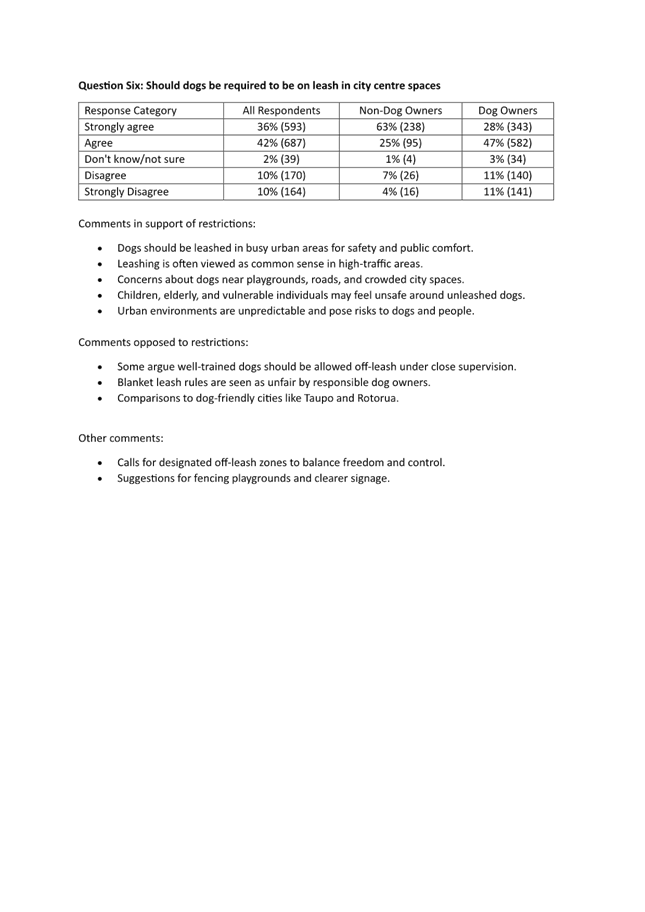
spaces and the adjacent transport corridors off leash dogs may not be
appropriate in these areas. The pre-engagement survey showed 88% of non-dog
owners and 75% of dog owners agreed that dogs should be required to be on leash
in city centre spaces. Current rules requiring dogs to be at least 10 metres
from play equipment would apply to the waterfront playground area.
Table
Three: City Centre Spaces
|
Options
|
Advantages
|
Disadvantages
|
|
Option
A: City centre spaces remain off leash
|
· Dogs are able to remain off leash in city centre.
· Access to the water remains for dogs to cool off.
· The playground area and 10m buffer provide a dog free option.
|
· City Centre users may not feel comfortable around off leash dogs.
· Does not reflect community preferences.
· May not be appropriate for dogs to be off leash in urban spaces
given surrounding environment (transport corridors).
|
|
Option
B: Require dogs to be on leash in urban city
centre spaces, including Red Square, Masonic Park, and the waterfront
(recommended)
|
· Reflect community preferences.
· May be more appropriate for dogs to be on leash in urban spaces
given surrounding environment (transport corridors).
|
· Access to the water for dogs to cool off in the city would be
limited.
· Reduces off-leash options within the City Centre.
|
|
Option
C: Require dogs to be on leash in urban
city centre spaces, including Red Square, Masonic Park, but excluding the
waterfront
|
· Reflect community preferences.
· May be more appropriate for dogs to be on leash in urban spaces
given surrounding environment (transport corridors).
· Access to the water remains for dogs to cool off and retains an
off-leash option.
· Supported by SPCA.
|
· City Centre users may not feel comfortable around off leash dogs
on the waterfront. Noting that the playground area and 10m buffer provide a
dog free option.
|
Shared
paths
32. Based on transport definitions, a shared path means a path that may
be used by some or all of the following persons at the same time: pedestrians,
cyclists, riders of mobility devices and riders of wheeled recreational
devices. The current definition of footpath in the Bylaw (requiring dogs to be
on leash) does not apply to shared paths in parks and reserves. Examples
include the Marine Parade Coastal Pathway, the Beach Road walkway (Kulim Park
to Fergusson Park), and the Papamoa shared path. The popularity of shared paths
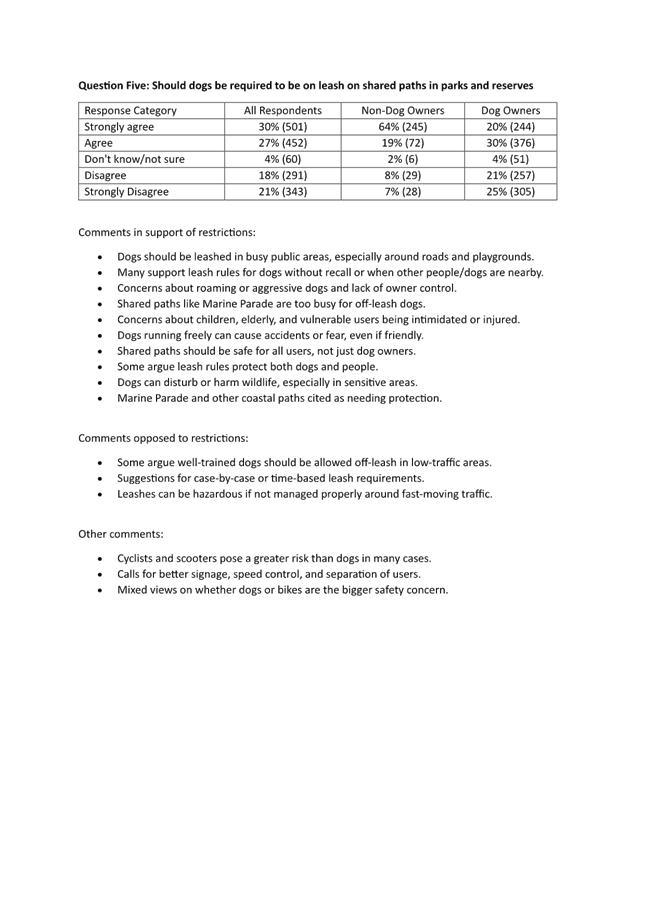
has led to incidences where uncontrolled dogs and other users have come into
conflict. The pre-engagement survey showed 83% of non-dog owners and 50% of dog
owners agreed that dogs should be required to be on leash on shared paths in
parks and reserves.
Table Four: Shared paths
|
Options
|
Advantages
|
Disadvantages
|
|
Option
D: Retain current off-leash status
|
· No restrictions for dogs and allows owners to make case by case
assessment if on or off leash is appropriate for their dogs.
|
· Difficultly managing shared paths conflicts between cyclists,
scooters, mobility device users, and dogs.
· Not supported by non-dog owners, mixed support from dog owners.
|
|
Option
E: Require leashing on all shared paths
|
· Strongly supported by non-dog owners, mixed support from dog
owners.
· Helps to manage shared paths conflicts between cyclists, scooters,
mobility device users, and dogs.
· Consistent approach to all shared paths.
|
· Concerns were raised around leashes causing a hazard in certain
circumstances.
· May restrict area for off-leash exercise for dogs due to a number
of walkways in parks meeting the criteria as a shared path.
|
|
Option
F: Require leashing on selected shared paths
(recommended)
|
· Helps to manage shared paths conflicts between cyclists, scooters,
mobility device users, and dogs on identified paths.
· Can target restrictions to areas with greater evidence of issues.
· Supported by SPCA and DOC.
· More likely to retain off-leash exercise for dogs compared with
option two.
|
· Reduces consistency which may make it harder for people to know
when to leash dogs.
|
Play
spaces and exercise equipment
33. Since the previous review of these bylaws the Play and Active
Recreation Action and Investment Plan has invested in a wider and more diverse
range of play and active recreation features in our parks and reserves. As such
the existing approach of requiring dogs to be 10m from a play space or exercise
equipment does not explicitly cover some active recreation equipment.
34. Tauranga City Council is currently progressing options for fenced
play spaces to support the safety of young children and those with diverse
needs (approximately 2-3 across the city). As part of this planning, it has
been identified that dogs may be a hazard for children in this environment.
Therefore, it is proposed that these parks become dog prohibited spaces. The
planning for these spaces will include consideration of alternative dog
friendly spaces nearby for those that wish to use these with their dogs.
Without restrictions it is possible that these spaces will be used as de-facto
fenced dog parks undermining the purpose of providing a safe space for young
children.
Table
Five: Play spaces and exercise equipment
|
Options
|
Advantages
|
Disadvantages
|
|
Option
G: Retain current rules (10m from play or
exercise equipment)
|
· No changes required.
|
· Ambiguity around what spaces are dog prohibited.
· Does not support accessibility goals to provide fenced play areas
for accessibility purposes.
|
|
Option
H: Clarify the definition of play spaces and
exercise equipment to include active recreation equipment (e.g. skate parks
and basketball courts)
(recommended)
|
· Provides greater clarity about which spaces should be dog
prohibited.
· Removes dogs from active recreation spaces that are likely to be
highly frequented by children reducing the danger to children from dogs.
|
· Restricts spaces, or parts of spaces that dog owners can take
dogs.
|
|
Option
I: Prohibiting dogs from parks that are fenced
for accessibility and inclusion purposes
(recommended)
|
· Removes dogs from spaces targeted to support the needs of young
children and those with accessibility needs therefore reducing the danger to
children from dogs.
· Provides a choice of dog free park space for those that would like
that option.
|
· Restricts spaces, or parts of spaces that dog owners can take
dogs.
· May require additional resources to implement.
|
Cemeteries,
burial grounds and heritage reserves
35. Issues have been raised with cemetery spaces being used as spaces to
exercise dogs regardless of the current cemetery rules requiring permission to
have dogs in cemeteries. There has been evidence of dog fouling in these
spaces. As the Pyes Pā cemetery is located within Western Bay of Plenty
District, we cannot make a Bylaw that includes that area.
36. Heritage reserves contain historical features that should be
protected. Dogs are prohibited from Ōtūmoetai Pa Reserve but are
otherwise permitted in other heritage reserves. There are 13 heritage reserves
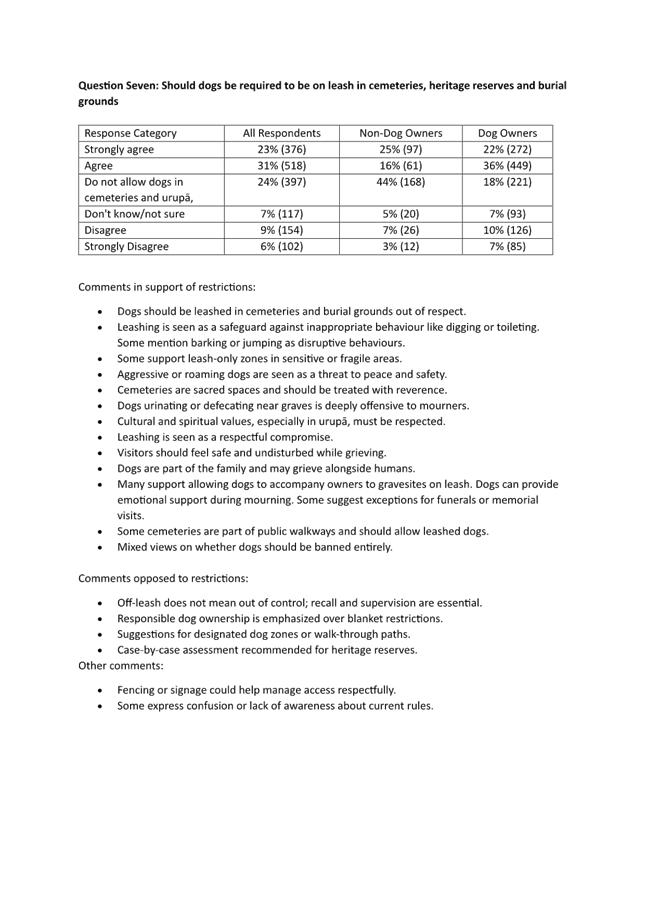
that are not otherwise cemeteries[10].
The pre-engagement survey showed 44% of non-dog owners felt that dogs should
not be allowed in cemeteries, heritage reserves and burial grounds, and 41%
agreed they should be allowed but leashed. Among dog owners 18% felt dogs
should not be allowed, with 58% agreeing that dogs should be allowed but on
leash.
Table
Six: Cemeteries, burial grounds and heritage reserves
|
Options
|
Advantages
|
Disadvantages
|
|
Option
J: Retain current cemetery rules, where dogs are
not allowed without permission, and no standard requirement for heritage
reserves
|
· No change required.
|
· Does not address concerns of impact of dogs fouling in these
spaces.
· Not supported by non-dog owners or dog owners.
· Relies on compliance with cemetery rules.
· Does not address potential damage from dogs in heritage reserves.
|
|
Option
K: Require leashing in all cemeteries,
burial grounds and heritage reserves where dogs are not otherwise prohibited.
|
· Supported by non-dog owners and dog owners.
· Would address impact of dogs fouling in these spaces and potential
damage from dogs in heritage reserves.
|
· Undermines existing cemetery rules.
· Reduces off leash exercise options (particularly in Te Papa South
where there is a gap in open space provision).
|
|
Option
L:
· Prohibit dogs in all cemeteries and burial grounds (unless
permitted by the cemetery manager) and;
· require leashing in heritage reserves where dogs are not otherwise
prohibited
(recommended)
|
· Supports the current cemetery rules.
· Supported by non-dog owners.
· Would address impact of dogs fouling in these spaces and potential
damage from dogs in heritage reserves.
|
· Not supported by dog owners.
· Reduces off leash use of heritage reserves (particularly in Te
Papa South where there is a gap in open space provision).
|
|
Option
M:
· Prohibit dogs in all cemeteries and burial grounds (unless
permitted by the cemetery manager) and prohibit dogs in heritage reserves
|
· Creates consistency across spaces.
· Would address impact of dogs fouling in these spaces and potential
damage from dogs in heritage reserves.
· Supported by non-dog owners.
|
· Not supported by dog owners.
· Reduces use of heritage reserves for the exercise and
socialisation of dogs and owners.
|
Issue
4: Licensing and Registration
Regulating cats
37. Cats are noted as an advisory pest in the Bay of Plenty Regional
Council Pest Management Plan. Areas of particular concern are around Mauao and Moturiki
with evidence of cats killing diving petrel and rock pigeon[11]. Smart traps are
also used in more rural areas to manage pests such as feral cats. The traps are
located to avoid residential dwellings and contain technology which releases
the trap when a microchip is detected.
38. At present there is no national legislation requiring cats to be
desexed and registered and therefore cat provisions are enabled through Local
Government Act 2002 bylaw making powers. These powers do not allow infringement
fines but can be enforced through prosecution where this is in the public
interest. Predator Free analysis in 2024 found 23 councils with cat related
provisions in their bylaws. This included nine requiring microchipping, nine
requiring desexing and 19 setting a maximum limit on the keeping of cats. As
noted in paragraph 23 Tauranga City Council provided community grants to the
SPCA to provide desexing vouchers for low-income households to encourage
desexing.
39. DOC, SPCA and WBWT all support regulating cats, with DOC noting the
impact cats have had on wildlife on Moturiki, wetland areas (particularly those
with boardwalks) and the potential for feral colonies to develop.
Table Seven: Regulating cats
|
Options
|
Advantages
|
Disadvantages
|
|
Option
A:
Create
bylaw provisions, for example, require cats to be registered, microchipped
and neutered.
no
staff recommendation
|
· Sets a position on microchipping, desexing and registration which
may encourage pet owners to comply.
· Helpful to support wider use of traps without accidental injury to
pet cats.
|
· No infringement fees are possible and the test for prosecution
means that any enforcement is unlikely to be possible.
· Additional administrative costs to try and encourage compliance.
· Other initiatives such as desexing vouchers may be more effective.
|
|
Option
B:
Do not
create bylaw provisions and continue to support funding to enable low-income
households to neuter and microchip cats
no
staff recommendation
|
· Initiatives such as desexing vouchers may be more effective.
· Does not create an expectation of enforcement that may not be able
to be met.
· No additional resource required.
|
· Does not set a position on microchipping, desexing and
registration which may encourage pet owners to comply.
· Does not support wider use of traps without accidental injury to
pet cats.
|
Other licensing issues
40. Several other issues have been raised related to licensing related
concerns and an analysis of each issue is provided in Table Eight. A minor
drafting change to clarify the ability to desex repeatedly roaming dogs is also
suggested in response to SPCA feedback.
Table Eight: Other licensing issues
|
Options
|
Advantages
|
Disadvantages
|
|
Option
C
Add a
maximum number of dogs per property (in addition to the current per person
limit)
(recommended)
|
· Allows for a check for property suitability when multiple people
have multiple dogs at a property.
|
· Would require a joint application for a licence for dog owners in
this situation.
|
|
Option
D
Add an
ability for dog walkers with relevant training to request a licence from
Tauranga City Council to walk more than four dogs at a time
no
staff recommendation
|
· Allows for dog walkers to provide for more dogs potentially
reducing costs for the service.
· Reflects feedback from dog walkers.
· Provides an incentive for training to dog walkers.
· Supported by dog owners.
|
· Mixed support from non-dog owners.
· Requires administration to approve dog walkers and licence fee may
be needed.
· Current bylaw limit was introduced to control
irresponsible commercial dog walkers so increasing the number may reintroduce
issues.
|
|
Option
E
Retain
the current limit allowing up to four dogs to be walked at a time
no
staff recommendation
|
· Current bylaw limit was introduced to control
irresponsible commercial dog walkers and since there have been less issues
raised.
· Less administratively burdensome.
· Mixed support from non-dog owners.
|
· Not supported by dog owners.
· Does not reflect feedback from dog walkers.
· Does not provides an incentive for training to dog walkers.
|
|
Option
F
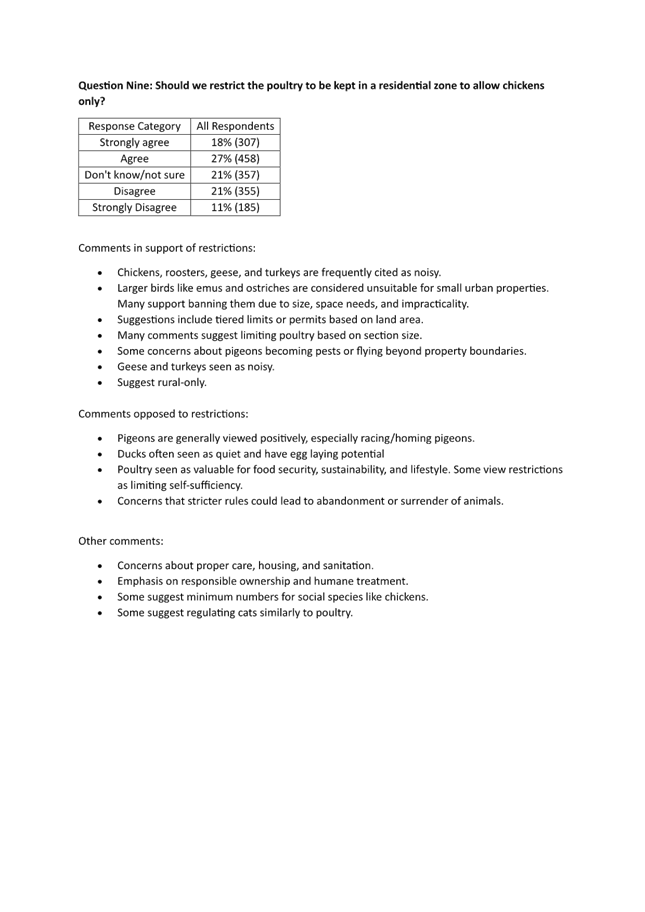
Reduce
the number of poultry that can be kept in the residential zone without a
licence to 6.
(recommended)
|
· Reduces the maximum number of poultry that can be kept without a
licence to reflect the increasing density of urban form.
· Allows more poultry with a licence where this is appropriate.
|
· Increases administration for those with 7-12 heads of poultry and
licence fee may be needed.
|
|
Option
G
Require
a licence to keep poultry other than chickens in the residential zone.
(recommended)
|
· Requires a licence for larger poultry and disruptive poultry
allowing council staff to consider conditions to reduce the possibility of
nuisance.
|
· Currently no evidence of complaints in the residential zone so may
not be an issue.
· Increases administration for those with poultry other than
chickens in the residential zone and licence fee may be needed.
|
|
Option
H
Add a
general requirement for those keeping animals in Tauranga to abide by the
direction of an authorised officer
(recommended)
|
· Provides an ability to respond to nuisance complaints that may not
be anticipated.
· Could support temporary issues (for example, requiring additional
hygiene measures during avian flu outbreaks).
|
· Public may still not comply with directive given the lack of
enforcement options available under the Local Government Act 2002.
|
Financial
Considerations
41. Changes to dog restrictions may involve a reprioritising of
enforcement resource in the short term due to the limited funding options under
the current Revenue and Finance Policy other than increasing dog registration
fees. In the Long-Term Plan a different balance of funding could be considered
through the Funding Needs Assessment which could allow for a larger general
rates contribution. At present the Funding Needs Assessment requires 70-100% of
the animal services activity to be funded through user fees and charges and
0-30% through general rates and/or subsidies and grants. Changes to implement
cat bylaw provisions would involve additional administrative costs and an
assessment of the appropriate enforcement support required.
Legal Implications /
Risks
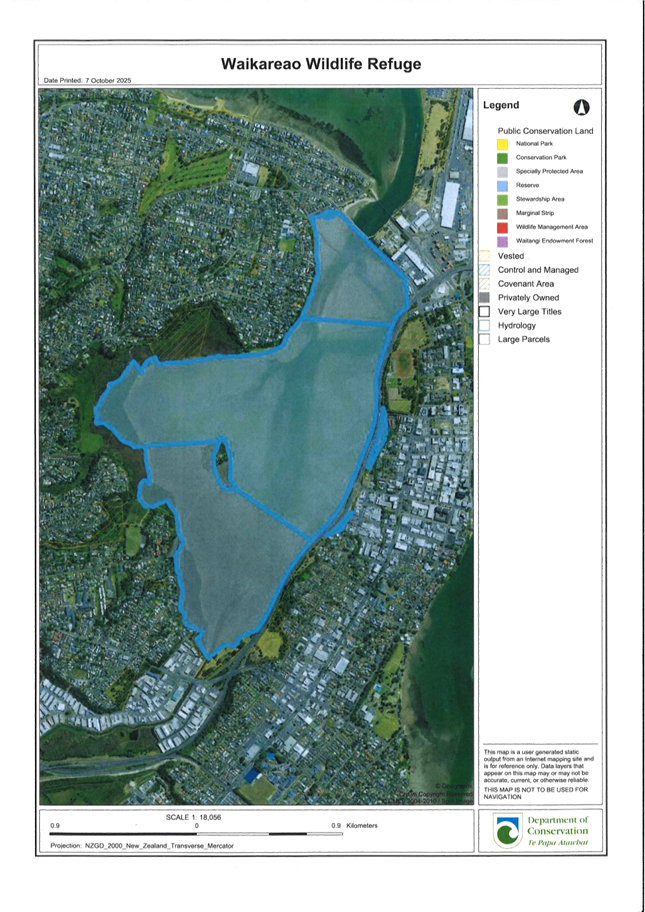
42. The Waikareao Estuary is classified as a Wildlife Refuge under the
Wildlife Act 1953 and as such the bringing of animals into the estuary is
prohibited under the Wildlife Act. The exact area that is covered by the
classification is provided in Attachment 4 and includes areas of the boardwalk
and reserve trails. DOC have noted that at present they are not actively
enforcing the requirement.
43. Given that bylaws cannot conflict with other legislation, should the
Council wish to consider dog regulation in this area further work will be
needed to ascertain the appropriate legislative approach to any regulation.
TE AO MĀORI
APPROACH
44. The Environment Strategy and Nature and Biodiversity Action and
Investment Plan was developed with input from Te Rangapū. The desire to
enhance, protect and restore SEAs is a key part of this strategy.
45. New Zealand research suggests that Māori communities are
disproportionately impacted by dog related incidents as outlined in Attachment
2. The direct causal link for this is not clear, however actions to prevent and
reduce dog related incidents are likely to particularly benefit Māori
communities.
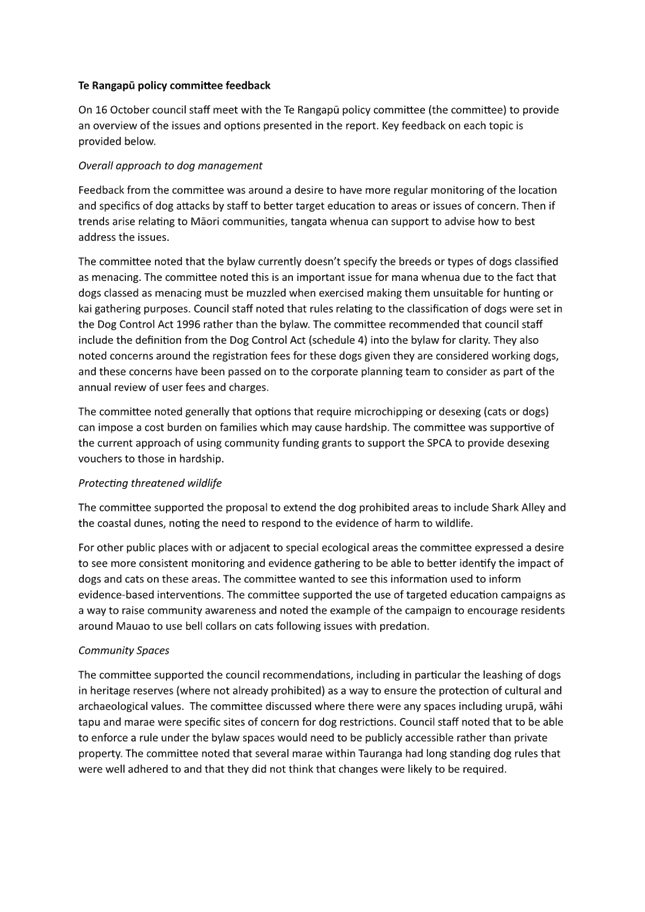
46. Council staff meet with the Te Rangapū policy subcommittee on
16 October 2025 and summary of their feedback is attached in Attachment 5.
CLIMATE IMPACT
47. Actions to reduce the impact of dogs on wildlife in SEAs will
contribute to the goal of enhancing nature and biodiversity.
Significance
48. The Local Government Act 2002 requires an assessment of the significance
of matters, issues, proposals and decisions in this report against
Council’s Significance and Engagement Policy. Council acknowledges
that in some instances a matter, issue, proposal or decision may have a high
degree of importance to individuals, groups, or agencies affected by the
report.
49. In making this assessment, consideration has been given to the
likely impact, and likely consequences for:
(a) the
current and future social, economic, environmental, or
cultural well-being of the district or region
(b) any persons who
are likely to be particularly affected by, or interested in, the issue.
(c) the capacity of
the local authority to perform its role, and the financial and other costs of
doing so.
50. In accordance with the considerations above, criteria and thresholds
in the policy, it is considered that the issue is of high significance.
ENGAGEMENT
51. Noting the above assessment, that the issue is of high significance,
officers are of the opinion that a Special Consultative Procedure is required
under the Dog Control Act 1996, together with notification to all registered
dog owners within the district at the point the draft bylaw is adopted for
community consultation.
52. A pre-engagement survey was undertaken in June to inform this
report. Key stakeholders were also contacted to share their views on the
proposed options within this report and their views have been noted within the
report where relevant. Council staff meet with the Te Rangapū policy
subcommittee on 16 October 2025 and summary of their feedback is attached in
Attachment 5.
Next Steps
53. Following the Council’s direction on the Issues and Options
provided in this report, council staff will prepare the draft bylaws and policy
and draft Statements of Proposals (including the section 155 analysis required
under the Local Government Act 2002) for consideration in early 2026. This
stage will include providing further advice on exact boundaries for areas
subject to change based on the direction provided from this report.
Attachments
1. Public pre-engagement survey
- A19132584 ⇩

2. Research and statistics on
dog related incidents - A19132631 ⇩

3. Assessment of high priority
public places for dog regulations to protect wildlife - A19132759 ⇩
4. Waikareao Wildlife Refuge
Area - A19050091 ⇩

5. Te
Rangapu policy committee feedback - A19132775 ⇩

|
Ordinary
Council meeting Agenda
|
29
October 2025
|
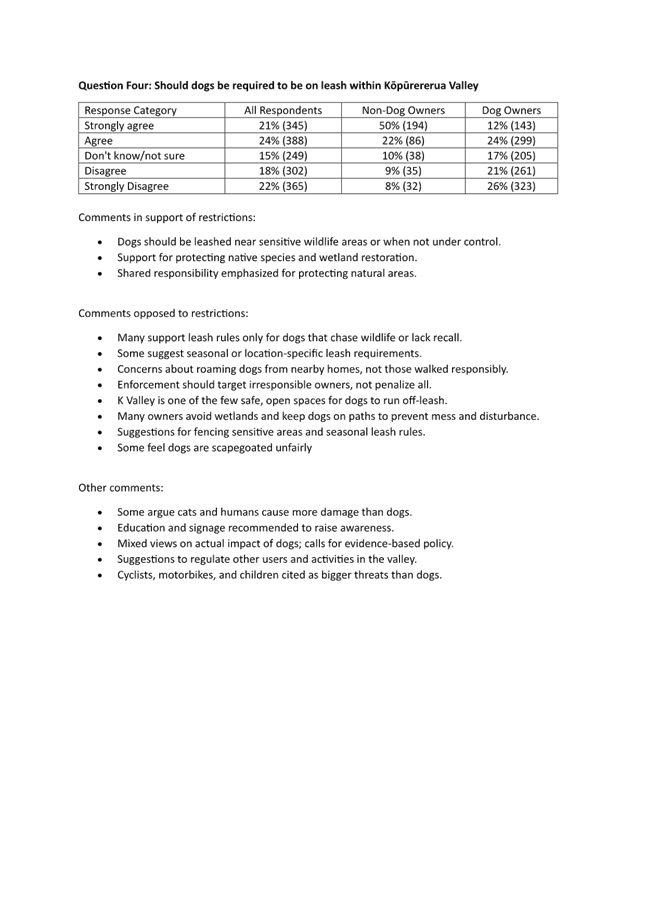
|
Ordinary
Council meeting Agenda
|
29
October 2025
|
|
Ordinary
Council meeting Agenda
|
29
October 2025
|
|
Ordinary
Council meeting Agenda
|
29
October 2025
|
|
Ordinary
Council meeting Agenda
|
29
October 2025
|

|
Ordinary
Council meeting Agenda
|
29
October 2025
|
11.3 Adoption
of 2024/25 Annual Report
File Number: A18769779
Author: Sheree Covell, Manager: Treasury & Financial Processes
Rachel
Burt, Corporate Planner
Authoriser: Kathryn Sharplin, Acting COFO - Finance & Digital
Purpose of the Report
1. The
purpose of this report is to adopt the 2024/25 Tauranga City Council Annual
Report.
|
Recommendations
That
the Council:
(a) Receives the
report titled "Adoption of 2024/25 Annual Report".
(b) Receives the
Audit NZ report on Tauranga City Council’s 2024/25 Annual Report.
(c) Adopts the
audited Tauranga City Council 2024/25 Annual Report, as required under the
provisions of the Local Government Act 2002.
(d) Authorises
the Chief Executive to make any necessary minor changes to numerical, wording
or layout to the 2024/25 Annual Report before final publication.
(e) Receives the
audited 2024/25 Annual Report Summary, which uses approved content only and
notes that no new content may be introduced in the Summary that is not
already included in the full Annual Report.
(f) Receives
the 2024/25 Annual Report highlights, which summarises key achievements from
the year.
|
Executive Summary
2. The
2024/25 Annual Report is presented for adoption by Council.
3. Audit
NZ is currently auditing the Annual Report and will present its opinion at this
meeting after which it is recommended that Council
adopt the audited Annual Report.
4. The
final Annual Report and summaries will be tabled at the meeting due to awaiting
verbal clearance from Audit NZ.
5. Feedback
from the Councillors and discussions with Audit NZ have shaped the final
version of the attached document. This report aims to be transparent,
consistent, and easy to read for the community.
6. The
non-financial performance results for the 2024/25 year are:
|
Key Performance Measures
|
Achieved
|
Not Achieved
|
Not Measured
|
|
82
total measures
|
63
|
16
|
3
|
7. The
key financial metrics for the 2024/25 financial year are as follows:
|
Key Financial Metric
|
2025 Budget (LTP)
|
2025 Actual
|
Variance to Budget
|
|
Debt Summary
|
|
|
|
|
Capital
programme ($m)
|
431
|
329
|
(102)
|
|
Operational
expenditure of a capital nature ($m)
|
78
|
86
|
8
|
|
Net
debt ($m)
|
1,450
|
1,312
|
(138)
|
|
Debt
to revenue ratio (Financial Strategy)
|
277%
|
246%
|
(31%)
|
|
Debt
to revenue ratio (LGFA compliance)
|
234%
|
224%
|
(10%)
|
|
Financial
limit on borrowing (debt to revenue ratio - bespoke)
|
330%
|
330%
|
0%
|
|
Operational Summary
|
|
|
|
|
Total
revenue including all asset development revenue
|
652
|
579
|
(73)
|
|
Capital subsidies
|
120
|
71
|
(49)
|
|
Total
operating revenue
|
470
|
474
|
4
|
|
Total
operating expenditure
|
573
|
584
|
11
|
|
Balanced
budget – LGFA & Financial Prudence requirement ($) 1
|
16
|
(39)
|
(56)
|
|
Balanced
budget – LGFA & Financial Prudence requirement (%)
|
103%
|
93%
|
(10%)
|
1 the balanced budget less than 100%
due to non-funded depreciation, capitalised DC interest, and loan funded
expenditure per page 74 of section 2 of Annual Report.
Background
8. The 2024/25 Annual Report is being presented to Council for formal
adoption.
9. The
draft Annual Report was first shared with the City Delivery Committee on 22
July 2025. A workshop was held on 7 August 2025 to gather feedback. The full
draft document was then presented to the Committee on 2 September 2025.
Feedback from both sessions was incorporated into the version circulated to the
mayor and councillors on 3 October.
10. Audit New
Zealand will complete its audit before adoption. The Audit Director will
present the audit opinion at this meeting.
11. Following the
presentation of the audit opinion, Council will be asked to adopt the audited
Annual Report. The final version will be made publicly available.
12. A draft
Summary Annual Report will also be provided. This includes financial highlights
and extracts from the front sections of the full report. The Summary will be
audited and published within one month of adoption. No new content may be
introduced in the Summary that is not already included in the full Annual
Report.
13. Councillors
requested that a one-page highlights document be developed to present key
information from the Annual Report in a clear and accessible format for the
community. A draft version of this summary will be provided for review.
Statutory Context
14. The Annual
Report is prepared each year in accordance with generally accepted accounting
practise in New Zealand and compliant with the requirements in section 98 of
the Local Government Act 2002. The Annual Report is required by section
98 of the Local Government Act 2002 to be completed, and the audited Annual
Report adopted by Council within four months of the end of financial year.
15. Council is
also required make publicly available within one month of the adoption of the
Annual Report, both the report and summary prepared under section 98(4)(b).
STRATEGIC ALIGNMENT
16. This
contributes to the promotion or achievement of the following strategic
community outcome(s):
|
Contributes
|
|
We are an inclusive city
|
ü
|
|
We value, protect and enhance the environment
|
ü
|
|
We are a well-planned city
|
ü
|
|
We can move around our city easily
|
ü
|
|
We are a city that supports
business and education
|
ü
|
While adoption of the Annual Report itself does not directly
contribute to the outcomes, the document does describe how Council contributes
to achieving the strategic community outcomes. All outcomes are covered
in this respect.
Options Analysis
17. There are no
options presented in this report.
Financial
Considerations
18. The Annual
Report provides a report to the community of Council’s performance
against the proposed services and capital investment set out in the Annual Plan
and the 2024-34 Long-term Plan.
Legal Implications /
Risks
19. Local
Government Act 2002 requires the Annual Report to be adopted within four months
of balance date. Council’s that do not adopt an Annual Report
within the legislative timeframe are required to make a disclosure in that
Annual Report as to why the timeframe was not met and this will be published in
the Office of Auditor General’s report for non-compliance.
TE AO MĀORI
APPROACH
20. The Annual Report presents information under the heading
“partnership with Tangata Whenua.” and refers to elements
reflecting Council’s approach to Te Ao Māori. However, the
information covered by this report is not directly impacted by that
approach.
CLIMATE IMPACT
21. Similarly, the information under the heading “sustainability
approach - Te Ahunga Toitū” will refer to but is not directly
impacted by Council’s approach to climate impact. Again, the information
covered by this report is not directly impacted by that approach.
Consultation /
Engagement
22. The Annual
Report will be made publicly available after adoption. The 2024-34
Long-term Plan which the years results are measured against was consulted on
before being adopted. There is no consultation on the Annual Report
itself
Significance
23. The Local
Government Act 2002 requires an assessment of the significance of matters,
issues, proposals and decisions in this report against Council’s
Significance and Engagement Policy. Council acknowledges that in some
instances a matter, issue, proposal or decision may have a high degree of
importance to individuals, groups, or agencies affected by the report.
24. In making this
assessment, consideration has been given to the likely impact, and likely
consequences for:
(a) the
current and future social, economic, environmental, or
cultural well-being of the district or region
(b) any persons who
are likely to be particularly affected by, or interested in, the .
(c) the capacity of
the local authority to perform its role, and the financial and other costs of
doing so.
25. In accordance
with the considerations above, criteria and thresholds in the policy, it is
considered that the matter is of medium significance.
ENGAGEMENT
26. Taking into
consideration the above assessment, that the matter is of medium significance,
officers are of the opinion that no further engagement is required prior to
Council making a decision.
Next Steps
27. The adopted report will be loaded to the
Tauranga City Council website and copies of the Annual Report Summary will be
distributed.
Attachments
Nil
|
Ordinary
Council meeting Agenda
|
29
October 2025
|
11.4 Street
Use and Public Places Bylaw Review - draft bylaw
File
Number: A18456942
Author: Jane Barnett, Policy Analyst
Shawn Geard, Manager: Transport System
Operations
Authoriser: Sarah Omundsen, General Manager: Regulatory and Community Services
Purpose of the
Report
1. To seek Council’s approval to
consult on the proposed draft amended Street Use and Public Places Bylaw.
|
Recommendations
That the Council:
(a) Receives the
report "Street Use and Public Places Bylaw Review - draft bylaw".
(b) Adopts the
draft Street Use and Public Places Bylaw (Attachment 1 of this report) and
Statement of Proposal (Attachment 2 of this report) for community
consultation.
(c) Resolves, in
accordance with section 155 of the Local Government Act 2002, that the Street
Use and Public Places Bylaw (Attachment 3 of this report):
(i) is the
most appropriate way to help protect the community from public nuisance and
offensive behaviour, protect public health and safety, and protect
council-controlled public places and the environment from misuse
(ii) is the most
appropriate form of the bylaw
(iii) is not
inconsistent with the New Zealand Bill of Rights Act 1990, noting that any
implications are considered reasonable and demonstrably justifiable in a free
and democratic society as they are necessary to protect public safety,
amenity and the rights or others using public places.
(d) Authorises
the General Manager: Regulatory and Community Services to make any necessary
minor drafting or presentation changes to the draft Street Use and Public
Places bylaw, statement of proposal and related consultation material before
consultation.
|
Executive Summary
2. The
Street Use and Public Places Bylaw 2018 (bylaw) sets the rules for public
spaces in Tauranga to ensure public safety, accessibility and enjoyment for the
community. It covers a wide range of activities including signage, trading,
street dining, skating and scooter use, and busking.
3. On
24 March 2025, Council directed staff to review the bylaw. During the initial
stages of the review issues relating to the pedestrian way, definition of a
mobile shop, use of the footpath outside businesses and real estate signs were
identified. On 7 October 2025 Council gave direction on these issues and this
direction has been incorporated into a proposed draft bylaw.
4. The
draft bylaw also includes structural changes, clarification of language,
refined and new definitions, and the addition of explanatory notes to help make
the bylaw easier to understand.
5. Council
is asked to adopt the draft bylaw (Attachment 1) and accompanying
statement of proposal (Attachment 2) for community consultation to be
carried out in November/December 2025.
6. Council
is required
to confirm that a bylaw is the most appropriate way to manage issues like
public nuisance, offensive behaviour, health and safety risks, and the misuse
of community assets. Council must also confirm that the bylaw is in the right
form and consistent with the New Zealand Bill of Rights 1990. Attachment 3
sets out these considerations.
7. If
Council adopts the draft bylaw, it will go out for community feedback through
the special consultative procedure as required under the LGA and Land Transport
Act 1998.
8. Targeted
consultation will also be carried out with stakeholders including the Police,
main street organisations, current licence to occupy and mobile shop holders, local real estate companies, Hospitality New Zealand, Tauranga
Māori Business Association (TMBA), Toi Kai Rawa, Tauranga Business
Chamber, Fire Emergency New Zealand (FENZ) and Ngā
Poutiriao ō Mauao.
9. Community
consultation will seek feedback on proposed changes to the definition of a
mobile shop, the rules around businesses using the footpath, and rules relating
to real estate signs.
Background
10. The Street
Use and Public Places Bylaw 2018 (bylaw) sets the rules for public spaces in
Tauranga to ensure public safety, accessibility and enjoyment for the
community. It covers a wide range of activities including signage, trading,
street dining, skating and scooter use, and busking.
11. On 24 March
2025, Council directed staff to review the bylaw, with a focus on street dining
and broader footpath use. The initial review identified several issues, which
Council considered and provided direction on at their meeting on 7 October
2025. This direction has been incorporated into a draft bylaw for community
consultation and includes:
· changing the pedestrian way definition
· changing the definition of a mobile shop to include those offering
services
· broadening the scope of what can be displayed on the footpath by
businesses
· applying consistent rules for all businesses across the city that
wish to use the footpath for street dining and commercial displays (allowing a
standard area to be used, with any additional space requiring approval from
Tauranga City Council)
· clarifying the rules for real estate signs.
12. The review
has led to the proposal to remove existing sections on trading, markets, mobile
shops and events. These will be replaced with a single simplified clause
requiring approval for all commercial activity, large scale and commercial
filming, and events. This allows for greater flexibility in managing these
activities and makes the bylaw easier to understand.
13. The review
identified that sections 23 to 28 are no longer necessary, as their content is
already addressed in legislation. Removing these sections avoids duplication of
legislation, streamlines the bylaw, and reduces the risk of inconsistency if
legislation changes.
14. The proposed
draft bylaw also includes structural changes, clearer language, and updated and
additional definitions, and a contents page and explanatory notes to support
interpretation. Some of the new definitions have been added to enable
Council’s direction on footpath use to be incorporated in the bylaw.
15. Council is
asked to adopt the proposed draft bylaw (Attachment 1) and statement of
proposal (Attachment 2) for community consultation. The proposed changes
to the bylaw are shown in red.
Statutory Context
16. The ability
for Council to make a bylaw comes from legislation that sets out the purpose
for which the bylaw can be made. The current bylaw is made under the LGA, the
Health Act 1956 and the Litter Act 1979. Generally, bylaws are made to:
· protect the public from nuisance;
· protect, promote and maintain public health and safety; and to
· minimise the potential for offensive behaviour in public places.
17. Proposed amendments to the bylaw include making both the pedestrian
way and mobile shop provisions under the Land Transport Act 1998 (LTA) in
addition to the LGA. Any bylaw made under the LTA must be sent to the Minister,
who may at any time disallow the bylaw or any part of it.
18. Under the LGA
the special consultative procedure must be used when
amending a bylaw. This also applies to a bylaw made under the LTA. Section 22AD
of the LTA also specifies that Tauranga City Council must also give notice in
writing to a number of parties including any affected local community, the
Commissioner of Police and any other user group that it considers affected.
19. Section 155
of the LGA sets out that Council must determine whether a bylaw is the most
appropriate and proportionate way of addressing the perceived problem and does not give rise to any implications under the New Zealand
Bill of Rights Act 1990. This analysis is presented in Attachment 3.
STRATEGIC ALIGNMENT
20. This
contributes to the promotion or achievement of the following strategic
community outcome(s):
|
Contributes
|
|
We are an inclusive city
|
ü
|
|
We value, protect and enhance the environment
|
ü
|
|
We are a well-planned city
|
ü
|
|
We can move around our city easily
|
ü
|
|
We are a city that supports business and education
|
ü
|
21. The bylaw aligns with all five community outcomes. It contributes
to:
· an inclusive city by ensuring public access and enjoyment of public
spaces
· valuing, protecting and enhancing the environment by setting rules
around pollution and damage of public places including trees and plants
· a well-planned city by setting rules for street dining furniture,
signage and trading in public places including mobile shops
· being able to move around the city easily by protecting pedestrian
access, regulating footpath use, prohibiting the unsafe use of skateboards and
scooters and ensuring visibility and safety around intersections and crossings
· being a city that supports business and education by allowing
business signs, retail display and street dining to support commercial
activity.
22. Reviewing the bylaw provides an opportunity to ensure the bylaw
aligns with these strategic community outcomes.
Options Analysis
23. The table
below sets out the advantages and disadvantages of approving the proposed draft
bylaw and statement of proposal for consultation.
|
Options
|
Advantages
|
Disadvantages
|
|
Option 1: Approve the draft Street Use
and Public Places Bylaw and the statement of proposal for community
consultation.
Recommended.
|
· Community feedback on the proposed changes can be considered.
· Meets Council’s statutory requirement to review the bylaw by
2028.
· Consistent with Council’s resolution (24 March 2025) to
review the bylaw.
|
· Resources used for required consultation.
|
|
Option 2: Retain the current Street
Use and Public Places bylaw and do not approve the draft bylaw and statement
of proposal for community consultation.
Under this option, the bylaw review would be paused, and no
changes would be made to the bylaw.
Note: The statutory review of the bylaw is required by 2028.
|
· No resources will need to be used for consultation.
|
· No opportunity for community feedback on the bylaw.
· Could mean that Council’s statutory requirement to review
the bylaw by 2028 may not be met.
· Does not align with Council’s resolution on 24 March 2025 to
review the bylaw.
|
Financial Considerations
24. The cost of
consulting on the proposed draft bylaw will be funded from the existing policy
and bylaws budget.
Legal Implications / Risks
25. There is a
risk that the bylaw will be perceived negatively by businesses and the wider
community. This risk will be managed through effective engagement and
consultation.
TE AO MĀORI APPROACH
26. The review of the bylaw reflects the principles of Manaakitanga by
ensuring public spaces are safe, accessible, and welcoming for all. It also
aligns with the principle of Kaitiakitanga through supporting the protection of
the environment. The bylaw regulates activities that may damage trees,
distribute soil or contribute to pollution while protecting the environment and
community assets.
27. The proposed amendment to the mobile shop definition enables
traditional Māori healing practices such as mirimiri and romiromi to be offered from mobile
shops, responding to feedback from Te Rangapū and supporting
Māori-led enterprise.
CLIMATE IMPACT
28. There are no direct or specific climate change impacts resulting
from considering the options in the bylaw review. However, the bylaw itself
provides an important regulatory tool to help protect environmental assets in
public spaces, in particular trees and other vegetation, that help contribute
to climate resilience.
Consultation / Engagement
29. Staff have
engaged with Fire and Emergency New Zealand (FENZ), the Police, Mount Main
Street, Downtown Tauranga, Te Rangapū policy subcommittee and the chair of
Ngā Poutiriao ō Mauao.
30. Conversations
with FENZ focused on the building identification provisions in the bylaw and
staff engaged with Police on the areas where skateboards and roller skates are
prohibited.
31. Discussions
with the chair of Ngā Poutiriao ō Mauao focused on the bylaw’s
application to Mauao to ensure this remained appropriate. The bylaw was seen to
still have value as a tool to help protect Mauao especially the natural
environment. Any requests for activities on Mauao would be guided by the
reserve management plan and consultation with Ngā Poutiriao ō Mauao.
The importance of waiata on Mauao was highlighted and how the bylaw could
recognise this. Staff have incorporated this feedback into a draft bylaw.
32. Mount
Mainstreet expressed significant concern around Council considering additional
fees for businesses in the Mount given the current business environment and the
increase in rates and recent licence to occupy fees. They note that ‘there
has been a notable increase in commercial vacancies on Mount Mainstreet, which
traditionally has very low store vacancies with 10 businesses either closing or
relocating since January 2025. Feedback from members indicates mounting
pressure due to a combination of declining consumer demand and rising
operational costs.’
33. Downtown
Tauranga expressed their desire for any changes to be fair and equitable. They
want the same rules to apply to all businesses in Tauranga regardless of where
they are located. In considering displays they favour allowing a set area for
this, provided it is not less than the current set area for retail display,
with the option on applying for a permit for additional space. Downtown
Tauranga supports the current approach for signs but consideration for a permit
to display extra signs depending on the size of the shop.
Significance
34. The Local
Government Act 2002 requires an assessment of the significance of matters,
issues, proposals and decisions in this report against Council’s
Significance and Engagement Policy. Council acknowledges that in some
instances a matter, issue, proposal or decision may have a high degree of
importance to individuals, groups, or agencies affected by the report.
35. In making
this assessment, consideration has been given to the likely impact, and likely
consequences for:
(a) the current and future social, economic, environmental, or cultural
well-being of the district or region
(b) any persons who are likely to be particularly
affected by, or interested in, the issue.
(c) the capacity of the local authority to perform
its role, and the financial and other costs of doing so.
36. In accordance
with the considerations above, criteria and thresholds in the policy, it is
considered that the issue of the bylaw is of medium significance, however the
decision on the options presented in this report is of low significance.
ENGAGEMENT
37. In accordance
with the legal requirement in the LGA and the LTA, community consultation will
be carried out on the draft bylaw, using the special consultative procedure.
38. The special
consultative procedure requires a statement of proposal, the opportunity for
people to present their views to Council, and a consultation period of no less
than a month.
39. As noted in
the statutory context section (paragraph 9) the LTA also requires that written
notice of the consultation be provided to a number of stakeholders including any affected local community, the Commissioner of Police
and any other user group that it considers affected.
40. In addition, we propose undertaking targeted consultation with the
main street organisations, current licence to occupy holders, mobile shop
licence holders, local real estate companies, Hospitability New Zealand,
Tauranga Māori Business Association (TMBA), Toi Kai Rawa, Fire and Emergency New Zealand (FENZ) and Ngā Poutiriao ō
Mauao.
41. Community
consultation provides the opportunity for the community to consider the rules
for the use of public places and it will ask people for feedback on:
· changing the definition of a mobile shop to include those offering
services, to provide a consistent approach and allow for infringement fees
(under the Land Transport Act 1998) to be used to help with compliance;
· businesses across the city using a set area of the footpath outside
their premises (for street dining and commercial display), with the option of
seeking approval to use additional area; and
· setting a limit on the number of real estate signs that can be
displayed.
Next Steps
42. If Council
approves the proposed draft bylaw and statement of proposal for community
consultation this will be carried out in November/December 2025.
43. If there are any submitters who wish to speak to their submission,
Council will hold hearings early next year. Council will then deliberate on the
issues raised and consider formally adopting the bylaw.
Attachments
1. Draft
Street Use and Public Places Bylaw - A19034122 ⇩

2. Draft
Statement of Proposal - A19083708 ⇩

3. Section 155 consideration -
A18993609 ⇩

|
Ordinary
Council meeting Agenda
|
29
October 2025
|
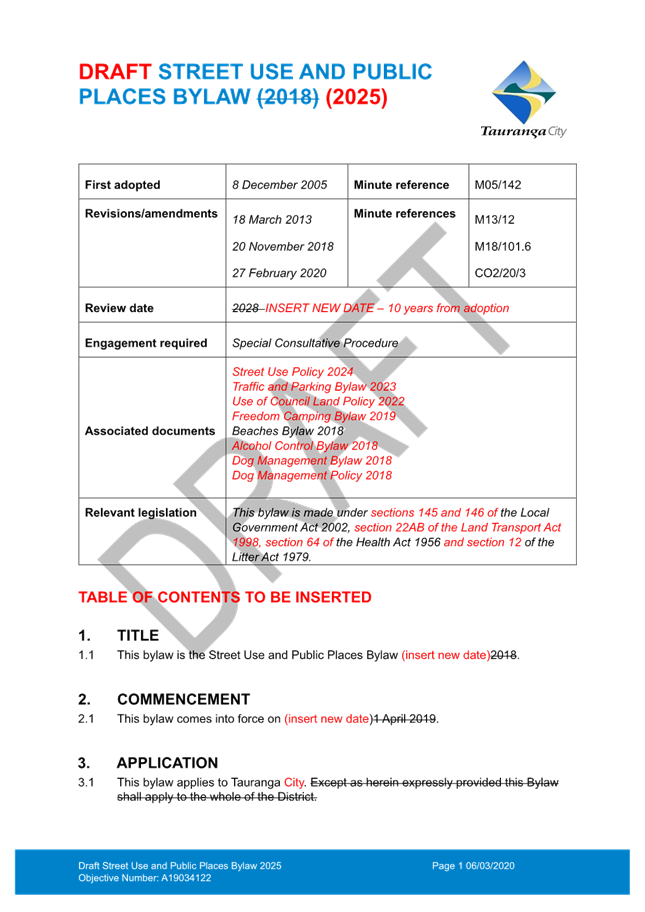
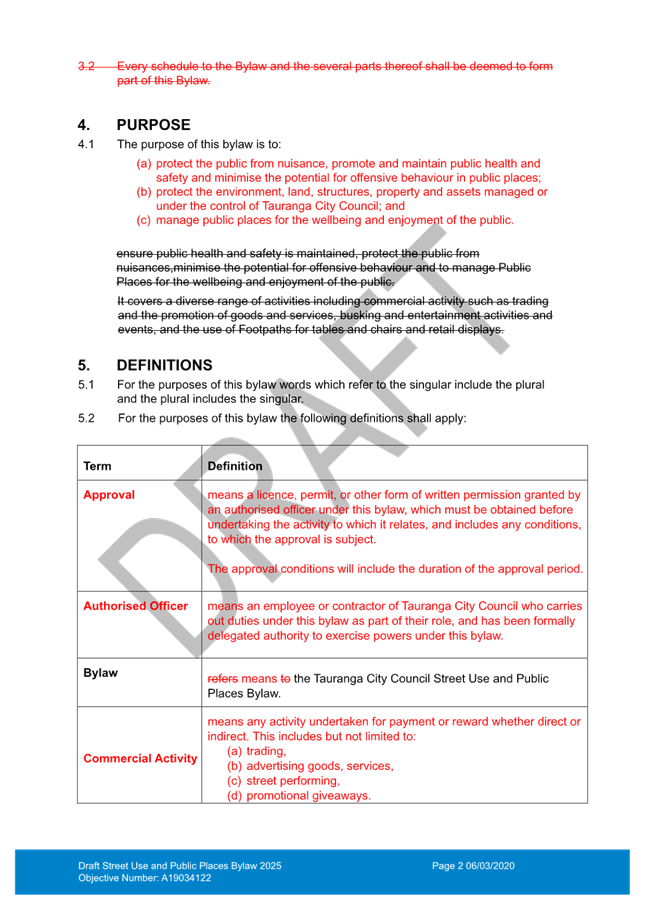
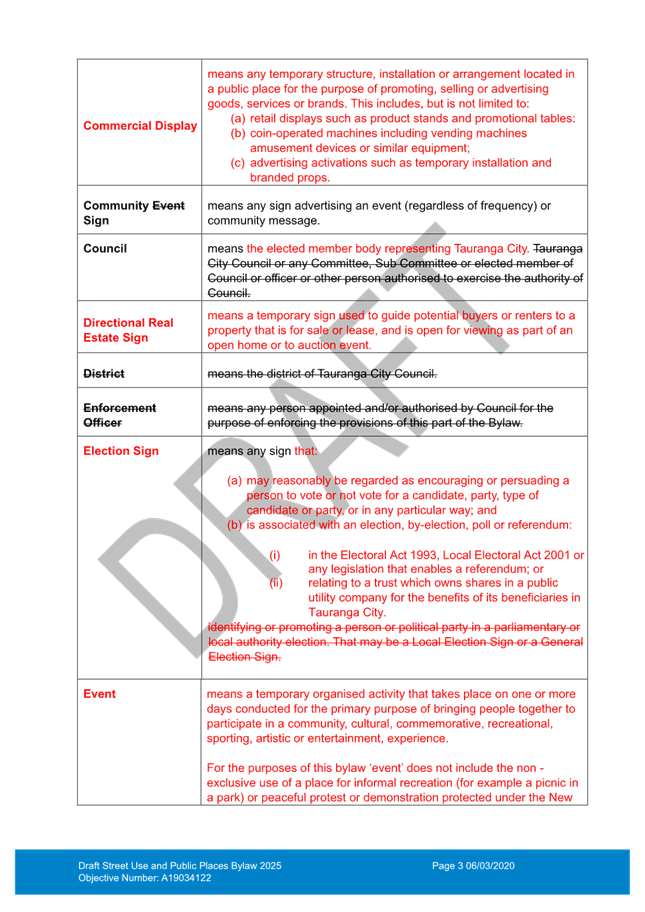
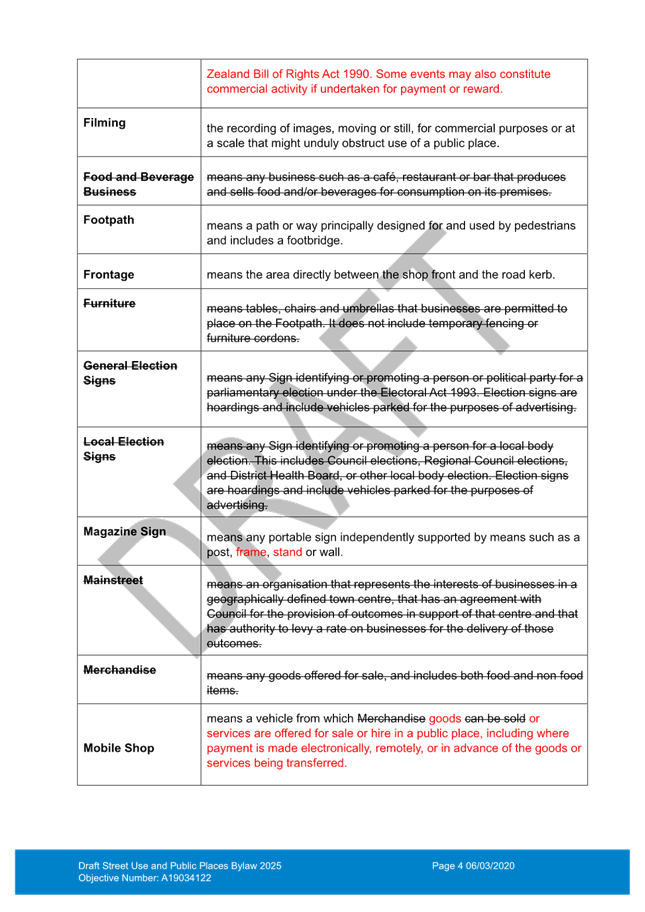
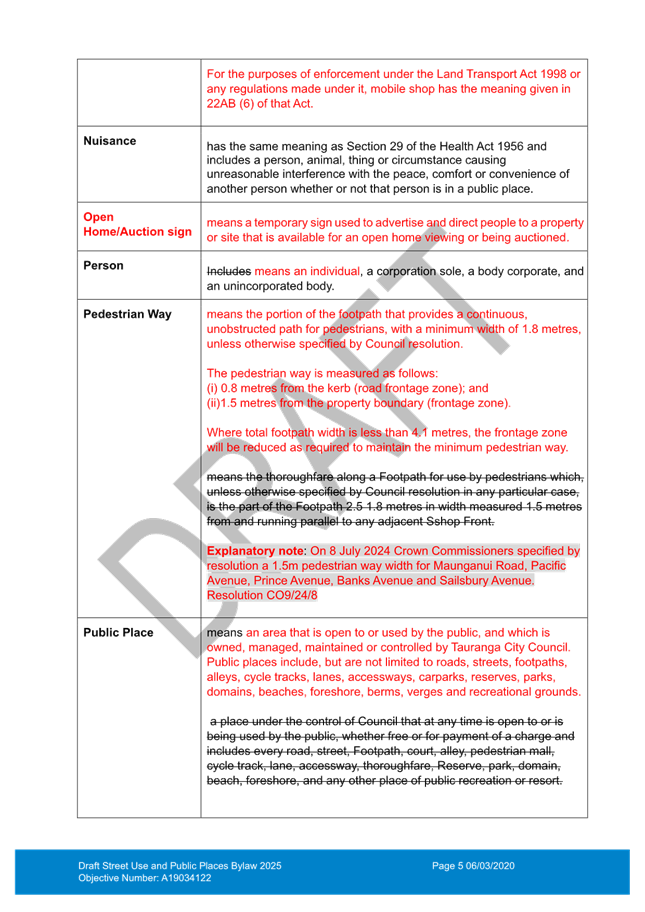
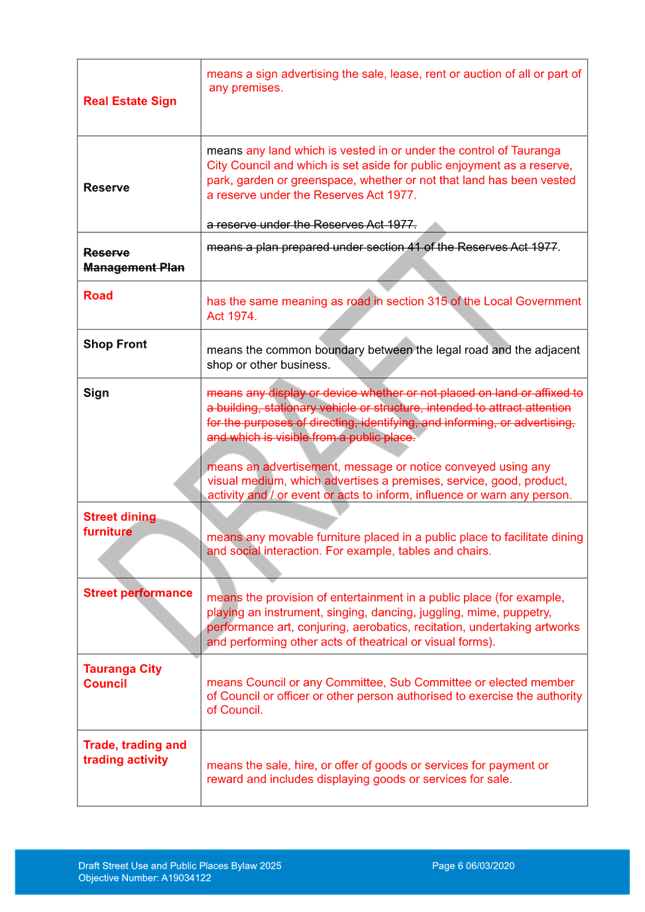
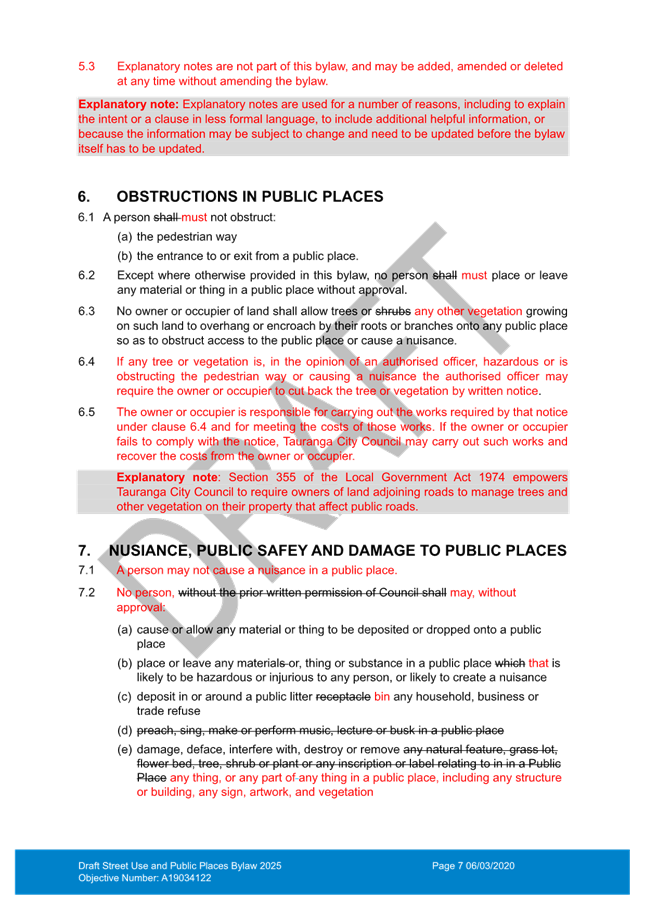
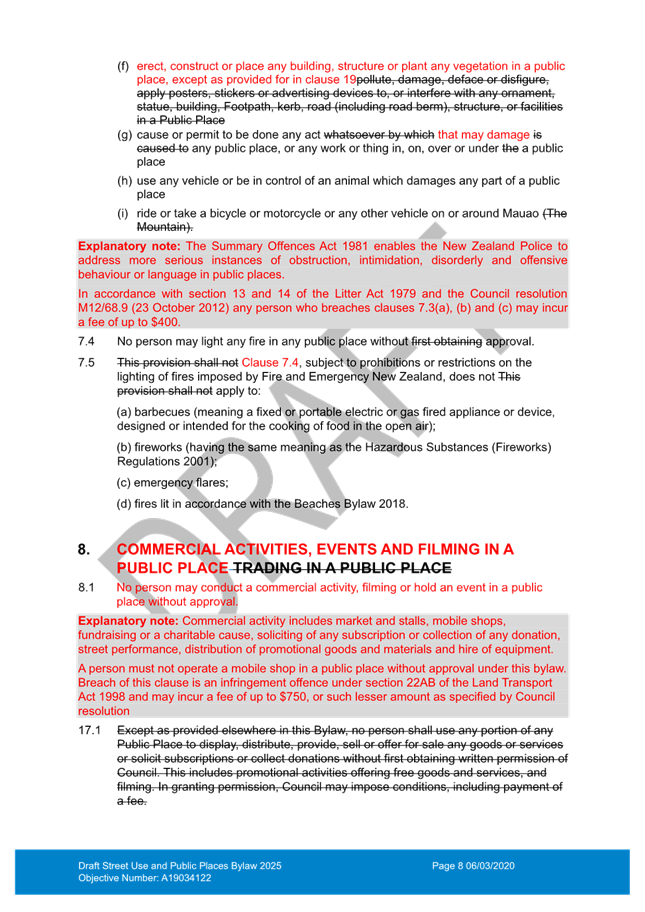
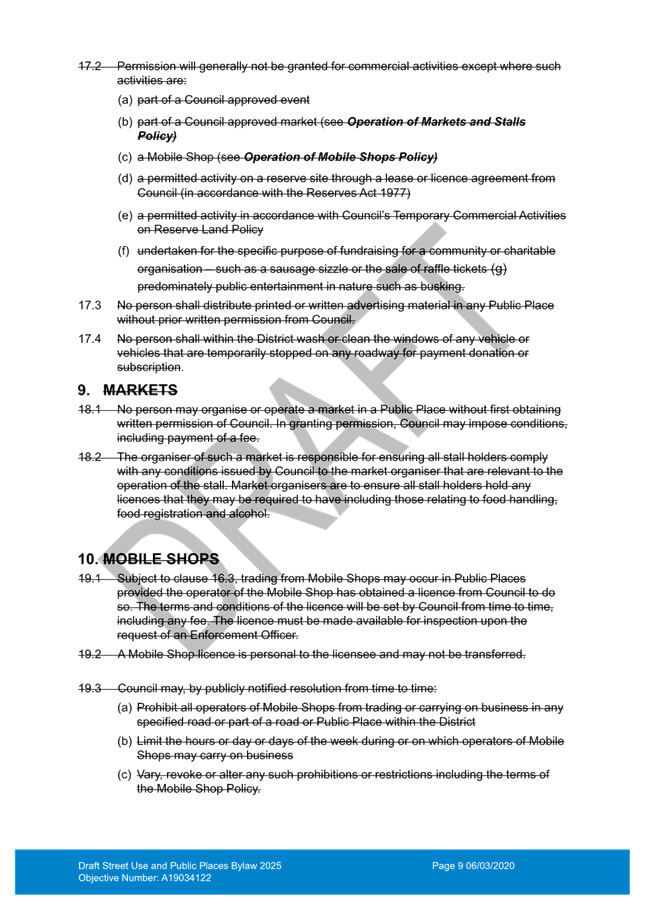
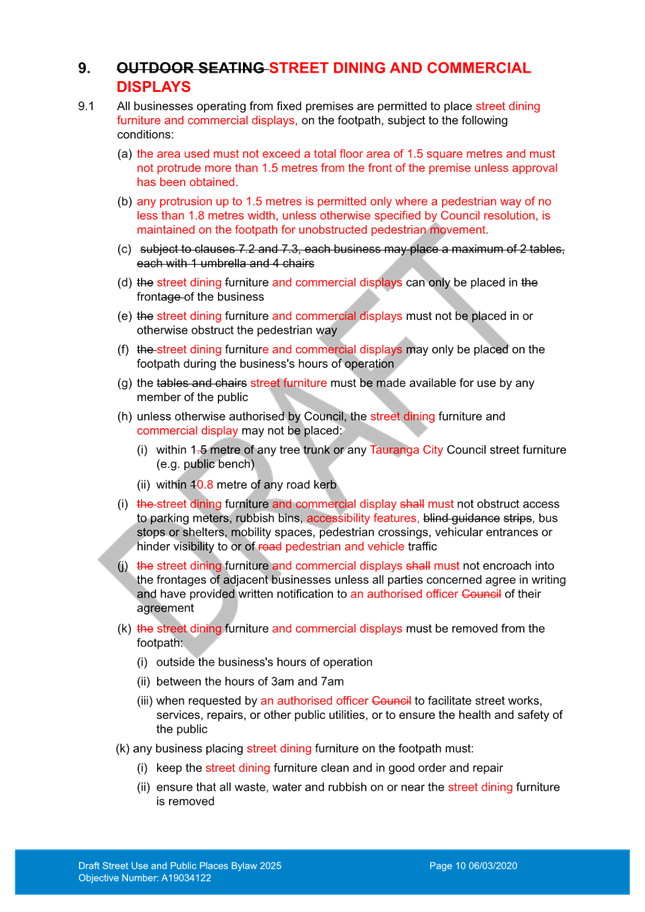
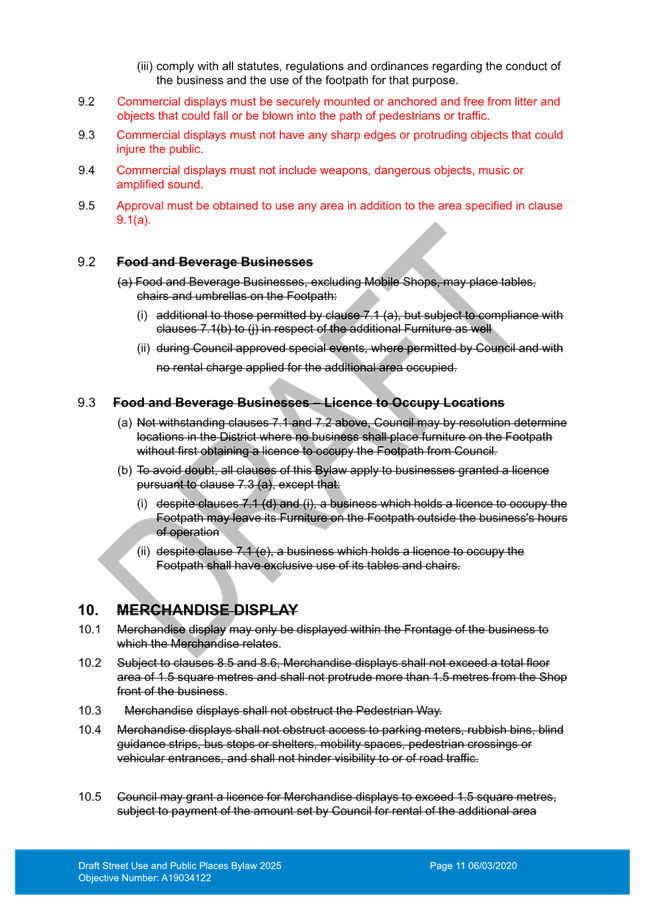
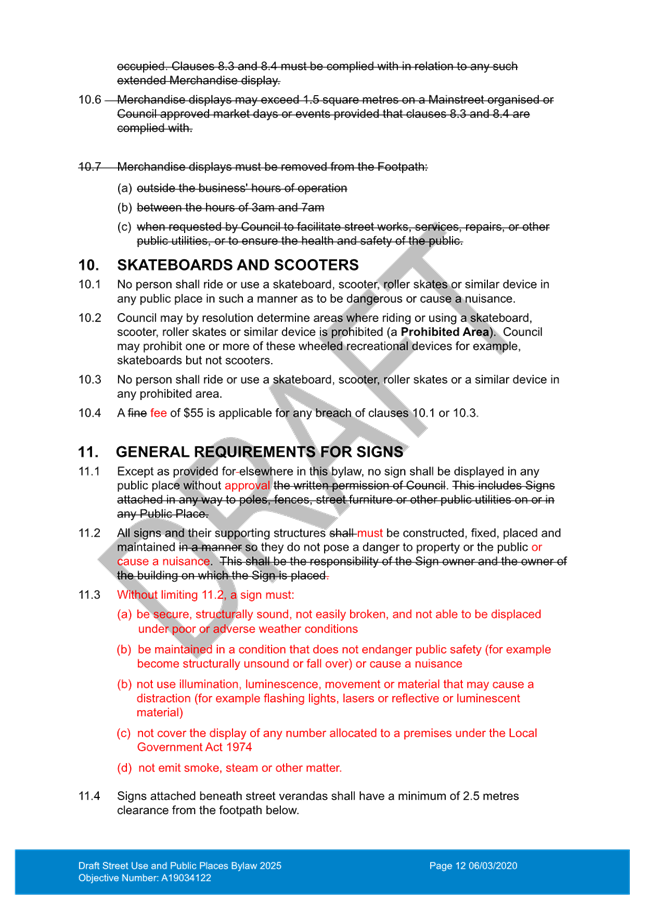
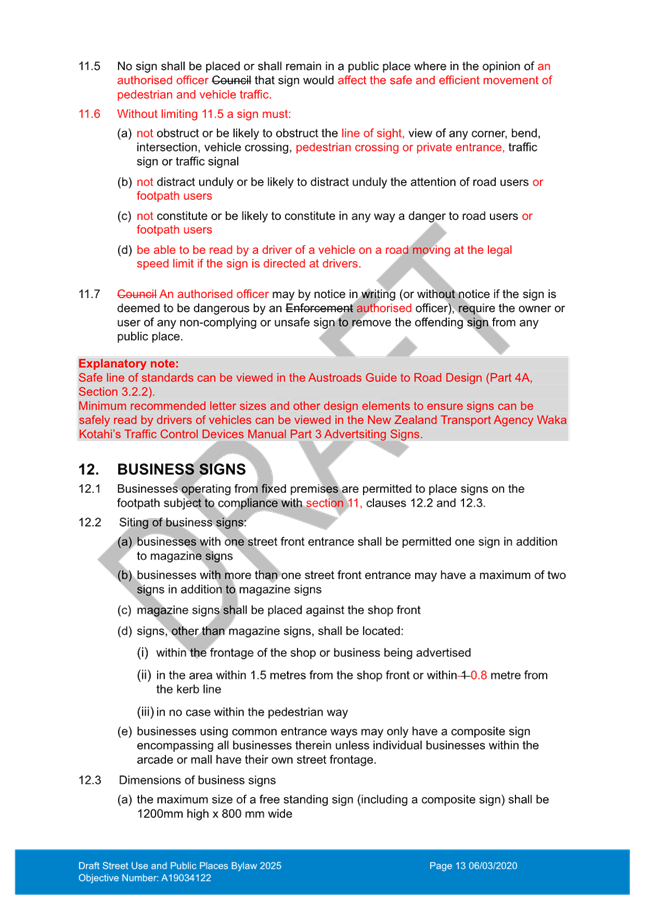
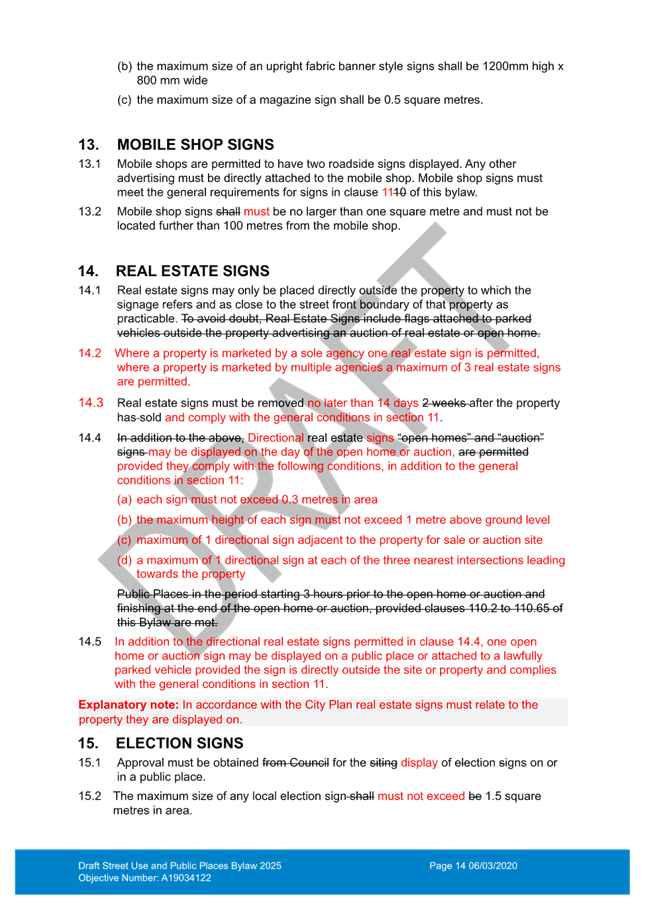
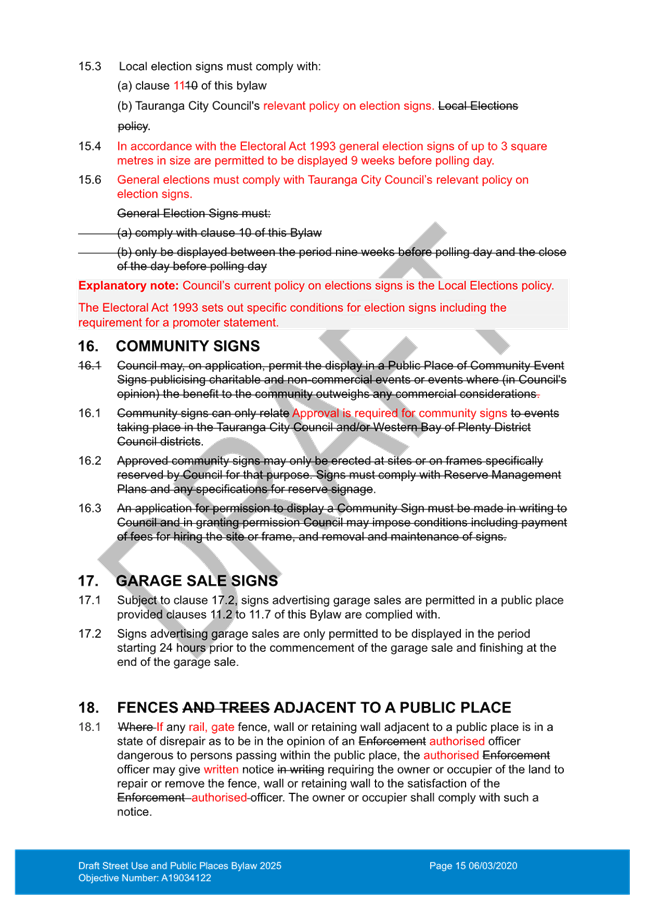
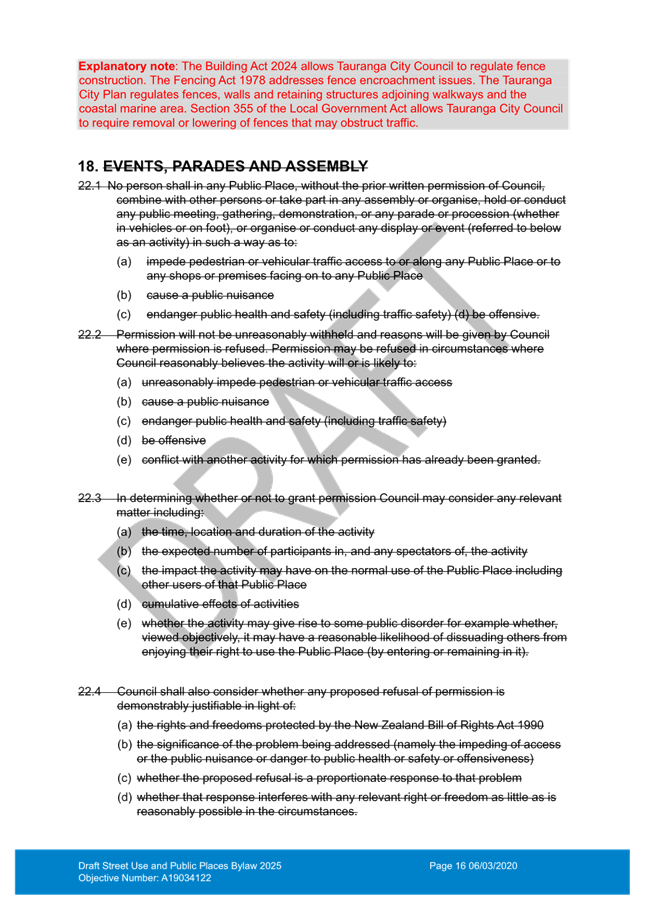
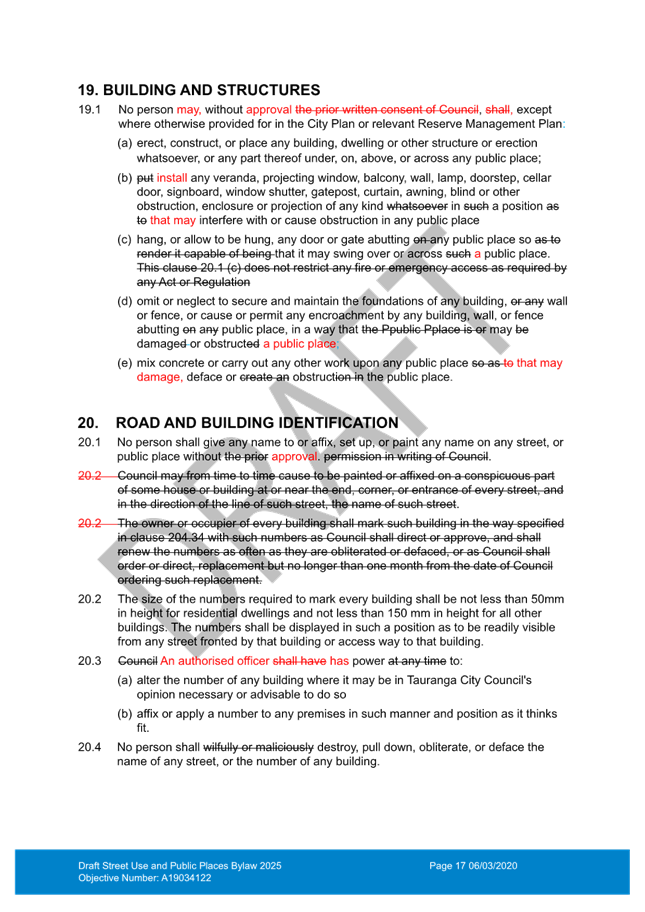
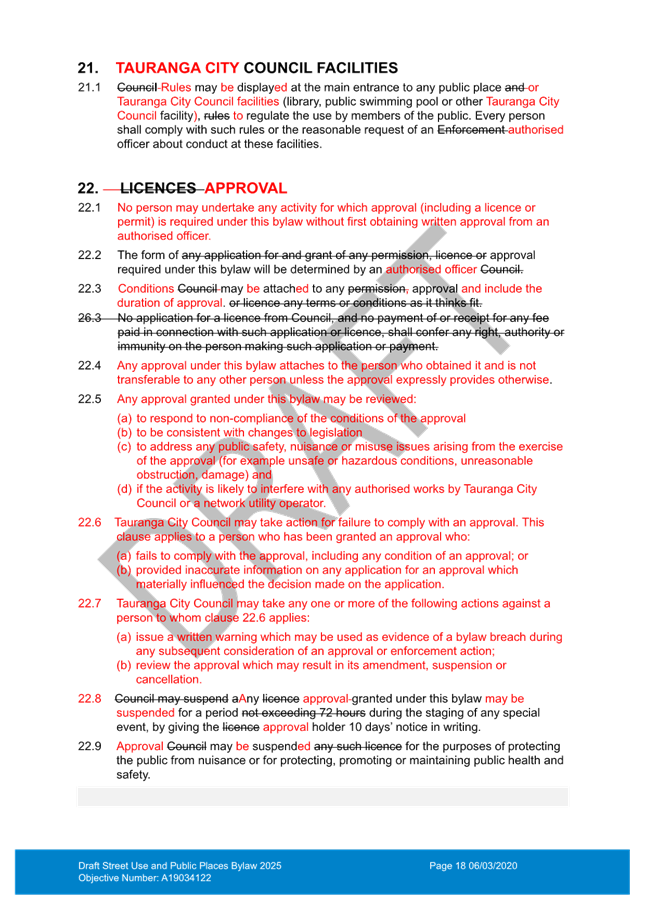
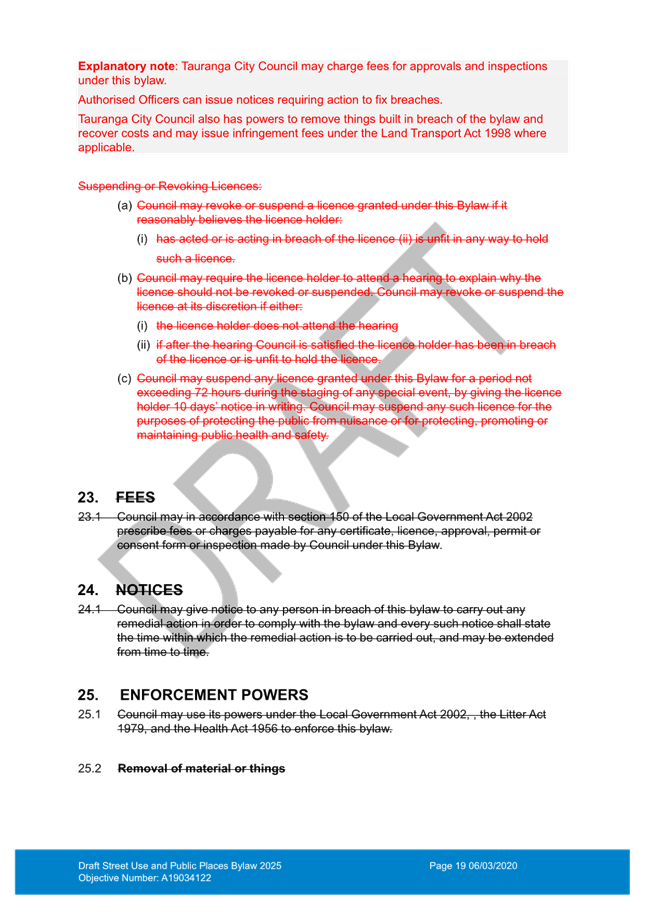
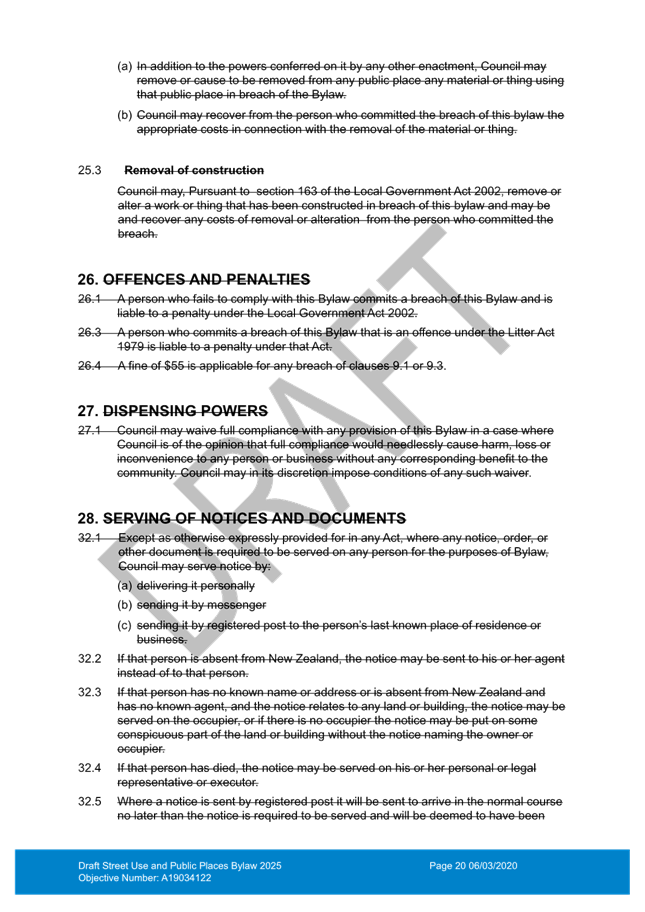
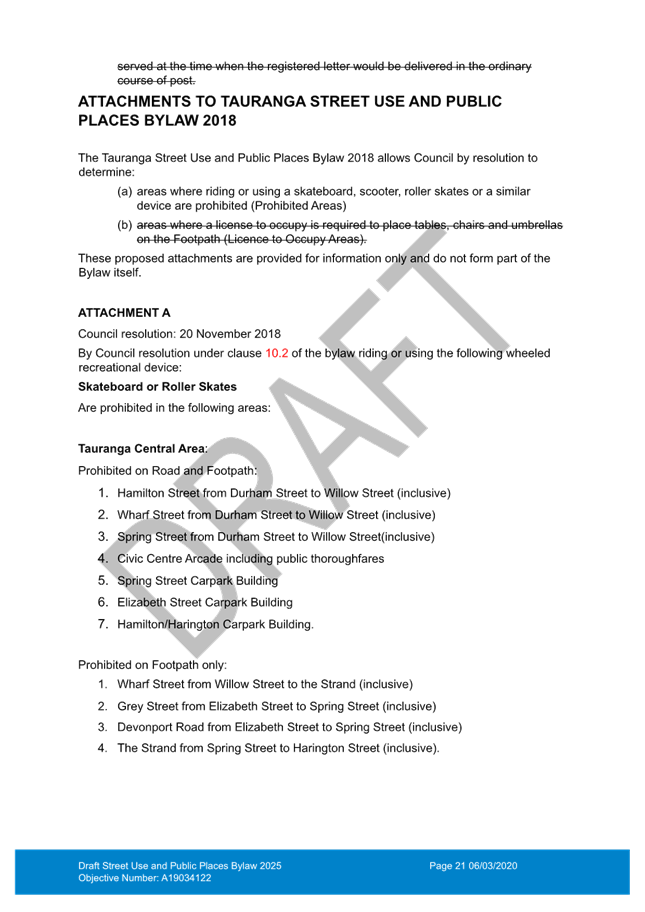
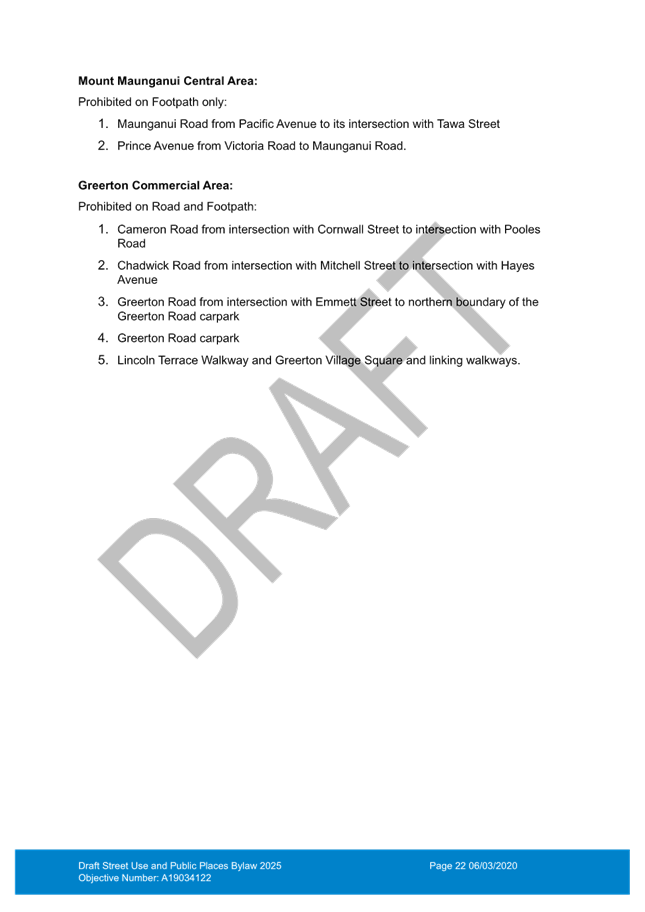
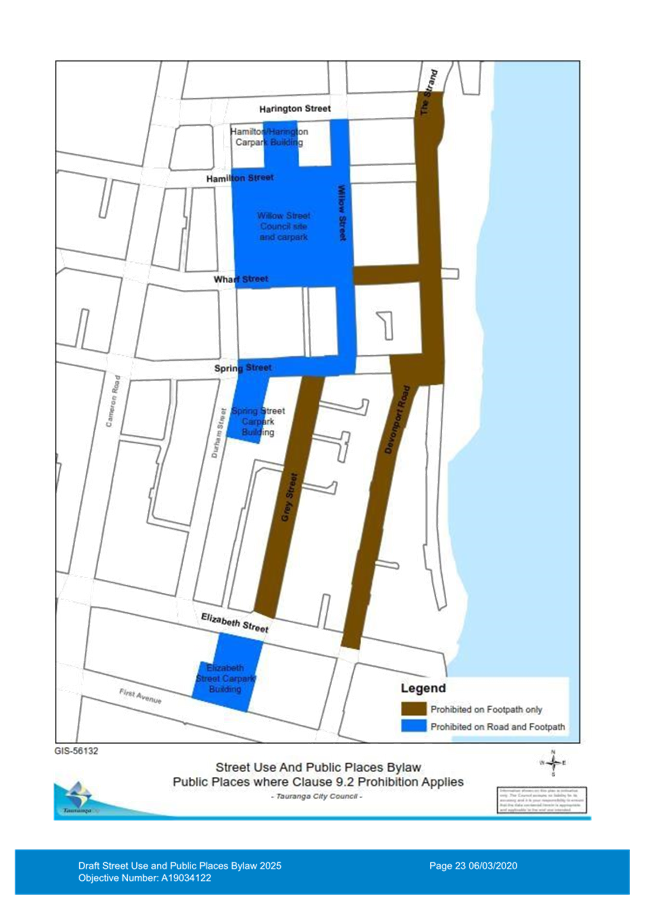
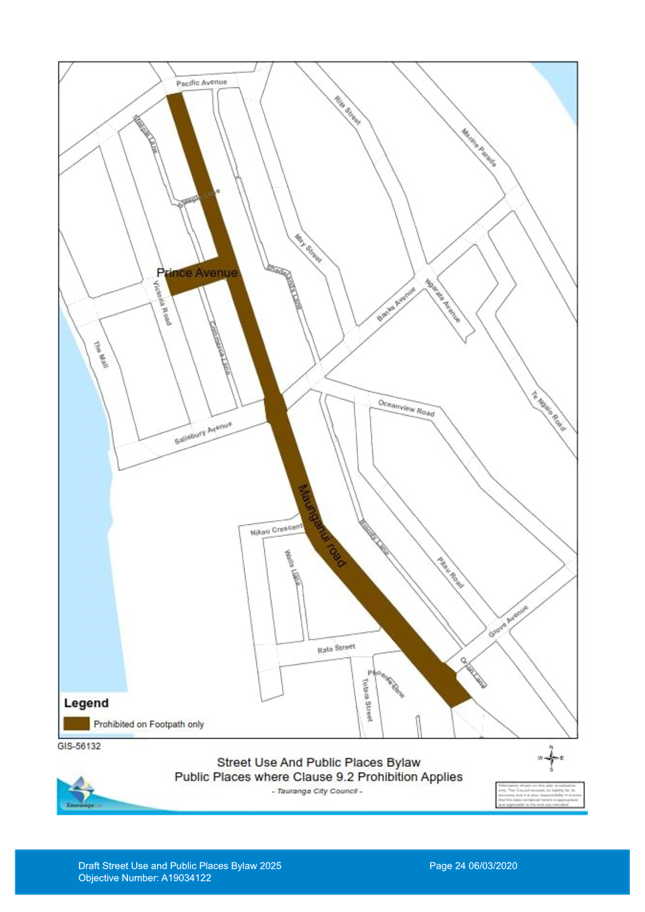
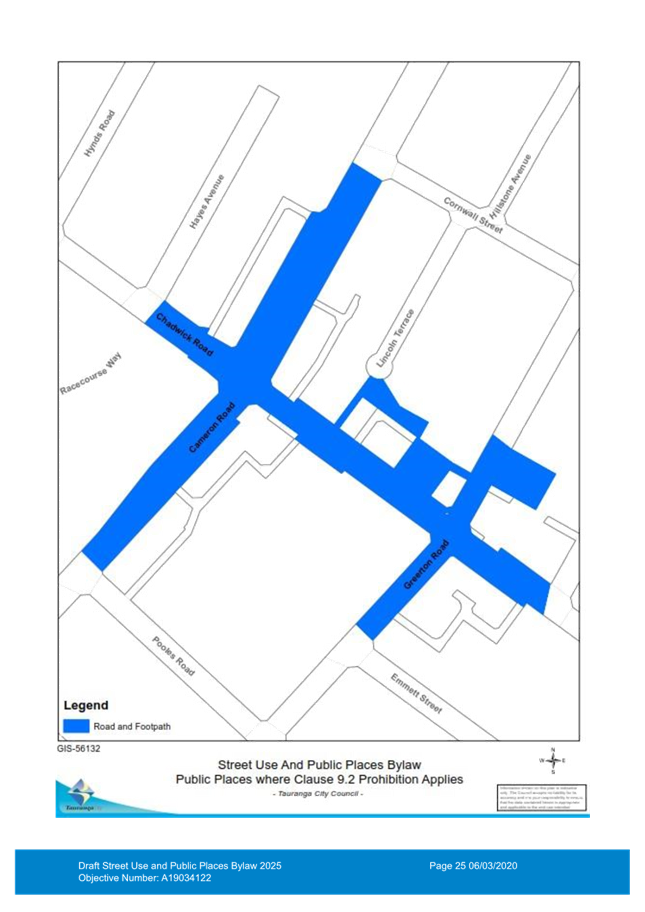
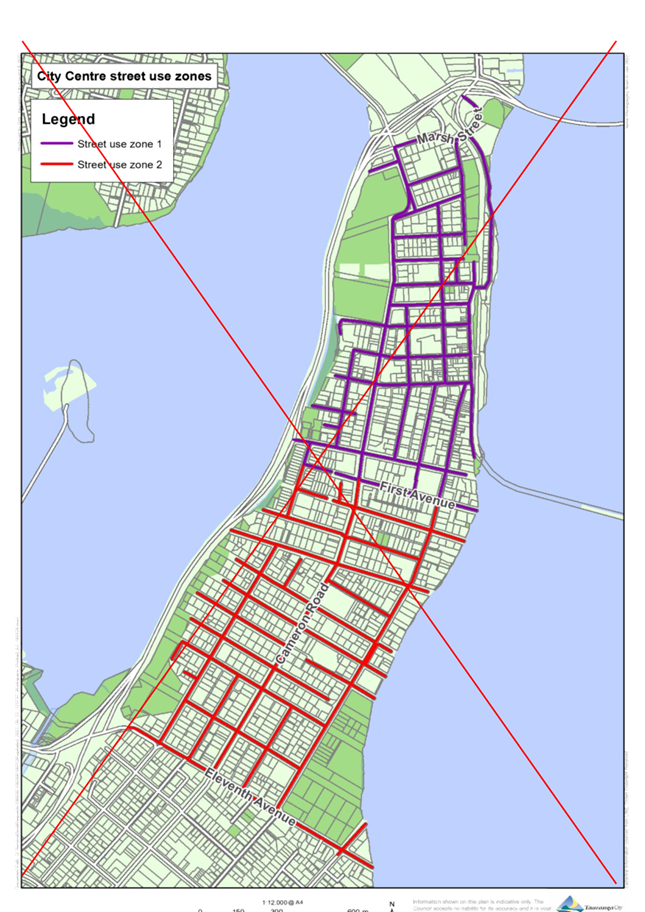
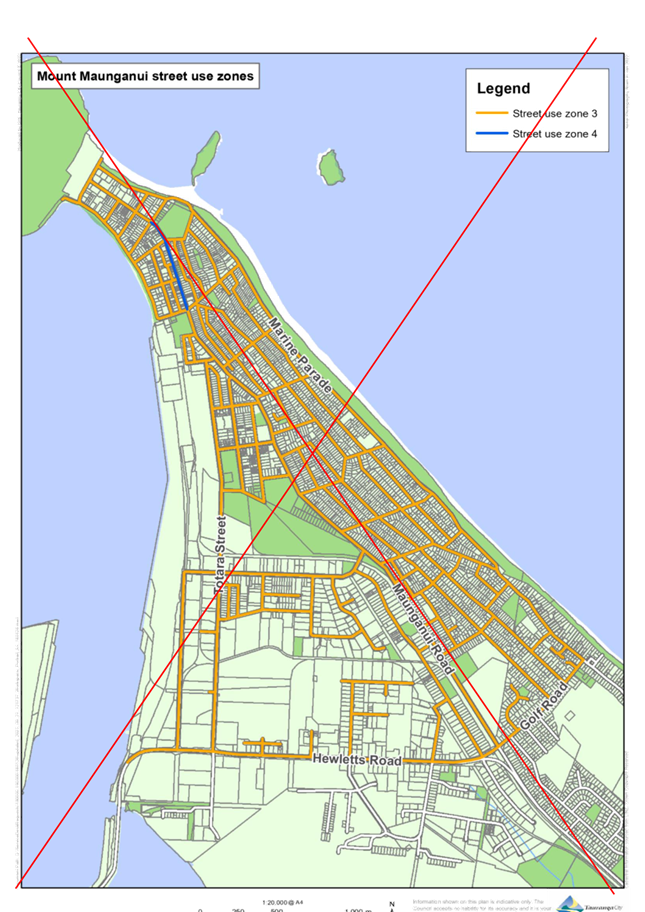
|
Ordinary
Council meeting Agenda
|
29
October 2025
|
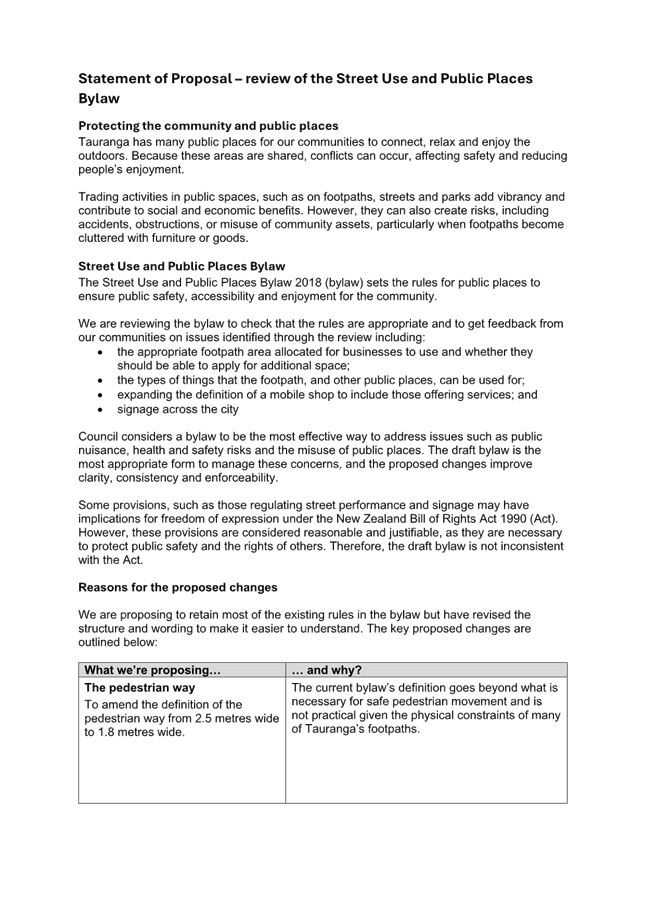
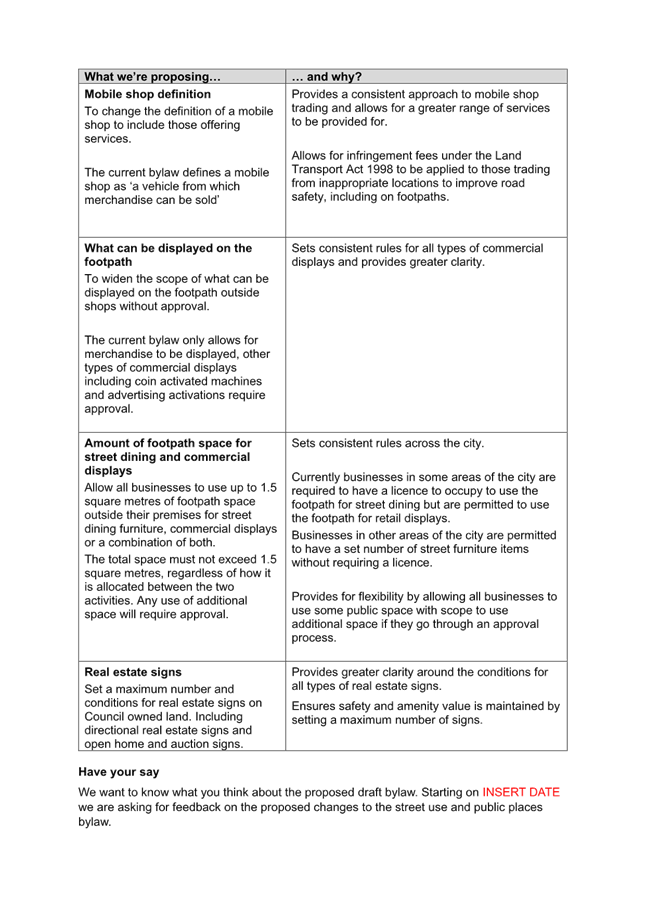

|
Ordinary
Council meeting Agenda
|
29
October 2025
|
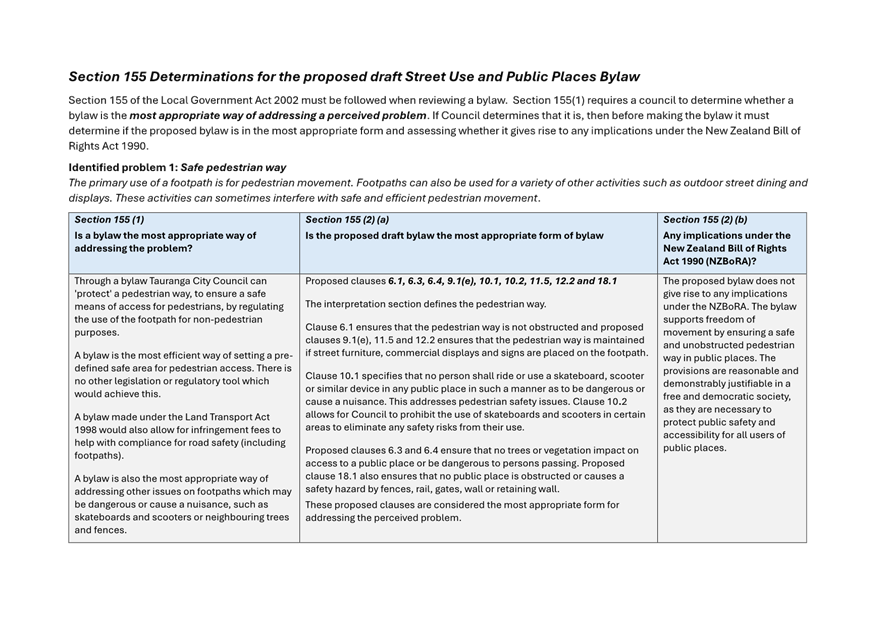
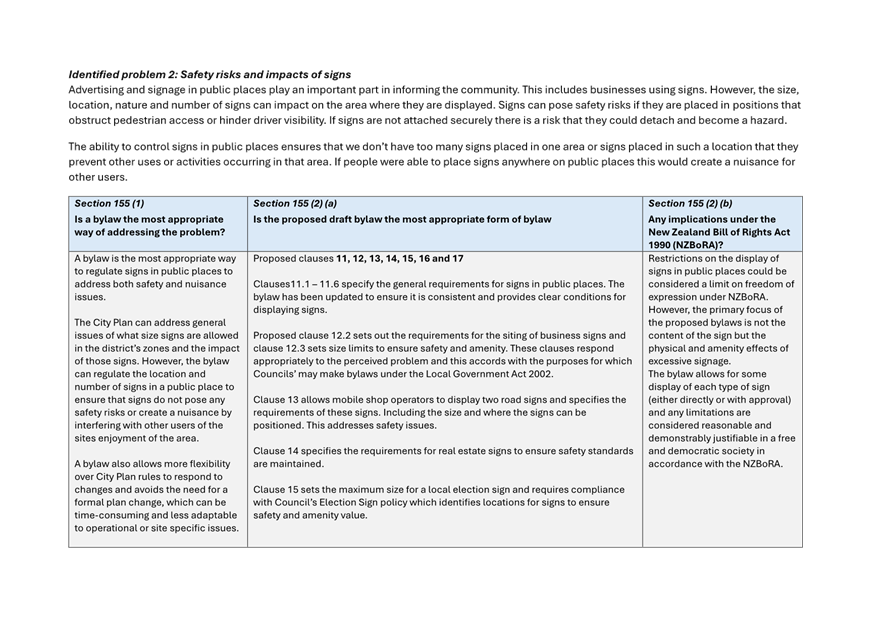
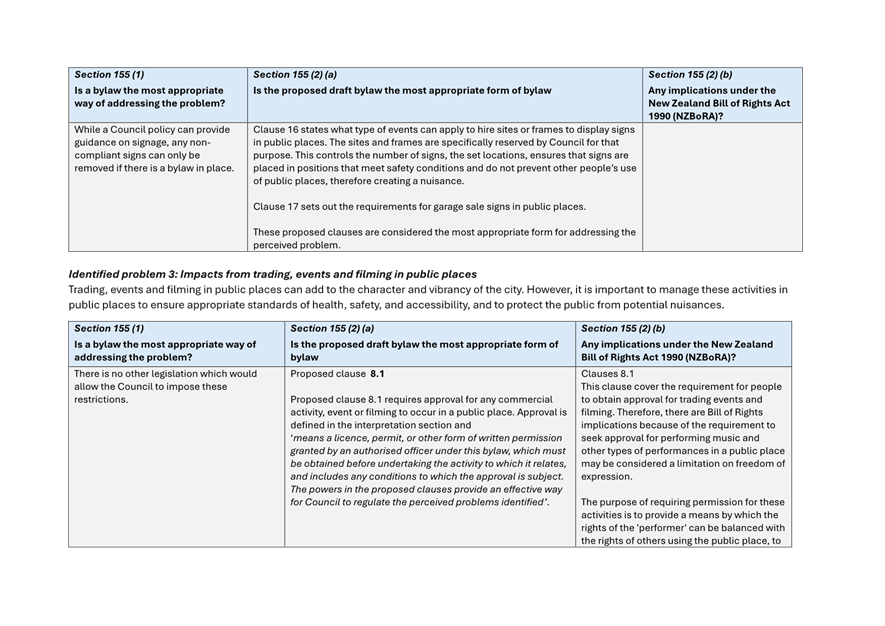
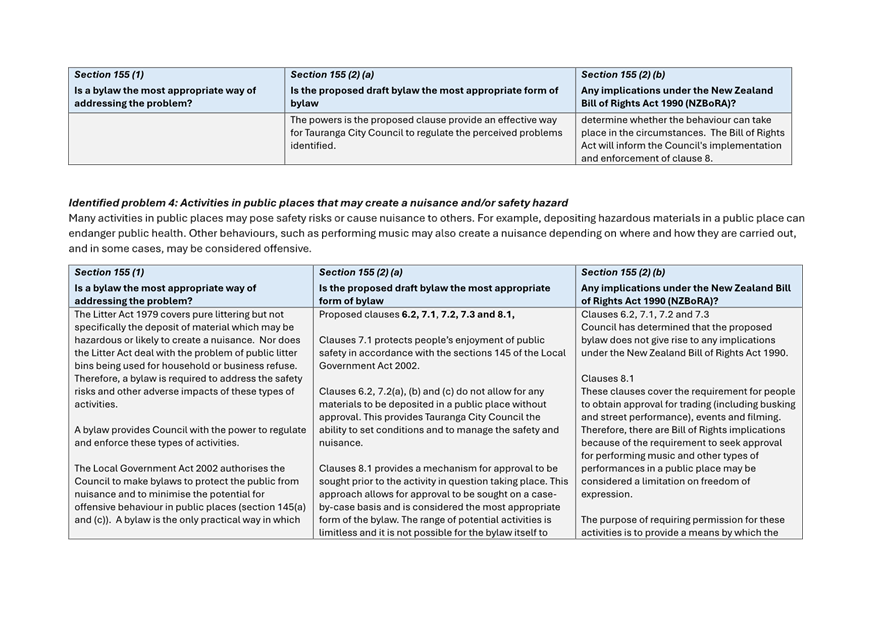
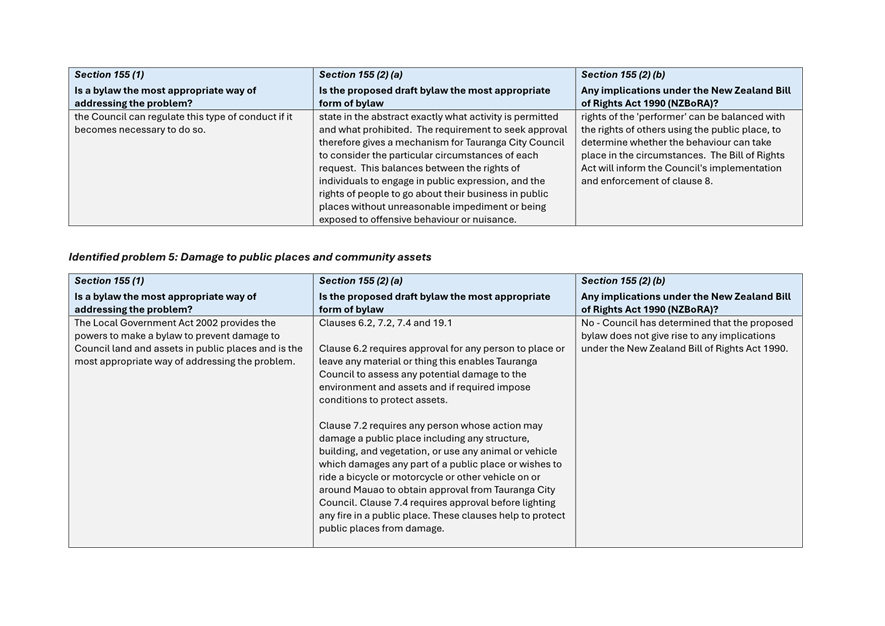
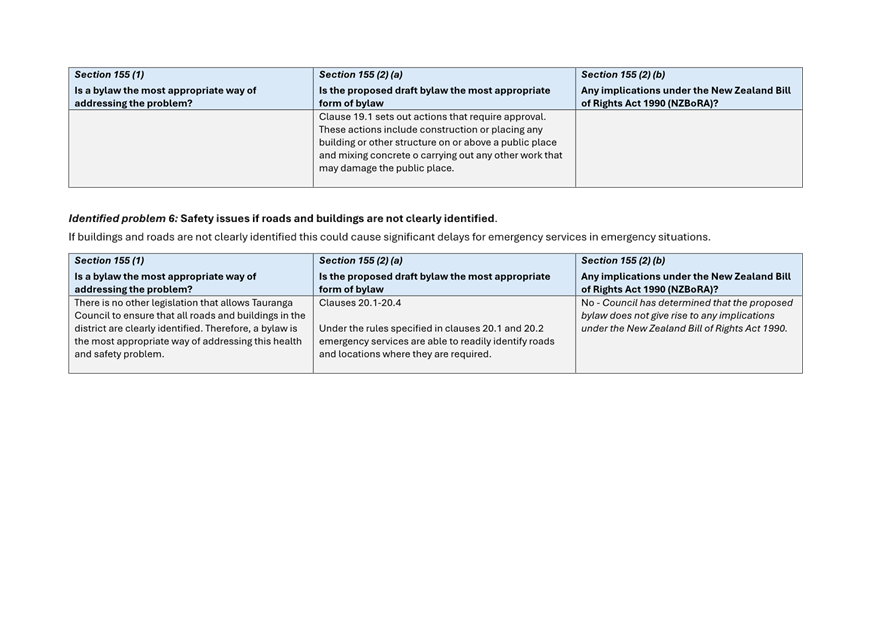
|
Ordinary
Council meeting Agenda
|
29
October 2025
|
11.5 Event
temporary alcohol-free areas 2025/2026
File Number: A18878444
Author: Nigel McGlone, Manager: Compliance Services
Jenna
Quay, Events Facilitation Manager
Authoriser: Sarah Omundsen, General Manager: Regulatory and Community Services
Purpose of the Report
1. To
seek Council approval for temporary alcohol-free areas to support safe hosting
of events across Tauranga for the 2025/2026 summer period.
|
Recommendations
That
the Council:
(a) Receives the
report "Event temporary alcohol-free areas 2025/2026".
(b) Agrees the
proposed temporary alcohol-free areas are appropriate and proportionate, and
justified as a reasonable limitation on people’s rights and freedoms.
(c) Resolves
under clause 9 of the Alcohol Control Bylaw 2018 to implement temporary
alcohol-free areas to support events across Tauranga for the 2025/2026 summer
as follows:
Tauranga City Council New Year’s Eve
community events and Soper Reserve events as per below table:
|
Fergusson Park
|
Fergusson Park including Tilby Drive from the intersection
of Tainui Street and Waratah Street (all inclusive) from 10am, 31 December
2025 to 6am, 1 January 2026.
|
|
Gordon Spratt Reserve
|
Gordon Spratt Reserve and Alice Way (all inclusive) and
Parton Road (between Tara Road and Papamoa Beach Road) from 10am, 31
December 2025 to 6am, 1 January 2026.
|
|
Tauranga Racecourse Reserve
|
Tauranga Racecourse Reserve from 10am, 31 December 2025
to 6am, 1 January 2026.
|
|
Soper Reserve
|
Soper Reserve and Newton Street (all inclusive) as
follows from 6am to midnight on the following dates.
· 7 February 2026, postponement date 14 February 2026 (Rockstock
Tauranga)
· 28 February 2026 (Beast of a Feast)
· 21 March 2026 (Tauranga Moana Irish Festival)
|
Mercury
Baypark New Year’s Eve event, covering the streets identified in the
table below from 10am, 31 December 2025 to 3am, 1 January 2026.
|
Girven
Road
|
From
Gloucester Road to Maunganui Road
|
|
Maunganui
Road
|
From
Girven Road to State Highway 2
|
|
State
Highway 2/Te Maunga Lane
|
From
Maunganui Road to Sandhurst Drive
|
|
Te
Maunga Lane
|
All
inclusive
|
|
Truman
Lane
|
All
inclusive
|
|
Mangatawa
Link Road
|
All
inclusive
|
|
State
Highway 29A
|
From
Truman Lane to Maunganui Road/Te Maunga Lane (including the roundabouts)
|
|
Gloucester
Road
|
From
Eversham Road to Girven Road
|
|
Eversham
Road
|
All
inclusive
|
|
Tudor
Place
|
All
inclusive
|
|
Palliser
Place
|
All
inclusive
|
|
Harrow
Place
|
All
inclusive
|
|
Exeter
Street
|
All
inclusive
|
|
Lambeth
Terrace
|
All
inclusive
|
|
Dover
Place
|
All
inclusive
|
|
Weymouth
Place
|
All
inclusive
|
|
Eversham
Road Reserve
|
All
inclusive
|
|
Kingsley
Place
|
All
inclusive
|
|
Penrhyn
Place
|
All
inclusive
|
|
Ernie
Way
|
All
inclusive
|
|
Hadleigh
Reserve
|
All
inclusive
|
Bay Oval
events, covering Blake Park and the surrounding streets identified below for
the following times and dates, 10am to midnight 17 January 2026 for Black
Clash, 10am, 31 January 2026 to 1am, 1 February 2026 for FISHER and 10am to
midnight on 7 February 2026 for UB40.
|
Blake Park
|
All inclusive (Skate Park and overflow
carpark)
|
|
Hull Road
|
All inclusive
|
|
Maunganui Road
|
From Tweed Street to Puriri Street
|
|
Hinau Street
|
All inclusive
|
|
Miro Street
|
From Kawaka Street to Puriri Street
|
|
Kawaka Street
|
All inclusive
|
|
Totara Street
|
From Hull Road to Puriri Street
|
|
Tawa Street
|
From Kawaka Street Puriri Street
|
|
Matai Street
|
All inclusive
|
|
Puriri Street
|
All inclusive
|
|
Executive Summary
2. Each
year NZ Police request temporary alcohol-free areas associated with various
events across Tauranga to reduce the risk of alcohol-related harm in and around
event areas and support event organisers in delivering safe and well-run events
with minimal disruption to nearby residents.
3. The
areas requested in attachment one support the New Year’s Event community
events, events at Baypark, Soper Reserve and the Bay Oval for the 2025/2026
summer.
4. The
Alcohol Control Bylaw 2018 (the Bylaw)
provides for Council to put in place temporary alcohol-free areas for events by
publicly notified resolution.
5. This
report seeks Council approval for the various temporary alcohol-free areas at
event locations to support safe hosting of a number of events across Tauranga
this summer.
6. If
approved council officers will place a public notice as required and develop a
communications plan that will include installation of temporary signage. NZ
Police will enforce the alcohol-free areas when in place.
Background
7. The purpose of the Bylaw is
to control the consumption of alcohol in public places to reduce potential
alcohol-related harm. As well as setting out permanent alcohol-free areas,
clause 9 of the Bylaw states Council may, by resolution, prohibit the
consumption, bringing and possession of alcohol on or in a public place for a
time and/or event specified in that resolution (temporary alcohol-free area).
8. Each
year, temporary alcohol-free areas are requested around key events across the
city. These help Police manage potential alcohol-related disorder, reduce the
risk of alcohol-related harm in and around event areas, and support event
organisers in delivering safe and well-run events with minimal disruption to
nearby residents.
9. The
attached letter (attachment one) from NZ Police outlines the events where
temporary alcohol-free areas have been requested, this request is also
supported by staff. This enables NZ
Police to better support the community celebrations and concerts and minimise
any potential alcohol related crime and disorder.
10. The request
covers three of the five New Year’s Eve community events where permanent
alcohol-free areas are not already in place and events at Mercury Baypark,
Soper Reserve and the Bay Oval.
11. Temporary alcohol-free areas are not required for the NYE
community celebrations planned for the Tauranga city centre and Blake Park, Mt
Maunganui as these event sites within existing alcohol-free areas.
12. The table below sets out the proposed temporary
alcohol-free areas for the New Year’s Eve community events and Soper
Reserve events.
|
Fergusson Park
|
Fergusson Park including Tilby Drive from the
intersection of Tainui Street and Waratah Street (all inclusive) from 10am,
31 December 2025 to 6am, 1 January 2026.
|
|
Gordon Spratt Reserve
|
Gordon Spratt Reserve and Alice Way (all inclusive) and
Parton Road (between Tara Road and Papamoa Beach Road) from 10am, 31 December
2025 to 6am, 1 January 2026.
|
|
Tauranga Racecourse Reserve
|
Tauranga Racecourse Reserve from 10am, 31 December 2025
to 6am, 1 January 2026.
|
|
Soper Reserve
|
Soper Reserve and Newton Street (all inclusive) as
follows from 6am to midnight on the following dates.
· 7 February 2026, postponement date 14 February 2026 (Rockstock
Tauranga)
· 28 February 2026 (Beast of a Feast)
· 21 March 2026 (Tauranga Moana Irish Festival)
|
13. To support the concert, at Mercury Baypark a temporary alcohol-free
area, covering the streets identified below is proposed from 10am, 31 December
2025 to 3am, 1 January 2026.
|
Girven
Road
|
From
Gloucester Road to Maunganui Road
|
|
Maunganui
Road
|
From
Girven Road to State Highway 2
|
|
State
Highway 2/Te Maunga Lane
|
From
Maunganui Road to Sandhurst Drive
|
|
Te
Maunga Lane
|
All
inclusive
|
|
Truman
Lane
|
All
inclusive
|
|
Mangatawa
Link Road
|
All
inclusive
|
|
State
Highway 29A
|
From
Truman Lane to Maunganui Road/Te Maunga Lane (including the roundabouts)
|
|
Gloucester
Road
|
From
Eversham Road to Girven Road
|
|
Eversham
Road
|
All
inclusive
|
|
Tudor
Place
|
All
inclusive
|
|
Palliser
Place
|
All
inclusive
|
|
Harrow
Place
|
All
inclusive
|
|
Exeter
Street
|
All
inclusive
|
|
Lambeth
Terrace
|
All
inclusive
|
|
Dover
Place
|
All
inclusive
|
|
Weymouth
Place
|
All
inclusive
|
|
Eversham
Road Reserve
|
All
inclusive
|
|
Kingsley
Place
|
All
inclusive
|
|
Penrhyn
Place
|
All
inclusive
|
|
Ernie
Way
|
All
inclusive
|
|
Hadleigh
Reserve
|
All
inclusive
|
14. To
support the Bay Oval events, covering Blake Park and the surrounding streets
identified below for the following times and dates, 10am to midnight 17 January
2026 for Black Clash, 10am, 31 January 2026 to 1am, 1 February 2026 for FISHER
and 10am to midnight on 7 February 2026 for UB40.
|
Blake Park
|
All inclusive (Skate Park and overflow
carpark)
|
|
Hull Road
|
All inclusive
|
|
Maunganui Road
|
From Tweed Street to Puriri Street
|
|
Hinau Street
|
All inclusive
|
|
Miro Street
|
From Kawaka Street to Puriri Street
|
|
Kawaka Street
|
All inclusive
|
|
Totara Street
|
From Hull Road to Puriri Street
|
|
Tawa Street
|
From Kawaka Street to Puriri Street
|
|
Matai Street
|
All inclusive
|
|
Puriri Street
|
All inclusive
|
Statutory Context
15. The proposed
temporary-alcohol free areas are consistent with the purpose of the Bylaw to
reduce alcohol-related harm in our community.
16. In accordance
with section 147B of the Local Government Act 2002, the proposed temporary
alcohol-free areas are proportionate responses and place reasonable limitations
of people’s rights and freedoms. The time periods for the proposed
alcohol-free areas reflect the time period of concern for potential alcohol
related crime and disorder.
STRATEGIC ALIGNMENT
17. This
contributes to the promotion or achievement of the following strategic
community outcome(s):
|
Contributes
|
|
We are an inclusive city
|
ü
|
|
We value, protect and enhance the
environment
|
☐
|
|
We are a well-planned city
|
☐
|
|
We can move around our city easily
|
☐
|
|
We are a city that supports
business and education
|
☐
|
18. The proposed temporary alcohol-free areas are consistent with the
purpose of the bylaw to reduce alcohol-related harm in our community.
19. The proposed temporary alcohol-free areas will help people feel
safer in their communities, a key goal of Council’s Tauranga Mataraunui
– Inclusive City Strategy and community outcome. This in turn contributes
to the community and inclusivity pillar of the vision for Tauranga, Together
we can … lift each other up, as outlined in Council’s Our
Direction framework.
Options Analysis
2. The
table below outlines the advantages and disadvantages of approving the
temporary alcohol-free areas.
|
Option
|
Advantages
|
Disadvantages
|
|
1
|
Approve the temporary alcohol-free areas
(recommended)
|
· Police are enabled to successfully limit
alcohol harm and manage public disorder in public places around events.
· Police are provided with an additional tool to
support a safer environment for the community.
· The community can enjoy a safer environment in
these areas and when attending events.
|
· Some residents and visitors may view the
proposed temporary alcohol-free areas as being too restrictive.
|
|
2
|
Do not approve the temporary-alcohol free
areas
|
· Nil
|
· The ability of the NZ Police to successfully
limit alcohol harm and manage public disorder along the coast and at events
would be reduced.
|
Financial
Considerations
20. Implementing
the alcohol-free areas involves costs related to public notification and the
installation of temporary signage. The total estimated cost to cover all areas
is approximately $4,300, which will be met within existing budgets.
Legal Implications /
Risks
21. To activate
Police powers under Section 170(2) of the Local Government Act 2002, the
Council must provide at least 14 days public notice and install signage for any
temporary alcohol-free areas. This enables the Police to carry out search
powers immediately and without further notice in those areas for alcohol.
TE AO MĀORI
APPROACH
22. The proposed temporary alcohol-free areas align with the principles
of Manaakitanga – a strong duty of care and safety for our people and
Kaitiakanga – stewardship of the natural environment.
CLIMATE IMPACT
23. There are no direct or specific climate change impacts resulting
from the proposed temporary alcohol-free areas this is a regulatory procedure.
Consultation /
Engagement
24. As clause 9 of
the Bylaw provides Council with the power to put in place temporary
alcohol-free areas by resolution, public consultation is not required. Public
consultation was carried out when the Bylaw was developed.
25. Council
officers have worked with the Police to determine the proposed temporary
alcohol-free areas. Although Council has the power to make the Bylaw and put in
place the alcohol-free areas it is the Police that enforce these.
Significance
26. The Local
Government Act 2002 requires an assessment of the significance of matters,
issues, proposals and decisions in this report against Council’s
Significance and Engagement Policy. Council acknowledges that in some
instances a matter, issue, proposal or decision may have a high degree of
importance to individuals, groups, or agencies affected by the report.
27. In making this
assessment, consideration has been given to the likely impact, and likely
consequences for:
(a) the
current and future social, economic, environmental, or
cultural well-being of the district or region
(b) any persons who
are likely to be particularly affected by, or interested in, the decision.
(c) the capacity of
the local authority to perform its role, and the financial and other costs of
doing so.
28. In accordance
with the considerations above, criteria and thresholds in the policy, it is
considered that the decision is of low significance.
ENGAGEMENT
29. Taking into
consideration the above assessment, that the decision is of low significance,
officers are of the opinion that no further engagement is required prior to
Council making a decision.
Next Steps
30. In accordance
with the Bylaw, public notice will be given prior to the temporary alcohol-free
areas taking effect and a communications plan covering each area and event will
be implemented, including but not limited to erecting signage required to
inform public of the temporary alcohol-free areas, dates and times. This will
ensure Police can exercise the power of search under the Local Government Act
2002.
Attachments
1. NZ Police request for
temporary achohol-free areas for events 2025/2026 - A19059481 ⇩ 
|
Ordinary
Council meeting Agenda
|
29
October 2025
|
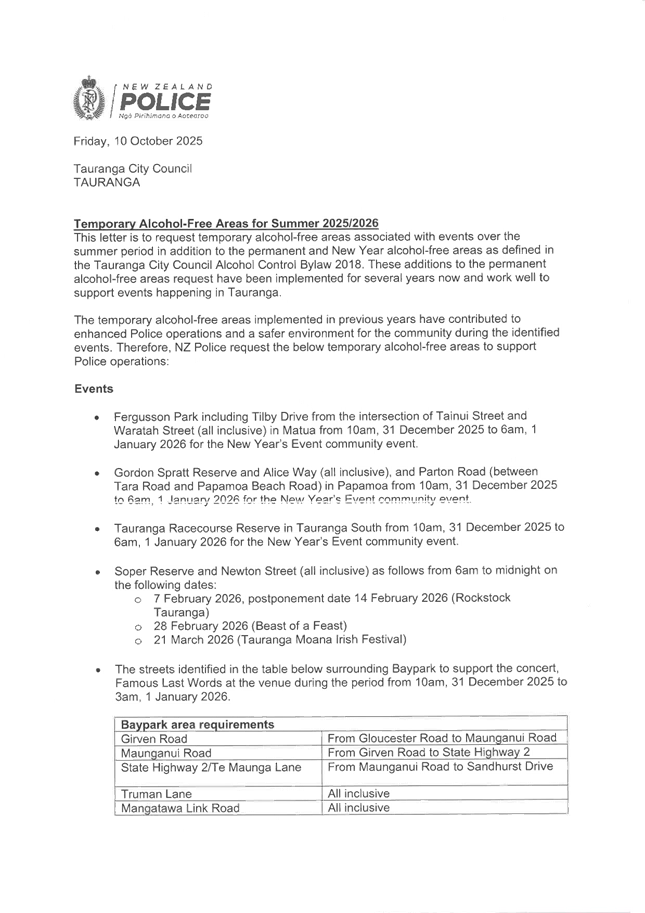
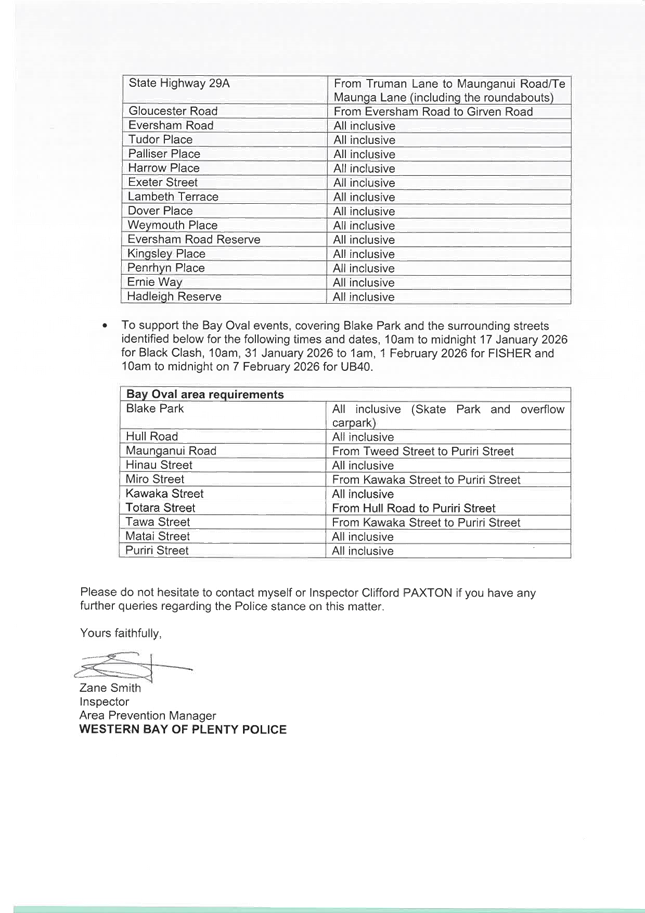
|
Ordinary
Council meeting Agenda
|
29
October 2025
|
11.6 Cambridge
Road Closed Landfill Infrastructure Upgrade: Unbudgeted Expenditure
File Number: A19035828
Author: Greg Steele, Head of City Operations.
Sharon
Herbst, Policy Analyst
Authoriser: Barbara Dempsey, Acting General Manager Operations and Infrastructure
Purpose of the Report
1. Request for approval of unbudgeted
capital expenditure in the 2025/26 financial year to complete compliance works
required under an abatement notice issued by Bay of Plenty Regional Council for
the Cambridge Road closed landfill site, noting that additional environmental
issues at the wider site are being investigated.
|
Recommendations
That
the Council:
(a) Receives the report "Cambridge
Road Closed Landfill Infrastructure Upgrade: Unbudgeted Expenditure".
(b) Approves an additional capital budget
of $1,497,085 for the completion of compliance works at 278 Cambridge Road.
(c) Approves an increase to
Council’s 2025/26 borrowing limit by $1,497,085 to fund the works.
|
Executive Summary
2. Tauranga City Council (the
council) is required to undertake urgent infrastructure upgrades at the
Cambridge Road closed landfill site to comply with an abatement notice issued
in July 2024 by Bay of Plenty Regional Council (BoPRC).
3. The notice relates to
unauthorised discharges of leachate and stormwater from a historic overflow
landfill area at 278 Cambridge Road into the Kopurererua Stream.
4. Design and consenting
work have been completed, but physical works were delayed due to seasonal
restrictions. The deadline for compliance is 1 May 2026.
5. The total cost of the
required works is $1,497,085. No budget has been allocated for this work in the
2025/26 financial year.
6. The proposed works
include leachate and stormwater infrastructure, easement documentation,
asbestos sampling and monitoring, project management, and contingency.
7. The works are
essential to avoid legal penalties, reputational damage, and environmental
harm.
Background
Cambridge Road Closed Landfill
8. The Cambridge Road closed
landfill was operational from the mid-1960s until 1998 (municipal waste) when
closure was completed. During that time, it was the main refuse disposal site
for domestic and commercial refuse from Tauranga. Resource consents were
obtained in 1995 to monitor and manage the ongoing discharges from the site,
which expire in May 2030.
9. Beginning in 2020, council
staff undertook a project to begin getting the site ready for re-consenting in
2030, which included a remediation project to rectify issues with the leachate
collection system. Part of this project was also to purchase the section of the
neighbouring property at 278 Cambridge Road that was identified as having been
used as an overflow landfill during the 1980s. By purchasing the land, this
enabled the council to then bring the area into the existing discharge consents
for the closed landfill, and design and install the infrastructure required to
manage the discharges for which it is ultimately responsible.
10. In 2020, the council and the
neighbouring landowners (Trust) entered a section 17 Public Works Act
acquisition agreement for the landfill area of 278 Cambridge Road. The Trust
was compensated for the acquisition, and a compensation certificate was registered
over the property to indicate the council acquired the landfill area and
compensated the Trust. Prior to the final survey being completed, it was
identified that the required buffer zone around the edge of the landfill had
not been included. It was decided to register a covenant over the buffer zone
rather than acquiring the additional area of land. This was more cost
effective, identified the risk of waste beyond the original boundary for
current and future landowners, and enabled restrictions on the additional
area.
11. Work on the covenant began in 2023, with
an agreement signed in 2024. A separate title for the acquired land was issued
in November 2024, and the restrictive covenant was registered against the
landowner’s title in March 2025. As the design progressed for the
physical works required, it became clear that an easement was required for
stormwater diversion infrastructure crossing the neighbouring property. The
agreement for easement was executed in September 2025.
12. In July 2024 BoPRC issued an abatement
notice, requiring the council to address the stormwater and leachate discharges
from the land at 278 Cambridge Road. Leachate is currently discharging from the
land, eventually into the Kopurererua Stream, which is an unauthorised
discharge.
13. The design and consent work required to
enable the works to become compliant has been completed (2024/25 FY), and the
physical works were intended to be completed last financial year, however the
consent included a condition of no winter works, which meant we were unable to
commence works until September 2025. The deadline to comply with the abatement
notice is 1 May 2026.
14. Based on initial concept designs, the
original engineer’s estimate for the physical works was $380,000 which
was expected to be covered by the $405,000 budget in the 2024/2025 financial
year. The budget was spent in 2024/2025 on the planning stage of the project.
15. However, the contractor’s price
has come back at $889,026.33 after the design and contaminated soils management
plan were peer reviewed and detailed design completed. This review identified
gaps and required revisions to meet the abatement notice conditions, which
contributed to the increased cost. The contractor was procured via the City
Waters Construction Services supplier panel due to the urgent nature of the
work and based on the engineers estimate, complied with the procurement policy.
The contractor’s price has been reviewed by a Quantity surveyor and was
reduced to the current price after reviewing recommendations
provided.
16. The design and consent work has proved
costly, as well as having to pay for a project manager (engagement cost $172K)
to oversee this programme. The project manager was engaged externally due to
insufficient expertise and internal resource availability to deliver the
project. This design, consenting and project management work spent the
2024/2025 capex that was budgeted. Once physical works commence, the external
project manager’s role will reduce.
17. Based on the contractor’s
programme, the physical works are expected to take 14 weeks.
18. Asbestos testing has been completed
onsite to mitigate any accidental finds triggering cease works under the
consent conditions. Asbestos has been identified; therefore, an asbestos
assessor and removalist will be engaged to oversee the works to enable the
works to continue once started.
19. There have been no funds budgeted for
the 2025/26 FY.
Wider
Site Issues at Cambridge Road Closed Landfill
1. BMX Track
20. The Tauranga BMX track at 262 Cambridge Road sits within the
footprint of the wider Cambridge Road closed landfill.
21. Leachate has been coming up
through the BMX track due to insufficient/inadequate stormwater and groundwater
infrastructure installed beneath and around the track, as well as the high
groundwater table. The track was built by the BMX club in 2011. Clean fill was
brought in to build on top of the cap, but it is unclear what infrastructure is
installed beneath the track. Cracks have formed which the council Spaces and
Places team are regularly repairing, and there is also a soft spot on one area
of the track.
22. A high-level investigation has
been drafted on remediation options, including a staged approach, however, a
cost estimate has not yet been provided and detailed design yet to be
completed. Due to the proposed scale, it could be similar cost to the physical
works at 278 Cambridge Rd.
23. A human health risk assessment
has been completed, and the risk was determined to be low. Advice has been
provided to the BMX club and contractors working on the site. The area the BMX
track is on is leased by the BMX club, the track is their asset, and
maintenance of the track is their responsibility, however as the site is on a
closed landfill the council has an obligation regarding the underground issues.
24. The stormwater from the BMX track
is currently connected to the leachate ponds due to being contaminated with
leachate, but BoPRC have advised that discharging stormwater into the pond will
not be accepted when we apply to renew the consents.
2.
Remainder of Site
25. A comprehensive site
investigation is required to identify any additional areas that may require
remediation in preparation for the reconsenting of the Cambridge Road closed
landfill, with the current consents set to expire in 2030. Leachate has been
observed in the drain along the access road heading into Cambridge Park, which
indicates further infrastructure upgrades will be required.
26. Council staff intend to undertake
a full site investigation during the current financial year to identify any
additional areas requiring remediation and what would be required to ensure
compliance. Funding may be required in the 2026/27 financial year to address
any issues identified. At present, there is no capital expenditure budget
allocated for the Cambridge Road site in future years. A report outlining the
findings of the investigation and recommended actions will be provided to
Council upon completion.
Statutory Context
27. The works are required under the
Resource Management Act 1991 to comply with the abatement notice and prevent
environmental harm.
28. Non-compliance risks infringement
notices with fines up to $4,000, prosecution with one-off fines up to $600,000
for councils, daily penalties for ongoing breaches, and enforcement orders from
the Environment Court requiring remedial action.
STRATEGIC ALIGNMENT
29. This
contributes to the promotion or achievement of the following strategic
community outcome(s):
|
Contributes
|
|
We are an inclusive city
|
☐
|
|
We value, protect and enhance the
environment
|
ü
|
|
We are a well-planned city
|
ü
|
|
We can move around our city easily
|
☐
|
|
We are a city that supports
business and education
|
☐
|
30. The
recommended works directly support council’s strategic outcome of
valuing, protecting and enhancing the environment by preventing unauthorised
leachate and stormwater discharges into the Kopurererua Stream, thereby
reducing pollution and ecological harm. The project also contributes to
Tauranga being a well-planned city by ensuring legacy infrastructure is brought
into compliance with environmental regulations and future-proofed ahead of
re-consenting in 2030. The works align with the council’s Climate Action
& Investment Plan and Nature and Biodiversity Action & Investment Plan
and reflect responsible stewardship of land and water resources.
Options Analysis
31. The design and consent work has been
completed. The physical works are required to meet legal obligations and avoid significant
risks.
32. No alternative options are considered
feasible given the statutory requirements and environmental risks.
Financial
Considerations
33. The total cost
of the works is $1,497,085. No budget has been allocated in the 2025/26 Annual
Plan.
|
Works
|
Costs
|
|
Planning
|
$42,327
|
|
Physical
Works
|
$904,501
|
|
Works
Monitoring/Project Management
|
$300,742
|
|
Contingency
20%
|
$249,514
|
|
Total
|
$1,497,085
|
34. The expenditure will be loan-funded and
requires an increase in Council’s borrowing limit for 2025/26. Associated
opex costs will be $105,000 depreciation per year and loan interest will be
$71,112 per year. Ongoing monitoring and other operational costs are already
included in operating budgets.
35. Delaying a decision on this
project may result in further cost escalation due to contractor price
increases, longer lead times for securing materials and specialist services,
and potential non-compliance with the abatement notice deadline of 1 May
2026.
Legal Implications /
Risks
36. Failure to comply with the abatement
notice may result in infringement notices, prosecution, and enforcement
orders.
37. Council is legally responsible to
give effect to the Resource Management Act.
38. The works will ensure compliance
with the Resource Management Act and mitigate environmental and reputational
risks.
TE AO MĀORI
APPROACH
39. The Cambridge Road Closed Landfill
compliance works respond to an abatement notice requiring urgent environmental
remediation. The project involves discharges into the Kopurererua Stream, a
waterway of significance to mana whenua. The project presents an opportunity to
strengthen kaitiakitanga through improved stewardship of land and water, and to
engage tangata whenua in the design and monitoring of the leachate and
stormwater systems.
40. Ngāi Tamarawaho were engaged
prior to the submission of the resource consent application. During this
engagement, they reviewed the proposed design and expressed interest in
opportunities for training, native planting, and ongoing involvement in the
project.
41. Cultural
engagement will continue as the project progresses, with a view to ensuring
meaningful participation by mana whenua in both environmental and design outcomes.
CLIMATE IMPACT
42. The proposed
works directly support Tauranga’s climate adaptation goals by mitigating
unauthorised leachate discharges that contribute to nutrient loading and
ecological degradation in the Kopurererua Stream and downstream environments.
While the infrastructure itself does not significantly reduce emissions, it
prevents environmental harm and supports biodiversity by protecting freshwater
ecosystems. The project aligns with TCC’s Climate Action & Investment
Plan and Nature and Biodiversity Action & Investment Plan by addressing
pollution risks and enhancing resilience to climate-related impacts such as
increased rainfall and stormwater runoff. Opportunities to incorporate
nature-based solutions and minimise embodied emissions should be considered
during implementation.
Consultation / Engagement
43. Initial engagement has occurred with
Ngāi Tamarawaho during the planning phase. Broader consultation with
affected landowners has also taken place to support easement agreements and
temporary occupation arrangements required for the works. While formal public
consultation has not been undertaken due to the urgent nature of the compliance
response, engagement with tangata whenua, landowners, and relevant stakeholders
will continue as the project progresses. This includes ongoing liaison with the
Takawaenga Māori Unit and opportunities to strengthen relationships with
mana whenua, environmental groups, and the local community.
Significance
44. The Local Government Act 2002 requires
an assessment of the significance of matters, issues, proposals and decisions
in this report against Council’s Significance and Engagement
Policy. Council acknowledges that in some instances a matter, issue,
proposal or decision may have a high degree of importance to individuals,
groups, or agencies affected by the report.
45. In making this assessment, consideration
has been given to the likely impact, and likely consequences for:
(a) the current and future social, economic, environmental, or cultural
well-being of the district or region
(b) any persons who are likely to be particularly
affected by, or interested in, the matter.
(c) the capacity of the local authority to perform
its role, and the financial and other costs of doing so.
46. In accordance with the considerations
above, criteria and thresholds in the policy, it is considered that the matter
is of medium significance.
ENGAGEMENT
47. Taking into consideration the above
assessment, that the matter is
of medium significance,
officers are of the opinion that no further engagement is required prior to
Council making a decision.
Next Steps
48. Subject to Council approval of the
unbudgeted expenditure, the project team will proceed with finalising
contractual arrangements and commence physical works, in accordance with
consent conditions. Engagement with tangata whenua, affected landowners, and
relevant stakeholders will continue throughout the delivery phase. Progress
will be monitored to ensure compliance with the abatement notice by the 1 May
2026 deadline, and updates will be provided to Council as required.
Attachments
Nil
|
Ordinary
Council meeting Agenda
|
29
October 2025
|
11.7 Status
update on actions from prior Council meetings
File Number: A19031023
Author: Clare Sullivan, Senior Governance Advisor
Sarah
Holmes, Team Leader: Governance & CCO Support Services
Authoriser: Christine Jones, General Manager: Strategy, Partnerships &
Growth
Please note that this report contains confidential attachments.
|
Public Excluded Attachment
|
Reason why Public Excluded
|
|
Item
11.7 - Status update on actions from prior Council meetings - Attachment 2 -
Actions from Council (public excluded) - as at 20 October 2025
|
s7(2)(h)
- The withholding of the information is necessary to enable Council to carry
out, without prejudice or disadvantage, commercial activities.
|
Purpose of the Report
This report provides a status update on
actions requested during previous Council meetings.
|
Recommendations
That
the Council:
(a)
Receives the report "Status update on
actions from prior Council meetings".
(b)
Attachment 2
can be transferred into the open when the report that generated this action
is released to open.
|
Background
2. This
is a recurring report provided to every second Council meeting. The next report
will be to the 9 December 2025 meeting.
3. The
attached update includes all open actions and actions completed since the last
report on 16 September 2025.
4. Once
reported, completed actions are archived and made available to Elected Members
in their Stellar library.[16]
Discussion
5. A
summary of outstanding and recently closed actions as at 15 October 2025 is
provided in the table on the following page:
|
Status of actions
|
No. actions
|
|
Closed
(completed since the last report – includes one action in public
excluded agenda)
|
7
|
|
Pending
(waiting on something)
|
4
|
|
In
progress
|
10
|
|
To be
actioned
|
|
|
Total
actions included in this report
|
21
|
6. The
full status update information is provided as Attachment 1 (20
actions from public agenda items) and Attachment 2 (1 closed
action from public excluded agenda items).
Attachments
1. Actions from Council (open
agenda) - as at 20 October 2025 - A19151412 ⇩

2. Actions
from Council (public excluded) - as at 20 October 2025 - A19151414 - Public
Excluded
|
Ordinary
Council meeting Agenda
|
29
October 2025
|
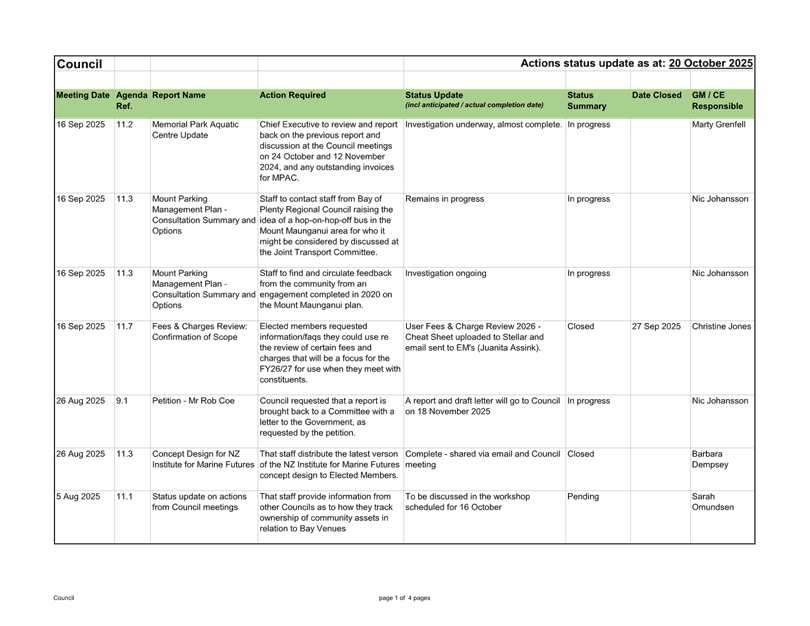
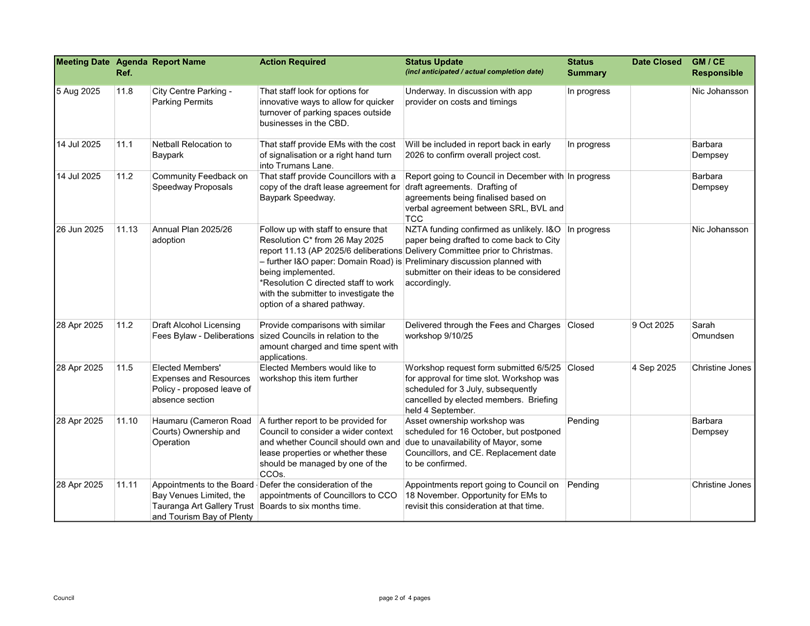
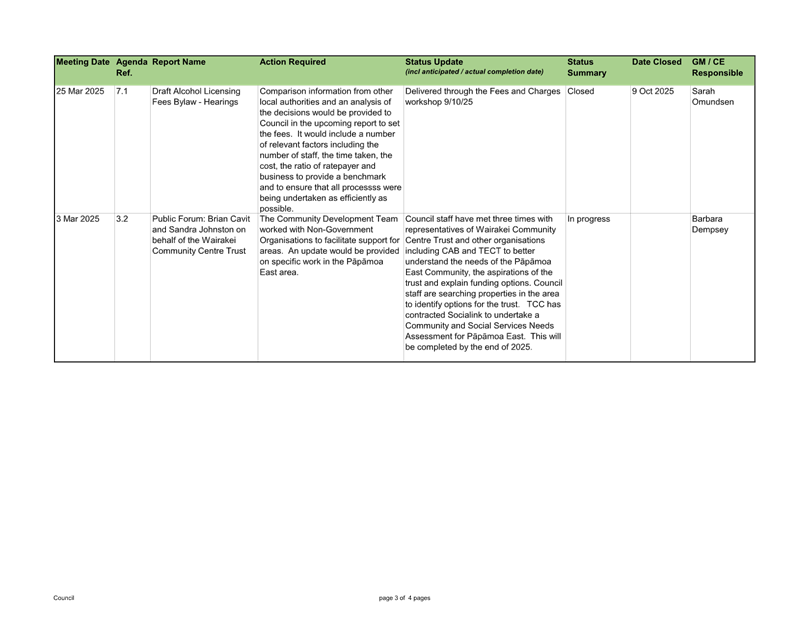
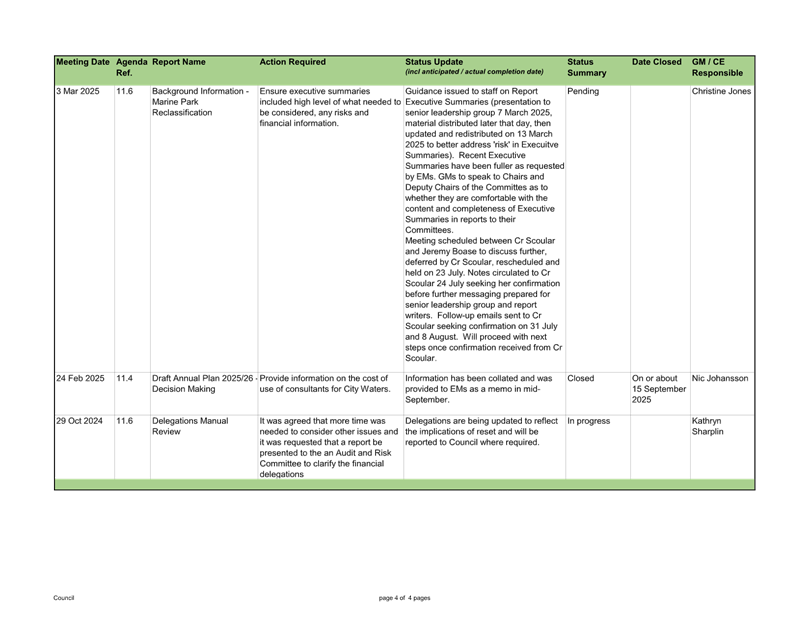
|
Ordinary Council meeting Agenda
|
29 October 2025
|
12 Discussion
of late items
|
Ordinary Council meeting Agenda
|
29 October 2025
|
13 Public
excluded session
Resolution
to exclude the public
|
Recommendations
That
the public be excluded from the following parts of the proceedings of this
meeting.
The
general subject matter of each matter to be considered while the public is
excluded, the reason for passing this resolution in relation to each matter,
and the specific grounds under section 48 of the Local Government Official
Information and Meetings Act 1987 for the passing of this resolution are as
follows:
|
General subject of each matter to be
considered
|
Reason for passing this resolution in
relation to each matter
|
Ground(s) under section 48 for the
passing of this resolution
|
|
13.1 - Local Water Done
Well - Work Programme and Due Diligence
|
s7(2)(b)(ii) - The withholding of the information
is necessary to protect information where the making available of the
information would be likely unreasonably to prejudice the commercial
position of the person who supplied or who is the subject of the
information
s7(2)(i) - The withholding of the information is
necessary to enable Council to carry on, without prejudice or disadvantage,
negotiations (including commercial and industrial negotiations)
|
s48(1)(a) - the public conduct of the relevant
part of the proceedings of the meeting would be likely to result in the
disclosure of information for which good reason for withholding would exist
under section 6 or section 7
|
|
Confidential Attachment 2 -
11.7 - Status update on actions from prior Council meetings
|
s7(2)(h) - The withholding of the information is
necessary to enable Council to carry out, without prejudice or
disadvantage, commercial activities
|
s48(1)(a) the public conduct of the relevant part
of the proceedings of the meeting would be likely to result in the
disclosure of information for which good reason for withholding would exist
under section 6 or section 7
|
|
|
Ordinary Council meeting Agenda
|
29 October 2025
|
14 Closing
karakia