|

|
|
AGENDA
Ordinary Council meeting
Tuesday, 18 November 2025
|
|
I hereby give notice that an Ordinary meeting of
Council will be held on:
|
|
Date:
|
Tuesday, 18
November 2025
|
|
Time:
|
8.30am
|
|
Location:
|
Tauranga City Council Chambers Mareanui
Level 1 - 90 Devonport Road
Tauranga
|
|
Please
note that this meeting will be livestreamed and the recording will be
publicly available on Tauranga City Council's website: www.tauranga.govt.nz.
|
|
Marty Grenfell
Chief Executive
|
Terms of reference –
Council
Membership
|
Chair
|
Mayor Mahé Drysdale
|
|
Deputy Chair
|
|
|
Members
|
|
|
Quorum
|
Half of the members present, where the number of members (including
vacancies) is even; and a majority of the members present,
where the number of members (including vacancies) is odd.
|
|
Meeting
frequency
|
Three weekly or
as required
|
Role
·
To ensure the effective and efficient governance
of the City.
·
To enable leadership of the City including
advocacy and facilitation on behalf of the community.
·
To review and monitor the performance of the
Chief Executive.
Scope
·
Oversee the work of all committees and
subcommittees.
·
Exercise all non-delegable and non-delegated
functions and powers of the Council.
·
The powers Council is legally prohibited from
delegating include:
○
Power to make a rate.
○
Power to make a bylaw.
○
Power to borrow money, or purchase or dispose of
assets, other than in accordance with the long-term plan.
○
Power to adopt a long-term plan, annual plan, or
annual report
○
Power to appoint a chief executive.
○
Power to adopt policies required to be adopted
and consulted on under the Local Government Act 2002 in association with the
long-term plan or developed for the purpose of the local governance statement.
○
All final decisions required to be made by
resolution of the territorial authority/Council pursuant to relevant
legislation (for example: the approval of the City Plan or City Plan changes as
per section 34A Resource Management Act 1991).
·
Council has chosen not to delegate the
following:
○
Power to compulsorily acquire land under the
Public Works Act 1981.
·
Make those decisions which are required by
legislation to be made by resolution of the local authority.
·
Authorise all expenditure not delegated to
officers, Committees or other subordinate decision‑making bodies of
Council.
·
Make appointments of members to the
council-controlled organisation Boards of Directors/Trustees and
representatives of Council to external organisations.
·
Undertake statutory duties in regard to
Council-controlled organisations, including reviewing statements of intent,
with the exception of the Local Government Funding Agency where such roles are
delegated to the City Delivery Committee. (Note that monitoring of all
Council-controlled organisations’ performance is undertaken by the City
Delivery Committee. This also includes Priority One reporting.)
·
Consider all matters related to Local Water Done
Well.
·
Consider any matters referred from any of the
Standing or Special Committees, Joint Committees, Chief Executive or General
Managers.
·
Review and monitor the Chief Executive’s
performance.
·
Develop Long Term Plans and Annual Plans
including hearings, deliberations and adoption.
Procedural matters
·
Delegation of Council powers to Council’s
committees and other subordinate decision-making bodies.
·
Adoption of Standing Orders.
·
Receipt of Joint Committee minutes.
·
Approval of Special Orders.
·
Employment of Chief Executive.
·
Other Delegations of Council’s powers,
duties and responsibilities.
Regulatory matters
Administration,
monitoring and enforcement of all regulatory matters that have not otherwise
been delegated or that are referred to Council for determination (by a
committee, subordinate decision‑making body, Chief Executive or relevant
General Manager).
1 Opening
karakia
2 Apologies
|
Ordinary Council meeting Agenda
|
18 November 2025
|
3 Public
forum
3.1 Nathan York -
Bluehaven regarding Wairakei Pump Station report
Attachments
Nil
3.2 Petr Koch and
Greg Clark - Hawridge - re Wairakei Pump Station
Attachments
Nil
3.3 Philip Brown -
Chair, Papamoa Residents & Ratepayers Assn - to be taken at 1pm
Attachments
Nil
3.4 Richard Coe -
Report on Petition - to be taken at 1pm
Attachments
Nil
|
Ordinary Council meeting Agenda
|
18 November 2025
|
4 Acceptance
of late items
5 Confidential
business to be transferred into the open
6 Change
to the order of business
|
Ordinary Council meeting Agenda
|
18 November 2025
|
7 Confirmation
of minutes
7.1 Minutes of the
Council meeting held on 7 October 2025
File Number: A19321670
Author: Clare Sullivan, Senior Governance Advisor
Authoriser: Sarah Holmes, Team Leader: Governance & CCO Support Services
|
Recommendations
That
the Minutes of the Council meeting held on 7 October 2025 be confirmed as a
true and correct record.
|
Attachments
1. Minutes of the Council
meeting held on 7 October 2025
|
 Ordinary Council
meeting minutes Ordinary Council
meeting minutes
|
7 October 2025
|
|

|
|
DRAFT MINUTES
Ordinary Council meeting
Tuesday, 7 October 2025
|
Order of
Business
1 Opening karakia. 3
2 Apologies. 3
3 Public forum.. 3
3.1 Graham Wilkinson on behalf of Generus Living. 3
4 Acceptance of late items. 4
5 Confidential business to be transferred into the open. 4
6 Change to the order of business. 4
7 Confirmation of minutes. 4
7.1 Minutes of the Extraordinary Council meeting held on 15 August 2025. 5
7.2 Minutes of the Council meeting held on 16 September 2025. 5
8 Declaration of conflicts of interest 5
9 Deputations, presentations, petitions. 5
Nil
10 Recommendations from other committees. 5
Nil
11 Business. 6
11.1 Omanawa Falls Reserve name change. 6
11.2 Elected Members' Code of Conduct 6
11.3 Standing Orders. 7
11.4 Elected Members' Expenses and Resources Policy - proposed leave of
absence section 11
11.5 Street Use and Public Places Bylaw Review: Issues and Options. 11
11.6 Endorsement for New Civil Defence Emergency Management Controllers
& Recovery Managers. 12
12 Discussion of late items. 13
12.1 Authorise International Air Travel for Mayor and two Councillors to
Wollongong, Australia 13
13 Closing karakia. 13
MINUTES OF Tauranga City
Council
Ordinary Council meeting
HELD AT THE Tauranga City
Council Chambers, Level 1 - 90 Devonport Road, Tauranga
ON Tuesday, 7 October 2025 AT
9.30am
|
MEMBERS
PRESENT:
|
Mayor
Mahé Drysdale, Deputy Mayor Jen Scoular, Cr Hautapu Baker, Cr Glen
Crowther, Cr Rick Curach, Cr Steve Morris (online),
Cr Hēmi Rolleston, Cr Marten Rozeboom, Cr Kevin Schuler and Cr Rod
Taylor
|
|
IN
ATTENDANCE:
|
Marty Grenfell
(Chief Executive), Christine Jones (General Manager: Strategy, Partnerships
& Growth), Sarah Omundsen (General Manager: Regulatory & Community
Services), Barbara Dempsey (Acting General Manager: Operations &
Infrastructure), Alison Law (Head of Spaces & Places) , Ana Hancock (Team
Leader: Design), Keren Paekau (Acting Head of Strategic Māori
Engagement), Jeremy Boase (Head of Strategy, Governance & Climate
Resilience), Shawn Geard (Manager: Transport System Operations), Jane Barnett
(Policy Analyst), Sarah Holmes (Governance & CCO Services Team Leader),
Clare Sullivan (Senior Governance Advisor), Caroline Irvin (Governance
Advisor)
|
Timestamps are included beside each of the
items and relate to the recording of the meeting held on 7 October 2025 on the Council's
YouTube channel
1 Opening
karakia
Cr Rolleston opened the meeting with a
karakia.
Acknowledgements
The Mayor congratulated Tauranga writer
Anne Cleary, who was announced as the winner of the Allen & Unwin fiction
prize for her manuscript for Apple Man.
The Mayor also congratulated Leroy Carter
who made his All Blacks debut recently and Emoni Narawa, for their achievements
in recent test matches and wished them well for the future.
2 Apologies
Nil
3 Public
forum
Timestamp - 8 minutes
|
3.1 Graham
Wilkinson on behalf of Generus Living
|
|
·
Graham Wilkinson from Generus Living, together
with Russell Maxwell, Chairperson for the Pacific Lakes Village Residents and
Mike Burgess, Chairperson for the Pacific Coast Village spoke to Council.
·
Mr Wilkinson noted that since 2015 they had
been promised kerb and channelling of Maranui Street, in front of Pacific
Coast Village, but it had been frequently rescheduled. They
acknowledged it was a large undertaking.
·
Generus Living is in the process of completing
a large community facility by the end of November at Pacific Lakes Village
which is across the road from the Pacific Coast Village on Grenada Road. A significant number of residents from both
villages regularly walk backwards and forwards between the complexes.
·
Traffic moves very fast along Grenada Road and
there is heavy usage, particularly in the morning and afternoon peak
periods. There are currently two traffic refuges on Grenada Road.
·
Generus Living hired a traffic consultant and
looked at four options for making the crossings safer. They requested that
Council install raised platforms and pedestrian crossings at the site of both
traffic refuges. They estimate the cost of the two platforms to be
approximately $80,000.
·
Generus Living offered to contribute $20,000
to the cost of the two crossings. Council staff attended a meeting onsite and
provided advice.
·
Mr Wilkinson acknowledged that each of the
options had a risk reduction factor but the raised crossing, together with
the refuge, was quite close to a pedestrian crossing with lights.
|
4 Acceptance
of late items
|
Resolution CO/25/25/1
Moved: Deputy
Mayor Jen Scoular
Seconded: Cr Rick Curach
That the Council:
Accepts the following late item for
consideration at the meeting:
• Authorise International Air
Travel for Mayor and Councillors to Wollongong, Australia
The above item was not included in the
original agenda because it was not available at the time the agenda was
issued, and discussion could be delayed until the next scheduled meeting of
the Committee because a decision was required in regard to this item.
Carried
|
5 Confidential
business to be transferred into the open
Nil
6 Change
to the order of business
Nil
7 Confirmation
of minutes
Timestamp - 22 minutes
Timestamp –
26 minutes
8 Declaration
of conflicts of interest
Nil
9 Deputations,
presentations, petitions
Nil
10 Recommendations
from other committees
Nil
11 Business
Timestamp – 29 minutes
|
11.1 Omanawa
Falls Reserve name change
|
|
Staff Alison Law, Head of Spaces and Places
Ana
Hancock, Team Leader: Design
Keren
Paekau, Acting Head of Strategic Māori Engagement
|
|
Moved: Cr Hēmi Rolleston
Seconded:
Cr RodTaylor
That the Council:
(a) Receives the
report "Omanawa Falls Reserve name change".
(b) Approves
changing the name “Omanawa Falls Reserve” to “Te Rere o
Ōmanawa.
AN AMENDMENT
WAS PROPOSED:
Moved:
Cr Steve Morris
Seconded:
Cr Glen Crowther
That the Council
(c) Acknowledge that
Council reference the name as “Te Rere o Ōmanawa (Ōmanawa Falls
Reserve).”
The proposed amendment was not
put to the meeting.
A
prodcedural motion was proposed to let the report lie on the table.
|
|
Resolution
CO/25/25/4
Moved: Cr
Hēmi Rolleston
Seconded: Deputy Mayor Jen Scoular
That the Council:
(a) Lets
the report lie on the table.
Carried
Reason for decision:
·
Further engagement with Ngāti Hangarau
and whether dual names are appropriate in this instance.
|
Timestamp - 1
hour 25 minutes
|
11.2 Elected
Members' Code of Conduct
|
|
Staff Jeremy Boase, Head of Strategy,
Governance & Climate Resilience
|
|
Moved: Mayor Mahé Drysdale
Seconded: Deputy Mayor Jen Scoular
That the Council:
(a) Receives
the report "Elected Members' Code of Conduct".
and
(b) Adopts the
updated Code of Conduct (Attachment 1 of this report); and
(c) Agrees that the Independent Investigator’s
recommendations are
(ii) Non-binding
on the Council
(d) Provides
for a committee to consider and decide on complaints of breaches under the
Code of Conduct and
(ii) defers
establishing a committee to consider and decide on complaints of breaches
under the Code of Conduct (either binding or non-binding on the Council).
For:
Mayor
Mahé Drysdale, Deputy Mayor Jen Scoular, Cr Hautapu Baker and Cr Rod Taylor
Against:
Cr Glen
Crowther, Cr Rick Curach, Cr Steve Morris, Cr Hēmi Rolleston, Cr Marten Rozeboom
and Cr Kevin Schuler
LOST 4 - 6
|
|
Resolution CO/25/25/5
Moved: Mayor
Mahé Drysdale
Seconded: Cr Hautapu Baker
That the Council:
(a) Receives
the report "Elected Members' Code of Conduct".
And
(b) Reconfirms
the existing Code of Conduct (included as Attachment 3 of this report).
Pursuant to Standing Order 3.2 this
resolution required and received a vote of not less than 75% of the members
present and voting.
Carried
|
At 11.10am the meeting adjourned.
At 11.22am the meeting reconvened.
Timestamp –
1 hour and 56 minutes
|
11.3 Standing
Orders
|
|
Staff Jeremy
Boase, Head of Strategy, Governance & Climate Resilience
|
|
Moved: Cr
Rod Taylor
Seconded:
Mayor Mahé Drysdale
That the Council:
(a) Receives the
report “Standing Orders “.
(b) Adopts the
Standing Orders (Attachment 1 of this report) with the following retentions
and changes:
(i) Based
on the plain English version based on Local Government New Zealand’s
template which includes additions to the “principles” section and
retains the free speech principle.
(ii) Change the
time frame when the Council must resolve to continue a meeting from eight to
six hours (Standing Order 4.2 (b))
(iii) Retain the
delegation to the Chief Executive during the election interregnum period
(Standing Order 6.6)
(iv) Add new Standing Orders 8.9 to 8.12 relating to urgent
meetings following an election that may be called as set out in the
legislation but not previously in Standing Orders.
(v) Add
quorum provisions for the Mayor appointed as a member of a joint committee
solely due to section 41A (5) of the Local Government Act 2002 (where the
Mayor is a member of each committee) they are not counted towards the quorum
(Standing Order 11.4).
(vi) Retain the leave
of absence provisions in Standing Order 13.3.
(vii) Retain the apologies
provisions in Standing Order 13.5.
(viii) Retain the right for
members to attend by audio-visual link (Standing Order 13.7)
(ix) Add
quorum provisions which enables members to be counted towards a quorum when
attending meetings by electronic link (Standing Order 13.8).
(x) Change time
limits for public forum/delegations’ speakers to five minutes
(excluding questions) with a limit of two speakers per organisation and
tighten up restrictions on who can speak at the Mayor/Chair’s
discretion (Standing Orders 15.1, 15.2, 16.1 and 16.2).
(xi) Add that for
petitions presented in an electronic format, the petitioner must indicate as
best they can when presenting the petition how many signatories live within
the Tauranga City Council boundaries (Standing Orders 17.1 (b)).
(xii) Retain the casting
vote provision for the Mayor/Chair (Standing Order 19.3).
(xiii) Retain the recording
of a division if the vote is not unanimous (Standing Order 19.4 €).
(xiv) Retain the ability to use a
suitable electronic voting system (Standing Order 19.4)
(xv) Add references to Code
of Conduct previously removed in 2021 as these did not apply to Commissioners
(Standing Orders 20.2 – 20.3).
(xvi) Add time limits of five
minutes when speaking to motions and amendments (Standing Order 21.2).
(xvii) Retain Option C for motions and
amendments (Standing Order 22.4) and Appendix 5.
(xviii) Add new Standing order 23.5 enabling the meeting to amend a motion subject to the
agreement of the mover and seconder.
(xix) Add additional
“reasons for not accepting an amendment” to Standing Order 23.6
(xx) Add in where
“reasons for decisions” are able to be included in a resolution
(Standing Order 23.13).
(xxi) Add criteria on what is
included in Minutes, agreed at the Council workshop on 3 December 2024
(Standing Order 28.2).
(xxii) Retain Appendix 8 on workshops
and add a few additional points as set out in the Guide to Standing Orders
relating to workshops.
|
|
AN AMENDMENT WAS
PROPOSED
Resolution CO/25/25/6
Moved: Cr
Glen Crowther
Seconded: Cr Rick Curach
That the Council:
(xxiii) Amend Standing Order 15.2 c) to read “the speaker is
personally criticising staff”.
For: Mayor Mahé Drysdale, Deputy Mayor
Jen Scoular, Cr Hautapu Baker, Cr Glen Crowther,
Cr Rick Curach Cr Steve Morris, Cr Hēmi Rolleston, Cr Kevin Schuler and
Cr Rod
Taylor
Against: Cr Marten Rozeboom
Carried 9/1

|
|
The substantive motion, as amended, was
then put to the Council.
|
|
Resolution CO/25/25/7
Moved: Cr
Rod Taylor
Seconded: Mayor Mahé
Drysdale
That the Council:
(a) Receives the
report "Standing Orders ".
(b) Adopts the
Standing Orders (Attachment 1 of this report) with the following retentions
and changes:
(i) Based
on the plain English version based on Local Government New Zealand’s
template which includes additions to the “principles” section and
retains the free speech principle.
(ii) Change the
time frame when the Council must resolve to continue a meeting from eight to
six hours (Standing Order 4.2 (b))
(iii) Retain the
delegation to the Chief Executive during the election interregnum period
(Standing Order 6.6)
(iv) Add new Standing
Orders 8.9 to 8.12 relating to urgent meetings following an election that may
be called as set out in the legislation but not previously in Standing
Orders.
(v) Add quorum
provisions for the Mayor appointed as a member of a joint committee solely
due to section 41A (5) of the Local Government Act 2002 (where the Mayor is a
member of each committee) they are not counted towards the quorum (Standing
Order 11.4).
(vi) Retain the leave
of absence provisions in Standing Order 13.3.
(vii) Retain the apologies
provisions in Standing Order 13.5.
(viii) Retain the right for
members to attend by audio-visual link (Standing Order 13.7)
(ix) Add quorum
provisions which enables members to be counted towards a quorum when
attending meetings by electronic link (Standing Order 13.8).
(x) Change time
limits for public forum/delegations’ speakers to five minutes
(excluding questions) with a limit of two speakers per organisation and
tighten up restrictions on who can speak at the Mayor/Chair’s
discretion (Standing Orders 15.1, 15.2, 16.1 and 16.2).
(xi) Add that for
petitions presented in an electronic format, the petitioner must indicate as
best they can when presenting the petition how many signatories live within
the Tauranga City Council boundaries (Standing Orders 17.1 (b)).
(xii) Retain the casting
vote provision for the Mayor/Chair (Standing Order 19.3).
(xiii) Retain the recording
of a division if the vote is not unanimous (Standing Order 19.4 (e)).
(xiv) Retain the ability to use a
suitable electronic voting system (Standing Order 19.4)
(xv) Add references to Code
of Conduct previously removed in 2021 as these did not apply to Commissioners
(Standing Orders 20.2 – 20.3).
(xvi) Add time limits of five
minutes when speaking to motions and amendments (Standing Order 21.2).
(xvii) Retain Option C for motions and
amendments (Standing Order 22.4) and Appendix 5.
(xviii) Add new Standing order 23.5
enabling the meeting to amend a motion subject to the agreement of the mover
and seconder.
(xix) Add additional
“reasons for not accepting an amendment” to Standing Order 23.6
(xx) Add in where
“reasons for decisions” are able to be included in a resolution
(Standing Order 23.13).
(xxi) Add criteria on what is
included in Minutes, agreed at the Council workshop on 3 December 2024
(Standing Order 28.2).
(xxii) Retain Appendix 8 on workshops
and add a few additional points as set out in the Guide to Standing Orders
relating to workshops.
(xxiii) Amend
Standing Order 15.2 c) to read “the speaker is personally criticising
staff”.
For: Mayor Mahé Drysdale, Deputy Mayor
Jen Scoular, Cr Hautapu Baker, Cr Rick Curach, Cr
Hēmi Rolleston, Marten Rozeboom Cr Kevin Schuler and Cr Rod Taylor
Against: Cr Glen Crowther, Cr Steve Morris,
Carried 8/2
Pursuant to Standing Order 3.2 this
resolution required and received a vote of not less than 75% of the members
present and voting.
|
Timestamp - 2
hours and 28 minutes
|
11.4 Elected
Members' Expenses and Resources Policy - proposed leave of absence section
|
|
Staff Jeremy Boase, Head of Strategy, Governance & Climate
Resilience
|
|
Resolution CO/25/25/8
Moved: Cr
Glen Crowther
Seconded: Cr Marten Rozeboom
That the Council:
(a) Receives the
report "Elected Members' Expenses and Resources Policy - proposed leave
of absence section".
(b) Adopts
Tauranga City Council’s Elected Members’ Expenses and Resources
Policy 2025 (Attachment 1) to take effect immediately.
Carried
|
Timestamp - 2
hours and 41 minutes
|
11.5 Street
Use and Public Places Bylaw Review: Issues and Options
|
|
Staff Sarah Omundsen, General Manager Regulatory and Community Services
Shawn
Geard, Manager: Transport Systems Operations
Jane
Barnett, Policy Analyst
|
|
Resolution
CO/25/25/9
Moved: Mayor
Mahé Drysdale
Seconded: Cr Marten Rozeboom
That the Council:
(a) Receives the
report "Street Use and Public Places Bylaw Review: Issues and
Options".
(b) Approves the
following options for the purpose of developing a draft bylaw:
|
No.
|
Issue
|
Option
|
|
1
|
Definition of pedestrian way
|
Option 1B: Amend the pedestrian way
definition to 1.8 metres wide and located 1.5 metres from any shop front,
unless otherwise specified by Council resolution.
|
|
2
|
Definition of a mobile shop
|
Option 2B: Amend the definition of a
mobile shop to include services – ‘a vehicle from which
goods or services are offered for sale.’
|
|
3
|
Approach to setting rules for street dining
|
Option 3D: Allow all
businesses (including current LTO areas) to use a set area and any
additional area would require an LTO.
|
|
4
|
Approach to setting rules for retail displays
|
Option 4D: Allow some area for
retail display and require a permit/LTO for any additional area.
|
|
5
|
Approach to set rules for non-retail displays
|
Option 5E: Allow a set area for non-retail display and require a
permit/LTO for any additional area.
|
|
6
|
Approach to setting rules for signs
|
Option 6A: Current approach with general conditions and permission for set
types of signs. (Status quo)
Note: As part of the review process the general sign conditions
in the bylaw will be clarified and updated.
|
|
7
|
Approach to setting rules for real estate signs
|
Option 7B: Clarify the current rules by amending the bylaw to include:
· a definition of a real estate sign
· a maximum number of real estate signs for each premises
· placement, number and duration conditions for open homes and
auctions signs
· conditions of an open home or auction real estate sign
|
(c) Request that
a draft bylaw be prepared based on the direction provided and then presented
to Council for consideration prior to adoption for consultation.
Carried
|
Timestamp - 3
hours and 41 minutes
|
11.6 Endorsement
for New Civil Defence Emergency Management Controllers & Recovery
Managers
|
|
Staff Sarah Omundsen, General Manager Regulatory and Community Services
|
|
Resolution
CO/25/25/10
Moved: Cr
Rick Curach
Seconded: Cr Kevin Schuler
That the Council:
(a) Receives the
report "Endorsement for New Civil Defence Emergency Management
Controllers & Recovery Managers".
(b) Endorse the
appointment of the following Local Controllers for Tauranga City Council:
(i) Tom
McEntyre – City Operations Delivery Manager
(ii) Deidre
Ewart - Head of Regulatory Support & Compliance Services
(iii) Steve
Pearce - Head of Building Services
(iv) Gareth Wallis -
Head of Community Hubs, Arts, Heritage & Events
(c) Endorse the
appointment of the following Local Recovery Managers for Tauranga City
Council:
(i) Nelita
Byrne - Manager of Venues and Events
(ii) Alana
Rapson - Team Leader – Community Development
(iii) Daniel
Pearce - Team Leader – Emergency Management
Attachment
2 is to stay in public excluded to protect the
privacy of natural persons.
Carried
|
Timestamp - 3
hours and 46 minutes
12 Discussion
of late items
The Mayor took no
part in item 12.1. Deputy Mayor Jen Scoular assumed the chair for the
consideration of this item.
|
12.1 Authorise
International Air Travel for Mayor and two Councillors to Wollongong,
Australia
|
|
Staff Jeremy Boase, Head of Strategy, Governance & Climate
Resilience
|
|
Resolution CO/25/25/11
Moved: Deputy
Mayor Jen Scoular
Seconded: Cr Rod Taylor
That the Council:
(a) Receives the
report "Authorise International Air Travel for Mayor and two Councillors
to Wollongong, Australia".
(b) Authorises
the Mayor’s and Councillor’s Rolleston and Schuler international
air travel of $ (airfares $4,393.67 and accommodation $8,485.44) to
Wollongong, Australia from 15 October 2025 to 20 October 2025.
For: Deputy Mayor Jen Scoular, Cr Hautapu Baker, Cr Glen Crowther, Cr
Rick Curach, Cr Steve
Morris, Cr Marten Rozeboom, and Cr Rod Taylor
Abstain: Mayor Mahé Drysdale, Cr Hēmi
Rolleston and Cr Kevin Schuler
Carried
|
The Mayor resumed the Chair.
The Mayor acknowledged Nic Johansson who was leaving Council after 6 and a half years and
wished him well.
13 Closing
karakia
Cr Hēmi Rolleston closed the meeting
with a karakia.
The meeting closed at 1.18 pm.
The minutes of this meeting were
confirmed as a true and correct record at the Ordinary Council meeting held on
18 November 2025.
|
Ordinary Council meeting Agenda
|
18 November 2025
|
8 Declaration
of conflicts of interest
9 Deputations,
presentations, petitions
Nil
10 Recommendations
from other committees
Nil
|
Ordinary Council meeting Agenda
|
18 November 2025
|
11 Business
11.1 Wairākei Pump Station
- Funding Risk
File Number: A19035861
Author: Richard Conning, Programme Manager: Delivery
Andrew
Mead, Head of City Planning & Growth
Alex
Miller, Head of Environmental Planning
Frazer
Smith, Manager: Strategic Finance & Growth
Karrie
Downey, Principal Wastewater Planning
Authoriser: Christine Jones, General Manager: Strategy, Partnerships &
Growth
Please note that this report contains confidential attachments.
|
Public Excluded Attachment
|
Reason why Public Excluded
|
|
Item
11.1 - Wairākei Pump Station - Funding Risk - Attachment 5 -
Confidential - Memorandum - Wairakei Pump Station - Legal Risk
|
s7(2)(g)
- The withholding of the information is necessary to maintain legal
professional privilege.
|
Purpose of the Report
1. To seek
a decision in relation to progressing the Wairākei Pump Station and
Wairākei Rising Main projects given risk associated with funding allocated
to the Te Tumu urban growth area and the possibility that an alternative
wastewater solution may be adopted for Te Tumu in future.
|
Recommendations
That
the Council:
(a) Receives the
report "Wairākei Pump Station - Funding Risk".
(b) Notes that
delaying, redesigning or abandoning the Wairākei Pump Station and
Wairākei Rising Main projects would create greater environmental,
development and financial risks than proceeding.
(c) Approves
proceeding with the Wairākei Pump Station (construction) and
Wairākei Rising Main projects (design then construction) – Option
A.
(d) Notes that
the General Manager Operations and Infrastructure will review the cost
estimates and procurement approach with the view to delivery cost
efficiencies and value for money and report back to Council on this review.
(e) Notes that
if the funding risk associated with an alternative Te Tumu wastewater
solution materialises it will be considered and addressed through a future
Long Term Plan process.
(f) Notes
that staff will ensure Te Tumu funding allocations for these projects and
others like the Opal Drive pump station will be considered when assessing the
merits of alternative Te Tumu / eastern corridor wastewater options against
the option of reticulating wastewater from Te Tumu to the Te Maunga treatment
plant.
(g) Attachment
5 will remain in public excluded to protect legal privilege.
|
Executive Summary
2. The
Wairākei Pump Station and Wairākei Rising Main projects are part of a
broader eastern corridor wastewater servicing strategy for the Papamoa,
Wairākei and Te Tumu urban growth areas.
3. Of
the around 2,000 lots remaining to be developed in Wairākei and Papamoa
within the pump station catchment, around 1,700 have already been
consented.
4. Project
delivery has been designed in a staged manner. Through the 2024-34 Long
Term Plan (LTP) process it was agreed to minimise expenditure in the early
years associated with the Te Tumu urban growth area and focus on investment
required to enabled zoned development to progress in the Papamoa and
Wairākei areas.
5. The
funding for both the Wairākei Pump Station and Wairākei Rising Main
projects is included in the approved Annual Plan (AP) and 24-34 LTP.
6. Across
the eastern corridor Phase 1 wastewater projects being delivered in the current
LTP period approximately $50M of cost is allocated to Te Tumu development
contribution funding. Approximately $27M relates to Wairākei pump station
and $3M with the Wairākei Rising Main. The rest relates to the Opal
Drive Pump Station (in construction) and the Te Tumu Rising Main (being
delivered in stages as the Wairākei town centre roads are built).
7. There
are complexities with the Te Tumu urban growth project in general which create
risk around the recovery of these funds, and specifically from a wastewater
perspective. Both TCC and the Te Tumu landowners are assessing
alternative wastewater solutions to enable development in Te Tumu.
8. It
should be noted that through the 2024-34 LTP process the Te Tumu landowners
strongly advocated for TCC to include all wastewater reticulation projects to
the Te Maunga Wastewater Treatment Plant in the LTP and at that stage
alternative options were not actively being considered.
9. Decision-making
is required on whether Council wishes to proceed with the Wairākei Pump
Station project which is ready for construction and the Wairākei Rising
Main project which is ready for design followed by construction.
10. Staff
have identified and considered the following options:
(a) Progress
the projects as planned
(b) Delay the
projects until there is greater certainty on the Te Tumu wastewater solution
(c) Redesign the
pump station to remove capacity associated with Te Tumu and then proceed to
construction
(d) Cancel /
abandon the projects.
11. Options B and
C are not favourable as:
(a) Removing Te
Tumu related capacity from the project will not provide a significant project
cost reduction due to costs to redesign and market escalation. Hence these
options would not mitigate Te Tumu related funding risks.
(b) Would create
project delivery delays, exacerbating already critical wastewater overflow and
asset failure risks with associated environmental impacts
(c) Would likely
result in development delays in Wairākei as new connections to the
wastewater network are limited or prevented until additional wastewater
capacity is delivered.
12. Option D is
also unfavourable. While it would mitigate the Te Tumu funding risk it
would create a much larger reduction in revenue for TCC and ultimately put TCC
in a worse financial position. It would result in the inability to enable
further development in Wairākei / Papamoa East where around 2,000
additional homes are expected alongside the development of the Wairākei
town centre and adjoining business land (which TCC is already delivering other
infrastructure for, such as the Papamoa East Interchange). Almost all of
this development already has resource consent to progress, including a
comprehensive development consent for the whole Wairākei town
centre. The only unconsented developments of note are two stages of the
Palm Springs subdivision and the TCC surplus land around the Papamoa East
Interchange.
13. It is assessed
that approximately $125M (NPV $101.1M) of development contribution revenue
would be collected from this development, or forgone if this development was
unable to proceed. Further to this is the on-going rating base / rates
revenue TCC would collect. In addition, TCC owns a significant amount of
surplus land around the Papamoa East Interchange, and its use, development or
divestment would be prevented.
14. While Option
A, proceeding with the projects, creates approximately $30M of funding risk for
TCC, it is assessed as the best option. The funding risk would only
materialise if Te Tumu did not proceed or was developed using an alternative
wastewater servicing solution, both of which are uncertain. Option A
would enable the collection of remaining development contributions, generate
additional rating revenue and enable Council to progress options for its
surplus land holdings.
15. The Te Tumu
funding risks will be assessed as part of the current work on alternative
wastewater options for Te Tumu which will be reported back to Council for
decision-making. If the Te Tumu funding risk materialises, options to
address it will be considered through a forthcoming LTP process.
Background
16. The
Wairākei Pump Station (PS) is ready to move from design to construction.
However, recent developments regarding the Te Tumu Urban Growth Area (UGA) have
introduced a significant funding risk. Specifically, if Te Tumu developers
proceed with an alternative wastewater servicing option, the associated
development contributions (DCs) that are assigned to fund 74% of the pump
station may no longer be available. A decision is needed whether the project
should proceed as planned, be deferred, or be redesigned to exclude Te Tumu
flows.
17. While the
focus of this paper is the funding risk associated with the construction of the
Wairākei pump station there are several interrelated and interdependent
projects within the Eastern Corridor Wastewater programme potentially affected
by the decision to be made. On this basis a whole of network approach is
discussed in this paper with specific projects within the programme highlighted
to ensure that an informed decision can be made.
18. The Eastern
Corridor Wastewater Servicing Strategy (ECS), developed in 2018, is to service
the wastewater needs of the eastern corridor catchment via a series of pump
stations and pipelines that reticulate wastewater to the Te Maunga Wastewater
Treatment Plant (TMWWTP). Figure 1 outlines the projects that make up the ECS.
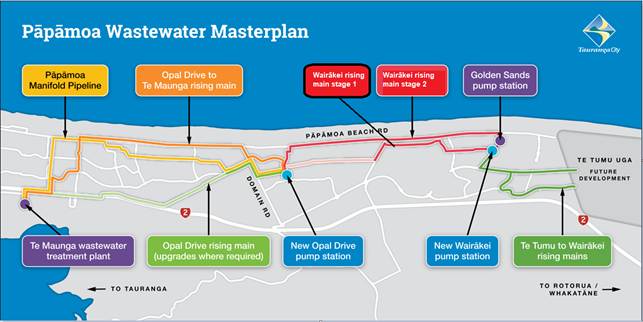
Figure 1 - eastern corridor wastewater strategy key assets
and projects
19. During the
development of the strategy consideration was given to an alternate site for
the Wairākei PS site. The existing site was adopted due to a combination
of factors including being owned by TCC, having an existing designation in
place and a favourable Phase 2 pipeline corridor to Opal Dr PS. Factors against
the alternate site included, land purchase resource consenting or designation
challenges, the need to realign existing pipelines and a less favourable Phase
1 and 2 pipeline corridors.
20. This strategy
accommodates the projected growth within the Eastern Corridor catchments of
Papamoa, Wairākei and Te Tumu. This approach was confirmed by previous
Councils through various technical assessments and options analysis. The Te
Tumu landowners have been aware of the strategy since 2018, and during the
2024-34 LTP process their desire was to accelerate the programme to allow
development in Te Tumu to occur sooner.
21. The strategy
provides for the staged delivery of upgraded and new trunk rising mains and
pump stations to service Papamoa, Wairākei and Te Tumu. This solution
builds on existing infrastructure and treatment capacity at Te Maunga WWTP,
with new infrastructure and progressive upgrades required as development in
different growth areas proceeds. This is a ‘whole of network
approach’, since 2018 the planning process has refined the strategy to be
an optimized, staged approach, to service committed growth and defer investment
where possible to align to urban growth area triggers. Refer to
Attachment 1 for a summary of the Eastern Corridor Programmes’ FY20-45
timing sequence and funding values and splits.
22. The
establishment of new rising mains in addition to the existing ones also provide
resilience to the system should the current trunk mains, which are largely
located in liquefiable land, fail during a natural hazard event.
23. Early
Contractor Involvement (ECI) was adopted as the delivery model for the
Wairākei PS, the contractor constructing the Opal Dr PS has been engaged
to deliver ECI services to leverage their learnings on the Opal Dr PS project.
The Opal Dr and Wairākei sites have similar ground conditions and elements
to be delivered.
24. The ECI
process has yielded significant benefits in relation to optimization of the
construction process, value engineering and risk mitigation. The ability of the
contractor to influence the site layout early in the design process to optimize
construction sequencing for maximum efficiency has been a key driver in the
benefits realised from the process. An analysis of the benefits of the ECI
process at the end of preliminary design assessed the value of avoided cost at
$1.5M - $2.3M.
Current State: Network Capacity
and Condition
Golden Sands Pump Station (PS)
25. This PS is
currently operating as the main trunk network pump station to convey flows west
from the Wairākei UGA to Opal Dr pump station. The pump station is already
below the required peak flow capacity. The pump station can pass forward a
maximum of ~85 L/S, while the theoretical wet weather peak incoming flows based
on calibrated measurements of the contributing pump stations in the network
significantly exceed this at ~120 L/S.
26. In addition,
the peak dry weather flow (the maximum flow expected to be seen daily even in
dry weather) will reach ~84 L/S by 2034, meaning there will be a risk of
wastewater overflows daily, even in dry weather.
27. An assessment
in 2008 concluded it was not feasible to upgrade the existing Golden Sands PS
to provide the initial 140l/s planned to be delivered by the new Wairākei
PS due to physical and hydraulic constraints within the wet well. Based on
capacity and operational constraints the pump station should be replaced as
soon as possible with the new Wairākei PS.
Existing Papamoa East Rising Main (PERM)
28. This is the
existing rising main (pipeline) which conveys all flows from the Wairākei
UGA to Opal Drive PS, starting at Golden Sands PS with several other pump
stations joining the same line at various locations downstream. The line
consists of ~1.6KM of DN300 PVC pipe (upstream) and ~3.KM of larger DN450 PVC
pipe (downstream).
29. In 2023 a
comprehensive assessment of condition and performance identified critical
issues with the DN300 PVC section, being:
· The DN300 section poses an unacceptable risk of failure and should
be taken out of service. Pressure monitoring and modelling show that this
section has likely suffered cumulative fatigue damage over its 20+ years of
service.
· The DN300 section of the main is a significant bottleneck in the
system and restricts overall pumping capacity.
30. Upgrading the
Golden Sands PS (or replacing it with the new Wairākei PS), without
replacing and upsizing the DN300 section is not advisable given the poor
condition and lack of capacity within the DN300 section of pipeline. Continued
operation of the existing pipeline will highly likely lead to fatigue failure
of the pipe and wastewater overflows into the Wairākei Stream and/or
residential streets. The upgrade project for this pipeline is the Wairākei
Rising Main Phase 1 project.
31. The 2024
population data indicates that at that time approximately 10,760 residents plus
schools, daycare and commercial developments are served by the Golden Sands
pump station and the 300mm PVC section of the PERM. Based on the 2024 data
there is approximately 3.5 hours of emergency storage with the network based on
average dry weather flows, this timeframe shrinks to approximately 1.6 hours
under peak wet weather flows. The period of emergency storage will decrease as
the population of the contributing catchment increases. Staff estimate that a
repair to the PERM will take at least 24 hours depending on the location and
nature of the failure. It is likely that residents and business’ ability
to use the wastewater network will be impacted as a result.
32. There has been
one wastewater overflow in the network to date due to capacity issues.
Golden Sands Drive throttle
33. The gravity
pipeline upstream of the Golden Sands PS has been identified as a significant
capacity constraint within the Wairākei network. This section of pipeline,
a DN225 gravity sewer, receives discharge from multiple upstream pumping
stations and then conveys flow to Golden Sands PS. The pipeline’s
capacity is ~55 L/S, the combined upstream pump stations peak flow can exceed
120 L/S at full build out of their catchments. This means there is a
significant surcharge and overflow risk currently, which increases as growth
continues in the Wairākei UGA.
34. A short-term
intervention (until Golden Sands PS is replaced with Wairākei PS) has been
designed to address the current capacity constraint at Golden Sands Drive. This
includes extending PS152 rising main to bypass the throttle and upgrading PS152
to deal with increased pressure. This element had a value of $1.3M assigned
when the total budget for the Wairākei Rising Main Phase 1 project was
built up in the planning phase. Through the design process and having received
the ECI contractors 50% detailed design cost estimate, the expected value to
deliver the intervention is $850,000.
35. Due to the
close proximity and construction synergies with the Wairākei Pump Station,
it is planned that the same contractor will deliver both projects. While the
intervention could be delivered as a standalone package, it will ultimately
connect Golden Sands PS to the new Wairākei PS.
36. Should
construction of the Wairākei PS and Phase 1 rising main upgrades be
deferred in favour of further ‘sweating’ of the assets, the
incoming gravity main from the Golden Sands Drive stream crossing to Golden
Sands PS remains a significant capacity constraint, and wastewater overflow
risks will remain at this location and at PS152. As a result, new wastewater
connections would have to be limited or prevented, further work is required to
determine TCC’s position on enabling any further connections.
Staged Approach:
Interdependencies within the programme
37. The Eastern
Corridor Wastewater Programme is structured around a staged delivery approach,
with each project sequentially programmed and interlinked to ensure capacity is
provided in alignment with growth triggers. Phase 1 projects are critical to
servicing existing and planned (zoned) growth in Wairākei and Papamoa
East, and include the Opal Drive Pump Station, Wairākei Pump Station, and
Wairākei Rising Main Phase 1.
38. These projects
are designed to mitigate current capacity and asset condition risks and enable
continued, planned development. Phase 2 projects, such as the second rising
mains and pump station upgrades, are planned to support future growth,
particularly in Te Tumu, and will be reassessed depending on the outcome of the
Te Tumu servicing strategy.
39. The
interdependencies between these projects mean that delays or changes to one can
have cascading impacts on others. For example, the Wairākei Rising Main
Phase 1 must be operational before the new Wairākei PS can be
commissioned. Opal Drive Pump Station’s capacity is designed to align
with future rising main installations. A full summary of these
interdependencies and project staging is provided in Attachment 2.
40. The
dependencies between the Wairākei PS project and the Wairākei Rising
Phase 1 project are even more complex, relating to existing capacity and
condition issues, and are summarized in Attachment 3.
41. The staged
approach has been enabled by the development of a dynamic wastewater model,
flow gauging and updated asset and performance information. The Phase 1
projects are needed urgently to provide for existing and planned growth in
currently zoned areas. The inflight Phase 1 projects are:
· Opal Dr PS – under construction
· Wairākei PS – ready to construct
· Wairākei Rising Main Phase 1 – to be designed
42. A staged
approach is also being taken in the delivery of the Opal Dr and Wairākei
pump stations. They have been designed to service the ultimate demand of the
Wairākei and Te Tumu UGA’s but will only have an installed pumping
capacity to service the Stage 1 (Wairākei) demand. The wet wells (large
concrete in ground structure that houses the pumps), generator and control
buildings at each pump station will be constructed to service the ultimate
demand.
43. Stage 2
upgrades to the pump stations will include additional pumps, upgrades to
electrical switchboards and installation of larger standby
generators.
44. Both pump
stations are located on geotechnically challenging and constrained sites, a
staged approach to the construction of the wet well at either site would
present significant risk in terms of operability, constructability and damage
to the existing structures as a result of construction activities. Likewise
given the constrained sites reconstruction or expansion of the generator or
control buildings at a later date would present significant constructability
and operational challenges. All the buildings are either precast concrete or
blockwork construction.
Optimised Design
45. For both the
Wairākei and Opal Dr pump station projects the investment in the
structural elements (above and below ground) has been optimised by adopting a
design approach that provides a higher level of seismic performance to the
structures that are buried and will therefore be very difficult to repair in
the event of a significant seismic event.
46. Lower
criticality or easier to repair structures have been designed to a lower level
of seismic performance. This investment logic has been adopted to
minimise the risk of over designing and therefore over investing in pump
station elements that are either of low criticality to the operation of the
pump station or would be relatively easy to repair.
47. For
Wairākei pump station this approach has resulted in only the wet well
being supported on reinforced concrete piles while the balance of the site,
including the generator and control room buildings are supported on stone
column improved ground.
Wairākei PS: Redesign Considerations
48. A high-level
assessment in relation to a redesign process to design out capacity for Te Tumu
flows and potential for cost savings has been carried out to inform this
report. The assessment considered a reduction in scale of the structures and
pipework of the current detailed detail. A redesign of this nature is unlikely
to yield significant costs savings, if any, due to the construction savings
being offset by the costs to redesign and market escalation (3% per annum
adopted for the analysis).
49. The ability to
reduce the size of the wet well is limited by the need to ensure it has
sufficient volume to deliver daily flushing flows down the rising main to Opal
Dr PS. Flushing flows are an important operational measure to reduce material
build up on pipelines to ensure their operational capacity. The Southern
Pipeline (Memorial Park to Te Maunga WWTP) was designed and is operated in the
same way.
50. A significant
driver of the cost to deliver the pump station is the geotechnically
challenging nature of the site which requires 43m deep, 2.4m diameter
reinforced concrete piles to support the wet well, and stone column ground
improvement to support the structures and pipework on the balance of the site.
The high-level assessment determined a redesign would result in a slightly
reduced stone column scope but no reduction in the pile size.
51. It should be
noted that redesigning and constructing the Wairākei PS to provide
capacity to service the Wairākei UGA only will remove the ability to
service Te Tumu or other unplanned growth, i.e. Bell Rd South, via the pump
station. This is due to the highly constrained and geotechnically challenging
nature of the site. Redevelopment to increase the pump station’s capacity
would create significant construction and operational risk. In the scenario
that Te Tumu is required to be serviced via the Eastern Corridor network a
second pump station on a new site would be required to pump flows to Opal Dr
PS.
Te Tumu Alternative Servicing
Assessment
52. Recent
engagement with Te Tumu landowners has highlighted significant concerns
regarding the time, cost and feasibility of the current wastewater servicing
strategy, which relies on conveying flows from Te Tumu through the
Wairākei and Opal Drive pump stations to the Te Maunga Wastewater
Treatment Plant (WWTP).
53. In response,
Council has initiated a high-level reassessment of wastewater servicing options
for the Te Tumu Urban Growth Area (UGA), with funding approved in the 2025/26
financial year to support this work. This issue and the assessment were the
subject of a report to the City Future Committee on 12 August 2025, the
committee resolved:
· Notes the Eastern Corridor
Wastewater options reassessment project programmed for the 2025/26 financial
year and that this project will involve the Tumu landowners and the parallel
wastewater investigations they are undertaking.
· Notes that staff will
continue to liaise with developers who wish to deliver alternative wastewater
infrastructure at their own cost, subject to all relevant planning, technical,
and statutory requirements, and that staff will report back on the options developers
have considered.
· Notes that there is
infrastructure challenges associated with Te Tumu other than wastewater
servicing (particularly access and stormwater management) and these need to be
resolved as a package to enable development to proceed
The reassessment will explore alternative servicing
options, including:
· Localised treatment solutions
(e.g. standalone WWTPs within Te Tumu),
· Regional servicing options
(e.g. a new WWTP to service Te Tumu, Wairākei South / Bell Road fast track
development, growth in Te Puke and other future growth areas).
54. This work is
being undertaken in collaboration with Western Bay of Plenty District Council
(WBOPDC) and Te Tumu landowners, some of whom are independently investigating
alternative wastewater solutions. The assessment will compare these
alternatives against the current strategy in terms of cost, risk, timing,
consenting pathway, environmental and cultural impacts, and feasibility.
55. In addition, a
review of the costs of the Phase 2 pipelines to Te Maunga WWTP is currently
underway as part of Council’s Infrastructure Priorities Programme (IPP)
submission. The outcome of the review will be compared to other options
including localised treatment solutions.
56. Staff have
also connected with a representative of the Bell Road fast-track proposal who
advised they are focused on working with WBOPDC to manage wastewater through
their Te Puke WWTP. Other options such as connecting to the TCC network
or to a new system in Te Tumu / eastern corridor were not seen as favourable
for a range of reasons e.g. long lead in times, significant uncertainties and
high cost. Earlier this month WBOPDC announced that it is proceeding with
a $96m replacement wastewater treatment plant in Te Puke that will cater for
growth (including the Rangiuru Business Park).
Implications for Funding and Infrastructure
57. If Te Tumu
wastewater flows are ultimately serviced outside of the Tauranga City Council
network, there are significant implications for the funding of key
infrastructure projects:
· Wairākei PS: Currently designed to service both Wairākei
and Te Tumu, with 74% of its funding expected from Te Tumu Development
Contributions (DCs). If Te Tumu flows are diverted, this funding will not be
received, placing the funding plan for the pump station at risk. It is not
feasible to reallocate costs to the Wairākei urban growth area as the vast
majority of development in this area is either complete or is consented (and
hence has its development contributions locked in).
· Opal Drive Pump Station: Already under construction, with 41% of its
funding allocated from Te Tumu DCs. If Te Tumu is not serviced by this
infrastructure, Council will need to reconsider funding sources.
· Te Tumu Rising Mains: Sections of these mains under roads being
built in the Wairākei town centre have already been constructed or are
underway, funded entirely by Te Tumu DCs. Without Te Tumu development, there
will be no funding source for this project, resulting in sunk costs and
stranded assets. The value of the currently installed sections in Te Okuroa Dr
and The Boulevard is $1.3M, with a further $350K budgeted to reimburse
Bluehaven for installation in The Boulevard as they extend the road towards the
Te Tumu boundary this and next financial year.
· Later stages of the strategy: scope of the stage 2 of the Opal Drive
and Wairākei projects, which aims to increase the capacity of the pump
stations and pipelines, will have to be assessed based on lower future flows.
As shown in Appendix 2, the Opal Drive system will need additional capacity in
the future even without Te Tumu flows to meet acceptable operational capacity.
Any unplanned growth in existing zoned areas is not catered for with stage 1
projects.
Timelines
and Strategic Considerations
58. The
reassessment of the Te Tumu wastewater servicing options (refer paragraph 53
above) is expected to take approximately 9 months to complete (end of FY26),
with further time required for detailed design, consenting, and implementation
of any alternative solution (2 – 3 years for consenting). This means that
a final decision on Te Tumu servicing could be several years away.
59. The consenting
process for a new wastewater treatment plant (WWTP) is complex, time-consuming,
and requires significant upfront investigation. Insights from GHD’s
Technical Lead Planning and industry case studies highlight that even upgrades
to existing plants, such as the Cambridge WWTP (20,000 population equivalent),
took three years to consent and a further two years to construct.
60. For new WWTPs,
such as the Hamilton Southern plant, the consenting process alone took five
years, preceded by feasibility studies and then followed by construction. These
timelines reflect the need for extensive site selection, environmental
assessments, stakeholder engagement, and robust consideration of alternatives.
61. For Te Tumu,
where a new WWTP would be required to service approximately 15,000 people, the
consenting process is expected to be similarly lengthy. Baseline environmental
investigations, which are essential for assessing discharge impacts, can take
years due to seasonal data requirements. While smaller, localised WWTPs may be
quicker to consent, the scale of Te Tumu’s needs makes this a significant
undertaking.
62. At present, it
is unclear how far Te Tumu landowners have progressed with land discharge
investigations. Without this foundational work, the feasibility and viability
of a WWTP in Te Tumu remains uncertain. Overall, the consenting process alone
could take at least three years, in addition to the 12-month high-level
servicing assessment currently underway.
63. It is noted
that the Resource Management Act reforms and the Draft Environmental
Performance Standards may reduce the timeframes presented above. However, at
this point there is insufficient information available to assess what the
likely processes and timeframes under these new frameworks will be.
64. In the
interim, Council must consider whether to proceed with the Wairākei PS as
designed, redesign it to exclude Te Tumu flows, or defer construction until the
outcome of the reassessment and direction on a wastewater servicing strategy is
known.
65. Given the
interdependencies across the Eastern Corridor wastewater programme, any change
to Te Tumu servicing will have cascading impacts on infrastructure planning,
funding, and delivery.
66. Potentially
some or all of Wairākei could be serviced by a new Te Tumu / eastern
corridor wastewater treatment plant. Operational issues would need to be
addressed with the current system designed to pump to Te Maunga, meaning it
would have to be altered (at significant cost) to pump in a different
direction. The timeframe for having a new treatment plant operational is
also substantial (estimated 8-10+ years) meaning remaining growth in
Wairākei would be delayed for a significant period.
Statutory Context
67. Under the
Resource Management Act 1991 and the Bay of Plenty Regional Plan, resource
consents are required for discharges of wastewater, and infrastructure must be
designed and operated to avoid adverse effects on water bodies and public
health. Council does not hold a resource consent for wastewater overflows in
the network, overflows in the area around the Wairākei PS have a high
chance of reaching the Wairākei Stream. Consequences of a non-compliant
discharge could include infringement and/or abatement notices, or prosecution,
which could result in significant financial penalties. There is also the risk
of damage to the council's reputation and loss of public trust.
68. TCC does not
have a statutory requirement to provide infrastructure to support the
development of land zoned for urban development, however it has signalled
through its current LTP and Annual Plan that it plans to proceed with these
wastewater projects.
69. As the
consenting authority for new developments and subdivisions, TCC is required to
ensure that any growth has appropriate servicing, either via public or private
infrastructure. Applications which rely on private infrastructure typically
have a much higher threshold for approval, based on the high risks associated
with having landowners responsible for maintaining and operating highly
technical plant.
70. A number of
resource consents have already been granted based on capacity being made
available through the Wairakei PS being brought online in accordance with the
LTP. Although a resource consent is not a legally binding agreement that
services will be provided, TCC would likely be exposed to significant legal
risk if these developments were to proceed through construction on the basis
that capacity is available, only to late be declined a service connection
necessary for sale and occupation. Refer to Attachment 5, for confidential
legal advice on this issue.
STRATEGIC ALIGNMENT
71. This
contributes to the promotion or achievement of the following strategic
community outcome(s):
|
Contributes
|
|
We are an inclusive city
|
☐
|
|
We value, protect and enhance the
environment
|
ü
|
|
We are a well-planned city
|
ü
|
|
We can move around our city easily
|
☐
|
|
We are a city that supports
business and education
|
ü
|
72. Recommendations to proceed with the respective wastewater projects
would:
(a) Protect the
environment by mitigating risks associated with wastewater overflows and asset
failure
(b) Enable planned
growth to occur in the Wairākei urban growth area
(c) Enable
business growth in the Wairākei town centre area.
73. Growth supported by the Papamoa East Interchange project (in
construction) would also be supported by this wastewater investment.
74. The Eastern Corridor programme of projects was included in Councils
Infrastructure Priorities Programme (IPP) submission to the NZ Infrastructure
Commission who have endorsed the submission. The IPP recognises projects as
being of strategic importance to NZ, to be endorsed projects must “meet
New Zealand’s strategic objectives, represent value for money, and be a
project or solution that can actually be delivered.”[1] Projects included in
the National Infrastructure Plan via the IPP process do not automatically
attract government funding.
Options Analysis
75. Staff have
identified and considered the following options:
A. Progress
the projects as planned
B. Delay the
projects until there is greater certainty on the Te Tumu wastewater solution
C. Redesign
the pump station to remove capacity associated with Te Tumu and then proceed to
construction
D. Cancel /
abandon the projects.
76. The benefits
and risks associated with each option are outlined in the table below:
|
Option
|
Benefits
|
Risks
|
|
A: Progress the projects as
planned
|
Ensures networks has capacity to cater
for current zoned/planned growth.
Avoids inevitable overflows
Ability to service unplanned growth if Te
Tumu flows serviced by alternate option provided the Phase 2 pipelines are
also delivered
Enables DCs ($124M) (NPV 102.8M) and
rates revenue from built out Wairākei UGA to be collected
Enables around 2,000 additional dwellings plus
Wairākei Town Centre and business land to develop
Enables development / divestment of TCC
owned PEI surplus land which has significant value
Leverages investment in ECI, risk management and
delivery team continuity
|
Funding risk if Te Tumu serviced by alternate
option:
• Sunk
costs $17M (mainly Opal Dr PS)
• Wairākei
PS and RM $30M
|
|
B: Delay the projects
|
Enables more informed decision on need to
provide capacity for Te Tumu
|
Cost savings likely to be marginal
Stall growth in Wairākei UGA with reduction in
DC and rates revenue.
Network overflows and asset failure
highly likely
Likely to affect consenting of new
development in Wairākei and ability to connect consented development to
the network
Significant delay drives network and growth/revenue
risks
|
|
C:
Redesign the pump station
|
Marginal saving in PS construction cost
Allows development of Wairākei, including
DC/rates/surplus land revenue
|
Locks Te Tumu out of network if no
alternate servicing option
Sunk costs Te Tumu rising main, Opal Dr PS - $17M
(Te Tumu cost share)
Large DC under-collection – $30m Te Tumu share
less cost saving from redesign
Limited ability to recoup from higher DCs in Papamoa
/ Wairākei results in need for significant rate funding
Project delay increases overflow /
failure risk, likely to affect consenting / ability to connect to network in
short-term.
|
|
D:
Cancel / abandon the projects
|
Reduces TCC capex
|
Not able to provide for growth in
Wairākei or Te Tumu
Will not be able to connect some
consented developments.
Loss of significant DC revenue and rating
base (far exceeding reduction in capex), plus prevents ability to develop /
divest PEI surplus land
Overall TCC in worse financial position
than proceeding
Network overflows and asset failure guaranteed
|
77. Option A is
recommended by staff.
Financial
Considerations
78. The Eastern
Corridor programme requires significant investment; the programme is currently
budgeted at $327M in Councils 30-year infrastructure plan. The total is
comprised of a base cost (planning, design, construction and land purchase) of
$246M and $82M of contingencies. The majority of the contingency value ($61M)
is held in the Opal to Te Maunga Rising Main and Wairākei Rising Main
Phase 2 projects. Given these projects are outside the LTP period and have not
been through detailed planning, it is reasonable to expect these contingency
values will decrease over time.
79. Through the
design and ECI process for the Wairākei PS the project teams forecasting
indicates that the project can be delivered within the allocated budget, the
forecast cost to complete position will be confirmed should the pricing of the
construction works proceed. Similarly, the project team holds reasonable
confidence that the Phase 1 rising main project can be delivered within budget
as demonstrated by the savings expected to be realised for the Golden Sands
throttle intervention, refer paragraph 35.
80. Development
contributions have been collected towards these projects since 2013 when
development started in Wairākei and even earlier for wastewater project
costs allocated to the Papamoa catchment. Funding allocations are based on
final population projections for Wairākei, Papamoa and Te Tumu. These
funding shares have been updated several times to reflect change in project
scopes. The most recent update was 2022 when the Wairākei rising main
project was split into two phases and the bulk of the costs of future phase 2
attributed to development in Te Tumu.
81. The Te Tumu
related funding share of the eastern corridor wastewater projects included in
the 2024-34 LTP is approximately $50m. Of this, approximately $27M
relates to the Wairākei Pump Station and $3M to the Wairākei Rising
Main. Currently it is expected these funds will be recovered from
charging development contributions as Te Tumu develops. As outlined
earlier in this report, an alternative wastewater solution may be developed for
Te Tumu which would compromise this development contribution funding
approach.
82. While this
financial risk is substantial, it needs to be assessed against financial risks
of not proceeding:
(a) Approximately
$125M (NPV: $101.1M) of development contribution revenue would not be collected
from the remaining growth in the Wairākei / Papamoa East area where around
2,000 homes are still to be built alongside a new town centre and adjoining
business land. This would create under-collection and the need for
ratepayer funding. The development contribution assessment is included as
Attachment 4.
(b) The
corresponding ongoing rating base / revenue from this development would also
not materialise. While additional rateable properties do not increase rates
revenue directly, they do increase the overall rating base and enable rates
requirements to be spread over a large group of ratepayers. This reduces
the impact of future rates increases. Allowing the projects to proceed
and associated growth would increase the residential rating base approximately
3.4% and for commercial by approximately 2.6%. This is shown in
Attachment 4. Based on current medial rates these residential ratepayers
would pay approximately $7.4M in rates p.a. and for commercial $750,000.
(c) TCC would be
unable to use, develop or divest the surplus council owned land around the
Papamoa East Interchange (approximately 16.5 ha of Papamoa East Employment
zoned land). The value of this land is considered to be commercially
sensitive and is not reported here but is well into the eight figures.
83. The timing of
development determines when development contribution revenue would be
received. The additional 2,000 lots are mainly allocated across the next
10 years as per the current TCC growth allocation set out in the table below
and consistent with most of this development already having resource consent to
proceed. The table shows 2,125 homes in total but some of these have been
delivered between 2023 and now leaving approximately 2,000 remaining.
Approximately 1,700 sections that would accommodate these new dwellings are
already consented.
|
2023-28
|
2028-33
|
2033-38
|
2038-43
|
2043-2048
|
2048-53
|
Total
|
|
Wairākei
|
778
|
909
|
207
|
58
|
5
|
5
|
1962
|
|
Papamoa
|
96
|
20
|
11
|
12
|
11
|
13
|
163
|
|
874
|
929
|
218
|
70
|
16
|
18
|
2125
|
Table 1: Residential lot
development projection
84. Considering
project costs and development contribution revenue, the NPV benefit of
proceeding with the projects is calculated at over $50m (see Attachment
4).
85. Development
contributions payable in Wairākei are not raised as a barrier to
development by the relevant developers / landowners. The standard
citywide development contributions payable across the city apply in
Wairākei. Local development contributions are payable based on land
area. In most of Wairākei they are approximately $400,000 / ha which
equates to $20,000 / lot based on a density of 20 dwellings / ha.
86. If developers
were unable to proceed with their projects as wastewater capacity was not
available, they would also face significant financial implications having
already significantly invested in them through land acquisition, consenting and
infrastructure delivery. Some developers have entered into contracts they
would no longer be able to satisfy, and this has been confirmed with
them.
Legal Implications /
Risks
87. Staff have
reviewed the development agreements in place with developers in Wairākei
and Papamoa East and have not identified any commitments TCC has made to
deliver these wastewater projects. Notwithstanding this the Agreements
were entered into in the context that development of these areas was
anticipated to continue.
88. Potential
legal risks in relation to resource consents that have been issued are
discussed in paragraph 70. Refer to Attachment 5, for confidential legal advice
on this issue.
89. Regular
wastewater overflows due to capacity issues, such as those anticipated should
the pump station and rising main projects be delayed, is likely to result in
BOPRC taking enforcement action against Council under the Resource Management
Act 1991.
TE AO MĀORI
APPROACH
90. The importance of the environment is central to Māori.
Presently there are significant risks of wastewater overflows, including to the
Wairākei Stream, in wet weather events or due to asset failure. Any
delay or decision not to proceed with these wastewater projects would
exacerbate these risks. The recommendations to proceed with the projects
therefore aligns with a Te Ao Māori approach.
91. The Te Tumu
urban growth area contains a significant amount of Māori land with
development potential. This can only be realised with appropriate
wastewater solutions. While alternative solutions are under
investigation, they are uncertain. The recommendations of this report
would ensure that wastewater reticulation of development in Te Tumu to the Te
Maunga Wastewater treatment Plant remains a viable option.
92. Engagement
with tangata whenua in relation to the delivery of Eastern Corridor programme
has been ongoing since 2021. Initially engagement focused on individual
projects, recently a programme wide approach has been taken with individual
projects coming into focus as they enter the delivery phase.
CLIMATE IMPACT
93. The wastewater projects would be designed and constructed in a way
to mitigate risk from climate change as well as natural hazard risk.
Consultation /
Engagement
94. Engagement
with Te Tumu landowners was undertaken during the development of the servicing
strategy in 2018. The purpose of the engagement was to introduce the strategy
and identify any fatal flows or ‘no go’ areas. Limited feedback was
received on the strategy, the landowners, through an ongoing relationship with
City Planning & Growth, were already engaging on structure planning within
Te Tumu which included wastewater servicing.
95. The inclusion
of the Wairākei Pump Station and Rising Main in the 2024-34 Long Term Plan
was consulted on through the LTP process. There was support for the
inclusion of these projects from developers / landowners in Wairākei and
Te Tumu.
96. Informal
engagement has occurred with representatives of the main Te Tumu landowners in
respect of the issues canvassed in this report. Their viewpoint is that
if they deliver an alternative wastewater solution for Te Tumu they should not
be required to contribute toward these projects. They are focused on an
alternative solution due to the high cost of reticulating wastewater from Te
Tumu to Te Maunga based on current estimates and associated effects on the
feasibility of development. That said, they would support the projects
proceeding and they note they could provide for further unplanned growth,
greater intensification and higher densities in the Papamoa and Wairākei
area.
97. A discussion
has also occurred with a representative of the Bell Road fast track
proposal. As outlined earlier in the report they are focused on working
with WBOPDC on reticulating wastewater to the Te Puke WWTP rather than other
options such as the TCC network or a potential new Te Tumu / eastern corridor
WWTP.
98. Informal
engagement has also occurred with the main developers in Wairakei (Bluehaven
and Hawridge). As expected, they are fully supportive of the projects
proceeding and have invested in their developments on the basis of
Council’s plans to deliver infrastructure like this wastewater investment
as confirmed through the current LTP. They would face significant adverse
financial implications if development was unable to proceed and have
significant concerns about options to defer / abandon the wastewater
projects. They also point out that they have been paying development
contributions toward these projects.
Significance
99. The Local
Government Act 2002 requires an assessment of the significance of matters,
issues, proposals and decisions in this report against Council’s
Significance and Engagement Policy. Council acknowledges that in some
instances a matter, issue, proposal or decision may have a high degree of
importance to individuals, groups, or agencies affected by the report.
100. In making this
assessment, consideration has been given to the likely impact, and likely
consequences for:
(a) the
current and future social, economic, environmental, or
cultural well-being of the district or region
(b) any persons who
are likely to be particularly affected by, or interested in, the decision.
(c) the capacity of
the local authority to perform its role, and the financial and other costs of
doing so.
101. In accordance with the
considerations above, criteria and thresholds in the policy, it is considered
that the decision is of high significance due to its large financial
implications, environmental risks and significant effect on future growth in
the Wairākei area.
ENGAGEMENT
102. Taking into consideration
the above assessment, that the decision is of high significance,
officers are of the opinion that no further engagement is required prior to
Council making a decision based on the level of engagement that has occurred
and the understanding we have around the views of the key parties
affected.
Next Steps
103. Should the
recommendations be passed the following next steps are proposed:
(a) Progress
projects through design and delivery phases
(b) Ensure Te Tumu
cost allocations are considered when assessing alternative wastewater options
for Te Tumu.
(c) If required,
consider options to address Te Tumu funding gap through forth coming LTP
process.
Attachments
1. Eastern Corridor Programme
Summary - A19221642 ⇩

2. Eastern Corridor -
Interdependencies within the programme - A19221883 ⇩

3. Wairakei Rising Main Phase 1
- Wairakei PS Dependencies - A19221922 ⇩

4. Development contributions
assessment - Remaining development in Wairakei / Papamoa East - A19223642 ⇩

5. Confidential
- Memorandum - Wairakei Pump Station - Legal Risk - A19297440 - Public Excluded
|
Ordinary
Council meeting Agenda
|
18
November 2025
|
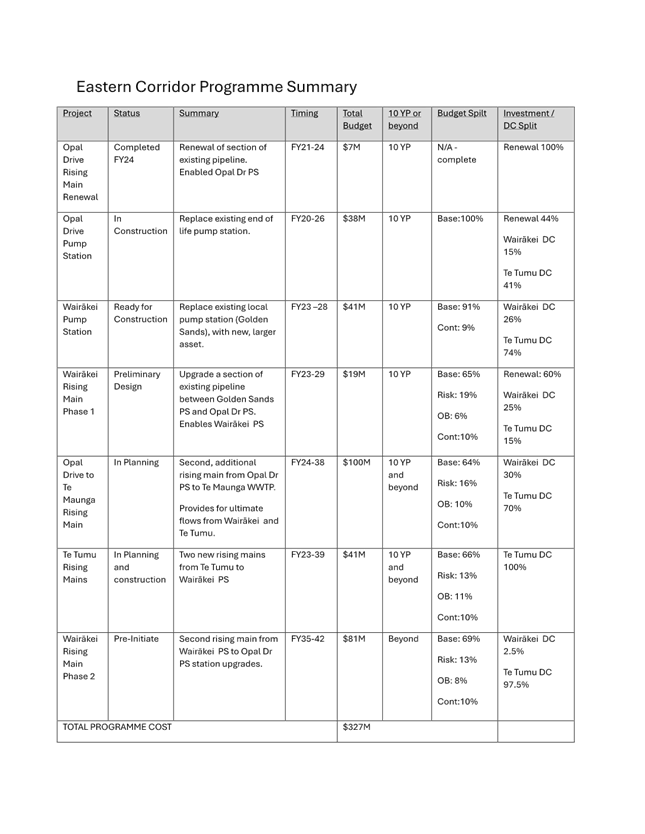
|
Ordinary
Council meeting Agenda
|
18
November 2025
|
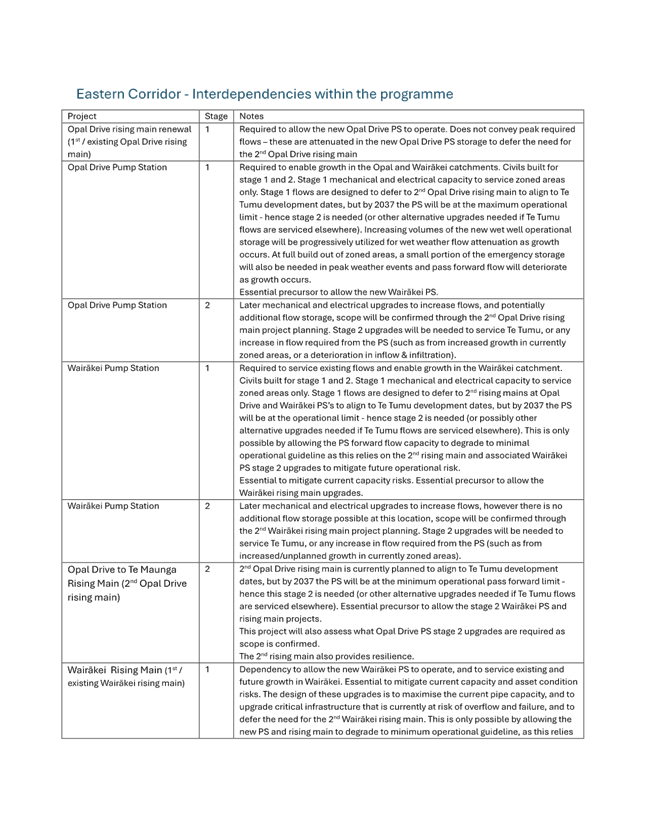
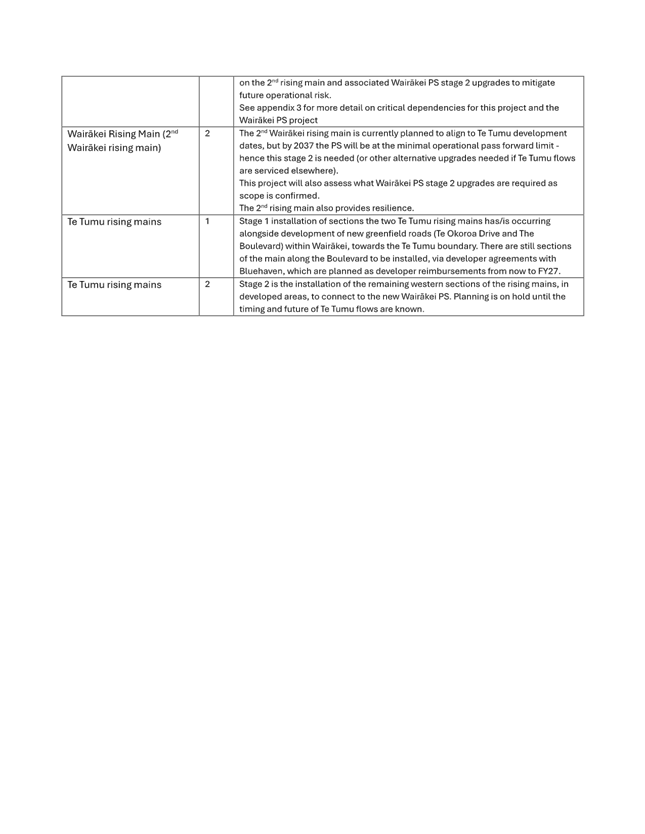
|
Ordinary
Council meeting Agenda
|
18
November 2025
|
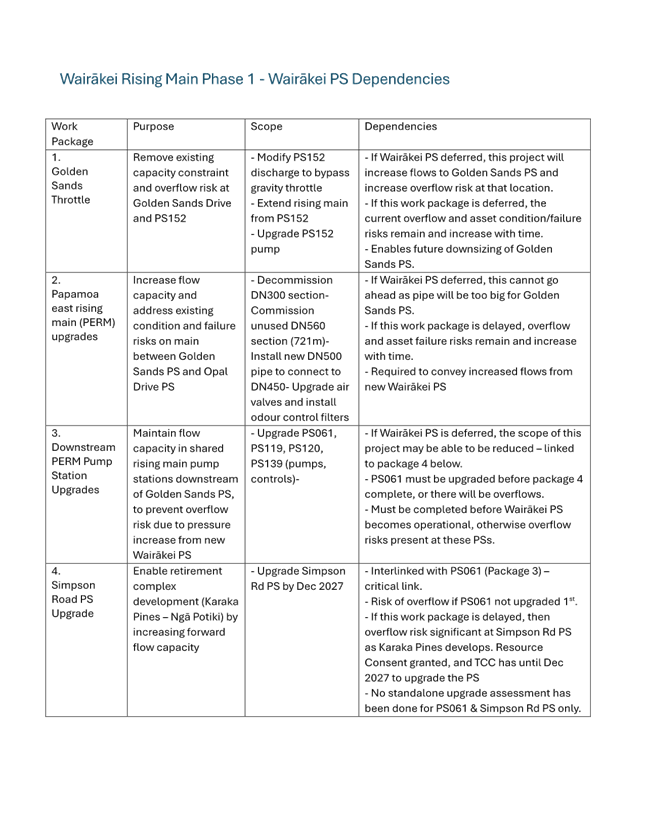
|
Ordinary
Council meeting Agenda
|
18
November 2025
|
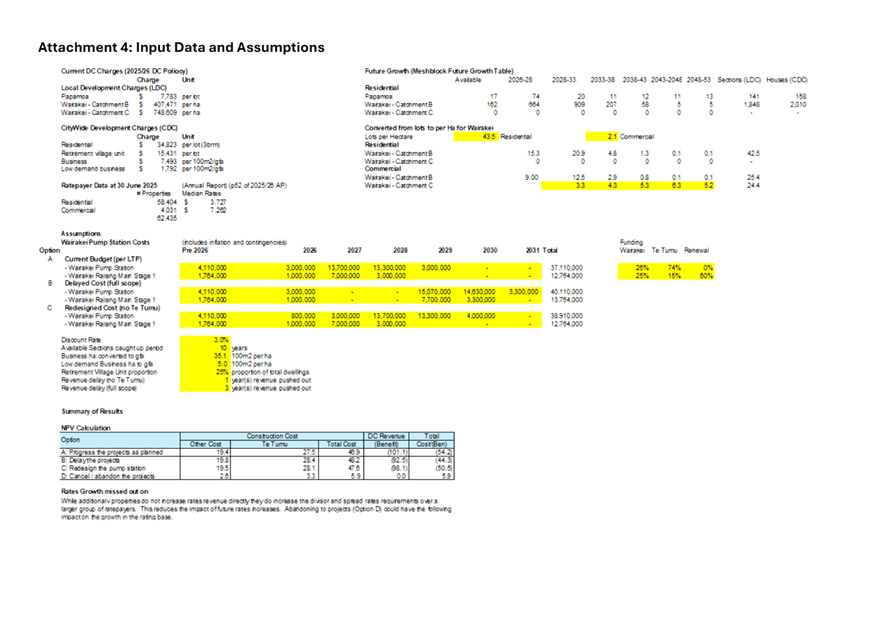
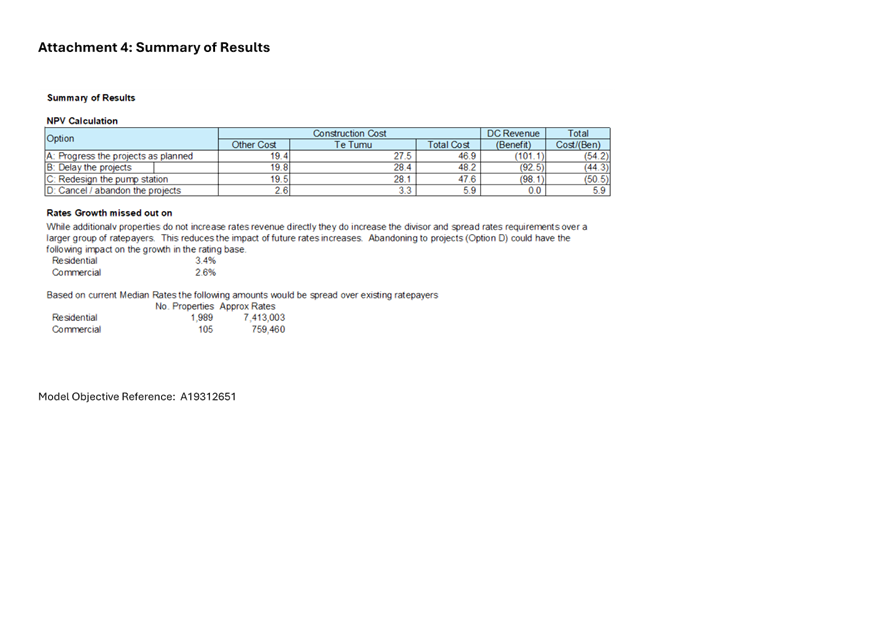
|
Ordinary
Council meeting Agenda
|
18
November 2025
|
11.2 Elected
members' remuneration allocation and expenses policy
File Number: A18428347
Author: Jeremy Boase, Head of Strategy, Governance & Climate Resilience
Authoriser: Christine Jones, General Manager: Strategy, Partnerships &
Growth
Purpose of the Report
1. This report seeks decisions on the
allocation of the remuneration pool for councillors, to take effect from 12
October 2025, together with decisions on aspects of the Elected Members’
Expenses and Resources Policy.
|
Recommendations
That
the Council:
(a) Receives the
report "Elected members' remuneration allocation and expenses
policy".
Remuneration
(b) Allocates
the councillors remuneration pool of $1,482,192 for submission to the
Remuneration Authority as follows:
i) Deputy
Mayor - $xxx
ii) Councillors
with additional responsibilities - $xxx
Security allowance
(c) Amends the
Elected Members’ Expenses and Resources Policy 2025 to include
provision for a home security allowance with the following characteristics:
(i) Issue
1 – eligibility – Option …
(ii) Issue 2
– security threat and assessment preparation - Option …
(iii) Issue 3
– maximum allowances – Option …
(iv) Issue 4 –
if elected member changes primary residence – Option …
(v) Issue 5
– if elected member’s position becomes vacant – Option
…
(vi) Issue 6 –
approvals – Option …
Or
(d) Does not
amend the Elected Members’ Expenses and Resources Policy 2025 to
include provision for a home security allowance
Other policy changes
(e) Amends the
Elected Members’ Expenses and Resources Policy 2025 to include
provision for an additional night of accommodation and relevant expenses if
an elected member is unable to make reasonable arrangements to return
directly to Tauranga.
(f) Amends
the Elected Members’ Expenses and Resources Policy 2025 provisions for
meal allowances per Option … in this report.
Or
(g) Does not
further amend the Elected Members’ Expenses and Resources Policy 2025.
|
Executive Summary
2. On an annual basis the
Remuneration Authority sets the mayor’s salary and sets a remuneration
pool to be distributed among councillors. Council determines the
distribution of that pool and then seeks approval from the Remuneration
Authority for that distribution.
3. In an election year, such as
2025/26, the Remuneration Authority sets remuneration for the period up to the
election, and then a new remuneration pool for the period after the
election. For the period after the election, the mayor’s remuneration
has increased 3.91% and the annual remuneration pool for councillors has
increased by 14.92%. Under the relevant legislation, the new pool must be
fully allocated between councillors.
4. This report invites Council
to determine an appropriate distribution of that new remuneration pool.
Mayor Drysdale has included a proposed distribution in this report. There
is no staff recommendation because this is an elected member matter.
5. The Remuneration Authority
has also enabled a new allowance for all elected members, being a home security
system allowance. If Council chooses to take advantage of this new
allowance, Council needs to make appropriate provision for it in the Elected
Members’ Expenses and Resources Policy. Direction is sought on
various matters to enable staff to draft proposed terms for that policy.
6. This report also addresses
three matters within the Elected Members' Expenses and Resources Policy that
were raised during the 7 October 2025 Council meeting.
7. There are no financial
implications to Council within the decision to allocate the remuneration
pool. The new pool is allowed for in budgets and the breakdown of how it
is allocated does not affect the overall spend.
8. The potential new allowance
for home security systems has not specifically been budgeted for. If
implemented, the financial impact will depend on policy decisions made and then
the uptake of the new allowance.
Background
Remuneration Authority and the Determination
9. The Remuneration Authority is
an independent body established by statute to set out a process and approve the
remuneration of key office holders including members of parliament and local
government elected members.
10. Each year the
Remuneration Authority issues a Determination which sets out:
· the remuneration of mayors,
· the minimum allowable remuneration for councillors
· the governance remuneration pool for distribution among councillors
· the permitted allowances for elected members
· the hearings fees paid to elected members, where applicable.
11. The most recent Determination (the Local Government Elected Members (2025/26) Determination 2025) came into force on 1 July 2025. Because of the
triennial local government elections in October this year the remuneration
elements of the Determination were split into two sections:
· remuneration rules from 1 July 2025 to the declaration of election
results[2]
· remuneration rules from the declaration of election results to 30
June 2026.
12. The rules for the period until the
election were unchanged from the 2024/25 Determination. As such, elected
member remuneration for that period remains as is.
13. For the period after the election, the
Determination:
· increases the mayor’s annual remuneration by 3.91% from
$186,130 to $193,402
· increases the annual governance remuneration pool for councillors by
14.92% from $1,289,799 to $1,482,192
· increases the minimum remuneration for a councillor with no
additional responsibilities (a category not used by Council in its final August
2024 decision) by 35.96% from $91,027 to $123,516
· introduces a new permitted allowance for elected members relating to
home security systems.
14. Council is required to make decisions on
remuneration and allowances and then seek approval from the Remuneration
Authority.
Previous Council decision-making
15. At its meeting
on 15 August 2024 the Council resolved to allocate the 2024/25 governance
remuneration pool as follows:
· a separate amount for the deputy mayor to reflect additional
responsibilities.
· a flat distribution of the remainder of the pool to promote equity
among all councillors regardless of their roles as chairs or deputy chairs.
16. This report
assumes that the same model of distribution will apply to the 2025/26
governance remuneration pool. If Council is of a mind to change the model
of distribution, then it is recommended that the parameters of such a
distribution model be determined before a further report is prepared for
decision-making.
Structure
of this report
17. This report
covers three different matters.
· Options for the distribution of the annual governance remuneration
pool between the deputy mayor and the councillors.
· Options for the introduction or not of a new home security system
allowance for elected members.
· Other matters relating to the Elected Members’ Expenses and
Resources Policy 2025 which were raised during the Council meeting on 7 October
2025.
Statutory Context
18. The Remuneration Authority determines
local government elected members’ remuneration under Clause 6 of Schedule
7 of the Local Government Act 2002 and the Remuneration Authority Act 1977.
19. Council is required to fully distribute
the governance remuneration pool set by the Remuneration Authority to
councillors and those with additional positions of responsibility.
20. The
governance remuneration pool does not apply to non-elected people who are
appointed to be members or chairpersons of council committees. Their remuneration is set separately by Council.
21. Once Council
has determined its preferred approach to distribution of the governance
remuneration pool, it will recommend that distribution to the Remuneration
Authority. The Remuneration Authority makes the final decision on elected
members’ remuneration.
22. Once the
Remuneration Authority issues its final decision and then publishes it in the
New Zealand Gazette, elected members’ remuneration will be backdated to,
in the case of 2025/26, 12 October 2025.
STRATEGIC ALIGNMENT
23. This
contributes to the promotion or achievement of the following strategic
community outcome(s):
|
|
Contributes
|
|
We are an inclusive city
|
ü
|
|
We value, protect and enhance the
environment
|
☐
|
|
We are a well-planned city
|
☐
|
|
We can move around our city easily
|
☐
|
|
We are a city that supports
business and education
|
☐
|
24. The purpose of local government is to
enable democratic local decision making and action, by, and on behalf of
communities. The Authority considers a range of factors when determining the
remuneration for elected members to attract people with the capacity to lead
and govern at a local level. One of these factors is “the existence of
a remuneration system that enables people from all sectors of the community to
commit time and effort necessary to fulfil their responsibilities as elected
members without being unduly disadvantaged.”
Options – part
1 – distribution of the governance remuneration pool
25. As noted above, this section is based on
the assumption that Council intends to retain the same principles for
distribution as it adopted in August 2024. These were:
· a separate amount for the deputy mayor to reflect additional
responsibilities.
· a flat distribution of the remainder of the remuneration pool to
promote equity among all councillors regardless of their roles as chairs or
deputy chairs.
26. The 2025/26 Determination includes very
different increases for the mayor (3.91%) compared to the pool (14.92%).
27. Mayor Drysdale has proposed a
distribution of the remuneration pool that approximately retains the relative
differentials between the mayor’s remuneration, the deputy mayor’s,
and the other councillors’, given the constraints of the numbers provided
in the Determination.
28. There are, of course, an unlimited
number of ways of dividing the pool. The Remuneration Authority has prepared an
interactive Excel tool if Council wishes to develop and consider other options.
That tool can be found towards the bottom of this page on their website.
29. The option proposed by Mayor Drysdale is
as follows:
|
|
Current
|
Mayor Drysdale’s proposal
|
Comments
|
|
Mayor
|
$186,130
|
$193,402
(3.91%
increase)
|
Set
by Remuneration Authority - cannot be changed by Council
|
|
Deputy Mayor
|
$161,285
|
$178,192
(10.48%
increase)
|
|
|
Councillors
|
$141,064
|
$163,000
(15.56%
increase)
|
|
|
|
|
|
|
|
Total
pool check
(1 x
DM + 8 x Cllr)
|
$1,289,797
|
$1,482,192
(14.92%)
|
Total
available pool must be allocated (and is under this proposal)
|
|
|
|
|
|
|
Mayor
over Dep Mayor
|
$24,845
|
$15,210
|
|
|
Dep
Mayor over Cllrs
|
$20,221
|
$15,192
|
|
30. This approach distributes the pool
totally (as required).
31. This approach also creates very similar
dollar differentials between the mayor and deputy mayor ($15,210) and the
deputy mayor and councillors ($15,192). The small difference is because
councillors’ remuneration has been rounded up from the $162,999 that
would have been required to create an almost exact balance in the differentials[3].
32. No staff recommendation is provided in
regard to the above.
OPTIONS – part
2 – home security allowance
33. The 2025/26 Determination includes
provision for a new allowance paid to elected members. Clause 15 of the
Determination states:
15 Home
security system allowance
(1) Based on a security threat and risk
assessment authorised by the local authority, a local authority may reimburse
the expenses of having a security system installed and monitored at a
member’s primary place of residence within the local authority area up to
a maximum of—
(a) $4,500 for
purchasing and installing the system; and
(b) $1,000 in
any year for monitoring, call-outs, and repairs.
(2) A member may also be reimbursed for
additional expenses for the provision of supplementary security measures at
their primary place of residence within the local authority area if—
(a) the
security threat and risk assessment recommends that those supplementary
security measures be provided to the member; and
(b) the
Remuneration Authority, on application from the local authority, approves
reimbursement of the additional expenses arising from the provision of those
supplementary security measures.
34. Clause 15 applies to Tauranga City
Council from 12 October 2025 onwards.
35. If Council wishes to implement these
provisions, they must be included in the Elected Members’ Expenses and
Resources Policy 2025 and approval must then be sought from the Remuneration
Authority.
36. Key issues to be considered when
preparing policy provisions relating to home security systems include the
following:
|
Issue
|
Options
|
Commentary
|
|
Issue 1 – Eligibility
|
1A
– all elected members
1B
– limited to mayor, deputy mayor
1C
– limited to mayor, deputy mayor and standing committee co-chairs
|
|
|
Issue
2 – Security threat and assessment preparation
|
2A
– prepared in-house by staff working to a determined template
2B
– prepared by specialist consultants
|
If a template is required, co-it will be
prepared and shared with Council when the policy is to be adopted.
|
|
Issue 3 – Maximum allowances
|
3A -
$4,500 for purchase and installation; $1,000 for annual monitoring, call-outs
and repairs (as provided for in the Determination)
3C
– other amounts determined by Council
|
|
|
Issue 4 – If elected member changes
primary residence
|
4A
– a new application (supported by a new risk assessment) may be made
for the new residence
4B
– no new application may be made
|
Note that the primary place of residence
must be within the local authority area.
|
|
Issue 5 – If elected member’s
position becomes vacant (including if not re-elected)
|
5A
– no impact on allowances already paid for that financial year
5B
– no impact on installation allowances already paid for that financial
year, but annual monitoring, call-outs and repairs allowance scaled back
proportional to the period of the financial year that the member was in
position.
5C
– all allowances (including installation) scaled back proportional to
the period of the financial year that the member was in position.
|
|
|
Issue 6 – Approvals
|
6A
– approvals of all claims under this part of the policy to be made by
the mayor and chief executive, with mayoral claims approved by the deputy
mayor and one other councillor
6B
– other approval process as determined by Council
|
6A is consistent with approvals for other
expense claims under the policy
|
37. Direction is sought from Council as to
whether provision should be made for home security system allowances and, if
so, the parameters of such a policy.
38. Draft policy provisions will be brought
back to Council when direction has been provided.
Options –
Part 3 – Other policy matters
39. At the Council meeting of 7 October
2025, elected members identified three other matters in the existing Elected
Members’ Expenses and Resources Policy 2025 (“the policy”)
for further discussion (see Attachment 1 for a copy of the
policy). These are considered below with options provided for changes to
the policy if required. It is anticipated that these changes can be made
during the meeting and become effective immediately, but if further consideration
is required then they too can be brought back to a subsequent Council meeting
for formal adoption.
40. The three matters cover:
(a) Overnight
accommodation and allowances when conferences (for example) finish late
(b) Limits on meal
allowances
(c) Within-city
travel – Bee cards versus car travel
Overnight accommodation and allowances
41. During the 7 October 2025, elected
members noted that the policy provisions for overnight accommodation and
allowances do not adequately address a situation where a conference or forum
finishes late, particularly if the last flight home cannot be caught.
42. To address this, options below allow for
a modification of the status quo (currently included at the bottom of section
5.1.2 in the policy.
|
Option
|
Commentary
|
|
Option 1 – status quo
“An elected member’s ability
to claim any daily or overnight accommodation expenses ends at the conclusion
of the conference/forum or when the elected member leaves the
conference/forum.”
|
|
|
Option 2 – enhanced
“An elected member’s ability
to claim any daily or overnight accommodation expenses ends at the conclusion
of the conference/forum or when the elected member leaves the
conference/forum.
“Where the conference/forum ends at
a time that does not allow the elected member to catch the last flight back
to Tauranga, the ability to claim daily or overnight accommodation expenses
ends at the time of the first flight to Tauranga on the following day.”
RECOMMENDED
|
Allows for an additional night’s
accommodation, as well as breakfast and potentially lunch depending on the
flight s schedules.
|
Maximum limits for meal allowances
43. The policy currently provides maximum
limits for meal allowances when an elected member is staying away from home
overnight on Council business (and where those meals are not part of a
‘package’, for example as supplied as part of a conference).
These limits, set out in section 5.1.2 of the policy, are: breakfast ($25 incl.
GST); lunch ($25 incl. GST); dinner ($50 incl. GST).
44. During the 7 October 2025 Council
meeting, elected members sought options to amend these limits to ‘actual
and reasonable’ costs, potentially with no dollar limitation.
45. Subsequent to that meeting staff have
been requested to include details of similar allowances for staff when
travelling overnight and away from Tauranga. That information, including
an extract from the standard employment contract template and an extract from
the Sensitive Expenditure Policy that applies to all staff, is included as Attachment
2 to this report.
46. Options to address this issue in the
Elected Members’ Expenses and Resources Policy are set out below for
Council’s consideration.
|
Option
|
Commentary
|
|
Option 1 – status quo
Retain the policy with dollar-based
limits for breakfast ($25 incl. GST), lunch ($25 incl. GST), and dinner ($50
incl. GST)
|
|
|
Option 2 – enhanced status quo
Retain the policy with dollar-based
limits but change those limits to:
Breakfast $.... (incl. GST)
Lunch $.... (incl. GST)
Dinner $.... (incl. GST)
|
Council to determine the limits it
considers appropriate.
|
|
Option 3 – ‘fair and
reasonable’
Amend the policy to state “When
meals do not form part of a ‘package’, actual and reasonable
costs may be claimed on presentation of an actual and itemised receipt (not a
credit card statement or photocopy).”
|
The policy currently defines
‘actual’ as ‘means as evidenced by the original receipt
attached to the claim form’ and defines ‘reasonable’ as
‘within the amount specified by the policy or as deemed reasonable by the
mayor and chief executive’.
|
47. No staff recommendation is provided.
Within-city travel
48. During the 7 October 2025 Council
meeting, elected members noted the provisions in the policy for within-city
travel and questioned whether those provisions were inconsistent.
49. The two elements identified were:
(a) Section 5.1.6
where a pre-paid public transport card (for example a “Bee card”
issued by Bay of Plenty Regional Council) may be issued to elected members for
travel to and from council business (the busses principally operate within the
city boundaries) and
(b) Section 5.1.3
where payment of mileage costs for an elected member using their own vehicle
only applies for travel outside of the Tauranga City Council area.
50. It should be
noted that section 5.1.5 covers the public transport noted in (a) above and
also covers ‘micro mobility’ services (such as e-bikes and
e-scooters) when travelling for council business (when actual and reasonable
costs will be reimbursed). Again, the expectation is that such services
will be within Tauranga’s boundaries.
51. The different approach to public
transport (including micro mobility) within the city boundaries and private
vehicle use is deliberate. The public transport provisions were
specifically prepared to promote non-car use in Tauranga. Section 5.1.5
starts “To promote alternative modes of transport apart from private
vehicle use…”
52. Sections 5.1.5 to 5.1.7 of the policy
relating to public transport allowances were specifically identified as being
proposed new provisions when Council adopted the policy on 15 August
2024.
53. If Council wishes to amend the policy
for public vehicle use or public transport travel or both, staff seek further
direction to enable drafting of revised provisions.
Financial
Considerations
54. The increase in the remuneration pool
has been provided for in budgets. The financial impact of changes to the
Elected Members’ Expenses and Resources Policy will depend on the uptake
of any new or amended allowances. Dependent on policy decisions yet
to be taken, the maximum potential impact is likely to be 10 elected members x
$4,500 for installation plus $1,000 per annum for monitoring, call-outs and
repairs i.e. $55,000 in total.
Legal Implications /
Risks
55. The Council is
required to allocate the entire remuneration pool set by the Authority.
There are no specific risks associated with this process.
TE AO MĀORI
APPROACH
56. Decisions on elected members’ remuneration are not directly
impacted by the Te Ao Māori approach.
CLIMATE IMPACT
57. Decisions on elected members’ remuneration are not directly
related to climate change impact.
Significance
58. The Local
Government Act 2002 requires an assessment of the significance of matters,
issues, proposals and decisions in this report against Council’s
Significance and Engagement Policy. Council acknowledges that in some
instances a matter, issue, proposal or decision may have a high degree of
importance to individuals, groups, or agencies affected by the report.
59. In making this
assessment, consideration has been given to the likely impact, and likely
consequences for:
(a) the
current and future social, economic, environmental, or
cultural well-being of the district or region
(b) any persons who
are likely to be particularly affected by, or interested in, the decision.
(c) the capacity of
the local authority to perform its role, and the financial and other costs of
doing so.
60. In accordance
with the considerations above, criteria and thresholds in the policy, it is
considered that the decision is of low significance.
ENGAGEMENT
61. Taking into
consideration the above assessment, that the decision is of low significance,
officers are of the opinion that no further engagement is required prior to
Council making a decision.
Next Steps
62. A
recommendation on remuneration from the Council will go to the Authority for
approval.
63. In the
meantime, all councillors will continue to receive their current remuneration
in line with the pre-election elements of the 2025/26 Determination from the
Remuneration Authority.
64. If Council
determines that it wishes to amend the Elected Members’ Expenses and
Resources policy to allow for the home security systems allowance, then a draft
revised policy will be brought back to the December Council meeting.
Attachments
1. Elected Members' Expenses and
Resources Policy 2025 - as adopted 7 Oct 2025 - A19035841 ⇩
2. Information
requested by elected members regarding staff allowances - A19221153 ⇩
|
Ordinary
Council meeting Agenda
|
18
November 2025
|
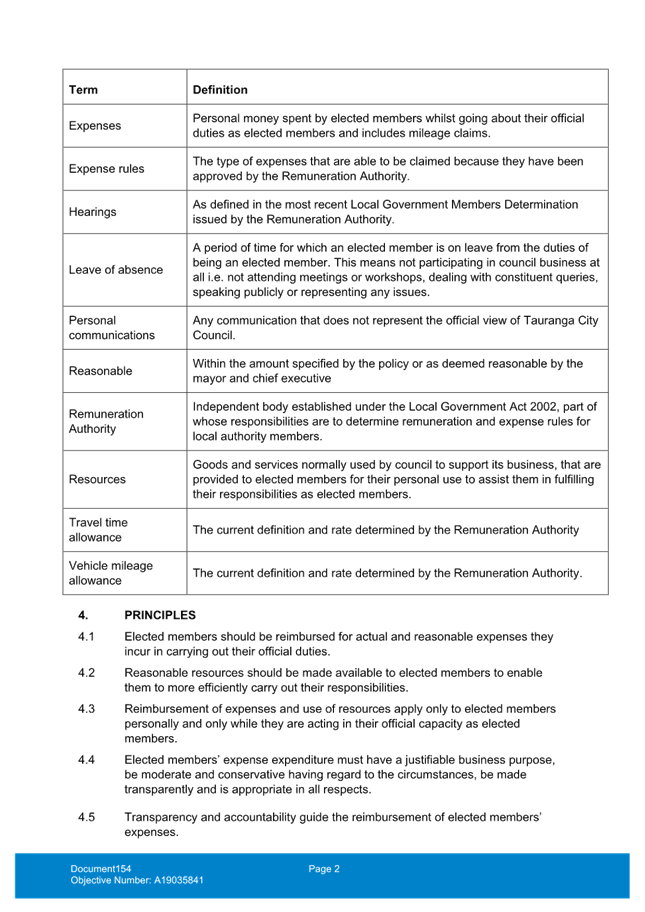
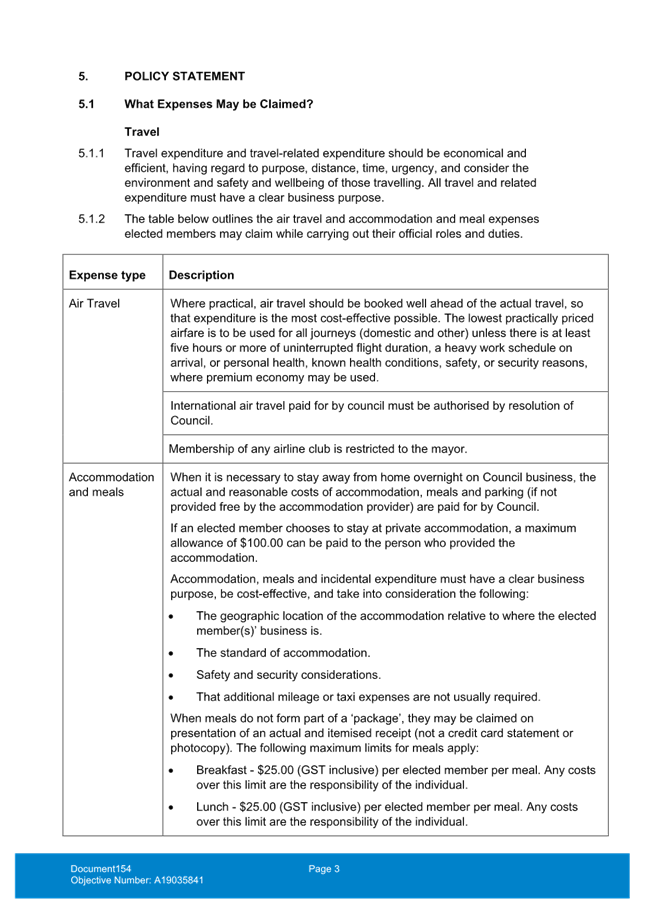
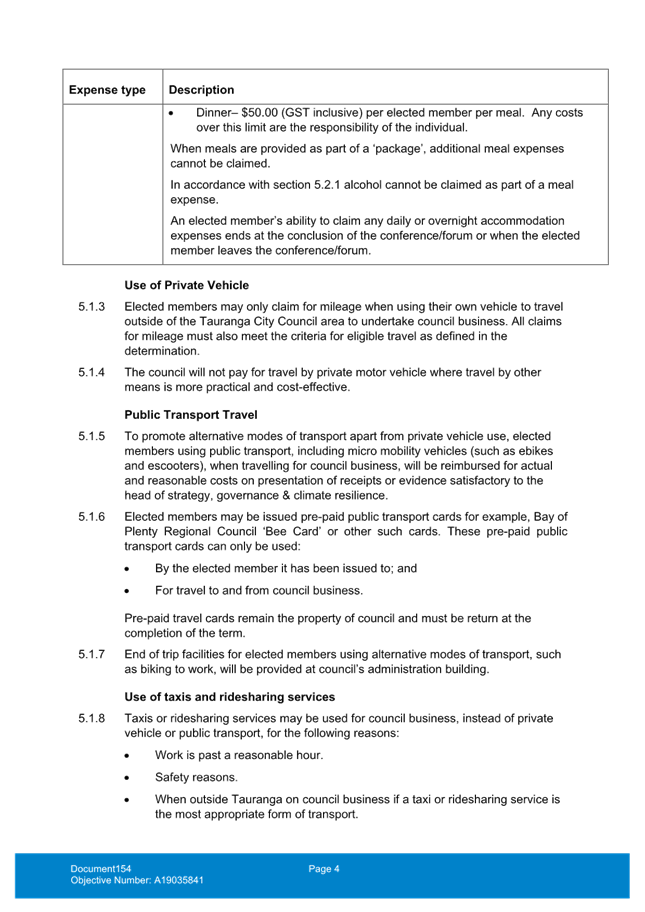
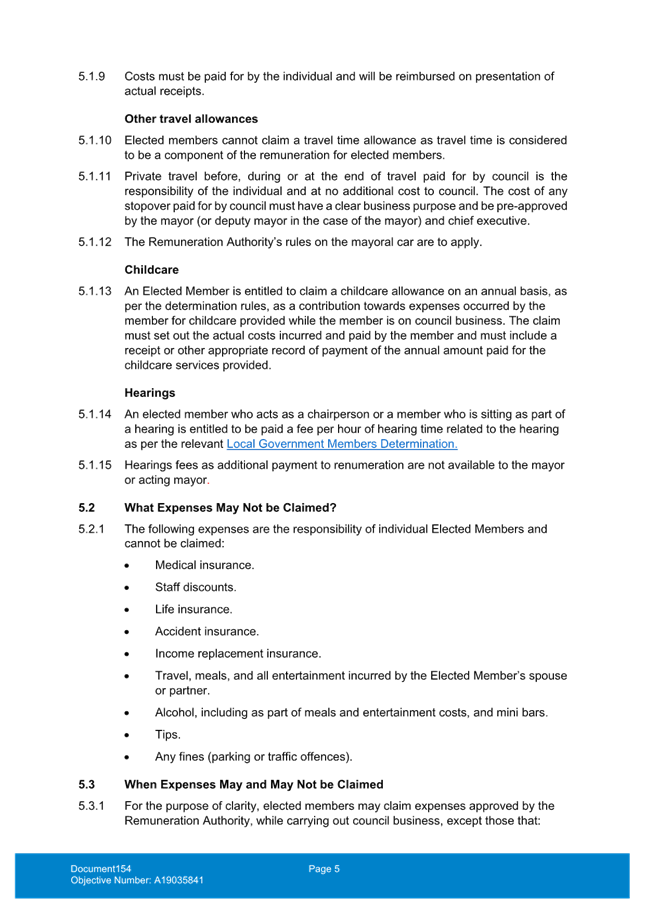
|
Ordinary
Council meeting Agenda
|
18
November 2025
|
|
Ordinary
Council meeting Agenda
|
18
November 2025
|
11.3 Draft
2026 Council and Committee Meetings Schedule
File
Number: A18997120
Author: Sarah Holmes, Team Leader: Governance & CCO Support Services
Jeremy Boase, Head of Strategy,
Governance & Climate Resilience
Authoriser: Christine Jones, General Manager: Strategy, Partnerships &
Growth
Purpose of the
Report
1. This report provides a first draft
2026 Council and Committee meetings schedule for feedback and approval in
principle, pending further input from external parties.
|
Recommendations
That the Council:
(a) Receives the
report "Draft 2026 Council and Committee Meetings Schedule".
(b) Approves in
principle the Draft 2026 Council/Committees Meetings Calendar (provided as
Attachment 1 to this report):
(i) Pending
input from Western Bay of Plenty District Council and Toi Moana Bay of Plenty
Regional Council to confirm joint committees and meeting dates,
(ii) Pending
confirmation from Local Government New Zealand on Zone 2, Metro Sector, Te
Maruata Whānui, and All-of-Local Government Sector meetings, and
(iii) Subject to
incorporation of feedback provided to staff at this meeting, as noted in the
meeting minutes, including specifically:
(1) Direction
on the Council’s preferred alternative meeting day for the City Future,
City Delivery, and Audit and Risk Committees when the Tuesday is unavailable.
(c) Notes that
the final confirmed 2026 Council/Committees Meetings Calendar is to be
reported back to the earliest possible Council meeting in the New Year.
OR
Notes that the
final 2026 Council/Committee Meetings Calendar does not need to be formally
reported back to Council.
|
Executive Summary
2. The
proposed January to December 2026 Council and Committee Meetings Schedule
(provided as Attachment 1 to this report) gives effect to Tauranga City
Council’s governance structure, and closely reflects the current 2025
year’s meeting schedule.
3. Feedback
on this draft schedule is sought at this meeting, including whether Monday is
the Council’s preferred alternative Committee meeting day when required
(as reflected in Attachment 1 to this report), or if a different day is
generally preferred.
4. This
report seeks Council’s approval in principle of the draft meeting
schedule (provided as Attachment 1 to this report), subject to inclusion of
feedback from this meeting and pending input from external partners.
5. Elected
members have also requested an overview of the key reports expected to be
presented to Council and the main Committees in 2026. This is provided in
Attachment 2.
DISCUSSION
6. The
Council can adopt a schedule of meetings that covers any future period. A
12-month calendar is recommended, as this provides certainty to Elected
Members, external appointees and staff, and transparency to the community and
media on when meetings will be held over the year ahead.
7. The
proposed 2026 meetings schedule (Attachment 1 to this report) adheres to the
same principles as the current 2025 schedule, in that it is based on the
current governance structure, meets the minimum meeting requirements of all
committee and advisory group terms of reference, and wherever possible treats
the school holiday periods as meeting recess opportunities.
8. This
means that Council meetings are scheduled three-weekly, the City Future
Committee and City Delivery Committees are scheduled six-weekly (eight meetings
per year), and the Audit and Risk Committee meetings are scheduled quarterly
(four per year).
9. These
Council and Committee meetings are scheduled on a Tuesday where possible, with
Committee meetings being scheduled for a Monday if there is a Council meeting
scheduled for the Tuesday.
10. The
Council’s feedback is sought on whether Monday (as currently) or a
different day is the preferred alternative Committee meeting day when required.
11. Dates for
joint committee meetings are co-ordinated with Toi Moana Bay of Plenty Regional
Council, the Western Bay of Plenty District Council, and other councils in the
Bay of Plenty. Staff will work with partner councils to confirm joint committee
and group meeting dates once their committee structure and representatives are
confirmed. This is anticipated to be before the Christmas break.
12. At this
stage, joint committee and advisory group meetings are provisionally scheduled
as close as possible to the 2025 meetings, normally on a Friday or Wednesday,
except for the Bay of Plenty Regional Transport Committee which, where
possible, scheduled on a Tuesday.
13. Dates for
joint Tangata Whenua and TCC advisory groups have been scheduled as close as
possible to the 2025 dates, however some movement in the proposed 2026 advisory
group dates may still be required. Staff will work together with Tangata Whenua
representatives to confirm the 2026 dates as soon as possible.
14. Draft dates
for Local Government New Zealand (LGNZ) SuperLocal (includes Annual General
Meeting), Zone 2, Metro, Te Maruata (group for all Māori elected and
appointed members), and All-of-Local Government Sector hui have been provided
by LGNZ and are included in the meetings schedule. LGNZ has advised the meeting
dates will be finalised in mid-November, therefore these are subject to change.
15. This
information is summarised in table 1 below, which provides key information used
to develop the draft 2026 meetings schedule.
Table 1:
supporting information incorporated into draft 2026 Meetings Schedule
|
Meeting of
|
Preferred meeting day
|
Frequency (per TOR)
|
|
Committees or Groups administered by TCC:
|
|
Council
(excluding AP
hearings & deliberations)
|
Tuesday
|
3-weekly
(currently 15 per year)
|
|
City Future Committee
|
Tuesday
(backup: Mon / Wed)
|
6-weekly
(currently 8 per year)
|
|
City Delivery Committee
|
Tuesday
(backup: Mon / Wed)
|
6-weekly
(currently 8 per year)
|
|
Audit & Risk Committee
|
Tuesday
(backup: Monday)
|
4 per year
|
|
Tangata Whenua/TCC Committee
|
Wednesday
|
6 per year
|
|
Wastewater Management Review Committee
|
Wednesday
|
4 per year
|
|
Ngā Poutiriao ō Mauao Advisory
Group
|
Wednesday
|
2+ per year
|
|
Waiāri Kaitiaki Advisory Group
|
Wednesday
|
4 per year, or as required
|
|
Matapihi Southern Pipeline Advisory Group
|
Thursday
|
2+ per year
|
|
Taumata Kahawai Governance Group
|
Wednesday or Thursday
|
Two-monthly, or as required
|
|
Tauranga & Western Bay of Plenty
Transport Committee
(TCC administered from Jan 2026)
|
Friday
|
Two-monthly, or as required (4 per year)
|
|
Joint Committees administered by others:
|
|
SmartGrowth Leadership Group
|
Wednesday
|
4 per year
|
|
Regional Transport Committee (BOPRC
administered)
|
Friday
|
Quarterly
|
|
BOP Public Transport Committee
(BOPRC administered)
|
Wednesday (?)
|
Quarterly
|
|
Civil Defence & Emergency Management
Committee
(BOPRC administered)
|
Friday
|
Quarterly (or as required)
|
|
Tauranga Moana Advisory Group
(BOPRC administered)
|
Friday
|
Quarterly (or as required)
|
|
Te Maru o Kaituna River Authority
(BOPRC administered)
|
Friday
|
As per meeting schedule
|
|
LGNZ National / Zone forums:
|
|
Mayoral Forum
|
Friday
|
3 per year
|
|
LGNZ Combined Sector
|
Friday
|
3 per year
|
|
LGNZ Metro Sector
|
Friday
|
3 per year
|
|
LGNZ Zone 2
|
Friday
|
3 per year
|
|
LGNZ AGM / Conference
|
Monday - Thursday
|
Annual (July)
|
|
LGNZ Te Maruata (group for all Māori
elected and appointed members)
|
Friday
|
4 per year
|
16. Elected
members have requested visibility of the key decision-making reports that will
be presented to Council and the main committees in 2026. Attachment 2
identifies the currently known key reports by month and management area.
Statutory Context
17. Clause 19(6)
of Schedule 7 of the Local Government Act 2002 provides for the Council to
adopt a meeting schedule to cover any future period.
STRATEGIC ALIGNMENT
18. This
contributes to the promotion or achievement of the following strategic
community outcome(s):
|
Contributes
|
|
We are an inclusive city
|
ü
|
|
We value, protect and enhance the environment
|
☐
|
|
We are a well-planned city
|
☐
|
|
We can move around our city easily
|
☐
|
|
We are a city that supports business and education
|
☐
|
19. Providing advance notice of Tauranga City Council’s proposed
meeting schedule for the upcoming year enables our communities to participate
in their local democracy and to be informed about the council’s plans and
activities.
Options Analysis
20. Option 1
– Approve the 2026 January to December Meetings Schedule in principle,
pending confirmation of joint committee and advisory group, and LGNZ meeting
dates, and subject to inclusion of feedback provided at this Council meeting
(Recommended).
21. This option
would enable the Elected Members, external appointees, staff, media and the
public to know when meetings are provisionally (then confirmed as) scheduled
for the year ahead. This would assist with openness and transparency for our
communities, and in enabling participation in local democracy.
22. This option
would also enable staff to book 2026 meetings into committee and group
members’ calendars, and to set up the report-writing system for the year
ahead.
23. Option 2
– Do not approve the 2026 January to December Meetings Schedule in
principle at this time.
24. This option
would not enable the people involved or our wider communities to know when
meetings are scheduled for the year ahead until a later date.
25. This option
would require a report to the next Council meeting on 15 December to approve
the 2026 meetings schedule, noting that partner councils may not have been able
to confirm their joint committee and group meeting dates in time for that
report.
Consultation / Engagement
26. Staff will
continue to engage with LGNZ, partner councils and Tangata Whenua
representatives to confirm all meeting dates for the 2026 calendar year.
Significance
27. The Local
Government Act 2002 requires an assessment of the significance of matters,
issues, proposals and decisions in this report against Council’s
Significance and Engagement Policy. Council acknowledges that in some
instances a matter, issue, proposal or decision may have a high degree of
importance to individuals, groups, or agencies affected by the report.
28. In making
this assessment, consideration has been given to the likely impact, and likely
consequences for:
(a) the current and future social, economic, environmental, or cultural
well-being of the district or region
(b) any persons who are likely to be particularly
affected by, or interested in, the matter.
(c) the capacity of the local authority to perform
its role, and the financial and other costs of doing so.
29. In accordance
with the considerations above, criteria and thresholds in the policy, it is
considered that the matter is of low significance.
ENGAGEMENT
30. Taking into
consideration the above assessment, that the matter is of low significance,
officers are of the opinion that no further engagement is required prior to
Council making a decision.
Next Steps
31. If Option 1
is approved:
(a) Provisional
2026 meeting calendar requests will be sent out to Elected Members, external
appointees and relevant staff as soon as possible after this meeting.
(b) The Draft
and, once all joint meeting dates have been confirmed, Final 2026 Meetings
Schedule will be made available on the council’s website.
32. If Option 2
is approved, an updated report incorporating feedback from this Council meeting
will be provided to the 15 December Council meeting for approval, noting that
our partner councils may not be able to confirm joint committee and group
meeting dates prior to the report being authorised for inclusion in the 15
December meeting agenda.
Attachments
1. Draft
2026 Council and Committee Meeting Schedule - 3 November 2025 (A3) - A19240968 ⇩
2. 2026 Planned Key Reports to
Council and Main Committees (A3) - A19266377 ⇩

|
Ordinary
Council meeting Agenda
|
18
November 2025
|
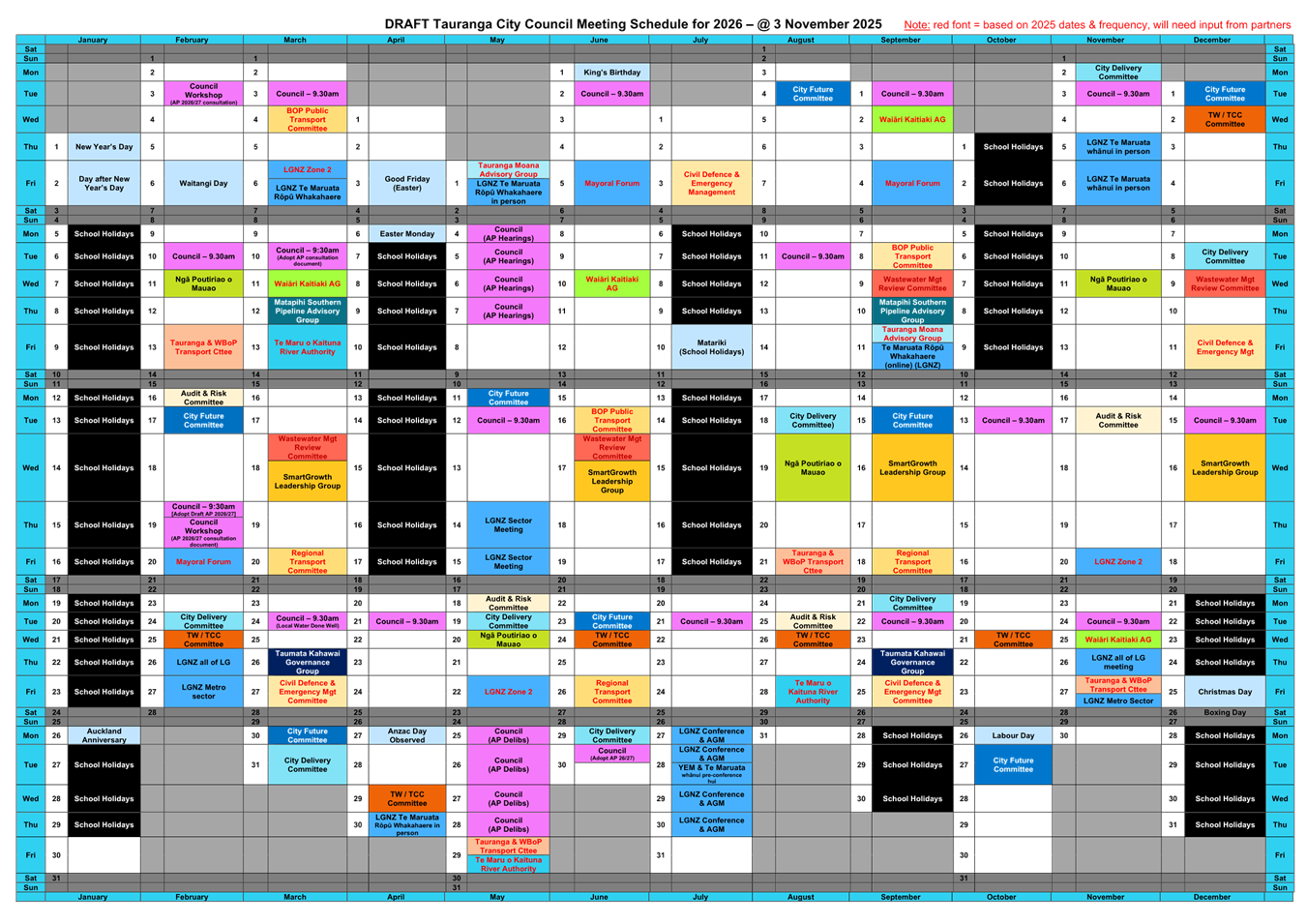
|
Ordinary
Council meeting Agenda
|
18
November 2025
|
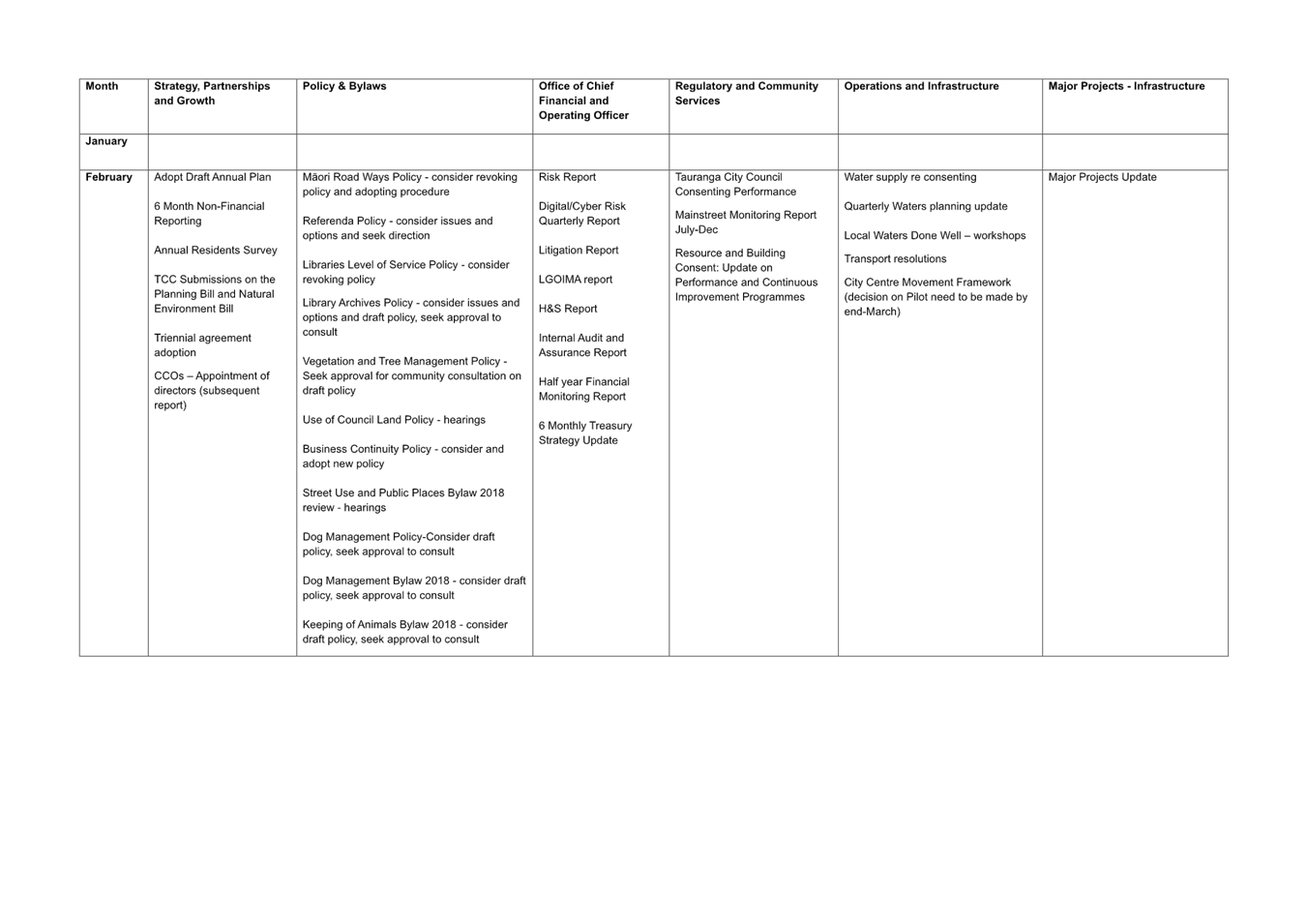
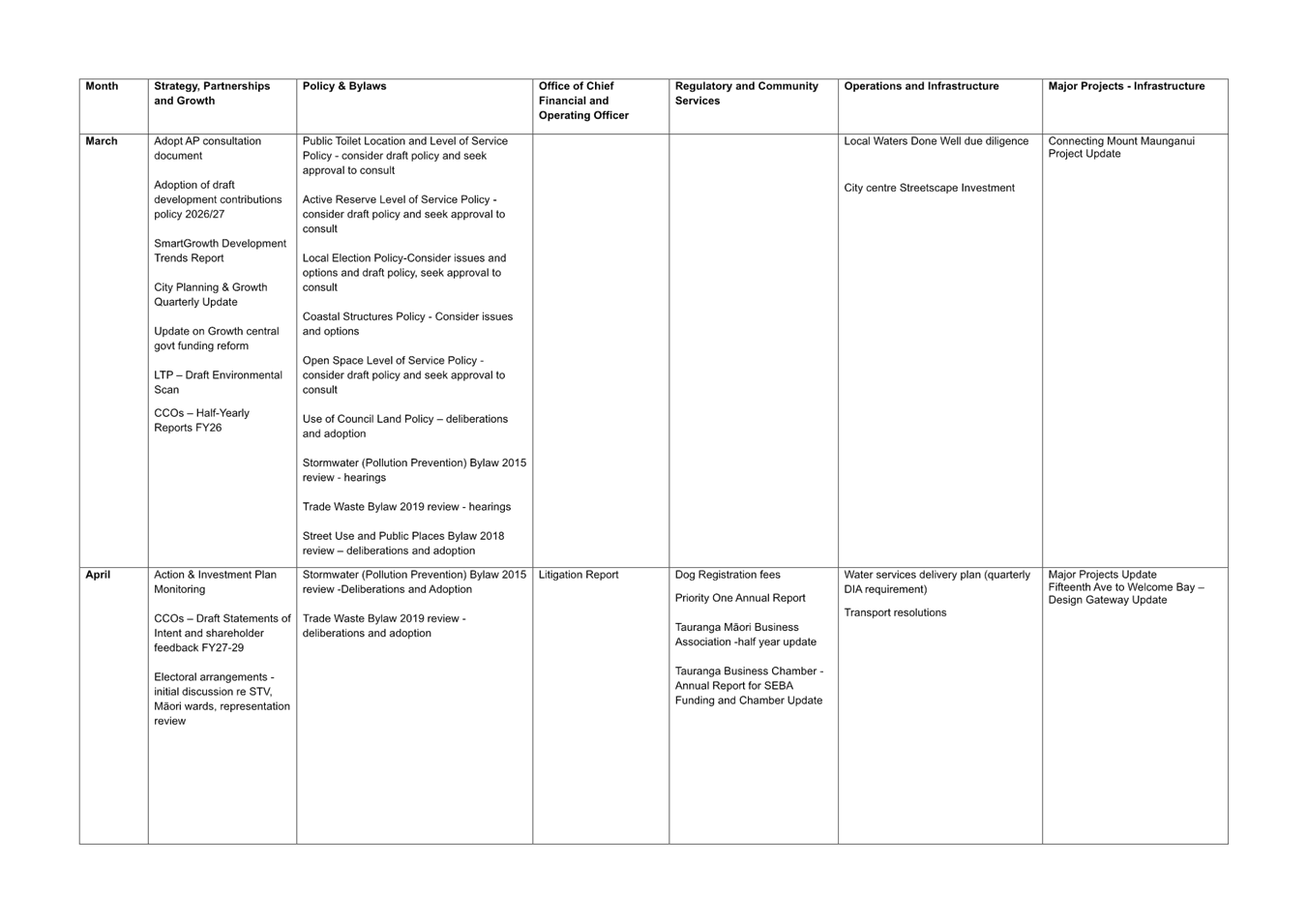
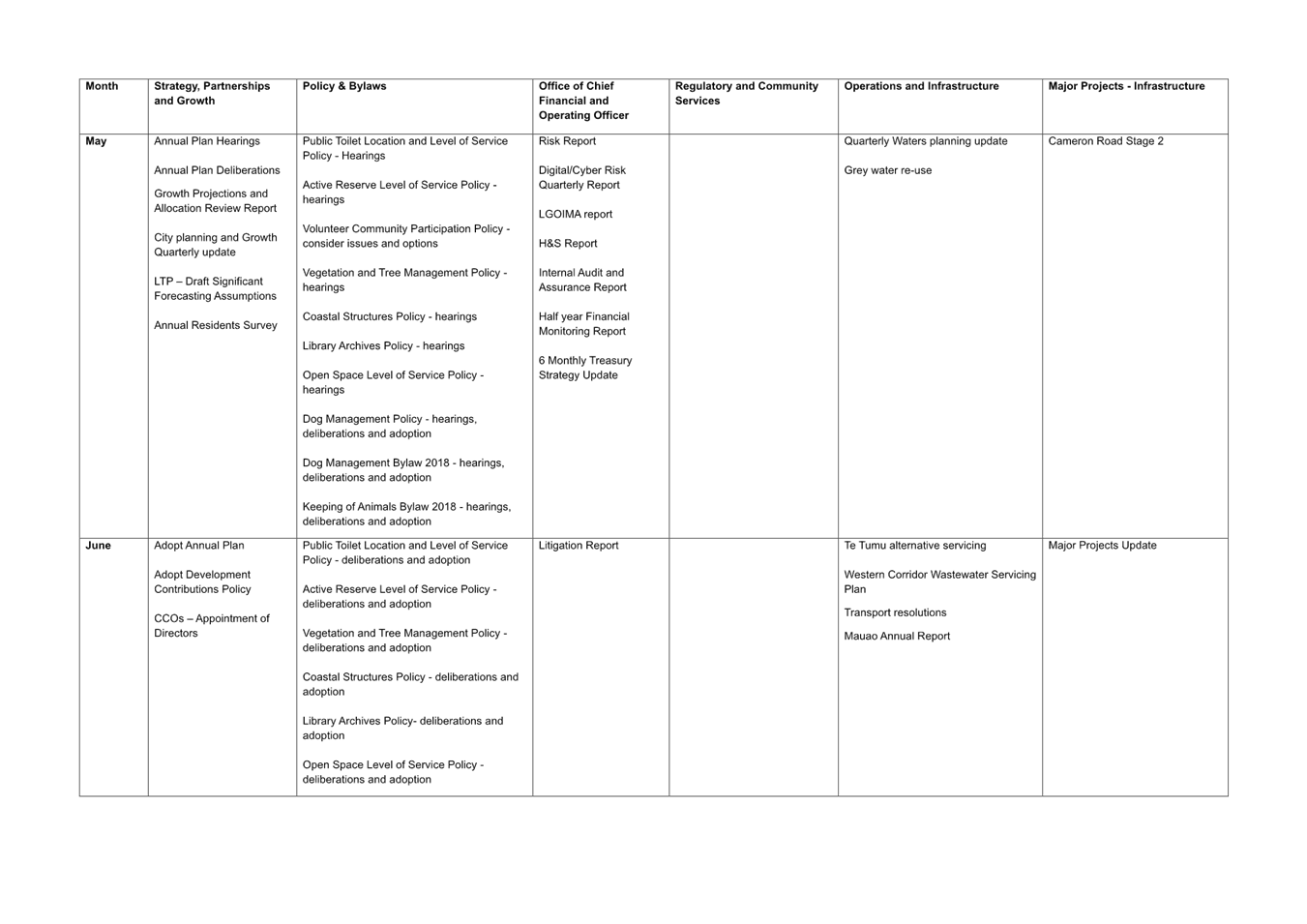
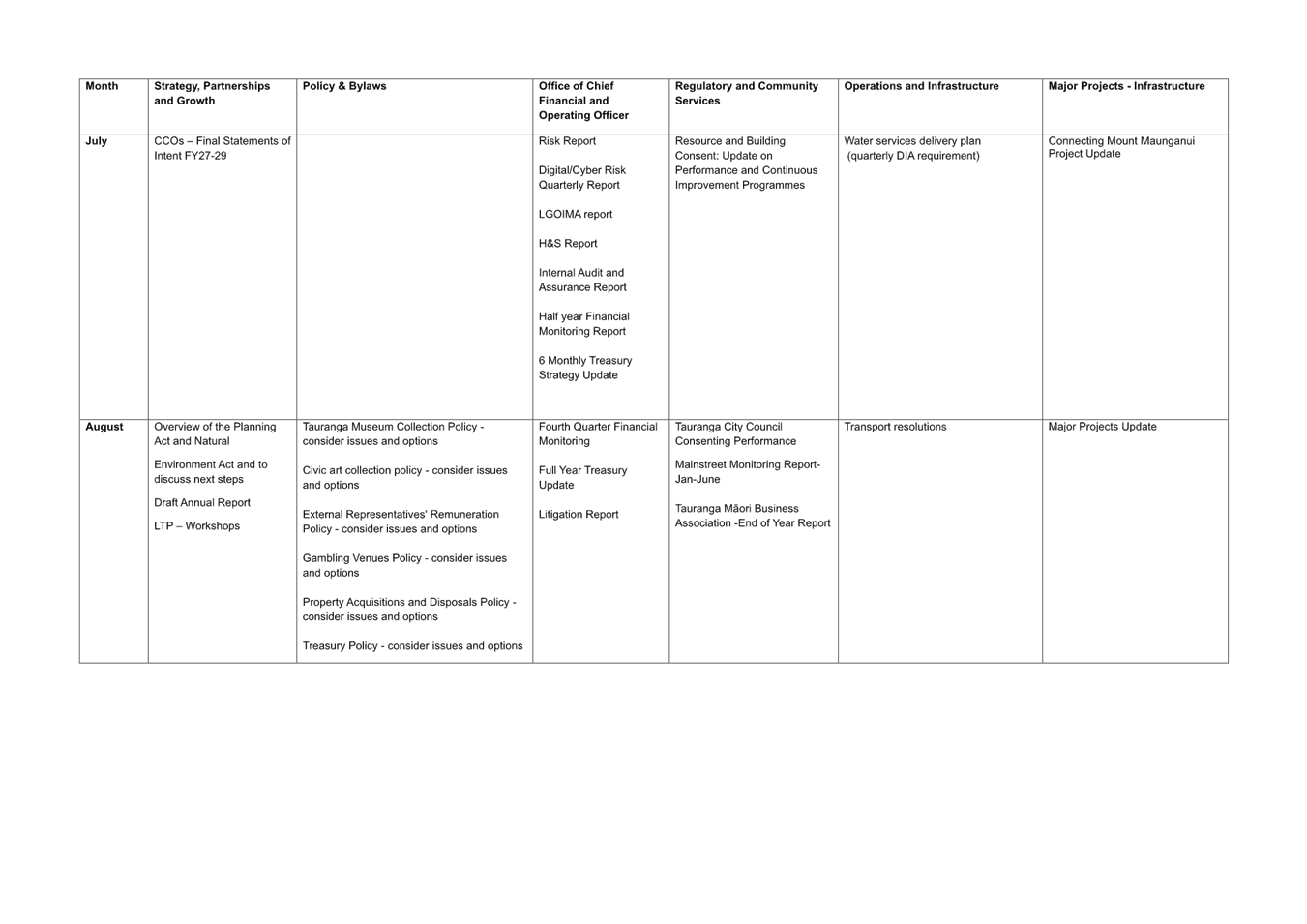
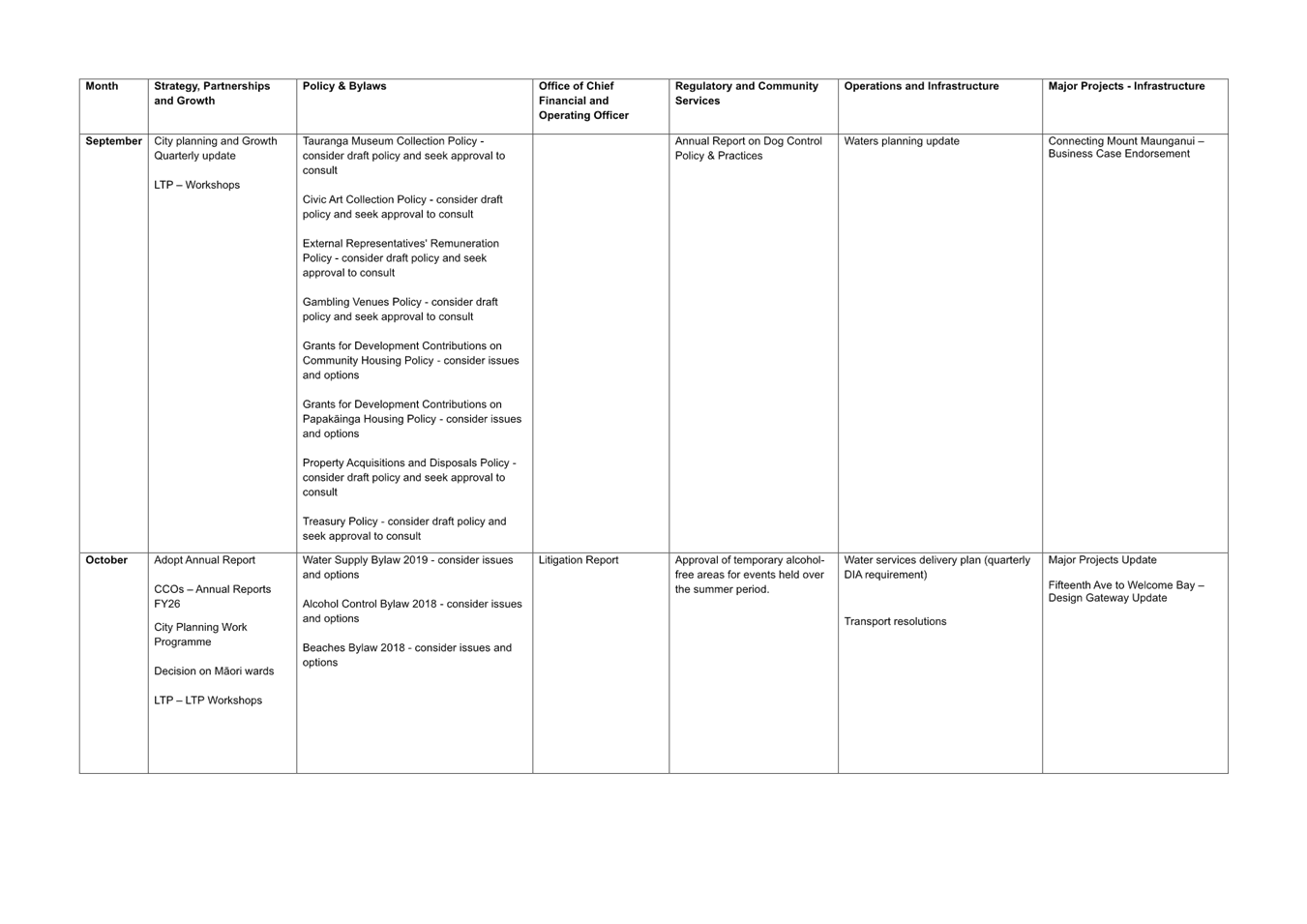
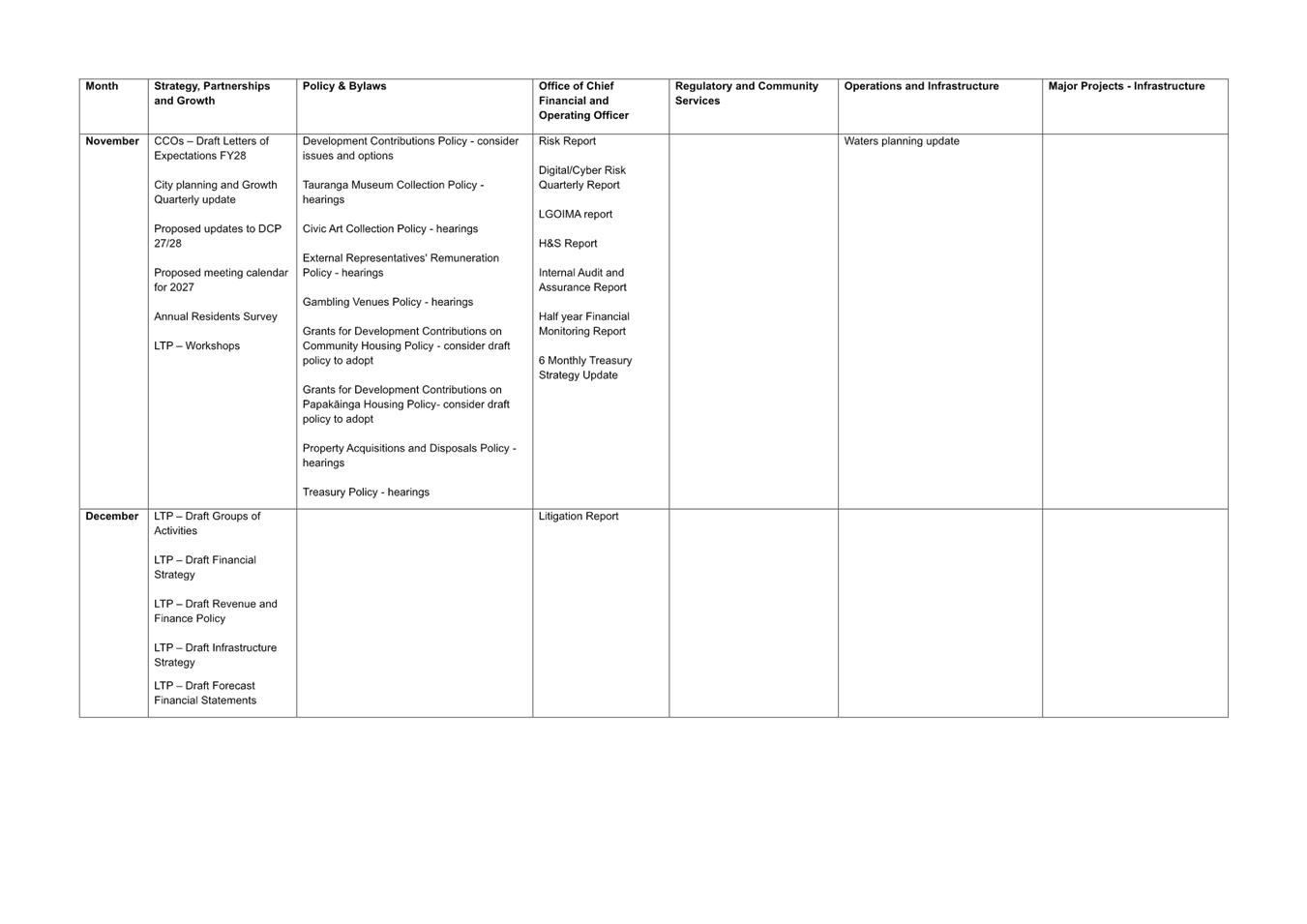
|
Ordinary
Council meeting Agenda
|
18
November 2025
|
11.4 Long-term
Plan 2027-2037 - Process
File
Number: A18776362
Author: Josh Logan, Team Leader: Policy & Corporate Planning
James Woodward, Manager: Performance,
Monitoring & Assurance
Authoriser: Christine Jones, General Manager: Strategy, Partnerships &
Growth
Purpose of the
Report
1. This
report provides a high-level overview of the 2027-2037 Long-term Plan (LTP)
process for Tauranga City Council, including the timeline, proposed
prioritisation methodology, and proposed amendments to community outcomes (the
outcomes we seek), priorities (where we will focus our effort), and principles
(how we will do things and deliver).
|
Recommendations
That the Council:
(a) Receives the
report "Long-term Plan 2027-2037 - Process".
(b) Endorses the
proposed prioritisation process for capital projects for the Long-Term Plan (Attachment
1).
(c) Notes that
for the prioritisation process, at a later date, staff will seek further
guidance from the mayor and councillors on strategic direction, risk appetite
and weightings of strategy/risk.
(d) Approves the
following revised Community Outcomes for the purposes of the 2027-2037
Long-term Plan development:
· Tauranga Mataraunui - An inclusive city
· Tauranga Taurikura - A city that values, protects and enhances our
environment
· Tauranga - Tātai Whenua - A well planned city that is easy to
move around
· Tauranga a te kura - A city that supports business and education
· Tauranga <translation to come> - A vibrant city that
embraces events
(e) Approves the
following 2027-2037 Long-term Plan underpinning principles:
· Look after what we’ve got
· Accountable and transparent
· Value for money
· Everyone pays a fair share
· Growth pays for growth
· Bold and innovative
(f) Approves
the following priorities to guide the development of the 2027-2037 Long Term
Plan:
· Delivering for our people:
o Enable
Housing
o Address
Transport
o Enhance
our Environment
o Deliver
services for our community
(g) Notes that
if amendments to the community outcomes are endorsed, either with or without
community consultation, the amended outcomes will be applied through the
upcoming Long Term Plan, and that the current community outcomes included in
the existing Long Term Plan will continue to be reported against for the next
two annual reports.
|
Executive Summary
2. The
Long Term Plan (LTP) is the most significant planning and decision-making
process for the Elected Members for their term of council. It sets out what
Tauranga City Council will do over the next 10 years and how we’ll pay
for it. This includes everything from major infrastructure projects to the
services we provide every day.
3. A
new LTP is developed and adopted every three years by Elected Members, in the middle year of the
normal local government election cycle. Each plan must include a financial
strategy that shows how we’ll manage our finances over the long term.
4. The next LTP is due for adoption by 30 June 2027.
5. This
report provides the Elected Members a high-level overview of the standard LTP
process and timeline that starts from now and runs through to June 2027. The
report also gives a high-level overview of the proposed prioritisation process
and seeks Council endorsement of that.
6. Finally,
the report seeks Council approval to proceed with proposed minor amendments to
the community outcomes, priorities and principles (as suggested by Elected
Members’ feedback on the current ones) which are intended to guide the
development and delivery of the upcoming LTP.
What are community outcomes
7. Community
outcomes, as required under the Local Government Act 2002, set out the
long-term aspirations of our city for social, economic, environmental, and
cultural wellbeing. These outcomes provide a shared vision that guides council
planning and decision-making, ensuring that services and investments contribute
to what matters most for our community.
8. The
LTP translates these aspirations into practical actions by aligning projects,
priorities, and performance measures with the desired outcomes, creating a
clear framework for delivering on community priorities and reporting progress
transparently.
Previous decisions on community outcomes
9. The
current community outcomes were adopted in April 2024 by the previously
Crown-appointed Commission, following extensive community consultation as part
of the “Our Direction” strategic framework.
10. Minor
amendments to outcomes, priorities, and principles are proposed after feedback
on the existing ones from the Elected Members.
11. The
recommended approach is to adopt these minor amendments without further
consultation, as prior engagement on Our Direction (Council’s strategic
direction) was comprehensive and legislative requirements do not require
Council to undertake additional consultation.
Financial Implications
12. The
recommended approach has no additional financial impact; work can proceed
within existing budgets. If further consultation is chosen, costs can be
covered by current budgets.
Risks
13. There is a
risk with the recommended option on the adoption of amended community outcomes
that some in the community would have expected consultation to be
undertaken.
Background
14. This report
gives Council a complete high-level overview of the upcoming LTP. The
background section has been split into three parts which discuss:
· what is an LTP and a high-level timeline
· the proposed capital programme prioritisation framework
· suggested changes to the community outcomes, priorities and
principles for building the LTP.
Background – What is a long-term
plan
15. The Long-Term
Plan (LTP) sets out what Council aims to deliver for our community over the
next 10 years. It outlines the services, infrastructure, and investments that
will be delivered to support our city’s growth and wellbeing. It also
shows how these activities will be funded — through rates, fees,
borrowing, and other revenue sources.
16. The LTP is
updated every three years to reflect changing community needs, financial
realities, and legislative requirements. It’s a key tool for the Elected
Members to lead and make informed decisions about priorities, trade-offs, and
timing.
17. The LTP
brings together a large number of processes and topics. It’s developed
with input from across council, led and shaped by Elected Members’
direction, and refined through public consultation. Once adopted, it becomes
our commitment to the community — showing what we’ll deliver, when,
and why.
18. The LTP
connects Our Direction (strategic framework) with action. It sets out:
· Community outcomes and strategic goals
· Major projects and programmes
· Levels of service across council activities
· Performance measures and targets
· Financial strategies, policies and budgets
· Infrastructure strategy
19. Coordinating
this, including providing appropriate content to the Elected Members for
direction-setting and decision-making, is a significant task. Some
workstreams have been underway for many months (for example the comprehensive
fees and charges review, phase one now and phase two in the LTP) while others
commence later in the process. Each separate process or content topic has
its own project planning commensurate with the type and scale.
20. Sector
guidance from Taituarā uses a jigsaw metaphor
(below)
to reflect the interconnected nature of the LTP components—each piece
contributes to a coherent whole. Taituarā is New Zealand’s
membership network of local government professionals. It develops and provides
tools and resources to assist Councils.
Figure 1:
Taituarā’s Long Term Plan Jigsaw
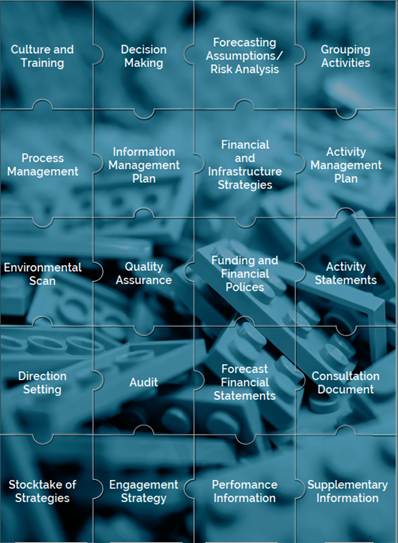
21. Their guide
is structured around 20 key pieces which are summarised below along with
guidance on the elected member decision making required (watching briefs are
also indicated for upcoming legislation changes likely to impact the LTP),
under the headings process, content and consultation:
Table
1: Process pieces with decision-making led by elected members
Process pieces –
Building the Foundation
|
Elected member decision-making
|
|
1) Environmental
Scan
Conduct early scans to understand
external factors affecting service delivery. Use tools like horizon scanning
and critical transitions to anticipate future needs.
|
To be reported to elected members as
background material and for input as required.
|
|
2) Direction
Setting
Establish strategic priorities early.
Engage Elected Members to define community outcomes and align council
activities accordingly.
|
Decisions required
Within this report, paragraph 38
seeks to confirm community outcomes for the basis to begin building the LTP.
|
|
3) Decision-Making
Ensure the Elected Members are
empowered and informed. Comply with legislative requirements (sections
76AA–82), document decisions, and avoid predetermination.
|
Business as usual approach to
decision-making processes (including Issues & Options papers).
|
|
4) Stocktake
of Strategies
Review existing plans, strategies,
action and investment plans for relevance and alignment. Assessment of
objectives, actions, and links to the LTP.
|
Stocktake (particularly
‘relevance and alignment’) will depend on elected members’
direction setting (see above).
Stocktake reported to elected members
as background material and for direction on applying the outcomes of the
stocktake.
|
|
5) Engagement
Strategy
Go beyond statutory consultation.
Develop a comprehensive engagement plan aligned with the significance and
engagement policy. Use diverse methods to reach different groups.
|
Direction and decisions
required
Elected members to provide their
views as the basis for building the communications and engagement plan for
the LTP. Applies to both the engagement content and approach.
|
Table 2:
Content pieces with decision-making led by elected members
Content Pieces – Telling the Story
|
Elected member decision-making
|
|
6) Forecasting
Assumptions and Risk Analysis
Document assumptions (e.g., growth,
climate change) and apply them consistently. Conduct sensitivity analysis and
disclose uncertainties.
|
Decisions required
Elected members will need to
consider, develop and adopt these as the basis for building the plan.
|
|
7) Grouping
Activities
Define and group activities
logically. Ensure transparency and alignment with community outcomes.
Mandatory groups currently include roads, water, wastewater, stormwater, and
flood protection.
|
Watching brief
These requirements may be changed
through the Local Government (Systems Improvement) Bill. Direction may
then be provided by Department of Internal Affairs (DIA) on future
requirements.
The Local Waters Done Well decision
from August 2025, will mean that water and wastewater will be removed from
the LTP with stormwater to be confirmed or changed through due diligence.
|
|
8) Activity
Management Plans
Maintain up-to-date plans that link
services to assets. These plans inform infrastructure and financial
strategies and support decision-making.
|
Decisions required
To be provided to elected members for
review and direction. Specific initiatives within activities may
require their own papers and decisions (this includes new project
initiation).
|
|
9) Financial
and Infrastructure Strategies
Develop integrated strategies that
reflect service needs, costs, and risks. Include quantified limits on rates
and debt and address resilience and climate change.
|
Decisions required
Elected members will need to
consider, develop and adopt these as the basis for building the plan.
|
|
10) Funding
and Financial Policies
Prepare revenue and financing
policies (RFP). Ensure compliance with section 101(3) and consult
appropriately. This would also include rating policies
(commercial/industrial/residential split, targeted rates (existing and/or
new).
|
Decisions required
Elected members will need to
consider, develop and adopt these as the basis for building the plan.
|
|
11) Activity
Statements
Summarise rationale, levels of
service, performance measures, and funding impact for each group of
activities. Use clear, consistent formats.
|
Decisions required
Elected members will need to
consider, develop and adopt these as the basis for building the plan.
Watching brief
These requirements may be changed
through the Local Government (Systems Improvement) Bill. Direction may
then be provided by DIA on future requirements.
|
|
12) Performance
Information
Define levels of service, measures,
and targets. Focus on what matters to the community. Ensure systems can
capture and report performance data.
|
Decisions required
Elected members will need to
consider, develop and adopt these as the basis for building the plan.
Watching brief
These requirements may be changed
through the Local Government (Systems Improvement) Bill. Direction may
then be provided by DIA on future requirements.
|
|
13) Forecast
Financial Statements
Include financial statements, funding
impact statements, capital expenditure, reserves, and budget balancing
disclosures. Ensure GAAP compliance and clarity.
|
Decisions required
Elected members will need to
consider, develop and adopt these as the basis for building the plan.
|
Table 3: Consultation and Supplementary Information with
decision-making led by elected members
Consultation and Supplementary Information
|
Elected member decision-making
|
|
14) Consultation
Document (CD)
The CD is the legal basis for LTP
consultation. The CD presents key issues, options, and impacts on rates,
debt, and service levels using accessible formats.
|
Decisions required
Elected members will need to provide
direction on the document (including questions to ask the community) and then
adopt as the basis for consultation.
Summary document also to be prepared
based on elected member direction and approved by elected members.
|
|
15) Supplementary
Information
Ensure this information is adopted
and available during consultation. Position it logically within the LTP for
clarity.
|
Decisions required
Elected Members will need to adopt
these as the basis for building the plan.
|
22. The remaining
pieces of the jigsaw are largely staff-led process pieces and are included
below for completeness:
Table 4:
Process pieces that are staff led
Process pieces – Building the Foundation
|
|
16) Culture
and Training
Embed LTP thinking into
organisational culture. Leadership, communication, and professional
development are essential. Staff should understand how their roles contribute
to the LTP.
|
|
17) Process
Management
Treat the LTP as a complex project.
Develop a clear plan with milestones, risks, and responsibilities.
|
|
18) Quality
Assurance
Apply QA throughout the whole LTP
process. Include consistency checks, peer reviews, and legal audits. QA
ensures coherence, completeness, and cost-effectiveness.
|
|
19) Information
Management
Develop systems for secure,
accessible, and consistent data handling.
|
|
20) Audit
The audit provides assurance to the
community and supports learning.
|
Proposed
high-level timeline
23. The
high-level timeline below outlines key actions from the processes identified
above and when they are likely to occur between 2026-2027.
24. In addition
to the table below Attachment 2
outlines a more detailed typical timeline of when the content pieces are
developed over a typical LTP.
25. Engagement with elected members will be ongoing. Subject to
elected member input, key decision points will align with the below dates to
ensure input and direction is captured at each critical stage.
Table 5: High level LTP timeline
|
Dates
|
Action/s
|
|
Late 2025
November – December
|
Confirmation of process, principles
and structure, early strategy stocktake.
|
|
Early 2026
February – May
|
Strategy stocktake and environment
scans, asset management refresh, start of user fees review phase 2.
|
|
Mid 2026
June – September
|
Initial briefings/workshops, policy
reviews (revenue and finance, rating, financial/infrastructure), direction
setting workshops, early issues identification and project decision-making.
|
|
Late 2026
October – December
|
Draft LTP preparation, early
engagement with audit, consultation planning and approval.
|
|
Early 2027
February – April
|
Finalisation of Consultation Document
and supporting documents. Audit of CD.
Formal consultation period (including
all identified engagement tools and topics).
|
|
Mid 2027
May – June
|
Analysis of feedback, Hearings and
Deliberations.
Finalisation of LTP, audit of final
document.
Adoption of Long-Term Plan
2027–2037.
|
Background – prioritisation aproach
to the ltp capital programme
26. The proposed
process for prioritising projects to be included in the LTP is sequential and
ranks projects based on strategic and risk-based assessments. It requires clear
strategic objectives and defined success metrics to measure projects against.
Additionally, it necessitates clear guidelines on unacceptable risks and
service levels. Principles to guide the prioritisation could also include
fairness and equity of investment both geographically and demographically.
27. The proposed
process for prioritisation for the LTP capital programme was presented to a
City Delivery Committee workshop on 11 September 2025. The sequential process
diagram can be found on page 20 of the slides from that workshop at: https://infocouncil.tauranga.govt.nz/Open/2025/09/CPCW_20250911_AGN_2864_AT.PDF
28. The prioritisation methodology begins by filtering out projects that
are already committed – those under construction or required by
legislation or binding contracts. These projects are automatically included in
the programme, but may still be reviewed if new risks to time, scope, or cost
arise. For other projects, the process applies a series of qualifiers, starting
with a critical risk assessment. Projects that address high or critical risks
(such as financial, legal, reputational, or health and safety risks) may also
be automatically included if they meet the set threshold.
29. Projects that pass the initial filters are then assessed against
Long Term Plan strategic priorities. This involves scoring each project based
on how well it supports strategic priorities, with moderation to ensure
consistency. The methodology also considers the cost of deferral, quantifying
the financial and operational impacts of delaying a project, such as increased
operating costs or loss of funding.
30. Finally,
projects are evaluated for readiness and deliverability – looking at
factors like consents, procurement, funding, and supply chain capacity.
Projects are then ranked, with critical risk projects and committed projects
automatic inclusions, followed by those prioritised based on strategic
alignment, risk, readiness, deliverability, and cost of delay. The process is
iterative and allows for scenario modelling, ensuring that investment decisions
are transparent, evidence-based, and aligned with both immediate needs and
long-term goals.
Background – community outcomes,
priorities and principles
What are Community Outcomes
31. Community
outcomes, as currently defined under the Local Government Act 2002, represent
the long-term aspirations of our city for the social, economic, environmental,
and cultural wellbeing of the city.
They provide a shared vision of what our community wants life here to look like
in the future and guide council planning and decision-making, particularly
through the LTP. By aligning services and projects with these outcomes, the
council ensures that its activities contribute to achieving the
community’s priorities and that progress can be measured and reported
transparently.
32. Community
outcomes are central to the development of the LTP. The LTP sets out the
council’s priorities, activities, and financial strategies for the next
10 years, and each of these is aligned to one or more community outcomes. This
alignment ensures that council investments and services directly contribute to
the long-term aspirations of the city. By linking projects and performance
measures to these outcomes, the LTP provides a clear framework for monitoring
progress and demonstrating accountability to the community.
Updating the community outcomes
33. Work to
refresh the council’s strategic framework began in 2021 under the
previously appointed Crown Commission, following community feedback about a
lack of consolidated Council direction.
34. The vision
developed for Tauranga in consultation with the community in June 2022 prior to
the 2024-34 LTP was ‘Tauranga – together we can prioritise nature,
lift each other up, and fuel possibility’. Council’s
contribution to achieving the vision is articulated in our strategic framework,
called Our Direction.
35. Our
Direction, Tauranga City Council’s Strategic Framework, comprises
Council’s five community outcomes (what we are aiming to achieve
for our communities, now and in the future) with our three
approaches (how we do everything). Our Direction is
visually represented by te kupenga (a type of fishing net):
Figure 2: Te
kupenga
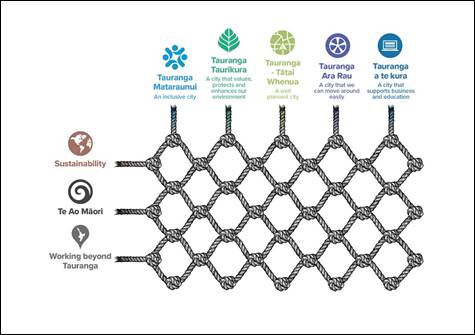
36. All of
Council’s strategies and plans, and the work programmes to deliver them,
contribute to delivering Our Direction for our communities.
37. The existing
community outcomes, in the Long-term Plan 2024-2034, were adopted as part of
the process of adopting the final LTP in April 2024.
38. Due
to Our Direction including significant community engagement, staff are of the
view that prior to the next LTP consulting on the community outcomes may not be
necessary.
39. The strategic
framework was discussed at the City Future Committee Workshop of 24 July 2025.
Subsequent to that, staff have received feedback from the Elected Members which
proposed some minor amendments to the community outcomes, priorities and
principles for the upcoming LTP. These amendments have
been captured in the three tables below and are presented to council for
adoption to be used as the basis for planning of the Long-term Plan 2027-2037.
Table 6: Existing community outcomes versus proposed minor
amendments to the community outcomes
|
Existing community outcomes
|
Proposed community outcomes
|
|
An inclusive city - Tauranga Mataraunui
Tauranga is a city that celebrates our past, is connected in our
present and invested in our future. Where people of all ages, beliefs,
abilities and backgrounds are included and feel safe, connected and healthy.
|
Tauranga Mataraunui - An inclusive city
Tauranga is a city that celebrates our past, is connected in our
present and invested in our future. Where people of all ages, beliefs,
abilities and backgrounds thrive.
|
|
A city that values, protects and enhances our environment -
Tauranga Taurikura
Tauranga is a city that values our natural environment and outdoor
lifestyle, and actively works to protect and enhance it
Toitū te marae a Tāne, toitū te marae a Tangaroa,
toitū te tangata. If the land and sea are sustained so too
will the people.
|
Tauranga Taurikura - A city that values, protects and enhances our
environment
Tauranga is a city that prioritises our natural environment and
outdoor lifestyle, and actively works to protect and enhance it.
|
|
A well planned city Tauranga – Tatai Whenua
Tauranga is a city that is well planned with a variety of
successful and thriving compact centres, resilient infrastructure, and
community amenities.
|
Tauranga - Tātai Whenua - A well planned city that is easy to
move around
Tauranga is well planned and connected, easy to live in and
navigate around with thriving centres, affordable homes, resilient
infrastructure, community amenities and sustainable transport choices.
|
|
A city that we can move around easily - Tauranga Ara Rau
Tauranga is a well-connected city, easy to move around in and with
a range of sustainable transport choices.
|
Merged with well-planned city above.
|
|
A city that supports business and education – Tauranga a te
kura
Tauranga is a city that attracts and supports a range of business
and educational opportunities, creating jobs and a skilled workforce.
|
Tauranga a te kura - A city that supports business and education
Tauranga is a city that attracts and supports a range of business
and educational opportunities, creating jobs and a skilled workforce.
|
|
|
Tauranga <translation to come> - A vibrant city that
embraces events
Tauranga is a city that champions events and experiences that
enhance vibrancy, connects communities, builds identity and delivers
cultural, social and economic benefits for its people.
|
Table 7:
2024 LTP priorities versus proposed priorities
|
Existing Council LTP priorities
|
Draft priorities (where we will focus effort)
Delivering for our people
|
|
Community spaces and facilities
|
Enable Housing
|
|
Growth in existing urban areas
|
Address Transport
|
|
Revitalising the city centre
|
Enhance our Environment
|
|
Transport network upgrades
|
Deliver Services for our community
|
|
Growth in the West (Tauriko)
|
|
|
Sustainability and resilience
|
|
Table 8:
Existing Council principles versus proposed principles
|
Existing Council key principles for the development of the Annual
Plan 2025/26
|
Draft LTP principles (How we will do things and deliver)
|
|
Looking after what we have got
|
Look after what we’ve got
|
|
Paying a fair share
|
Everyone pays a fair share
|
|
Ongoing financial, economic, social,
cultural and environmental sustainability
|
Be bold and innovative
|
|
Affordability
|
|
|
Robust and transparent financial analysis
|
Accountable and transparent
|
|
Growth pays for growth
|
Growth pays for growth
|
|
Value for money
|
Value for money
|
40. These newly
worded community outcomes, priorities and principle have been developed by
elected members and are not inconsistent with feedback received from prior
engagement processes (for example, the proposed new vibrancy community outcome
is consistent with significant community feedback received when developing the
city vision in 2022). They are strongly aligned with the responsibilities and
requirements of local government, as outlined in the Local Government Act 2002.
It is intended to use these new community outcomes, priorities and principles
to guide how we do our business as an organisation, and the upcoming LTP will
show the linkages between the principles and Council’s decision making,
planning and delivery tools.
Statutory Context
41. Under the
Local Government Act 2002 (LGA), every three years the Council is required to
produce an LTP. The purpose
of the LTP is to:
a) describe the activities of the local authority; and
b) describe the community outcomes of the local
authority’s district or region; and
c) provide integrated decision-making and co-ordination
of the resources of the local authority; and
d) provide a long-term focus for the decisions and
activities of the local authority; and
e) provide a basis for accountability of the local
authority to the community.
42. An LTP is
prepared every three years, covers ten years (and includes an infrastructure
strategy that covers 30 years), must include specific information described in
the Local Government Act 2002 (see Schedule 10 specifically), must be audited,
and can only be adopted after a period of public consultation on a consultation
document which itself also needs to be audited.
STRATEGIC ALIGNMENT
43. This
contributes to the promotion or achievement of the following strategic
community outcome(s):
|
Contributes
|
|
We are an inclusive city
|
ü
|
|
We value, protect and enhance the environment
|
ü
|
|
We are a well-planned city
|
ü
|
|
We can move around our city easily
|
ü
|
|
We are a city that supports business and education
|
ü
|
44. This report focusses on the legislation and process involved in an
LTP. The LTP seeks to enable Council to achieve its community outcomes.
45. This report also seeks Council approval for the suggested minor
amendments to the community outcomes to guide the organisation’s
development and delivery of the next LTP.
Options Analysis
46. Three options
are identified in the tables below, which outline the benefits, disadvantages
and key risks for each option.
Table 9:
Option 1 – No changes to the current community outcomes
|
Description
|
|
Retain the existing community outcomes, priorities and principles
that were adopted in 2024 for the 2024-2034 LTP.
Noting that there was extensive community consultation on
Council’s strategic framework, Our Direction. The community outcomes
are part of the strategic framework.
|
|
Benefits
|
Disadvantages
|
Key risks
|
|
Consistent with what was adopted post consultation with the
community.
|
Not updated to reflect the views and direction of the current
elected members.
|
None
|
Table 10:
Option 2 – Community outcomes with minor amendments adopted without
consultation (RECOMMENDED OPTION)
|
Description
|
|
Council adopts the new proposed community outcomes, priorities and
principles as outlined in Tables 6-8 above.
No consultation with our communities, as Council is not
legislatively required to consult on the community outcomes.
Key information from past community engagement and strategic
planning work has been used to inform proposed community outcomes, priorities
and principles.
|
|
Benefits
|
Disadvantages
|
Key risks
|
|
Timeframes for LTP process are more reasonable, making it easier
for activity managers and others to forward plan.
Reduces consultation fatigue risk from the community when they
have already been consulted on this topic.
|
The community is not given an opportunity to provide feedback on
the proposed minor amendments to the community outcomes.
|
Reputational risk:
Potential negative community perception over the lack of
consultation leading to possible lack of engagement for longer strategic
framework project and other Council projects.
|
Table 11:
Option 3 – Proposed community outcomes are consulted on with the
community
|
Description
|
|
Council approves the proposed community outcomes, priorities and
principles as outlined in Tables 6-8 for community consultation.
Consultation will focus on ensuring that the community outcomes
reflect community needs and will also seek an indication from the community
on which outcome/s are most important and why. Consultation could occur over
a four-week period in March/April at a similar time as the annual plan
consultation period.
|
|
Benefits
|
Disadvantages
|
Key risks
|
|
Allows confirmation of proposed community outcomes with our
communities and allows Council to gather information on community priorities.
Provides vehicle to highlight the longer-term strategic framework
process that includes significant community engagement.
|
Timeframes for the LTP process are tight. As a result, this
consultation will be limited in its scope and reach.
If significant changes are required after consultation may require
rework of early LTP material. Which in turn could delay the project.
|
Community consultation risk:
Community may confuse the community outcomes consultation (high
level) and Annual Plan consultation (detailed), with potential for
either/both processes becoming sidelined.
Communication will need to be clear and transparent.
|
47. Option two is
the recommended option. As the proposed amendments are only minor and the
community has already been consulted extensively through the Our Direction
process, staff recommend not to consult and just adopt the proposed amendments
as suggested in this report so that early work on the LTP can begin.
Financial Considerations
48. This report
covers the legislative and process requirements in regard to developing an LTP.
49. The report
has no further financial implications as it recommends that Council adopt the
proposed amendments to the community outcomes, priorities and principles
without community consultation.
50. Should
Council choose option three and consult with the community then this could be
covered using existing budgets.
Legal Implications / Risks
51. Legal
implications of an LTP have been discussed in the statutory context section of
this report.
52. This report
has no other legal implications. The risks associated with the recommended
approach are outlined in the options analysis.
Consultation / Engagement
53. There is no
requirement for Council to consult on the refreshed community outcomes or
proposed priorities and principles (this work does not trigger a special
consultative procedure).
Significance
54. The Local
Government Act 2002 requires an assessment of the significance of matters,
issues, proposals and decisions in this report against Council’s
Significance and Engagement Policy. Council acknowledges that in some
instances a matter, issue, proposal or decision may have a high degree of
importance to individuals, groups, or agencies affected by the report.
55. In making
this assessment, consideration has been given to the likely impact, and likely
consequences for:
(a) the current and future social, economic, environmental, or cultural
well-being of the district or region
(b) any persons who are likely to be particularly
affected by, or interested in, the decision.
(c) the capacity of the local authority to perform
its role, and the financial and other costs of doing so.
56. In accordance
with the considerations above, criteria and thresholds in the policy, it is
considered that the decision is of low significance.
ENGAGEMENT
57. Taking into
consideration the above assessment, that the decision is of low significance,
officers are of the opinion that no further engagement is required prior to
Council making a decision.
Next Steps
58. If Council
approves the recommendations contained in this report, the next steps are to
progress the early LTP work such as the environmental scan and strategy
stocktake that will inform the rest of the upcoming LTP.
59. Staff will
report back to Council throughout 2026 on the progress of the LTP. Staff will
also inform Council of any new legislation released by central government that
will have any impact on the LTP content and timelines.
Attachments
1. Prioritisation
Process 2027 LTP - A19255804 ⇩

2. Indicative 2027 LTP Timeline
based on Taituarā advice - A19297301 ⇩
|
Ordinary
Council meeting Agenda
|
18
November 2025
|
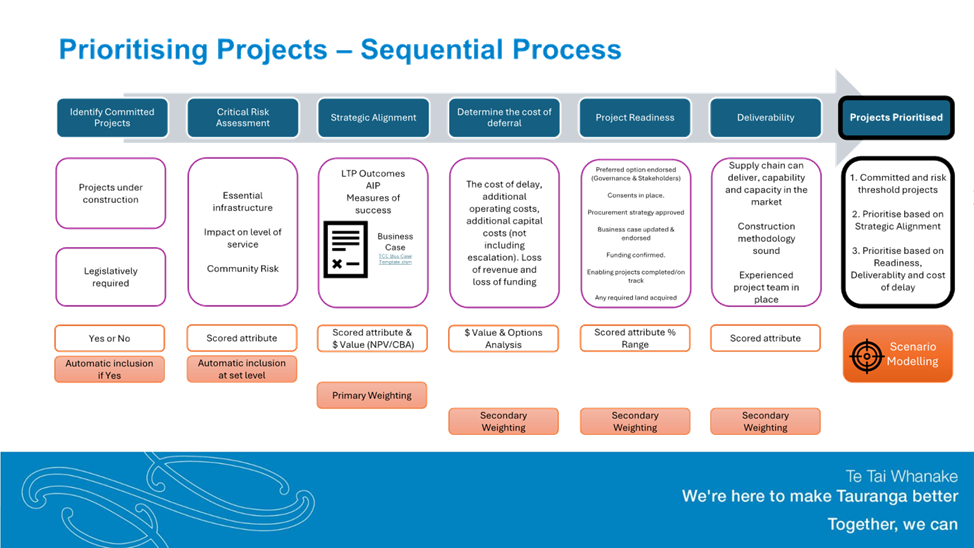
|
Ordinary
Council meeting Agenda
|
18
November 2025
|
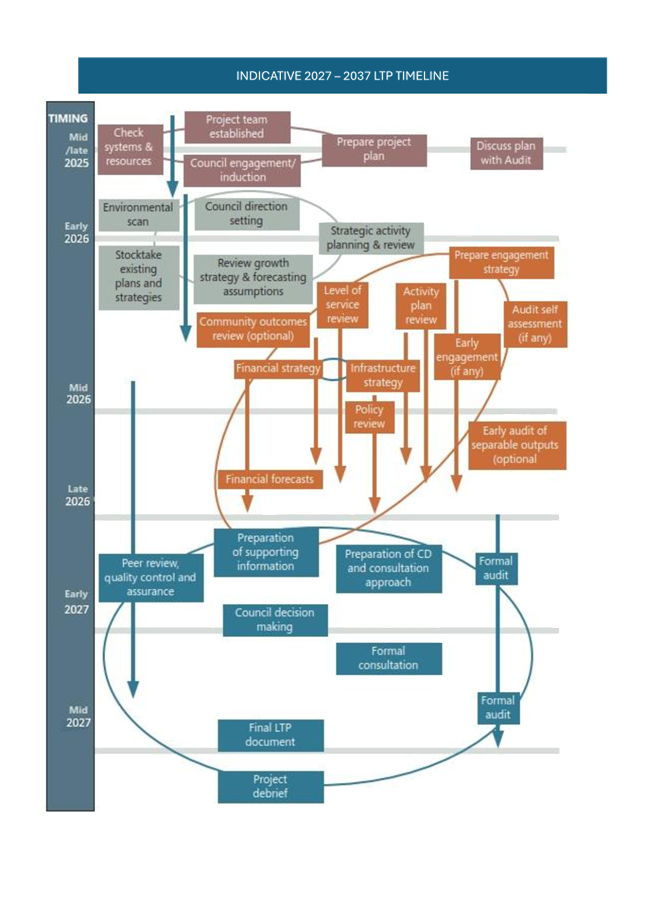
|
Ordinary
Council meeting Agenda
|
18
November 2025
|
11.5 Development
Contributions Policy Review - 2026/27
File
Number: A18796058
Author: Andrew Mead, Head of City Planning & Growth
Ben Corbett, Team Leader: Growth
Funding
Authoriser: Christine Jones, General Manager: Strategy, Partnerships &
Growth
Purpose of the
Report
1. To
seek approval for TCC’s proposed work programme for the 2026/27
Development Contributions Policy (DC Policy).
|
Recommendations
That the Council:
(a) Receives the
report "Development Contributions Policy Review - 2026/27".
(b) Approves the
draft 2026/27 Development Contributions Policy to be prepared incorporating
the following matters for Council consideration prior to public consultation:
(i) Amendments
to development contributions funding for Memorial Park Aquatics Centre and
Haumaru Sports & Recreation Centre to reflect decisions made on these
projects;
(ii) New/amended
wording to clarify local and citywide development contributions are payable
for minor dwellings in residential zones;
(iii) Revision
to the definition of “bedroom” to improve clarity; and
(iv) Updated wording
in the Upper Ohauiti, Tauriko Business Estate Stage 4 and Tauriko West
catchments to more fully detail how local development contributions are
calculated in these catchments.
(c) Notes that
separate council reporting is being prepared on incentives for residential
intensification / city centre development which may impact on the development
contributions policy.
(d) Notes that
more substantive policy amendments are not being considered due to impending
development contribution reform and waters reform.
|
Executive Summary
2. TCC
uses development contributions (DCs) to fund a portion of the cost of
growth-related capital expenditure for certain infrastructure projects.
DCs are charged in accordance with the operative DC Policy and the Local
Government Act 2002 (LGA).
3. TCC
generally updates its DC Policy annually. For 2026/27, updates are
proposed to:
(i) reflect
decisions made in the current year and as part of the 2026/27 Annual Plan and
(ii) (ii) make
the DC Policy clearer and easier to use for TCC and developers.
4. Staff
will prepare a draft 2026/27 DC Policy for the purposes of public
consultation. This will be reported to Council in early 2026 for approval
to proceed to consultation. Consultation, hearings and deliberations will
occur alongside the 2026/27 Annual Plan. The DC Policy will be updated as
required to reflect the outcome of deliberations. The final DC Policy
will be prepared for adoption in June 2026.
5. Central
Government’s reform of water services and proposed reform of growth
funding will have a significant impact on the development contributions system
over the short to medium term. TCC has prioritised its DC Policy work
program to focus on essential updates to the DC Policy only without investing
time in major policy matters which are likely to be set aside through the
reform process.
6. Proposed
updates (other than those made to reflect the 2026/27 Annual Plan) are to
incorporate growth funding for proposed projects, reflect recent Council
resolutions regarding the long-term operation of the Queen Elizabeth Youth
Centre and wording updates to improve the efficacy of the DC Policy and clarify
TCC’s revenue collection powers.
7. Together
these changes are likely to have a minimal impact on DC charges but will
improve the efficacy and transparency of the DC Policy for TCC and the
development community. These updates are likely to have a small positive
impact on TCC’s DC revenue and make assessment of contested DC
assessments more efficient. No risks associated with this approach have
been identified.
8. Separate
work is underway on incentives for intensification and city centre development
which may affect the development contributions policy in due course.
9. Staff
will incorporate the resolutions passed by Council into the draft 2026/27 DC
Policy prior to public consultation in 2026.
Background
10. TCC uses DCs
to fund growth-related capital expenditure for certain infrastructure projects.
DCs are charged in accordance with TCC’s operative DC Policy and the
relevant provisions of the LGA.
11. The LGA
requires TCC to consult on a DC Policy at least every three years and TCC last
consulted and adopted a new DC Policy in June 2025.
12. TCC typically
follows the same process for developing its DC Policy as its Annual Plan.
This allows staff to reflect the draft Annual Plan in the draft DC Policy and
carry through Council decisions into the draft and final DC Policy. This
means staff will return to Council with a draft DC Policy in the first quarter
of 2026 for Council to review and approve for public consultation.
Consultation will run alongside the Annual Plan. Staff will prepare a
deliberations report to ensure Council can consider Annual Plan decisions
alongside the impact on the DC Policy and DC charges. The draft DC Policy
will be updated to reflect decisions made through deliberations before the
final DC Policy is brought to Council for adoption in June 2026. Subject
to Council adoption, the DC Policy will be operative from 1 July 2026.
13. At this early
stage of development, it is not possible to assess likely changes to DCs.
Statutory Context
14. Central
Government is currently undertaking two reform workstreams which will
substantially impact TCC’s DCs: the water services and growth funding
reforms.
15. In time,
water reform will result in a new Water Services Entity (WSE) setting
and collecting growth funding charges for its own growth-related capital
expenditure. TCC will no longer set and collect DCs for three waters
activities transferred to a Water Service Entity (although it may consult on
the DC policy and collect DC’s on behalf of a WSE, at least
initially).
16. This will
result in a substantial decrease in TCC’s DC charges. For example,
based on today’s charges, this would reduce the citywide charge for a 3
bedroom dwelling from approximately $36,000 to $5,000. Many local DCs
will also reduce substantially. A developers total growth funding
obligation is likely to remain materially unchanged as the same infrastructure
still has to be funded.
17. It is worth
noting that TCC does not anticipate this change will occur from the
establishment of the WSE. It is likely that the WSE will continue to rely
on TCC to collect DCs on the WSE’s behalf for a period while it
establishes its own systems and growth funding policy.
18. Central
Government is also preparing reforms to the LGA to replace DCs with a new
system based on development levies. Government officials have shared
initial plans with several councils on a confidential basis. TCC has
contributed to these discussions and provided preliminary comment. It is
likely that the proposed changes will require a significant review and rewrite
of TCC’s DC Policy which is expected to be implemented from 1 July 2027
or 2028.
19. Staff
understand the Government will introduce legislation for development levies
late this calendar year.
discussion
20. The following
matters were signalled for consideration through the 2026/27 DC Policy:
(a) Review of
transport and active reserves methodologies;
(b) Population
data updates;
(c) Review of
timing of DC charges;
(d) Impact of
ongoing Memorial Park Aquatic Centre and Queen Elizabeth Youth Centre updates;
(e) Clarification
of growth funding approach for secondary independent dwelling units and small
standalone dwellings;
(f) Updates
to the definition of a “bedroom” in the DC Policy; and
(g) Updates to
new growth catchments.
Review of transport and active reserves methodologies
21. The DC Policy
sets out how growth funding is assessed for each type of infrastructure
including transport and active reserves. Staff had intended to review and
make any necessary updates to these methodologies to ensure they are fit for
purpose in the 2026/27 DC Policy.
22. In light of
upcoming growth funding reform, staff have not progressed this matter. It
is considered likely that the new growth funding system will mandate growth
funding methodologies and any revision undertaken now is likely to be set aside
in the short to medium term.
23. As a
consequence, TCC is proposing to continue its current approach to growth
funding for active reserves and will incorporate the outcome of upcoming
Council decisions regarding the active reserve network (including the future of
Poteriwhi).
24. Staff intend
to review growth funding allocations for the Connecting the People –
Turret Rd to Welcome Bay project. Once a growth funding allocation has
been set and NZTA funding has been approved for construction, staff will look
to begin DC collection for this project.
25. This approach
balances maximising growth revenue while minimising the opportunity cost of
investing in work with short-term application.
Population data updates
26. Each year
staff update the DC calculations to reflect Tauranga’s projected
population. This works off population assumptions set in the 2024-34
Long-term Plan.
27. Population
projections will be revisited in the next LTP, and the DC Policy will be
updated again at that point. These updated projections are currently
being prepared. Early indications are that there could be a material
increase in resident numbers. This may have a substantial impact on DC
charges as funding periods for infrastructure may be shortened. Staff
will continue to update Council on this matter.
Timing of DC charges
28. Generally
speaking, TCC charges DCs in two tranches. Local DCs are charged on
subdivision and citywide DCs are charged on building consent. This
approach is uncommon in New Zealand with many other councils charging all DCs
on subdivision. Each approach has positive and negative elements compared
to the other. TCC has explored changing its approach a number of times
over the last 20 years but in each case has decided not to proceed.
29. Staff
anticipate that the new growth funding system will require all DCs to be
collected at the first possible opportunity (being subdivision) but this is not
certain. This would require TCC to change its approach. It is
recommended TCC wait for the reform process to consider / implement this
change. It is likely to be counterproductive to change the timing of
collection in 2026/27 as TCC will have to implement a complex transitional
regime.
Update DC Policy to reflect impact of Memorial Park Aquatic Centre
and Queen Elizabeth Youth Centre decisions
30. TCC
introduced DCs for the Memorial Park Aquatic Centre and BayPark Indoor Courts
in 2022/23.
31. In 2025/26 we
have prepared aquatics DCs on the basis Otumoetai Pool remains open and
Memorial Park Aquatics Centre proceeds on the last adopted budget. TCC is
currently revisiting its design and budget for Memorial Park. Staff will
look to incorporate changes to the growth allocation, budget and timing of
delivery once Council has made decisions on these matters. If a decision
is made by February 2026, staff will incorporate the outcome into the draft DC
Policy for consultation. If the decision is made after February, staff
will likely use the current budget and timing for this project. Once
consultation has occurred, TCC can only make relatively small increases to DC
charges. In the event Council increased the budget for this project substantially
beyond what is currently assumed, DCs are unlikely to be able to rise to meet
the desired funding allocation resulting in some under collection. This
is considered a low risk in light of Council’s recent comments on this
project which suggest project cost should reduce.
32. Earlier this
year Council resolved to retain Queen Elizabeth Youth Centre in the indoor
courts network for a further 15 years. Staff have modelled the impact of
this decision on DCs. TCC only collects DCs towards one indoor court
project at a time. Currently, TCC is collecting for the BayPark Arena
Extension. However, with Queen Elizabeth Youth Centre retained in the
network, the recently opened Haumaru Sport & Recreation Centre is now
providing capacity for growth based on the current level of service. This
means the draft 2026/27 DC Policy will be updated to remove BayPark and
introduce Haumaru. DCs collected for BayPark will be directed to
Haumaru. Initial calculations suggest this will have an immaterial impact
on the total DC charge for community infrastructure.
Updates to wording of DC Policy
33. It is
proposed to make a number of updates to clarify the application of the DC
Policy and DC calculation. These are:
(a) New wording
to ensure potential developers are clear that DCs will be charged for all
independent dwellings built on a site. This includes small, attached dwellings
in residential zones (previously called Secondary Independent Dwelling Units)
and “small standalone dwellings” (commonly known as granny
flats). This is an equitable way to treat these developments which place
demands on TCC’s infrastructure network in the same way as any other
independent dwelling.
(b) The
definition of “bedroom” – citywide DCs are charged based on
how many bedrooms a dwelling contains. The DC Policy treats every room as
a bedroom unless it clearly has another function that is not compatible with
use as a bedroom (e.g. kitchen, one living room, garage, passageway,
bathroom). Wording will be introduced to simplify TCC’s existing
definition and reduce scope for debate as to whether or not a room is a
bedroom.
(c) Updates to
growth catchments – wording will be introduced for three new catchments
(Upper Ohauiti, Tauriko West and TBE Stage 4) to set out the DC assessment
methodology in greater detail to assist TCC’s DC assessor team in
implementing the DC Policy.
STRATEGIC ALIGNMENT
34. This
contributes to the promotion or achievement of the following strategic
community outcome(s):
|
Contributes
|
|
We are an inclusive city
|
☐
|
|
We value, protect and enhance the environment
|
☐
|
|
We are a well-planned city
|
ü
|
|
We can move around our city easily
|
ü
|
|
We are a city that supports business and education
|
ü
|
35. DC funding is essential to ensuring infrastructure is delivered to
align with land use and new development in an integrated way. DCs support
transport investment which helps ensure people and goods can move around the
City and infrastructure funded by DCs supports the development of existing and
new business areas, schools and other educational institutions.
Options Analysis
36. This report
sets out updates staff intend to prepare for the draft 2026/27 DC Policy.
These changes balance improving the efficacy of the DC Policy now against the
likely short to medium term application prior to the implementation of growth
funding and waters reform.
37. It is
recommended that staff prepare these changes as part of the draft DC Policy for
Council approval early in 2026.
38. Alternatively,
Council may provide other direction to staff which will be incorporated into
the draft DC Policy on the same timeline.
Financial Considerations
39. The decisions
discussed in this report do not have a financial impact at this time as they
relate to the preparation of a draft (rather than final) DC Policy.
40. In substance,
the proposed changes are expected to have a positive financial impact.
They will:
(a) update DCs to
more accurately reflect the cost of growth for projects like Connecting the
People and Haumaru Sports & Recreation Centre; and
(b) provide
greater clarity of when and how DCs apply which strengthens TCC’s ability
to collect DC revenue.
Legal Implications / Risks
41. No legal
implications have been identified.
42. The key risk
identified is the investment of staff time in more substantial updates to the
DC Policy which are likely to have limited longevity in light of upcoming
reforms.
Significance
43. The Local
Government Act 2002 requires an assessment of the significance of matters,
issues, proposals and decisions in this report against Council’s
Significance and Engagement Policy. Council acknowledges that in some
instances a matter, issue, proposal or decision may have a high degree of
importance to individuals, groups, or agencies affected by the report.
44. In making
this assessment, consideration has been given to the likely impact, and likely
consequences for:
(a) the current and future social, economic, environmental, or cultural
well-being of the district or region
(b) any persons who are likely to be particularly
affected by, or interested in, the matter.
(c) the capacity of the local authority to perform
its role, and the financial and other costs of doing so.
45. In accordance
with the considerations above, criteria and thresholds in the policy, it is
considered that the matter is of low significance.
ENGAGEMENT
46. Engagement on these matters will be undertaken as part of
consultation on the draft 2026/27 DC Policy.
Next Steps
47. Prepare a
draft 2026/27 DC Policy reflecting Council’s resolutions and return to
Council for approval to consult in early 2026.
Attachments
Nil
|
Ordinary
Council meeting Agenda
|
18
November 2025
|
11.6 Council-Controlled
Organisations - Letters of Expectations 2026/27
File
Number: A17358830
Author: Caroline Lim, CCO Specialist
Jeremy Boase, Head of Strategy,
Governance & Climate Resilience
Authoriser: Christine Jones, General Manager: Strategy, Partnerships &
Growth
Purpose of the
Report
1. To
seek Elected Members approval of the Letters of Expectations 2026/27 to its
substantive council-controlled organisations, namely, Bay Venues Limited,
Tauranga Art Gallery Trust, Tourism Bay of Plenty and Te Manawataki o Te Papa
Limited, to guide the development of the council-controlled
organisations’ Statements of Intent 2026/27-2028/29.
|
Recommendations
That the Council:
(a) Receives the
report "Council-Controlled Organisations - Letters of Expectations
2026/27".
(b) Approves the
Letter of Expectations 2026/27 from Tauranga City Council to Bay Venues
Limited (Attachment 1 of this report), subject to the following:
(i) Approves
the following exceptions to the $0 increase of Bay Venues’ operating
grant for FY27:
· ……to be determined.
(ii) Authorises
Tauranga City Council staff to make final changes to the letter accordingly.
(c) Approves the
Letter of Expectations 2026/27 from Tauranga City Council to Tauranga Art
Gallery Trust (Attachment 2 of this report).
(d) Approves the
Letter of Expectations 2026/27 from Tauranga City Council to Tourism Bay of
Plenty (Attachment 3 of this report). Noting that joint shareholder Western
Bay of Plenty District Council is not providing Tourism Bay of Plenty with a
Letter of Expectations.
(e) Approves the
Letter of Expectations 2026/27 from Tauranga City Council to Te Manawataki o
Te Papa Limited (Attachment 4 of this report).
|
Executive Summary
2. Tauranga
City Council (TCC or Council) provides annual Letters of Expectations (LOEs) to
its substantive Council-Controlled Organisations (CCOs) to ensure alignment and
integrated delivery to strategic outcomes. In essence, the letters are provided
to ensure that Council, as early as possible, can influence the development of
the CCOs’ Statements of Intent.
3. Council’s
substantive CCOs are Bay Venues Limited (Bay Venues), Tauranga Art Gallery
Trust (TAGT), Tourism Bay of Plenty (TBOP) and Te Manawataki o Te Papa Limited
(TMOTPL).
4. The LOEs 2026/27 were developed with input from key council staff
and provided to Council Elected Members for their review prior to this meeting.
Feedback received has been incorporated into these letters. The letters are attached to this report for Council’s
approval.
5. Council’s
LOEs, at their core, continue to prioritise value for money, and deliver more
for less for the residents of Tauranga.
6. Across the CCOs, their operating grants FY27 will remain the same as
their operating grant for this financial year. Essentially, there will be $0
increase and the CCOs are expected to continue to be financially prudent in the
tough economic and cost of living environment Tauranga ratepayers are
experiencing. Subject to Council approval, there might be reasons for
exceptions to this $0 increase for Bay Venues, Council’s largest
CCO. (Refer paragraphs 13 to 15 for discussion and decision.)
7. The
background section below outlines the draft list of reasons for exceptions for
Bay Venues’ FY27 operating grant, Council’s overall expectations of
all of its substantive CCOs, why a letter exists even though it is not a legal
requirement under the Local Government Act 2002, and the core purpose of the
CCOs.
8. The
options analysis is provided below recommending that Council approves these
letters to ensure that clear direction and expectations are provided to the
CCOs, that the collaborative approach as part of the
TCC group fosters cohesion and maximises the impact of shared resources and
strategic initiatives, and that CCOs continue to contribute towards
Council’s vision, strategic priorities and community outcomes.
9. There are no financial or legal implications / risks associated with
these letters (other than the level of operating grants as noted above).
10. After the
letters have been provided, the focus for Council going forward is as follows:
· Draft Statements of Intent 2026/27-2028/29 – when the draft
SOIs are provided to Council by 1 March 2026 (a legislative deadline), it will
be assessed as to whether overall they meet Council’s expectations,
and Council will provide feedback by 1 May 2026 (a legislative deadline). A TCC
staff report outlining Council’s feedback will be presented to Council
for approval in April
· Final Statements of Intent 2026/27-2028/29 – when the final
SOIs have been adopted by the CCO Boards and provided to Council by 30 June
2026 (a legislative deadline), a TCC staff report noting key points of the
final statements will be presented to Council in July for formal
acknowledgement.
Background
Council’s
overall expectations of its substantive council-controlled organisations
11. To ensure
responsible stewardship of public funds and continued community trust, the
overall expectations of CCO’s are:
· Sharing of requested information – provide requested
information in a timely manner.
· Implementing operational cost savings – continue to be financially prudent in the tough economic and cost of
living environment Tauranga ratepayers are experiencing. This includes an
expectation that operating grants will be retained at the same level as
2025/26.
· Maximising value for money – carefully review all planned
expenditure to confirm necessity and optimise value for Tauranga residents,
actively seeking opportunities to reduce or avoid costs where possible
· Demonstrating community impact – clearly communicate the
organisation’s contributions to the community, highlighting the value
delivered through public services, spaces, and facilities. This includes
reinforcing the collaborative role of Council and its CCOs in enhancing public
wellbeing
· Maintaining transparency – continue to provide accessible and
timely information through half-yearly and annual reports, as well as media
releases. These should be published on CCO websites and made available to the
public, showcasing achievements, future plans, and areas for improvement, and
· Utilising meaningful performance measures – include a
realistic and relevant set of performance indicators that effectively
illustrate the organisation’s impact and value. These measures should be
used to tell a compelling story of progress and benefit to both Council and the
public.
Bay Venues
– draft list of reasons for exceptions to the $0 increase for FY27
operating grant
Council
staff are seeking direction on the following information to finalise the Bay
Venues letter.
12. The table
below provides a list of requested exceptions to the $0 increase to Bay Venues
operating grant for FY27:
|
|
$m
|
Comments
|
|
FY26 Opex Grant Budget
|
7.35m
|
|
|
Additional opex grant budget required in FY27, including:
|
|
Annual facility painting
|
0.27m
|
Offset by a reduction in renewals grant funding (from the
depreciation reserve)
|
|
Annual drowning prevention system IT subscription
|
0.10m
|
System installation occurring in FY26 (implementation already
agreed to progress via memo)
|
|
Annual additional cost to keep Queen Elizabeth Youth Centre
operational
|
0.05m
|
Incorrectly costed for FY26 based on early estimate prior to
availability of bookings information
|
|
Net losses associated with Baywave closure
|
0.13m
|
Two-month closure period to carry out significant maintenance and
renewals work
|
|
Inflationary allowance for specific contracted opex
|
0.06m
|
2.2% inflation on specific opex costs, including electricity,
cleaning, IT licences, rates and grounds maintenance
|
|
Total additional opex grant budget required in FY27
|
0.62m
|
|
|
Proposed FY27 Opex Grant Budget
|
7.97m
|
$8.04m presented in the working draft 2027 Annual Plan numbers in
October 2025 (net reduction $70k)
|
13. If approved
by Council, there will be an additional $616k required in FY27 over and above
the $7.35m operating grant budgeted in FY26. (Note that in the working draft
2027 Annual Plan numbers presented in October 2025, $8.04m was included.)
14. If not
approved by Council, Bay Venues will be asked if it can ‘absorb’
the additional cost. If it cannot, Bay Venues will need to provide options to
offset the additional cost in its response to the letter and the development of
its draft SOI by 1 March 2026.
Letter of Expectations – best practice
15. Letters of
Expectations are forward-looking documents, and while not mandated by
legislation, they are considered best practice and serve as strategic guidance
tools for CCOs.
16. Under the
Local Government Act, TCC has limited formal input into CCOs’ annual
planning until draft SOIs are submitted. At that stage, TCC, as shareholder,
has only two months to respond.
17. To address
this, TCC, alongside several other councils, adopts a proactive and
collaborative approach by engaging with its CCOs early in the planning cycle.
This ensures alignment between the CCOs’ objectives and Council’s
strategic priorities, particularly where CCOs deliver significant services on
behalf of Council.
18. The LOEs
outline strategic focus areas for the upcoming year, reflecting
Tauranga’s broader priorities. They serve as guidance for what Council
expects to see in the next SOIs.
19. TCC does not
typically issue LOEs to its other CCOs, Bay of Plenty Local Authority Shared
Services Limited (BOPLASS), Local Government Funding Agency (LGFA), and Te
Manawataki o Te Papa Charitable Trust, unless significant concerns arise. This
is due to TCC being one of nine shareholders in BOPLASS, one of 31 in LGFA, and
co-governs TMOTP Charitable Trust with the Otamataha Trust.
20. The term substantive
CCO originates from the 2010 Auckland local government amalgamation
legislation, referring to entities that deliver significant services on behalf
of that council.
Core purpose of the substantive
council-controlled organisations
21. The following
table outlines the core purpose of Council’s substantive CCOs.
|
Substantive council-controlled organisation
|
Core purpose
|
|
Bay Venues Limited
|
To connect the community with exceptional experiences through
hosting activities and events at community facilities across Tauranga
including aquatic centres, indoor sport and fitness facilities, event venues,
community centres and halls, and the Adams Centre for High Performance.
|
|
Tauranga Art Gallery Trust
|
To create and deliver exceptional art experiences that engage,
inspire, challenge and educate visitors through exhibitions, public
programmes and events.
|
|
Tourism Bay of Plenty
|
To lead the sustainable growth of the Western BOP visitor economy,
the management of the region as a visitor destination, and the management of
iSITE Visitor Information Centres at Tauranga, Mount Maunganui and the Port
of Tauranga (during the cruise season only).
|
|
Te Manawataki o Te Papa Limited
|
To govern the effective delivery of a suite of projects across
Tauranga city centre, to benefit the whole community.
|
Statutory Context
22. While not a
legislative requirement under the Local Government Act (2002), when combined
with the overarching Enduring Statement of Expectations, the LOEs is a key
strategic governance document through which Council provides clear guidance to
its CCOs.
23. The Letters of Expectations help ensure that the CCOs’ objectives and strategies are
aligned with Council’s, by providing key areas of focus that Council
expects to see reflected in the CCOs’ Statements of Intent.
24. Council’s
partnerships with its CCOs help successfully deliver our community outcomes and
facilitate Tauranga
becoming a vibrant city that attracts businesses, people and visitors, is well
planned, connected and inclusive.
STRATEGIC ALIGNMENT
25. This
contributes to the promotion or achievement of the following strategic
community outcome(s):
|
Contributes
|
|
We are an inclusive city
|
ü
|
|
We value, protect and enhance the environment
|
ü
|
|
We are a well-planned city
|
ü
|
|
We can move around our city easily
|
☐
|
|
We are a city that supports business and education
|
ü
|
26. The CCOs actively work in partnership with Council, mana whenua and
our community to achieve great outcomes. The LOEs ensure the CCOs continue to
deliver on behalf of Council and the communities across the city.
Options Analysis
Option 1: Approve the Letters of Expectations
2026/27 – RECOMMENDED
27. Council
approves the Letters of Expectations for the council-controlled organisations.
|
Advantages
|
Disadvantages
|
|
· Council provides
clear, timely guidance to its CCOs, ensuring expectations, especially around
Statements of Intent, are communicated early to Board Chairs for strategic
alignment.
· CCOs are expected
to collaborate as part of the TCC group, working together to enhance shared
success and deliver unified public value.
· Council approval
of letters publicly confirms expectations, promoting transparency,
accountability, and good governance.
|
· Frequent shifts in
direction via annual letters can create uncertainty for CCOs, affecting their
ability to deliver long-term programmes effectively.
· Responding to
evolving directives may draw CCO Boards into operational matters, reducing
their focus on strategic, long-term governance.
· Over-reliance on
formal letters may limit meaningful engagement, making Council–CCO
relationships more transactional and less collaborative.
|
Option 2: Do not approve the Letters of Expectations
2026/27 – NOT RECOMMENDED
28. Council
does not approve the Letters of Expectations for the council-controlled
organisations.
|
Advantages
|
Disadvantages
|
|
· Council can use
various effective channels, like governance catch-ups, strategic workshops,
and Chair-Mayor meetings, to foster alignment and deeper dialogue with CCOs
beyond formal letters.
· Trust and
confidence are best built through open, consistent communication. A “no
surprises” approach fosters collaboration, relationship building, and
shared commitment to community outcomes.
|
· Without consistent
communication and shared strategy, TCC and its CCOs risk misalignment, which
can hinder community outcomes and reduce Group effectiveness.
· Lack of clear
strategic guidance may undermine recent progress in collaboration,
transparency, and trust between Council and its CCOs.
· Without early
input, Council may miss key opportunities to influence CCO priorities before
Statements of Intent are drafted.
· LOEs provide a
year-on-year governance record of Council’s expectations. Without them,
future Councils or staff may lack clarity on past decisions, weakening
continuity and institutional learning.
|
Financial Considerations
29. Council’s
expectation is that the CCOs continue to operate prudently in the tough economic and cost of living environment Tauranga
ratepayers are experiencing.
Legal Implications / Risks
30. There are no
legal implications or risks.
TE AO MĀORI APPROACH
31. The Letters of Expectations emphasise partnership with mana whenua,
a continuation to strengthen this partnership and demonstrate the fostering of
relationships with local iwi and hapū. For example, there is an
expectation for Bay Venues to complete the memoranda of understanding with 2-3
local iwi and hapū.
CLIMATE IMPACT
32. The Letters of Expectations emphasise sustainability, climate
resilience and reducing carbon footprint. For example, there is an expectation
for TBOP to continue to support The Green Room Programme by getting more
businesses through this programme from the current total of 135 businesses.
Consultation / Engagement
33. Council is not required or expected to
consult on a CCO’s Letter of Expectations under the Local Government Act
2002.
Significance
34. The Local
Government Act 2002 requires an assessment of the significance of matters,
issues, proposals and decisions in this report against Council’s
Significance and Engagement Policy. Council acknowledges that in some
instances a matter, issue, proposal or decision may have a high degree of
importance to individuals, groups, or agencies affected by the report.
35. In making
this assessment, consideration has been given to the likely impact, and likely
consequences for:
(a) the current and future social, economic, environmental, or cultural
well-being of the district or region
(b) any persons who are likely to be particularly
affected by, or interested in, the decision.
(c) the capacity of the local authority to perform
its role, and the financial and other costs of doing so.
36. In accordance
with the considerations above, criteria and thresholds in the policy, it is
considered that the decision is of medium significance.
ENGAGEMENT
37. Taking into consideration the above assessment, that the decision is of medium
significance, officers are of the opinion that no
further engagement is required prior to Council making a decision.
Next Steps
38. If approved
by Council, any final changes requested by Council will be made to the Bay
Venues letter. Then all the letters will be sent to the CCO Board Chairs and
made public via TCC’s website.
39. The LOEs will
inform the CCOs’ draft Statements of Intent, which are due to Council for
shareholder feedback by 1 March 2026. Council will then provide feedback on the
draft SOIs to the CCOs by 1 May 2026 via a staff report to be presented for
approval at a Council meeting in April.
40. The final
SOIs, after adoption by the CCO Boards, must be provided to Council by 30 June
2026. Council will then formally receive the final SOIs via a staff report to
be presented at a Council meeting in July, noting the key points of the final
statements.
41. The final
SOIs will be made public via TCC’s website.
42. The CCOs will
report back to Council on how they’ve performed against their SOIs, via
their Half-Yearly Report FY27 and Annual Report FY27 in due course.
Attachments
1. Attachment
1: Bay Venues - Letter of Expectation 2026-27 - For Council meeting 18 November
2025 - pdf - A19275476 ⇩

2. Attachment
2: TAGT - Letter of Expectation 2026-27 - For Council meeting 18 November 2025
- pdf - A19275483 ⇩
3. Attachment
3: TBOP - Letter of Expectation 2026-27 - For Council meeting 18 November 2025
- pdf - A19275491 ⇩
4. Attachment 4: TMOTPL - Letter
of Expectation 2026-27 - For Council meeting 18 November 2025 - pdf - A19275500
⇩
|
Ordinary
Council meeting Agenda
|
18
November 2025
|
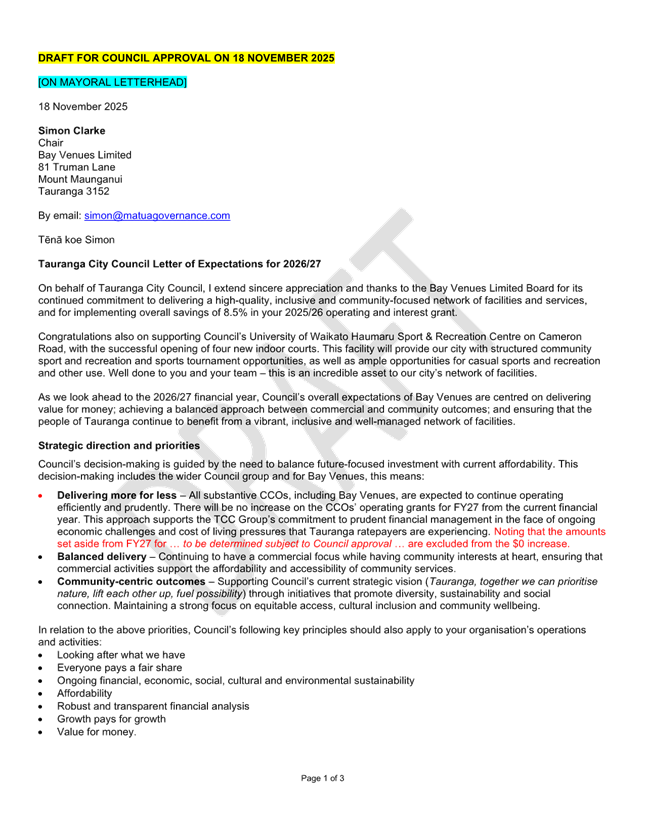
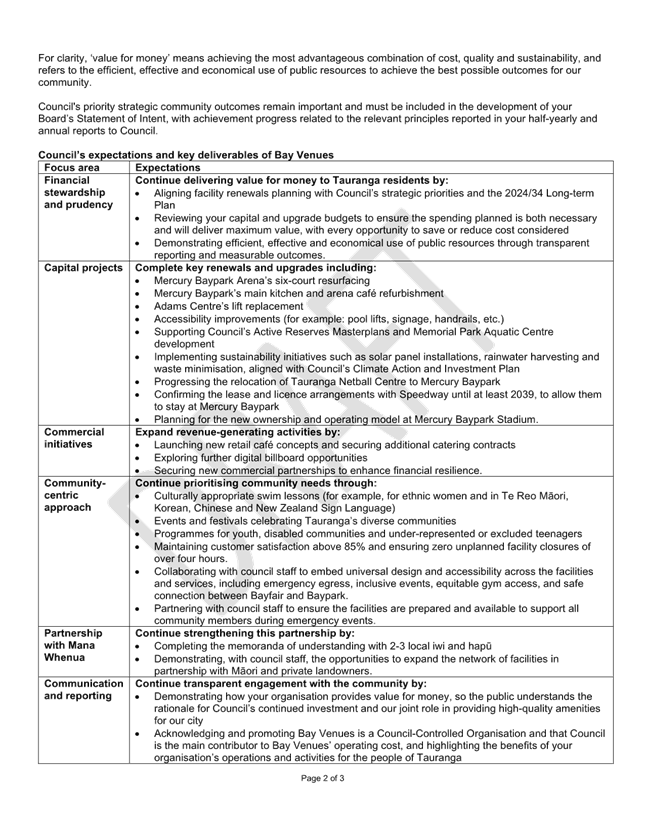
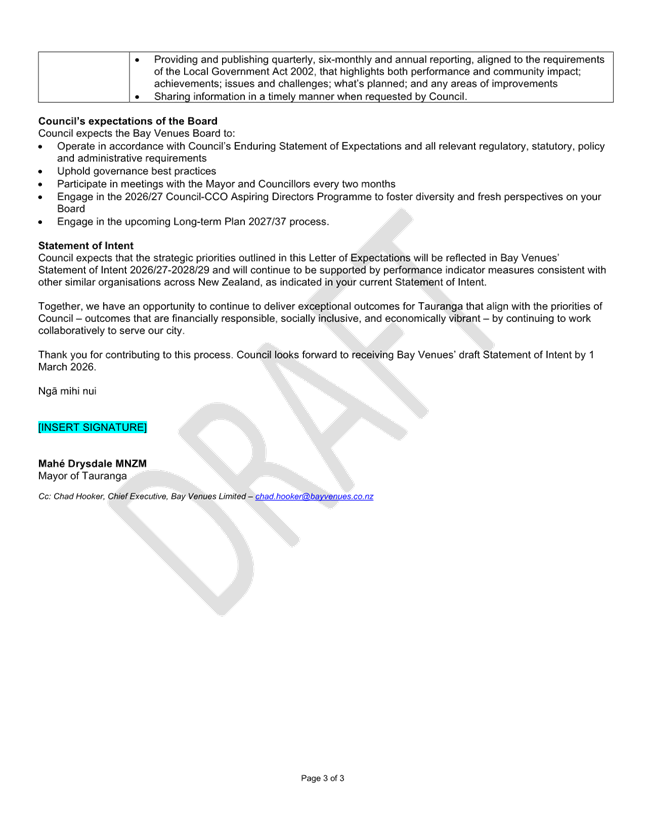
|
Ordinary
Council meeting Agenda
|
18
November 2025
|

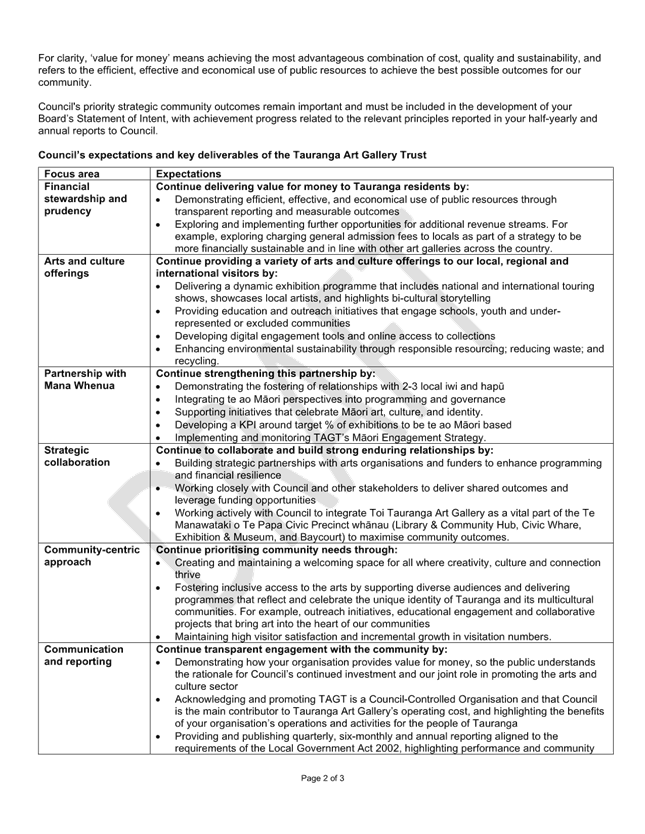
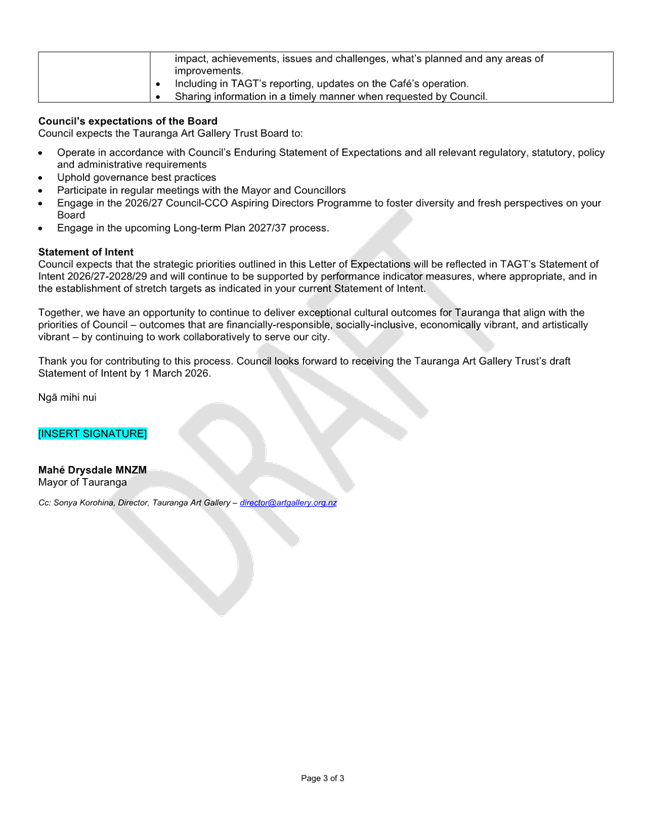
|
Ordinary
Council meeting Agenda
|
18
November 2025
|
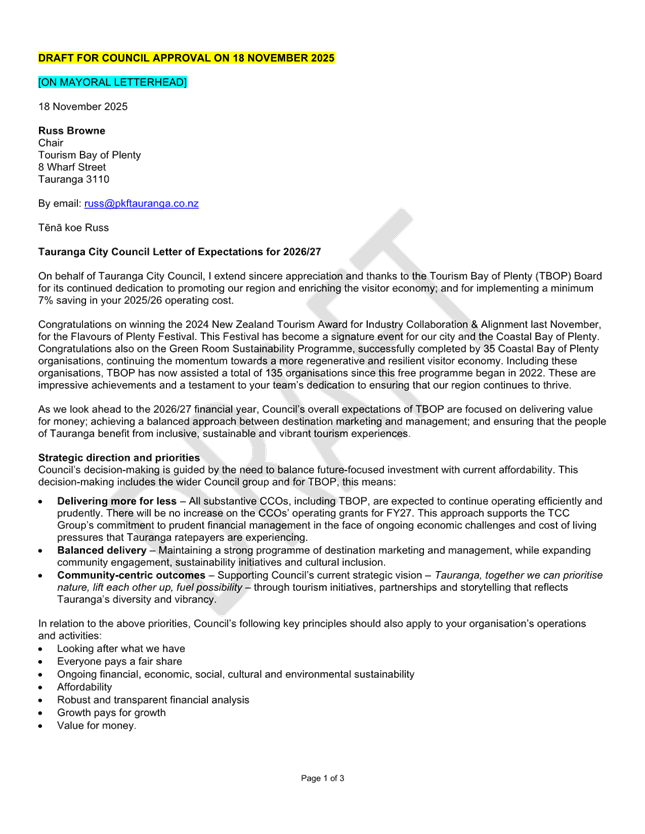

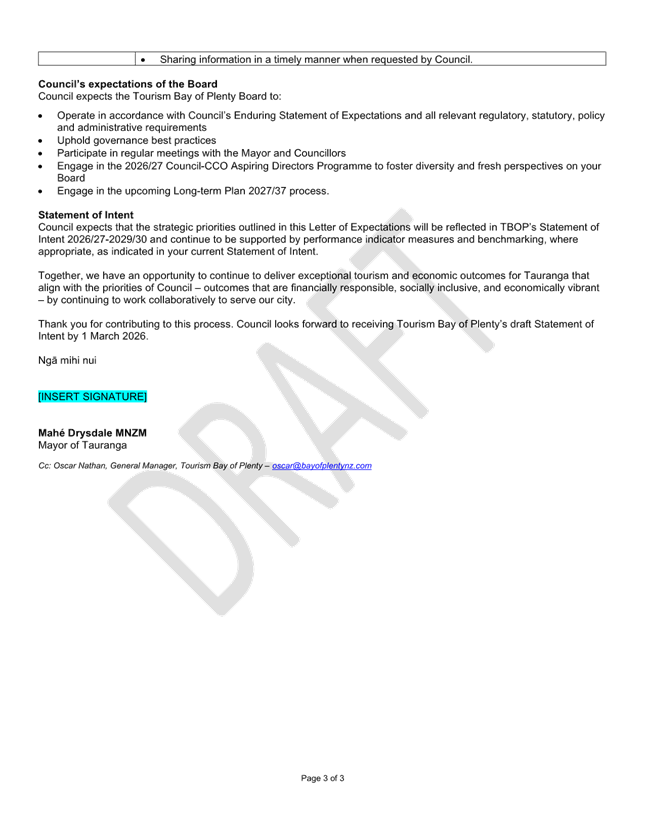
|
Ordinary
Council meeting Agenda
|
18
November 2025
|

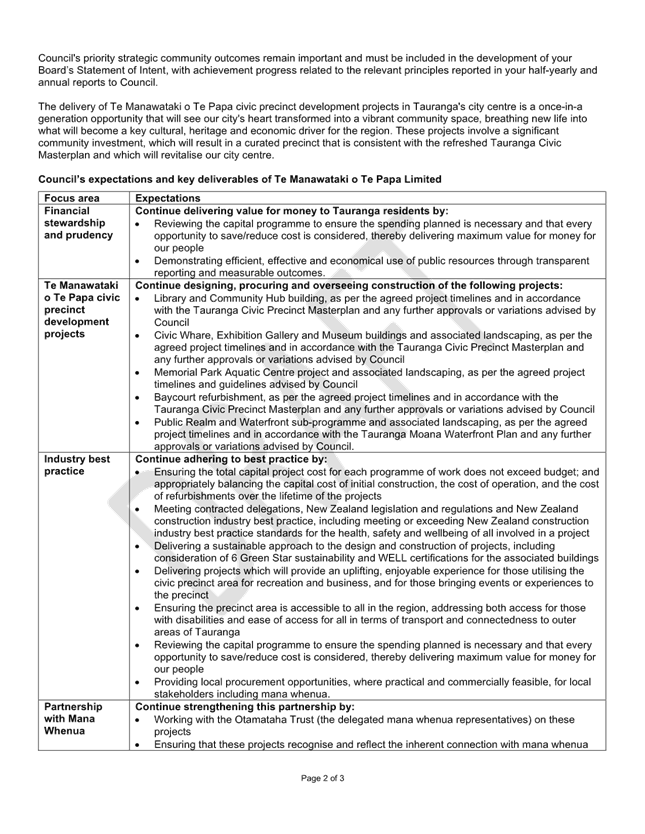
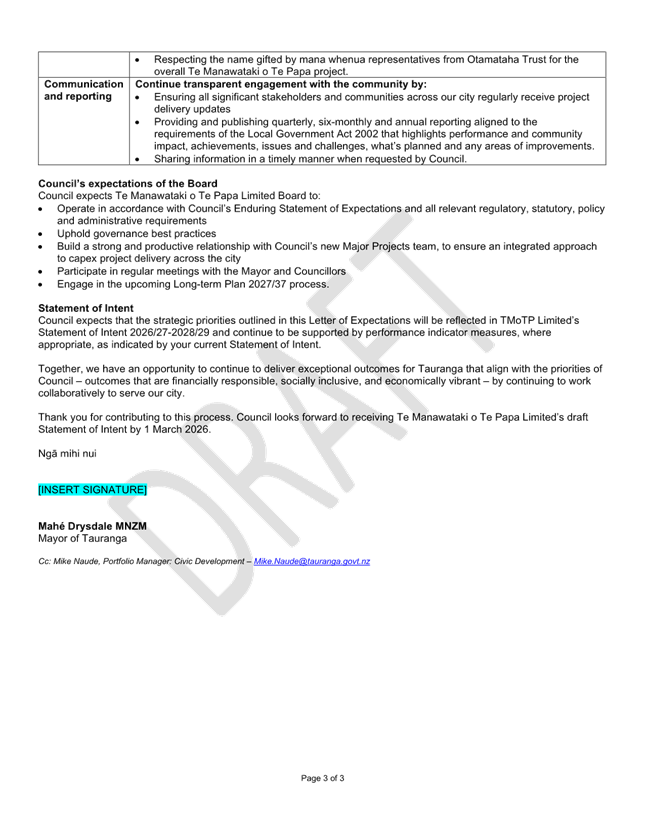
|
Ordinary
Council meeting Agenda
|
18
November 2025
|
11.7 Bylaw
Review Schedule
File
Number: A19143398
Author: Jane Barnett, Policy Analyst
Authoriser: Christine Jones, General Manager: Strategy, Partnerships &
Growth
Purpose of the
Report
1. To inform Council on the
requirements for reviewing bylaws.
|
Recommendations
That the Council:
(a) Receives the
report "Bylaw Review Schedule ".
|
Discussion
What is a bylaw?
2. A
bylaw is a local regulation made by a council under powers granted by
legislation. A council can only make a bylaw if it is specifically empowered to
do so by law. Bylaws can address a range of matters, depending on the statutory
powers available.
3. A
general bylaw making power is provided in the Local Government Act 2002 (LGA). This allows councils to
make bylaws for one or more of the following purposes:
· protecting the public from nuisance
· protecting, promoting and maintaining public health and safety
· minimising the potential for offensive behaviour in public places
4. The
LGA also provides some specific by-law making powers for councils.
5. Other
common bylaw-making powers are set out in a number of other Acts, including the
Dog Control Act 1996, Freedom Camping Act 2011, Land Transport Act 1998, and
Prostitution Reform Act 2003. Different bylaw-making powers can apply to
different clauses of a bylaw.
6. A
breach of a bylaw is an offence. If there is a breach, a prosecution is
initiated (by filing a charging document in the District Court) and if it
results in a conviction, fines are the usual penalty. The maximum fines are
prescribed in the relevant legislation, such as the LGA, which allows for a
fine up to $20,000 for certain breaches.
7. If
infringement fees are prescribed, such as the $200 fee for breaching freedom
camping rules, these can be issued without prosecution. There are no
infringement fees available for bylaw clauses made under the LGA.
8. Other
enforcement options are available, such as seeking an injunction, exercising
powers to seize, remove or alter something constructed in breach of a bylaw,
and in appropriate circumstances, trespassing individuals from
council-controlled areas.
Making and reviewing a bylaw
9. Bylaws
must be made and reviewed in accordance with the legislation under which they
are created. The key step in developing any bylaw is identifying and defining
the problem the bylaw is intended to address.
10. For bylaws
made under the LGA, councils must determine:
· that a bylaw is the most appropriate way of addressing the
identified problem
· that the proposed bylaw is the most appropriate form of bylaw; and
· whether the bylaw gives rise to any implications under the New
Zealand Bill of Rights Act 1990 and ensure it is not inconsistent with that
Act.
11. Consultation
is required when making or reviewing bylaws, except in cases involving minor
amendments or the correction of errors. If the bylaw concerns a matter of
significant interest to the community or is likely to have a significant
impact, the special consultative procedure (under the LGA) must be used.
Reviews – when?
12. Bylaws can be
amended or revoked at any time, although this most commonly occurs as result of
a scheduled review. Reviews help ensure bylaws remain relevant, effective and
legally compliant.
13. Required
reviews are set out in the empowering legislation. Most bylaws are governed by
the LGA, which requires that a new bylaw must be reviewed within five
years of it first being made. After the initial review, a bylaw must be
reviewed every 10 years after it was last reviewed.
14. If a bylaw is
not reviewed within the required timeframe, it does not lapse immediately.
However, it will be automatically revoked two years after the
date by which the scheduled review should have occurred.
Tauranga’s bylaws
15. Table 1 sets
out Tauranga City Council’s 14 bylaws and the dates they are scheduled
for review.
16. Several bylaw
reviews are currently underway. The Street Use and Public Places bylaw review
was initiated by Council. The review of the Dog Management Bylaw was identified
as an action in the Nature and Biodiversity Action and Investment Plan. Given
the related subject matter, it was considered timely and efficient to review
the Keeping of Animals Bylaw alongside it.
17. The
Stormwater (Pollution Prevention) Bylaw 2015 review was initiated to comply
with the statutory timeframes under the LGA. Due to uncertainty around the
timing and content of new legislation, the review has proceeded to ensure
continued compliance with the LGA.
18. The Trade
Waste Bylaw 2019 is being reviewed to consider the allocation of trade waste
management costs between the businesses producing the trade waste and general
rates, and to update the bylaw to reflect current best industry practice.
Table
1: Tauranga City Council’s bylaws.
|
Bylaw
|
Review date
|
Empowering legislation
|
|
Currently under review
|
|
Street Use and Public Places
Bylaw 2018
|
20 November 2028
|
Local Government Act 2002
Health Act 1956
Litter Act 1979
|
|
Dog Management Bylaw 2018
|
11 December 2028
|
Dog Control Act 1996
|
|
Keeping of Animals Bylaw
2018
|
11 December 2028
|
Local Government Act 2002
|
|
Stormwater (Pollution
Prevention) Bylaw 2015
|
26 August 2030
|
Originally Local Government
Act 2002 but now Local Government (Water Services) Act 2025
|
|
Trade Waste Bylaw 2019
|
26 August 20303
|
Originally Local Government
Act 2002 but now Local Government (Water Services) Act 2025
|
|
Scheduled
to commence review within the next 24 months
|
|
Water Supply Bylaw 2019
|
Initial review 26 August
20273
Full review 26 August 2030
|
Originally the Local
Government Act 2002 but now Local Government (Water Services) Act 2025
|
|
Alcohol Control Bylaw 2018
|
September 2028
|
Local Government Act 2002
|
|
Beaches Bylaw 2018
|
September 2028
|
Local Government Act 2002
|
|
Freedom Camping Bylaw 2019
|
June 2029
|
Freedom Camping Act 2011
|
|
Prostitution Bylaw 2019
|
June 2029
|
Local Government Act 2002
Prostitution Reform Act 2003
|
|
The other bylaws
|
|
Airport Bylaw 2016
|
No legal requirement.
The Airport requires
registration under the CAA by 5 April 2030.
|
Airports Authorities Act
1996 but this has been replaced by the Civil Aviation Act 2023 (CAA).
The CAA retains the ability
to make bylaws and requires airports be registered by 5 April 2030 before
bylaws can be made under this Act, or current bylaws can remain in force.
|
|
Alcohol Licensing Fees Bylaw
2025
|
No legal requirement
|
Sale and Supply of Alcohol
(Fee-Setting Bylaws) Order 2013 made under the Sale and Supply of Alcohol
Act 2012
|
|
Traffic and Parking Bylaw
2023
|
December 2033
|
Local Government Act 2002
Land Transport Act 1998
|
|
Waste Management and
Minimisation Bylaw 2022
|
September 2032
|
Waste Minimisation Act 2008
Local Government Act 2002
Health Act 1956
Litter Act 1979
|
Attachments
Nil
|
Ordinary
Council meeting Agenda
|
18
November 2025
|
11.8 Petition
- Fluoridation of water supply
File
Number: A19100420
Author: Peter Bahrs, Manager: Water Services
Fiona Nalder, Principal Strategic
Advisor
Authoriser: Reneke van Soest, General Manager: Operations & Infrastructure
Purpose of the
Report
1. On 26 August 2025 Robert Coe
presented a petition to Tauranga City Council (Council) regarding fluoridation
of Tauranga’s drinking water. This report provides Council with the
option of responding to the requests made by Robert Coe and the petition.
|
Recommendations
That the Council:
(a) Receives the
report "Petition - Fluoridation of water supply".
EITHER
(b) Supports
sending a letter, from Council, to the Director-General of Health and Chief
Executive (Ministry of Health) asking for:
(i) an
independent public enquiry into fluoridation.
(ii) the
direction to fluoridate Tauranga’s water supply to be suspended.
(c) Approves the
attached draft letter to the Ministry of Health and the Director-General of
Health and Chief Executive (Ministry of Health)
(d) Delegates
the Mayor authority to make minor edits to the attached letter on behalf of
Council.
OR
(e) Does not
support sending a letter, from Council, to the Director-General of Health and
Chief Executive (Ministry of Health) asking for:
(i) an
independent public enquiry into fluoridation.
(ii) the
direction to fluoridate Tauranga’s water supply to be suspended.
|
Discussion
2. In
November 2021, the Health
(Fluoridation of Drinking Water) Amendment Act (the Act) was passed. This
Act empowered the Director-General of Health to direct local governments to
fluoridate water supplies, i.e. it removed decision-making regarding the
fluoridation of water supplies from local authorities.
3. Subsequently Council was directed
to fluoridate Tauranga’s water supply by 30 November 2024 and, in
compliance with this direction, Council began fluoridating the city’s
water supply from 24 October 2024.
4. Council has also responded to those
who wish to access non-fluoridated water by providing access to non-fluoridated
bore water in Pāpāmoa. This water is treated by cartridge filters and
ultra-violet light, with no added fluoride.
Two additional non-fluoridated water sources will be provided at Wharepai
Domain in Tauranga and Waipuna Park in Welcome Bay, and these are
currently under construction.
5. On
26 August 2025 Robert Coe presented a petition to Council titled
‘Petition to stop fluoridation of Tauranga’s drinking water’.
The petition had approximately 1,100 signatures at the time of the Council
meeting, and this has since increased to 1,345 (as at 22 October 2025).
6. The
petition calls upon Council to:
· Request that the Ministry of Health initiate an independent public
enquiry into fluoridation.
· Write to the Director General of Health asking for the direction to
fluoridate Tauranga’s water supply to be suspended.
7. This
Council report responds to the requests made by the petition by providing a
draft letter (Attachment 1) to the Director-General of Health and Chief
Executive (Ministry of Health) for Council consideration.
8. As
the Chief Executive of the Ministry of Health is the Director-General of
Health, only one letter has been drafted. This letter asks the Ministry to
initiate an independent public enquiry into fluoridation and for the
Director General of Health to suspend the direction to fluoridate
Tauranga’s water supply.
9. It
is noted that Council has previously written to the Director-General of Health
regarding the community’s concerns with fluoridation of the water supply.
This letter, and the Director-General of Health’s response, are provided
as Attachments 2 and 3.
10. The decision
whether to send the letter is a political decision and no staff recommendation
has been made.
Next Steps
11. If Council
decides to approve the attached draft letter, the next step would be for the
Mayor’s office to finalise and send the letter.
Attachments
1. Draft
letter to the Director-General of Health and Chief Executive (Ministry of
Health) - A19193289 ⇩

2. Letter
to Director General of Health 30 August 2024 - Fluoridation - A16739803 ⇩
3. Letter to TCC from Director
General of Health 20 September 2024 - Fluoridation - A16739815 ⇩
|
Ordinary
Council meeting Agenda
|
18
November 2025
|

|
Ordinary
Council meeting Agenda
|
18
November 2025
|
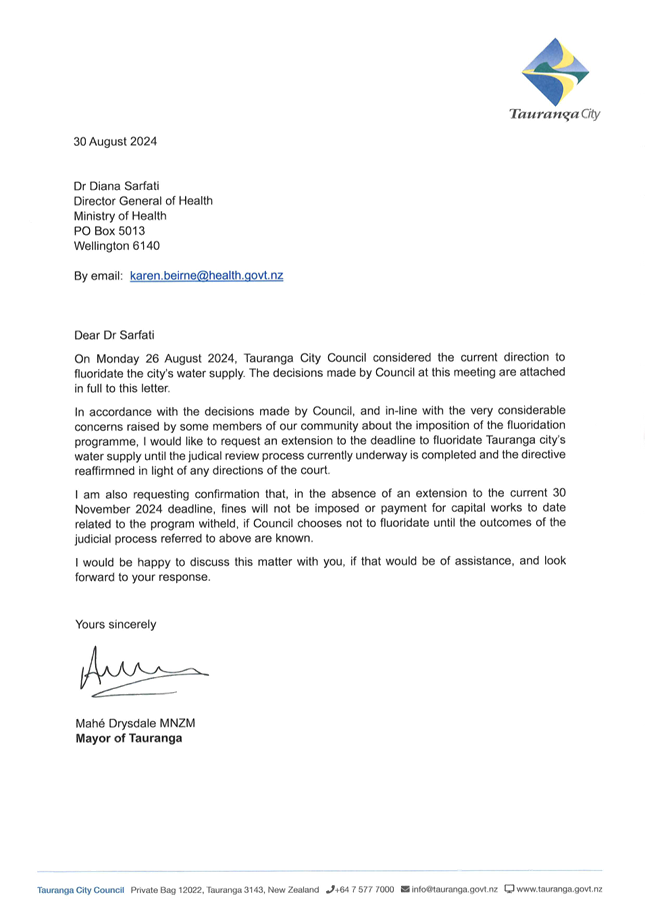
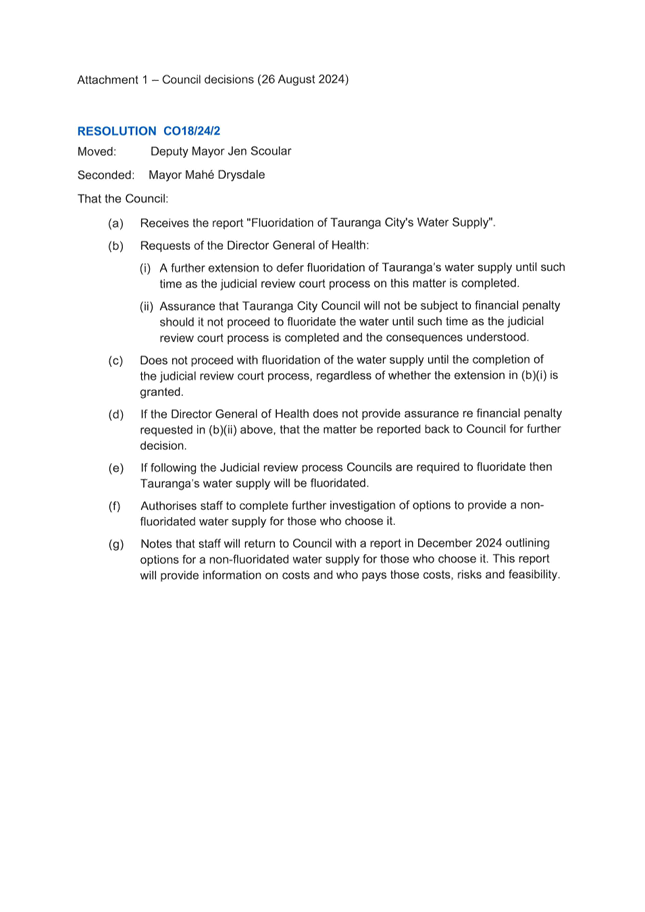
|
Ordinary
Council meeting Agenda
|
18
November 2025
|
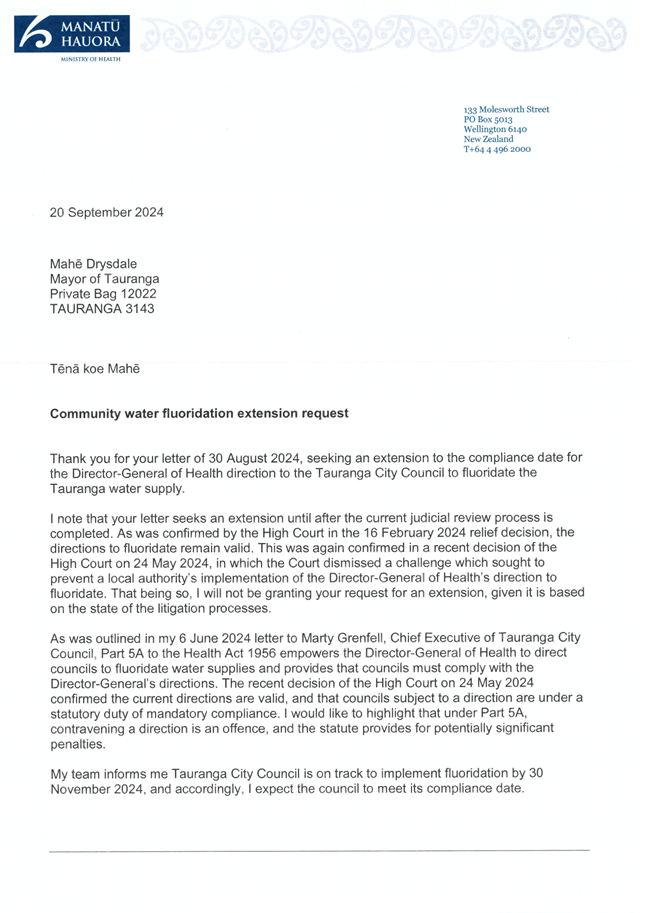
|
Ordinary
Council meeting Agenda
|
18
November 2025
|
11.9 Transport
Resolutions Report No.58
File Number: A18904546
Author: Karen Hay, Team Leader: Engineering Services
Will
Hyde, Senior Transport Engineer
Authoriser: Reneke van Soest, General Manager: Operations & Infrastructure
Purpose of the Report
1. This
report proposes the introduction, removal or amendment of traffic controls
throughout the city, and seeks a resolution from Council to implement or
formally approve these proposals.
|
Recommendations
That
the Council:
(a) Receives the
report "Transport Resolutions Report No.58".
(b) Resolves to implement the proposed traffic and parking
controls for general safety, operational, or amenity purposes as detailed in
Attachment 1 of this report.
(c) These changes will take effect on or after 19 November
2025, subject to the installation of appropriate signs and road markings
where necessary.
|
Executive Summary
2. As the city grows and changes, the demands on the road network also
change. Often there can be conflict between the need to keep traffic lanes
clear to enable an efficient network, the need to provide on-street parking and
loading zones to support nearby activities, restrict parking to improve access
and the need for vulnerable road users such as pedestrians and cyclists to move
around the city safely.
3. Attachment A sets out changes for general access, parking, safety
and operational reasons. Some of these are requests from the public or other
stakeholders for numerous changes to parking controls which have been assessed
to be appropriate.
4. Amendments include changes to the following attachments to the
Traffic & Parking Bylaw (2023):
(a) Attachment
6.2: Heavy Vehicles
(i) A
temporary heavy vehicle ban on Hairini Street during the trial opening of the
Hairini Street bus lane. The ban will only be implemented if heavy
vehicles using the bus lane are assessed as causing a safety concern or
excessive noise. Heavy vehicles are already prohibited from using this as
a through-route (as are all vehicles except buses, motorcycles and cycles), so
the ban would have no practical effect on heavy vehicles. Legitimate use of
Hairini Street by heavy vehicles (emergency services, buses, utility access,
refuse trucks etc.) are exempt.
(ii) The NZ Road
Transport Forum (which represents heavy haulage operators), NZ Police and NZ
Transport Agency/Waka Kotahi have been notified.
(b) Attachment
7.1: No Parking Behind Kerb
(i) A new
part-time restriction relating to vehicles parking on the berm close to a
school, creating safety issues by drivers traversing footpaths to access berm
parking.
(c) Attachment
7.2: Prohibited Stopping and Standing of Vehicles
(i) Extending
or removing broken yellow lines to improve safety, enhance access, or increase
parking capacity.
(ii) Retrospective
changes related to completed projects or resource consents, aimed at capturing
modifications that affect access or visibility at various locations.
(d) Attachment 7.7 Mobility
Parking
(i) Retrospective
resolutions required for existing mobility spaces.
(e) Attachment
7.9 Parking Time Restrictions
(i) Retrospective
resolutions required for existing parking time restrictions.
(ii) New time
restrictions requested by business owners, to avoid all-day parking occupying
all nearby spaces.
(f) Attachment
7.15 Loading Zones
(i) Adding a
new loading zone to support the operation of Baycourt Theatre, as part of
changes due to Te Manawataki o Te Papa, and relocation of the bus hub to Durham
St south.
(g) Attachment
7.16 Loading Zone with Time Restrictions
(i) Adding a
new 5-minute loading zone as part of Te Manawataki o Te Papa project, to
support the patronage of Baycourt Theatre.
(h) Attachment
7.20 Passenger Service and Other Vehicle Stands (School buses)
(i) At the request of Welcome Bay School, arrangements are
being made to formally designate the area in front of the school for school bus
use, ensuring that this space remains clear and is not obstructed by parked
vehicles.
Background
5. The
Traffic and Parking Bylaw 2023 includes attachments which list various traffic
and parking restrictions. Council can impose traffic and parking restrictions
by Council resolution.
6. The
Council regularly adds, removes or amends traffic and parking controls to
reflect and support operational and safety needs on the road network.
7. The
proposed amendments in Attachment A are minor changes to parking restrictions
across the city which have arisen through requests from the public,
transportation staff, or other stakeholders; or changes resulting from approved
developments.
Statutory Context
8. Land
Transport Act 1998, particularly section 22AB, which empowers councils as Road
Controlling Authorities (RCAs) to make bylaws for traffic and parking control.
9. Local
Government Act 2002, which outlines the general process for making bylaws,
including consultation and public notification.
10. Land Transport
(Road User) Rule 2004 and Traffic Control Devices Rule 2004, which set
standards for signage, markings, and enforcement.
STRATEGIC ALIGNMENT
11. This
contributes to the promotion or achievement of the following strategic
community outcome(s):
|
Contributes
|
|
We are an inclusive city
|
ü
|
|
We value, protect and enhance the
environment
|
☐
|
|
We are a well-planned city
|
ü
|
|
We can move around our city easily
|
ü
|
|
We are a city that supports
business and education
|
ü
|
12. The recommendations address a number of
issues affecting safety, access and/or amenity and contribute to the safe and
efficient operation of the city’s transport network. The provision of
mobility parking enables a more inclusive city by making our amenities more
accessible to less-abled members of our community.
Options Analysis
13. The proposed
changes relate to general operations. The reasons for each proposal are
described in Appendix A. In each case the problem identified is expected to
continue if the proposed amendment is not adopted.
14. The proposals
are independent of each other, and Council may resolve to adopt some, all or
none of them.
Financial
Considerations
15. The signs and
markings costs associated with general operational changes are minor and can be
accommodated within existing project or operational budgets.
Legal Implications /
Risks
16. These
proposals are required in order to allow enforcement of changes deemed
necessary for safety and amenity purposes. Council has an obligation to address
known safety issues on the road network.
TE AO MĀORI
APPROACH
17. The proposals create safety, access and/or amenity improvements for
our residents and visitors and therefore align with the principal of
manaakitanga. For the major projects, consultation with hapū was
undertaken as part of the project development.
CLIMATE IMPACT
18. Given this
report relates to regulatory procedure, no climate impact assessment is made.
Consultation /
Engagement
19. Changes requested by adjacent properties or are existing scenarios
where consultation is not deemed necessary. Alternatively, consultation was
undertaken as part of project delivery, or adjacent property owners are advised
or consulted with prior to the implementation of changes
Significance
20. The Local
Government Act 2002 requires an assessment of the significance of matters,
issues, proposals and decisions in this report against Council’s
Significance and Engagement Policy. Council acknowledges that in some instances
a matter, issue, proposal or decision may have a high degree of importance to
individuals, groups, or agencies affected by the report.
21. In making this
assessment, consideration has been given to the likely impact, and likely
consequences for:
(a) the
current and future social, economic, environmental, or
cultural well-being of the district or region
(b) any persons who
are likely to be particularly affected by, or interested in, the decision.
(c) the capacity of
the local authority to perform its role, and the financial and other costs of
doing so.
22. In accordance
with the considerations above, criteria and thresholds in the policy, it is
considered that the decision is of low significance.
23. For the changes which are retrospective, these are likely to have a
low public interest as these were previously consulted upon or responded to
requests from adjacent landowners.
ENGAGEMENT
24. Taking into
consideration the above assessment, that the decision is of low significance,
officers are of the opinion that no further engagement is required prior to
Council making a decision.
Next Steps
25. The bylaw
attachments will be updated in accordance with the resolution and
implementation of associated line marking and signage as appropriate.
26. Adjacent
business and residents to be notified of parking restriction changes, prior to
implementation.
Attachments
1. Transport Resolutions Report
- 58 Proposals - A18904596 ⇩

|
Ordinary
Council meeting Agenda
|
18
November 2025
|
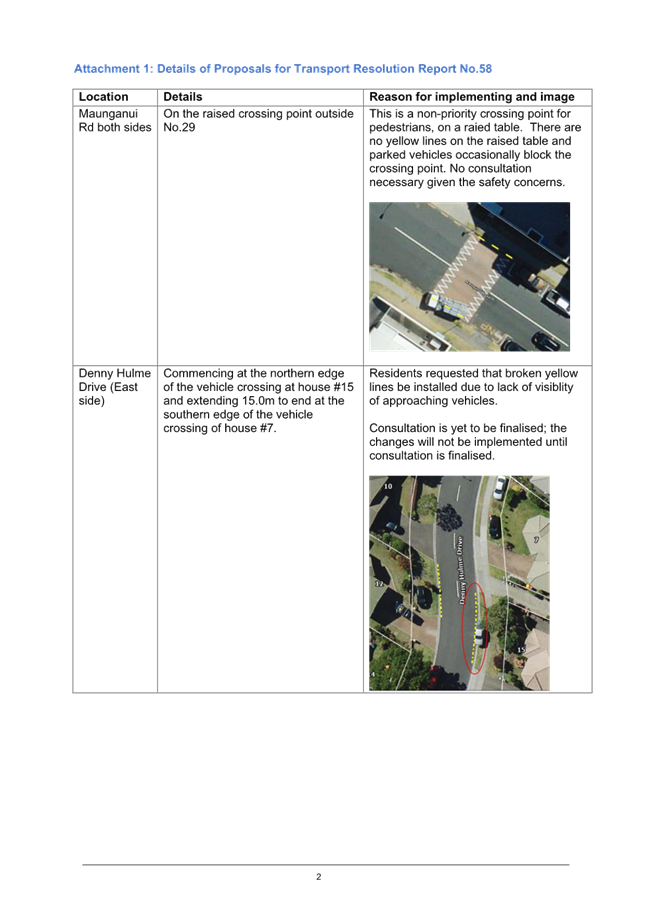
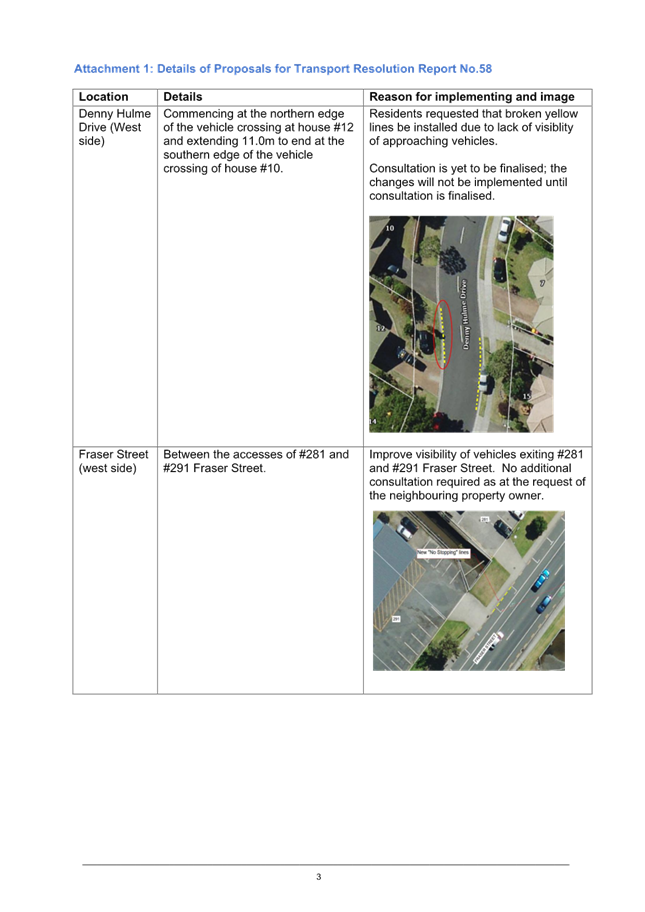
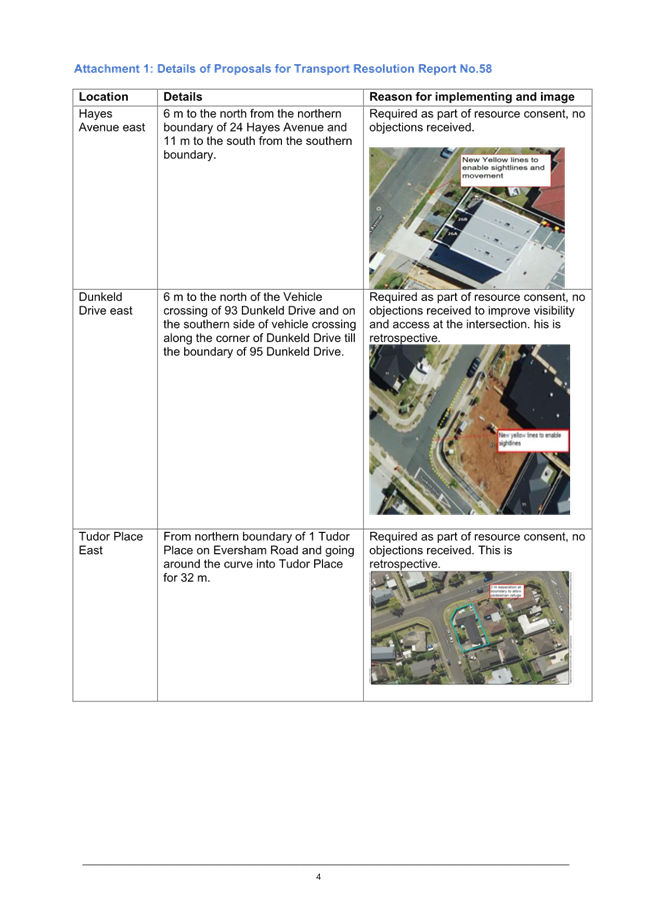
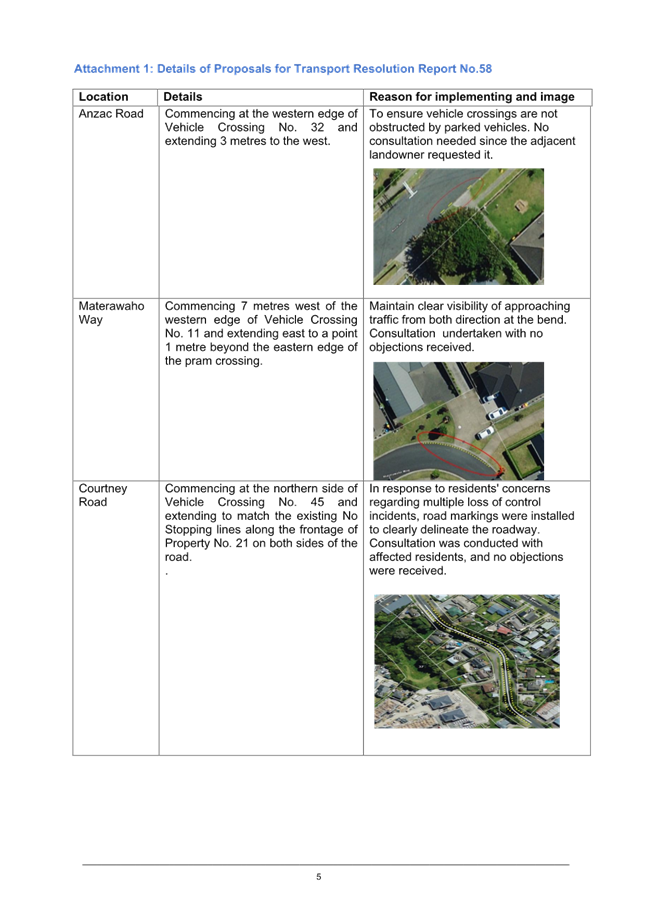
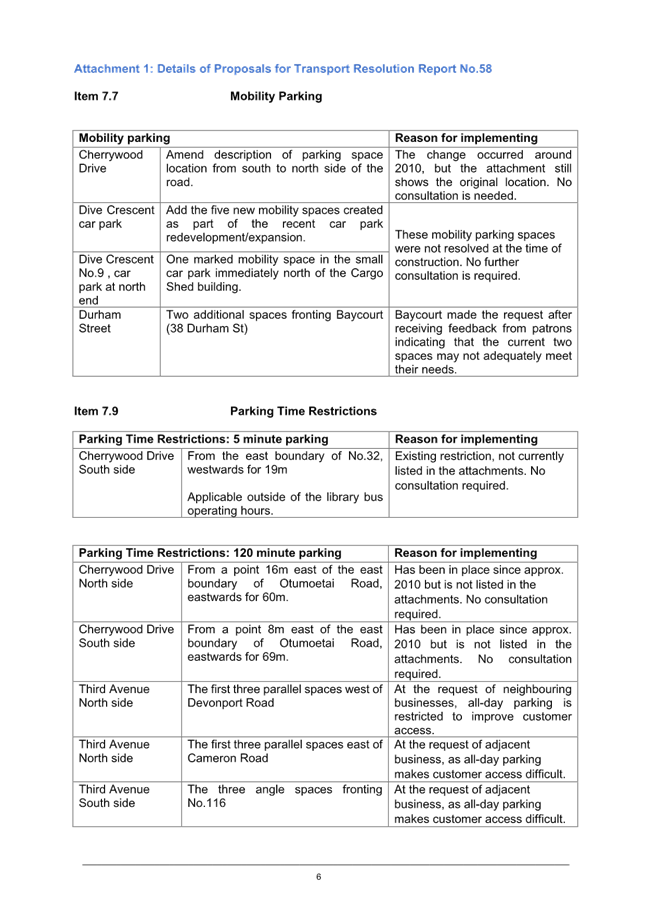
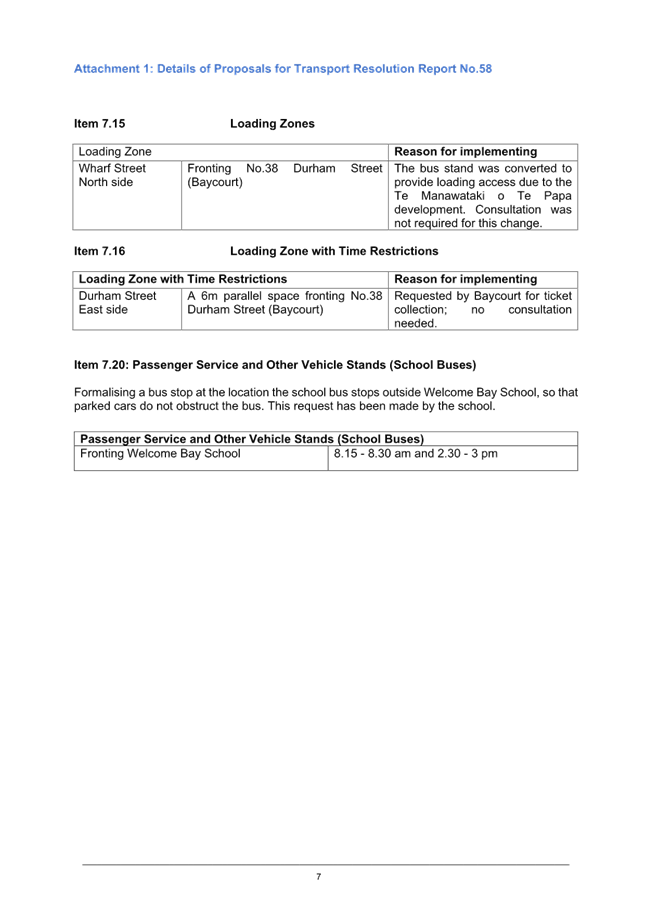
|
Ordinary Council meeting Agenda
|
18 November 2025
|
12 Discussion
of late items
|
Ordinary Council meeting Agenda
|
18 November 2025
|
13 Public
excluded session
Resolution
to exclude the public
|
Recommendations
That
the public be excluded from the following parts of the proceedings of this
meeting.
The
general subject matter of each matter to be considered while the public is
excluded, the reason for passing this resolution in relation to each matter,
and the specific grounds under section 48 of the Local Government Official
Information and Meetings Act 1987 for the passing of this resolution are as
follows:
|
General subject of each matter to be
considered
|
Reason for passing this resolution in
relation to each matter
|
Ground(s) under section 48 for the
passing of this resolution
|
|
13.1 - Representative from
Women's Refuge - to be taken at 1pm
|
s7(2)(a) - The withholding of the information is
necessary to protect the privacy of natural persons, including that of
deceased natural persons
|
s48(1)(a) - the public conduct of the relevant
part of the proceedings of the meeting would be likely to result in the
disclosure of information for which good reason for withholding would exist
under section 6 or section 7
|
|
13.2 - Litigation report
|
s7(2)(a) - The withholding of the information is
necessary to protect the privacy of natural persons, including that of
deceased natural persons
s7(2)(b)(ii) - The withholding of the information
is necessary to protect information where the making available of the
information would be likely unreasonably to prejudice the commercial
position of the person who supplied or who is the subject of the information
s7(2)(f)(ii) - The withholding of the information
is necessary to maintain the effective conduct of public affairs through
the protection of Council members, officers, employees, and persons from
improper pressure or harassment
s7(2)(g) - The withholding of the information is
necessary to maintain legal professional privilege
s7(2)(h) - The withholding of the information is
necessary to enable Council to carry out, without prejudice or
disadvantage, commercial activities
s7(2)(i) - The withholding of the information is
necessary to enable Council to carry on, without prejudice or disadvantage,
negotiations (including commercial and industrial negotiations)
|
s48(1)(a) - the public conduct of the relevant
part of the proceedings of the meeting would be likely to result in the
disclosure of information for which good reason for withholding would exist
under section 6 or section 7
|
|
13.3 - Housing Equity Fund
- Seeking approval of funding facility
|
s7(2)(b)(ii) - The withholding of the information
is necessary to protect information where the making available of the
information would be likely unreasonably to prejudice the commercial
position of the person who supplied or who is the subject of the information
|
s48(1)(a) - the public conduct of the relevant
part of the proceedings of the meeting would be likely to result in the
disclosure of information for which good reason for withholding would exist
under section 6 or section 7
|
|
13.4 - Council-Controlled
Organisations - Board appointments to 30 June 2026 and an amendment to the
end of tenure date in the Appointment Policy
|
s7(2)(a) - The withholding of the information is
necessary to protect the privacy of natural persons, including that of
deceased natural persons
|
s48(1)(a) - the public conduct of the relevant
part of the proceedings of the meeting would be likely to result in the
disclosure of information for which good reason for withholding would exist
under section 6 or section 7
|
|
13.5 - Strategic Property
Disposal to Women’s Refuge
|
s6(b) - The making available of the information
would be likely to endanger the safety of any person
s7(2)(d) - The withholding of the information is
necessary to avoid prejudice to measures protecting the health or safety of
members of the public
s7(2)(i) - The withholding of the information is
necessary to enable Council to carry on, without prejudice or disadvantage,
negotiations (including commercial and industrial negotiations)
|
s48(1)(a) - the public conduct of the relevant
part of the proceedings of the meeting would be likely to result in the
disclosure of information for which good reason for withholding would exist
under section 6 or section 7
|
|
Confidential Attachment 5 -
11.1 - Wairākei Pump Station - Funding Risk
|
s7(2)(g) - The withholding of the information is
necessary to maintain legal professional privilege
|
s48(1)(a) the public conduct of the relevant part
of the proceedings of the meeting would be likely to result in the
disclosure of information for which good reason for withholding would exist
under section 6 or section 7
|
|
|
Ordinary Council meeting Agenda
|
18 November 2025
|
14 Closing
karakia