|
City Delivery Committee meeting Agenda
|
10 March 2026
|
10 Business
10.12 TMOTP
Landscaping Report
File
Number: A19717636
Author: Cashy
Ball, Principal Advisor to the Executive
Graeme Frith, Major
Projects Director
Helen Andrews,
Financial Analyst
Authoriser: Graeme
Frith, Major Projects Director
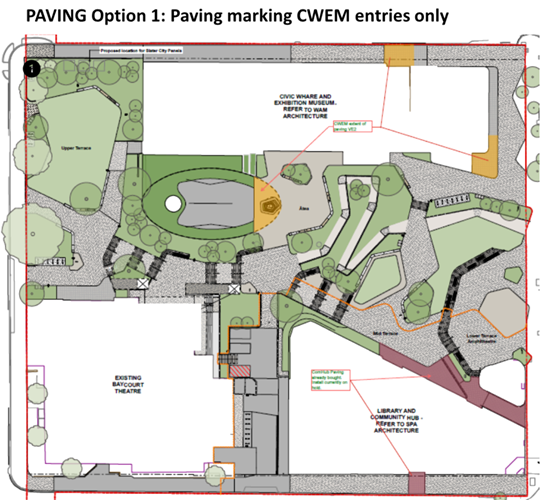
Please
note that this report contains confidential attachments.
|
Public Excluded Attachment
|
Reason why Public Excluded
|
|
Item 10.12 - TMOTP
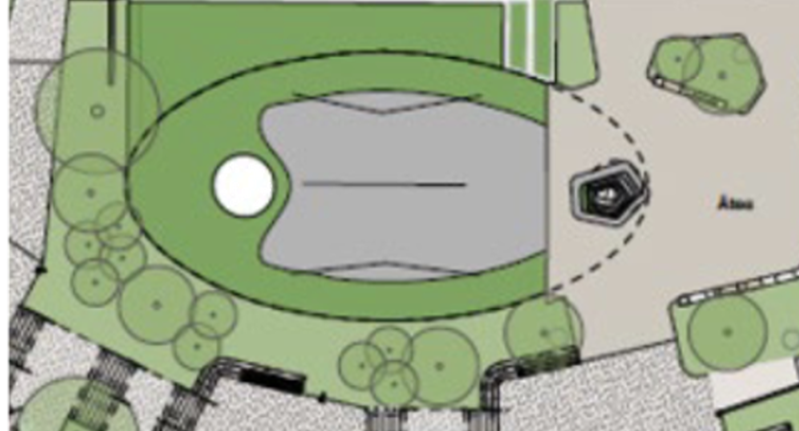
Landscaping Report - Attachment 1 - TMoTP - Landscape Presentation (March
2026)
|
s7(2)(h) - The
withholding of the information is necessary to enable Council to carry out,
without prejudice or disadvantage, commercial activities.
|
|
Item 10.12 - TMOTP
Landscaping Report - Attachment 2 - CWEM Willis Bond Report Site A Landscape
Feedback
|
s7(2)(h) - The
withholding of the information is necessary to enable Council to carry out,
without prejudice or disadvantage, commercial activities.
|
Purpose of the Report
1. The
purpose of this report is to present options to reduce the cost of the Stage 3
(Site A Landscape) and Stage 4 (Willow Street) Te Manawataki o Te Papa
landscaping and report back to Council as required by Council resolution
C024/24/6 passed at the 9 December 2024 Council meeting.
|
Recommendations
That the City Delivery
Committee:
(a) Receives the report
"TMOTP Landscaping Report".
(b) Notes the cost‑reduction options
assessed for the Stage 3 (Site A Landscape) and Stage 4 (Willow Street)
landscaping scope for Te Manawataki o Te Papa outlined in this report and
notes that the resulting cumulative impact is a reduction in the budget of
$4.85m.
Either
(c) Directs staff to proceed with
the Civic Whare roof-planting, Option 1 – full roof planting, noting
that the resulting cumulative impact is a reduction in the budget of $4.85m.
Or
(d) Directs staff to proceed with
the Civic Whare roof-planting Option 2 - 50% roof planting, noting that the
resulting cumulative impact is a reduction in the budget of $4.93m.
(e) Notes that, in line with
existing delegations, the remaining stages 3 and 4 of the CWEM Contract will
be progressed once final tendered costs have been endorsed by the Te
Manawataki o Te Papa Limited Board.
(g) Attachments 1 and 2 can
be transferred into the open when all commercial arrangements have been
completed and the contract has been awarded.
|
Executive Summary
2. Council requested
staff to identify opportunities to reduce the cost of the Te Manawataki o Te
Papa (TMOTP) landscaping works for Stage 3 (Site A Landscape) and Stage 4
(Willow Street), and to report those options back to Council prior to
progressing the remaining Civic Whare, Exhibition & Museum (CWEM) contract
stages. In response, staff have completed a staged value‑engineering process to identify reductions
that maintain the integrity and functionality of the precinct.
3. A number of design
and scope adjustments have been assessed, including limiting the extent of
paving, removing Baycourt from the landscaping scope, not progressing the
covered walkway between the Library & Community Hub (Com Hub) and CWEM at
this time, simplifying design elements along Willow Street while retaining the
flush‑level
upgrade, and removing selected community amenity features. Two options have
also been identified for the Civic Whare roof planting: full planting (Option
1) or partial planting (Option 2).
4. These options
provide a pathway to achieving meaningful cost reductions while retaining the
core public realm, accessibility, cultural, and civic outcomes expected for the
TMOTP precinct. The recommended options have been endorsed by the TMOTP Board.
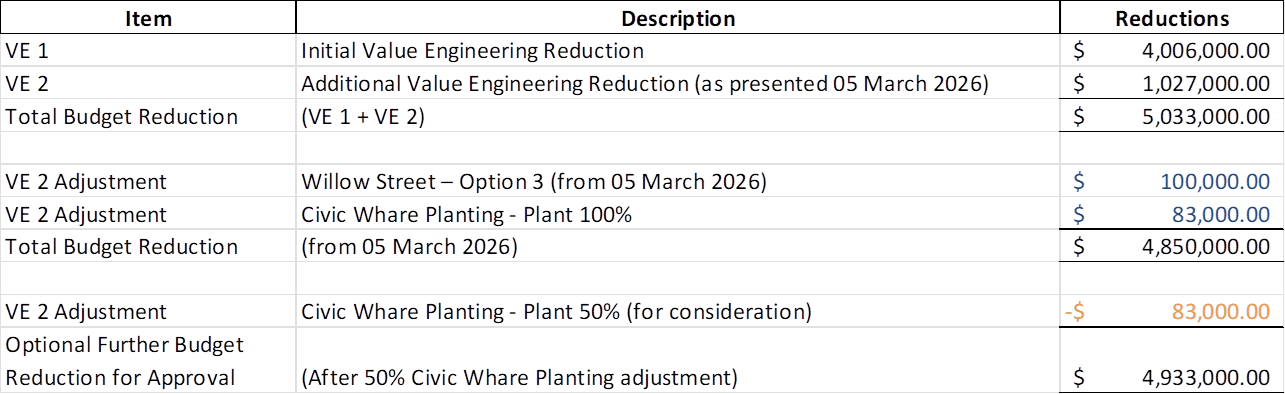
5. The table below
outlines the cumulative total value engineering reductions presented to the
Council in November 2025 (VE 1) and March 2026 (VE 2).
6. Council
is asked to provide direction on which roof‑planting
option is preferred for the Civic Whare (refer paragraphs 24 to 27 of this
report).
7. Subject
to Council direction, staff will finalise and complete design documentation and
proceed to tender the Stage 3 and Stage 4 works. Tenders will be evaluated and
the final recommended contract price will be presented to the TMOTP Board for
endorsement in line with existing delegations. Following Board approval, the
contract for Stages 3 and 4 will be awarded and delivery will commence.
Background
8. A comprehensive
background to the TMOTP project was outlined in the Council report of 9
December 2024. At that meeting, Council resolved that the contracts for stage 3
(Site A Landscape) and stage 4 (Willow Street) of the CWEM may only progress
once:
(a) Options to reduce the cost of
stage 3 and 4 have been completed and reported back to Council; and
(b) Final tendered costs have been
endorsed by the TMOTP Board.
9. Since
that time, staff have undertaken a staged value‑engineering
process to identify reduction opportunities that do not compromise essential
public‑realm,
accessibility, cultural, or civic outcomes for the precinct. Two rounds
of value‑engineering were completed as part of this process, and the
cumulative outcomes of both rounds are presented in this report.
10. Engagement
with mana whenua, Council technical teams, and relevant stakeholders has
informed development of a minimum‑viable‑product approach to the
landscaping scope. This report outlines the resulting options and presents the
recommended reductions back to Council.
Statutory Context
11. The Local Government Act 2022
(LGA)[1]
sets out the purpose of local government, which includes ‘to promote
the social, economic, environmental, and cultural well-being of communities in
the present and for the future’ (Section 10(1)(b)).
12. The LGA also requires a local
authority to ‘manage its revenues, expenses, assets, liabilities,
investments, and general financial dealings prudently and in a manner that
promotes the current and future interests of the community’ (Section
101(1)).
13. The cost‑reduction
options outlined in this report support both obligations by ensuring that
essential outcomes for the TMOTP precinct are retained while achieving a more
efficient landscaping scope.
STRATEGIC ALIGNMENT
14. This contributes to the
promotion or achievement of the following strategic community outcome(s):
|
Contributes
|
|
We are an inclusive city
|
ü
|
|
We value, protect and enhance the environment
|
☐
|
|
We are a well-planned city that is easy to move
around
|
ü
|
|
We are a city that supports
business and education
|
ü
|
|
We are a vibrant city that embraces
events
|
ü
|
15. TMOTP has clear alignment with
the city and Council’s strategic direction, from the aspirational
community vision to Council’s action and investment plans, particularly
the City Centre Action and Investment Plan, and the Te Papa Peninsula Spatial
Plan, to revitalise and reactivate the heart of the city.
16. TMOTP clearly seeks to
strengthen Tauranga’s city centre as the commercial, civic, and cultural
heart of the Western Bay of Plenty sub region – the cultural and
community focus of the city centre; a unique civic destination for the stories
and decision making of Tauranga, and its people.
17. As Tauranga continues to grow,
our city centre will continue to transform from a commercial business centre
into a sub-regional destination, providing a wide range of activities and
facilities that support our economy, strengthen our community, and celebrate
who we are.
Options Analysis
18. Paving
The
proposed approach sees paving reduced across the hard landscaping area, with
paving limited to CWEM entries only, identified in yellow in the diagram below,
with the remainder of the site’s hard surface being concrete.
Pros:
· Reinforces
CWEM entry points and maintains consistency with Com Hub design.
· Supports
internal–external material alignment.
· Reduces
overall cost.
Cons:
· Reduced
use of pavers may lessen the overall premium finish of the public‑realm
environment.
19. Baycourt
20. It is proposed that Baycourt
works be removed from the Stage 3 landscaping scope at this time, as the timing
and extent of any future Baycourt upgrade are still being confirmed. Proceeding
with full landscape works at this time may result in rework once the upgrade is
confirmed. To avoid unnecessary cost, only minor tidy‑up works will be
undertaken to ensure the immediate area remains functional and safe. These
works include site‑retaining adjustments, relocating the drinking
fountain, and consolidating cycle parking. Stakeholders, including Baycourt
management, support this approach.
Pros:
· Avoids
investing in landscape treatments that may need to be replaced when
Baycourt’s redevelopment proceeds.
· Provides
immediate cost reductions while still addressing basic functionality and
amenity through targeted tidy‑up works.
Cons:
· The
Baycourt interface will not fully align with the upgraded precinct standard
until a future Baycourt project is completed.
21. Covered Walkway
Staff
were requested to consider the option of including a covered walkway between
the Com Hub and CWEM on the site. It is proposed that a covered walkway not be
progressed at this stage, noting a covered walkway could be retrofitted at a
future date.
Pros:
· Maintains
clear sight lines through the precinct.
· Avoids
locking in a design element that may evolve in the future.
· Reduces
cost.
Cons:
· Patrons
will not be protected from rain between buildings.
· Retrofitting
a covered walkway later may be more costly than incorporating it now.
22. Willow Street
Proposed
that Willow Street be retained as per the existing plan, including relevelling
the road to achieve a flush surface for the length of the road. Within the
final design, planting and obstacles will be simplified to enable multi-modal
transport accessibility.
Pros:
· A
flush‑level surface
differentiates the space as pedestrian‑priority
while supporting multimodal access.
· Provides
seamless accessibility between the waterfront, Masonic Park, and Site A.
Cons:
· No
cost reduction relative to the 2024 cost plan.
23. Remove community amenity
features
The
value engineering process identified some community amenity components that can
be removed from the scope to reduce the overall cost. The proposal is to
remove:
· Amphitheatre
Stage and Canopies.
· Stools,
similar to those at Masonic Park.
· Some
of the boulders and stepping stones.
· One
of the four event power stations.
Pros:
· Reduces
cost while retaining core functionality of the public‑realm.
· Simplifies
the layout and focuses investment on essential elements.
Cons:
· Removal
of amphitheatre structures, stools, boulders/stepping stones, and an event‑power unit reduces
discretionary amenity and play elements.
24. Planting to Civic Whare Roof
25. During design workshops with
mana whenua through the Cultural Advisory Group (CAG), the Civic Whare was
emphasised as the manawa (heart) of the precinct. Grounding the building within
the whenua was identified as a key design driver, supporting the project vision
and the four guiding pou that re‑establish the connection from
ngāhere to moana.
26. The green‑roof planting
palette reflects this intent, drawing cues from the local environment and
incorporating hardy native species that are well suited to rooftop conditions
and require low ongoing maintenance.
27. Two options have been
identified for the Civic Whare roof planting.
Option
1 retains the original design intent, with full planting across the entire
roof.
Option
2 reduces the planted area to approximately 50%, while retaining the same
native species palette. The diagram below identifies the reduced planting area
for Option 2 (planting to focus on the perimeter of the roof):



Pros:
· Option
1 (full planting) maintains the full cultural and design intent of the Civic
Whare as the precinct’s manawa, with the strongest visual and ecological
integration. The estimated ongoing maintenance cost is $494 per month.
· Option
2 (partial planting) provides reduced capital costs of $83,000 and reduces
ongoing maintenance requirements by $50-$100 per month while retaining a
portion of the native green‑roof treatment.
Cons:
· Option
2 delivers reduced cultural, visual and ecological benefit compared with the
full‑roof planting originally co‑designed with mana whenua.
Through
this report, Council may either approve Option 1 or Option 2. The alternative
is to include both options in the tender documents, allowing a decision to be
made once pricing is received.
28. Paving Edging: reduced due to
reduction in paving (now only required to separate lawn from garden).
Financial Considerations
29. The reduction of $4.85m in the
capital spend as outlined above would result in a reduction in debt funding
required, leading to lower financing and depreciation operational costs. This
reduction would result in an estimated saving of $303k per annum.
30. The report outlines an
additional potential reduction through a decision to only partially plant the
Civic Whare roof. This would create a further capital cost reduction of
$83,000.
Legal Implications / Risks
31. The recommendations included in
this report allow the Com Hub landscaping works to proceed in accordance with
current contract requirements mitigating programme and cost risk. They also
mean that tender documentation can be prepared for the stage 3 and stage 4 CWEM
contract works in accordance current programme, again mitigating cost and
programme risk.
TE AO MĀORI APPROACH
32. As part
of the pre-work for the development of TMOTP, Council worked closely with Iwi
and Hapū to resolve historical grievances relating to the ownership of the
civic precinct (Site A) land. This work resulted in the creation of a new joint
ownership structure, Te Manawataki o Te Papa Charitable Trust CCO, jointly
owned and governed by Tauranga City Council and mana whenua (through Otamataha
Trust). This key move forms part of Council’s overall intention for the
site, which is to use it to build community cohesion and civic pride, recognise
and honour our history, and to connect mana whenua and the people of Tauranga
with the land and their stories.
33. The Journey of TMOTP, on
Tauranga City Council’s website[2],
includes the following explanation:
‘Te Manawataki o Te Papa will stand as a symbol of the
revitalised relationship between Council and mana whenua.
In
the spirit of partnership and co-ownership, Te Manawataki o Te Papa is being
developed as an inclusive community space that reflects the original kaupapa as
outlined in the trust deed that was formed by the Church Missionary Society and
tangata whenua in the 1830s. It will be a place to engage with the history of
the whenua, share stories, and celebrate the rich and diverse cultural heritage
of Tauranga Moana.
In
line with the reconciliation process, mana whenua has a voice in the design and
development process, enabling the stories behind Te Papa to be told faithfully
through design, art and building methods… The civic whare, which replaces
the old council chambers, will resemble a big meeting house and provide the
appropriate space for welcoming visitors to the city.’
34. The Civic Whare is considered
to be the beating heart of TMOTP and is envisaged to be used for council and
cultural gatherings of importance. The TMOTP Design and Cost Update Report
presented to Council on 24 July 2023 (page 16)[3],
describes the design as follows:
‘Inspired
by mana whenua, the Civic Whare showcases a modern architectural form that
incorporates and respects elements of a traditional wharenui (meeting house).
This design approach blends modern elements with a contemporary aesthetic,
resulting in a distinctive structure that pays homage to the rich cultural
heritage of the region.’
35. Otamataha Trust appointed a
Cultural Advisory Group, which gifted the name of Te Manawataki o Te Papa (the
beating heart of Te Papa) to the land and project. Both the Cultural Advisory
group and Te Kahui Toi, a collective of mana whenua artists, have been involved
in co-design of the entire TMOTP precinct and all its facilities.
36. In addition to the principles
created by tangata whenua through the Te Papa (Peninsula) Spatial Plan
development, four pou (guiding pillars) have been established as TMOTP values,
foundational in restoring Te Papa as a thriving centre of vibrancy, collectivity,
and well-being – the Heart of our City, Te Papa.
CLIMATE IMPACT
37. Sustainability is at the
forefront of the TMOTP design. The Com Hub, and CWEM buildings are targeting 6
Green Star sustainability ratings. To achieve this, both buildings have adopted
a mass timber hybrid structure. The use of timber in construction has very low
embedded carbon and plays a key role in creating a better built environment for
our future.
38. Other sustainability
initiatives and features include high-performance building materials, passive
design strategies to minimise energy demand, and integration of renewable
energy technologies and rainwater harvesting.
39. The precinct buildings are also
aiming for WELL gold certification. WELL is a certification system that
promotes human health and wellness within new and existing buildings.
40. Future climate resilience has
been taken into account through the landscaping design, including considering
future rainfall and water management across the site. Overland flow paths and
raingardens are incorporated to meet future rainfall projections.
Consultation / Engagement
41. The proposal to implement TMOTP
required an amendment to the Council’s LTP 2021-31 under section 93(5) of
the Local Government Act 2002. As such, a full consultation process was
undertaken from 25 March to 26 April 2022.
Significance
42. The Local Government Act 2002
requires an assessment of the significance of matters, issues, proposals and
decisions in this report against Council’s Significance and Engagement
Policy. Council acknowledges that in some instances a matter, issue,
proposal or decision may have a high degree of importance to individuals,
groups, or agencies affected by the report.
43. In making this assessment,
consideration has been given to the likely impact, and likely consequences for:
(a) the current
and future social, economic, environmental, or cultural well-being of the
district or region
(b) any persons who are likely to be
particularly affected by, or interested in, the matter.
(c) the capacity of the local authority
to perform its role, and the financial and other costs of doing so.
44. In accordance with the
considerations above, criteria and thresholds in the policy, it is considered
that while the TMOTP project is a significant project, the matters of this
report are presenting minor adjustments to design and scope to achieve cost reductions
and therefore the matter is of medium significance.
ENGAGEMENT
45. Taking into consideration the
consultation that has been undertaken on the TMOTP programme, and the above
assessment that the matter is of medium significance, officers are of the
opinion that no further engagement is required prior to Council making a
decision.
Next Steps
46. Subject to Council direction,
the combined budget for Stage 3 and 4 of the CWEM contract will be reduced by
$4.85m. Tender documentation for Stage 3 and 4 of the CWEM contract will be
prepared and will proceed to tender. Tenders will be evaluated and the
final recommended contract price will be presented to the TMOTP Board for
endorsement in line with existing delegations. Following Board approval, the
contract for Stages 3 and 4 of CWEM will be awarded and delivery will commence.
Attachments
1. TMoTP
- Landscape Presentation (March 2026) - A19853980 - Public Excluded
2. CWEM Willis Bond
Report Site A Landscape Feedback - A19853981 - Public Excluded