|
Ordinary
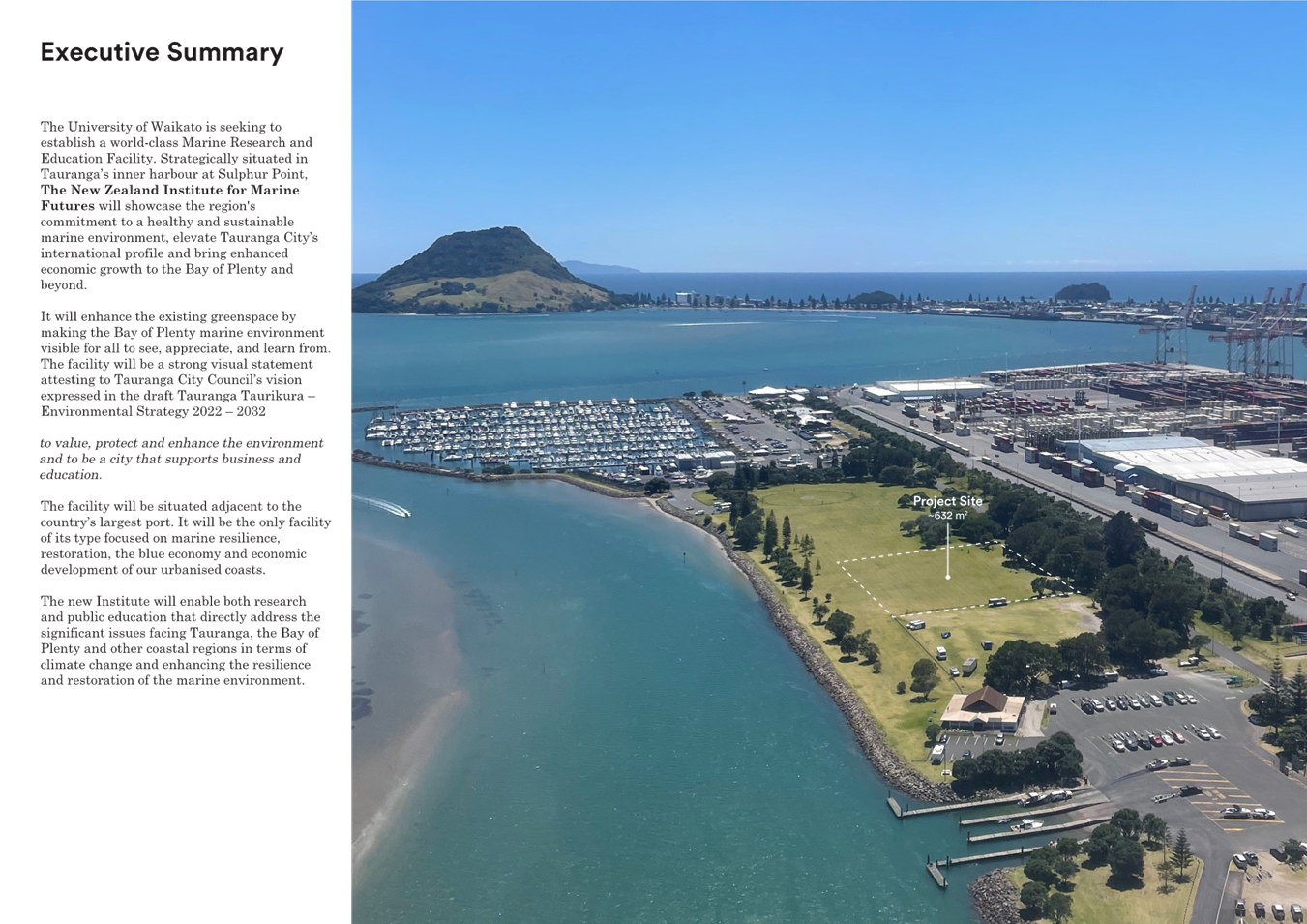
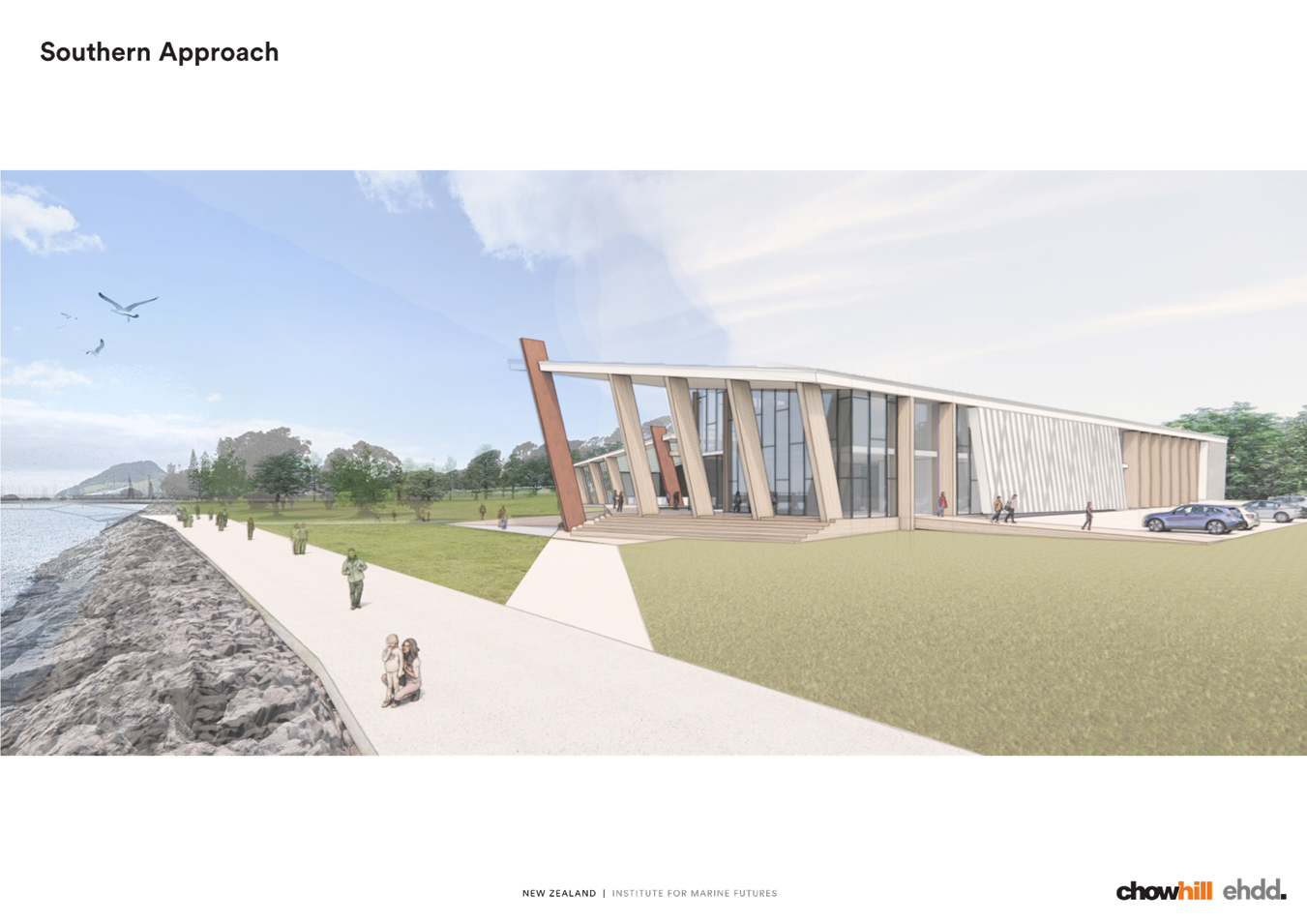
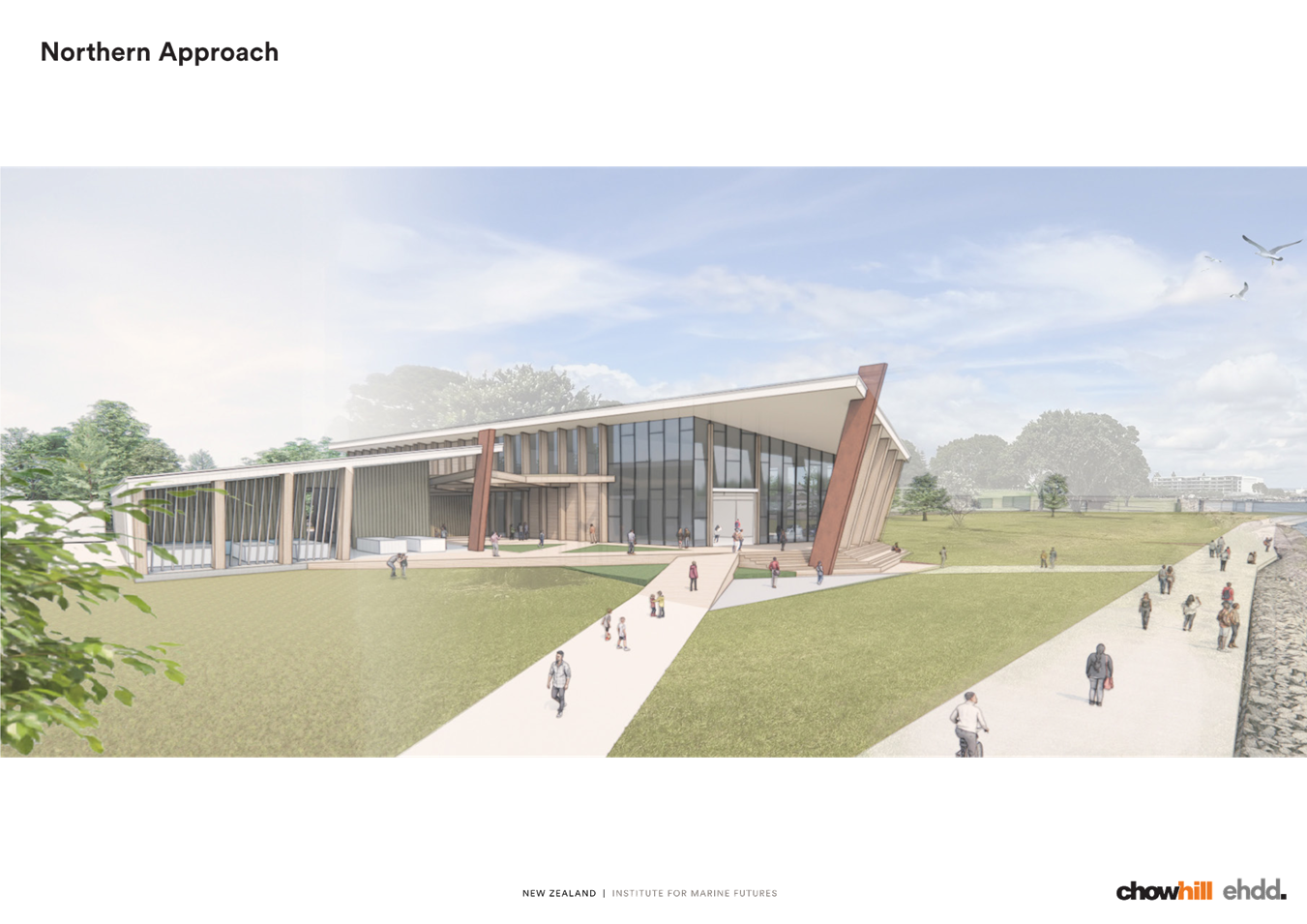
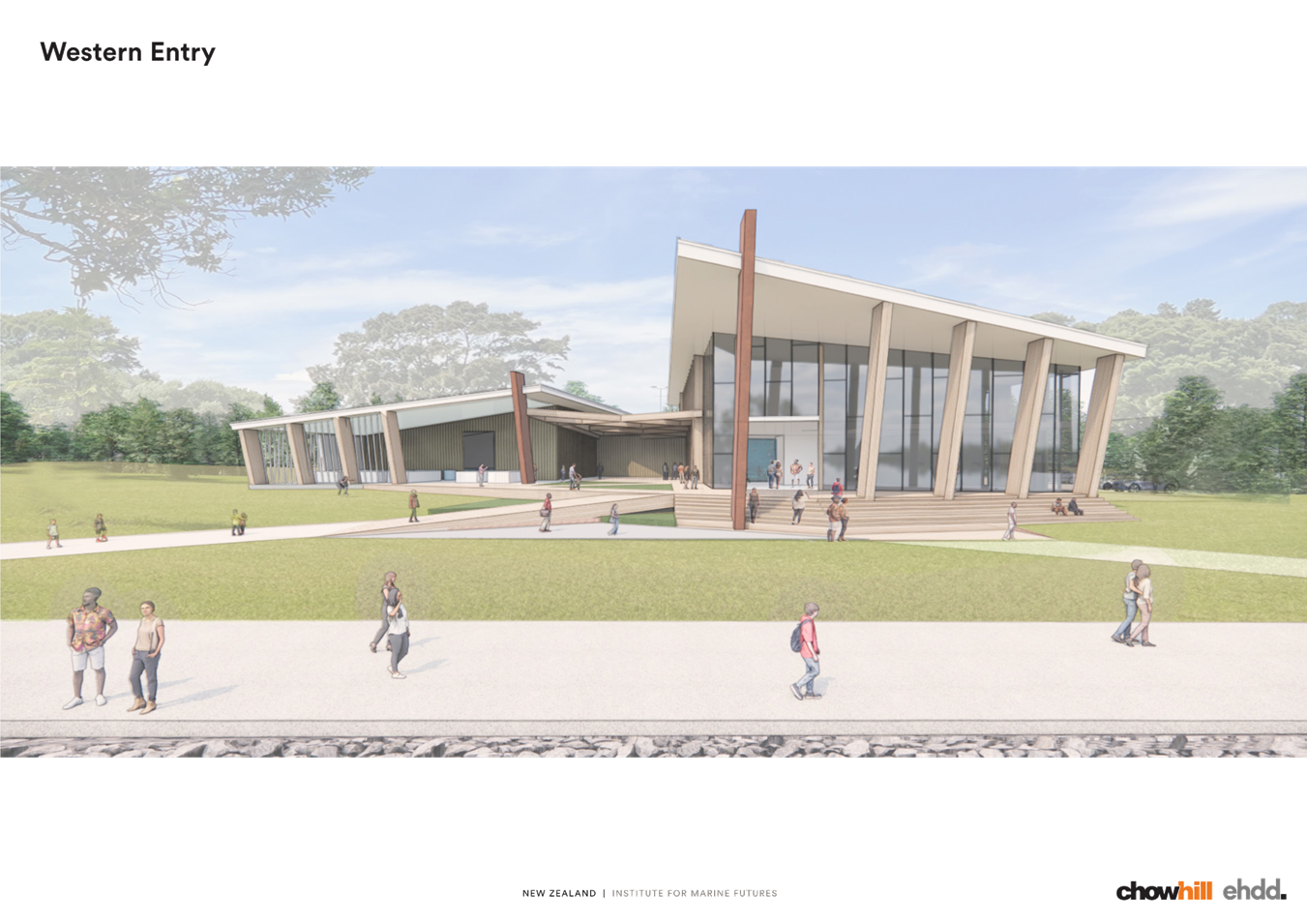
Council meeting Agenda
|
26
August 2025
|
11.2 Cameron Road Stage 2
Concept Options
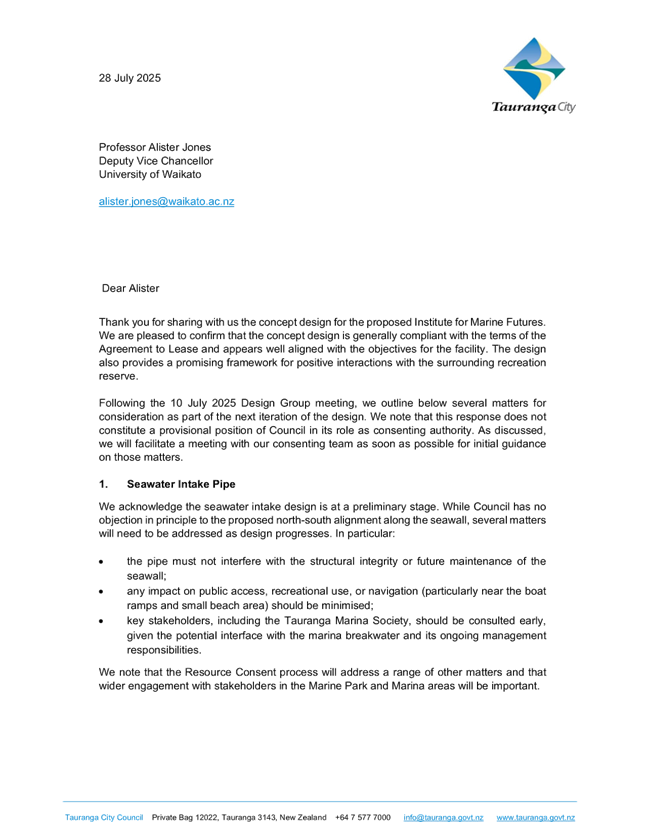
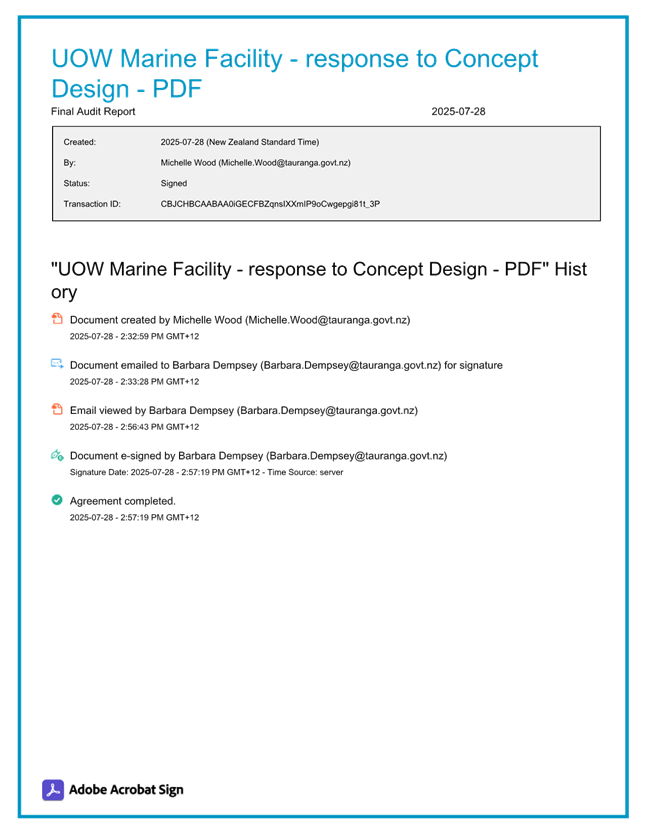
File
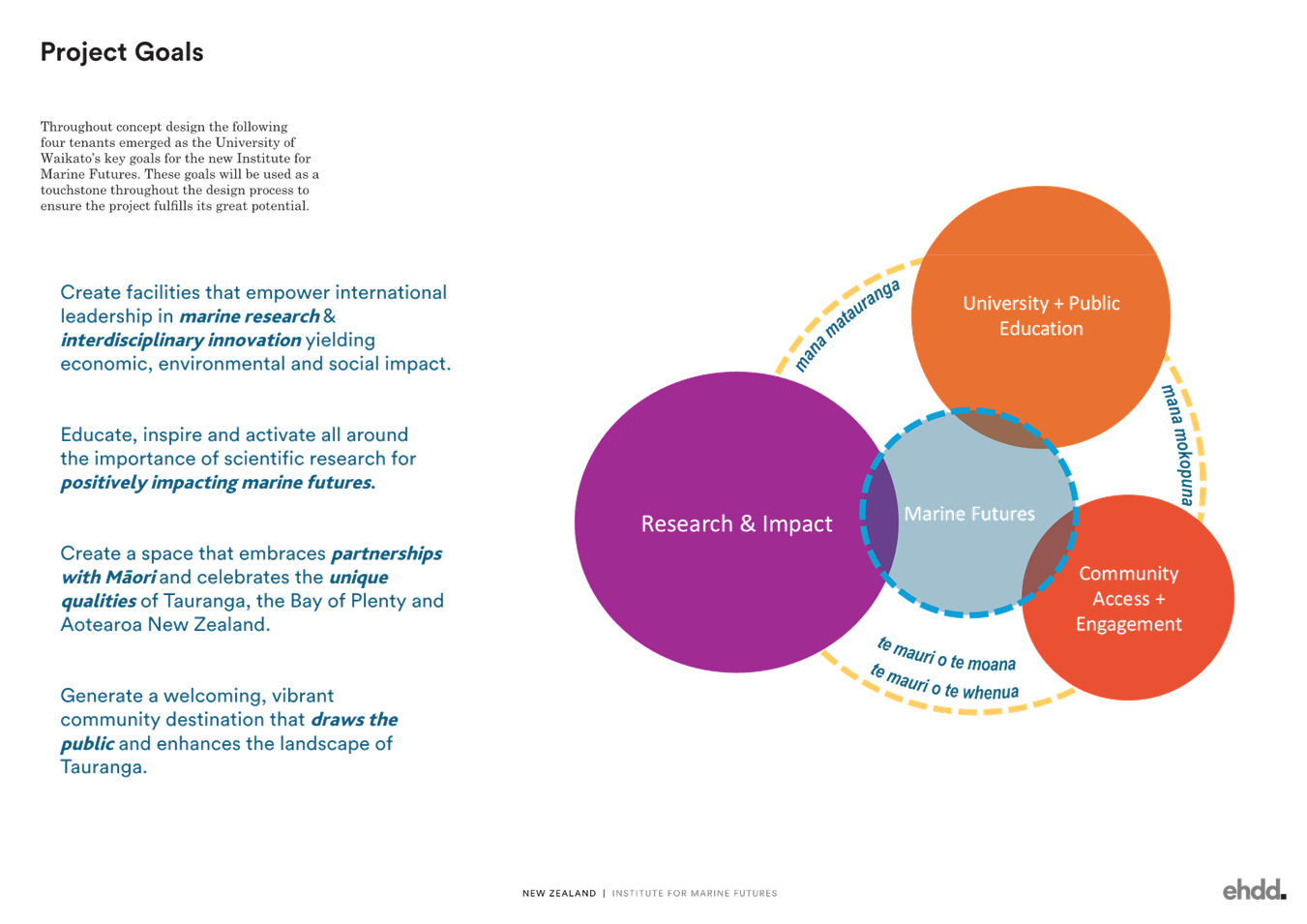
Number: A17123440
Author: Richard
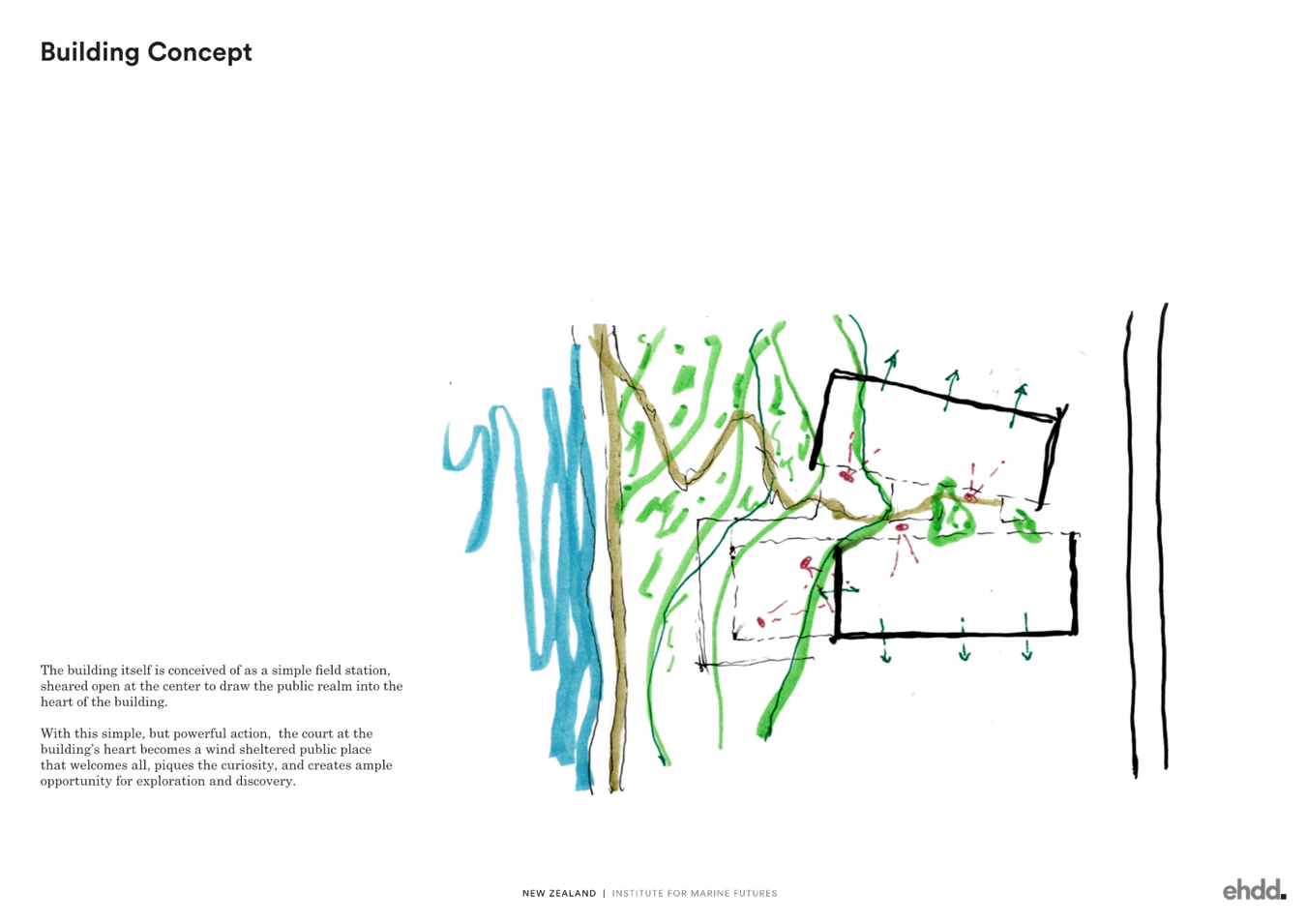
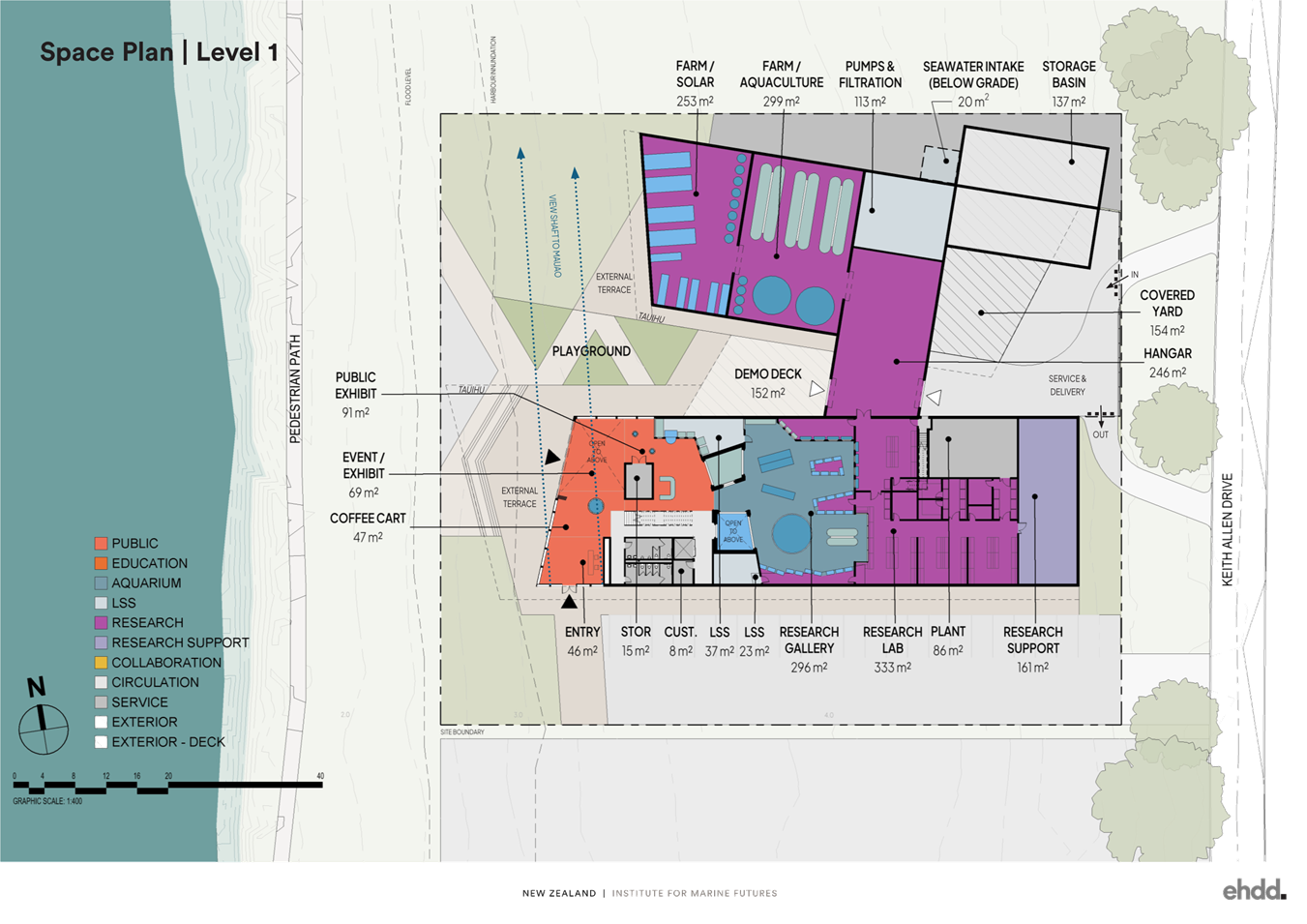
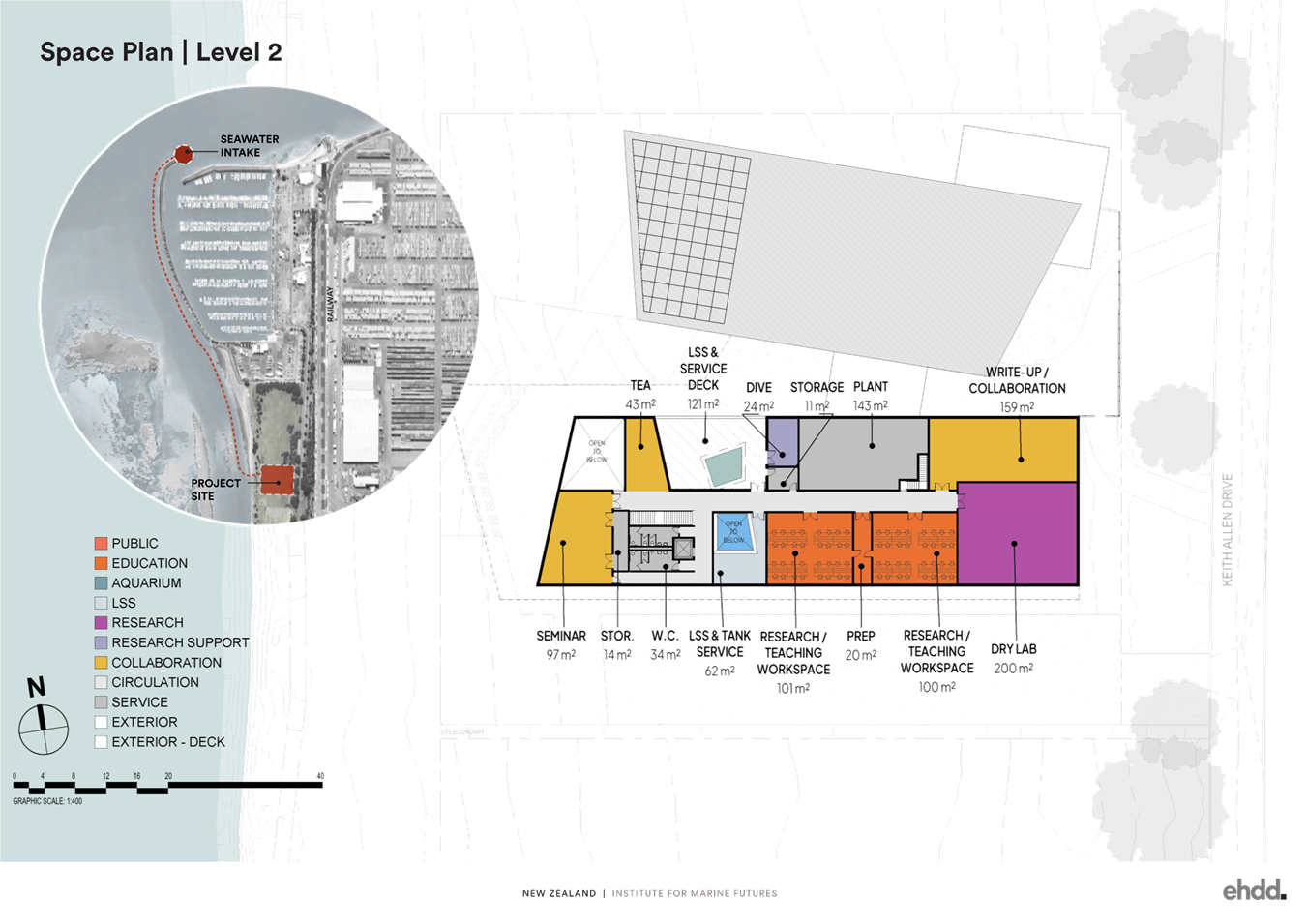
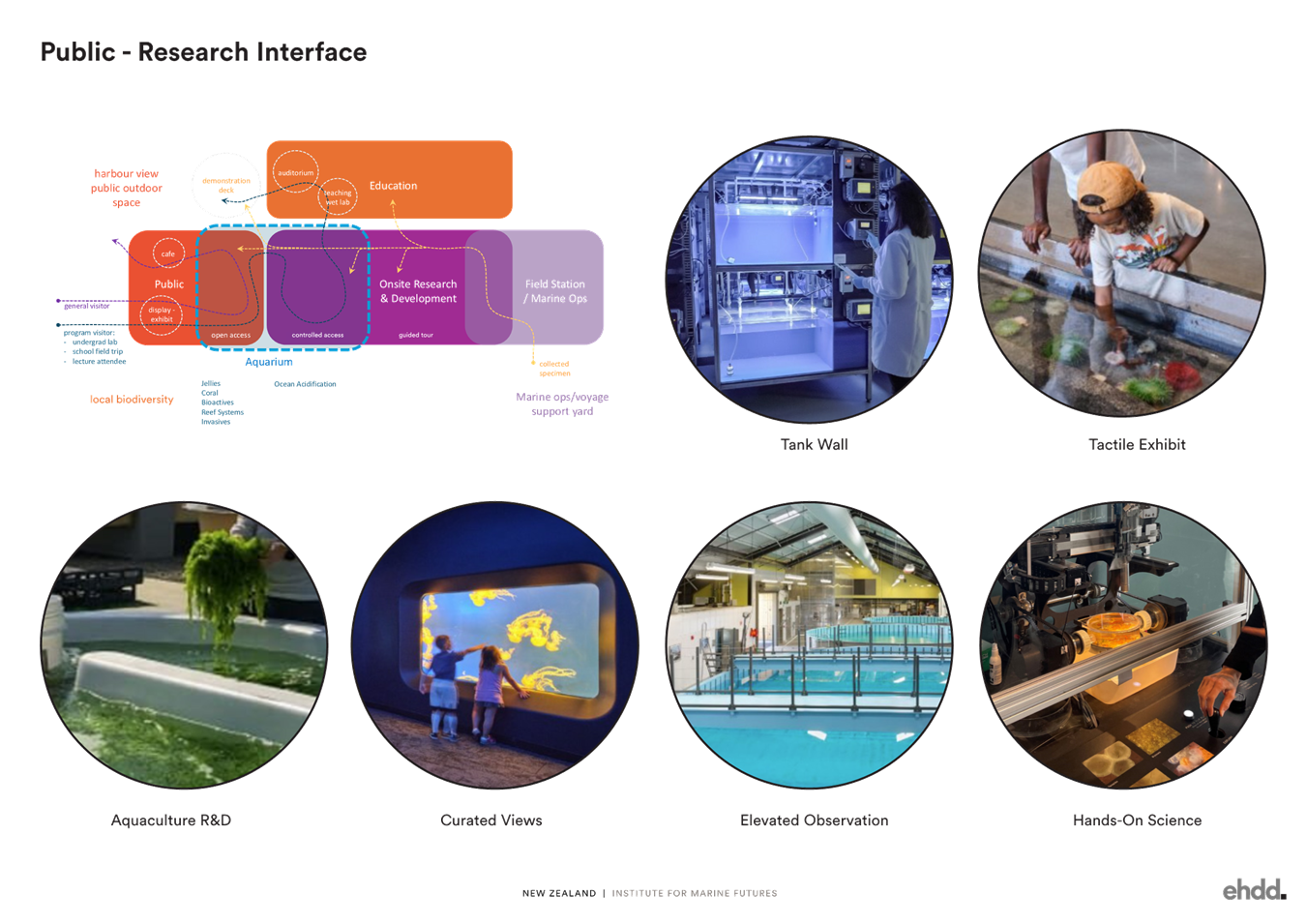
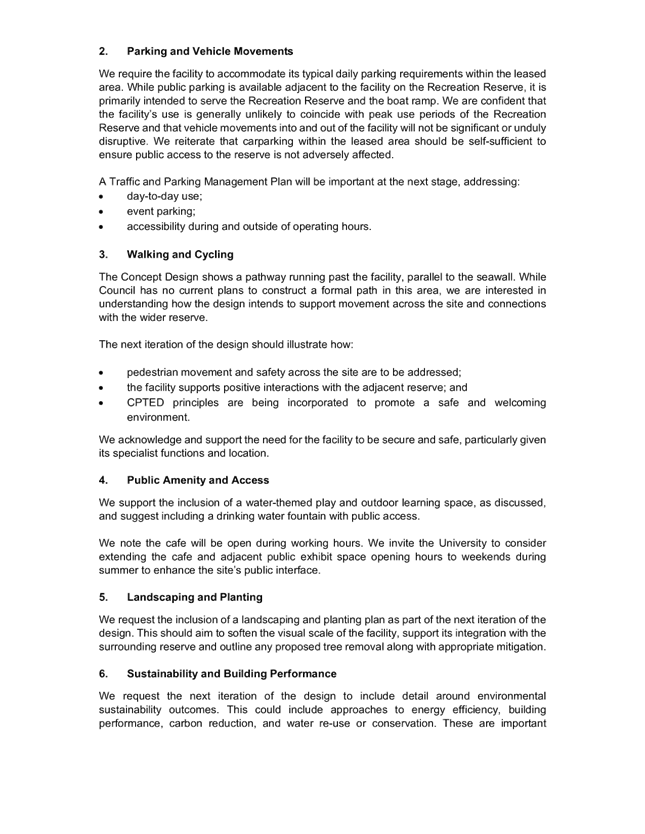
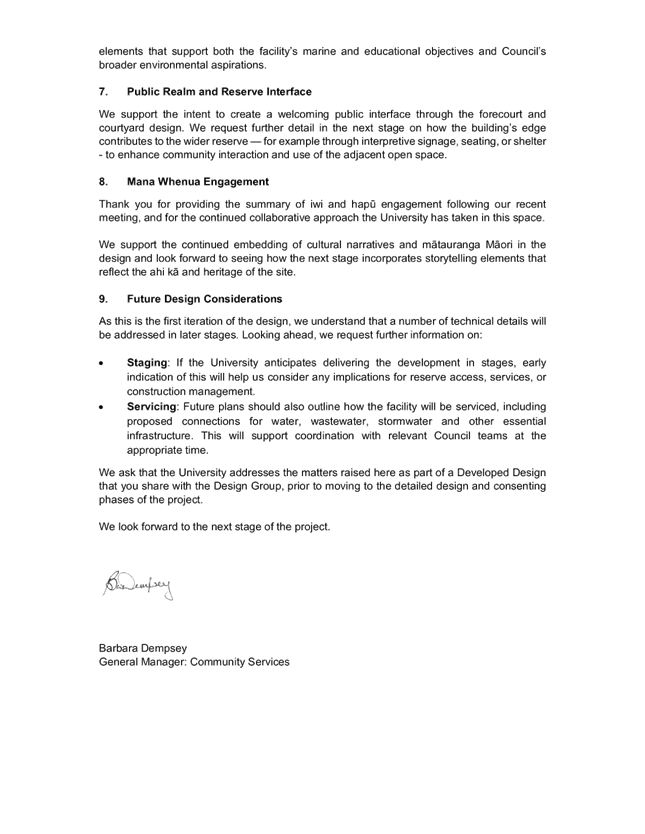
O Kane, Senior Project Manager
Chris Barton,
Programme Director: Major Projects
Authoriser: Nic
Johansson, General Manager: Infrastructure
Purpose of the Report
1. To seek confirmation
Council is committed to delivering the Cameron Road Stage 2 project by 30 June
2030 in alignment with the timeframes in the current Infrastructure
Acceleration Fund (IAF) funding agreement and seek endorsement to progress to
community engagement on concept options.
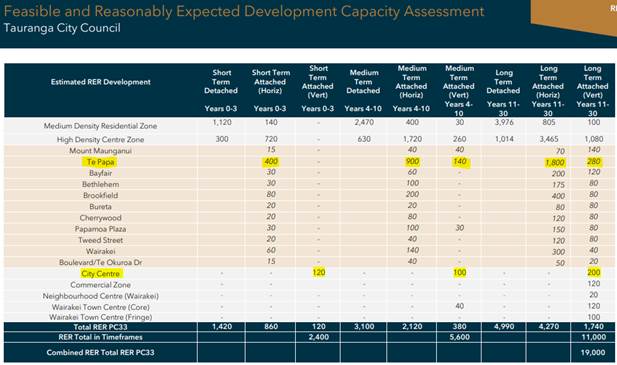
|
Recommendations
That the Council:
(a) Receives the report
"Cameron Road Stage 2 Concept Options";
(b) Confirms intent and
commitment to deliver of the Cameron Road Stage 2 upgrade project from 17th
Avenue to Maleme Street by 30 June 2030 to support housing intensification in
the Te Papa peninsula area at or above the level described in the existing Te
Papa IAF funding agreement timeframes; and
(c) Endorse
to progress to community engagement to seek feedback on the concept design
for the Cameron Road Stage 2 corridor and options through Greerton
village, subject to re-confirmation of current IAF funding availability
resulting in a funding stack of $185.5m comprised of:
· Transport
Components - $98.8m
§ $56.4m Crown grant via the
Infrastructure Acceleration Fund (IAF)
§ $20m via Transport System Plan
Infrastructure Funding and Financing Levy (IFF)
§ $22.4m of Developer Contributions
(DC’s)
· Waters
Components - $86.7m as budgeted in the 2024-34 Long Term Plan (LTP)
|
Executive Summary
2. The Cameron Road
Stage 2 (CRS2) project is planned to upgrade the arterial corridor between
Seventeenth Avenue and Maleme Street to enable planned housing intensification
along the Te Papa peninsula and support continued growth of the Western
Corridor. It is a key strategic link between the completed CRS1 project and the
proposed SH29/SH29A RoNS project, with a key function of supporting the people
movement function of Cameron Road.
3. As previously
reported to the City Futures Committee on 17 February 2025, the project was
budgeted in Tauranga City Council’s 2024–34 Long Term Plan (LTP)
assuming co-funding support from NZ Transport Agency Waka Kotahi (NZTA),
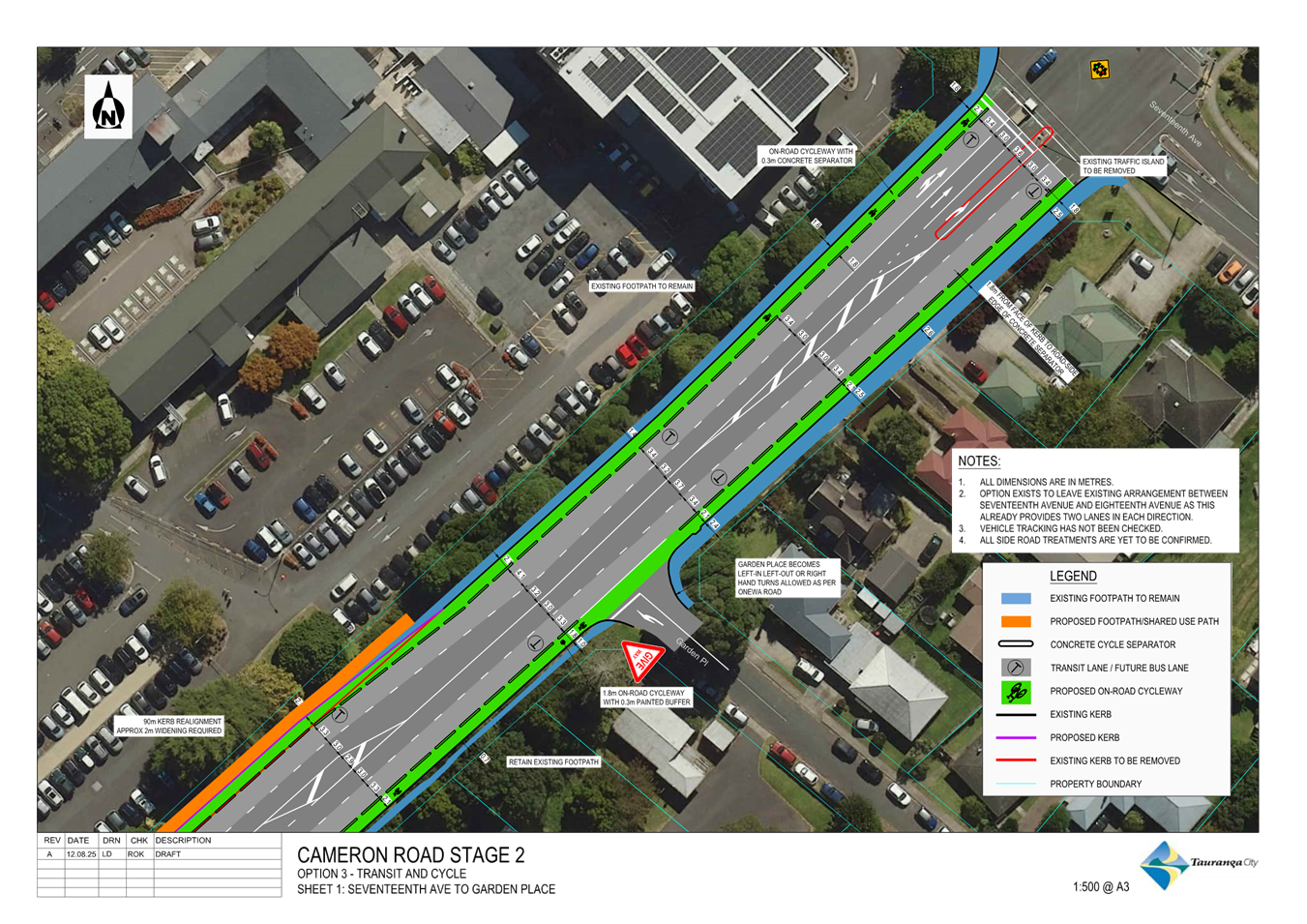
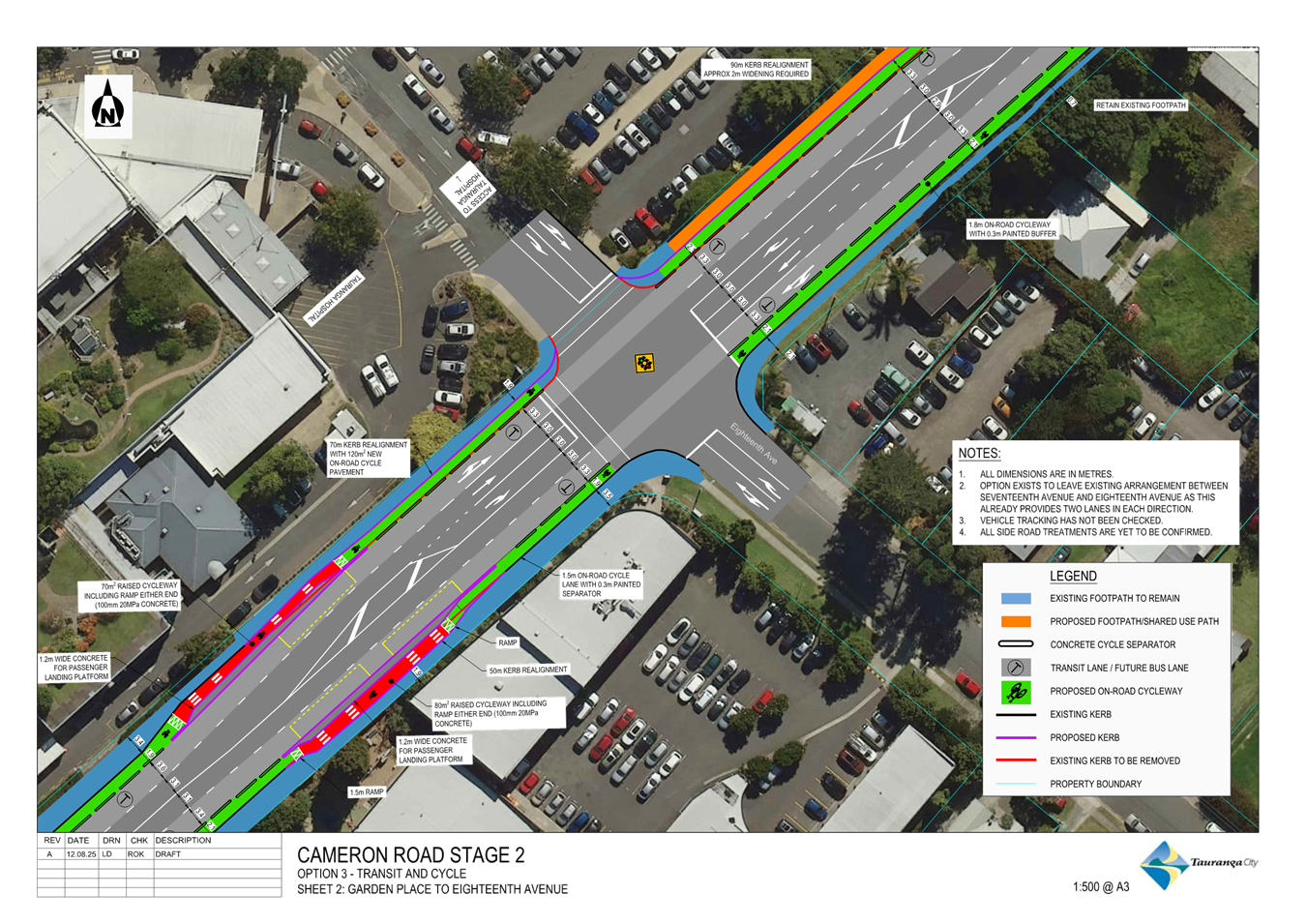
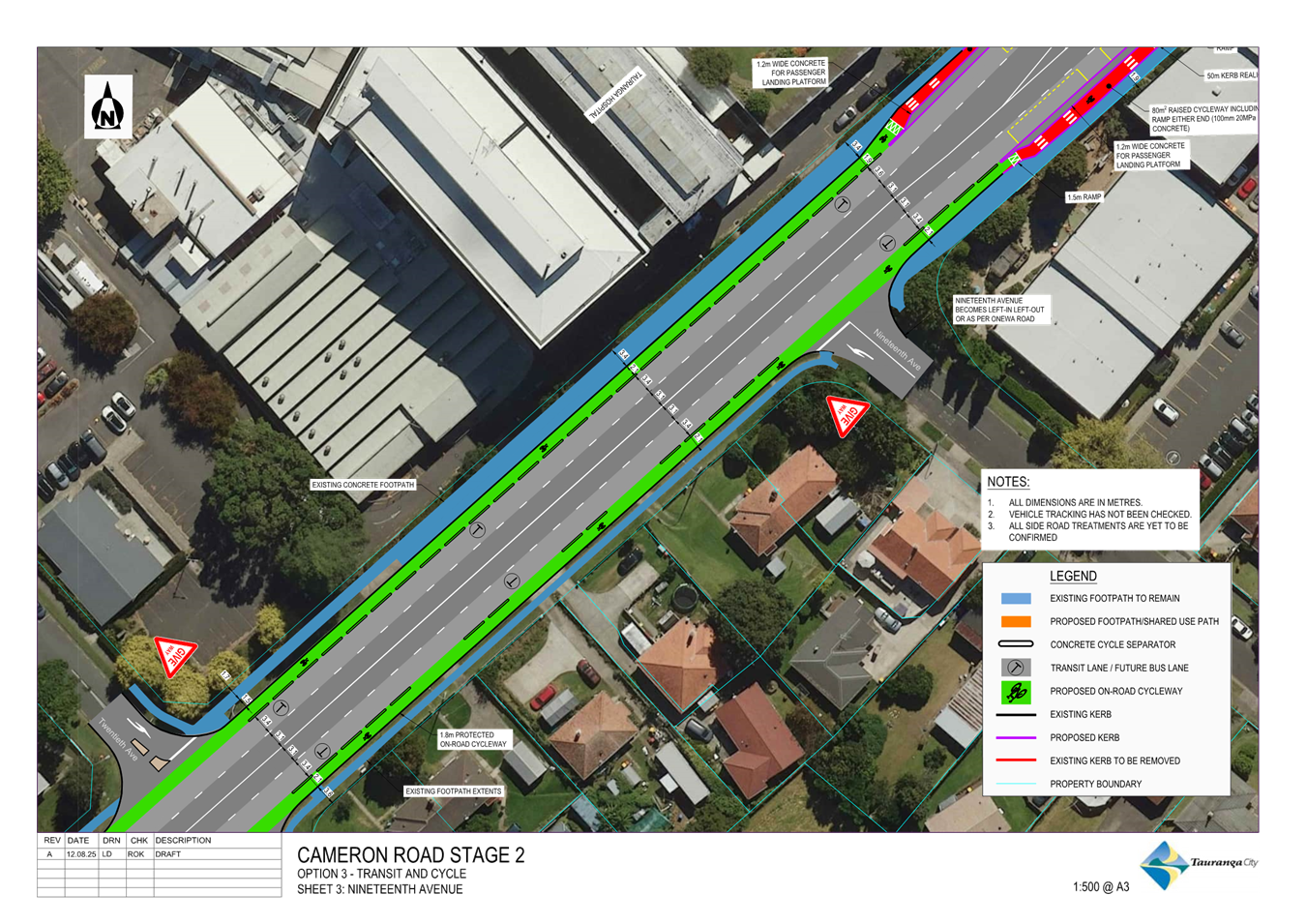
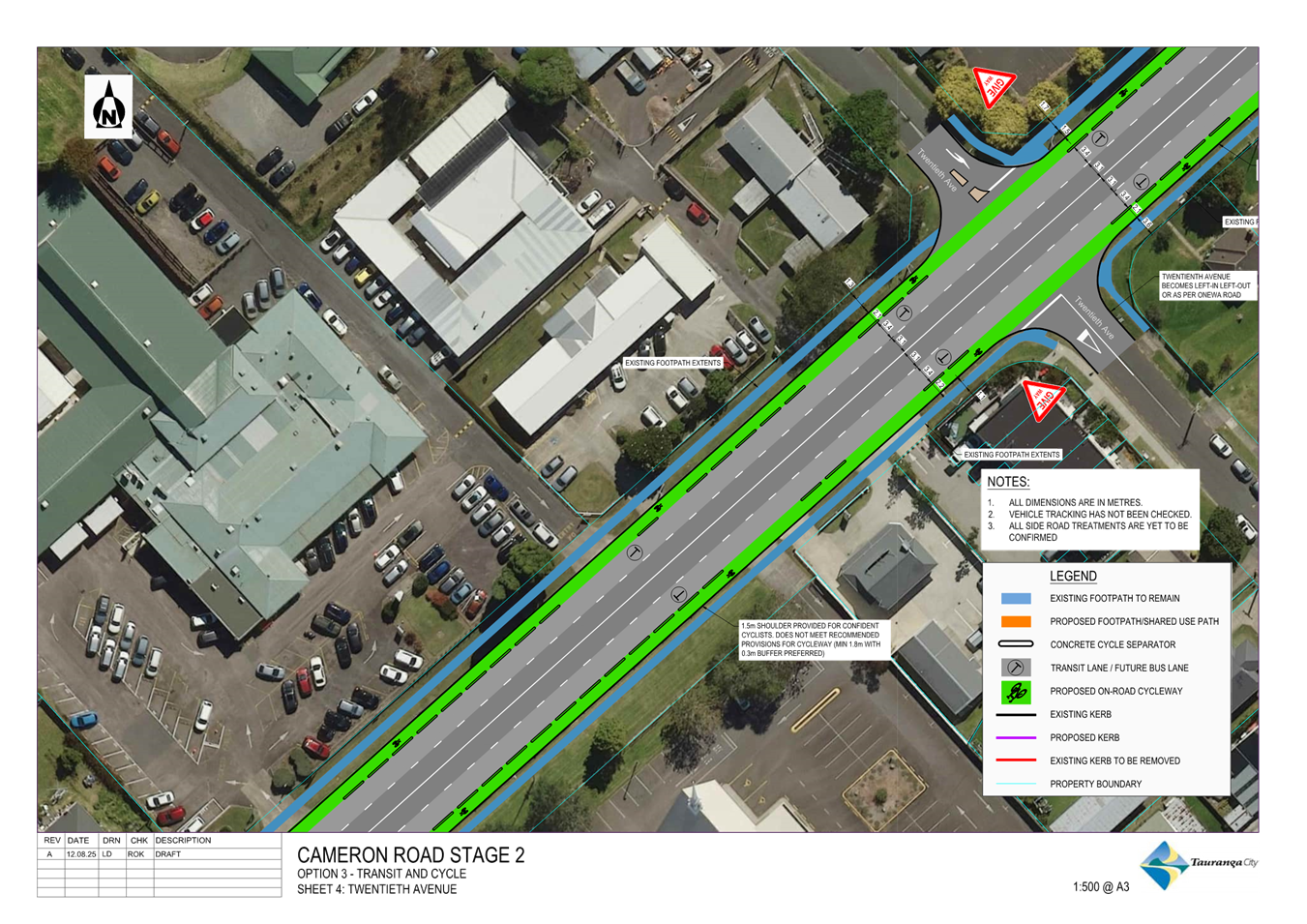
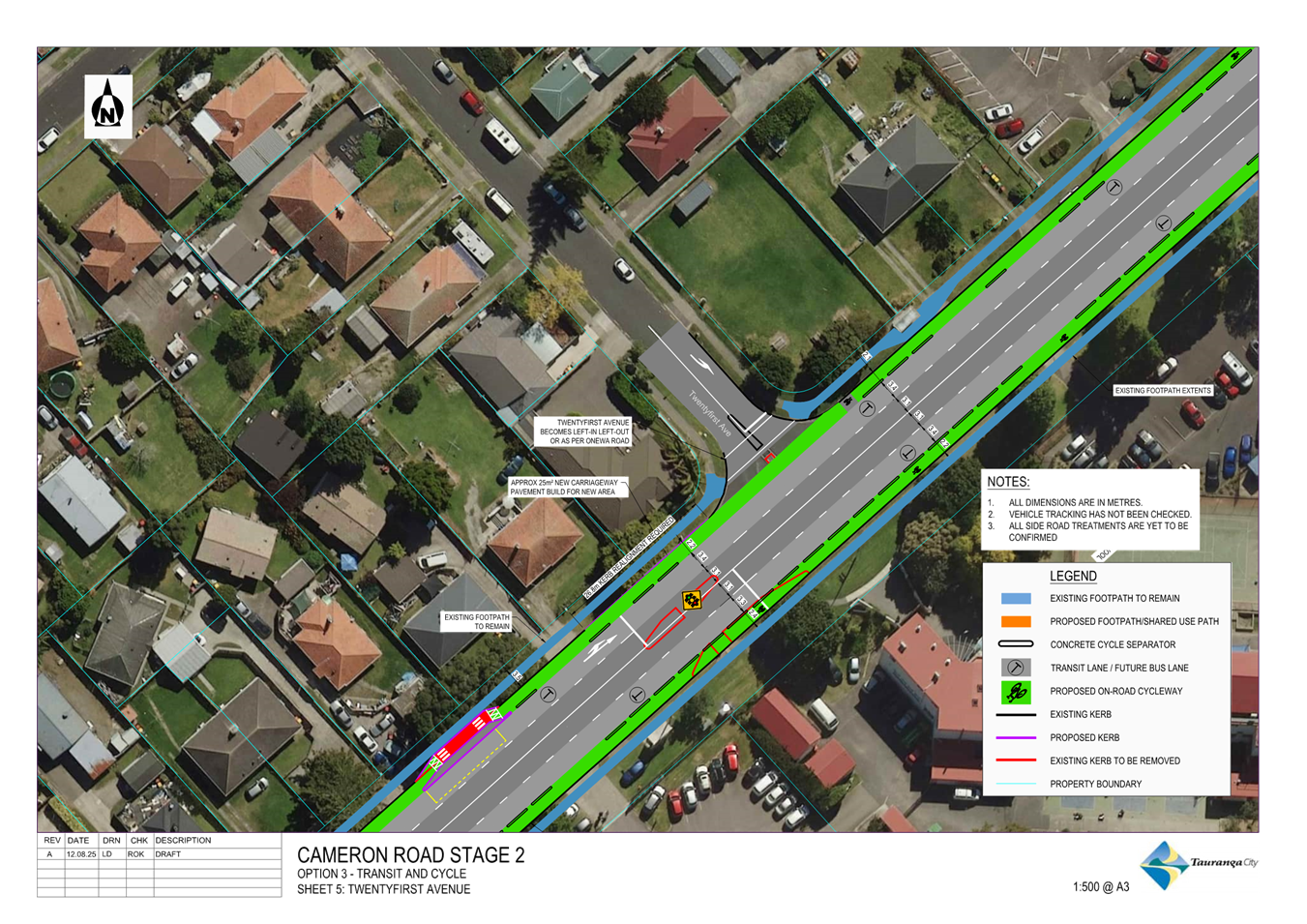
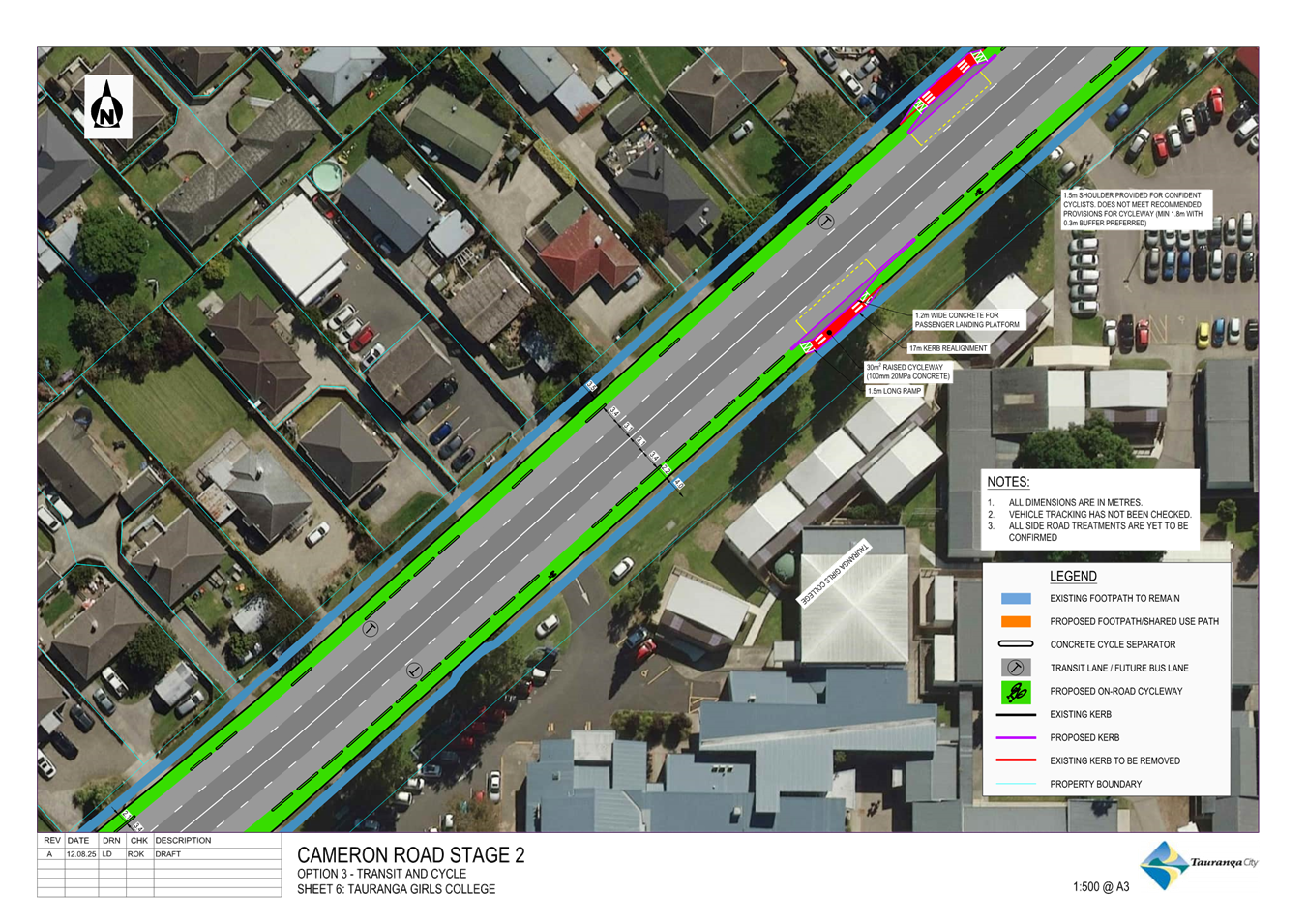
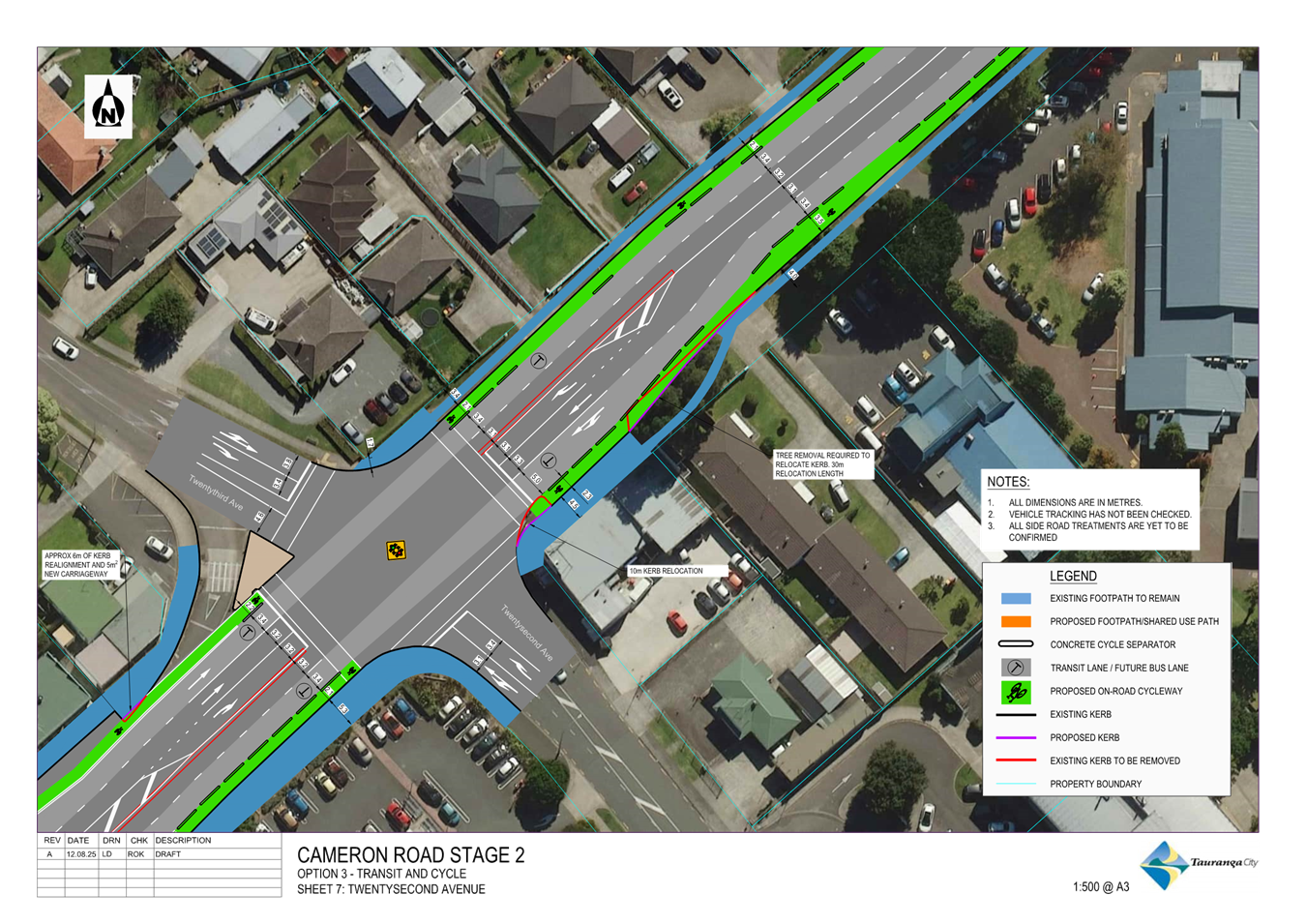
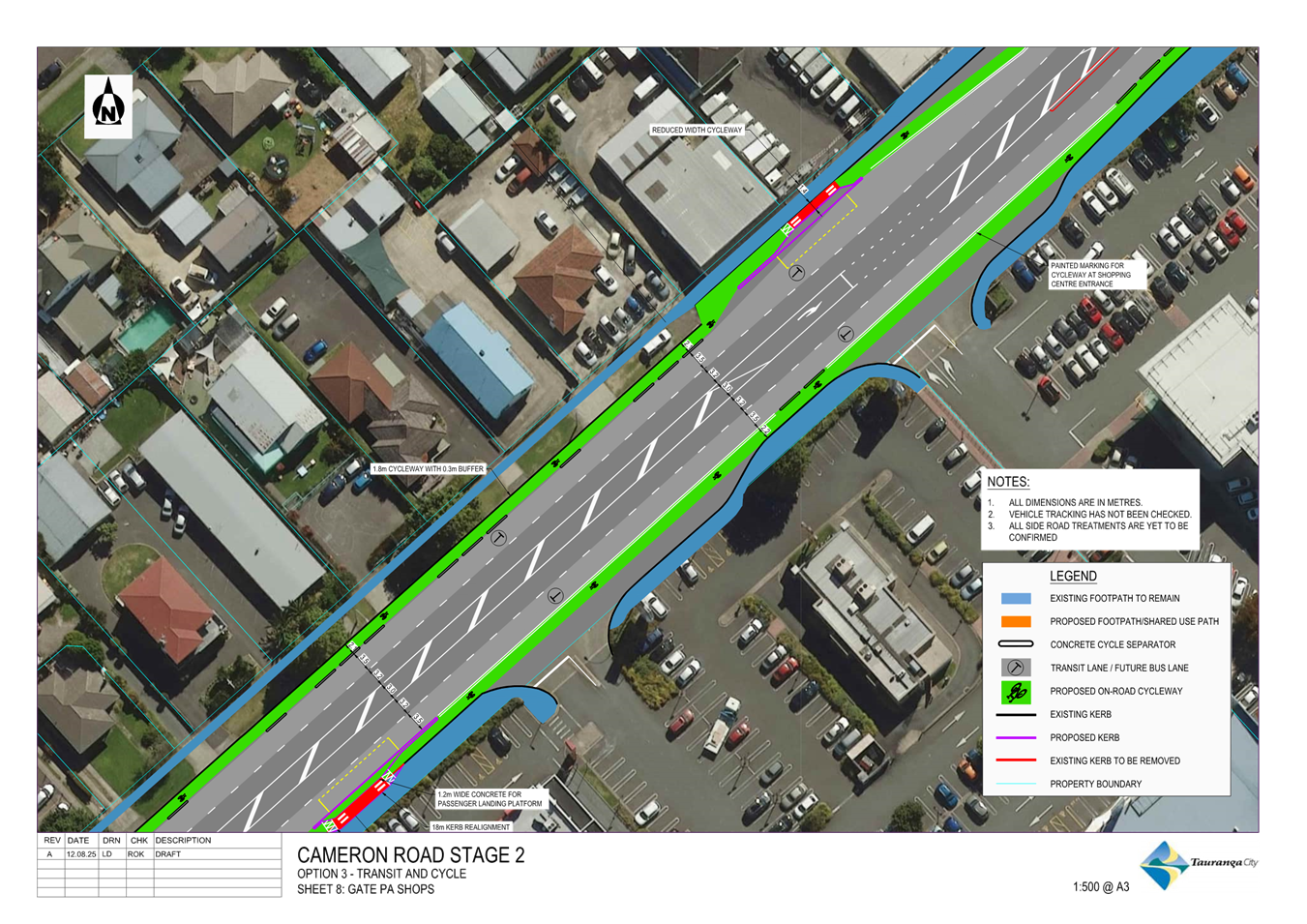
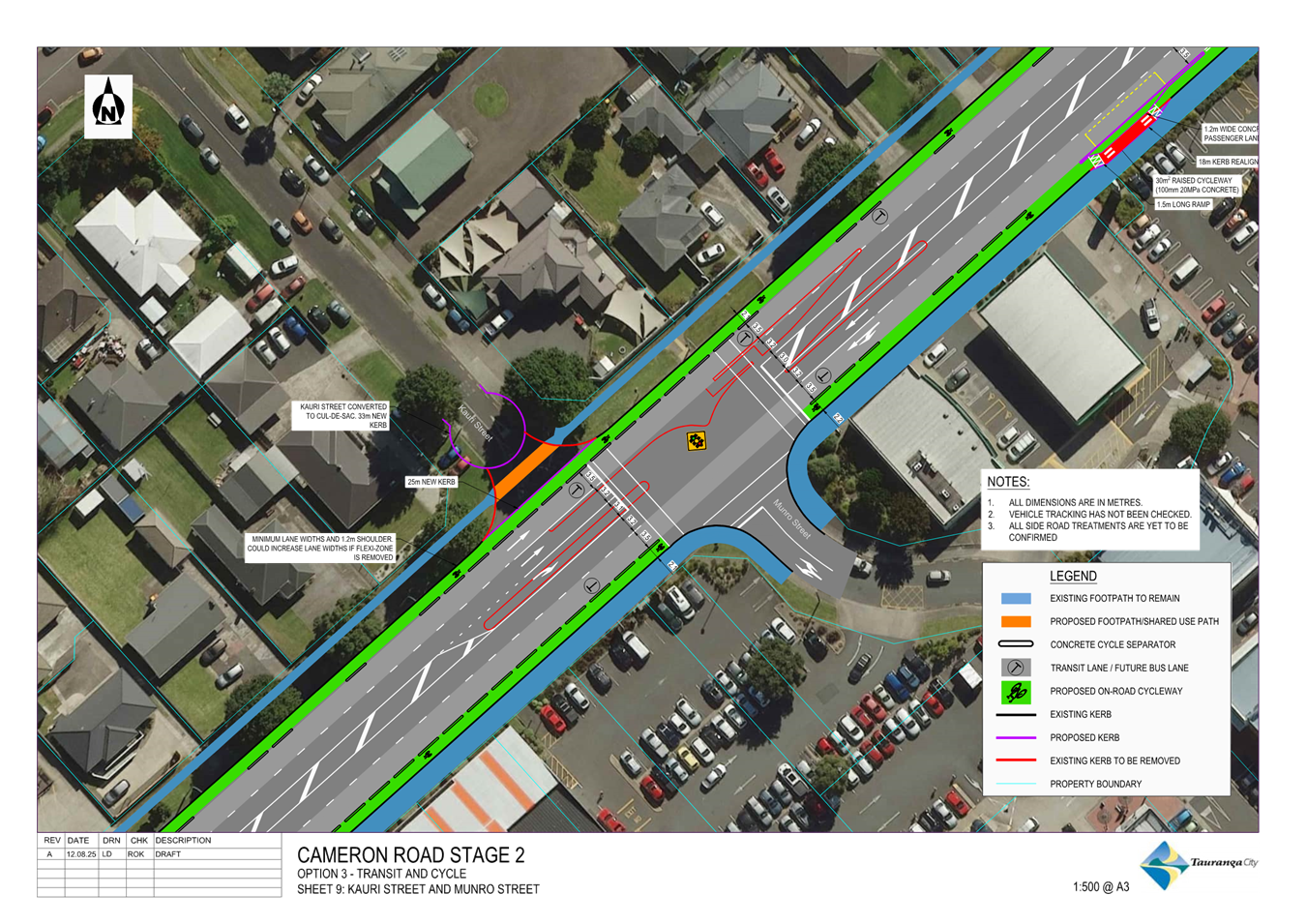
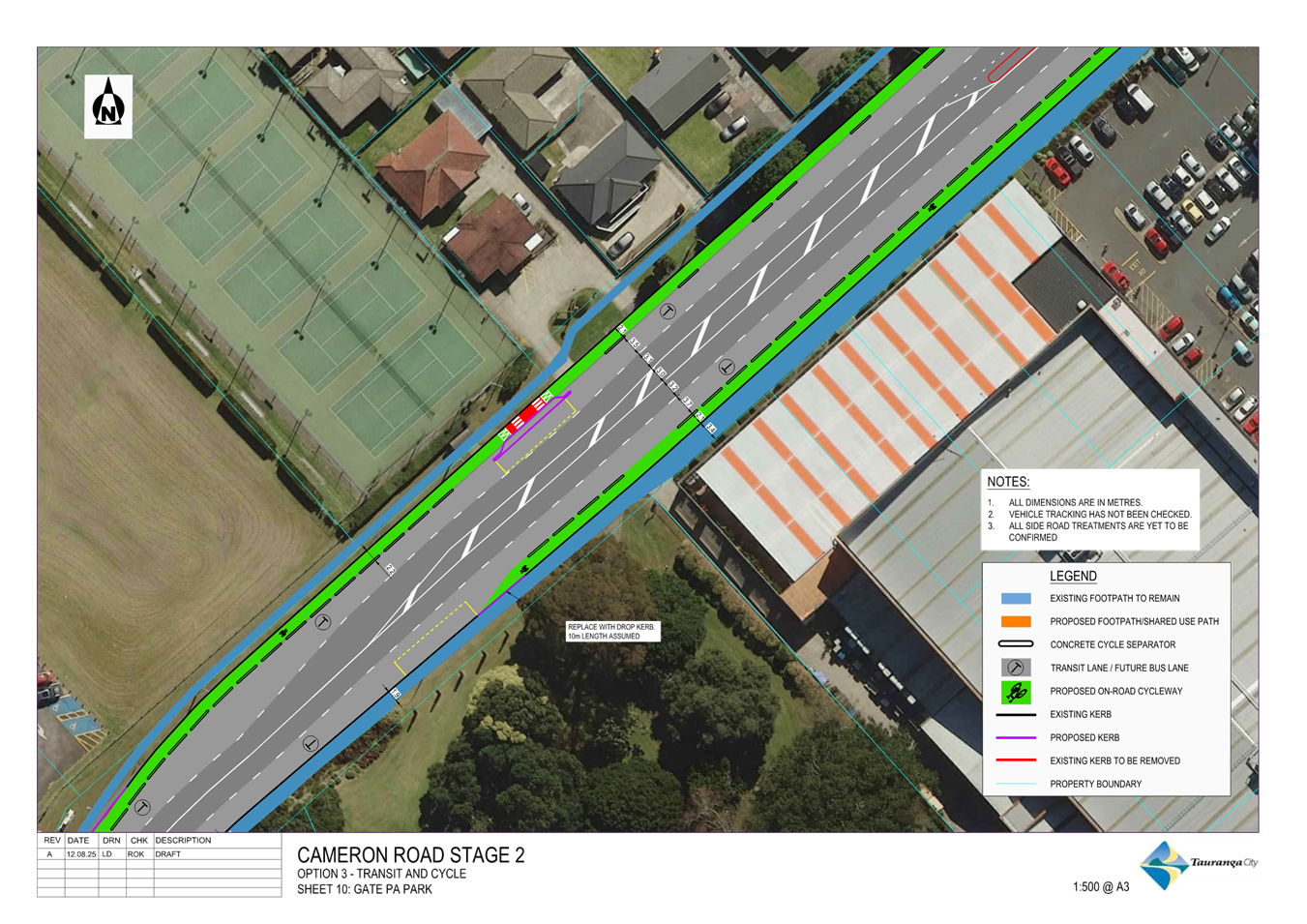
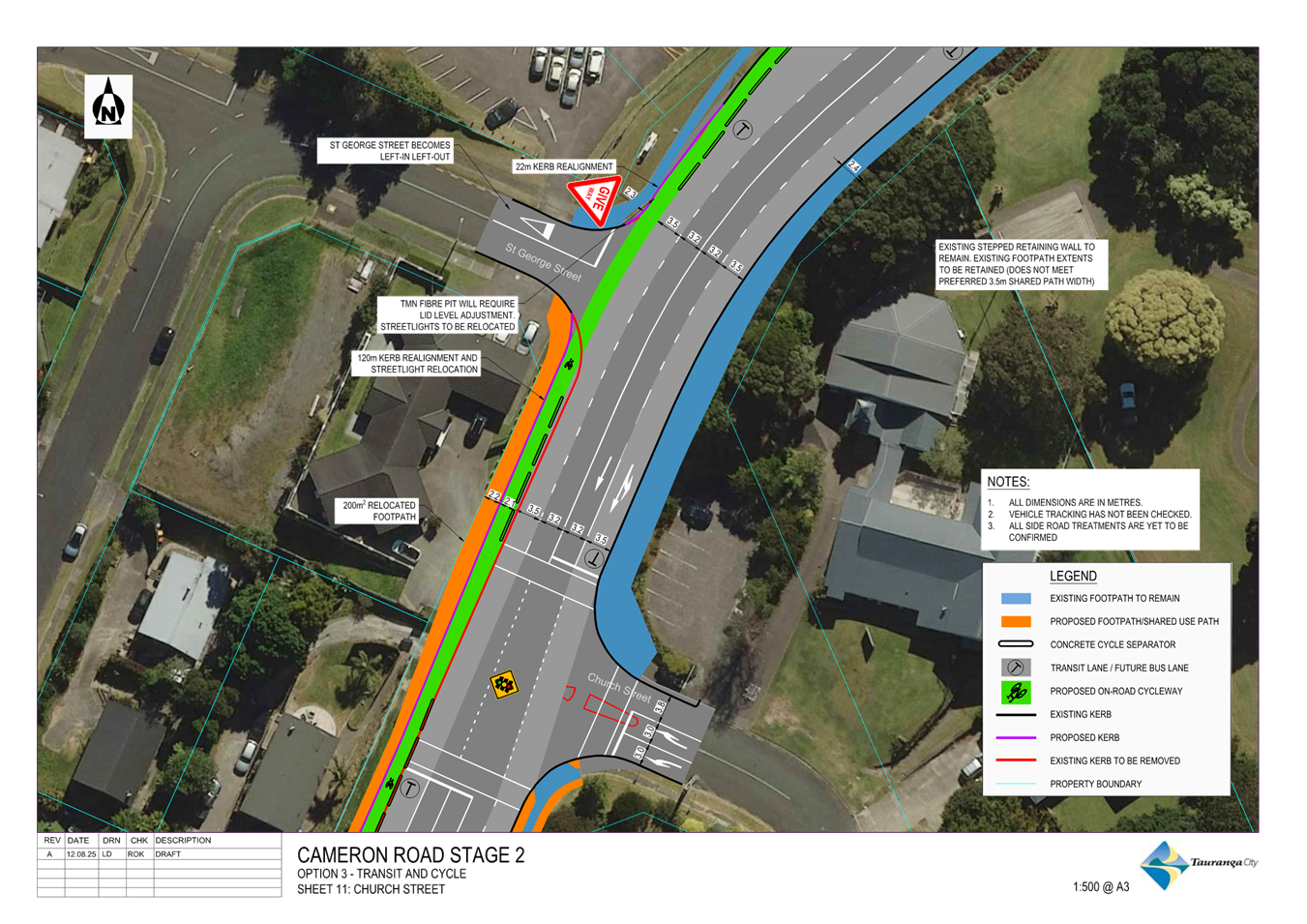
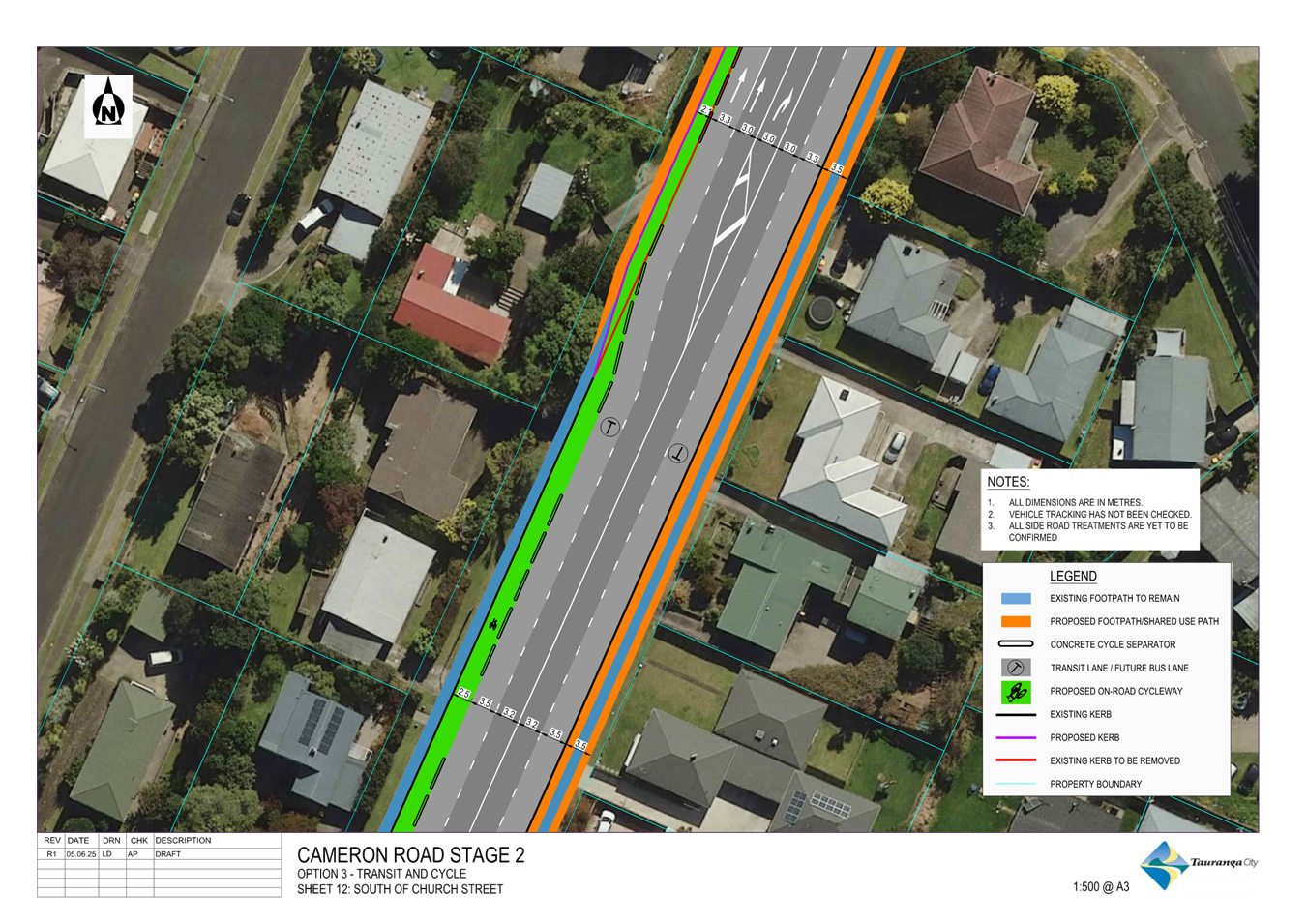
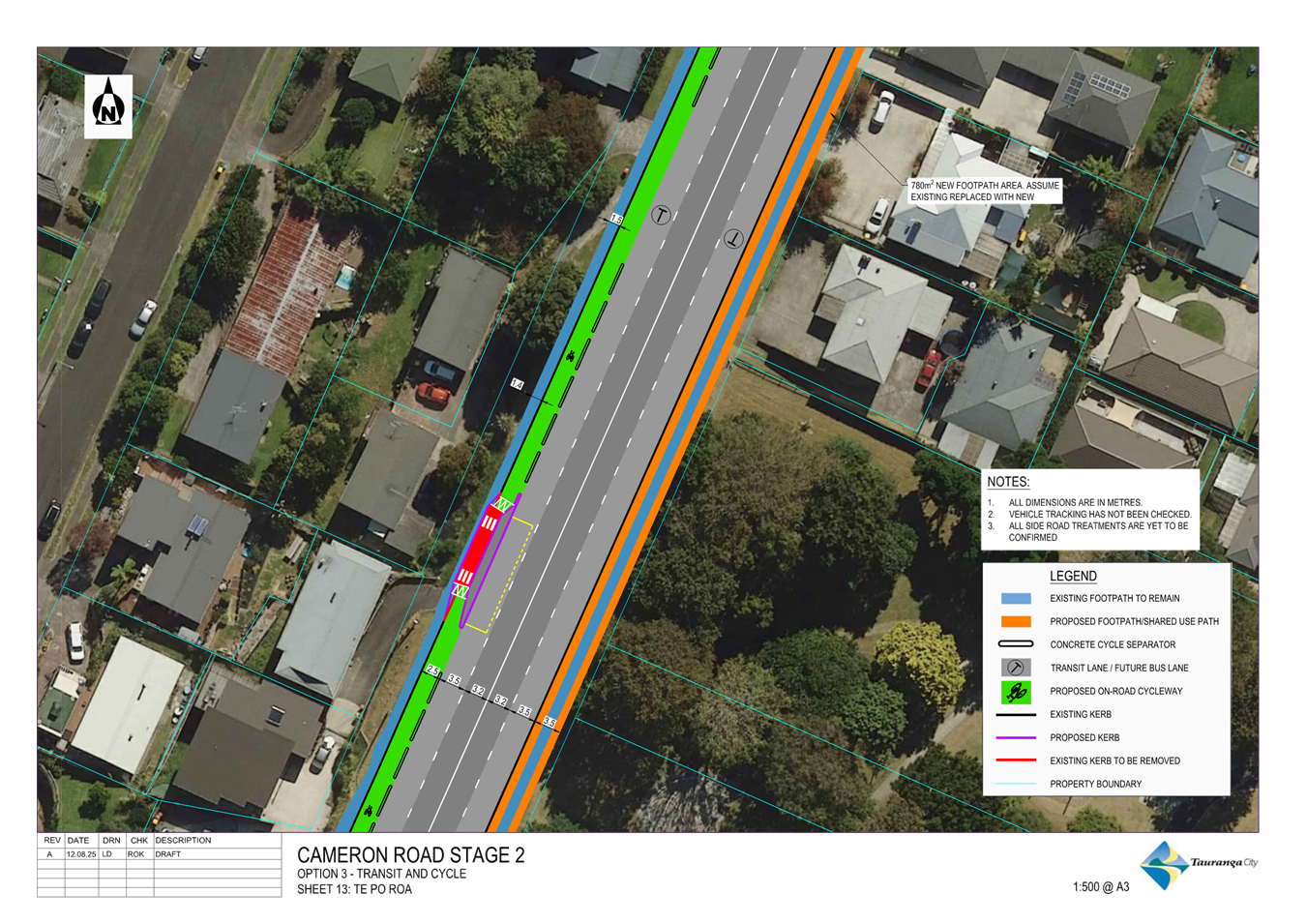
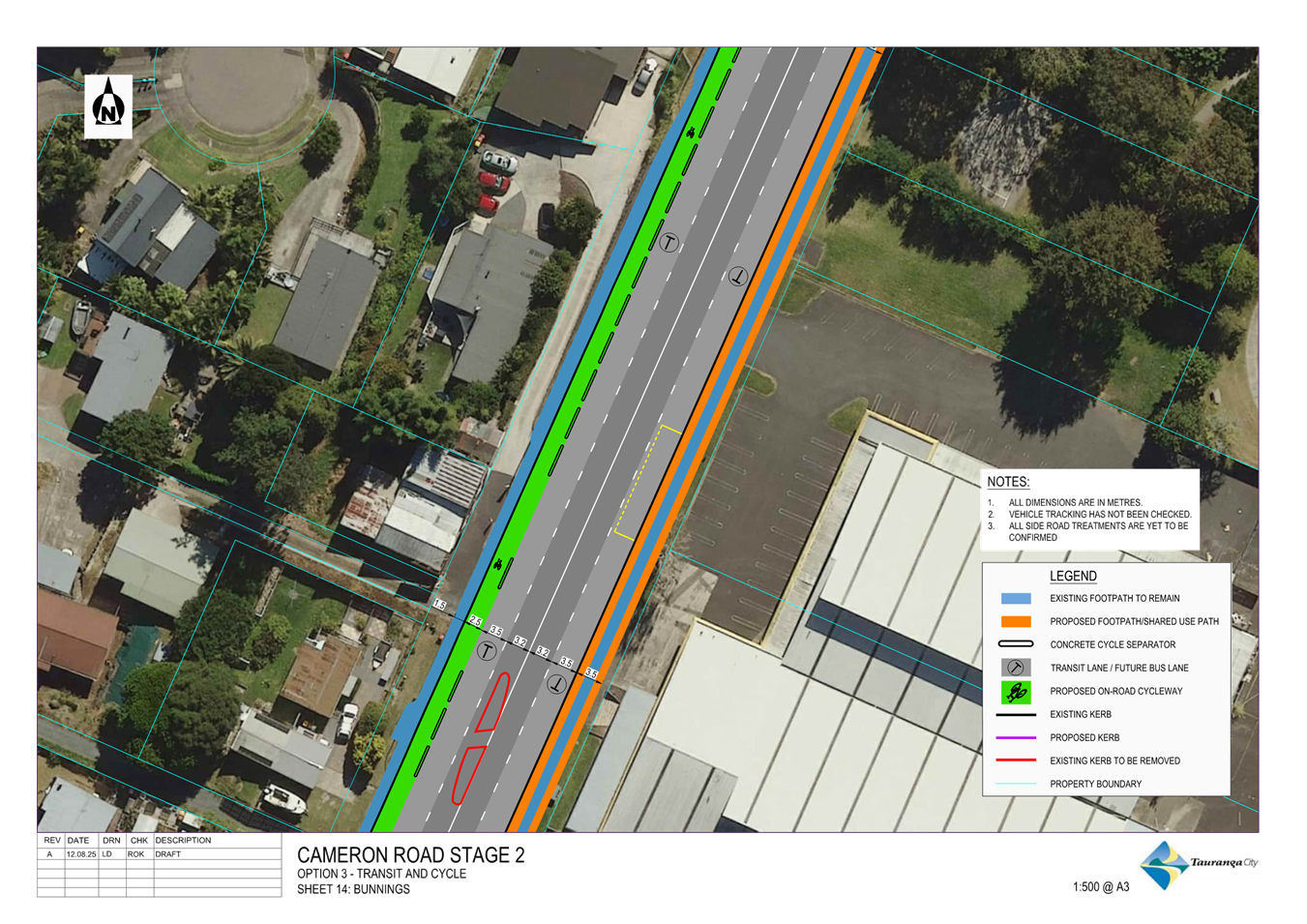
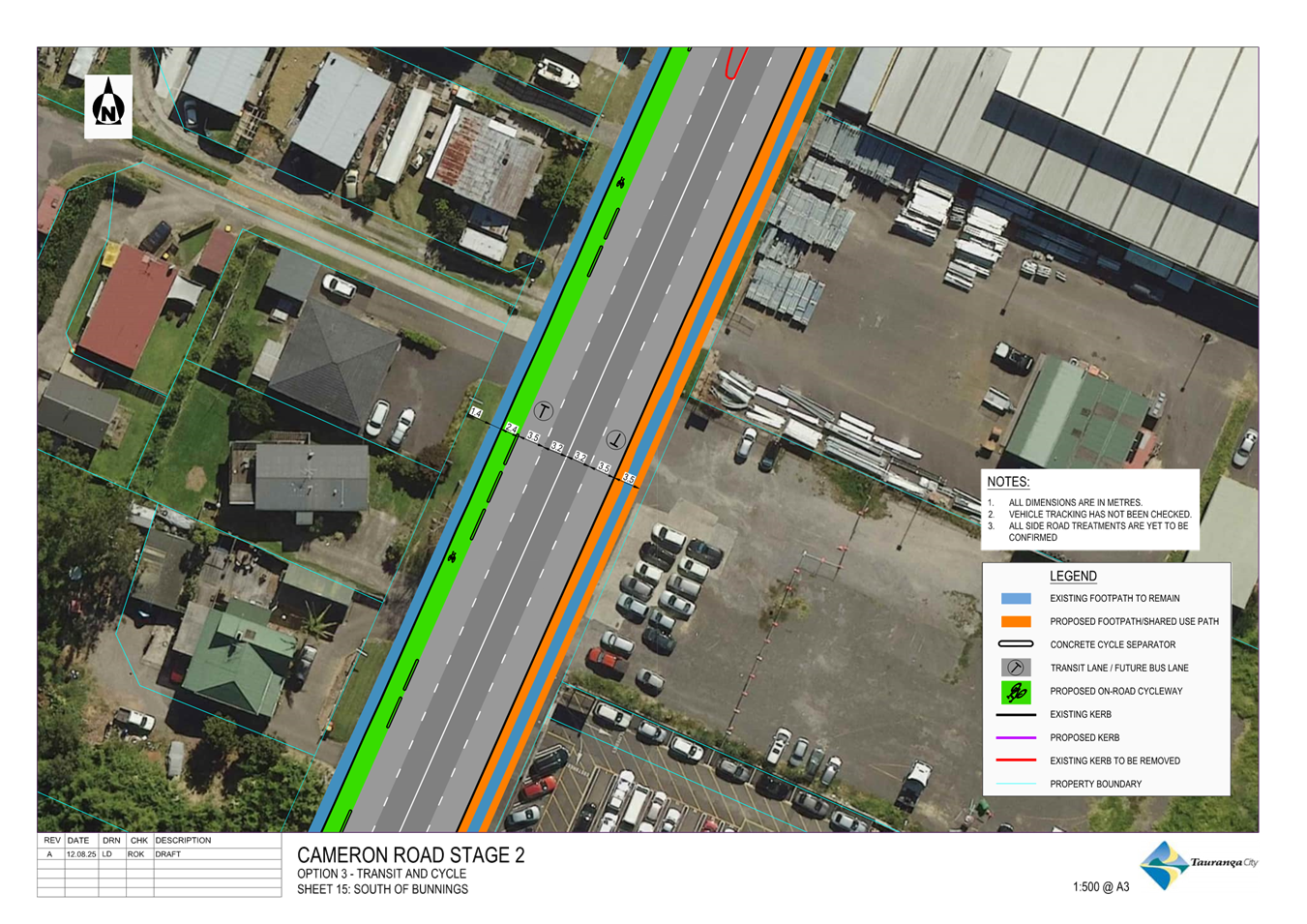
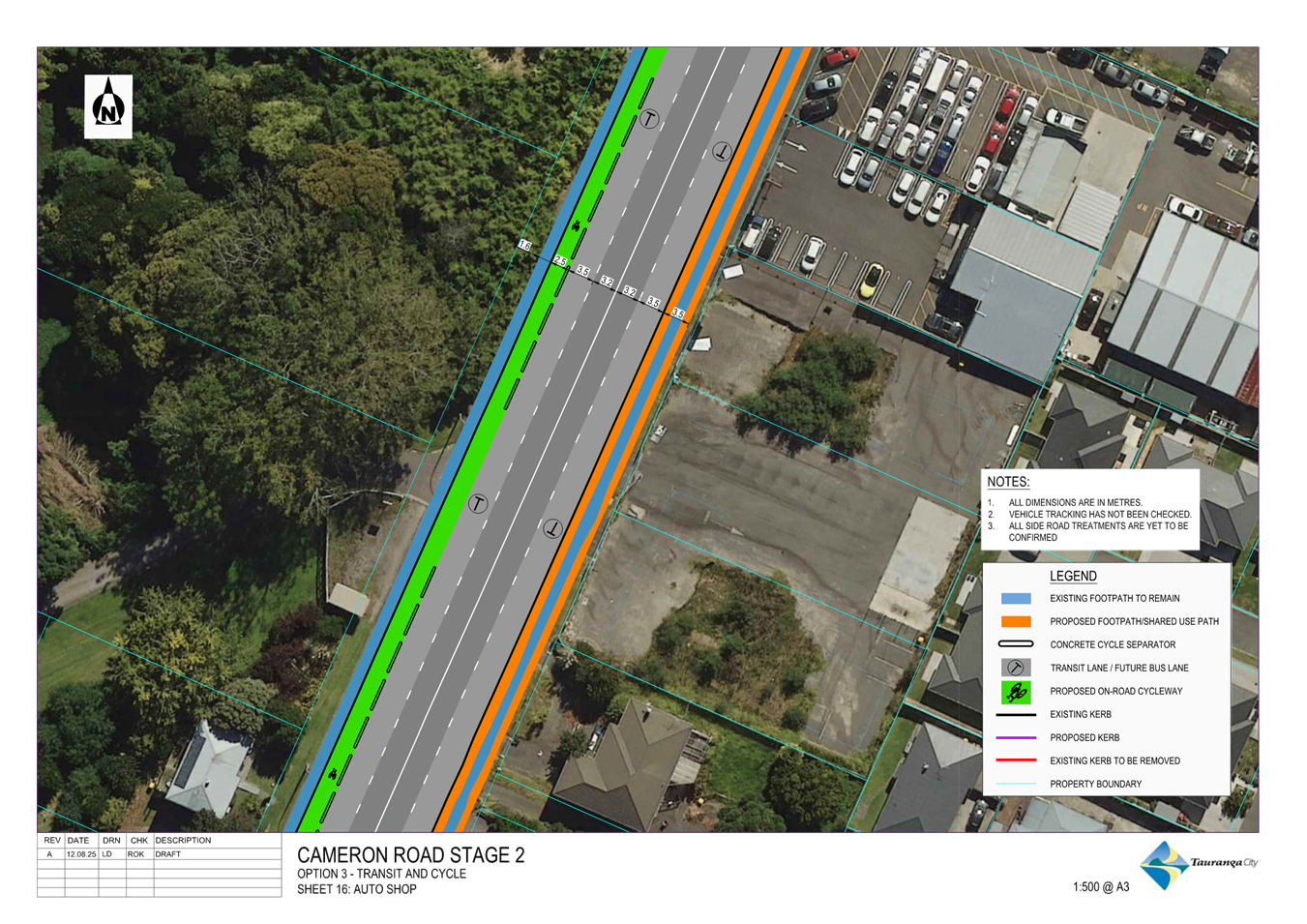
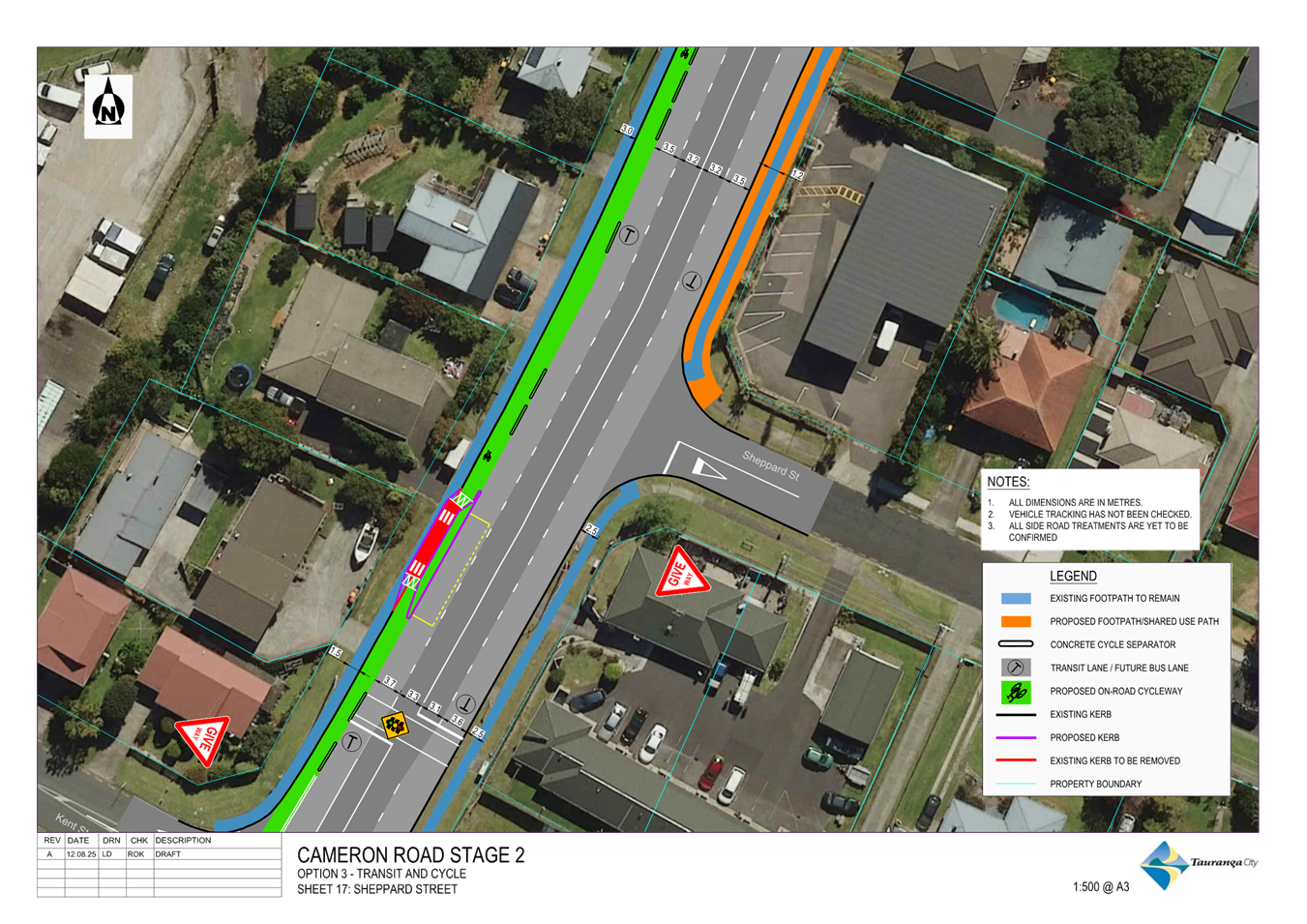
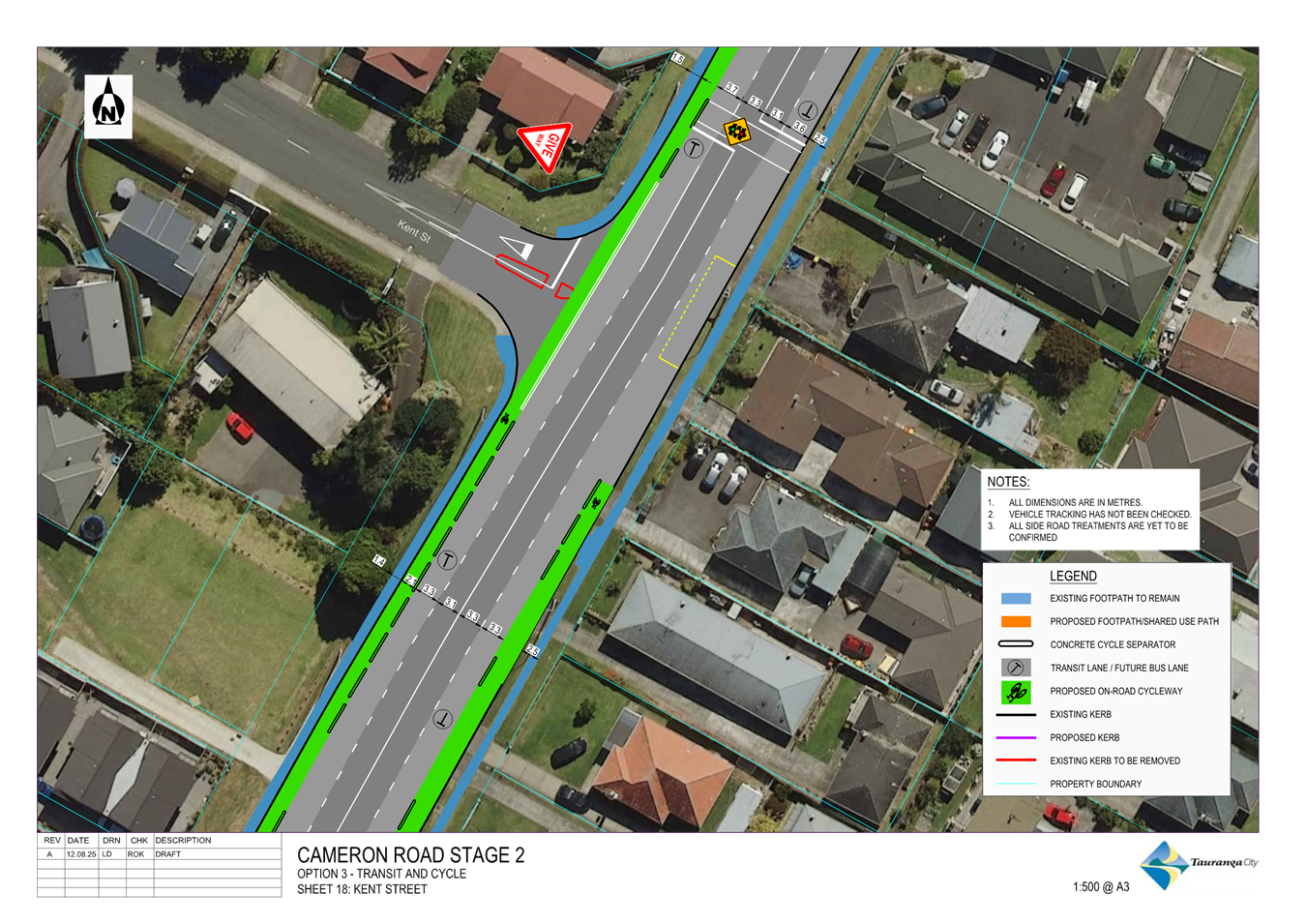
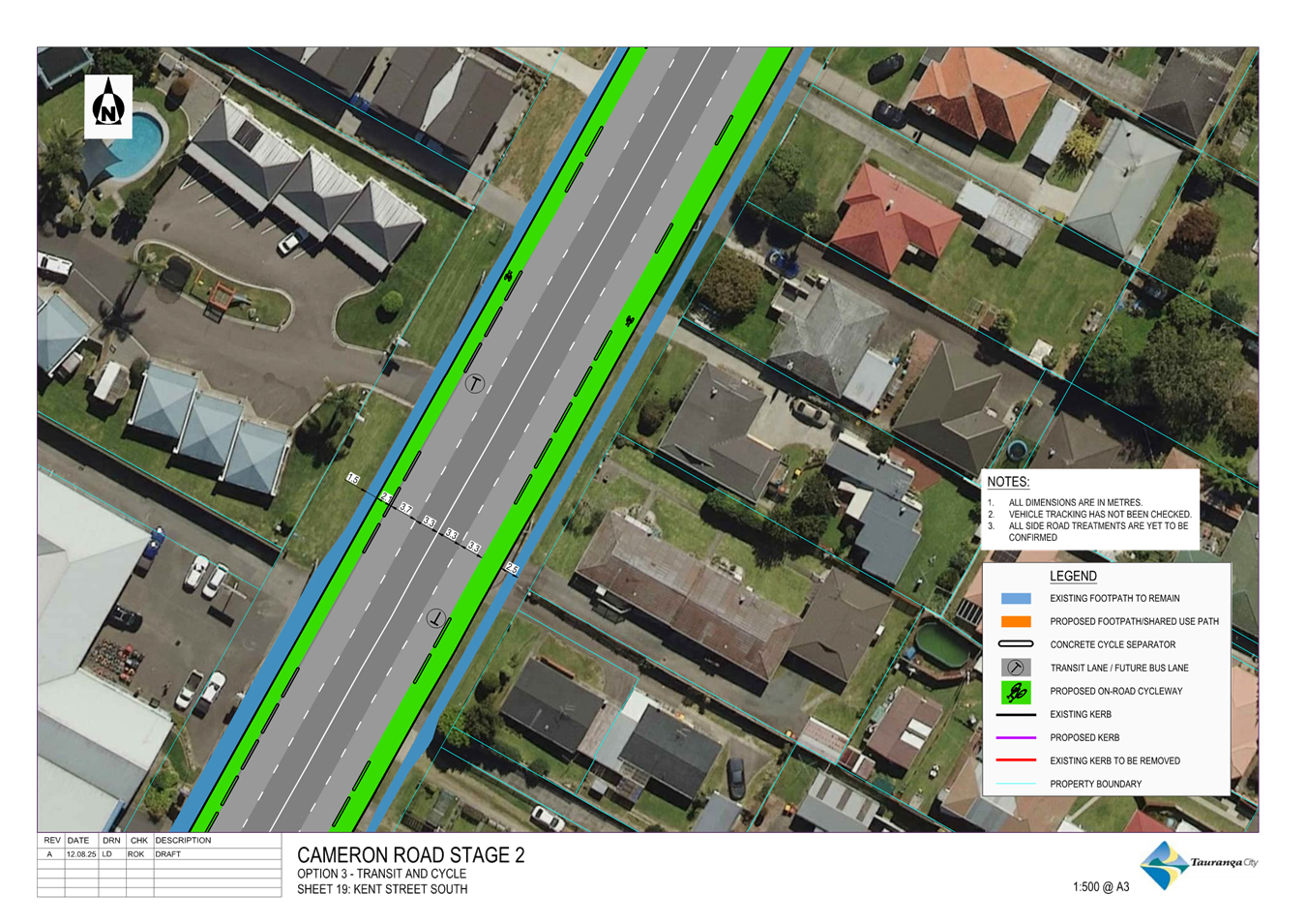
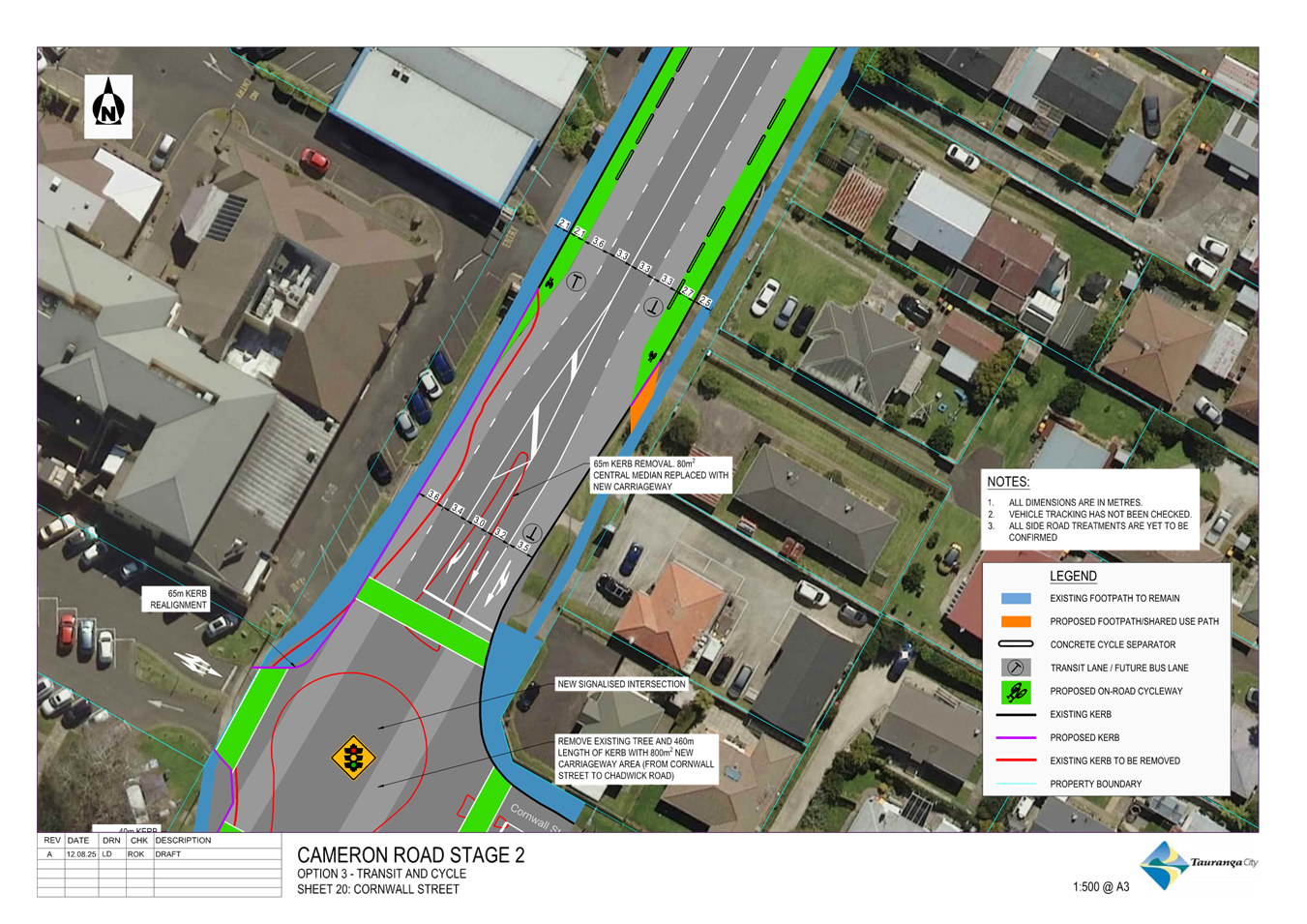
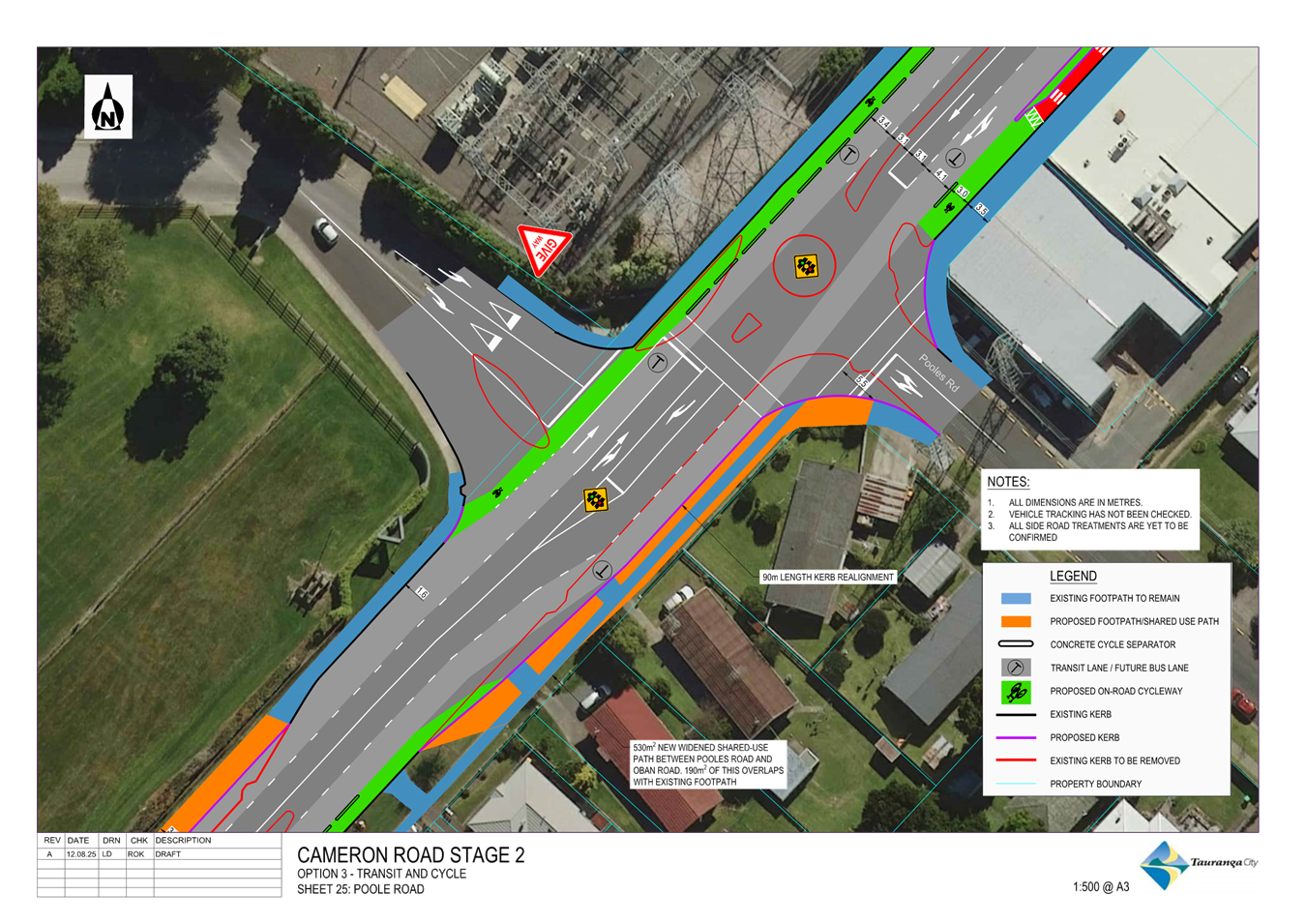
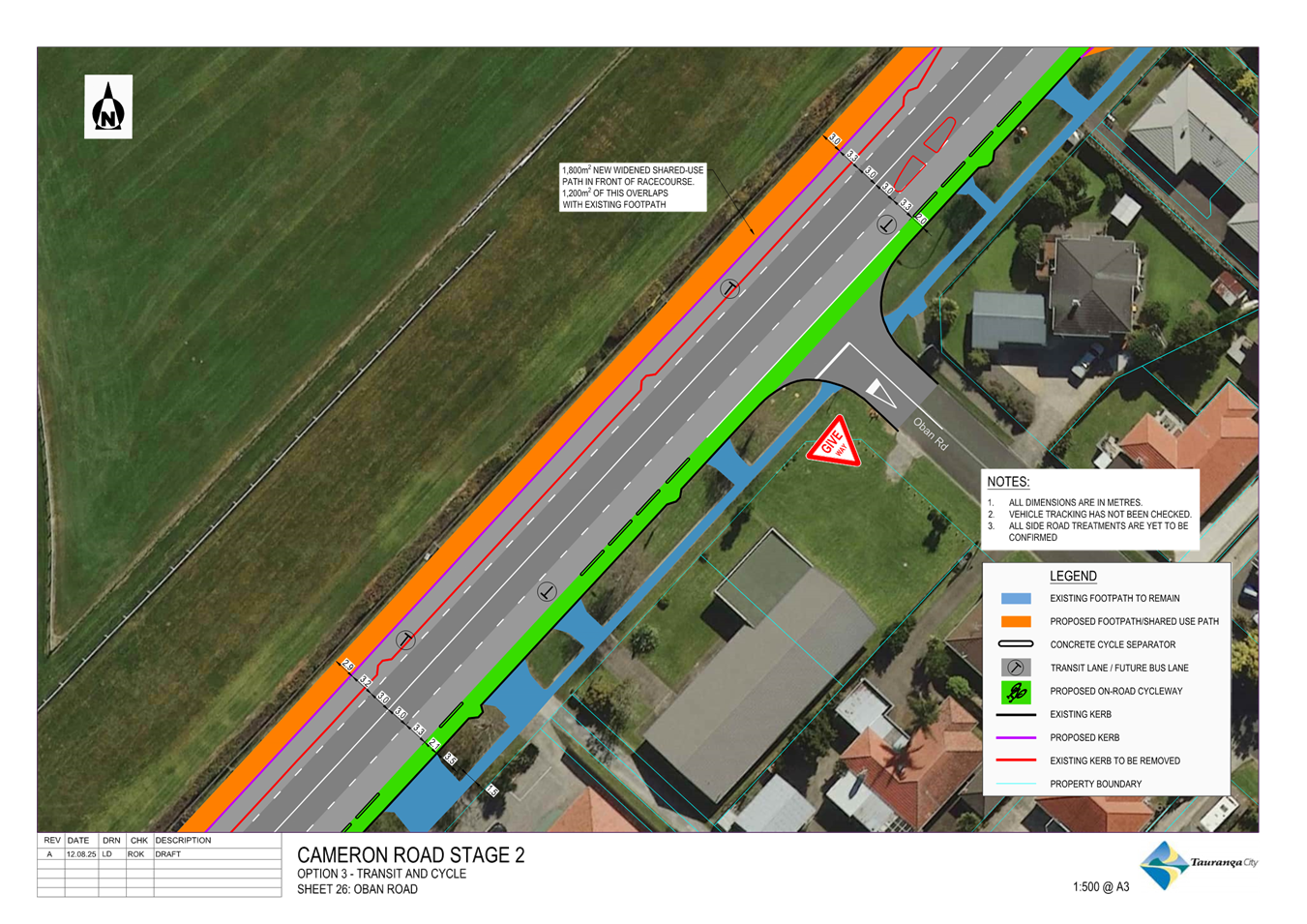
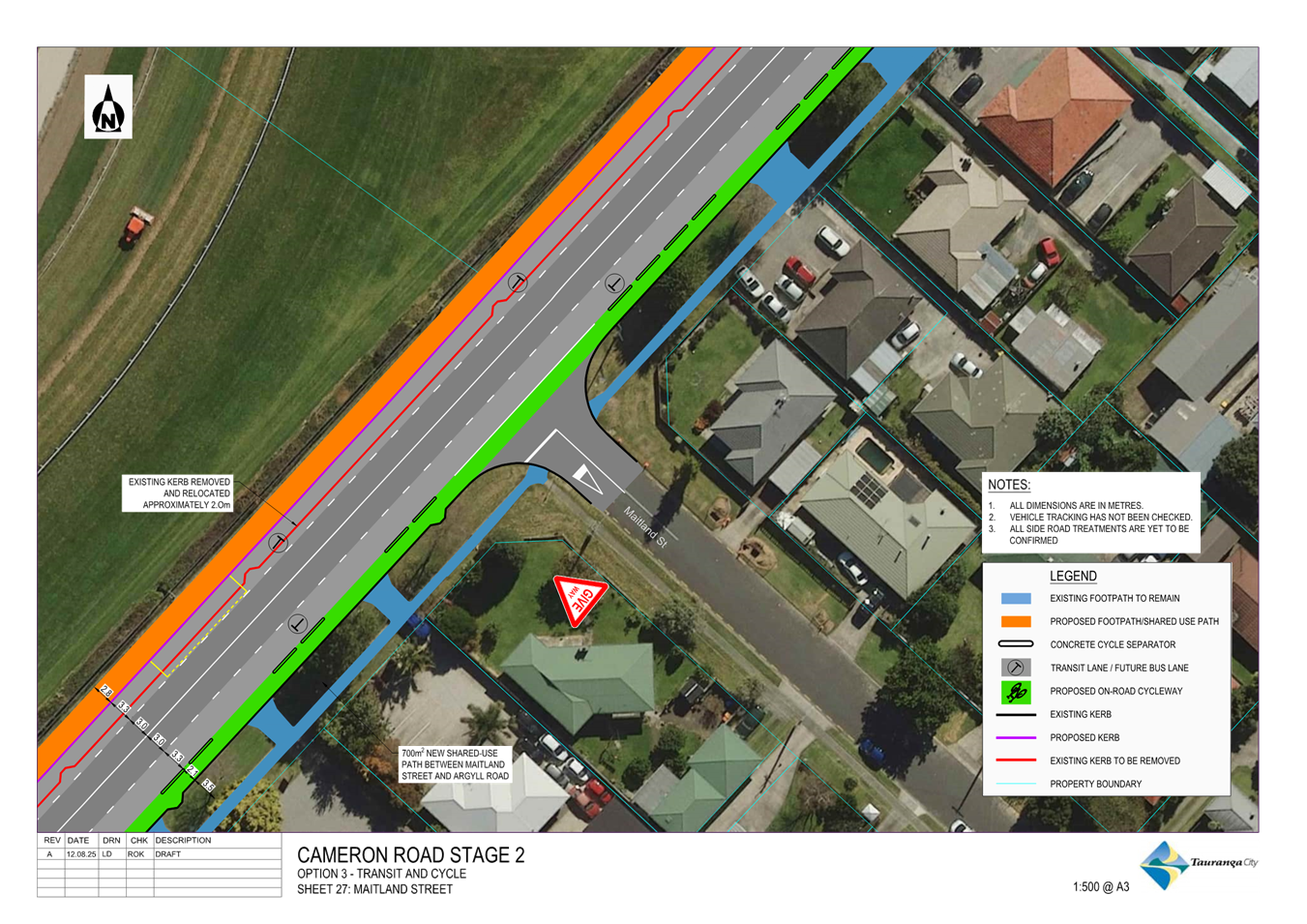
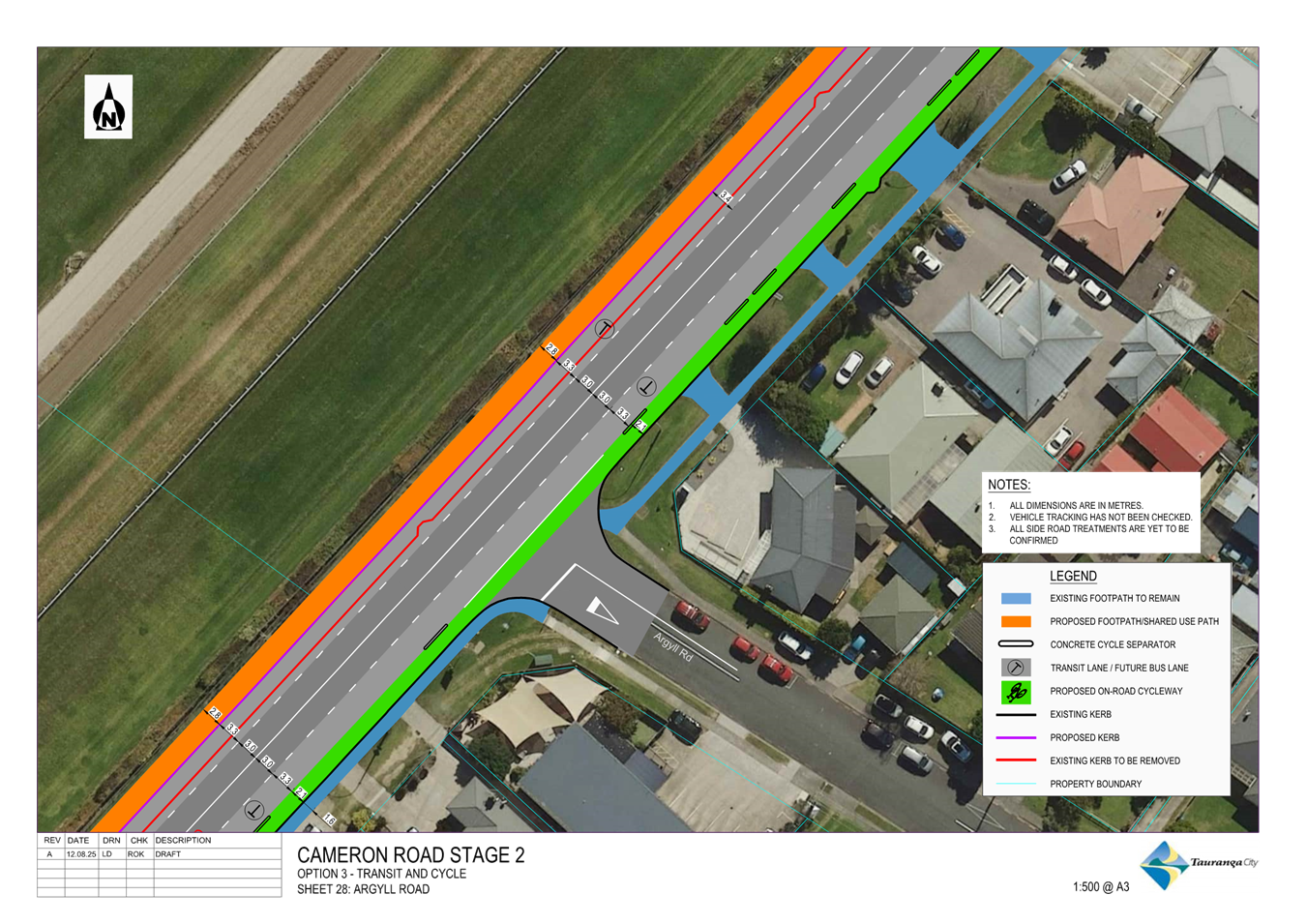
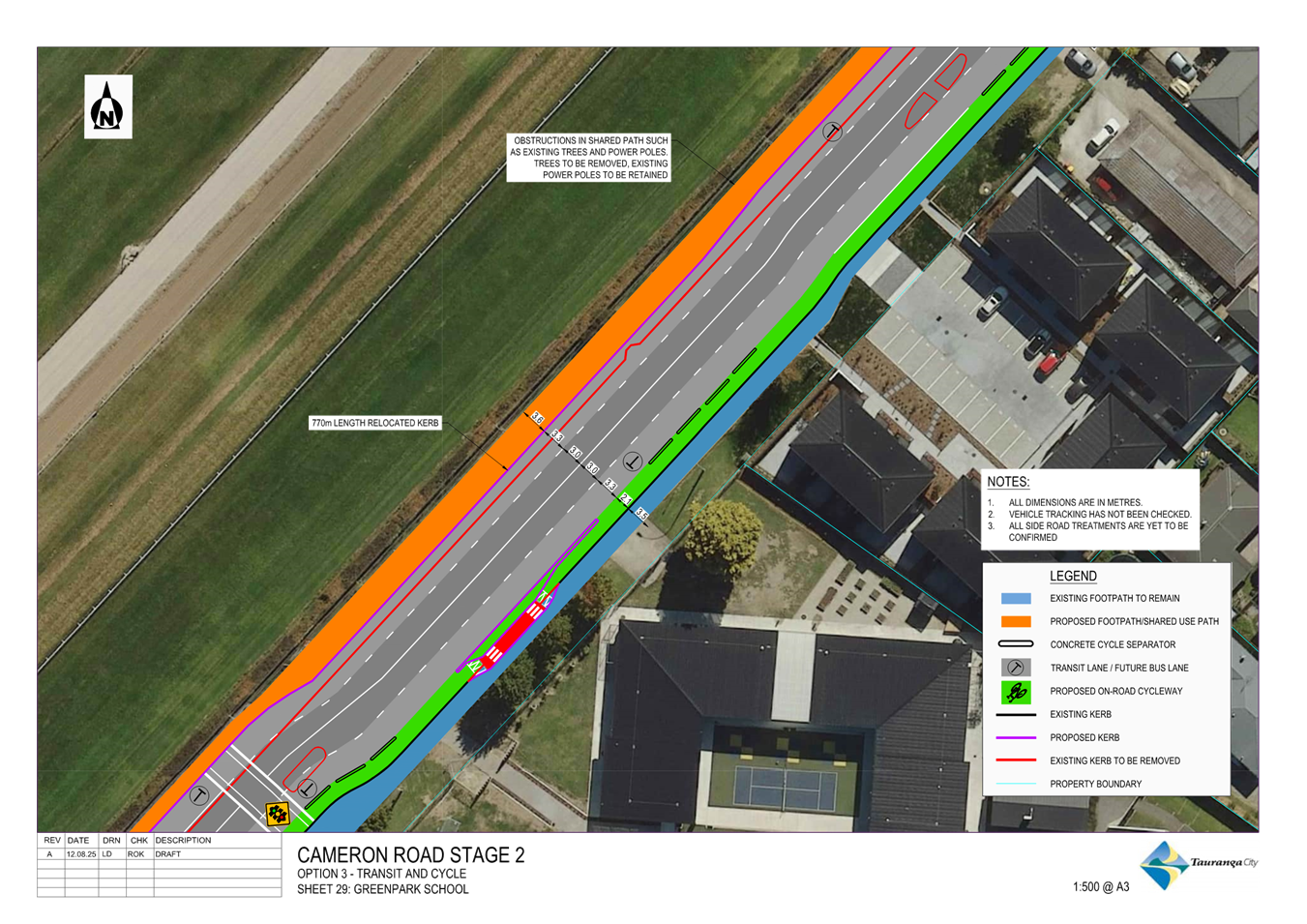
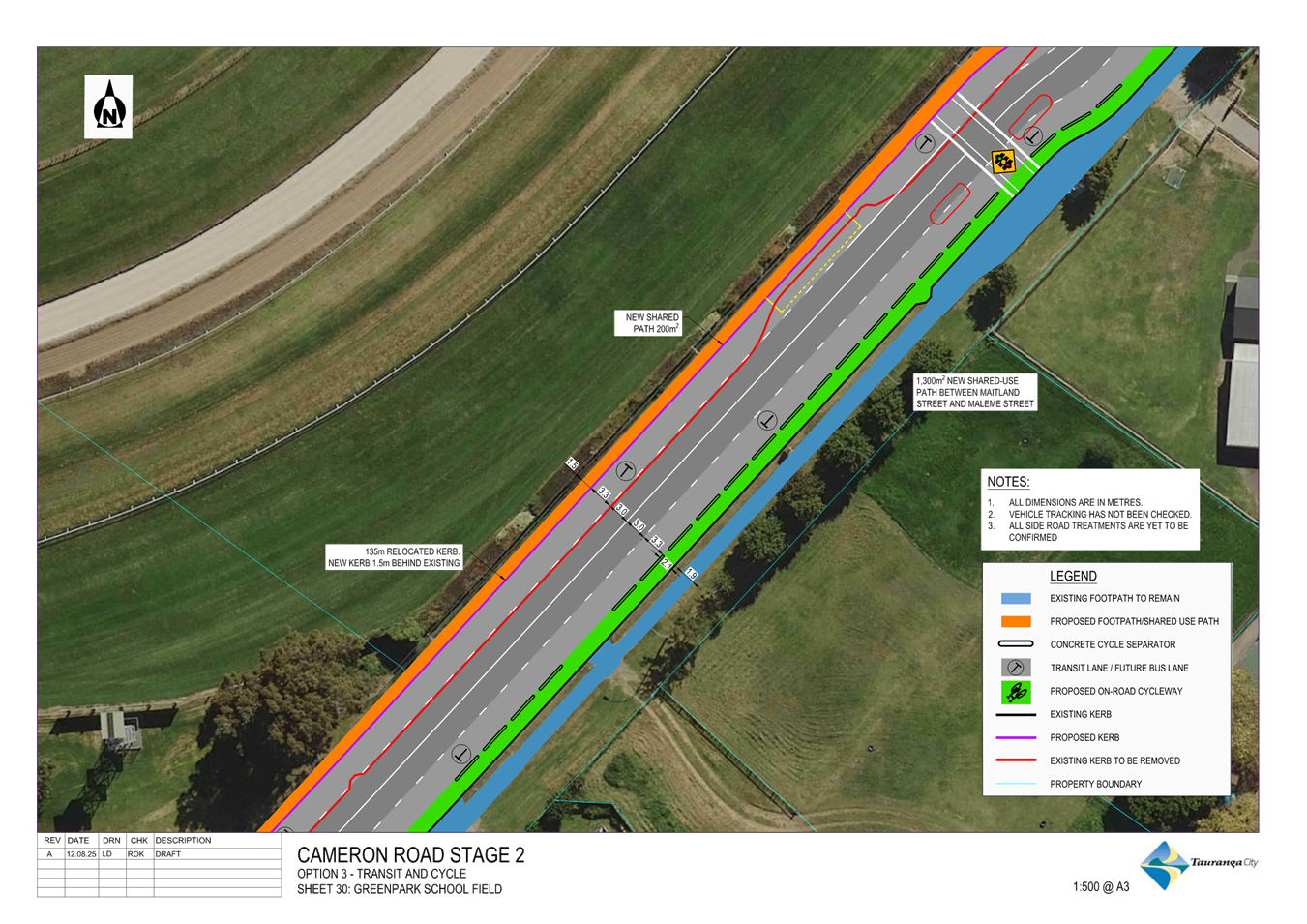
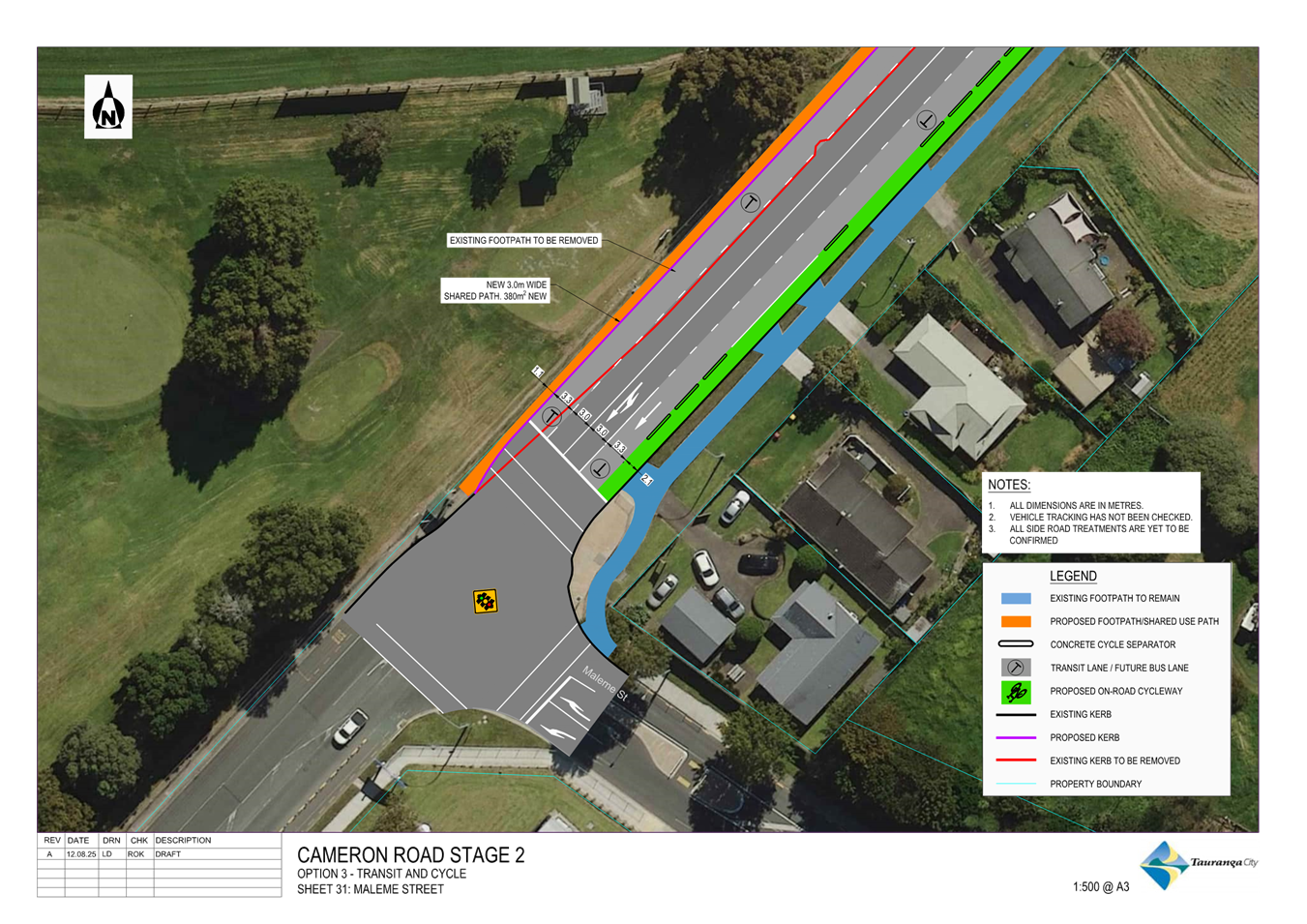
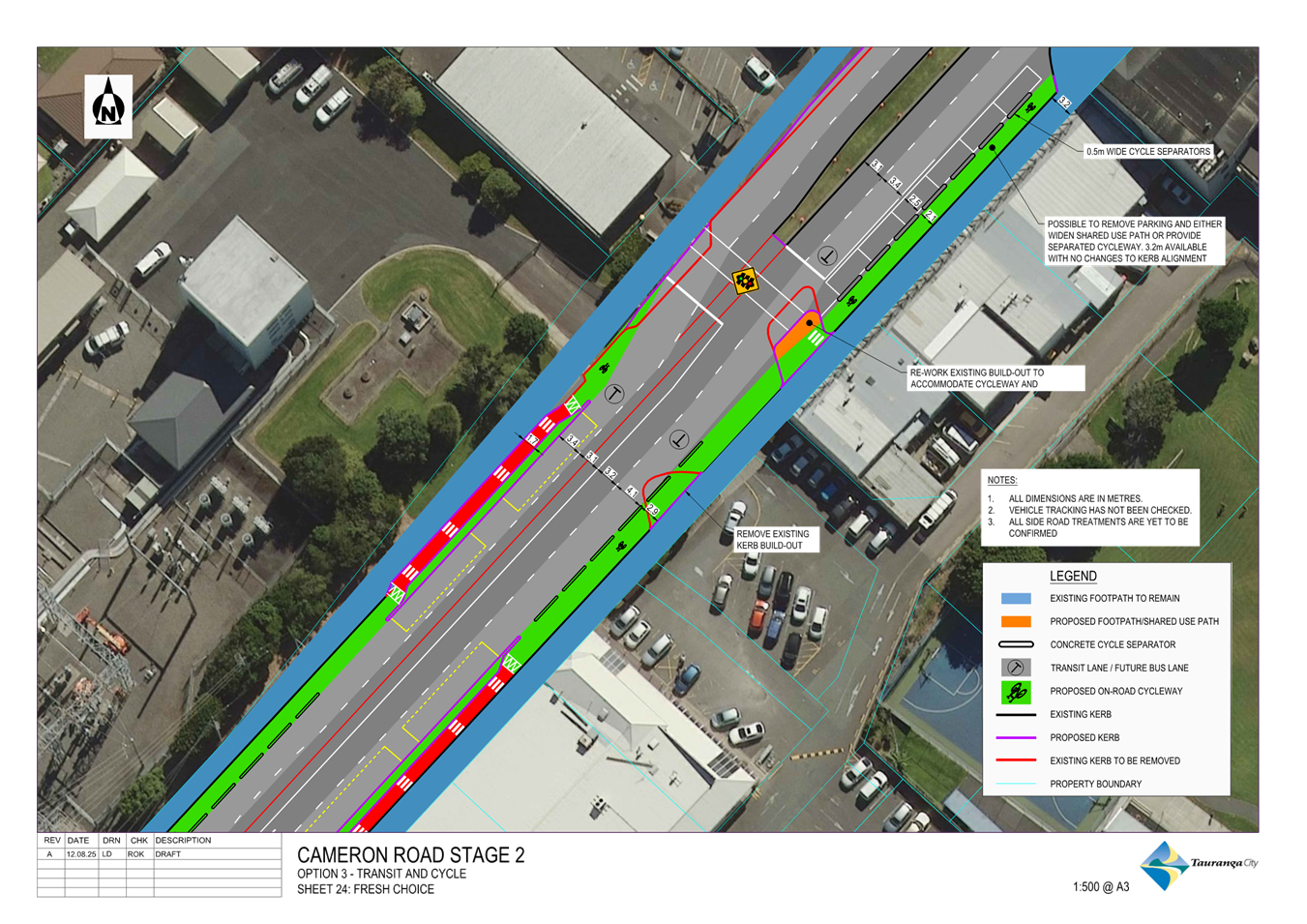
however NZTA co-funding for this project has not been prioritised in the
2024–27 National Land Transport Programme (NLTP).
4. The City Futures
Committee resolved for staff to further investigate options to progress and
deliver the Cameron Road Stage 2 project and its intended benefits within a
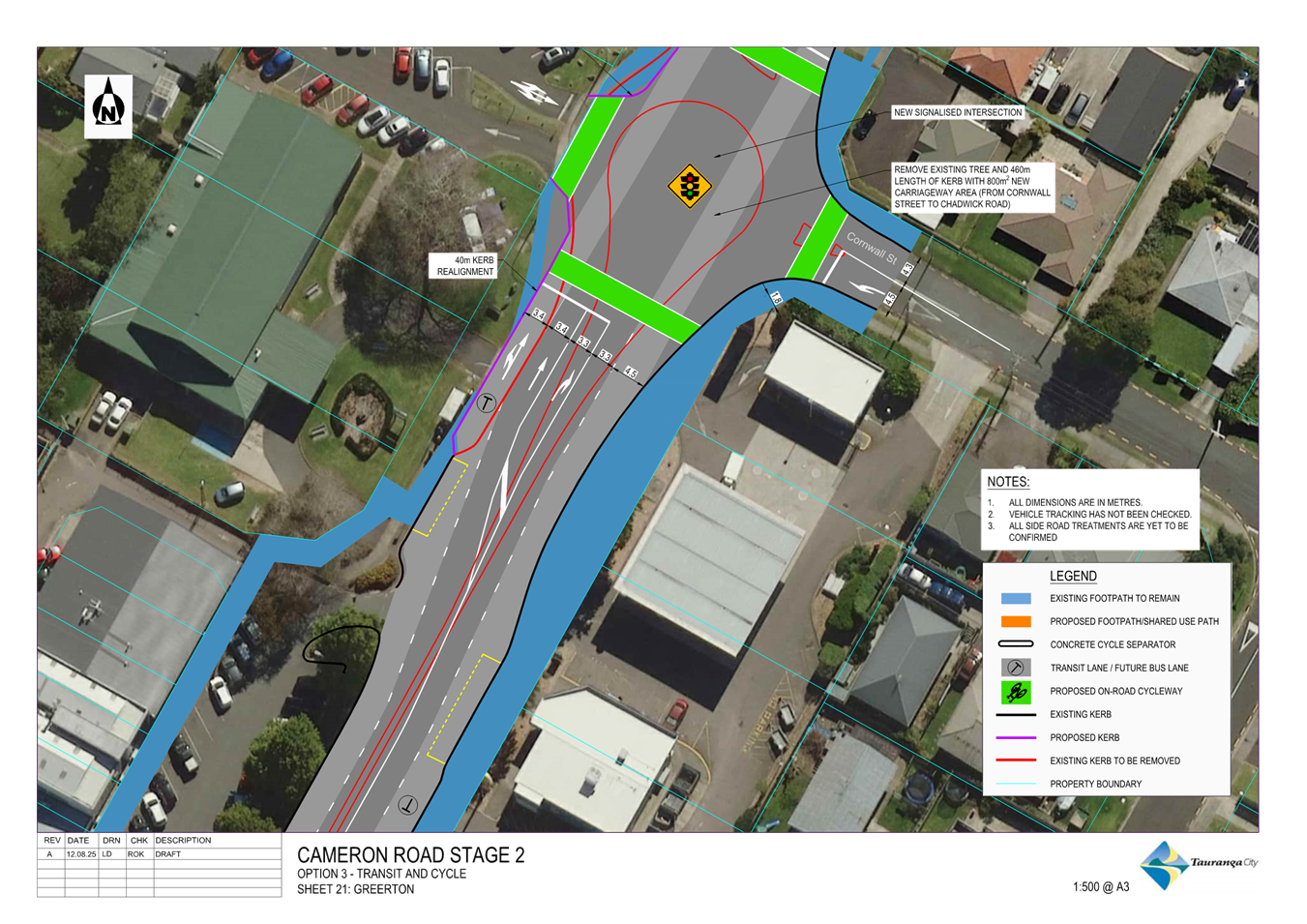
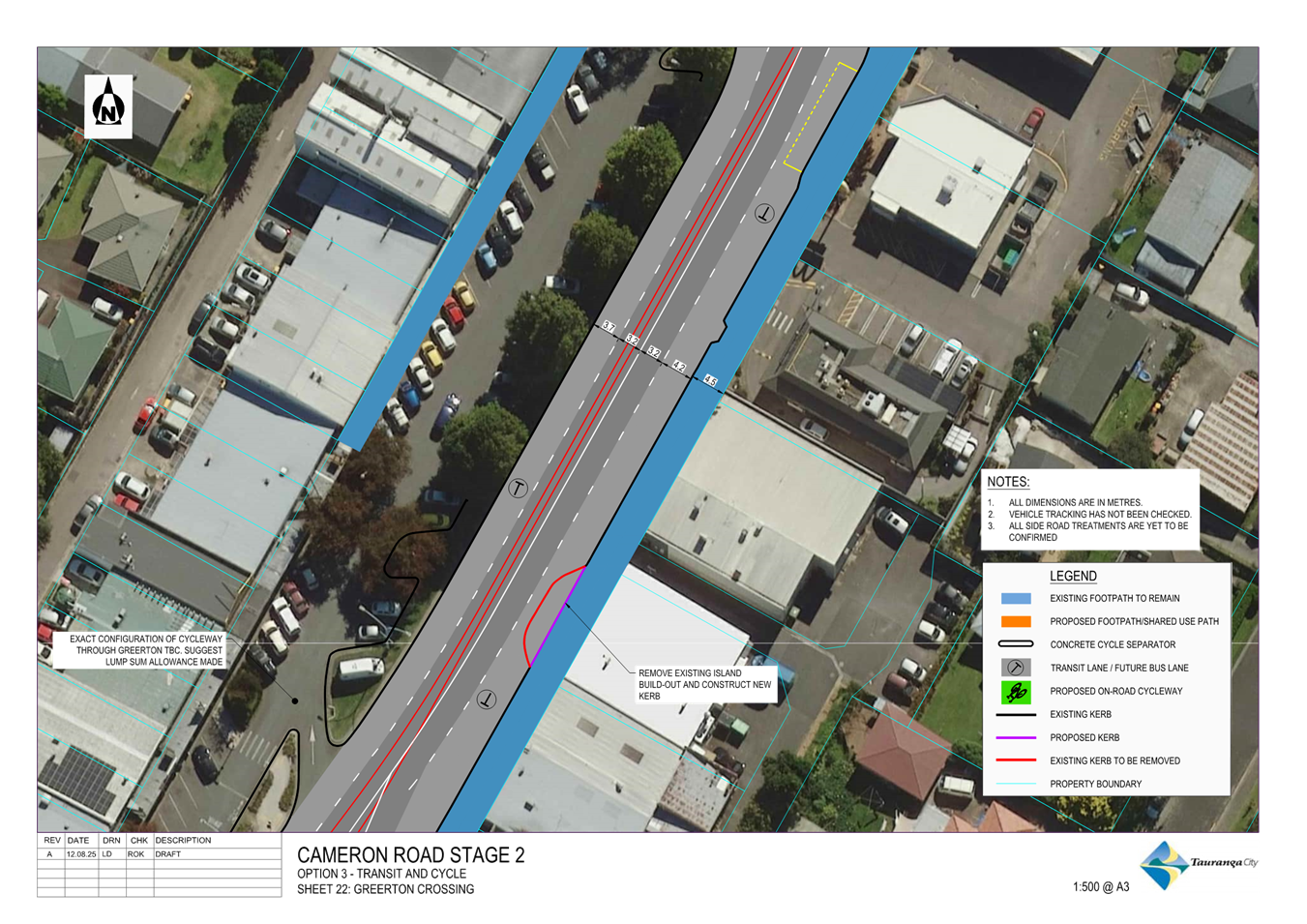
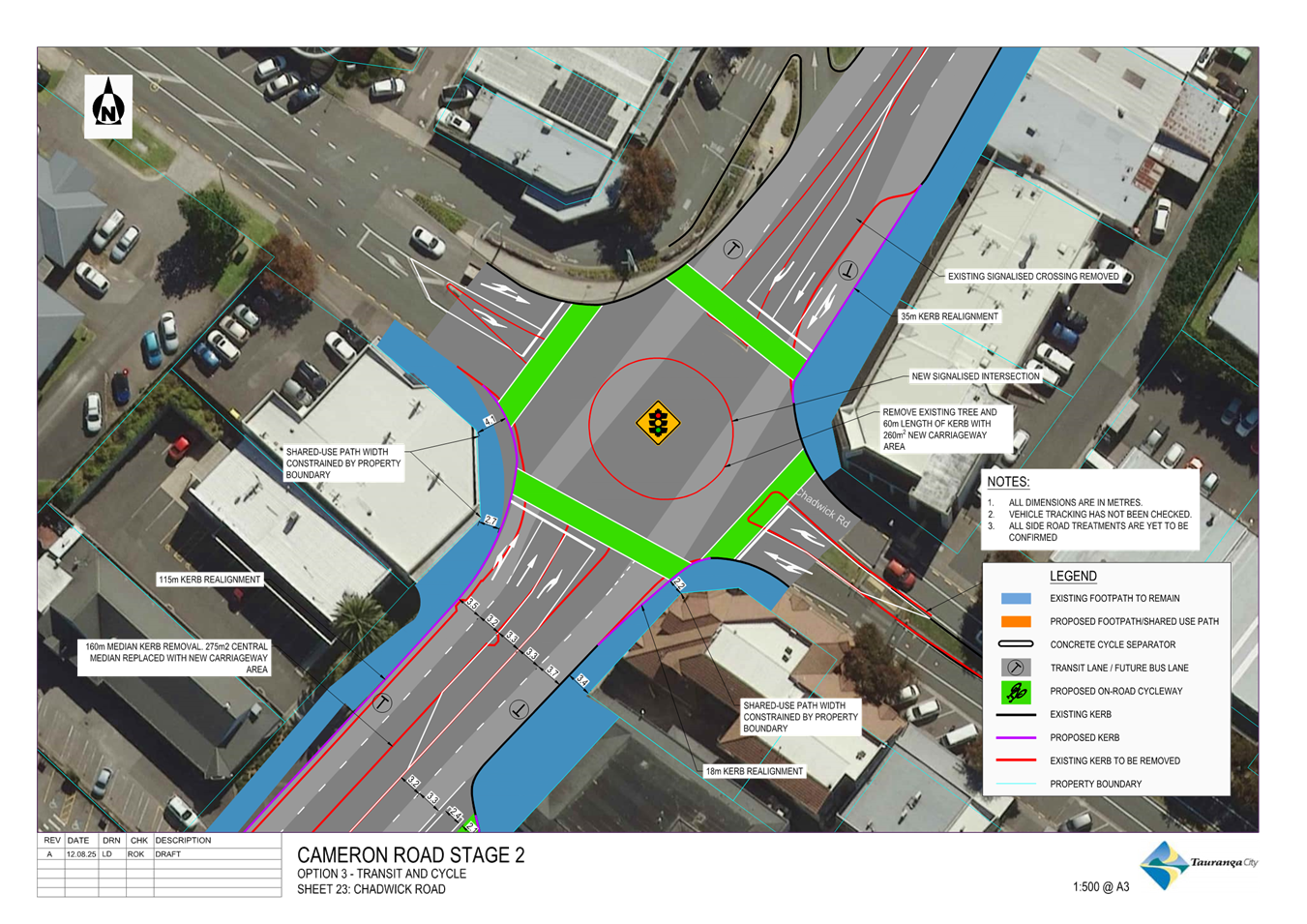
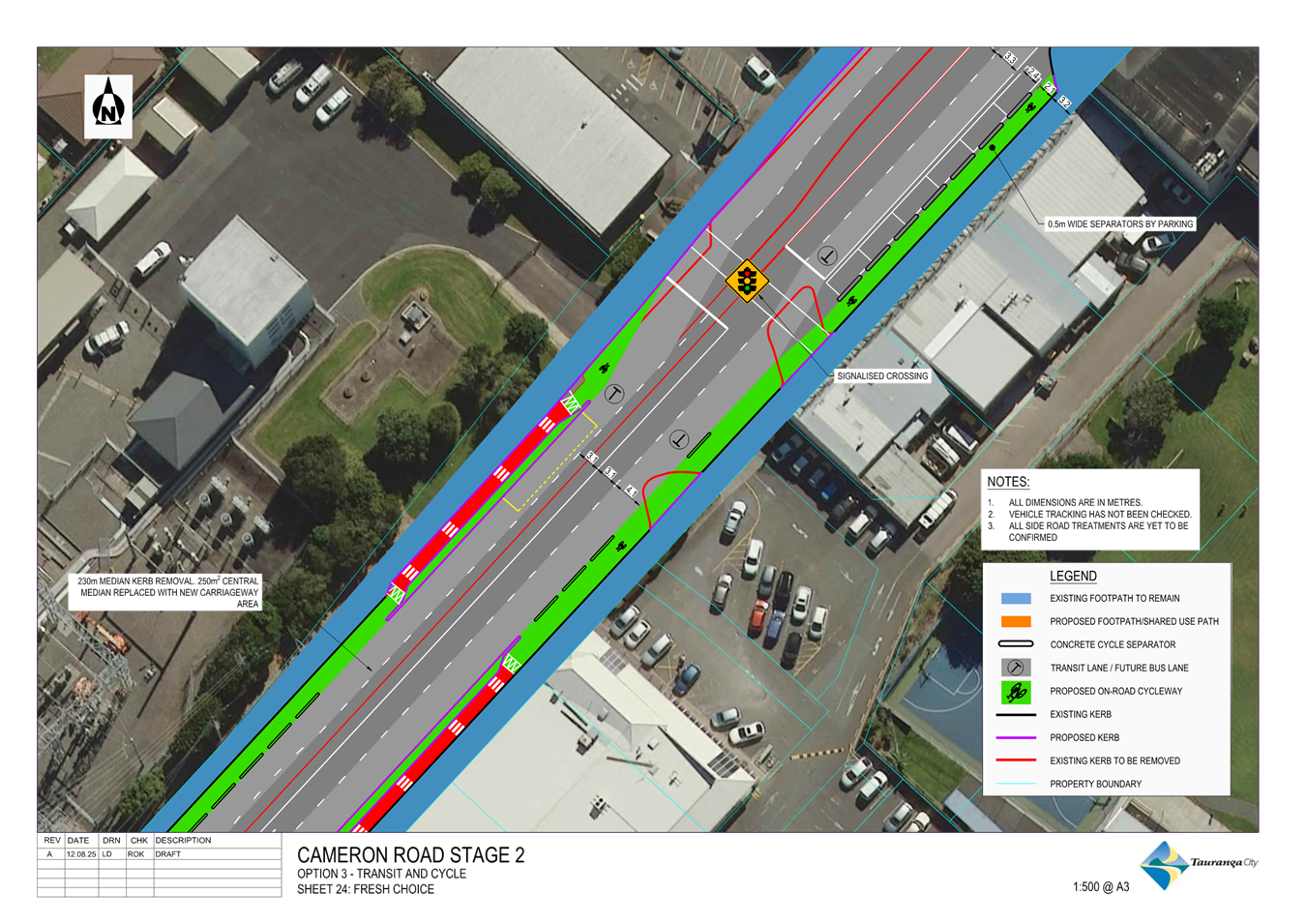
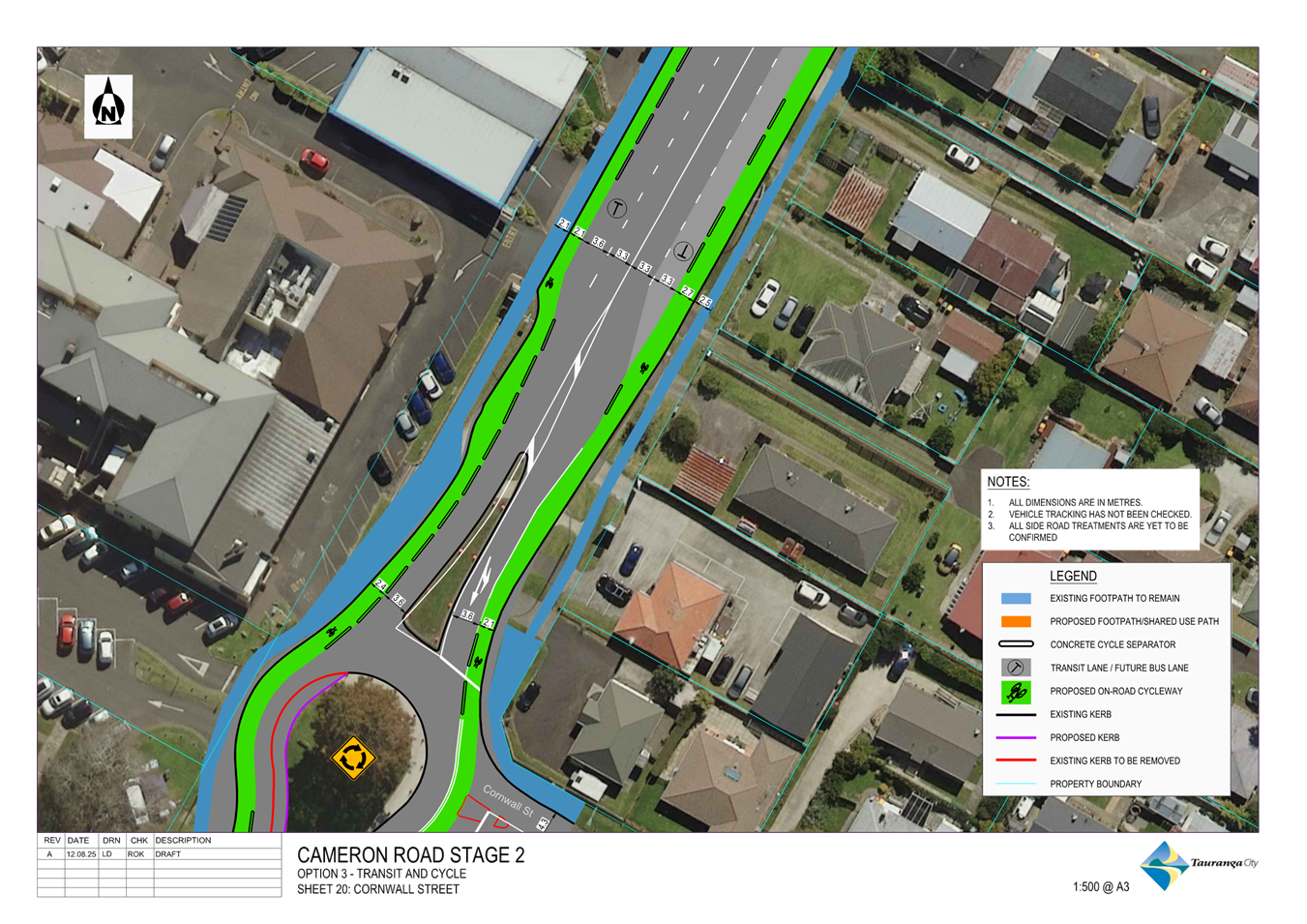
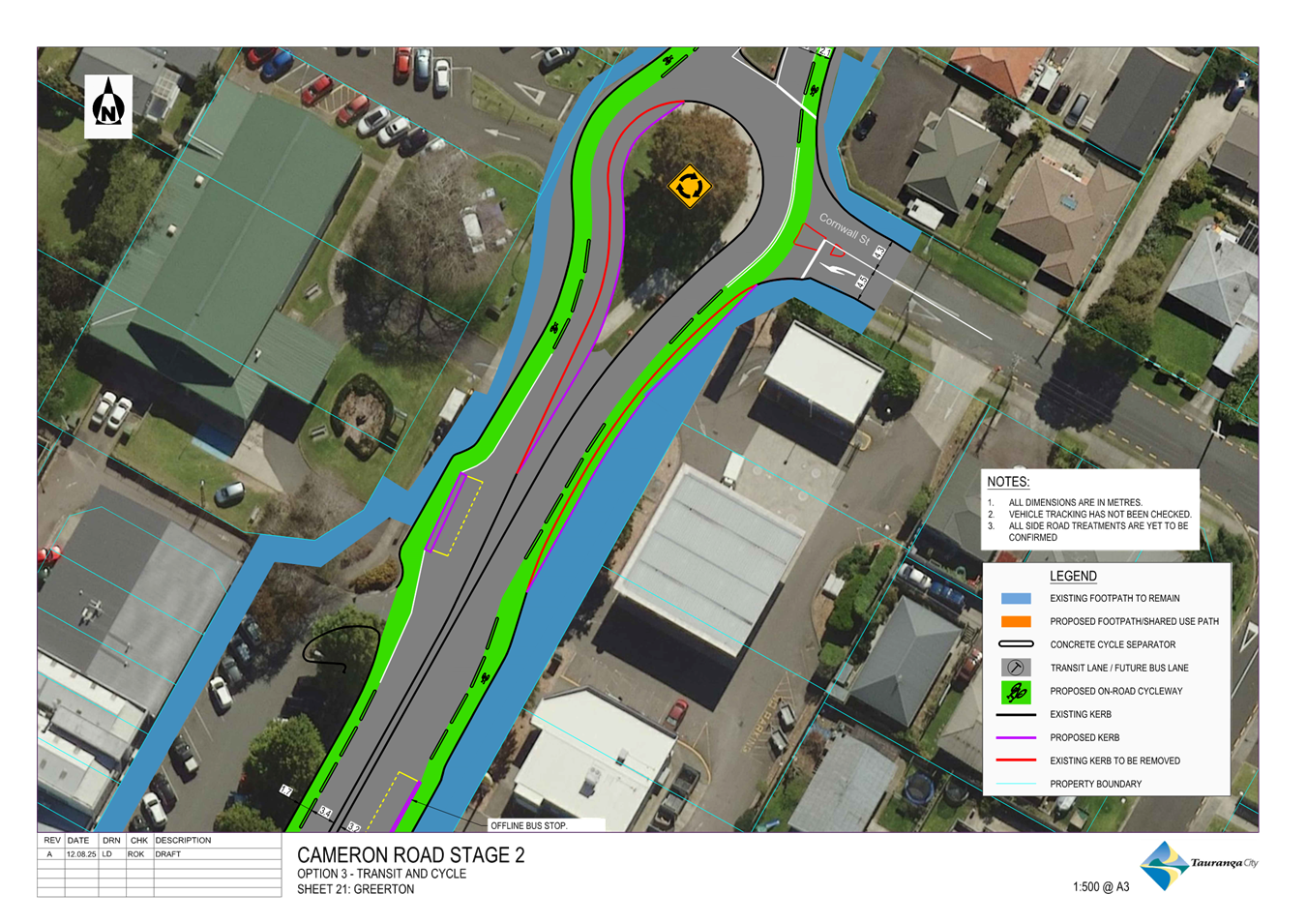
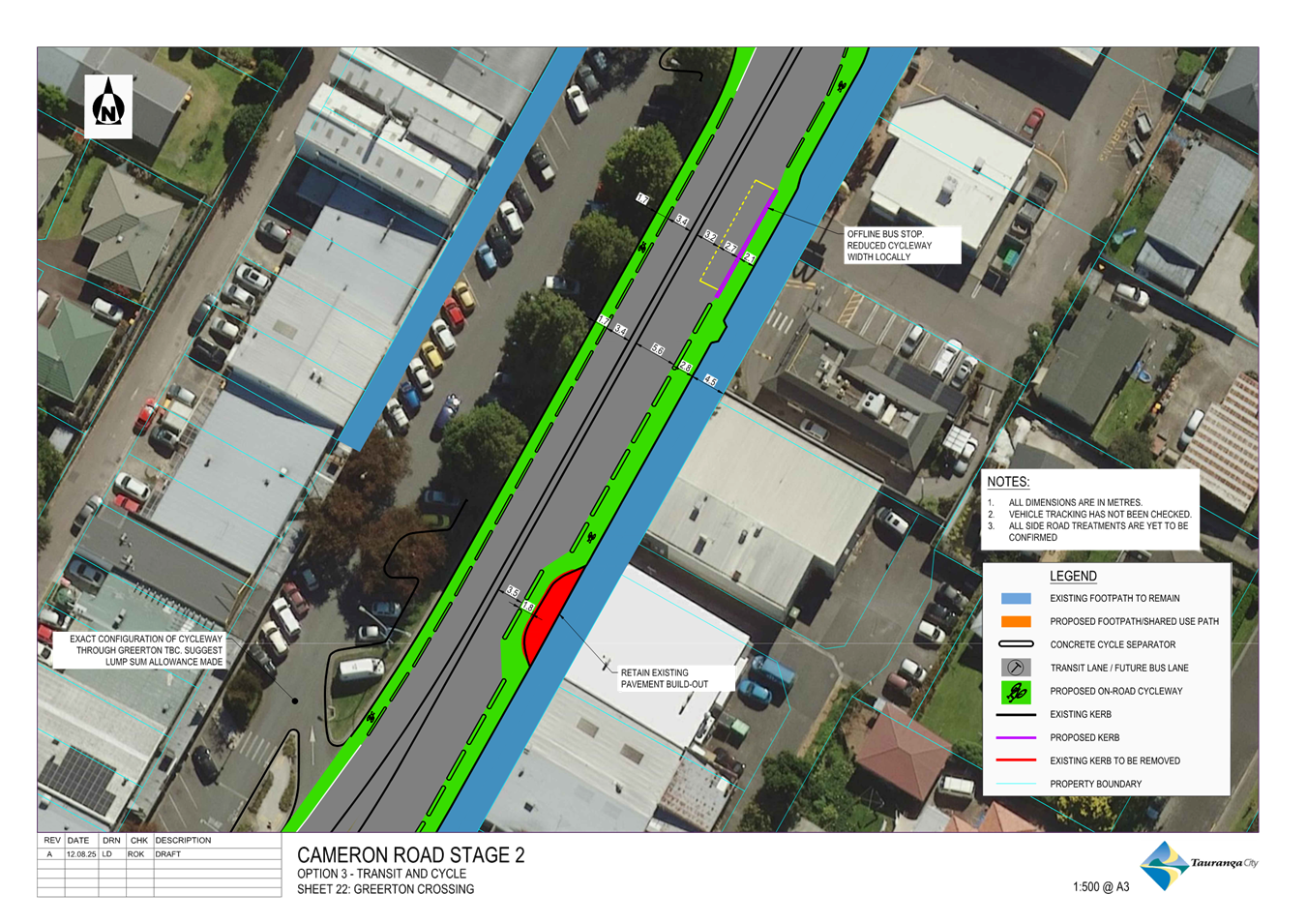
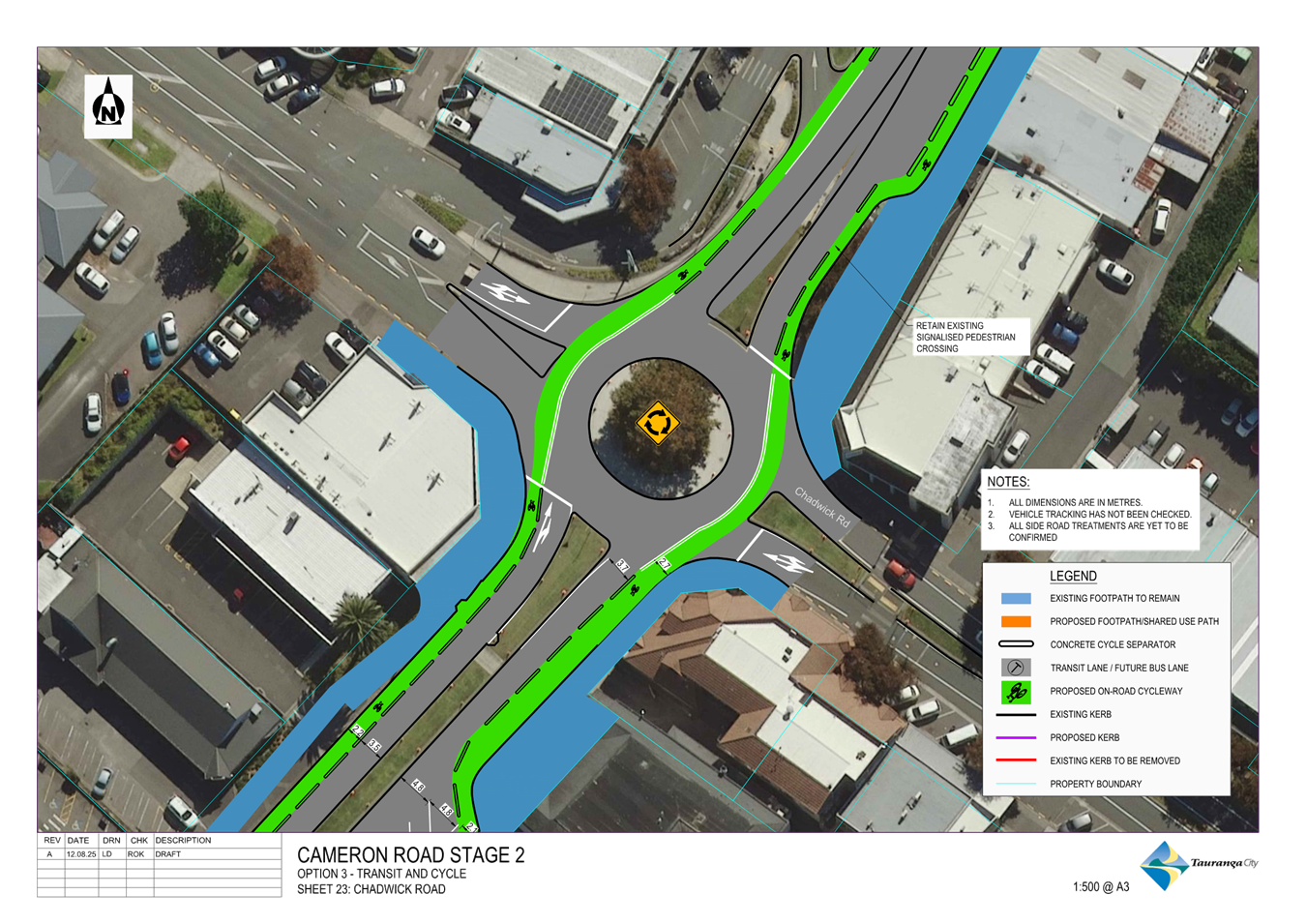
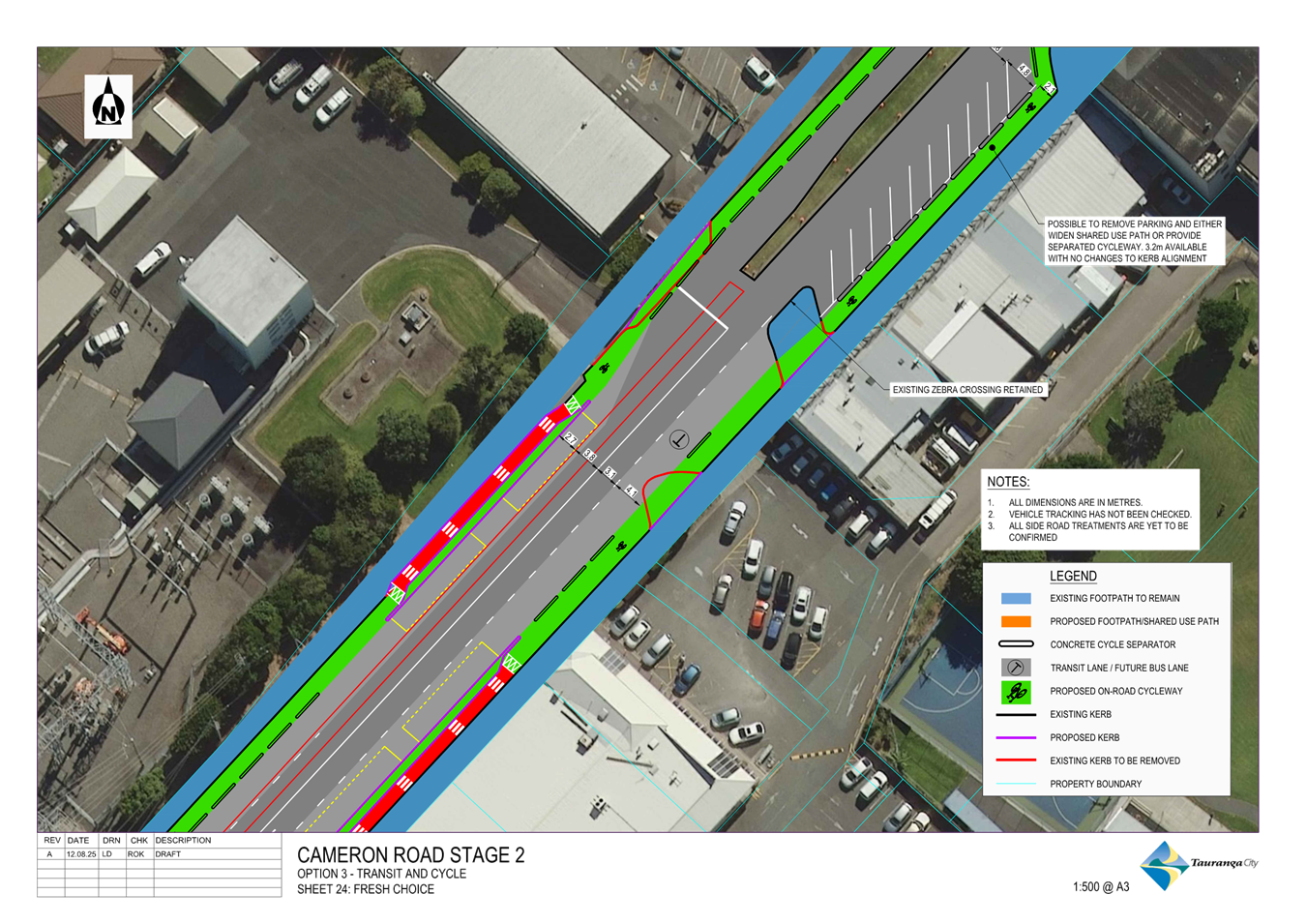
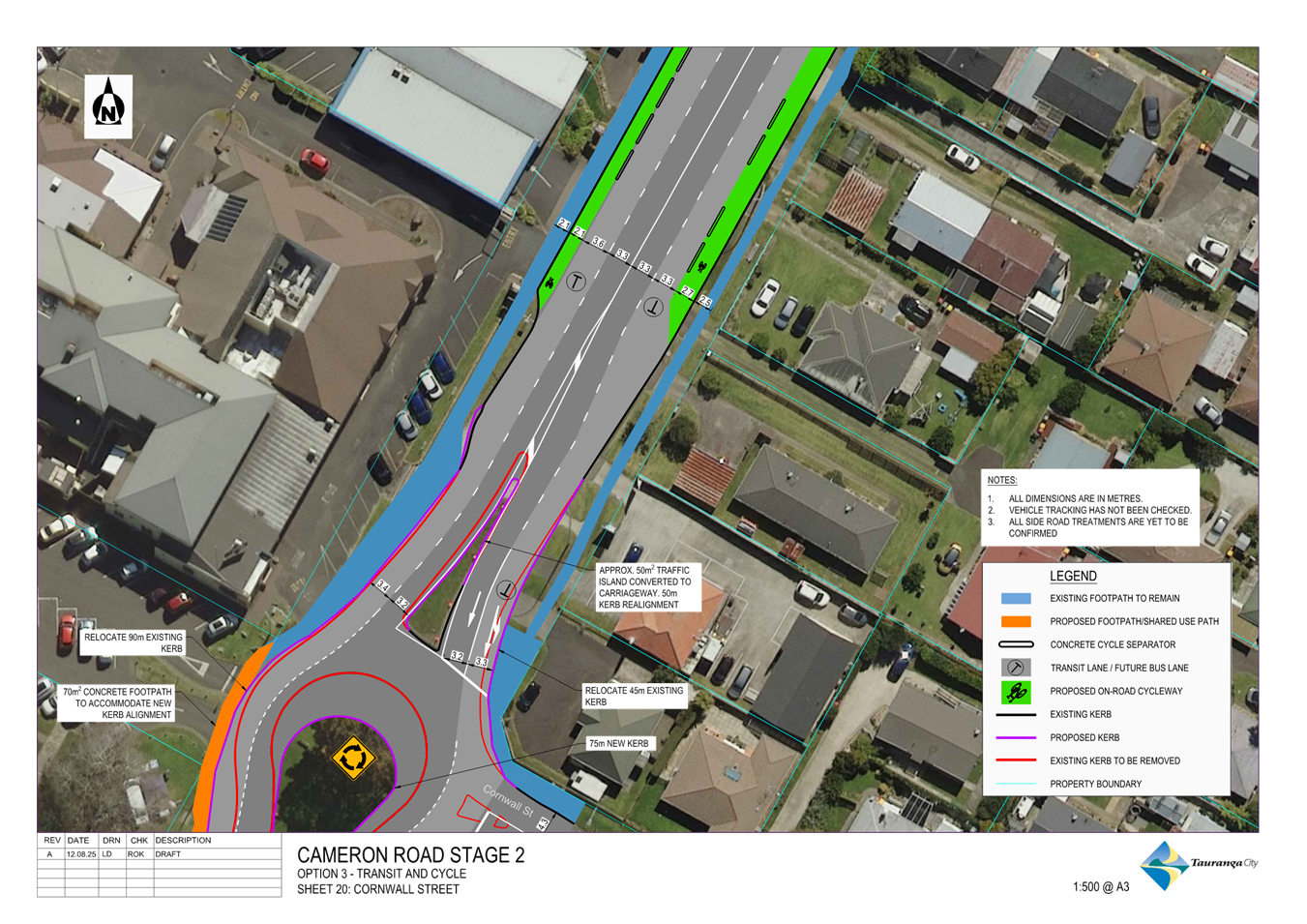
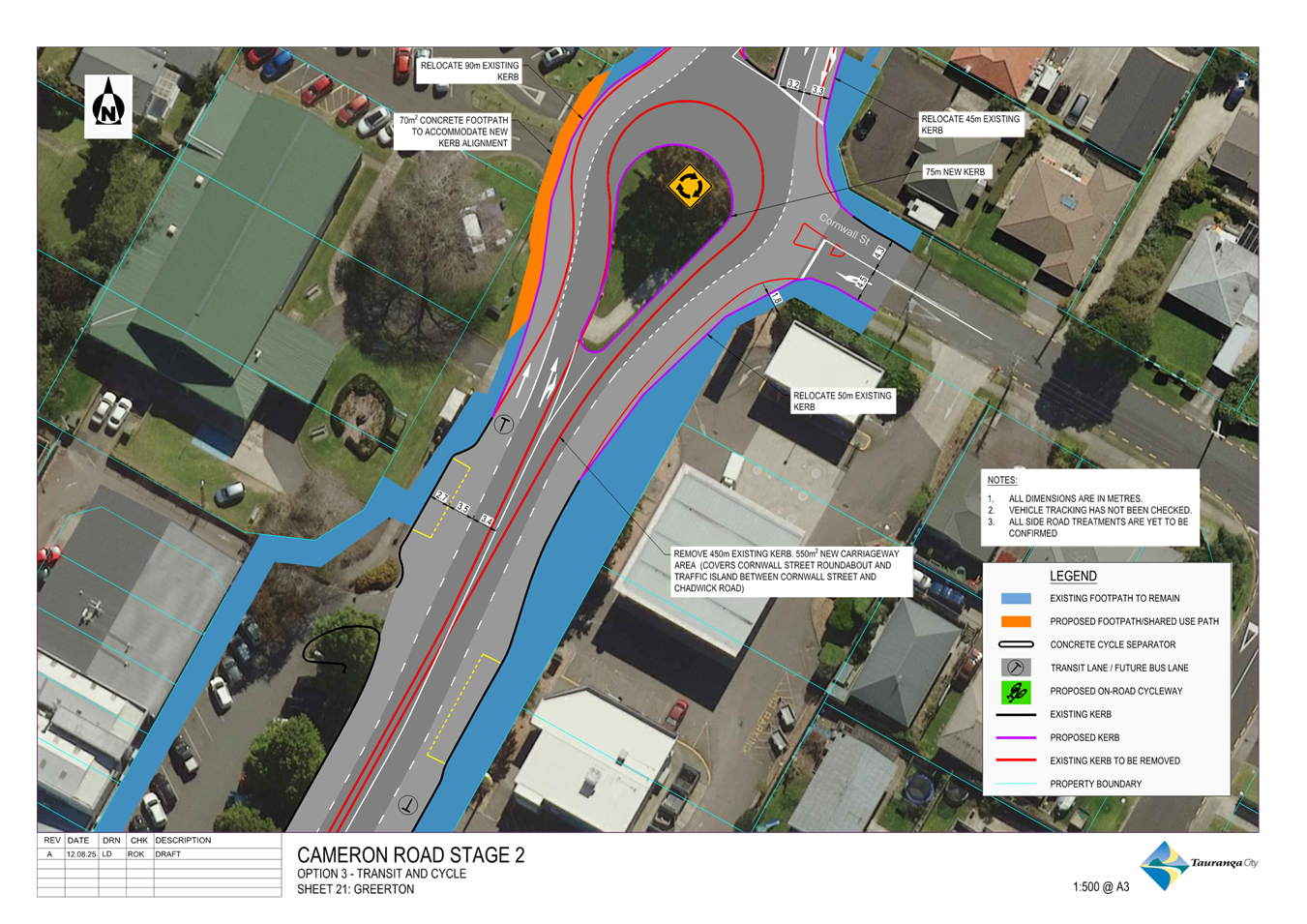
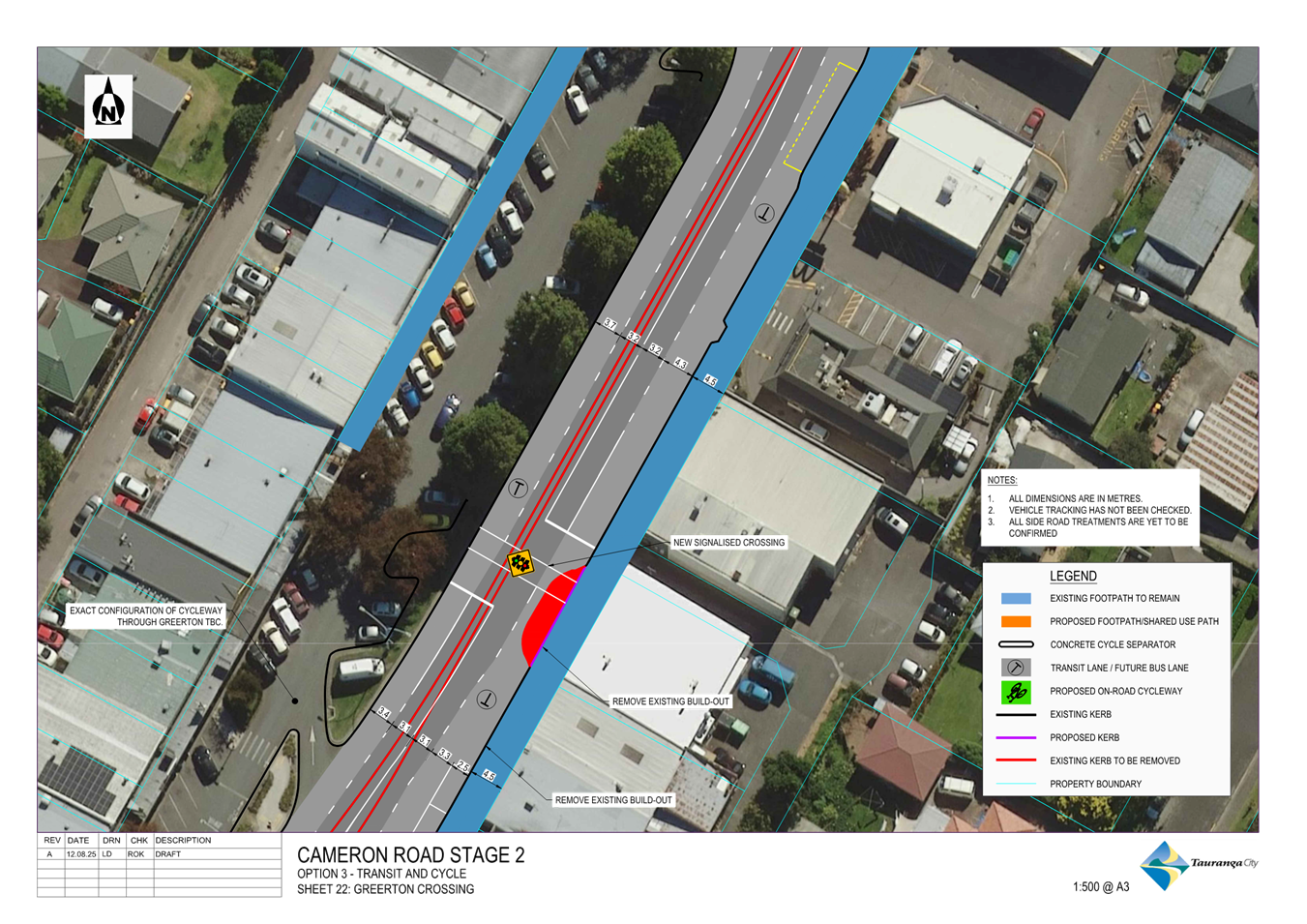
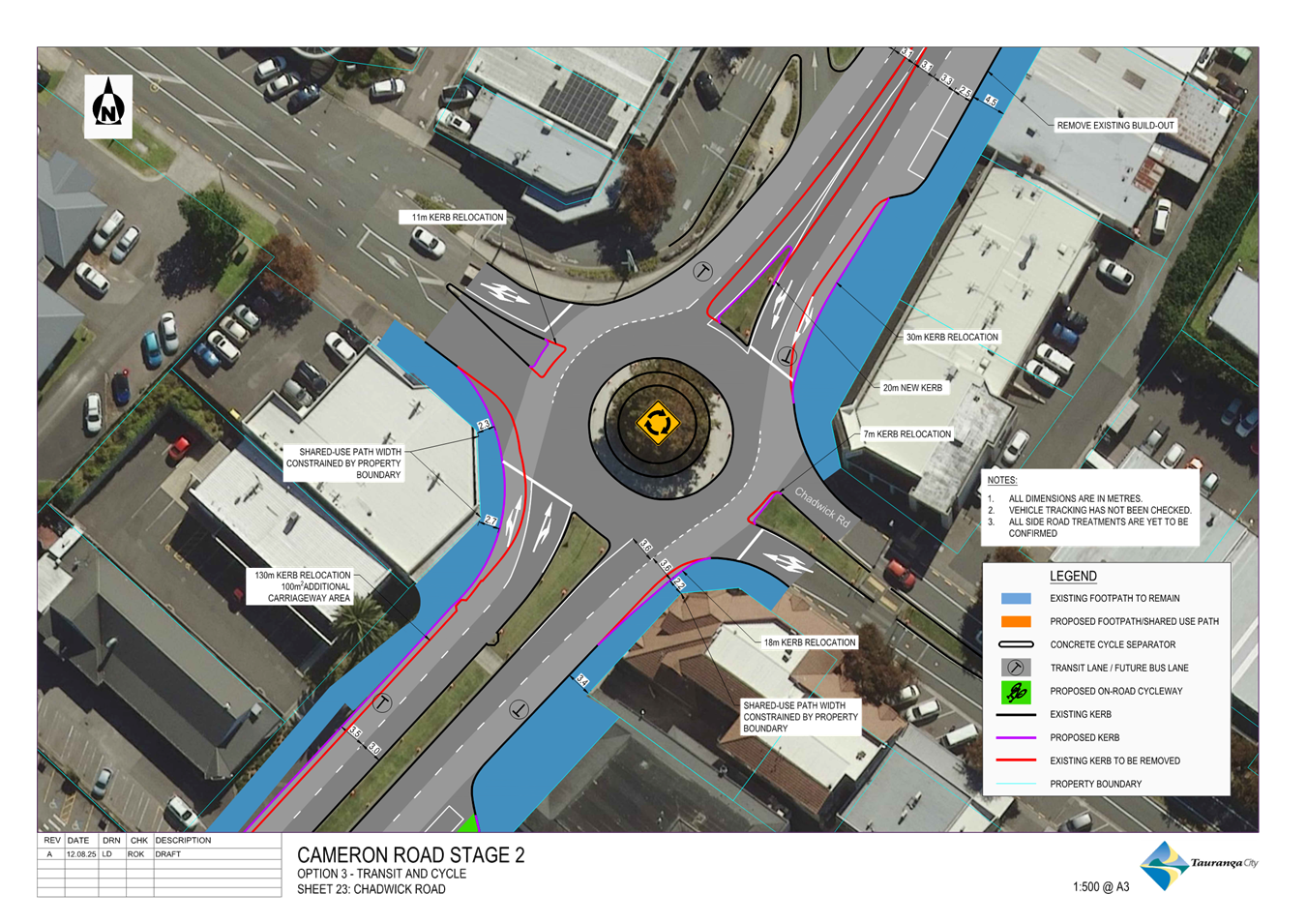
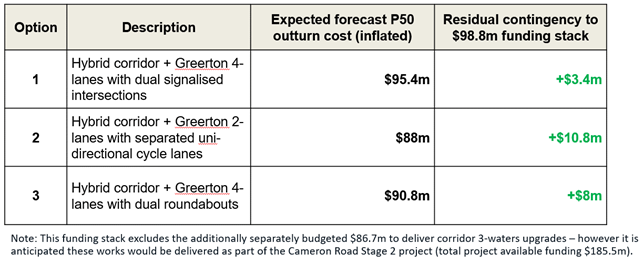
reduced funding envelope excluding NZTA co-funding.
5. Concept options have
been identified and workshopped with the City Futures Committee on 12 June and
31 July 2025 which functionally deliver the intended transport benefits for all
modes within a reduced funding envelope through a number of value engineering
considerations, including maximising delivery within existing road pavement
areas (current kerb to kerb) where possible and revisiting the requirement for
full depth pavement rehabilitation along the majority of the corridor.
6. The emerging
preferred concept option for the corridor (excl. Greerton village) provides for
a four lane roading corridor along the full length plus a full length cycle
route – primarily with separated on-road cycle facilities and with shared
paths in some areas where space is constrained. It is assumed that initially
outside lanes would operate as peak period transit lanes with provision for
‘off peak’ parking where required, however the corridor would be
future-proofed for operation with full-time transit or bus lanes.
7. Through Greerton
village there remain options for either 2-lanes or 4-lanes of traffic and
traffic signals or roundabouts at the Chadwick Road and Cornwall Street
intersections. Initial assessments indicate all options are viable in
delivering intended benefits without significantly compromising the strategic
operation of the corridor, however the options have different features and
associated benefits or compromises. To inform a preferred option in this area
community and stakeholder engagement is proposed.
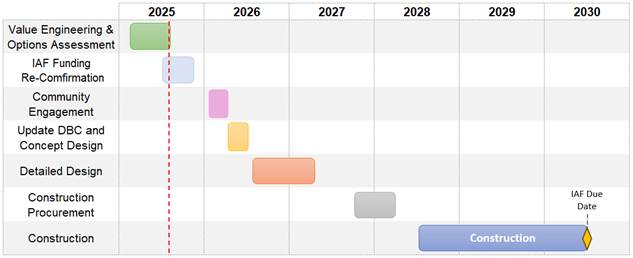
8. The revised funding
stack for the total Cameron Road Stage 2 project (excl. NZTA co-funding) is
$185.5m. Current cost estimates for the revised concepts are within this
funding stack budget. The funding stack is comprised of:
· Transport
Components - $98.8m
§ $56.4m
Crown grant via the Infrastructure Acceleration Fund (IAF)
§ $20m via
Transport System Plan Infrastructure Funding and Financing Levy (IFF)
§ $22.4m
of Developer Contributions (DC’s)
· Waters
Components - $86.7m
§ Fully
funded in the 2024-34 LTP
9. From 1 July 2025
administrative responsibility for the IAF was shifted from Kainga Ora to
National Infrastructure Funding and Financing Limited (NIFF). The Minister for
Infrastructure has tasked NIFF with reviewing the IAF fund progress,
highlighting any material issues and making any recommendations on developments
as result of the review.
10. NIFF have identified CRS2 as a
project which has not met the agreed milestones and specific requirements and
is considering material changes in scope since the IAF Funding Agreement was
put in place, due to:
· anticipated
NZTA funding has not been approved – which was identified as a milestone
to be met by 31 January 2025 in the IAF Agreement;
· the
extent of works at the SH29A end of the project is proposed to extend to Maleme
Street to tie-in with NZTA’s planned works at the Barkes Corner
intersection (SH29A / Cameron Road) which is planned to be separately delivered
as part of the Tauriko SH29/SH29A RoNS project; and
· there
has been a material decrease in total project budget.
11. With the transition of IAF
administration from Kainga Ora to NIFF, the project is undergoing a preliminary
review. NIFF identified the scale of changes - particularly the absence of NZTA
subsidy and reduced budget - as likely constituting a ‘material change of
scope’ under the Funding Agreement. Additionally, any revision to the
agreed completion date of 30 June 2030 would require further Ministerial
approval. As it stands, the project remains scheduled for delivery by that
date.
12. In order to have the best
chance of retaining IAF funding, NIFF recommends Council provide a clear
indication that it intends to deliver CRS2 by 30 June 2030 to a design that
supports significant housing intensification in the Te Papa peninsula as detailed
under the IAF Funding Agreement. This will enable recommendations to be put
forward to Ministers.
13. Subject to Council endorsement,
it is proposed that community consultation and engagement on the project would
be progressed with an intention to report back to City Futures Committee in
early 2026 to confirm the proposed concept option prior and seek approval to
progress to detailed design and construction.
Background
14. The Cameron Road Stage 2
project is a key enabler to continued city growth, particularly as a connector
for development of the western corridor and planned intensification of the Te
Papa peninsula.
15. There is a significant housing
shortfall and affordability crisis in Tauranga and the wider sub-region. Moving
forward at pace to deliver serviced and zoned land is critical to increasing
supply which in turn will improve affordability.
16. The Urban Form and Transport
Initiative, Te Papa Indictive Business Case and Spatial Plan, SmartGrowth
Strategy and Transport System Plan are all key planning documents which provide
direction on the future housing and business land supply to sufficiently
accommodate the projected growth in the sub-region, along with supporting
transport infrastructure required to enable housing intensification of existing
urban areas and new greenfield areas.
17. Cameron Road is one of
Tauranga’s main arterial corridors, providing an important connection to
the city centre for people within and beyond the corridor. It is an important
route and a destination for many with the city centre, primary and secondary
schools, businesses, public spaces, and the hospital located along it. Over the
next 30 years, it is anticipated that more than 35,000 people will be living on
Te Papa Peninsula.
18. More broadly, the wider Western
Bay of Plenty region is planning for an extra 200,000 people living in the
region over the next 30 to 50 years. Tauranga needs to transform into a place
where more people can live, work, study, and provide more sustainable ways to
move around.
19. The Cameron Road Stage 1
project from Harington Street to 17th Avenue has now been completed. Cameron
Road Stage 2 connects between this and the future planned State Highway 29 and
29A upgrades from Tauriko to Barkes Corner / Cameron Road. Delivery of CRS2 is
required to fully realise the intended benefits of these adjacent projects.
20. The Te Papa Indicative Business
Case (prepared alongside the Te Papa Spatial Plan), a joint business case
prepared by NZTA, TCC and Bay of Plenty Regional Council, was approved by NZTA
alongside the Urban Form and Transport Initiative Programme Business Case in
2020.
21. Both the Urban Form and
Transport Initiative and the Te Papa Indicative Business Case provide for an
integrated land use transport strategy supporting significant intensification
within the Te Papa corridor, located around the Cameron Road spine.
22. Plan
Change 33 has recently been completed which significantly increases the enabled
housing density along the Cameron Road Stage 2 corridor - enabling
intensification up to eight storeys. Intensification along the corridor will
also support employment growth in the city centre and surrounding commercial
area.
23. Te Papa is identified as the
city’s largest residential intensification zone over the next 30 years to
support housing growth. The Development
Capacity Assessment undertaken as part of the Plan Change 33 process shows
that feasible and reasonably expected additional development capacity through
the Te Papa peninsula (incl. the city centre and Te Papa high density zone) is
approximately 3,940 attached dwellings over the next 30 years in addition to
detached intensification.

24. There have been a number of
larger scale apartment developments delivered along and in the vicinity of
Cameron Road over the past few years, with significant future development
opportunity also existing in the Gate Pā area where Accessible Properties
Limited (recently identified by Government as a strategic partner for delivery
of community housing) owns approximately 120 parcels within walking distance to
Cameron Road. Dwellings consented in Te Papa over the last three years are
summarised below demonstrating a strong demand:
|
Dwelling Type
|
2022/23
|
2023/24
|
2024/25
|
Total
|
|
Stand-alone dwelling
|
17
|
11
|
21
|
49
|
|
Apartment – mixed use
|
6
|
|
|
6
|
|
Attached dwellings
|
141
|
85
|
40
|
266
|
|
Duplex dwelling
|
10
|
9
|
2
|
21
|
|
Secondary dwelling
|
1
|
1
|
|
2
|
|
Total
|
175
|
106
|
63
|
344
|
25. Cameron Road will play a key
role providing transport alternatives to enable growth and development of the
Western Corridor, connecting planned greenfield residential and industrial
development areas to the city centre and other key city destinations. The
Western Corridor development includes the Tauriko West residential area of
approximately 3,000 new homes, continued development of the Tauriko Business
Estate supporting significant employment growth, and future planned development
areas such as Keenan Road and Belk Road areas.
26. The Te Papa Indicative Business
Case and Spatial Plan is also strongly aligned with Government Policy Statement
on Land Transport 2024, particularly the Strategic Priority for Economic Growth
and Productivity. The economic analysis for the indicative business case, which
included Cameron Road stages 1 and 2 as key components, identified significant
benefits relating to safety, travel time savings, congestion reduction,
productivity gains and emissions reduction.
27. Investment in movement within
the Te Papa area and along Cameron Road corridor, including modal choice
options for walking, cycling, public transport and high occupancy vehicle
travel is both a necessity to respond to reasonably expected growth and network
capacity challenges, as well as providing a catalyst for future private
investment. This aligns with both the existing National Policy Statement on
Urban Development and envisaged future amendments to this policy, which provide
for a focus to enable “more people to live in, and more businesses and
community services to be located in, areas of an urban environment …
well-serviced by existing or planned public transport”.
28. The CRS2 project is also
planned to deliver significant upgrades and renewals to water and wastewater
infrastructure along the Cameron Road corridor. Upgrades to the water and
wastewater networks are also key enablers to planned intensification and
growth.
29. An initial CRS2 Detailed
Business Case (DBC) was completed in January 2024. Noting changes to Government
Policy Statement for Land Transport (GPS) in 2024, in July 2024 NZTA advised
this original Business Case was not endorsed or accepted.
30. A reworked DBC that focused
strategic alignment to the priorities within the 2024 GPS was commenced in
August 2024, with completion in February 2025.
31. The reworked DBC incorporated a
design philosophy that prioritised a four-lane route wide layout that provides
future flexibility for multi modal infrastructure – however cost
estimates to deliver the DBC scope exceeded funding availability without NZTA
co-funding.
32. The City Futures Committee
considered a progression options report at the 17 February 2025 meeting based
on the reworked DBC scope and 30% design, with the following resolutions:
(a) Asks for a report on continuing
with Cameron Road Stage 2, delivering a project within the envelope of
IAF+IFF+DCs that delivers the outcome of value for money with priority on
enabling housing intensity and roading throughput, and:
(b) Explores opportunities to
reallocate planned IAF and IFF funding to alternative eligible projects.
33. Following the City Futures
Committee resolution, staff commenced a value engineering/cost efficiency
process which produced five concept options that were presented to the City
Futures Committee Workshop on 12 June 2025.
34. The City Futures Committee
Workshop provided direction to the project team to further refine two full
corridor length options, along with the development of a ‘hybrid’
third option.
35. Refined options were further
presented at a City Futures Committee Workshop on 31 July 2025 where the
developed hybrid corridor option has emerged as a preferred option for
progression, with three sub-options for Greerton Village.
STRATEGIC ALIGNMENT
36. This contributes to the
promotion or achievement of the following strategic community outcome(s):
|
Contributes
|
|
We are an inclusive city
|
ü
|
|
We value, protect, and enhance the environment
|
ü
|
|
We are a well-planned city
|
ü
|
|
We can move around our city easily
|
ü
|
|
We are a city that supports business and education
|
ü
|
37. We are an inclusive
city – The CRS2 project supports inclusive access consistent with the
Ministry of Transport’s Transport Outcomes Framework and the National
Policy Statement on Urban Development.
38. We value, protect, and
enhance the environment – The project will incorporate minimal impact
design principles and support reduced emissions through improved modal choice
and maximum retention of existing flora and fauna.
39. We are a well-planned city
– CRS2 will help deliver the Connected Centres, Urban Forum and Transport
Initiative (UFTI), Transport System Plan and Te Papa Spatial Plan outcomes.
40. We can move around our city
easily – Flexible design with multi-mode conversion options aims to maximise the people movement function of
Cameron Road in supporting the required intensification of housing along the
peninsula.
41. We are a city that supports
business and education – The Te Papa Peninsula is a key
intensification area with Cameron Road the main arterial corridor, providing
connection between residential, employment, health, education, and recreational
destinations.
Financial Considerations
Funding
42. Waters
works for the Cameron Road Stage 2 project are planned and budgeted in the
2024-34 LTP to a value of $86.7m.
43. The
proposed funding stack for Transport works is $99m - $106m (excl. originally
budgeted NZTA 51% FAR subsidy). This is comprised of:
|
Current Funding Agreement Stack ($M)
|
Notes/Risk
|
|
Infrastructure Acceleration Fund (IAF)
|
56.4
|
Total
apportioned to CRS2 project. NIFF (IAF fund administrator) have signalled
that funding is at risk of being terminated unless TCC can:
o provide certainty that
TCC is committed to delivering the project by 30th June 2030.
o provide evidence that
project will deliver intended housing outcomes.
o evidence a credible
delivery timeline.
|
|
Transport System Plan Infrastructure Funding and Financing
(TSP IFF)
|
20 – 27.5
|
$20m
currently assigned to CRS2.
Additionally,
there is circa $7.5m of unallocated IFF levy funding to support identified
projects, which could potentially be assigned to CRS2.
|
|
Developer Contributions (DCs)
|
22.4
|
The Development Contributions Policy 2025/26 includes
$22.4m of funding for this project. This amount is likely to change
somewhat to reflect (i) growth enabled by the final design and (ii) the final
budget for this project. Staff do not anticipate significant change at
this time.
|
|
Total
|
98.8 – 106.3
|
|
Table
1 – Current Funding Agreement stack.
44. Funding is currently budgeted
in the 2024-34 LTP and 2025-26 Annual Plan to enable project construction to be
completed by mid 2030.
Infrastructure
Acceleration Fund
45. In 2023 TCC agreed the Te Papa
Intensification IAF funding agreement with Kainga Ora (then the administrator
of the IAF). This agreement provided the following Crown grant funding provided
certain milestones are met:
(a) $56.4m for CRS2,
(b) $6.8m for Chadwick Road water
supply main; and
(c) $4.7m for Cameron Road
Connections (of which roughly $1.3m has already been drawn down).
46. The Te Papa Intensification IAF
funding agreement is premised on accelerating infrastructure delivery to enable
and support development of at least 1600 additional dwellings within the Te
Papa intensification area over 10 years.
47. Earlier this year NIFF took
over administering IAF from Kainga Ora. The Minister for Infrastructure has
tasked NIFF with undertaking a review of the performance of the IAF. In
particular the Minister is keen to understand why drawing under the IAF agreements
is significantly slower than anticipated when the agreements were entered into
and what can be done by NIFF to speed up drawings. As part of this
review, NIFF will identify projects that are not expected to achieve their
intended outcomes either due to delivery delays or because the project is being
delivered at a smaller scale (or not at all). CRS2 falls into this
category as NIFF does not have clarity regarding:
(a) Whether TCC intends to deliver
the project;
(b) If TCC does intend to deliver
the project, how this will be achieved by 30 June 2030;
(c) How the overall funding
requirements will be met without NZTA FAR subsidy;
(d) The potential changes to
project scope – in particular the removal of the Barkes Corner / State
Highway 29 intersection – and the impacts for housing outcomes; or
(e) The substantial proposed
decrease in project budget and the impact of this change for housing outcomes.
48. NIFF has advised staff that
each of these changes is likely to be considered a material change of scope
under the funding agreement. This will require Ministerial
approval. NIFF has also noted that any delay in completing the project
beyond 30 June 2030 is likely to be considered an additional material change in
scope.
49. In the event funding is
terminated for CRS2, funding for the other two projects in the Te Papa IAF
funding agreement will also be terminated.
50. NIFF has advised that there is
a risk with the Agreement and continued funding availability due to materiality
of the proposed changes and with TCC not meeting key milestone dates under the
IAF Agreement. TCC’s best opportunity to retain the funding is to:
(a) Provide certainty that TCC is
committed to the project and the completion by 30th June 2030.
(b) Evidence a timeline from now
until delivery commences.
(c) Evidence how this project
contributes towards achieving housing outcomes, in particular housing
intensification, in Te Papa.
(d) Demonstrate how CRS2 realises
the full benefits of the CRS1 project and facilitates the proposed housing
growth in the Western Corridor to Te Papa.
(e) Emphasise the importance of
CRS2 upgrades to enabling community housing development in Te Papa by APL (one
of the Government’s strategic development partners).
(f) Emphasising the
importance of this project in connecting a relatively economically deprived
area to the hospital and medical facilities, schools, employment opportunities
in the city centre, areas of cultural significance and significant open space
areas.
51. Point (a) can be achieved
through resolutions today. In order to have the best chance of retaining IAF
funding, it is essential that Council provide a clear and definitive statement
in support of delivering CRS2 by 30 June 2030. Without this statement, it
is likely that NIFF will recommend terminating the IAF funding. It is not known
which considerations will influence the Minister’s decision but it is
reasonable to assume a clear statement of support from Council will be viewed
positively.
52. The remaining points will be
achieved by the content of this report and supplementary information provided
by TCC.
53. NIFF will prepare their project
review to the Minister in October 2025. The Minister is expected to make
the final decision in October – November 2025.
54. Staff will provide informal
updates to Council on the NIFF resolution and the Minister’s
decision.
Transport System Plan
Infrastructure Funding and Financing (TSP IFF)
55. The TSP IFF is a charge levied
on Tauranga properties over a 30-year period from 1 July 2024. The TSP IFF Levy
finances capital expenditure of approximately $177m to fund up to 13 transport
projects including CRS2.
56. $20m of TSP IFF funding has
been allocated to CRS2. There is currently an unallocated balance of
approximately $7.5m which could also be applied to CRS2 if required.
57. Should the CRS2 project
delivery not continue, TCC would look to direct these funds to an alternative
project. This is likely to occur in time but is likely to leave the TSP
IFF underutilised for some years before eligible projects proceed.
Development
contributions
58. CRS2 was included in the
2024/25 Development Contributions Policy for collection in the Te Papa Infill
catchment. In the current year, DCs are funding $22.4m. When
collection for this project was set, TCC considered the concept design and its
potential to support intensification growth in the peninsula. TCC
consulted and adopted a funding share of 20% of capital expenditure after NZTA
FAR subsidy.
59. Staff will reassess the
preferred design once agreed to understand whether it is likely to generate
materially similar growth outcomes. As the proposed design is expected to
provide much the same functionality, this is considered likely to be similar.
Options Analysis
60. In accordance with resolutions
from the 17 February 2025 City Futures Committee meeting and workshops on 12
June and 31 July, revised design options have been developed within a reduced
funding envelope.
Cameron Road Corridor
– Seventeenth Avenue to Maleme Street (excl. Greerton Village)
61. Through workshops an emerging
preferred ‘hybrid’ concept option for the corridor has been
identified (included on attachments 1, 2 and 3). This is a full route concept
that supports housing intensification and enhanced accessibility to schools,
recreation and medical amenities, which:
(a) Prioritises a four-lane
carriageway through the route
(i) Initially assumed to
operate with peak period transit lanes with ‘off peak’ parking
(ii) Future-proofed for full-time
transit or bus lanes as required
(b) Includes dedicated separated
‘uni-directional’ cycle route along majority of corridor to promote
safer cycling
(c) Includes full corridor
resurfacing and remarking
(d) Includes raised bus
‘landings’ at bus stops for safety
(e) Retains right turn facilities
at major signalised junctions
(f) Generally fits within
existing ‘kerb to kerb’ – with localised widening where
required.
62. Key constraints and compromises
of hybrid option:
(a) Compromises median for right
turn movements into side streets and driveways
(b) Shared paths in sections where
corridor width does not facilitate two separated cycle lanes
(c) Limited budget for community
‘place’ enhancements and cultural artwork
(d) Restrictions to existing on
street parking in peak periods
63. All concept options have
undergone a high-level internal safety review without any ‘fatal
flaws’ identified
64. It is recommended that
stakeholder and community feedback is sought on the concept to support design
refinement and confirmation of a preferred design option.
Greerton Village
65. Through Greerton village there
remain sub-options for either two lanes or four lanes of traffic and traffic
signals or roundabouts at the Chadwick Road and Cornwall Street intersections.
66. Three concept design options
have been identified for the Greerton Village:
· Option
1 – Four lanes with dual signalised intersections
(Attachment 1)
· Option
2 – Two lanes with separated uni-directional cycle
lanes (Attachment 3)
· Option
3 – Four lanes with dual roundabouts (Attachment 2)
67. The options have different
features and associated benefits or compromises as summarised below:
|
Greerton Village Options
|
|
Summary of scope and key benefits
|
Key constraints and compromises
|
|
Option 1 - Four lanes with dual signalised intersections
|
|
• Prioritising a four lane
carriageway full route
• Initially with assumed
peak period clearways for transit lanes and parking ‘off peak’
• Future proofed for
dedicated transit or bus lanes
• Signalised junctions
safer than roundabouts
|
• Restrictions to existing
on street parking in peak periods
• No separated cycle
facility through village
• Trees to be removed at
roundabouts
|
|
Option 2 – Two lanes with separated uni-directional cycle
lanes
|
|
• Uni-direction separated
cycle lanes through village
• Reduced construction
work and lower cost through kerb/median retention
• Retention of all
existing trees
• More space opportunity
for ‘place’ enhancements and cultural artwork
• Less corridor
segregation with less traffic lanes for pedestrians to cross –
supporting a people-centric town centre.
|
• No future proofing for
transit/bus lanes
• Buses would require
‘bus jumps’ on approaches for priority
• Most on street parking
removed for cycle lanes
• Cycle lanes on
roundabouts not preferred
|
|
Option 3 – Four lanes with dual roundabouts
|
|
• Prioritising a four lane
carriageway through the route
• Initially with assumed
peak period clearways for transit lanes and parking ‘off peak’
• Future proofed for
dedicated transit or bus lanes
|
• Restrictions to existing
on street parking in peak periods
• No separated cycle
facility through village
• Limited budget for
‘place’ enhancements and cultural artwork
|
68. Initial assessments indicate
all options are viable in delivering intended benefits without significantly
compromising the operation of the corridor.
69. To inform a preferred option in
this area further community and stakeholder engagement on the concept options
is proposed.
Cost Estimation
70. Independent bottom-up detailed
cost estimates have been completed on the revised options – with the
expected estimate of all options being within the identified funding stack as
shown below. These estimates include a P50 contingency allowance and forecast
inflationary adjustments.
Traffic Modelling
71. The initial modelling shows the
CRS2 project is predicted to reduce travel times and significantly improve
travel time reliability along the length of the corridor. This is particularly
evident in the more congested commuter peak directions.
72. The project is predicted to
reduce average travel times by:
(a) Around 1½ minutes
northbound in the morning peak in 2035, increasing to 3 minutes in 2048
(Southbound peak remains about the same)
(b) Around 1½ minutes
southbound and 2½ minutes northbound in the evening peak in both 2035
and 2048
(c) Around 1½ minutes
southbound and 2½ minutes northbound in the evening peak in both 2035
and 2048
73. Further full traffic modelling
will be completed as part of the 30% design process.
On-Street Parking
74. The existing Cameron Road Stage
2 corridor includes approximately 338 on-street carpark spaces. Initial
assessment of the proposed hybrid concept has identified potential to retain up
to 300 on-street parking spaces in transit lanes outside of peak periods -
subject to subsequent Council decisions on whether to allocate and allow on-street
parking.
75. Although on-street parking can
be retained, there may be inconsistencies along the corridor. For example,
based on the current concept, in the area between Chadwick Road and Pooles Road
11 of the existing 38 on-street parking spaces could be retained. Further
assessment of parking demand and provision will be completed through next
stages of design development.
Waters
76. The project includes planned
upgrades to the water, wastewater, and some stormwater networks
77. All three transport hybrid
options detailed in this memo align with the Waters infrastructure upgrade
projects that support the planned housing intensification and would be
coordinated accordingly.
78. It is noted however that if
implementation of the Cameron Road Stage 2 transport upgrade project is
deferred beyond 2030, it is likely some water infrastructure upgrades and
renewals would need to be progressed in advance of the transportation works to
maintain network levels of service.
TE AO MĀORI APPROACH
79. Council’s Te
Ao Māori approach has been incorporated throughout project development
to date. As valued delivery partners, hapū/iwi have been intrinsically
involved with the project with a particular focus on the significant Gate
Pā /Pukehinahina site.
80. As the project progresses it is
intended this engagement would continue to support the principles of
manaakitanga, rangatiratanga, kaitiakitanga, whanaungatanga, wairuatanga,
tūmanako and Te Reo Māori.
CLIMATE IMPACT
81. The CRS2 project DBC has
incorporated and assessed options and opportunities to adapt to a changing
climate, reduce emissions and enhance nature and biodiversity.
82. Key project opportunities
include partial stormwater treatment, retention, and incorporation of flora
into design, reduction in raw material requirements through optimised design
and recycling of materials and encouraging sustainable transport modes through
ensuring appropriate connections and design optimisation.
Significance
83. The Local Government Act 2002
requires an assessment of the significance of matters, issues, proposals, and
decisions in this report against Council’s Significance and Engagement
Policy. Council acknowledges that in some instances a matter, issue,
proposal, or decision may have a high degree of importance to individuals,
groups, or agencies affected by the report.
84. In making this assessment,
consideration has been given to the likely impact, and likely consequences for:
(a) the current
and future social, economic, environmental, or cultural well-being of the
district or region
(b) any persons who are likely to be
particularly affected by, or interested in, the decision.
(c) the capacity of the local authority
to perform its role, and the financial and other costs of doing so.
85. In accordance with the
considerations above, criteria and thresholds in the policy, it is considered
that the decision is of medium significance.
ENGAGEMENT
86. There have been four phases of
community engagement on the project to seek community input and feedback since
2022 when project scoping originally commenced. This has included targeted
engagement with mana whenua and key stakeholders, including businesses and
schools along the corridor. Engagement tools have included visioning workshops,
project business cards, walking tours with schools, surveys, community drop-in
sessions, awareness campaigns, letter drops, newsletters and email updates. The
project has a Virtual Engagement Room (https://cameronroad.ghdengage.com/)
and a presence on the Let’s Talk Tauranga website (www.tauranga.govt.nz/cameronroad).
Further community engagement on proposed changes are intended.
87. Taking into consideration the
above assessment that the decision is of medium significance, officers are of
the opinion that the following consultation/engagement is suggested/required:
(a) The project team would carry
out community engagement on the recommended hybrid concept design along with
the three variable concept designs for Greerton Village.
(b) The feedback from this process
would be reviewed in conjunction with the detailed historic community
engagement data collected over the last 4 years and presented back to Council
in 2026.
Next Steps
88. Subject to decisions and
direction from Council, staff will continue to engage with NIFF to provide the
necessary information required to support a recommendation to continue
funding. Staff will advise Council of the recommendation in October and the
Ministers decision thereafter.
89. Subject to Council endorsement
and re-confirmation of IAF funding availability, community engagement on the
concept and options is proposed to be completed. If confirmation is received in
September community engagement would be completed this year prior to finalising
a Detailed Business Case, however we anticipate re-confirmation of IAF funding
availability will not be received until October/November 2025.
90. It is currently anticipated
community engagement would be progressed in early 2026 to inform subsequent
concept design confirmation – which would be sought from the City Futures
Committee in the first half of 2026 before commencing the detailed design
(pre-implementation). The below timeline shows an indicative CRS2 programme.
91. In regard to managing
construction impacts of project delivery, it is not desirable to be completing
major construction of Cameron Road Stage 2 at the same time as the Fifteenth
Ave to Welcome Bay project, which is scheduled for construction primarily in
2027 and 2028 calendar years. Based on indicative concepts, it is currently
estimated construction would be able to be completed over an approximate 18
month period. There are opportunities however for some overlap of low-impact
works, and also opportunities within the programme to further advance
construction implementation subject to funding availability and network
constraints.
92. In accordance with the current
IAF/NIFF funding agreement implementation of the project is required to be
complete by 30 June 2030. The project is deliverable within this timeframe,
with funding allocated in the Long Term Plan for works to proceed.
Attachments
1. Cameron
Road Stage 2 - Concept Option 1 - Hybrid Design with Greerton Village 4-Lanes +
Signalised Intersections - A18598531 ⇩ 
2. Cameron
Road Stage 2 - Concept Option 2 - Hybrid Design with Greerton Village 2-Lanes +
Roundabout Intersections - A18598532 ⇩ 
3. Cameron Road
Stage 2 - Concept Option 3 - Hybrid Design with Greerton Village 4-Lanes +
Roundabout Intersections - A18598533 ⇩ 
|
Ordinary
Council meeting Agenda
|
26
August 2025
|
11.3 Concept Design for NZ
Institute for Marine Futures
File
Number: A18592587
Author: Ross
Hudson, Manager: Strategic Planning and Partnerships, Spaces and Places
Jaimee Kinzett,
Senior Strategic Advisor
Authoriser: Barbara
Dempsey, GM: Operations & Infrastructure (City Ops & S&P)
Please
note that this report contains confidential attachments.
|
Public Excluded Attachment
|
Reason why Public Excluded
|
|
Item 11.3 - Concept
Design for NZ Institute for Marine Futures - Attachment 3 - UoW_MSC_Concept_Confidential
Appendix
|
s7(2)(b)(i) - The
withholding of the information is necessary to protect information where the
making available of the information would disclose a trade secret.
|
Purpose of the Report
1. To
make a public record of the Concept Design, and Council’s response, for
the University of Waikato’s Institute of Marine Futures, submitted in
accordance with the Agreement to Lease for land for the facility at Marine
Park.
|
Recommendations
That the Council:
(a) Receives the report
"Concept Design for NZ Institute for Marine Futures".
|
CONCEPT
DESIGN SUBMISSION & COUNCIL RESPONSE
2. Council
has an Agreement to Lease (Agreement) approximately 7,000m2 of land
at Marine Park to the University of Waikato (University) for the development of
the New Zealand Institute of Marine Futures. This Agreement was made public at
the 3 March 2025 Council meeting.
3. Under
clause 2.1(a) of the Agreement, the University was required to submit a Concept
Design within 12 months of the date of this Agreement (4 July 2024). The
Concept Design was received on 2 July 2025 and, following review, was approved
by Council staff in accordance with clause 4.7 of the Agreement.
4. Clause
4.7 requires Council to give its approval as soon as practicable, and in no
more than 20 working days after receipt of the Concept Design, if it is
satisfied that the Concept Design is consistent with the Design Criteria.
Approval must not be withheld or delayed where the Concept Design is consistent
with the Design Criteria, nor otherwise unreasonably withheld for any other
reason. If Council does not respond within this timeframe, the Concept
Design is deemed to be approved. As the Concept Design was received only
two days before the Condition Date, Council staff sought and obtained an
extension from the University under clause 2.3(d) to the to enable the full 20
working days to consider the concept and provide constructive feedback.
5. This
process has been undertaken in line with the good faith commitments in clauses
3.4 and 3.5 of the Agreement, with both parties working collaboratively to
progress the design and address any matters constructively as part of the
development process.
6. Upon
receipt on 2 July 2025, the Concept Design was circulated to relevant Council
staff for review. An internal meeting was held on 8 July 2025 to discuss
the Concept Design and identify matters for discussion with the University at
the Design Group meeting.
7. A
Design Group, established under clauses 4.2 and 4.3 of the Agreement, met on 10
July 2025 to discuss the Concept Design. Members of the Design Group are:
· Deputy Vice
Chancellor, University of Waikato
· Director, Tauranga
Campus Development & Operations, University of Waikato
· Manager Strategic
Planning & Partnerships, Spaces & Places, TCC
· Senior Strategic
Advisor, Commercial Advisory, TCC
8. Council
staff then reviewed the Concept Design and shared the design package and a
draft response to it with Elected Members informally on 23 July 2025 for
information and the opportunity to provide input prior to the formal response.
There is no requirement within the Agreement for further formal resolution by
Elected Members, which is consistent with Council’s approach to lease
management and the Reserves Act, where once direction is set, implementation is
delegated to staff.
9. The
formal response to the Concept Design was sent to the University on 28 July
2025. The Concept Design (excluding commercially sensitive material) was then
made publicly available on Council’s website on 1 August 2025 at:
https://letstalk.tauranga.govt.nz/projects/new-zealand-institute-for-marine-futures-sulphur-point
10. Schedule
2 of the Agreement sets out the Design Criteria, which clause 4.7 requires
Council to apply when considering approval of the Concept Design. The Design
Criteria establish the key performance and design expectations for the
facility, including requirements for environmental sustainability, cultural and
iwi engagement, simplicity of built form, integration with the surrounding
reserve, community accessibility, and long-term research adaptability.
11. The
letter approving the Concept Design acknowledges the general alignment with the
Design Criteria and the Preliminary Concept Design, and outlines areas where
further detail is required at the next stage of design development,
particularly in relation to:
(a) Integration
with the reserve and public realm
(b) Seawater
intake infrastructure (noting that Bay of Plenty Regional Council will be the
consenting authority for infrastructure in the harbour)
(c) Services
and car parking
(d) Sustainability
(e) Project
Staging
(f) Iwi
engagement
12. The
Concept Design is at Attachment 1. The response letter from the General
Manager, Community Services providing Council’s response to it is at
Attachment 2 of this report. Note that an appendix to the Concept Design is
provided as a Public Excluded Attachment as it contains information that is
commercially sensitive intellectual property of a third party.
Next Steps
13. The
approval letter requests that the University prepare a developed design for
further consideration before the University proceeds to detailed design and
consenting stages of the project. Any further design iterations will be shared
with Elected Members and published on the Council website.
14. This
approval to proceed to the next stages of design and consents is given in
Council’s capacity as landlord and administering body under the Reserves
Act. Council retains its separate role as Consenting Authority for any resource
and building consents.
15. The
University is progressing its funding strategy for the project, with the aim of
securing funding and consents for construction commencement before 2028.
Attachments
1. UoW_MSC_Concept_Package
- A18637572 ⇩ 
2. UOW
Marine Facility - response to Concept Design - A18637532 ⇩
3. UoW_MSC_Concept_Confidential
Appendix - A18637573 - Public Excluded