|

|
|
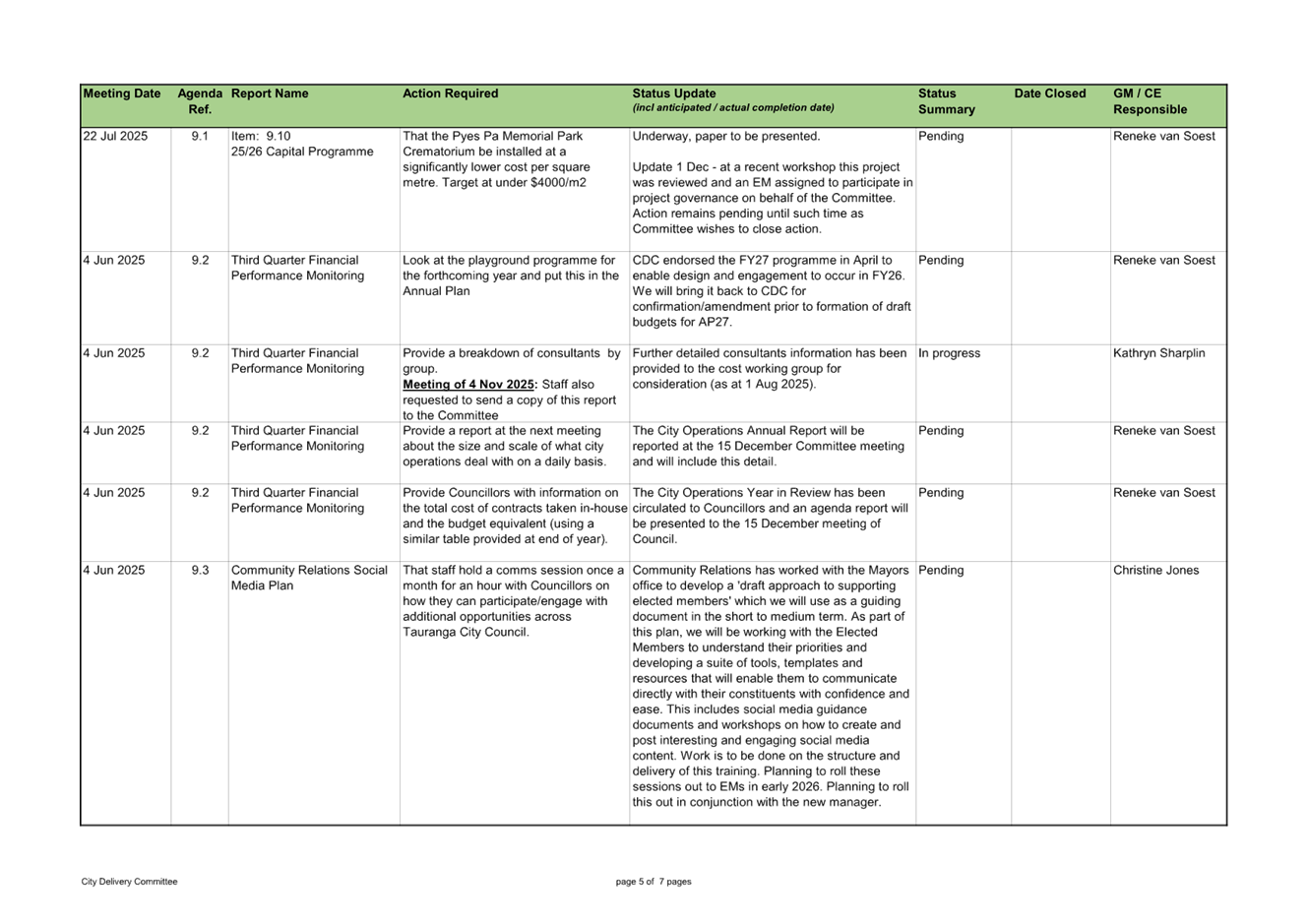
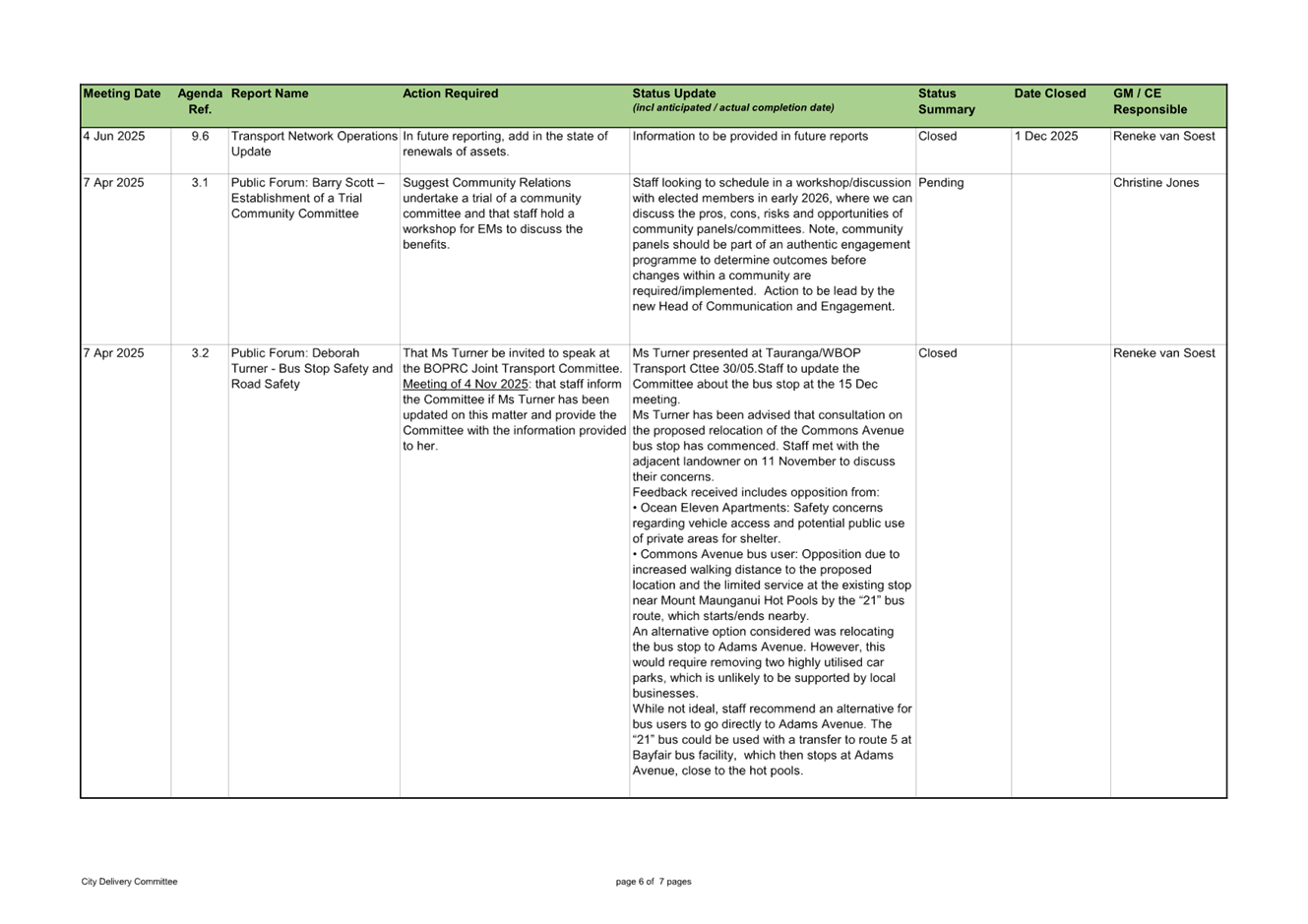
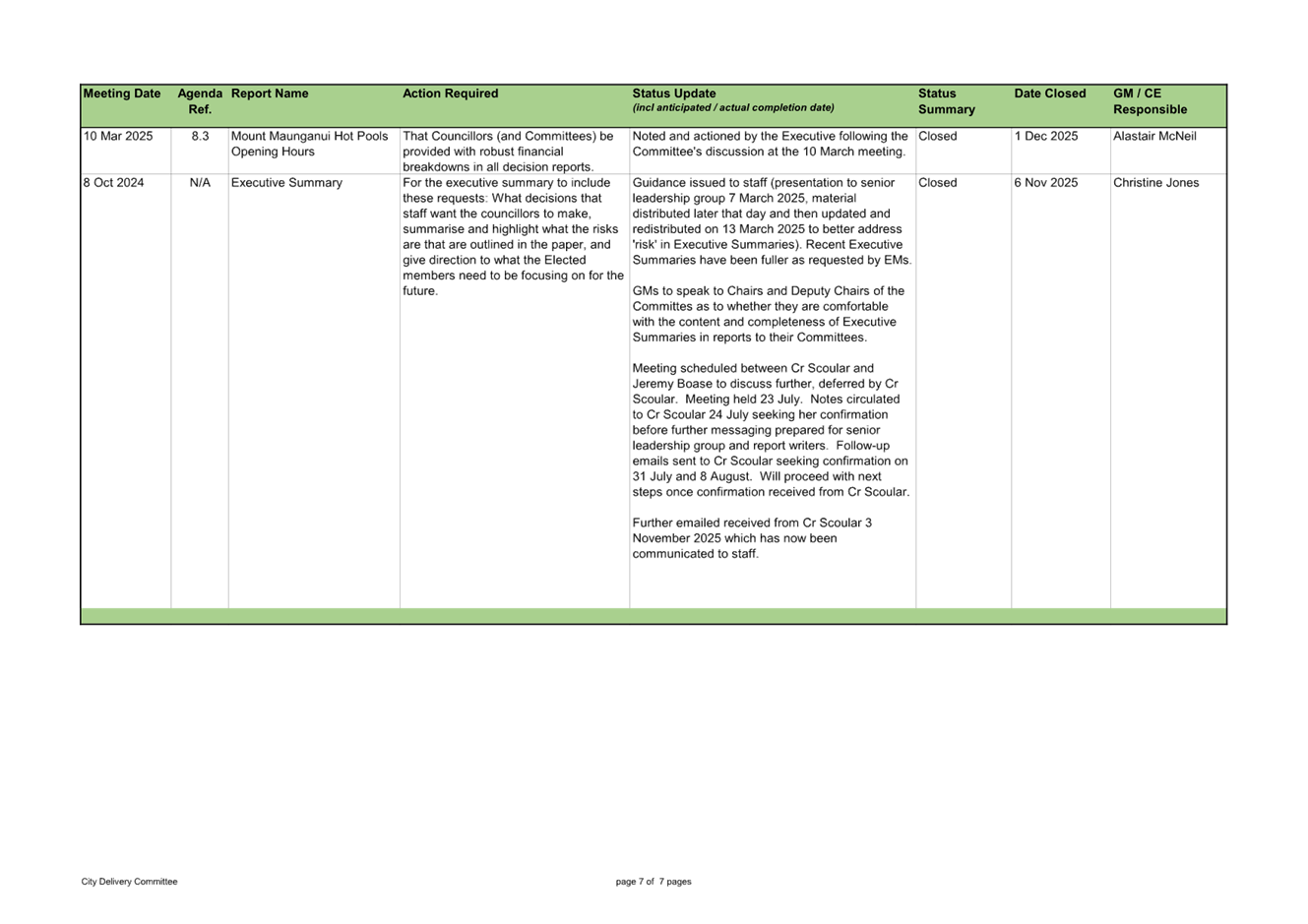
AGENDA
City Delivery Committee meeting
Monday, 15 December 2025
|
|
I hereby give notice that a City Delivery Committee
meeting will be held on:
|
|
Date:
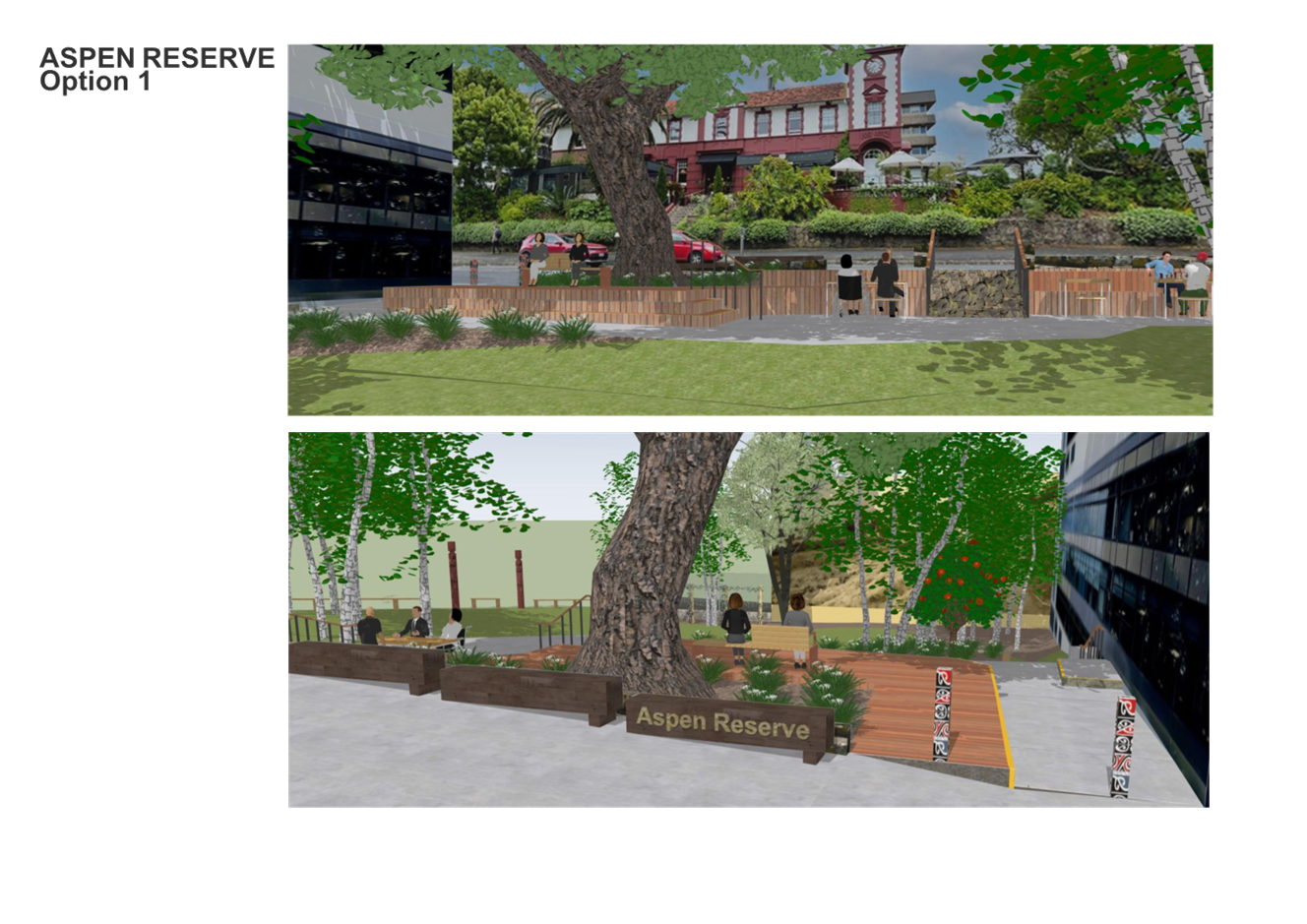
|
Monday, 15 December 2025
|
|
Time:
|
1:30 pm
|
|
Location:
|
Tauranga City Council Chambers
Level 1 - 90 Devonport Road
Tauranga
|
|
Please note that this
meeting will be livestreamed and the recording will be publicly available on
Tauranga City Council's website: www.tauranga.govt.nz.
|
|
Marty Grenfell
Chief Executive
|
Terms of reference – City Delivery Committee
Common
responsibility and delegations
The following common responsibilities and delegations apply
to all standing committees.
Responsibilities of standing committees
· Establish priorities and guidance on programmes relevant to the Role
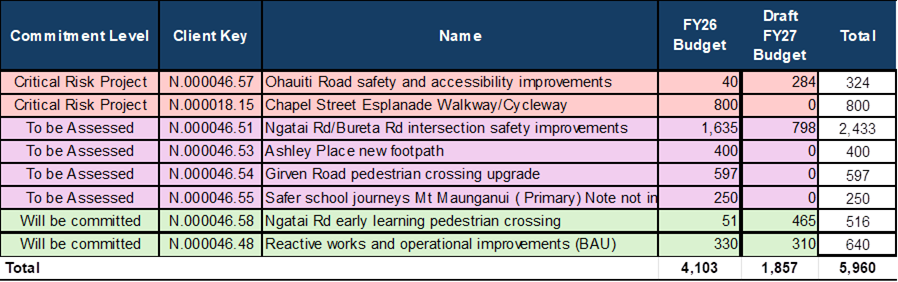
and Scope of the committee.
· Provide guidance to staff on the development of investment options
to inform the Long Term Plan and Annual Plans.
· Report to Council on matters of strategic importance.
· Recommend to Council investment priorities and lead Council
considerations of relevant strategic and high significance decisions.
· Provide guidance to staff on levels of
service relevant to the role and scope of the committee.
· Establish and participate in relevant task forces and working
groups.
· Engage in dialogue with strategic partners, such as Smart Growth
partners, to ensure alignment of objectives and implementation of agreed
actions.
· Confirmation of committee minutes.
Delegations to standing committees
· To make recommendations to Council outside of the delegated
responsibility as agreed by Council relevant to the role and scope of the
Committee.
· To make all decisions necessary to fulfil the role and scope of the
Committee subject to the delegations/limitations imposed.
· To develop and consider, receive submissions on and adopt
strategies, policies and plans relevant to the role and scope of the committee,
except where these may only be legally adopted by Council.
· To consider, consult on, hear and make determinations on relevant
strategies, policies and bylaws (including adoption of drafts), making
recommendations to Council on adoption, rescinding and modification, where
these must be legally adopted by Council.
· To approve relevant submissions to central government, its agencies
and other bodies beyond any specific delegation to any particular committee.
· Engage external parties as required.
Terms of reference – City Delivery
Committee
Membership
|
Chair
|
Deputy
Mayor Jen Scoular
|
|
Deputy chair
|
Cr
Kevin Schuler
|
|
Members
|
Mayor Mahé Drysdale (ex officio)
Jacqui Rolleston-Steed - Tangata Whenua Representative
|
|
Non-voting members
|
(if any)
|
|
Quorum
|
Half of the members
present, where the number of members (including vacancies) is even;
and a majority of the members present, where the number of members
(including vacancies) is odd.
|
|
Meeting frequency
|
Six weekly
|
Role
The role of the City Delivery Committee is:
·
To ensure and report delivery against agreed
targets and benchmarks across capital investment, operating activity, and
engagement.
·
To ensure community involvement in, and support for, Council
projects, proposals, initiatives and services.
·
To monitor delivery of activity by community-led organisations
receiving Council funding, partnering with, or otherwise contracted to,
Council.
·
To determine the reporting frequency for financial performance
targets across the organisation, and to measure and regularly report on
delivery against those.
·
To review and improve public confidence and participation in
Council decision making processes.
·
To measure delivery of projects by ensuring that approved
projects are effectively planned and delivered in full, on time, in scope, and
within budget.
·
To determine the reporting frequency for performance measures for
non-financial activity and regularly report against those measures.
·
To ensure the Annual Report provides relevant, transparent and
accurate information.
Scope
·
All projects, both
capital and operating, where the business case has been approved are included
in the scope of the Delivery Committee.
·
Develop and monitor
delivery of a council-wide engagement and communications strategy.
·
Lead the development
of relationships with community organisations, schools, businesses and other
groups to broaden Council’s reach into the community and use of available
resources.
·
Receive and consider
feedback from the community including, but not limited to, the annual
residents’ survey.
·
Review statements of
intent and receive reporting of the Local Government Funding Agency.
·
Receive reporting
from all other Council-controlled organisations.
·
Receive reporting
from Priority One.
·
Receive reporting by
Mainstreet organisations as appropriate.
·
Receive reporting
against partnership agreements with key cornerstone organisations (as per the
Community Funding Policy) and from other community-led organisations as
appropriate.
·
Assess the
organisation’s processes to ensure these are not constraining the
organisation in delivering value for money.
·
Review the proposed
approach and options for procurement processes that the Committee considers
significant having taken into account value, risk, and public interest.
·
Take necessary steps
to ensure that procurement processes provide value-for-money.
·
Approval of tenders
and contracts that are outside of approved staff delegations.
·
Ensure that where
projects have a potential negative environmental impact, appropriate mitigation
is considered in design, delivery, and eventual operations.
·
Monitor the delivery
of projects. (Note that the development of future strategic and growth-related
projects, including future strategic transport projects, will be monitored by
the City Future Committee until the project purpose definition, business case,
and funding are in place).
·
Review regular
financial performance reporting, including reporting against strategic
outcomes, the Long-term Plan, the Annual Plan, and other strategic and
implementation documents.
·
Review non-financial
performance reporting.
·
Provide oversight on
the preparation of the Annual Report and other external financial reporting
required by legislation to ensure it not only meets legislative requirements,
but that it provides transparent, relevant and accurate information.
·
To reassess
financial reporting targets for the next Long-term Plan process and make
recommendations to Council accordingly.
Power to
Act
· To
make all decisions necessary to fulfil the role, scope and responsibilities of
the Committee subject to the limitations imposed.
· To
establish sub-committees, working parties and forums as required.
Power to
Recommend
· To
Council and/or any standing committee as it deems appropriate.
Chair and Deputy Chair acting as Co-Chairs
·
While the Chair and Deputy Chair of the Committee roles are
separately appointed it is the intention that they act as co-chairs.
○ Only
one person can chair a meeting at any one time. The person chairing the meeting
has the powers of the chair as set out in standing orders and has the option to
use the casting vote in the case of an equality of votes.
○ The rotation
of the meeting chairs is at the discretion of the Chair and Deputy Chair and
subject to their availability, however it is expected that they will alternate
chairing meetings when possible.
○ When the
Deputy Chair is chairing the meeting, the Chair will vacate the chair and
enable the Deputy Chair to chair the meeting. The Chair will be able to stay
and participate in the meeting unless they declare a conflict of interest in an
item, in which case they will not participate or vote on that item.
○ The Chair and
Deputy Chair will attend pre-agenda briefings and split any other duties
outside of meetings, e.g. spokesperson for the Committee.
○ The Chair and
Deputy Chair will jointly oversee and co-ordinate all activities of the
Committee within their specific terms of reference and delegated authority,
providing guidance and direction to all members and liaising with Council staff
in setting the content and priorities of meeting agendas.
○ The Chair and
Deputy Chair will be accountable for ensuring that any recommendations from the
Committee are considered by the Tauranga City Council.
|
City Delivery Committee meeting Agenda
|
15 December 2025
|
3 Public
forum
3.1 Robyn
& Warren Dassler
Attachments
Nil
3.2 Steve
& Danielle Rundle
Attachments
Nil
|
City Delivery Committee meeting Agenda
|
15 December 2025
|
7 Confirmation
of minutes
7.1 Minutes
of the City Delivery Committee meeting held on 4 November 2025
File
Number: A19424620
Author: Caroline
Irvin, Governance Advisor
Authoriser: Sarah
Holmes, Team Leader: Governance & CCO Support Services
|
Recommendations
That the Minutes of the
City Delivery Committee meeting held on 4 November 2025 be confirmed as a
true and correct record.
|
Attachments
1. Minutes
of the City Delivery Committee meeting held on 4 November 2025
|
 City Delivery
Committee meeting minutes City Delivery
Committee meeting minutes
|
4 November 2025
|
|

|
|
DRAFT MINUTES
City Delivery Committee meeting
Tuesday, 4 November 2025
|
Order of
Business
1 Opening karakia. 3
2 Apologies. 3
3 Public forum.. 4
4 Acceptance of late items. 4
5 Confidential business to be transferred into the open. 4
6 Change to order of business. 4
7 Confirmation of minutes. 5
7.1 Minutes of the City Delivery Committee meeting held on 2 September
2025. 5
8 Declaration of conflicts of interest 5
9 Business. 5
9.6 Status Update on actions from prior City Delivery Committee meetings. 5
9.7 Quarter 1 Financial Monitoring. 6
9.8 1st Quarter 2025/26 Capital Programme Performance. 6
9.9 Major Projects Update - Transport 7
9.1 Annual Residents Survey 2025/26 - Wave One Results and 2024/25
Benchmarking Report 7
9.2 City Centre Development Incentive Fund - Annual Report 2024/25. 8
9.10 Grenada Street Pedestrian Crossing Options. 9
9.5 Council-Controlled Organisations - Annual Reports 2024/25. 10
9.4 Local Government Funding Agency - Annual Report 2024/25 and Annual
General Meeting Shareholder Voting. 11
9.3 Variable speed limit update and speed limit proposals. 12
10 Discussion of late items. 12
11 Closing karakia. 13
MINUTES OF Tauranga City
Council
City Delivery Committee meeting
HELD AT THE Tauranga City
Council Chambers, Level 1 - 90 Devonport Road, Tauranga
ON Tuesday, 4 November 2025 AT
9.30am
|
MEMBERS
PRESENT:
|
Deputy Mayor
Jen Scoular (Chair), Mayor Mahé Drysdale, Cr Hautapu Baker, Cr Glen
Crowther, Cr Rick Curach, Cr Steve Morris, Cr Marten Rozeboom, Cr Kevin
Schuler, Cr Rod Taylor, Ms Jacqui Rolleston-Steed, Cr Hēmi Rolleston,
Tangata Whenua Member Ms Jacqui Rolleston-Steed (online).
|
|
IN
ATTENDANCE:
|
Christine Jones
(General Manager: Strategy, Partnerships & Growth), Alastair McNeill
(Acting COFO - Commercial & General Counsel), Reneke van Soest (General
Manager: Operations & Infrastructure), Gareth Wallis (Head of Community
Hubs, Arts, Heritage & Events), Kathryn Sharplin (Acting COFO - Finance
& Digital), Tracey Hughes, (Manager: Organisational Financial
Performance and Corporate), Sheree Covell (Treasury & Financial
Compliance Manager), Susan Braid (Finance Lead Capital Performance and
Community Investment), Chris Barton (Programme Director: Major Projects), Alex
Johnston (Team Leader CPAD), Mike Seabourne (Head of Transport), Karen Hay
(Team Leader: Engineering Services), Josh Logan (Team Leader: Policy &
Corporate Planning), Emily McLean (Manager: Urban Centres Development), Caroline
Lim (CCO Specialist), Helen Andrews (Financial Analyst), Caroline Irvin
(Governance Advisor), Clare Sullivan (Team Leader: Governance Services).
|
|
EXTERNAL:
|
Council
Controlled Organisation representatives as listed in item 9.5
|
Timestamps are included at the start of each item and signal
where the agenda item can be found in the recording of the meeting held on 4
November 2025 at Council's YouTube Channel (part 1)
and Council's
YouTube Channel (part 2)
1 Opening
karakia
Deputy Mayor Jen Scoular opened the meeting
with a karakia.
2 Apologies
|
Apology
|
|
Committee Resolution CDC/25/6/1
Moved: Cr
Hēmi Rolleston
Seconded: Mayor Mahé
Drysdale
That the apology for lateness/absence
received from Cr Baker be accepted.
Carried
|
3 Public forum
Nil
4 Acceptance of
late items
Nil
5 Confidential
business to be transferred into the open
Nil
6 Change to
order of business
The Chair advised that the order of
business would be as follows
|
1.
|
Status Updates
on actions from prior City Delivery Committee meetings
|
Supplementary Agenda Item 9.6
|
|
2.
|
Quarter 1
Financial Monitoring
|
Supplementary
Agenda Item 9.7
|
|
3.
|
1st
Quarter 2025/26 Capital Programme Performance
|
Supplementary
Agenda Item 9.8
|
|
4.
|
Major Projects
Update – Transport
|
Supplementary
Agenda Item 9.9
|
|
5.
|
Annual
Residents Survey 2025/26 – Wave One Results and 2024/25 Benchmarking
Report
|
Agenda Item 9.1
|
|
6.
|
City Centre
Development Incentive fund – Annual Report 2024/25
|
Agenda Item 9.2
|
|
7.
|
Variable speed
limit update and speed limit proposals
|
Agenda Item 9.3
|
|
8.
|
Grenada Street
Pedestrian Crossing Options
|
Supplementary
Agenda Item 9.10
|
|
9.
|
Local government Funding Agency –
Annual Report 2024/25 and Annual General Meeting Shareholder Voting
|
Agenda Item 9.4
|
|
10.
|
Council-Controlled Organisations –
Annual Reports 2024/25 – External Presenters
|
Agenda Item 9.5
|
7 Confirmation
of minutes
8 Declaration
of conflicts of interest
Nil
9 Business
Timestamp: 5 minutes (part 1)
Timestamp: 8 minutes (part 1)
|
9.7 Quarter
1 Financial Monitoring
|
|
Staff
Kathryn Sharplin, Acting COFO - Finance &
Digital
Susan Braid, Finance Lead Capital Performance and Community Investment
Sheree Covell, Treasury & Financial Compliance Manager
Susan Braid, Finance Lead Capital Performance and Community Investment
Tabled
document: Q1 P&L and Operating Deficit (attachment).
Actions
That the
finance staff:
·
Provide the Committee with a full reconciliation of salaries
and wages 2025 to Annual Plan 2026 including reduction in roles.
·
Provide the Committee with more clarity on year-end costs,
including accruals in the final year operating costs, and underspend in
24/25, the carry forwards, and more clarity on which have been resolved, and
which are waiting to be resolved.
|
|
Committee
Resolution CDC/25/6/4
Moved: Deputy
Mayor Jen Scoular
Seconded: Mayor Mahé
Drysdale
That the City
Delivery Committee:
(a) Receives the
report "Quarter 1 Financial Monitoring".
(b) Recommends
to Council to approve capital budget adjustments of $12.7m (net decrease) in
the 2025/26 financial year as outlined in Attachment 3 of this report.
Carried
|
|
Attachments
1 Q1
P&L and Operating Deficit
|
Timestamp: 1 hour and 16 minutes (part 1)
|
9.8 1st
Quarter 2025/26 Capital Programme Performance
|
|
Staff
Alex Johnston, Team
Leader CPAD
Mike Seabourne, Head of Transport
Action
·
That staff provide the Committee with a
further breakdown of balance in their reporting.
|
|
Committee Resolution CDC/25/6/5
Moved: Cr
Marten Rozeboom
Seconded: Deputy Mayor Jen Scoular
That the City
Delivery Committee:
(a) Receives the
report "1st Quarter 2025/26 Capital Programme Performance".
Carried
|
Timestamp: 1 hour and 33 minutes (part 1)
|
9.9 Major
Projects Update - Transport
|
|
Staff
Chris Barton, Programme Director: Major Projects
Action
·
That staff clarify the cost forecasts for the Connecting Mount
Maunganui project and whether they are within budget, particularly
referencing the variance as noted on Attachment 2 of Item 9.7 (Q1 Financial
Monitoring – pg. 29 of the supplementary agenda).
|
|
Committee
Resolution CDC/25/6/6
Moved: Cr
Rod Taylor
Seconded: Cr Marten Rozeboom
That the City
Delivery Committee:
(a) Receives the
report "Major Projects Update - Transport".
Carried
|
Timestamp: 1 hour and 46:39 minutes (part 1)
At 11.28am the meeting adjourned.
At 11.44am the meeting reconvened.
Timestamp: 9 minutes (part 2)
|
9.2 City
Centre Development Incentive Fund - Annual Report 2024/25
|
|
Staff
Emily McLean, Manager: Urban Centres Development
Actions
That staff:
·
Create a master list of all city centre budgets (capex and opex)
with a comment outlining the key objective of each budget (and example funded
projects) to help clarify the purpose of each of the separate budget.
·
Initiate discussions with the Tauranga Māori Business
Association, Toi Kai Rawa and the Pacific Business Hub for opportunities of
associated business members to the Vacant Shopfront Strategy that are/may be
interested in occupying space in the Tauranga central business district.
·
Provide further details on one of the initiatives the fund
supported between July 2024 and June 2025 – specifically the $50,000
for ‘Feasibility Study’ for the development of student
accommodation in Spring Street’ - who was it done by and what was the
result, if any.
|
|
Committee Resolution CDC/25/6/8
Moved: Cr
Rod Taylor
Seconded: Deputy Mayor Jen Scoular
That the City
Delivery Committee:
(a) Receives the
report "City Centre Development Incentive Fund - Annual Report
2024/25".
Carried
|
The Chair advised
that item 9.10 would be taken before item 9.3
Timestamp: 35
minutes (part 2)
|
9.10 Grenada
Street Pedestrian Crossing Options
|
|
Staff
Mike Seabourne, Head of Transport
Karen Hay, Team Leader: Engineering Services
At 12.31pm, Mayor Mahé Drysdale
withdrew from the meeting.
At 12.31pm, Cr Hēmi Rolleston
withdrew from the meeting.
|
|
Committee
Resolution CDC/25/6/9
Moved: Cr
Steve Morris
Seconded: Cr Rick Curach
That the City
Delivery Committee:
(a) Receives the
report "Grenada Street Pedestrian Crossing Options".
(b) Brings the project forward for delivery in FY26 within existing
budgets.
(c) Notes that
the project will be fully loan-funded by Council at a total capital cost of
$161,000, including 20% risk allowance less contribution of $33,521.
(d) Notes that
the annual consequential operating expense is estimated at $10,401 including
maintenance, depreciation and financial expenses.
(e) Approves the
agreed contribution from Generus Living to the project as follows:
(i) 25% of
the base estimate of $134,084 excluding contingency totalling $33,521, noting
costs will be refined through the design process.
(ii) A
further 25% contribution if contingency is utilised at final invoice. Noting
contingency funding will not be utilised and is reserved for unforeseen
circumstances, for example, rain causing work delay or additional lighting.
(iii) This
delivers two raised speed tables at both refuge islands, and a zebra crossing
only at the eastern side to support access to the Pavillion.
(f) Permanently
retains Attachment 2 in the public excluded section to prevent the
disclosure or use of official information for improper gain or improper
advantage.
Carried
|
At 12.35pm the meeting adjourned.
At 12.55pm the meeting reconvened.
The Chair advised that item 9.5 would be taken as the next
item of business due to the external presenters.
Timestamp: 1 hour and 24 minutes (part 2)
|
9.5 Council-Controlled
Organisations - Annual Reports 2024/25
|
|
Staff
Caroline Lim (CCO Specialist
The following
Council Controlled Organisation representatives provided the Committee with a
presentation (see also attached):
|
Bay Venues Limited
|
Julie
Hardacker (Deputy Chair)
Chad Hooker
(Chief Executive)
Ellmers
(General Manager: Finance & Commercial)
|
|
Tauranga Art
Gallery Trust
|
Alan
Withrington (CCO Chair of Finance Audit & Risk)
Sonya
Korohina (Director)
|
|
Tourism Bay
of Plenty
|
Russ Browne
(CCO Chair)
Oscar Nathan
(General Manager)
|
|
Te Manawataki
o Te Papa Limited
|
Kim Wallace
(Chair)
Helen Andrews
(Financial Analyst)
|
|
Te Manawataki
o Te Papa Charitable Trust
|
Ra Winiata
Emily Gudsell
Alan Tate
|
|
Bay of Plenty Local Authority Shared
Services Limited
|
Stephen Boyle
(Chief Executive)
|
Action
·
That staff review the ability to have
standardised accounting treatment and reporting across all Council Controlled
Organisations.
|
|
Committee
Resolution CDC/25/6/10
Moved: Cr
Rod Taylor
Seconded: Cr Glen Crowther
That the City
Delivery Committee:
(a) Receives the
report "Council-Controlled Organisations - Annual Reports 2024/25".
(b) Receives
the Annual Reports 2024/25 for the year to 30 June 2025 for:
I. Bay
Venues Limited (Attachment 1 of this report);
II. Tauranga
Art Gallery Trust (Attachment 2 of this report);
III. Tourism
Bay of Plenty (Attachment 3 of this report);
IV. Te
Manawataki o Te Papa Limited (Attachment 4 of this report);
V. Te
Manawataki o Te Papa Charitable Trust (Attachment 5 of this report); and
VI. Bay
of Plenty Local Authority Shared Services Limited (Attachment 6 of this
report).
Carried
|
|
Committee Resolution CDC/25/6/11
Moved: Cr
Rod Taylor
Seconded: Cr Glen Crowther
That the City Delivery Committee:
(c)
Notes its concern that information has been withheld by Tauranga Art Gallery
Trust and resolves that Council Controlled Organisations respond proactively
to questions from Elected Members and provide information as requested.
For: Deputy
Mayor Jen Scoular, Cr Glen Crowther, Cr Rick Curach, Cr Steve Morris, Cr Rod
Taylor and Cr Jacqui Rolleston-Steed.
Against: Cr
Marten Rozeboom and Cr Kevin Schuler.
Carried 6/2
|
|
Attachments
1 Bay
Venues Presentation
2 Tauranga
Art Gallery Trust
3 Tourism
Bay of Plenty Presentation
4 Te
Manawataki o Te Papa Charitable Trust presentation
5 Te
Manawataki o Te Papa Limited presentation
|
Timestamp: 2 hours and 49 minutes (part 2)
|
9.4 Local
Government Funding Agency - Annual Report 2024/25 and Annual General Meeting
Shareholder Voting
|
|
Staff
Caroline Lim
Kathryn Sharplin
|
|
Committee
Resolution CDC/25/6/12
Moved: Cr
Marten Rozeboom
Seconded: Cr Glen Crowther
That the City
Delivery Committee:
(a) Receives the
report "Local Government Funding Agency - Annual Report 2024/25 and
Annual General Meeting Shareholder Voting".
(b) Receives the
Local Government Funding Agency’s Annual Report 2024/25 (Attachment 1
of this report).
(c) Receives the
Local Government Funding Agency’s Letter to its Shareholders on its
Annual Report 2024/25 (Attachment 2 of this report).
(d) Notes the
Letter of Recommendations from the Shareholders Council (Attachment 3 of this
report).
(e) Approves the
following resolutions to allow voting by proxy for the Local Government
Funding Agency Annual General Meeting (Attachments 4 and 5 of this report):
(i) Approve
the re-election of Helen Robinson as an Independent Director (Proxy
Form Resolution 1(a));
(ii) Approve
the election of Paul Anderson as an Independent Director (Proxy Form
Resolution 1(b));
(iii) Approve
the re-election of Christchurch City Council as a Nominating Local
Authority to the Shareholders Council (Proxy Form Resolution 2(a));
(iv) Approve the
re-election of Tasman District Council as a Nominating Local Authority
to the Shareholders Council (Proxy Form Resolution 2(b)).
(f) Authorise
by way of proxy, the Tauranga City Council Mayor or Deputy Mayor to sign the
proxy form and for the Chair of the Local Government Funding Agency to act as
the proxy on behalf of Tauranga City Council.
Carried
|
Timestamp: 2 hours and 54 minutes (part 2)
|
9.3 Variable
speed limit update and speed limit proposals
|
|
Staff
Mike Seabourne, Head of Transport
Karen Hay, Team Leader: Engineering Services
|
|
Committee
Resolution CDC/25/6/13
Moved: Cr
Rod Taylor
Seconded: Cr Marten Rozeboom
That the City
Delivery Committee:
(a) Receives the
report "Variable speed limit update and speed limit proposals".
(b) Approves
public consultation on the following proposed speed limit changes:
(i) Truman
Lane: Temporary 50 km/h limit introduced during Baylink project is no longer
enforceable. Proposal to make it permanent.
(ii) Gasson
Lane: Amend the speed limit from 100km/h to 60km/h.
(iii) Welcome
Bay Road: Proposal to reduce a 210m section from 80 km/h to 50 km/h to enable
a mandatory school zone at Tauranga Waldorf School.
(iv) Domain Road
interchange – adjust the section from Te Puke highway to the
interchange from 50km/h to 80km/h to provide consistency at the interchange.
(c) The final
recommendations will be presented to Council for approval once consultation
has concluded and submissions have been received and considered.
Carried
|
10 Discussion of late items
Nil
11 Closing karakia
Cr Steve Morris closed the meeting with a
karakia.
The meeting closed at 3:43pm.
The minutes of this meeting were
confirmed as a true and correct record at the City Delivery Committee meeting
held on 15 December 2025.
|
City Delivery Committee meeting Agenda
|
15 December 2025
|
8 Declaration
of conflicts of interest
|
City Delivery Committee meeting Agenda
|
15 December 2025
|
9 Business
9.1 Status
Update on actions from prior City Delivery Committee meetings
File
Number: A19424643
Author: Caroline
Irvin, Governance Advisor
Authoriser: Alastair
McNeil, Acting COFO - Commercial & General Counsel
Purpose of the Report
1. This report provides
a status update on actions requested during previous City Delivery Committee
meetings.
|
Recommendations
That the City Delivery
Committee:
(a) Receives the report
"Status Update on actions from prior City Delivery Committee
meetings".
|
Background
2. This is a recurring
report provided to every City Delivery Committee meeting. The next report will
be to the 10 March 2026 meeting.
3. The attached update
includes all open actions and actions completed since the last report on 4
November 2025.
4. Once reported,
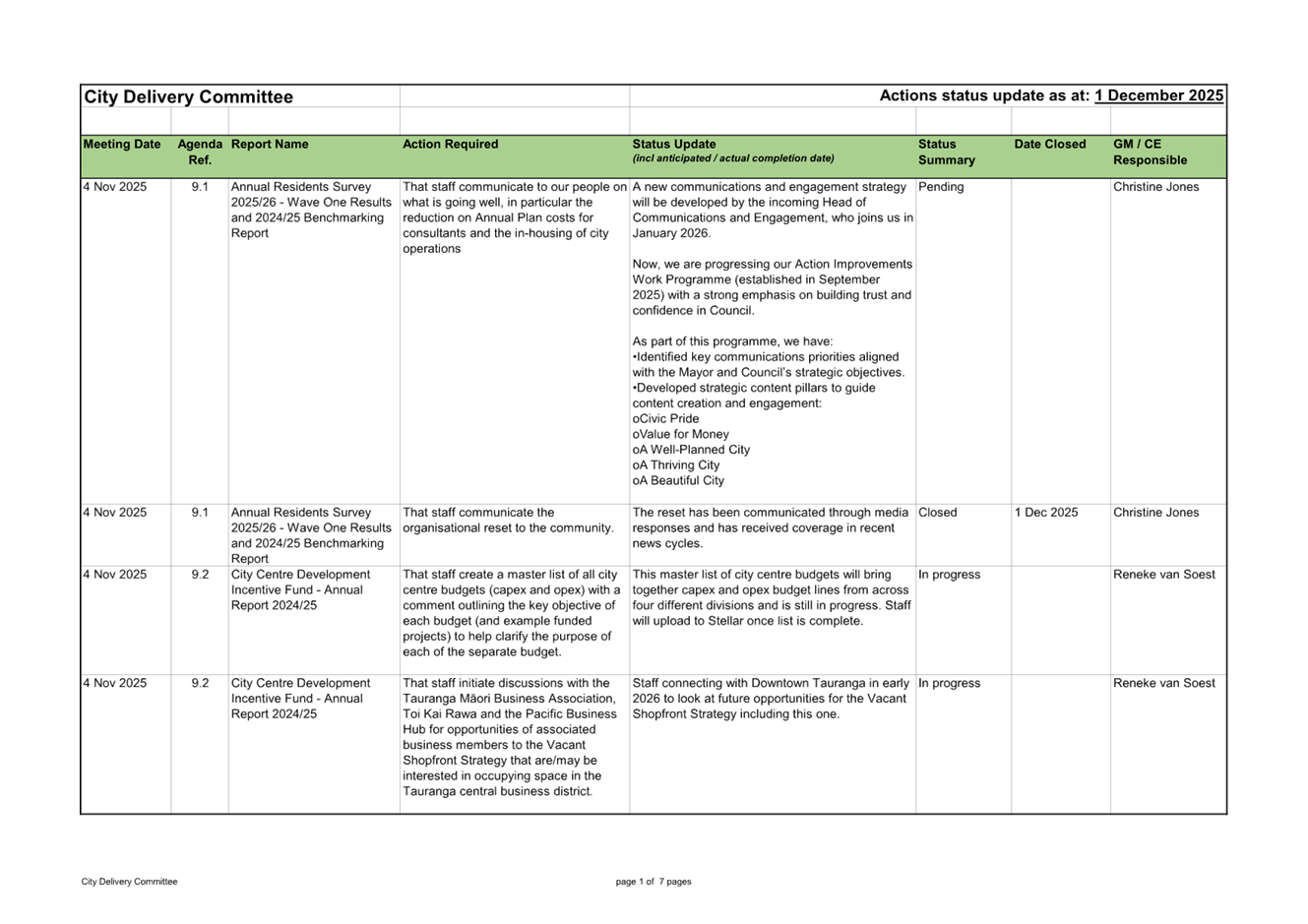
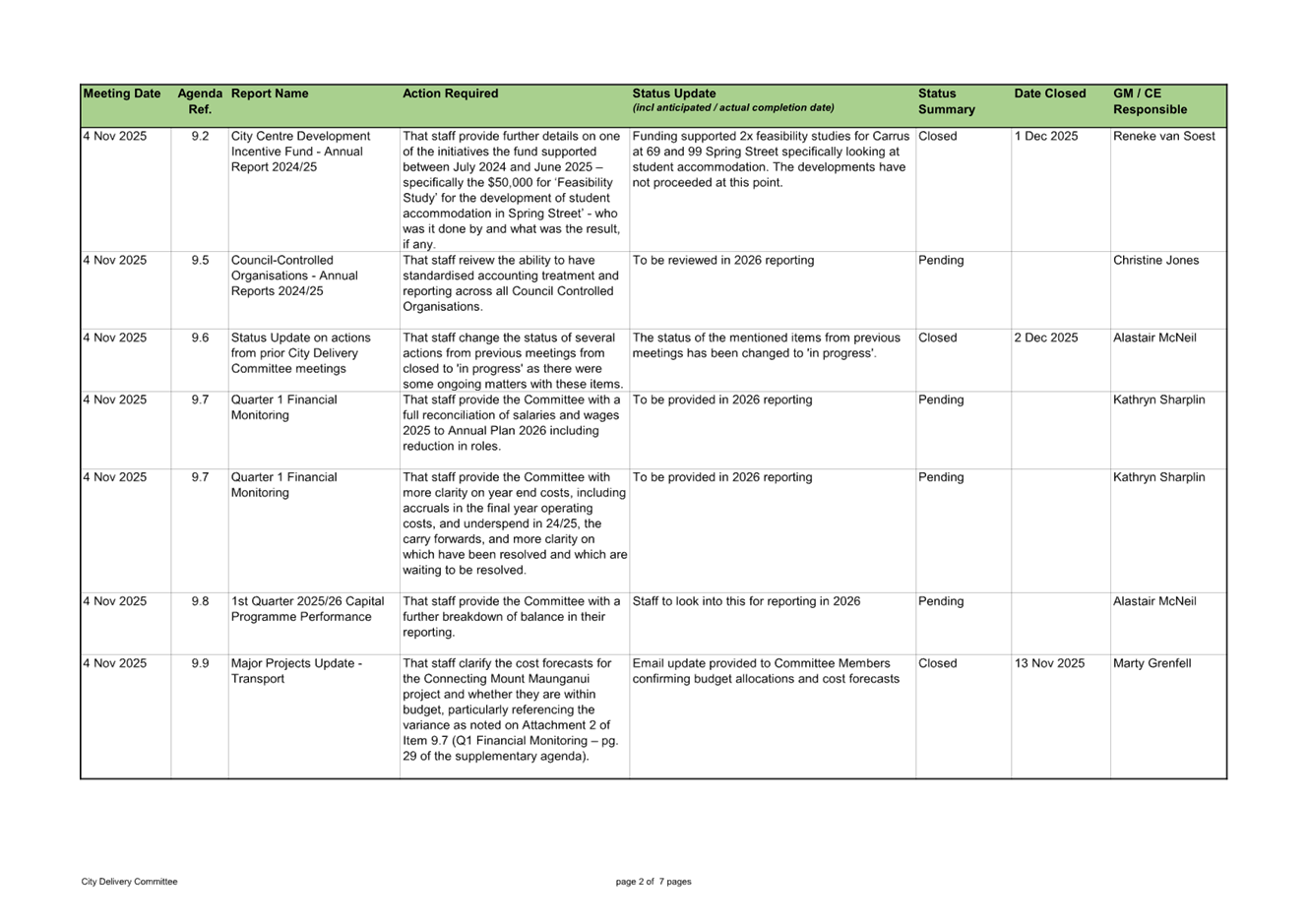
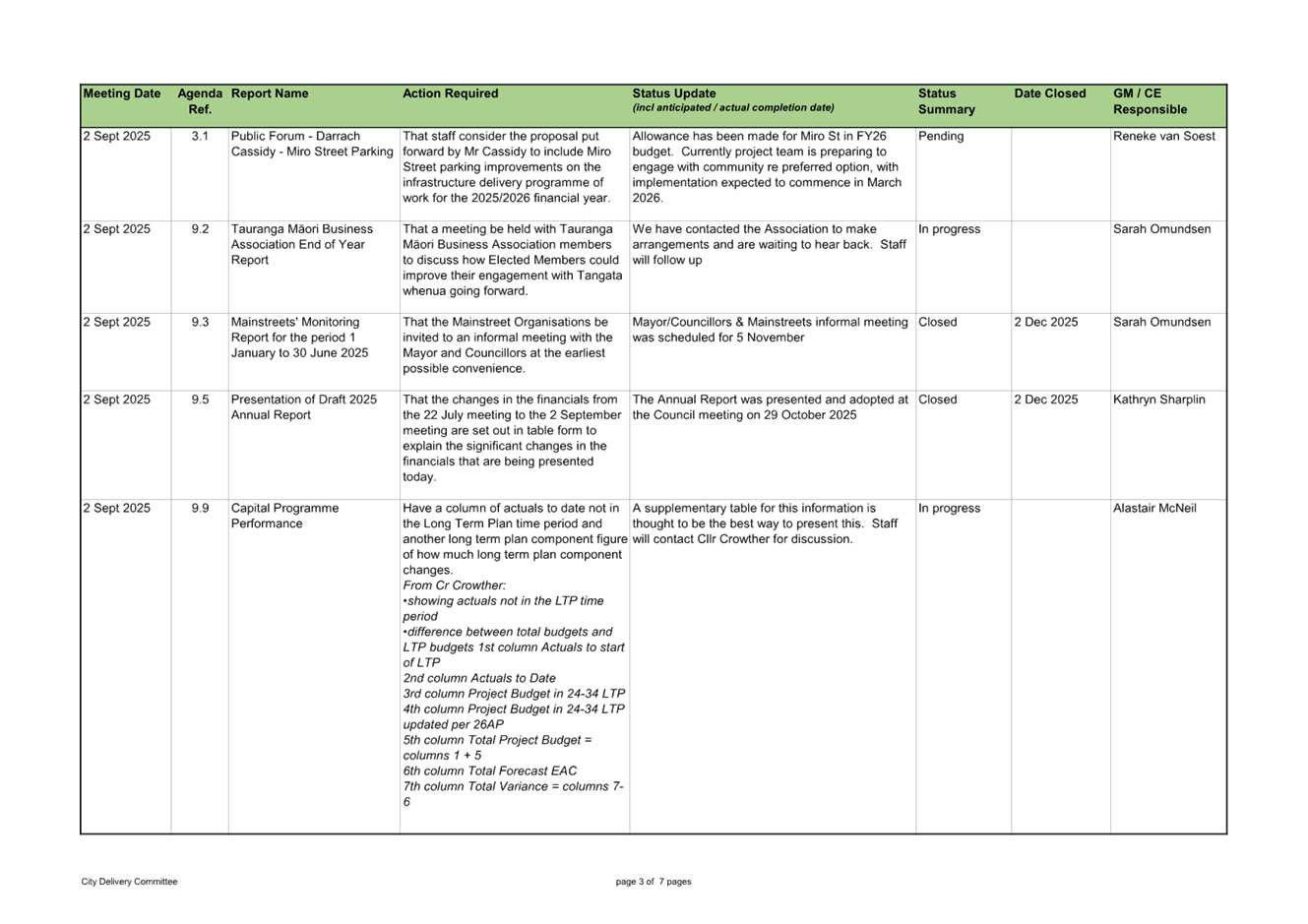
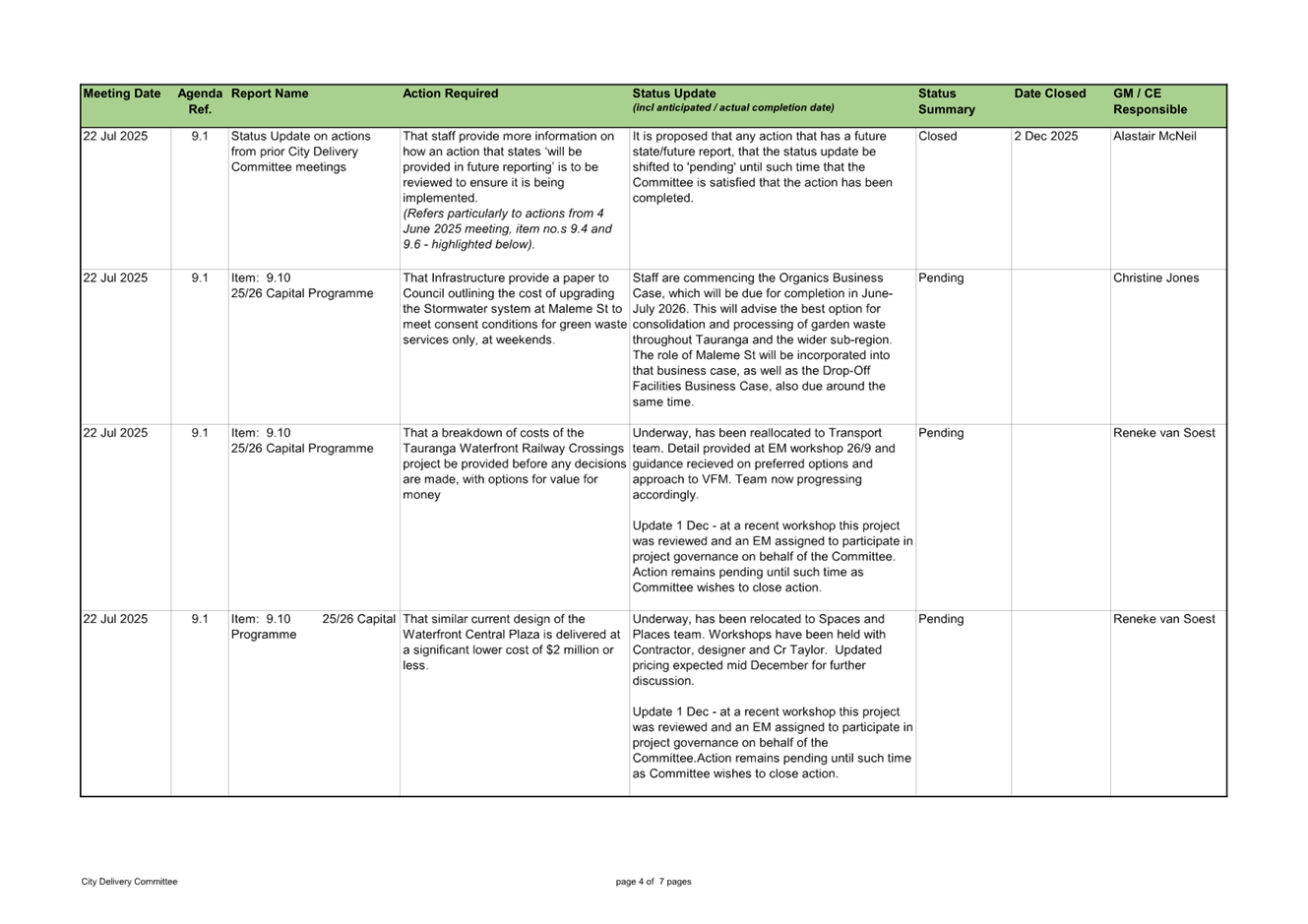
completed actions are archived and made available in the Stellar library[1].
DISCUSSION
5. The action status
update report for the City Delivery Committee, as at 1 December 2025, is
provided as Attachment 1 to this report, and is summarised in the
table below.
|
Status of actions
|
No. actions
|
|
Closed (completed
since the last report)
|
11
|
|
Pending (waiting on
something)
|
15
|
|
In progress
|
5
|
|
To be actioned
|
-
|
|
Total actions
included in this report
|
31
|
Attachments
1. Actions
from City Delivery Committee - as at 1 December 2025 - A19480240 ⇩ 
|
City
Delivery Committee meeting Agenda
|
15
December 2025
|
|
City
Delivery Committee meeting Agenda
|
15
December 2025
|
9.2 City
Operations Year in review 2024/2025
File
Number: A19210067
Author: Greg
Steele, Head of City Operations.
Authoriser: Reneke
van Soest, General Manager: Operations & Infrastructure
Purpose of the Report
The purpose of this report is to
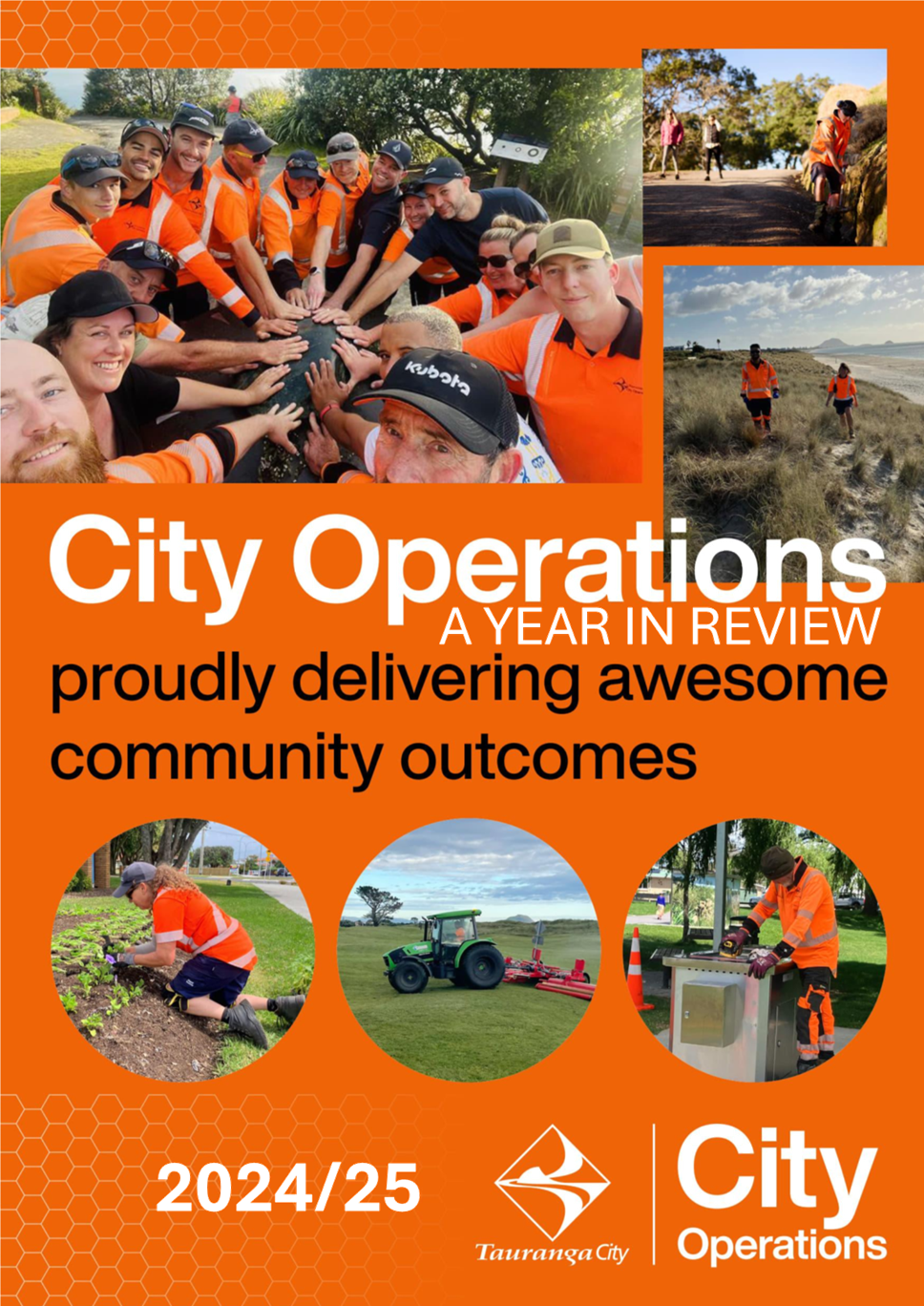
present the City Delivery Committee with a City Operations Annual Report for
the 1 July 2024 to 30 June 2025 financial year.
|
Recommendations
That the City Delivery
Committee:
(a) Receives the report
"City Operations Year in review 2024/2025".
|
Executive Summary
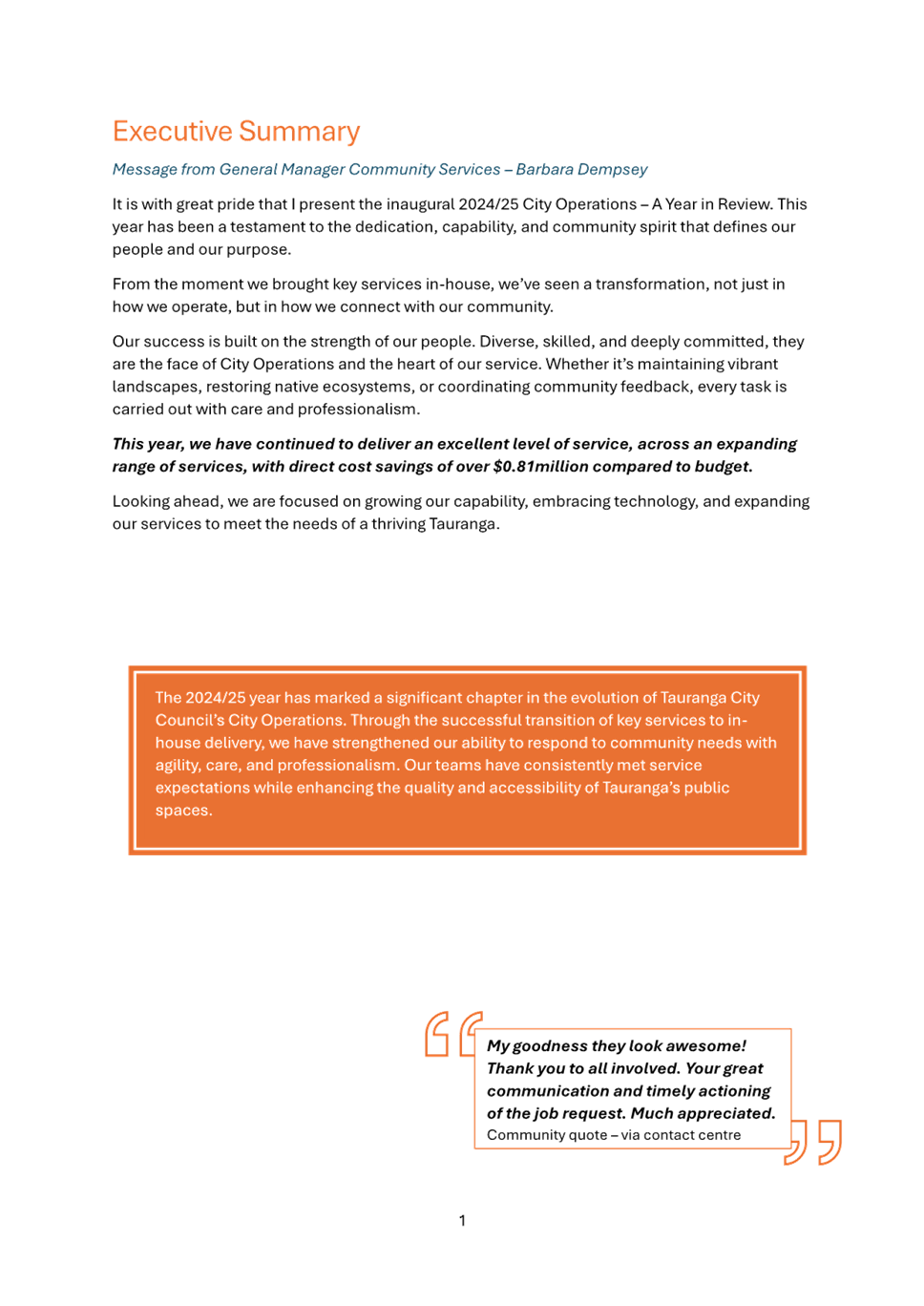
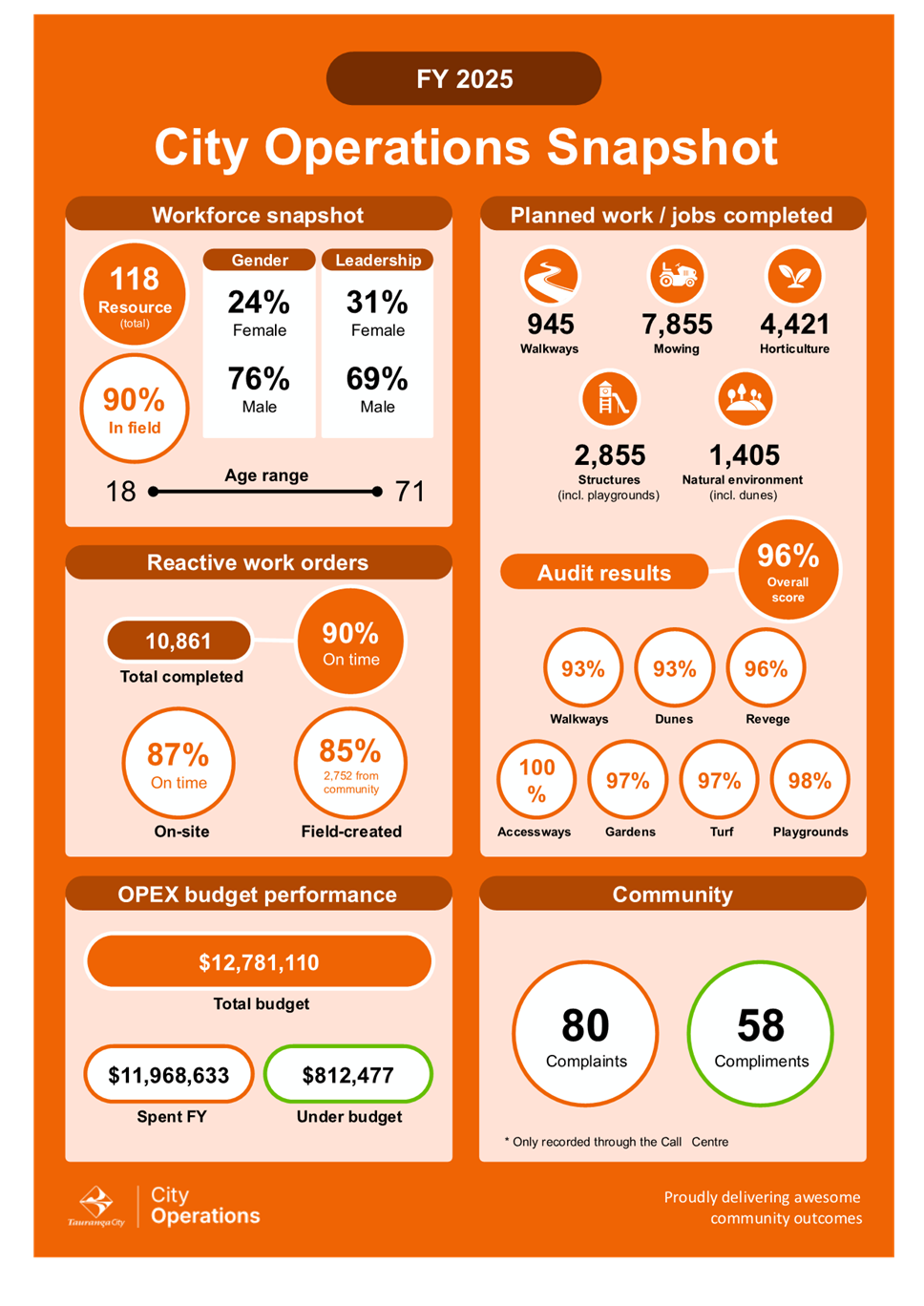
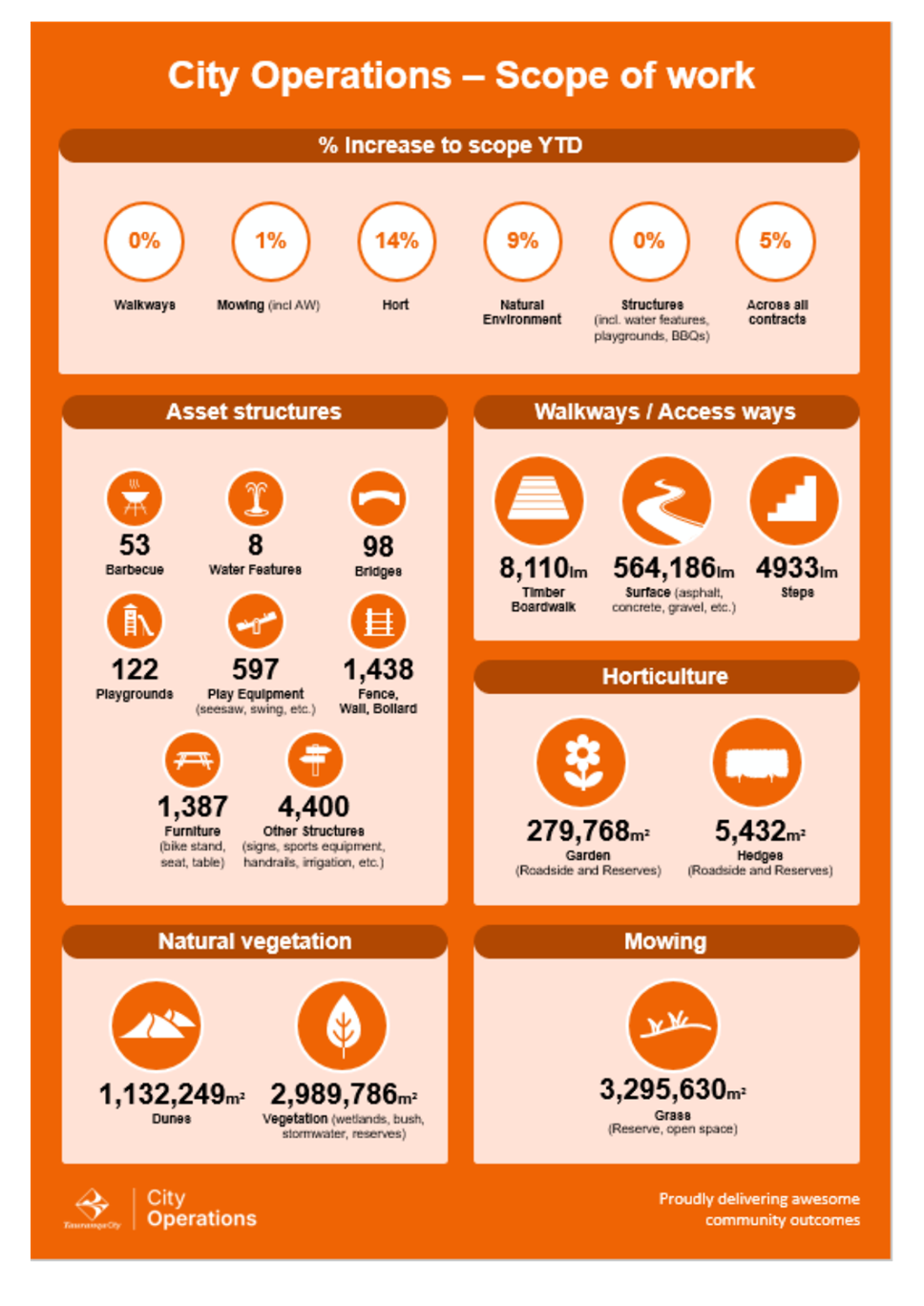
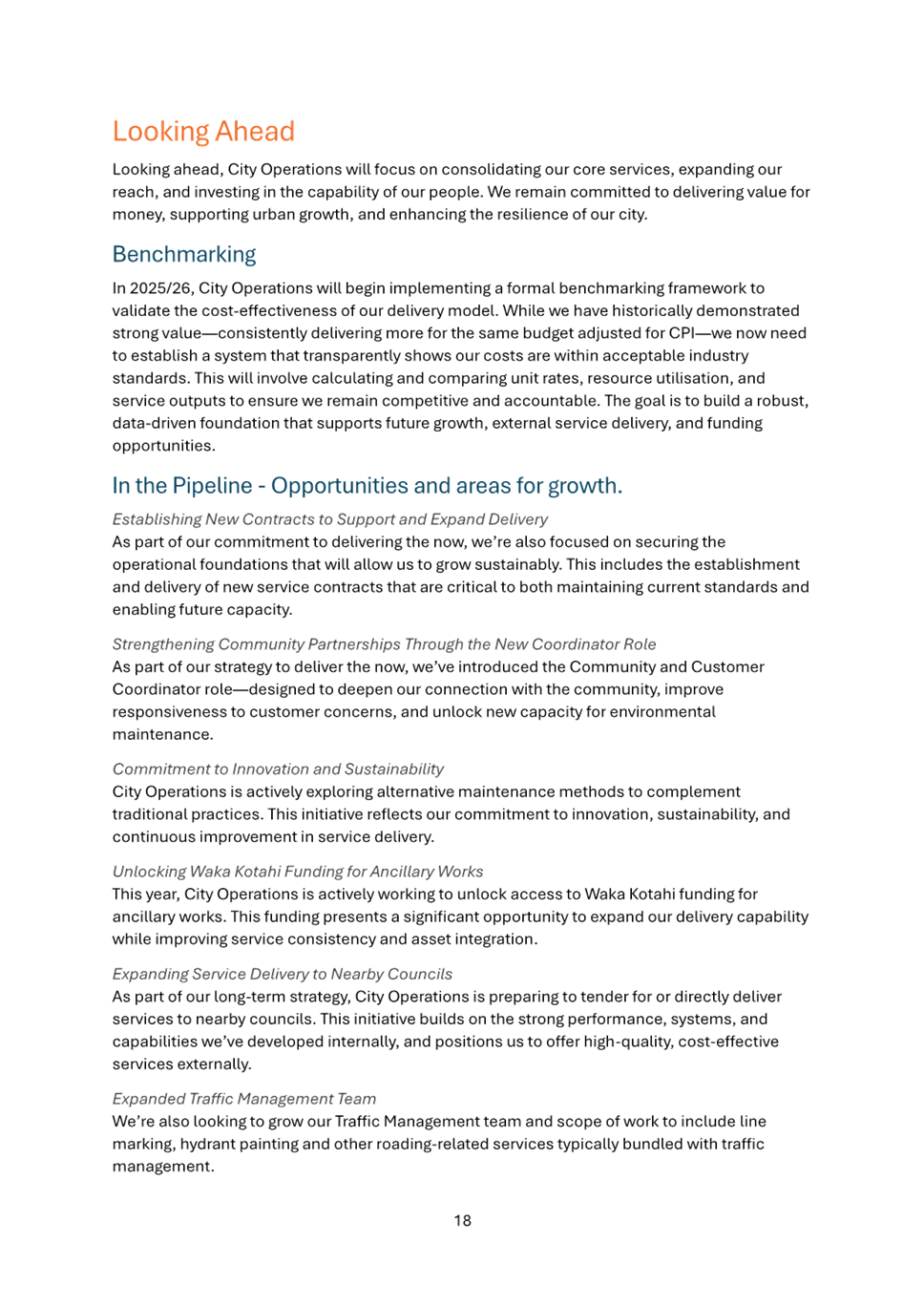
City Operations delivered a transformative year marked by
service expansion, innovation, and
strong community engagement.
Key
Achievements:
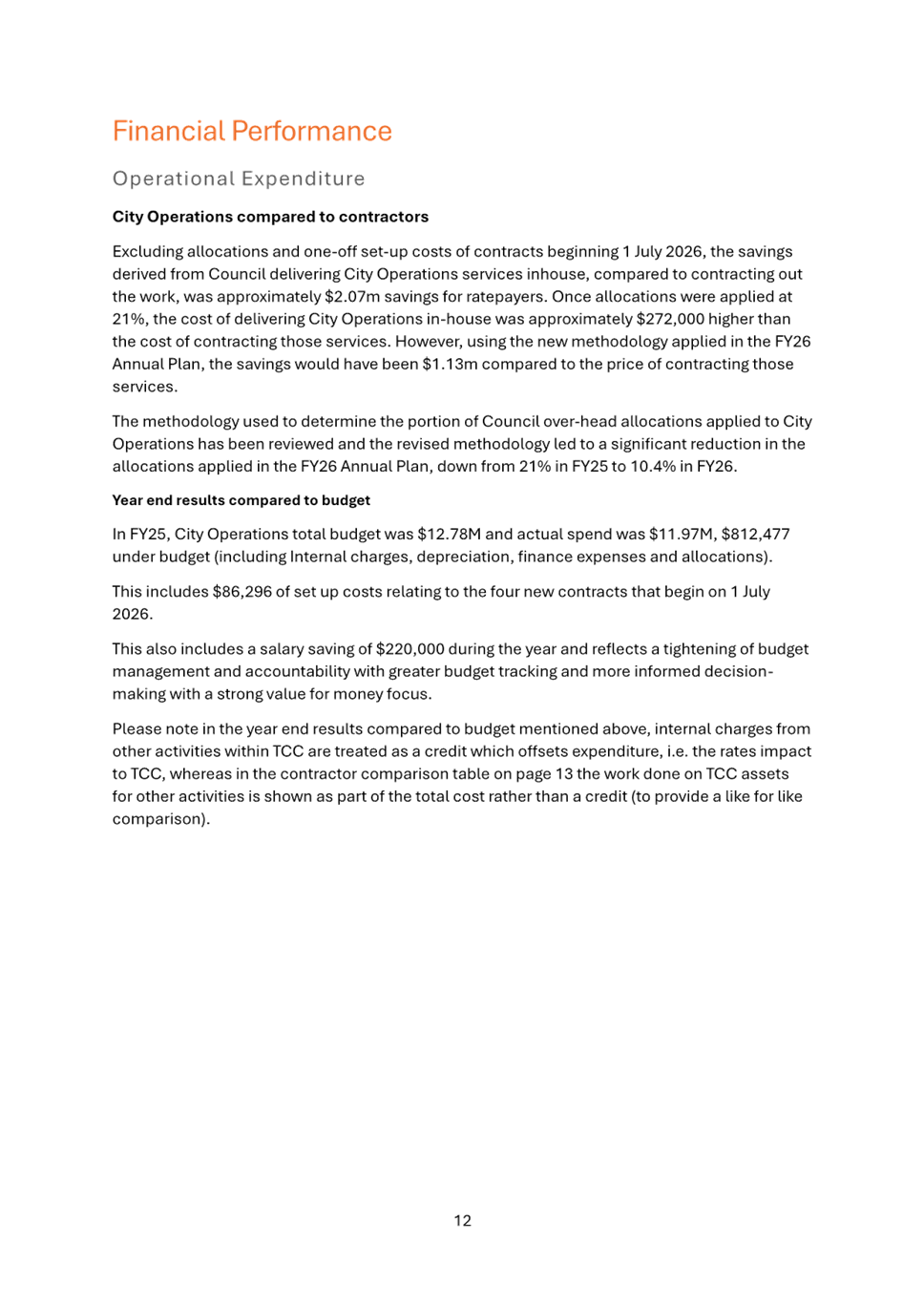
· Financial
Performance: City Operations delivered services in-house with significant
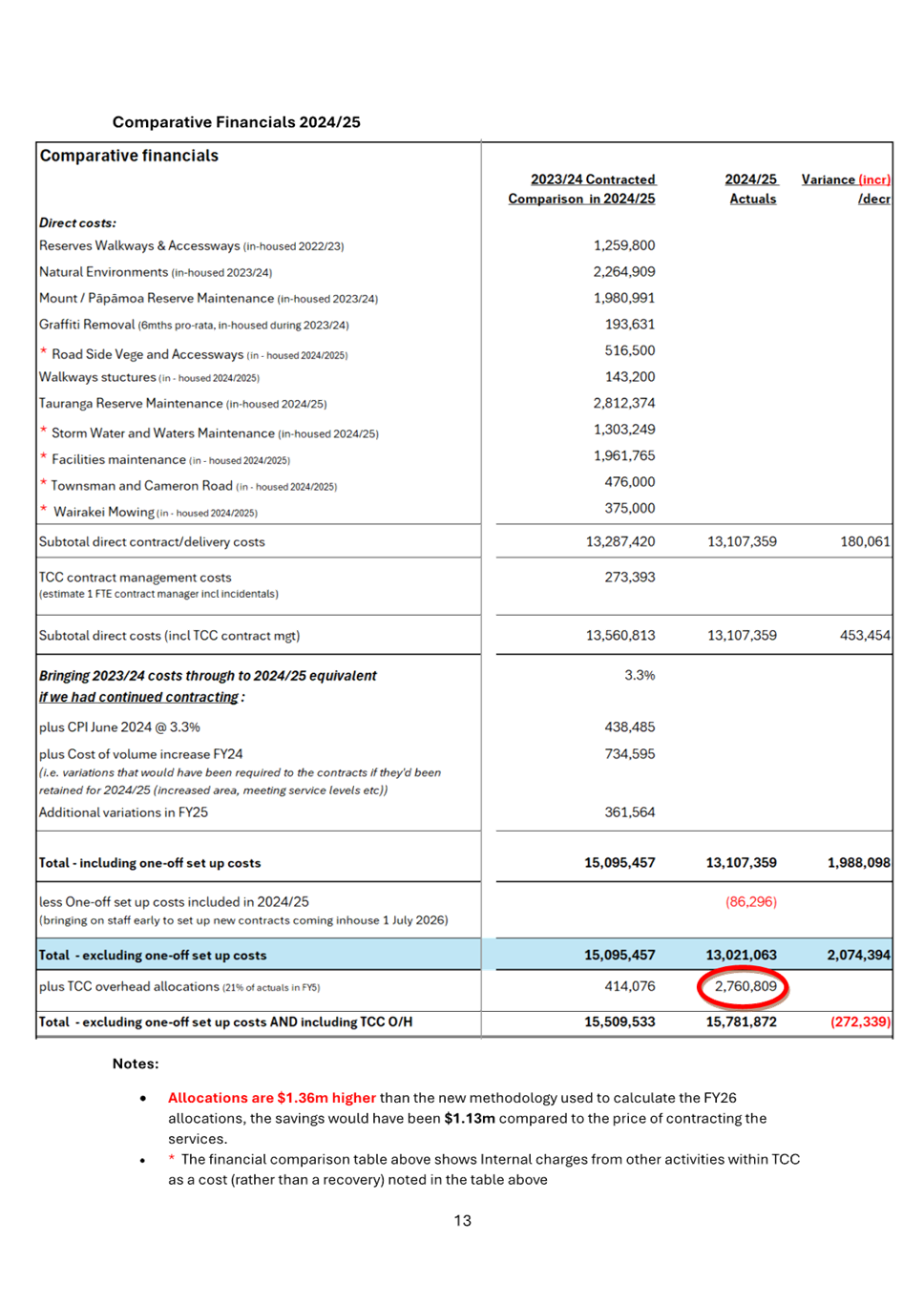
cost savings compared to contractors. Excluding allocations and one-off setup
costs, the in-house model saved approximately $2.07 million for ratepayers.
Using the revised allocation methodology applied in the FY26 Annual Plan, the
savings would have been $1.13 million. This demonstrates strong financial
governance and validates the cost-effectiveness of the internal delivery model
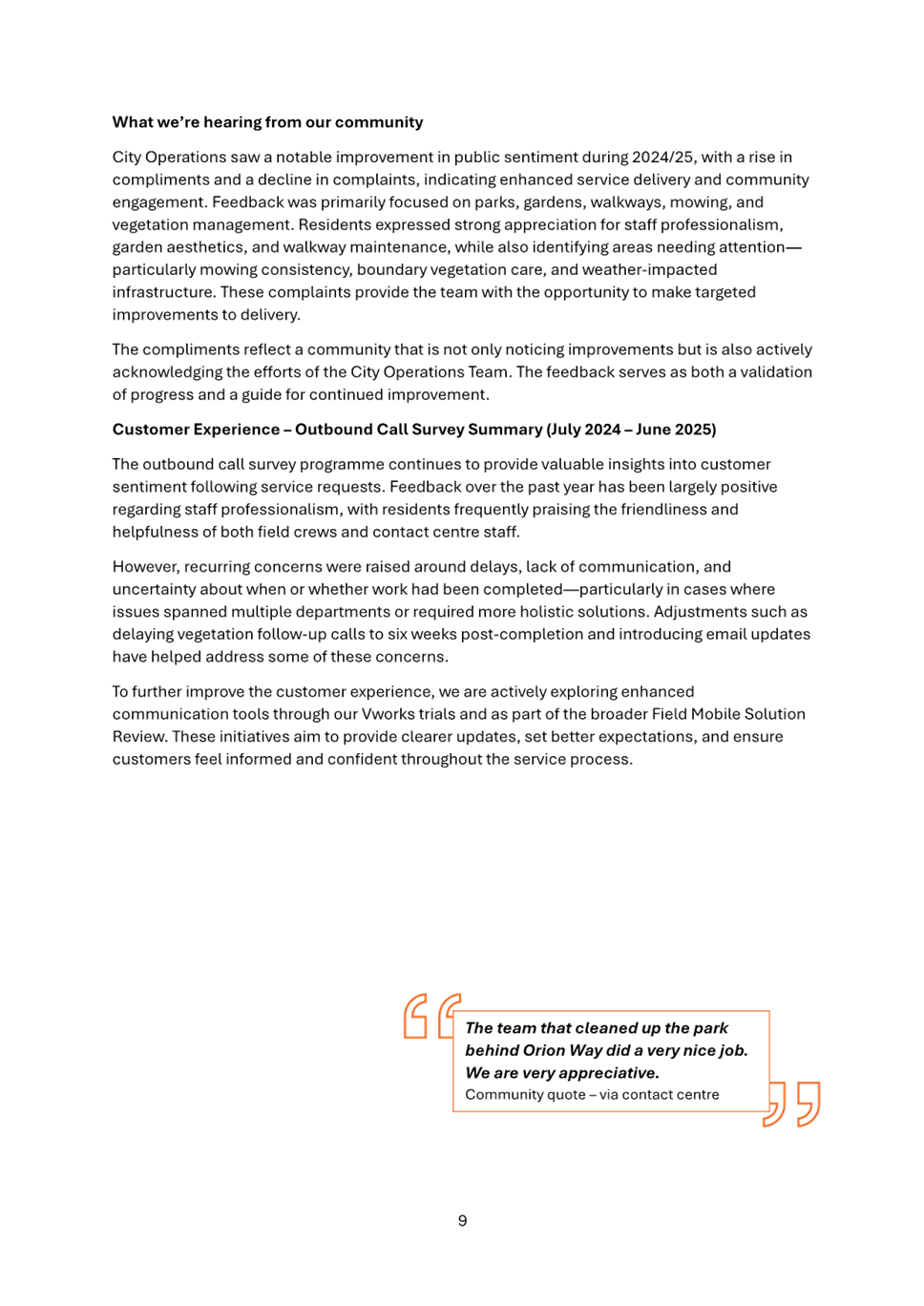
· Community
Engagement: City Operations received strong volumes of compliments during
FY2024–2025, reflecting improved service delivery and stronger community
trust. Feedback highlighted staff professionalism, garden aesthetics, and
walkway maintenance. The team’s responsiveness to requests and proactive
communication contributed to a more positive public sentiment and enhanced
civic pride.
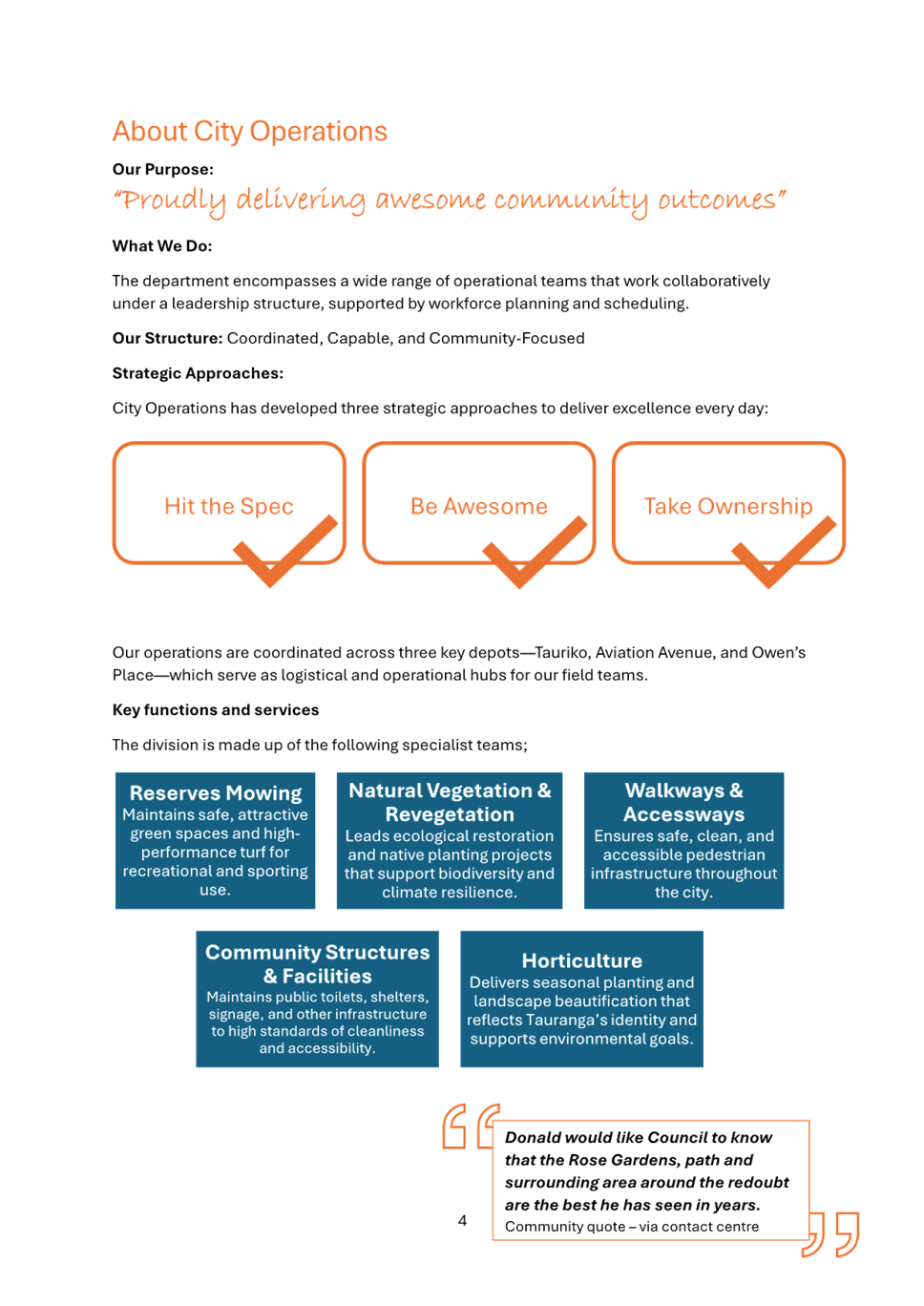
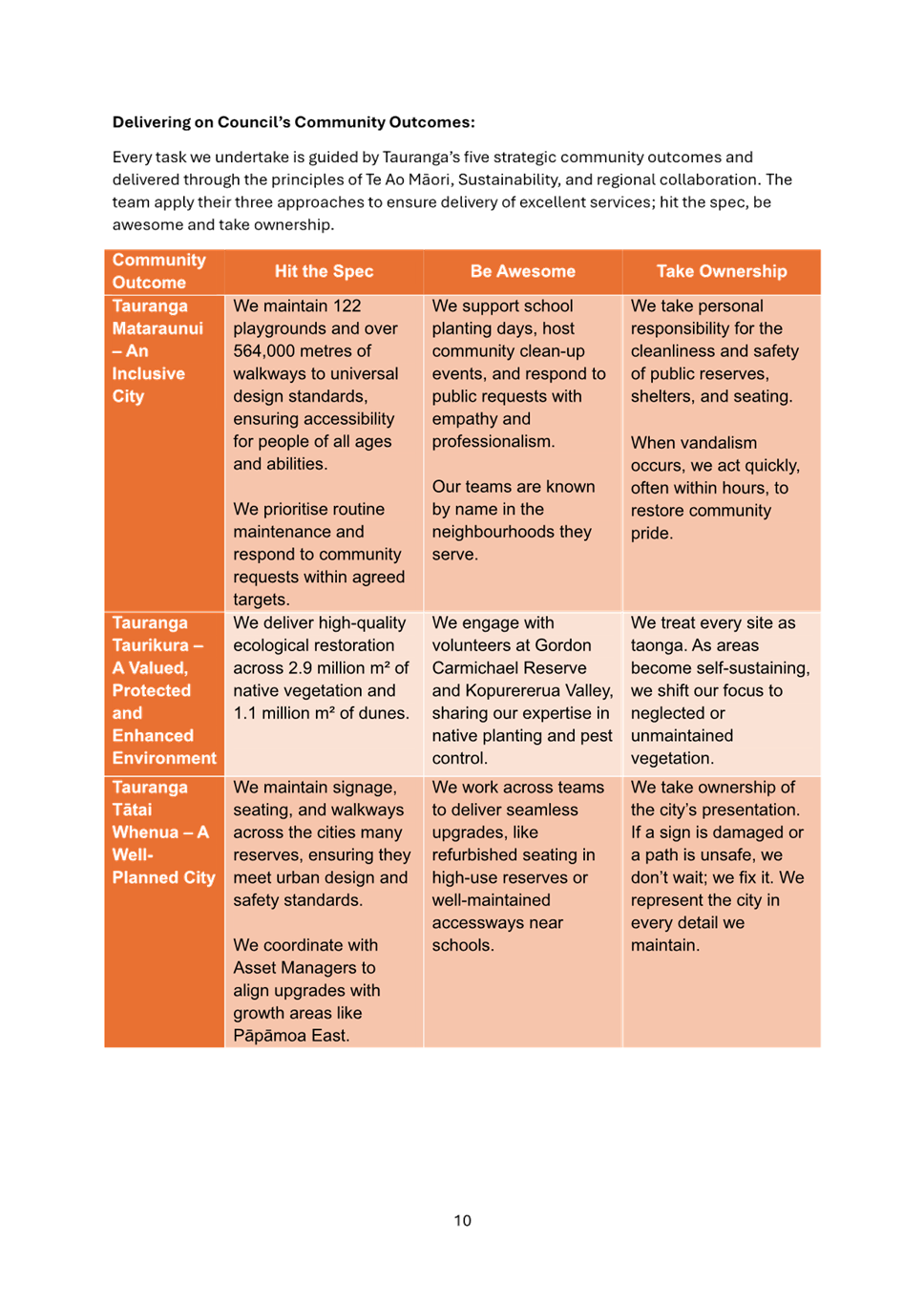
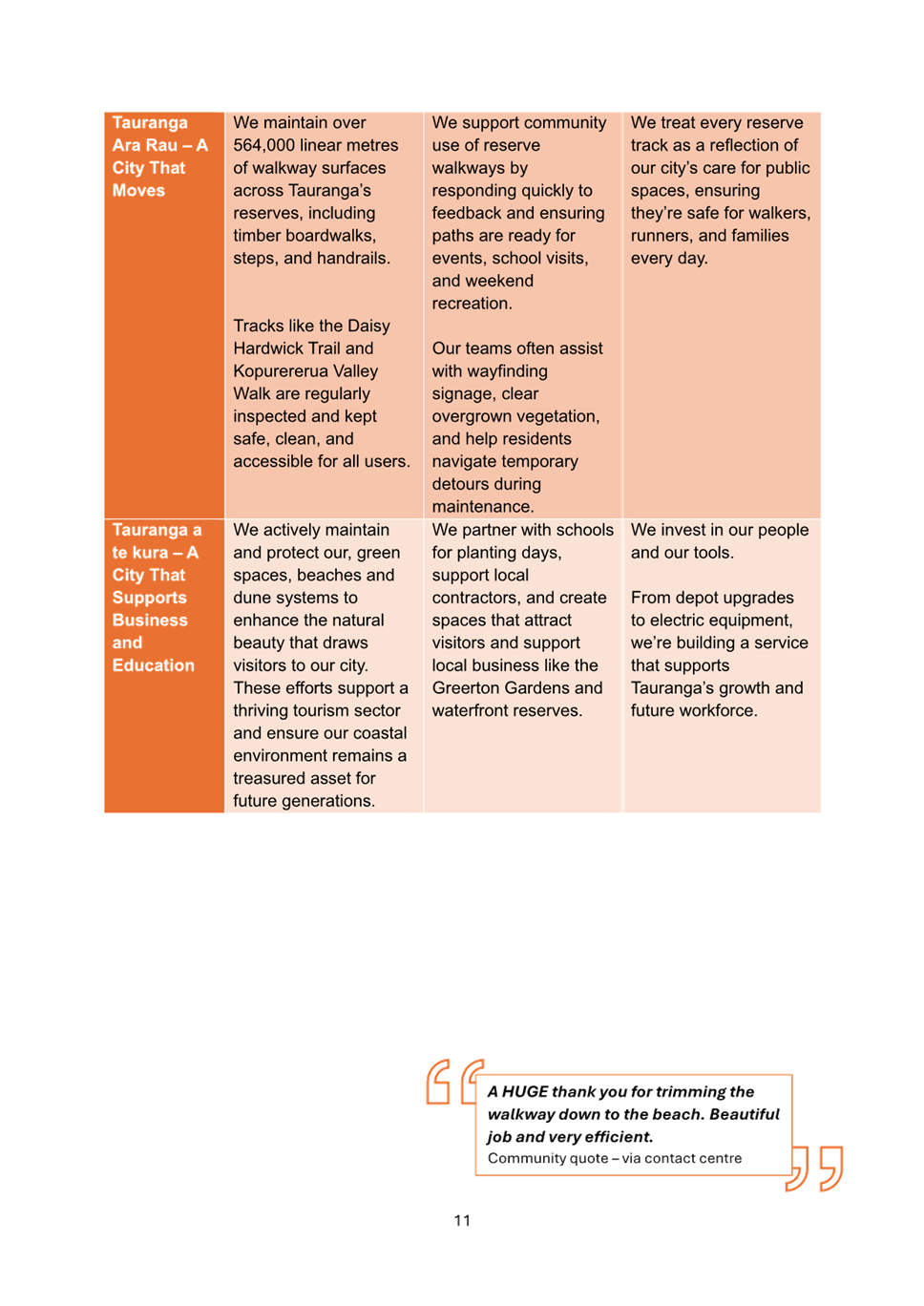
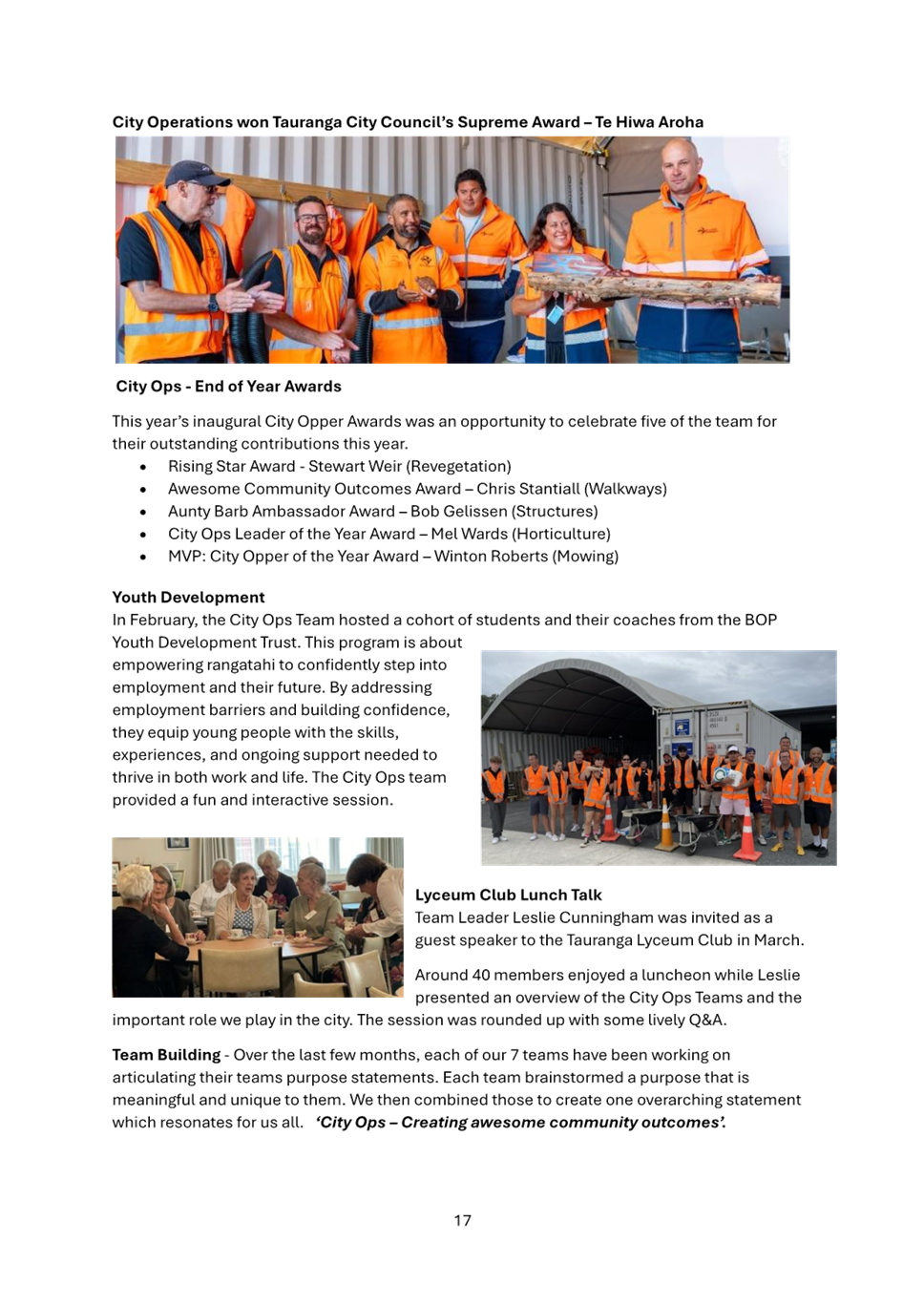
· Team
Culture: City Operations is driven by a strong team culture rooted in its
purpose: “Proudly delivering awesome community outcomes.” This
ethos is brought to life through the division’s core values — Hit
the Spec, Be Awesome, and Take Ownership — which guide daily operations
and foster a culture of excellence, pride, and accountability. Many team
members live in the same communities they serve, creating a deep sense of local
pride and responsiveness. This connection enhances trust with residents and ensures
services are tailored to community needs. Ongoing investment in staff
development, leadership training, and wellbeing initiatives has built a
resilient, capable, and community-focused workforce that not only maintains the
city but represents it with pride.
·
Innovation and Sustainability: Implemented work digital scheduling,
trialled robotic mowers and automated line-marking, adopted iAuditor for
self-compliance, and introduced electric wheelbarrows and agrichemical
alternative methodologies.
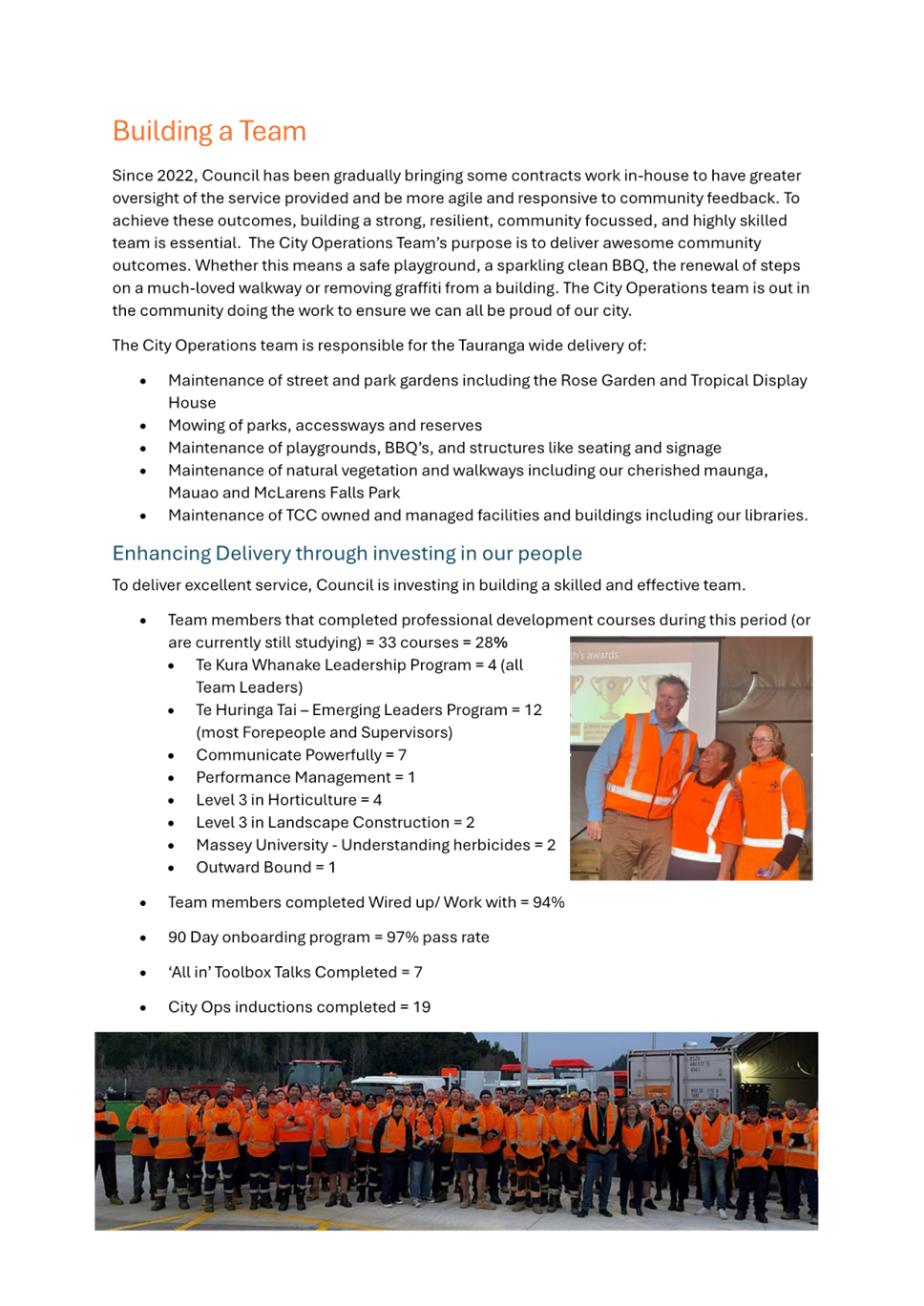
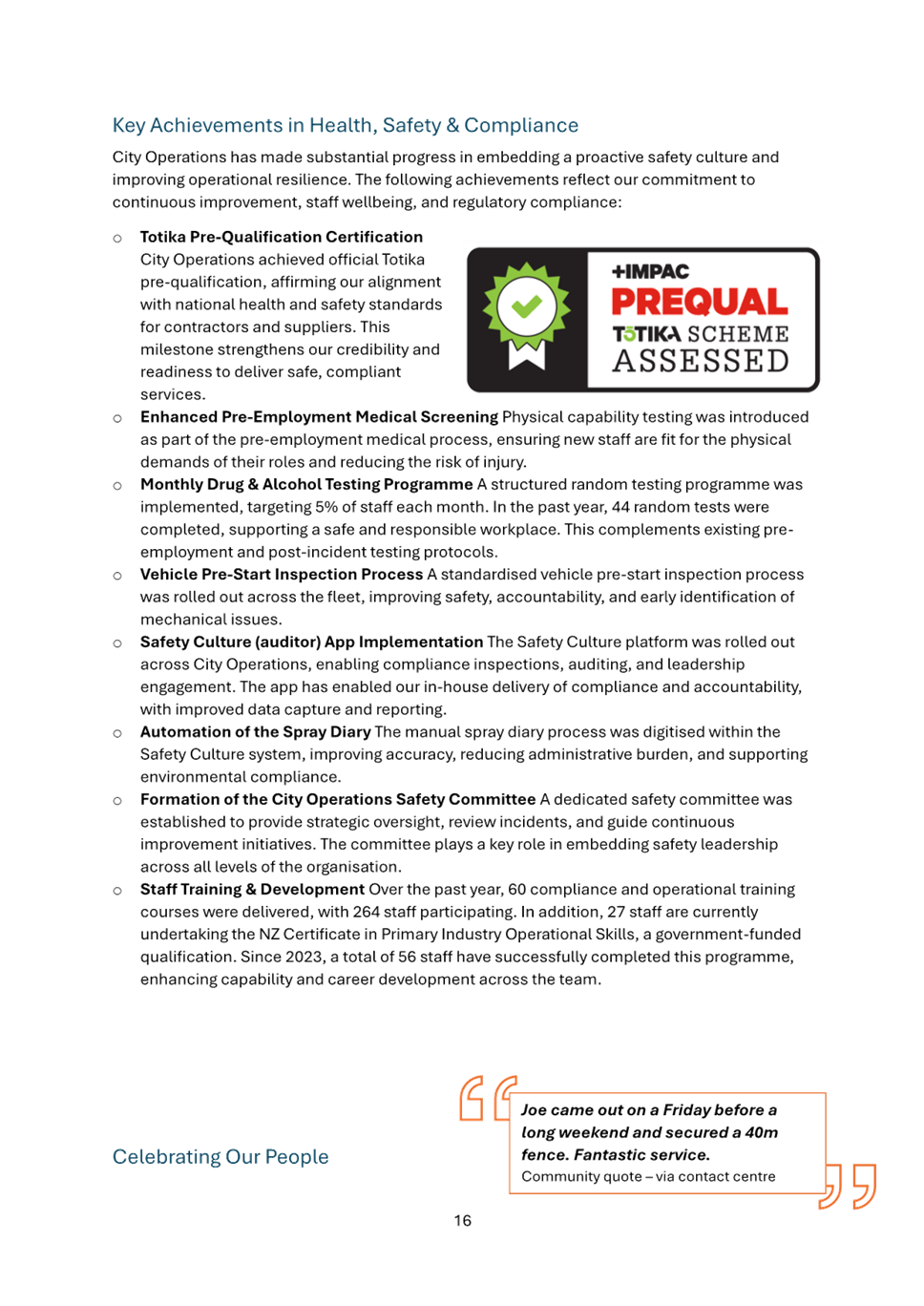
· Staff
Development and Safety: Delivered 60 training courses to 264 staff, with 27
staff undertaking NZ Certificate in Primary Industry Operational Skills. Safety
culture enhanced through Totika certification and monthly drug testing.
· Strategic
Outlook: Plans include benchmarking framework, expanding service delivery
to nearby councils, unlocking Waka Kotahi funding, and growing Traffic
Management scope.
Background
In 2022, Tauranga City Council
transitioned from a contractor-based model to an in-house delivery model for
parks and recreational services, following a Section 17A review under the Local
Government Act 2002. This transformation led to the establishment of the City
Operations team, with a clear purpose: to beautify Tauranga and foster civic
pride through more responsive, efficient, and community-focused service
delivery.
The new model aimed to break down
traditional contract boundaries, take full ownership of public assets, and
adapt services based on community feedback. It was designed to deliver better
outcomes for the same budget by focusing on three key goals:
1. Keeping
Tauranga Beautiful – adding visible value to public spaces
2. Prioritising
maintenance – addressing routine service gaps
3. Achieving
better outcomes for the same budget
STRATEGIC ALIGNMENT
1. This contributes to
the promotion or achievement of the following strategic community outcome(s):
|
Contributes
|
|
We are an inclusive city
|
☐
|
|
We value, protect and enhance the environment
|
ü
|
|
We are a well-planned city
|
ü
|
|
We can move around our city easily
|
☐
|
|
We are a city that supports business and education
|
☐
|
Attachments
1. City
Ops Annual Report 'final' - A19466964 ⇩
|
City
Delivery Committee meeting Agenda
|
15
December 2025
|
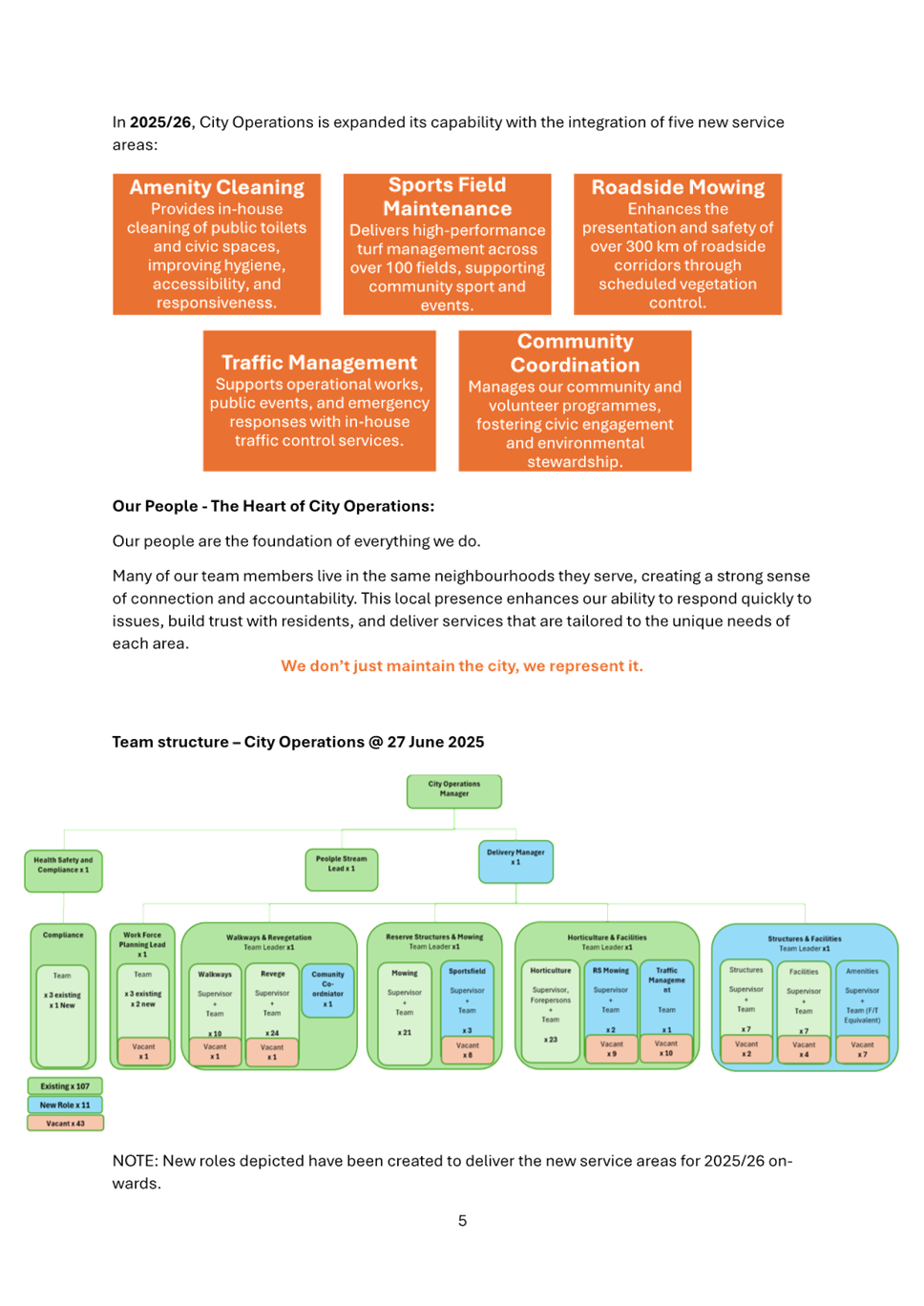
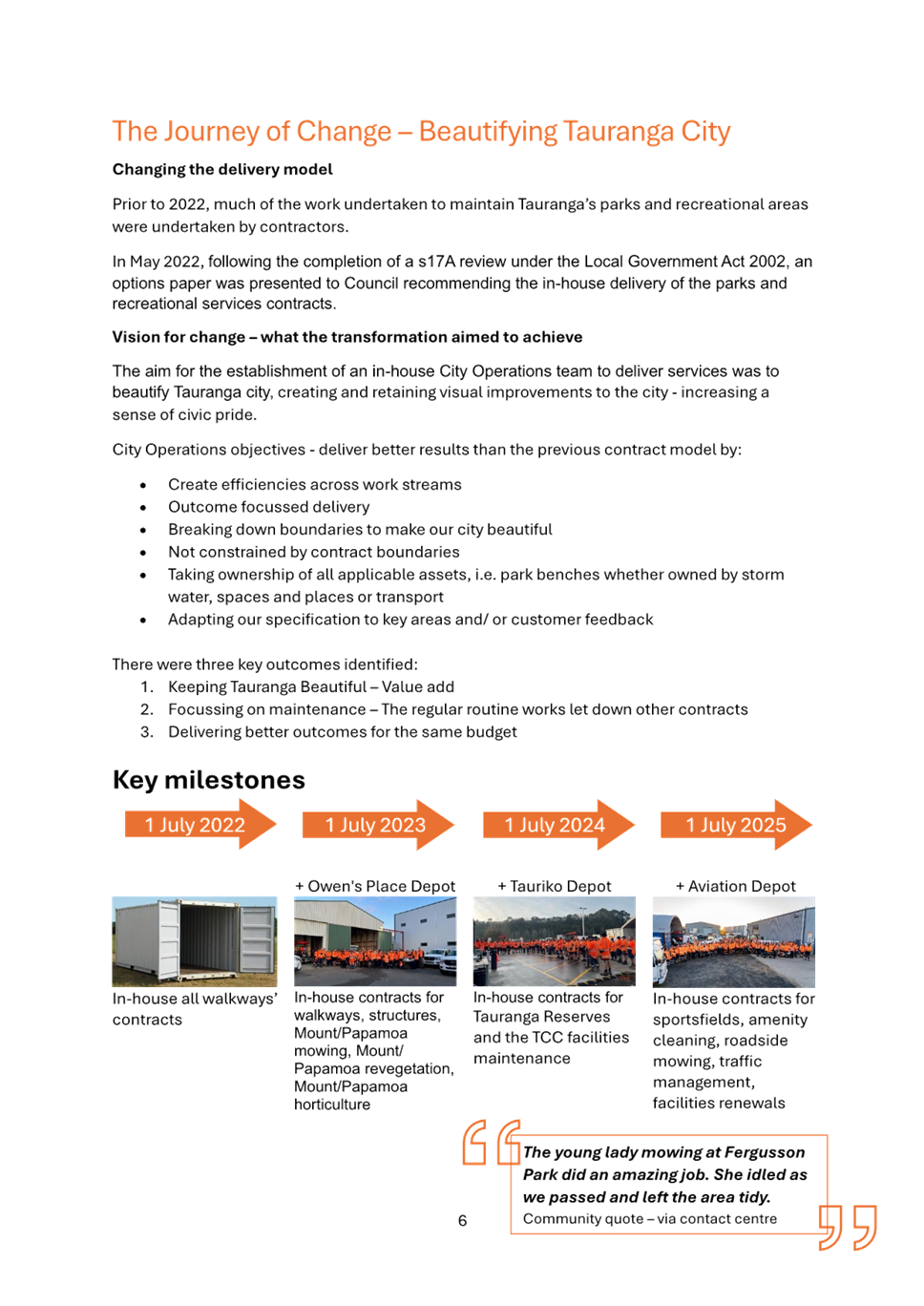
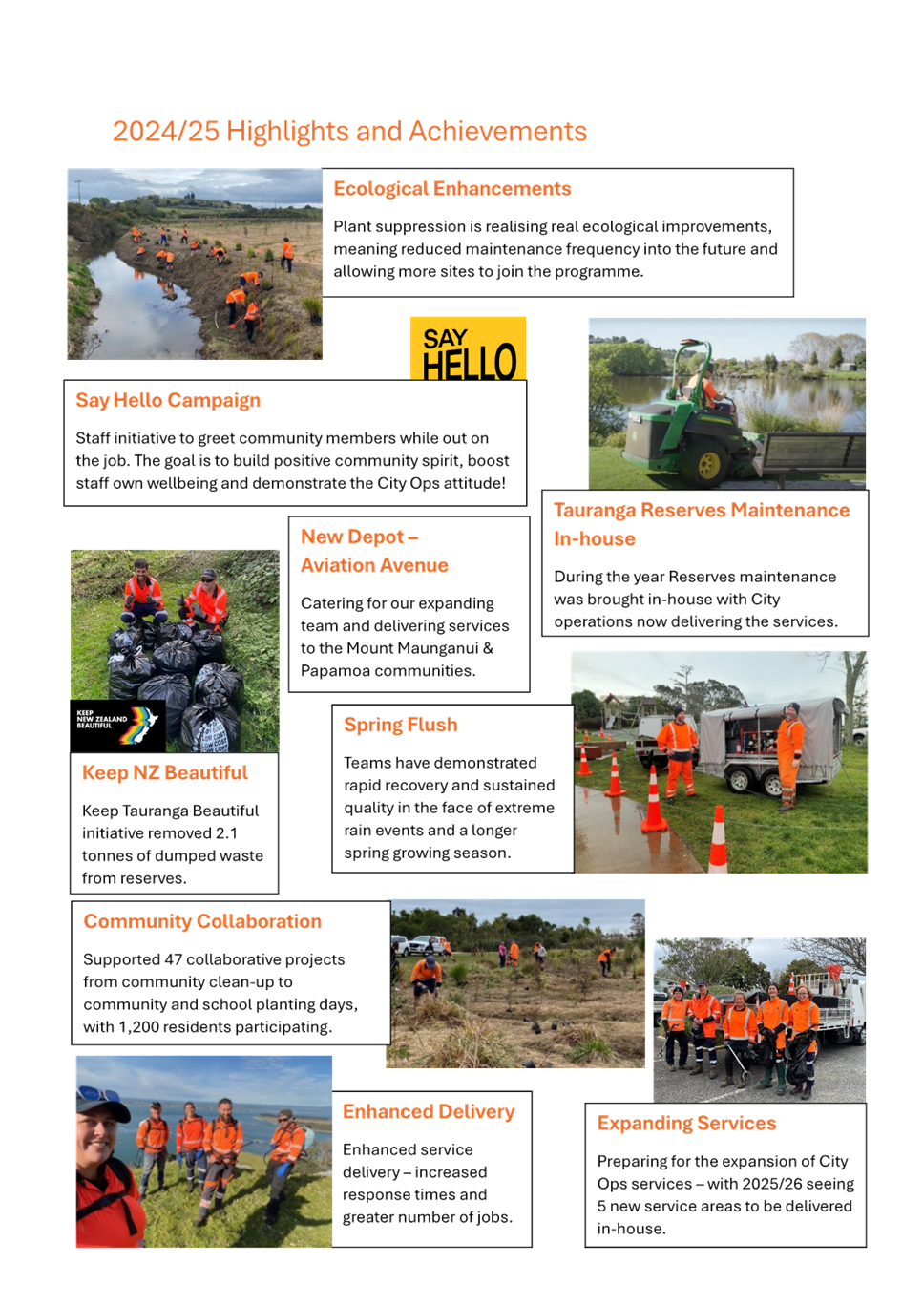
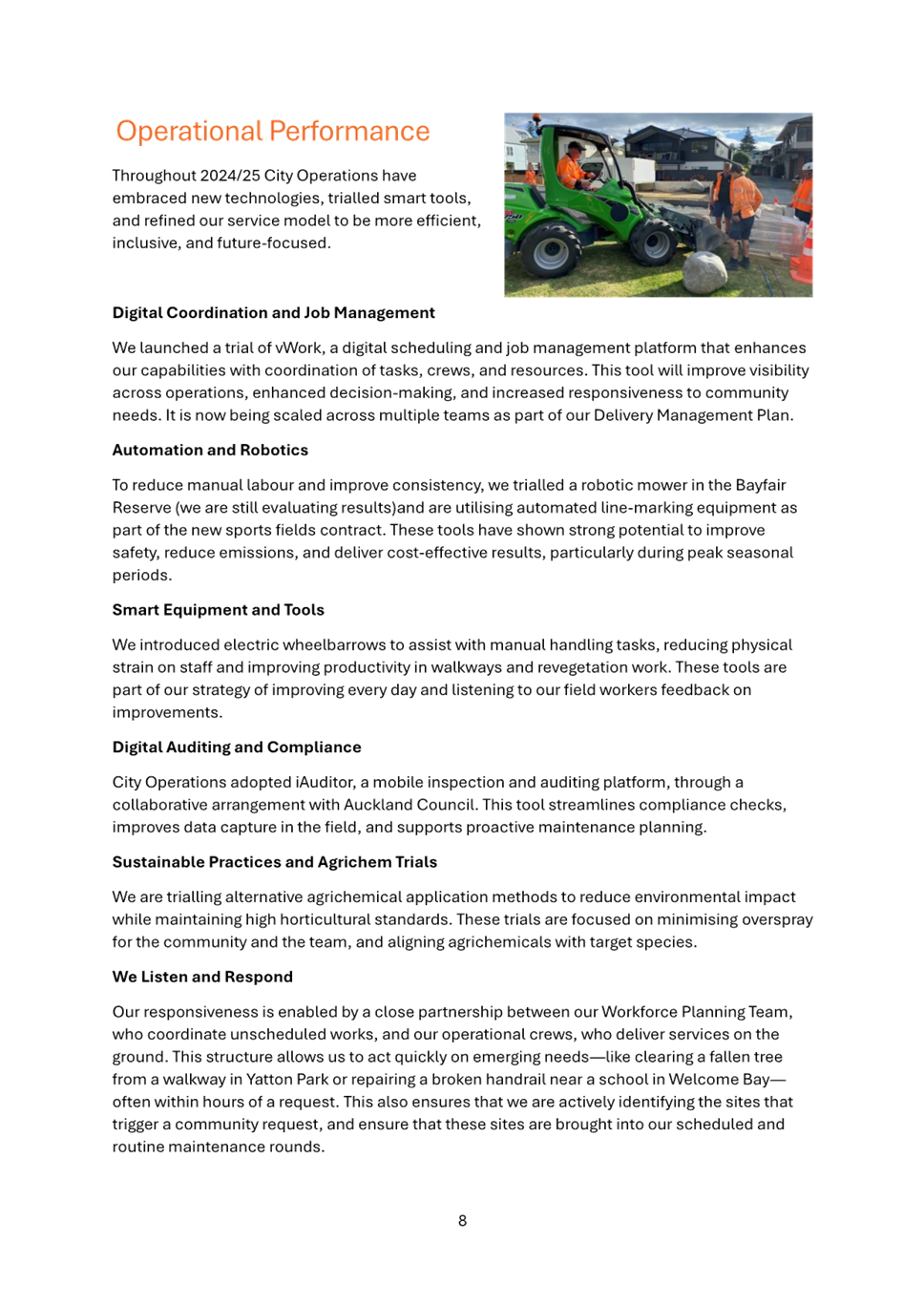

|
City
Delivery Committee meeting Agenda
|
15
December 2025
|
9.3 Aspen
Reserve Upgrade Options
File Number: A19261597
Author: Ana Hancock, Team Leader: Design
Emily
McLean, Manager: Urban Centres Development
Authoriser: Mike Seabourne, Acting General Manager Operations and Infrastructure
Purpose of the Report
1. To seek direction on the proposed
enhancement of Aspen Reserve, particularly the appropriate level of investment
for this space.
|
Recommendations
That the City Delivery Committee:
(a) Receives the report "Aspen Reserve Upgrade Options".
(b) Approves Option 1 for the development of Aspen Reserve.
|
Executive Summary
2. At the City Delivery
Committee Meeting 7 April 2025, the Committee decided to let the report to lie
on the table in order for Councillor’s to discuss more value for money
options for the upgrade of Aspen Reserve. The reasons report was left to
lie on the table include:
(a) Staff
will organise a workshop for Councillors to enable them to agree on an
acceptable scope for the Aspen Reserve work/upgrades from a safety and security
perspective, consistent with a value for money approach and provide information
on the operational expenditure.
(b) A
need for Councillors to understand broader decisions around the Annual Plan and
the impact on City Centre budgets before making a decision.
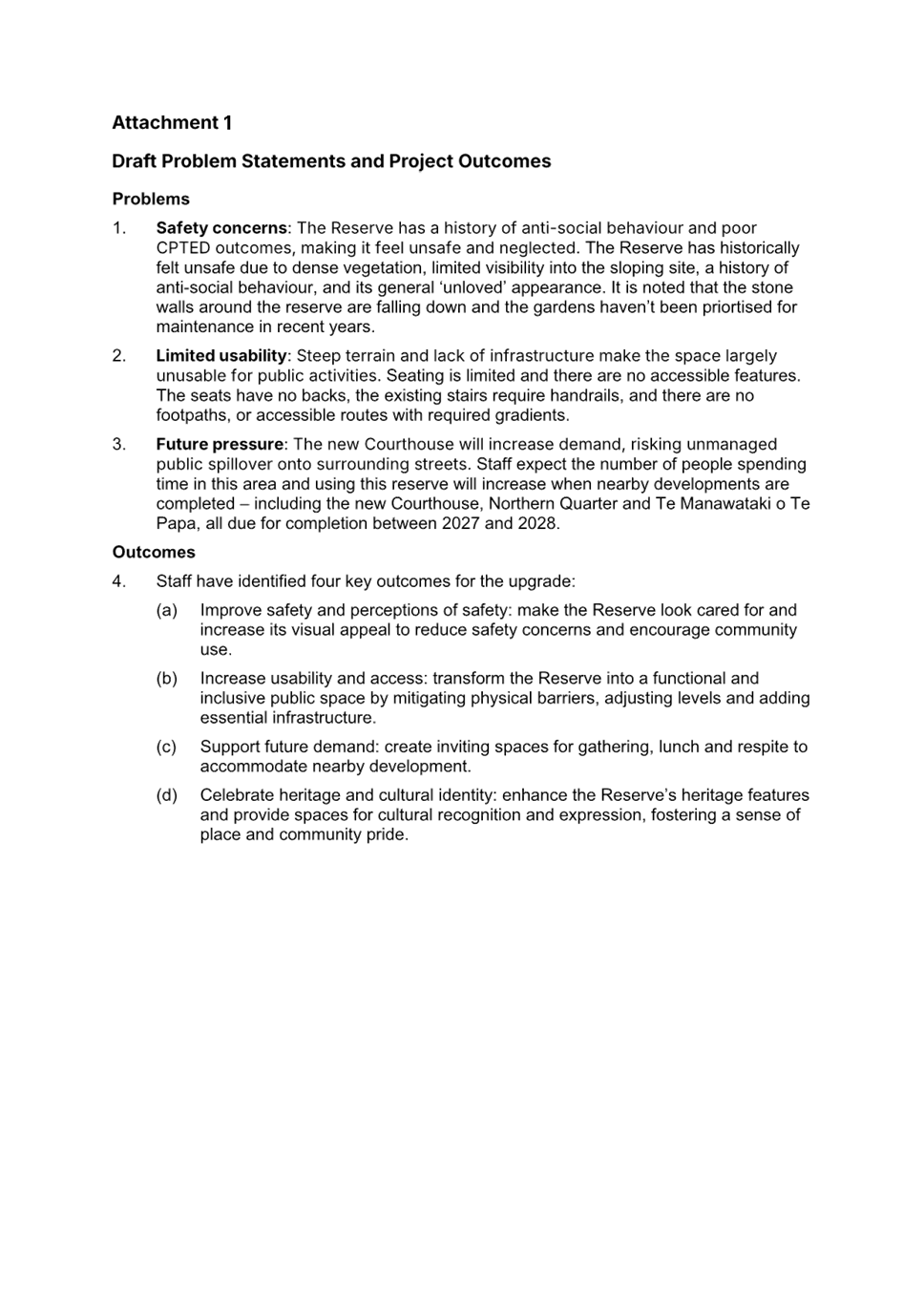
3. The Council workshop was held on 28 August 2025. Staff defined the
three key problems to be solved by the upgrade and the corresponding key
outcomes for the project. There were safety concerns, limited usability and
future pressure (more detail is provided in Attachment 1). Staff
presented a range of options which could be delivered individually or together
which responded to the problems and objectives for the project. These were:
(a) An accessible footpath from McLean Street and additional
seating;
(b) Terracing the grass slope;
(c) Creating a lower focal point, with landscaping, a mural and
potentially an informal stage area;
(d) Creating a deck around the pohutukawa tree with lighting;
and/or
(e) Providing universal access from Willow Street and McLean
Street.
4. The Councillors asked staff to develop options (a) and (d)
further. Staff were also asked to:
(a) Work with TCC asset managers and City Ops to remove the yew
trees, come up with a plan to improve planting at top and bottom of the
reserve, and plant additional trees throughout the reserve for shade;
(b) Work
with Mana Whenua and identify opportunities for cultural expression and
storytelling;
(c) Apply to the Public Art Fund for a mural on the wall at the
bottom of the reserve; and
(d) Protect the historic wall and consider the development of
interpretive signage.
These actions are being progressed.
5. Since that meeting staff have:
(a) proposed the addition of a fourth outcome: Celebrate
heritage and cultural identity.
(b) met onsite with Mana Whenua and identified opportunities for
cultural expression;
(c) are looking into options for how to proceed with an
application to the Public Art Fund. According to the Public Art Fund Policy,
Council is unable to apply for funding for projects under $50,000. Options
include bundling an application for the mural with other public art
applications or working with an external party to apply for funding on
Council’s behalf. A Mana Whenua representative has suggested a theme and
an artist for the mural however this has not been finalised or approved by all
Mana Whenua.
(d) met with the surrounding businesses to share plans for the
upgrade. (Mana Whenua and neighbouring businesses indicated support for an
upgrade);
(e) removed the two yew trees; and
(f) developed two design options:
(i) Option 1 combines options (a) accessible footpath and seating
and (d) tree deck with lighting as presented at the Council workshop.
(ii) Option 2 provides (a) accessible footpath and seating.
Both options
include opportunities for cultural expression, signage, improved planting and
trees for shade. Regarding item 4(d) protection of the historic wall, Option A
proposes removing the section of the wall damaged by the tree roots of the
pohutukawa and building a deck over and around the wall. Option B leaves the
wall including the damaged section fully intact.
6. We are now bringing this
matter back to Councillors for a decision on which option to proceed with.
7. Next steps include:
(a) Work with Mana Whenua to progress
opportunities for cultural expression
(b) Apply to the Public Art Fund;
(c) Complete detailed design for the
selected option and work with City Ops and a contractor to complete
construction and planting before the end of the financial year; and
(d) Keep the adjacent businesses informed as
the project progresses.
Background
8. This report seeks direction on the proposed enhancement of Aspen
Reserve, a small reserve on the corner of Willow and McLean Streets.
Historically the site was used for gardening, then hitching horses next to the
old post office and then later as the location for a large tree. Aspen reserve
was named after a large poplar tree (mistakenly thought to be an Aspen) planted
in the mid 1860’s. The tree remained until 2011 when it was
removed for health and safety reasons. Today, Aspen Reserve is surrounded by
office buildings and provides a valuable green space in the city centre. The
land is steep, with a four-metre fall from top to bottom, and includes a
natural amphitheatre previously used for events.
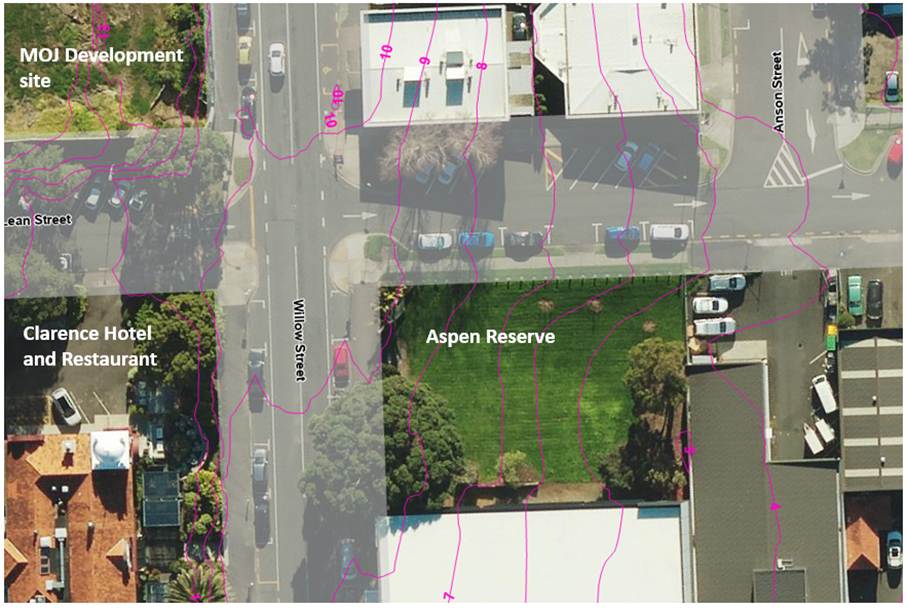
9. The reserve is
diagonally opposite the new Ministry of Justice Courthouse, currently under
construction (see Figure 1). Its proximity to the new
courthouse creates an opportunity to develop the reserve into a contemporary
inner-city “sanctuary space,” as identified in the City Centre
Action and Investment Plan (CCAIP). The upgraded reserve could provide respite
for courthouse visitors and staff, as well as office workers nearby.
Figure 1: Location of Aspen Reserve
10. In
response to the problems identified at the reserve (see Attachment 1),
Staff have identified four key outcomes for the upgrade:
(a) Improve
safety and perceptions of safety: make the Reserve look cared for and increase
its visual appeal to reduce safety concerns and encourage community use.
(b) Increase
usability and access: transform the Reserve into a functional and inclusive
public space by mitigating physical barriers, adjusting levels and adding
essential infrastructure.
(c) Support
future demand: create inviting spaces for gathering, lunch and respite to
accommodate nearby development.
(d) Celebrate
heritage and cultural identity: enhance the Reserve’s heritage features
and provide spaces for cultural recognition and expression, fostering a sense
of place and community pride.
11. The future vision for Aspen Reserve is
for it to be:
A safe, inclusive, and vibrant
green space that honours heritage, celebrates cultural identity, and becomes a
sought-after destination for the growing number of people living, working, and
visiting this part of the city.
12. Staff received the following feedback
and direction from Councillors at the August workshop:
(a) There was general agreement with the problem statements and
key objectives;
(b) There
was support for considering low-impact design principles both from a cost
perspective as well as protecting the ‘untouched’ character of the
Reserve;
(c) There
was some support for increasing lighting within the Reserve to provide better
safety outcomes as well as to enhance the after-hour experience of the
Reserve;
(d) There
was limited support for terracing the sloping banks of the Reserve;
(e) There
was support for low-cost interventions that achieves landscaping improvements
at the lower level of the Reserve, accessible access (at least) from McLean
Street, and improving the space around the base of the Pohutukawa Tree, while
considering the heritage nature of the stone walls;
(f) There
was some support for a phased approach where updates to the Reserve could be
made over time; and
(g) Councillors
asked staff to consider applying to the Public Art Fund to bring a mural and/or
mahi toi into the Reserve;
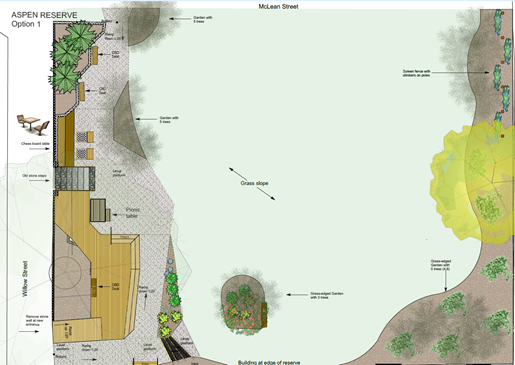
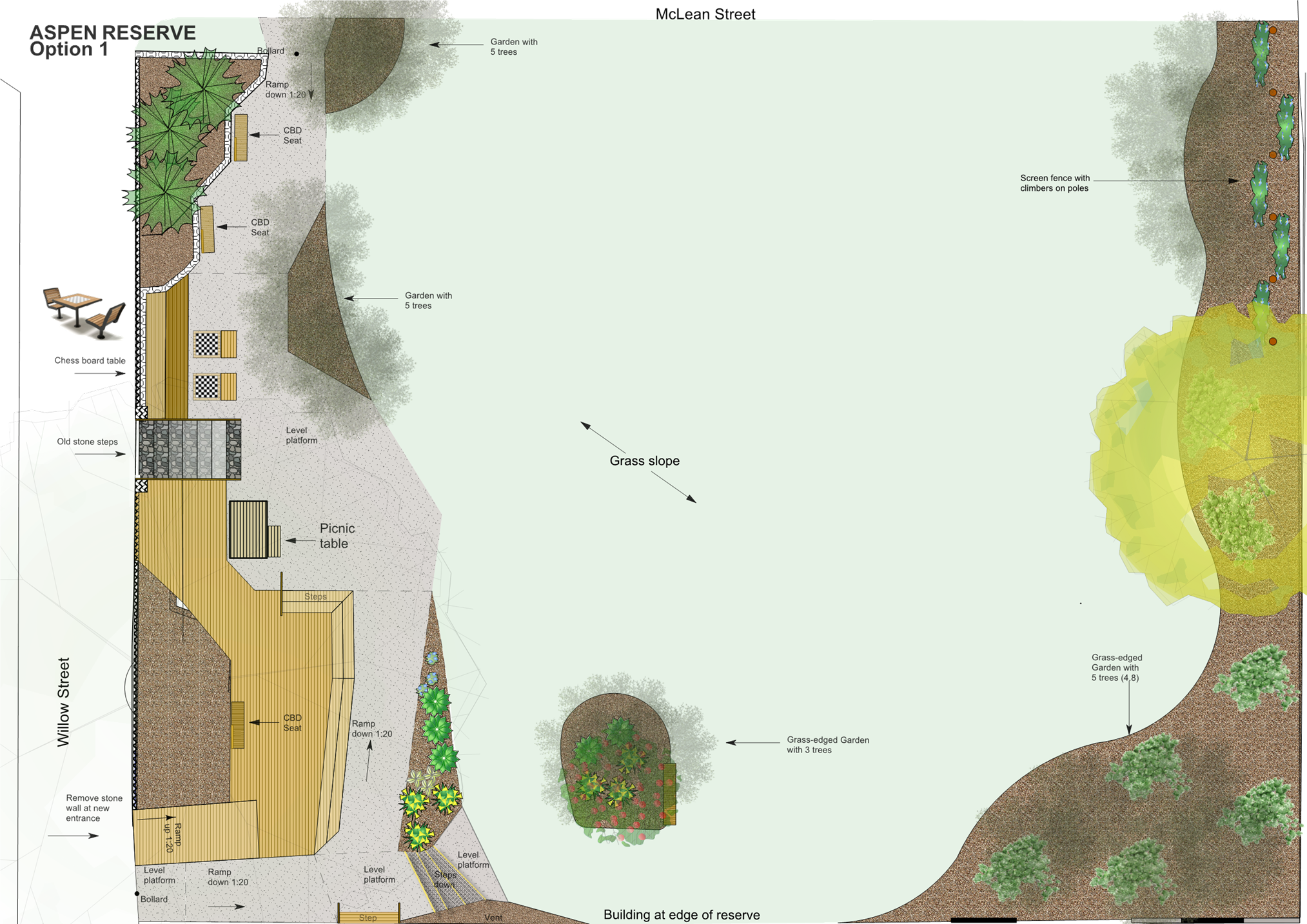
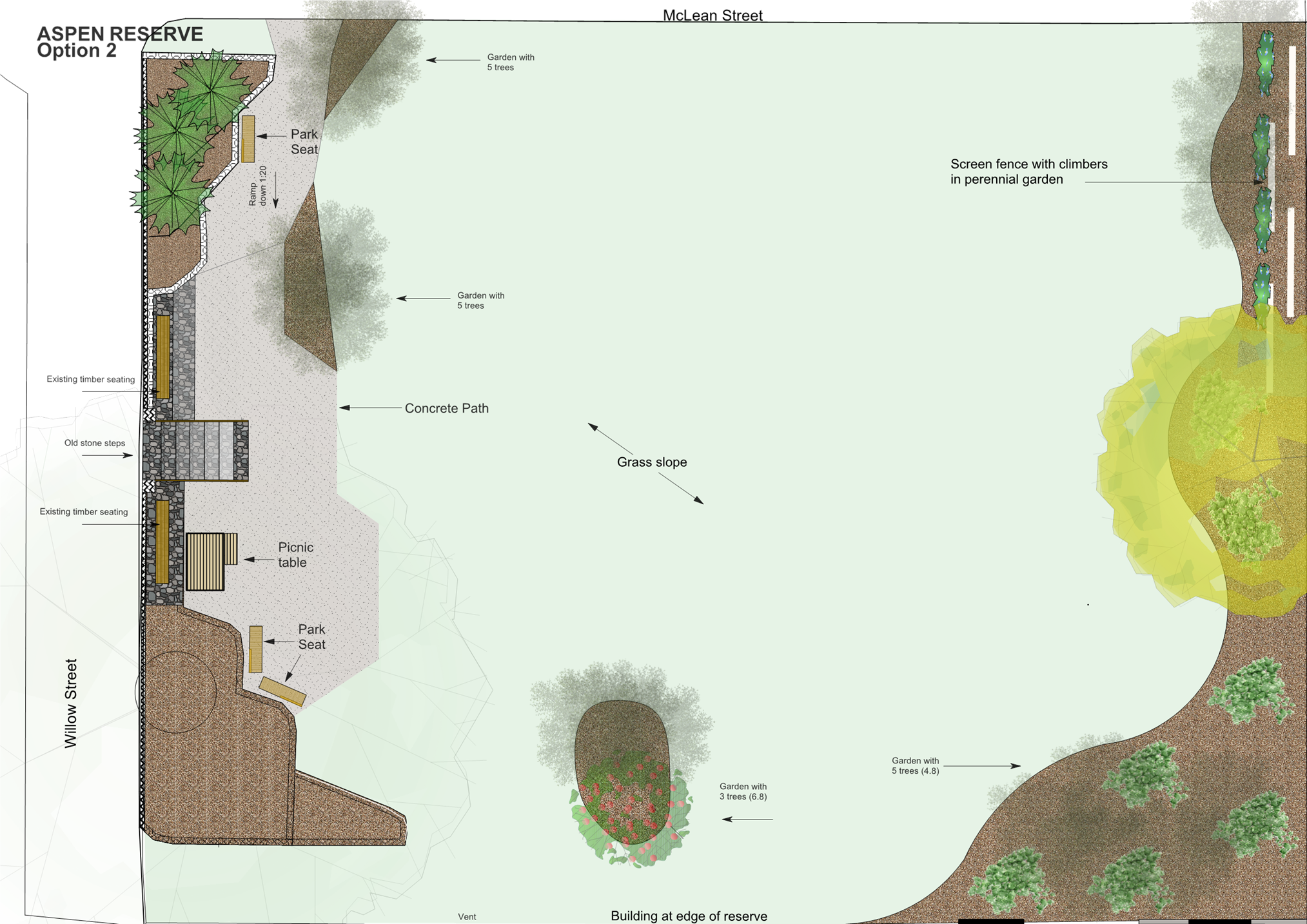
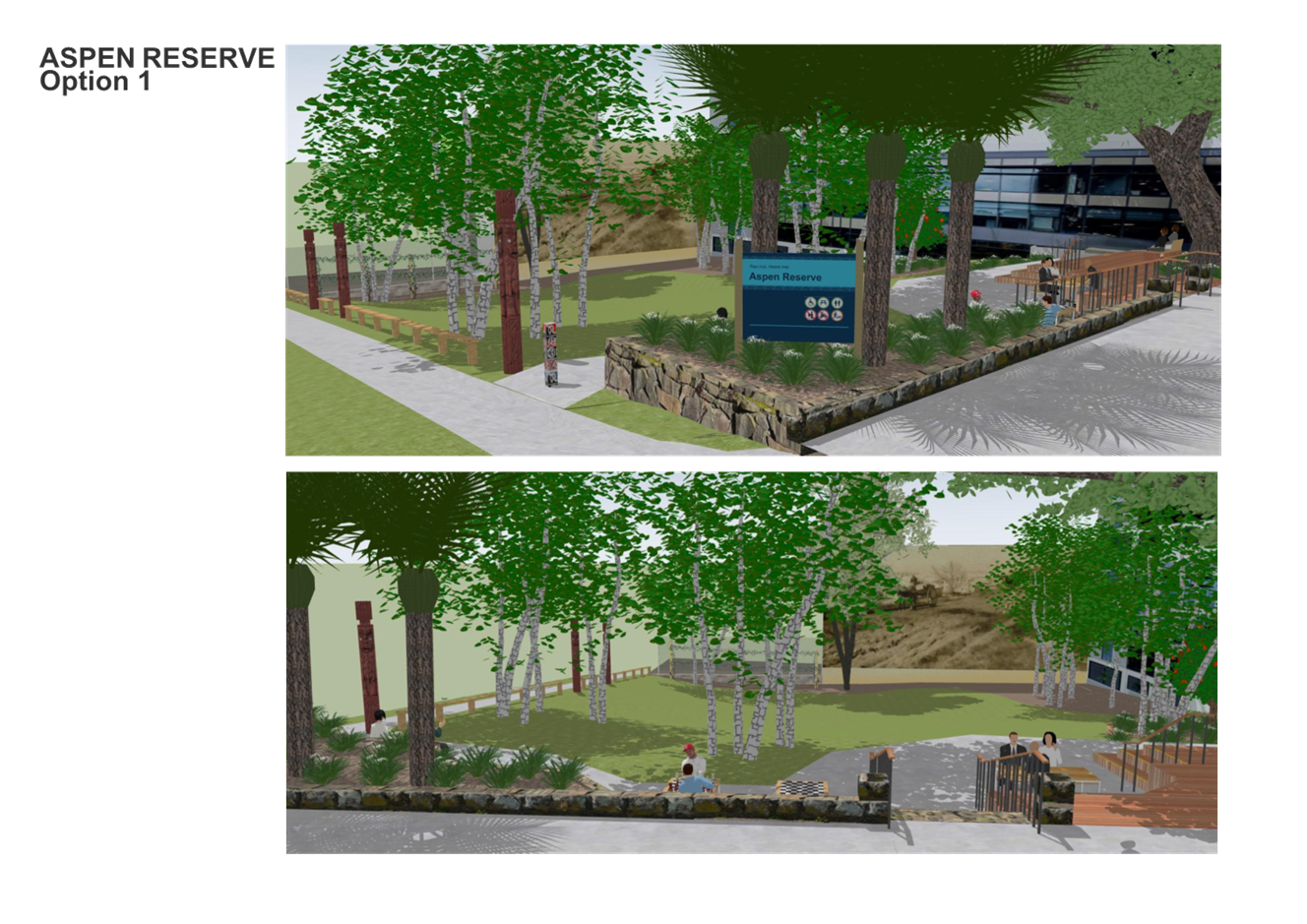
13. In response, staff have developed two
concepts for the enhancement of Aspen Reserve (Attachment 2).
(a) Option 1 provides accessible access
across the top of the Reserve from Willow Street and McLean Street. It
incorporates a timber deck around the Pohutukawa tree and lighting, as well as
a picnic table under the shade of the Pohutukawa, and a chess table in the sun,
Option 1 also provides an opportunity for the neighbouring business at 17
Harrington Street to open directly on the reserve, therefore providing
additional opportunities for activation and passive surveillance.
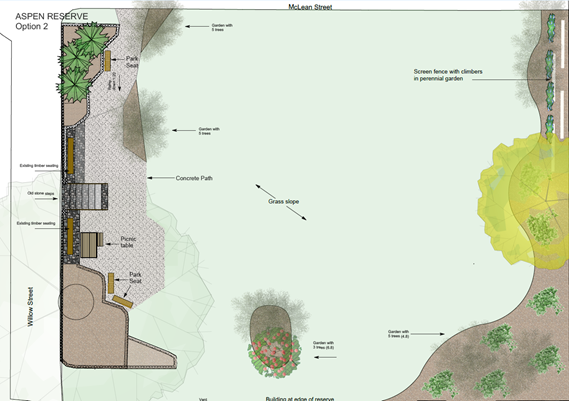
(b) Option 2 omits some of the features that
make access to the reserve from Willow Street more inviting, specifically the
deck around the Pohutukawa tree and lighting. The accessible footpath is
shortened, only providing access from McLean Street.
Both options
include opportunities for cultural expression, signage, improved planting and
trees for shade.
The delivery of
Option 1 is likely to cost a maximum of $350k, including staff time for design
and project management and archaeological observations. Option 2 is anticipated
to cost a maximum of $200,000. Further detail on these two options is provided in
the options analysis section of this report.
Statutory Context
14. Aspen Reserve is classified as a
recreation reserve in the Reserves Act. Categorised as a unique urban space in
the Tauranga Reserves Management Plan (TRMP), the Reserve provides valuable
amenity open space in an area of high population density. The TRMP also states
that the Reserve should provide facilities to enable events, although this may
no longer be appropriate given proposed investment in the city centre to create
other event spaces e.g. Te Manawataki o Te Papa and the Waterfront North
Reserve.
15. There are a number of archaeological
features on and surrounding the reserve so an archaeological authority will be
required.
STRATEGIC ALIGNMENT
16. This
contributes to the promotion or achievement of the following strategic
community outcome(s):
|
|
Contributes
|
|
We are an inclusive city
|
ü
|
|
We value, protect and
enhance the environment
|
ü
|
|
We are a well-planned city
that is easy to move around
|
☐
|
|
We are a city that supports
business and education
|
ü
|
|
We are a vibrant city that
embraces events
|
☐
|
17. Within
the City Centre Action and Investment Plan (CCAIP), Aspen Reserve is a key
feature of the Justice Precinct. Upgrading Aspen Reserve is identified as one
of three priority actions within the Justice Precinct, described as: “upgrade
Aspen Reserve, to support the Ministry of Justice courthouse and campus and as
a ‘sanctuary space’ in the short term”.
18. This project also contributes to a key objective within the CCAIP
“a city centre for people” as part of the work to “Develop
and deliver a programme of upgrades to existing parks and open spaces
considering the needs of both visitors and residents.”
19. Aspen Reserve is also located along Te Manawa
Huanui, the pedestrian focussed north-south walking route that connects Te
Manawataki o Te Papa with the significant heritage precinct north of the city
centre (including Taumatakahawai/Monmouth Redoubt, the Ōtamataha Mission
Cemetery, and the Elms.)
Options Analysis
20. Option 1
provides:
(a) Universal access across the top of the reserve from Willow Street to
McLean Street. Access is provided both through compliant 1:20 gradients and
stairs with compliant handrails;
(b) A
timber deck around the Pohutukawa that provides access into the Reserve and
areas for informal seating drawing people into the space;
(c) Lighting
of the Pohutukawa. It is currently proposed to have the same lighting treatment
as the trees in Red Square and on Grey Street;
(d) A
picnic table in the shade under the Pohutukawa and a chess table in the sun,
providing seasonal seating options;
(e) A
variety of seating – both formal and informal;
(f) Amenity
planting at the top and bottom of the reserve, with groups of shade trees to
unify the reserve;
(g) Screening
of the adjacent carpark behind LiquorLand with planting;
(h) Opportunities
for cultural expression;
(i) Signage;
and
(j) An
opportunity for the neighbouring business at 17 Harrington
Street to open directly on the reserve, therefore providing additional
opportunities for activation and passive surveillance.
21. Option 1 is proposed to be delivered
within a budget of ~ $350k which includes internal staff design and project
management time.
Figure 2: Option 1
22. Option 2
provides:
(a) A shorter
accessible access from McLean Street only;
(b) Seating under the Pohutukawa
and a chess table in the sun, providing for seasonal seating options;
(c) Amenity planting at the top and
bottom of the reserve, with groups of shade trees to unify the reserve;
(d) Screening of the adjacent
carpark behind LiquorLand (with planting);
(e) Opportunities for cultural
expression (still to be determined); and
(f) Signage.
23. Option 2 is
proposed to be delivered within a budget of ~$200k which includes internal
staff design and project management time.
Figure
3: Option 2
24. The table
below outlines the advantages and disadvantages of each option, as well as a
“do nothing” Option 3:
|
Option
|
Advantages
|
Disadvantages
|
|
Option
1
|
· Timber deck surrounding Pohutukawa provides
improved connection between Willow Street and the Reserve, drawing people
into the space.
· Lighting of the tree contributes to the
amenity of Willow Street at night and provides an attractive gateway into the
city centre.
· Better outcomes for universal accessibility
and inclusion.
· More seating opportunities and options for
multiple groups, and places to eat lunch.
· Provides an opportunity for the neighbouring
business at 17 Harrington Street to open directly on the Reserve, therefore
providing additional opportunities for activation and passive surveillance.
· The upgrade improves the usability of the
Reserve which mitigates against perceptions of a lack of safety.
|
· Comes at a higher cost.
· Upgrade will take slightly longer to complete
than Option 1.
|
|
Option
2
|
· Lower cost option
|
· Provides less opportunities and options for
seating and having lunch for multiple groups;
· Provides no opportunities for lighting;
· Provides less choice of universal access into
the Reserve;
· Reduces the opportunity for the neighbouring
business to access directly into the Reserve.
|
|
Option
3 – status quo
|
· Budget can be reprioritised to other city
centre Reserve projects.
|
· Aspen Reserve remains under-utilised,
inaccessible to those with accessibility requirements, and retains the
perception that it is unsafe.
|
25. Option 1 is recommended as it
maximises use of the reserve, better responds to the outcomes in the CCAIP and
has the most benefits for the community.
Financial Considerations
26. Capital funding is available through the City Centre Green Spaces
budget that supports the delivery of a key CCAIP action
to: “Develop and deliver a
programme of upgrades to existing parks and open spaces considering the needs
of both visitors and residents.”
27. Delivering this project at a cost
between $200k and $350k would allow remaining budget to be spent on other green
spaces projects contributing to a ‘city centre in nature’.
28. As an existing asset, maintenance of the Reserve including
existing gardens and trees and lawns are covered by existing opex budgets. It
is estimated that the current reserve would cost $3,024 annually including
maintenance and depreciation costs.
29. Additional furniture, timber decking and particularly
lighting will increase opex costs. Option 1 is estimated to cost $5,336 in
annual opex and Option 2 is likely to cost approximately $3,563.
Legal Implications / Risks
30. There are no legal implications or other
risks noted with the recommendation to determine a preferred option for the
redevelopment of Aspen Reserve.
31. There may be risks to implementation if
archaeological approval is not given.
TE AO MĀORI
APPROACH
32. There are three hapū with an interest in the city centre area.
There is an opportunity to investigate how the design can reflect the
area’s Māori history building on similar approaches elsewhere in the
city centre.
33. Previous engagement with Ngāi Tamarāwaho in 2017 suggested
referencing nearby Taumatakahawai and that the area’s historic use as a
garden be incorporated into the design, as well as interpretation signage and
pou, and dual naming recognising the Māori occupation of this area. More
recently at the site meeting with Mana Whenua representatives including
Ngāi Tamarāwaho and Ngāi Tukairangi, opportunities for cultural
recognition were confirmed as the following:
· Reserve naming
· Pou
· Etched patterns on the concrete footpath
· Mural (one suggestion was painting from a historic photo showing whanau
members helping to build Willow Street next to the Reserve); and an
· Interpretation
panel.
34. The pou and interpretation panel
are included in the cost estimate in both options. The concrete etching is
included in the budget for option 1 only. The mural is currently unfunded.
35. Other items suggested by Mana
Whenua included a stage, a drinking fountain and removal of the three Nikau
trees and replacement with a suitable shade tree. These have not been budgeted
for.
CLIMATE IMPACT
36. There is an
opportunity to look at incorporating sustainability considerations into the
design. For example, previous designs for this area included substantial
concrete, which has a significant embedded carbon cost. The designs presented
here propose less use of concrete and instead enhance the green space to
provide access to nature for city centre residents and visitors.
Consultation / Engagement
37. Engagement on the proposed upgrade with
hapū, stakeholders, and neighbouring businesses and property owners was
undertaken in March and again in October-November.
38. Mana Whenua and the majority of the
businesses were supportive of an upgrade taking place. Adjacent businesses
continue to share concerns about perceived safety as the Reserve attracts
people lingering and drinking.
39. Staff will reconnect with the adjacent
businesses and property owners to share Council’s selected option.
Significance
40. The Local Government Act 2002 requires
an assessment of the significance of matters, issues, proposals and decisions
in this report against Council’s Significance and Engagement Policy.
Council acknowledges that in some instances a matter, issue, proposal or
decision may have a high degree of importance to individuals, groups, or
agencies affected by the report.
41. In making this assessment, consideration
has been given to the likely impact, and likely consequences for:
(a) the
current and future social, economic, environmental, or
cultural well-being of the district or region;
(b) any
persons who are likely to be particularly affected by, or interested in, the
decision; and
(c) the capacity of the local authority to perform
its role, and the financial and other costs of doing so.
42. In accordance with the considerations
above, criteria and thresholds in the policy, it is considered that the
decision is of low significance.
ENGAGEMENT
43. Taking into consideration the above
assessment, that the decision
is of low significance,
officers are of the opinion that appropriate engagement will be undertaken with
hapū, the community, and other city centre stakeholders as this project
progresses.
Next Steps
44. Following confirmation of the preferred
option and project budget, staff will:
(a) Work with Mana Whenua to progress
opportunities for cultural expression;
(b) Apply to the public art fund for the
mural
(c) Complete detailed design for the
selected option and work with City Ops and a contractor to complete
construction and planting before the end of the financial year;
(d) Keep the adjacent businesses informed as
the project progresses.
(e) Construction is likely to take no
more than two months
Attachments
1. Aspen Reserve problem
definition and project outcomes - A19444772 ⇩
2. Aspen
Reserve Design Options - A19426106 ⇩
|
City
Delivery Committee meeting Agenda
|
15
December 2025
|
|
City
Delivery Committee meeting Agenda
|
15
December 2025
|
|
City
Delivery Committee meeting Agenda
|
15
December 2025
|
9.4 Transport Minor Safety and Accessibility Project Update
File
Number: A18889368
Author: Karen
Hay, Team Leader: Engineering Services
Authoriser: Mike
Seabourne, Acting General Manager Operations and Infrastructure
Purpose
of the Report
1. Provide an update on
small -scale safety and accessibility projects planned in the current
financial year.
|
Recommendations
That the City Delivery
Committee:
(a) Receives the report
"Transport Minor Safety and Accessibility Project Update ".
|
Executive Summary
2. This report provides an update on the progress of minor
safety and accessibility projects scheduled for design or implementation during
the current fiscal year. It also addresses improvements at the intersection of
Ngatai Road and Bureta Road. The primary focus is on delivering safer, more
accessible routes for residents by prioritising areas identified as high-risk
and responding to community needs.
3. The transport
programme is structured around four key activity areas: planning, improvement,
operations, and maintenance. Together, these activities ensure that the
city’s transport network remains safe, efficient, and capable of meeting
the evolving needs of a growing population.
4. The improvement
programme is responsible for delivering new capital projects across the
network. These projects are categorised by scale:
(a) Major
projects: Valued at over $2 million, these projects typically require
significant design and construction efforts. These require a business case.
(b) Minor
improvements: Projects under $2 million, focusing on targeted upgrades that
improve safety, accessibility, and efficiency within the network.
5. Project
and programme prioritisation follows the framework approved by the Project
Planning and Monitoring Committee at its meeting on 25 November 2024. This
framework supports the prioritisation of investment, ensures value for money,
and enables effective responses to community needs.
6. Among
the major projects, the Ngatai/Bureta Road intersection has been identified as
the highest risk intersection within the transport network. Planned
improvements include the implementation of a roundabout and pedestrian
crossings, both designed to enhance safety and improve the overall efficiency
of the intersection. Coordination with planned rehabilitation work in the area
is intended to support efficient project delivery and minimise disruption to
the public.
7. Staff
visited local businesses to gather early feedback, and the plans were shared
with the community in October 2025. Initial responses have been positive,
although there may be concerns about loss of parking.
8. The
planned small-scale safety and accessibility improvement projects are
summarised below:
(a) Girven Road signalised crossing
project was initiated due to the high number of crashes involving a pedestrian
fatality, two other active mode user crashes and two minor injuries involving
vehicles. Due to increased traffic volumes together with high active user
demand, the current zebra crossing is no longer appropriate.
(b) Safety
improvements on Ohauiti Road will be implemented in response to a high rate of
vehicle crashes and community concerns regarding safety. Enhancements include a
new pedestrian refuge to facilitate access to local shops, installation of an
electronic speed warning sign, additional line marking, kerb extensions at
strategic locations, and updated signage to assist in managing speeds.
(c) The zebra crossing for Mount
Maunganui Primary School on Tay Street near Muricata Avenue is in response to
lack of a safe crossing with high student demand. The project was supported by
a student petition with over 250 signatures.
(d) Ashley Place in Papamoa has
grown rapidly, with various retail and commercial businesses, including an
early childhood education centre that increases pedestrian use, with
insufficient footpaths to meet demand. People parking on the berm decreases
access in the area. There has been strong advocacy from local businesses to
address the issue.
(e) Chapel Street Esplanade: A
shared path will link Chapel Street to Takitimu Drive. Progress is slow as the
Mobil service station needs to relocate infrastructure prior to project
implementation. The project is currently in its
initial design phase, and future progress will depend on Mobil's ability to
complete their work, which may require carrying the project forward into FY27.
Cultural integration within the design is an important consideration in this
project with engagement with hapu to commence early in the new year.
(f) The planned signalised
crossing in the vicinity of 189 Ngatai Road has been revised to a zebra
crossing due to updated demand assessment. This reduces costs from $516K to
$230K. The new design includes a zebra crossing with a central refuge, improved
lighting, relocated bus stops and enhanced footpaths. Biggles Montessori and
the local community have long advocated for this improvement.
9. The reactive works
and operational improvements programme support small-scale changes to the
network (between $250 to $25K), such as new signage or markings, parking
modifications, the provision of mobility parking spaces, and minor geometric
changes such as cycle ramps.
10. These changes are largely
initiated in response to community requests and contribute to routine
operational and safety improvements. In the previous financial year,
$103K was allocated for 92 projects across the network. All design work has
been brought in-house reducing costs and improving turnaround significantly.
Background
11. Transport
plays a key role in how people move around Tauranga. Whether it’s
planning new projects or maintaining existing infrastructure, our goal is to
support safe and efficient travel – no matter how people choose to get
around.
12. Road
safety is of concern for many in our community. Each year, the Engineering
Services team receives around 1000 customer service requests. About 30% of
these relate to safety issues, such as speeding issues or lack of pedestrian
crossing facilities.
13. We
respond in two ways:
(a) by
investigating concerns raised by the community or Councillors through analysis,
demand assessments, accessibility and up-to-date crash data.
(b) Utilising
information from a road safety network assessment undertaken every three years.
14. These
help us understand where improvements are needed most and help guide priorities
from a safety or accessibility perspective.
15. To
assess safety performance of the transport network, the national KiwiRAP model
is used. This identifies Tauranga’s top 50 high-risk roads, intersections
and active user locations. It uses two key measures:
(a) Collective
Risk – is a measure of the total number or estimated fatal and serious
injury crashes per kilometre over a section of road.
(b) Personal
Risk - is a measure of the danger to everyone using the network – measure
of exposure.
16. This
macro-level data supports both major transport infrastructure projects and
smaller initiatives. It helps prioritise and implement improvements, in
addition to targeted investigations and assessments.
17. Projects
with higher safety risks or of high community or access demand, may be
prioritised ahead of previously scheduled work. As a result, some
lower-priority projects are temporarily put on hold to allow resources to be
directed where they will deliver the greatest benefit for the community.
Statutory Context
18. The
provision of safe and accessible routes to schools, shops, and public transport
in New Zealand is guided by several key frameworks including:
(a) Land
Transport Act 1998: Establishes the legal basis for transport safety and
infrastructure planning.
(b) Safer
Journeys for Schools Guidelines: Promotes a Safe System approach to improve
safety around schools.
(c) NZTA’s
Pedestrian Network Guidance: Promotes a Safe System approach and inclusive
design, encouraging Road Controlling Authorities (RCAs) to consider the needs
of all users, particularly vulnerable road users, when planning and
implementing pedestrian facilities (paths and crossings).
STRATEGIC ALIGNMENT
19. This
contributes to the promotion or achievement of the following strategic
community outcome(s):
|
Contributes
|
|
We are
an inclusive city
|
ü
|
|
We
value, protect and enhance the environment
|
ü
|
|
We are a
well-planned city
|
ü
|
|
We can
move around our city easily
|
ü
|
|
We are a
city that supports business and education
|
ü
|
20. Providing
safe and accessible routes aligns with Council’s vision of developing a
well-planned city that supports movement and offers a range of sustainable
transport choices, which also supports carbon emission reduction.
21. Accessible
routes with safe crossing facilities enable local communities to navigate the
city safely and inclusively, whether travelling to work, school, shops or
public transport, while accommodating people of all ages and abilities.
Options Analysis
22. This
year’s annual plan includes a set of projects currently in design or
delivery. Each project has a defined purpose. Any potential changes are
outlined below to ensure clarity and context.
Ngatai Road and Bureta
Road Intersection
23. This
intersection is currently ranked as Tauranga’s highest risk under the
KiwiRAP road safety assessment. It presents high collective and personal risk,
with medium to high risk for people walking and cycling. The zebra crossing on
Ngatai Road is heavily used for access to the beach and Bureta shops, but the
layout is no longer fit for purpose.
24. Signalisation
was originally proposed as part of the Accessible Streets for
Ōtūmoetai (Area B) project, which included cycle lanes, bus priority,
and pedestrian upgrades. However, NZTA funding was not secured in 2024 due to a
change in government priorities.
25. Initial
modelling assumed wider network upgrades, which are no longer progressing.
Updated modelling assessed a mountable mini roundabout, which better suits the
site’s geometry and tidal traffic flow. Compared to signals, the
roundabout improves traffic flow, reduces queuing, and includes upgrading the
existing high-demand zebra crossing to a signalised pedestrian crossing.
26. The
revised design maintains safe access to nearby shops and the beach while
improving overall network performance. Previous consultation through the
Ōtūmoetai Spatial Plan and Accessible Streets programme showed strong
support for changes at this location. The updated proposal has been shared with
directly affected businesses. Figure 1 below shows the updated layout.

Figure
1 Proposed layout of the Ngatai/Bureta Road Roundabout
27. Council
approved separate funding through the annual plan. NZTA has committed up to $1
million in co-funding via the Targeted Fund. Pavement failure at the site
requires rehabilitation and resealing parts of Ngatai Road, creating an
opportunity to coordinate works and minimise disruption.
28. The draft annual plan provides for the safety upgrade of
the Bureta Road railway crossing. Presently, Maxwells Road railway crossing is
prioritised ahead of Bureta Road; however, staff are investigating the
possibility of reversing this order, contingent upon available funding, to
minimise overall disruption.
Girven Road Pedestrian Crossing Upgrade
29. Girven
Road carries around 16,500 vehicles daily, with approximately 40 people using
the crossing over a two-hour period — many are students accessing nearby
schools. The zebra crossing near 62 Girven Road is no longer safe or efficient
due to high traffic volumes and active mode use.
30. Between
2019 and 2023, five crashes occurred at this location. Two involved
pedestrians—one fatal, one serious. Another involved a cyclist, and two
others caused minor injuries. The crossing is considered high risk and has been
prioritised for delivery this financial year.
Ohauiti Road safety
and accessibility improvements
31. Since
2019, there have been 20 reported crashes along the Ohauiti Road corridor. In
response, a public meeting was held to discuss community concerns, particularly
around speeding and the lack of safe pedestrian crossing facilities.
32. As
part of early safety interventions, a pedestrian refuge island was installed
near No.264 Ohauiti Road. The remaining projects include:
(a) A
new pedestrian refuge near the dairy in the vicinity of 150 Ohauiti Road.
(b) Electronic
speed advisory sign between Mariri Drive and Summerhaven Place.
(c) Speed
threshold treatment at the urban/ rural boundary on Upper Ohauiti Road.
(d) Further
delineation and marking or kerb build outs between Poike Road and McFetridge
Lane.
33. The
safety upgrade project is currently in the initiation phase, with
implementation scheduled for FY27.
Safer school journeys - Mount Maunganui Primary School
34. A
student from Mount Maunganui Primary School submitted a petition with 257
signatures raising safety concerns about crossing Tay Street near Muricata
Avenue.
35. In
response, a project is now in early design. A zebra crossing is proposed, along
with shared path extensions to support safer walking and cycling to and from
school — connecting the crossing to Lee Street and Orkney Street.
Ashley Place Footpath
36. Ashley
Place in Papamoa has grown rapidly, with a mix of retail and commercial
developments now operating in the area. This includes an early childhood
education centre, which increases foot traffic and the need for safe pedestrian
access.
37. Currently,
there are missing footpath links between Te Okuroa Drive and Tiria Drive. These
missing sections create safety risks (with many vehicles parking on the berm)
and limit accessibility for people walking or biking.
38. This
project is now underway to address these gaps. The design will complete the
footpath connections to support active transport and improve access to local
services.
Chapel Street Esplanade
39. The
project will deliver a shared path behind the Mobil service station site,
linking Chapel Street to Takitimu Drive – a well-used route for both
recreation and commuting.
40. Progress
has taken time. Mobil needs to relocate some infrastructure before Council can
move ahead with the project. There’s also work required to strengthen the
seawall and cultural elements that need to be carefully considered as part of
the design.
Ngatai Road early childhood centre
41. As part of the Accessible Streets for Ōtūmoetai
project, the proposal was to install a signalised crossing to support access
between Biggles Early Childhood Centre and Best Start and to make it easier for
bus users to cross Ngatai Road. Since demand for walking and cycling has
changed, and the initial project is delayed, installing a zebra crossing is now
feasible.
42. Costs
have decreased from $516k to $230K (including a 20% contingency), resulting in
a difference of $286K. This revised budget will cover the crossing with a
central refuge island, lighting, relocation of bus stops and shelters, footpath
improvements, and the addition of a splitter island on Short Street.
43. Biggles
Montessori has strongly advocated for crossing improvements over several years.
Financial Considerations
44. The current approved annual
plan, along with the proposed FY27 annual plan programme and associated costs,
is outlined in Table 1 below.
45. The Ngatai Road early learning
childhood centre crossing facility is reduced to $230K with a difference of
$286K. If this funding is maintained in a bulk fund,
it could be allocated to subsequent projects in the pipeline.
46. Project
cost estimates are based on similar completed projects and further refined for
value during detailed design.
47. Community feedback can affect both the scope and budget of
a project. For example, community requests to extend or increase footpaths to
an adjacent crossing are evaluated during the design phase and may lead to
increased expenditure but overall value for money as we are only constructing
once.
48. Conversely,
costs may decrease if existing infrastructure is deemed adequate, such as when
current street lighting meets required standards and further upgrades or power
connections is unnecessary.
49. Wherever possible and appropriate, staff are undertaking
concept design and cost estimation resulting in efficiencies and
savings.
Legal Implications / Risks
50. The
key risk is meeting community expectations around timing of project delivery is
challenging, particularly when some initiatives take several years to
implement.
51. While
funding constraints are a key factor, having a fair and consistent process for
evaluating projects helps support clear communication about delivery timeframes
and priorities.
TE AO MĀORI APPROACH
52. Minor
projects, such as pedestrian crossings support the principles as outlined in
the Te Ao Māori approach, including Manaakitanga, meaning care and safety
of our people.
CLIMATE IMPACT
53. These
projects support the Climate Investment and Action plan as it supports walking,
biking, and micro-mobility transport modes and improves access to public
transport.
Consultation / Engagement
54. Once
a project’s funded, staff will engage with affected parties and key
groups to ensure we get the right input before moving into finalising the
design for delivery.
Significance
55. The
Local Government Act 2002 requires an assessment of the significance of
matters, issues, proposals and decisions in this report against Council’s
Significance and Engagement Policy. Council acknowledges that in some
instances a matter, issue, proposal or decision may have a high degree of
importance to individuals, groups, or agencies affected by the report.
56. In
making this assessment, consideration has been given to the likely impact, and
likely consequences for:
(a) the current and future
social, economic, environmental, or cultural well-being of the district or
region
(b) any
persons who are likely to be particularly affected by, or interested in, the
matter.
(c) the
capacity of the local authority to perform its role, and the financial and
other costs of doing so.
57. In
accordance with the considerations above, criteria and thresholds in the
policy, it is considered that the matter is of low significance.
58. However,
there is a high interest for local communities and schools who wish to see
improvements for their community delivered as soon as possible.
ENGAGEMENT
59. Taking
into consideration the above assessment, that the matter is of low significance,
officers are of the opinion that no further engagement is required prior to
Council making a decision.
60. Contingent
on the scale and nature of the project, local engagement with directly affected
residents or businesses are undertaken together with identified stakeholders to
ensure feedback is incorporated to the extent possible.
Next Steps
61. Progress
the implementation of identified projects.
Attachments
Nil
|
City
Delivery Committee meeting Agenda
|
15
December 2025
|
9.5 Transport
Minor Safety and Accessibility Prioritisation and Programme Status
File
Number: A19425527
Author: Karen
Hay, Team Leader: Engineering Services
Authoriser: Mike
Seabourne, Acting General Manager Operations and Infrastructure
Purpose of the Report
1. This report provides
Council with an update on the small-scale safety and accessibility programme.
It responds to the City Future Committee’s request for a list of current
Annual Plan and Long-Term Plan projects by year, including bundled projects and
their details.
2. The report seeks
approval for prioritisation matrices and weightings for projects under $2M, and
outlines ways to accelerate delivery within current budget limits.
|
Recommendations
That the City Delivery
Committee:
(a) Receives the report "
Transport Minor Safety and Accessibility Prioritisation and Programme
Status".
(b) Approves the prioritisation matrix and the associated weightings
for ranking small-scale projects within a bulk fund, noting that this does
not prevent the bulk fund from being prioritised within the wider Annual Plan
and Long-Term Plan processes.
(i) Safety exposure –
45%
(ii) Active road user
demand – 35%
(iii) Community risk – 10%
(iv) Ease of delivery – 10%
(c) Approves use of $536K of the
$1,147M savings as a rates/cost neutral alternative (i.e. depreciation
generated by replacement projects are same as savings from projects) and
notes that for the balance, the reduced borrowing will also lead to savings
in budgeted interest costs.
(d) Approves progressing the following rapidly deployable projects
totalling $536K, including the previously committed Grenada Street crossing
(Council resolution CDC/25/6/1).
(i) James Cook Drive (near
Victory St) refuge island
(ii) Enforcement CCTV
cameras at multiple high risk school locations
(iii) Mt. Maunganui Primary
School Safety Improvements on Orkney Road
(iv) Bethlehem College zebra
crossing on Elder Lane at the intersection of Moffat Road.
(e) Supports in principle
utilising available capacity within the transport budget within a fiscal year
to deliver rapidly deployable projects, contingent upon necessary internal
review and Council approval, including any related or associated initiatives.
The condition of these principles include:
(i) Operate within the
allocated budget, leveraging any underspends to accelerate delivery of agreed
projects and enable quicker activation of initiatives important to the
community and Council.
(ii) Utilise only funding
sources that have no impact on rates or existing funding commitments.
(iii) No additional operational
costs are expected from these rapidly deployable projects. This represents a
direct swap between savings from loan-funded projects and new loan-funded
projects.
(iv) That
these funding sources be applied
where genuine savings are achieved or where financial headroom exists. This
is subject to approval considering the wider fiscal strategy.
|
Executive Summary
3. To enhance the
delivery of community-focused initiatives, the Council’s input is sought
regarding possible modifications to current practices. The objective is to
increase flexibility and responsiveness within the existing financial
framework, while maintaining alignment with agreed priorities. We are
seeking to do more with what we have.
4. Staff regularly
receives a high number of community requests, often driven by concerns about
safety or accessibility. This highlights a need for a more responsive and
structured approach to addressing these issues.
5. The transport
network continues to evolve. New road safety risks can emerge due to growth,
changing traffic patterns and community feedback. Community requests are
investigated and where they are assessed as being warranted, a project is
initiated and enters a prioritisation pipeline.
6. To support project
selection, technical assessments are conducted to establish the necessity for
interventions. These are complemented by a data-driven prioritisation matrix,
creating a transparent and equitable framework for assessing and ranking proposals.
This methodology ensures that resources are directed towards projects offering
the greatest benefit to the community.
7. Validated projects
are prioritised based on multiple criteria, including safety considerations,
demand from vulnerable users, community risk factors, and delivery constraints
within current funding limits.
8. Changes to the New
Zealand Transport Agency (NZTA) funding and policy have created significant
challenges, particularly for projects that address community priorities such as
accessibility and pedestrian safety.
9. Considering these
pressures, we seek Council’s endorsement on adopting a more agile
approach to ensure the programme continues to deliver value and respond
effectively to community needs.
10. There’s an opportunity to
fast-track projects that are shovel-ready or rapidly deployable. Many already
have detailed designs completed and only need a final safety audit or minor
design work due to their lower complexity.
11. Staff are seeking endorsement
in principle to utilise available capacity within the transport budget within a
fiscal year to deliver rapidly deployable projects, contingent upon necessary
internal review and Council approval, including any related or associated
initiatives. The condition of these principles include:
(a) Operate within the allocated
budget, leveraging any underspends to accelerate delivery of agreed projects
and enable quicker activation of initiatives important to the community and
Council.
(b) Utilise only funding sources
that have no impact on rates or existing funding commitments.
(c) No additional operational costs
are expected from these rapidly deployable projects. This represents a direct
swap between savings from loan-funded projects and new loan-funded projects.
(d) That these funding sources be
applied where genuine savings are achieved or where financial headroom exists.
This is subject to approval considering the wider fiscal strategy.
12. In addition to the above, the
following funding options are presented for consideration:
(a) Retain $1.147M savings for
future use, in which case the identified projects would be prioritised for
delivery in the 2026/27 fiscal year. This results in capital savings as well as
$27K consequential Opex in future years.
(b) Bring forward $1.161M from the
FY27 draft annual plan total of $6M, with the understanding that an additional
operating expense of $34K will be incurred in FY27. The operating cost has been
accounted for in the budgets of subsequent years. (This funding could be
utilised to include Pyes Pa signalised crossing at a cost of $625K.)
(c) Utilise $536K of the $1.147M
savings as a rates/cost neutral alternative (i.e. depreciation generated by
replacement projects is the same as savings from projects); however, it should
be noted that for the balance, the reduced borrowing will also lead to savings
in budgeted interest costs.
13. Alternatively, Council may opt
to retain these savings for future use, in which case the identified projects
would be prioritised for delivery in the 2026/27 financial year.
Background
14. Transport is essential to how
people move around Tauranga. Whether planning new projects or maintaining
current infrastructure, the primary goal is to enable safe and efficient travel
for everyone, regardless of their chosen mode of transport.
15. Road safety is a concern for
many in our community. Each year, the Engineering Services team receives
approximately 1,000 customer service requests, with around 30% relating to
safety issues such as speeding or inadequate pedestrian crossing facilities.
16. We address these concerns in
two main ways:
(a) Investigating issues raised by
the community or Councillors through analysis, demand assessments,
accessibility reviews, and up-to-date crash data.
(b) Utilising findings from a
comprehensive road safety network assessment conducted every three years.
17. These approaches help us
identify where improvements are most needed and guide our priorities from both
safety and accessibility perspectives.
18. To evaluate the safety
performance of the transport network, we use the national KiwiRAP model. This
model identifies Tauranga’s top 50 high-risk roads, intersections, and
active user locations using two key measures:
(a) Collective Risk: The total
number or estimated fatal and serious injury crashes per kilometre over a
section of road.
(b) Personal Risk: The level of
danger for all users of the network, measured by exposure.
19. This broad data informs both
major transport infrastructure projects and smaller initiatives. It helps guide
prioritisation, implementation of improvements, and targeted investigations and
assessments.
Prioritisation
matrices and project pipeline development
20. Requests from schools or the
wider community for improved walking and cycling access, or the emergence of
new crash risks, are actively investigated. If a safety issue is confirmed and
action is needed, it is included in our prioritisation pipeline.
21. We use prioritisation matrices
to ensure all community requests are considered fairly and consistently. These
matrices help rank projects across the city, so improvements are made where
they are most needed. This approach also supports forward planning and funding
decisions. The matrices are tailored to these types of projects and are widely
used across New Zealand.
22. To maximise opportunities for
NZTA partnership funding, we may adjust these prioritisation matrices to align
with national requirements.
23. Smaller
projects are assessed using criteria such as safety, demand from vulnerable
users, community risk, and how easily the project can be delivered. The
weighting for these criteria is shown in Table 1 below.
|
Criteria
|
Weight
|
Description
|
|
Safety exposure
|
45%
|
Assessed using a risk-based approach that
draws on historic crash data, near-miss reports, and an understanding of
traffic volumes, speed against user demand.
|
|
Active Road User Demand
|
35%
|
Looks at how many people would benefit
from the proposed changes, with a particular focus on those most at
risk—such as students, older adults, and people who walk, cycle, or use
mobility devices.
|
|
Community risk
|
10%
|
The likelihood that there will be high or
significant community pushback based on delivery of projects of a similar
nature. An example is loss of parking.
|
|
Ease of delivery
|
10%
|
How practical the proposed changes are to
implement. This includes construction risks, timeframes, complexity, and the
value the changes offer.
|
Table 1: Assessment criteria and associated weightings
24. Safety exposure is evaluated
through both crash data and network safety assessment metrics. Crash data
primarily depend on incidents reported by the New Zealand Police, recognising
that reporting rates tend to increase with the severity of the crash.
25. Specifically, more severe
crashes are more likely to be formally documented, whereas incidents involving
minor injuries often go unreported. It is estimated that approximately 30% of
crashes are not reported.
26. The safety exposure metric
combines crash data with an exposure score based on traffic volume and
interactions with other users. Higher risk results in higher priority, as shown
in the Table 2 below.
|
Active Mode User exposure score
|
|
Traffic
Volume
|
Low
Active User Volume
<20
|
20
to 50
|
50
to 200
|
200
to 400
|
High
Cycle /Pedestrian Volume 400 plus
|
|
<
2000
|
1
|
1
|
1
|
2
|
3
|
|
2,000
- 5,000
|
1
|
2
|
3
|
3
|
3
|
|
5,000
- 10000
|
1
|
2
|
3
|
4
|
4
|
|
10000
- 30000
|
2
|
3
|
4
|
4
|
4
|
|
Death
or Seriously Injury
|
5
|
5
|
5
|
5
|
5
|
Table 2: Exposure Scoring matrix
27. Project priorities are reviewed
annually. Network changes or new issues may shift focus to projects with
greater safety risks or higher community demand, delaying lower-priority work
so resources are utilised that would provide the most benefit.
28. Other minor community business
as usual requests requiring intervention ($250–$20K) are delivered
through the annual reactive works programme. These projects deliver
interventions such as small geometric changes, mobility parking, road markings,
and signs. In 2024, 92 projects were delivered within the allocated budget of
$103k. Year to date, $188K is committed from the allocated budget of
$300K.
Minor Safety
and Accessibility Programme Structure
29. The
programme supports the delivery of small-scale capital projects across the
transport network. These projects are systematically categorised based on their
financial scale and complexity to ensure effective planning, funding, and
implementation.
30. Large
improvement projects, defined as those with a value exceeding $2 million,
generally encompass extensive design and construction phases. When applying for
funding from the New Zealand Transport Agency (NZTA), it is essential to submit
a formal NZTA business case to support the application and obtain the required
resources.
31. Small-scale
projects are defined as those with a value of less than $2 million. These
initiatives concentrate on specific upgrades designed to improve the safety and
accessibility of the network. Projects within this category are further
prioritised based on their respective costs:
(a) Projects under $1.5 million:
These are prioritised and funded through bulk funding allocations, allowing for
greater flexibility. Council approval is sought for specific projects but
may be outside to the annual plan cycle.
(b) Projects between $1.5 million
and $2 million: These are considered as standalone projects and are subject to
assessment and consideration through the annual plan and/or Long-Term Plan
(LTP) processes.
Current
pipeline status
32. The projects listed in
Attachment 1 and Attachment 2 focus solely on safety or identified walking and
cycling or access related improvements. They do not include public transport,
resilience or maintenance-related activities as these are dealt with separately
through their own bulk funds or separately identified projects.
33. The
current programme pipeline comprises 61 projects with a combined total value of
$22.4M, as detailed in Attachment 1 (Rapid Deployable) and Attachment 2
(Project Pipeline). Of these:
34. There are 59 minor safety and
accessibility projects (valued at $1.5 million or less), collectively amounting
to a total of $18.3M.
35. Two projects with a total value
of $4.1M are classified as larger-scale initiatives and are for consideration
as standalone projects via the annual plan and/or forthcoming Long-Term Plan
(LTP) process, where they will be prioritised accordingly. These specifically
include:
(a) Harbour Drive which was
presented as an independent initiative at the City Futures Committee meeting on
14 October. Although currently classified under the Minor Safety and
Accessibility project pipeline, its scope and significance justify evaluation
as a distinct project for Council consideration. The total value of the
project is estimated at $2.3M.
(b) This assessment should be
undertaken during the forthcoming Annual Plan and/or Long-Term Plan processes,
in accordance with the resolution adopted at that meeting.
(c) The Concord and Oceanbeach Road
mini roundabout and pedestrian crossing improvements. Like Harbour Drive the
estimated cost is $1,850,000. This intersection is a high-risk intersection
(top 13 high risk intersection) and hence is prioritised for consideration for
future annual plan and/or LTP processes.
36. Project cost estimates are
primarily informed by comparable work that has already been designed and
delivered. These estimates are refined throughout the concept and detailed
design phases.
37. Community feedback may
influence both the scope and cost of a project. For instance, a request to
extend a shared path to a nearby crossing would be considered during design
development and may result in increased costs. Equally, project costs may
reduce, for example, street lighting is sufficient, and hence additional
lighting is not required.
38. Most recently, many projects
are investigated, and a concept design and cost estimate are undertaken using
internal capability, providing strong value engineering opportunities where we
are seeing good wins.
Statutory Context
39. The provision of safe and
accessible routes to schools, shops, and public transport in New Zealand is
guided by several key frameworks including:
(a) Land Transport Act 1998:
Establishes the legal basis for transport safety and infrastructure planning.
(b) Safer Journeys for Schools
Guidelines: Promotes a Safe System approach to improve safety around schools.
(c) NZTA’s Pedestrian Network
Guidance: Promotes a Safe System approach and inclusive design, encouraging
Road Controlling Authorities (RCAs) to consider the needs of all users,
particularly vulnerable road users, when planning and implementing pedestrian
facilities (paths and crossings).
STRATEGIC ALIGNMENT
40. This contributes to the
promotion or achievement of the following strategic community outcome(s):
41. This
contributes to the promotion or achievement of the following strategic
community outcome(s):
|
Contributes
|
|
We are
an inclusive city
|
ü
|
|
We
value, protect and enhance the environment
|
ü
|
|
We are a
well-planned city
|
ü
|
|
We can
move around our city easily
|
ü
|
|
We are a
city that supports business and education
|
ü
|
42. Providing
safe and accessible routes aligns with Council’s vision of developing a
well-planned city that supports movement and offers a range of sustainable
transport choices, which also supports carbon emission reduction.
43. Accessible
routes with safe crossing facilities enable local communities to navigate the
city safely and inclusively, whether travelling to work, school, shops or
public transport, while accommodating people of all ages and abilities.
Options Analysis
Current
State
44. The
programme continues to experience growth, with new projects emerging primarily
in response to community requests and changes within the transport network.
45. At
present, the prioritised projects are delivered through the funding envelope
through the Annual Plan processes for decision-making.
46. While
this structured approach provides consistency and accountability, it can reduce
agility when responding to emerging needs or high-interest community
priorities. Opportunities to address these priorities or adapt to changing
circumstances may be delayed, which can impact overall responsiveness.
Future
Opportunity
47. We
have been exploring ways to enhance the delivery of community-focused projects
and seek Council’s views on potential changes to our approach. The aim is
to improve flexibility and responsiveness within existing financial constraints
while maintaining alignment with agreed priorities and maximising in-house
staff capability and any capacity that may emerge through programme delays or
changes.
48. We
propose a structured method to accelerate priority projects by applying
verified savings, approved by the finance team, within the same financial year.
This would allow selected initiatives to advance by up to 12 months, provided
they align with existing long-term and annual plans and meet all required
checks.
49. Council
would review and endorse these projects, and include safeguards that include
stakeholder sign-off, documentation, and compliance with NZTA funding standards
and complying with Councils business case process.
Proposed Programme
Approach Principles:
50. Operate
within the allocated budget, leveraging any underspends to accelerate delivery
of agreed projects and enable quicker activation of initiatives important to
the community and Council, using the following parameters.
(a) Utilise only funding sources
that have no impact on rates or existing funding commitments
(b) Use these funding sources only
where actual savings are achieved or where there is financial headroom, pending
approval. Note that funds coming in and out of the financial year depend on the
broader council impact.
(c) Enables Council to approve
minor projects within the existing fiscal envelope without waiting for a full
annual plan cycle.
(d) Maximise value and efficiency
by optimising existing resources and budgets, ensuring every dollar delivers
the greatest possible benefit.
(e) Progress projects that are
identified as being rapidly deployable. This means projects are progressed to
the stage and the project itself can be delivered within the financial year
with a good portion of the cost of delivery already invested/sunk and the
projects are of high community interest.
Rapidly deployable projects
51. To
maintain delivery momentum, and if funding allows, we aim to prioritise
completing advanced design work on around six high benefit projects each year,
with construction starting in the following year. This approach keeps the
pipeline moving and ensures we’re ready to deliver when funding and
approvals align.
52. Targeted
funds may become available when NZTA has surplus funds. Having a flexible,
shovel-ready pipeline means we can act quickly and secure these opportunities.
This approach has worked in the past and positions us to maximise funding
without delay.
53. Attempting
to design and deliver all projects simultaneously increases costs and places
pressure on the market resource and capacity. By staggering design and
delivery, we support a steady and manageable flow of work through the supply
chain.
54. An
example of a project suitable for early design work is the Vale Street or
Grange/Milton Road zebra crossing. Delivering the project within the next six
months would be challenging due to the current design status and required
community engagement. However, progressing the design now could enable delivery
in the latter part of next year.
55. Several
previously designed projects are currently paused, until the next annual plan
approval, but identified as suitable for rapid deployment (for implementation
by July 2026) if funding becomes available but are also subject to other
projects with higher potential priority. These are outlined in Attachment 1 and
Table 4 below.
56. The
projects were advanced to their current stage using funding from the previous
National Land Transport Fund and were 51% NZTA funded. Rapidly means they have
benefit to the community, and consider:
(a) Deliverability is assessed by
evaluating both the practicality of implementing the proposed changes and the
complexity and risk involved. This includes whether detailed design is already
complete or can be completed quickly, and whether the project is low in
complexity.
(b) Projects that have already been
consulted on, or that carry a low risk of community impact, are also considered
more deliverable.
(c) Consider the level of community
support or demand.
57. While some
projects may be ready to progress, they are also subject to annual
reprioritisation — particularly if more urgent or higher-priority needs
are identified. This approach ensures we stay responsive to changing community
demands or safety risks that may emerge
Financial Considerations
58. Recent
changes to the Government Policy Statement (GPS) have significantly reduced
funding for projects that are highly valued by the community, such as
accessibility improvements and pedestrian crossings. In addition, NZTA funding
support is unlikely in the short term, which further limits delivery options.
59.  The current draft future annual plan proposed budgets are
outlined in Table 3 below
The current draft future annual plan proposed budgets are
outlined in Table 3 below
Table
3: Draft annual plan
60. The programme view is that
Transport is working within our allocated budget and actively looking for ways
to make the most of it. A total of $1.35M has been saved through value
engineering.
61. NZTA subsidy and IFF funding
have been excluded from any saving calculation because they don’t affect
debt levels. Savings have been identified for projects that are
debt-funded, delivering net savings of $1.35M. as outlined in Table 4 below.
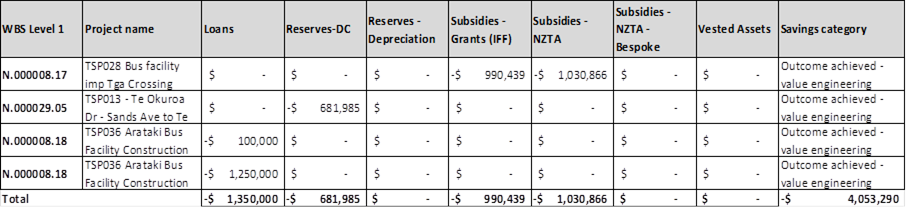
Table
4: Savings achieved for Transport project in FY26
62. To allow for potential cost
variations, a 15% contingency buffer is applied. This results in an estimated
debt funding requirement of $1.15M
63. Annual
future operating costs for all projects are 3% of project value, with smaller
projects costing more than the Arataki Bus Facility. If savings are maximized,
net additional operating cost will be $34K per year from FY27 onward, affecting
rates.
64. Options for consideration
include:
(a) Retain $1.147M savings for
future use, in which case the identified projects would be prioritised for
delivery in the 2026/27 fiscal year. This results in capital savings as well as
$27K consequential Opex in future years.
(b) Bring forward $1.161M from the
FY27 draft annual plan total of $6M, with the understanding that an additional
operating expense of $34K will be incurred in FY27. The operating cost has been
accounted for in the budgets of subsequent years. (This funding will be
utilised to include Pyes Pa signalised crossing at a cost of $625K.)
(c) Utilise $536K of the $1.147M
savings as a rates/cost neutral alternative (i.e. depreciation generated by
replacement projects is the same as savings from projects); however, it should
be noted that for the balance, the reduced borrowing will also lead to savings
in budgeted interest costs.
65. To
achieve a cost neutral position, $536K of the total savings could be utilised
to implement the proposed list of projects in Table 5 below, noting that
approval has already been granted by Council resolution for the Grenada Street
project to proceed.

Table 5: Proposed list of rapidly deployable projects for delivery
by July 2026.
66. This
proposed approach ensures:
(a) Efficient
use of confirmed savings, enabling delivery of projects that matter to the
community.
(b) Alignment
with Council’s financial strategy, by operating within existing
debt-funded parameters.
Legal Implications / Risks
67. The key risks are:
(a) Projects are initiated and
assessed to confirm feasibility. While some would be approved for delivery
through annual plan processes, public consultation may not yet have taken
place. Balancing safety outcomes with parking availability during consultation
can be challenging. These discussions may lead to delays and in some cases,
projects are placed on hold. Early engagement is critical to minimise these
risks.
(b) Meeting community expectations
around project delivery can be challenging, particularly when some initiatives
take several years to implement. While funding constraints are a key factor,
having a fair and consistent process for evaluating projects helps support
clear communication about delivery timeframes and priorities.
TE AO MĀORI APPROACH
68. Minor projects, such as
pedestrian crossings support the principles as outlined in the Te Ao Māori
approach, including Manaakitanga, meaning of care and safety of our people.
CLIMATE IMPACT
69. These
projects support the Climate Investment and Action plan as it supports walking,
biking, and micro-mobility transport modes and improves access to public
transport.
Consultation / Engagement
70. Once a project’s funded,
staff will engage with affected parties and key groups to ensure we get the
right input before moving into finalising the design for delivery.
Significance
71. The Local Government Act 2002
requires an assessment of the significance of matters, issues, proposals and
decisions in this report against Council’s Significance and Engagement
Policy. Council acknowledges that in some instances a matter, issue,
proposal or decision may have a high degree of importance to individuals,
groups, or agencies affected by the report.
72. In making this assessment,
consideration has been given to the likely impact, and likely consequences for:
(a) the current and future
social, economic, environmental, or cultural well-being of the district or
region
(b) any
persons who are likely to be particularly affected by, or interested in, the .
(c) the
capacity of the local authority to perform its role, and the financial and
other costs of doing so.
73. In accordance with the
considerations above, criteria and thresholds in the policy, it is considered
that the matter is of low significance.
74. However, there is a high
interest for local communities and schools who wish to see improvements for
their community be delivered as soon as possible.
ENGAGEMENT
75. Taking
into consideration the above assessment, that the matter is of low
significance, officers are of the opinion that no further engagement is
required prior to Council making a decision.
76. This
report provides an update and outlines the backlog of projects relating to
small scale safety and accessibility improvements. Should project progress,
engagement with residents and key stakeholders will be undertaken.
Next Steps
77. Contingent on Council’s
decision, progress projects to implementation in FY 26, or
78. Projects to be considered as
part of the FY27 annual plan process.
Attachments
1. Attachment
1 Project backlog of rapidly deployable projects - A19433677 ⇩
2. Attachment 2
Project backlog for future annual plan or LTP consideration - A19433676 ⇩
|
City
Delivery Committee meeting Agenda
|
15
December 2025
|
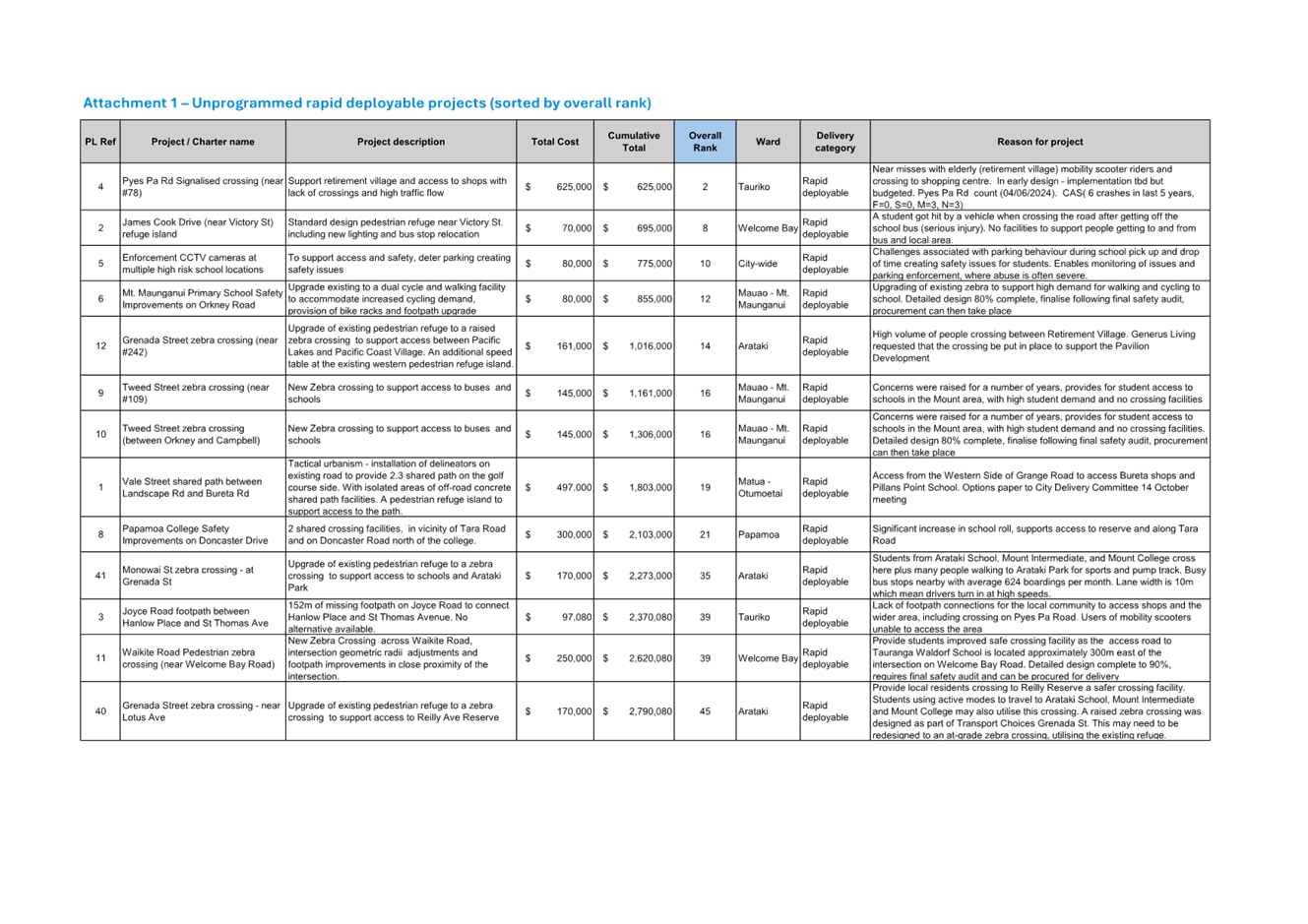
|
City
Delivery Committee meeting Agenda
|
15
December 2025
|
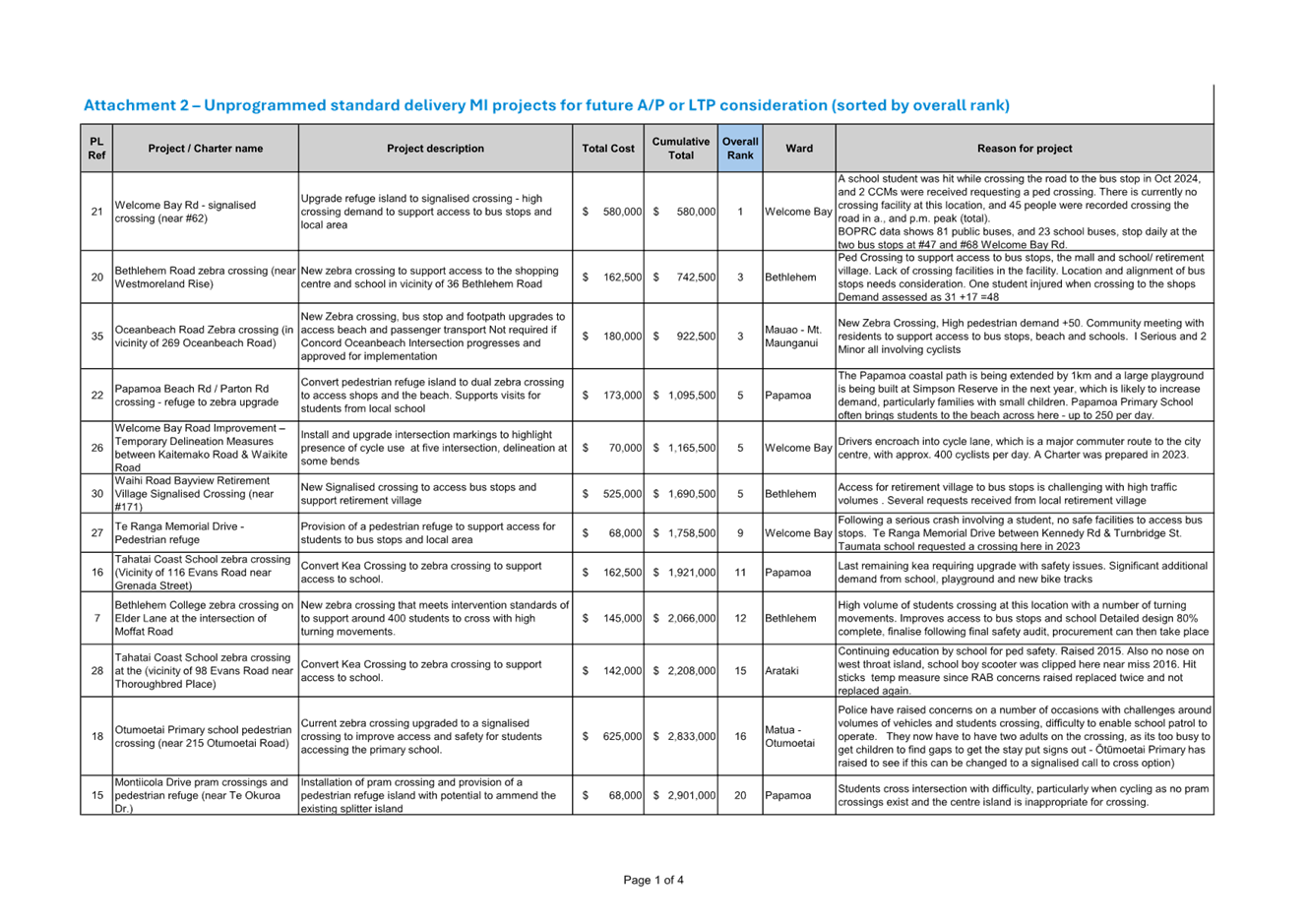
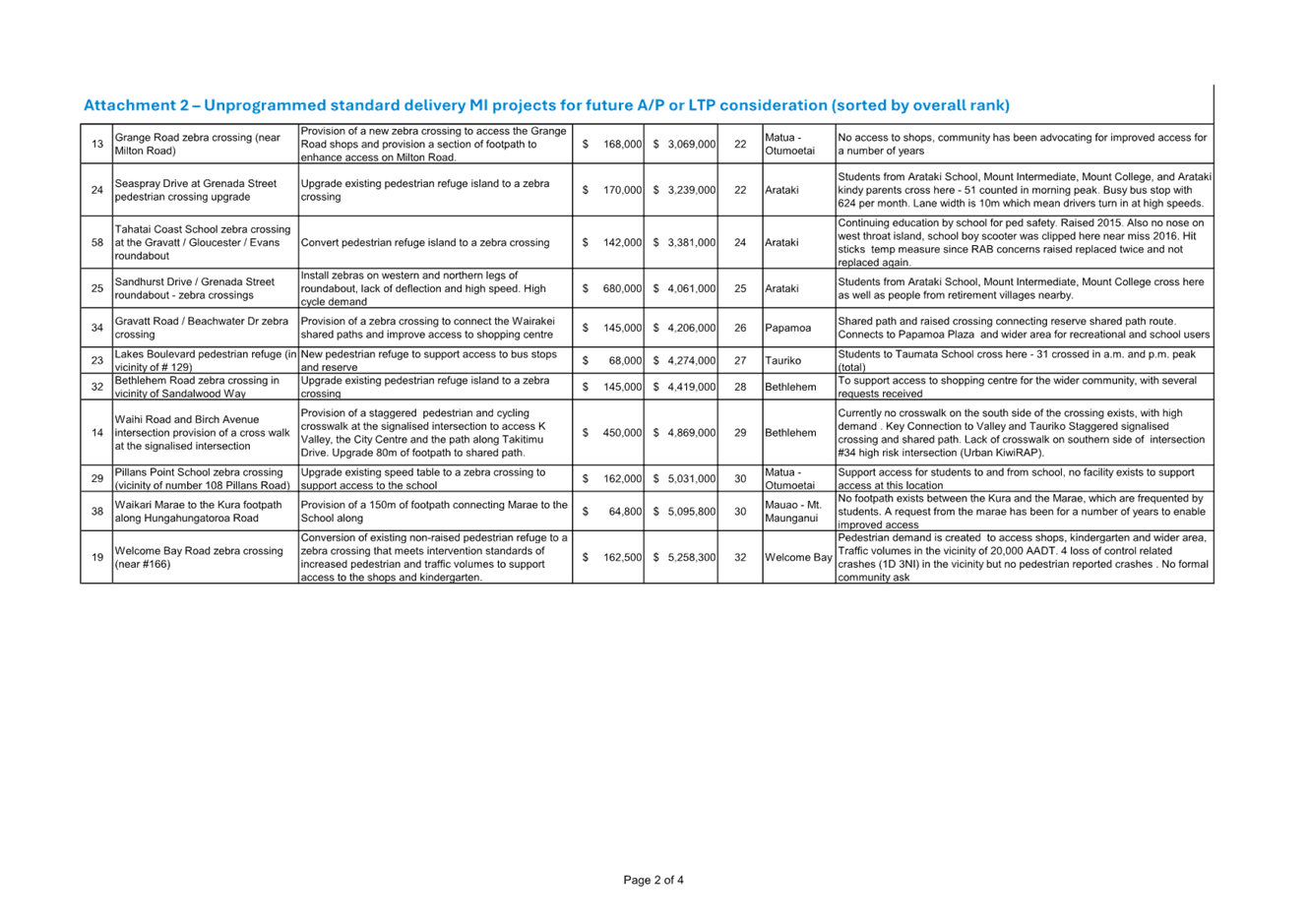
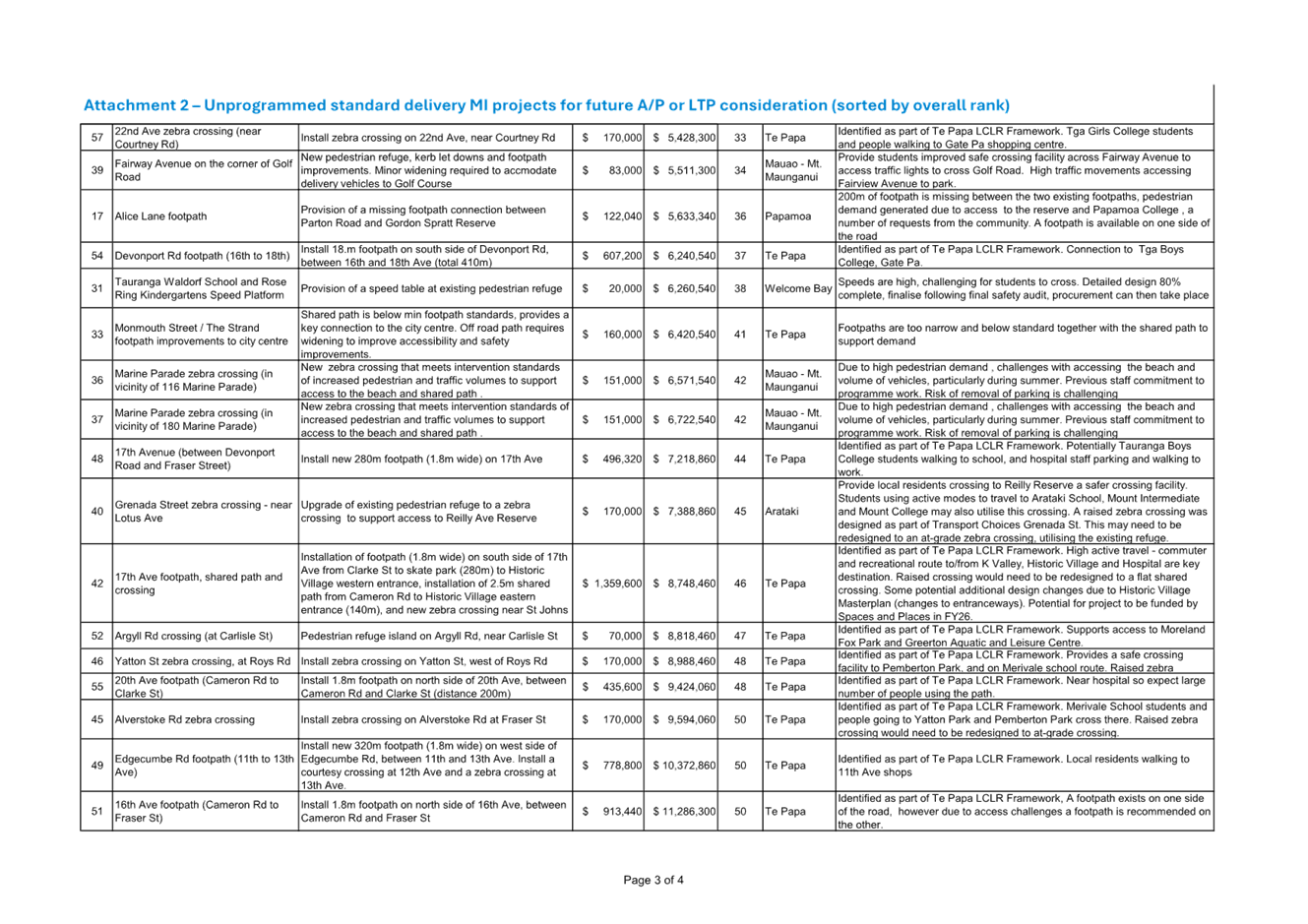
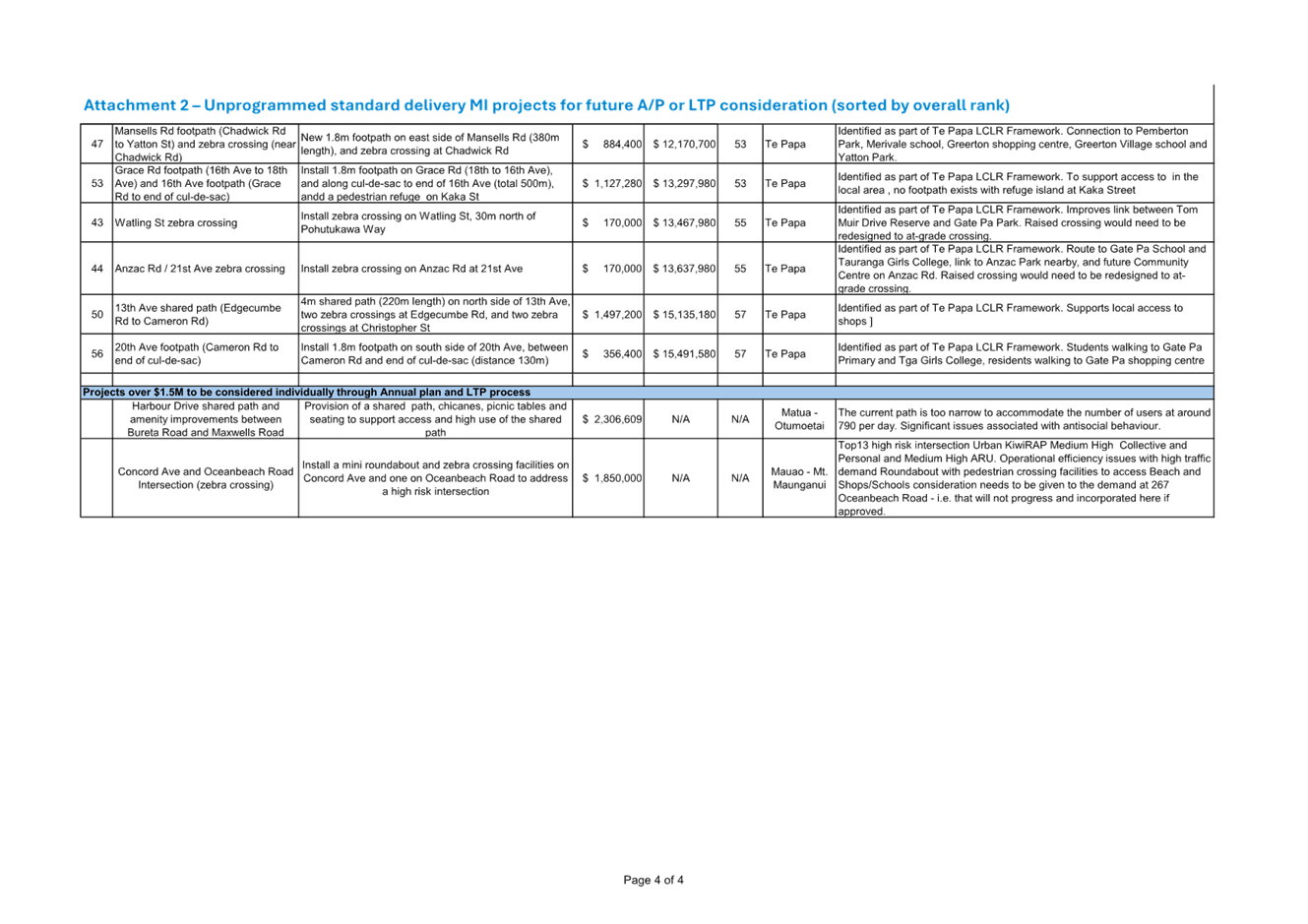
|
City Delivery Committee meeting Agenda
|
15 December 2025
|
10 Discussion of late
items
|
City Delivery Committee meeting Agenda
|
15 December 2025
|
11 Public excluded
session
Resolution to exclude
the public
|
Recommendations
That the public be
excluded from the following parts of the proceedings of this meeting.
The general subject
matter of each matter to be considered while the public is excluded, the
reason for passing this resolution in relation to each matter, and the
specific grounds under section 48 of the Local Government Official
Information and Meetings Act 1987 for the passing of this resolution are as
follows:
|
General subject of each matter to be
considered
|
Reason for passing this resolution in
relation to each matter
|
Ground(s) under section 48 for the
passing of this resolution
|
|
11.1 - Te Maunga Wastewater Treatment
Plant Bioreactor 1 Renewal Works and New Inlet Works advance works - Direct
Appointment of Contractor
|
s7(2)(b)(ii) - The withholding of the information
is necessary to protect information where the making available of the
information would be likely unreasonably to prejudice the commercial
position of the person who supplied or who is the subject of the information
|
s48(1)(a) - the public conduct of the relevant
part of the proceedings of the meeting would be likely to result in the
disclosure of information for which good reason for withholding would exist
under section 6 or section 7
|
|
|
City Delivery Committee meeting Agenda
|
15 December 2025
|
12 Closing
karakia