|

|
|
AGENDA
Ordinary Council meeting
Tuesday, 10 February 2026
|
|
I hereby give notice that an Ordinary meeting of
Council will be held on:
|
|
Date:
|
Tuesday, 10 February
2026
|
|
Time:
|
9:30 am
|
|
Location:
|
Tauranga City Council Chambers, Mareanui
L1, 90 Devonport Road
Tauranga
|
|
Please note that this
meeting will be livestreamed and the recording will be publicly available on
Tauranga City Council's website: www.tauranga.govt.nz.
|
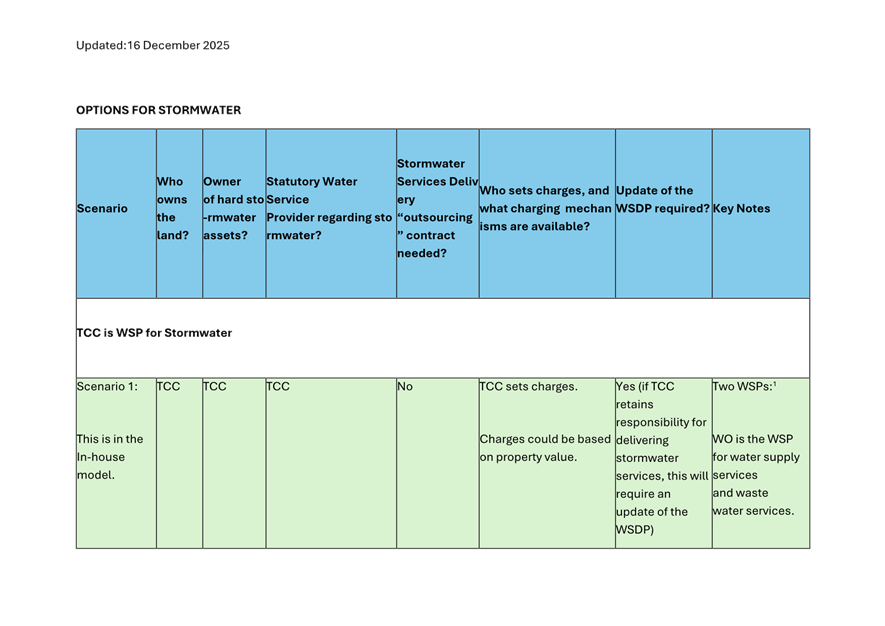
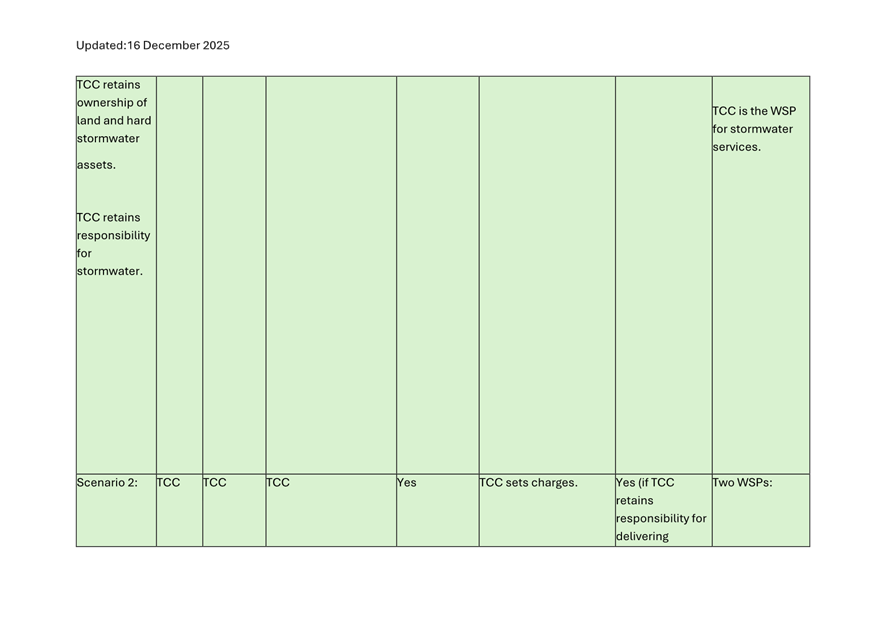
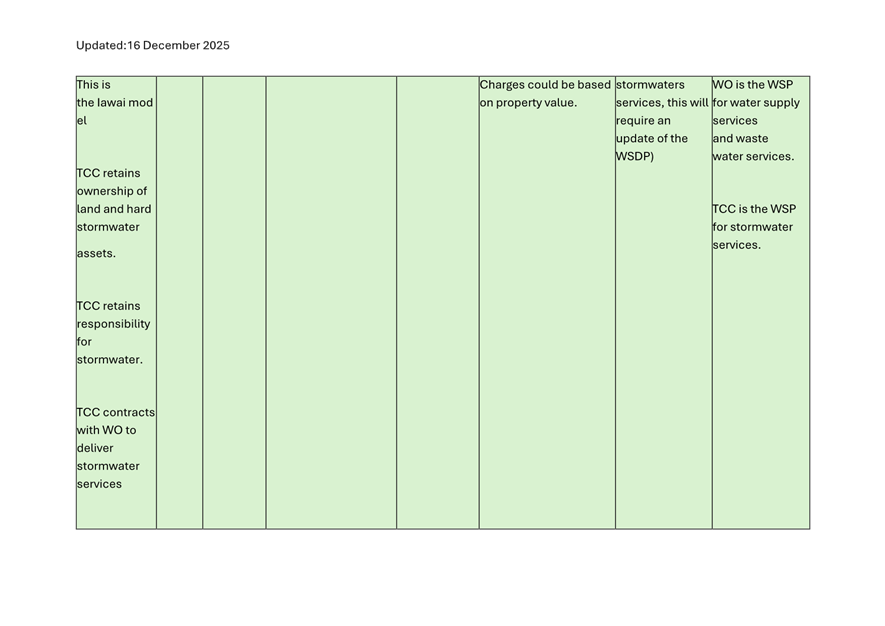
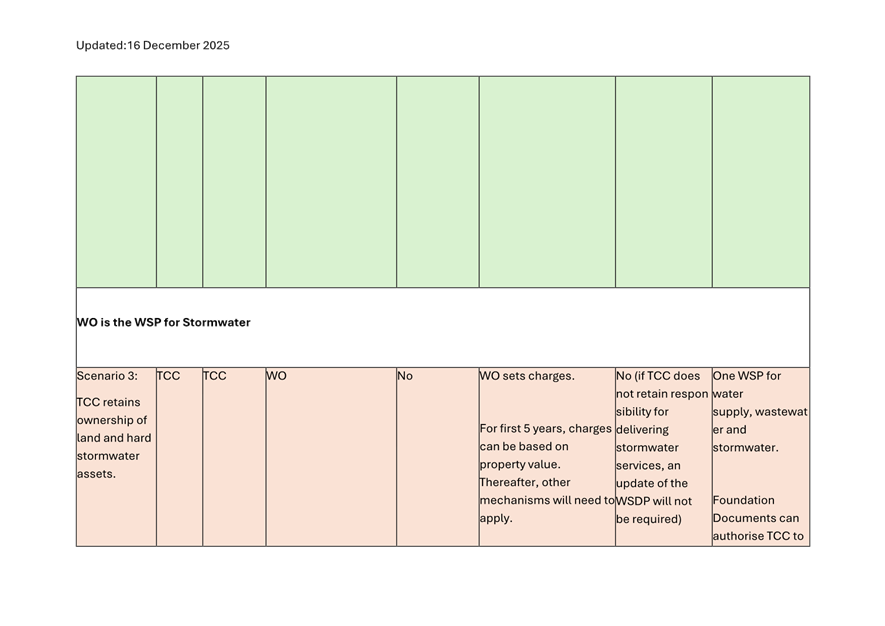
|
Marty Grenfell
Chief Executive
|
Terms of reference – Council
Membership
|
Chair
|
Mayor
Mahé Drysdale
|
|
Deputy Chair
|
|
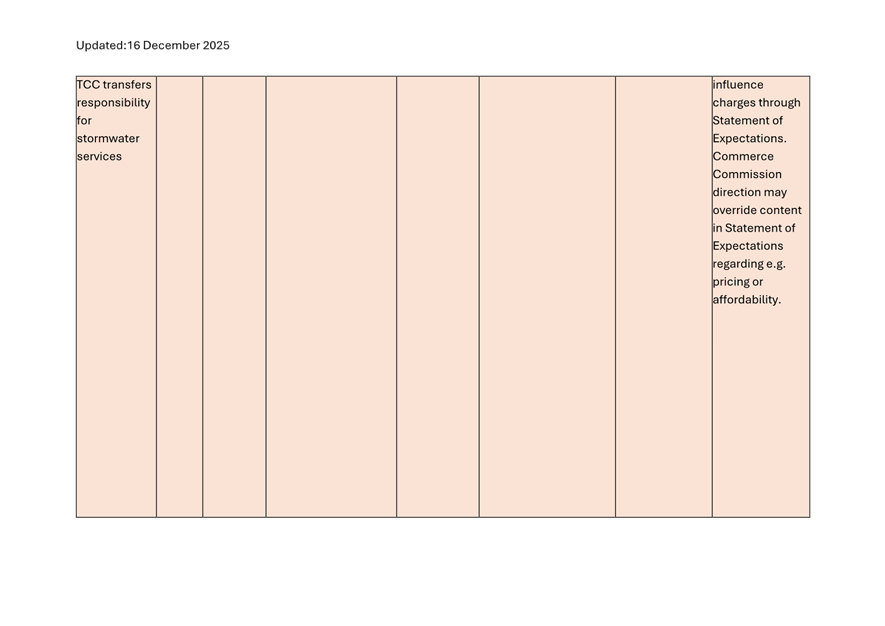
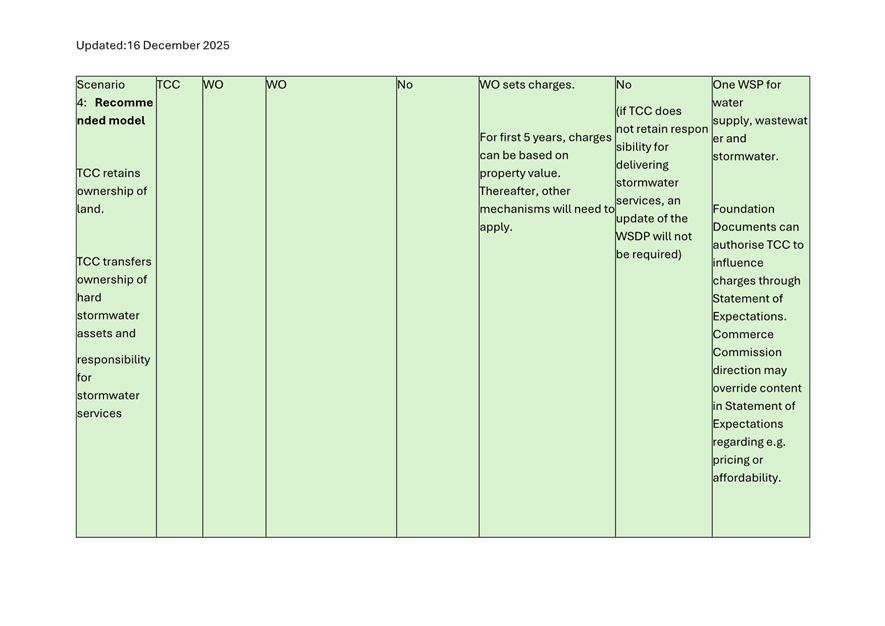
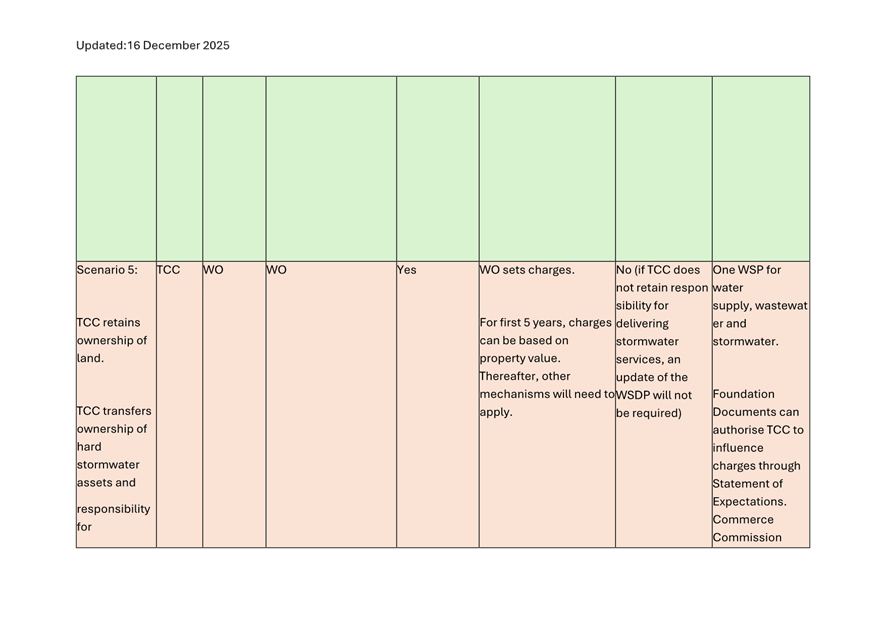
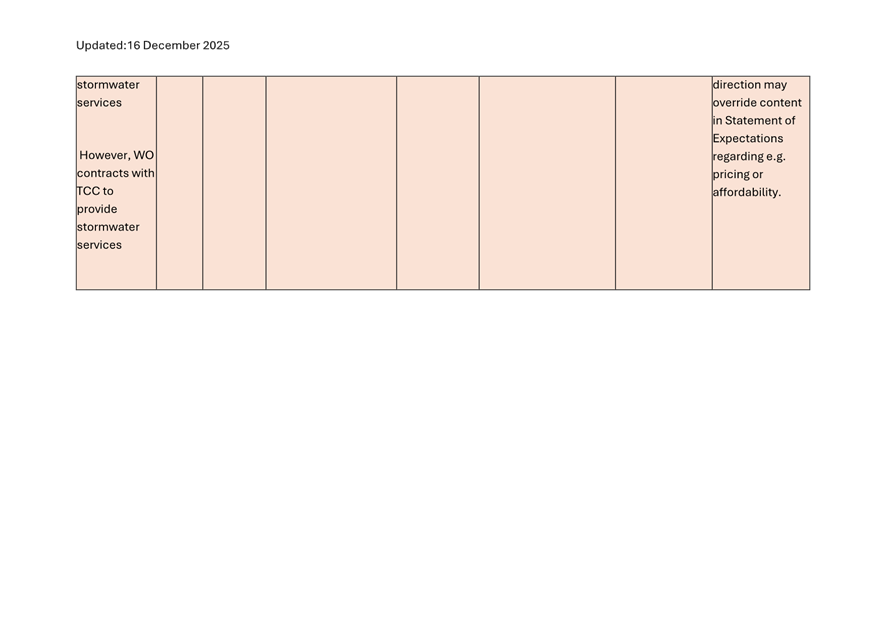
|
Members
|
|
|
Quorum
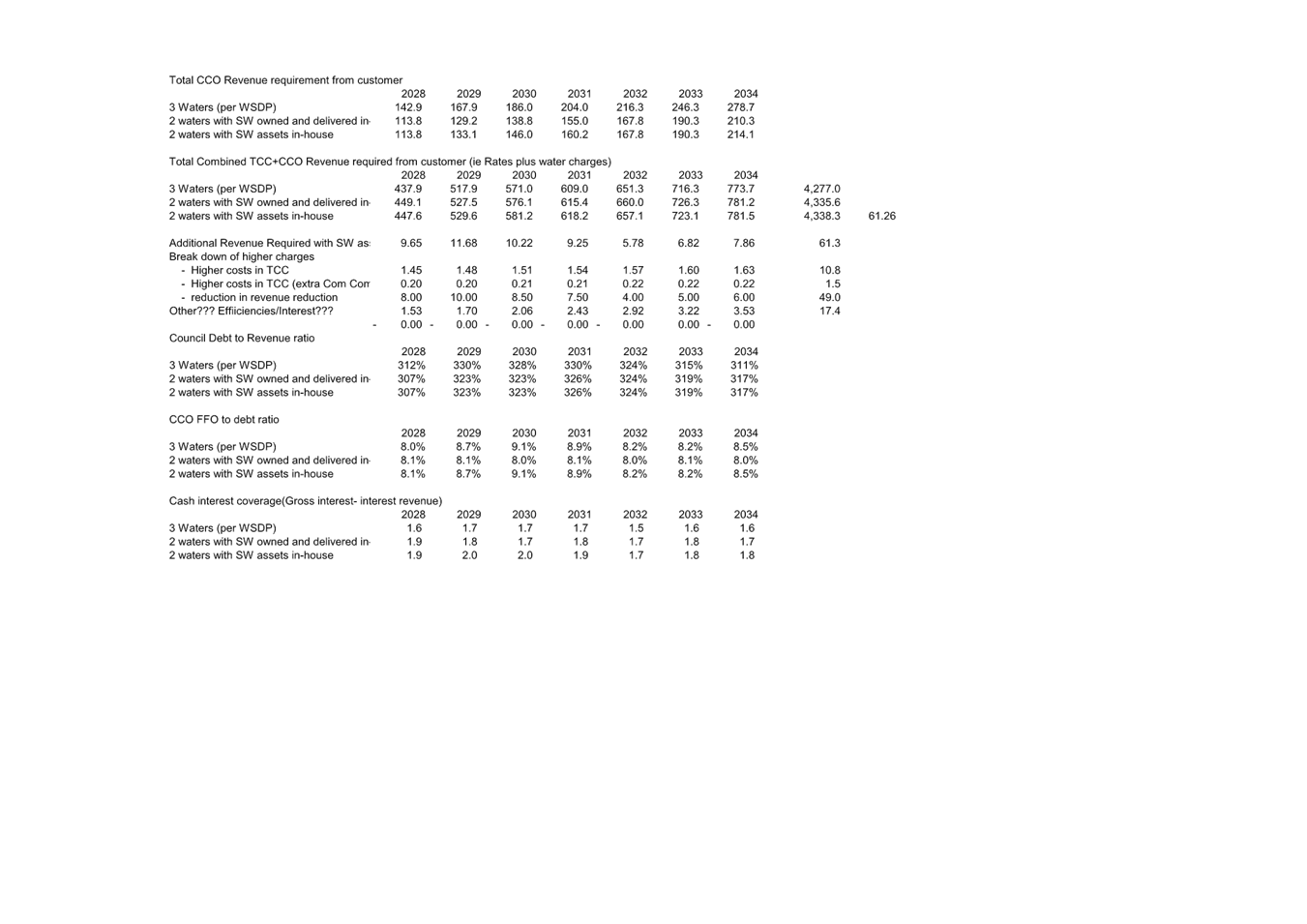
|
Half of the members
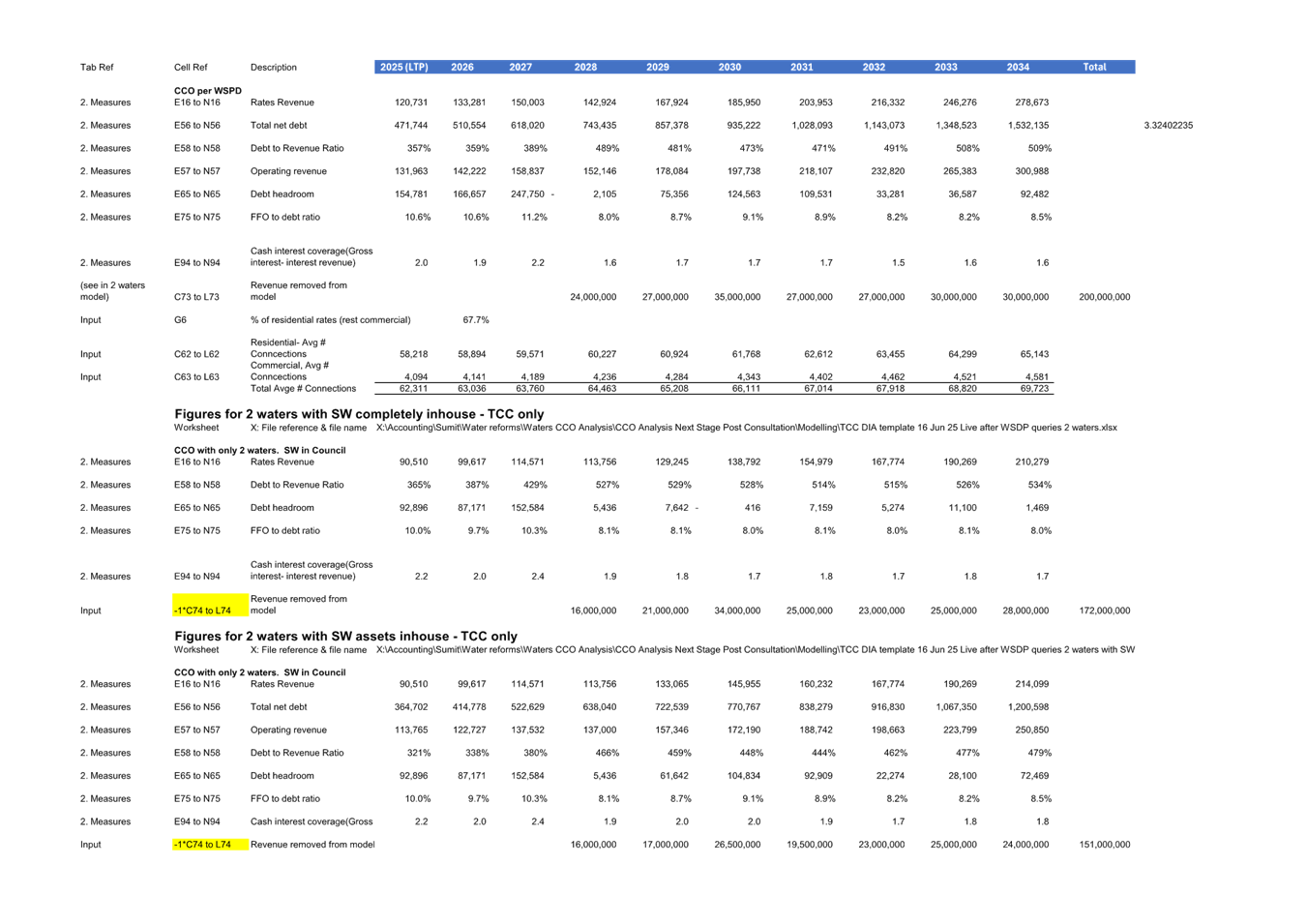
present, where the number of members (including vacancies) is even;
and a majority of the members present, where the number of members
(including vacancies) is odd.
|
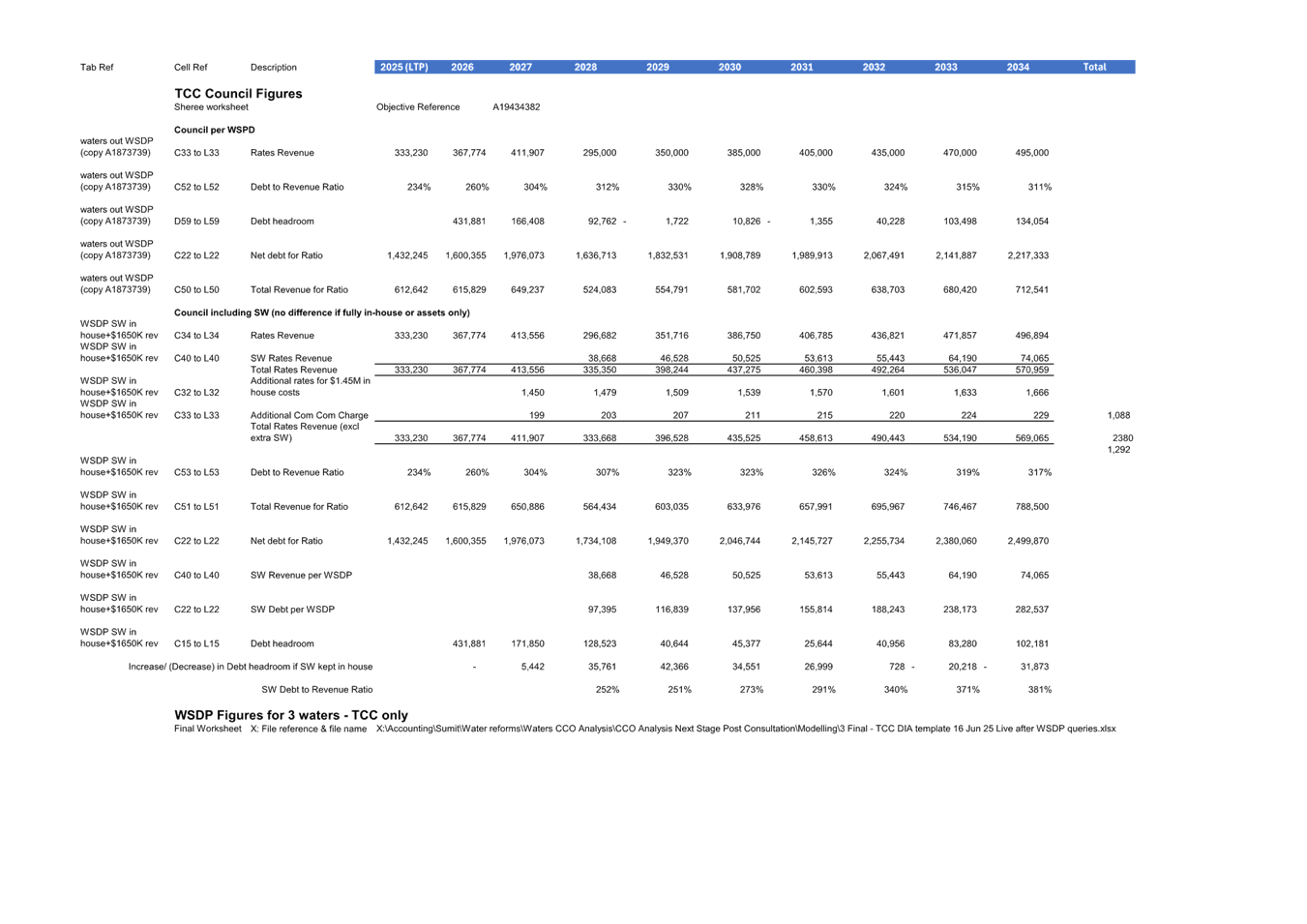
|
Meeting frequency
|
Three weekly or as required
|
Role
·
To ensure the effective and efficient governance
of the City.
·
To enable leadership of the City including
advocacy and facilitation on behalf of the community.
·
To review and monitor the performance of the
Chief Executive.
Scope
·
Oversee the work of all committees and
subcommittees.
·
Exercise all non-delegable and non-delegated
functions and powers of the Council.
·
The powers Council is legally prohibited from
delegating include:
○
Power to make a rate.
○
Power to make a bylaw.
○
Power to borrow money, or purchase or dispose of
assets, other than in accordance with the long-term plan.
○
Power to adopt a long-term plan, annual plan, or
annual report
○
Power to appoint a chief executive.
○
Power to adopt policies required to be adopted
and consulted on under the Local Government Act 2002 in association with the
long-term plan or developed for the purpose of the local governance statement.
○
All final decisions required to be made by
resolution of the territorial authority/Council pursuant to relevant
legislation (for example: the approval of the City Plan or City Plan changes as
per section 34A Resource Management Act 1991).
·
Council has chosen not to delegate the
following:
○
Power to compulsorily acquire land under the
Public Works Act 1981.
·
Make those decisions which are required by
legislation to be made by resolution of the local authority.
·
Authorise all expenditure not delegated to
officers, Committees or other subordinate decision‑making bodies of
Council.
·
Make appointments of members to the council-controlled
organisation Boards of Directors/Trustees and representatives of Council to
external organisations.
·
Undertake statutory duties in regard to
Council-controlled organisations, including reviewing statements of intent,
with the exception of the Local Government Funding Agency where such roles are
delegated to the City Delivery Committee. (Note that monitoring of all
Council-controlled organisations’ performance is undertaken by the City
Delivery Committee. This also includes Priority One reporting.)
·
Consider all matters related to Local Water Done
Well.
·
Consider any matters referred from any of the
Standing or Special Committees, Joint Committees, Chief Executive or General
Managers.
·
Review and monitor the Chief Executive’s
performance.
·
Develop Long Term Plans and Annual Plans
including hearings, deliberations and adoption.
Procedural matters
·
Delegation of Council powers to Council’s
committees and other subordinate decision-making bodies.
·
Adoption of Standing Orders.
·
Receipt of Joint Committee minutes.
·
Approval of Special Orders.
·
Employment of Chief Executive.
·
Other Delegations of Council’s powers,
duties and responsibilities.
Regulatory matters
Administration,
monitoring and enforcement of all regulatory matters that have not otherwise
been delegated or that are referred to Council for determination (by a
committee, subordinate decision‑making body, Chief Executive or relevant
General Manager).
1 Opening
karakia
2 Apologies
|
Ordinary Council meeting Agenda
|
10 February 2026
|
3 Public
forum
3.1 Richard
Longley - Miro St Parking
Attachments
Nil
|
Ordinary Council meeting Agenda
|
10 February 2026
|
7 Confirmation
of minutes
7.1 Minutes
of the Council meeting held on 16 December 2025
File
Number: A19652048
Author: Clare
Sullivan, Senior Governance Advisor
Authoriser: Sarah
Holmes, Team Leader: Governance & CCO Support Services
|
Recommendations
That the Minutes of the
Council meeting held on 16 December 2025 be confirmed as a true and correct
record.
|
Attachments
1. Minutes
of the Council meeting held on 16 December 2025
|
Ordinary
Council meeting minutes
|
16 December 2025
|
|

|
|
DRAFT MINUTES
Ordinary Council meeting
Tuesday, 16 December 2025
|
Order of Business
1 Opening
karakia. 4
2 Apologies. 4
3 Public
forum.. 4
4 Acceptance
of late items. 4
5 Confidential
business to be transferred into the open. 5
6 Change to
the order of business. 5
7 Confirmation
of minutes. 5
7.1 Minutes
of the Council meeting held on 29 October 2025. 5
7.2 Minutes
of the Council meeting held on 18 November 2025. 5
8 Declaration
of conflicts of interest 5
9 Deputations,
presentations, petitions. 5
10 Recommendations from
other committees. 5
11 Business. 5
11.1 Update
to Funding and Financing for Te Manawataki o Te Papa. 6
11.2 Annual
Plan - Options for Rates Increases. 6
11.3 Local
Water Done Well - Project Update and Recruitment 8
11.4 Mount
College 50m Pool Due Diligence. 9
11.5 Memorial
Park Aquatic Centre Steering Group and Project Timeline. 10
11.6 Final
Speedway Arrangements. 10
11.7 Risk
Appetite Report - December 2025. 11
11.8 Organisational
Reset - Update of Delegations. 11
11.9 Regulatory
Hearings Panel term and appointment process. 12
11.11 Status
update on actions from prior Council meetings. 12
11.12 Report
for the adoption of draft Trade Waste Bylaw for consultation. 13
11.13 Report
for the adoption of draft Stormwater Bylaw for consultation. 13
12 Public excluded
session. 13
13.1 Public
Excluded Minutes of the Council meeting held on 18 November 2025. 14
13.2 Waikite
Road - proposed residential development 14
13.3 Local
Water Done Well - Digital Programme. 14
13.4 Appointment
of Independent Chair to Audit & Risk Committee. 15
13.5 City
& Regional Deal Terms Endorsement in Principle. 15
13.7 Asset
Recycling Update. 15
Confidential Attachment 1 11.6 - Final
Speedway Arrangements. 15
Confidential Attachment 2 11.11 - Status
update on actions from prior Council meetings... 15
Public Business continued
11.6 Final
Speedway Arrangements resumed. 16
13.6 Chief
Executive's Performance 2024/25 and 2025/26. 16
13 Closing karakia. 17
MINUTES
OF Tauranga City Council
Ordinary Council meeting
HELD
AT THE Tauranga City Council Chambers,
L1,
90 Devonport Road, Tauranga
ON
Tuesday, 16 December 2025 AT 8:34 am
|
MEMBERS PRESENT:
|
Mayor Mahé Drysdale,
Deputy Mayor Jen Scoular, Cr Hautapu Baker, Cr Glen Crowther, Cr Rick Curach,
Cr Steve Morris, Cr Hēmi Rolleston, Cr Marten Rozeboom, Cr Kevin
Schuler, and Cr Rod Taylor
|
|
IN ATTENDANCE:
|
Marty Grenfell (Chief Executive),
Christine Jones (General Manager: Strategy, Partnerships & Growth), Sarah
Omundsen (General Manager: Regulatory & Community), Reneke van Soest
(General Manager Operations & Infrastructure), Kathryn Sharplin (Acting
COFO – Finance & Digital), Alastair McNeill (Acting COFO,
Commercial ), Tracey Hughes (Head of Finance), Susan Braid (Finance Lead
Capital Programme & Community Investment), Sheree Covell (Manager:
Treasury & Financial Processes), Alison Law (Head of Spaces &
Places), Ross Hudson (Manager: Strategic Planning & Partnerships) Jaimee
Kinzett (Senior Strategic Advisor), Jeremy Boase (Head of Strategy,
Governance & Climate Resilience), Charles Lane (Team Leader: Commercial
Legal), Tyler Buckley (Commercial Solicitor), Libby Dobbs (Head of
Communications & Engagement), Cashy Ball (Principal Advisor to the
Executive), Chris Quest, (Manager: Risk & Assurance), Radleigh Cairns
(Manager: Drainage Services) Sarah Holmes (Team Leader Governance & CCO
Support Services), Clare Sullivan (Senior Governance Advisor), Anahera
Dinsdale (Governance Advisor)
|
|
EXTERNAL:
|
|
Timestamps are included beside each of the items and relate
to the recording of the meeting held on 16 December 2025 on the Council's YouTube channel
Part 1, Part 2,
and Part
3.
1 Opening
karakia
Cr Hēmi Rolleston opened the meeting with a karakia.
2 Apologies
|
Apology
|
|
Resolution CO/25/0/1
Moved: Cr
Kevin Schuler
Seconded: Cr Rod Taylor
That the apology for lateness received from Cr Baker be
accepted.
Carried
|
3 Public
forum
Nil
4 Acceptance
of late items
Nil
5 Confidential
business to be transferred into the open
Nil
6 Change
to the order of business
Nil
7 Confirmation
of minutes
|
7.2 Minutes of
the Council meeting held on 18 November 2025
|
|
Resolution CO/25/0/3
Moved: Cr
Kevin Schuler
Seconded: Cr Rod Taylor
That the Minutes
of the Council meeting held on 18 November 2025 be confirmed as a true and
correct record subject to the reasons for the decision on item 11.4 that the
definition of affordable is subjective.
Carried
|
8 Declaration
of conflicts of interest
Nil
9 Deputations,
presentations, petitions
Nil
10 Recommendations
from other committees
Nil
11 Business
Timestamp: 11 minutes (Part 1)
|
11.1 Update to Funding and
Financing for Te Manawataki o Te Papa
|
|
Staff Kathryn
Sharplin, Acting COFO, Finance & Digital
Susan
Braid, Finance Lead Capital Programme & Community Investment
Tracey
Hughes, Head of Finance
The Council considered this item
and then returned to it later in the meeting.
|
|
Resolution CO/25/0/4
Moved: Mayor
Mahé Drysdale
Seconded: Cr Glen Crowther
That the Council:
(a) Receives the report
"Update to Funding and Financing for Te Manawataki o Te Papa".
(b) With respect to Te Manawataki
o Te Papa funding arrangements for the 2026/27 Annual Plan and noting the
rates implications of these funding choices:
(i) Confirms that the
priority use of asset realisation net proceeds is to offset new debt, and
what would otherwise be rates-funded interest, associated with Te Manawataki
o Te Papa, noting that the proposed asset realisation for 2026/27 is not yet
included in the December draft annual plan and if included would reduce rates
requirement by $0.5m.
(c) Notes philanthropic funding
assumptions are very low in the currently assumed project funding.
(d) Agrees that proposals to
actively seek philanthropic funding support should be prepared for Council
consideration in early 2026.
(e) Notes that contingency
budgets of $30.1m remain across the Te Manawataki o Te Papa programme from
2025/26 to 2029/30 some of which may be released in later years (Attachment 1).
For: Mayor
Mahé Drysdale, Deputy MayorJen Scoular, Cr Hautapu Baker, Cr
Glen Crowther,
Cr Rick Curach, Cr Steve Morris, Cr Hēmi Rolleston and Cr Steve Morris
Against: Cr Marten Rozeboom and Cr
Kevin Schuler
Carried8/2
|
Timestamp: 26 minutes (Part 1)
|
11.2 Annual Plan - Options
for Rates Increases
|
|
Staff Kathryn
Sharplin, Acting COFO, Finance & Digital
Tracey
Hughes, Head of Finance
Sheree
Covell, Manager: Treasury and Financial Processes
Actions requested:
That staff:
·
Provide a one-page document noting the systems Council uses for
its Asset Registers, revaluations, depreciation and planning and options to
adequately resource the systems needed
·
Provide an scenario in February 2026 for Council not to
increase employee costs by 8% and include what makes up the increase of $8
million
·
Provide elected members with a high level summary of potential
savings by 20 January 2026.
|
|
Resolution CO/25/0/5
Moved: Deputy
Mayor Jen Scoular
Seconded: Cr Marten Rozeboom
That the Council:
(a) Receives the report
"Annual Plan - Options for Rates Increases".
(b) Notes that without further
decisions of Council the rates increase currently sits at 13% after growth of
0.5%, with 1% of rates increase equivalent to $3.68 million
(c) Agrees with respect to Water
services to:
(i) Retain the surplus in
the waters activities and the higher charges proposed in the Water Services
Delivery Plan, but separate water by meter revenue, which is a volumetric
charge, from the rates increase calculations, noting that this is consistent
with the direction for the proposed future rates caps and noting this avoids
raising concerns with the Department of Internal Affairs and the Local
Government Funding Agency. This would lower the rates increase by
1.4%
(d) Agrees
to consider further options for rates reduction at the Council meeting on 10
February 2026 to achieve a rates requirement of 7.5% taking into account:
(i) Prioritisation
of reducing the capital programme
(ii) Executive
proposals for reductions in operating costs
(iii) User
fee increases and amendments that reduce reliance on rates to be confirmed by
Council.
(e) Agrees
to consider more significant level of service reductions or acceptance of
more risk that would be required to reduce the rates increase to
approximately 4% for the year at its meeting on 10th February 2026.
(f) Notes
that funding for the Māori Ward referendum was not included in the Long
Term Plan and if Council wishes to budget for a referendum the expenditure
would require a decision of Council, which is likely to have an impact on
rates of 0.2%.
Carried
|
At 10.50am the meeting adjourned.
At 11.10am the meeting resumed in open.
Timestamp: 1 minute (Part 2)
|
11.3 Local Water Done Well -
Project Update and Recruitment
|
|
Staff Christine
Jones, General Manager, Strategy, Partnerships & Growth
|
|
Resolution CO/25/0/6
Moved: Cr
Marten Rozeboom
Seconded: Cr Steve Morris
That the Council:
(a) Receives the report
"Local Water Done Well - Project Update and Recruitment".
Recruitment
(b) Agrees to the appointment of
a Water Organisation Establishment Chief Executive Officer, with recruitment
to commence now so that a recommendation can be made subject to Council and
Western Bay of Plenty District Council’s final decision to proceed with
the Water Organisation on 2nd April 2026 (with a likely start date circa 1
July 2026)
Project
Governance
(c) Endorses the appointment of
the following Tangata Whenua representatives to the Joint Working Group:
· Kylie Smallman
· Hakopa Tapiata
· Shadrach
Rolleston
· Rohario Murray
· Kiritapu Allan
· Roana Bennett
(d) Approves
the variation to the Commitment Agreement to reflect the establishment of the
Joint Working Group and delegates authority to the General Manager: Strategy,
Partnerships & Growth to execute the Variation Agreement (see Attachment
1).
(e) Approves the Terms of
Reference for the Joint Working Group (Attachment 2), noting that these have
been endorsed at the Joint Governance Meeting of 8 December 2025.
(f) Endorses the Commercial
Terms Sheet (Attachment 3)
(g) That
the Council delegates the Chief Executive to make changes to the Terms
of Reference, Commitment Agreement and Commercial Terms to reflect Council's
agreed direction.
Carried
|
Timestamp: 46 minutes (Part 2)
|
11.4 Mount College 50m Pool
Due Diligence
|
|
Staff Alison
Law, Head of Spaces & Places
Cashy
Ball, Principal Advisor to the Executive
|
|
Resolution CO/25/0/7
Moved: Deputy
Mayor Jen Scoular
Seconded: Cr Rod Taylor
The motion was taken in parts
That the Council:
(a) Receives the report
"Mount College 50m Pool Due Diligence".
(b) Considers the outcome of the
due diligence work undertaken to date.
(e) Agrees to prioritise the
school carpark expansion, at a capital cost of $296,982 +GST as a Council
funded enabling project, by reprioritising existing budgets through the
Annual Plan 2026/27. Noting that depreciation and maintenance costs of this
carpark expansion would not be the responsibility of Council.
CARRIED
(c) Confirms support for the
Mount Maunganui College 50m training pool expansion proposal, following due
diligence, including ongoing Council support to subsidise the community use
of the pool, with:
(i) a $4.945m +GST 10-year
loan-funded operational grant for the pool construction, paid to the Mount
Maunganui Aquatic Centre Trust. Currently budgeted to be phased over 2025/26
($2.59m) and 2026/27 ($2.355m), although actual payment of grant will be
dependent on project delivery and linked to key project milestones, and
(ii) up to $340,000 +GST annual
operational grant, inflated annually, based on actual net operational costs,
on an ongoing basis to meet the extra cost of providing a 50m community pool.
Starting with a 50% payment (up to $170,000 +GST) in 2026/27 to reflect the
first half year of operation and 100% (up to $340,000 +GST) from 2027/28.
Noting that the operational grant will not fully fund depreciation.
Subject to the satisfactory
resolution of:
• New
lease agreed between the Mount Maunganui College Board of Trustees (with
Ministry of Education consent) and the Mount Maunganui Aquatic Centre Trust
that, at a minimum, includes the new pool footprint and provides an initial
term of 14 years and 364 days plus two 10-year rights of renewal (total
potential tenure of up to 35 years).
• Full
capital funding for construction secured.
• Quantity
Survey peer review - due by 23 December 2025; and
(d) Delegates authority to the
Chief Executive to approve and execute the Funding Agreement and Operating
and Community Use Agreement on behalf of council, consistent with the terms
outlined in this report, including approving minor amendments within
delegated authority.
For: Mayor
Mahé Drysdale, Deputy Mayor Jen Scoular, Cr Rick Curach, Cr Steve Morris,
Cr Hēmi Rolleston, Cr Marten Rozeboom & Cr Rod Taylor
Against: Cr Hautapu Baker, Cr Glen
Crowther & Cr Kevin Schuler
Carried 7/3
|
|
11.5 Memorial Park Aquatic
Centre Steering Group and Project Timeline
|
|
Staff Alison
Law, Head of Spaces & Places
Cashy
Ball, Principal Advisor to the Executive
External Sam
Toulin, Apollo Projects
Action requested
·
That staff include a list of working groups,steering groups and
their membership including naming the elected members, on the website.
|
|
Resolution CO/25/0/8
Moved: Cr
Hautapu Baker
Seconded: Cr Rod Taylor
That the Council:
(a) Receives the report
"Memorial Park Aquatic Centre Steering Group and Project Timeline".
(b) Endorses the attached Terms
of Reference for the Memorial Park Aquatic Centre, including the membership
and reporting structure outlined in the Terms of Reference;
(c) Supports in principle the key
stages and process proposed through this report for the delivery of the
Memorial Park Aquatic Centre project.
(d) Notes the two timelines
presented through this report propose construction periods for the Memorial
Park Aquatic Centre between December 2026 to March 2029 or September 2027 to December
2029, and both would require changes to Council’s current capital
programme through the Annual Plan 2026/27 and Long Term Plan 2027-37.
Carried
|
At 12.46pm the meeting adjourned.
At 1.22pm the meeting resumed in open.
Timestamp: 2 hours and 12 minutes (Part 2)
|
11.6 Final Speedway
Arrangements
|
|
Staff Alison
Law, Head of Spaces & Places
Ross
Hudson, Manager: Strategic Planning & Partnerships
Jaimee
Kinzett, Senior Strategic Advisor
External Chad
Hooker, Chief Executive, Bay Venues Ltd
The Council considered this item
and returned to it later in the meeting.
|
Timestamp: 2 hours and 33 minutes (Part 2)
|
11.7 Risk Appetite Report -
December 2025
|
|
Staff Alastair
McNeill, Acting COFO, Commercial,
Chris
Quest, Manager Risk & Assurance
|
|
Resolution CO/25/0/9
Moved: Cr
Steve Morris
Seconded: Cr Kevin Schuler
That the Council:
(a) Receives the report
"Risk Appetite Report - December 2025".
(b) Notes that the risk appetite for the environmental risk consequence
category has been changed from moderate to low (Audit & Risk Committee
resolution AR/25/4/3).
(c) Adopts the preliminary risk
appetite position and statements as outlined in Attachment 1 of this report.
Carried
|
Timestamp: 2 hours and 40 minutes (Part 2)
|
11.8 Organisational Reset -
Update of Delegations
|
|
Staff Alastair
McNeill, Acting COFO, Commercial
Tyler
Buckley, Commercial Solicitor
Action requested:
·
That staff provide elected members with a full copy of the
delegations manual including the delegated financial authorities.
|
|
Resolution CO/25/0/10
Moved: Deputy
Mayor Jen Scoular
Seconded: Cr Hautapu Baker
That the Council:
(a) Receives the report
"Organisational Reset - Update of Delegations" position titles and
reporting lines.
(b) Approves the updates to the
Delegations Manual as shown in tracked changes in Attachment 1. The
recommended additions are underlined, and the recommended deletions
are shown as a strike
(c) Confirms resolution (b) is
effective as of 18 August 2025, the date the Reset was implemented.
(d) Note that in the first
quarter of 2026, Council staff within Tauranga City Council’s finance
team will provide Elected Members with an overview of existing staff
financial delegations, and a copy of the full delegations manual, and the
delegated financial authorities to enable the Elected Members to decide
whether they require an additional Council report on the scope and nature of
staff financial delegations.
Carried
|
Timestamp: 2 hours and 47 minutes (Part 2)
|
11.9 Regulatory Hearings
Panel term and appointment process
|
|
Staff Jeremy
Boase, Head of Strategy, Governance & Climate Resilience
Sarah
Holmes, Team Leader, Governance & CCO Support Services
|
|
Resolution CO/25/0/11
Moved: Mayor
Mahé Drysdale
Seconded: Cr Kevin Schuler
That the Council:
(a) Receives the report
"Regulatory Hearings Panel term and appointment process".
(b) Extends the contract term of all
four current Regulatory Hearings Panel members and chairperson to 3 April
2026 with a view to further extensions with rolling expiry dates at the 3rd
of April Council meeting.
(c) Appoints one new member to
the Regulatory Hearings Panel by late March 2026, for the period of 6 April
2026 to the end of this Council’s term in October 2028.
(d) At the 3 April 2026 Council
meeting, considers amending the terms of reference for the Regulatory
Hearings Panel to allow for five members, four of which would be invitees for
any particular hearing, with members stepping aside on a rotational basis.
Carried
Note: Following the adoption of the meeting
schedule for 2026, resolutions (b) and (d) should be changed at the adoption
of the minutes on 10 February to 24 March as there is no Council meeting on 3
April.
|
Timestamp: 2 hours and 52 minutes (Part 2)
|
11.11 Status update on actions from
prior Council meetings
|
|
Action Requested:
·
That staff highlight current updates for pending/longer term
actions in red font (adding the update date) for future reports.
|
|
Resolution CO/25/0/12
Moved: Cr
Hautapu Baker
Seconded: Cr Glen Crowther
That the Council:
(a) Receives the report
"Status update on actions from prior Council meetings".
(b) Attachment 2 is to
remain in the public excluded section to maintain the commercial position of
the Bay of Plenty Housing Equity Fund (as per s7(2)(b)(ii) of the Local
Government Official Information and Meetings Act 1987).
Carried
|
|
11.12 Report for the adoption of draft
Trade Waste Bylaw for consultation
|
|
This item was withdrawn.
|
Timestamp: 2 hours and 55 minutes (Part 2)
|
11.13 Report for the adoption of draft
Stormwater Bylaw for consultation
|
|
Staff Reneke
van Soest, General Manager Operations & Infrastructure
Radleigh
Cairns, Manager, Drainage Services
|
|
Resolution CO/25/0/13
Moved: Cr
Rick Curach
Seconded: Cr Marten Rozeboom
That the Council:
(a) Receives the report
"Report for the adoption of draft Stormwater Bylaw for
consultation".
(b) Notes the Bylaw Review Plan
for Stormwater Bylaw (Attachment One) developed to meet the
requirements of section 263(4)(d) of the Local Government (Water Services)
Act 2025.
(c) Approves the proposed draft
Stormwater Bylaw (Attachment Two) and the Statement of Proposal (Attachment
Three) for community consultation.
(d) Delegates to the General
Manager: Operations & Infrastructure the ability to make any minor edits
or amendments to the draft Stormwater Bylaw 2026 or Statement of Proposal to
correct any identified errors or typographical edits prior to consultation.
Carried
|
12 Public
excluded session
Resolution to exclude the public
|
Resolution CO/25/0/14
Moved: Cr
Kevin Schuler
Seconded: Cr Hēmi Rolleston
That the public be excluded from the following parts of
the proceedings of this meeting at 2.09pm.
The general subject matter of each matter to be considered
while the public is excluded, the reason for passing this resolution in
relation to each matter, and the specific grounds under section 48 of the
Local Government Official Information and Meetings Act 1987 for the passing
of this resolution are as follows and allow Sean Haynes from VEROS to speak
to item 13.2 and Kevin Lavery from IAWAI to be present for the
consideration of item 13.3:
|
General subject of each
matter to be considered
|
Reason for passing this
resolution in relation to each matter
|
Ground(s) under section 48
for the passing of this resolution
|
|
13.1 - Public Excluded
Minutes of the Council meeting held on 18 November 2025
|
s6(b) - The making available of the information would be
likely to endanger the safety of any person
s7(2)(a) - The withholding of the information is
necessary to protect the privacy of natural persons, including that of
deceased natural persons
s7(2)(b)(ii) - The withholding of the information is
necessary to protect information where the making available of the
information would be likely unreasonably to prejudice the commercial
position of the person who supplied or who is the subject of the information
s7(2)(d) - The withholding of the information is
necessary to avoid prejudice to measures protecting the health or safety of
members of the public
s7(2)(g) - The withholding of the information is
necessary to maintain legal professional privilege
s7(2)(h) - The withholding of the information is
necessary to enable Council to carry out, without prejudice or
disadvantage, commercial activities
s7(2)(i) - The withholding of the information is
necessary to enable Council to carry on, without prejudice or disadvantage,
negotiations (including commercial and industrial negotiations)
|
s48(1)(a) - the public conduct of the relevant part of
the proceedings of the meeting would be likely to result in the disclosure
of information for which good reason for withholding would exist under
section 6 or section 7
|
|
13.2 - Waikite Road -
proposed residential development
|
s7(2)(i) - The withholding of the information is
necessary to enable Council to carry on, without prejudice or disadvantage,
negotiations (including commercial and industrial negotiations)
|
s48(1)(a) - the public conduct of the relevant part of
the proceedings of the meeting would be likely to result in the disclosure
of information for which good reason for withholding would exist under
section 6 or section 7
|
|
13.3 - Local Water Done
Well - Digital Programme
|
s7(2)(b)(ii) - The withholding of the information is
necessary to protect information where the making available of the
information would be likely unreasonably to prejudice the commercial
position of the person who supplied or who is the subject of the information
s7(2)(i) - The withholding of the information is
necessary to enable Council to carry on, without prejudice or disadvantage,
negotiations (including commercial and industrial negotiations)
|
s48(1)(a) - the public conduct of the relevant part of
the proceedings of the meeting would be likely to result in the disclosure
of information for which good reason for withholding would exist under
section 6 or section 7
|
|
13.4 - Appointment of
Independent Chair to Audit & Risk Committee
|
s7(2)(a) - The withholding of the information is
necessary to protect the privacy of natural persons, including that of
deceased natural persons
|
s48(1)(a) - the public conduct of the relevant part of
the proceedings of the meeting would be likely to result in the disclosure
of information for which good reason for withholding would exist under
section 6 or section 7
|
|
13.5 - City & Regional Deal Terms Endorsement in
Principle
|
s7(2)(i) - The withholding of the information is
necessary to enable Council to carry on, without prejudice or disadvantage,
negotiations (including commercial and industrial negotiations)
|
s48(1)(a) - the public conduct of the relevant part of
the proceedings of the meeting would be likely to result in the disclosure
of information for which good reason for withholding would exist under
section 6 or section 7
|
|
13.7 - Asset Recycling Update
|
s7(2)(h) - The withholding of the information is
necessary to enable Council to carry out, without prejudice or
disadvantage, commercial activities
|
s48(1)(a) - the public conduct of the relevant part of
the proceedings of the meeting would be likely to result in the disclosure
of information for which good reason for withholding would exist under
section 6 or section 7
|
|
Confidential Attachment 1 -
11.6 - Final Speedway Arrangements
|
s7(2)(h) - The withholding of the information is
necessary to enable Council to carry out, without prejudice or
disadvantage, commercial activities
|
s48(1)(a) the public conduct of the relevant part of the
proceedings of the meeting would be likely to result in the disclosure of
information for which good reason for withholding would exist under section
6 or section 7
|
|
Confidential Attachment 2 -
11.11 - Status update on actions from prior Council meetings
|
s7(2)(b)(ii) - The withholding of the information is
necessary to protect information where the making available of the
information would be likely unreasonably to prejudice the commercial
position of the person who supplied or who is the subject of the information
|
s48(1)(a) the public conduct of the relevant part of the
proceedings of the meeting would be likely to result in the disclosure of
information for which good reason for withholding would exist under section
6 or section 7
|
Carried
|
At 2.09pm the meeting adjourned.
At 6.28pm the meeting resumed in open.
At 6.28pm the meeting adjourned.
At 6.41pm the meeting resumed in open.
Timestamp: 1 minute (Part 3)
|
11.6 Final
Speedway Arrangements resumed
|
|
Staff Alison
Law, Head of Spaces & Places
Ross
Hudson, Manager: Strategic Planning & Partnerships
Jaimee
Kinzett, Senior Strategic Advisor
Charles
Lane, General Counsel
|
|
Resolution CO/25/0/15
Moved: Cr
Marten Rozeboom
Seconded: Cr Steve Morris
That the Council:
(a) Receives the report
"Final Speedway Arrangements".
(b) Receives the final draft
agreements prior to execution between Speedway Racing Limited and Bay Venues
Limited
The attachments – final
draft commercial agreements – are to remain in the public excluded
section to enable Council or its subsidiaries to conduct commercial
negotiations. They can be transferred into the open once signed by the
respective parties.
Carried
|
|
Resolution to exclude the public
|
|
Resolution CO/25/0/16
Moved: Cr
Rod Taylor
Seconded: Cr Marten Rozeboom
That the public be excluded from the following parts of
the proceedings of this meeting at 6.51pm.
The general subject matter of each matter to be considered
while the public is excluded, the reason for passing this resolution in
relation to each matter, and the specific grounds under section 48 of the
Local Government Official Information and Meetings Act 1987 for the passing
of this resolution are as follows:
|
13.6 -
Chief Executive's Performance 2024/25 and 2025/26
|
s7(2)(a) - The
withholding of the information is necessary to protect the privacy of
natural persons, including that of deceased natural persons
|
s48(1)(a) - the public
conduct of the relevant part of the proceedings of the meeting would be
likely to result in the disclosure of information for which good reason for
withholding would exist under section 6 or section 7
|
Carried
|
At 7.36pm the meeting resumed in
open.
13 Closing
karakia
Cr Rolleston closed the meeting with a karakia.
The meeting closed at 7.38pm.
The minutes of this meeting were confirmed as a true and
correct record at the Ordinary Council meeting held on 10 February 2026
|
Ordinary Council meeting Agenda
|
10 February 2026
|
11 Business
11.1 Local
Water Done Well - Options for Stormwater
File
Number: A19186232
Author: Wally
Potts, Head of City Waters
Cathy Davidson,
Manager: Directorate Services
Charles Lane, Team
Leader: Commercial Legal
Fiona Nalder,
Principal Strategic Advisor
Frazer Smith,
Manager: Strategic Finance & Growth
Authoriser: Christine
Jones, General Manager: Strategy, Partnerships & Growth
Purpose of the Report
1. To present further work
to Council on aspects of stormwater management including
assets, ownership, charging and to seek a Council decision regarding the future
approach for responsibility and delivery of stormwater and the ownership of
stormwater assets.
|
Recommendations
That the Council:
(a) Receives the report
"Local Water Done Well - Options for Stormwater".
(b) Approves maintaining an
integrated approach for the responsibility and delivery of stormwater, water
supply and wastewater, i.e. a single organisation will both hold
responsibility and provide service delivery for all three water functions.
(c) Notes that if, following
consideration of due diligence matters, Council continues to establish a
multi-council Water Organisation with Western Bay of Plenty District Council,
this will result in the responsibility for, and delivery of, stormwater
services transferring to the Water Organisation along with water supply and
wastewater.
(d) Approves that Council’s
general approach will be for Tauranga City Council to retain ownership of
land used for stormwater purposes, regardless of whether this land is subject
to the Reserves Act 1977 and regardless of whether a Water Organisation is
established.
(e) Notes that if a Water
Organisation is established, exceptions to retention of land ownership can be
considered by Council on a case-by-case basis.
(f) Approves that
Council’s general approach is that the Water Service Provider for
stormwater shall own stormwater ‘hard’ infrastructure assets,
such as all pipes, pumps, dams, inlets and outlets etc.
(g) Notes that Council may choose
to influence stormwater charging by a Water Organisation via foundation
documents (the Constitution and Shareholders Agreement).
|
Executive Summary
2. Tauranga City
Council (TCC) and Western Bay of Plenty District Council (WBOPDC) are jointly
progressing planning and due diligence for a proposed multi‑council Water
Organisation (WO) under the Local Government (Water Services) Act 2025.
3. Both councils’
Water Services Delivery Plans (WSDPs), which have been approved by the
Department of Internal Affairs, assume a fully integrated ‘one
water’ model: the delivery and responsibility for stormwater, water
supply, and wastewater all sit with the one organisation.
4. This report presents
the further analysis directed by Council resolution regarding stormwater
management, asset ownership, charging, and the implications of retaining versus
transferring responsibility. The report recommends maintaining an integrated
approach and transferring stormwater responsibility to the WO if the WO
proceeds.
5. It recommends an
integrated ‘one water’ approach, where the responsibility and
delivery for water supply, wastewater and stormwater sit with the same
organisation (which is proposed to be the WO, subject to due diligence).
6. It should be noted
that the decision on whether a WO is established or not will be made in early
April 2026. This report deals only with the question of whether
stormwater should be in the WO if one is established, or whether it should be
retained in-house within Council regardless of what service delivery model is
chosen for water and wastewater.
Key Findings
7. An integrated
‘one water’ approach offers:
· Operational
efficiency and economies of scale - including capex/opex efficiencies and
reduced duplication.
· Improved
emergency response, especially during extreme weather events where networks
interact.
· Better
long‑term planning, including climate‑resilience via integrated
adaptive pathways planning.
· Greater
investment capacity - the WO’s borrowing limit (Free Flow of Funds
(FFO):debt of 8%, which in the early years is equivalent to a debt to revenue
ratio of 489%) is expected over time to enable more extensive stormwater
improvements than may be enabled under the Councils bespoke covenant of
330%. Going forward the ratio used for the WO debt analysis will be
measured by FFO:debt ratio. (This is the ratio proposed by the Local
Government Funding Agency (LGFA) which will be a primary lender to waters CCOs),
· Single
point of accountability for customers—avoiding confusion of having two
Water Service Providers (WSP).
· Less
cost for ratepayers.
8. Both WBOPDC and
Tangata Whenua strongly support a single integrated water service model.
9. Retaining
responsibility for stormwater in-house, whilst transferring water supply and
wastewater to the proposed WO increases cost and complexity.
· Tauranga
would have two WSP’s (Council + WO), doubling compliance, reporting, and
regulatory obligations.
· Additional
cost of approximately $60m in total over 7 years would fall to ratepayers
primarily due to duplication of oversight and planning, separate oversight
arrangements, together with loss of some of the savings from efficiencies and
ability to leverage higher borrowing.
· Duplication
of some staffing, governance and contract management would be required.
· Reduced
economies of scale and reduced sub‑regional coordination.
· Recruitment
challenges - specialist roles focused only on stormwater are less attractive
than integrated water roles.
10. The report recommends that
Council retains ownership of land used for stormwater purposes, regardless of
whether a WO is established.
· Recognises
land’s multi‑use roles (e.g., recreation, biodiversity).
· Avoids
unnecessary asset transfers.
· ‘Hard’
stormwater assets (pipes, pumps, dams, inlets/outlets) should be owned by
whichever organisation holds responsibility for stormwater.
· This
avoids the operational failures seen where ownership of ‘hard’
assets is split from the management of those assets (e.g. historic Wellington
Water arrangements).
11. Stormwater charging under the
Act - if stormwater transfers to the WO:
· Property‑value‑based
charging must phase out over 5 years.
· New
charging mechanisms may include flat fees, impervious-area‑based
charging, or geographically tiered charges (these can be based on metrics such
as deprivation).
· Councils
can influence charging through the WO’s constitution or
shareholders’ agreement.
12. If Council retains stormwater
responsibility it can continue using property‑value‑based rates.
However, this change to the previous decisions of Council would require
re-consultation and WSDP amendments before Sept 2026.
13. The options for stormwater were
discussed at the Joint Governance Group on 22 December (refer to Attachment 1
of this report).
· Tangata
Whenua: Strong support for integrated ‘one water’ model and
holistic management of wai.
· WBOPDC:
Has already decided to transfer all three waters to the WO and prefers
alignment with TCC with both Councils having stormwater in the WO.
Options Assessment – responsibility for stormwater
Option 1 – Integrated Approach (Recommended)
14. Transfer responsibility for
stormwater to the proposed WO along with water supply and wastewater.
· Benefits:
lowest cost, one WSP, greater investment capacity, operational efficiency,
customer clarity, stronger climate resilience.
Option 2 –
Retain Stormwater In‑House (Not Recommended)
15. Council keeps responsibility
for stormwater.
· Impact:
~$60M extra cost to ratepayers (over 7 years), duplicated regulatory
obligations, reduced benefits resulting from integrated sub-regional approach,
customer confusion, governance complexity.
Options Assessment –
land ownership
Option 1 – Land remains with Council (Recommended)
16. Council retains ownership of
land used for stormwater purposes
· Benefits:
recognises the dual purpose of many stormwater land parcels, ensures long-term
Council control (protecting non-water outcomes), may simplify maintenance.
Still allows for case-by-case exceptions.
Option 2 – Council transfers ownership of land to
the WO (Not Recommended)
17. Council transfers ownership of
stormwater land to the WO, with the exception of land classified as reserve
land under the Reserves Act 1977.
· Impacts:
the dual-use nature of much of the land is not recognised and non-stormwater
uses may not be valued as highly as stormwater (compromising the wider value of
the land for the community).
Next steps
18. If Council approves the
recommendations of this report and subsequently approves to proceed with the
establishment of the proposed WO (decision scheduled for 2 April 2026), the
next steps are to:
· transfer
responsibility for stormwater to the proposed WO (alongside water supply and
wastewater).
· retain
Council ownership of land used for stormwater, with case‑by‑case
exceptions.
· transfer
ownership of stormwater ‘hard’ infrastructure assets to the WO.
· use
WO foundation documents to influence charging parameters as noted in paragraphs
49 to 54 if desired.
· develop
a detailed Transfer Agreement to cover transfer of responsibilities, assets,
and any specific land parcels.
Background
19. Tauranga City Council (Council)
and Western Bay of Plenty District Council (WBOPDC) are currently
working together to complete due diligence and establishment planning for a
proposed joint Water Organisation (WO) under the Local Government (Water
Services) Act 2025 (the Act). If established, this WO will deliver
water services for the Tauranga and Western Bay sub-region.
20. Both Council
and WBOPDC have submitted a Water Services Delivery Plan (WSDP)
to the Department of Internal Affairs (DIA) for approval, and the
DIA has approved both WSDPs. These WSDPs adopt an integrated ‘one
water’[1] approach, i.e. they assume that the responsibility for all aspects
of water delivery and management (water supply, wastewater, stormwater) will
transfer to the proposed WO.
21. Council has also committed to
completing further work investigating aspects of stormwater management,
including considering the implications of deciding to retain responsibility for
stormwater in-house. This report presents the outcomes of that further work and
seeks a Council decision regarding future responsibility for stormwater.
22. WBOPDC has decided to transfer
responsibility for stormwater to the proposed WO and is not reconsidering
this approach.
Water Organisation versus Water Service Provider
23. Under the Act a WO is a company
established for the purposes of providing water services, and must be wholly
owned by:
· one
or more local authorities; or
· one
more local authorities and the trustees or one or more consumer trusts; or
· the
trustees of one or more consumer trusts.
24. A WO is a Water Services
Provider (WSP) under the Act. A WSP is an inclusive term that covers
both WOs and local authorities. Most requirements and responsibilities under
the Act apply to all WSPs.
25. If Council decides to establish
a WO but to only transfer responsibility for water supply and wastewater to the
WO, and to retain responsibility for stormwater within Council (in-house), then
Council also becomes a WSP. This means that Tauranga residents would have two
WSPs and both Council and the WO would need to comply with the regulatory,
financial and planning requirements imposed by the Act.
Stormwater as a water
service
26. Stormwater is the runoff
of rainwater from hard surfaces such as buildings, footpaths and
roads. Managing stormwater is about protecting public health and
safety by reducing the impacts of flooding on people, property,
water quality and eco-systems. The challenge of managing stormwater
is increasing with Tauranga’s growing population and changing urban form,
and the worsening impacts of climate change.
27. Council’s
stormwater network consists of underground pipes, open drains, ponds,
wetlands and outlets, spread across six catchment areas which together cover
the whole city. Roads and streets are also used as part of Council’s stormwater
management approach, and overland flowpaths (which cross private and
public property) are mapped and managed via Council’s City Plan and
consenting processes. As not all stormwater is treated, Council also invests in
public education and regulation to help prevent stormwater pollution of the
environment.
28. Responsibility for flooding,
storm surges, and related natural events is shared across several agencies,
with roles set by multiple pieces of legislation. At present, TCC and WBOPDC
manage urban stormwater systems and local flood responses, while Bay of Plenty
Regional Council (BOPRC) is responsible for regional flood protection, hazard
management, environmental regulation, and civil defence when events escalate to
a regional scale.
· If
stormwater is transferred to the Water Organisation (WO), the WO would take
over ownership and operation of stormwater infrastructure, hold discharge
consents, and maintain those assets, while councils would retain ownership of
stormwater land and continue issuing resource and building consents and
managing local civil defence responsibilities. BOPRC’s role would remain
unchanged.
· Liability
for flooding or damage will depend on the specific facts of each event and
whether fault can be established. Generally, liability follows operational
responsibility. That is, the entity managing stormwater infrastructure
(TCC/WBOPDC or WO) would typically carry liability for failures linked to those
assets, while BOPRC may bear liability where regional flood protection systems
fail due to negligence.
· Where
responsibilities are shared (e.g., coastal storm surges or multi‑hazard
events), liability is likely to be apportioned between entities based on fault,
with each organisation’s insurance responding accordingly.
· Clear
allocation of roles and liabilities will need to be defined in transfer and
service agreements, particularly where councils retain land ownership but
operational responsibility shifts to the WO.
· Any
legislative changes affecting regional councils may also alter how these
responsibilities intersect in the future.
Past decisions regarding
stormwater and options
29. In May
2025 Council resolved (CO/25/14/28):
“c. Approves an integrated,
three-waters approach for the delivery of water services, with all three water
services (water supply, wastewater and stormwater) delivered through the same
organisation.”
30. This report contains a
discussion of the pros and cons of keeping stormwater integrated with water
supply and wastewater, versus retaining stormwater within Council (in-house)
regardless of whether a WO is established. It also considers ownership of land
and ‘hard’ assets used for stormwater purposes.
31. In August 2025, Council
resolved (CO/25/0/17):
“Notes
that the WSDP includes stormwater, and that due to a combination of practical
constraints and the statutory deadline for submission of the WSDP
that:
a. further work will be done to consider other aspects of stormwater
management including assets, ownership, charging and following
further information Council may, at a later date, decide
to retain stormwater in-house.”
32. This report presents the
further work completed considering assets, ownership and charging, and seeks a
Council decision as to whether the responsibility for stormwater is retained
in-house.
33. The range of options considered
by this report are outlined below.
34. Responsibility
and delivery
i. Option 1: Council maintains an
integrated ‘one water’ approach, keeping the responsibility for,
and delivery of, stormwater with that of water supply and wastewater. If a WO
is established, all responsibility transfers to the WO. This scenario means
Tauranga residents will have only one WSP.
ii. Option 2: Council retains
responsibility for stormwater and, if a WO is established, contracts delivery
of stormwater to the WO. This means that, if a WO is established, Tauranga
residents will have two WSPs.
35. An alternative third approach
would be for Council to retain responsibility for, and delivery of, stormwater.
This approach has not been modelled and assessed in full, as Council has
already given direction that delivery of stormwater is to remain with water
supply and wastewater (refer to point 29 above). Although this report does not
provide a full assessment of this option, high level considerations are
discussed in the options analysis.
36. Discussions on the pros and
cons of the different approaches Council may take towards the responsibility
and delivery of stormwater are also contained in reports on Local Water Done
Well presented to Council on 9
December 2024, 24
March 2025 and 26
May 2025 and in the reading material provided to the Council and WBOPDC
Joint Working Group on 22 December 2025 (see Attachment 1). Rather than
duplicate this analysis it is cross referenced and not repeated in this report.
37. Ownership of land
i. Option 1: Council, as a general rule,
retains ownership of land used for stormwater purposes, regardless of whether a
WO is established and has responsibility for delivery of stormwater.
ii. Option 2: The ownership of land used
for stormwater purposes sits with the organisation (either Council or WO) that
has responsibility for stormwater, except for land classified as reserve land
under the Reserves Act 1977[2]
which will remain with Council under all scenarios.
38. Ownership of
‘hard’ assets: this report recommends that the ownership of
stormwater ‘hard’ infrastructure assets, such as all pipes, pump
stations, dams, inlets and outlets etc, sits with the organisation (either
Council or the WO) which has the responsibility for stormwater. Whilst legally
it would be possible for Council to transfer responsibility for stormwater to
the proposed WO whilst retaining ownership of ‘hard’ assets, this
option is impractical, particularly from an operational perspective, and for
this reason a full options analysis has not been completed.
39. An example of where one
organisation had responsibility for delivering the service, whilst several
other organisations owned the ‘hard’ assets was the Wellington
Water model. Over time this led to inconsistent infrastructure investment
decisions.
Legislative context and regulatory considerations
40. From a legislative perspective,
the Act accommodates a range of approaches in relation to the responsibility
for, and delivery of stormwater, as well as a range of options in terms of
asset ownership.
41. Importantly, asset ownership
does not equate to responsibility under the Act. This allows Council to retain
ownership of land used for stormwater purposes whilst transferring
responsibility for stormwater to the proposed WO.
42. Regardless of who owns the
assets, a party that holds responsibility for one or more water services
(either fully or in part) is considered a WSP. The Act places a range of
responsibilities onto WSPs, including preparing a Water Services Strategy,
annual budget processes, auditing requirements and reports, compliance to
regulatory standards, levies to the regulator(s) etc.
43. If Council chooses to retain
responsibility for stormwater, and the proposed WO assumes responsibility for
water supply and wastewater, this will trigger further public consultation
followed by developing an amended WSDP and submitting this to the DIA (by no
later than 3 September 2026). The Minister of Internal Affairs may or may not
choose to approve a revised WSDP.
Operational considerations
44. Council’s current water
management approach is that of ‘one water’, and there is no team
dedicated solely to stormwater management. The WSDP also takes a ‘one
water’ approach. If Council chooses to retain responsibility for stormwater
in-house, whilst transferring responsibility for water supply and wastewater to
the proposed WO, this would fragment the current ‘one water’
approach and result in the following:
· Duplication
of staff and duplication of knowledge and compliance. Separating the
responsibility for stormwater from water supply and wastewater would (in the
event the proposed WO is established) create two WSPs for Tauranga, both
subject to regulatory and reporting requirements. As WBOPDC are proposing to
transfer responsibility of stormwater to the WO, there would need to be
stormwater expertise within the WO. If Council retains responsibility for
stormwater, then Council would also need to have in-house expertise (even if
delivery was contracted to the WO).
· Increases
in cost due to duplication, co-ordination of cross-organisational
decision-making, governance and contract management.
· Decreases
in economies of scale (for both capex and opex). The financial modelling
completed for the proposed WO demonstrates expected savings for Tauranga
residents due to economies of scale resulting from the multi-council nature of
the proposed WO and from adopting a ‘one water’ approach for the
sub-region. These savings will decrease if stormwater is retained in-house by
Council (see the financial considerations section of this report).
· Decreased
opportunity to invest in stormwater improvements. The proposed WO will
have the ability to borrow up to an 8% FFO:Debt ratio, which equates
to close to 500% debt to revenue based on TCC’s 2027/28 Financial
model. Under a council bespoke covenant borrowing is limited to 330% debt
to revenue ratio. This greater debt capacity opens
up investment opportunity for stormwater and flood management improvement
works.
· Difficulty
attracting skilled staff (to Council). Currently the integrated approach that
Council takes in terms of water management means that staff can, and do, work
on multiple aspects of water service delivery. If Council retains stormwater
in-house, whilst moving water supply and wastewater to the proposed WO, then
Council will need to create roles focussed solely on stormwater. This is
expected to be less attractive overall to potential candidates than roles which
offer a wider focus and better opportunities for career development and
progression.
· Lack
of clarity for customers. Having two WSPs for Tauranga would result in
customers/ratepayers being charged/rated for water services from two
organisations, by the WO for water supply and wastewater and by the Council for
stormwater. This is likely to create confusion. Customers may also be confused
as to which organisation is responsible for what.
· Less
effective responses in an emergency management situation (and less effective
pollution prevention). The differentiations between stormwater, water supply
and wastewater are largely due to the different treatment approaches and
separated hard infrastructure (pipes, pumps etc.). During emergency events such
as storm events, or large earthquakes, there is often cross-contamination
between the different systems. This can be more effectively managed when
service delivery is integrated and within the one organisation, particularly if
this organisation has sub-regional jurisdiction (versus city-only).
45. If all aspects of water service
delivery are moved to the proposed WO there will still need to be ongoing
coordination between Council activities and the WO, particularly in the areas
of land use planning and the management and maintenance of land used for
stormwater purposes (which is recommended to remain in Council ownership). It
is proposed that these interconnections will be managed via relationship
agreements and/or service level agreements between Council and the WO.
46. Past Council reports which
discussed options for the responsibility and delivery of water services
(integrated versus split), include 24
March 2025 and 26
May 2025.
Climate impact
47. Whilst the stormwater, water
supply and wastewater each have their own infrastructure network, the nature of
water means that when issues or failures occur within one network, the other
networks are also impacted. For example, a wastewater or water supply failure
will affect the stormwater network.
48. As extreme weather events
increase due to climate change, the likelihood of network failures also
increases. An integrated approach will assist emergency management responses
and improve outcomes for people, properties and the environment.
49. Additionally, as the impacts of
a changing climate continue to be felt on a day-to-day basis, water service
providers are utilising dynamic adaptive pathways planning. This planning tool
enables asset owners to explore the outcomes of multiple scenarios, allowing
for the development of a flexible but clear roadmap (adaptive plan) that can
accommodate future uncertainty. The best outcomes can be achieved via this tool
when an integrated approach is taken towards total water management.
Future options for stormwater charging
50. The Act introduces two elements
which will change the way that WOs charge for stormwater services.
i. The introduction of ‘stormwater
service zone/s’, which requires WOs to charge for stormwater based on
whether a property is inside or outside of the stormwater service zone. This is
intended to result in a 2-tiered charging approach based on location (noting
that to be part of a stormwater service zone, land must be part of, or
adjacent to, an urban area and receiving or having available to it
stormwater services provided by the WO).
ii. Removing, over time, the ability to
base charges for stormwater services on property value. Under Council,
stormwater is funded by rates (largely based on property values). Under
the Act, a WO will have to use a different charging method over time. The Act
allows for WOs to gradually transfer from charging based on property value to
an alternative charging method over a 5-year period.
51. After 5 years the WO must use
another charging method which must be both reasonable and not based on land
value. Charging methods could include any of the following (or a combination of
the following):
· A
flat fee per property (or per connection).
· A
tiered fee based on land area or impervious surface area (since bigger
hard-surfaced properties generate more runoff).
· A
differentiated fee based on land use or location (e.g. residential vs
commercial, or different charges for different suburbs if justified by
different service costs).
· Using
socioeconomic factors – the WO could set lower stormwater charges
for areas with high deprivation index as a policy choice (as long
as it’s reasonable and not simply being used as a proxy for
property value).
· Other
fee structures that are not based on property value.
52. The default position under the
Act excludes shareholders (councils) from directly dictating operational
decisions, such as setting of charges, which would be set by the WO’s
Board. However, there is the ability to bypass this exclusion (allowed for
under s 228(4) of the Act). The WO’s foundation documents (the
Constitution or Shareholders Agreement) can explicitly override the default
position for certain matters (such as charging).
53. This would look like Council
and WBOPDC agreeing to include a clause in the WO’s Constitution or
Shareholders’ Agreement that allows the Statement of Expectation to
address stormwater charging mechanisms. Without such provisions being included
in the foundation documents, any direction in the Statement of
Expectation would have to stay at a high-level (e.g. urging that
stormwater charges be kept affordable, without mandating the exact
mechanism).
54. However, it is important to
note that where there is inconsistency between the requirements imposed by a
regulator (e.g. the Commerce Commission), and the requirements contained within
a SOE, the regulator’s requirements will prevail.9
55. If Council does not transfer
responsibility for stormwater to the WO, then Council would be the WSP, would
charge customers/ratepayers for stormwater services (even if those services
were delivered by the WO), and could continue to charge based on property
value. Council would have the legal responsibility to meet all regulatory
requirements associated with stormwater.
Financial considerations
Additional
Revenue required to cover higher costs if stormwater remains with Council
56. There is an additional revenue
requirement of approximately $60m over 7 years ($61.3m in the model) if the
responsibility for stormwater remains in-house over the 7 years modelled. Rates
would need to be increased to meet this requirement. The key items impacting on
additional rates are outlined below.
57. If Council keeps the WO
responsibility in-house, then there are expected to be some duplication of
roles within TCC and the WO. The estimate used in the model is that there
would be approximately $1.75m of additional costs have been identified. Of these,
$300k will be duplicated even if the WO has responsibility for all aspects of
water service delivery (i.e. stormwater, as well as water supply and
wastewater). For this reason, the modelling has assumed an additional
$1.45m of costs. With 2% inflation, this gives a total additional cost of
$10.8m over the 7 years to 2034. These additional costs would be reflected in
higher rates requirements. The proposed positions on which this estimate
is based are included as Attachment 4. It is noted in the attachment that
no additional operational costs of these positions are included. However, it
has been assumed that the direct costs of the additional activity could be
provided within total potential staff costs identified in Attachment 4.
The overall cost estimate is a high-level estimate of roles and
responsibilities to be carried out. If the additional costs were less,
say by $200k per annum, it would translate to approximately $1.48m over the 7
years (plus inflation), so the additional staff costs of in-housing would, in
that scenario, be closer to $9.3m over that period.
58. A WO can borrow more than a
Council as discussed in paragraph 61 below. This additional borrowing capacity
provides the WO with the opportunity to either invest more in assets or
keep water charges lower. For modelling purposes, it is assumed that this
capacity is used to keep prices down. In the modelling for a WO with the
responsibility for all facets of water service delivery this results in $200m
of revenue savings. If the responsibility for stormwater (together with
‘hard’ assets) remains in-house then this saving available to the
WO reduces to $151m generating increased costs to customers/connections of
$49m.
59. Combined, these figures result
in increased costs to customers/ratepayers of approximately $60m over 7-years
if the responsibility for stormwater remains in-house. This equates in
total to circa $140 per annum per connection initially. In the financials
shown in attachment 2 this cost increase barely shows in the graph because the
difference is less than $10m on total revenue of $438m.
60. We have assumed that the WO
would deliver stormwater (day-to-day management and operations) under both
options. This means that the capex and opex efficiencies modelled by
MartinJenkins, and previously reported to Council, would be applicable to both
scenarios and generate no difference in the financial impacts.
Debt
capacity impacts between stormwater in a CCO or within council
61. Council has a debt to revenue
ratio of 330% based on a current bespoke covenant with LGFA. This ratio
applies across all council borrowing but does not apply to a waters CCO which
has a different covenant of FFO:Debt ratio of 8%. Using 2028 figures the
FFO:Debt ratio equates to a debt to revenue ratio for waters of 489%.
This means that using the two structures - a CCO for all waters and Council for
all other activities provides greater ability to borrow overall for a given
level of revenue.
62. Based
on the WSDP, the WO debt was modelled to be $743m by 2028. Together with
remaining Council debt of $1,637m by 2028 this gives total debt for both
Council and WO of $2,380m. If we add the revenue assumed for waters in
2028 ($152m) with the total revenue for Council in 2028 ($524m) we get a total
revenue of $676m. This results in a debt to revenue ratio of 352% which
would exceed Council’s bespoke covenant if all revenue and debt was to be
included within council and demonstrates the advantage of using the two
organisational structures.
63. As discussed in paragraph 55
above, if stormwater comes in house, the costs of delivery and the associated
revenue to fund those costs increases. Because one of the reasons for the
cost increase of in-housing stormwater is that the option of increasing debt
rather than charging customers more is foregone for stormwater. This means both
aspects of the debt to revenue ratio improve. Revenue is higher
(ratepayers/ customers pay more) and debt is lower for
stormwater. Using the 2028 figures these adjustments to debt
and revenue would give a debt to revenue ratio for council with stormwater in
house of 307% compared to a ratio for Council that year without stormwater of
312%. More detail on this is included in attachment 2.
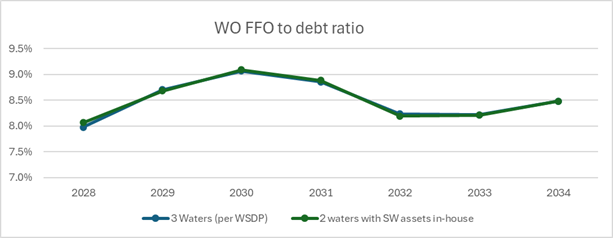
64. Within the CCO, the FFO:Debt
ratio remains similar whether the CCO is responsible for two waters or three.
65. In summary from the perspective
of the financial borrowing ratio, there is a small short-term improvement in
Council’s ratio if TCC retains the Stormwater assets in house and becomes
the WSP. See Figure 1 for the impact on council debt to revenue ratio and
Figure 2 for the impact on the WO’s FFO to debt ratio.
Figure 1: Comparison
between Council debt to revenue ratio for the two options (‘one
water’ approach versus keeping responsibility for stormwater in-house)
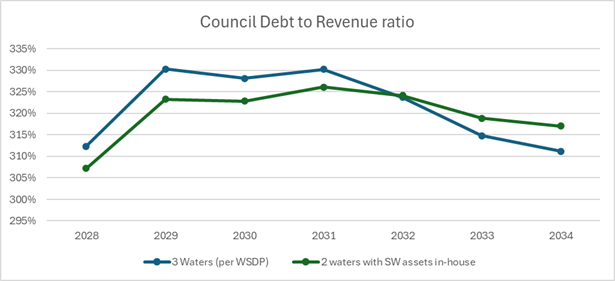
Figure 2:
Comparison between the WO’s (referred to as CCO in the graph) FFO to debt
ratio for the two options (‘one water’ approach versus keeping
responsibility for stormwater in-house)
66. More detail on the financial
modelling and commentary on the outcomes is included as Attachment 2. The
higher debt headroom in 2028 from keeping stormwater in house and charging
ratepayers more than in a CCO is $35M. However, this debt headroom advantage
reverses over time based on modelled trends in revenue requirements relative to
debt increases associated with the proposed capital programme (outlined in
Figure 1 above).
Other Financial
Issues
67. If stormwater assets are
retained in-house this will create complexities that will need to be resolved
between Council and the WO, such as:
· the
funding and financing of capital expenditure. This especially relates to
the adequacy of renewals and the prioritisation of stormwater capital works.
· Note:
that stormwater will be excluded from the rates capping legislation if waters
assets are held in-house.
Feedback from the Joint Working Group
68. Options for how Council may
manage stormwater, including the options put forward by this report, were
presented to the Joint Working Group (consisting of Council, WBOPDC and Tangata
Whenua). This provided Tangata Whenua and WBOPDC the opportunity to provide
feedback regarding their preferences.
69. Tangata Whenua –
Tangata Whenua expressed a strong desire for Council to choose a ‘one
water’ approach, keeping the responsibility for, and delivery of,
stormwater with that of water supply and wastewater. Wai (water) is a precious
taonga and the distinctions of stormwater, wastewater and water supply create
an artificial separation. It is essential to adopt a holistic management
approach to maintain the ongoing mauri (lifeforce) of wai and this is most
easily achieved when one organisation holds both responsibility for, and
delivery of, all aspects of wai.
70. WBOPDC – WBOPDC
has made the decision to transfer all their water services, in full, to the WO
(subject to due diligence). WBOPDC are not intending to revisit this
decision and have expressed a preference for TCC to transfer
responsibility for, and delivery of, water supply, wastewater and stormwater
to the proposed WO. From WBOPDC’s perspective, these factors collectively
support a more sustainable and coordinated approach to water management across
the western Bay of Plenty. They have signalled that alignment by both councils
would maximise the benefits of the proposed WO model and generate the
strongest long-term benefits for both councils and their communities.
Other multi-council Water Organisations decisions
71. WOs which take a ‘one
water’ approach are considered best practice but are still a relatively
new approach. However, central government’s water reforms have encouraged
water providers (councils) to apply a long-term transformational perspective
towards the delivery of water. Whilst councils have responded by choosing a
variety of models to deliver water services, the majority of these models will
retain a fully integrated ‘one water’ approach.
72. The graph and table below
illustrate these choices and Attachment 3 provides a further breakdown at a
council level (note, Auckland is excluded from this modelling, data has been
sourced from approved WSDPs available on DIA website).
Figure 3 – Capture of 67
Council decisions on approach to Stormwater responsibility (WSP)
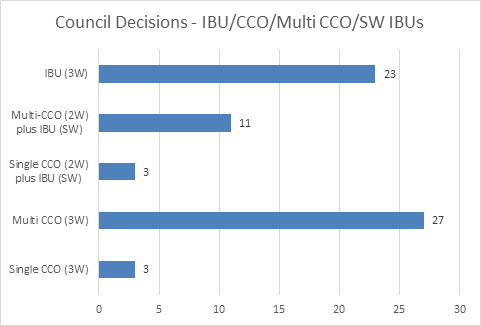
73. The graph above shows that most
councils (53) have decided to keep the delivery and responsibility for
stormwater with that of water supply and wastewater, regardless of whether that
is via a single council WO, a multi-council WO or an in-house business unit.
Only fourteen councils have decided to separate the responsibility for
stormwater from that of water supply and wastewater.
74. Table 1, below, shows that
approximately 76% of New Zealand’s population (excluding Auckland) will
have water services delivered via an integrated ‘one water’
approach.

Options Analysis -
Responsibility for delivery of stormwater
Option 1: Maintain an integrated approach, keeping the
responsibility for stormwater with that of water supply and wastewater.
(RECOMMENDED)
75. Choosing this option means that
if Council proceeds to establish a Water Organisation, the responsibility for
stormwater will transfer to the WO along with water supply and wastewater. This
option aligns with Council’s Water Services Delivery Plan and the current
operating model currently employed by Council. It will also mean there is one
WSP.
76. The pros and cons assume that
Council proceeds to establish a WO.
77. Estimated cost: As per
WSDP’s modelled costs and debt.
78. Key risk: The WO is not able to
develop a charging methodology that adequately recognises socio-economic
factors (noting however that the WO is able to use metrics such as the
deprivation index to inform charging).
|
Advantages
|
Disadvantages
|
|
· No
requirement to amend WSDP or re-consult.
· Only
one WSP (being the WO).
· Scope
for the WO to achieve economies of scale efficiencies.
· Aligns
with the position expressed by WBOPDC and Tangata Whenua
· If
both Councils transfer responsibility to the WO, then the WO will be able to
take a consistent approach to stormwater across all of the
cross-boundary catchments between TCC land and WBOPDC land.
· The
WO will be responsible for delivering 3 waters for both Councils,
and the Board will not face any competing interests that may arise if the
WO is responsible for delivering 2 waters for one Council and 3
waters for the other Council.
· Improved
emergency management, due to greater sub-regional integration.
· Easier
to attract and retain skilled staff due to the ability for staff to increase
water management knowledge across the full range of water services.
· Acknowledges
the inherent connected nature of water and water services.
· Provides
greater opportunity to invest in stormwater infrastructure (due to the WO
higher debt capacity).
· Greater
clarity for customers as only one organisation is delivering water services.
|
· The
Council will not be directly responsible for setting stormwater
charges, and after 5 years the WO will not be able to use a property’s
rateable value as the basis for setting charges.
· There
is a risk that charges by the water organisation may not take account of
relative affordability across the area serviced by the CCO in the same way
that an elected council may consider these matters and address them through
property value charging approach.
|
Option 2: Retain the responsibility for stormwater within
Council, regardless of whether Council retains responsibility for water supply
and wastewater. (NOT RECOMMENDED)
79. Choosing this option means that
if Council proceeds to establish a WO as planned, the responsibility for
stormwater would stay with Council, whilst the responsibility for water supply
and wastewater would transfer to the WO. Ownership of all land used for
stormwater along with ‘hard’ assets would remain with Council. This
option would have the effect of creating two WSPs for Tauranga and does not
align with Council’s WSDP.
80. Estimated cost: additional cost
to ratepayers of approximately $60m over the next 7 years.
81. Key risks: That ratepayers end
up paying more, that the WO cannot fully achieve the anticipated benefits from
economies of scale, and that the sub-region does not benefit as anticipated
from a fully integrated ‘one water’ approach that crosses council
boundaries.
|
Advantages
|
Disadvantages
|
|
· The
Council will be responsible for setting stormwater charges and will
have the ability to use rateable property values.
· Ownership
of all land used for stormwater along with ‘hard’ assets would
remain with Council.
|
· Ratepayers
pay more.
· This
will be a structural change to the WSDP that requires re-consultation with
the public. This would need to occur within a very
constricted timeframe, because WSDP’s cannot be changed after 3
September 2026.
· There
will be 2 WSPs, meaning a duplication of statutory obligations. Those
statutory obligations require significant investment in terms of time and
resources (they will not be a mere “form-filling”
exercise).
· Unable
to fully realise the non-financial benefits resulting from fully integrated
‘one water’ approach across the sub-region.
· Likelihood
that WO will provide 2 water services for one Council, and 3 water services
for the other. This will likely impact WO governance dynamics.
· Customer
confusion, as there will be two WSPs for Tauranga residents.
· Council’s
in-house WSP may struggle to attract skilled staff as the WO will be viewed
as the more attractive option from a career development perspective.
· Emergency
management will require higher levels of coordination as more than one WSP
will be involved.
· The
anticipated economies of scale for the WO will be reduced.
|
Alternative Option: Council retains the responsibility
for, and delivery of, stormwater.
82. This option would see all
aspects of stormwater responsibility and delivery remaining in-house,
along with all land and hard assets. This approach does not reflect decisions
made to date by Council. Given Council decisions have not supported
this approach, a full options analysis is not provided. This alternative
option carries the disadvantages of option 2, with additional disadvantages
associated with recruiting and retaining resources to deliver these services
along with the need to partially novate contractual arrangements with Downer
which currently delivers a full range of services across three waters.
83. Council and WBOPDC currently
holds a joint contract with Downer for the delivery of maintenance activities
across the water supply, wastewater and stormwater networks. This contract will
be fully novated across to the proposed WO. If Council keeps responsibility for
delivery, Council will either need to become an additional party to this
contract or exit the contract and develop an individual one. This would be
complex and incur additional costs (both initially and on an ongoing basis).
84. The additional costs to
ratepayers of this option would be higher than option 2 above, reflecting the
need to manage the network assets in house, undertake asset management
planning, as well as managing the performance of a maintenance contract.
The additional costs have not been modelled.
Options Analysis - Confirming ownership of land
used for stormwater purposes
Option 1: Council, as a general rule, confirms it will
retain ownership of land used for stormwater purposes, regardless of whether
that land is classified as reserve land under the Reserves Act 1977, and
regardless of whether a WO is established (RECOMMENDED)
85. Choosing this option means that
the ownership of the majority of land used for stormwater purposes would remain
with Council, whilst still allowing Council the flexibility to transfer
ownership of specific land parcels to the proposed WO, on a case-by-case basis.
Transfer of land assets to the WO will occur via a Transfer Agreement.
86. This approach is recommended as
it recognises that many land parcels which are used for stormwater purposes are
also used for recreational and/or other purposes by Council. It allows
continued management of this land by Council, streamlining operational processes
and protecting its multi-use status moving forward.
87. Estimated cost: as per WSDP
88. Key risk: Other land uses are
prioritised over stormwater outcomes.
|
Advantages
|
Disadvantages
|
|
· Recognises
the dual-use nature of many of the land parcels used for stormwater purposes.
· Ensures
Council retains ultimate control over the management of land used of
stormwater purposes which ensures non-water outcomes (such as biodiversity
and recreational use) continue to be valued alongside stormwater management.
· May
simplify maintenance arrangements.
|
· Council
retains any debt associated with these land parcels (however Council also
retains the value of these assets).
|
Option 2: Council, as a general rule, would transfer
ownership of land used for stormwater purposes to the WO, if established,
except when that land as classified as reserve land under the Reserves Act
1977. (NOT RECOMMENDED)
89. This option would see the
majority of land used for stormwater transferred to the proposed WO, including
land used for recreational purposes. Transfer of land assets to the WO will
occur via a Transfer Agreement.
90. The exception would be land
classified as reserve land under the Reserves Act 1977. It would be impractical
to transfer this land due to the need to first revoke its reserve status under
the Act.
91. Estimated cost: financial
modelling has not been completed for this option.
92. Key risk: Land which is used
for stormwater purposes, but which also fulfils other critical functions for
Tauranga residents, is no longer in Council ownership and non-water outcomes
(such as biodiversity and recreational use) may not be valued as highly as
stormwater functionality
|
Advantages
|
Disadvantages
|
|
· Council’s
debt decreases (but so will Council’s asset value)
|
· Does
not recognise the dual-use nature of many of the land parcels used for
stormwater purposes.
· Council
has decreased control over the management of land used of stormwater purposes
and non-water outcomes (such as biodiversity and recreational use) may not be
valued as highly as stormwater functionality.
· Maintenance
arrangements may require greater coordination.
|
Stormwater ‘hard’ assets
93. This report recommends that
ownership of the ‘hard’ assets (excludes land) with responsibility
for their management is transferred to the WO. A full options analysis has not
been completed for this (see earlier points 37-38).
Statutory Context
94. The Local Government (Water
Services) Act 2025 (referred to as the Act in this report) and the Local
Government (Water Services) (Repeals and Amendments) Act 2025 set out the
enduring settings for the new water services system. The Act provides councils with
options for the provision of water services.
95. The Act provides a high degree
of flexibility in regards to the delivery of, and responsibility for,
stormwater, as is discussed earlier in this report (refer to the section
‘Legislative context and regulatory considerations’).
STRATEGIC ALIGNMENT
96. The recommendations made by
this report contribute to the achievement of the following community outcomes:
|
Contributes
|
|
An inclusive city
|
☐
|
|
A city that values, protects and enhances the
environment
|
ü
|
|
A well-planned city that is easy to move around
|
ü
|
|
A city that supports business and education
|
☐
|
|
A vibrant city that embraces events
|
☐
|
97. This report recommends adopting
a ‘one water’ approach, with one organisation to have the
responsibility for, and delivery of, wastewater, water supply and stormwater,
and, as a general rule, for the ownership of land used for stormwater to remain
with Council. This approach delivers environmental benefits, economies of
scale, and supports integrated planning and delivery. The recommended approach
also avoids the creation of two water service providers for Tauranga residents.
TE
AO MĀORI APPROACH
98. Council has committed to engage
with Tangata Whenua as part of its ongoing planning work for the proposed WO.
This is largely occurring via the inclusion of Tangata Whenua representatives
on the Joint Working Group,
99. The inclusion of Tangata Whenua
representatives on the Joint Working Group with Council and WBOPDC elected
members is part of Council’s commitment to the principles of Te Ao
Māori, and particularly recognises the principles of:
· Rangatiratanga
(self determination, best practice and reciprocity)
· Kaitiakitanga
(stewardship of the natural environment)
· Wairuatanga
(belief systems that support instinct and intuition in line with whāia te
tika – the pursuit of the right way forward)
100. The Tangata Whenua representatives on the
Joint Working Group have strongly expressed their view that the division of wai
(water) into the three activities of stormwater, water supply and wastewater is
an artificial construct, as all wai is one, and that for this reason, the
responsibility for all water should remain together to enable an integrated
management and delivery approach (refer also to point 64).
Past consultation with Tangata Whenua
101. Council completed formal consultation on
the proposal to establish a WO for stormwater, water supply and wastewater
alongside the 2025/2026 Annual Plan. As part of this consultation, Council
received a submission from Te Rangapū supporting the
creation of a multi-council WO and requesting that Council
ensures Tangata Whenua representation on the board of any
WO, and that co-governance and co-design principles are built into the
establishment and operations of any future WO. There were
subsequent discussions on the Te Rangapu views when there was consideration of
Thames Coromandel District Council joining the WO (this has been addressed in
previous Council reports).
102. Overall, the
Te Rangapū submission argued that Tangata Whenua
partnership is essential to any CCO achieving long-term positive outcomes and
that the principle of kaitiakitanga is upheld and the mauri
of wai is protected.
103. Council also received submissions
from several
iwi, hapū and Māori landowners, largely
focused on infrastructure and land ownership.
· Otanewainuku Whanau
Trust
· Maungatapu Marae
Committee and Trustees
· Ngāti Pūkenga ki
Tauranga
104. Following this formal consultation,
Council received a position
paper from Tangata Whenua which was tabled at Council on 5 August 2025.
Whilst this paper does not specifically focus on a ‘one water’
approach versus splitting responsibility for water services, it does contain
relevant principles, most notably:
· that
the proposed WO must ensure the mauri, health and wellbeing of water and water
bodies is central to its decision-making.
· that
the proposed WO will only recognise the voice of iwi and hapū specific to
the respective rohe when considering issues relating to a rohe, including
issues associated with a water resource or product which is sourced,
transmitted, treated or discharged in that rohe (i.e. avoid overreach by other
iwi/hapū or councils into established rohe boundaries).
· that
Council will ensure that the views of Tangata Whenua are given equal weight to
other key considerations (such as financial viability) when determining the
preferred WO model.
Guidance provided by iwi and
hapū management plans
105. There are a number of iwi
and hapū management plans which have been lodged with Council, two pan
tribal plans covering Tauranga Moana and Te Awanui (Tauranga harbour), and
further plans with individual iwi and hapū. These plans describe resource
management issues which are of importance to Tangata Whenua. Wai (water)
features prominently in these plans, with common themes including the:
· need
for effective management of stormwater.
· overall
importance of caring for wai to ensure the wellbeing of current and future
communities
· interconnections
between the moana and freshwater tributaries.
Consultation / Engagement
106. Consultation on the proposal to establish
a multi-council WO occurred alongside the consultation for the 2025/2026 Annual
Plan and the Deliberations
Report from 5 May 2025 outlines community feedback. None of the options
consulted on contemplated separating the responsibility for stormwater from
that of water supply and wastewater.
107. If Council decides to retain
responsibility for stormwater in-house this would result in the need to revise
the current WSDP and reconsult. This will have a ‘knock-on’
effect with WBOPDC to some extent, as the two Council WSDPs have been assessed
alongside each other.
Significance
108. The Local Government Act 2002 requires an
assessment of the significance of matters, issues, proposals and decisions in
this report against Council’s Significance and Engagement Policy.
Council acknowledges that in some instances a matter, issue, proposal or
decision may have a high degree of importance to individuals, groups, or
agencies affected by the report.
109. In making this assessment, consideration
has been given to the likely impact, and likely consequences for:
(a) the current
and future social, economic, environmental, or cultural well-being of the
district or region
(b) any persons who are likely to be
particularly affected by, or interested in, the decision.
(c) the capacity of the local authority
to perform its role, and the financial and other costs of doing so.
110. In accordance with the considerations
above, criteria and thresholds in the policy, it is considered that the
decision is of medium significance as it has moderate public interest, moderate
impact on Council, and would be moderately difficult to reverse.
ENGAGEMENT
111. Taking into consideration the above
assessment, that the decision is of medium significance, officers are of the
opinion that no further engagement is required prior to Council making a
decision.
112. No further engagement is required as
Council has already completed consultation from March to April 2025. Council is
also engaging with Tangata Whenua on an ongoing basis in relation to the
proposed establishment of the WO.
113. If Council decides not to retain the
responsibility for stormwater with that of water supply and wastewater, then
Council would need to complete further consultation.
Next Steps
114. The next steps depend on whether Council
decides:
· To
approve the recommendations of this report.
· To
proceed with establishment of the proposed WO.
115. If Council does decide to proceed as per
the recommendations of this report, and with the proposed WO, the next steps
would include development of a Transfer Agreement. This would be a detailed
document which will set out the process for transferring responsibility of
stormwater, and ownership of stormwater ‘hard’ assets to the WO. It
would also capture the transfer of any specific land parcels (noting that it is
proposed that the majority of stormwater land will stay with Council).
Attachments
1. Joint
Governance Group material from 22 December 2025 - A19660951 ⇩ 
2. Attachment
2 - LWDW Summary of WSDP vs SW inhouse - A19689206 ⇩
3. Attachment
3 - LWDW Other Multi Council Water Organisation Decisions - A19688996 ⇩
4. Attachment 4 -
LWDW Stormwater IBU assessment of Costs and service requirements - A19705258 ⇩
|
Ordinary
Council meeting Agenda
|
10
February 2026
|
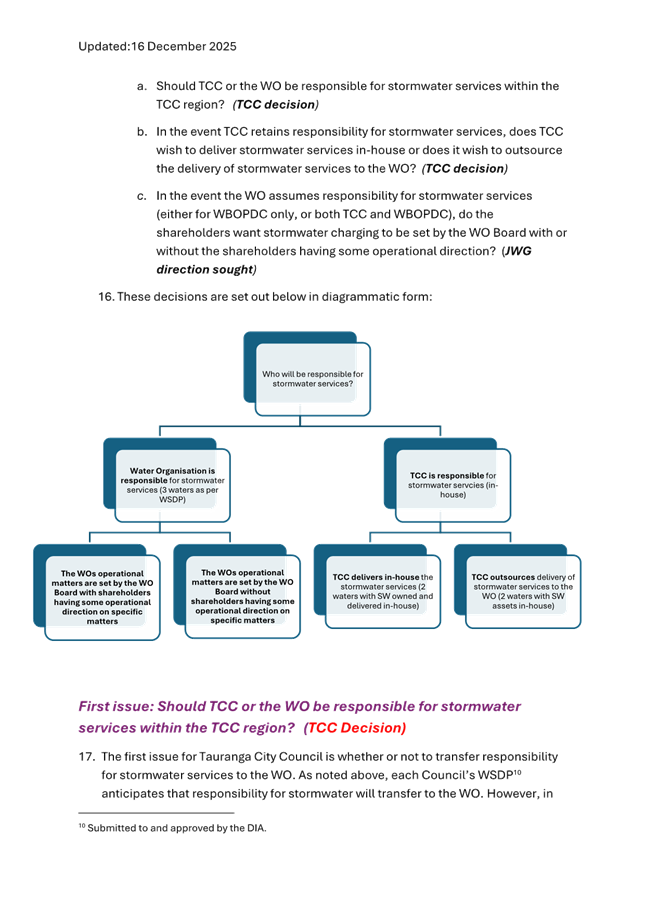
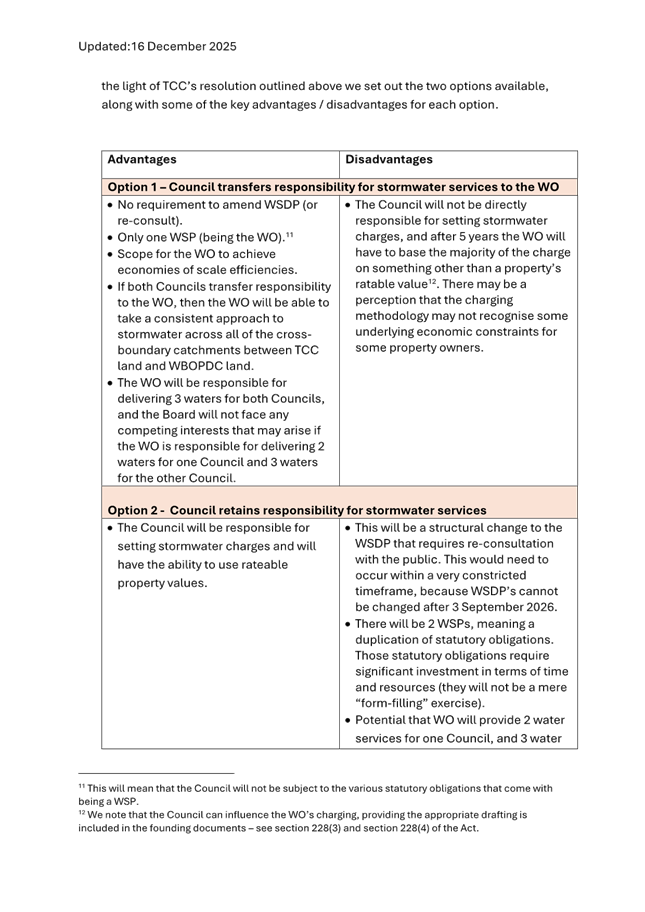
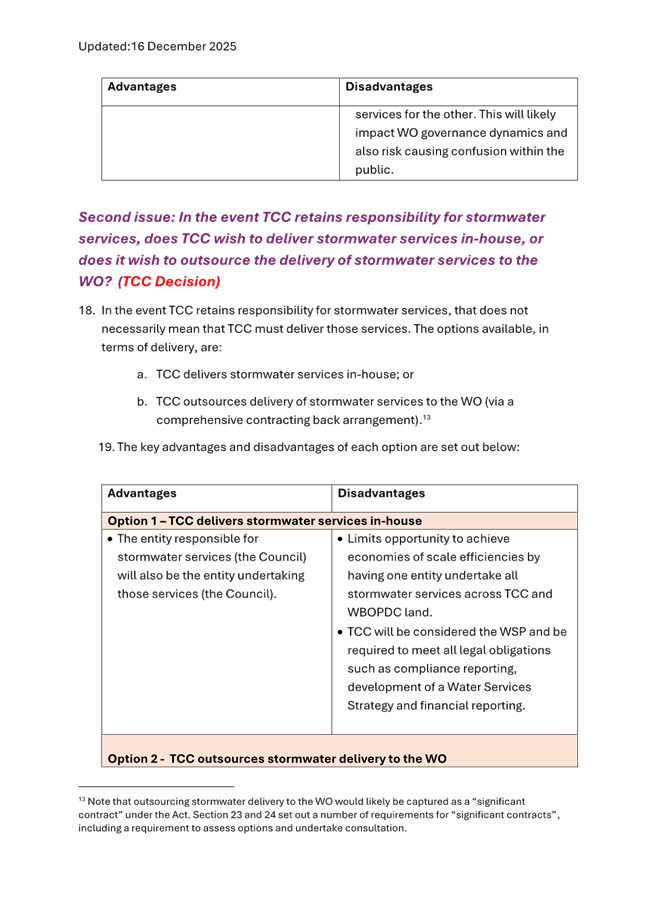
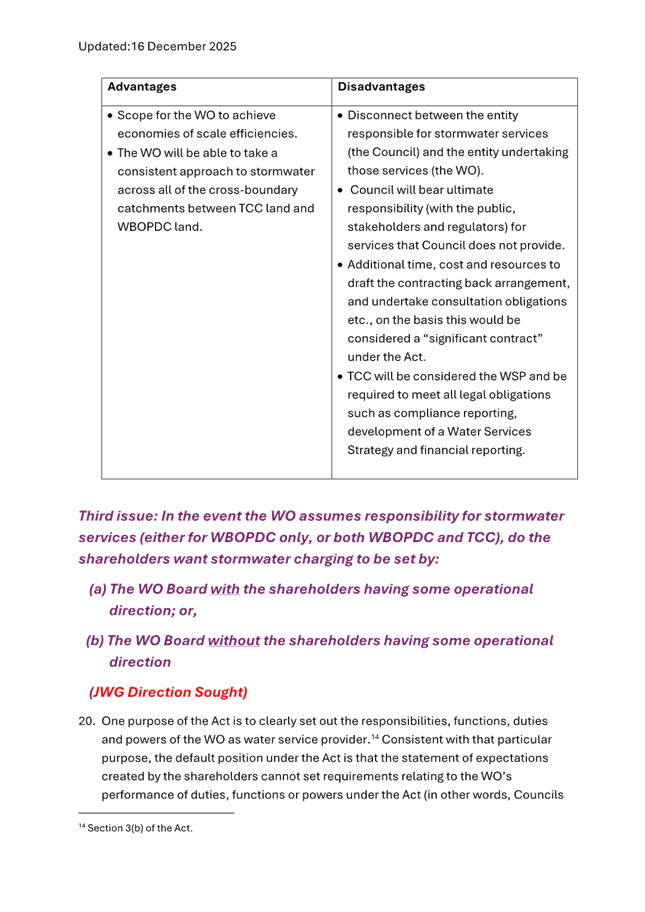
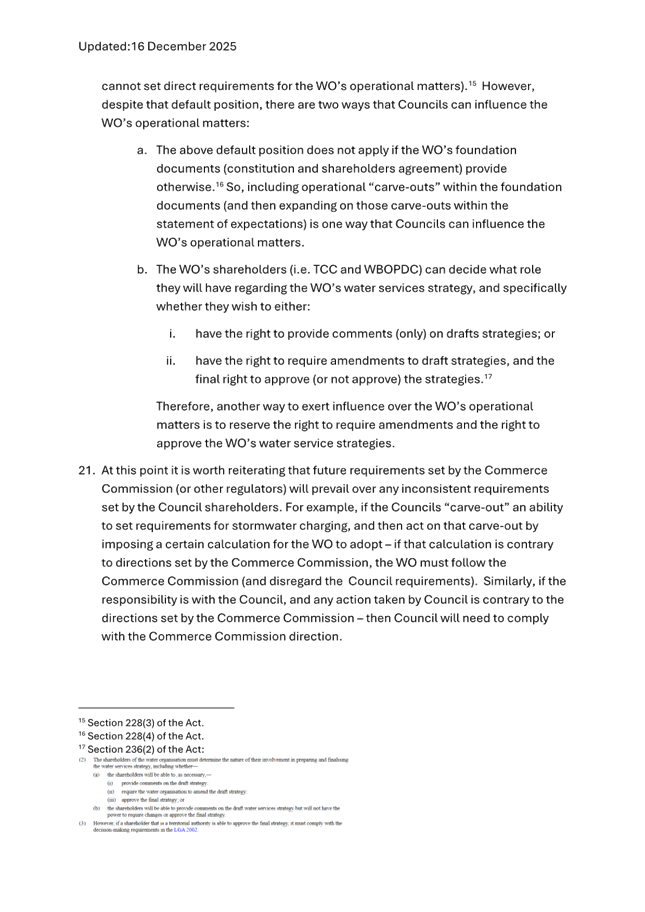
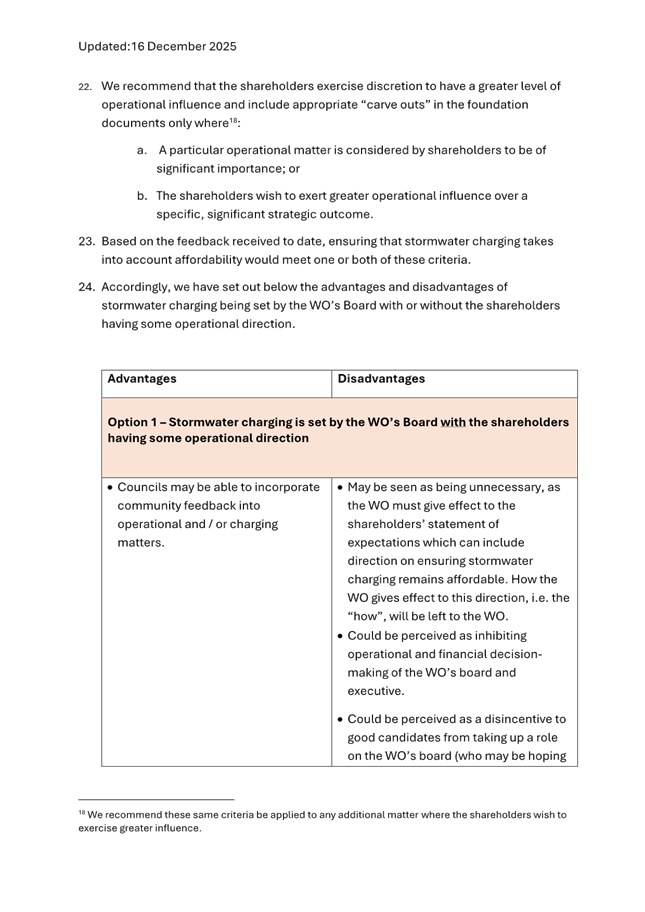
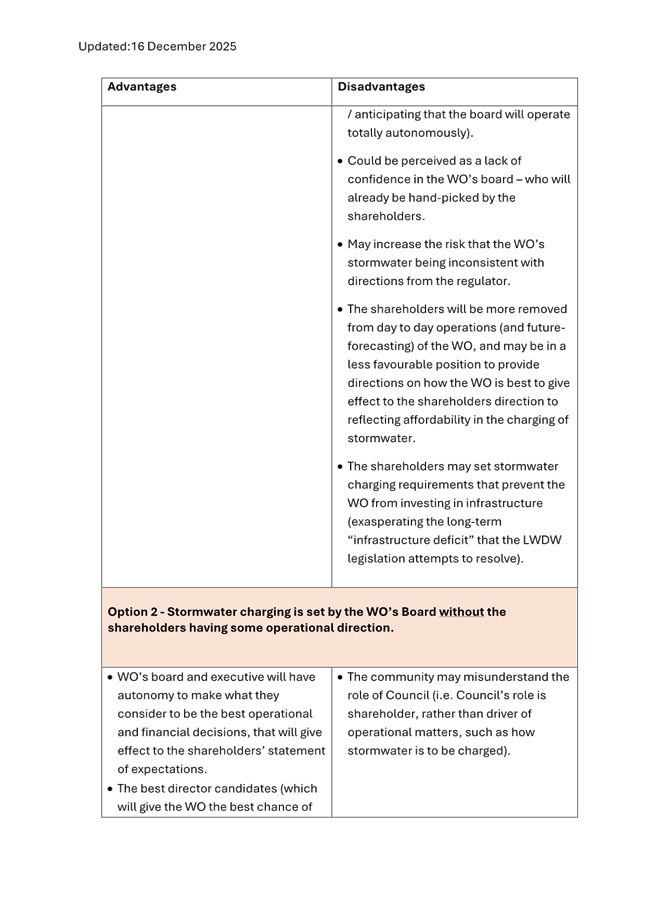
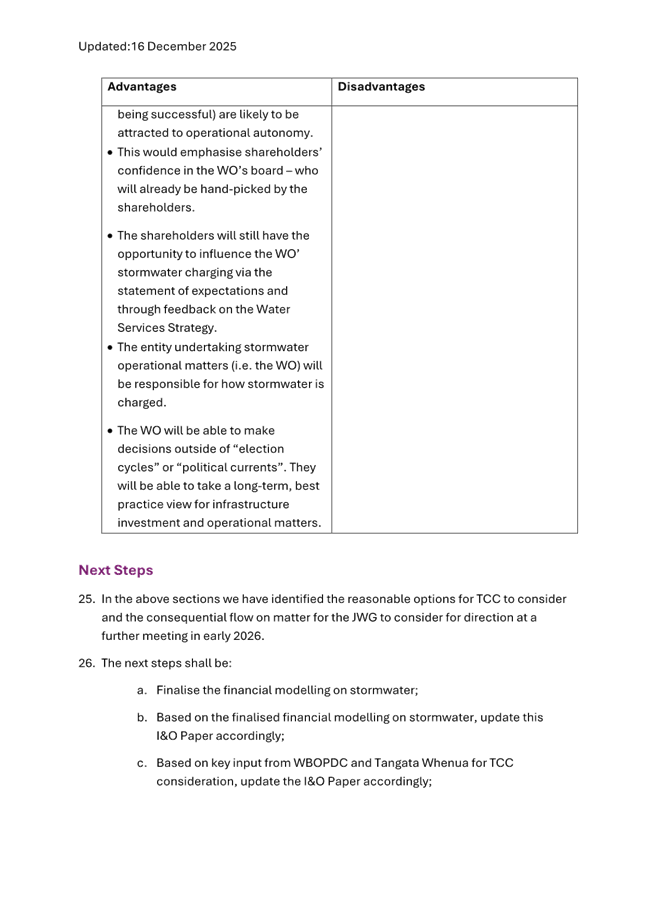

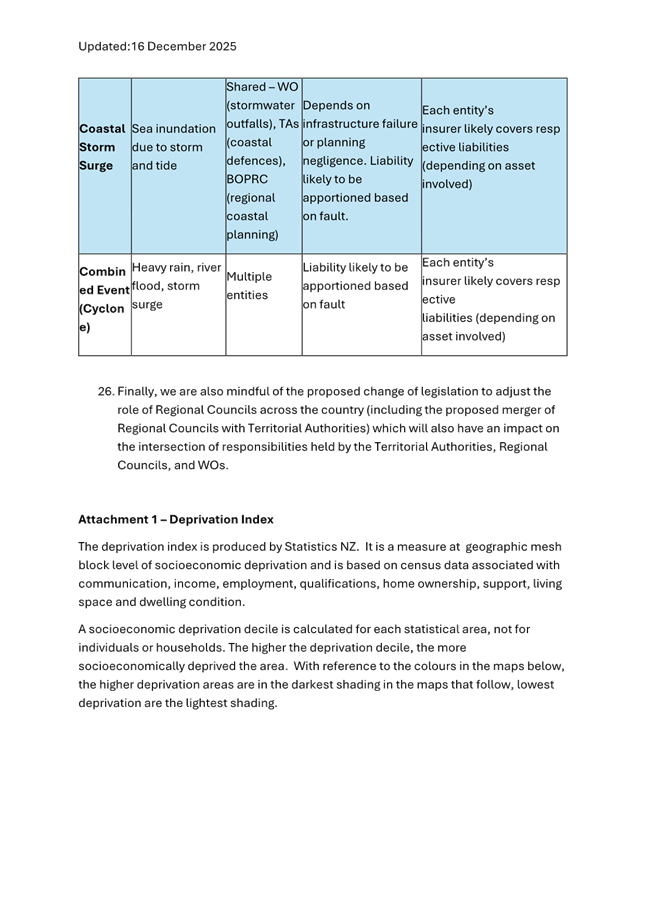
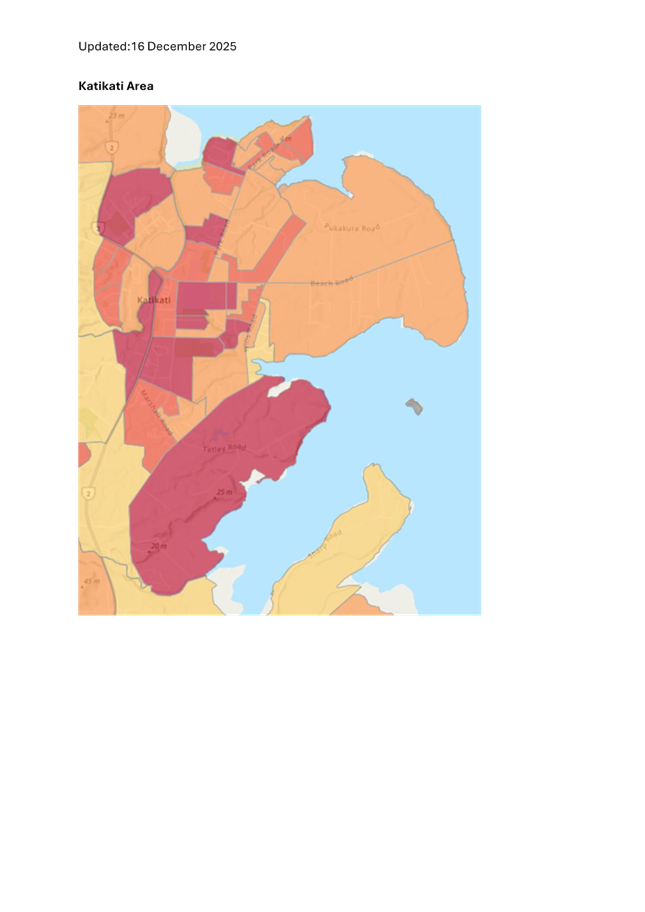
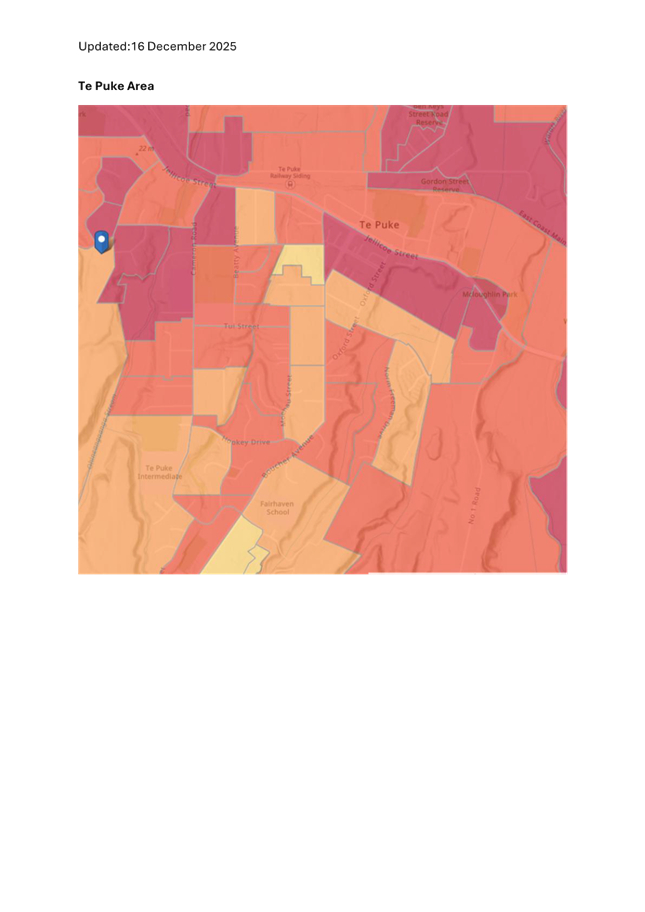
|
Ordinary
Council meeting Agenda
|
10
February 2026
|
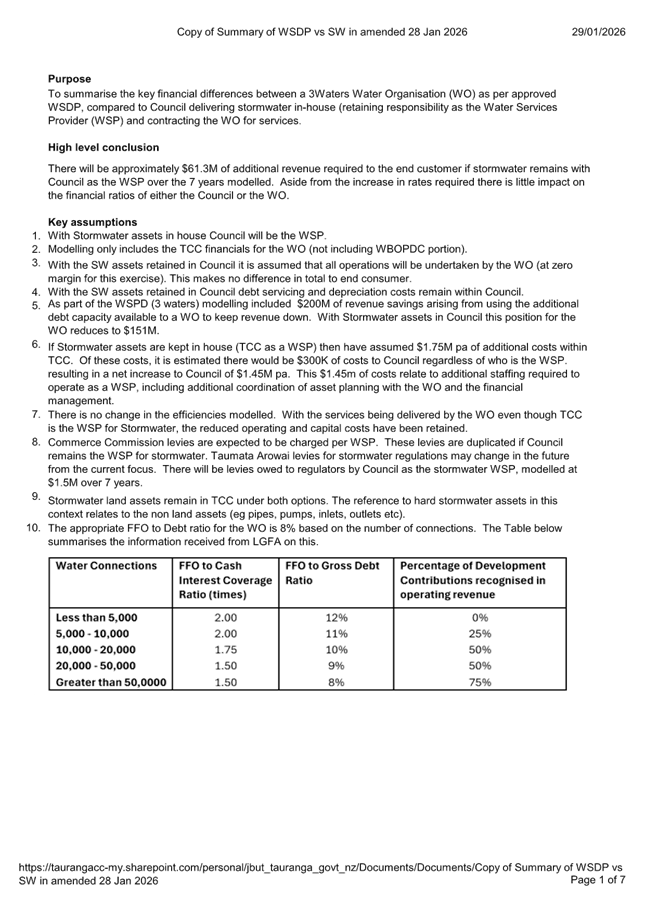
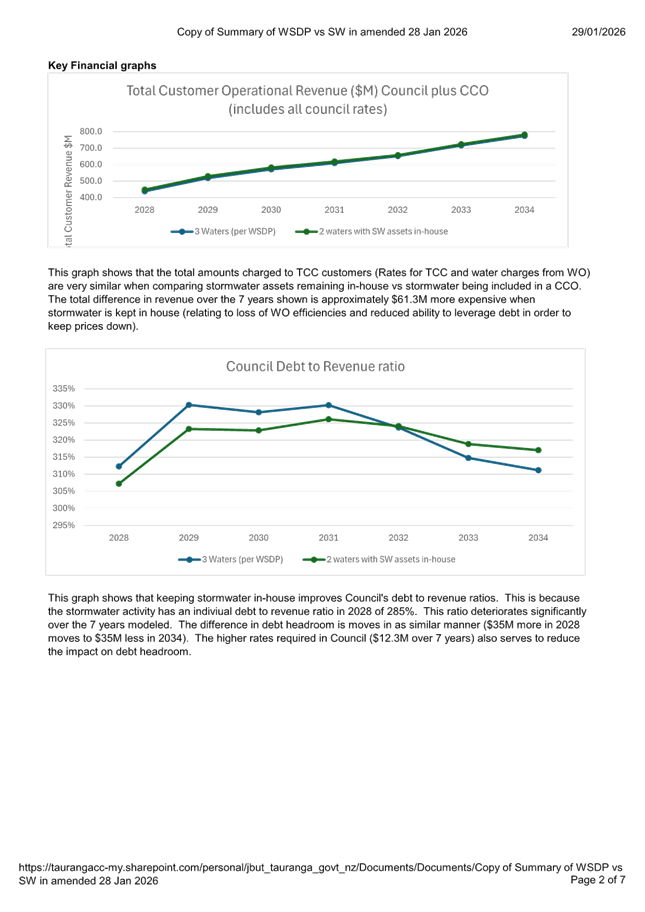
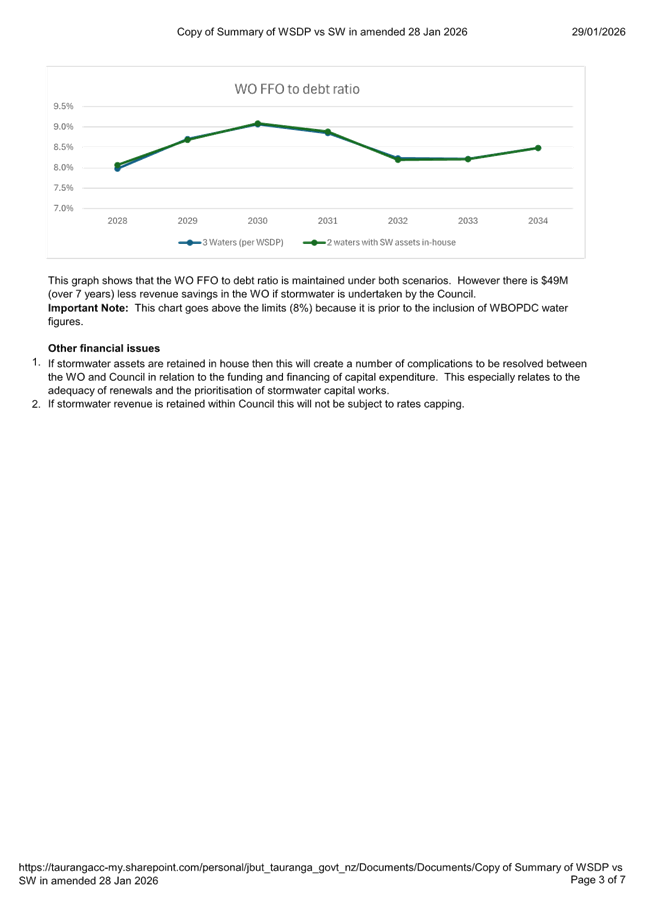
|
Ordinary
Council meeting Agenda
|
10
February 2026
|
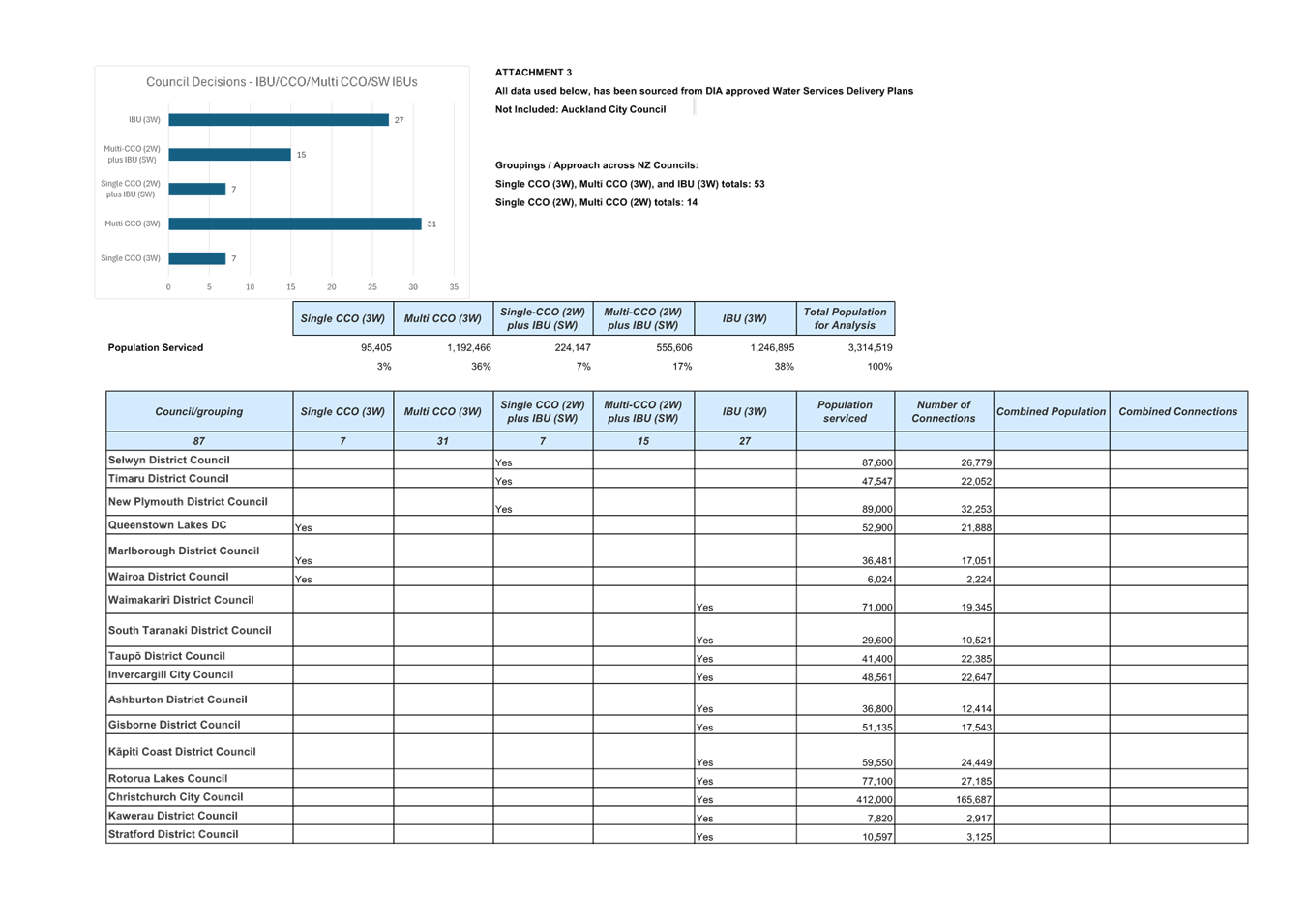
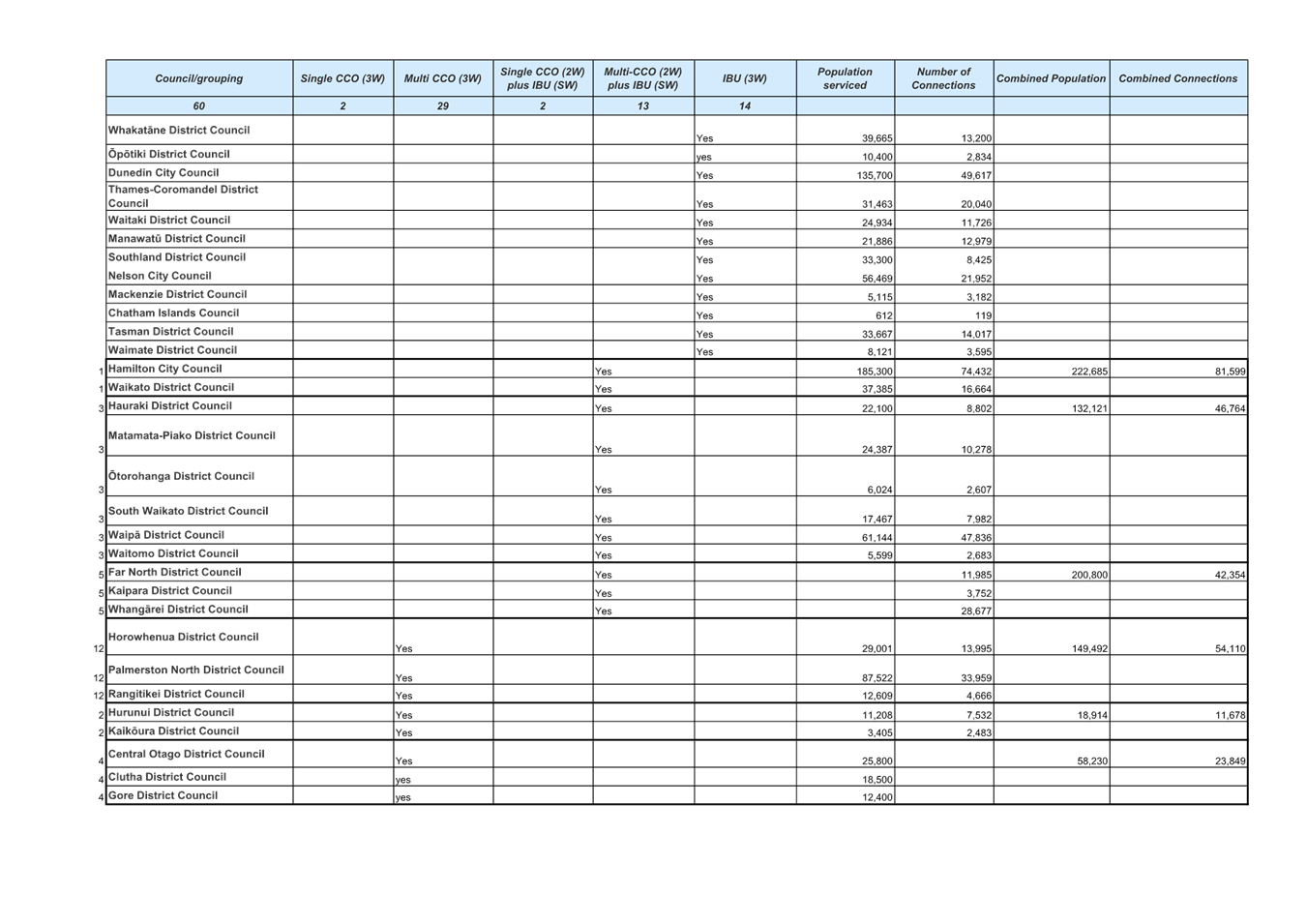
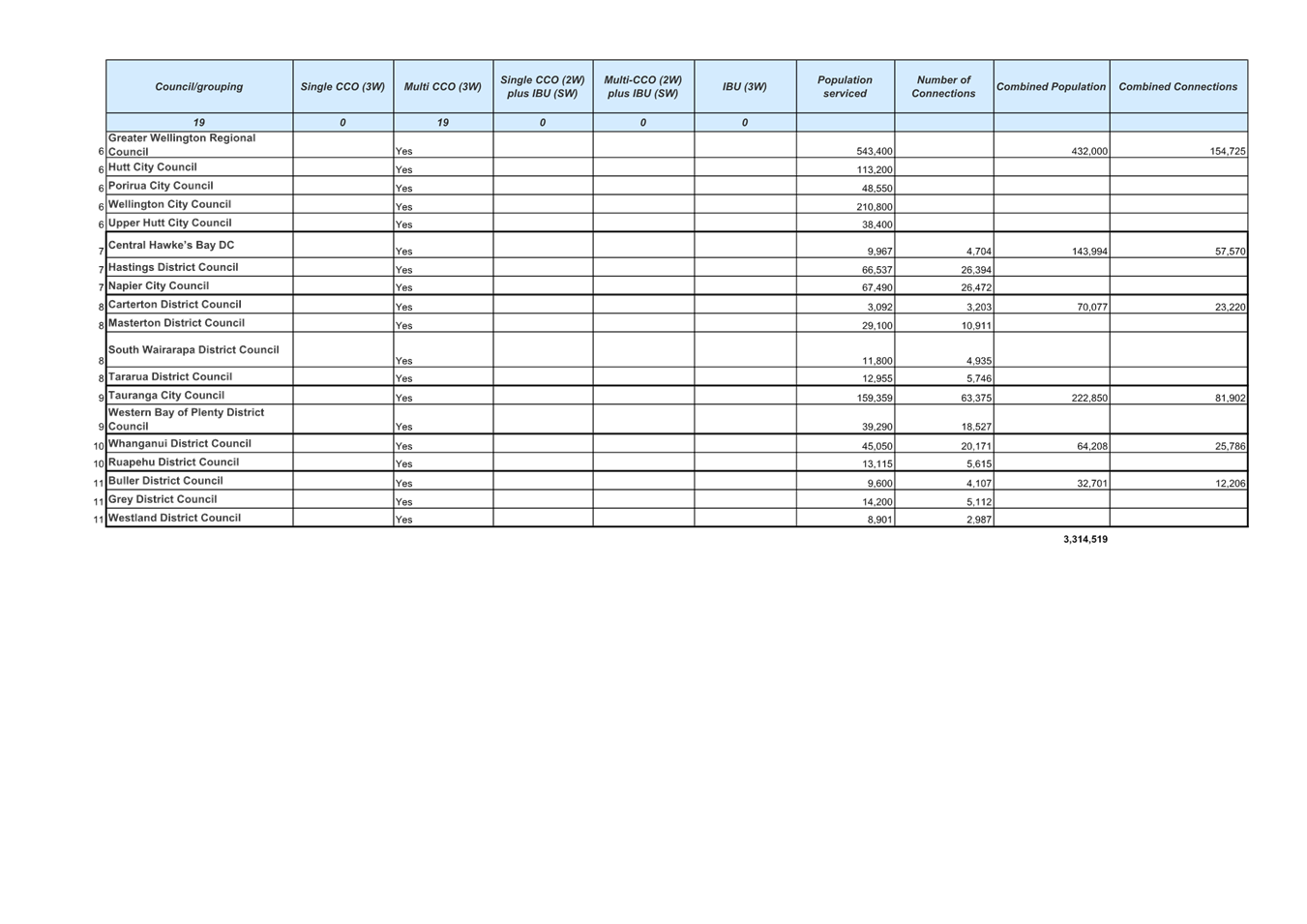
|
Ordinary
Council meeting Agenda
|
10
February 2026
|
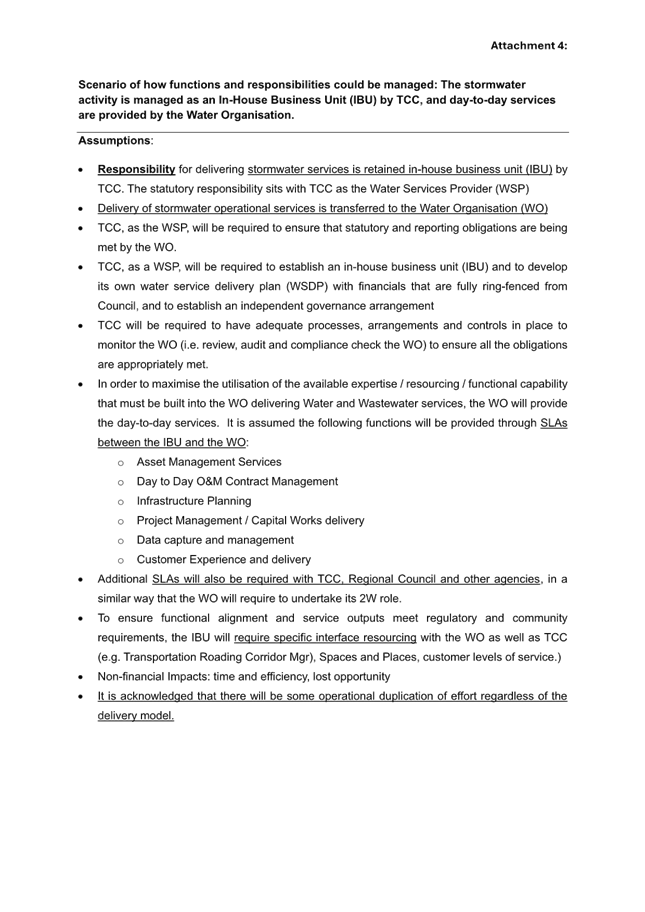
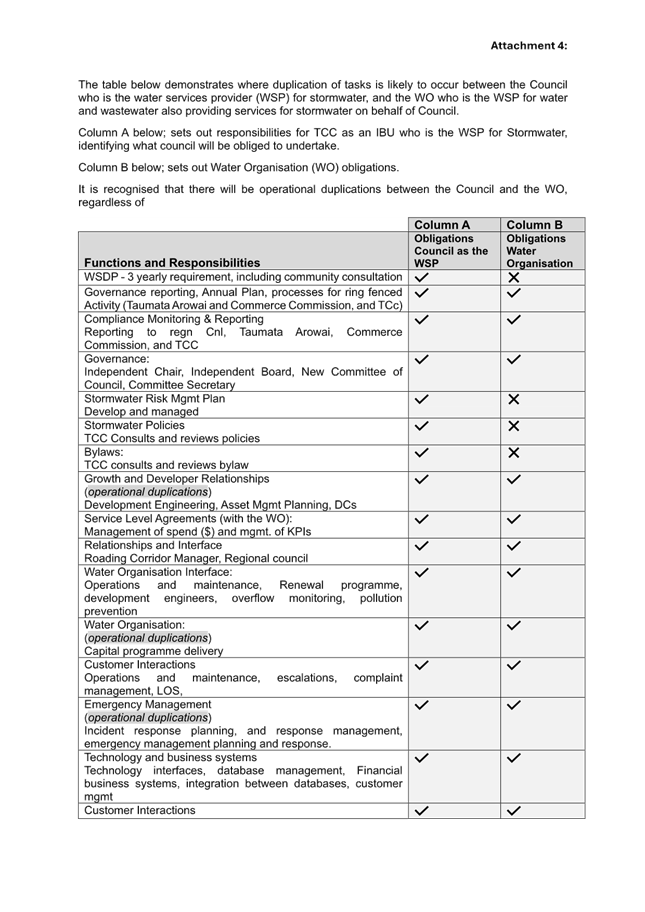
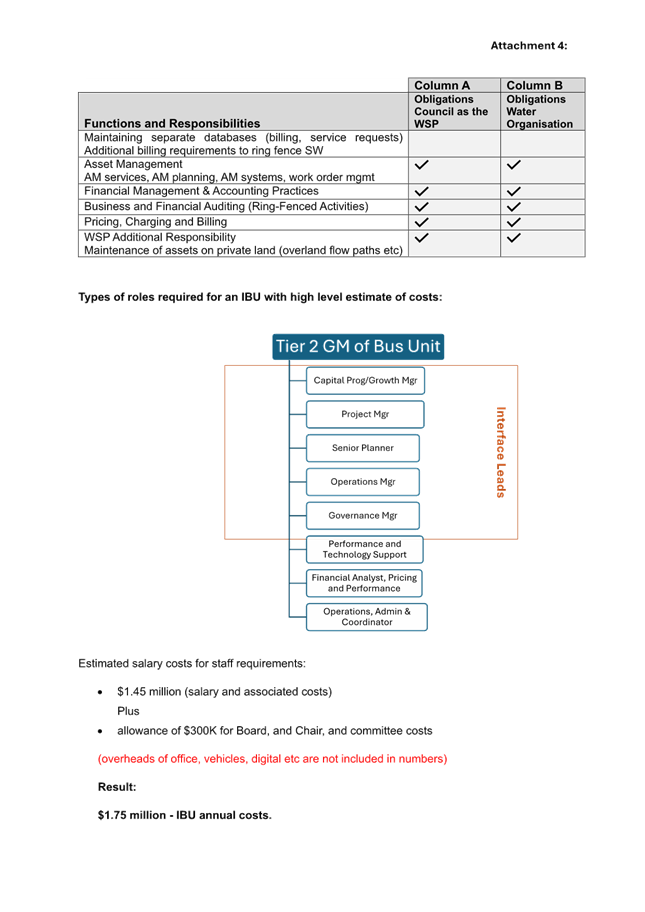
|
Ordinary
Council meeting Agenda
|
10
February 2026
|
11.2 Submission on Planning
Bill and Natural Environment Bill
File
Number: A19671732
Author: Janine
Speedy, Team Leader: City Planning
Authoriser: Christine
Jones, General Manager: Strategy, Partnerships & Growth
Purpose of the Report
1. The purpose of this
report is to seek endorsement of the key submission points for Tauranga City
Council (Council) to make a submission to the Select Committee regarding the
Planning Bill and Natural Environment Bill which will replace the Resource
Management Act.
|
Recommendations
That the Council:
(a) Receives the report
"Submission on Planning Bill and Natural Environment Bill".
(b) Endorse the key submission
points included as Attachment 1 on the Planning Bill and Natural Environment
Bill to be included in a detailed submission to the Select Committee.
(c) Delegates to the Chief
Executive to approve the submission on the Planning Bill and Natural
Environment Bill to the Select Committee.
|
Executive Summary
2. On 9 December 2025,
central Government introduced the Planning Bill and Natural Environment Bill.
The Planning Bill and Natural Environment Bill is proposed to replace the
Resource Management Act 1991 (RMA) and provide a new planning system which will
directly affect how council delivers growth, infrastructure, natural
environmental management, consenting and long-term planning.
3. Submissions on the
Planning Bill and Natural Environment Bill close at 4.30pm on 13 February, and
it is intended that the legislation is passed into law by mid-2026.
4. Staff are preparing
a detailed submission, which generally supports the new planning system. The
submission also sets out where it is considered that provisions are unworkable,
confusing or amendments can be made to improve efficiency and effectiveness. Due
to the time constraints to prepare the submission, only the key submission
points to be included in the detailed submission are included in Attachment 1
for endorsement.
Background
5. The Government has set out three
phases of resource management reform. Phase 3 is the replacement of the RMA
with two new laws, the Planning Bill and Natural Environment Bill.
6. A major
change in the new system is the shift to two separate Acts proposed through the
two Bills:
· A
Planning Bill that establishes a framework for planning and regulating the use,
development and enjoyment of land.
· A
Natural Environment Bill that establishes a framework for the use, protection
and enhancement of the natural environment.
The new planning system
is based on a blueprint developed by the Expert Advisory Group on Resource
Management Reform.
7. Central
Government expected outcomes of the new legislation include:
· Enhanced
property rights through regulations that focus on only controlling impacts on
the environment and other people. There will also be greater availability of
relief if property rights are infringed.
· A
simpler, faster and more cost-effective system for users and councils with
fewer consents, more direction from government, and clear, fair rules.
· Future-ready
planning that meets housing and infrastructure needs, while managing and
reducing risks from natural hazards.
· A
digitally enabled system providing better access to information, with trusted
data driving faster decisions, and better performance monitoring.
· Māori
interests and the Treaty of Waitangi are provided for.
· Improved
environmental outcomes and innovation encouraged by enabling growth and
development within environmental limits.
8. The new
system approach makes the system more directive from the top, ensuring
consistency across the country, and allowing local communities to focus on
applying that approach in their area. It will make decision-making more focused
at each stage of the planning system. As the process narrows, fewer things
would be up for debate, saving time and money. It is also intended to give
people greater certainty about what they can and can’t do, helping them
understand likely outcomes before they begin.
9. The Natural
Environment Bill and Planning Bill creates a system that will operate like a
funnel, starting with clear goals that narrow what can be considered at the top
and each level of the system. The system architecture in the Bill comprises:
· A
set of goals that tightly define the scope of the system:
· A
set of national instruments, comprising:
o National policy
direction (NPD) that particularises the goals:
o National standards that
provide further detailed direction for implementing the NPD and standardised
direction for decision-making and plans, nationally standardised rules and
zones, and methods to identify matters such as outstanding natural features, indigenous
biodiversity, sites of significance to Māori:
· A
single combined plan for each region made up of three integrated components:
o A regional spatial plan
that implements the national instruments to support urban development and
infrastructure provision within environmental limits; and
o A land use plan under
that the Planning Bill implements spatial plans by applying nationally
standardised zones, rules, and methodologies; and
o A natural environment
plan under the Natural Environment Bill implements spatial plans by applying
standardised overlays, rules, and methodologies; and
10. Consents will be issued
under the Planning Bill and permits under the Natural Environment Bill.
11. Each instrument must
implement the one above it (the land use plans and the natural environment
plans operate at the same level of the funnel under each Bill).
12. At the consenting level,
councils will manage fewer effects using a higher threshold, reducing the
number of consents required. Community engagement is intended to primarily
occur during the spatial and land use plan development rather than at the
consenting level (as per the RMA).
13. This is intended to make
the system simpler and more efficient, reducing re-litigation of matters that
have already been decided higher up in the system and reduce the number of
consents needed. The levels of the system are outlined in more detail below.
Statutory Context
5. The Planning Bill
and Natural Environment Bill is Phase 3 of the resource management reforms. It
is proposed that Council make a submission on the Planning Bill and Natural
Environment Bill to the Select Committee as the proposed new system will have a
direct impact on resource management processes that Council are responsible
for.
STRATEGIC ALIGNMENT
6. This contributes to
the promotion or achievement of the following strategic community outcome(s):
|
Contributes
|
|
We are an inclusive city
|
☐
|
|
We value, protect and enhance the environment
|
ü
|
|
We are a well-planned city that is easy to move
around
|
ü
|
|
We are a city that supports
business and education
|
ü
|
|
We are a vibrant city that embraces
events
|
☐
|
7. The Planning Bill
and Natural Environment Bill proposes a new resource management system which
will directly affect how council delivers growth, infrastructure, natural
environmental management, consenting and long-term planning.
Financial Considerations
8. There are no
financial considerations associated with this report.
Legal Implications / Risks
9. Legal advice has
been obtained to assist staff understand the implications and opportunities of
the proposed changes in the Bill. The legal advice has informed the draft
submission.
TE AO MĀORI APPROACH
10. Engagement has been undertaken
with the Te Pou Takawaenga team. A number of key submission points relate to
tangata whenua is set out in Attachment 1. These submission points were
provided to the Te Rangapu Mana Whenua o Tauranga Moana for feedback.
CLIMATE IMPACT
11. The Planning Bill and Natural
Environment Bill considers climate through natural hazards. There is also
proposed to be the consideration of adaptation planning through the regional
spatial plan process. Submission points support the climate change aspects
within the Planning Bill and Natural Environment Bill, however, seek amendments
to strengthen these provisions such as proposing a definition for climate
change.
Consultation / Engagement
12. In preparing the draft
submission and key submission points, the City Planning and Growth team has sought input and feedback from subject
matter experts throughout Council. All feedback has been collated and
included in the draft submission.
13. In addition, staff have been
discussing submission points with the SmartGrowth partners and other councils
across the country.
Significance
14. The Local Government Act 2002
requires an assessment of the significance of matters, issues, proposals and
decisions in this report against Council’s Significance and Engagement
Policy. Council acknowledges that in some instances a matter, issue,
proposal or decision may have a high degree of importance to individuals,
groups, or agencies affected by the report.
15. In making this assessment,
consideration has been given to the likely impact, and likely consequences for:
(a) the current
and future social, economic, environmental, or cultural well-being of the
district or region
(b) any persons who are likely to be
particularly affected by, or interested in, the matter.
(c) the capacity of the local authority
to perform its role, and the financial and other costs of doing so.
16. In accordance with the
considerations above, criteria and thresholds in the policy, it is considered
that the matter is of low significance. This is a submission to be
lodged, the decision making sits with central government.
ENGAGEMENT
17. Taking into consideration the
above assessment, that the matter is of low significance, officers are of the
opinion that no further engagement is required prior to Council making a
decision.
Next Steps
18. Following endorsement of the
key submission points included as Attachment 1, the detailed submission will be
finalised and approved by the Chief Executive. Once approved, the submission
will be lodged.
19. We will request the opportunity
to speak to the TCC submission.
Attachments
1. Attachment
1: Key Submission Points on Natural Environment and Planning Bills - A19671723 ⇩ 
|
Ordinary
Council meeting Agenda
|
10
February 2026
|

|
Ordinary
Council meeting Agenda
|
10
February 2026
|
11.3 Draft submission on
Simplifying Local Government proposal
File
Number: A19488962
Author: Anne
Payne, Principal Strategic Advisor
Jeremy Boase, Head
of Strategy, Governance & Climate Resilience
Authoriser: Christine
Jones, General Manager: Strategy, Partnerships & Growth
Purpose of the Report
1. To consider and approve
Council’s draft submission to the Government’s Simplifying Local
Government draft proposal.
|
Recommendations
That the Council:
(a) Receives the report
"Draft submission on Simplifying Local Government proposal".
(b) Approves the draft submission
“Tauranga City Council Submission – Simplifying Local Government
draft proposal” included as Attachment 1 to this report, with the
following amendments:
(i) (to be added during
the meeting if necessary).
(c) Delegates authority to the
General Manager: Strategy, Partnerships & Growth to make minor drafting,
typographical, and presentation amendments as required prior to formally
lodging the submission ahead of the 20 February 2026 deadline.
|
Executive Summary
2. On 27 November 2025,
the Government released a draft proposal on Simplifying Local Government (the
proposal), with feedback sought by 20 February and a final proposal signalled
for release in March 2026.
3. The proposal aims to
address the Government’s view that the local government system is not
working well by making local government easier to understand, reducing
duplication, and delivering better value for ratepayers.
4. The
proposed approach is to replace regional councillors with a new governance
board comprising all city and district mayors from the region, called a
Combined Territories Board (CTB). The CTB would also be required, within a
two-year time period, to develop a regional reorganisation plan (RRP). The RRP
would require final approval by the Minister of Local Government, with input
from the Local Government Commission. The expectation is that regional councils
would no longer exist (at governance or organisational level) once the RRPs are
implemented, and that there is also potential for some structural change for
city and district councils within each region.
5. Key points from
Council’s draft submission on this draft proposal are that we support the
Government’s intention to improve the local government system, however:
· We
believe the Government should go further in specifying its envisaged local
government system
· Resourcing
from the Government to support mayors, the Local Government Commission, and the
transition will be essential to success
· We
propose an alternative staged approach where regional councillors continue to
govern the day-to-day operations until the regional reorganisation plan
developed by the combined territories board has been approved, and
· We
believe there is a risk that environmental protection functions may be
deprioritised if this proposal proceeds as drafted, depending on the results
from the Government’s current rapid review of regional council functions.
· Determining
the new arrangements should be progressed at some pace, with implementation in
parallel with other reforms where it is practical and efficient to do so.
6. Once the draft
submission is approved, the next step is to lodge it with the Department of
Internal Affairs by due date of 20 February 2026.
Background
7. On 27 November 2025,
the Government released a
draft proposal on Simplifying Local Government (the proposal)[3], which aims to make
local government easier to understand, reduce duplication, and deliver better
value for ratepayers. The proposed approach intends to provide a framework for
regions to design what works best for them
8. The first part of
the proposal is to replace regional councillors with a new governance board
comprising all city and district mayors from the region, called a Combined
Territories Board (CTB), which may also include an appointed commissioner with
or without voting rights. Alongside existing regional council governance
responsibilities, the CTB would also be responsible for decision-making
required by the concurrent resource management reforms, including the new
regional spatial plans and regional natural environment plans. The city and
district mayors on the CTB would be responsible for representing all of their
constituencies, and no specific regional Māori constituencies are
proposed.
9. The proposal notes
that central Government is currently undertaking a review of regional council
roles and functions to clarify which responsibilities are to remain local and
which may be either centralised or discontinued. This review will be completed before
CTBs are established.
10. The second part of the proposal
is to require the CTB to develop, within two-years, a regional reorganisation
plan (RRP) that sets out how councils would work together to deliver services
more effectively and efficiently across the region. The RRP would require final
approval by the Minister of Local Government, with input from the Local
Government Commission.
11. The proposal is that, once the
RRPs are implemented, regional councils would no longer exist (at governance or
organisational level) and the city and district councils would deliver all
local government services in a more joined up way, which may include structural
change if this is deemed beneficial for their communities.
12. The Government is seeking
public feedback on the proposal by 20 February and has signalled that a final
proposal will be released in March 2026.
discussion
13. Following
input from Elected Members, Council’s draft submission has been prepared
and is included as Attachment 1 to this report, for consideration and
approval. Key points from the draft submission are that:
· The
Council supports the aims of the draft proposal to simplify local government to
make it easier to understand, reduce duplication, and deliver better value for
ratepayers; and the intention for local (regional) solutions to be developed
rather than a one-size-fits-all approach being imposed by central government.
However, the Council also has several key concerns with this proposal.
· There
is a cumulative effect of local government reforms that places pressure on
councils. However, there is a definite benefit in moving with some pace and
removing what has been ongoing uncertainty within the sector. The
Council supports replacement arrangements developed with some pace with
subsequent implement proceeding in parallel with other reform initiatives where
it is practical and efficient to do so.
· The
Council believes that the Government should go further in specifying its
envisaged local government system, at least at a high level, to reduce
duplication of effort and improve efficiency in developing approved regional
solutions.
· Resourcing
will be essential to support mayors, the Local Government Commission, and the
transition for each region. The Council recommends that funding for additional
resourcing in these areas is included within the final proposal.
· The
Council proposes an alternative staged approach to implementation of this draft
proposal, to mitigate capacity risks and enable input from regional
councillors. The Council proposes that the CTB of city and district mayors for
the region is established to focus primarily on developing a way forward for
local government through the RRP. During this two-year period, regional
councillors would continue to govern the day-to-day business of regional
councils, with triggers put in place for bigger issues requiring escalation to
the CTB.
14. The turnaround time for
submissions to the proposal has been shortened by the Christmas / New Year
break, which has made it difficult to seek and incorporate feedback from local
Iwi/Hapū through Te Rangapū o Mana Whenua o Tauranga Moana within this
timeframe.
Statutory Context
15. The Government’s draft
proposal on Simplifying Local Government has the potential to significantly
change the current local government system in New Zealand, resulting in changes
to legislation that fundamentally affects all councils and communities.
16. Taken together with other local
government reforms, both underway and proposed, this proposal signals
fundamental change to New Zealand’s local governance and local
government.
STRATEGIC ALIGNMENT
17. This contributes to the
promotion or achievement of the following strategic community outcome(s):
|
Contributes
|
|
We are an inclusive city
|
☐
|
|
We value, protect and enhance the environment
|
ü
|
|
We are a well-planned city that is easy to move
around
|
ü
|
|
We are a city that supports
business and education
|
☐
|
|
We are a vibrant city that embraces
events
|
☐
|
18. The aims of the proposal seek
to improve the efficiency and effectiveness of local government, and provide
better value for money for local communities. If given effect, these aims would
primarily contribute to the council’s environmental and urban form and
transport outcomes.
19. The Council’s draft
submission seeks to improve the proposal to provide a greater chance that it
would achieve these aims.
Options Analysis
20. The Council has three options
available to it:
· Approve
the submission as written and submit to the Department of Internal Affairs by
20 February 2026
· Amend
the submission and submit to the Department of Internal Affairs by 20 February
2026
· Do
not make a submission on the proposal.
21. Making a submission ensures
that the Council’s thoughts and opinions on the proposal are clearly
communicated to the Government for its consideration.
TE AO MĀORI APPROACH
22. Given the timeframes for this
consultative process, the Council has not sought input or advice from Te
Rangapū o Mana Whenua o Tauranga Moana
CLIMATE IMPACT
23. If the aims of this proposal
are achieved, there is likely to be benefit through better coordinated local
government research and responses to the impacts of climate change.
Significance
24. The Local Government Act 2002
requires an assessment of the significance of matters, issues, proposals and
decisions in this report against Council’s Significance and Engagement
Policy. Council acknowledges that in some instances a matter, issue,
proposal or decision may have a high degree of importance to individuals,
groups, or agencies affected by the report.
25. In making this assessment,
consideration has been given to the likely impact, and likely consequences for:
(a) the current
and future social, economic, environmental, or cultural well-being of the
district or region
(b) any persons who are likely to be
particularly affected by, or interested in, the issue.
(c) the capacity of the local authority
to perform its role, and the financial and other costs of doing so.
26. In accordance with the
considerations above, criteria and thresholds in the policy, it is considered
that issue of simplifying local government and this proposal is of high
significance, but that the decision to approve a submission on the issue to the
Government is of low significance.
ENGAGEMENT
27. Taking into consideration the
above assessment, that the decision is of low significance, officers are of the
opinion that no further engagement is required prior to Council making a
decision.
Next Steps
28. Once direction is received from
Council, the submission will be finalised and lodged with the Department of
Internal Affairs by the deadline of 20 February 2026.
29. The Government has signalled
that a final proposal should be released in March 2026. The Council may wish to
provide feedback on the final proposal should that be an option.
Attachments
1. Draft
submission to DIA on draft proposal for simplifying local government -
A19688944 ⇩
|
Ordinary
Council meeting Agenda
|
10
February 2026
|
|
Ordinary
Council meeting Agenda
|
10
February 2026
|
11.4 Rates capping
submission
File
Number: A19694842
Author: Jeremy
Boase, Head of Strategy, Governance & Climate Resilience
Authoriser: Christine
Jones, General Manager: Strategy, Partnerships & Growth
Purpose of the Report
1. To invite retrospective
endorsement of Council’s submission on the government’s
‘rates target model’ which was submitted by the deadline of 4
February 2026.
|
Recommendations
That the Council:
(a) Receives the report
"Rates capping submission".
(b) Retrospectively endorses
Council’s submission to the Department of Internal Affairs on the
government’s rate capping proposal, included as Attachment 1
|
Background
2. On 1 December 2025,
the government announced that it had ‘agreed to progress a rates cap to
help councils keep rates increases under control and reduce pressure on
household budgets’[4].
3. As part of that
announcement, the government shared its ‘rates target model for New
Zealand’ and opened targeted consultation through the Department of
Internal Affairs (“the Department”). That initial targeted
consultation did not include all individual councils but was restricted to
‘stakeholders’. Those stakeholders are known to have included
Auckland Council, Local Government New Zealand, and Taituarā Local
Government Professionals Aotearoa.
4. Subsequently, the
Department broadened the terms of its targeted consultation to allow direct
submissions by all individual councils.
Consultation
material
5. The original
targeted consultation material outlined key decisions made by the government[5]:
· The
range will apply to all sources of rates (general rates, targeted rates, unform
annual charges), but excludes water charges and water-related targeted rates,
and other non-rates revenue.
· The
range will apply to the price component of rates, not volume growth.
· Under
the rates cap councils will have discretion to spend rates funding as they
currently do. This system does not limit spending to certain services or
activities. But councils will need to comply with changes made through
the Local Government System Improvements Bill.
· The
range will be anchored in long-run economic indicators, such as inflation at
the lower end and nominal GDP at the higher end. An additional growth component
will be added for some councils.
· There
will be a transition period from 2026 to 2029. During this time, councils
will be required to consider the rates target when setting rates, but it will
not be mandatory to operate within the range. The Department of Internal
Affairs will issue guidance and undertake monitoring of councils during this
time.
· From
1 July 2029, the model will allow for variations in extreme circumstances and a
clear process for councils to apply for other temporary adjustments.
6. That consultation
material also included initial details on the proposed formula to be used to
calculate the ‘cap’. The consultation material sought
feedback on five questions:
(1) Do you agree with the proposed
economic indicators to be included in a formula for setting a rates target?
(2) If not, what economic
indicators do you suggest be included and why?
(a) Does setting the minimum target
in line with inflation ensure that councils can maintain service
standards? If not, why not?
(3) Does the maximum of the target
account for council spending on core services?
(4) What council spending will not
be able to take place under this target range? Why?
(5) Are changes to the target
needed to account for variations between regions and councils? What
changes do you propose and why?
Council’s
response
7. In mid-December, the
Mayor indicated that Council’s submission should be focused on question 3
onwards. This is because indications were that a substantial review of
the ‘model’ and the economic indicators to be used was already underway.
8. A draft submission
was prepared during January for finalisation in early February. This
draft submission was shared with the Mayor and all councillors. At the
time of writing, feedback has been received from elected members and will be
incorporated into the final submission. The submission is on-track to be
submitted by the deadline of Wednesday 4 February 2026.
9. A copy of the final
submission will be circulated to elected members and published in this
meeting’s papers on the website once it has been approved by the Mayor
and submitted.
Statutory Context
10. The rates caping legislation
has not yet been introduced to Parliament. The Minister’s initial
announcement indicated that legislation was expected to be enacted in 2026 and
be law from 1 January 2027.
STRATEGIC ALIGNMENT
11. This submission to a central
government process does not directly impact Council’s community
outcomes. The eventual design and implementation of a rates cap may have
some future impact on community outcomes, but they cannot be quantified at this
stage and will likely depend on future Council decision-making.
Options Analysis
12. By the time of this meeting,
the submission will have already been forwarded to the Department.
Council can decide to formally endorse that submission or not. If Council
does not endorse the submission and wishes to retract it, staff will communicate
with the Department accordingly.
Financial Considerations
13. There are no direct financial
implications in making, or endorsing, this submission.
Legal Implications / Risks
14. There are no legal implications
or risks in making, or endorsing, this submission.
TE AO MĀORI APPROACH
15. This is a procedural
report. There are no direct impacts on Council’s te ao Māori
approach associated with making, or endorsing, this submission. Because
of the timeframes involved, staff have not had an opportunity to discuss this
submission with Te Rangapū Mana Whenua o Tauranga Moana.
CLIMATE IMPACT
16. This is a procedural
report. There are no direct climate impacts in making, or endorsing, this
submission.
Significance
17. The Local Government Act 2002
requires an assessment of the significance of matters, issues, proposals and
decisions in this report against Council’s Significance and Engagement
Policy. Council acknowledges that in some instances a matter, issue,
proposal or decision may have a high degree of importance to individuals,
groups, or agencies affected by the report.
18. In making this assessment,
consideration has been given to the likely impact, and likely consequences for:
(a) the current
and future social, economic, environmental, or cultural well-being of the
district or region
(b) any persons who are likely to be
particularly affected by, or interested in, the matter.
(c) the capacity of the local authority
to perform its role, and the financial and other costs of doing so.
19. In accordance with the
considerations above, criteria and thresholds in the policy, it is considered
that the matter of a potential rates cap is of medium significance but that the
decision to retrospectively endorse Council’s submission is of low significance.
ENGAGEMENT
20. Taking into consideration the
above assessment, that the decision is of low significance, officers are of the
opinion that no further engagement is required prior to Council making a
decision.
Next Steps
21. If the submission is endorsed,
as recommended, there is no further action at this stage. If the
submission is not endorsed, staff will seek direction as to whether Council
seeks the submission which has already been lodged, to be formally withdrawn
from the Department’s process.
Attachments
Nil
|
Ordinary
Council meeting Agenda
|
10
February 2026
|
11.5 User Fees and Charges
Review - Issues and Options
File
Number: A19438140
Author: Holly
Riddell, Corporate Planner
Emma Cooper,
Business Analyst & Partner
Authoriser: Christine
Jones, General Manager: Strategy, Partnerships & Growth
Purpose of the Report
1. This report presents
options to include within the draft 2026/27 User Fees and Charges
Schedule. It also provides an option to defer the next stages of the user
fees and charges review to the long-term plan process commencing later this
calendar year.
|
Recommendations
That the Council:
(a) Receives the report
"User Fees and Charges Review - Issues and Options".
EITHER:
(b) Approves the following
options from each attachment to be included in the draft User Fees and
Charges 2026/27:
Baycourt
(Attachment 1)
(i) Option 1: Retain status
quo (existing 50% discount on venue hire fees for eligible community events).
Libraries
(Attachment 2)
Room hire:
(ii) Option 1: Market comparable
commercial hire fees for venue with a 50% discount for eligible community
uses.
Fees for book lending:
(iii) Option 1: Increase the borrowing fee for Top Title adult fiction
and nonfiction from $3.00 to $4.00.
Active Reserves (Attachment 3)
(iv) Option 1: Charge all junior
training and matches at $4 an hour or match, with seniors at $8 an hour or
match.
Use of Council Land (Attachment 4)
(v) Option 1: Retain the status
quo and review again through LTP 2027-37, informed by revised land valuation.
Cemetery
Parks and Crematorium (Attachment 5)
(vi) Option 3: Increases over the next
two years to achieve fees reflective of actual cost.
Boat Ramp Parking (Attachment 6)
(vii) Option 1: Reintroduce trailer parking
fees adjacent to the deepwater boat ramps at $7 a day, $70 a year for
residents and $100 a year for non-residents, with exemptions for community
organisations.
Alcohol Licensing (Attachment 7)
(viii) Option 4: Increase
the current fees to reflect a 30% rates / 70% user funded model.
Animal Services (Attachment 8)
(ix) Option 1: Increase Animal Service
fees and reduce dog registration fee by $6.
Building Services (Attachment 9)
(x) Option 2: Increase fees 10%
plus CPI.
Trade Waste (Attachment 10)
(xi) Option 1: Align fee structure with
changes proposed in bylaw include proposed fee structure.
AND/OR
(c) Notes the work done to date
on the user fees and charges review by staff and elected members and agrees
to defer further progress on all aspects of the review (or ‘all other
aspects of the review’, if any decisions are made under (b)(i) to (b)(xi)
above) until the long-term plan process which will be progressed during
2026.
|
Executive Summary
2. Council staff are
undertaking a comprehensive review of user fees and charges for the 2026/27
financial year, following community consultation that committed Council to
undertaking this work.
3. The review is guided
by the principles of the Revenue and Financing Policy, aiming to ensure fees
are fair, equitable, simple to administer, consistent across Council, and
reflective of asset value and investment. A core objective is to reduce
reliance on general rates by applying a ‘user pays’ approach
wherever a service user can be identified and efficiently charged.
4. Staff assessed all
fees and charges activity areas to identify those with the greatest potential
for improved cost recovery or financial impact. Council subsequently approved[6] in-depth reviews of
nine activity areas: Baycourt, Libraries, Parks and Recreation, Use of Council
Land, Cemetery Parks and Crematorium, Alcohol Licensing, Animal Services,
Building Services, and Trade Waste. Each detailed review included analysis of
cost recovery, historical consultation feedback, service usage, inflation and
affordability impacts, market context, and benchmarking against other councils.
5. In addition to these
in-depth reviews, staff have completed the standard annual review of all other
fees and charges, including proposed new fees. These, along with decisions from
this report, will inform a draft User Fees and Charges Schedule and will be
reflected in revenue and rates budgets for the draft Annual Plan to be
presented to Council on 3 March 2026.
6. Feedback from
Elected Members throughout the workshop process has shaped the options
presented within the attachments to this report.
7. Recognising that
Council is looking to re-prioritise its work programme, a further option has
been provided that allows for a temporary pause to the user fees and charges
review, with the project being picked up as part of the long-term plan process.
8. A hybrid option is
also presented where Council could proceed with an incremental increase of some
fees (above inflation) with consideration of any subsequent more significant
increases through the LTP. Depending on the scale of these increases’
consultation may or may not be required.
Background
9. User fees and
charges are updated by staff on an annual basis with a comprehensive review
typically undertaken during the development of the Long-term Plan. Following
consultation on the 2025/26 Annual Plan, it was resolved that Council would
conduct a comprehensive review during the 2026/27 annual plan process.
10. Council’s general
approach is to reduce the burden on the ratepayer by utilising a ‘user
pays’ approach. Therefore, where a service user can be identified, and
efficiently charged, users will pay for that service through a user fee or charge.
This approach requires a greater percentage of the costs of an activity to be
recovered from service users.
11. The comprehensive review has
been guided by principles in the Revenue and Financing Policy; ensuring fees
are fair and equitable, consistent across Council, simple to administer and
understand, and reflective of both capital investment and the value of assets
and the environment. It also aims to capture non-ratepayer users of Council
amenities and enable demand management.
12. Staff undertook a review of all
fee and charges activity areas to identify areas that present a strong case for
an in-depth review due to financial significance or known opportunities for
greater cost recovery. These are areas where staff attention was most likely to
result in meaningful improvements.
13. The following activities were
approved by Council at a formal Council meeting on the 16 September 2025 for an
in-depth review, with subsequent public workshops[7] to share staff analysis and
potential options:
· Baycourt
· Libraries
· Parks
and Recreation
· Use
of Council Land
· Cemetery
Parks and Crematorium
· Alcohol
Licensing
· Animal
Servies
· Building
Services
· Trade
Waste
14. In addition to these detailed
reviews, staff have undertaken the standard annual review of all other fees and
charges, including the addition of new fees. These proposed changes and the
decisions from this report will be included in a draft User Fees and Charges
Schedule and is intended to be presented to Council on the 3 March 2026.
15. Each review of the activities
above has involved a thorough assessment, including analysis of current cost
recovery levels, consideration of community feedback from previous
consultations, identification of known issues and opportunities, inflation and
affordability impacts, market trends and service usage, and benchmarking
against other councils.
16. This information has been
prepared in an issues and options report for each of the activities and is
attached to this report.
17. For fees where no other
adjustments are to be made, a 3% increase will be applied in line with the
Consumer Price Index (CPI). This figure is based on the most recent CPI data
published by Stats NZ (October 2025). The same 3% CPI adjustment has also been
incorporated into the financial modelling within the attached Issues and
Options reports. Applying CPI ensures that fees reflect inflationary cost
pressures and maintain cost recovery without shifting the burden to rates.
18. Feedback provided by Elected
Members at the workshops to date, have informed the options provided within
this report.
19. Subsequent to the workshops a
request was made by Elected Members to provide information on the rates / user
fee % mix for activities and presenting this by grouping similar activities
showing the range that currently applies, and the range aligned to the emerging
direction per the work completed to date. There was insufficient time for
staff to complete this work prior to finalising this report. If elected
members choose the option to defer the project to the LTP process, then that
information will be able to be collated and reported.
Option
to pause the review project and progress through LTP process
20. Staff recognise that Council is
looking to reprioritise its work programme. Notwithstanding paragraphs 8
to 17 above and the attachments to this report, the user fees and charges
review is a discretionary project that can be temporarily paused if Council so
determines.
21. If the project is temporarily
paused, it can be picked up as part of the long-term plan process that will
start shortly. This approach would allow further time to more closely
consider the level of user fees and charges across similar activities in a
manner which fits with Council’s desire to create as much consistency of
approach as possible.
22. If the project is temporarily
paused the ‘standard’ updates to user fees and the introduction of
select new charges, as described in paragraph 13, will continue. The
draft user fees and charges schedule for 2026/27 will be presented to the 3
March 2026 Council meeting for consideration.
Hybrid Option –
Incremental increase of some fees (above inflation) with consideration of any
subsequent more significant increases through the LTP.
23. Council could increase some
fees in an incremental manner which are in the direction of the desired
long-term approach. Then Council could consider the specific scale and
structure of that longer term approach through the LTP process.
24. This would enable the Council
to start to adjust in areas where a change via the LTP is likely, without
having to have a full view as to what the final position on the charging
arrangement will be.
25. In terms of consultation, as a
guide, if the incremental increase is circa less than inflation plus 3%, then
consultation is not likely to be required. Each fee would need to be
considered in terms of the actual $ increase and other matters, but this guide
may be helpful as a starting point when determining if consultation is
required.
Statutory Context
26. Setting fees and charges at the
correct level enables the funding of council’s activities. These
activities help deliver our community outcomes and facilitate improved quality
of life, quality of economy and sound city foundations.
STRATEGIC ALIGNMENT
27. This contributes to the
promotion or achievement of the following strategic community outcome(s):
|
Contributes
|
|
We are an inclusive city
|
ü
|
|
We value, protect and enhance the environment
|
ü
|
|
We are a well-planned city that is easy to move
around
|
ü
|
|
We are a city that supports
business and education
|
ü
|
|
We are a vibrant city that embraces
events
|
ü
|
28. This review supports all
strategic community outcomes by ensuring fees are fair, transparent, and
aligned with the financially sustainable delivery of Council services that
benefit the community.
Financial Considerations
29. The decisions within this
report and attachments have financial implications for the Annual Plan 2026/27.
In addition to revenue impacts, the proposed changes aim to improve cost
recovery for services, ensuring that fees are fair, transparent, and aligned
with Council’s financial principles. Consideration has been given to
affordability, inflationary pressures, and market comparisons to maintain a
balance between financial sustainability and community accessibility to
services.
30. Detailed financial analysis for
each activity and option is provided in the attachments to this report.
Legal Implications / Risks
31. The proposed changes to the
User Fees and Charges Schedule must comply with the Local Government Act 2002
and any other legislation relevant to specific fees. Council is required to
ensure that all fees are lawful, transparent, consistent with its Revenue and
Financing Policy, and do not exceed reasonable cost recovery.
32. Significant increases in fees
carry the risk of negative community perception and may result in reduced
service uptake.
Consultation / Engagement
33. The proposed 2026/27 User Fees
and Charges Schedule will be subject to public consultation in accordance with
the Local Government Act 2002. This process ensures transparency and provides
the community with an opportunity to give feedback on the proposed changes
before they are adopted.
34. If required, consultation will
be undertaken as part of the Annual Plan process. Key steps include:
· Public
notification: The draft schedule will be published on Council’s website
and made available at Council offices and libraries.
· Submission
period: Community members will have the opportunity to make written submissions
during the consultation period.
· Engagement
channels: Information will be shared through Council’s digital platforms,
social media, and local media to encourage participation.
· Hearings
and deliberations: Submitters who wish to speak to their submission will be
heard by Council before final decisions are made.
· Decision
and adoption: Feedback will be considered, and any changes will be incorporated
before the final schedule is adopted.
35. Depending on the scale of
change in the fee, consultation may not be required. Consultation on User
Fees and Charges can occur on a stand alone basis, separate from an Annual Plan
process.
Significance
36. The Local Government Act 2002
requires an assessment of the significance of matters, issues, proposals and
decisions in this report against Council’s Significance and Engagement
Policy. Council acknowledges that in some instances a matter, issue,
proposal or decision may have a high degree of importance to individuals,
groups, or agencies affected by the report.
37. In making this assessment,
consideration has been given to the likely impact, and likely consequences for:
(a) the current
and future social, economic, environmental, or cultural well-being of the
district or region
(b) any persons who are likely to be
particularly affected by, or interested in, the decision.
(c) the capacity of the local authority
to perform its role, and the financial and other costs of doing so.
38. In
accordance with the considerations above, criteria and thresholds in the
policy, it is considered that the decision is of high significance if there are
significant changes to the current fees and charges proposed. If small to
moderate changes, or Council decides to defer the matter to the long term plan,
then the significance is low.
ENGAGEMENT
39. Taking into consideration the
above assessment, that the decision is of high significance, officers are of
the opinion that consultation is required under sections 82 and 150 of the
Local Government Act 2002.
Next Steps
40. A proposed draft Fees and
Charges Schedule, along with the consultation material, will be presented to
Council on 3 March 2026 and will incorporate the decisions from this report.
41. A final proposed User Fees and
Charges Schedule and, if required, consultation material will be adopted for
consultation on 24 March 2026. Consultation, if required, will be
undertaken with the community, with hearings (if required) and deliberations
meetings to take place and a final adoption of the User Fees and Charges
Schedule by the end of June 2026.
42. Finalised fees and charges will
come into effect on 1 July 2026.
Attachments
1. Issues
and Options - Baycourt - A19687260 ⇩
2. Issues
and Options - Libraries & Community Hubs - A19687268 ⇩
3. Issues
and Options - Active Reserves - A19687256 ⇩
4. Issues
and Options - Use of Council Land - A19687271 ⇩ 
5. Issues
and Options - Cemetery Parks and Crematorium - A19687266 ⇩
6. Issues
and Options - Boat Ramp Parking - A19687264 ⇩ 
7. Issues
and Options - Alcohol Licensing - A19687257 ⇩ 
8. Issues
and Options - Animal Services - A19687258 ⇩
9. Issues
and Options - Building Services - A19687265 ⇩ 
10. Issues and Options - Trade
Waste - A19687269 ⇩
|
Ordinary
Council meeting Agenda
|
10
February 2026
|
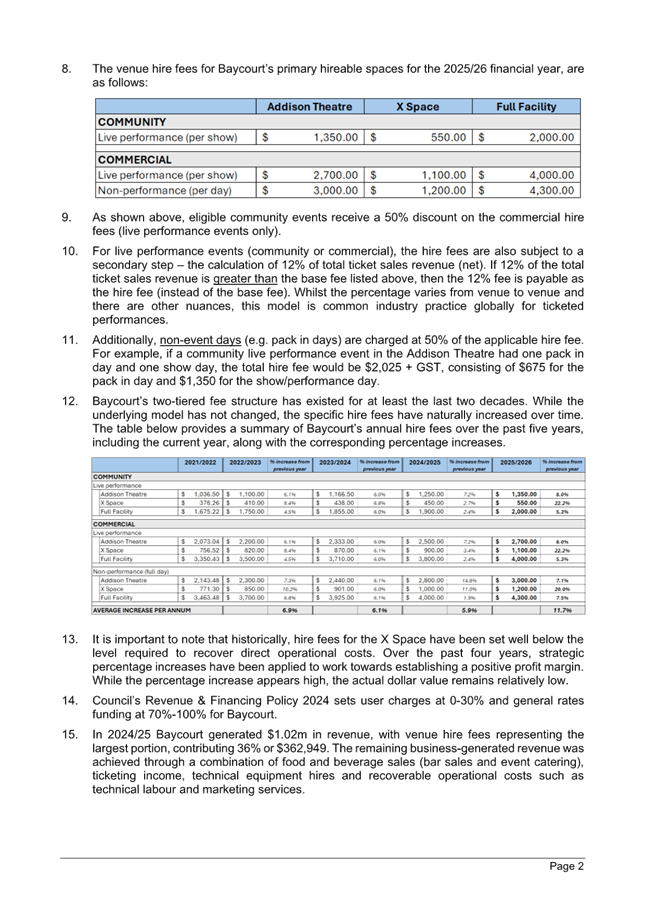
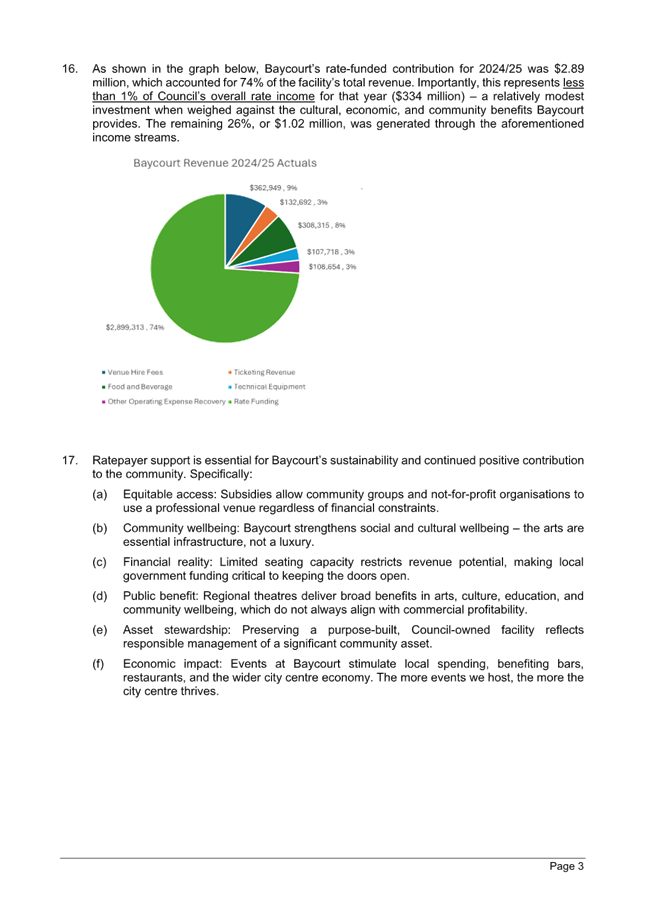
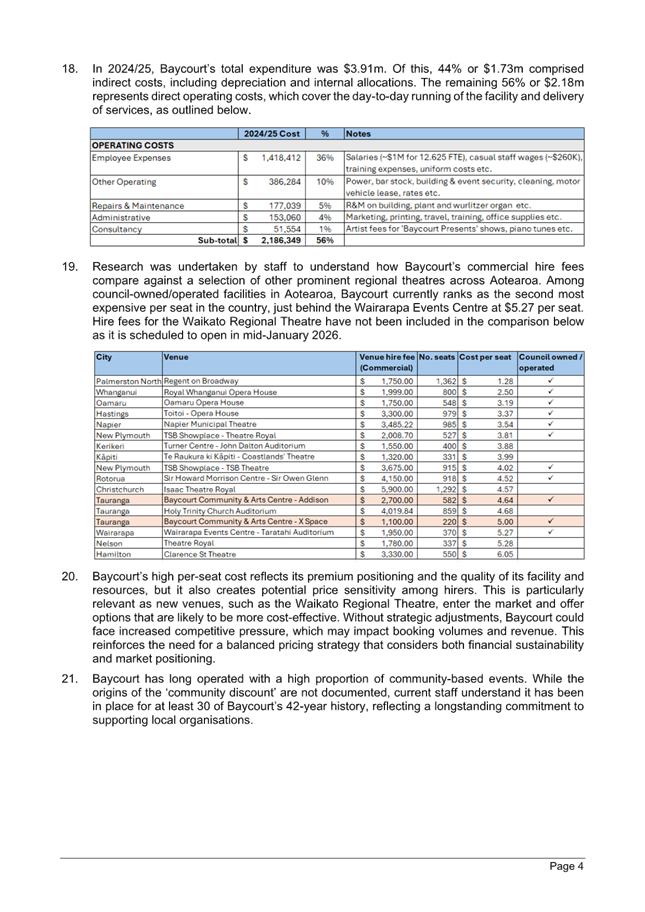
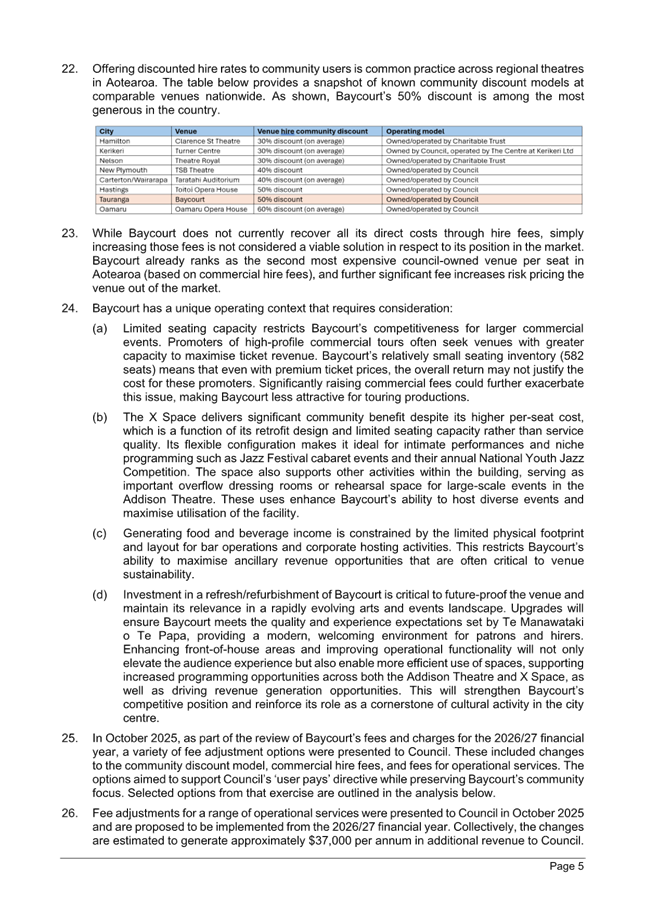
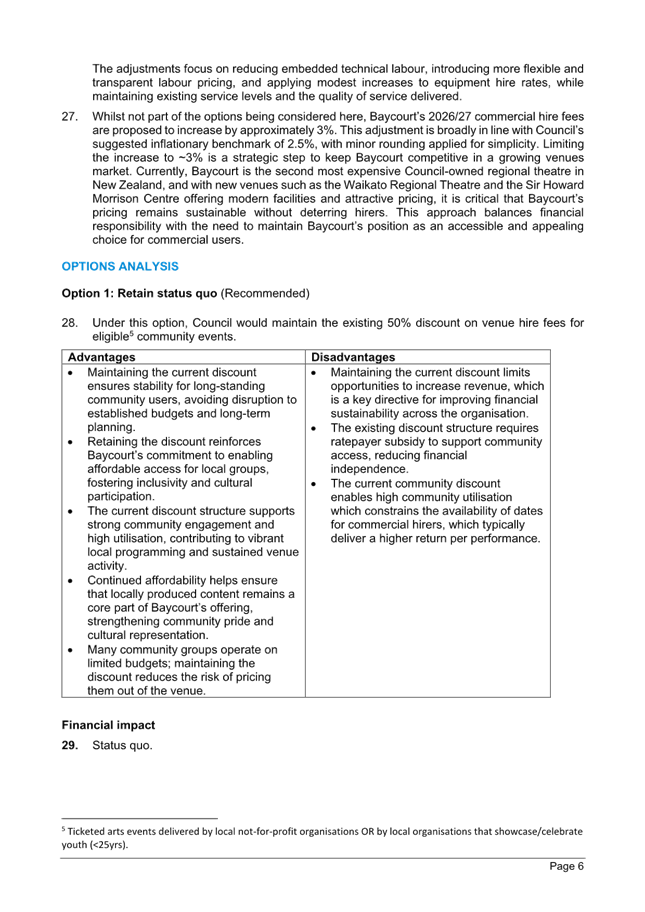
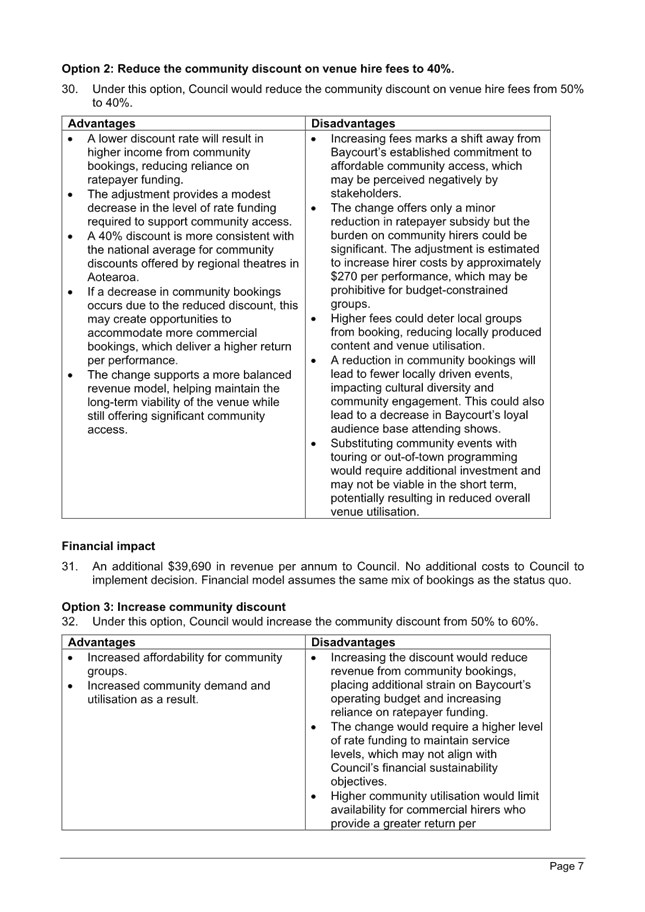

|
Ordinary
Council meeting Agenda
|
10
February 2026
|
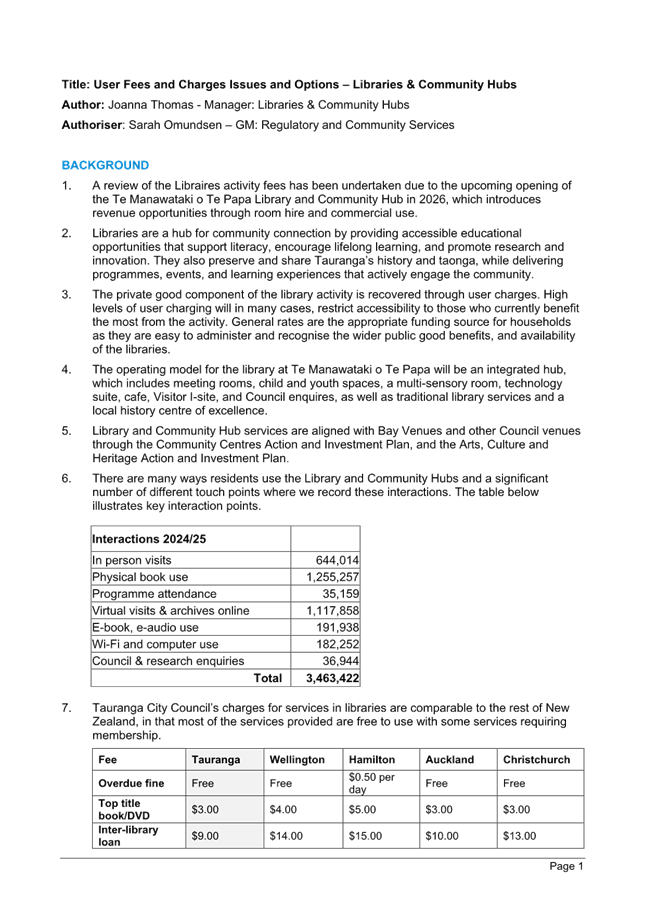
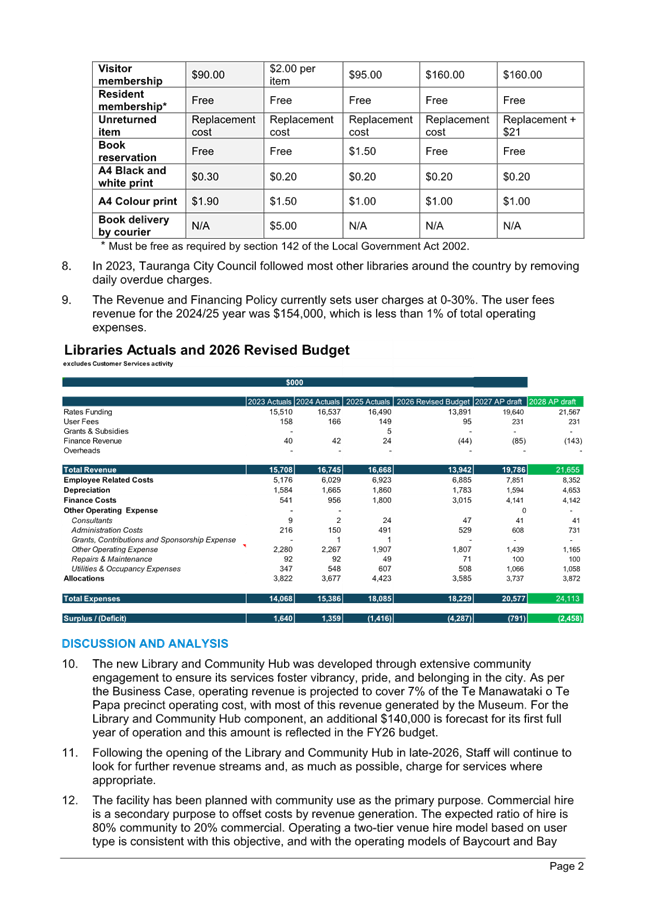
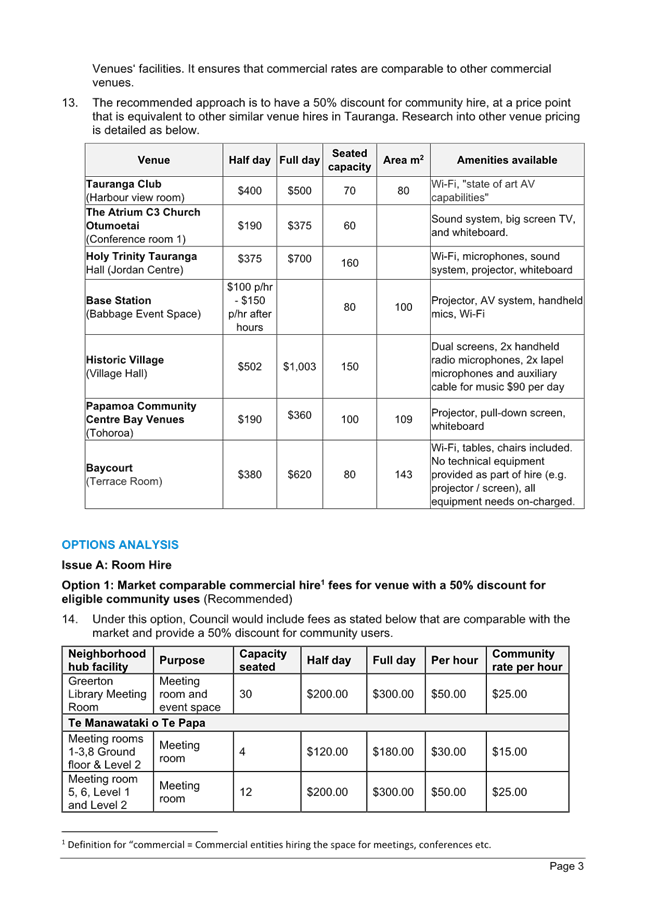
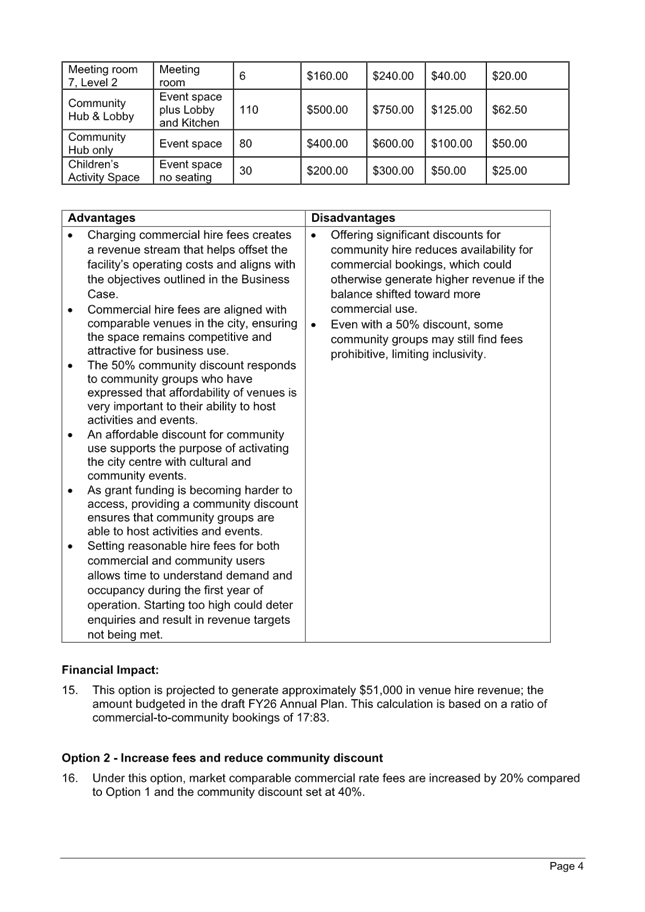
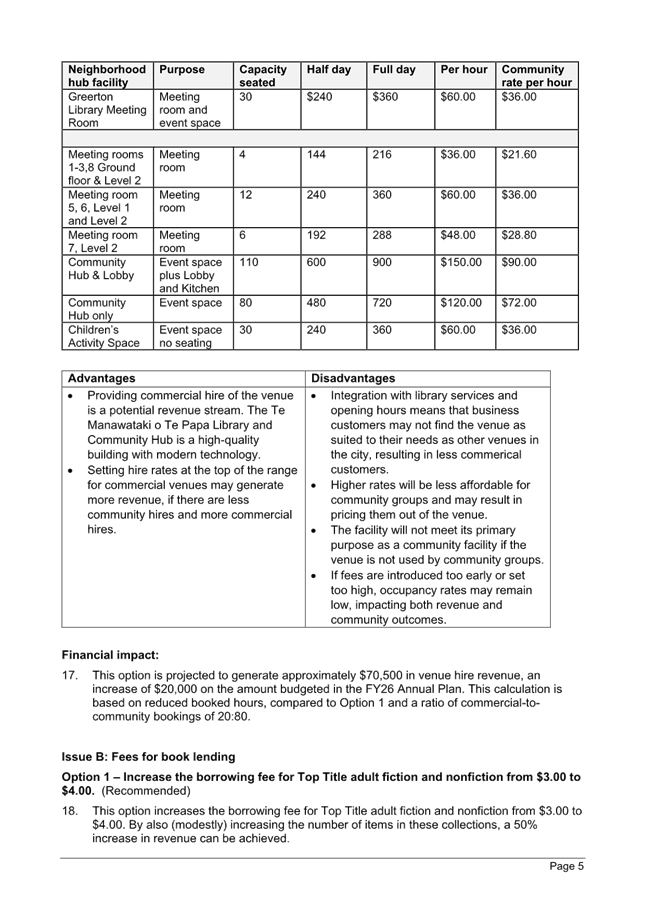
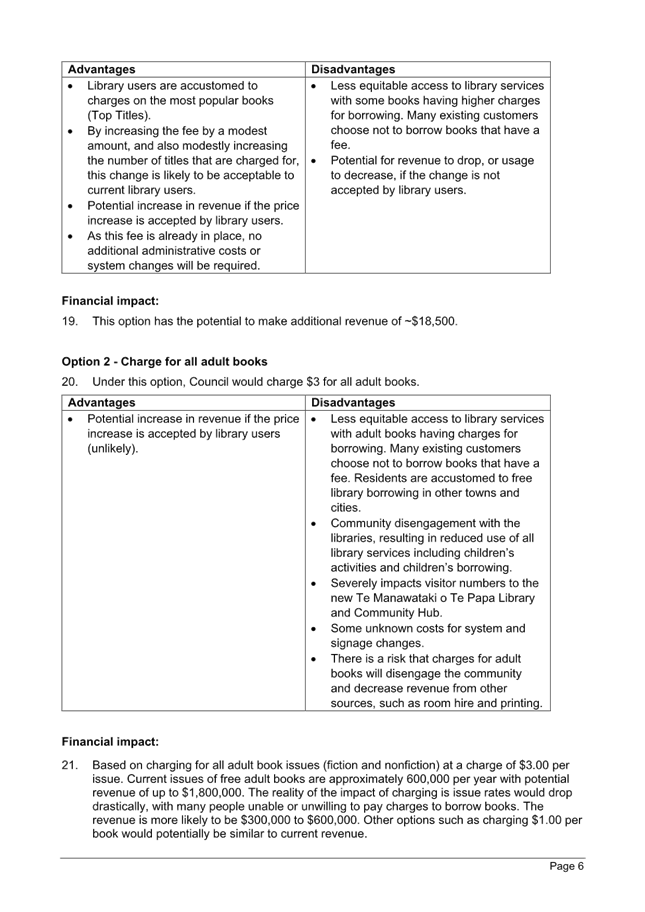
|
Ordinary
Council meeting Agenda
|
10
February 2026
|
|
Ordinary
Council meeting Agenda
|
10
February 2026
|
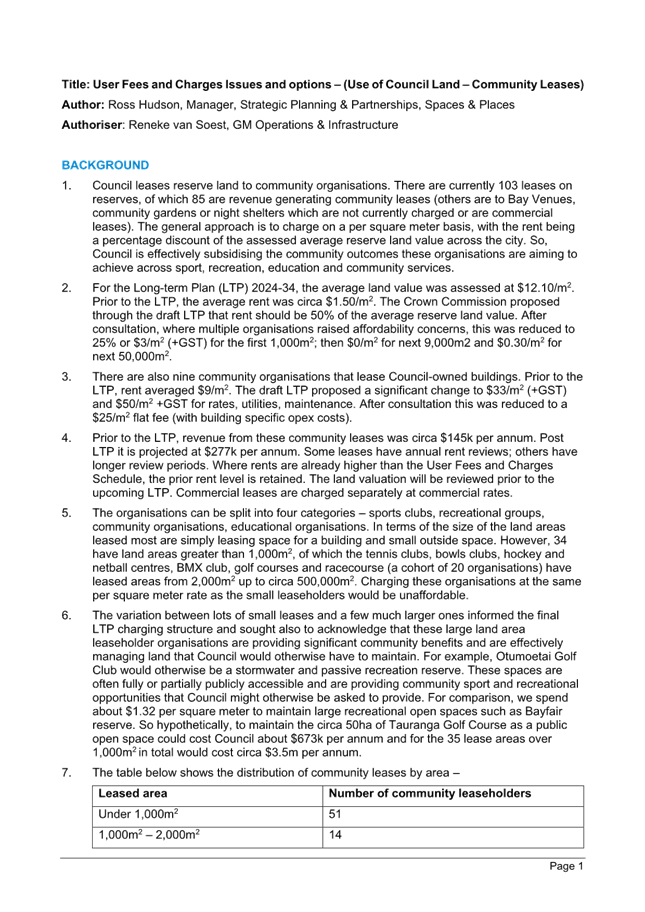
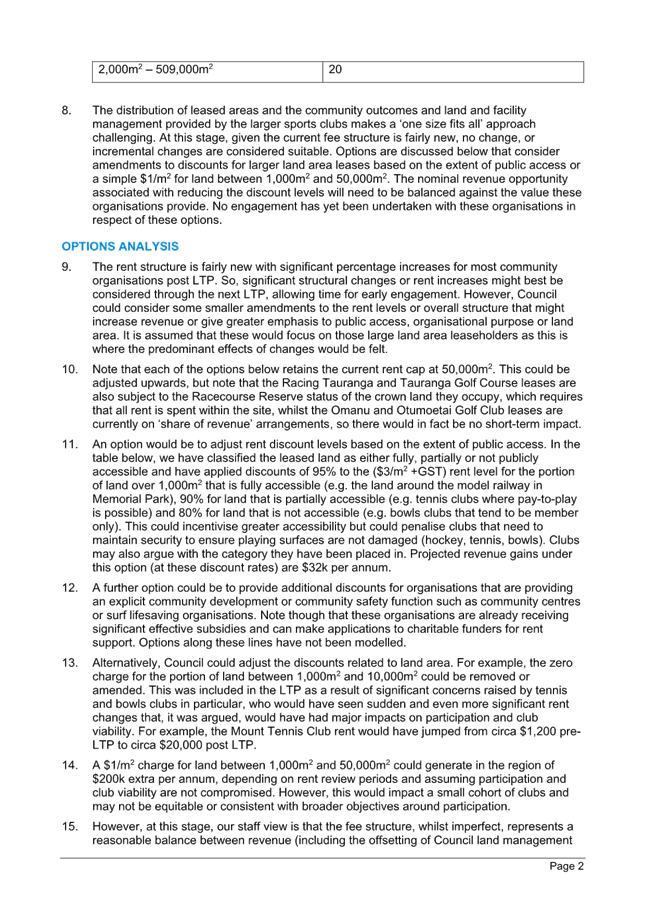
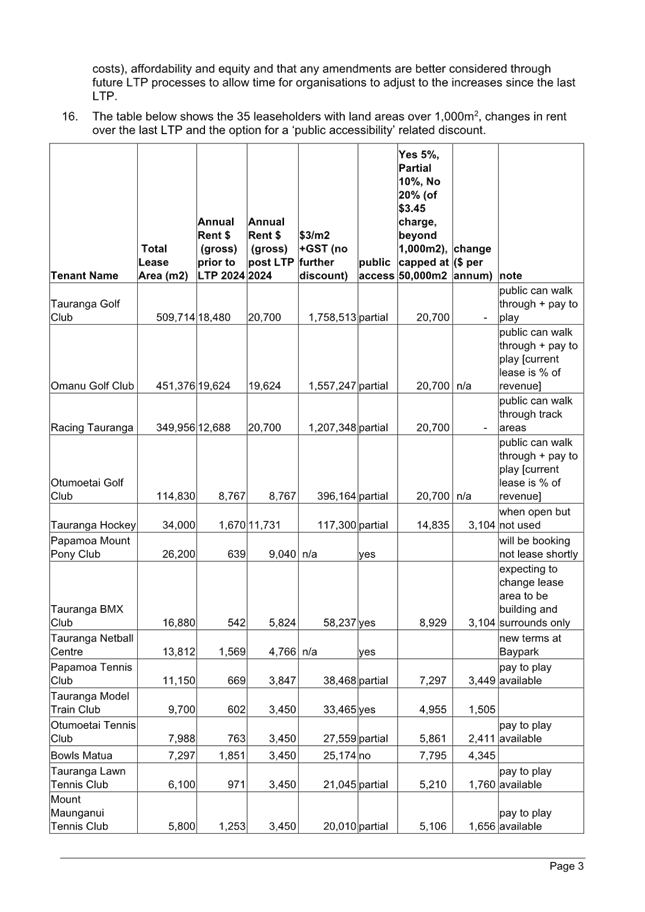
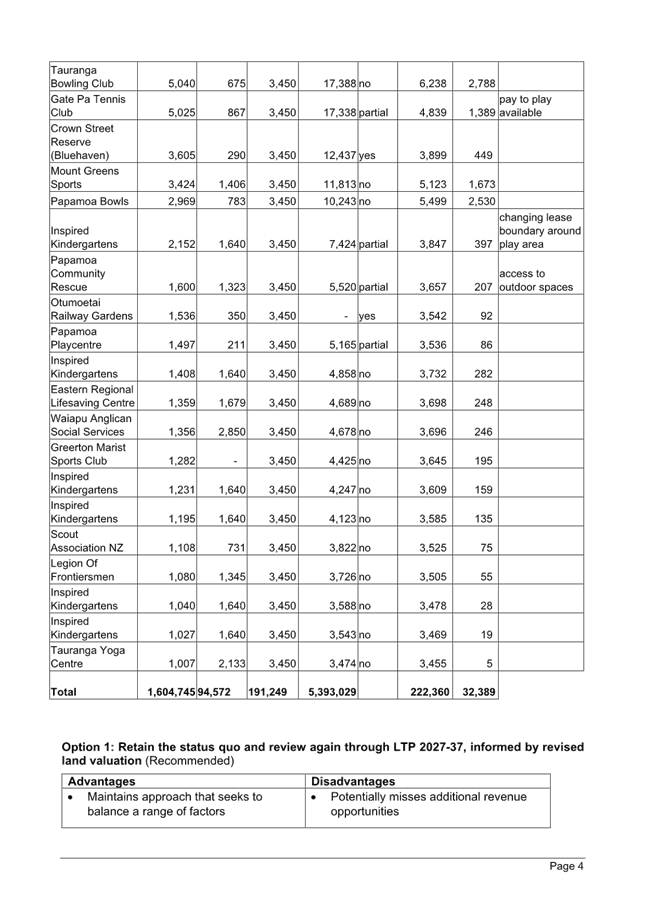
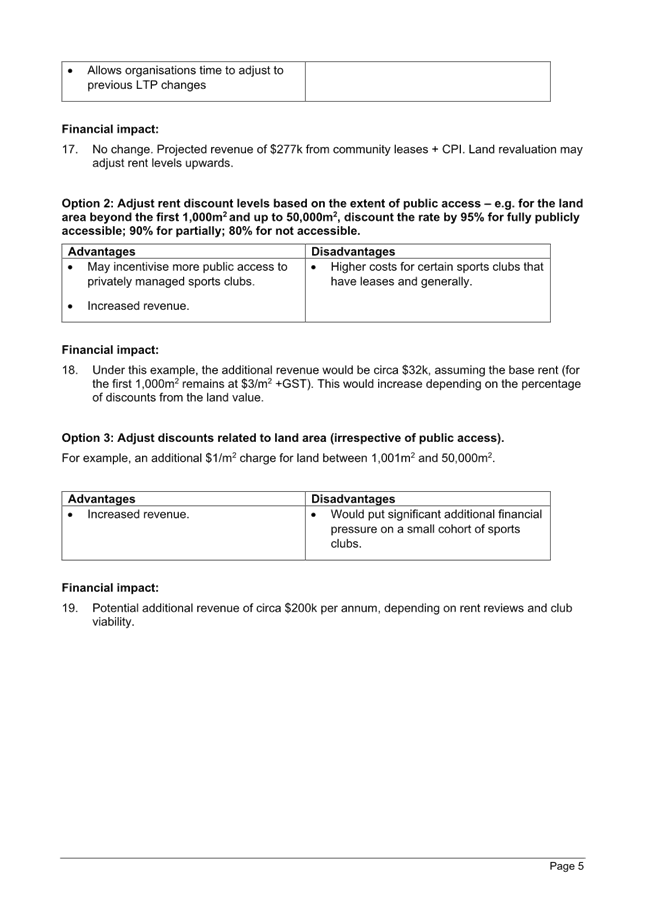
|
Ordinary
Council meeting Agenda
|
10
February 2026
|
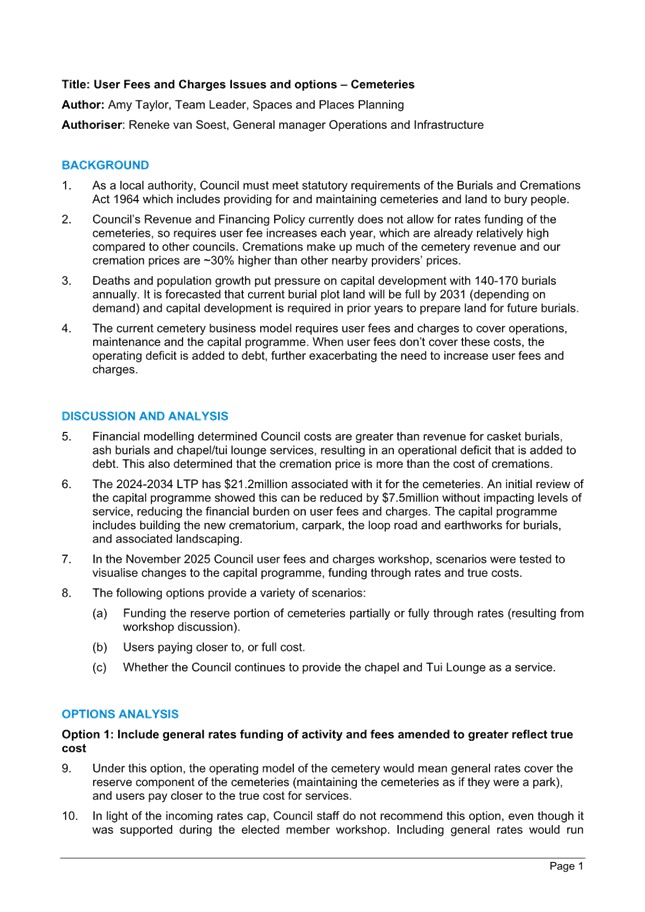
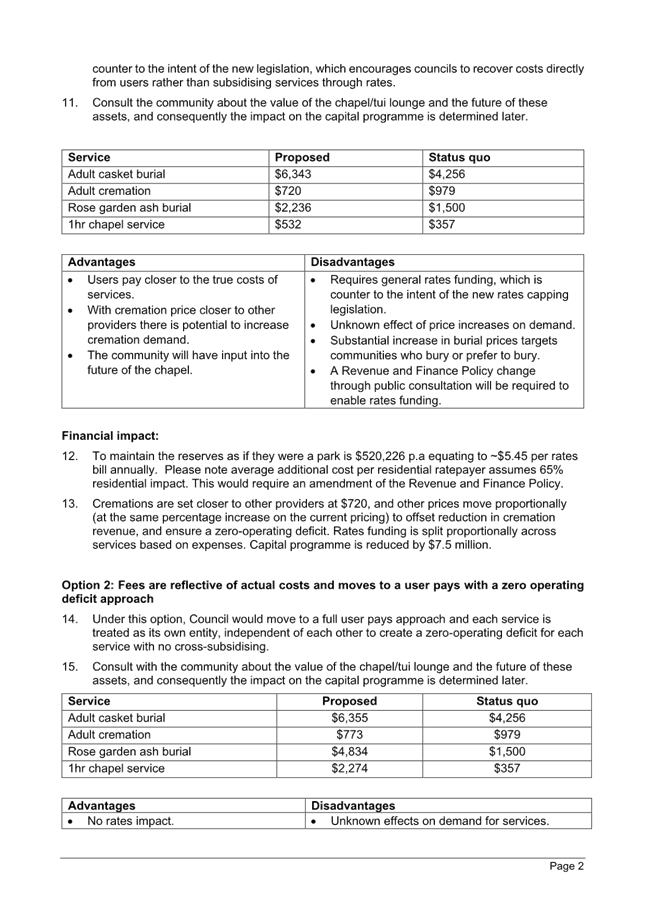
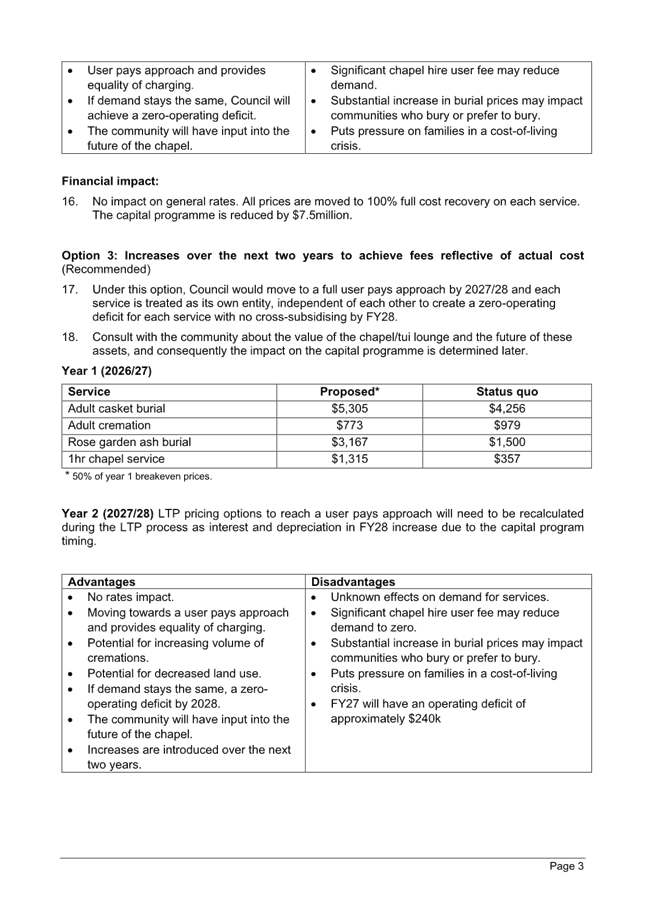

|
Ordinary
Council meeting Agenda
|
10
February 2026
|
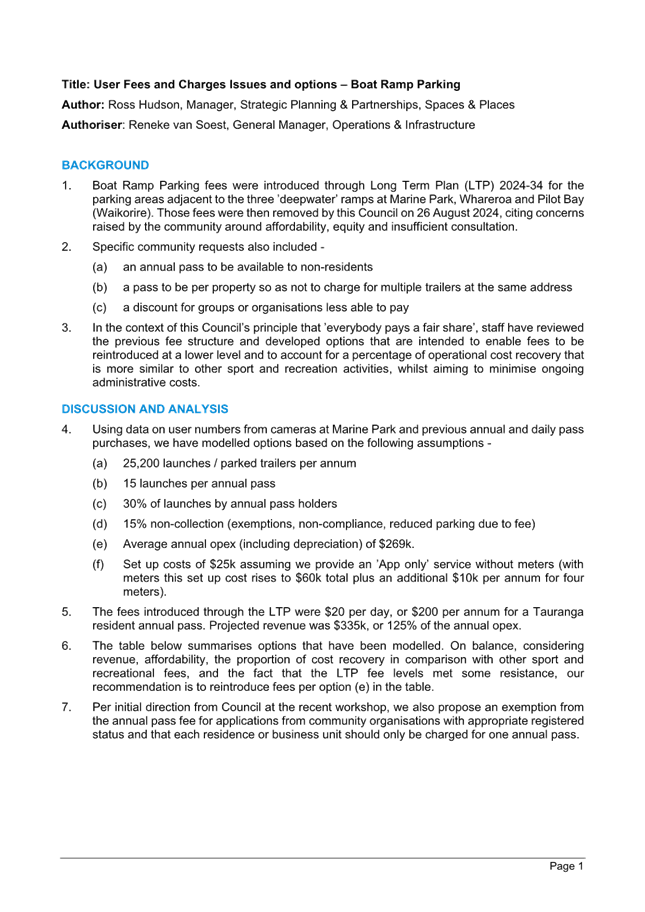
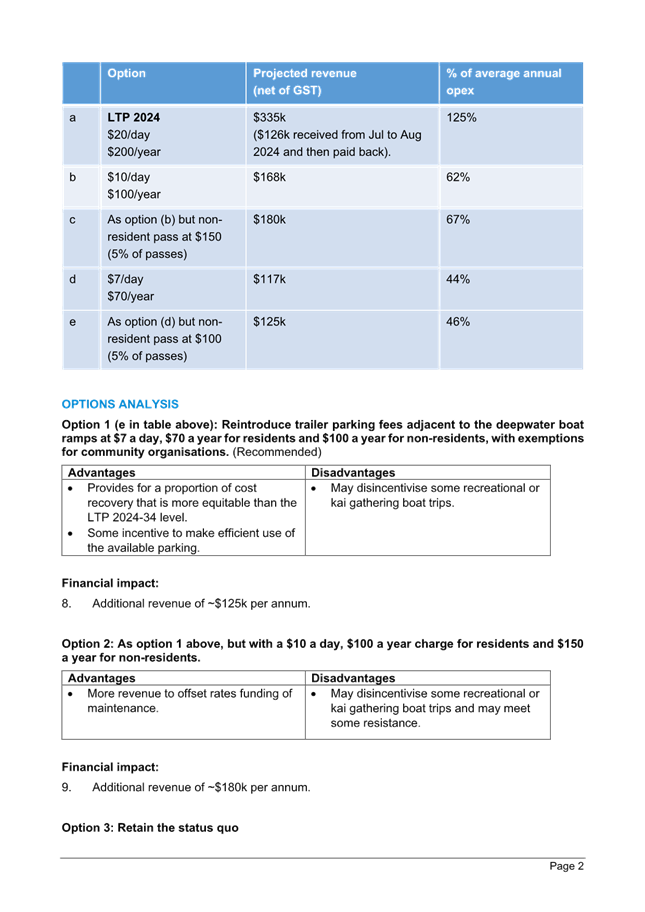
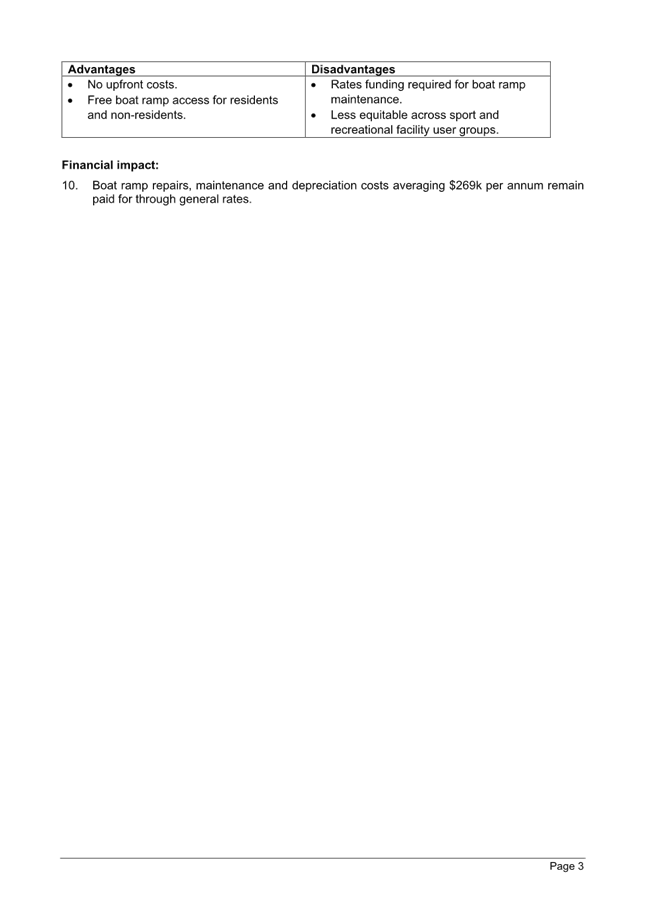
|
Ordinary
Council meeting Agenda
|
10
February 2026
|
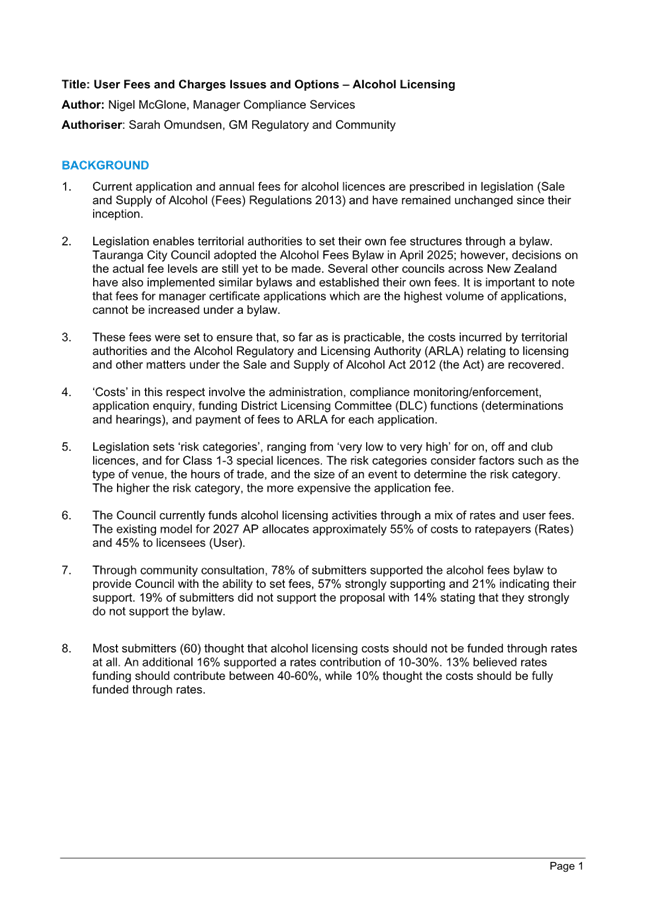
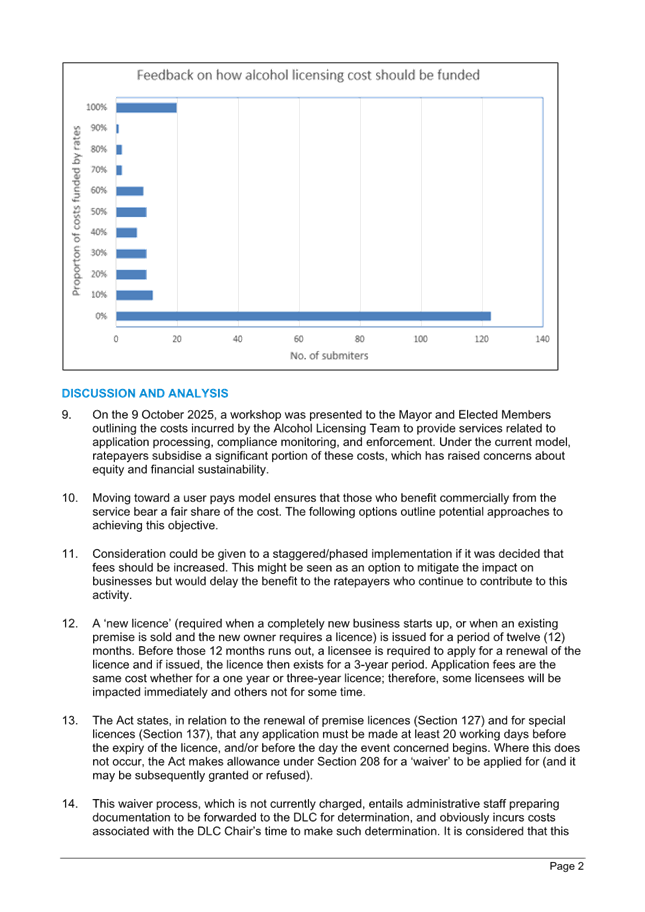
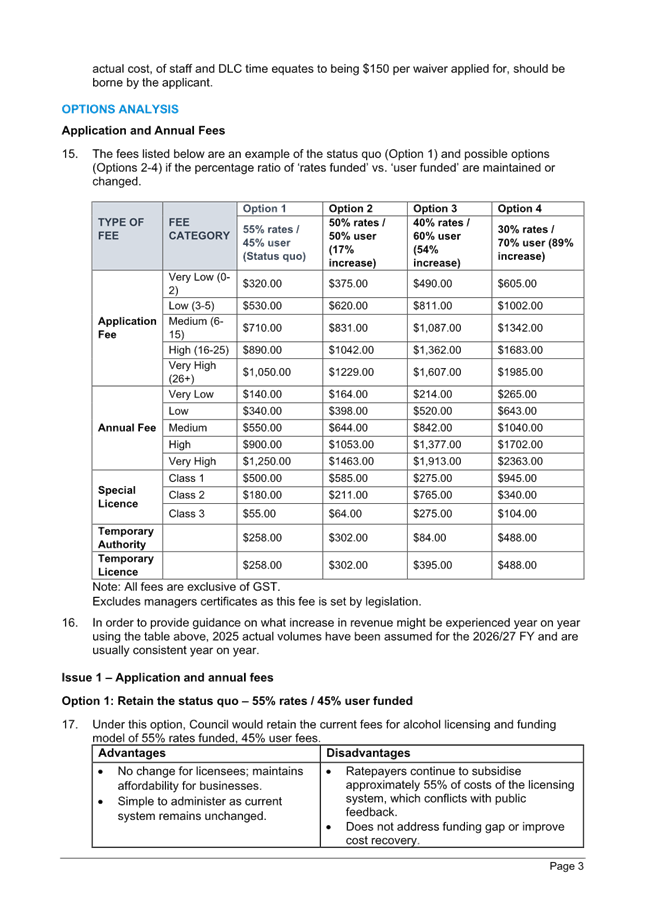
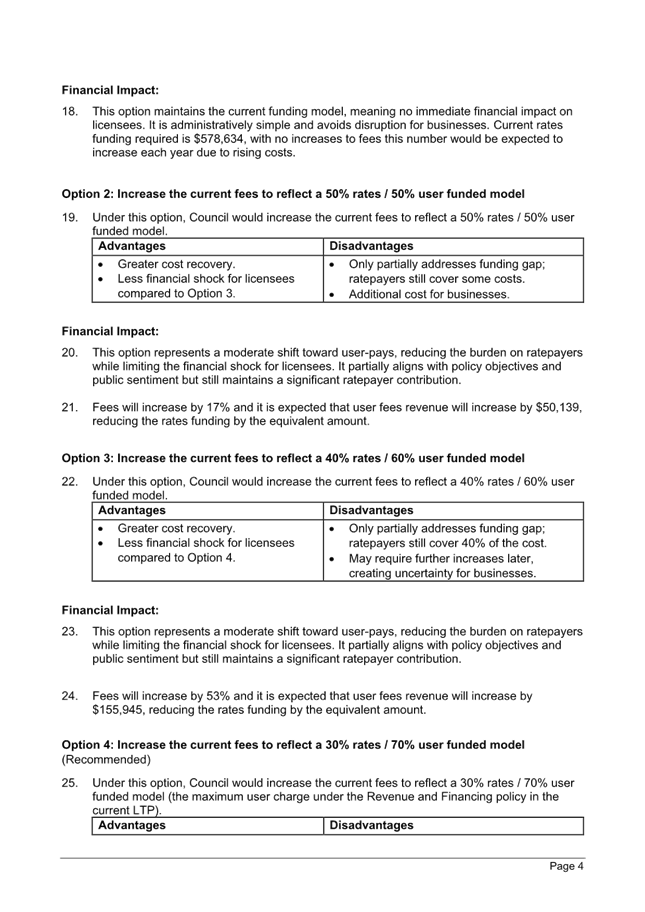
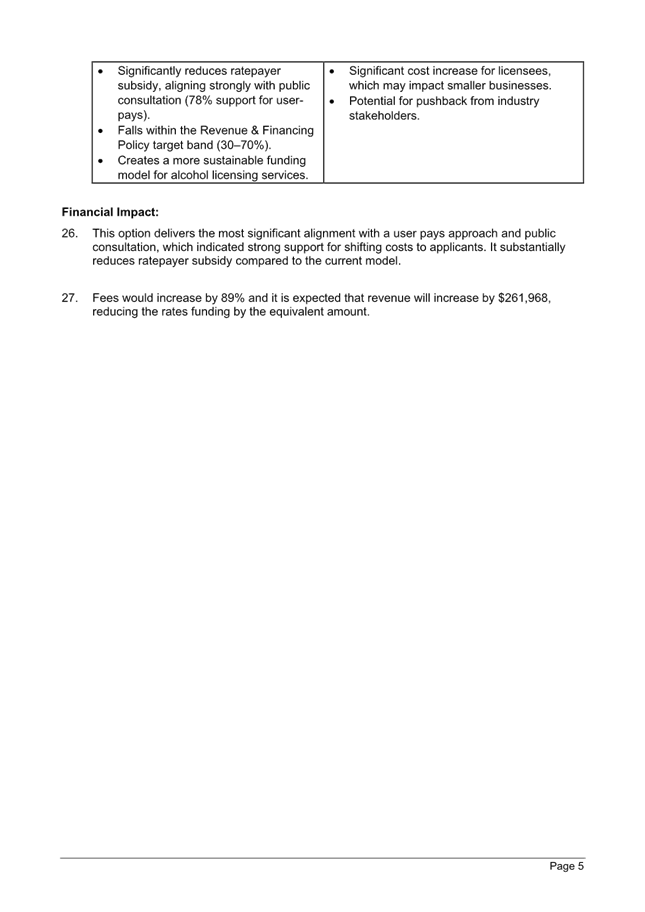
|
Ordinary
Council meeting Agenda
|
10
February 2026
|
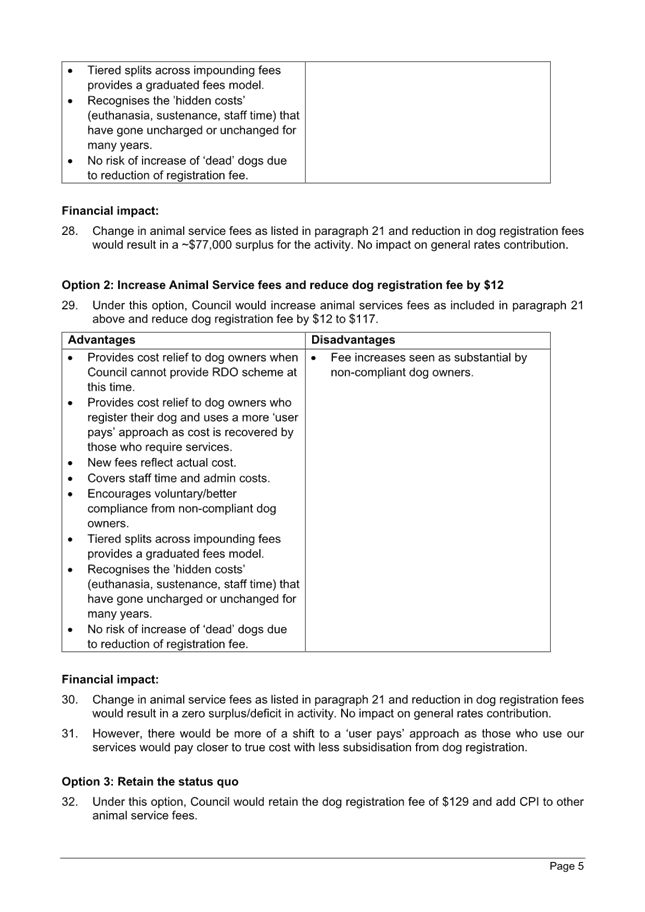
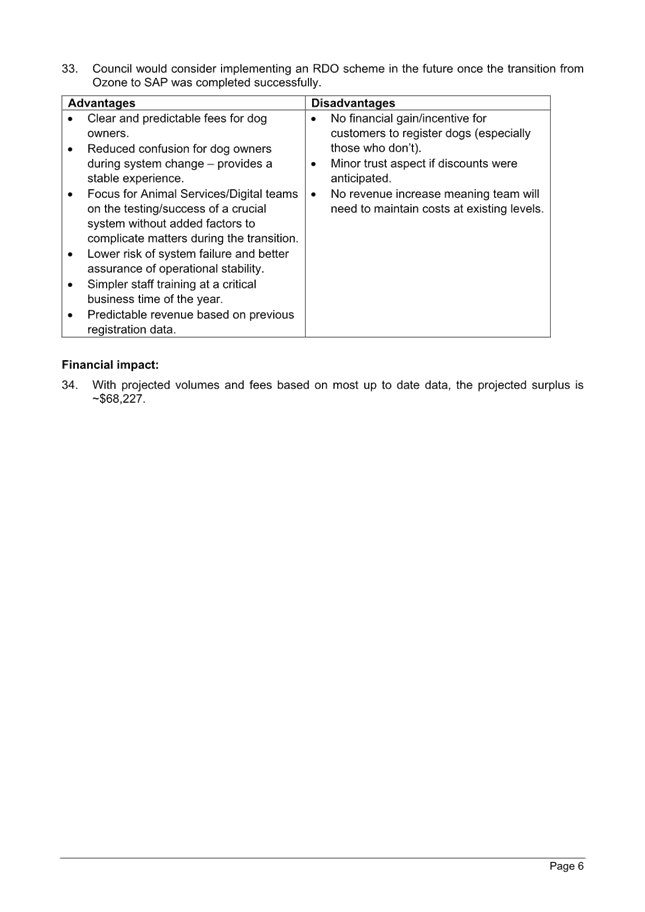
|
Ordinary
Council meeting Agenda
|
10
February 2026
|
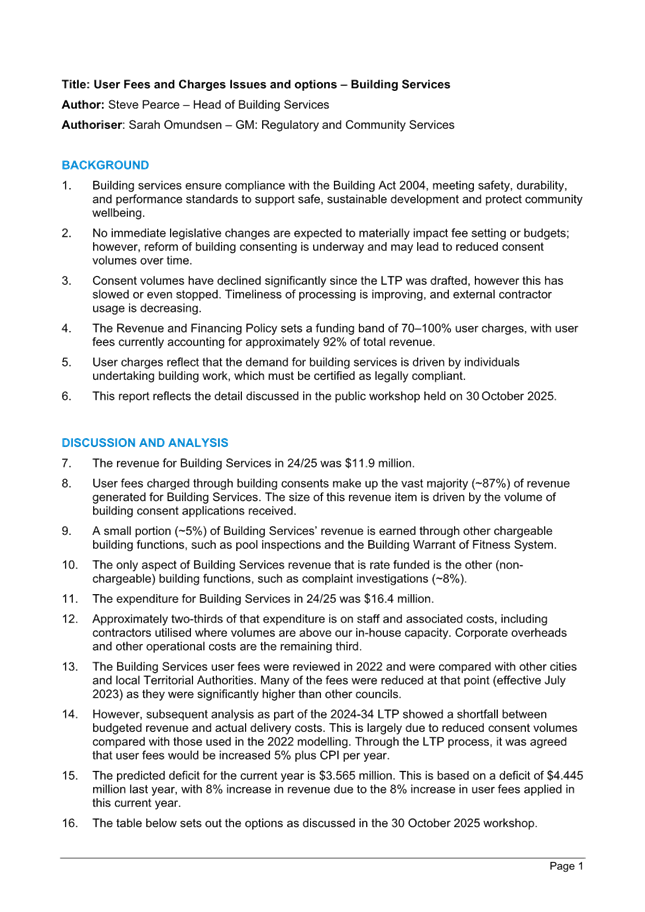
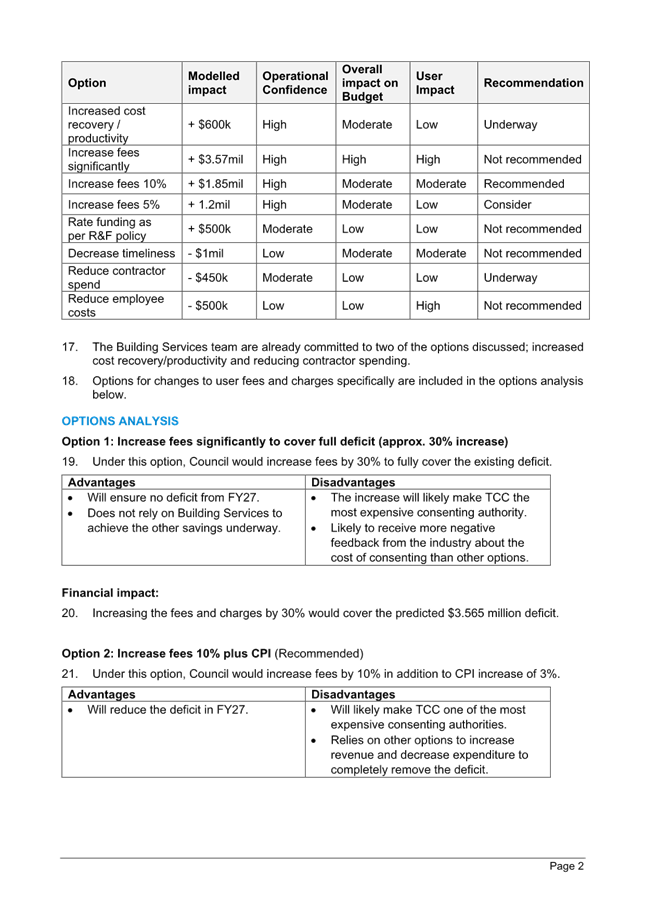
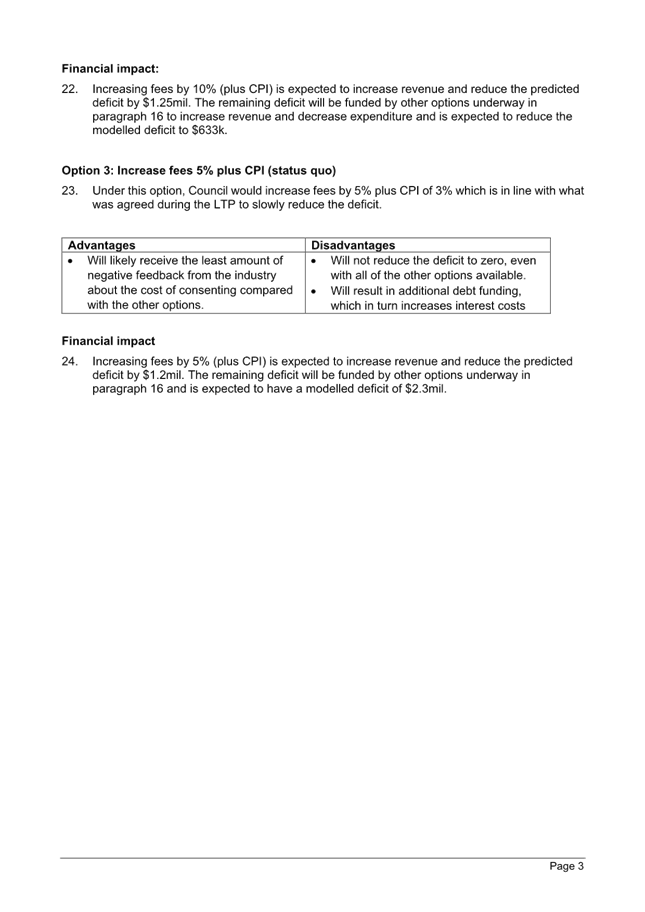
|
Ordinary
Council meeting Agenda
|
10
February 2026
|
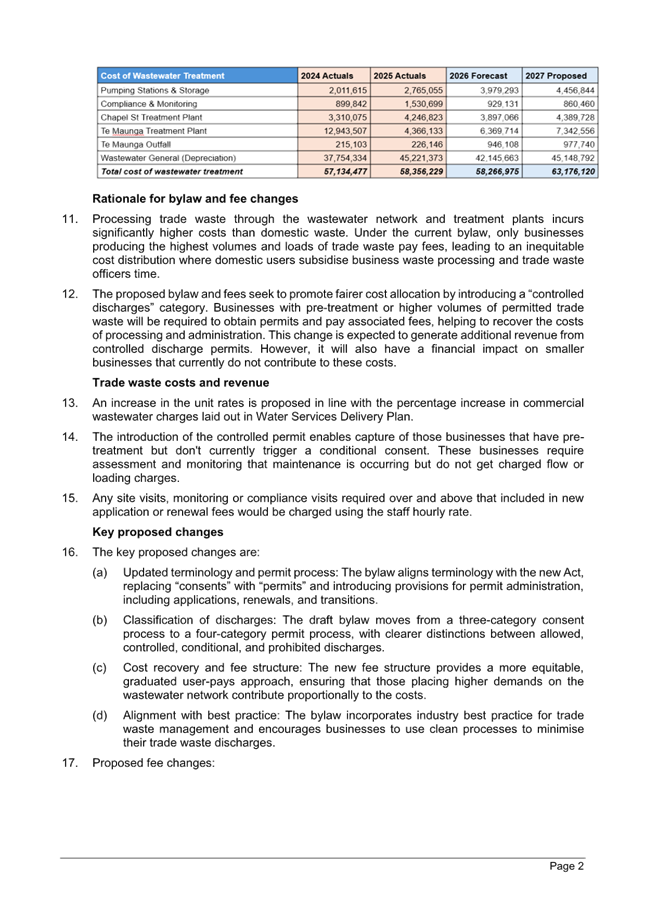
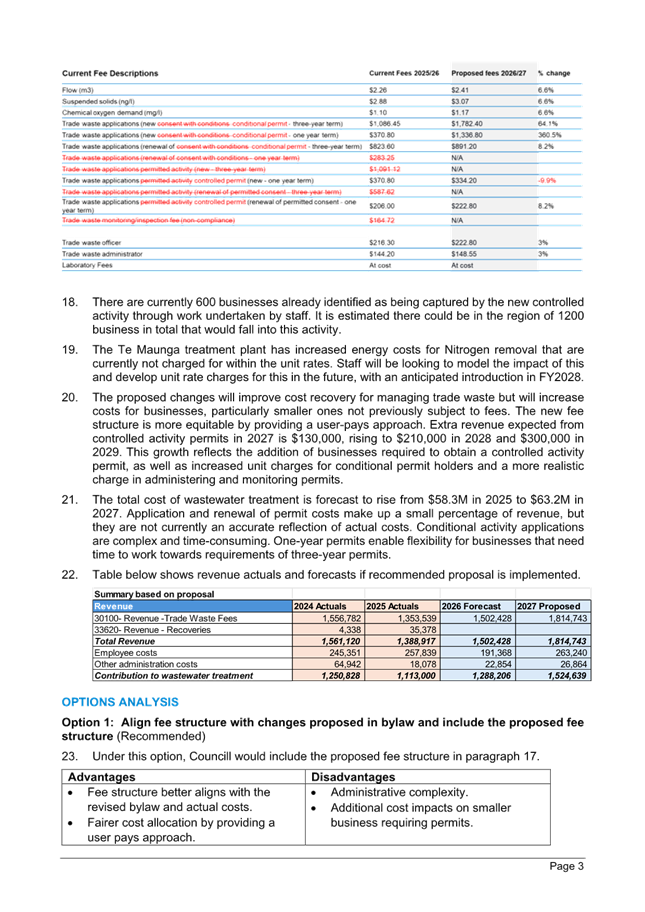
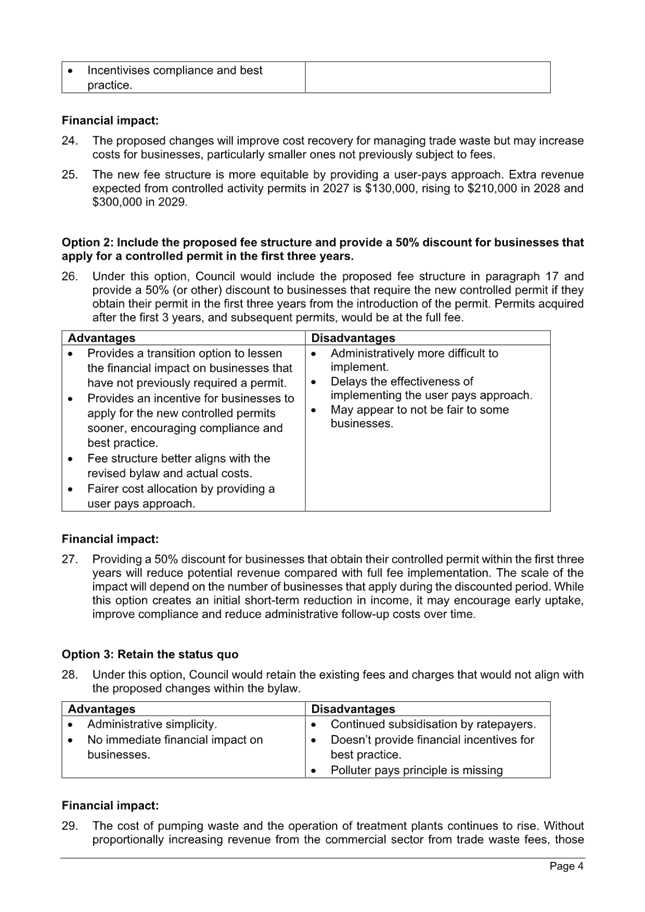

|
Ordinary
Council meeting Agenda
|
10
February 2026
|
11.6 Transport Resolutions
Report No.59
File
Number: A19513270
Author: Karen
Hay, Team Leader: Engineering Services
Mike Seabourne, Head
of Transport
Will Hyde, Senior
Transport Engineer
Authoriser: Reneke
van Soest, General Manager: Operations & Infrastructure
Purpose of the Report
1. This
report proposes the introduction, removal or amendment of traffic controls
throughout the city, and seeks a resolution from Council to implement or
formally approve these proposals.
|
Recommendations
That the Council:
(a) Receives the report
"Transport Resolutions Report No.59".
(b) Resolves
to implement the proposed traffic and parking controls for general safety,
operational, or amenity purposes as detailed in Attachment A -
including Attachment 7.1, 7.2, 7.7, 7.8,7.9,7.16, 7.21, 7.25
(c) That
these changes take effect on or after 11 February 2026, subject to the
installation of appropriate signs and road markings where necessary.
|
Executive Summary
2. As the city grows
and changes, the demands on the road network also change. Often there can be
conflict between the need to keep traffic lanes clear to enable an efficient
network, the need to provide on-street parking and loading zones to support
nearby activities, restrict parking to improve access and the need for
vulnerable road users such as pedestrians and cyclists to move around the city
safely.
3. Attachment A sets
out changes for general access, parking, safety and operational reasons. Some
of these are requests from the public or other stakeholders for numerous
changes to parking controls which have been assessed to be appropriate.
4. Amendments include
changes to the following attachments to the Traffic & Parking Bylaw (2023):
(a) Attachment 7.1: No Parking
Behind Kerb
(i) A new part-time
restriction relating to vehicles parking on the berm close to an intersection
and cycle access ramp, creating safety issues by blocking sight lines.
(b) Attachment 7.2:
Prohibited Stopping and Standing of Vehicles
(i) Extending or removing
broken yellow lines to improve safety, enhance access, or increase parking
capacity.
(c) Attachment 7.7: Mobility
Parking
(i) Retrospective resolutions
required for existing mobility spaces.
(d) Attachment 7.8: Motorcycle
Parking
(i) Retrospective resolutions
required for an existing motorcycle space.
(e) Attachment 7.9: Parking
Time Restrictions
(i) Retrospective resolutions
required for existing time restrictions implemented as part of Cameron Road
project.
(f) Attachment 7.16: Loading
Zones with Time Restrictions
(i) Retrospective resolution
required for an existing loading space in a service lane.
(g) Attachment 7.21: Passenger
Service and Other Vehicle Stands (Stopping Places for Buses)
(i) Retrospective resolutions
for existing bus stops.
(h) Attachment 7.25
Passenger Service and Other Vehicle Stands (Police Vehicles)
(i) Increasing the number of
spaces outside the police station reserved for police operations.
Background
5. The Traffic and
Parking Bylaw 2023 includes attachments which list various traffic and parking
restrictions. Council can impose traffic and parking restrictions by Council
resolution.
6. The Council
regularly adds, removes or amends traffic and parking controls to reflect and
support operational and safety needs on the road network.
7. The proposed
amendments in Attachment A are minor changes to parking restrictions across the
city which have arisen through requests from the public, transportation staff,
or other stakeholders.
Statutory Context
8. Land Transport Act
1998, particularly section 22AB, which empowers councils as Road Controlling
Authorities (RCAs) to make bylaws for traffic and parking control.
9. Local Government Act
2002, which outlines the general process for making bylaws, including
consultation and public notification.
10. Land Transport (Road User) Rule
2004 and Traffic Control Devices Rule 2004, which set standards for signage,
markings, and enforcement.
STRATEGIC ALIGNMENT
11. This contributes to the
promotion or achievement of the following strategic community outcome(s):
|
Contributes
|
|
We are an inclusive city
|
ü
|
|
We value, protect and enhance the environment
|
☐
|
|
We are a well-planned city
|
ü
|
|
We can move around our city easily
|
ü
|
|
We are a city that supports business and education
|
ü
|
12. The recommendations address a number of issues affecting safety, access
and/or amenity and contribute to the safe and efficient operation of the
city’s transport network. The provision of mobility parking enables a
more inclusive city by making our amenities more accessible to less-abled
members of our community.
Options Analysis
13. The proposed changes relate to
general operations. The reasons for each proposal are described in Appendix A.
In each case the problem identified is expected to continue if the proposed
amendment is not adopted.
14. The proposals are independent
of each other, and Council may resolve to adopt some, all or none of them.
Financial Considerations
15. The signs and markings costs
associated with general operational changes are minor and can be accommodated
within existing project or operational budgets.
Legal Implications / Risks
16. These proposals are required in
order to allow enforcement of changes deemed necessary for safety and amenity
purposes. Council has an obligation to address known safety issues on the road
network.
TE AO MĀORI APPROACH
17. The proposals create safety,
access and/or amenity improvements for our residents and visitors and therefore
align with the principal of manaakitanga. For the major projects, consultation
with hapū was undertaken as part of the project development.
CLIMATE IMPACT
18. Given this report relates to
regulatory procedure, no climate impact assessment is made.
Consultation / Engagement
19. Requests for changes may originate from neighbouring
properties or reflect existing circumstances where consultation is deemed not
necessary. Alternatively, consultation may occur during project delivery, or
where property owners adjacent to the site are informed or consulted prior to
implementing any modifications.
Significance
20. The Local Government Act 2002
requires an assessment of the significance of matters, issues, proposals and
decisions in this report against Council’s Significance and Engagement
Policy. Council acknowledges that in some instances a matter, issue, proposal
or decision may have a high degree of importance to individuals, groups, or
agencies affected by the report.
21. In making this assessment,
consideration has been given to the likely impact, and likely consequences for:
(a) the current
and future social, economic, environmental, or cultural well-being of the
district or region
(b) any persons who are likely to be
particularly affected by, or interested in, the decision.
(c) the capacity of the local authority
to perform its role, and the financial and other costs of doing so.
22. In accordance with the
considerations above, criteria and thresholds in the policy, it is considered
that the decision is of low significance.
23. For the changes which
are retrospective, these are likely to have a low public interest as these were
previously consulted upon or responded to requests from adjacent landowners.
ENGAGEMENT
24. Taking into consideration the
above assessment, that the decision is of low significance, officers are of the
opinion that no further engagement is required prior to Council making a
decision.
Next Steps
25. The bylaw attachments will be
updated in accordance with the resolution and implementation of associated line
marking and signage as appropriate.
26. Adjacent business and residents
to be notified of parking restriction changes, prior to implementation.
Attachments
1. Appendix
A - Transport Resolutions Report 59 Proposals - A19548311 ⇩ 
|
Ordinary
Council meeting Agenda
|
10
February 2026
|
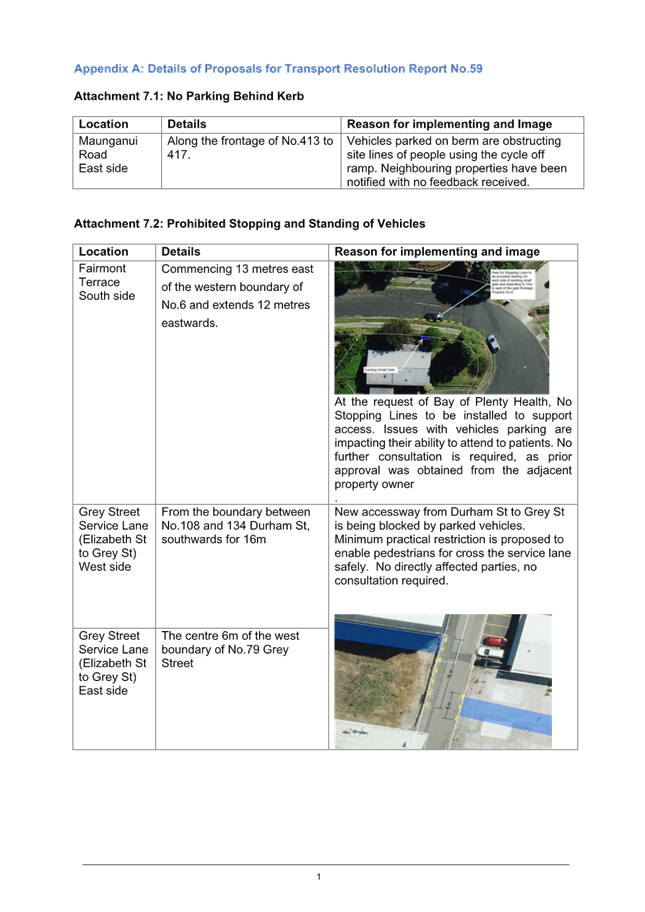
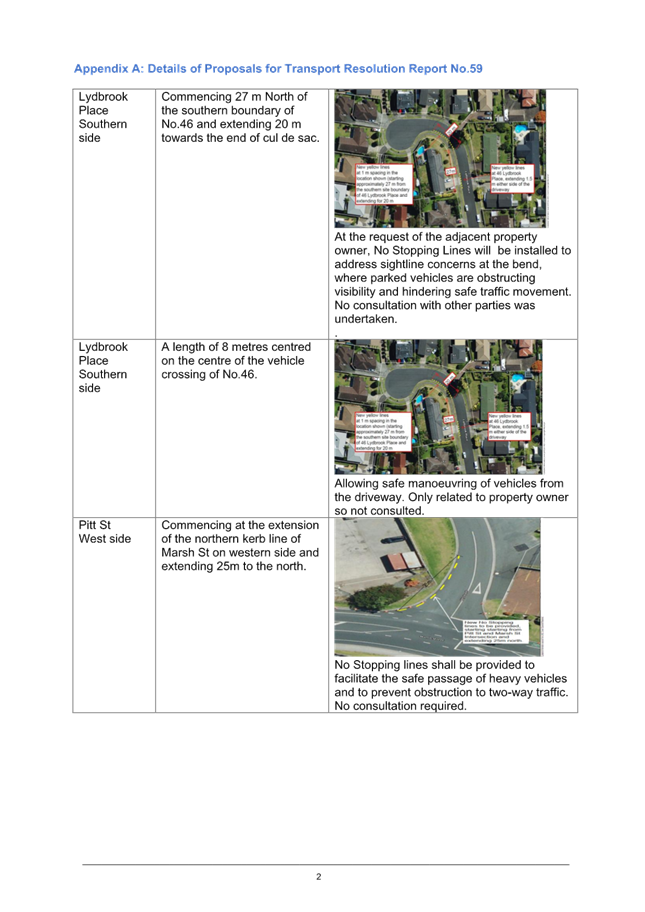
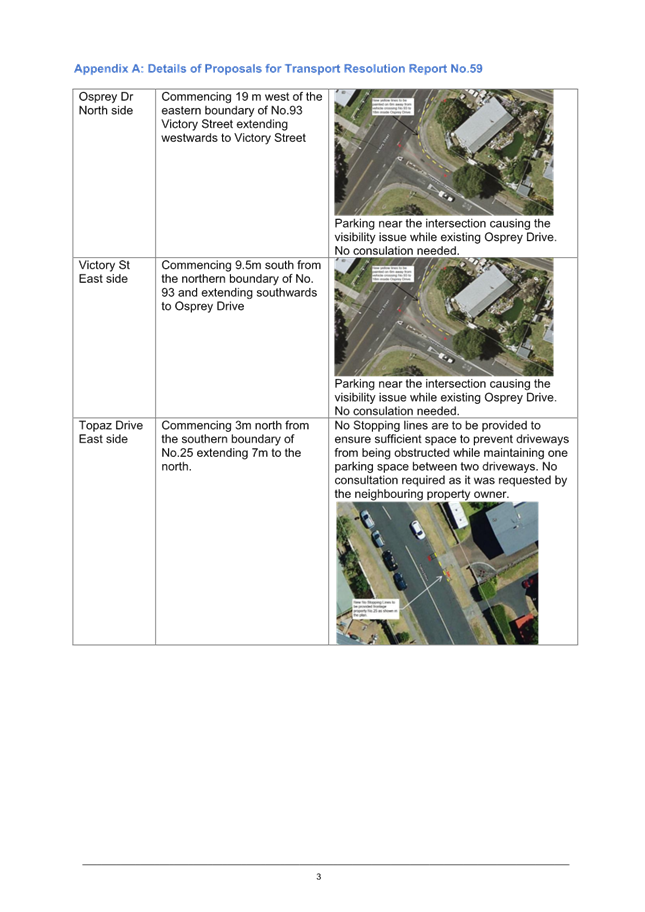
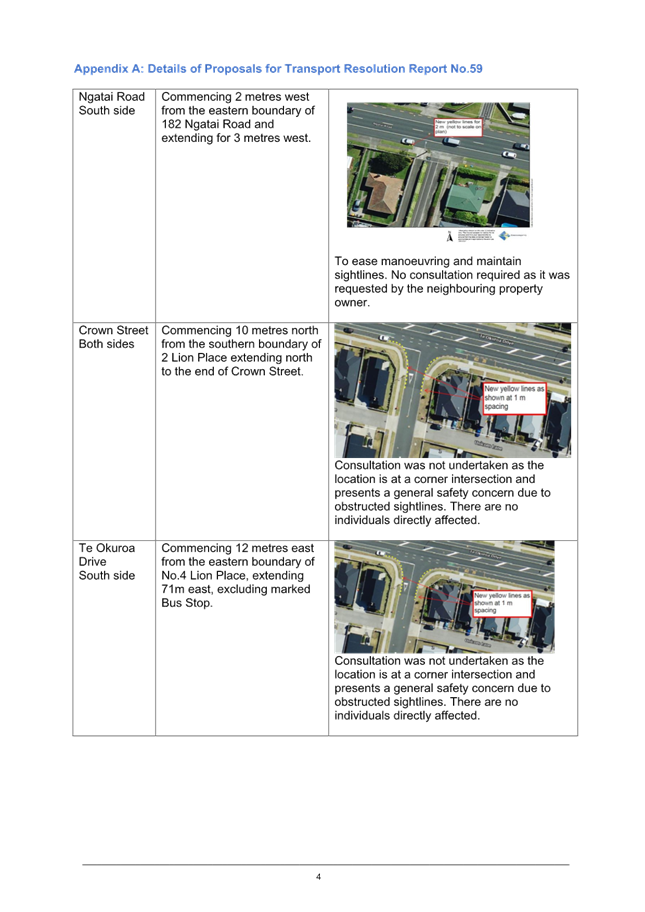
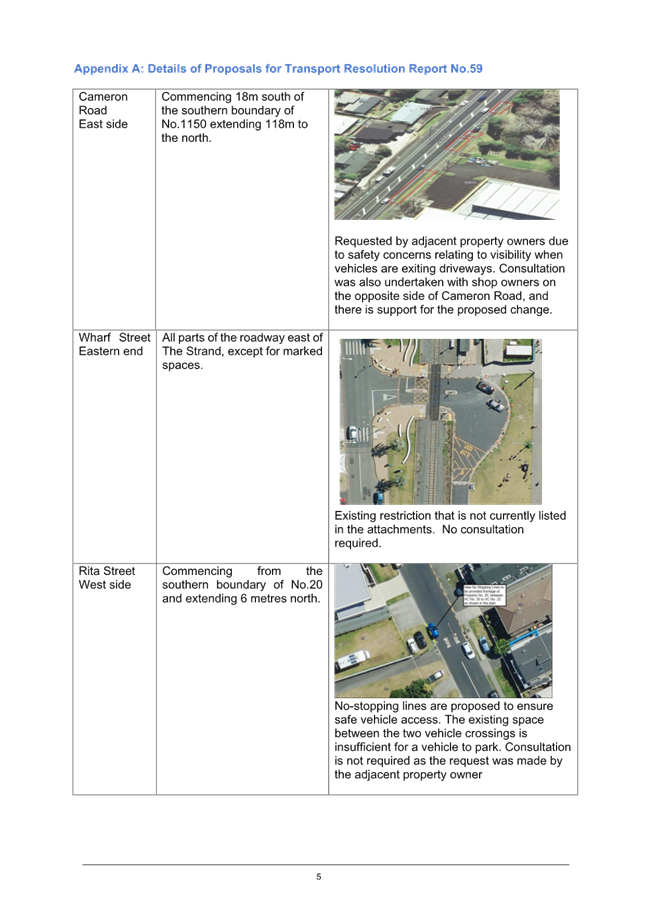
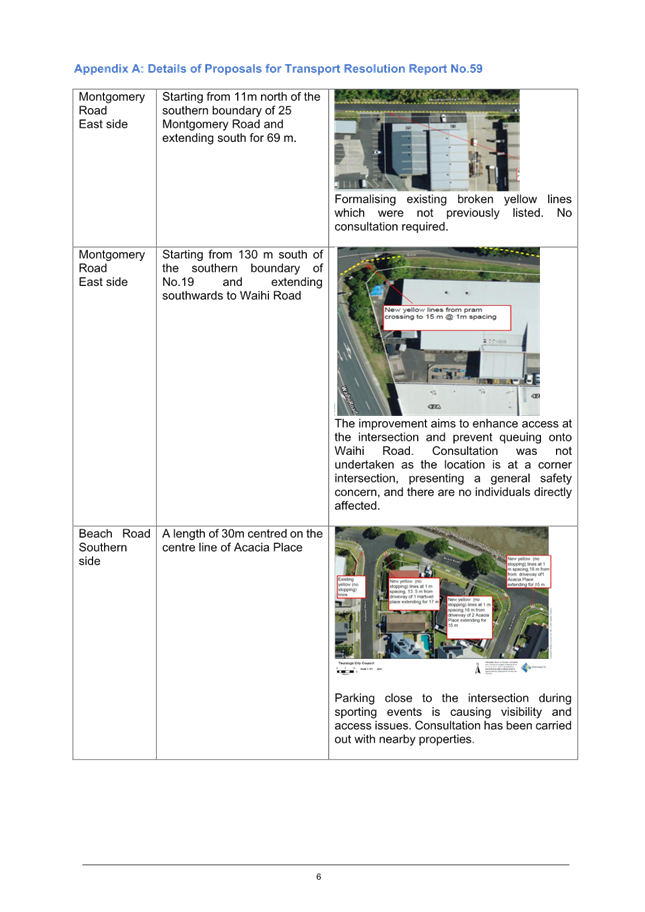
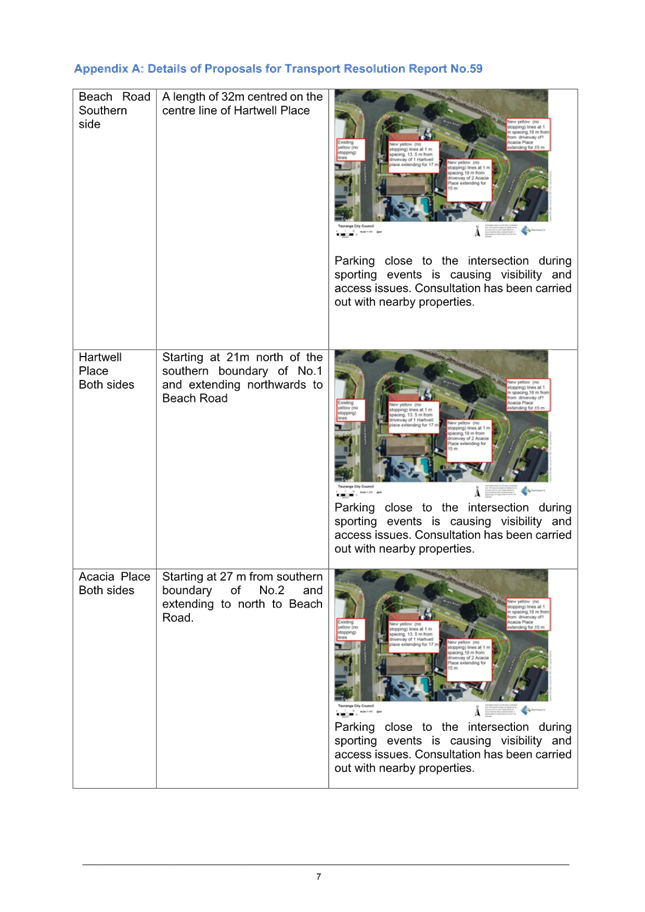
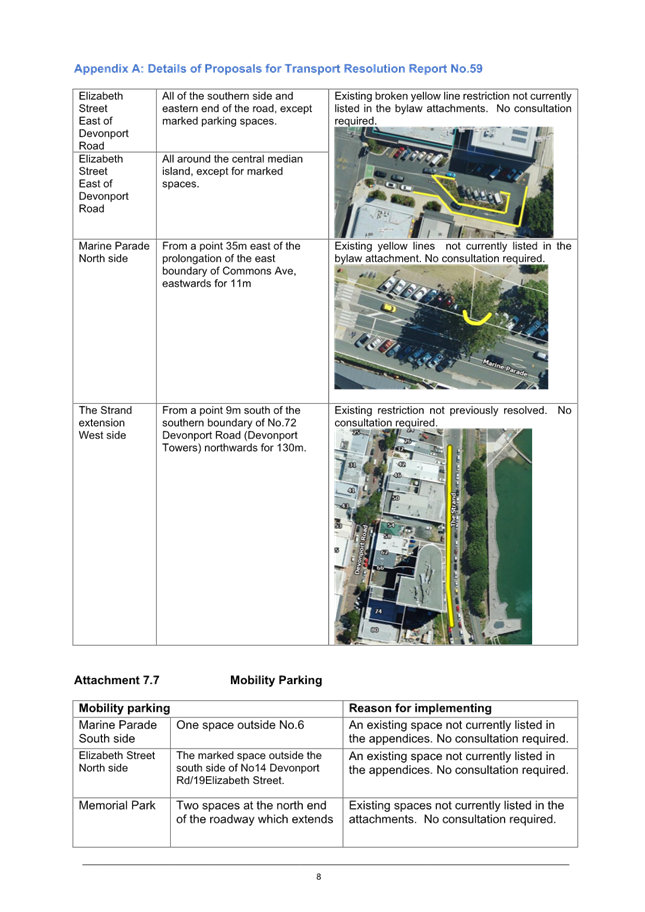
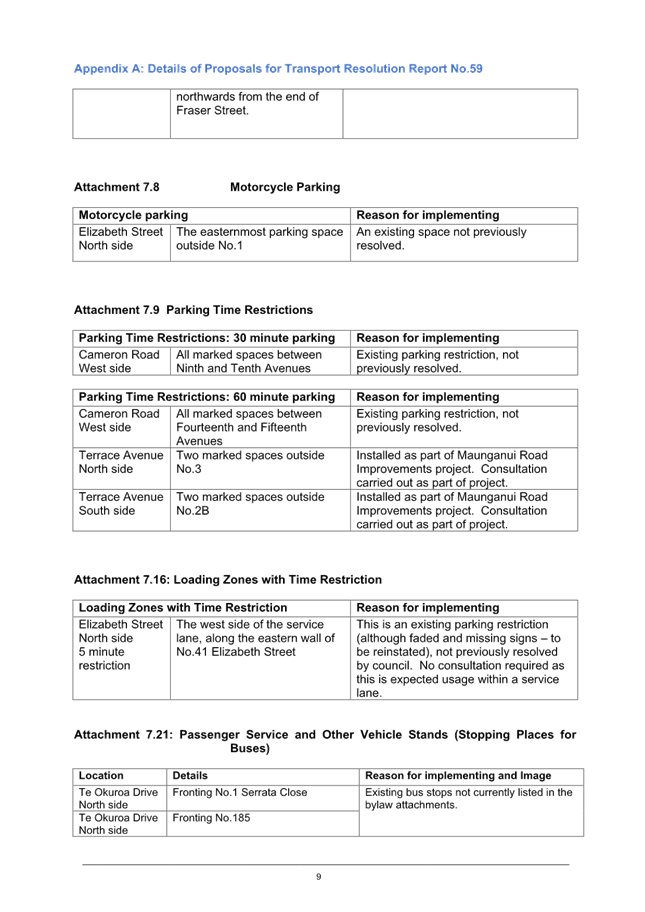
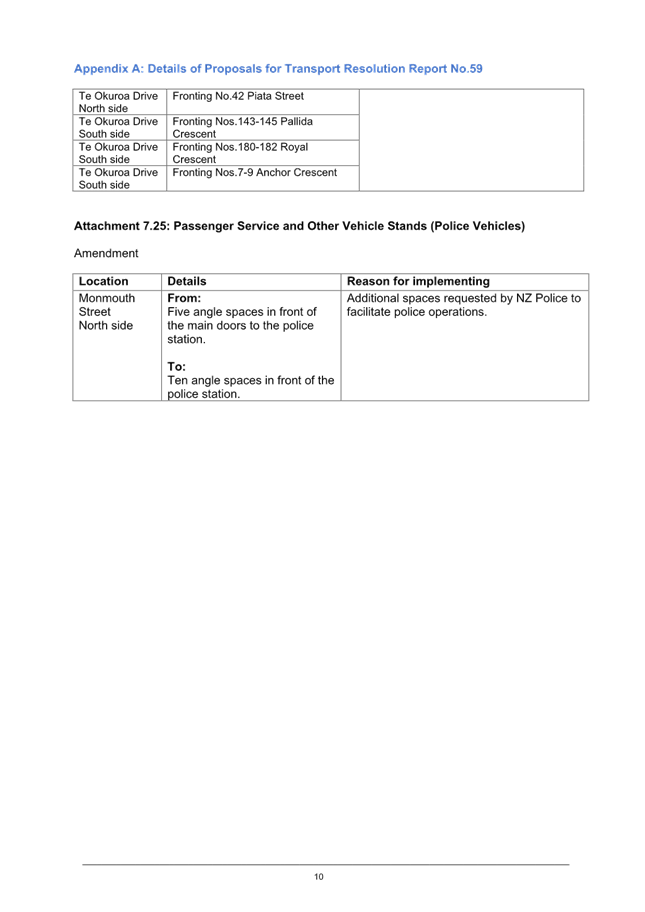
|
Ordinary
Council meeting Agenda
|
10
February 2026
|
11.7 Bay of Plenty Mayoral
Forum Triennial Agreement 2025-2028
File
Number: A19693312
Author: Jeremy
Boase, Head of Strategy, Governance & Climate Resilience
Authoriser: Christine
Jones, General Manager: Strategy, Partnerships & Growth
Purpose of the Report
1. To seek Council
endorsement of the Bay of Plenty Mayoral Forum Triennial Agreement for the
2025-2028 triennium.
|
Recommendations
That the Council:
(a) Receives the report "Bay
of Plenty Mayoral Forum Triennial Agreement 2025-2028".
(b) Endorses the draft Bay of
Plenty Mayoral Forum Triennial Agreement 2025-2028, included as Attachment 1.
(c) Endorses the draft Bay of
Plenty Mayoral Forum Terms of Reference, included as Attachment 2.
(d) Authorises the Mayor to sign
the Triennial Agreement on behalf of Tauranga City Council.
(e) Supports a review of the
Triennial Agreement commencing no later than six months after it is signed to
ensure that it remains relevant given ongoing government reforms of the local
government sector, and requests that the Mayor formally communicate this to
the other signatories.
|
Executive Summary
2. All councils in a
region must enter into a Triennial Agreement.
3. The Bay of Plenty
Regional Council has led a process to prepare a draft Triennial Agreement for
the 2025 to 2028 triennium. The changes from the 2022-2025 Triennial
Agreement are relatively minor.
4. There are no direct
financial implications or specific risks in endorsing the draft Triennial
Agreement.
5. If Council does not
endorse the draft Triennial Agreement, the existing Triennial Agreement will
remain in place and discussions with partner councils will need to continue
until consensus is reached.
Background
6. The Local Government
Act 2002 (“LGA”) requires all local authorities within each region
to enter into a Triennial Agreement by 1 March in the year following triennial
elections. The Bay of Plenty Regional Council leads the process to facilitate
this. A copy of the draft Triennial Agreement is included as Attachment
1 to this report.
7. Each Council in the
Bay of Plenty region will separately consider whether to endorse the draft
Triennial Agreement before 1 March 2026.
8. The last Triennial
Agreement was approved by the Commission at its meeting of 7 February 2023 and
was signed by the Commission Chair shortly afterwards.
Proposed
changes
9. The
draft 2025-2028 Triennial Agreement has the following changes from the signed
2022-2025 version:
(a) The statement of intent
(section 2) has been amended to more closely reflect the soon-to-be-revised
LGA. It now states that councils will ‘work collaboratively, and
to maximise effectiveness and efficiency while delivering our core and
statutory services and activities to our communities’.
The
2022-2025 version included working collaboratively and maximising effectiveness
and efficiency, and also added ‘and to:
· Promote
the social, cultural, economic and environmental wellbeing of the Bay of Plenty
communities now and in the future;
· Promote
an agreed consultation process for preparation and review of the Regional
Policy Statement.’
(b) Under general protocols
(section 5), the first paragraph is new. It outlines the regional Mayoral
Forum and introduces the Terms of Reference of that committee. A copy of
those terms of reference are included as Attachment 2 to this
report. As this is a formal committee of all member councils,
consideration and endorsement of the Terms of Reference is recommended.
(c) Under policies and plans
(section 8), the final two sentences are new. These simply recognise that
the existing Protocol for Bay of Plenty RMA Policy and Plans, a regional
council document, may need to be updated during the triennium in response to
government reforms of the resource management system.
(d) Section 10, covering local
government reform, is new.
Sector reform
10. The government is leading a
large range of projects to implement reform on the local government
sector. The sector’s understanding of the potential consequences of
these reforms is evolving as the details of those reforms are being shared by the
government.
11. To ensure the Triennial
Agreement remains fit-for-purpose through the triennium, a formal review
process could be initiated between Bay of Plenty councils. Such an
approach is included in the options below and is recommended.
Statutory Context
12. Section
15 of the LGA requires local authorities in a region to adopt a Triennial
Agreement that includes:
(a) protocols
for communication and co-ordination among the local authorities
(b) the
process by which the local authorities will consider proposals for new regional
council activities
(c) processes
and protocols through which all local authorities can participate in
identifying, delivering, and funding facilities and services of significance to
more than 1 district.
13. The
proposed Triennial Agreement meets the requirements of the LGA.
STRATEGIC ALIGNMENT
14. The Triennial Agreement could
be considered to contribute to all of Council’s strategic community
outcomes through strengthened collaboration and effectiveness.
15. Council’s Strategic
Framework aligns its strategies and plans to its community outcomes, interwoven
with our three Council approaches i.e., how we do things. This Triennial
Agreement is consistent with the approach of Working Beyond Tauranga. Council
commits to working collaboratively, building constructive partnerships with our
key stakeholders and considering the impacts of what we do, and don’t do,
on not just our city but also our region and country. We acknowledge our role
as the largest city in the Bay of Plenty region and the connections we have
beyond the city boundaries.
Options Analysis
16. In essence, Council has two
main options: to endorse the draft Triennial Agreement and terms of reference,
or to not. A third option is presented relating to a formal review
process.
Option 1 – Endorse the draft Triennial Agreement
and associated terms of reference (Recommended)
17. Council
endorses the agreement.
|
Advantages
|
Disadvantages
|
|
· Subject to other councils’ decisions, meets the
statutory requirement for a Triennial Agreement to be in place by 1 March
2026.
· Tauranga City Council demonstrates its commitment to
working efficiently and effectively with other local authorities in the Bay
of Plenty region.
· Minor amendments from the last agreement are incorporated
and become effective.
|
· Should changes be sought, Council would need to request a
review of the Triennial Agreement and agreement of the other parties.
|
Option 2 – Propose amendments to the draft
Triennial Agreement and associated terms of reference
18. Council
do not endorse the agreement and instead proposes amendments.
|
Advantages
|
Disadvantages
|
|
· Appropriate
if the Council believes major amendments are needed to ensure that effective
relationships are maintained with the other councils in the region.
|
· Any
changes proposed will need to gain the agreement of the other councils in the
region.
· This option is likely to miss the 1 March 2026 statutory requirement
to have an agreement in place. However, the current agreement continues
in place until a new one is approved by all councils.
|
Option 3 – Support a formal review of the Triennial
Agreement within six months of adoption (also Recommended)
19. Under
this option, Council approves (option 1) or amends (option 2) the draft
agreement today but also seeks a formal review of it within six months.
20. Such
a review would allow the partner councils to consider any further information
about, and understanding of, the various government reforms of the local
government sector that are underway, and to determine whether the Triennial
Agreement as adopted remains fit-for-purpose or requires amendment.
21. At
the first review, the councils and Mayoral Forum may decide to conduct regular
reviews of the agreement as the triennium continues.
22. Section
15(4) of the LGA provides that “An agreement under this section may be
varied by agreement between all the local authorities within the region.”
|
Advantages
|
Disadvantages
|
|
· If
supported by the other councils, provides the councils and the Mayoral Forum
a formal opportunity to revisit the Triennial Agreement on a timely basis.
· Ensures
the Triennial Agreement remains fit-for-purpose through what is likely to be
a triennium of significant change for the local government sector.
|
|
Financial Considerations
23. There are no direct financial
consequences in entering into the Triennial Agreement.
TE AO MĀORI APPROACH
24. This is a procedural
report. There are no direct implications to council’s te ao
Māori approach.
CLIMATE IMPACT
25. This is a procedural
report. There are no direct climate implications.
Significance
26. The Local Government Act 2002
requires an assessment of the significance of matters, issues, proposals and
decisions in this report against Council’s Significance and Engagement
Policy. Council acknowledges that in some instances a matter, issue,
proposal or decision may have a high degree of importance to individuals,
groups, or agencies affected by the report.
27. In making this assessment,
consideration has been given to the likely impact, and likely consequences for:
(a) the current
and future social, economic, environmental, or cultural well-being of the
district or region
(b) any persons who are likely to be
particularly affected by, or interested in, the matter.
(c) the capacity of the local authority
to perform its role, and the financial and other costs of doing so.
28. In accordance with the
considerations above, criteria and thresholds in the policy, it is considered
that the matter is of low significance.
ENGAGEMENT
29. Taking into consideration the
above assessment, that the matter is of low significance, officers are of the
opinion that no further engagement is required prior to Council making a
decision.
Next Steps
30. If Council endorses the
Triennial Agreement, this will be communicated to the Bay of Plenty Regional
Council and the mayor’s electronic signature will be forwarded. If
Council does not endorse the Triennial Agreement, then the Bay of Plenty Regional
Council and all other councils in the region will be informed and a further
process will be entered into to obtain regional consensus.
31. If Council approves recommended
resolution (e), the Mayor will communicate Council’s decision to the
Chair of Bay of Plenty Regional Council and the other mayors in the
region.
Attachments
1. 2026-01-29
Draft Bay of Plenty Mayoral Forum Triennial Agreement 2025-2028 - A19693196 ⇩
2. 2026-01-29 Draft
Terms of Reference - Bay of Plenty Mayoral Forum 2025-2028 - A19693220 ⇩
|
Ordinary
Council meeting Agenda
|
10
February 2026
|
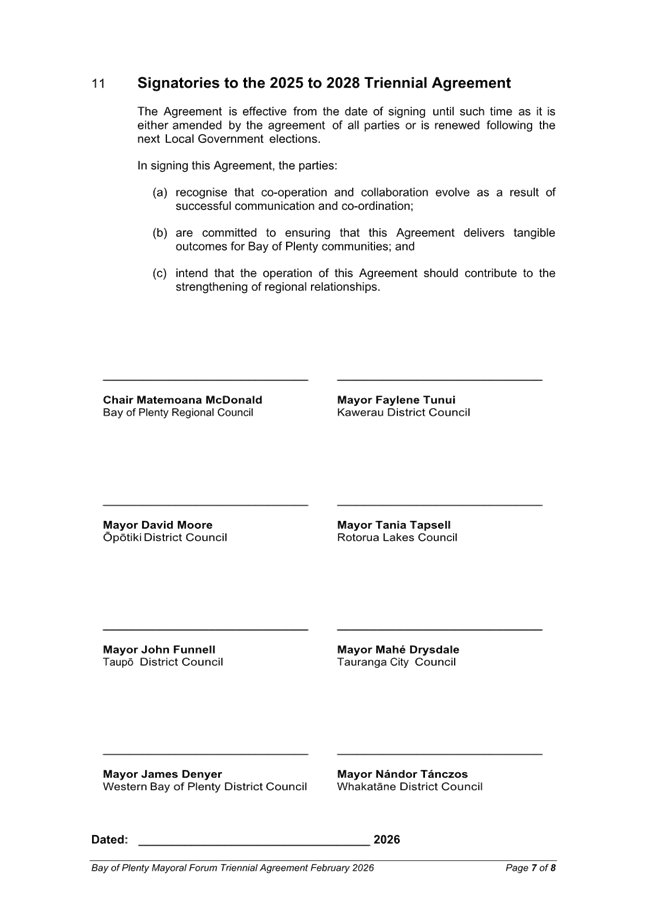
|
Ordinary
Council meeting Agenda
|
10
February 2026
|
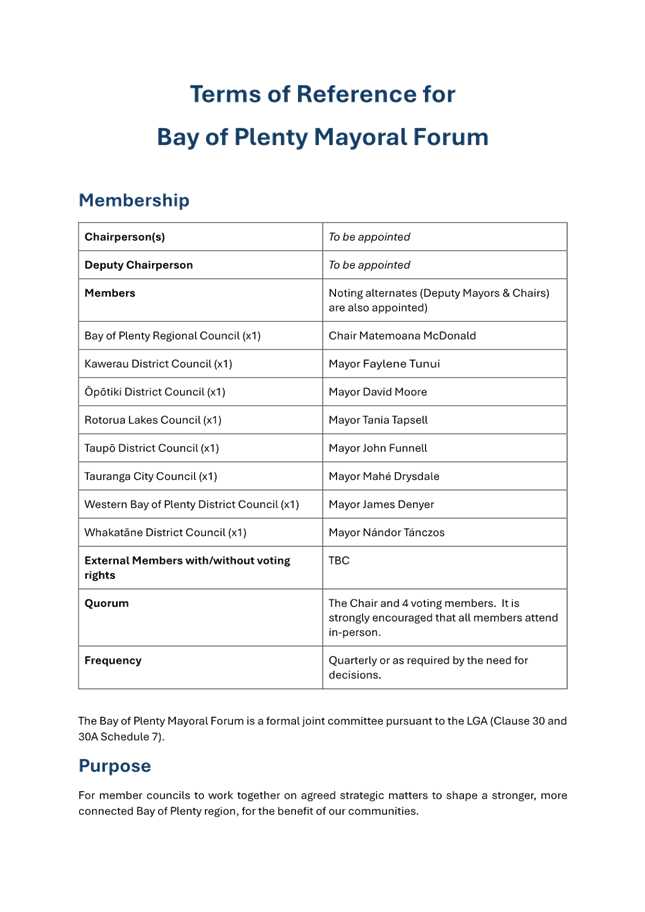
|
Ordinary Council meeting Agenda
|
10 February 2026
|
12 Discussion
of late items
|
Ordinary Council meeting Agenda
|
10 February 2026
|
13 Public
excluded session
Resolution to exclude
the public
|
Recommendations
That the public be
excluded from the following parts of the proceedings of this meeting.
The general subject
matter of each matter to be considered while the public is excluded, the
reason for passing this resolution in relation to each matter, and the
specific grounds under section 48 of the Local Government Official
Information and Meetings Act 1987 for the passing of this resolution are as
follows:
|
General subject of each matter to be
considered
|
Reason for passing this resolution in
relation to each matter
|
Ground(s) under section 48 for the
passing of this resolution
|
|
13.1 - Public Excluded Minutes of the
Council meeting held on 26 August 2025
|
s6(b) - The making available of the information
would be likely to endanger the safety of any person
s7(2)(a) - The withholding of the information is
necessary to protect the privacy of natural persons, including that of
deceased natural persons
s7(2)(b)(ii) - The withholding of the information
is necessary to protect information where the making available of the
information would be likely unreasonably to prejudice the commercial
position of the person who supplied or who is the subject of the information
s7(2)(g) - The withholding of the information is
necessary to maintain legal professional privilege
s7(2)(h) - The withholding of the information is
necessary to enable Council to carry out, without prejudice or
disadvantage, commercial activities
s7(2)(i) - The withholding of the information is
necessary to enable Council to carry on, without prejudice or disadvantage,
negotiations (including commercial and industrial negotiations)
|
s48(1)(a) - the public conduct of the relevant
part of the proceedings of the meeting would be likely to result in the
disclosure of information for which good reason for withholding would exist
under section 6 or section 7
|
|
13.2 - Public Excluded Minutes of the
Council meeting held on 16 September 2025
|
s7(2)(h) - The withholding of the information is
necessary to enable Council to carry out, without prejudice or
disadvantage, commercial activities
s7(2)(i) - The withholding of the information is
necessary to enable Council to carry on, without prejudice or disadvantage,
negotiations (including commercial and industrial negotiations)
|
s48(1)(a) - the public conduct of the relevant
part of the proceedings of the meeting would be likely to result in the
disclosure of information for which good reason for withholding would exist
under section 6 or section 7
|
|
13.3 - Public Excluded Minutes of the
Council meeting held on 29 October 2025
|
s7(2)(b)(ii) - The withholding of the information
is necessary to protect information where the making available of the
information would be likely unreasonably to prejudice the commercial
position of the person who supplied or who is the subject of the information
s7(2)(h) - The withholding of the information is
necessary to enable Council to carry out, without prejudice or
disadvantage, commercial activities
s7(2)(i) - The withholding of the information is
necessary to enable Council to carry on, without prejudice or disadvantage,
negotiations (including commercial and industrial negotiations)
|
s48(1)(a) - the public conduct of the relevant
part of the proceedings of the meeting would be likely to result in the
disclosure of information for which good reason for withholding would exist
under section 6 or section 7
|
|
13.4 - Public Excluded Minutes of the
Council meeting held on 16 December 2025
|
s6(b) - The making available of the information
would be likely to endanger the safety of any person
s7(2)(a) - The withholding of the information is
necessary to protect the privacy of natural persons, including that of
deceased natural persons
s7(2)(b)(ii) - The withholding of the information
is necessary to protect information where the making available of the
information would be likely unreasonably to prejudice the commercial
position of the person who supplied or who is the subject of the information
s7(2)(d) - The withholding of the information is
necessary to avoid prejudice to measures protecting the health or safety of
members of the public
s7(2)(g) - The withholding of the information is
necessary to maintain legal professional privilege
s7(2)(h) - The withholding of the information is
necessary to enable Council to carry out, without prejudice or
disadvantage, commercial activities
s7(2)(i) - The withholding of the information is
necessary to enable Council to carry on, without prejudice or disadvantage,
negotiations (including commercial and industrial negotiations)
|
s48(1)(a) - the public conduct of the relevant
part of the proceedings of the meeting would be likely to result in the
disclosure of information for which good reason for withholding would exist
under section 6 or section 7
|
|
13.5 - Council-Controlled
Organisations - Board Appointments beyond 30 June 2026
|
s7(2)(a) - The withholding of the information is
necessary to protect the privacy of natural persons, including that of
deceased natural persons
|
s48(1)(a) - the public conduct of the relevant
part of the proceedings of the meeting would be likely to result in the
disclosure of information for which good reason for withholding would exist
under section 6 or section 7
|
|
|
Ordinary Council meeting Agenda
|
10 February 2026
|
14 Closing
karakia