|
Ordinary Council meeting Agenda
|
10 February 2026
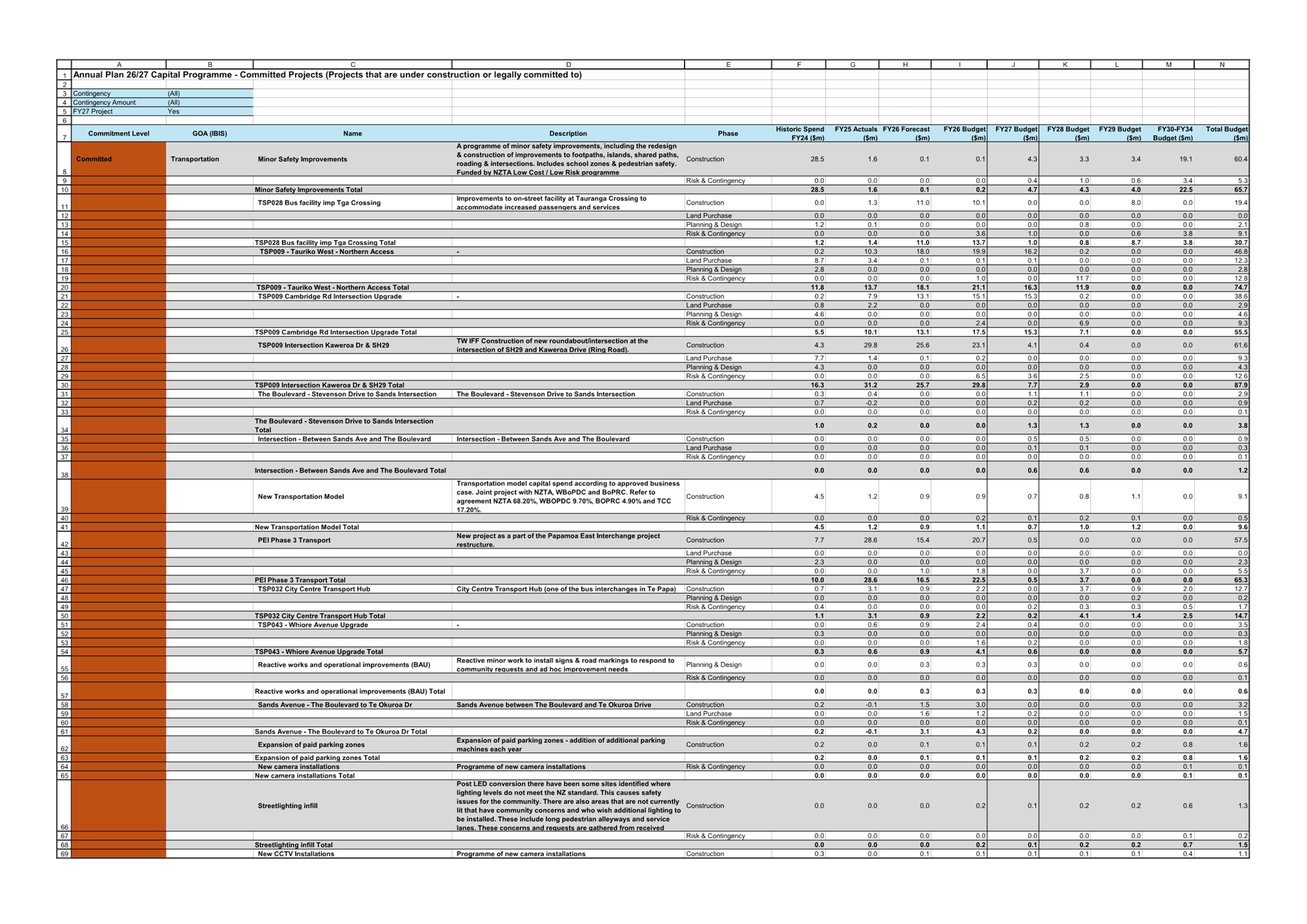
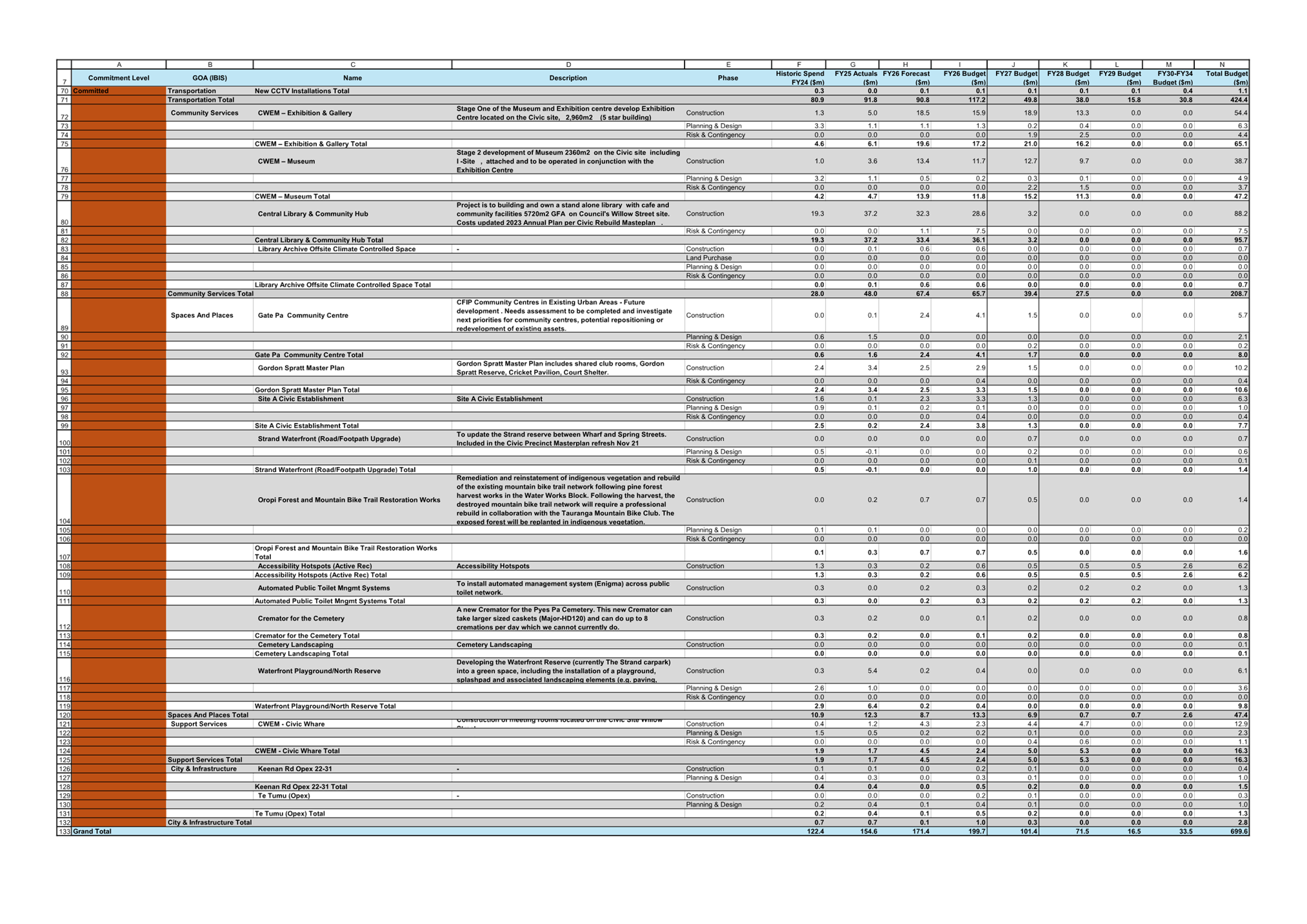
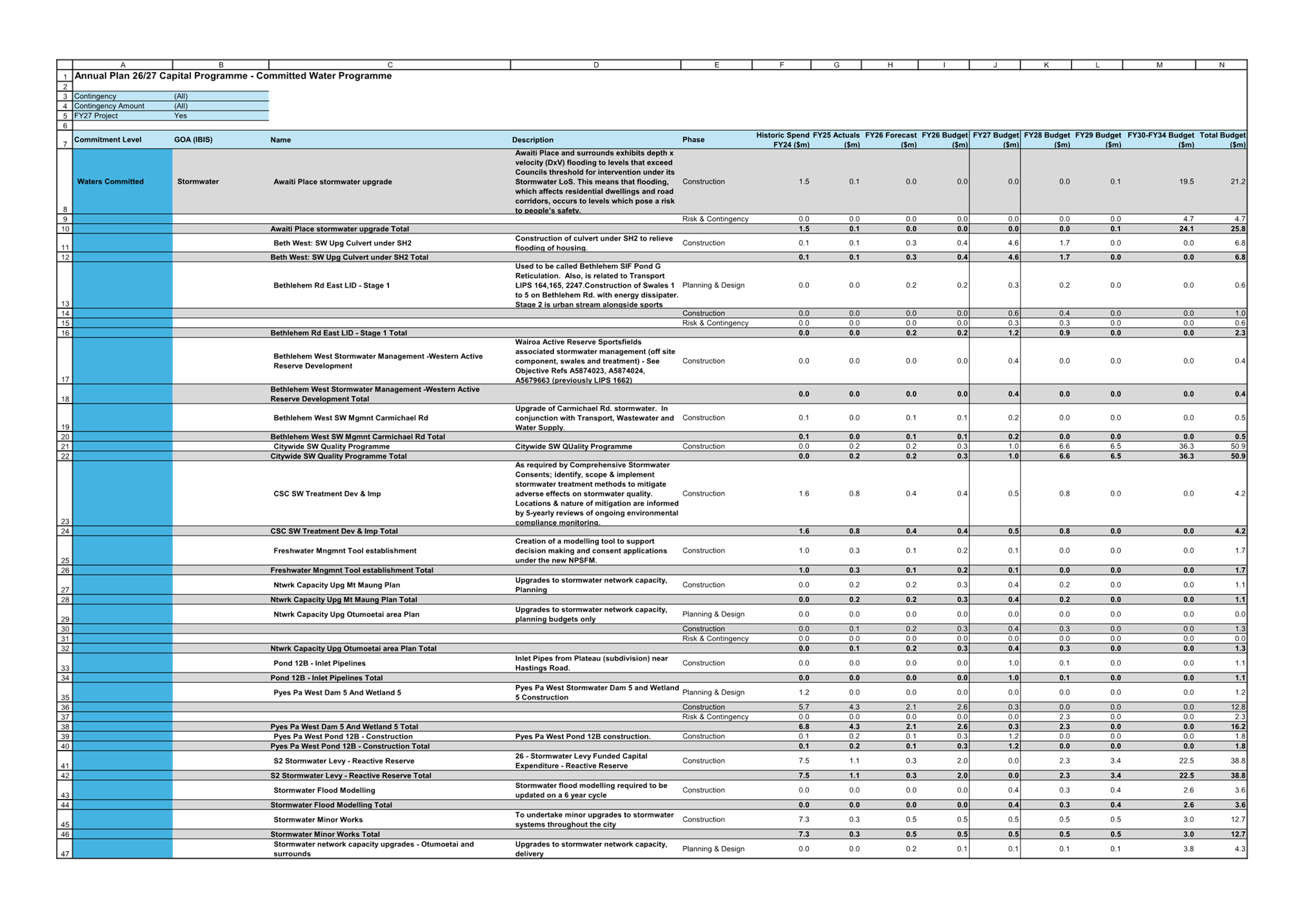
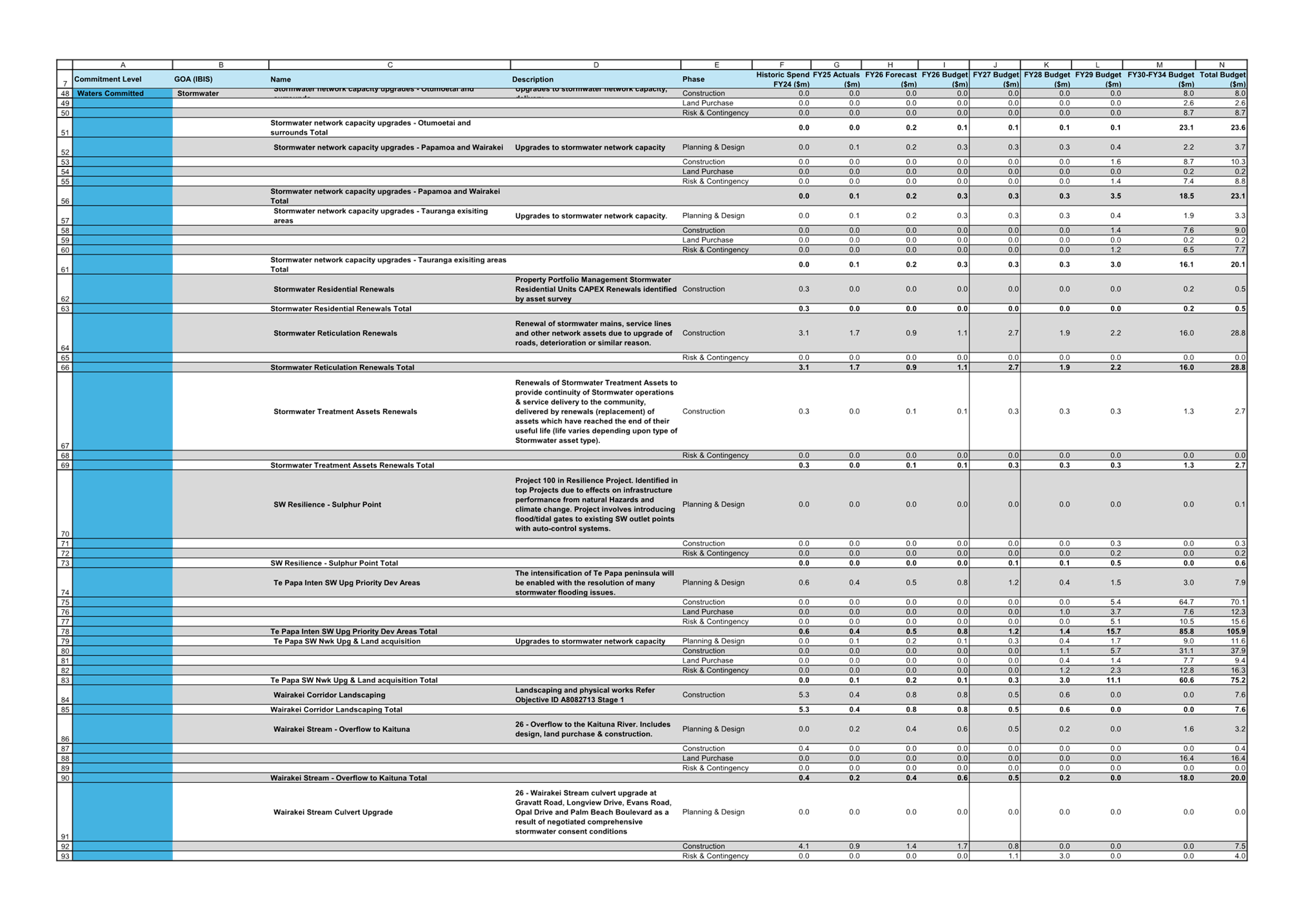
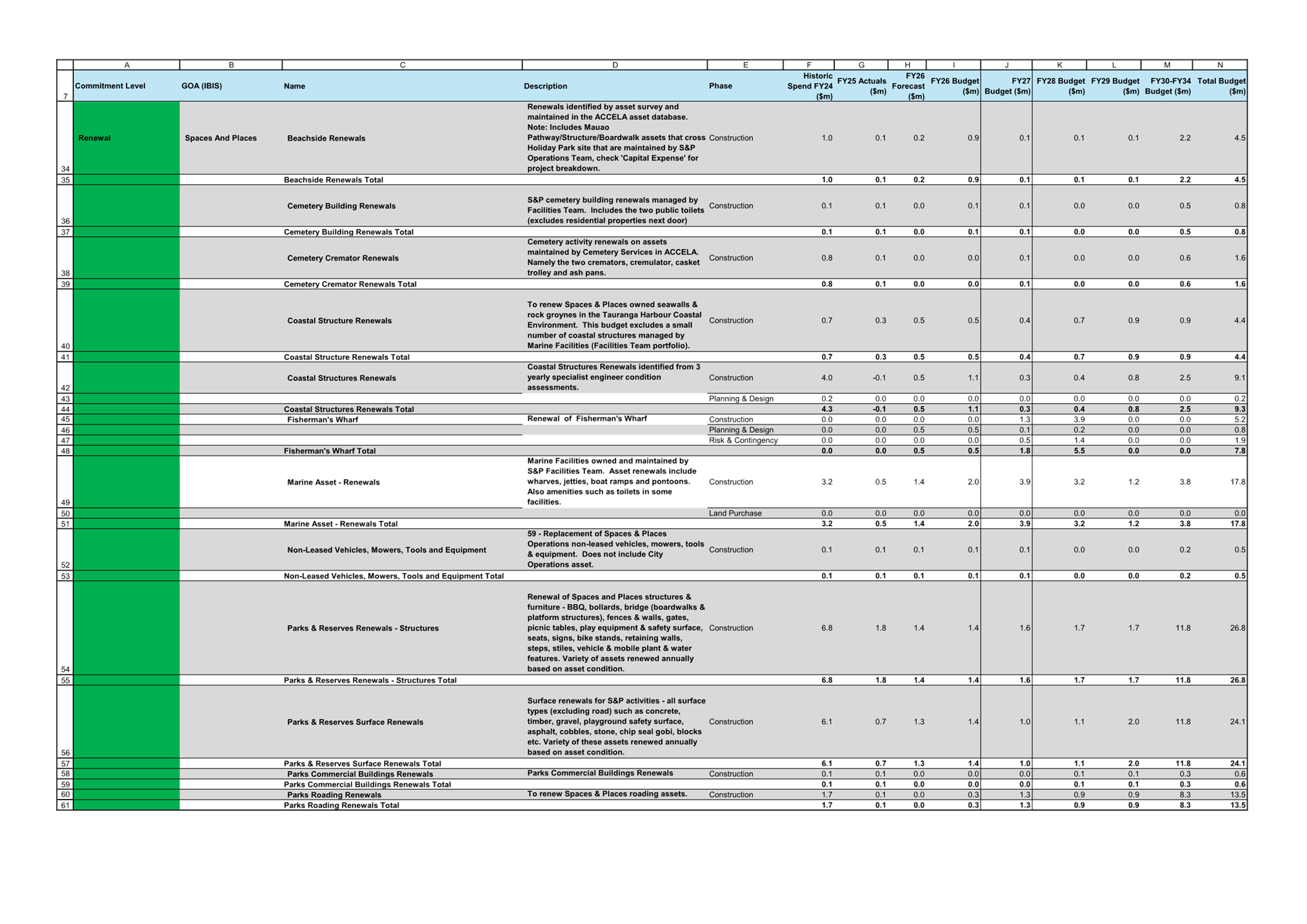
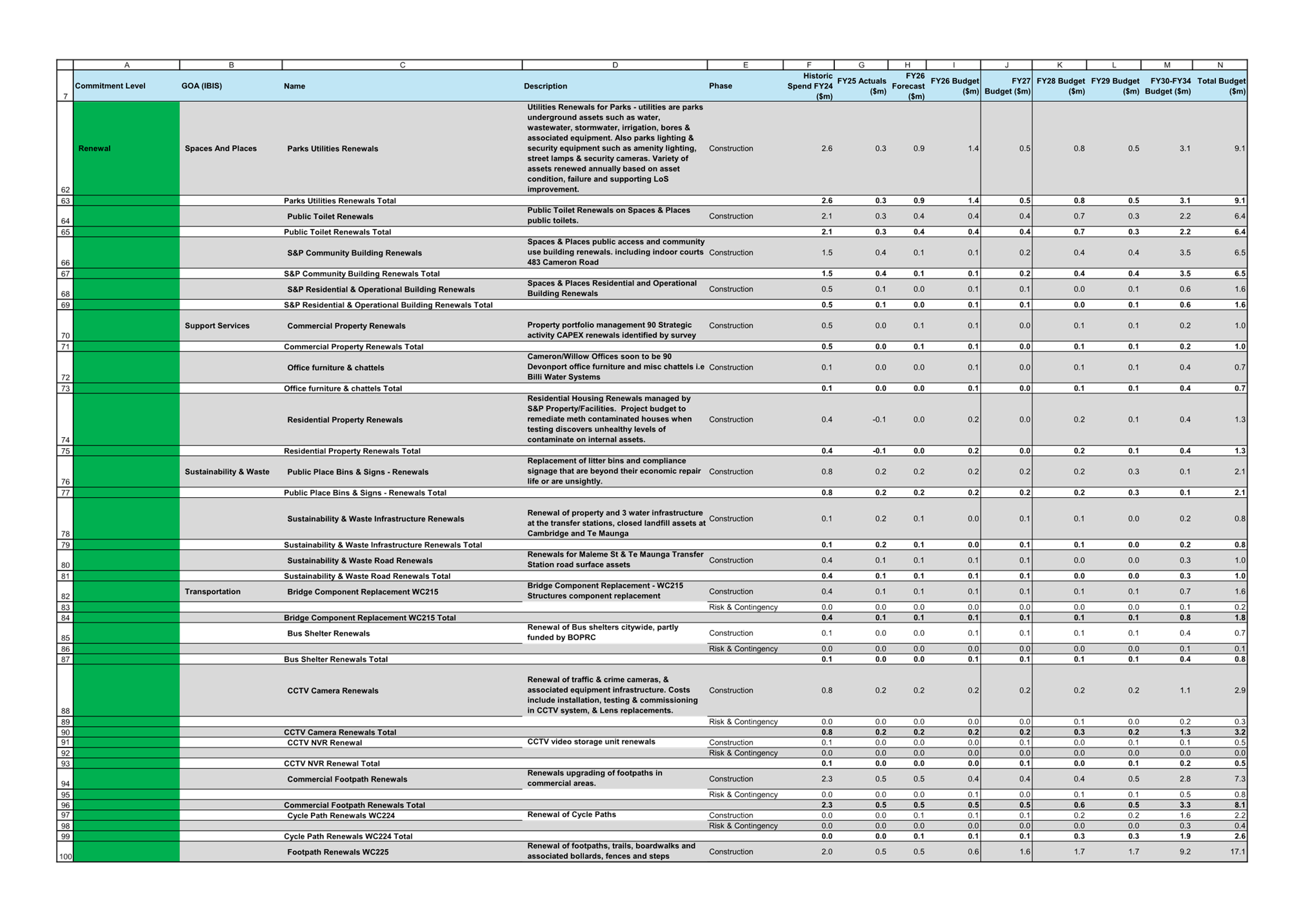
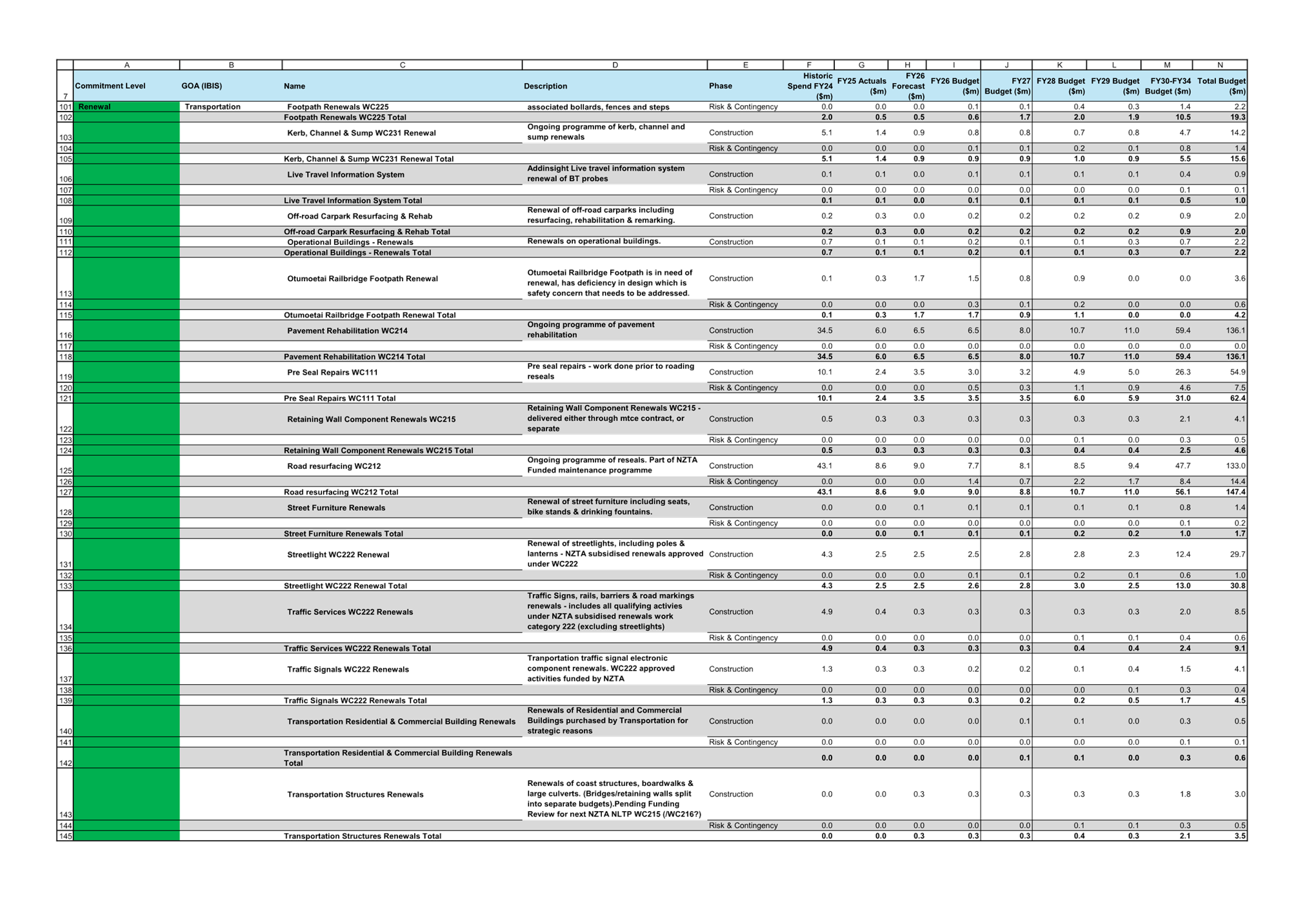
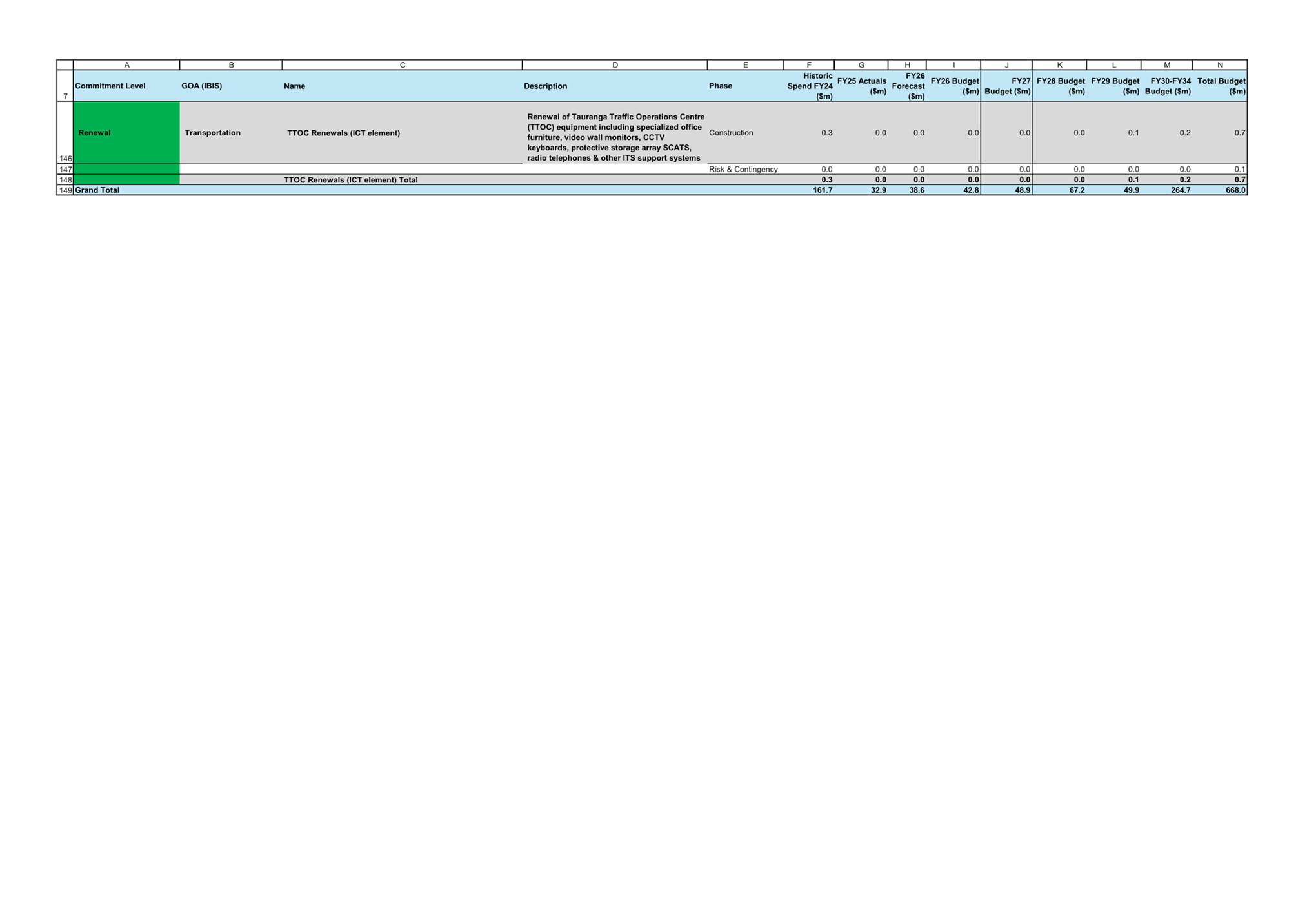
|
11 Business
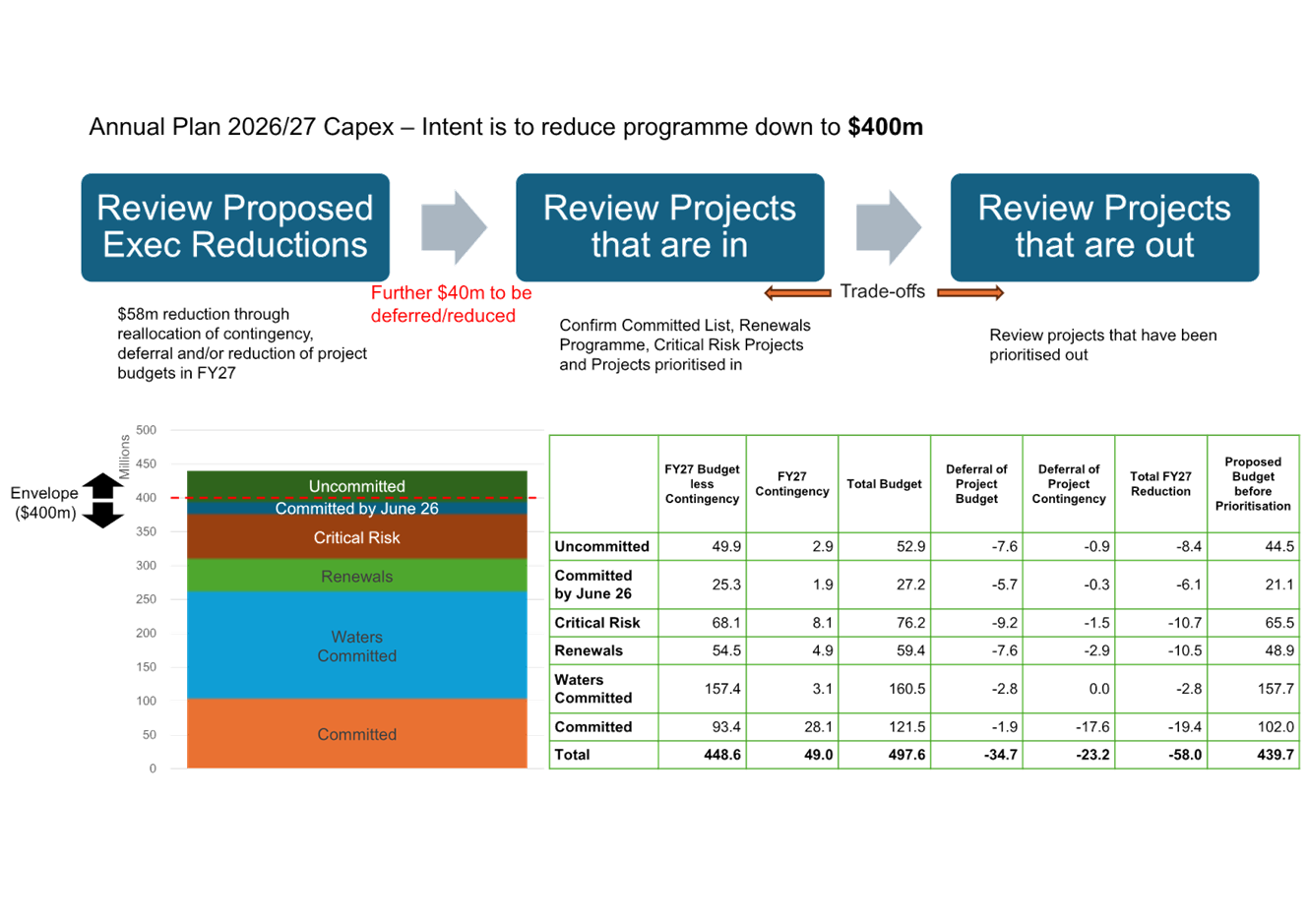
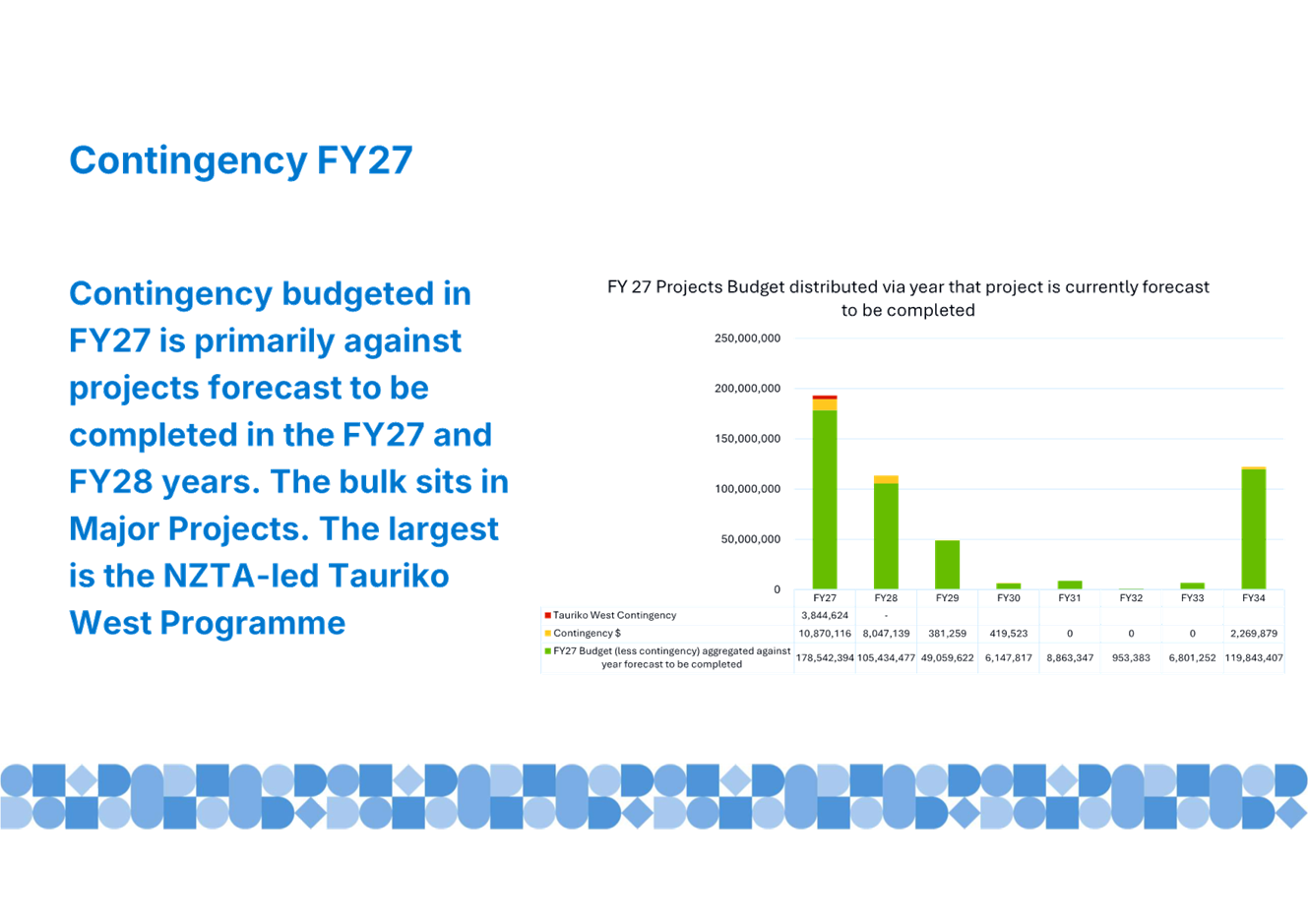
11.7 Miro
Street Parking Improvements
File
Number: A19489166
Author: Kurt
Graham, Project Manager
Shawn Geard,
Manager: Transport System Operations
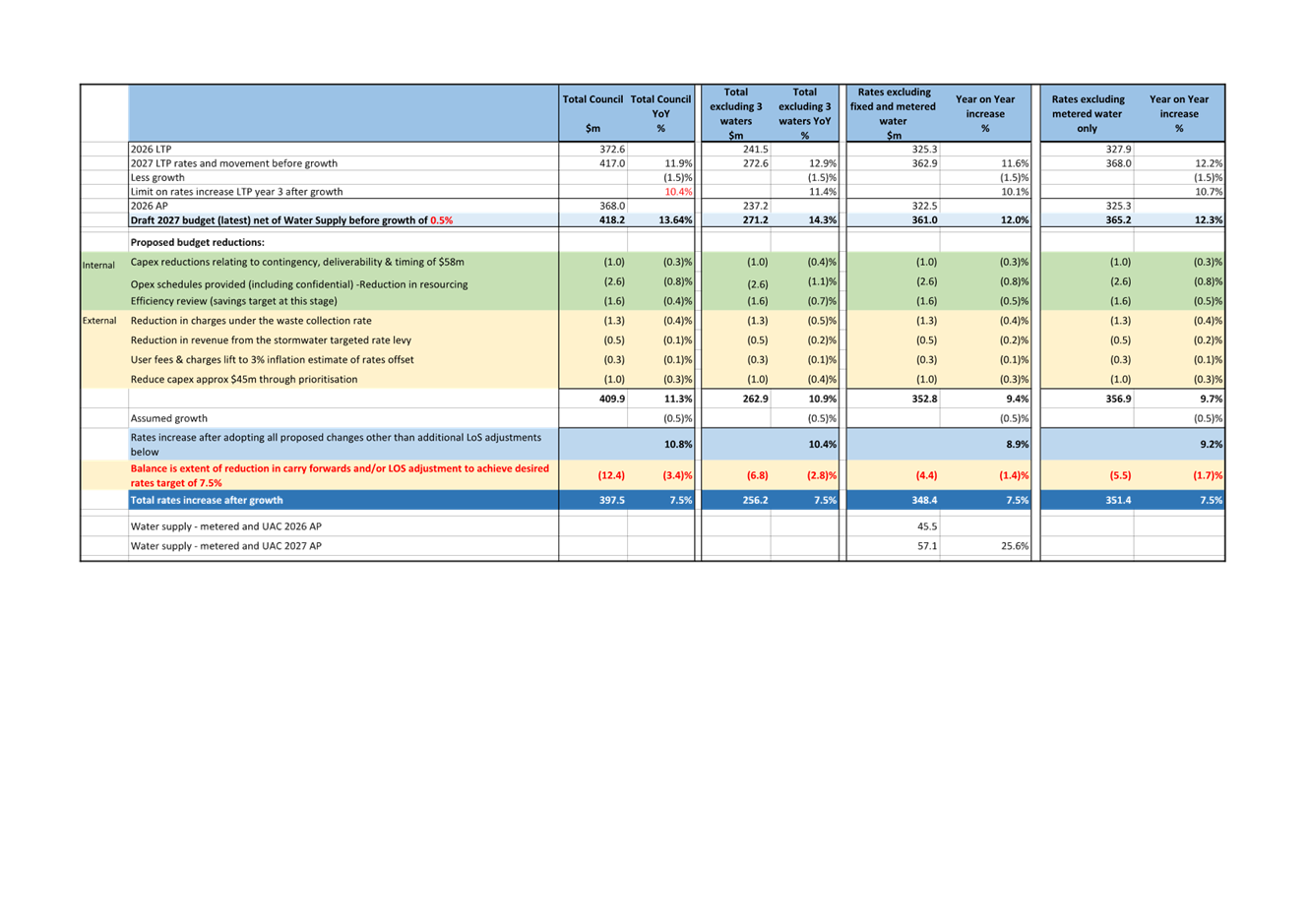
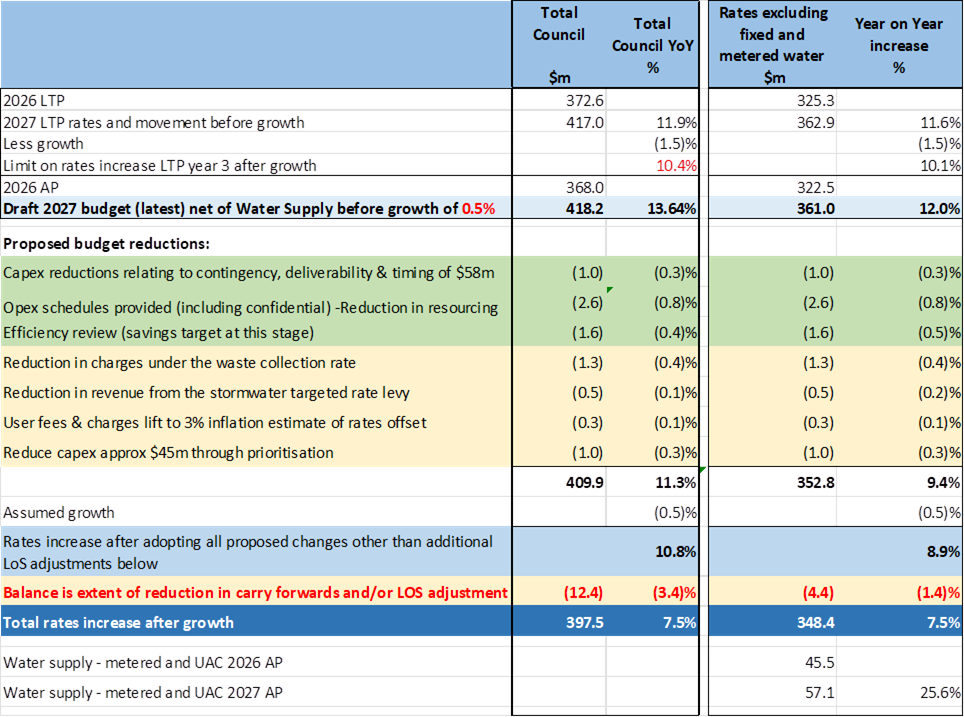
Authoriser: Reneke
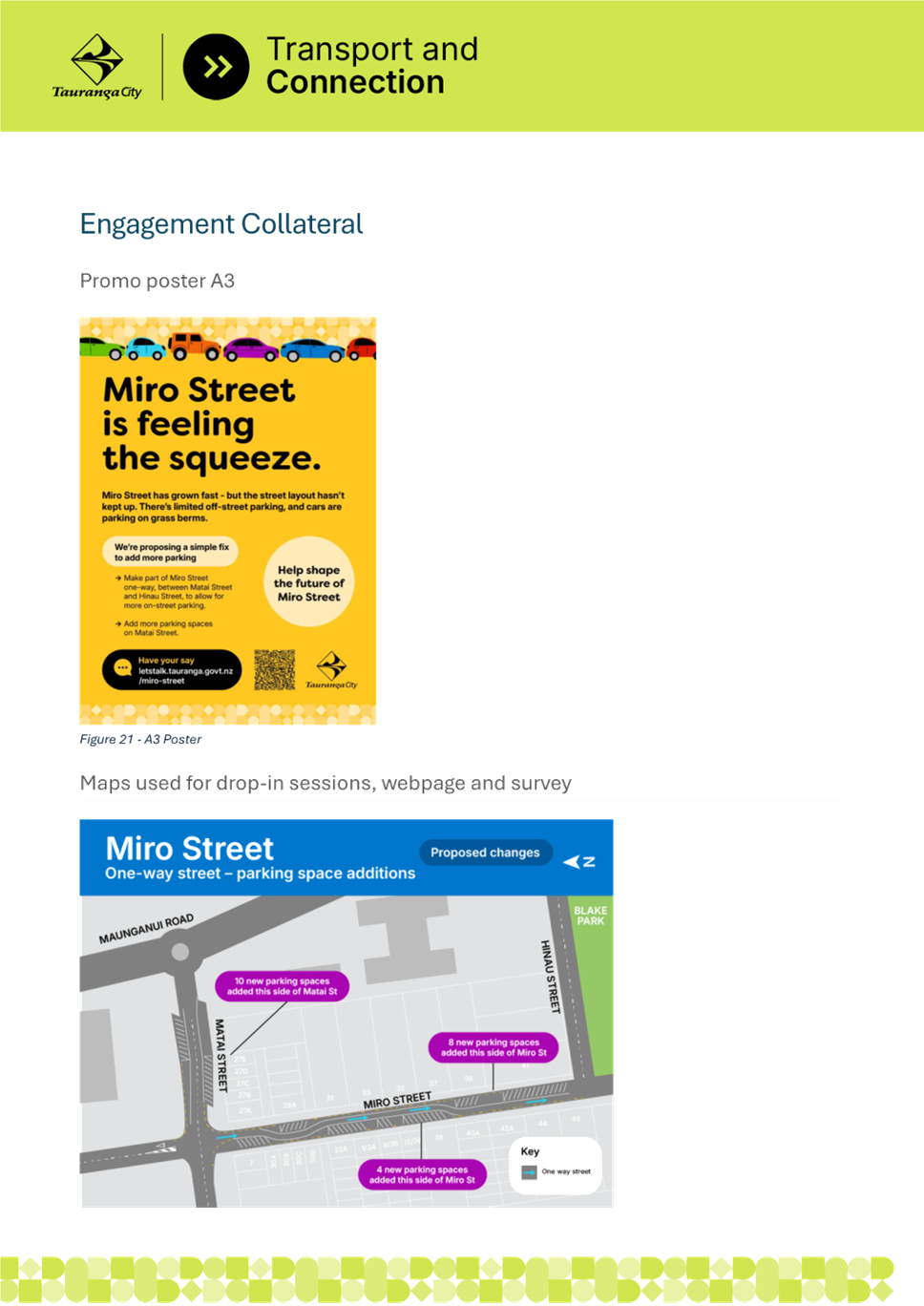
van Soest, General Manager: Operations & Infrastructure
Purpose of the Report
1. The purpose of this
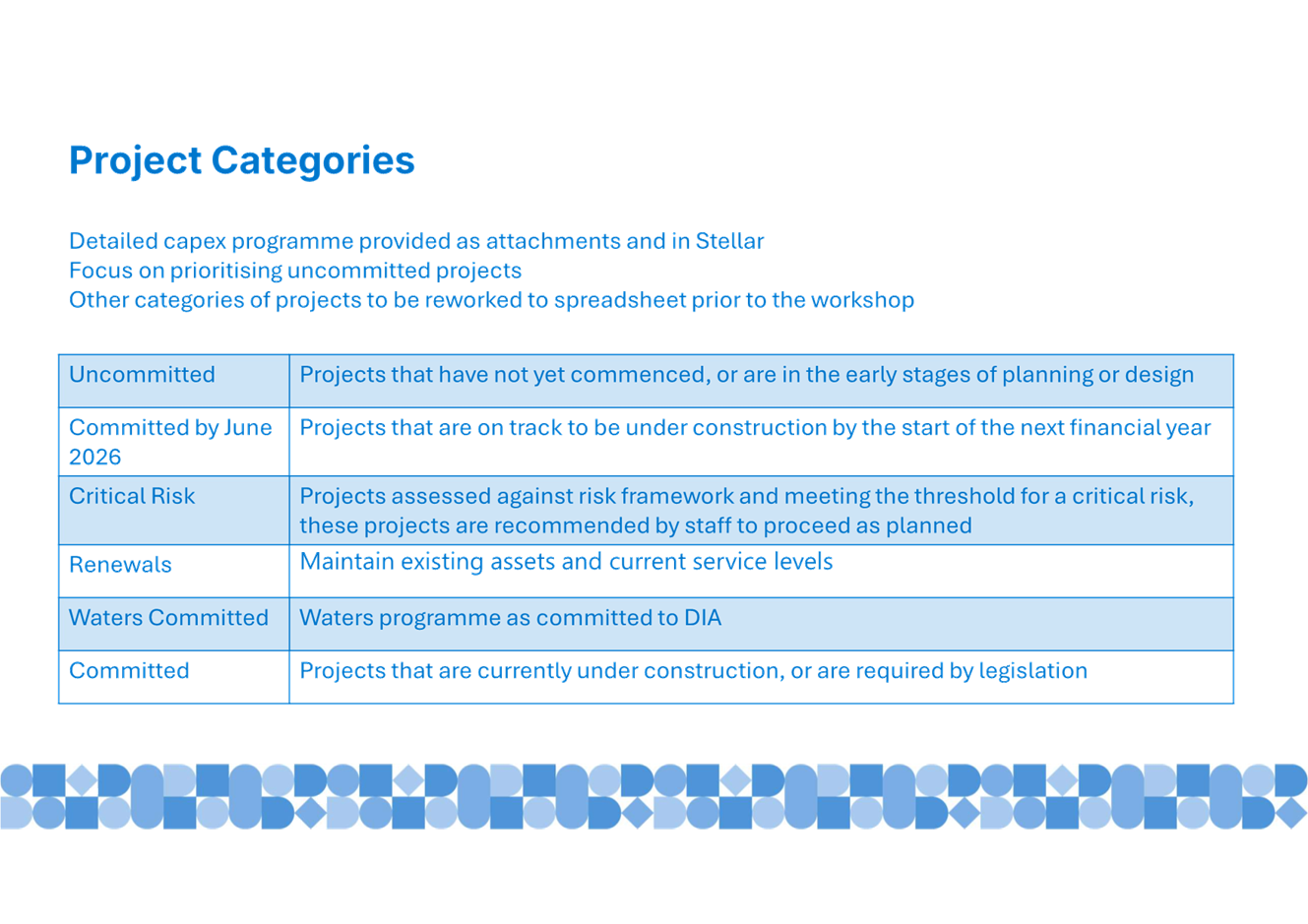
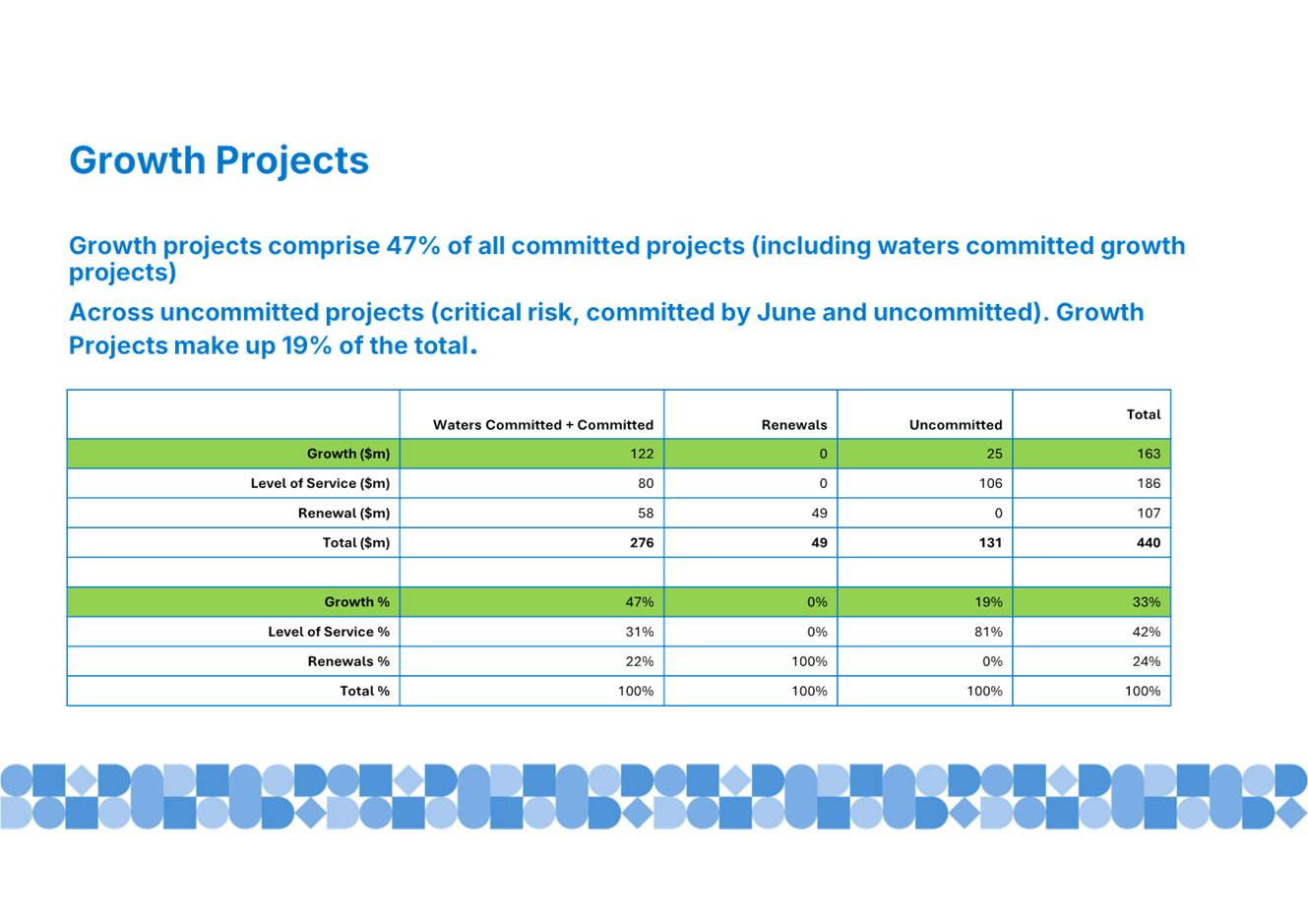
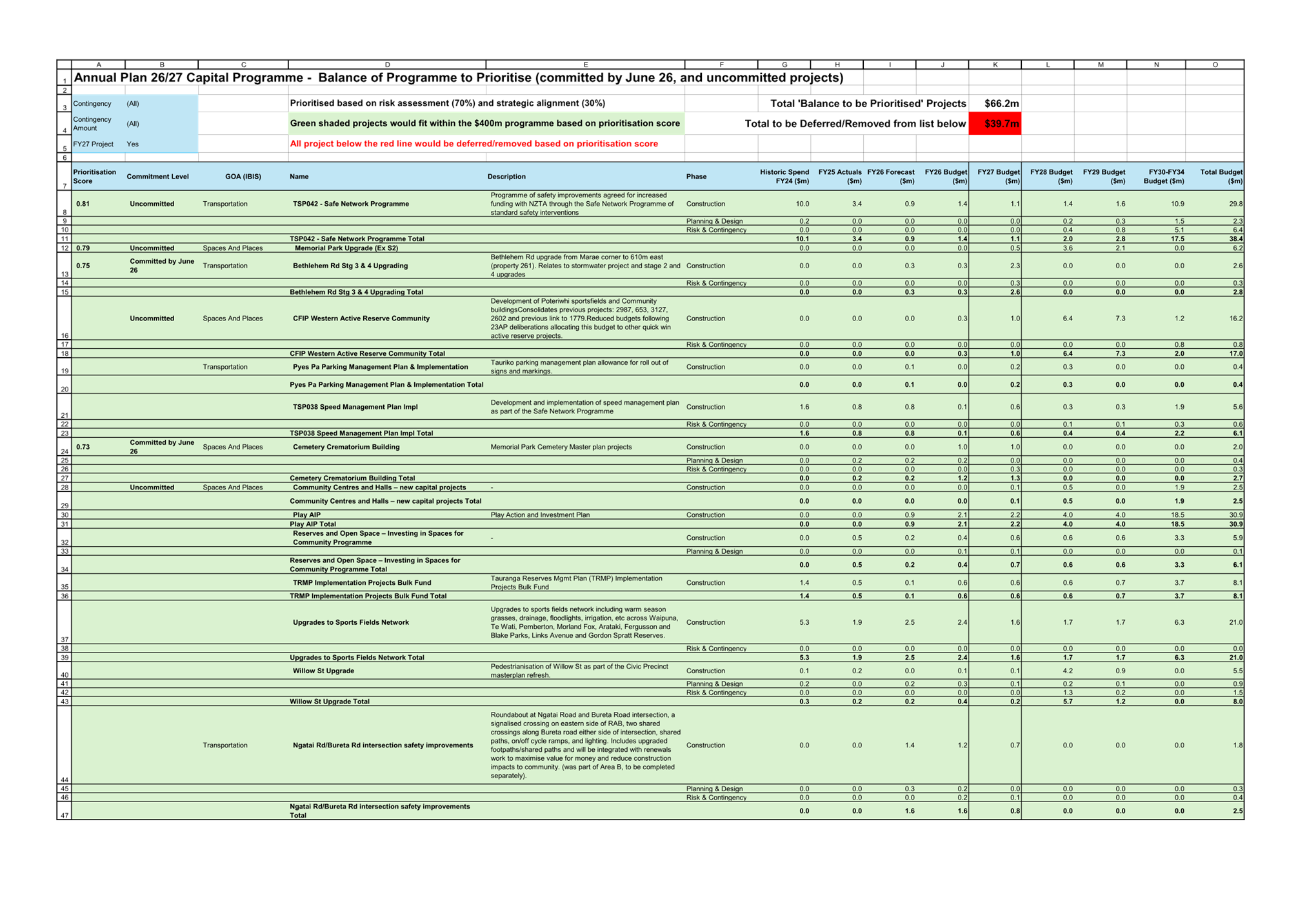
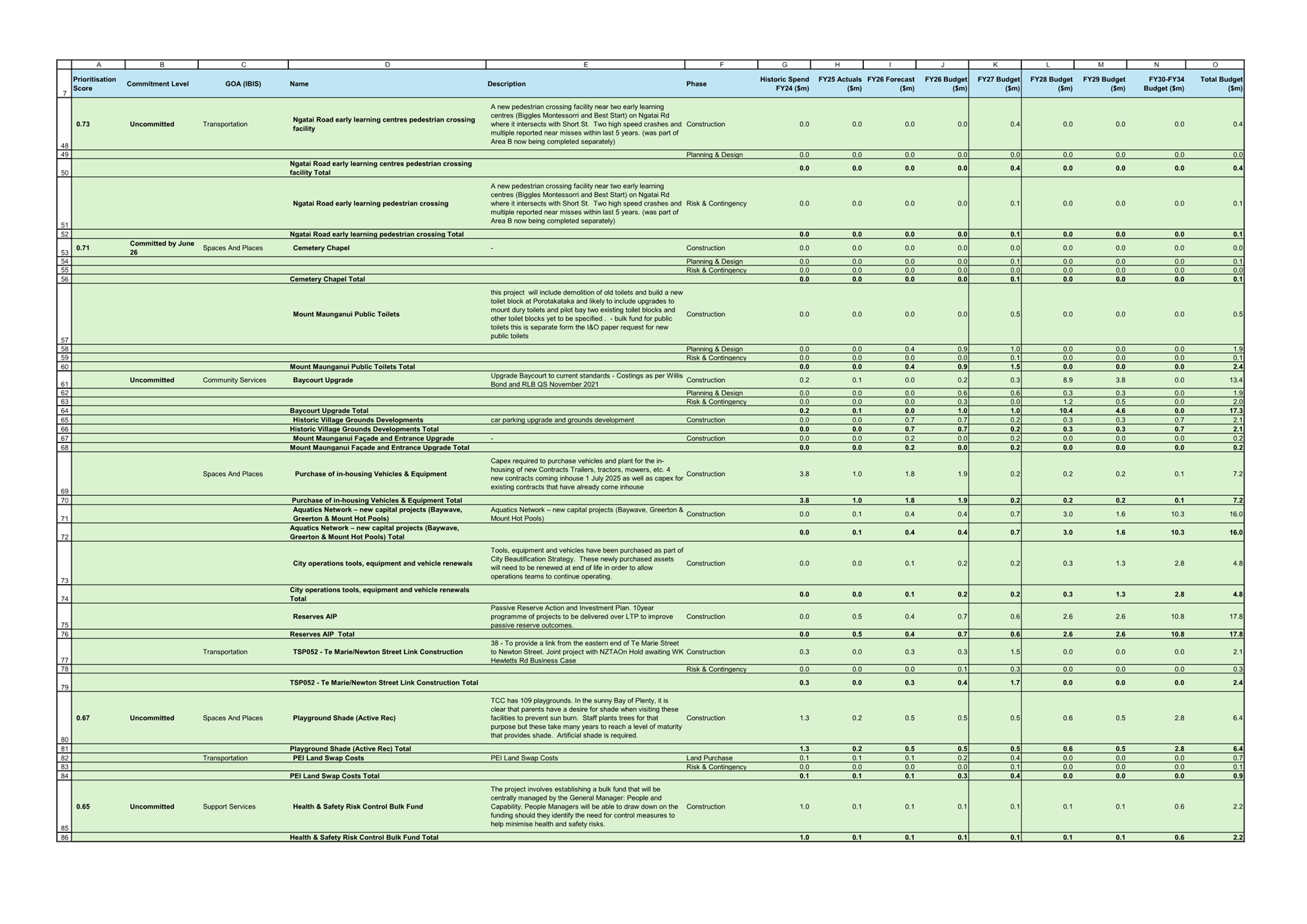
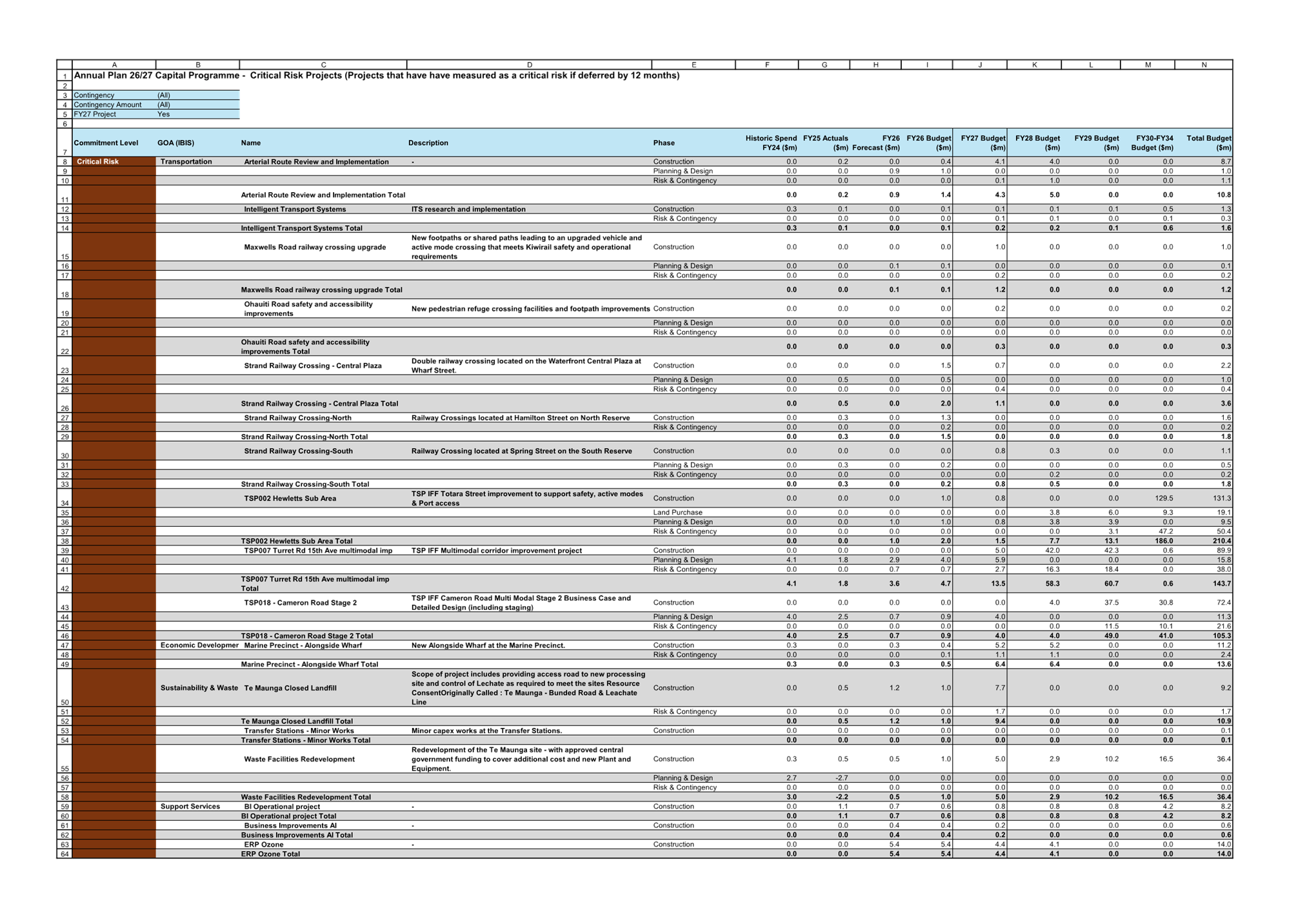
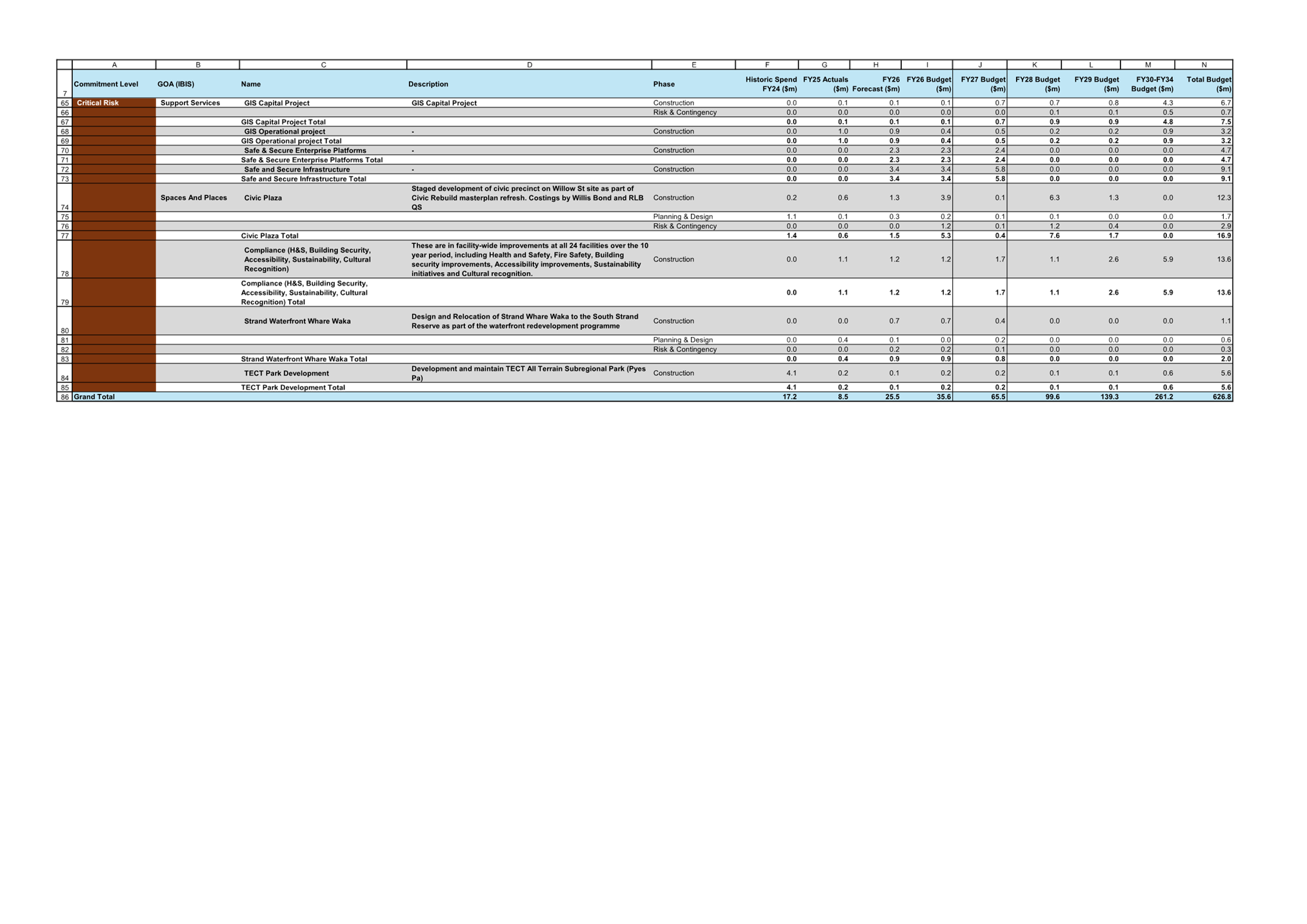
report is to provide council with the background of the Miro Street Parking
Improvements project and seek a decision from council on the solution to be
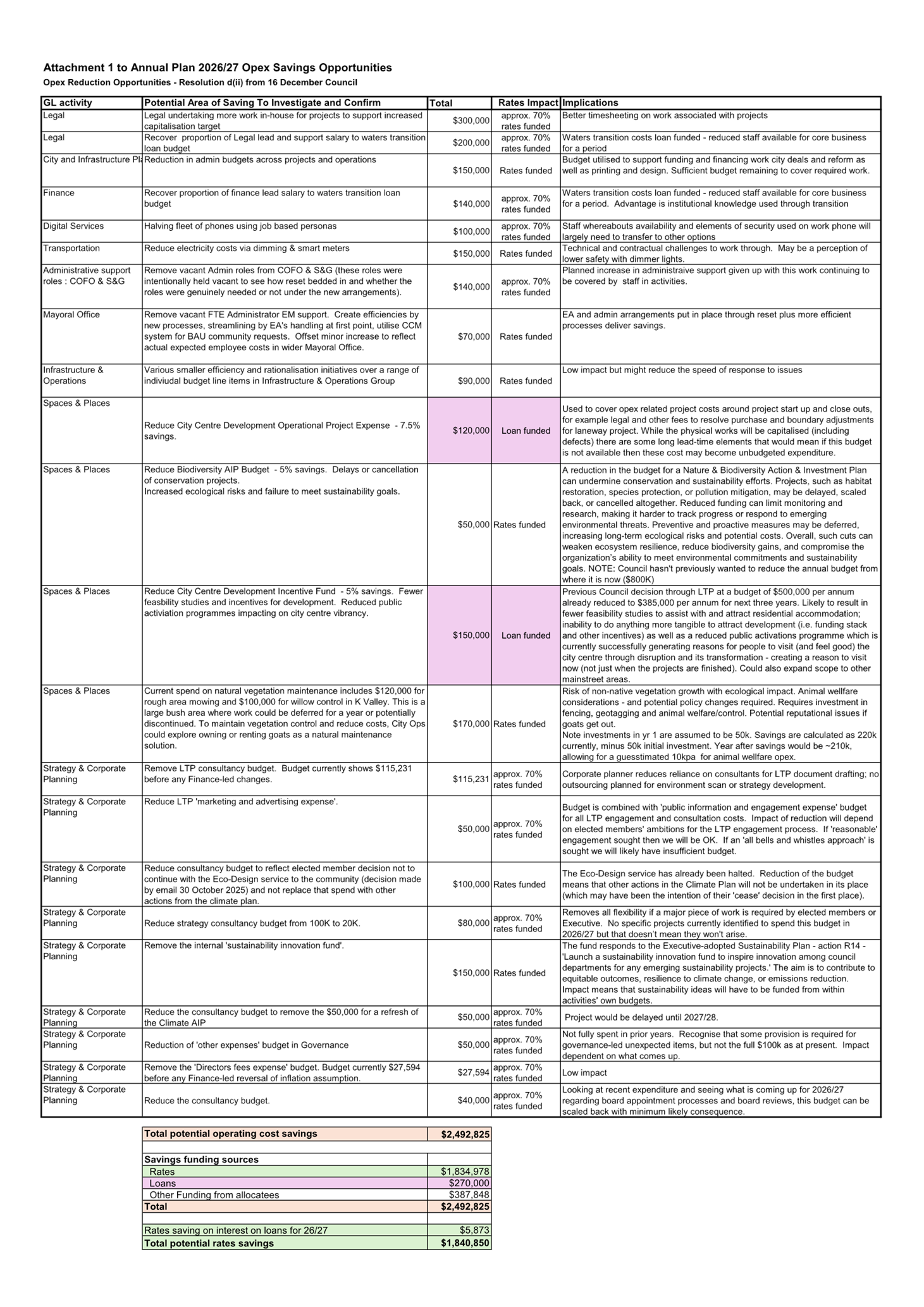
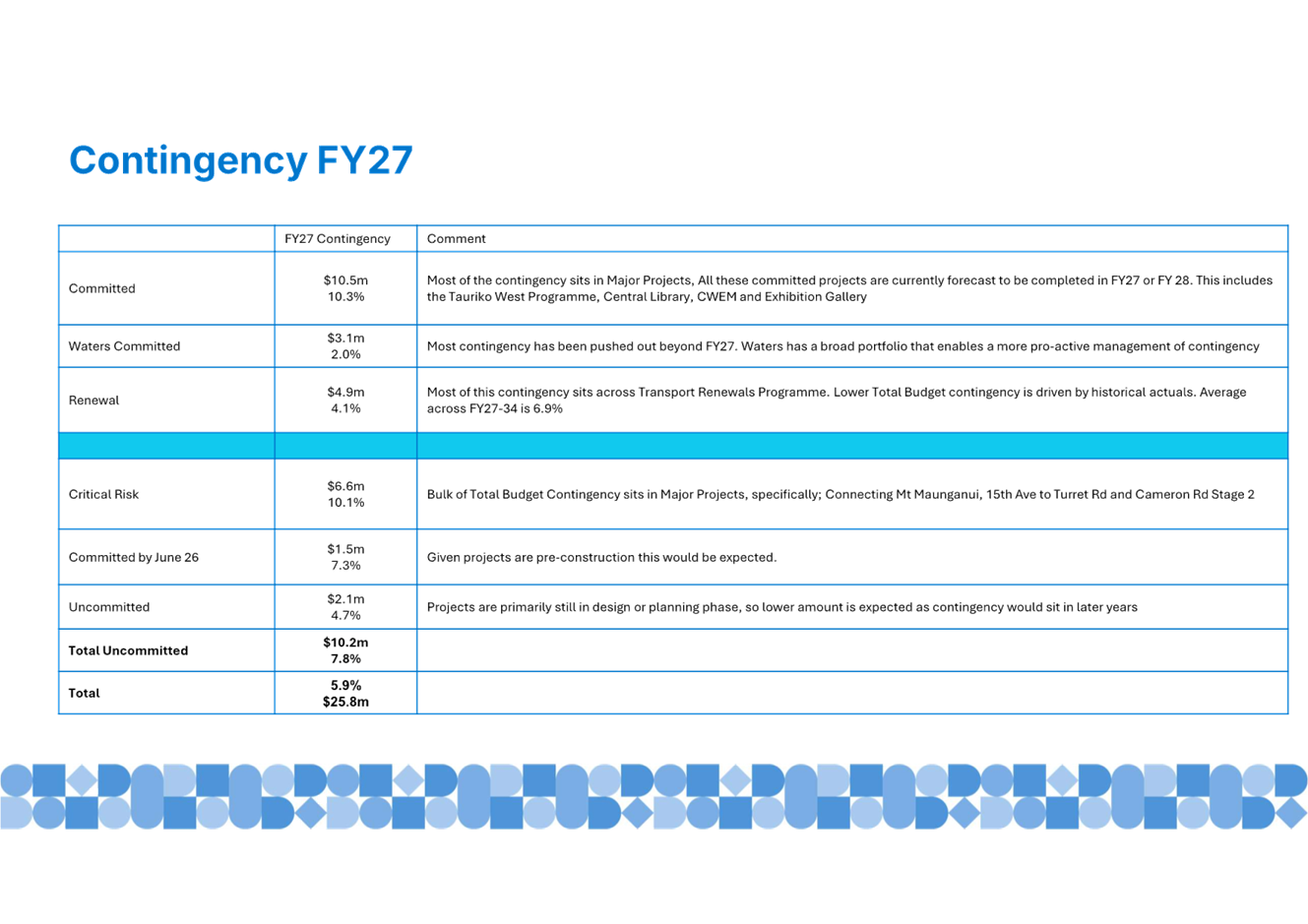
progressed.
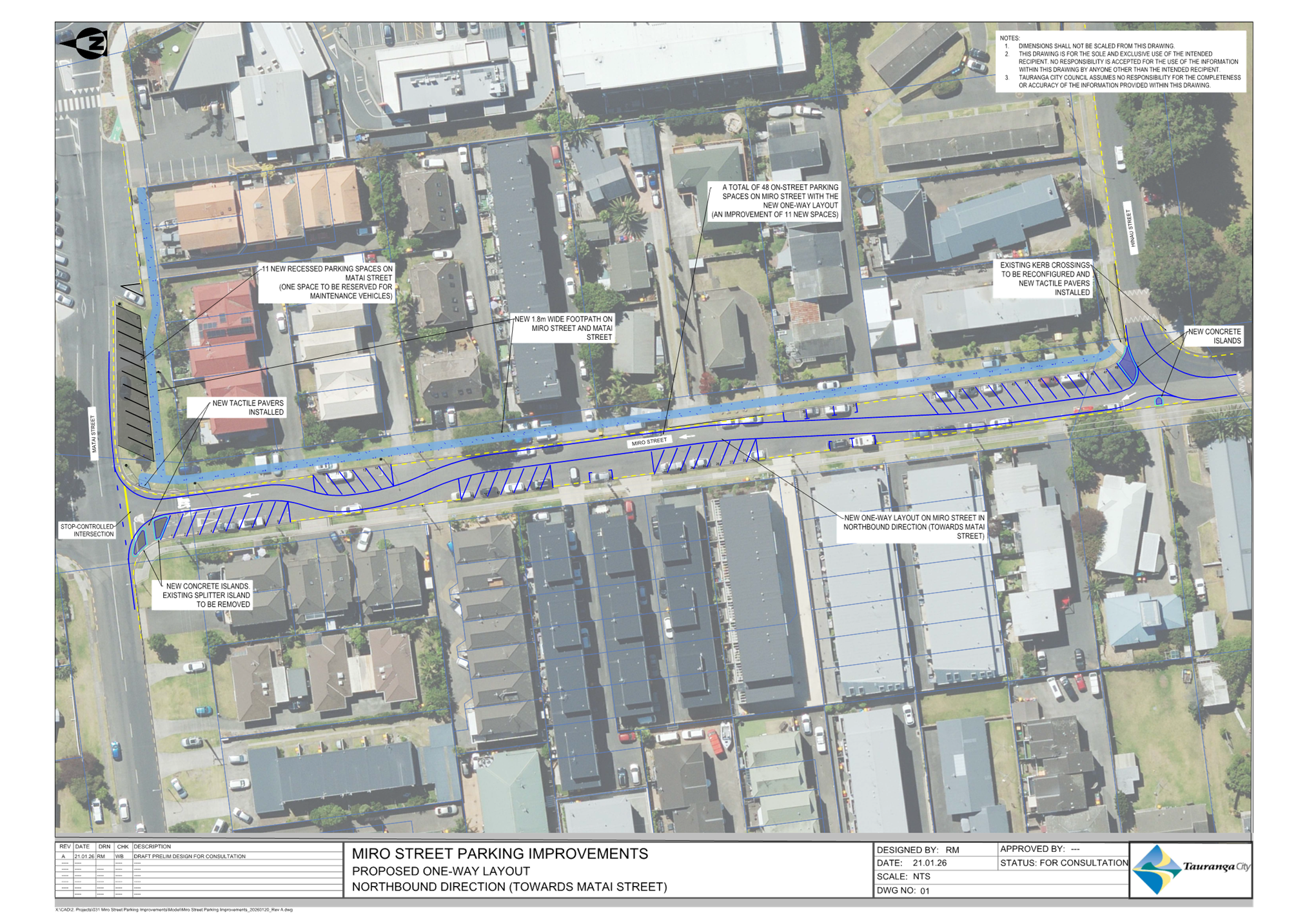
Executive Summary
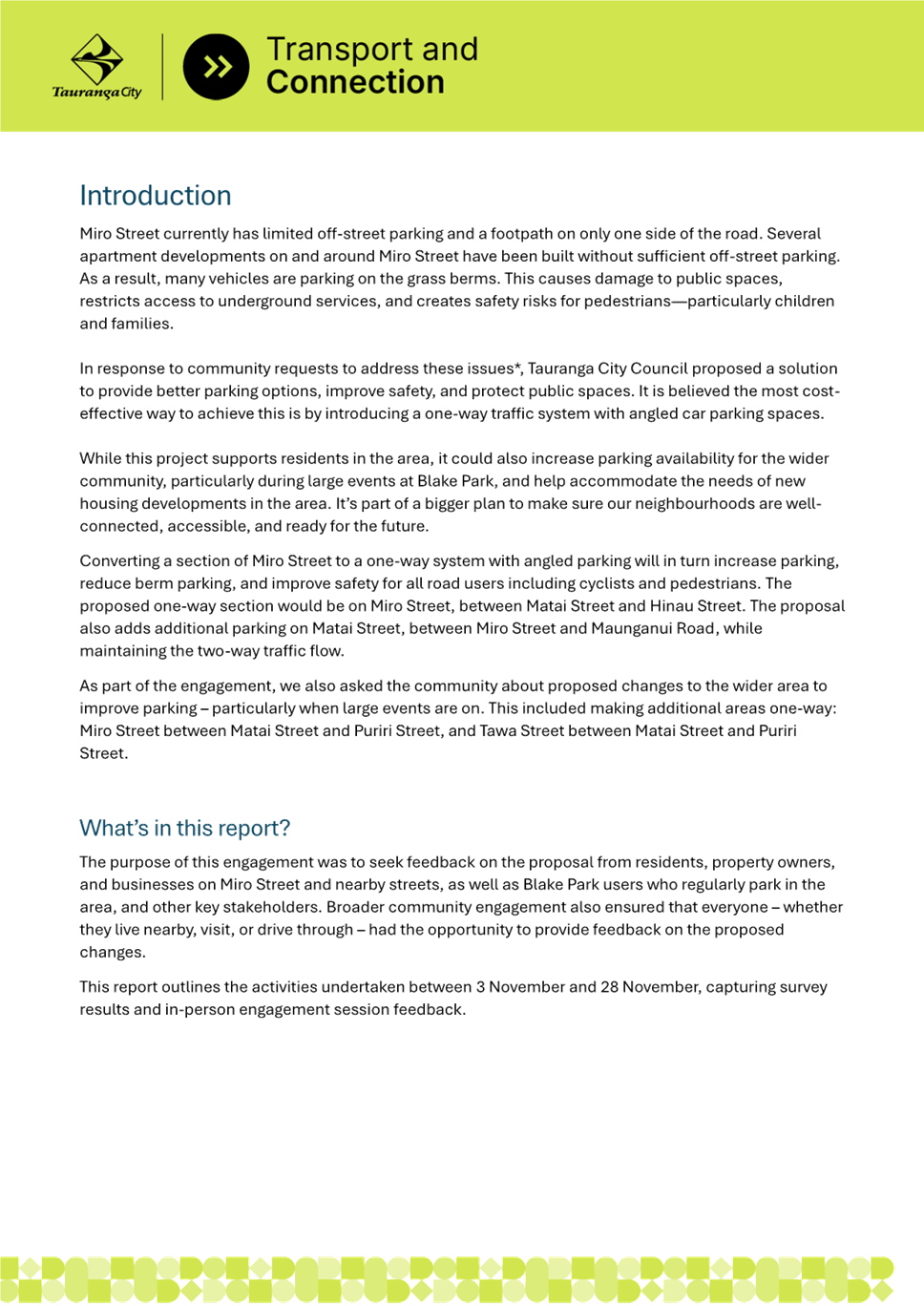
2. Miro Street is
experiencing significant parking pressure due to residential intensification,
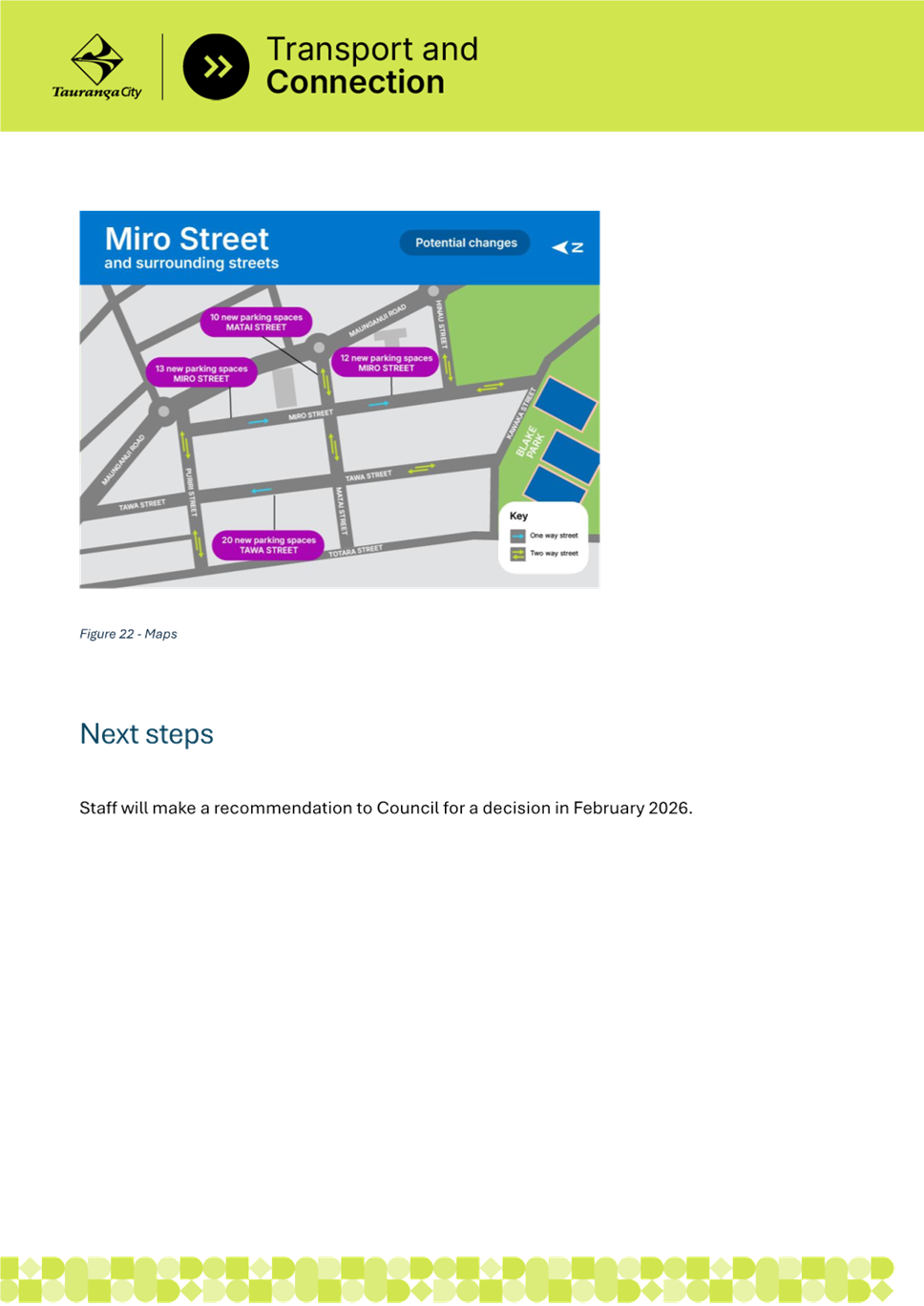
nearby businesses, and Blake Park sporting facilities. The Miro Street
community has notified council of the issues and requested improvements.
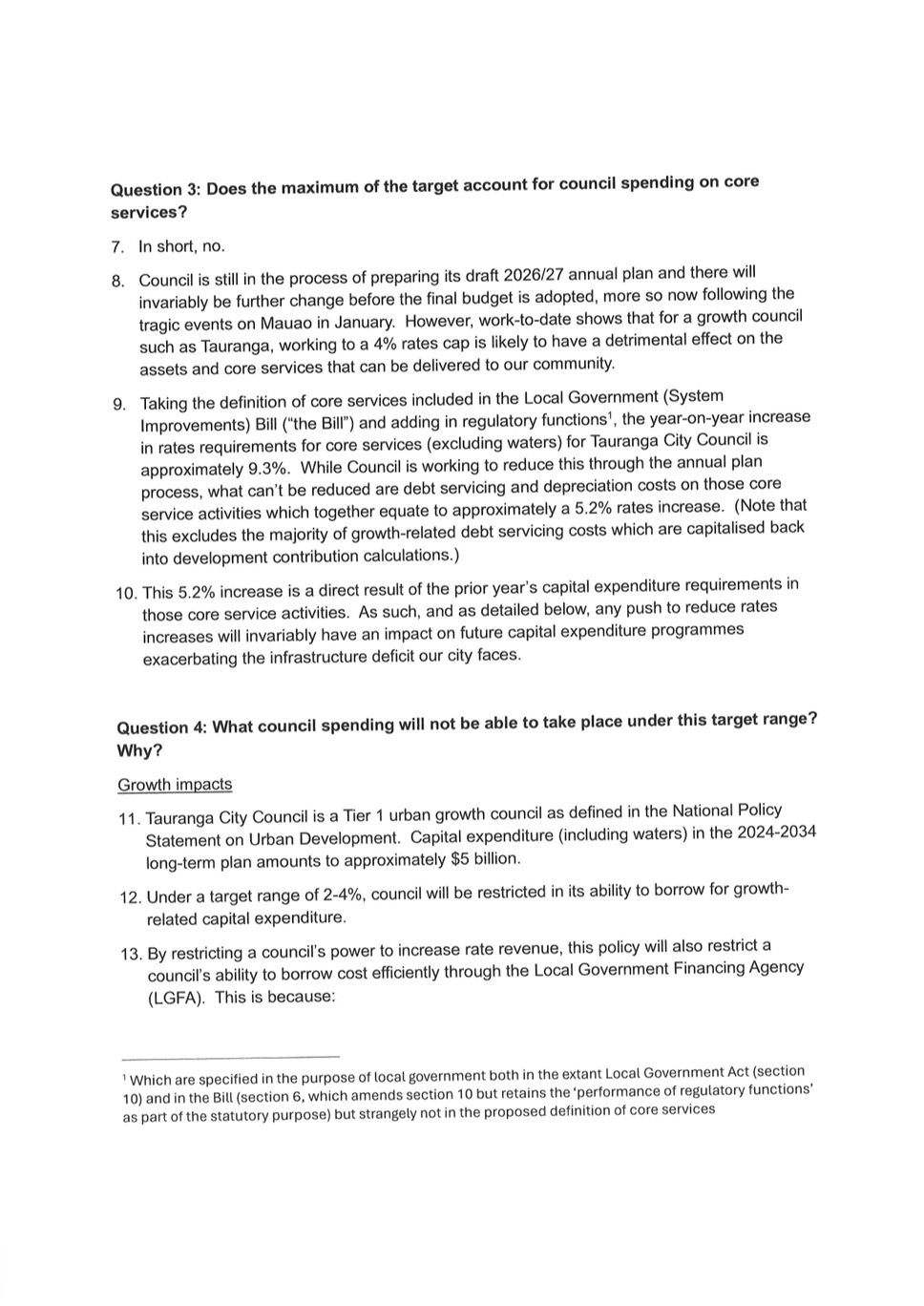
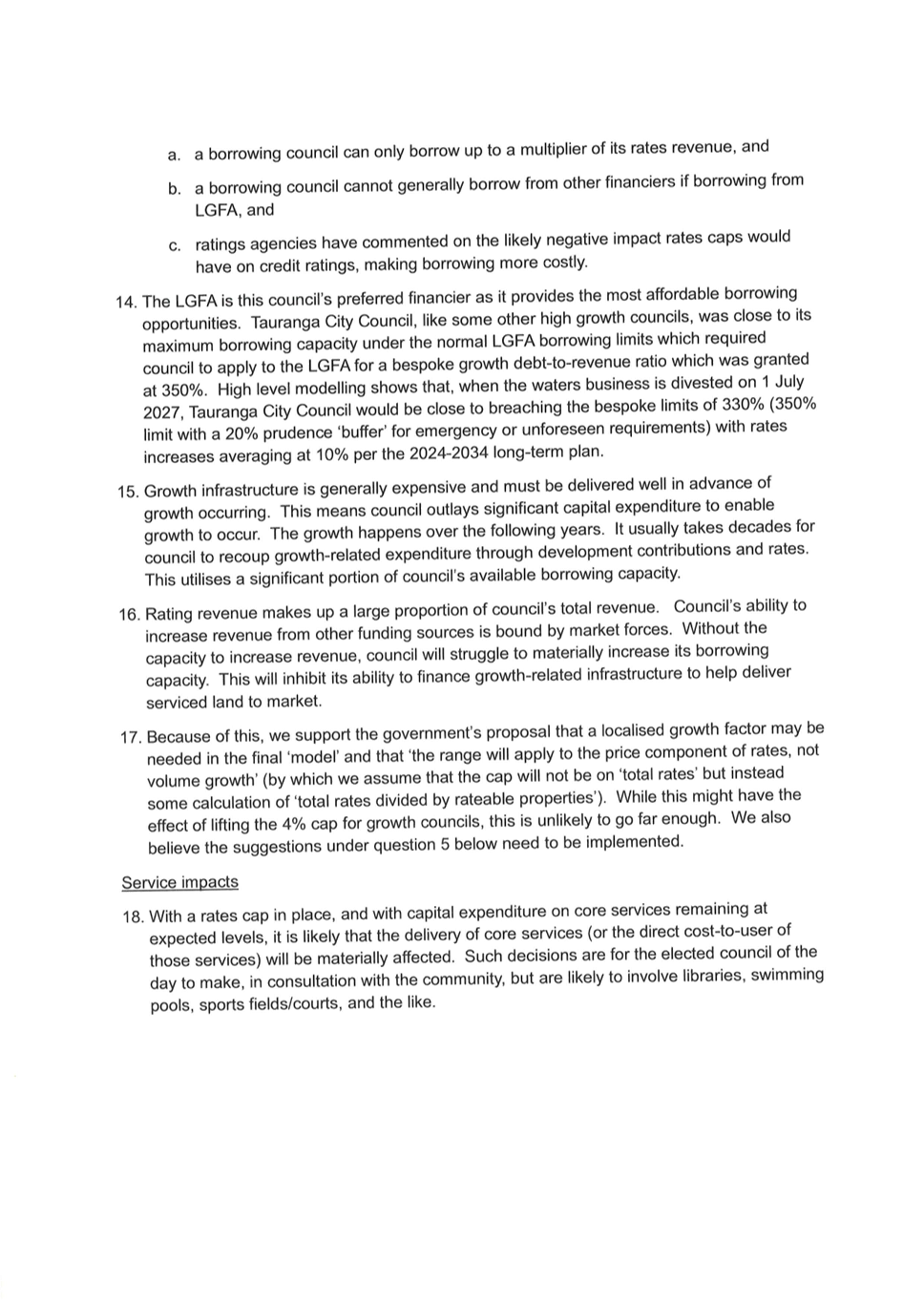
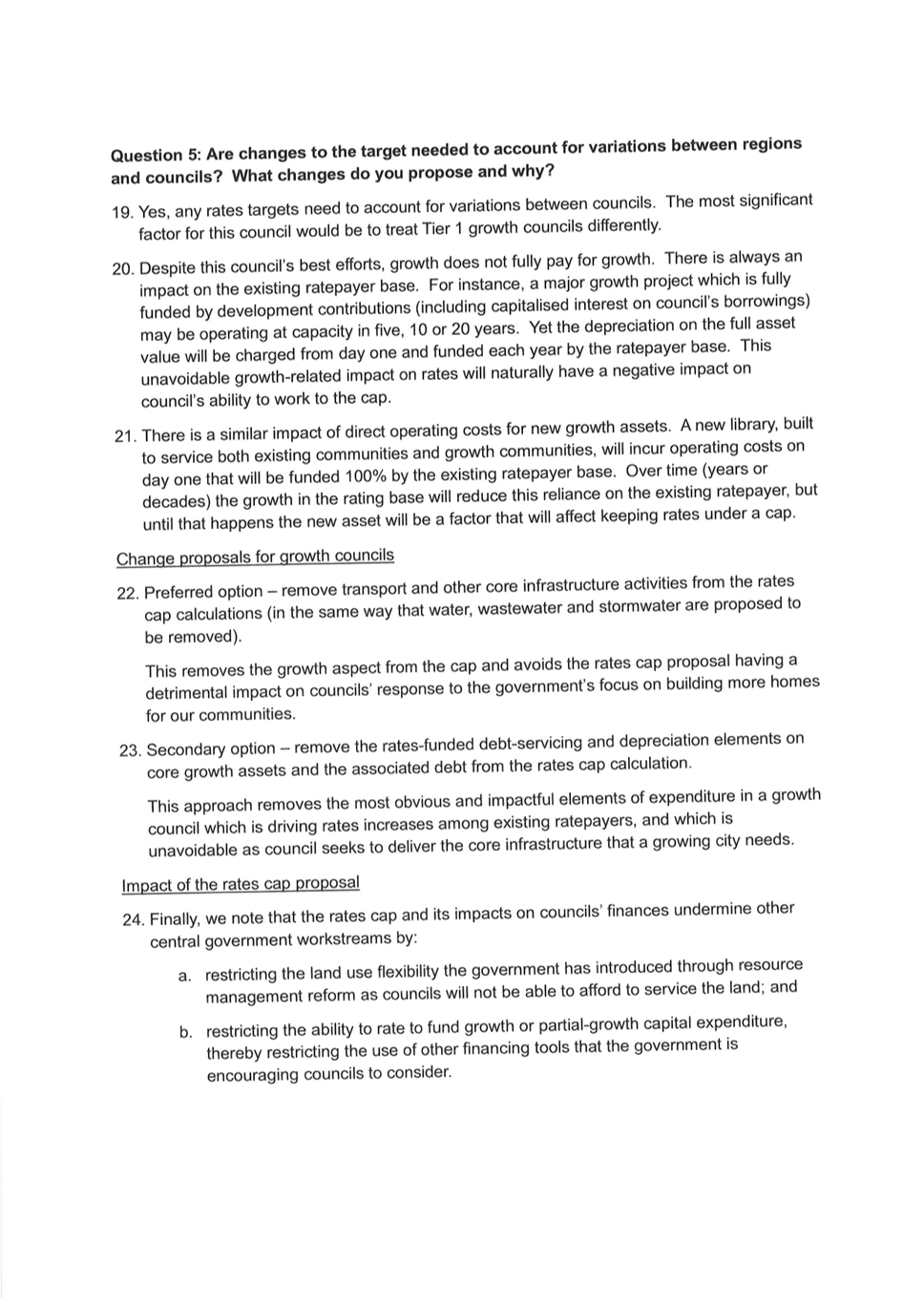
Parking surveys undertaken by staff confirmed that parking demand exceeds
capacity, particularly between Matai Street and Hinau Street, where berm
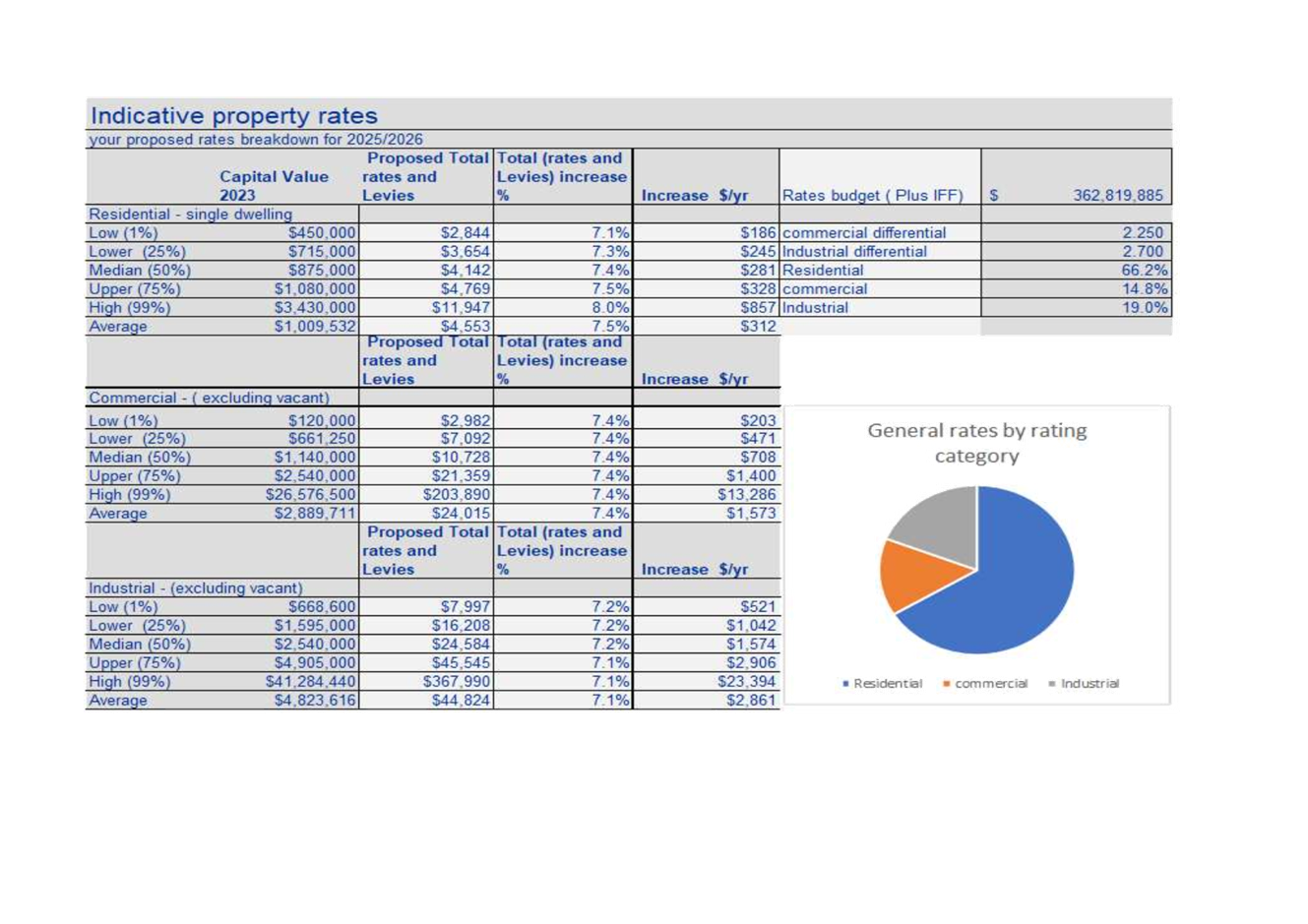
parking is common and creates safety and amenity issues.
3. This has resulted in
frequent berm parking, reduced pedestrian safety and poor connectivity as well
as damage to berms and visibility issues at property access points.
4. As a result, Tauranga
City Council staff considered options to provide better parking for residents
of Miro Street. It is believed the most cost-effective way to achieve this is
by introducing a one-way traffic system on Miro Street between Matai Street and
Hinau Street with angled car parking spaces.
5. This approach is expected
to add 2 new parking spaces to Miro St while a further 10 new parking spaces
will be constructed with a recessed parking bay on Matai St. The expected cost
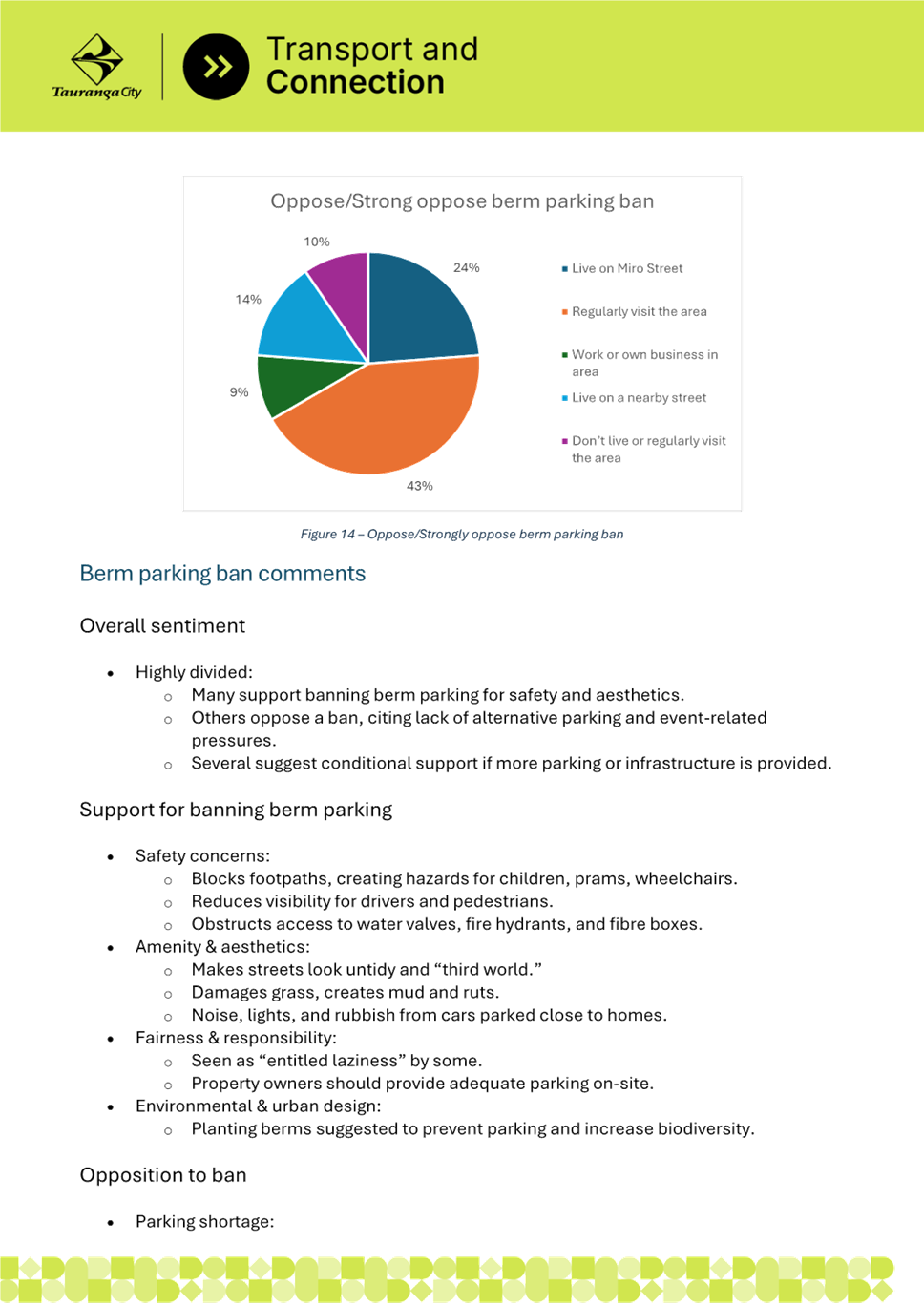
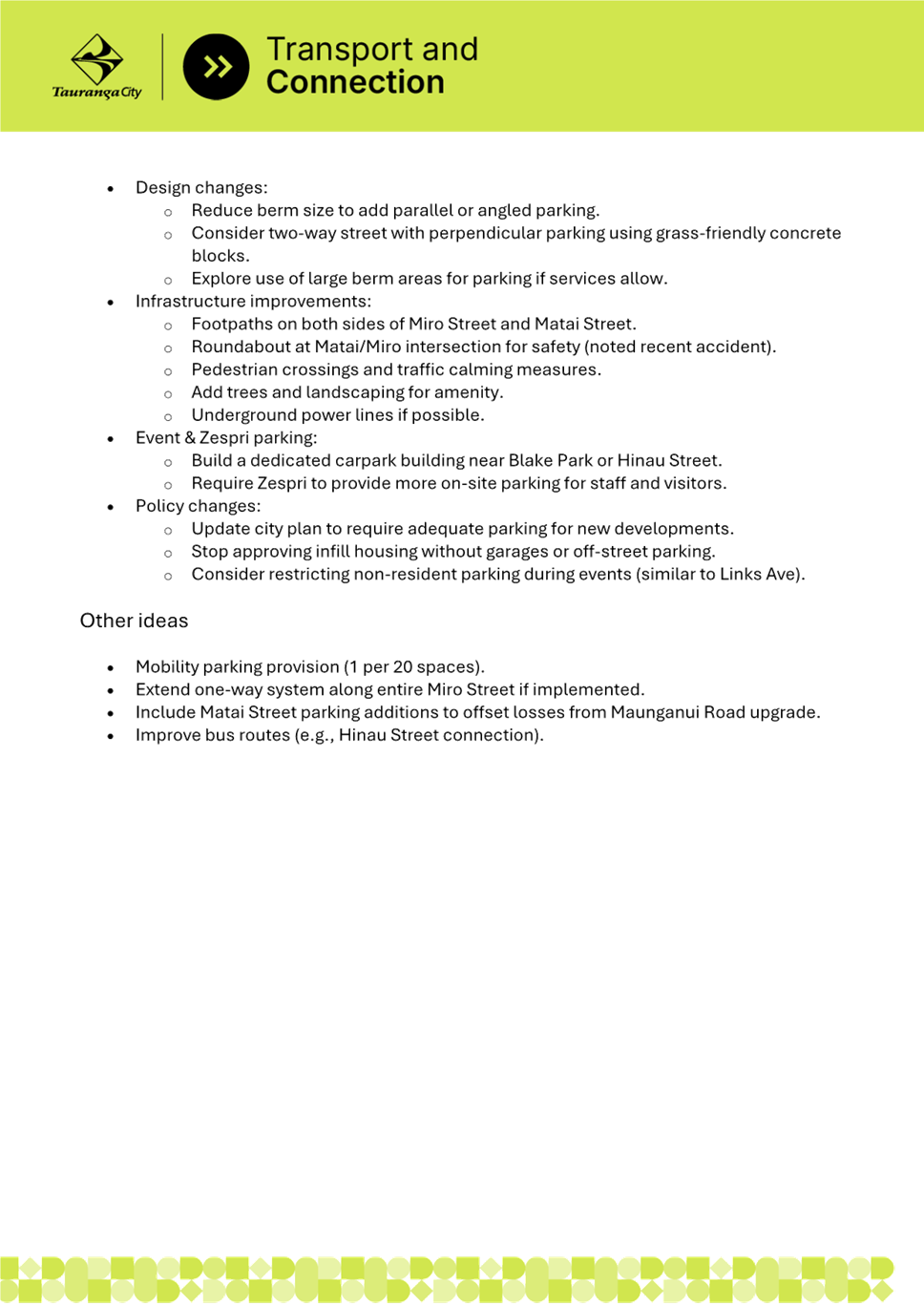
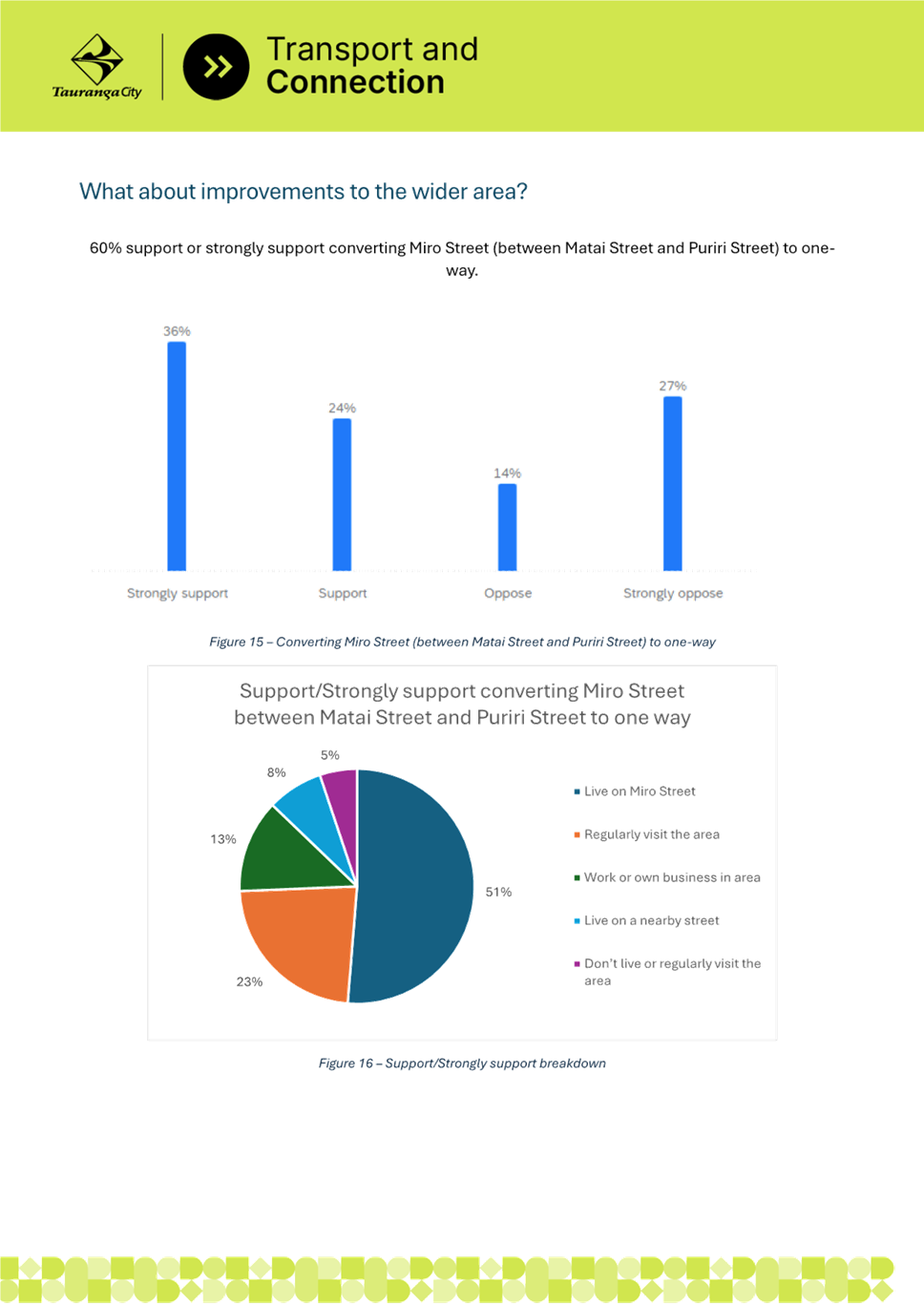
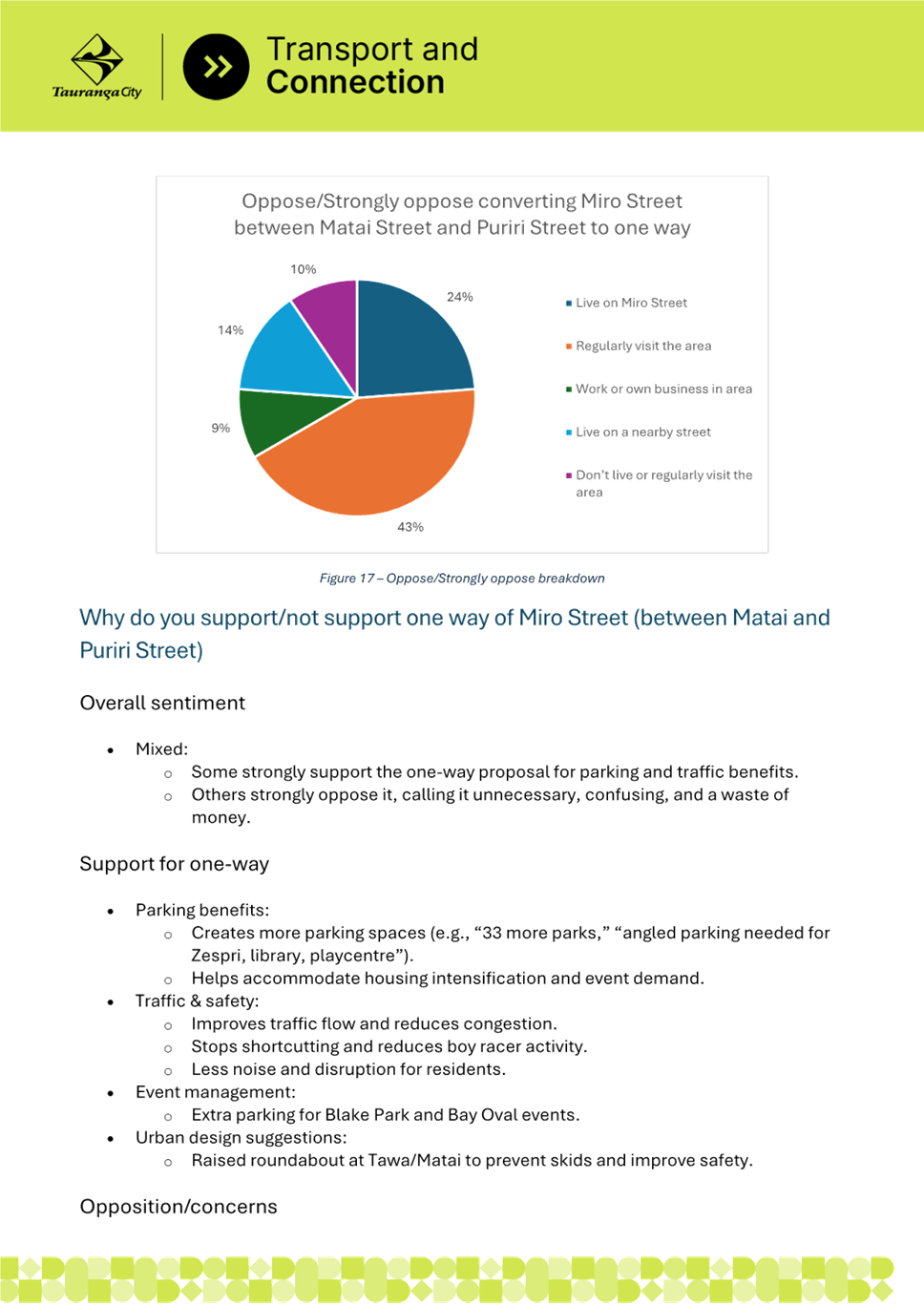
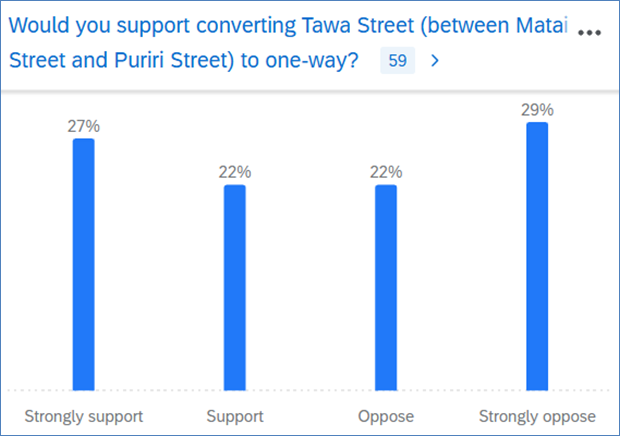
is estimated at $315,000. This includes $50,000 of contingency due to the
early stage of design. Approximately half of the estimated construction cost is
attributed to the recessed parking bay on Matai Street while the remainder is
associated with the conversion of Miro Street to a one-way street.
6. The construction of a
footpath on the eastern side of Miro Street is also recommended and would
alleviate the berm parking issues – without formally banning berm
parking. The estimated cost of the footpath is $150,000, including contingency,
if included in the scope.
7. Two alternative options
to maintain two-way flow and constructing recessed angled parking on were also
considered. The options and costs are summarised in the table below.
|
Option
|
No. of additional parking spaces (on street)
|
Estimated Cost
|
Cost per additional parking space
|
|
One-way Miro Street (including recessed bay on Matai
Street) - RECOMENDED
|
22
|
$315,000
|
$14,318
|
|
Hybrid (two-way with some recessed parking)
|
24
|
$520,000
|
$21,667
|
|
Two-way recessed parking
|
40
|
$1,150,000
|
$28,750
|
|
Addition - Footpath on eastern side of Miro Street -
RECOMENDED
|
Removal of approximately 12 berm space)
|
$150,000
|
-
|
8. Community Engagement
has been undertaken to gauge community support for a one-way system on Miro
Street. There was 69% support for the one-way proposal. Concerns raised during
the engagement included; cost, insufficient parking making it a short-term solution,
reversing and manoeuvring risks, while one resident was concerned, they would
no longer be able to park their motor home on their property.
9. The main risk for
the one-way option is legal risk of the bylaw change. This risk has been
mitigated though consultation undertaken to date. For the two-way options - the
main risks revolve around the presence of underground services at (currently)
unknown depths which may require relocation.
10. If approved, the intention
would be to align the works with a March / April 2026 reseal of Miro Street to
minimise cost and disturbance to residents.
11. Proceeding
with the recommendation will result in a saving of $735,000 compared to the
budget allocated to this activity. As per the City Delivery Committee
Resolution CDC/25/0/1 - recommendation (e) of the report “Transport
Minor Safety and Accessibility Prioritisation and Programme Status” from
15 December 2025 - the remaining budget is intended to be re-prioritised to
deliver rapidly deployable projects.
Background
12. Residential housing
intensification in combination with neighbouring businesses and Blake Park
sporting facilities, have increased the parking demands on Miro Street. Parking
demand outweighs capacity, with parking on berms the norm. There are reports of
reduced amenity, poor pedestrian connections, poor visibility from access
points and damage to berms.
13. Three parking surveys were
conducted at various times of the day and week. This found that the most
impacted section of Miro Street is the section between Matai Street and Hinau
Street where on each occasion 12 to 18 vehicles were observed parking on the
berm. Nights appear to have the highest demand for parking, with all 37 on road
parking spaces in use and 18 vehicles parked on the berm at 8:30pm on Thursday
31 July.
14. As a result of the observations
and complaints, Tauranga City Council staff considered options to provide
better parking for residents of Miro Street. It is believed the most
cost-effective way to achieve this is by introducing a one-way traffic system with
angled car parking spaces, without adjusting kerbs or drainage on Miro
Street.
15. Staff with support from elected
members have undertaken engagement with the residents, businesses and sporting
clubs in the area, to understand if a one-way system between Matai Street and
Hinau Street would be supported. The engagement also sought to understand if
this solution should be applied to the neighbouring streets and if residents
were wanting council to formally prohibit berm parking in the area.
16. This section of Miro Street is
currently planned for reseal in March 2026. This timing provides good
opportunity to complete the works without the need to black-out or remove old
line marking, which results in “ghosting” where the old markings
are still visible, particularly under headlights – though black
Statutory Context
17. A bylaw change would be
required to adopt the one-way solution.
18. A bylaw would also be required
if council elected to ban berm parking in the area.
STRATEGIC ALIGNMENT
19. This contributes to the
promotion or achievement of the following strategic community outcome(s):
|
Contributes
|
|
We are an inclusive city
|
☐
|
|
We value, protect and enhance the environment
|
☐
|
|
We are a well-planned city that is easy to move
around
|
ü
|
|
We are a city that supports
business and education
|
☐
|
|
We are a vibrant city that embraces
events
|
☐
|
20. The preferred solution aligns
well with the Value for Money approach as it seeks to make the most of existing
infrastructure, using what is largely existing road and kerb-lines, with a new
layout to enhance parking for the benefit of Miro Street residents.
Options Analysis
21. Two main options were
considered to improve Miro Street between Matai Street and Hinau Street
i. A one-way system to accommodate
angled parking in combination with a recessed car parking bay on Hinau Street
(Image 1 below). This option would provide 12 additional spaces on Matai Street
and 10 additional spaces on Miro Street. This is considered the minimum viable
product
i. Estimated
cost: $315,000
ii. Number of
additional car parks: 22
iii. Cost per car park: $14,318
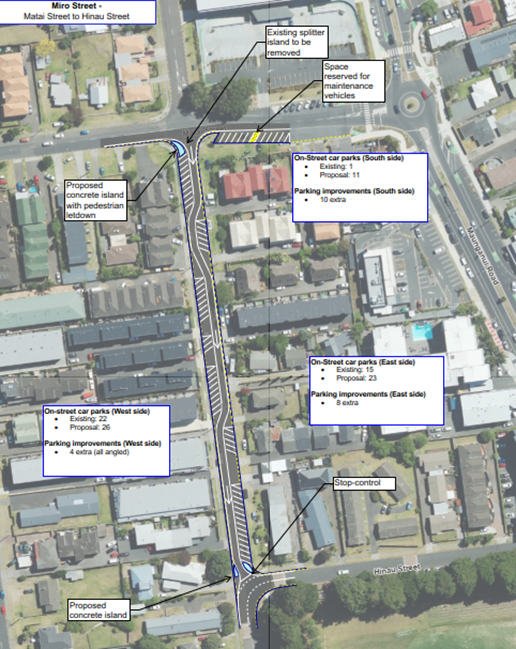
Picture 1: Proposed one-way system on
Miro Street
ii. Road widening to accommodate angled
parking along the length of the Street (Picture 2 below)
i. Road widening
to accommodate angled parking along the eastern side of Miro Street and retain
parallel parks on the western side (Picture 2 below)
ii. Estimated
cost: $1,150,000
iii. Number of additional car
parks: 40
iv. Cost per additional car
park: $28,750
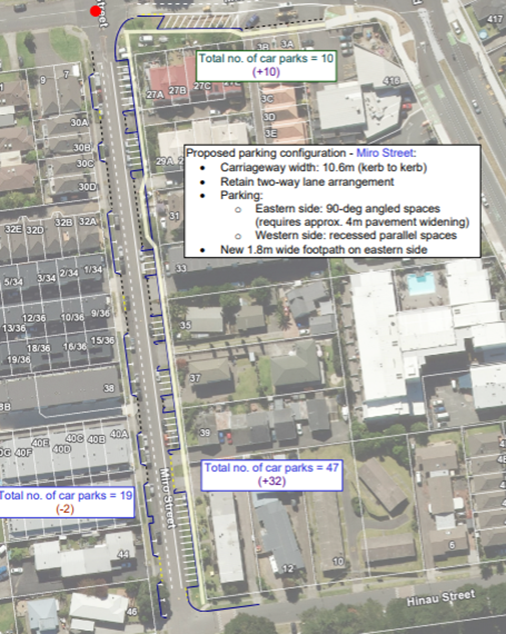
Picture 2: Alternative option to improve
parking while maintaining two-way traffic
22. During consultation a member of
the community also requested that council consider a hybrid solution with two
smaller recessed parking bays on Miro Street and maintaining two-way flow. This
option was investigated by staff but found to be approximately $205,000 more in
project costs (a large portion of this being provision for underground utility
work required due to expected utility locations in the berm) while providing
only two additional car parks, when compared to the one-way option.
23. There is also the option to
include a footpath on the Northern side of Miro St. This is estimated to cost
an additional $150,000, while removing approximately 12 potential
‘parking spaces’ from the berm. This roughly halves the estimated
current potential berm parking locations without the need for bylaws to ban
berm parking.
24. If the one-way solution is
progressed, there is also the option to expand the one-way solution to include
the northern sections of Miro Street and Tawa Street between Matai Street and
Puriri Street. This provides an additional 18 car parks on Miro Street and 20
additional spaces on Tawa St. Parking surveys on these streets suggest there is
sufficient on street parking at night and that additional spaces would be
largely utilised during sporting events and by businesses during work hours.
25. Other additions to the minimum
viable product include banning berm parking and construction of a footpath on
the eastern side of Miro Street (between Hinau Street and Matai St) and Matai
Street (between Miro Street and Maunganui Road).
26. Some feedback centred on
banning berm parking, this would impact approx. 20 vehicles regularly parked on
the berm - albeit with 22 new on-street spaces provided.
Financial Considerations
27. The
preferred option is both the lowest cost over all and the lowest cost per
additional car park provided. A budget of $1,200,000 has been allowed for in
the current annual plan. The recommended option would provide significant
savings on the allocated budget.
28. The remaining budget is
intended to be re-prioritised to deliver rapidly deployable projects, as per
the City Delivery Committee Resolution CDC/25/0/2 - recommendation (e) of the
report “Transport Minor Safety and Accessibility Prioritisation and
Programme Status” from 15 December 2025.
Legal Implications / Risks
29. Converting a two‑way
street to a one‑way configuration engages statutory requirements under
the Land Transport Act 1998 and the Land Transport
Rule: Street Layouts 2023. As the road controlling authority, Council has
the power to change the use and layout of the roadway, including implementing a
one‑way traffic system, and must have regard to road safety, emergency
and service vehicle access, freight and public transport movements, and the
effects on pedestrians, cyclists, adjoining landowners, and other affected road
users.
30. Public engagement requirements
are guided by Council’s Significance and Engagement Policy under
the Local Government Act 2002. While changes to traffic direction
and on‑street parking are ordinarily implemented by traffic resolution
rather than bylaw and do not generally require a formal Special Consultative
Procedure, consultation must be proportionate to the scale and impact of the
proposal. Targeted engagement with affected residents, businesses, and service
providers reduces procedural and reputational risk. The consultation undertaken
to date fulfils these requirements.
31. Potential legal exposure may
also arise in relation to property access and amenity. Although there is no
general right to a particular traffic arrangement, materially increased
circuity or functional constraints on vehicle access may give rise to objection
or challenge if such effects are not appropriately identified, assessed, and
considered as part of the decision‑making process.
TE AO MĀORI APPROACH
32. Kaitiakitanga –
Stewardship of the Natural Environment – the proposed design minimises
the resource requirements and impact on the environment by utilising the
existing road and kerbs as much as possible – optimising the existing
infrastructure.
CLIMATE IMPACT
33. The recommended solution has
minimal environmental impact. The solution maximises the use of existing
infrastructure, minimising use of construction resources. The potential
addition of a footpath would encourage active transport modes, thereby lowering vehicle emissions and supporting sustainable
urban mobility.
Consultation / Engagement
34. Community engagement for the
one-way system was undertaken between 3 November and 28 November 2025. The full
consultation report is attached. In summary consultation was targeted towards,
residents, businesses and sports clubs in the area and the engagement consisted
of:
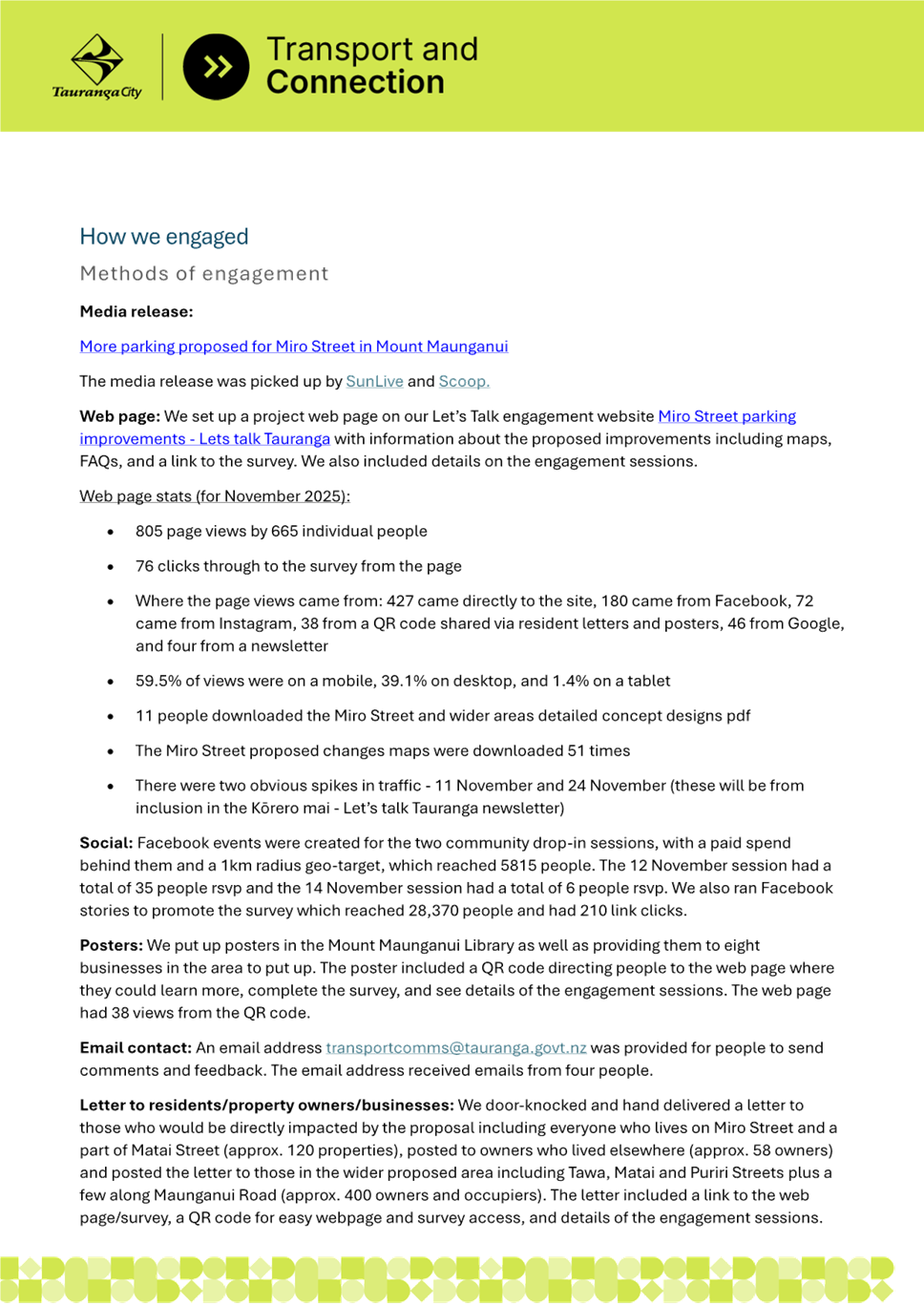
i. Media Release: The media
release was picked up by SunLive and Scoop.
ii. Web Page: A project web page on
our Let’s Talk engagement
website with information about the proposed improvements including
maps, FAQs, and a link to the survey.
iii. Posters: posters in the
Mount Maunganui Library as well as providing them to
eight businesses in the area to put up.
iv. Letters to stakeholders including residents, businesses and clubs: posted to owners who lived
elsewhere (approx. 58 owners) and posted the letter to those in
the wider proposed area including Tawa, Matai
and Puriri Streets plus a few along Maunganui
Road (approx. 400 owners and occupiers). The letter included a
link to the web page/survey, a QR code for easy webpage and survey
access, and details of the engagement sessions. We also
door-knocked businesses in the immediate and wider area (approx. 35
businesses) and gave them a copy of the letter, including eight
who also took the A3 poster to put up in their business.
v. Door knocking:
for immediately affected properties on Miro Street and parts of Matai
Street (approx. 120 properties).
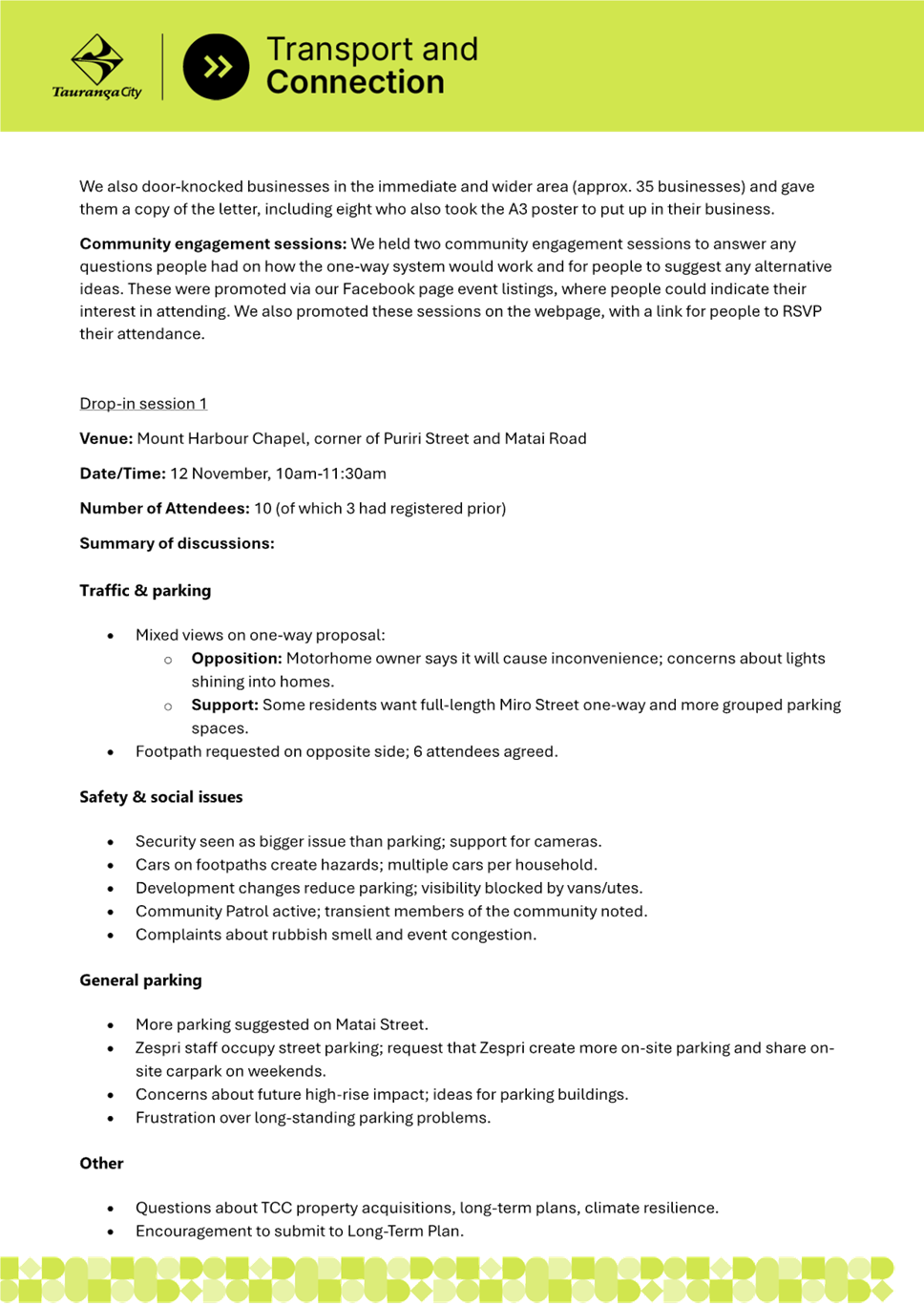
vi. Community engagement sessions: Two
community engagement sessions were held to answer any questions people had on
how the one-way system would work and for people to suggest any alternative
ideas.
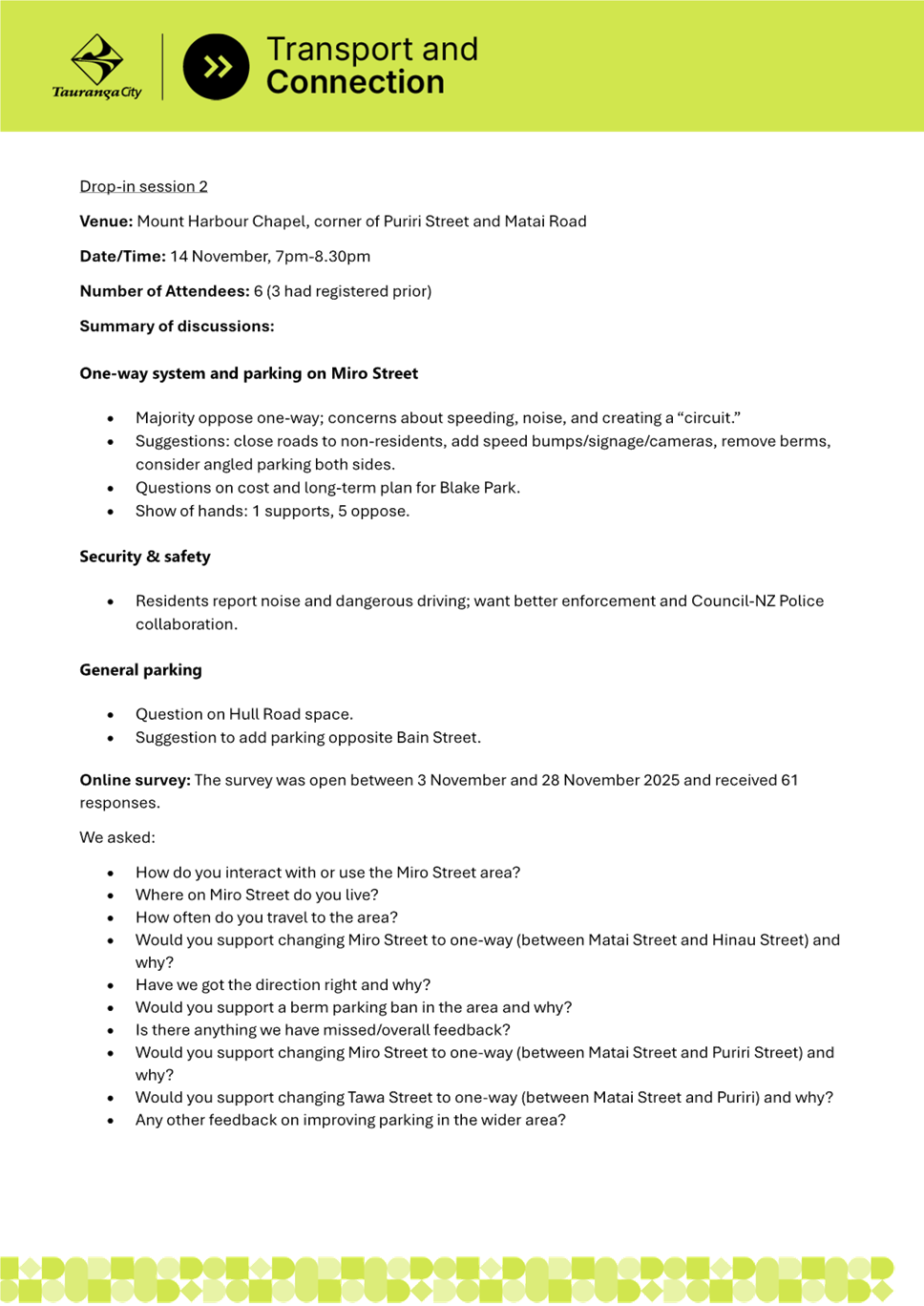
vii. Online survey: The survey was open
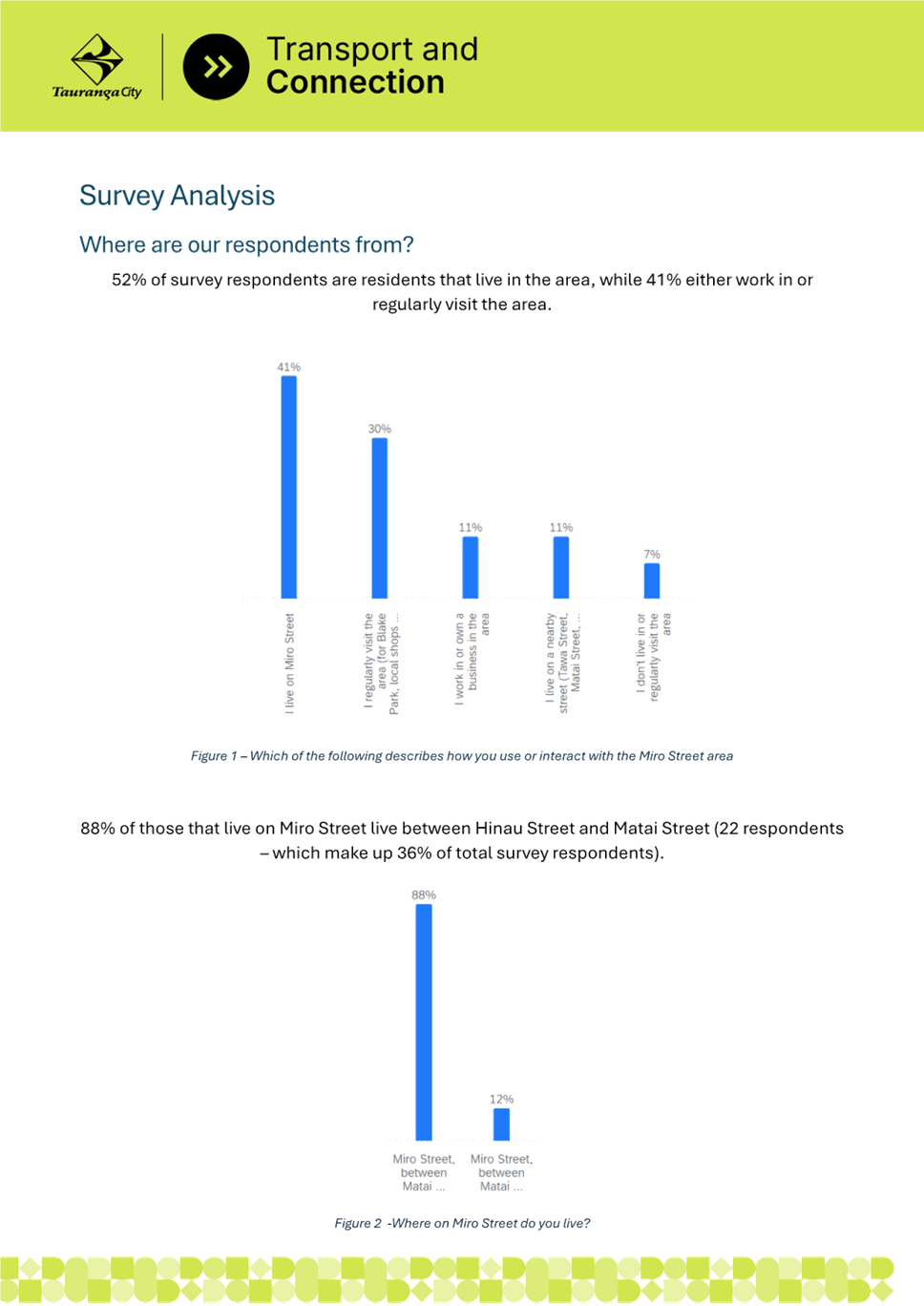
between 3 November and 28 November 2025 and received 61 responses. We
asked:
· How
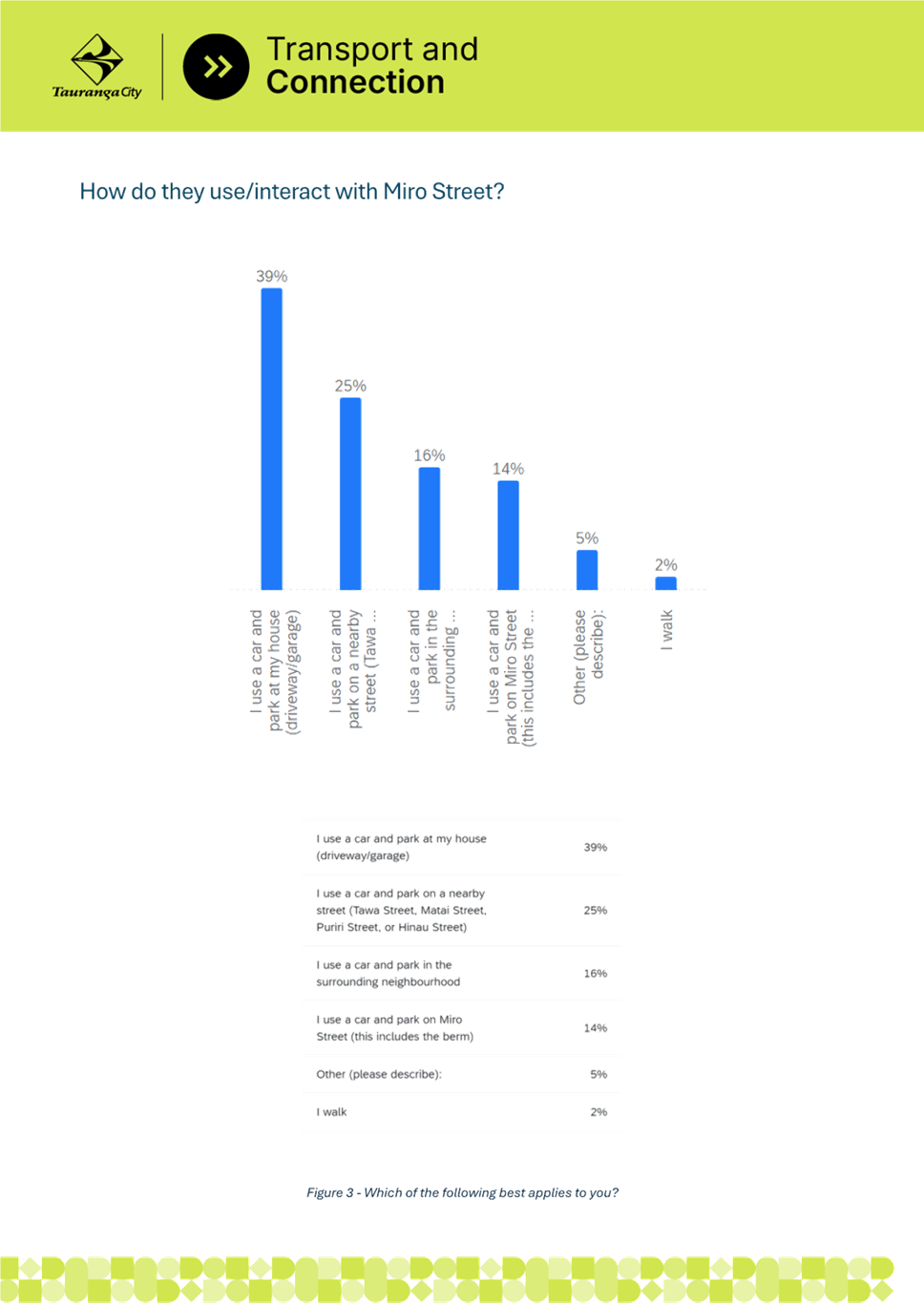
do you interact with or use the Miro Street area?
· Where
on Miro Street do you live?
· How
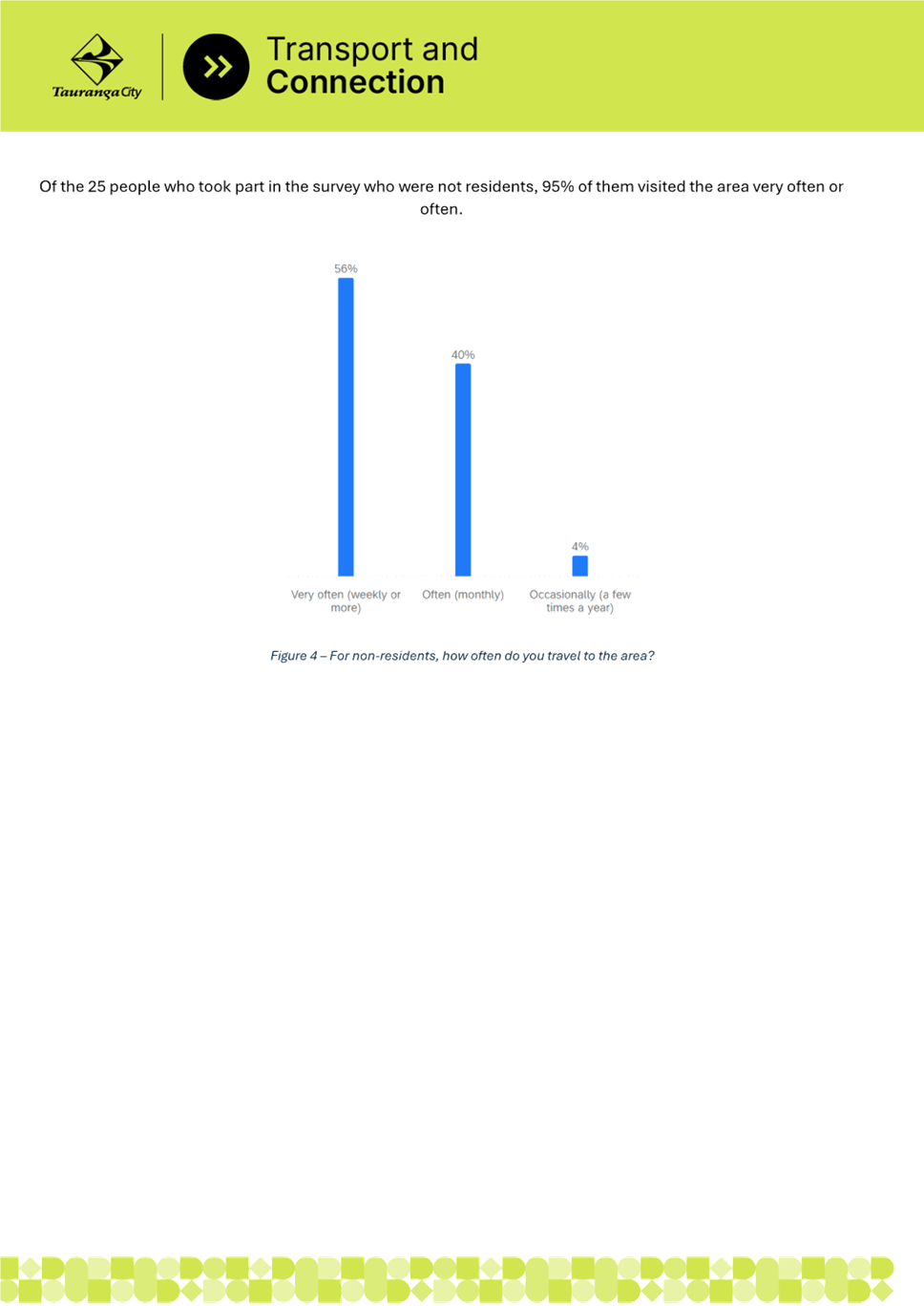
often do you travel to the area?
· Would
you support changing Miro Street to one-way (between Matai Street and Hinau
Street) and why?
· Have
we got the direction right and why?
· Would
you support a berm parking ban in the area and why?
· Is
there anything we have missed/overall feedback?
· Would
you support changing Miro Street to one-way (between Matai Street and Puriri
Street) and why?
· Would
you support changing Tawa Street to one-way (between Matai Street and Puriri)
and why?
· Any
other feedback on improving parking in the wider area? Online advertisement and
information
viii. Other stakeholder engagement: An
email was sent to Blake Park user groups (30 stakeholders) and
emergency services (St John, Police and Fire and Emergency) with
information on the proposed changes, a link to the survey, and
details of the two engagement sessions.
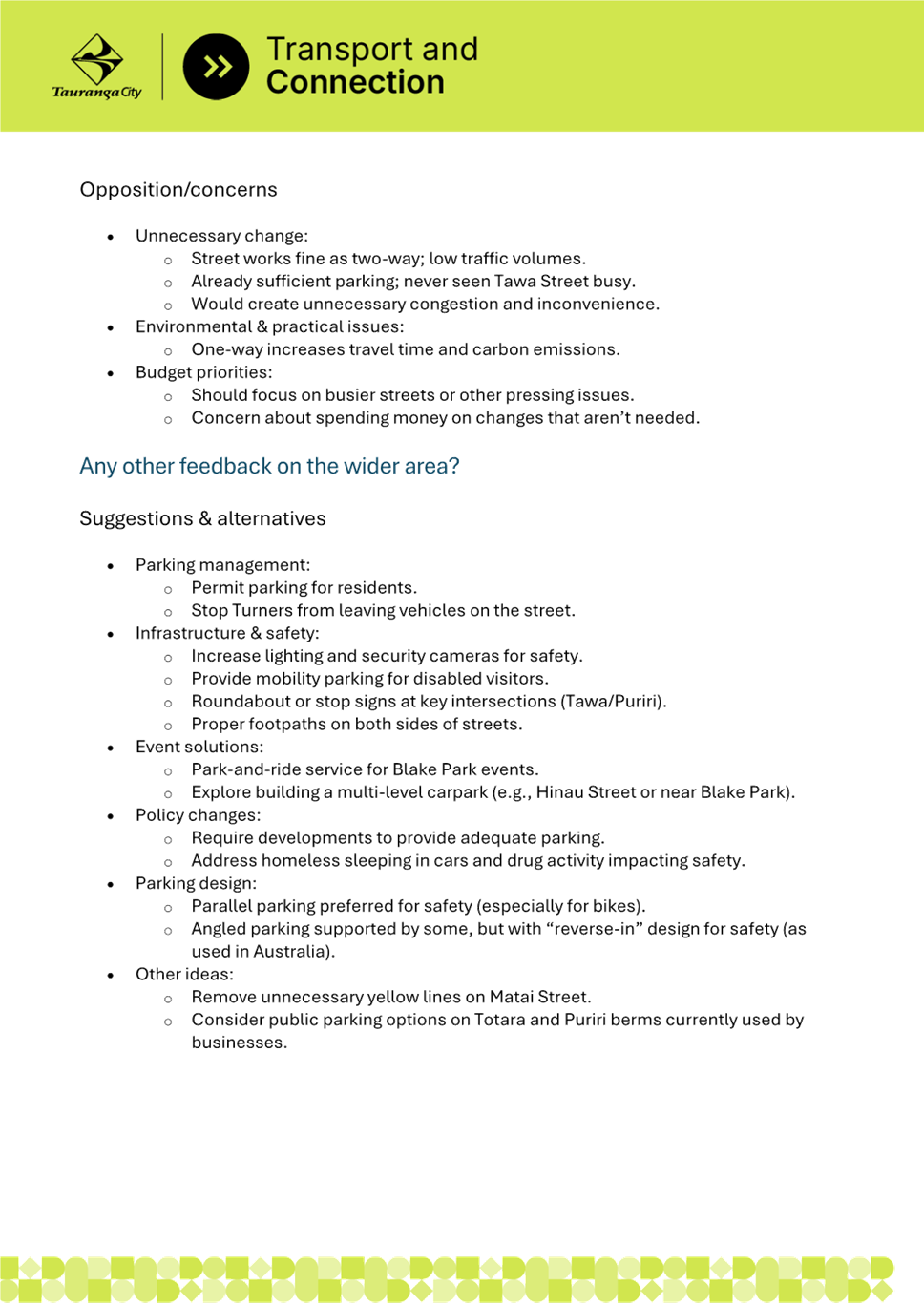
35. The survey results showed good
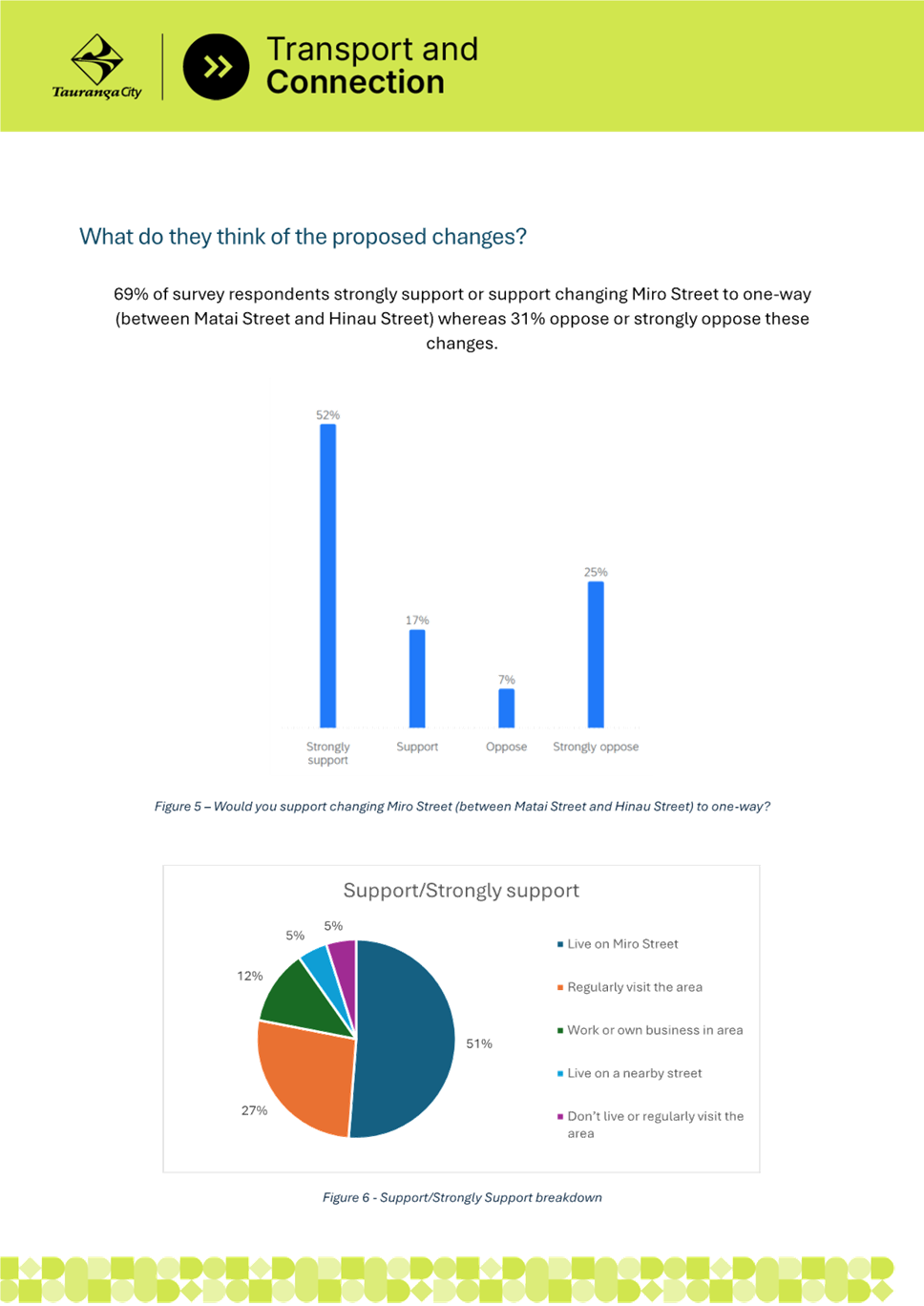
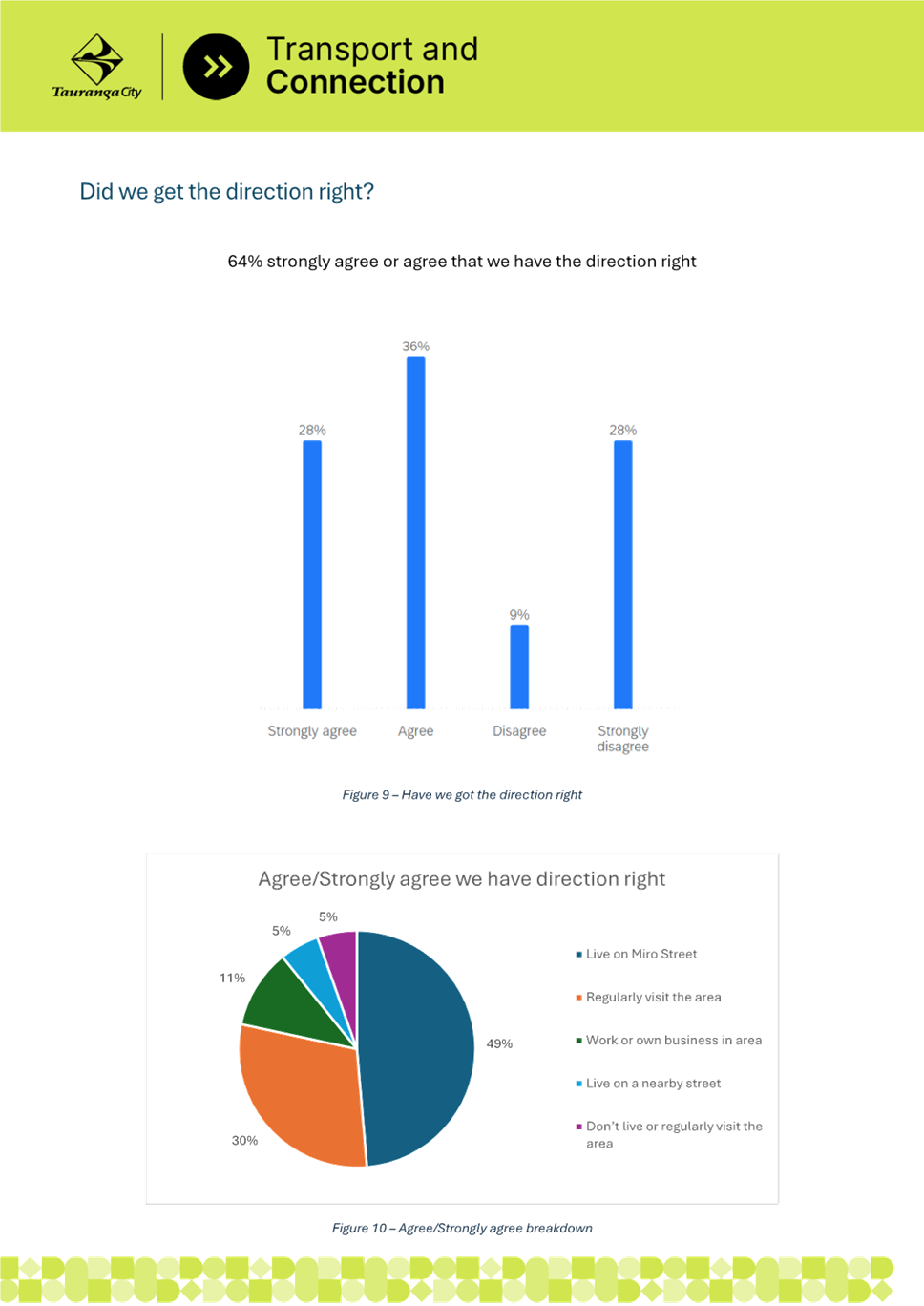
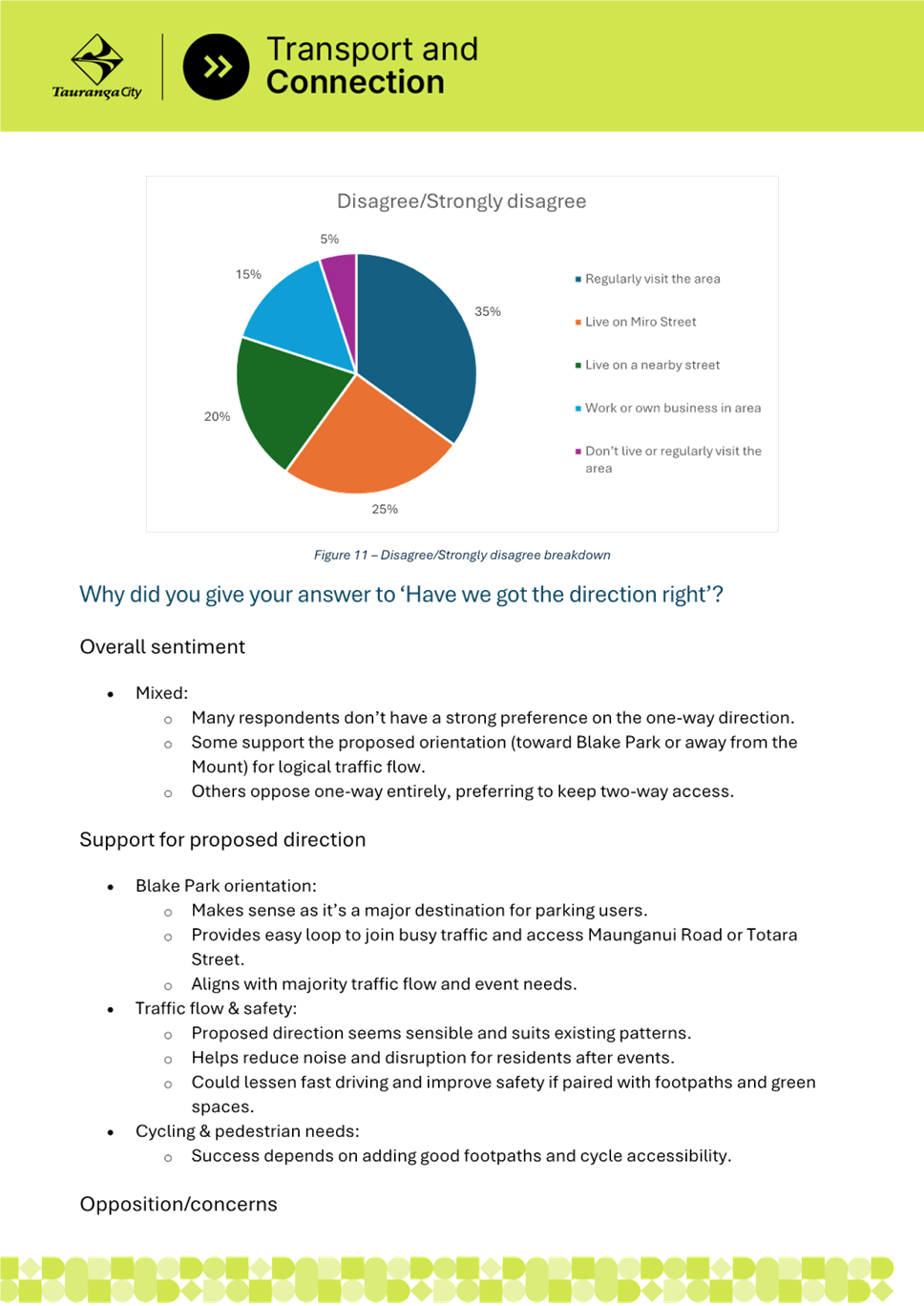
support for a one-way system on Miro Street between Matai and Hinau. 69% of
survey respondents strongly support or support changing Miro Street to
one-way (between Matai Street and Hinau Street) whereas 31% oppose or
strongly oppose these changes. The image below:
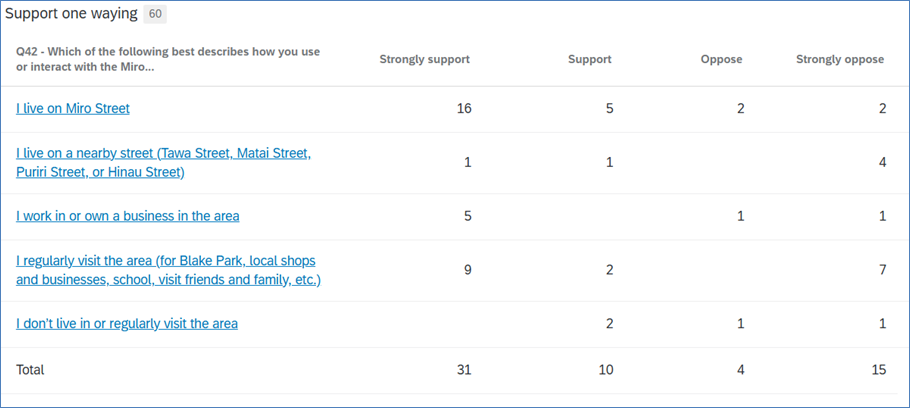
Picture 3: Summary of support &
opposition to the proposed one-way system on Miro Street
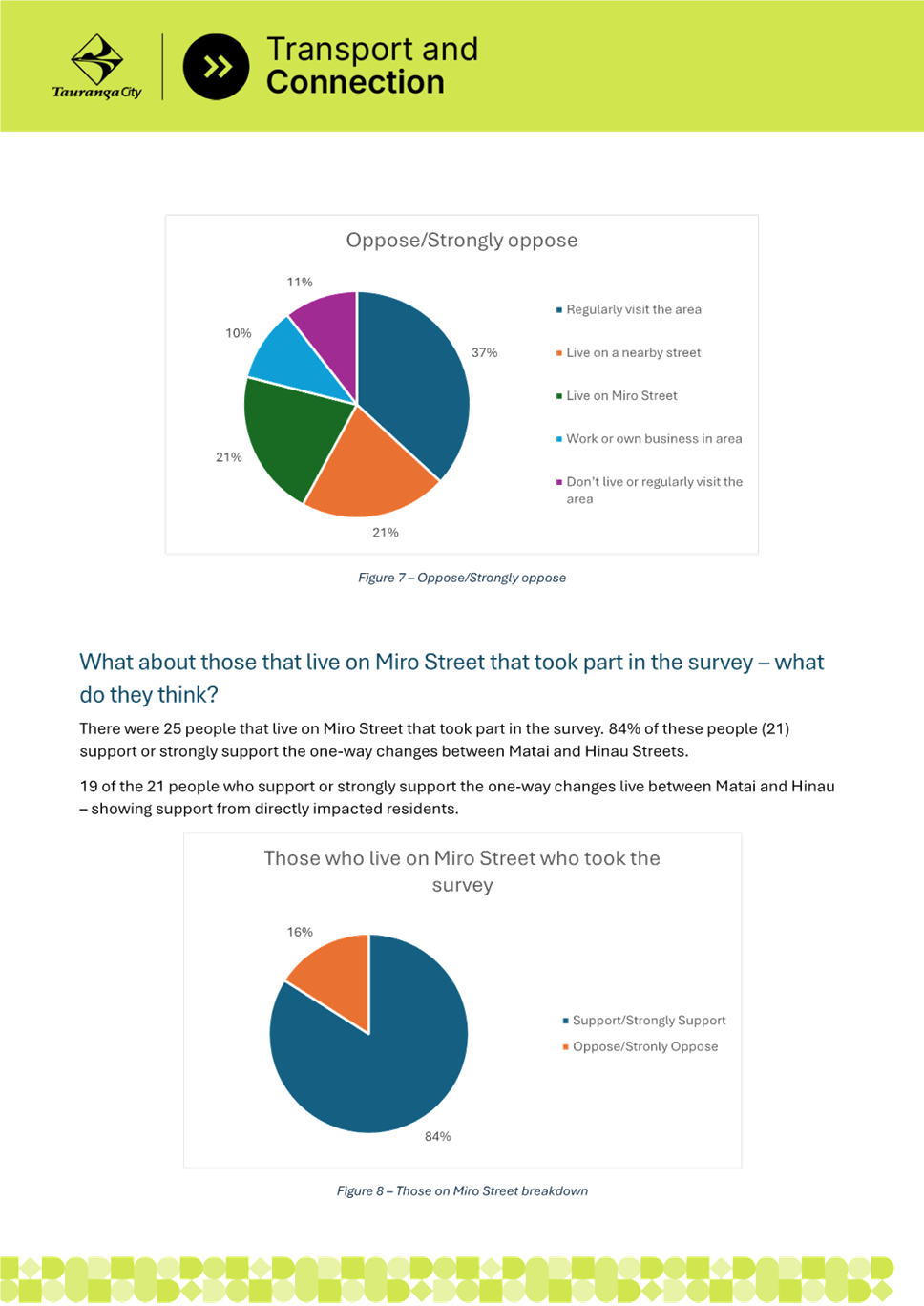
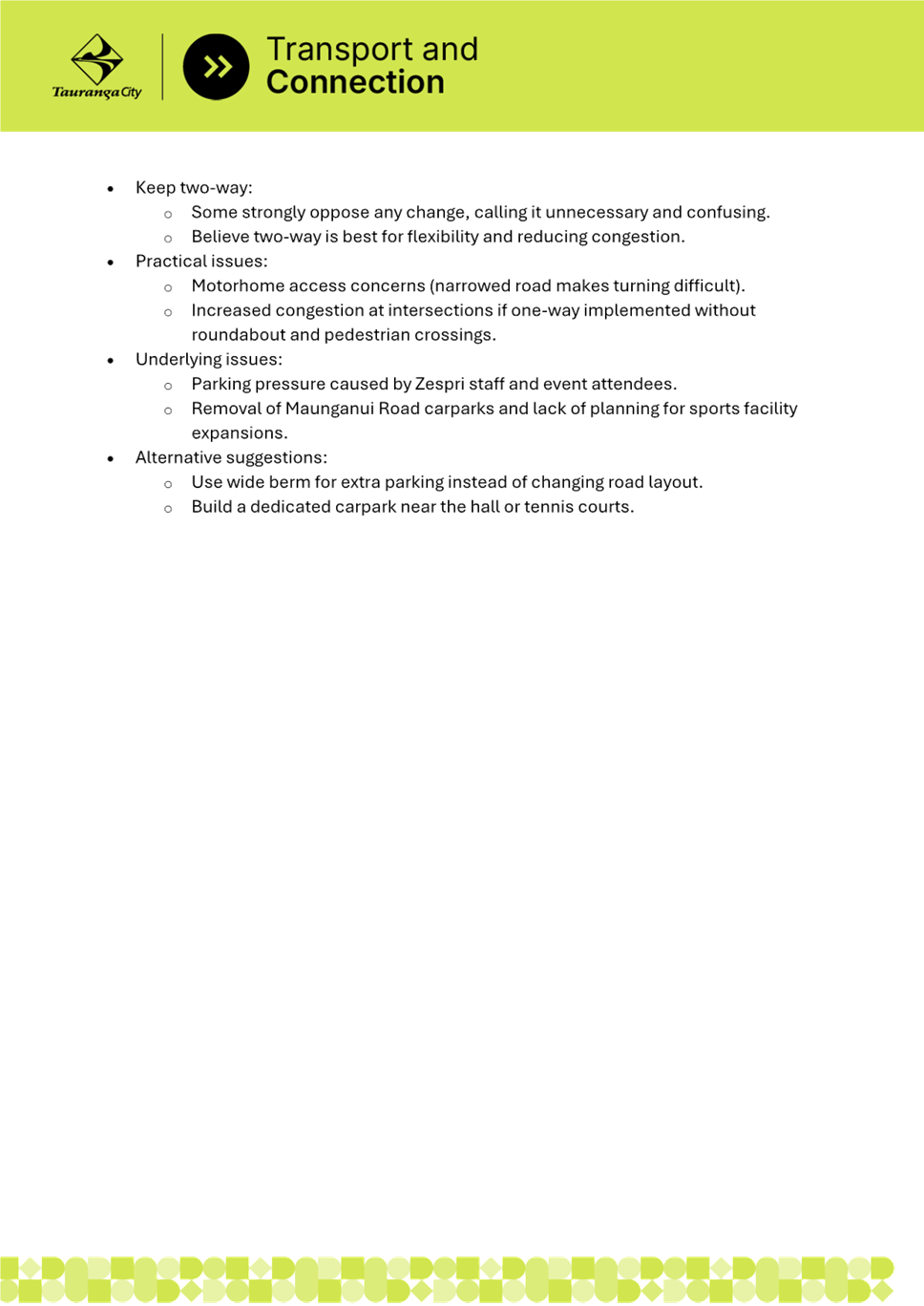
36. Of those that opposed the
proposal common themes were:
i. Cost concerns
ii. Short term solution / insufficient to
solve event or sporting parking issues.
iii. Increased reversing movements with
angled parking - higher crash risk
iv. Visibility issues with more angled parking
v. Poor suitability for larger vehicles
(vans, trades).
vi. No dedicated cycle lanes; cyclists may use
footpaths → pedestrian and mobility users’ risk.
vii. Criticism for the city centre one-way system
viii. Noise, fumes, and lights from more cars near homes.
ix. Overdevelopment and housing consents without
garages.
x. Alternative solutions were also
suggested:
· Build
a large carpark (e.g., Hinau Street, 250 spaces).
· Use
sports ground land for event parking.
· Install
barriers/rocks to prevent berm parking.
· Improve
Zespri’s private parking provision.
· Recessed
parking and maintaining two-way flow
37. One of the residents of Miro
Street who opposed the proposal was particularly concerned with how the
proposal would impact their ability to park their motor home as well as the
additional travel distance the one-way system would create. The proposal would
mean the resident will need to reverse into the area they currently park. The
resident feels that their wing mirrors may protrude into the footpath if
reversed in.
38. At the engagement events there
were mixed opinions. The event on 12 November attracted ten attendees of which
nine were Miro Street residents. There was majority support for the one-way
system, with two residents of Miro Street opposed, while remaining seven were
in support. A resident from Maunganui Road voiced wider concerns about parking,
traffic and rubbish in the area. A show of hands at
the event, had six of ten attendees request a footpath on the eastern side of
the road from residents.
39. The engagement event on 14
November had one new attendee from Miro Street who was in favour of the changes
and one returning resident who was opposed due to issues parking their motor
home. Four people from surrounding streets also attended. They were generally
opposed to the changes but more interested in wider issues. Their main concerns
were – creating a circuit increasing traffic on Maunganui Road and issues
with speed on Hinau street.
40. Other takeaways from the
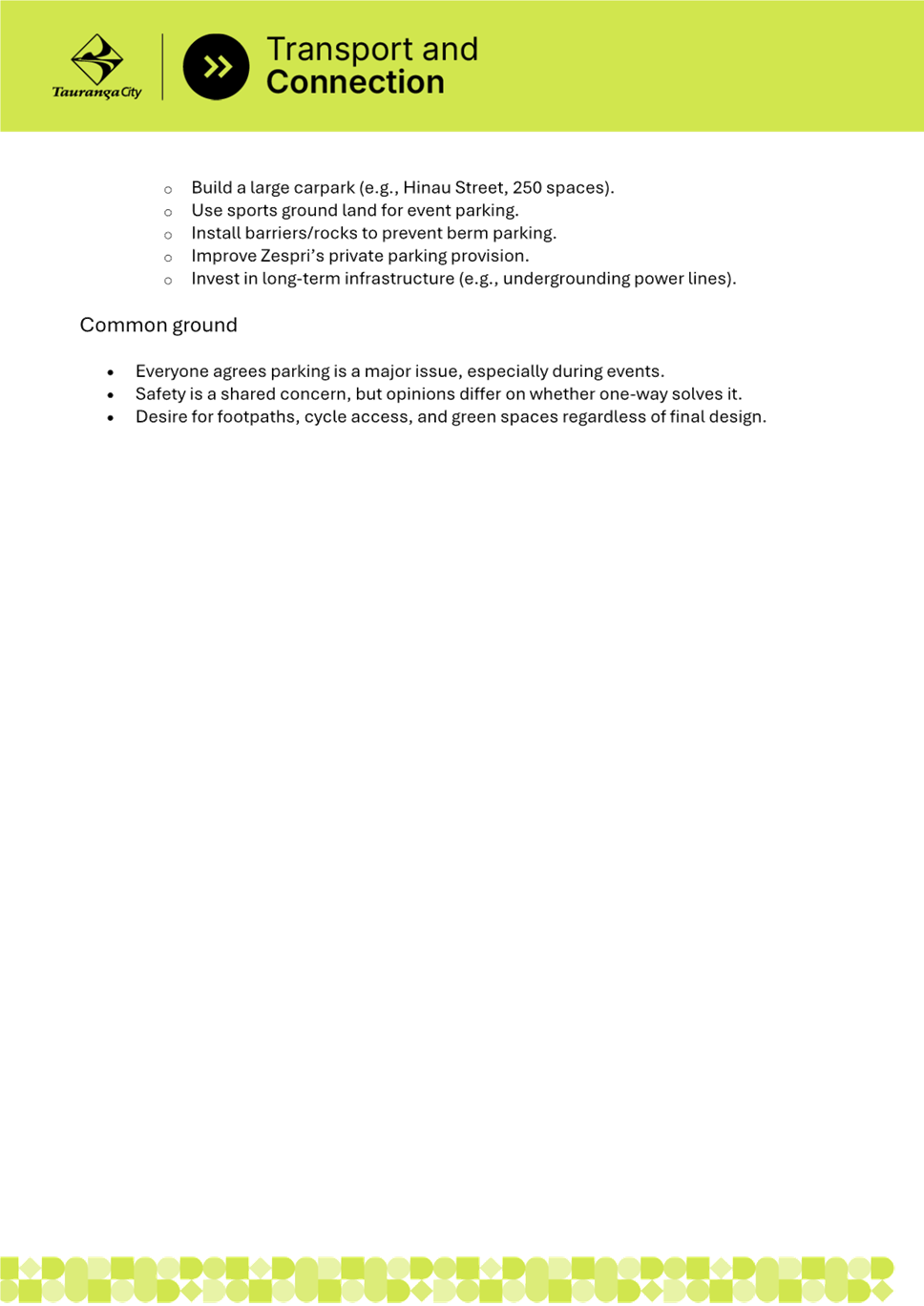
proposal included roughly even numbers for and against expanding the one-way
system to the northern section of Miro and Tawa Street. There was also good
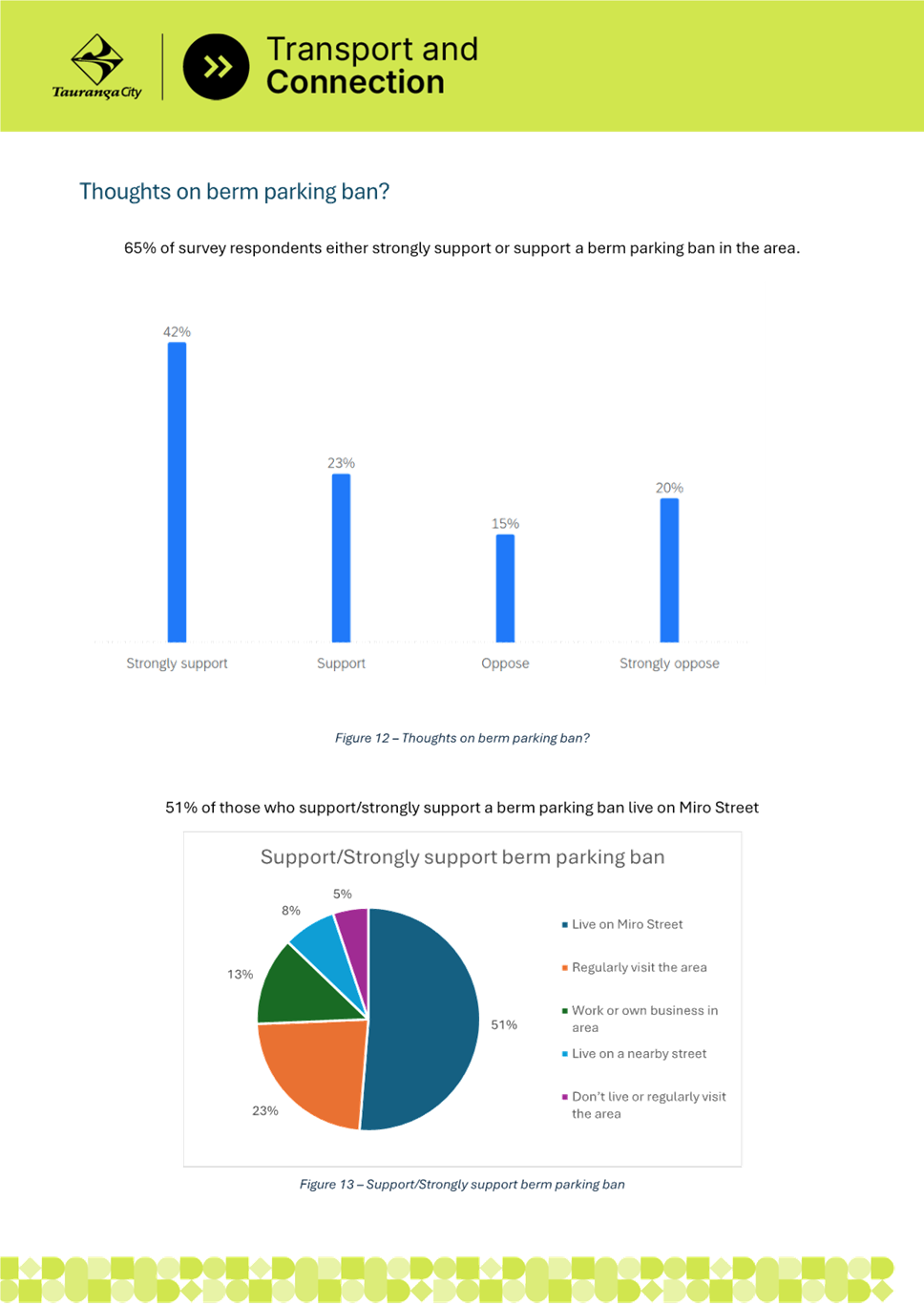
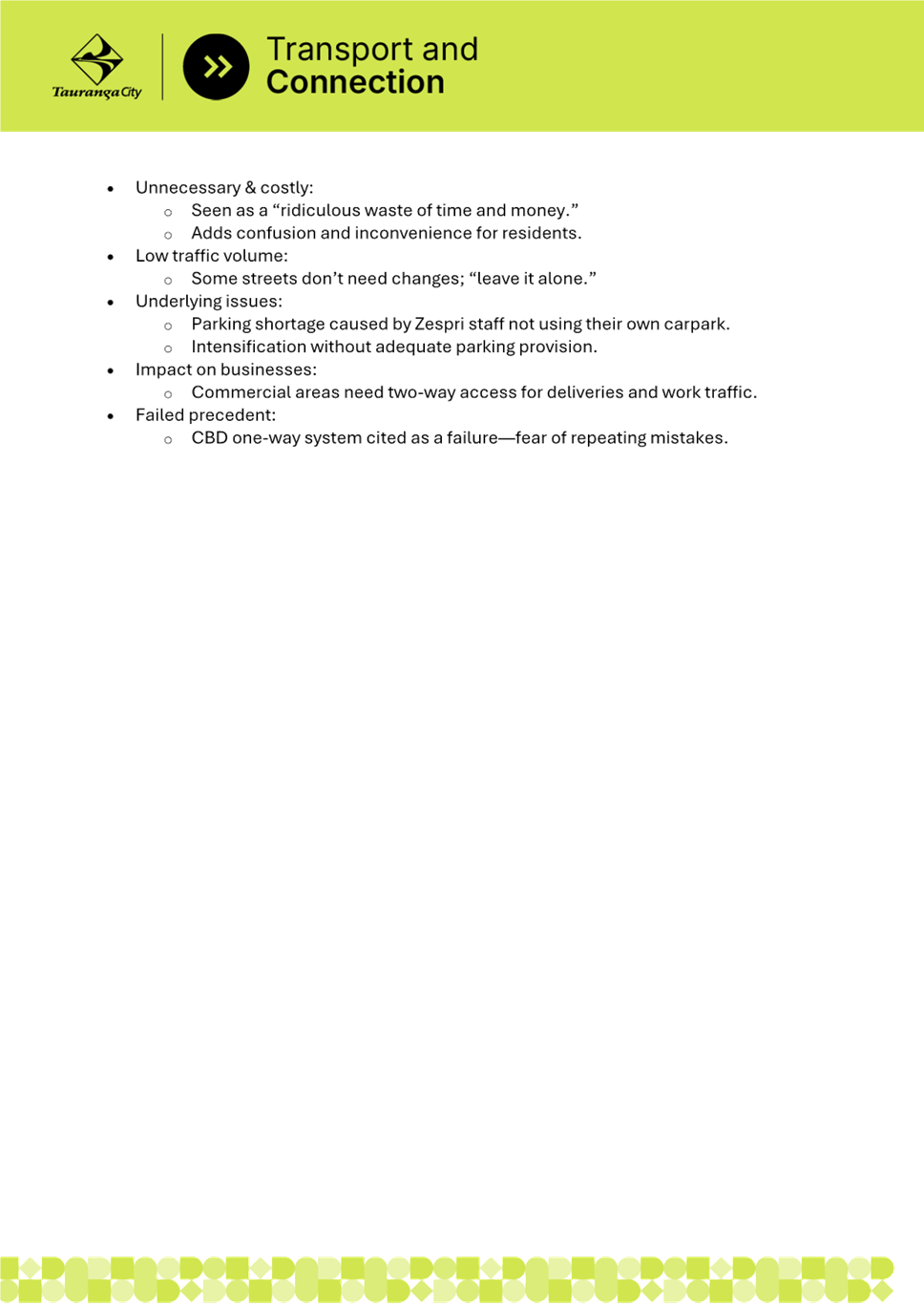
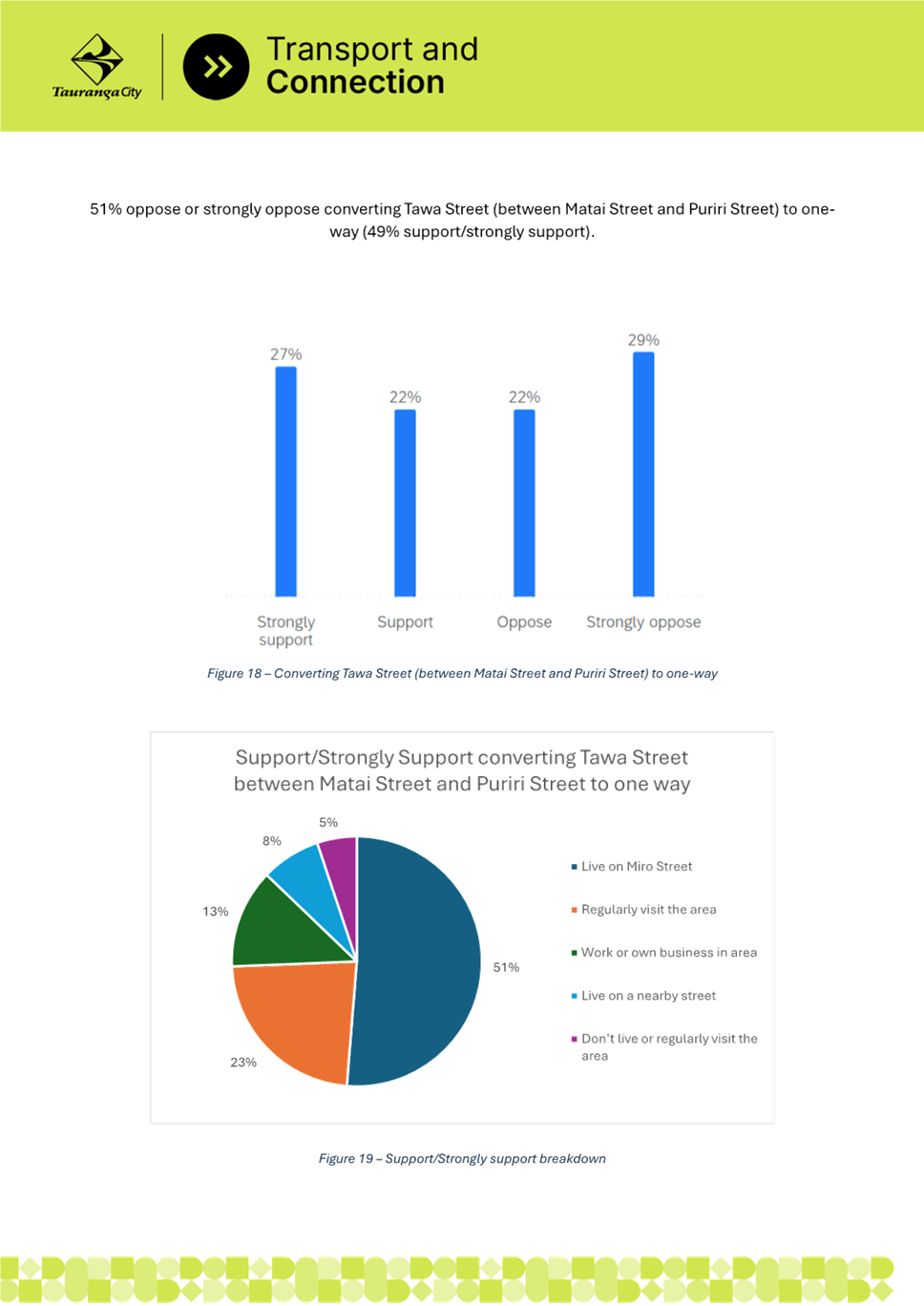
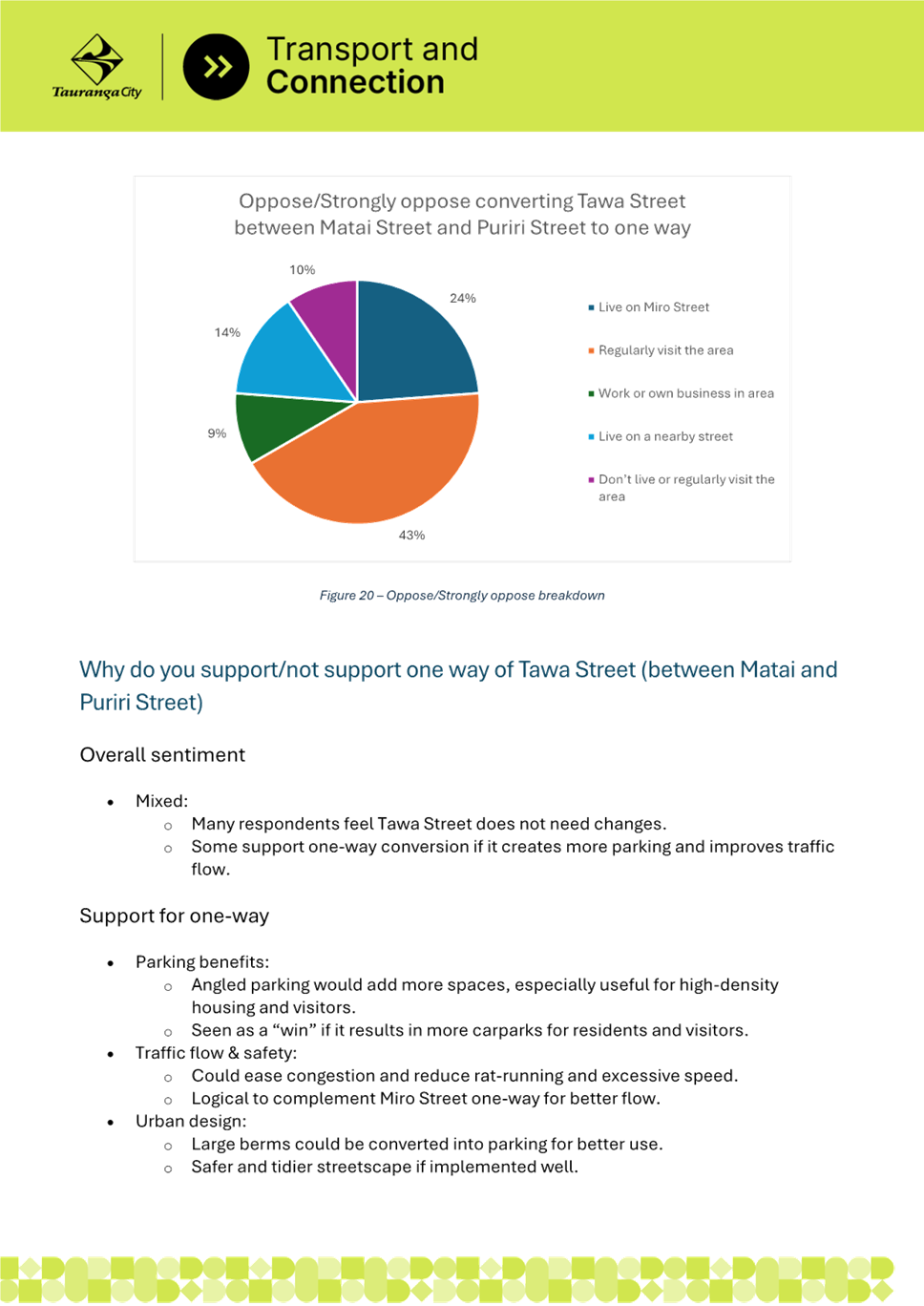
support for banning berm parking (65% support). See images 3, 4 and 5 below.
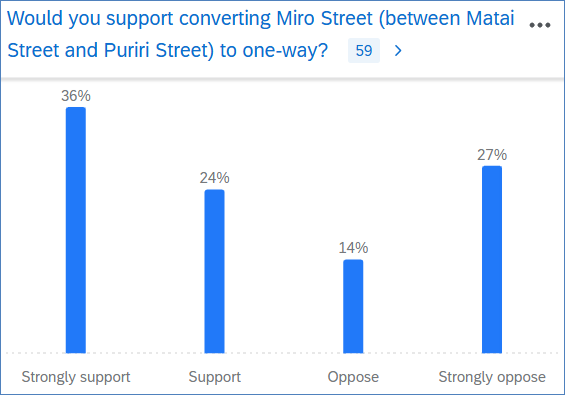
Picture 4: Engagement results for one way
on Miro Street between Matai Street and Puriri Street
Picture 5: Engagement results for one way
on Tawa Street between Matai Street and Puriri Street
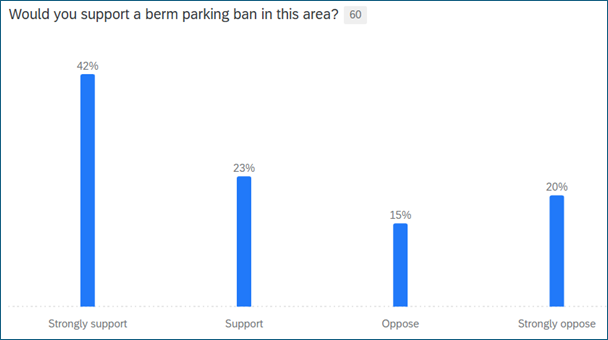
Picture 6: Engagement results for banning
berm parking
Significance
41. The Local Government Act 2002
requires an assessment of the significance of matters, issues, proposals and
decisions in this report against Council’s Significance and Engagement
Policy. Council acknowledges that in some instances a matter, issue,
proposal or decision may have a high degree of importance to individuals,
groups, or agencies affected by the report.
42. In making this assessment,
consideration has been given to the likely impact, and likely consequences for:
(a) the current
and future social, economic, environmental, or cultural well-being of the
district or region
(b) any persons who are likely to be
particularly affected by, or interested in, the proposal.
(c) the capacity of the local authority
to perform its role, and the financial and other costs of doing so.
43. In accordance with the
considerations above, criteria and thresholds in the policy, it is considered
that the proposal is of medium significance.
ENGAGEMENT
44. Taking into consideration the
above assessment, that the proposal is of medium significance, officers are of
the opinion that no further engagement is required prior to Council making a
decision.
Click here to view the
TCC Significance and Engagement Policy
Next Steps
45. Miro street is planned to be
resealed in March 2026. If the recommended solution is progressed, the current
plan is to notify the community of the outcomes of the survey and council
decision. Construction works would then be aligned with the planned reseal,
minimising cost and disruption.
Attachments
1. Miro
Street Parking Improvements Drawing - A19643961 ⇩ 
2. Miro Street
Engagement Summary Report - A19643966 ⇩
|
Ordinary
Council meeting Agenda
|
10
February 2026
|
11.1 Draft Annual Plan
2026/27
File
Number: A19671925
Author: Josh
Logan, Team Leader: Policy & Corporate Planning
Kathryn Sharplin,
Head of Finance
Tracey Hughes,
Manager: Organisational Financial Performance and Corporate Planning
Authoriser: Craig
Rice, Chief Operating and Financial Officer
Please
note that this report contains confidential attachments.
|
Public Excluded Attachment
|
Reason why Public Excluded
|
|
Item 11.1 - Draft
Annual Plan 2026/27 - Attachment 2 - Confidential - Opex Reduction
Opportunities
|
s7(2)(a) - The
withholding of the information is necessary to protect the privacy of natural
persons, including that of deceased natural persons.
s7(2)(b)(ii) - The
withholding of the information is necessary to protect information where the
making available of the information would be likely unreasonably to prejudice
the commercial position of the person who supplied or who is the subject of
the information.
|
|
Item 11.1 - Draft
Annual Plan 2026/27 - Attachment 3 - Confidential -LoS savings
opportunities tables (with extra column) for elected members
|
s7(2)(a) - The
withholding of the information is necessary to protect the privacy of natural
persons, including that of deceased natural persons.
s7(2)(b)(ii) - The
withholding of the information is necessary to protect information where the
making available of the information would be likely unreasonably to prejudice
the commercial position of the person who supplied or who is the subject of
the information.
|
Purpose of the Report
1. The purpose of this
report is to seek further direction on a number of matters relating to the
draft Annual Plan 2026/27.
|
Recommendations
That the Council:
(a) Receives the report
"Draft Annual Plan 2026/27".
(b) Agrees to maintain water
supply activity revenue increases broadly in line with those projected in the
Water Services Delivery Plan which overall is an increase of 25.6% including
both fixed and volumetric water charges.
(c) Notes the maximum limit on
rates increase for Year 3 of the 2024-34 Long Term Plan (LTP) was 12% net of
growth and the rates increase net of growth for 2027 was 10.4%.
(d) Confirms the following
adjustments to December draft budgets to reduce rates requirement by $8.3M to
give a total rate increase for the year including water supply charges of
10.8% after growth and excluding water supply fixed and variable charges of
8.9%.
(i) Reduction in the
capital programme including contingency management, clarification of
deliverability and timing and removing placeholder funding budgets of $58M to
reduce operational costs (primarily interest) of $1M.
(ii) A reduction in
operational expenditure from Attachment 1 and Confidential Attachment
2 of $2.6M.
(iii) Additional savings target
across the organisation of $1.6M, noting the details of this are to be found
by the executive prior to the final budget.
(iv) Reductions
in charges under the waste collection rate of $1.3M of revenue to reflect
budgeted costs of delivering this service.
(v) Reduction in revenue from the
stormwater targeted rate levy of $0.5M.
(vi) Increase in user fee revenue
by $0.3M from applying 3% inflation rather than 2.3% annual inflation that
was assumed in the draft budget.
(vii) Moving budgeted capital
expenditure of approximately $45M, from Attachment 4 capital
prioritisation list, to a bring forward list for projects to be commenced as
savings are achieved on budgeted projects, reducing rates requirement by
$1.2M.
(e) Notes there are potential
additional savings for next year’s rates as a result of lower capital
delivery in 2025/26 leading to lower debt. This depends on the level of
carry forward budget approved with potential savings of $1 to $2m in interest
costs for 2026/27.
(f) Agrees the following
areas of service provision that council would consider for expenditure
reduction to achieve rates saving, noting an overall reduction in rates
funded expenditure of $2.4 to 3.4m would be required to achieve a rates
increase of 7.5%, from the options provided in Confidential Attachment 3:
(i) (to be completed by
elected members)
(g) Requests details of the
budget adjustments required by resolution in (e) be provided at the 3 March
Council meeting for final decision-making.
(h) Notes the high-level
indication of rates increases for the residential, commercial and industrial
rating categories ranges between 7.2% and 7.4% for the median property value
of each category and that the largest increase of 8% occurs for the high
value residential properties (99th percentile). These indicative
increases are based on existing rating differentials for each category of
ratepayer using a 7.5% overall rates increase as included in Attachment 5.
Consultation
(i) Adopts “Option 1:
Do not consult” approach to consultation for
the Annual Plan 2025/26, assuming level of service changes contemplated by
resolution (e) are not significant in terms of the Local Government Act 2002
or
(j) If council decides to
undertake consultation (Option 2), then also:
(i) Confirms
that an independent survey will be undertaken again by direct appointment of
the same supplier as the Annual Plan 2025/26 with 250 respondents and a
margin of error rate of +/-6% at 95% confidence level.
(ii) Confirms the approach
to hearings for the Annual Plan 2026/27 will be traditional hearings.
(iii) Confirms the approach to
submission responses for the Annual Plan 2026/27 will be Option 2, a new and
more efficient approach to submission responses by only responding to
submitters with generic responses to point them
to documents that highlight the key decisions made in the Annual Plan
2026/27.
(k) Attachments 2 and 3 can be
transferred into the open once the Annual Plan has been adopted.
|
Executive Summary
2. The draft budget was
presented to council on 16 December 2025. Decisions made at that meeting
were to provide expenditure reductions or revenue changes to achieve a rate
increase of 7.5% after growth and to identify areas of saving that would be required
to support lower increases down to 4%.
3. This report provides
options for council decision to move toward the 7.5% preferred rates
increase. Expenditure reductions are proposed in internal costs, external
services and the timing and management of costs of the capital programme.
4. The analysis of
options to be confirmed by Council is summarised in Table 1 of this
report. The detail of options for Council consideration of capital
prioritisation and level of service reductions is included in Attachments 1
to 4 of this report.
5. On 16 December
council agreed to consider this increase separate from water by meter charges
which are billed separately. The water invoices sent to customers include
both the connection charges and the volume-based charge. Both these
charges are excluded in the options analysis to reach 7.5% rate increase shown
in Table 1. It is noted the water supply activity showed significant increases
in fixed and variable water charges in the water service delivery plan (WSDP)
approved by the Department of Internal Affairs.
6. The reduction in the
budgeted capital programme for the 2026/27 Annual Plan would be from $497M to
approximately $400m. This is partly achieved ($58M) by a review of
contingency, a tighter process for allocation of contingency expenditure in the
year, and a review of project timing to reflect updated expectations of
delivery. The remaining reduction in budget is proposed to be achieved by
establishing a prioritised programme with lower priority projects not budgeted
but instead included in a bring forward list if the budgeted programme is
delivered for less.
7. Following the
council meeting on 10 December 2025 regarding consultation and engagement on
the Annual Plan, the Elected Member Working Group reviewed the Annual Plan
process and requested staff to present options for consultation, engagement,
hearings, and submission response methods for the 2026/27 Annual Plan. The key
context is the council’s resolution to consider a 7.5% rates increase,
with staff anticipating that there are no significant or material changes from
year three of the Long-Term Plan (LTP) to trigger mandatory consultation under
the Local Government Act.
8. The key decision on
consultation to be made by Council at this meeting is whether to consult on the
Annual Plan, given minimal changes from the LTP. If consultation proceeds the
preferred approach will also require further decisions outlined in this report.
Background
9. The development of
the Annual Plan 2026/27 continues following presentation of the first draft on
16 December which showed a 13% rate increase after growth of 0.5%.
10. At this meeting Council
resolved to:
(a) Consider further options for
rates reduction at the council meeting on 10 February 2026 to achieve a rates
requirement of 7.5%, and options to reduce the rates increase further to 4%.
(b) Separate water by meter
charges, which have significantly increased, from the target 7.5% increase
calculation.
11. Options identified in the 16
December report included:
(i) Prioritisation of
reducing the capital programme by $100m including tighter management of
contingency and deliverability as well as deferral of some projects with a
bring forward option if savings are found within the remaining budget.
(ii) Further reduction in
operating expenditure including consideration of level of service reductions
i. Options for user fee increases to
offset rates requirement
ii. Separation of the volumetric water charge
from consideration of rates increases as this charge relates to supply of a
specific service and is billed separately from the rates bill.
12. The summarised table of options
is shown as Table 1 in this report and an extended version of the table is
included as Attachment 6.
13. Council also requested:
(a) an initial high-level
indication of the impact on residential commercial and industrial ratepayers of
a 7.5% after growth overall rates increase (Attachment 5)
(b) information on movements in FTE
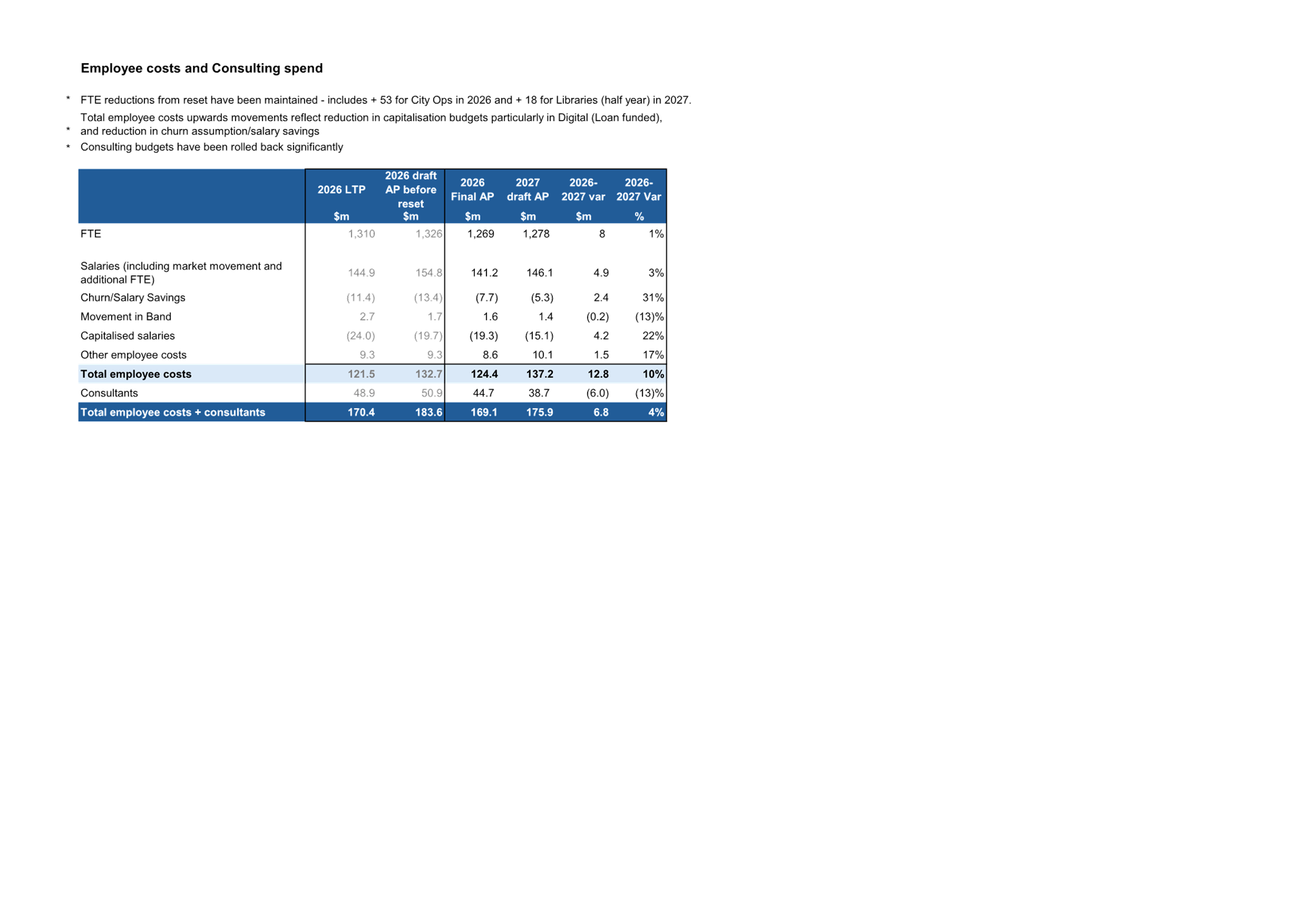
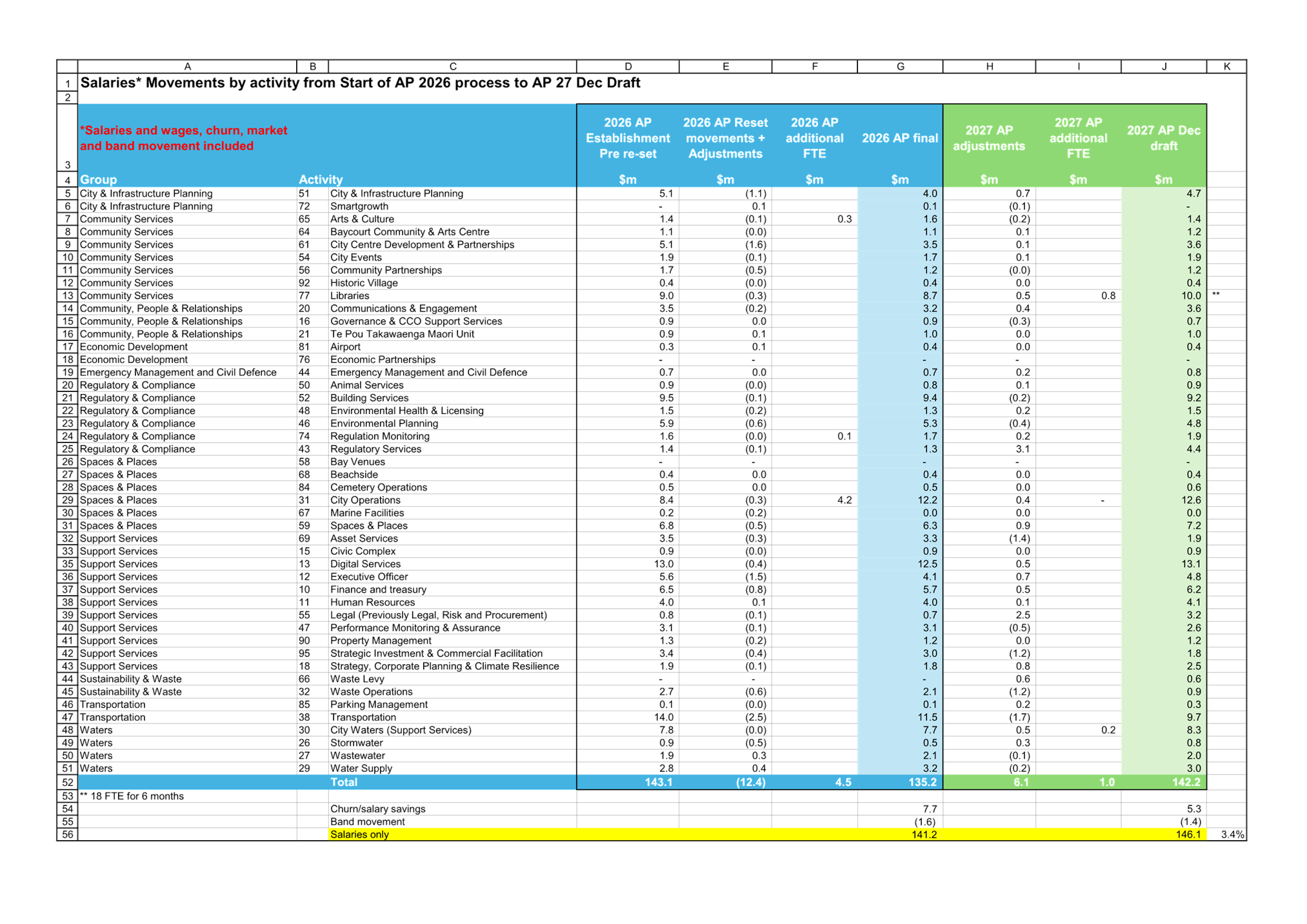
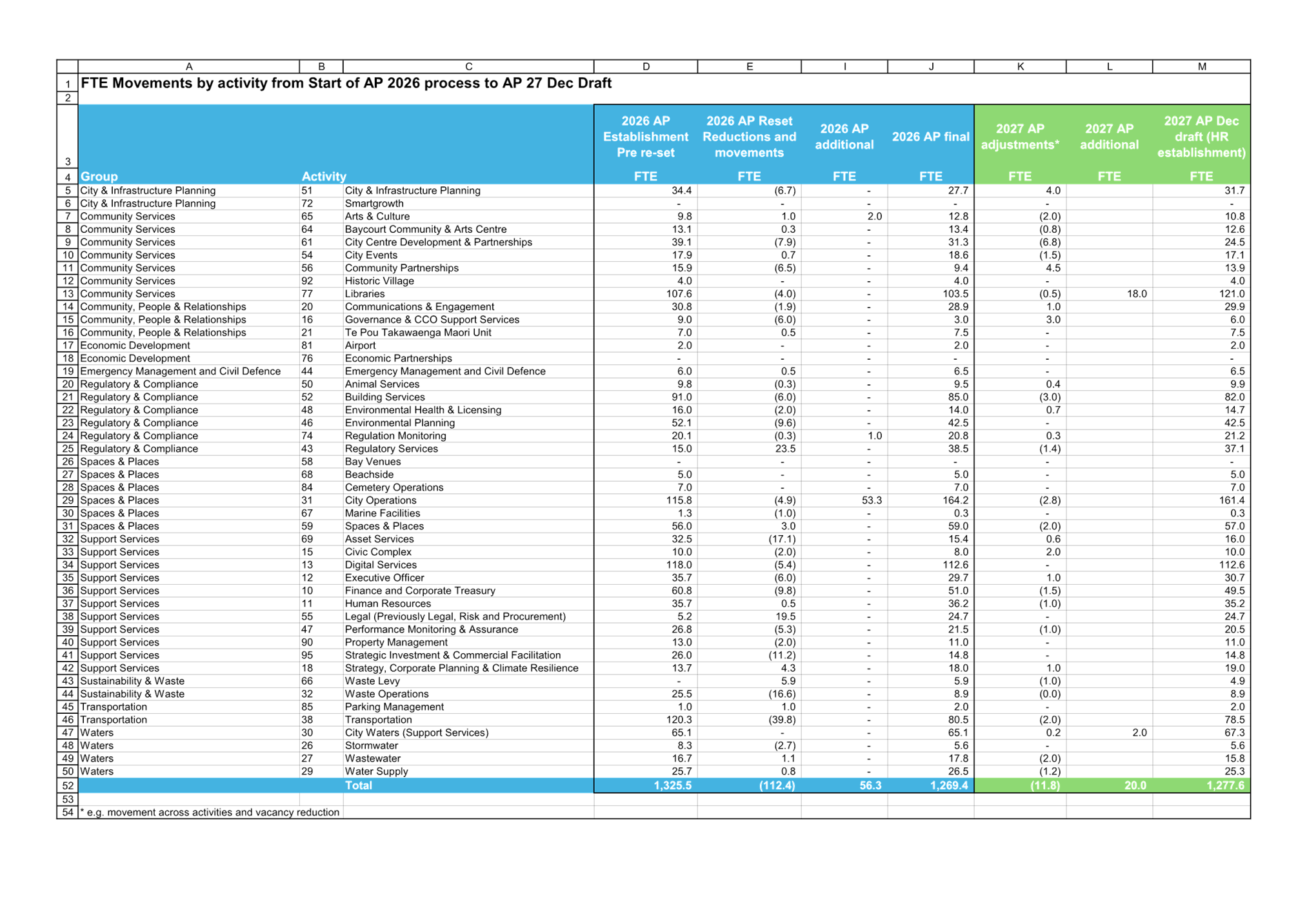
and salaries (Attachment 7)
(c) A separation of three waters
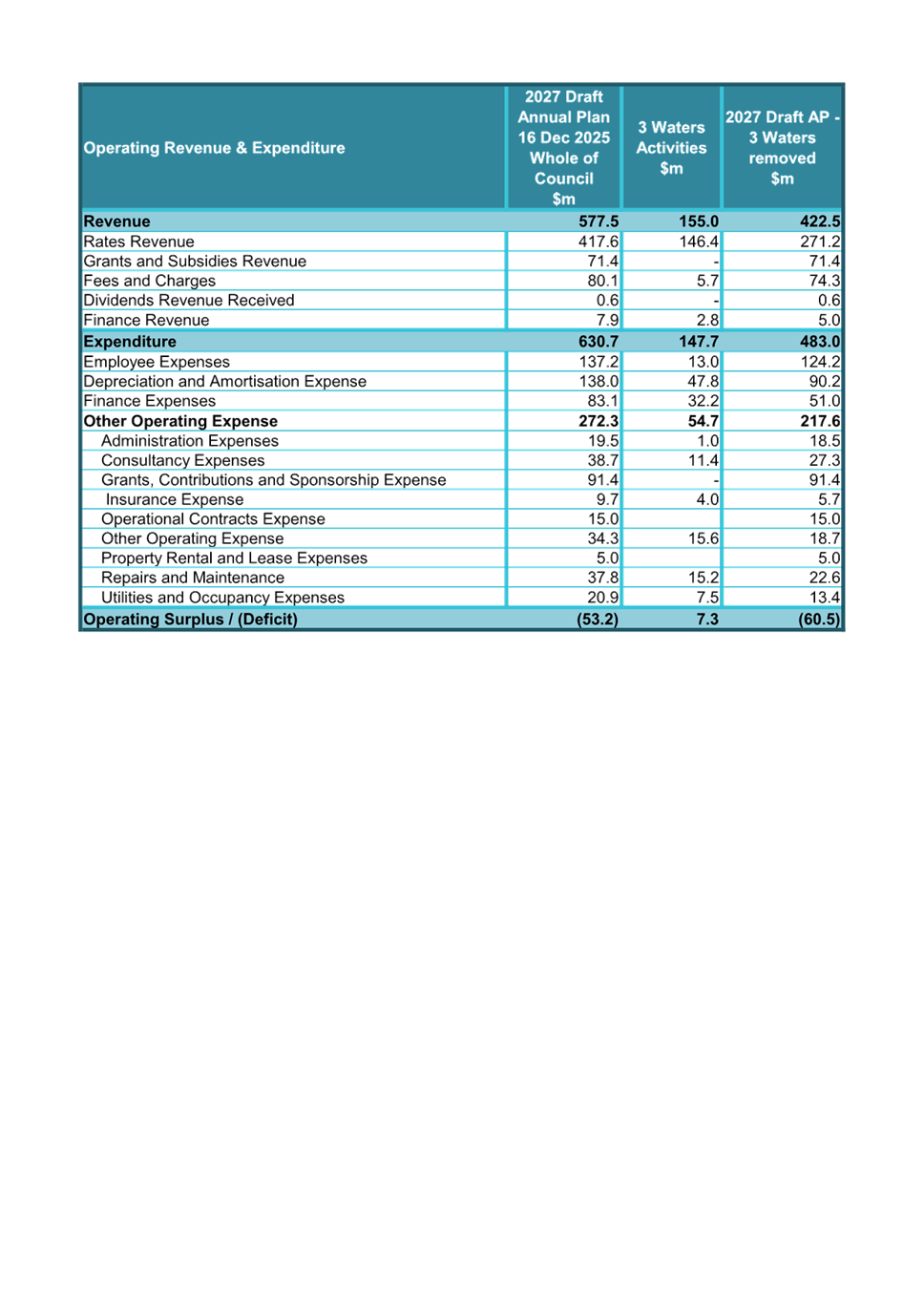
activities revenue and expenses from whole of council revenue and expenses (Attachment
8)
(d) an
update on the approach to the annual plan and consultation, which is discussed
in this report.
Pathway to achieve a rates increase of 7.5% (excluding water
charges)
14. The following table summarises
the pathway to reach a rate increase for 2026/27 of 7.5%, excluding water
charges. There are a number of measures and areas of the
organisation’s expenditure and revenue to be considered to achieve the
Council’s requested target. Each of these is discussed in order from the
table below.
15. In the 16 December Council report
it was proposed that Council consider this 7.5% target increase in rates
separate from water by meter charges which are billed separately. The
water invoices sent to customers include both the connection charges and the
volume-based meter charge. Both these charges are excluded in the table
below in the right-hand columns. It is noted the water supply activity showed
significant increases in fixed and variable water charges in the water service
delivery plan (WSDP) approved by the Department of Internal Affairs.
Attachment 6 to this report shows a number of scenarios and the additional
rates funded expenditure reductions required to achieve a 7.5% rate increase
target.
Table 1 - Proposal to reduce rates increase to 7.5% after
growth
Capital Reprioritisation
16. The December report identified
a capital programme of $497M and a recommendation to reduce the budgeted
capital programme to $400M.
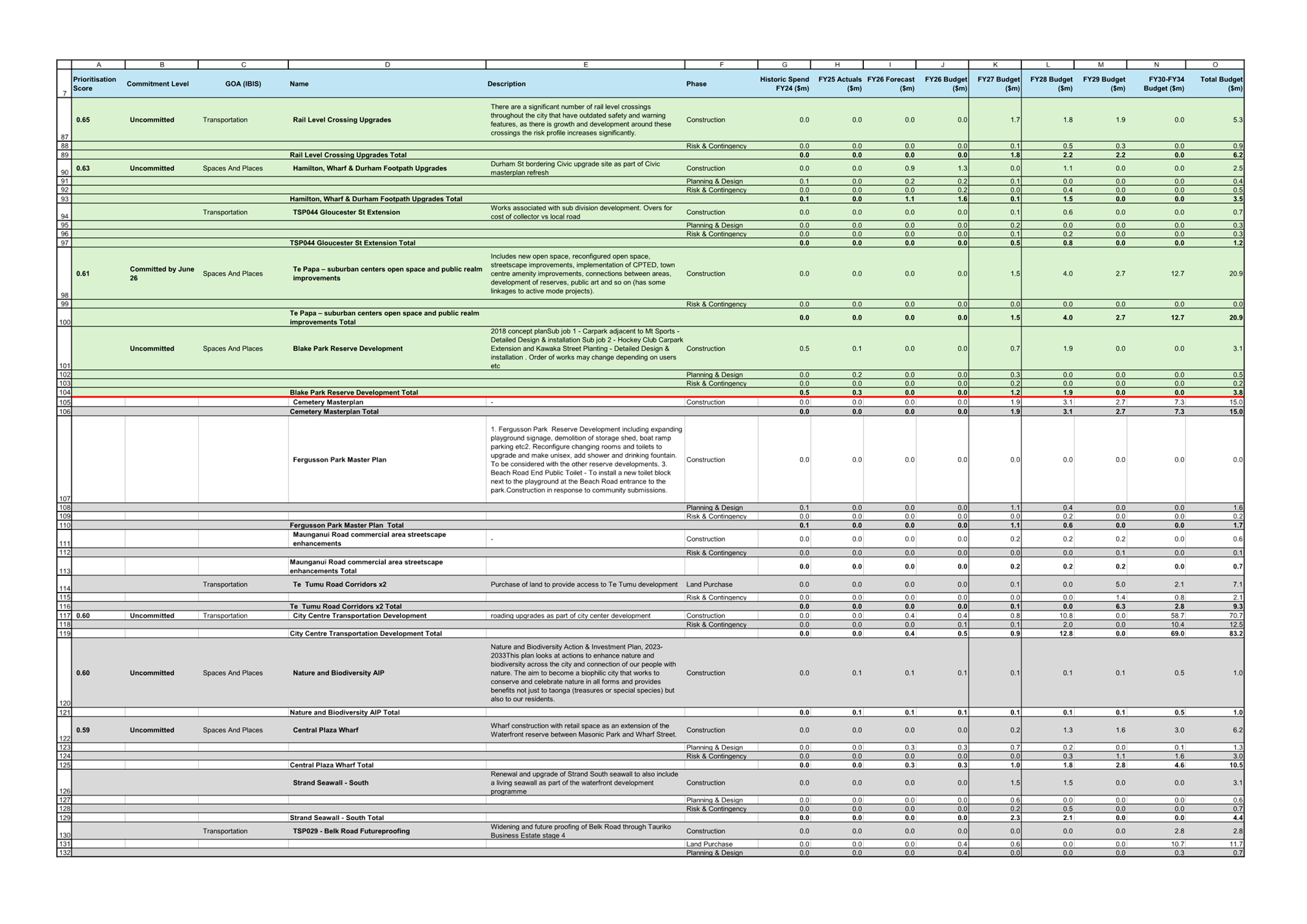
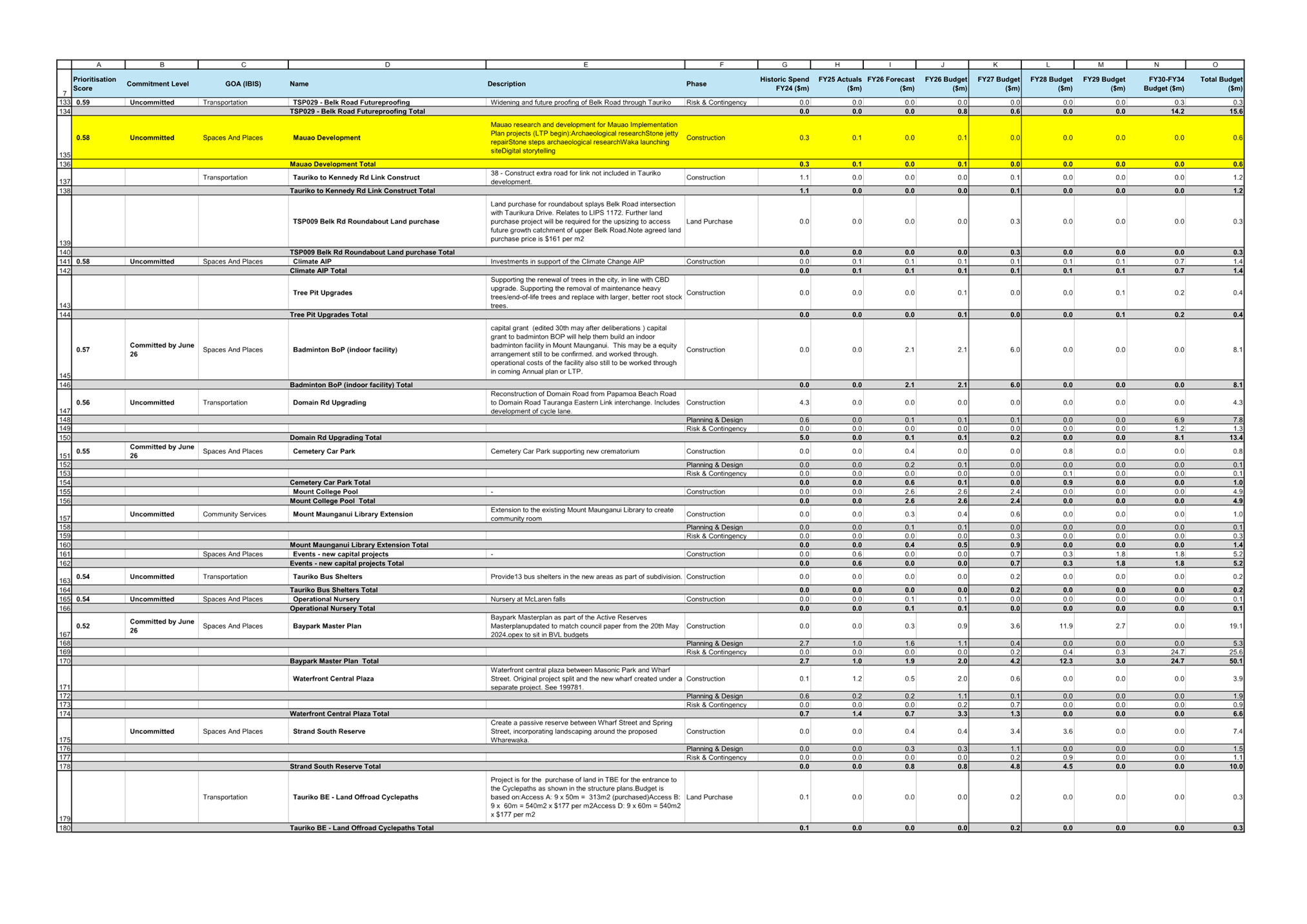
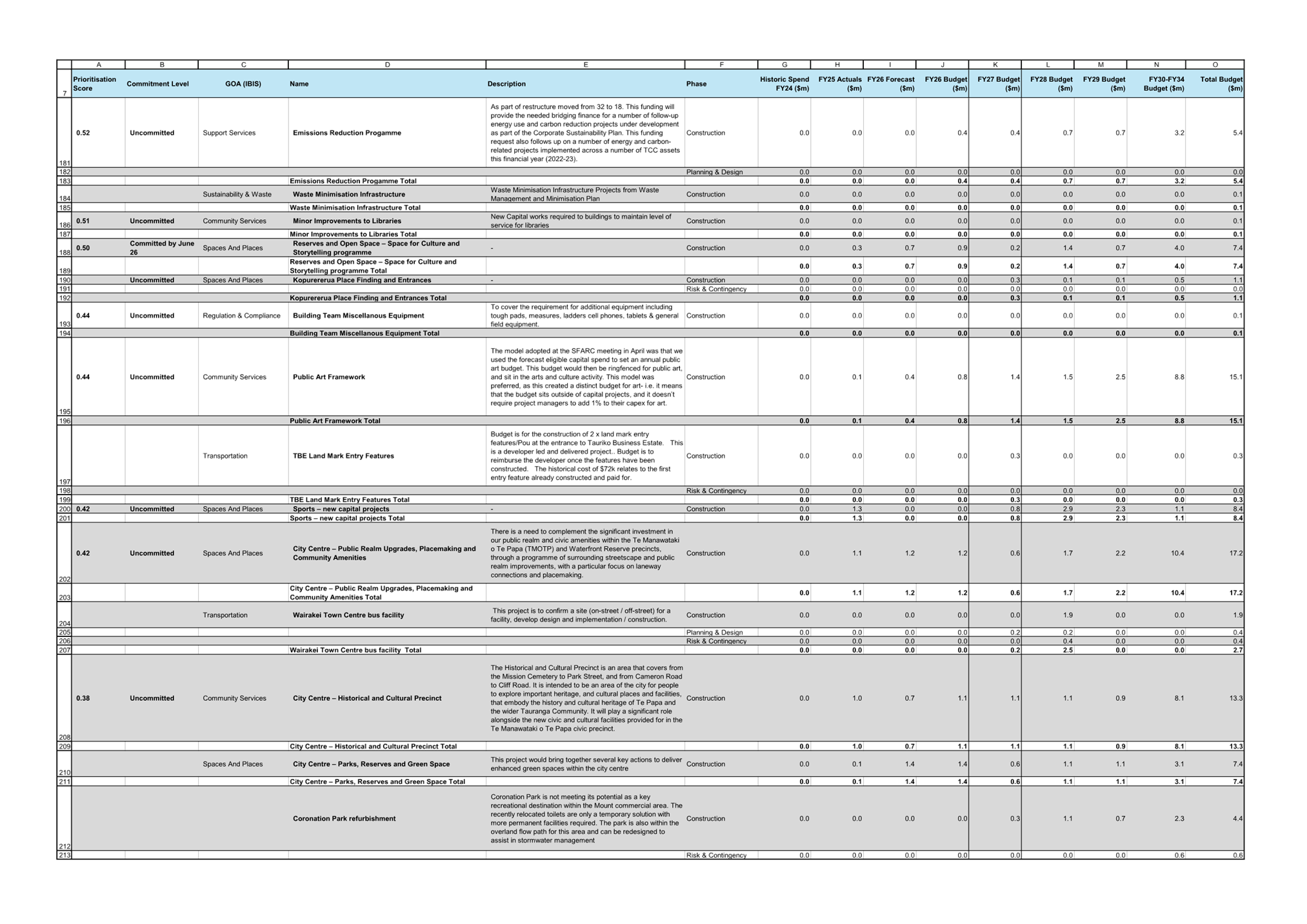
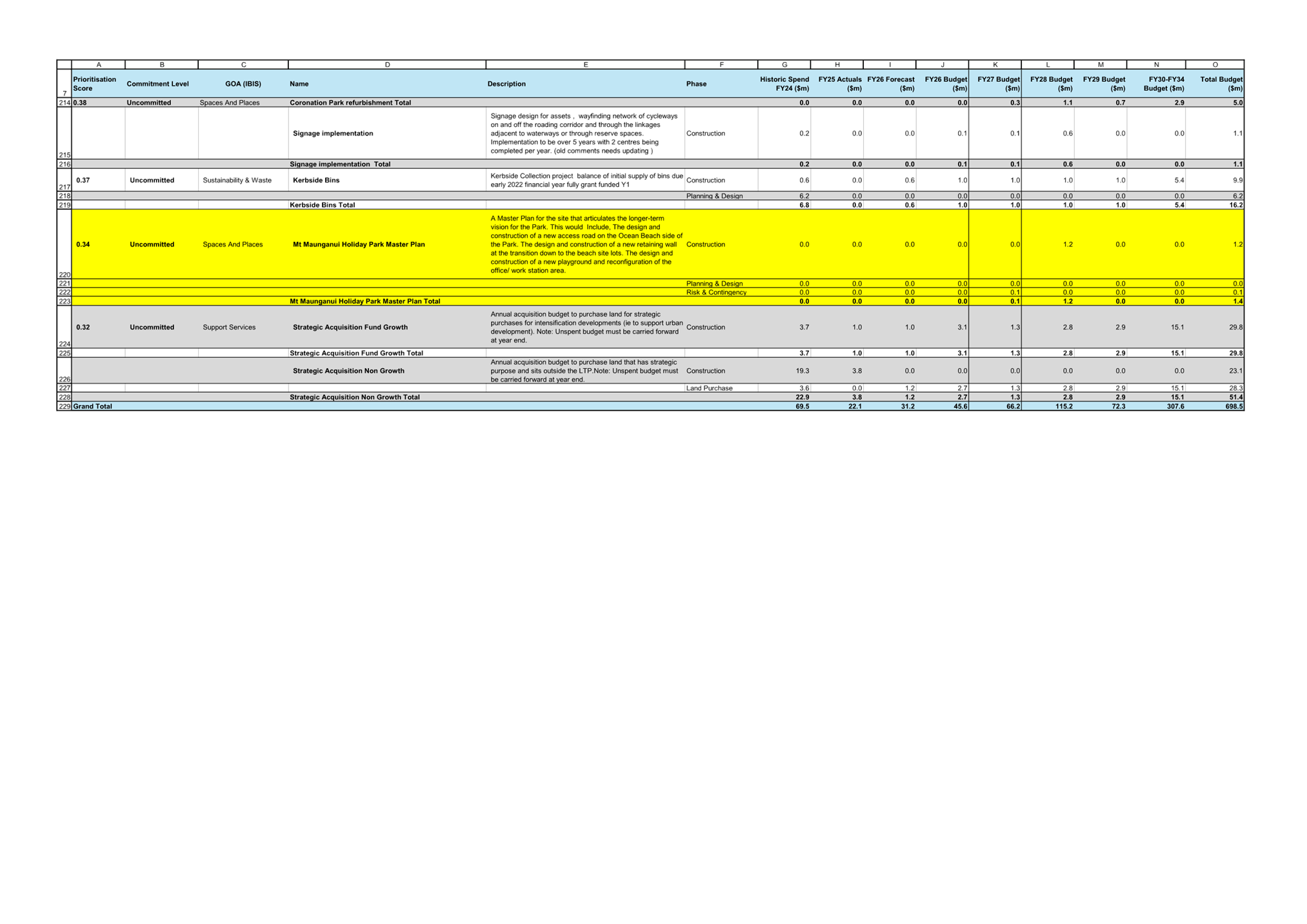
17. Staff have re-budgeted a
reduction of the capital programme budget by $58M to approximately $442M based
on revised deliverability assessment along with changes to contingency budgeted
in the year and a plan to manage contingency more actively across the programme.
18. To reduce the budget a further
$42 to $45M a prioritisation assessment has been undertaken by staff based on
the council’s community outcomes. Projects have been categorised as
committed, renewals, critical risk projects and projects not yet committed.
The projects that are not yet committed have been ranked by staff and presented
in Attachment 4. From the lower ranked projects, agreement is
sought from council to confirm which of these projects could be moved out of
the 2026/27-year budget and placed on a bring forward list if savings are able
to be found in other projects for the year. If they are not brought forward
these projects would be included through next year’s Long-term Plan
process.
19. The December draft excluded any
reduction in opening debt for 2026/27 arising from lower than budgeted capital
delivery in 2025/26. The expenditure for 2026 is currently forecast to be
less than $420m ($80m less than budget). If all the unspent budget is
carried forward to 2026/27 there will not be a significant saving in interest
from the lower opening debt position. However, if it is not all carried
forward the lower debt will continue through the 2026/27 year. A
reduction in carry forward of $20m would flow through to interest savings for
the year of approximately $1m. Interest savings from a reduction in
carryforward would reduce the need for level of service savings.
Expenditure Reductions
20. Further expenditure reductions
have been proposed for council endorsement in Attachment 1 and
confidential Attachment 2. The green colour coded options in Table
1 above indicate areas of expenditure reduction affecting Council’s
funding of its operations and support functions including some external
providers. To achieve $5.2M of rates reduction across the green coded
initiatives there is required to be a reduction in council operational
expenditure of $8.1M.
21. The
reduction in resourcing and other changes proposed carries with it a reduction
in services and support to the organisation and the services it delivers.
Reducing resources will impact on the quality of service and risk associated
with council operations. The efficiency review line item represents an
undertaking by the executive to pursue further efficiency savings and
expenditure reduction. For the draft budget to be presented in March this
line item of savings will be included as a salary savings target within the
operating expenditure category, which the executive will aim to identify as
actual budget adjustments prior to finalising the budget in June 2026.
Other Revenue and Expenditure Amendments Proposed
22. After further review of the
draft budgets some changes are proposed to charges to the community through
specific targeted rates and an overall inflation adjustment to user charges.
23. Kerbside Collection Charges
(Targeted Rate)
Kerbside
collection charges are calculated to cover the costs of kerbside
collection. Based on costs to deliver the service it is proposed that the
kerbside targeted rate be retained at 2025/26 levels reflecting that these are
sufficient to cover the costs of this activity. Small surpluses have been
recorded in recent years, and the Kerbside Targeted Rate reserve is currently
in funds of $4.5M. This adjustment reduces the rates requirement by
$1.3M.
24. Stormwater Levy (Targeted
Rate)
After
the 2011 flooding in parts of Tauranga a stormwater targeted rate was
implemented to fund stormwater flooding mitigation works across the city.
A policy was established to determine when the reserve could be applied to
capital works. In recent years the qualifying capital works have reduced
so that the reserve has accumulated funds of $14.5M. Over the last two
years the levy has been reduced to $0.5M per annum, and it is proposed to
continue this funding at the lower level for 2026/27 rather than the $1M
budgeted in the draft creating a rates reduction of $0.5M.
25. User Fees and Charges
inflation adjustment
The
draft annual plan applied a general 2.3% inflation uplift to user fees and
charges revenues. Recent inflation information has informed a higher
adjustment of 3% which is to be proposed in the user fees and charges
schedule. This adjustment to user fee revenue reduces rates requirement
across activities of approximately $0.3M per annum.
Level
of Service Adjustments to Reach a 7.5% rates increase
26. To reach the 7.5% rates target
(water supply excluded), Council will be required to reduce or adjust service
delivery to the community by up to $4.4m. The amount will depend on decisions
on unspent capital budgets from 2025/26 (carryforwards), which could reduce the
amount of savings to find by approximately $2m. Confidential
Attachment 3 identifies areas of level of service that could be adjusted
without significant impact on the community.
27. Council has been requested to
indicate which areas of service delivery it would be willing to consider
reducing or amending. The proposed changes are at a level that is unlikely to
be significant and therefore require consultation under the Local Government
Act 2002.
Rate
Impact by Category of Ratepayer
28. Council requested an indication
of rates increase for each quartile of each category of ratepayer (residential,
commercial and industrial). This information is provided in Attachment
5 based on an indicative rates requirement targeting an overall 7.5%
increase excluding water supply. From this the median residential and
commercial ratepayers face an increase of 7.4%, while the industrial median
ratepayer would have an increase of 7.2%. The highest increase would be
8% for the 99th percentile residential properties.
Consultation and Engagement on
the Annual Plan 2026/27
29. After the council meeting on 10
December the Annual Plan Elected Member Working Group met in December and
subsequently fed back to staff a number of requests for items to consider in
this report, Staff have prepared the following options for council’s
consideration of:
· Whether or not to
consult on the annual plan
· Approach to
communications and engagement
· If a
demographically representative survey should be used and what number of
respondents and margin of error rate Elected Members are comfortable with
· Approach to
hearings
· Approach
to submission responses
Approach to
consultation
30. The Local
Government Act gives councils the opportunity to reduce costs in the
preparation of its annual plan each year by electing whether to consult on that
annual plan. The Act specifies that unless the differences from that year of
the LTP are significant or material it need not to consult. However, council
can still choose to consult if it wishes to.
31. Pursuant to the resolution from
the 10 December 2025 meeting recommending consideration of a 7.5% rate increase
at this meeting, subject to content decisions yet to be made by council, staff
anticipate that there are no significant or material changes to year three of
the Long-Term Plan (LTP). Accordingly, consultation would not be required
unless council decides to proceed with consultation.
32. Staff are therefore seeking
council’s direction in on the following options for consultation:
Option
1: Do not consult (Recommended)
33. Council does not consult on
Annual Plan 2026/27
34. Key risk: council’s
assessment of significance and/or materiality, and the resulting decision not
to consult, is challenged via the annual report audit process and/or by the
community.
|
Advantages
|
Disadvantages
|
|
· Improved organisational capacity to focus on Long-term Plan 2027-2037 (LTP).
· Reduced
workload for elected members while dealing with the aftermath of the January
weather event.
· Reduced workload for corporate teams and activity and project
managers, as there is no requirement to manage and respond to annual plan
submissions.
· Eliminates costs of annual plan consultation.
· Reduced risk of community engagement fatigue.
|
· Reduced ability to bundle together issues for community
engagement.
· Risk of community criticism for a lack of consultation on the
annual plan.
· Loss of opportunity for community input into the annual plan.
|
35. Option 2
– Consultation standard approach (Not recommended)
36. Council follows the current
annual plan consultation approach and conducts a regular month-long
consultation taking into consideration Section 82 of the Local Government Act.
37. Key risk: community engagement
fatigue and organisational capacity.
|
Advantages
|
Disadvantages
|
|
· Community perceives council as conducting robust and transparent
consultation.
|
· High risk of community engagement fatigue
· Additional time required for council meetings to hold hearings.
· Increased organisational burden as submissions are received,
processed and responded to by corporate teams and activity and project
managers.
|
Approach to
Communications and Engagement
38. Should
council choose to consult (Option 2) on the Annual Plan 2026/27, the Elected
Member Working Group had requested in January that staff bring via this report
suggestions on the type of engagement that could be used should engagement
occur.
39. The request is also asked that
dates be included in this information. However, as venue bookings usually
require non-refundable deposit, staff are of the view that prior to any booking
being made that decisions from this paper need to be made first.
40. Potential engagement activities
this would include the following:
· Council-owned
channels (website, social media, e-newsletters)
· A
broad paid media schedule (digital, newspaper, billboard, and radio)
· Use
of the rates and engagement databases to directly reach a larger number of
ratepayers and residents
· Use
of Newsbeat (TCC’s news platform) to share councillor
video content promoting engagement opportunities and consultation
questions
· Pre-engagement
with identified stakeholders
· Up
to two large-scale Town Hall events led by the mayor and
recorded (replacing council-based Q&A sessions)
· Councillors
and staff attending community events and high foot-traffic locations
· A
demographically representative market research survey managed by an external
research company.
Approach to using demographically
representative market research survey during consultation
41. Demographically representative
surveys are used to support public consultation by providing a statistically
robust snapshot of wider community views, including those less likely to
participate.
42. Historically, surveys have
formed part of Annual Plan consultation and are not recommended as a standalone
engagement approach.
43. This was reflected in the last
Annual Plan through the Annual Plan / Local Water Done Well survey, which
interviewed 253 Tauranga residents and achieved a margin of error comparable to
recognised benchmarks.
44. The type of method used last
year was an online external research panel which enables two main benefits in
that it reduces costs as there is no need to post out surveys, and it also
reduces the risk of people making a submission via council’s website and
then also receiving a survey invite.
45. While larger samples can reduce
the margin of error, they require contacting significantly more people and
increase cost. For example, at a 10% response rate (typical of a postal survey
methodology), 250 would responses require contacting around 2,500 people while
1,000 responses would require contacting around 10,000 people. In this context,
a 250-respondent online panel survey (online panels achieve in the range of 30%
completion rate, so only around 750 people would be contacted for 250
interviews) represents a proportionate and established benchmark alongside
consultation.
46. The table below compares sample
size options, showing how changes in methodology and respondent
numbers affect margin of error.
|
Number
of people
|
Margin
of error
|
Confidence
level
|
|
250
|
+/-
6%
|
95%
|
|
500
|
+/-
4%
|
95%
|
|
1000
|
+/-
3%
|
95%
|
47. Depending on the number of
people to be surveyed, the number of questions asked, types of questions to be
asked (e.g. open ended, close questions) and methodology to be used (e.g.
online external research panels, mailouts etc) the costs could vary between
(estimated) $25,000 up to $50,000.
48. Based off the information above
staff are of the opinion that if a survey is used again for this annual plan,
we could directly appoint the same provider as last year to conduct a similar
survey to last year which would interview around 250 respondents and have a
margin of error of +/- 6% at a confidence level of 95%. However, final costs
would be dependent on the number and the format of the questions.
49. Staff also confirm that the
questions in this survey will be the same questions used as the online
submission form open to the public. This was also the case in the survey
undertaken for last year’s Annual Plan/Local Water Done Well survey.
Approach to Hearings
50. Another of the requests from
the Elected Member Working group included staff providing alternatives to
traditional hearings.
51. Alternatives ideas from other
councils have used in their past consultations include:
1. Holding less-formal sessions to allow
people to share their views. Where you have round-table discussions where one
or two elected members sit with a group of submitters or interested parties and
hear their views. Those elected members, or staff invited to be present,
would then collate those views and share them with the wider elected member
cohort so that everyone hears the stories.
2. Also, a variation to above is that these
could be done online, as we already allow and are equipped for people
presenting remotely for hearings. These could also likely be recorded making
for ability to capture the views via recording. (noting if chosen this option
would require confirmation with digital services)
3. A reduced membership ‘hearings
committee’ could be created to hear submitters and then report back to
full council to aid decision-making (noting, that all elected members would
still be expected to have read all the written submissions prior to
deliberations).
52. With any of the options
mentioned above, we would need to capture, summarise and share the information
so that all elected members were able to access it before decisions were made
in deliberations.
53. Through all of this, the key
will be in ensuring that we are aware of the requirements of the Act relating
to the principles of consultation under section 82, the relevant ones for
hearings of which are:
· encouraging
people to present their views
· providing
a reasonable opportunity for people to present their views in a manner that
suits them
· considering
views presented with an open mind
· having
processes in place for consulting Māori.
54. Staff are seeking for council
to confirm that if they do consult on the annual plan that they wish to proceed
with traditional hearings or if they would like to further explore one of the
options mentioned above.
Approach to Submission
Responses
55. The final request of the
working group was that staff plan for a submission process and online form that
can be analysed and responded to by Artificial Intelligence (AI), in this
instance it is presumed the request was in regard to Generative AI.
56. Generative AI
means AI systems that can create or generate new content, such as text, images,
video, or audio, often by learning from existing data patterns.
57. While our current submission
software that staff use to collect and analyse submissions already has
(generative) AI functionality built in. It is typically only used with the
summarising of submissions to then enable creation of a high-level summary of the
main points of the submission.
58. However, when it comes to using
AI to directly respond to submissions on behalf of council staff would not
recommend its use. Whilst AI is a useful tool it also makes a number of errors
that still need to be manually checked by a person. Additionally, as per clause
6.12 in council’s Artificial Intelligence Policy 2025, staff remain responsible for reviewing and editing outputs from generative
AI.
59. Given the need to check each
and every response, staff are of the view that there would be little to no time
saving efficiencies achieved when compared with the current process.
60. Staff can and do look for
efficiencies each submission period. In the past we have used tools like going
through the previous year’s responses by activity to look for themes and
common responses that can be used again.
61. An alternative approach that
staff can look at for this upcoming process is that we do not respond
individually to each submitter. It is currently the practice of council,
although it should be noted that it is not legislatively required to respond to
each submitter individually.
62. Instead as part of this
year’s annual plan staff could use a similar approach to that used by
Western Bay of Plenty District council and send every submitter an email
response that is the same along with a link to a decision document that will be
created by staff after deliberations.
63. An example of the Western Bay
of Plenty District council 2023/24 decision document for their annual plan is
available at the following link for reference: https://www.westernbay.govt.nz/repository/libraries/id:25p4fe6mo17q9stw0v5w/hierarchy/council/plans-and-strategies/annual-plans/2023-24%20Annual%20Plan/2023-24%20Annual%20Plan%20Decision%20Document.pdf
64. Staff are seeking
council’s direction in on the following options for submission responses:
Option 1: Personalised
response to all submissions (Not recommended)
65. Council continues with its
current practice and responds individually to each submission to the Annual
Plan 2026/27.
|
Advantages
|
Disadvantages
|
|
· Community perceives council as conducting good practice
consultation.
· It is the standard practice that the community is used to.
· Closes the loop on topics they have raised in their submission.
|
· Least efficient way of responding to submissions.
· Out
of line with a number of other councils that only respond with generic key
decision documents.
· Increased organisational burden as submissions are received,
processed and responded to by corporate teams and activity and project
managers.
|
Option 2 – Generic response to
all submissions (Recommended)
66. Council adopts a new and more
efficient approach to submission responses by only responding to submitters
with generic responses to point them to documents that highlight the key
decisions made in the Annual Plan 2026/27.
|
Advantages
|
Disadvantages
|
|
· Reduced
workload for elected members while dealing with the aftermath of the January
weather event (by not needing to review and endorse each individual proposed
response).
· Reduced workload for corporate teams and activity and project
managers, as there is no requirement to manage and respond to annual plan
submissions.
· Improved organisational capacity to focus on Long-term Plan 2027-2037 (LTP).
· Other
councils have used this approach successfully in the past.
|
· Community perceives council as conducting not as good a practice
consultation.
· Less
personal
· May take time for regular submitters to get used to this new
approach.
|
Timeline of Annual
Plan to Adoption
67. If no consultation takes place,
the only key statutory date is adoption before 30 June 2026.
68. To meet this deadline, all
decision-making on the annual plan would need to be completed in a time
consistent with the deliberations above i.e. 4 June 2026.
|
|
2026/27
No Consultation Option
|
2026/27
Consultation Option
|
|
Adopt draft AP content
|
NA
|
Tue 3 March 2026
|
|
Adoption of CD
|
NA
|
Tue 24 March 2026
|
|
Consultation opens
|
NA
|
Wed 1 April 2026
|
|
Easter
|
3 to 6 April
2026
|
3 to 6 April
2026
|
|
School holidays
|
3 to 19 April
2026
|
3 to 19 April
2026
|
|
Anzac Day holiday
|
Mon 27 April
2026
|
Mon 27 April
2026
|
|
Consultation closes
|
NA
|
Fri 1 May 2026
|
|
Hearings meeting agenda
published
|
NA
|
Mon 11 May 2026
|
|
Hearings meeting
|
NA
|
Mon 18 to Thu 21
May 2026
|
|
Deliberations meeting
agenda published
|
NA
|
Tue 26 May 2026
|
|
Deliberations meeting
|
NA
|
Tue 2 to Thu 4 June
2026
|
|
AP content adopted
|
Thu 4 June 2026
|
NA
|
|
Adoption report agenda
published
|
Tue 16 June 2026
|
Tue 23 June 2026
|
|
Adoption of annual plan
|
Tue 23 June 2026
|
Tue 30 June 2026
|
Statutory Context
69. In accordance with the Local
Government Act 2002 (LGA), Council is required to produce and adopt an annual
plan, by 30 June 2026. The purpose is to identify variations from the financial
statements of the third year of the current Long-term Plan.
STRATEGIC ALIGNMENT
70. The annual plan provides the
funding that contributes to the promotion or achievement of all of Tauranga
City Council’s strategic community outcomes. How funding is allocated
will determine the impact made in each of these areas.
|
Contributes
|
|
We are an inclusive city
|
ü
|
|
We value, protect and enhance the environment
|
ü
|
|
We are a well-planned city that is easy to move
around
|
ü
|
|
We are a city that supports
business and education
|
ü
|
|
We are a vibrant city that embraces
events
|
ü
|
Financial Considerations
71. This report considers budget
proposals that contribute to lowering rate requirement for 2026/27 to a target
of 7.5% excluding revenue for water supply. Confirmation of budget
changes will be applied to achieve a draft budget. It is noted that there
is likely to be some variability in savings and rates impacts as details are
incorporated in the corporate planning system.
72. Assumptions in the corporate
planning system were based on data in November 2025. As the 2025/26 year
progresses capital cost and delivery and expenditure and revenue impacts will
affect the opening position for the budget. Events such as the recent
impacts at Mauao and resultant business impacts and expenditure requirements
will also influence the final budget.
Legal Implications / Risks
73. In accordance with the Local
Government Act 2002, Council must consult with the community if the annual plan
includes significant or material differences from the content of the Long-term
Plan for the financial year to which the proposed annual plan relates.
TE AO MĀORI APPROACH
74. The Annual Plan process does
not affect TCC’s ambitions to align with the Te Ao Māori approach.
However, funding decisions may have an impact on individual projects or
programmes that are specifically working towards fulfilling on the approaches.
CLIMATE IMPACT
75. The Annual Plan process does
not affect TCC’s ambitions to align with the Climate Impact Statement.
However, funding decisions may have an impact on individual projects or
programmes that are specifically working towards fulfilling on this ambition.
Consultation / Engagement
76. Consultation on the annual plan
will be in accordance with the requirements of the Local Government Act 2002
(LGA).
77. The Local Government Act 2002
(LGA) was amended in 2014 with the intent of streamlining consultation
requirements for annual plans. As a result, councils are only required to
consult when there are significant or material differences between
the proposed content of the annual plan and the content of the long-term plan
for the financial year to which the annual plan relates (s95(2A), LGA). At this
point in time it is anticipated that the changes in the annual plan are not a
significant or material departure from the long-term plan.
78. Taking into consideration the
above assessment, officers are of the opinion that no further engagement is
required prior to council deciding and that the annual plan be considered by
Council for adoption without consultation.
Significance
79. The Local Government Act 2002
requires an assessment of the significance of matters, issues, proposals and
decisions in this report against council’s Significance and Engagement
Policy. Council acknowledges that in some instances a matter, issue,
proposal or decision may have a high degree of importance to individuals,
groups, or agencies affected by the report.
80. In making this assessment,
consideration has been given to the likely impact, and likely consequences for:
(a) the current
and future social, economic, environmental, or cultural well-being of the
district or region
(b) any persons who are likely to be
particularly affected by, or interested in, the matter.
(c) the capacity of the local authority
to perform its role, and the financial and other costs of doing so.
81. In accordance with the
considerations above, criteria and thresholds in the policy, it is considered
that the matter is of medium significance.
ENGAGEMENT
82. Taking into consideration the
above assessment, that the matter is of medium significance, officers are of
the opinion that no further engagement is required prior to Council making a
decision. Unless Council resolves to consult on the matter.
Next Steps
83. Once Council has made decisions
regarding expenditure proposals these will be included in the corporate
planning system and a draft budget produced for adoption by council on 3 March
2026.
84. Consultation and engagement
decisions will guide further work and proposals for annual plan engagement.
85. Capital programme delivery and
expenditure will continue to be monitored and updated as projects are delivered
and forecasts of expenditure and timing change. Updated project
information will be incorporated in April / May and reported to Council prior
to finalisation of the budget.
86. Operational revisions and
expenditure related to recommendations from the executive or decisions by
Council since the draft was prepared, including potential impacts related to
the Mauao event, will also be incorporated in a revised draft prior to the final
budget being presented to Council in June 2026.
Attachments
1. Opex
Savings Opportunities - A19710314 ⇩
2. Confidential
- Opex Reduction Opportunities - A19710195 - Public Excluded (Separate
Attachments 1)
3. Confidential
-LoS savings opportunities tables (with extra column) for elected members -
A19729782 - Public Excluded (Separate Attachments 1)
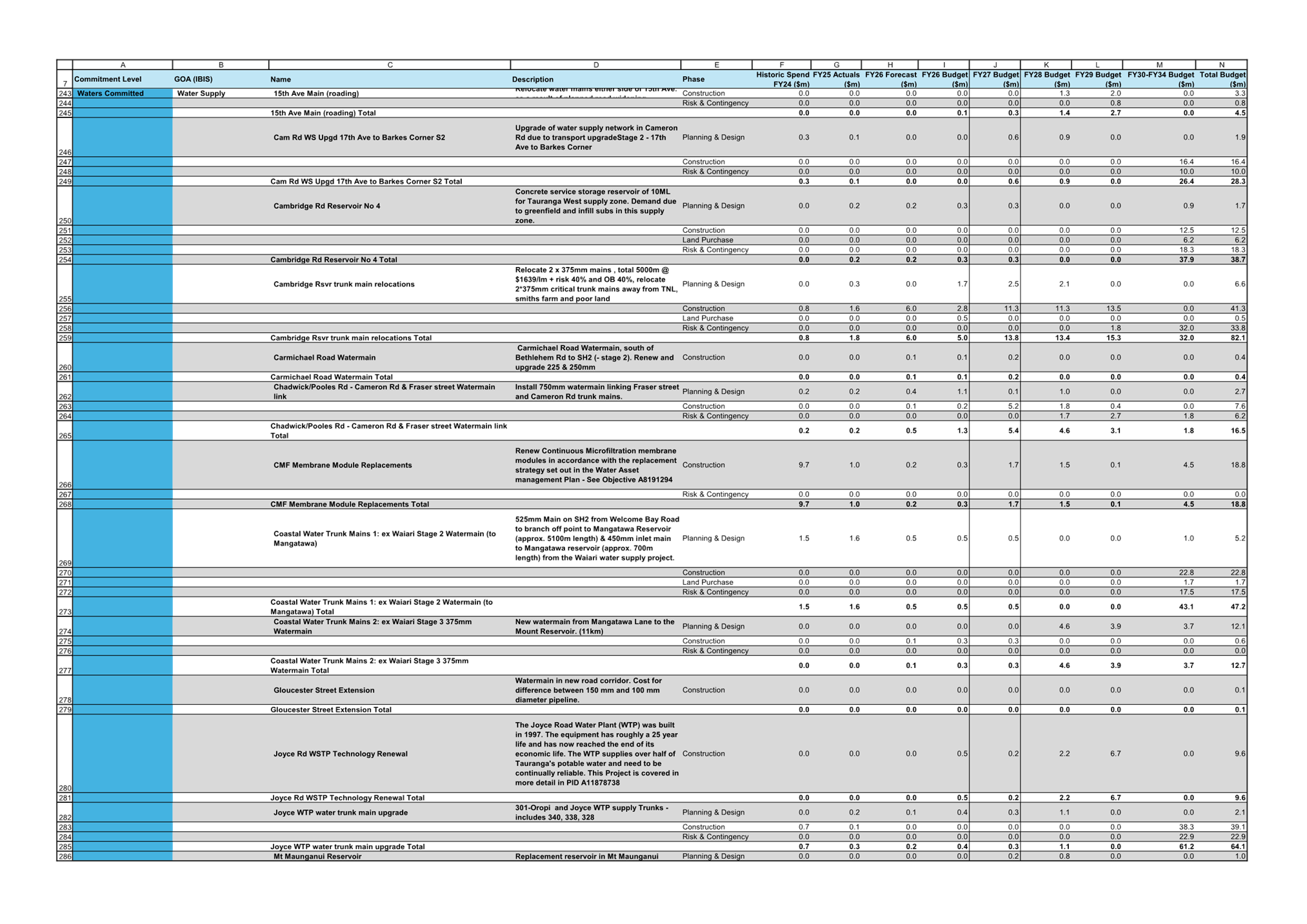
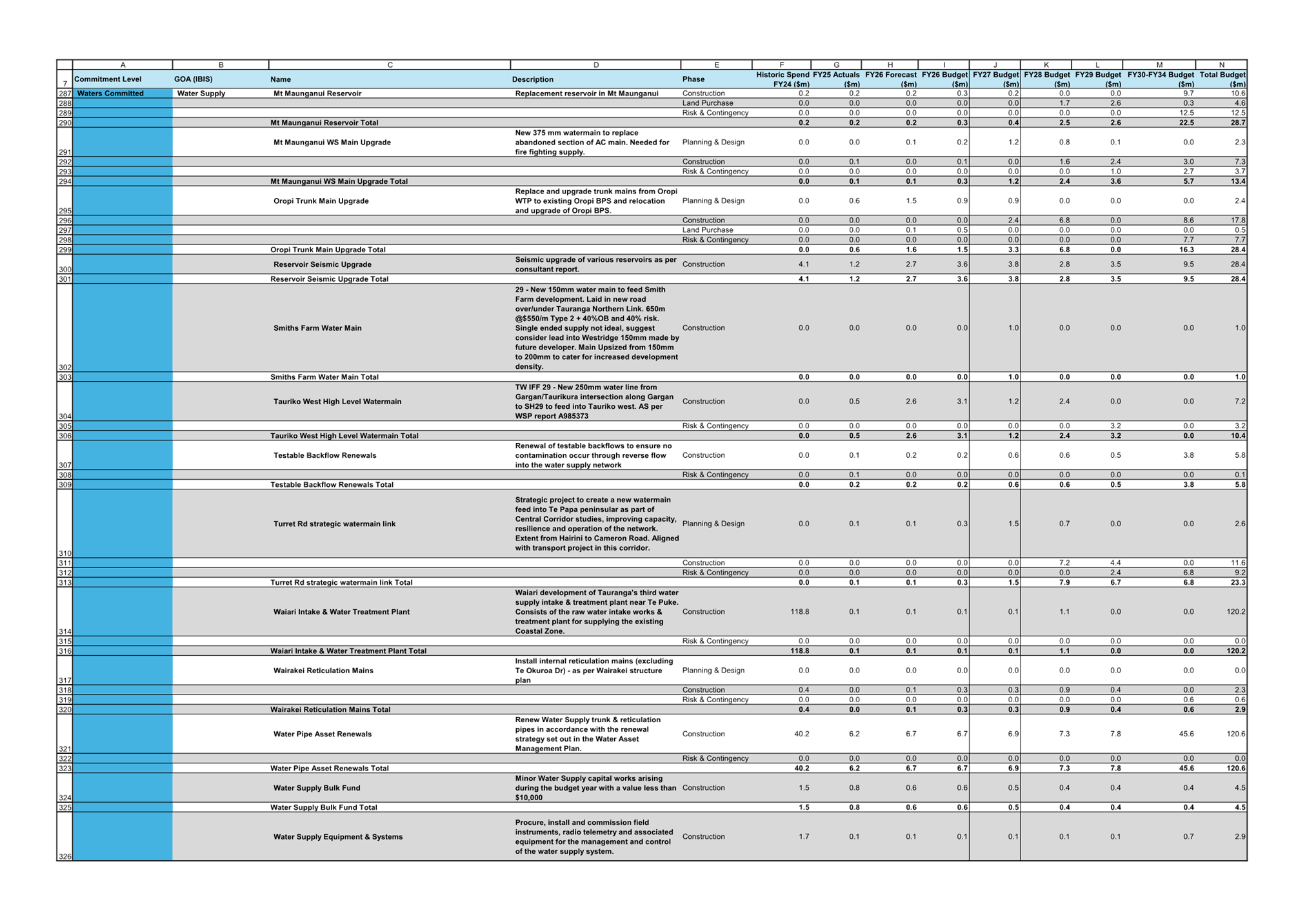
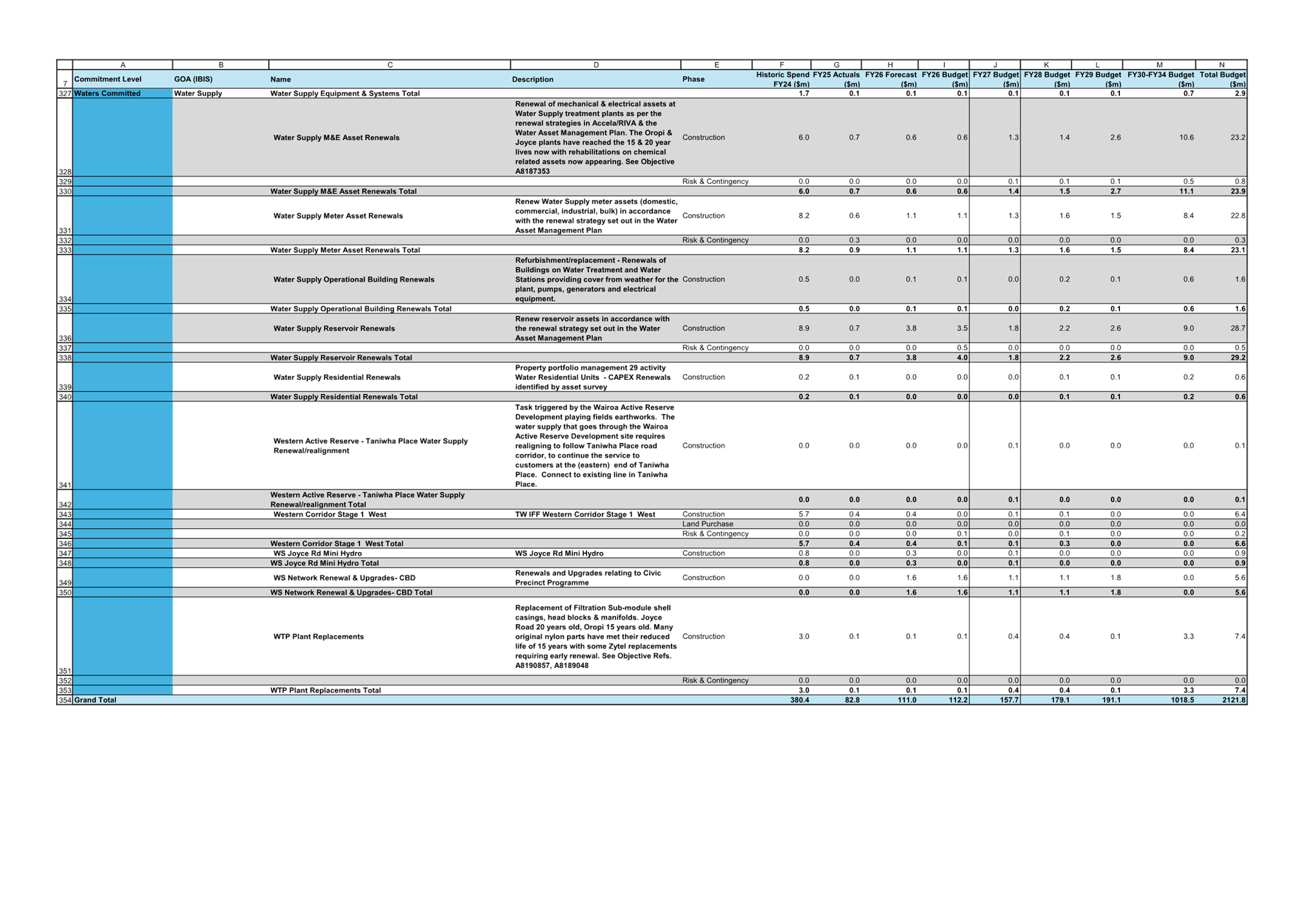
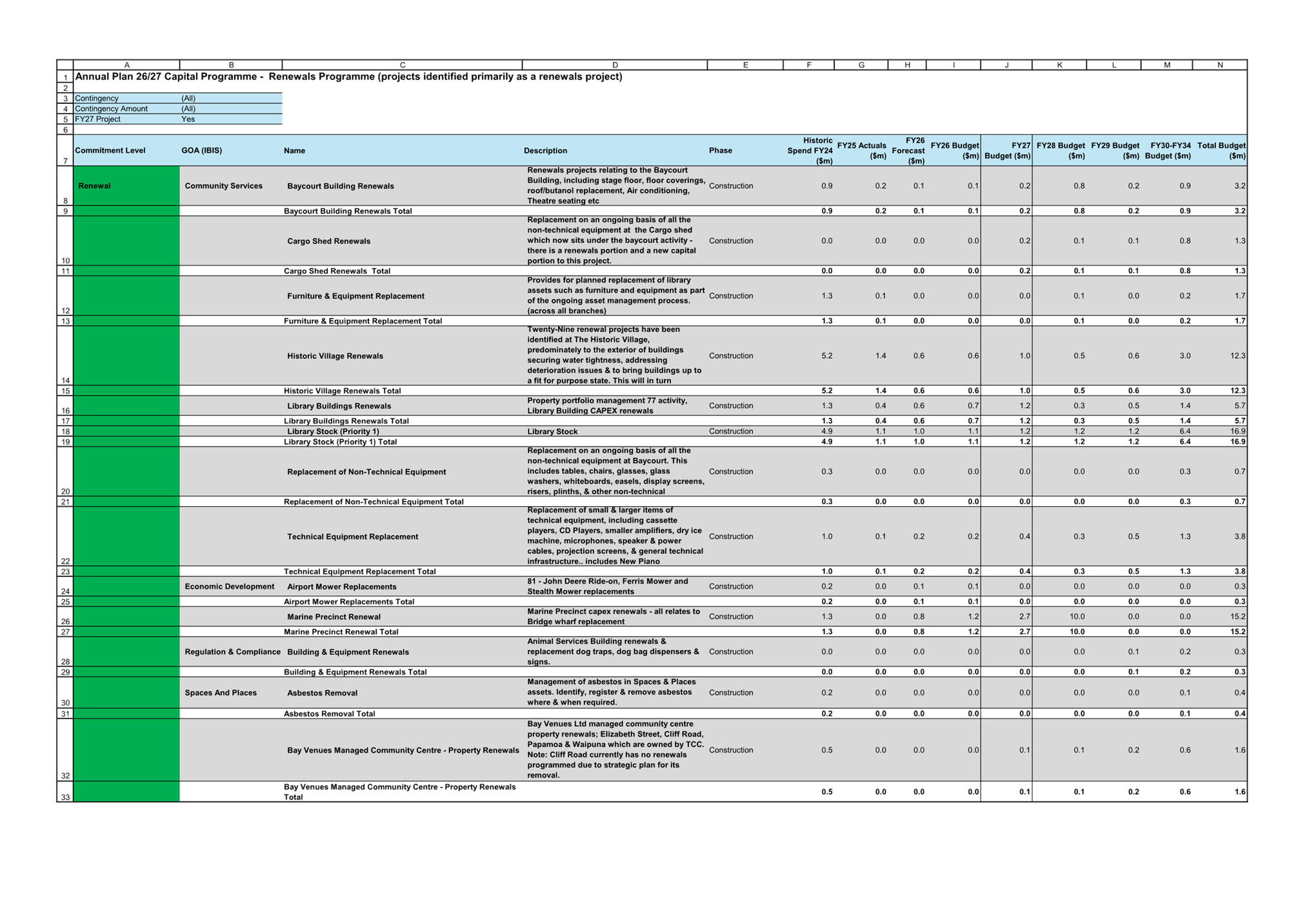
4. Capital
Projects to be prioritised - A19729846 ⇩
5. Indicative
rates - A19729372 ⇩
6. Pathway
to 7.5% - A19729336 ⇩
7. Salaries
and FTE Reconciliation - A19729459 ⇩
8. Operational
Revenue and Expense including 3 Waters out - A19729982 ⇩