|

|
|
AGENDA
City Delivery Committee meeting
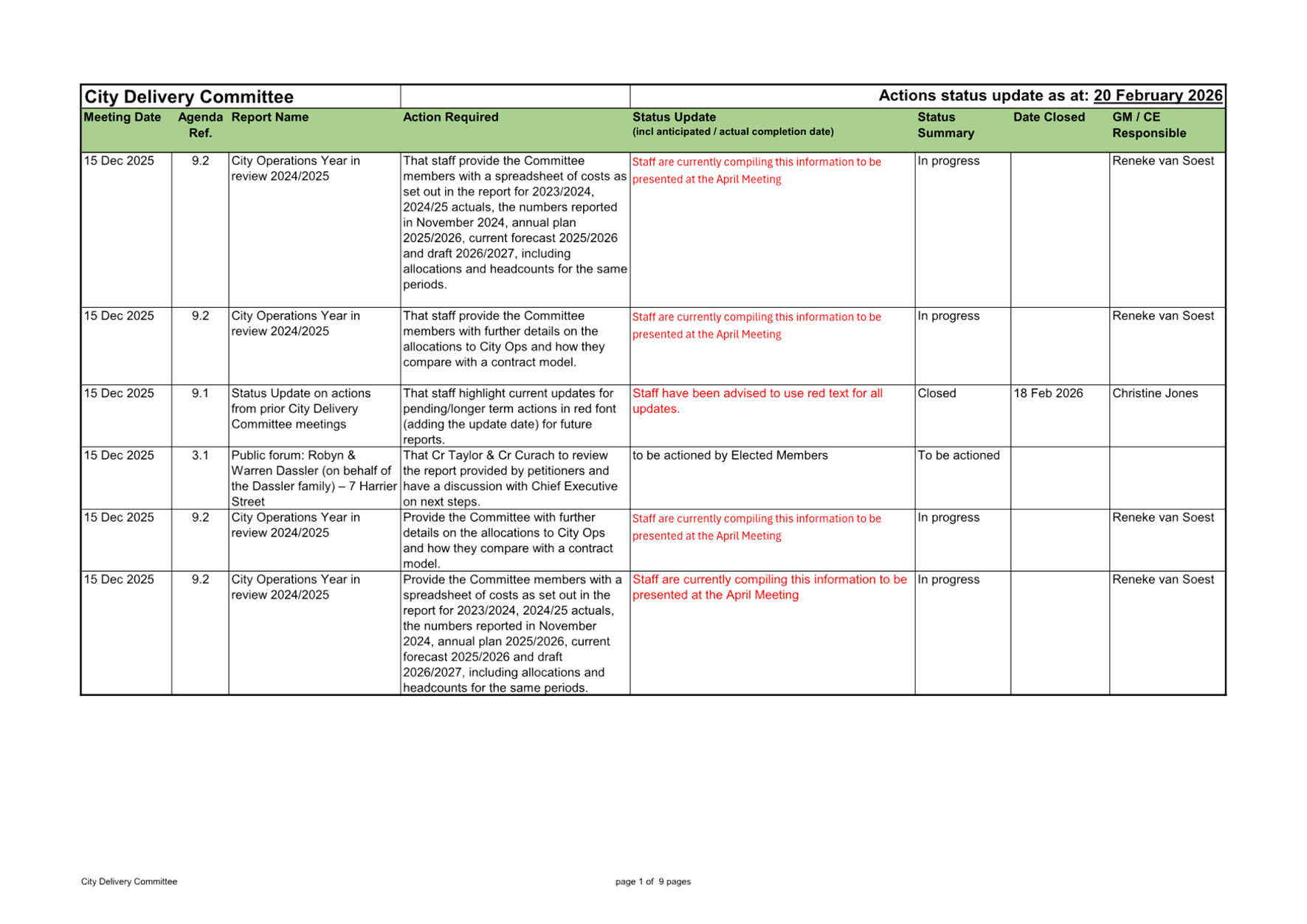
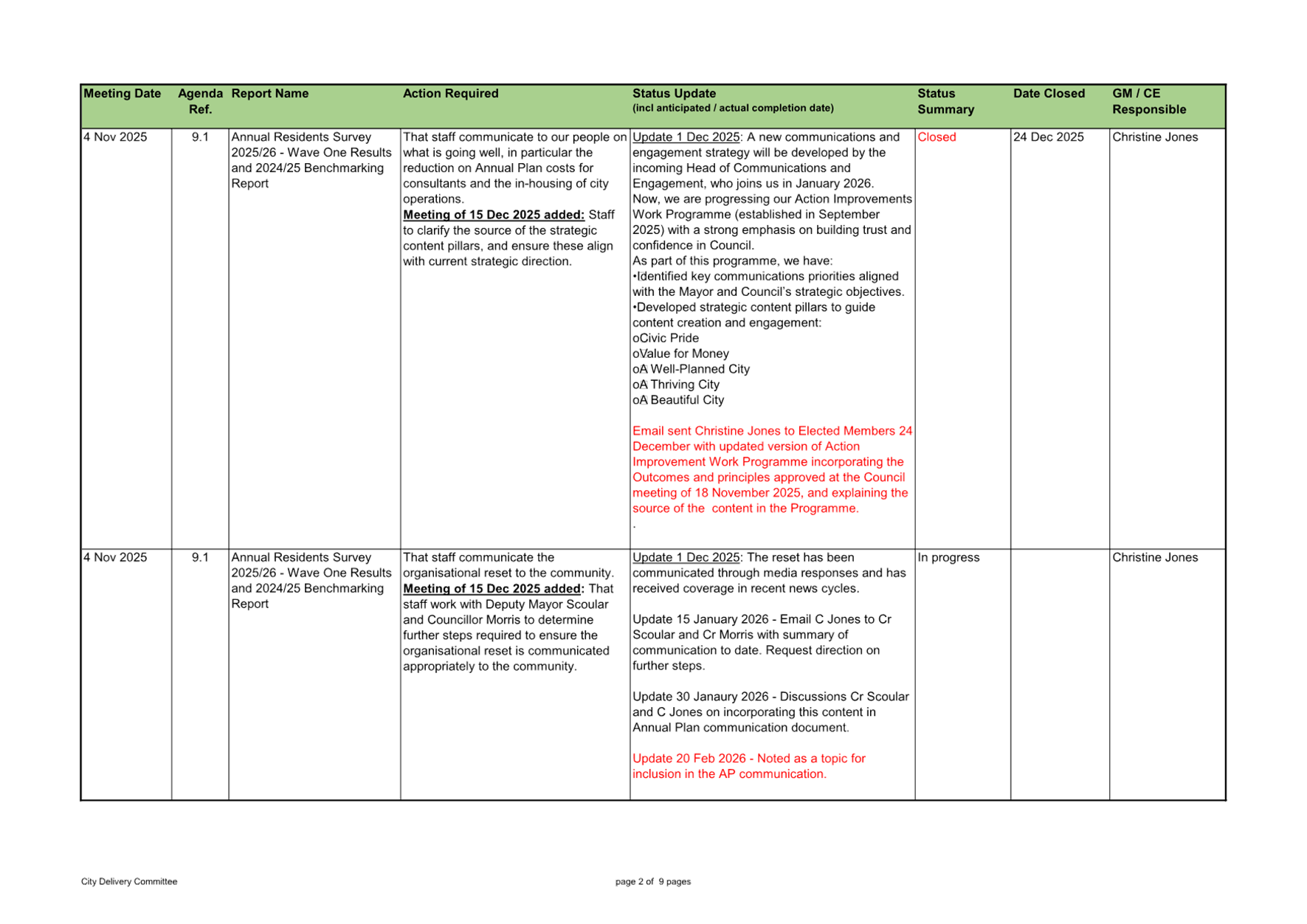
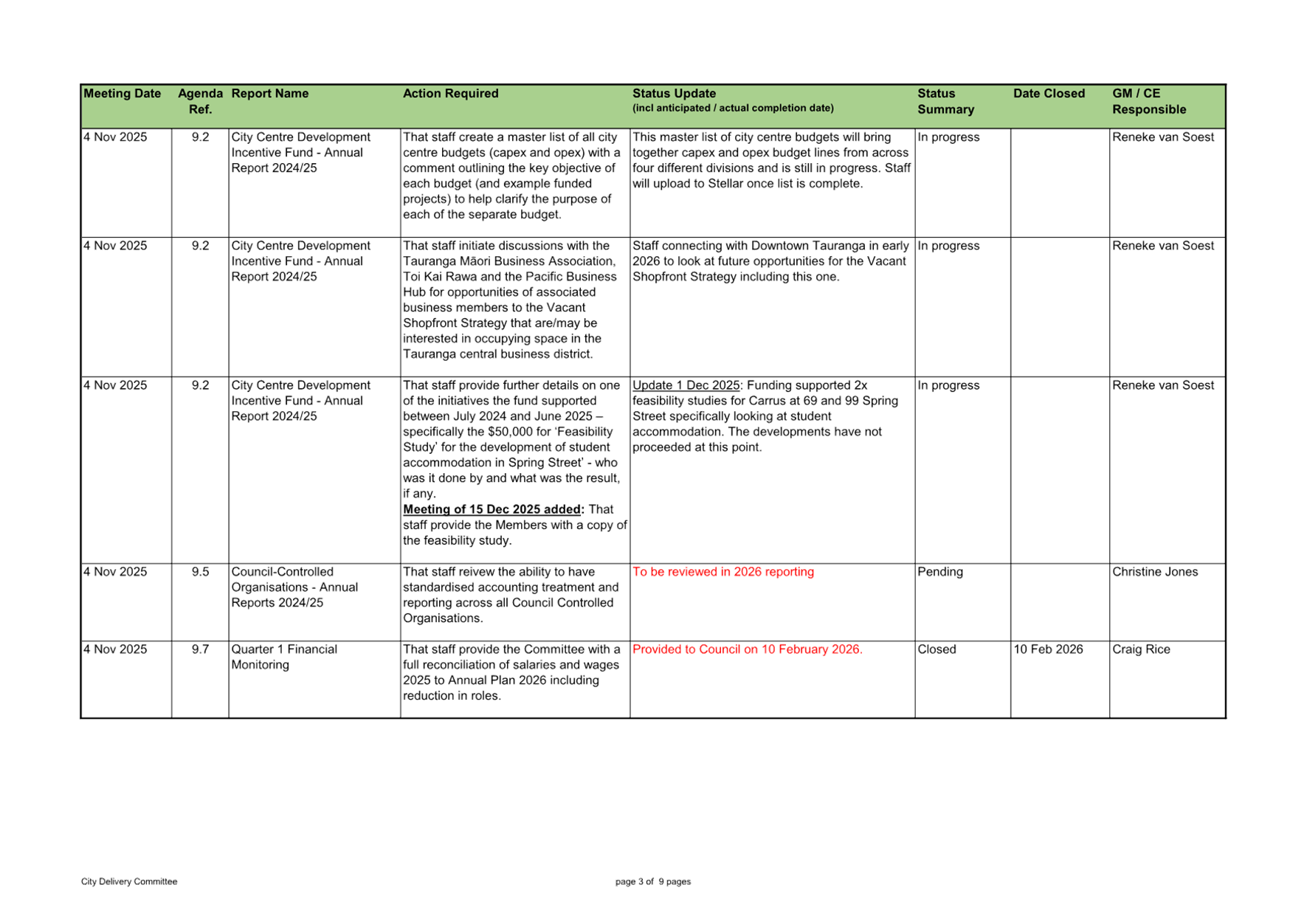
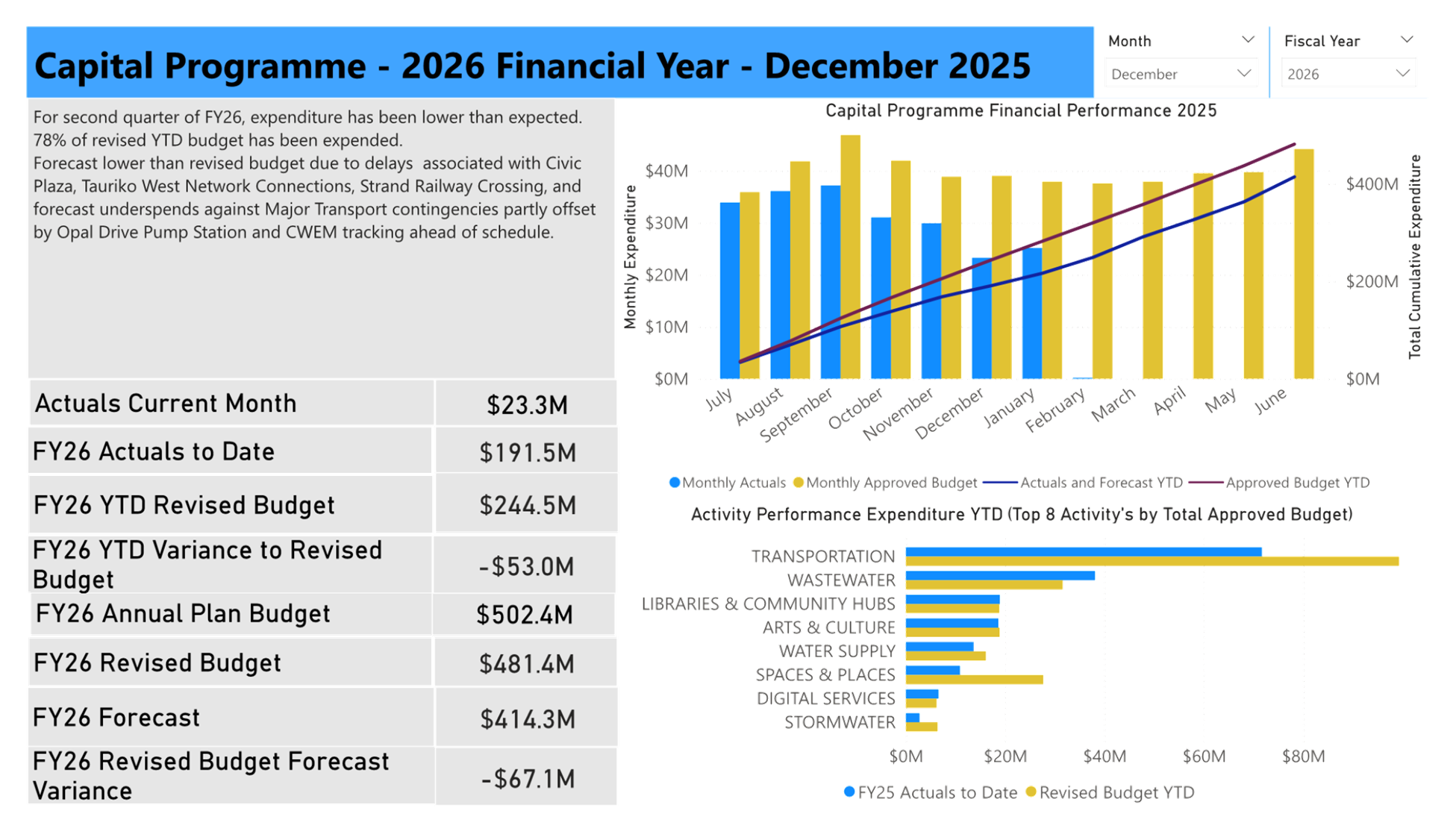
Tuesday, 10 March 2026
|
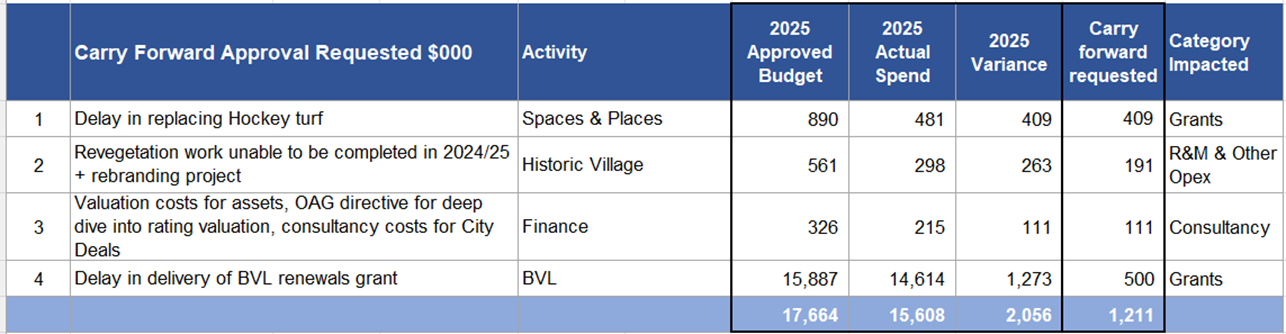
|
I hereby give notice that a City Delivery Committee
meeting will be held on:
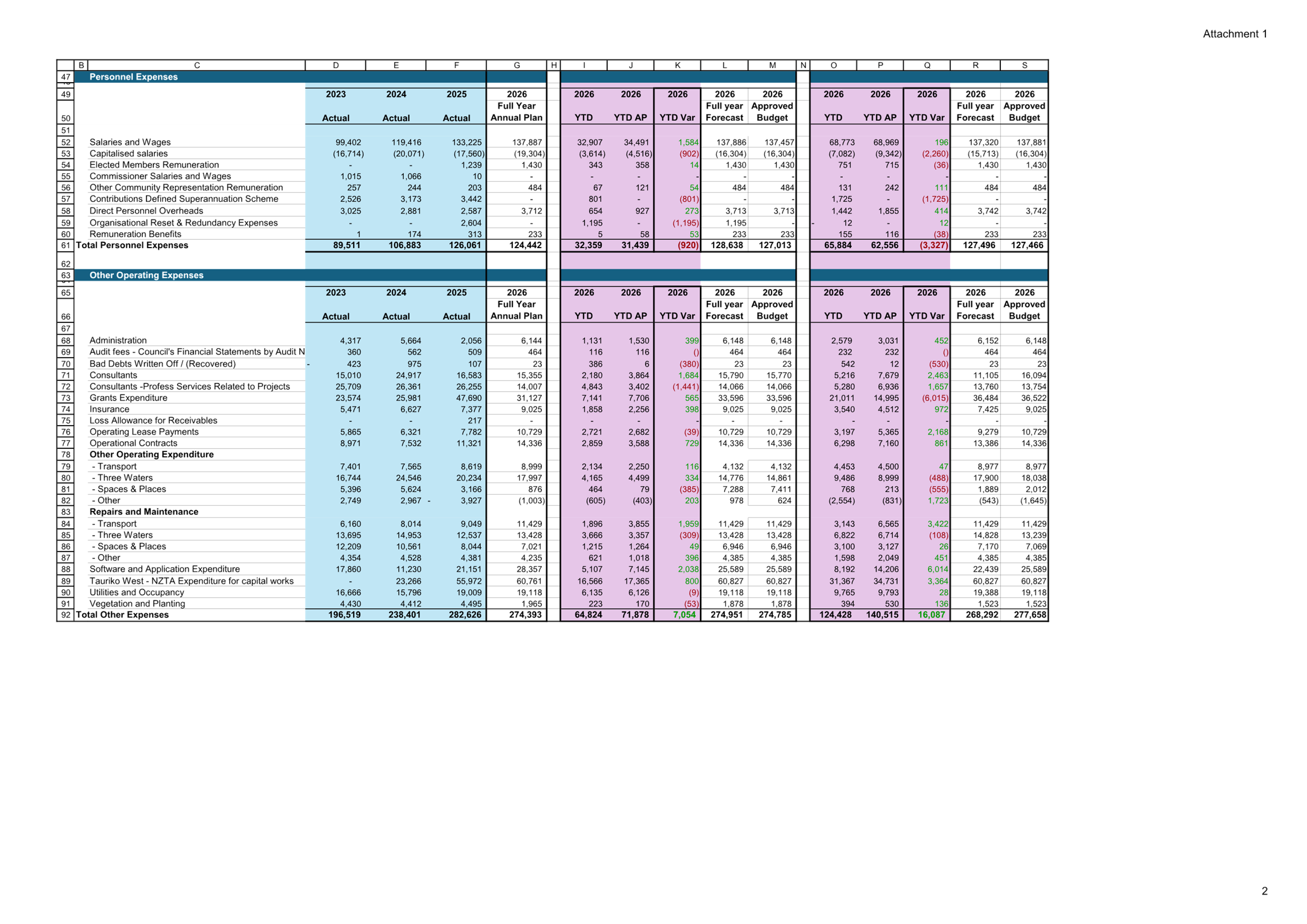
|
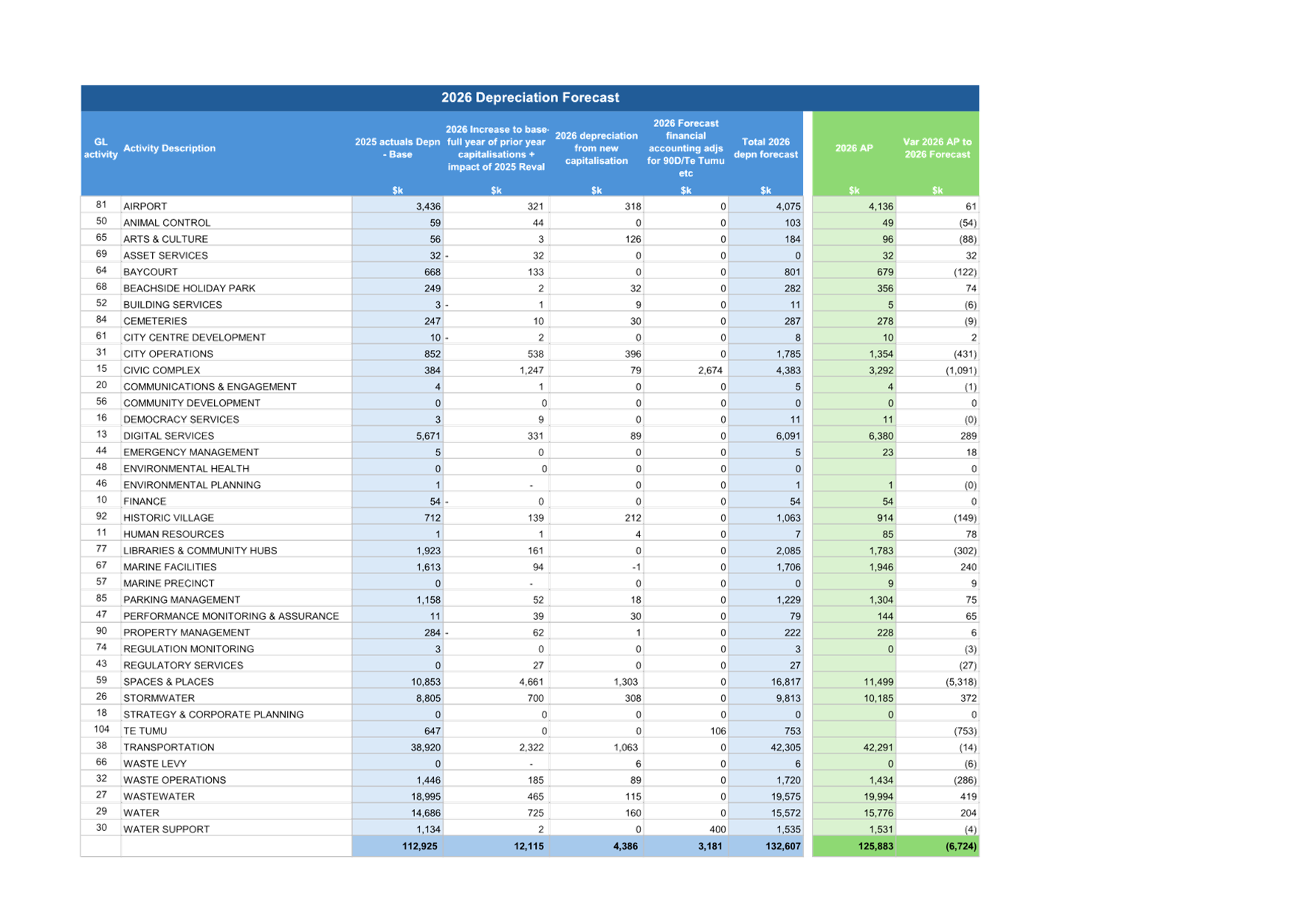
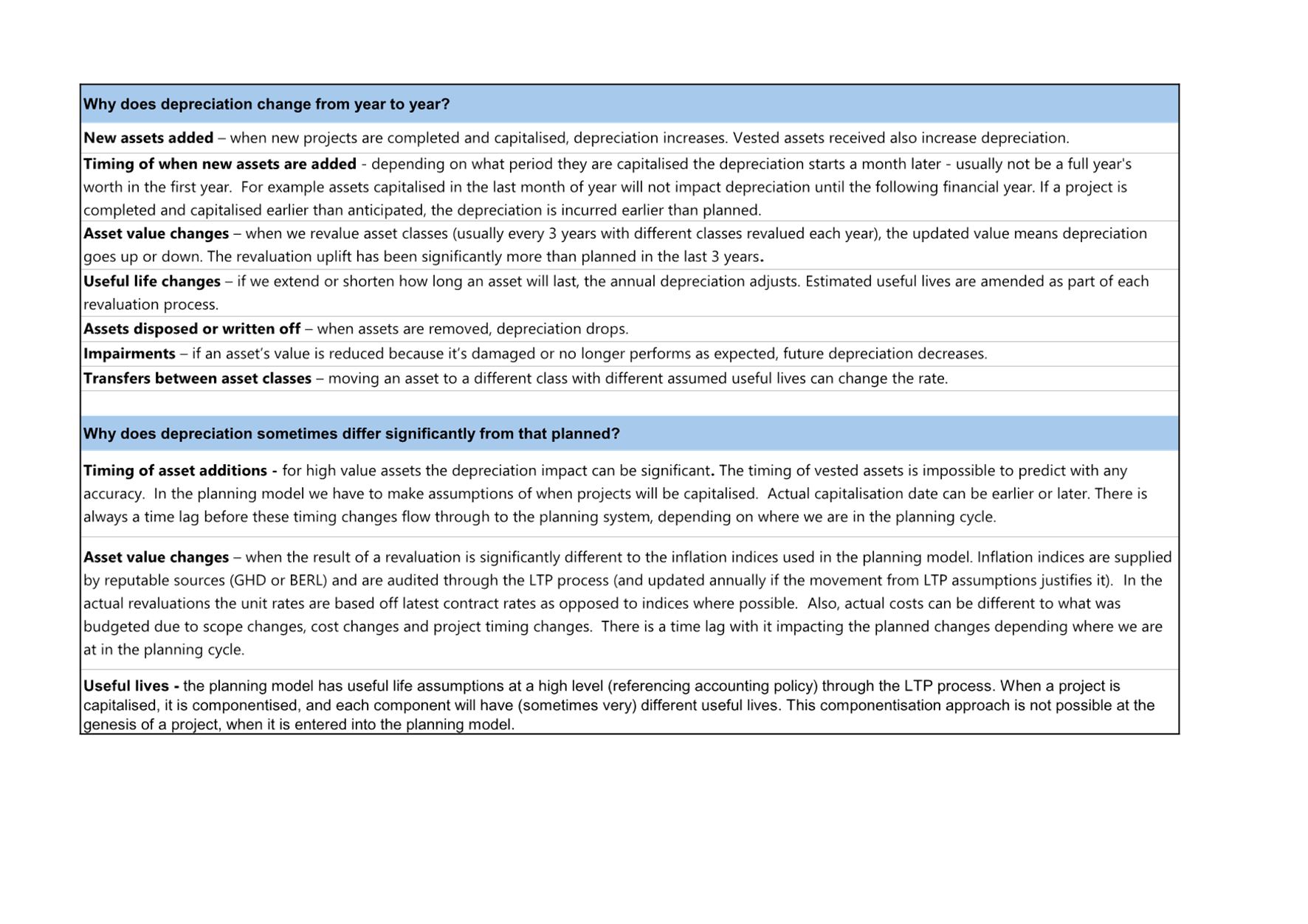
|
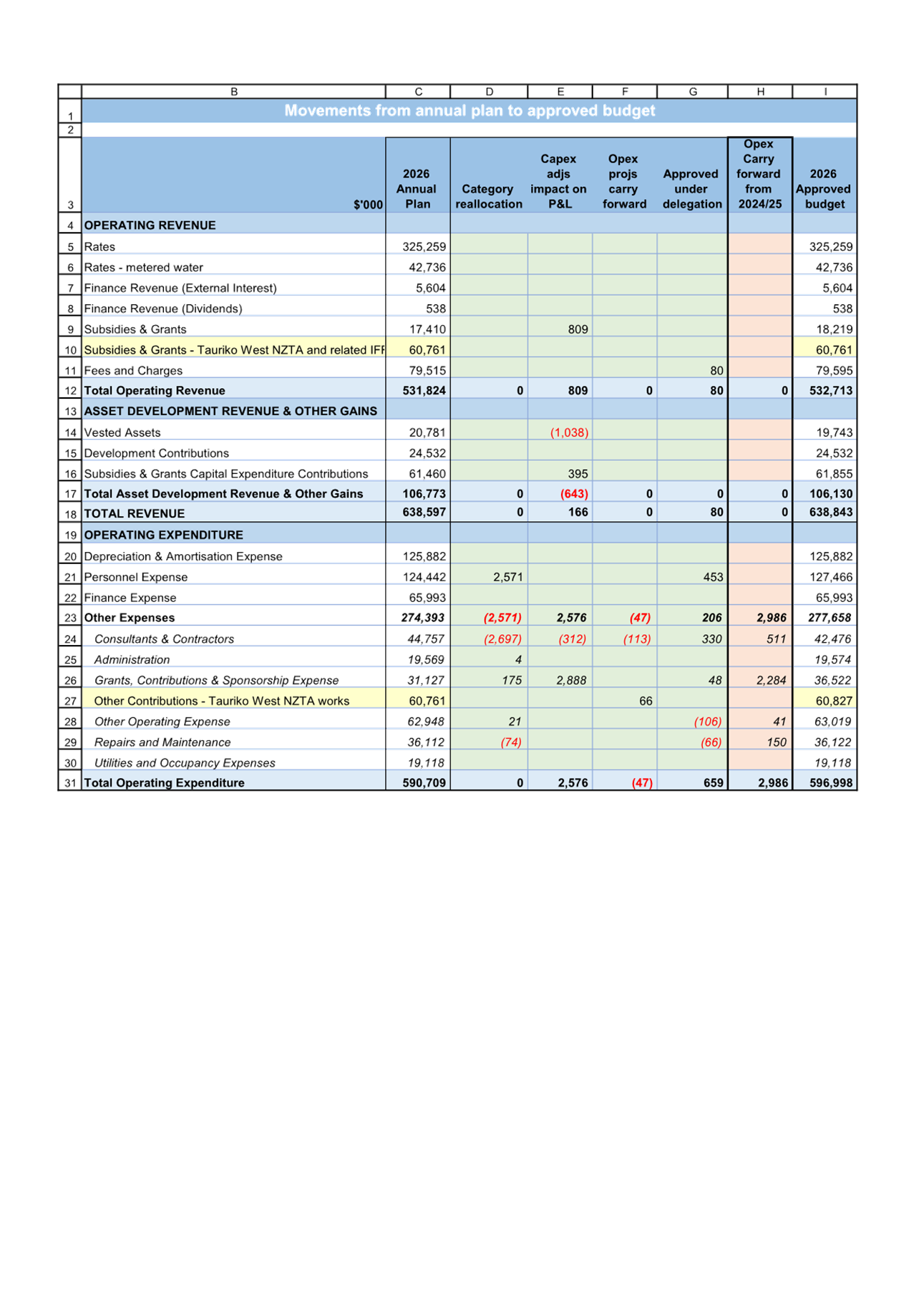
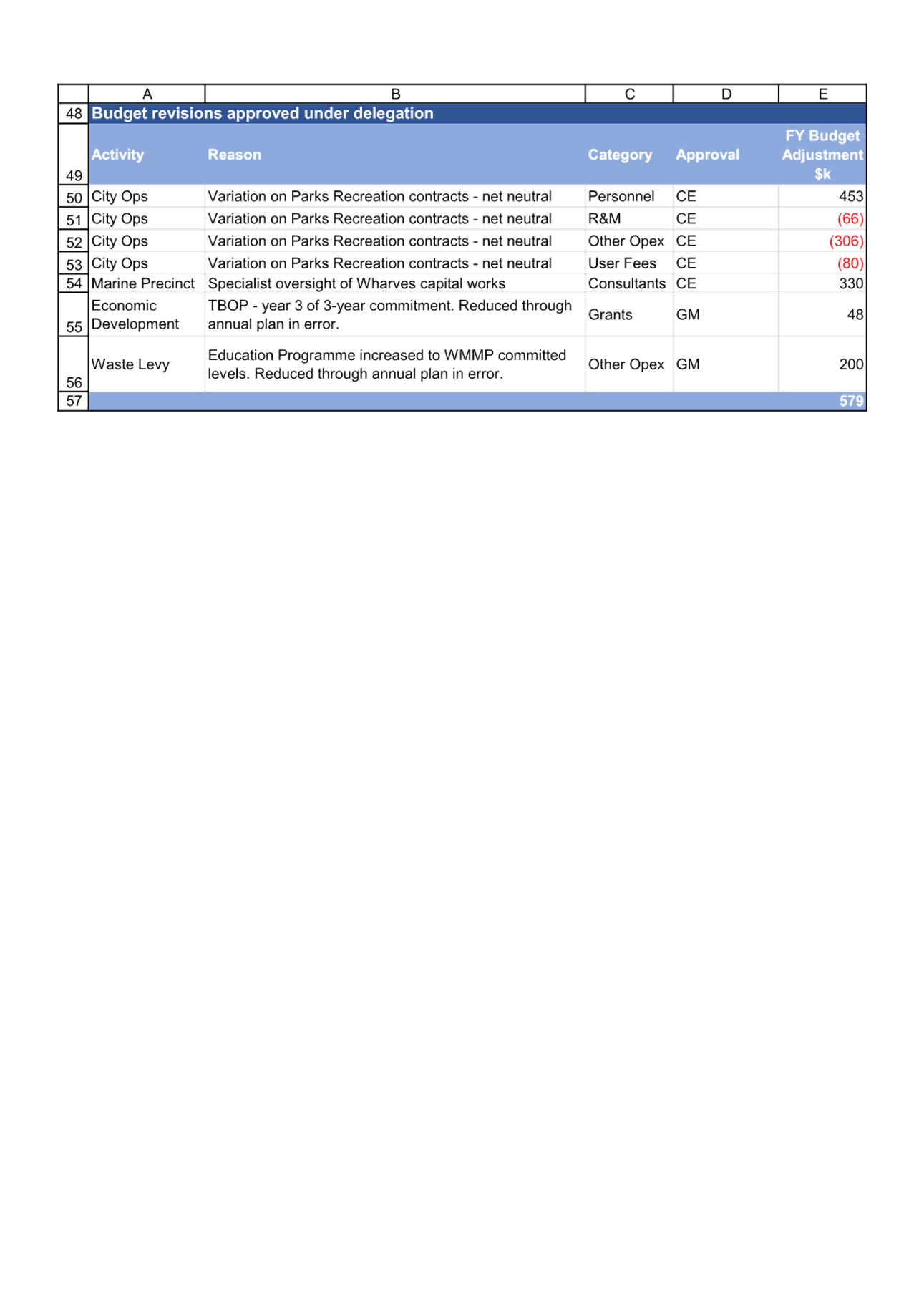
Date:
|
Tuesday, 10 March 2026
|
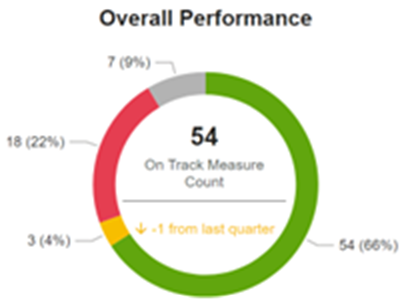
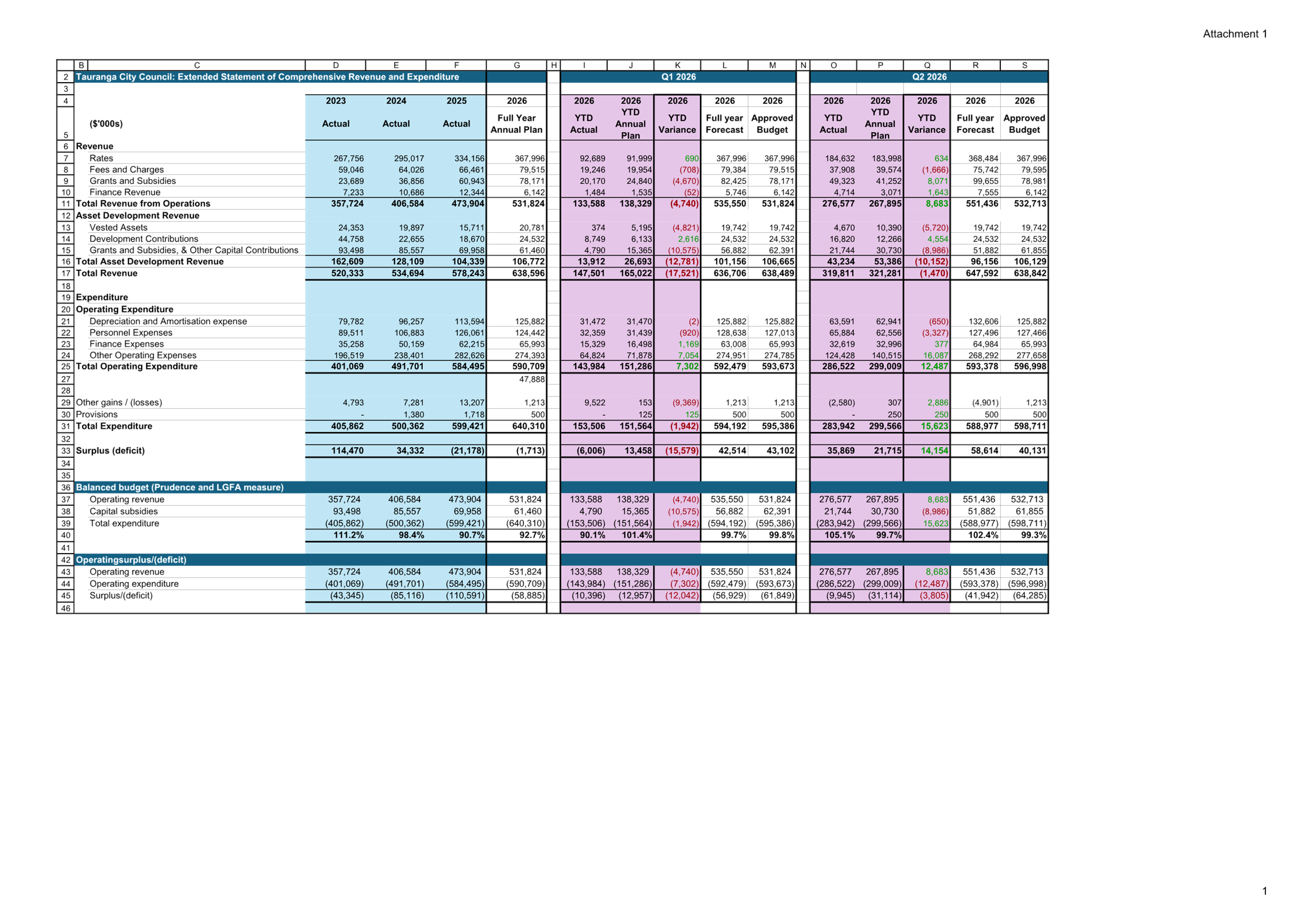
|
Time:
|
9:30 am
|
|
Location:
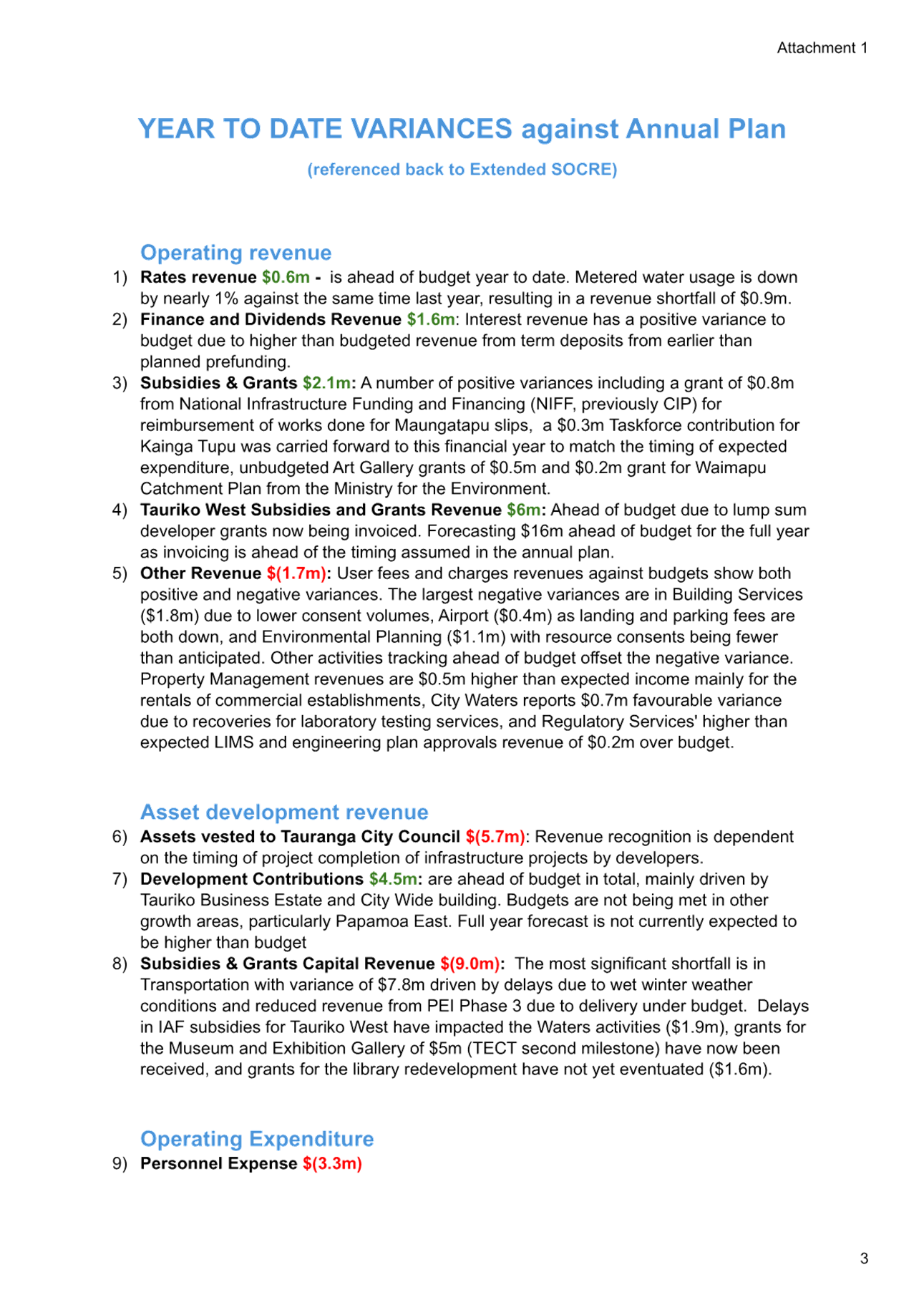
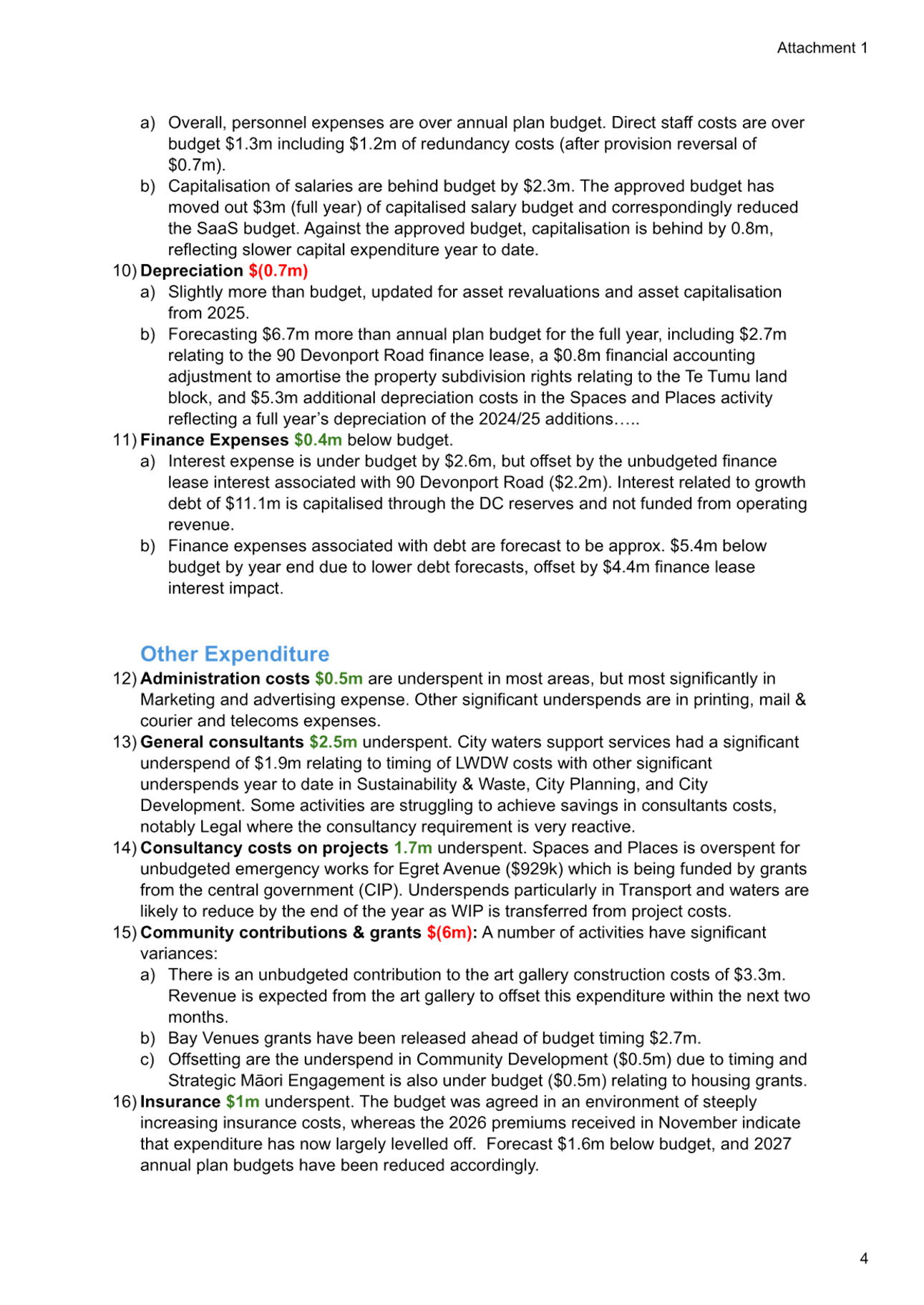
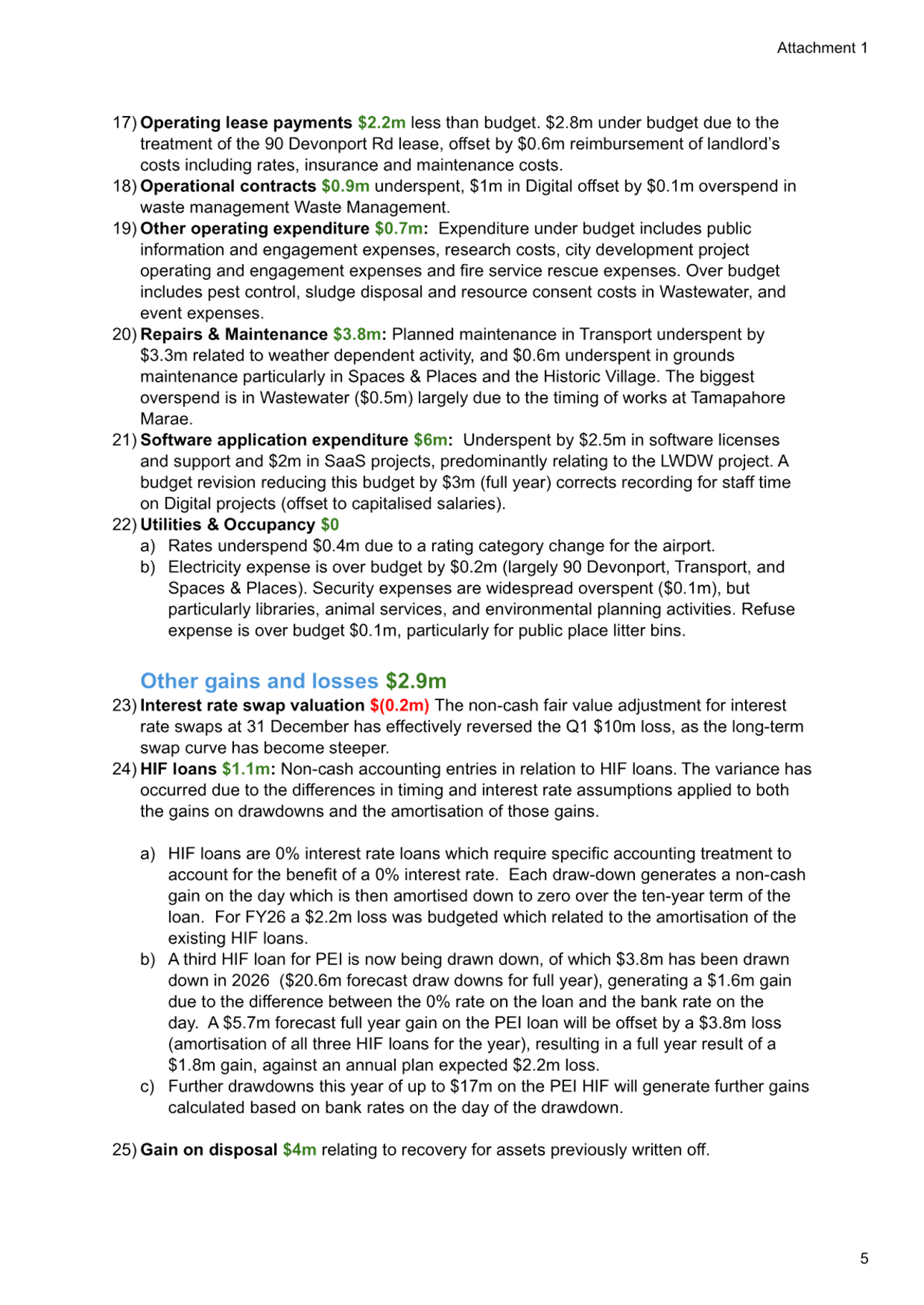
|
Tauranga City Council Chambers
Level 1 - 90 Davenport Road
Tauranga
|
|
Please note that this
meeting will be livestreamed and the recording will be publicly available on
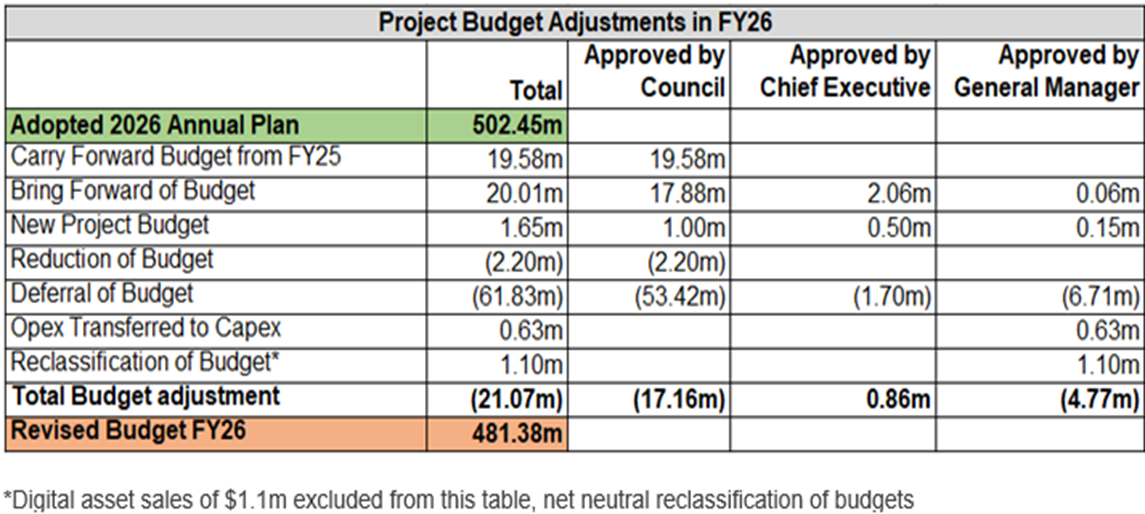
Tauranga City Council's website: www.tauranga.govt.nz.
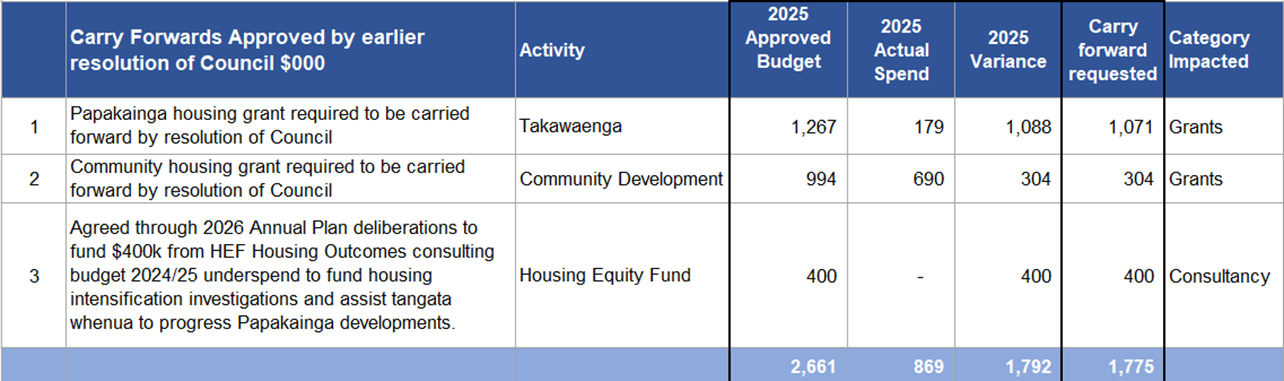
|
|
Marty Grenfell
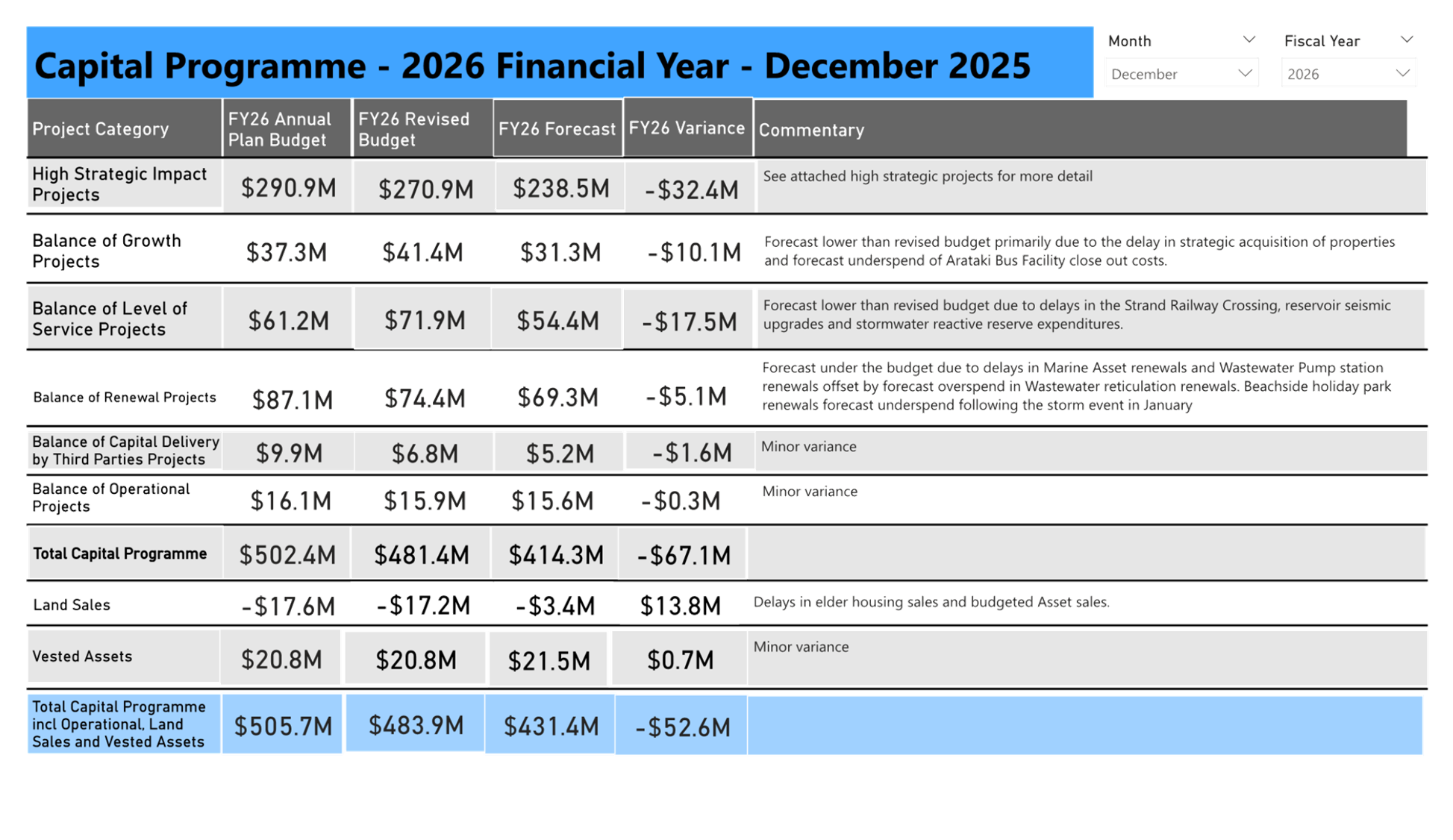
Chief Executive
|
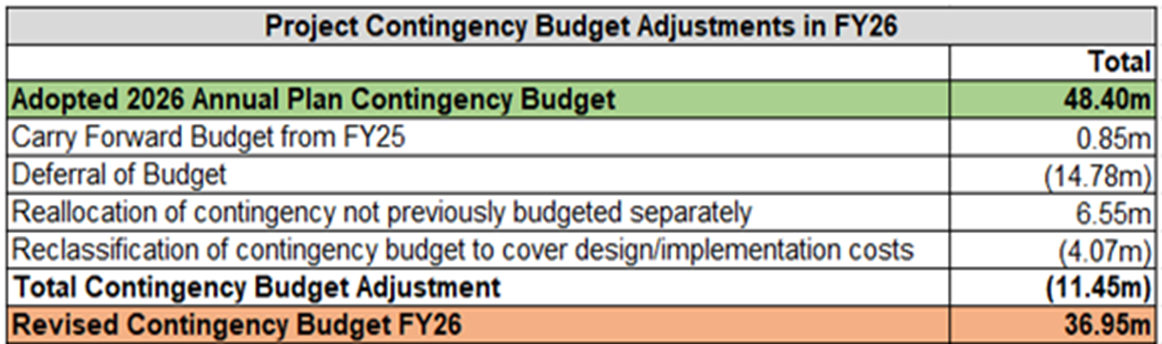
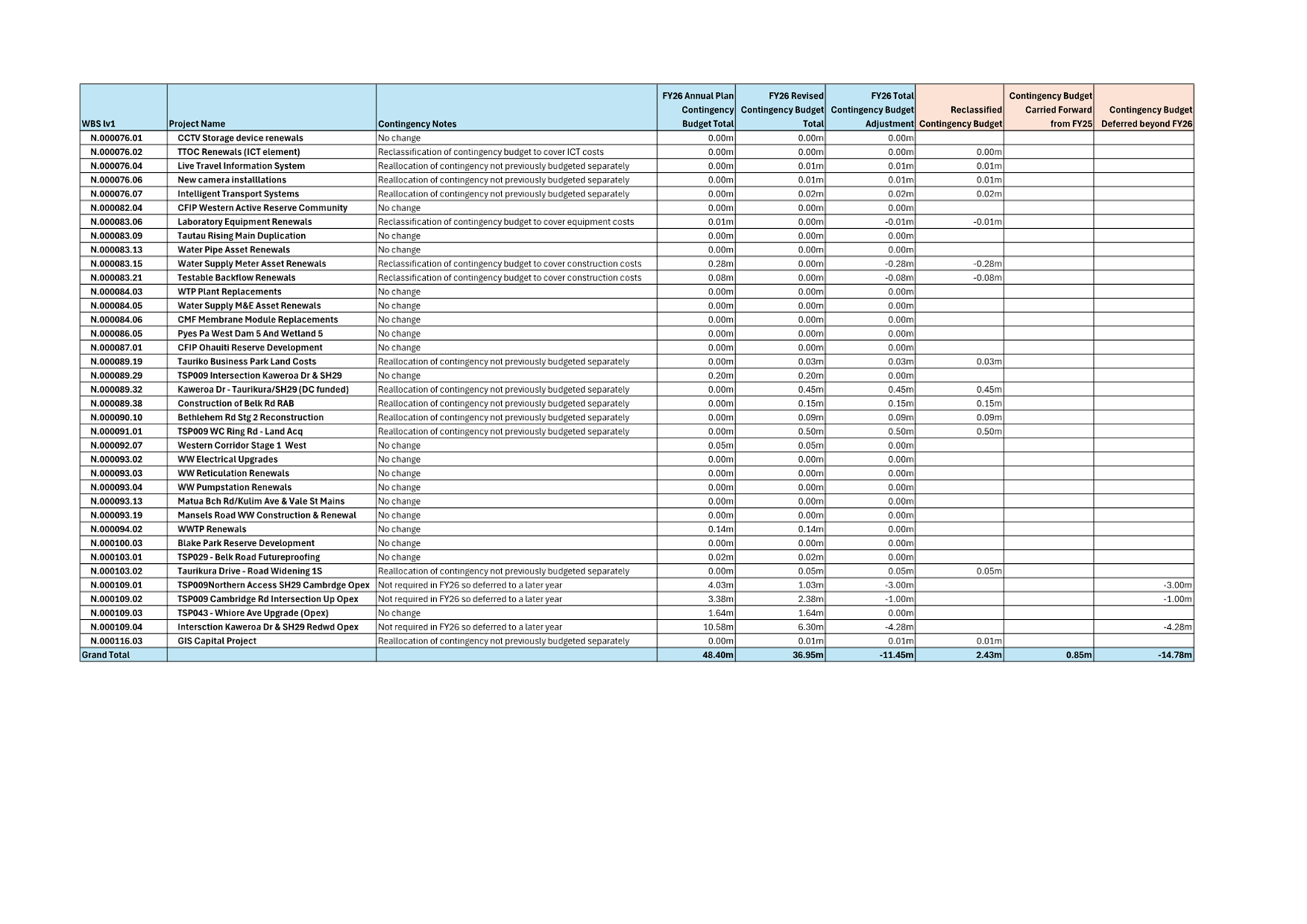
Terms of reference – City Delivery Committee
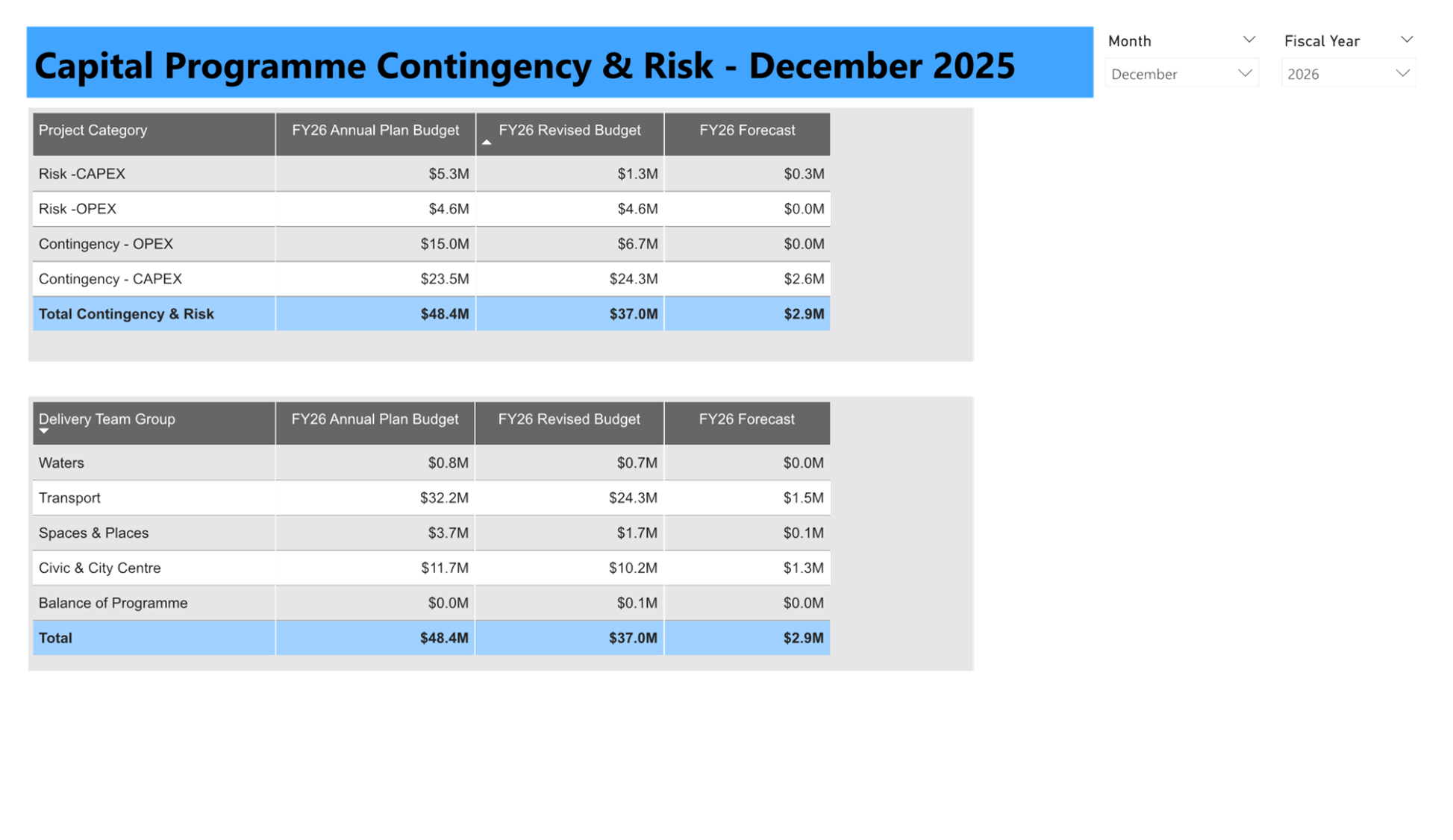
Common
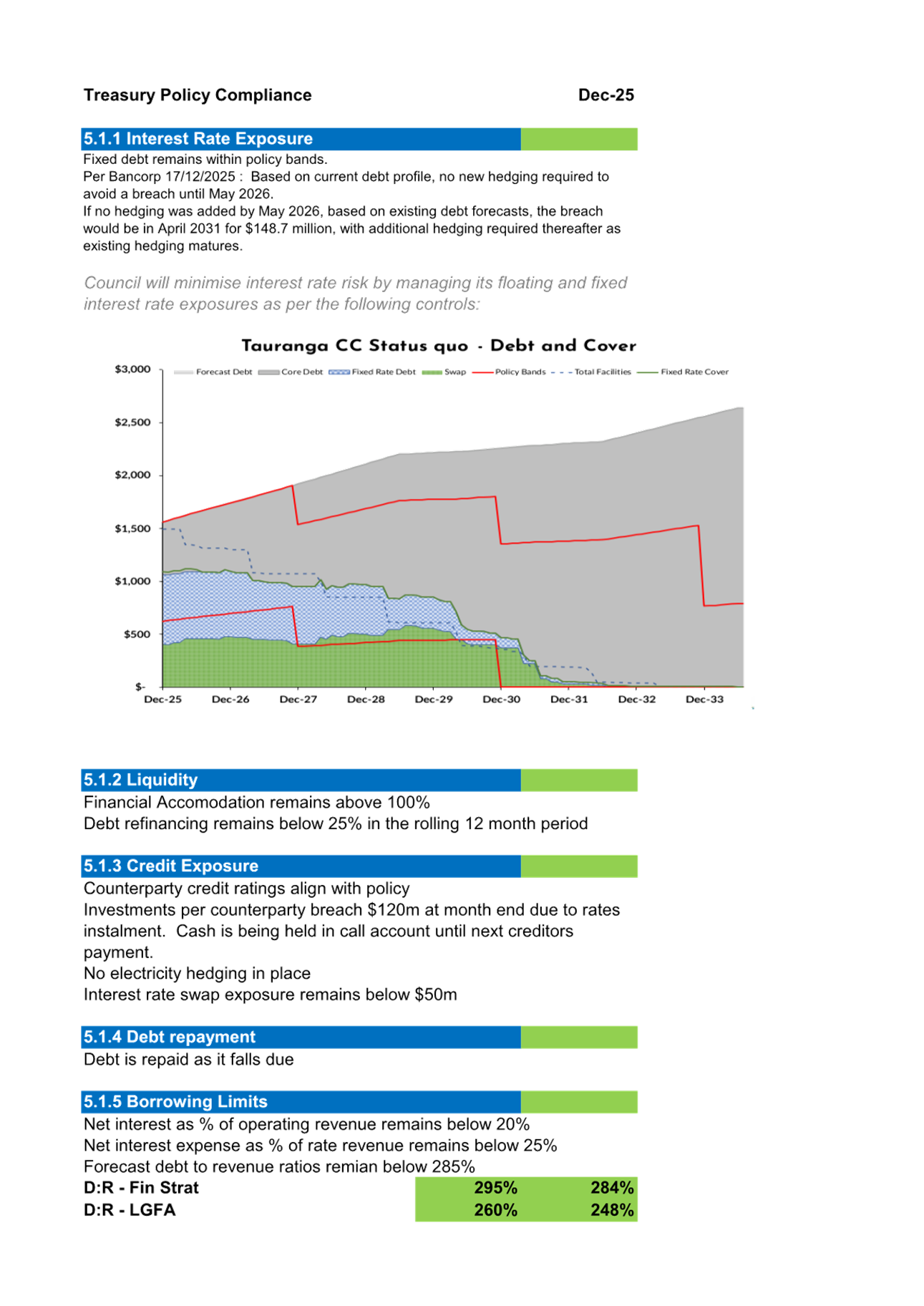
responsibility and delegations
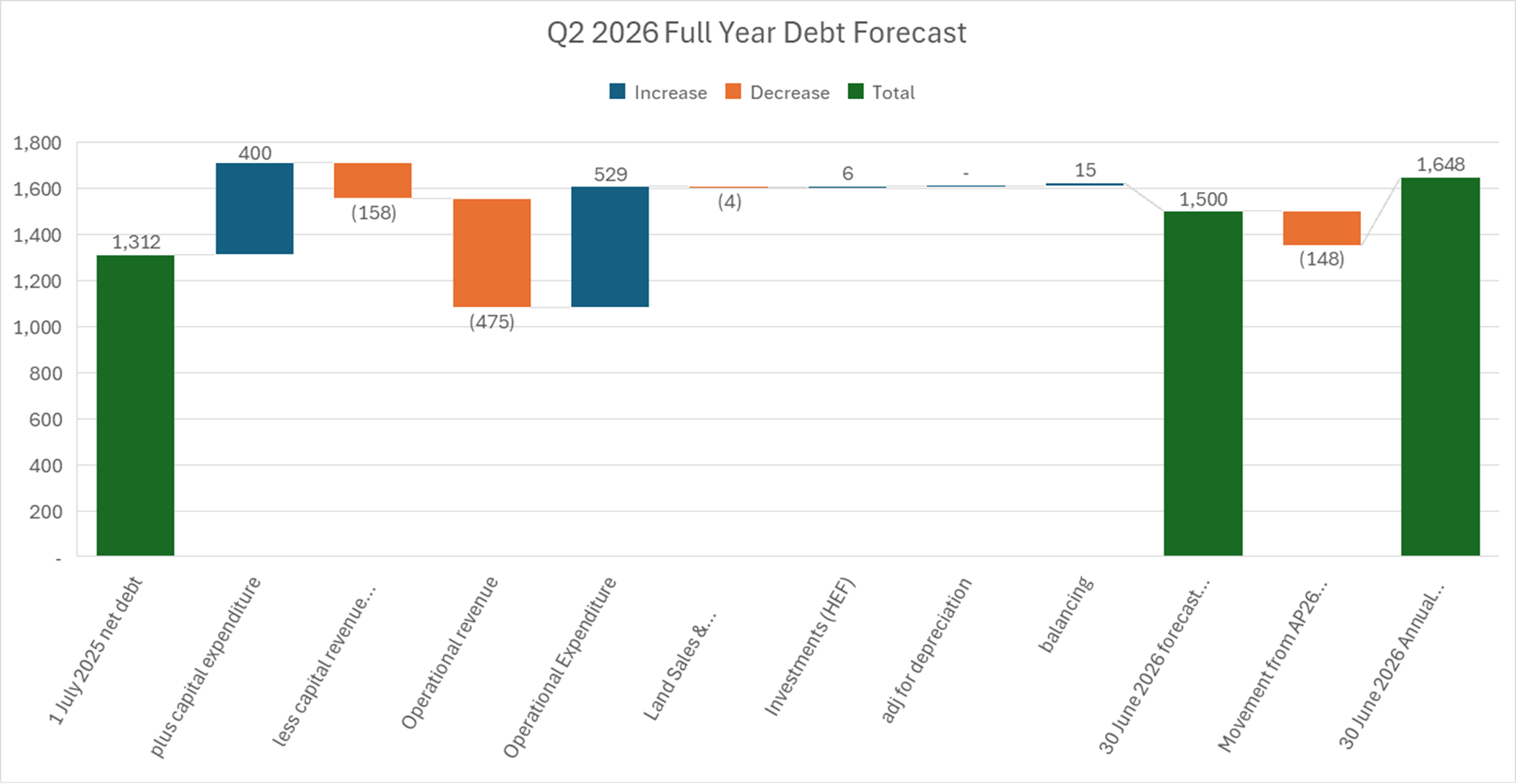
The following common responsibilities and delegations apply
to all standing committees.
Responsibilities of standing committees
· Establish priorities and guidance on programmes relevant to the Role
and Scope of the committee.
· Provide guidance to staff on the development of investment options
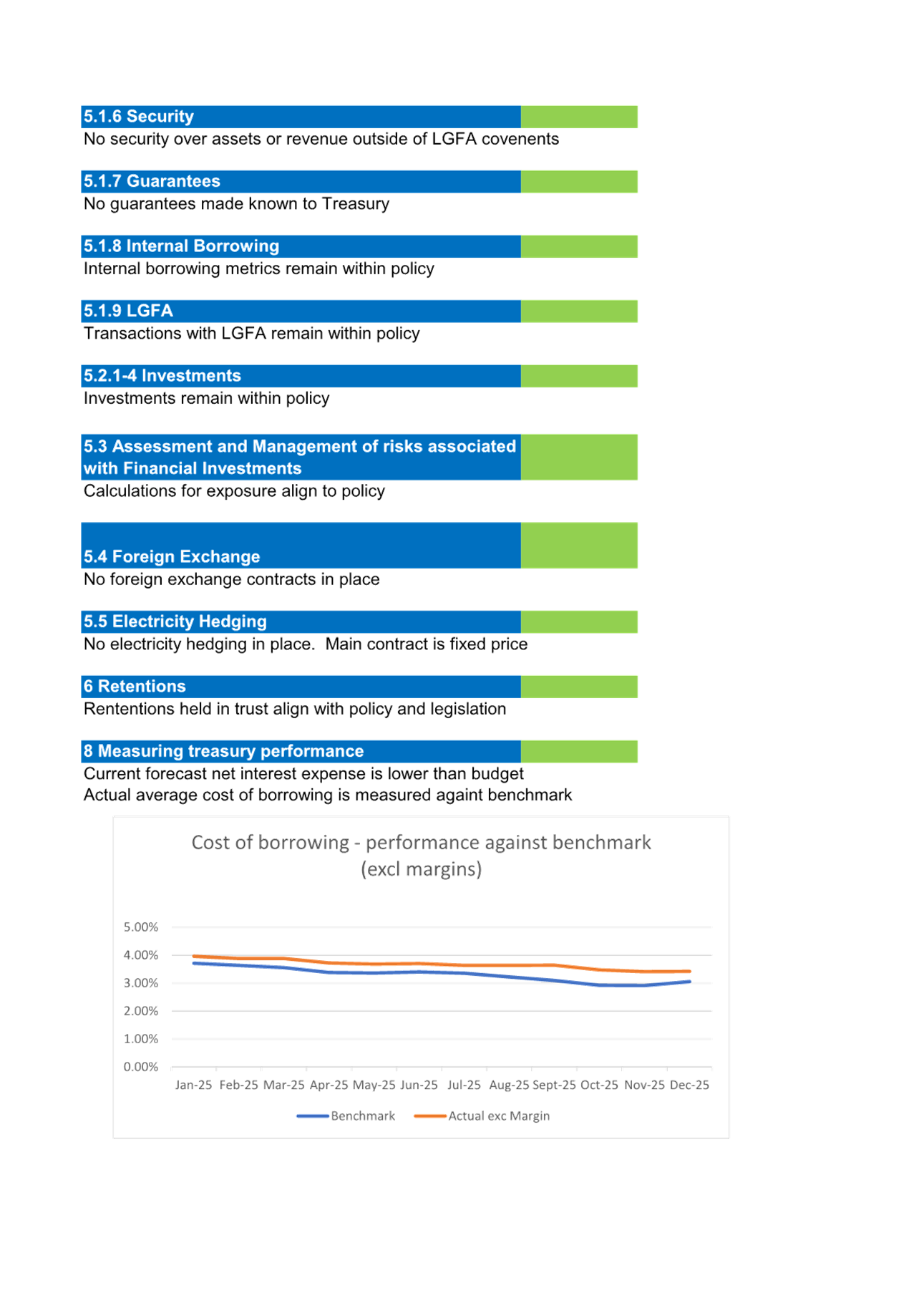
to inform the Long Term Plan and Annual Plans.
· Report to Council on matters of strategic importance.
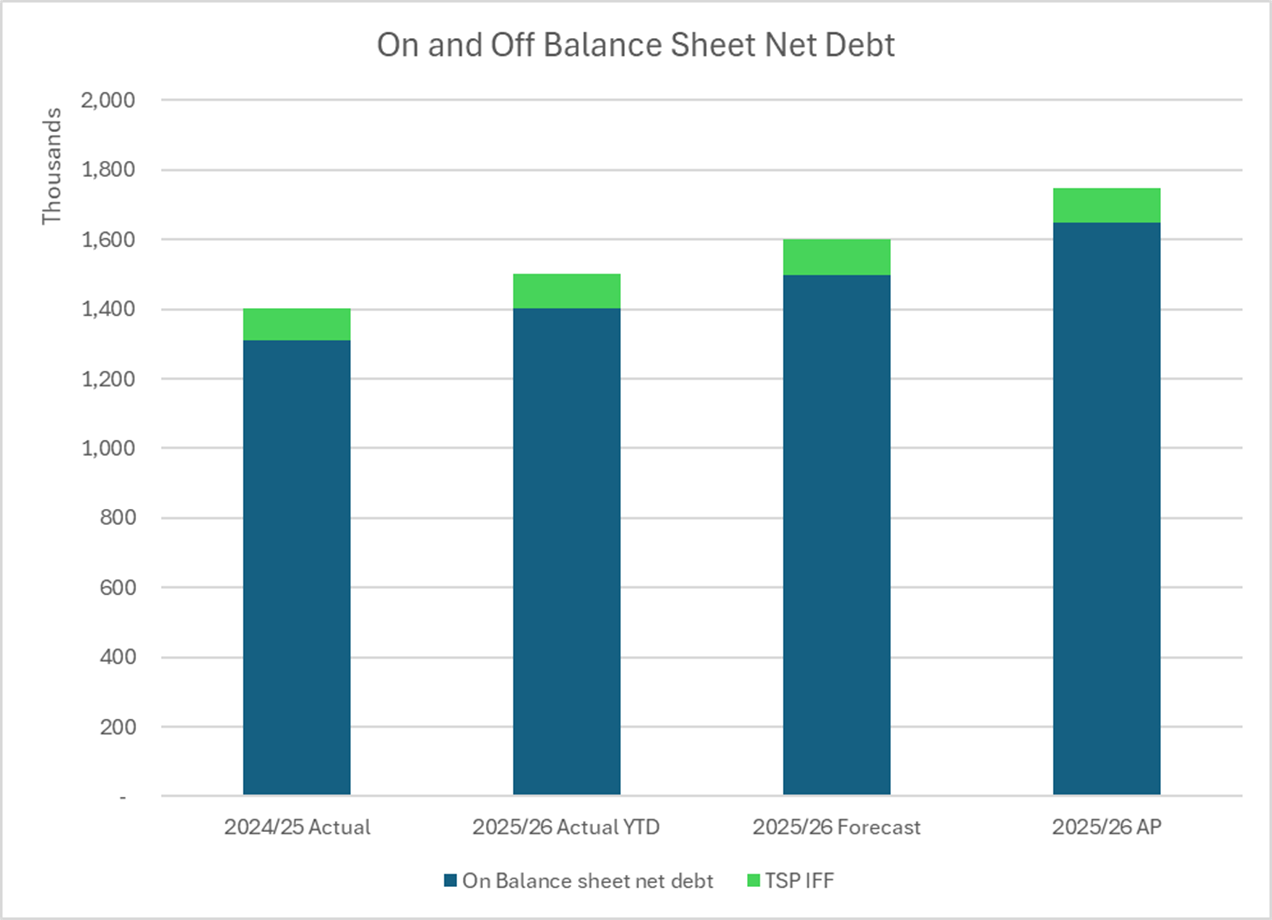
· Recommend to Council investment priorities and lead Council
considerations of relevant strategic and high significance decisions.
· Provide guidance to staff on levels of
service relevant to the role and scope of the committee.
· Establish and participate in relevant task forces and working
groups.
· Engage in dialogue with strategic partners, such as Smart Growth
partners, to ensure alignment of objectives and implementation of agreed
actions.
· Confirmation of committee minutes.
Delegations to standing committees
· To make recommendations to Council outside of the delegated
responsibility as agreed by Council relevant to the role and scope of the
Committee.
· To make all decisions necessary to fulfil the role and scope of the
Committee subject to the delegations/limitations imposed.
· To develop and consider, receive submissions on and adopt
strategies, policies and plans relevant to the role and scope of the committee,
except where these may only be legally adopted by Council.
· To consider, consult on, hear and make determinations on relevant
strategies, policies and bylaws (including adoption of drafts), making
recommendations to Council on adoption, rescinding and modification, where
these must be legally adopted by Council.
· To approve relevant submissions to central government, its agencies
and other bodies beyond any specific delegation to any particular committee.
· Engage external parties as required.
Terms of reference – City Delivery
Committee
Membership
|
Chair
|
Deputy
Mayor Jen Scoular
|
|
Deputy chair
|
Cr
Kevin Schuler
|
|
Members
|
Mayor Mahé Drysdale (ex officio)
Jacqui Rolleston-Steed - Tangata Whenua Representative
|
|
Non-voting members
|
(if any)
|
|
Quorum
|
Half of the members
present, where the number of members (including vacancies) is even;
and a majority of the members present, where the number of members
(including vacancies) is odd.
|
|
Meeting frequency
|
Six weekly
|
Role
The role of the City Delivery Committee is:
·
To ensure and report delivery against agreed
targets and benchmarks across capital investment, operating activity, and
engagement.
·
To ensure community involvement in, and support for, Council
projects, proposals, initiatives and services.
·
To monitor delivery of activity by community-led organisations
receiving Council funding, partnering with, or otherwise contracted to,
Council.
·
To determine the reporting frequency for financial performance
targets across the organisation, and to measure and regularly report on
delivery against those.
·
To review and improve public confidence and participation in
Council decision making processes.
·
To measure delivery of projects by ensuring that approved
projects are effectively planned and delivered in full, on time, in scope, and
within budget.
·
To determine the reporting frequency for performance measures for
non-financial activity and regularly report against those measures.
·
To ensure the Annual Report provides relevant, transparent and
accurate information.
Scope
·
All projects, both
capital and operating, where the business case has been approved are included
in the scope of the Delivery Committee.
·
Develop and monitor
delivery of a council-wide engagement and communications strategy.
·
Lead the development
of relationships with community organisations, schools, businesses and other
groups to broaden Council’s reach into the community and use of available
resources.
·
Receive and consider
feedback from the community including, but not limited to, the annual
residents’ survey.
·
Review statements of
intent and receive reporting of the Local Government Funding Agency.
·
Receive reporting
from all other Council-controlled organisations.
·
Receive reporting
from Priority One.
·
Receive reporting by
Mainstreet organisations as appropriate.
·
Receive reporting
against partnership agreements with key cornerstone organisations (as per the
Community Funding Policy) and from other community-led organisations as
appropriate.
·
Assess the
organisation’s processes to ensure these are not constraining the
organisation in delivering value for money.
·
Review the proposed
approach and options for procurement processes that the Committee considers
significant having taken into account value, risk, and public interest.
·
Take necessary steps
to ensure that procurement processes provide value-for-money.
·
Approval of tenders
and contracts that are outside of approved staff delegations.
·
Ensure that where
projects have a potential negative environmental impact, appropriate mitigation
is considered in design, delivery, and eventual operations.
·
Monitor the delivery
of projects. (Note that the development of future strategic and growth-related
projects, including future strategic transport projects, will be monitored by
the City Future Committee until the project purpose definition, business case,
and funding are in place).
·
Review regular
financial performance reporting, including reporting against strategic
outcomes, the Long-term Plan, the Annual Plan, and other strategic and
implementation documents.
·
Review non-financial
performance reporting.
·
Provide oversight on
the preparation of the Annual Report and other external financial reporting
required by legislation to ensure it not only meets legislative requirements,
but that it provides transparent, relevant and accurate information.
·
To reassess
financial reporting targets for the next Long-term Plan process and make
recommendations to Council accordingly.
Power to
Act
· To
make all decisions necessary to fulfil the role, scope and responsibilities of
the Committee subject to the limitations imposed.
· To
establish sub-committees, working parties and forums as required.
Power to
Recommend
· To
Council and/or any standing committee as it deems appropriate.
Chair and Deputy Chair acting as Co-Chairs
·
While the Chair and Deputy Chair of the Committee roles are
separately appointed it is the intention that they act as co-chairs.
○ Only
one person can chair a meeting at any one time. The person chairing the meeting
has the powers of the chair as set out in standing orders and has the option to
use the casting vote in the case of an equality of votes.
○ The rotation
of the meeting chairs is at the discretion of the Chair and Deputy Chair and
subject to their availability, however it is expected that they will alternate
chairing meetings when possible.
○ When the
Deputy Chair is chairing the meeting, the Chair will vacate the chair and
enable the Deputy Chair to chair the meeting. The Chair will be able to stay
and participate in the meeting unless they declare a conflict of interest in an
item, in which case they will not participate or vote on that item.
○ The Chair and
Deputy Chair will attend pre-agenda briefings and split any other duties
outside of meetings, e.g. spokesperson for the Committee.
○ The Chair and
Deputy Chair will jointly oversee and co-ordinate all activities of the
Committee within their specific terms of reference and delegated authority,
providing guidance and direction to all members and liaising with Council staff
in setting the content and priorities of meeting agendas.
○ The Chair and
Deputy Chair will be accountable for ensuring that any recommendations from the
Committee are considered by the Tauranga City Council.
|
City Delivery Committee meeting Agenda
|
10 March 2026
|
7 Confirmation
of minutes
7.1 Minutes
of the City Delivery Committee meeting held on 15 December 2025
File
Number: A19671177
Author: Caroline
Irvin, Governance Advisor
Authoriser: Sarah
Holmes, Team Leader: Governance & CCO Support Services
|
Recommendations
That the Minutes of the
City Delivery Committee meeting held on 15 December 2025 be confirmed as a
true and correct record.
|
Attachments
1. Minutes
of the City Delivery Committee meeting held on 15 December 2025
|
City
Delivery Committee meeting minutes
|
15 December 2025
|
|

|
|
DRAFT MINUTES
City Delivery Committee meeting
Monday, 15 December 2025
|
Order of Business
1 Opening
karakia. 3
2 Apologies. 3
3 Public
forum.. 3
3.2 Steve
& Danielle Rundle – Harrier Street 4
3.1 Robyn
& Warren Dassler (on behalf of the Dassler family) – Harrier Street 4
4 Acceptance
of late items. 5
5 Confidential
business to be transferred into the open. 5
6 Change
to order of business. 5
7 Confirmation
of minutes. 5
7.1 Minutes
of the City Delivery Committee meeting held on 4 November 2025. 5
8 Declaration
of conflicts of interest 6
9 Business. 6
9.1 Status
Update on actions from prior City Delivery Committee meetings. 6
9.2 City
Operations Year in review 2024/2025. 7
9.3 Aspen
Reserve Upgrade Options. 7
9.4 Transport
Minor Safety and Accessibility Project Update. 8
9.5 Transport
Minor Safety and Accessibility Prioritisation and Programme Status. 8
10 Discussion of late
items. 10
11 Public excluded
session. 11
11.1 Te
Maunga Wastewater Treatment Plant Bioreactor 1 Renewal Works and New Inlet
Works advance works - Direct Appointment of Contractor 11
12 Closing karakia. 11
MINUTES
OF Tauranga City Council
City Delivery Committee meeting
HELD
AT THE Tauranga City Council Chambers,
Level 1 - 90 Davenport Road, Tauranga
ON
Monday, 15 December 2025 AT 1:30 pm
|
MEMBERS PRESENT:
|
Deputy Mayor Jen Scoular
(Chair), Cr Hautapu Baker, Cr Glen Crowther, Cr Rick Curach, Cr Steve Morris,
Cr Marten Rozeboom, Cr Kevin Schuler, Cr Rod Taylor, Cr Hēmi Rolleston,
Tangata Whenua Representative Ms Jacqui Rolleston-Steed
|
|
IN ATTENDANCE:
|
Alastair McNeil (Acting COFO
– Commercial & General Counsel), Reneke van Soest (General Manager:
Operations & Infrastructure), Clare Sullivan (Senior Governance Advisor),
Anahera Dinsdale (Governance Advisor), Sarah Holmes (Team Leader: Governance
& CCO Support Services)
|
|
EXTERNAL:
|
Danielle and Steven Rundle,
Robyn and Warren Dassler.
|
Timestamps are included at the start of each item and signal
where the agenda item can be found in the recording of the meeting held on 15
December 2025 on Tauranga City
Council YouTube Channel.
1 Opening
karakia
Deputy Mayor Jen Scoular opened the meeting with a karakia.
2 Apologies
|
Apology
|
|
Committee Resolution CDC/25/0/1
Moved: Cr
Hēmi Rolleston
Seconded: Cr Steve Morris
That the apology for absence received from Mayor
Mahé Drysdale be accepted.
Carried
|
3 Public
forum
Timestamp: 2 minutes
|
3.2 Steve &
Danielle Rundle – 9 Harrier Street
|
|
Key Points
·
Property owners of 9 Harrier Street report severe subsidence
affecting #7 and #9 Harrier Street.
·
Purchased property in 2020 based on council assurances that
prior instability issues were resolved and signed off. Council documentation
included a 50-year guarantee, creating a reasonable expectation of land
stability.
·
Land beneath the property was built on a 10-metre deep waterway
and was now sinking.
·
Owners felt misled and unsupported, citing lack of warning and
contradictory council actions.
·
At an on-site meeting, council staff suggested legal action
before inspecting the property.
·
Tauranga City Council’s Chief Executive’s letter
indicated “little scope for change”, which owners argued ignored
legal responsibility and noted that Councillors were in their place to
advocate for residents against internal resistance and ensure transparency.
·
Properties are unsellable, creating significant financial and
emotional stress for affected families.
·
Requested that Council acquire the affected properties at a
fair and reasonable price to provide resolution as the properties were
unsellable.
|
Timestamp: 8 minutes
|
3.1 Robyn &
Warren Dassler (on behalf of the Dassler family) – 7 Harrier Street
|
|
Key Points
·
Represented the family at 7 Harrier Street and referred to a
detailed evidence-based report submitted in August, which took months of
research to prepare.
·
Copies of the report were provided to councillors, but no
response was received from the Mayor despite a request to be kept informed.
·
The Chief Executive’s letter effectively closed the door
on resolution while claiming discussions were still open, creating confusion
and disappointment.
·
The family questioned what “open to discussion”
meant if councillors had already decided there was no responsibility and
little scope for change.
·
The property was unsellable, sinking, and located in a flood
zone. The family expressed frustration at perceived tactics to delay and
exhaust affected residents.
·
They emphasised that the law remained on their side and that
the issue was about decency and accountability.
·
The Chief Executive’s statement that it was “not
fair on other ratepayers” for council to intervene was described as
offensive.
·
The family argued this was an insurance matter and not their
responsibility to rectify council mistakes.
·
They noted council had previously purchased private homes for
infrastructure projects and should consider acquiring their two unsafe
properties.
·
The sections were on unstable land and part of a historic
waterway.
·
The family suggested converting the land into a car park or
safe public space for Yatton Park visitors, citing congestion and safety
risks for children.
·
Elected members were urged to free affected families from this
situation and show leadership.
·
The family stressed they were seniors with no appetite for
legal battles and expected council to act in good faith.
·
They appealed for courage, resolution, and fair treatment, not
special treatment.
·
The report was based on council documents, and they reminded
councillors of their obligation to represent ratepayers.
In response to questions:
·
Mr Dassler advised that the property was not saleable and they
could not attempt to sell a property that no one could build on again.
·
Stormwater drains had been installed recently, however these
only took the street water.
Actions Requested:
·
That Cr Taylor & Cr Curach review the report provided by
petitioners and have a discussion with Chief Executive on next steps.
|
4 Acceptance
of late items
Nil
5 Confidential
business to be transferred into the open
Nil
6 Change
to order of business
Nil
7 Confirmation
of minutes
Timestamp: 15 minutes
8 Declaration
of conflicts of interest
Nil
9 Business
Timestamp: 16 minutes
|
9.1 Status
Update on actions from prior City Delivery Committee meetings
|
|
Staff Alastair
McNeil, Acting COFO: Commercial & General Counsel
Actions Requested:
·
That staff highlight current updates for pending/longer term
actions in red font (adding the update date) for future reports.
·
Meeting of 4 November 9.1 – Annual Resident Survey re
staff communicating organisational reset to the community: That staff work
with Deputy Mayor Scoular and Councillor Morris to determine further steps
required to ensure the organisational reset is communicated appropriately to
the community. (Status to be changed from ‘Closed’ to ‘In
progress’).
·
Meeting of 4 November 2025, 9.2 – City Centre development
incentive fund – Annual Report action re feasibility study: That staff
provide the Members with a copy of the
feasibility study. (Status to be changed from ‘Closed’ to
‘In progress’).
·
Meeting of 7 April 2025, 3.2 - Public Forum Ms Turner: that
staff investigate further to determine a better bus route option for Ms
Turner. (Status to be changed from ‘Closed’ to ‘In
progress’).
·
Meeting of 8 October 2024 – Executive Summary: Status to
be changed from ‘Closed’ to ‘In progress’
·
Meeting of 4 November 2025, 9.1 – Annual Resident Survey
re communicating to our people on what is going well: Staff to clarify the
source of the strategic content pillars, and ensure these align with current
strategic direction.
|
|
Committee Resolution CDC/25/0/3
Moved: Cr
Rick Curach
Seconded: Cr Glen Crowther
That the City Delivery Committee:
(a) Receives the report
"Status Update on actions from prior City Delivery Committee
meetings".
Carried
|
Timestamp: 28 minutes
|
9.2 City
Operations Year in review 2024/2025
|
|
Staff Greg
Steele, Head of City Operations
Actions Requested
That staff:
·
Provide the Committee with further details on the allocations
to City Ops and how they compare with a contract model.
·
Provide the Committee members with a spreadsheet of costs as
set out in the report for 2023/2024, 2024/25 actuals, the numbers reported in
November 2024, annual plan 2025/2026, current forecast 2025/2026 and draft
2026/2027, including allocations and headcounts for the same periods.
|
|
Committee Resolution CDC/25/0/4
Moved: Cr
Hautapu Baker
Seconded: Cr Hēmi Rolleston
That the City Delivery Committee:
(a) Receives the report
"City Operations Year in review 2024/2025".
Carried
|
|
Attachments
1 Item
9.2 - Presentation - City Ops Report - FY24.25 Year in Review - 15 December
2025
|
Timestamp: 1 hour and 19 minutes
|
9.3 Aspen
Reserve Upgrade Options
|
|
Staff Ana
Hancock, Team Leader: Design
Emily
McLean, Manager: Urban Centres Development
|
|
Committee Resolution CDC/25/0/5
Moved: Cr
Kevin Schuler
Seconded: Cr Marten Rozeboom
That the City
Delivery Committee:
(a) Receives the
report "Aspen Reserve Upgrade Options".
(b) Approves
Option 1 for the development of Aspen Reserve.
(c) Requests
staff brings back to the Committee options for the remaining budget.
For: Deputy
Mayor Jen Scoular, Crs Kevin Schuler, Glen Crowther, Steve Morris, Marten
Rozeboom, Rod Taylor, Hēmi Rolleston and Tangata Whenua Representative
Ms Jacqui Rolleston-Steed
Against: Crs
Hautapu Baker and Rick Curach
carried
8/2
|
At 3.31pm the meeting adjourned.
At 3.46pm the meeting resumed in open.
Timestamp: 2 hours 16 minutes
|
9.4 Transport
Minor Safety and Accessibility Project Update
|
|
Staff Karen
Hay, Team Leader: Engineering Services
Reneke
van Soest, General Manager: Operations & Infrastructure
|
|
Committee Resolution CDC/25/0/6
Moved: Cr
Steve Morris
Seconded: Cr Hautapu Baker
That the City Delivery Committee:
(a) Receives the report
"Transport Minor Safety and Accessibility Project Update ".
Carried
|
Timestamp: 2 hours and 27 minutes
|
9.5 Transport
Minor Safety and Accessibility Prioritisation and Programme Status
|
|
Staff Karen
Hay, Team Leader: Engineering Services
Reneke
van Soest, General Manager: Operations & Infrastructure
|
|
Committee Resolution CDC/25/0/7
Moved: Cr
Rod Taylor
Seconded: Cr Kevin Schuler
That the City Delivery Committee:
(a) Receives
the report " Transport Minor Safety and Accessibility Prioritisation and
Programme Status".
(b) Approves the prioritisation matrix and the associated weightings
for ranking small-scale projects within a bulk fund, noting that this does
not prevent the bulk fund from being prioritised within the wider Annual Plan
and Long-Term Plan processes.
(i) Safety
exposure – 45%
(ii) Active
road user demand – 35%
(iii) Community
risk – 10%
(iv) Ease
of delivery – 10%
(c) Approves
use of $536K of the $1,147M savings as a rates/cost neutral alternative (i.e.
depreciation generated by replacement projects are same as savings from
projects) and notes that for the balance, the reduced borrowing will also
lead to savings in budgeted interest costs.
(d) Approves progressing the following rapidly deployable projects
totalling $536K, including the previously committed Grenada Street crossing
(Council resolution CDC/25/6/1).
(i) James
Cook Drive (near Victory St) refuge island
(ii) Enforcement
CCTV cameras at multiple high risk school locations
(iii) Mt.
Maunganui Primary School Safety Improvements on Orkney Road
(iv) Bethlehem
College zebra crossing on Elder Lane at the intersection of Moffat Road.
(e) Supports
in principle utilising available capacity within the transport budget within
a fiscal year to deliver rapidly deployable projects, contingent upon
necessary internal review and Council approval, including any related or
associated initiatives. The condition of these principles include:
(i) Operate
within the allocated budget, leveraging any underspends to accelerate
delivery of agreed projects and enable quicker activation of initiatives
important to the community and Council.
(ii) Utilise
only funding sources that have no impact on rates or existing funding
commitments.
(iii) No
additional operational costs are expected from these rapidly deployable
projects. This represents a direct swap between savings from loan-funded
projects and new loan-funded projects.
(iv) That
these funding sources be applied where genuine savings are achieved or where
financial headroom exists. This is subject to approval considering the wider
fiscal strategy.
Carried
|
10 Discussion
of late items
Nil
11 Public
excluded session
Resolution to exclude the public
|
Committee Resolution CDC/25/0/8
Moved: Cr
Hēmi Rolleston
Seconded: Cr Kevin Schuler
That the public be excluded from the following parts of
the proceedings of this meeting.
The general subject matter of each matter to be considered
while the public is excluded, the reason for passing this resolution in
relation to each matter, and the specific grounds under section 48 of the
Local Government Official Information and Meetings Act 1987 for the passing
of this resolution are as follows:
|
General
subject of each matter to be considered
|
Reason for
passing this resolution in relation to each matter
|
Ground(s)
under section 48 for the passing of this resolution
|
|
11.1 - Te
Maunga Wastewater Treatment Plant Bioreactor 1 Renewal Works and New Inlet
Works advance works - Direct Appointment of Contractor
|
s7(2)(b)(ii) - The
withholding of the information is necessary to protect information where
the making available of the information would be likely unreasonably to
prejudice the commercial position of the person who supplied or who is the
subject of the information
|
s48(1)(a) - the public
conduct of the relevant part of the proceedings of the meeting would be
likely to result in the disclosure of information for which good reason for
withholding would exist under section 6 or section 7
|
Carried
|
The meeting commenced in public
excluded at 4:16pm.
The meeting continued in open at
4:35pm.
12 Closing
karakia
Cr Hautapu Baker closed the meeting with a karakia.
The meeting closed at 4:36pm.
The minutes of this meeting were confirmed as a true and
correct record at the City Delivery Committee meeting held on 10 March 2026.
|
City Delivery Committee meeting Agenda
|
10 March 2026
|
8 Declaration
of conflicts of interest
|
City Delivery Committee meeting Agenda
|
10 March 2026
|
9 Deputations,
presentations, petitions
9.1 Presentation:
Strand Extension - Oil Spill Response Project Update from Bay of Plenty
Regional Council
Attachments
Nil
|
City Delivery Committee meeting Agenda
|
10 March 2026
|
10 Business
10.1 Status
Update on Actions from prior City Delivery Committee Meetings
File
Number: A19733703
Author: Caroline
Irvin, Governance Advisor
Authoriser: Craig
Rice, Chief Operating and Financial Officer
Purpose of the Report
1. This report provides
a status update on actions requested during previous City Delivery Committee
meetings.
|
Recommendations
That the City Delivery
Committee:
(a) Receives the report
"Status Update on Actions from prior City Delivery Committee
Meetings".
|
Background
2. This is a recurring
report provided to every City Delivery Committee meeting. The next report will
be to the 28 April 2026 meeting.
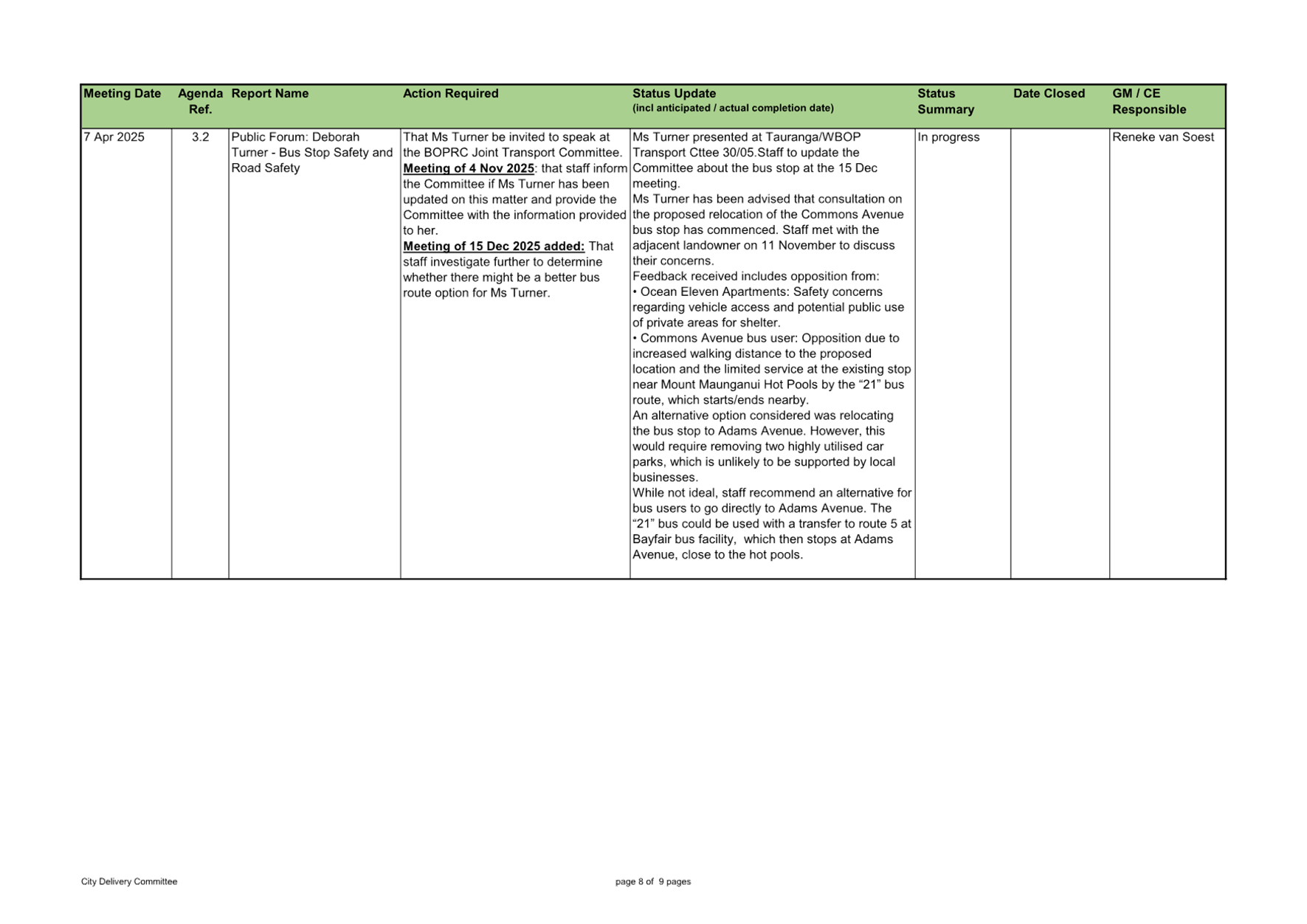
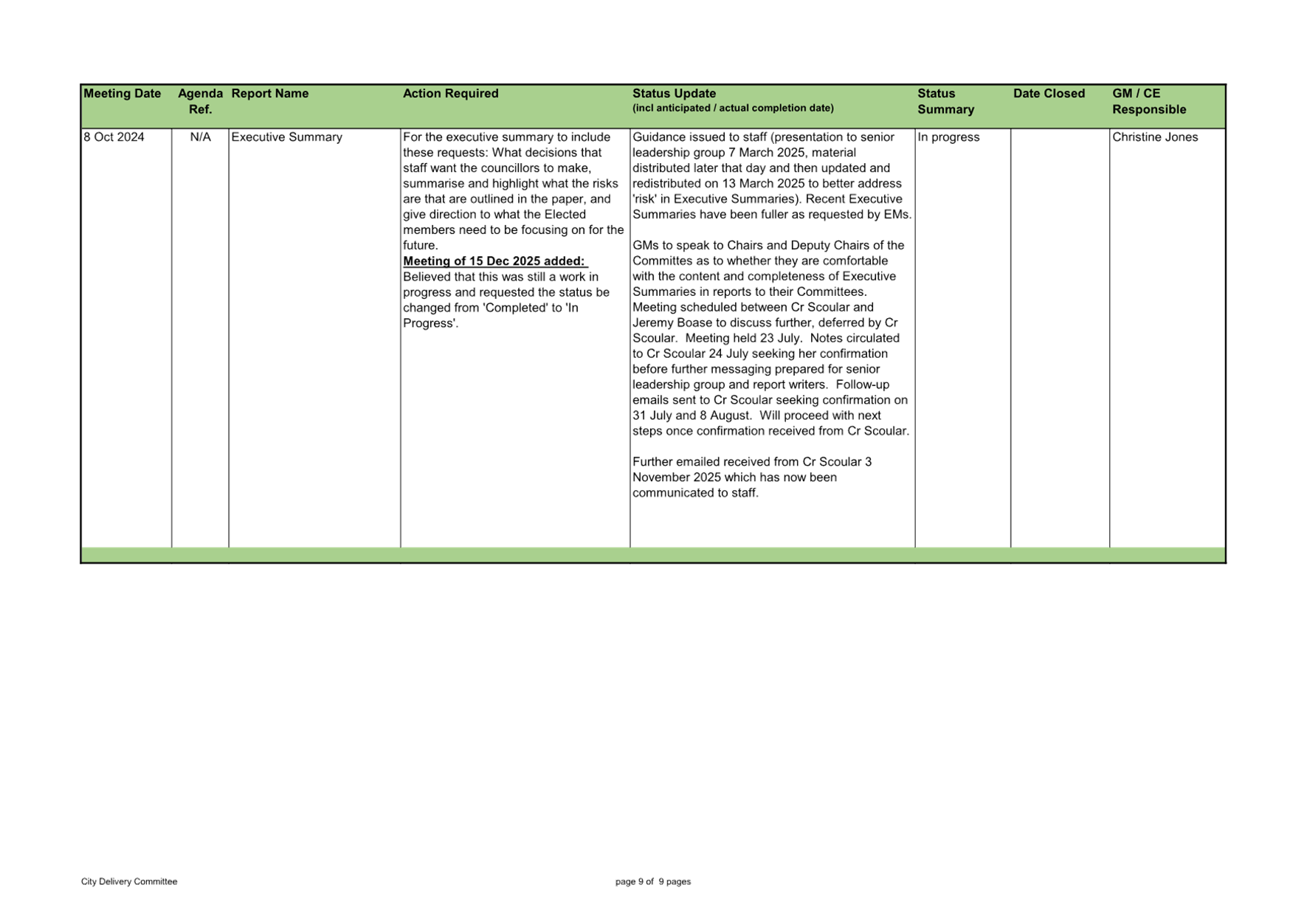
3. The attached update
includes all open actions and actions completed since the last report on 15
December 2025.
4. Once reported,
completed actions are archived and made available in the Stellar library[1].
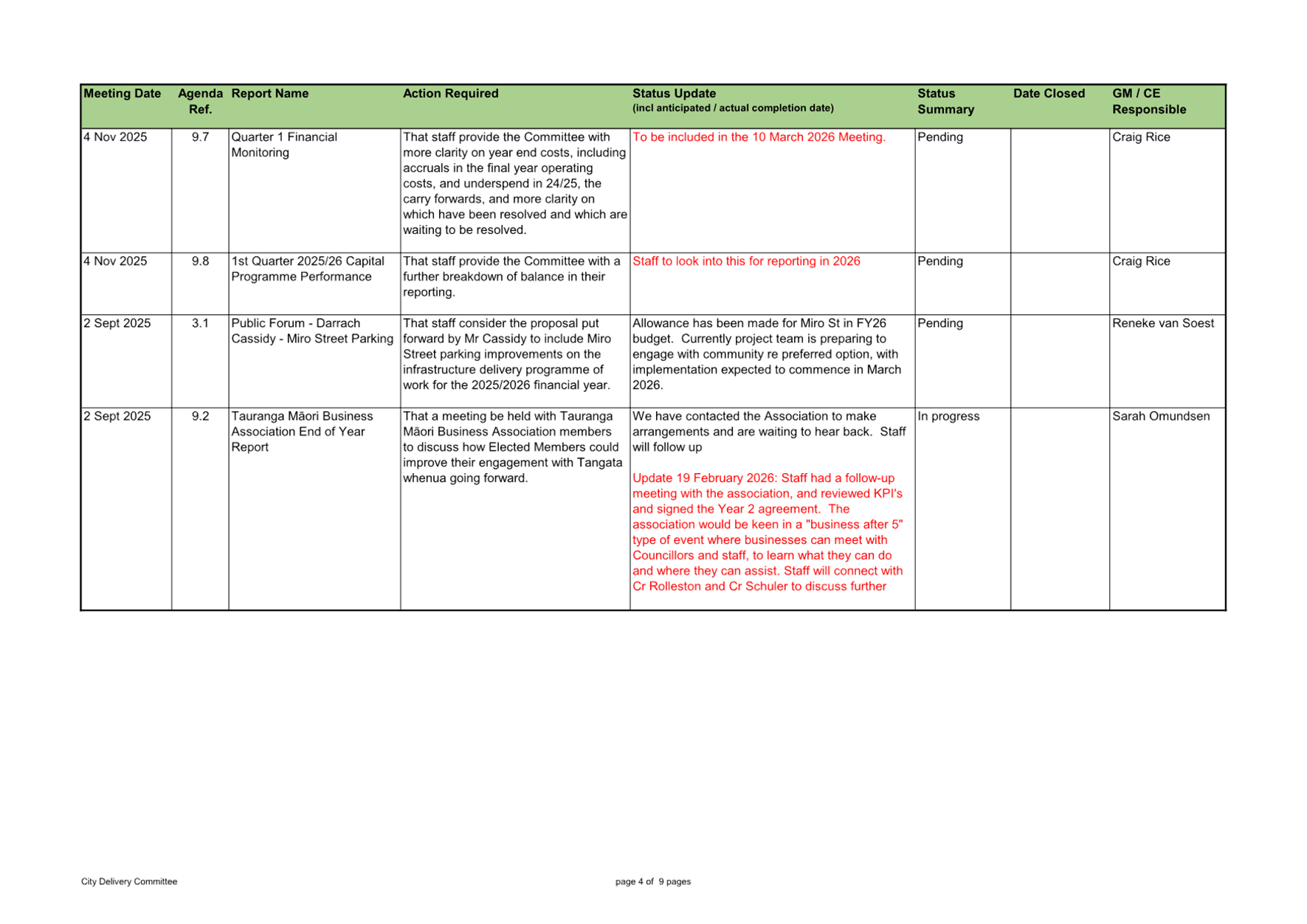
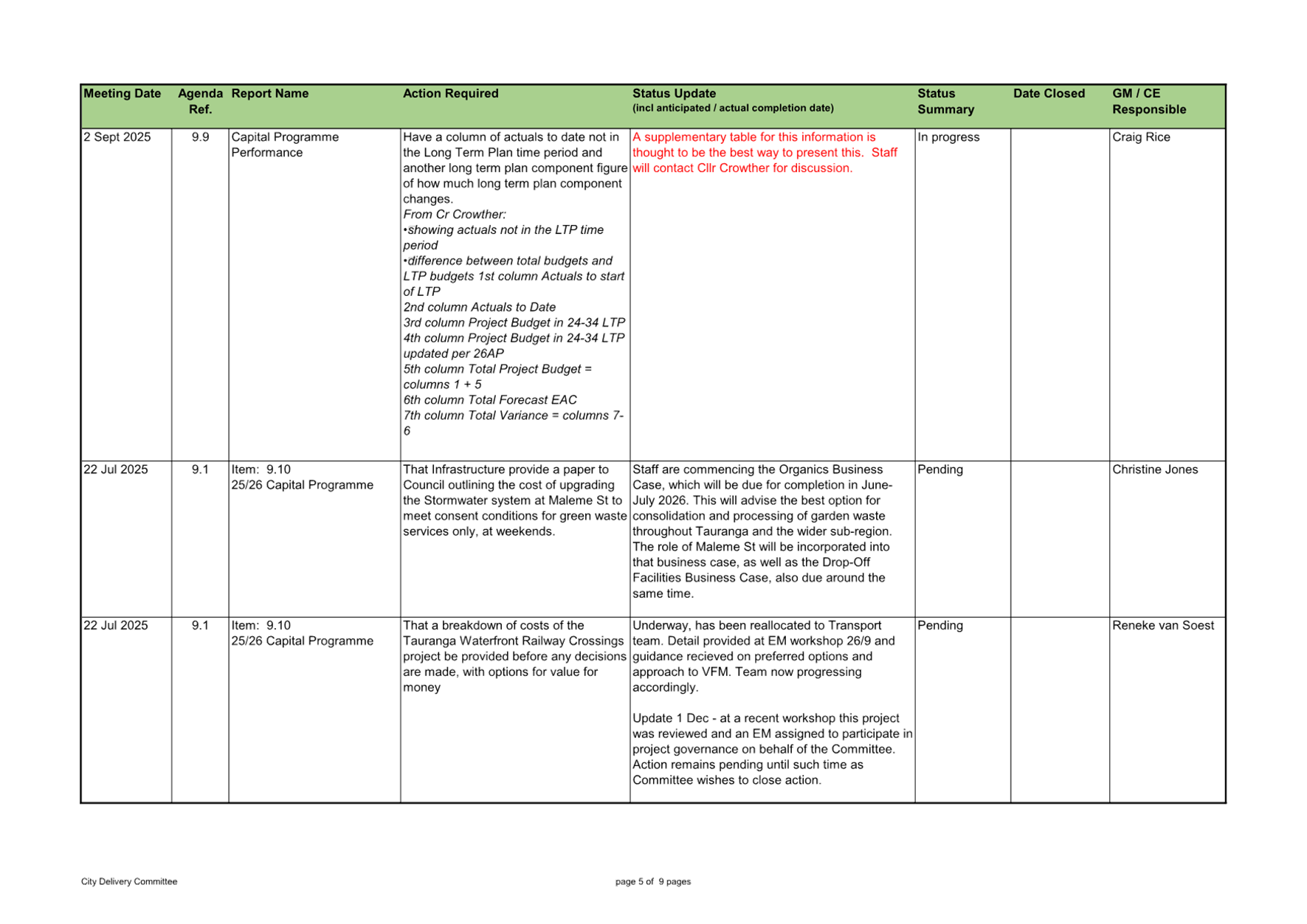
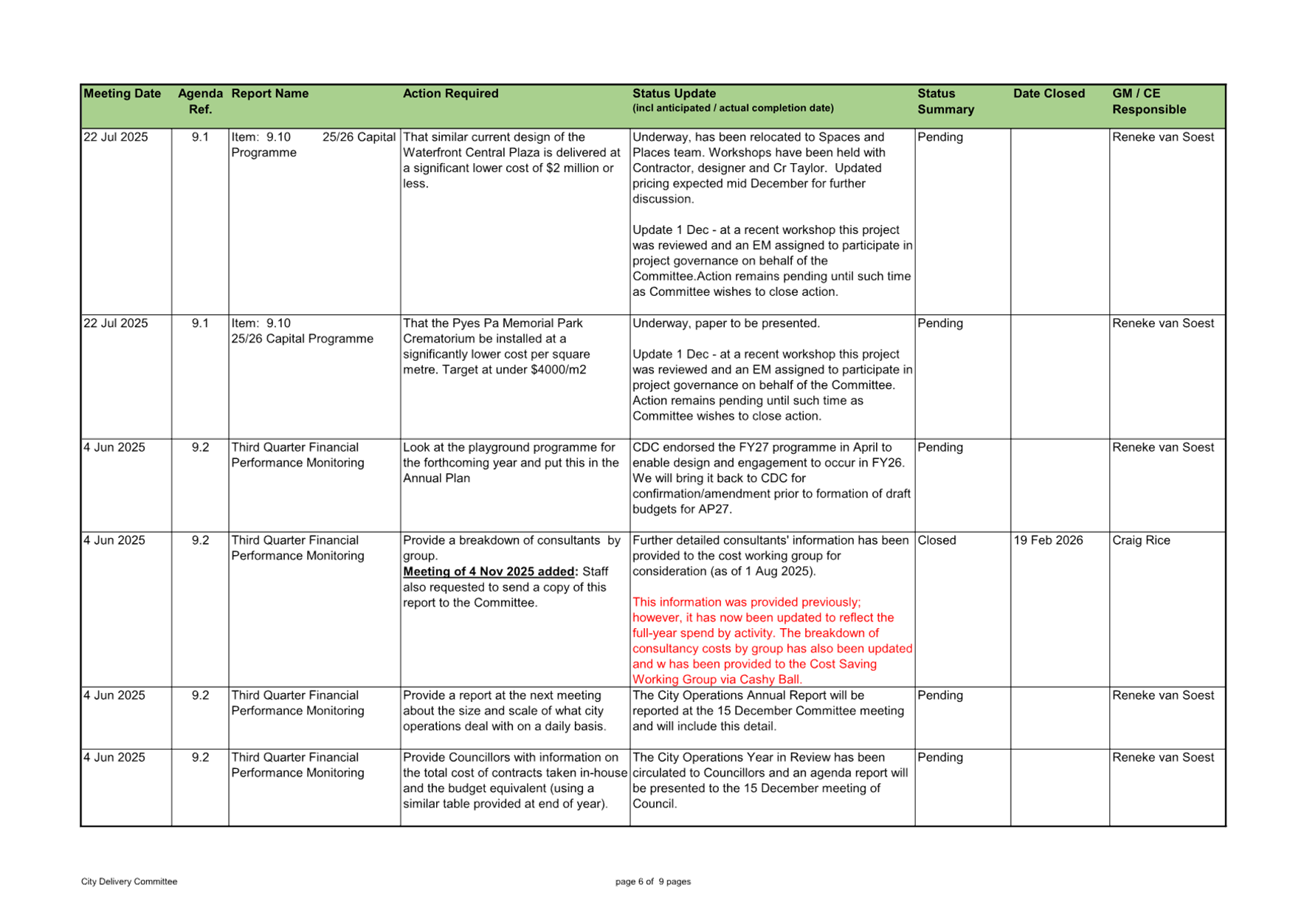
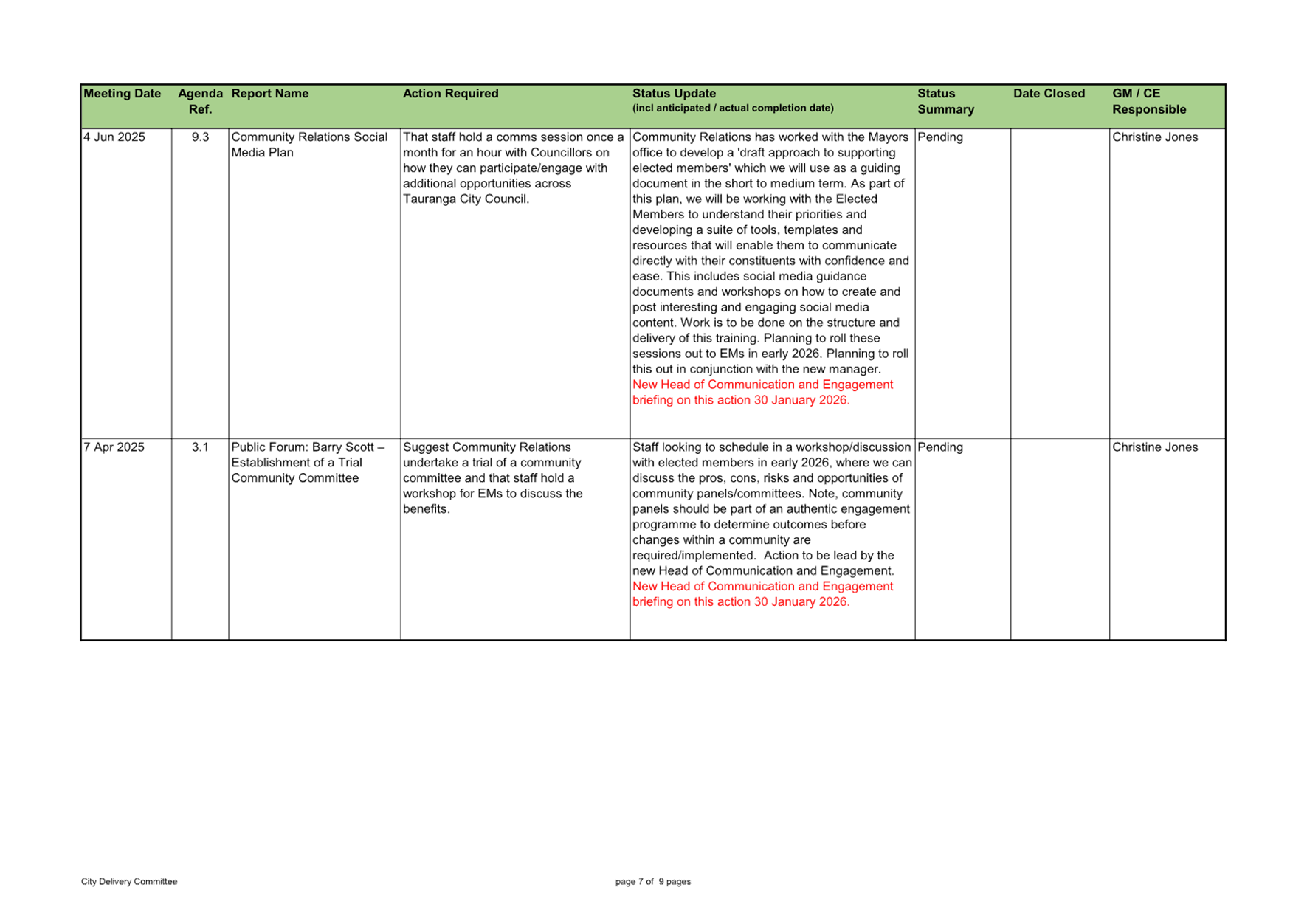
discussion
5. The action status
update report for the City Delivery Committee, as at 24 February 2026, is
provided as Attachment 1 to this report, and is summarised in the table
below.
|
Status of actions
|
No. actions
|
|
Closed (completed
since the last report)
|
4
|
|
Pending (waiting on
something)
|
13
|
|
In progress
|
12
|
|
To be actioned
|
1
|
|
Total actions
included in this report
|
30
|
Attachments
1. Actions
from prior City Delivery Committee Meetings as at February 2026 - A19784142 ⇩ 
|
City
Delivery Committee meeting Agenda
|
10
March 2026
|
|
City
Delivery Committee meeting Agenda
|
10
March 2026
|
10.2 Quarter 2 Financial
Monitoring
File
Number: A19432252
Author: Kathryn
Sharplin, Head of Finance
Tracey Hughes,
Manager: Organisational Financial Performance and Corporate Planning
Sheree Covell,
Manager: Treasury & Financial Processes
Susan Braid, Finance
Lead Capital Performance and Community Investment
Authoriser: Craig
Rice, Chief Operating and Financial Officer
Purpose of the Report
1. The purpose of this
report is to provide an update on the financial performance of the Council
against budget for the six months to 31 December 2025.
|
Recommendations
That the City Delivery
Committee:
(a) Receives the report
"Quarter 2 Financial Monitoring".
(b) Recommends
to Council to approve opex budget revisions as outlined in Table 3b of this
report totalling $1.2m.
|
Executive Summary
2. This report presents
the financial performance of Council for the first half of the 2025-26
financial year to 31 December 2025. It compares actual results to the
Annual Plan and indicates a forecast year-end position.
3. At the end of
quarter two, operating, capital and treasury metrics are within year-to-date
budgets and comply with relevant policies.
4. The
year-to-date surplus before gains and losses is $11m favourable to the Annual
Plan. Prior to the January weather event and recovery efforts a full year
surplus would have been projected to be above budget by $6m (see attachment
1). However, this excludes the costs to date of the response and recovery
and any future costs and offsetting revenues.
5. Capital
expenditure of $192m has been delivered in the first half of the 2025-26
financial year. The full-year forecast spend from project managers is $414m
against the Adopted 2026 Annual Plan budget of $502m and the full year approved
budget of $481m.
6. The
Treasury position shows debt forecast under budget, with appropriate hedging
and debt maturity levels. Both interest rate hedging and debt maturity
levels are within recommended levels.
7. A recommendation to Council is sought to approve 4 opex
budget carry forwards from 2024-25. Table 3b shows that funding for these items
was available at the end of the 2025 financial year.
8. The
analysis in the report focuses on variances in revenue, expenditure and capital
delivery, and the ongoing management of the Council’s debt and financial
position. Further detail can be found in Attachments 1, 3 and 6.
Background
9. This
report is for monitoring and reporting purposes showing Council’s
December 2025 year-to-date financial performance against year-to-date Annual
Plan budgets.
10. Attachment
1 provides the profit and loss (P&L) with
additional historical data and a breakdown of employee costs and other
expenses, along with variance analysis by category.
11. Attachment
2 provides a breakdown of the depreciation forecast
along with some information on why depreciation results against budget can vary
so significantly.
12. Attachment
3 tracks movements between the agreed annual plan
2026 and the approved budget used for operational management. These differences
arise because of movements in the capital programme (including opex projects),
carry forwards of expenditure budgets and associated funding from 2024/25 where
appropriate, approved changes under delegation (Chief Executive and General
Managers), and net neutral reallocations between P&L categories.
13. An overview of
capital expenditure is provided in Attachment 4, noting that the capital
programme is more thoroughly explored through the 2nd Quarter 2025/26 Capital
Programme Performance report on this agenda.
14. Attachment
5 provides detailed information supporting tables 2
and 3.
15. Treasury
metrics for the quarter are supplied in Attachment 6.
DISCUSSION
Operating Results
16. The
year-to-date operating result and full year forecasts to budget are shown in
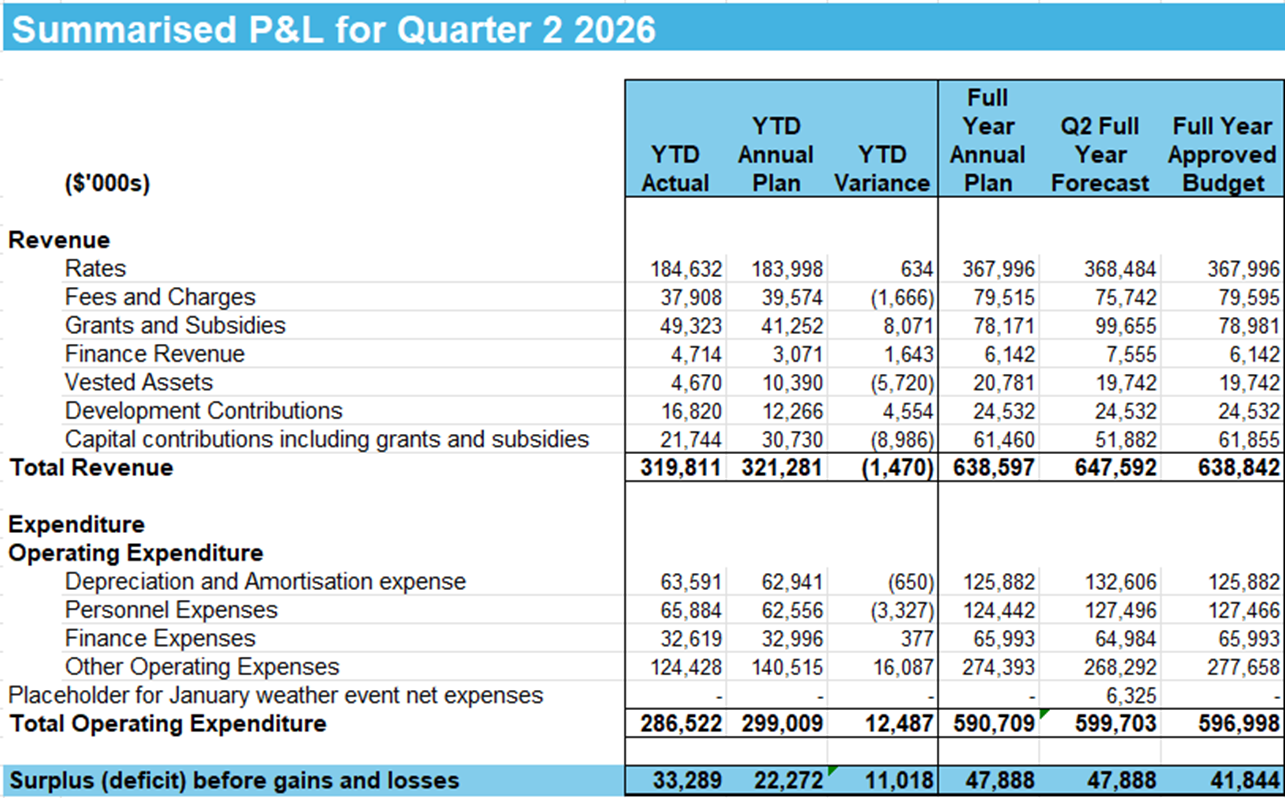
table 1 below. The full Profit and Loss report and variances are provided
in Attachment 1 to this report.
17. In summary, the
year-to-date surplus before gains and losses is $11m favourable to the Annual
Plan, with a forecast full year surplus in Table 1 below projected to be on
budget with a placeholder for net expenditure arising from the January weather
event. The financial impacts of this event are further explored later in this
report.
18. Operating
revenue is above budget by $9m, due to payments for subsidies and grants
including Tauriko West developer agreements received ahead of budgeted timing
for this project. Capital revenue is behind by $10m, mainly vested assets and
NZTA revenue due to slower capital delivery, however development contributions
revenue has been strong in the early part of the year due to revenue from the
Tauriko Business Estate and Citywide Building.
19. Revenue for operating grants
and subsidies will be significantly impacted this year by the receipt of bulk
funding from developers for Tauriko West, which was not anticipated until the
2026/27 financial year. $16m unbudgeted revenue is forecast for this financial
year.
20. Operating
expenditure is under budget by $12m year to date with positive variances in
most categories apart from employee costs, and depreciation. The variance in Grants expenditure is partly related to
timing and the remainder is expected to be offset by revenue.
21. Personnel costs are over annual
plan budget, noting the impact of redundancy payments of $1.2m and a budgeting
error relating to how we report internal resource for opex of a capital nature
($1.5m, offset in other operating costs). Direct salary costs are otherwise on
budget, although capitalised salaries are running behind budget year to
date.
22. A review of controllable costs
by activity indicates that most overspends are related to timing or offset by
additional revenue or underspends in other expenditure categories. Exceptions
include legal and recruitment costs in support services, and revenue shortfalls
in Environmental Planning, Building Services, and to a lesser extent in
Cemeteries and Parking Management. Environmental Planning and Building Services
are forecasting lower full year revenue by $6m due to lower levels of building
and development activity than budgeted, offset by forecast increased revenue in
Regulatory Services of $2m.
Table
1: YTD Operating Result
23. Attachment 1 contains a
breakdown of significant variances to annual plan budget. Many of these
variances will relate to a timing mismatch, however forecasts indicate that
positive variances in operating grant revenue, net finance costs, and some
other operating costs are permanent, along with negative variances in fees and
charges, capital grants and subsidies, personnel expenses and depreciation.
Depreciation
24. The forecast for depreciation
has been increased by $7m for the current year after a thorough review of
expected capitalisation. Planning and forecasting for depreciation is dependent
on a number of inputs which are constantly moving, such as project cost and
timing to completion, and which individually can have significant impacts on
timing of depreciation movements. These variables are itemised in Attachment
2, along with a break-out of the depreciation forecast generated from our
most up to date inputs.
25. This forecast includes $2.7m
relating to the finance lease treatment of 90 Devonport Road, and $0.8m for the
annual impairment of the property subdivision right relating to the Te Tumu
land block, previously unbudgeted. The remainder is generated essentially by
the full year impact of the 2025 capitalisation in the Spaces & Places
activity. To date there has been no write-off of assets relating to the Mauao
landslides. These write offs will flow through in the year end results.
26. Growth councils with large
capital programmes such as TCC are impacted more than most in their
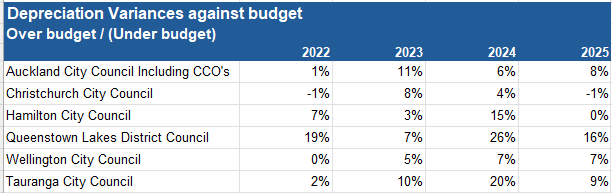
depreciation costs by capital programme updates and asset revaluation outcomes,
making it challenging to reliably budget cost impacts through annual plans. For
illustration of this challenge Table 2 below compares the variances against
budget experienced by TCC against those experienced by other growth councils
(data taken from their annual reports). Significant variances are both common
and almost always in excess of budget.
Table
2 – Depreciation Comparison of variances
January Weather Event
Financial Implications
27. The
6-month results (attachment 1) do not include the impacts on the January
weather event. To date we have spent c$1.7m on response and
recovery. This includes support to impacted businesses, legal fees
related to internal reviews, on- going physical works and equipment hire and
welfare support for impacted families.
28. For
the Beachside Holiday Park there has been around $250k of refunds paid and it
is expected that there will be a further $30k of refunds processed in the
coming weeks. The budgeted $470k surplus for Beachside is more likely to
be a $700k deficit for the year. This is based on the assumption that the
holiday park will not open again in the 2025/26 year and reflects lost revenue
and revised operational costs.
29. The
additional costs of recovery are being worked through and will be
substantial. Much of this will be reported as operational costs and
expenditure for the third quarter and full year forecasts will be updated in
the next monitoring report. Presently, as we await confirmation of ongoing
costs and clarification on an agreed way forward, we cannot reliably forecast
the impact for the current financial year, except to indicate that it is
unlikely the additional surplus of $6m in the initial Q2 forecast will occur.
30. With
regard to compensating income, staff are working with various government
agencies and insurers to determine the potential insurance claims and other
funding available to offset these costs. To date, TCC has received $100k
in grants, $12k in donations and $1m in insurance (related to the hot pools and
holiday park assets and which has yet to be allocated). There has been no
material adjustment to the revenue forecasts for these or other potential
claims noting that there is also a loss of revenue to the holiday park for this
financial year that could be as high as $1.5m.
Approval
of budget and funding carry forward from 2024/25
31. Attachment 2 outlines
the movement between the adopted Annual Plan 2026 and the Approved Budget that
the organisation is working to.
32. The budget movements can occur
for a number of reasons:
(a) Budgets have been reallocated
to different line items or activities (with nil effect on total budget or
funding)
(b) Approval under delegated
authority (Chief Executive or General Manager) to address specific budget
issues in the existing work programme or to accommodate new initiatives.
(c) Project phasing has been
changed (capital and opex impacts)
(d) Budget has been redistributed
between capex and opex to align with accounting requirements with no impact on
funding
(e) Carry forwards (revenue and
expenditure with associated funding) have been requested. These are the only
items that require Council approval. The items in Table 3a below are already
approved through prior resolutions of Council. A recommendation for Council to
approve the items in Table 3b totalling $1.2m is included in this report. The
tables outline the budget and expenditure for these items in 2025 and validate
the availability of funding to be carried forward.
Table
3a
Table
3b
Capital Delivery
33. An overview of capital
expenditure is provided in attachment 4.
34. Capital expenditure of $192m
has been delivered in the first quarter of FY26 (including operational projects
of a capital nature but excluding vested assets, land sales and Bay
Venues-funded new capital).
35. The full year forecast spend
from project managers is $414m against the full year approved budget of $481m.
36. At the time of writing this
report, project managers across the business were working to rephase capital
budgets flowing into the Draft 2027 Annual Plan. This will result in a downward
revision of the full year budget for FY26 to pre-empt carry forward requests
(and reduce any budgets no longer required to complete a project) to bring it
closer to the forecast spend for the year. An overview of this iterative
approach to carry forwards and its benefits was presented at the Council
workshop on 12 February 2026.
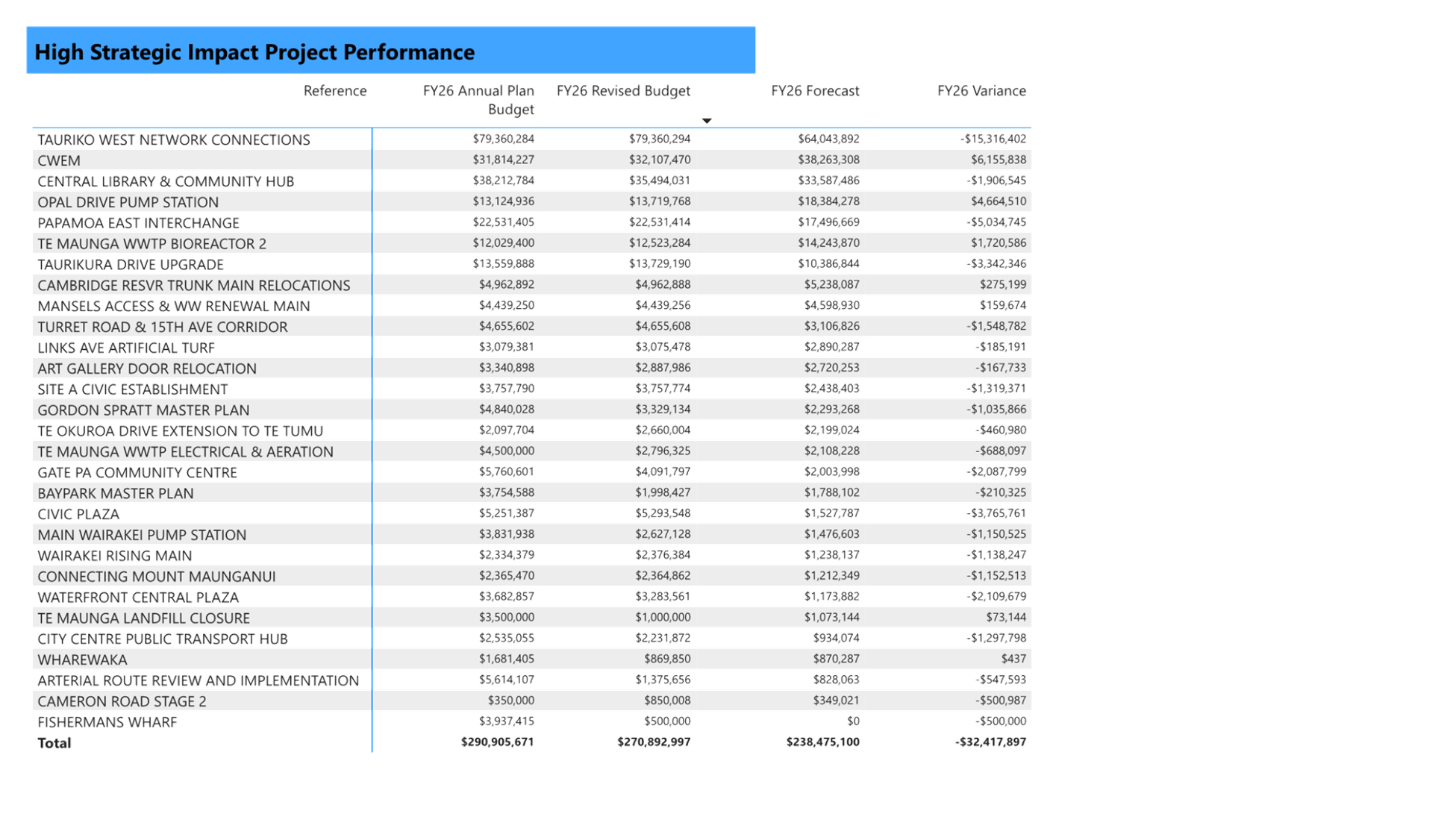
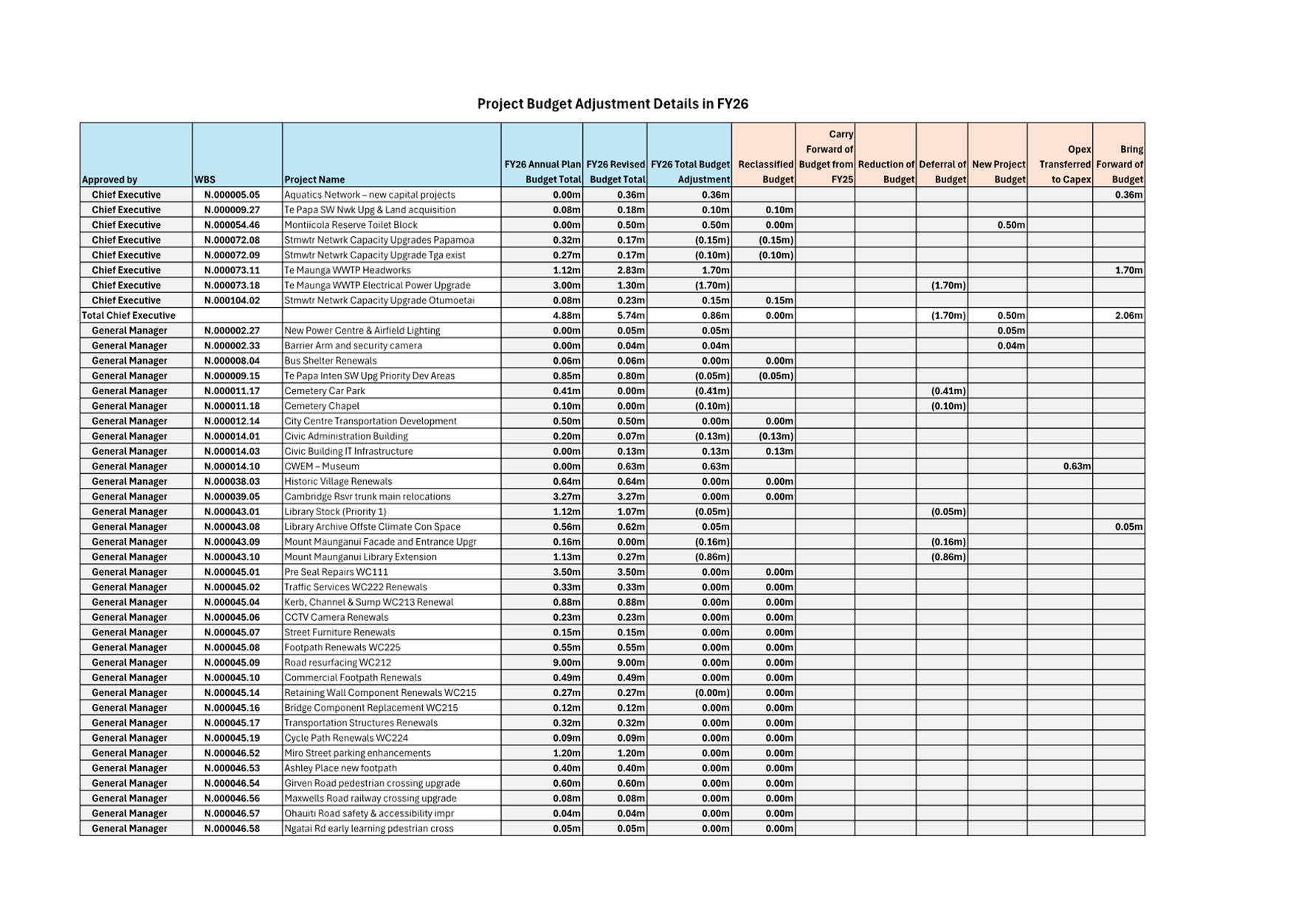
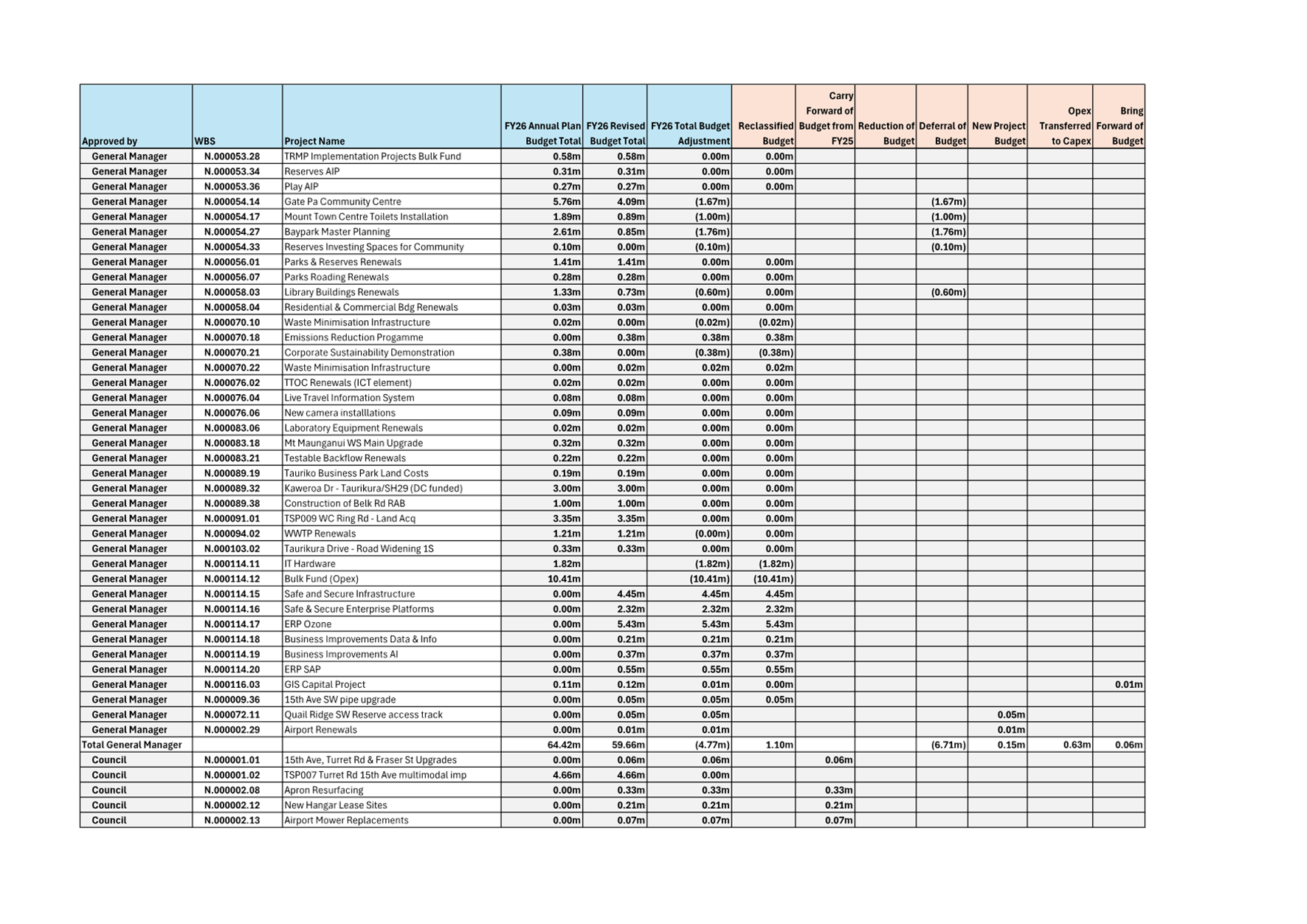
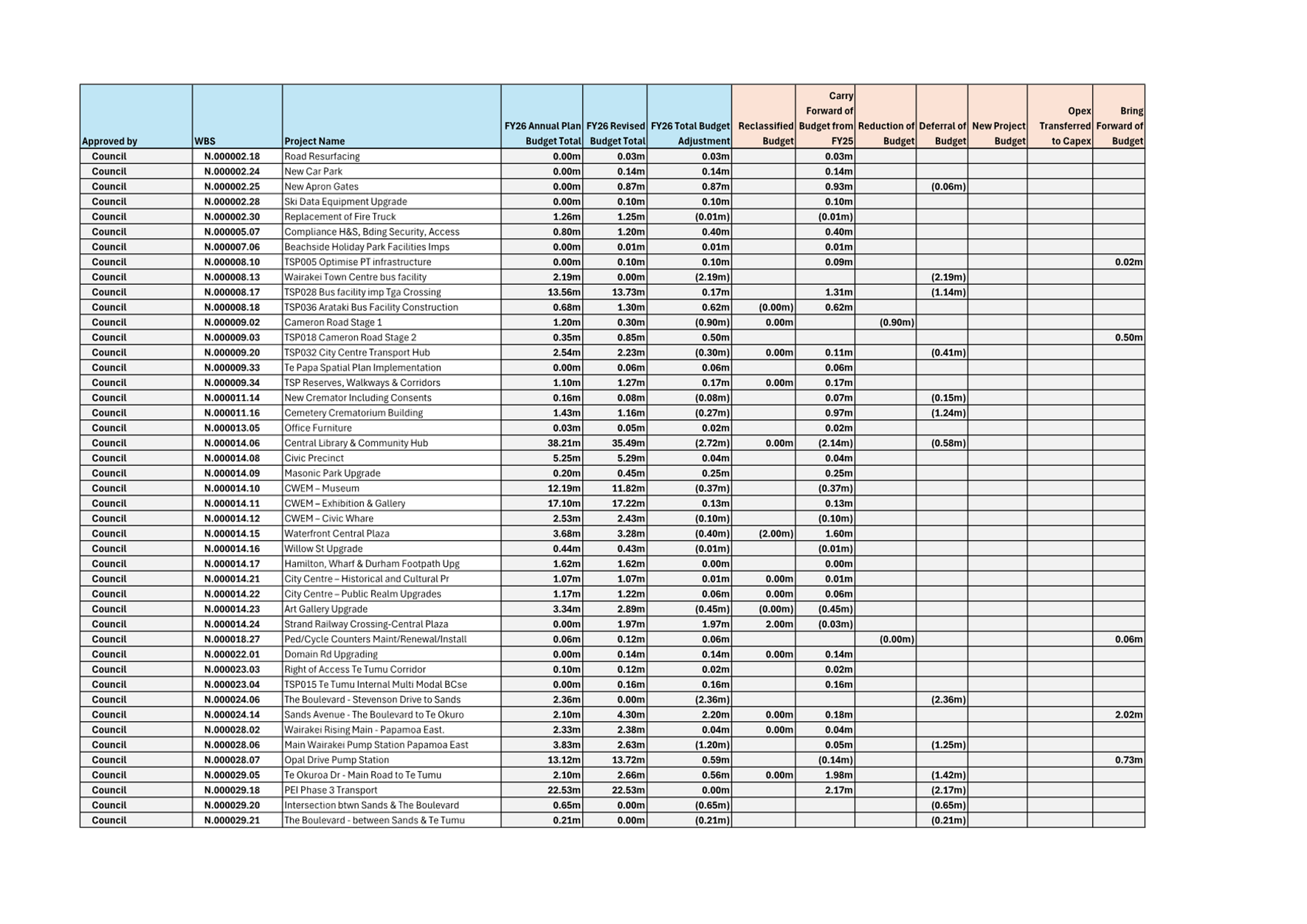
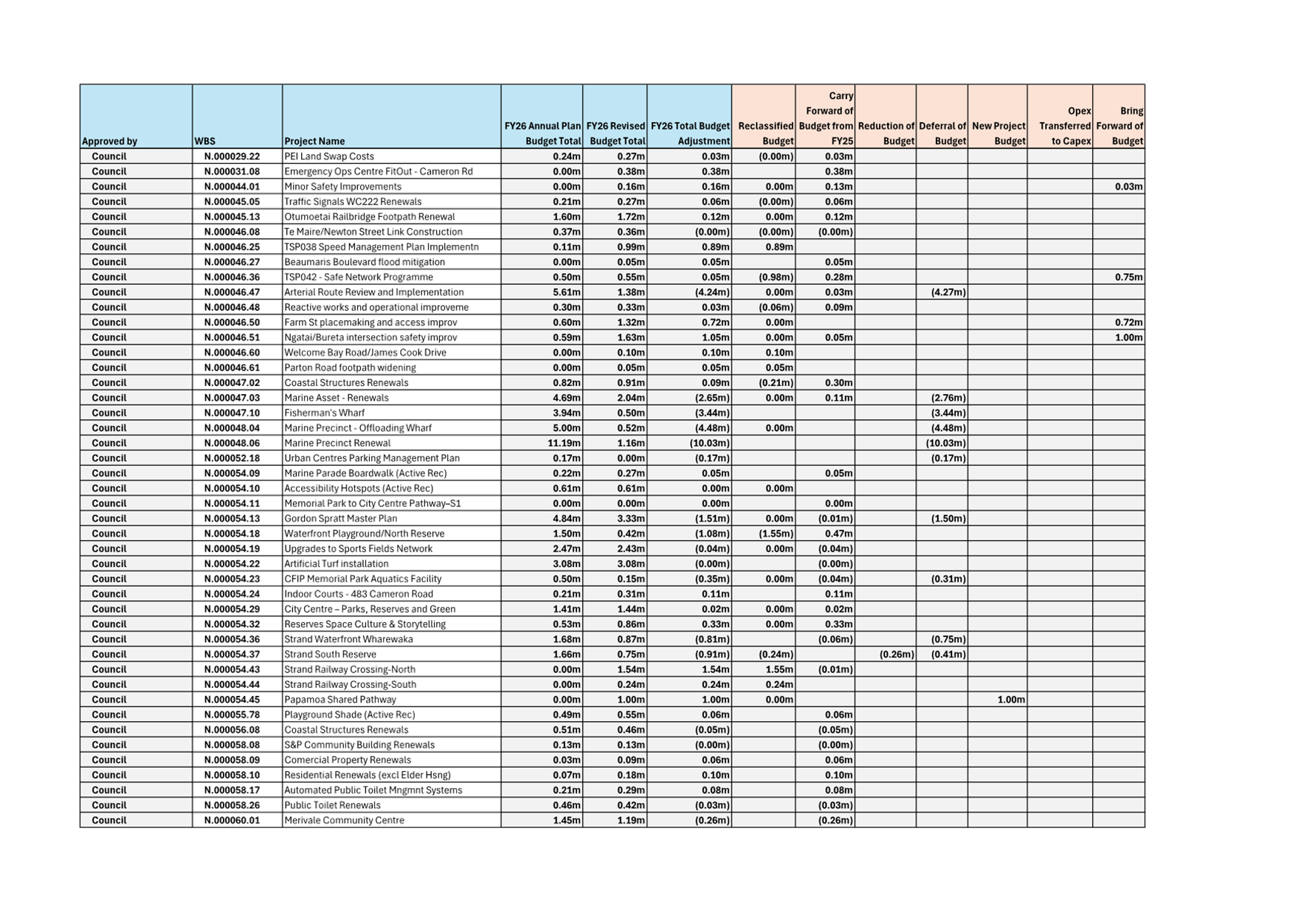
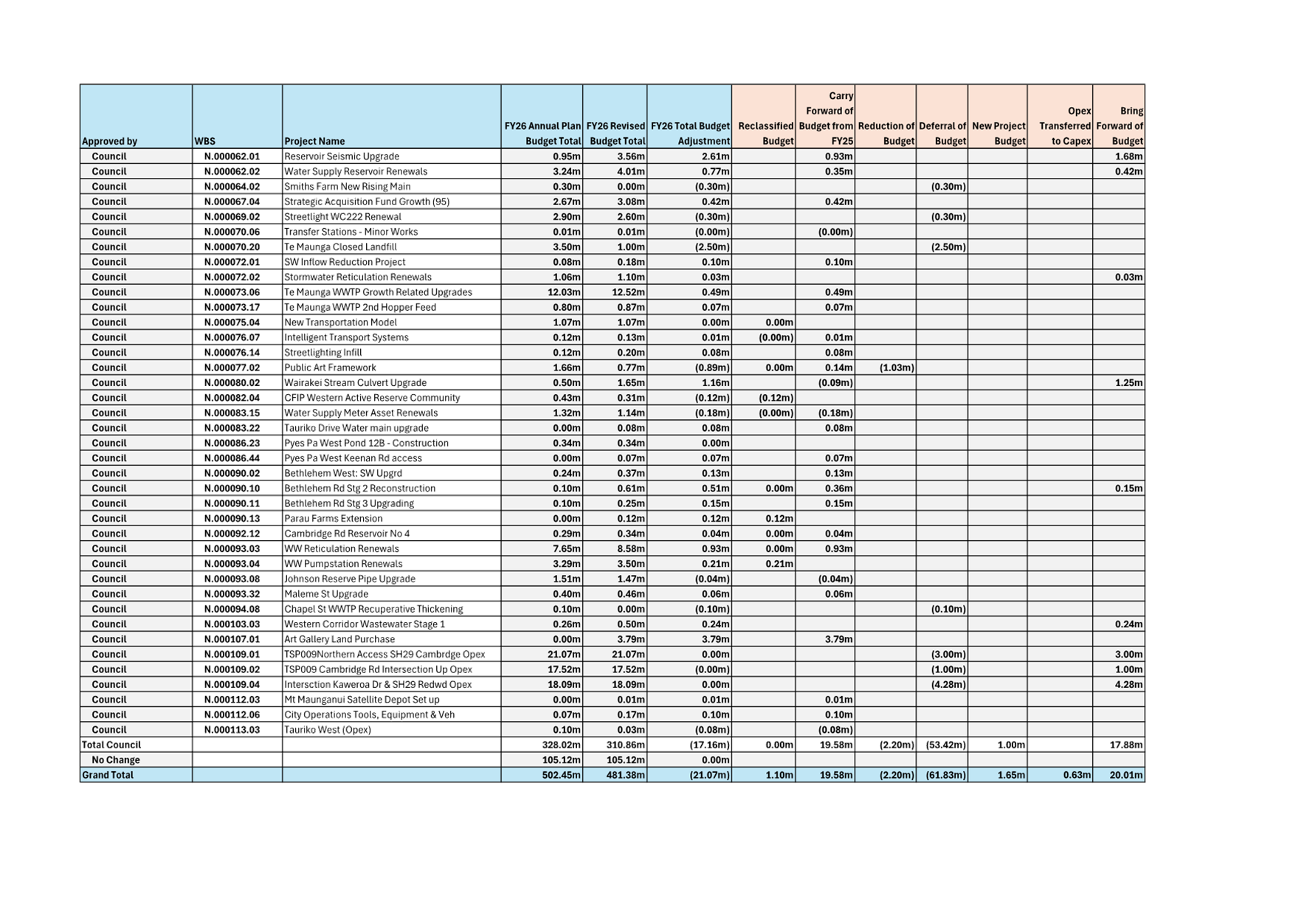
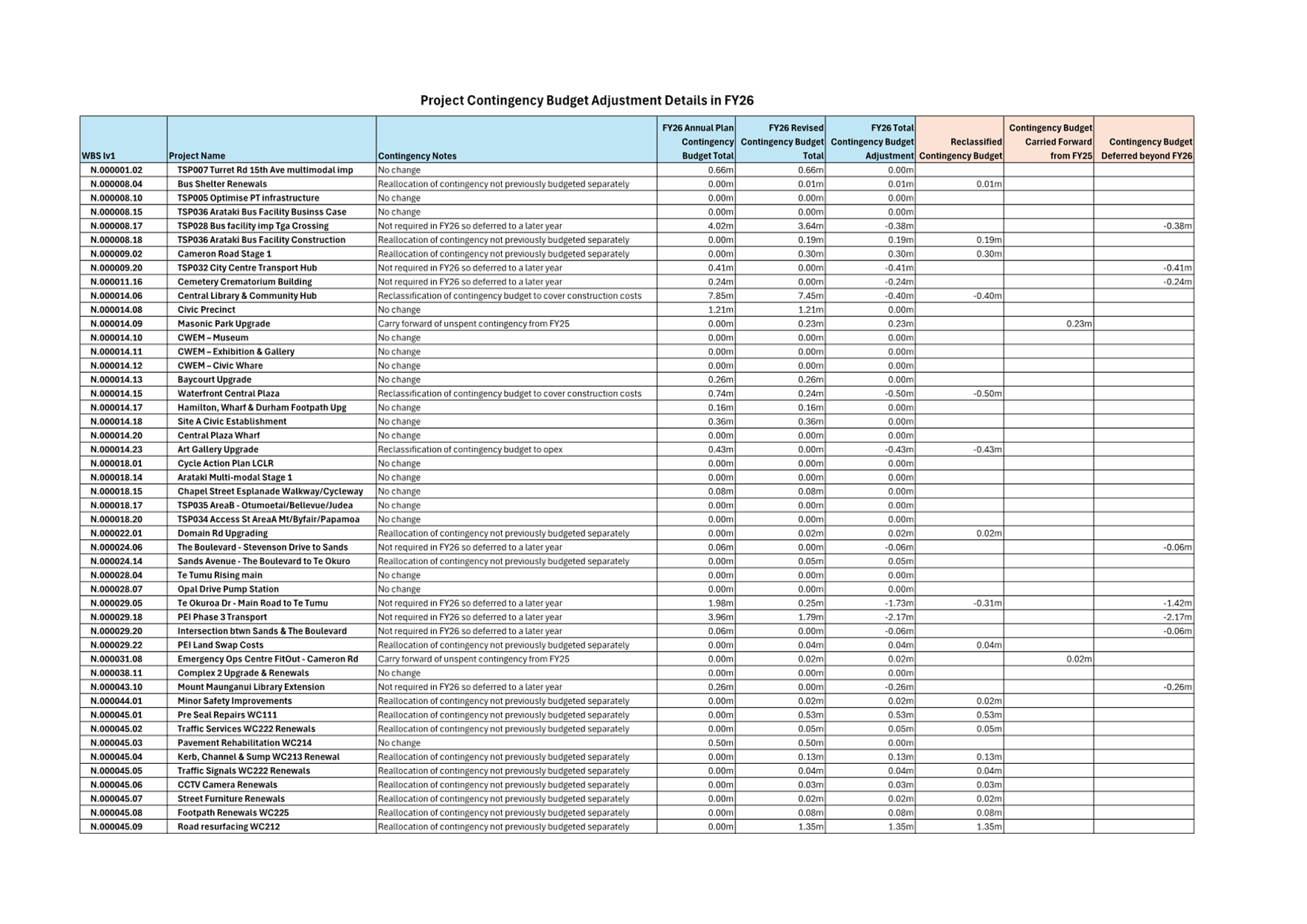
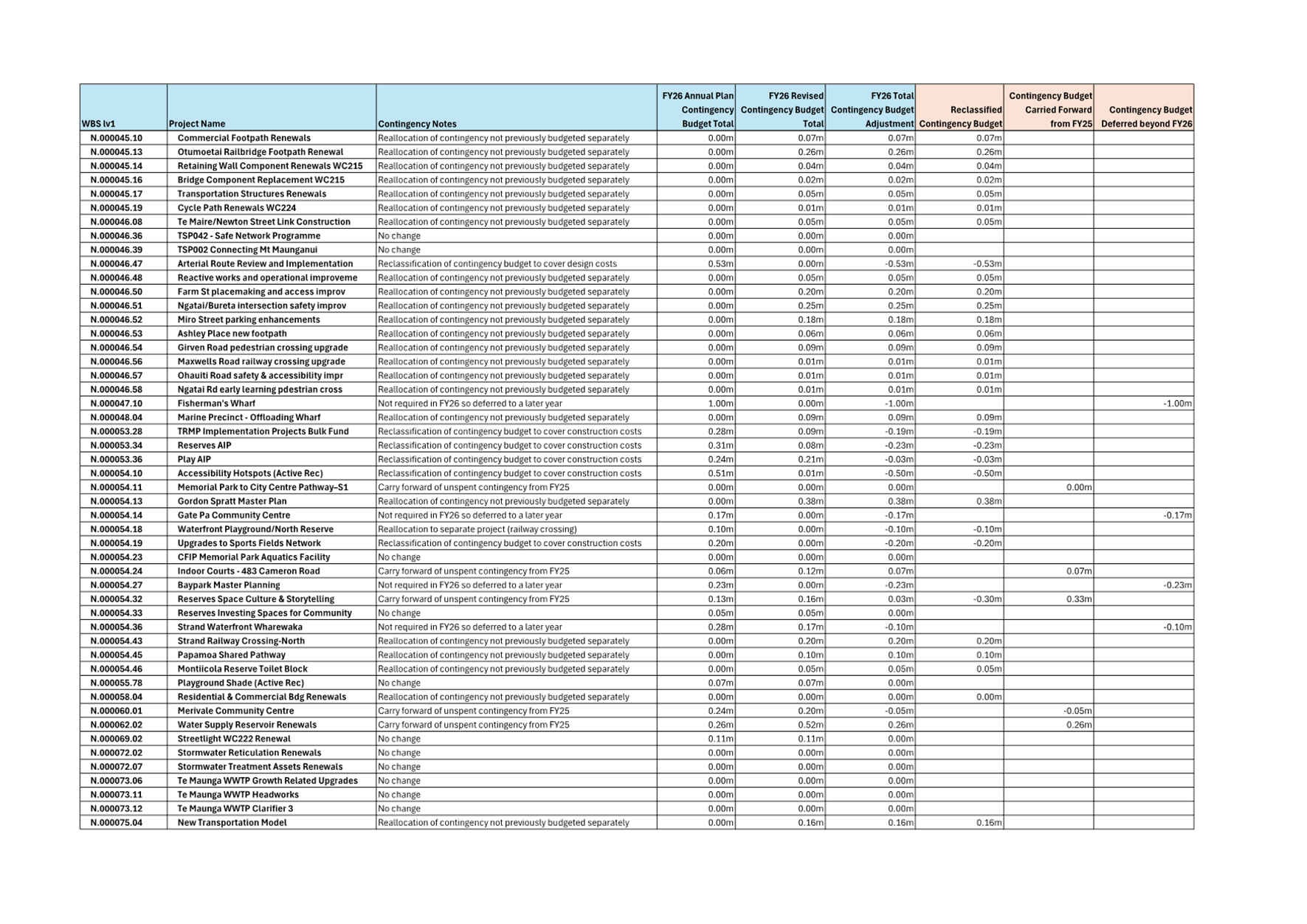
37. A summary of budget adjustments
actioned since the 2026 Annual Plan was adopted, including contingency specific
adjustments, is provided in the tables below and detailed views are provided in
attachment 5.
38. Contingency budgets of $37m
remain in FY26 and approx. $3m of these are forecast to be spent by year end.
Some of these contingency budgets will be given up as savings (budget
reductions) as project milestones are reached and reported back in the next quarterly
monitoring report. We are already seeing some evidence of this in the latest
Draft 2027 Annual Plan updates.
Table 4
Table
5
Treasury
39. All treasury matters remain
within policy. Attachment 6 is a detailed status report showing
all metrics that are monitored and measured.
40. The net debt budget set in the
2026 Annual Plan is $1.50b. The current forecast net debt for June 2026
is $150m lower than budgeted at $1.65b. The main factors contributing to the
lower forecast are $78m lower opening debt than forecast in the 2026 Annual
Plan, $100m lower capex which are offset by lower than budgeted land
divestment.
41. The charts below show the
actual and expected cash flows for the remainder of the year resulting in the
forecast debt position.
42. The first chart starts with
opening debt (green bar on left of graph, then shows actual cash flows leading
to net debt at 31 December 2025 (green bar in the middle of the graph). The
various columns on the right-hand side show forecast flows for the remainder of
the year. The second chart is a simplified version of the first and
combines actual and forecast cash flows. It should be noted that
the actual amounts below are extracted from a treasury report that does not
account for accruals, GST or general ledger accounts, and will not align
directly to the operational and capital performance report.
|
City
Delivery Committee meeting Agenda
|
10
March 2026
|
Chart 1
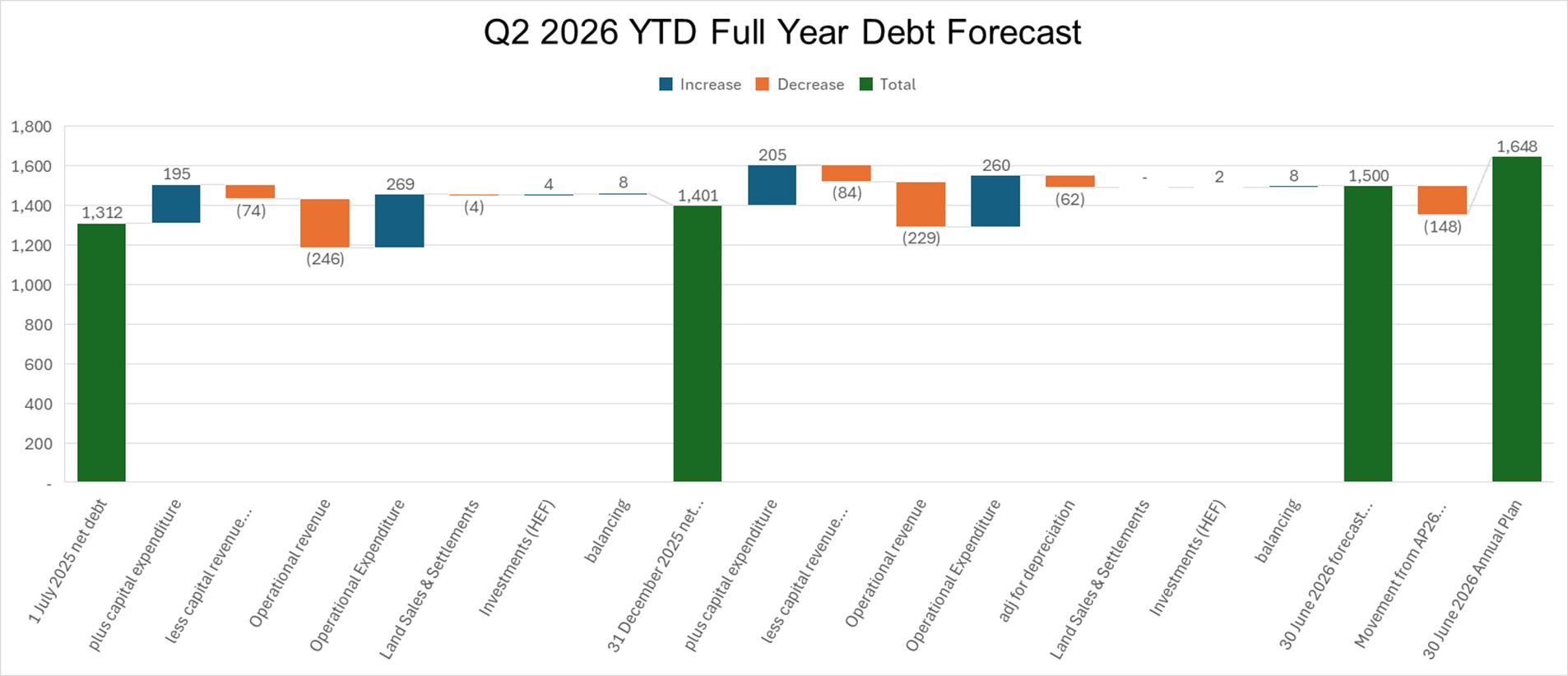
Chart 2
|
City
Delivery Committee meeting Agenda
|
10
March 2026
|
43. The approved debt drawdown for
the 2026 Annual Plan is $485m, comprising replacement of $215m of maturing debt
and $270m of new debt to finance the debt requirements of the 2026 Annual
Plan.
44. Year to date borrowings as of
31 December are $209m. Current forecasts indicate a borrowing requirement of
$340m, reflecting the revised debt forecast.
45. Both interest rate hedging and
debt maturity levels are within recommended levels. 71% or $1.09b of
total on balance sheet debt is at fixed rates (including interest rate swaps)
at 31 December 2025.
46. The average cost of borrowing
is currently 3.42% excluding margins and 3.97% including margins. TCC
measures this against a benchmark rate which reflects an averaging of 90-day to
15-year swap rates. While a benchmark may be a good general indicator of
interest rate management, in practice Council can’t immediately switch to
cheaper debt in line with a benchmark. It is also good practice to maintain a
portion of debt at fixed rates to manage interest rate risk.
47. When comparing the average cost
of borrowing including margins at 30 June 2025 of 4.21% to the results in the
Annual Reports of peers with the same or higher credit rating, TCC was 30 basis
points lower than the average.
48. Council has made use of the
Infrastructure Funding and Financing Act (IFF) as an off balance sheet tool to
fund $177m of transport projects under the Transport System Plan (TSP).
While this debt is not reflected in the Council’s financial statements or
included in any formal debt metrics used by lenders and credit rating agencies,
repayments are made by ratepayers through a targeted levy on their rates
bill. The below chart shows both on and off balance sheet debt.
49. Total off balance sheet debt at
31 December 2025 is $99.6m which results in total net debt, including the TSP
IFF of $1.50b. The 2026 AP total debt is $1.75b and the current forecast
is $1.566b.
|
City
Delivery Committee meeting Agenda
|
10
March 2026
|
Chart
3
Statutory Context
50. Section 101 of the Local
Government Act (2002) places responsibility on local authorities to ensure
prudent stewardship of Council resources and proper financial oversight.
STRATEGIC ALIGNMENT
51. This contributes to the
promotion or achievement of the following strategic community outcome(s):
|
Contributes
|
|
We are an inclusive city
|
ü
|
|
We value, protect and enhance the environment
|
ü
|
|
We are a well-planned city
|
ü
|
|
We can move around our city easily
|
ü
|
|
We are a city that supports business and education
|
ü
|
52. Maintaining
expenditure within annual plan budget ensures delivery of services in a
financially sustainable way. Variance review assists in identifying risks and
trends facing Council.
Options Analysis
53. This report recommends that CDC
recommends amendment to the revised 2025/26 budget to reflect carry forwards
and other changes as outlined in this report.
CDC can
choose to either recommend that Council adopts these changes as revised budgets
(capital and operating) or decline capital carry forwards and operational carry
forwards. If these carry forwards budgets are declined, then projects
would not be completed as proposed.
Financial Considerations
54. This report monitors
performance to budget and reviews compliance with Council’s policies and
delegations. Delivery within allocated budgets ensures financial sustainability
and accountability.
Legal Implications / Risks
55. This monitoring report has no
specific legal implications or risks.
TE AO MĀORI APPROACH
56. This report has no impact on
Council’s Te Ao Māori approach as it is monitoring Council’s
performance against annual plan metrics.
Consultation / Engagement
57. This report is made public.
Significance
58. The Local Government Act 2002
requires an assessment of the significance of matters, issues, proposals and
decisions in this report against Council’s Significance and Engagement
Policy. Council acknowledges that in some instances a matter, issue,
proposal or decision may have a high degree of importance to individuals,
groups, or agencies affected by the report.
59. In making this assessment,
consideration has been given to the likely impact, and likely consequences for:
(a) the
current and future social, economic, environmental, or cultural
well-being of the district or region
(b) any persons who are likely to be
particularly affected by, or interested in, the matter
(c) the capacity of the local authority
to perform its role, and the financial and other costs of doing so.
60. In accordance with the
considerations above, criteria and thresholds in the policy, it is considered
that the matter is of low significance.
ENGAGEMENT
61. Taking into consideration the
above assessment, that the matter is of low significance, officers are of the
opinion that no further engagement is required prior to Council making a
decision.
Click here to view the
TCC
Significance and Engagement Policy
Next Steps
62. The next monitoring report for
Quarter 3 will be presented to this committee on 28 April.
Attachments
1. Q2
Extended P&L - A19829553 ⇩
2. Depreciation
Forecast - A19831915 ⇩
3. Approved
budget Q2 2026 - A19829470 ⇩
4. Capital
Financial Summary - A19827454 ⇩
5. Capex
Budget Adjustment Details - A19827455 ⇩
6. Treasury Policy
Status - A19739540 ⇩
|
City
Delivery Committee meeting Agenda
|
10
March 2026
|
|
City
Delivery Committee meeting Agenda
|
10
March 2026
|
|
City
Delivery Committee meeting Agenda
|
10
March 2026
|
|
City
Delivery Committee meeting Agenda
|
10
March 2026
|
|
City
Delivery Committee meeting Agenda
|
10
March 2026
|
|
City
Delivery Committee meeting Agenda
|
10
March 2026
|
|
City
Delivery Committee meeting Agenda
|
10
March 2026
|
10.3 2nd Quarter 2025/26
Capital Programme Performance
File
Number: A19801195
Author: Alex
Johnston, Team Leader CPAD
Authoriser: Craig
Rice, Chief Operating and Financial Officer
Purpose of the Report
1. To update the Committee on the progress of the capital
programme
|
Recommendations
That the City Delivery
Committee:
(a) Receives
the report "2nd Quarter 2025/26 Capital Programme Performance".
|
Executive Summary
2. Project
reporting is aligned with the revised budget 2025/26 of $481.4m. As of the end
of Q2 (end December), year-to-date expenditure amounted to $191.5m, compared to
the year-to-date revised budget of $244.5m. The forecast from project managers
for the financial year-end is projected to be $414.3m.
3. High-level
information regarding capital project performance is available in Attachment
1 - Q2 Capital Programme Performance. Currently, 10 out of 236
active projects are indicated to be at an overall red status. Most of these
projects remain in the planning/design phase, presenting opportunities to
achieve value for money through scope refinement and the procurement process.
The most significant High-Risk project remains to be the Te Maunga Landfill
Project. Additional details on all red status projects can be found in Attachment
2 – Red Status Projects
4. There
are 13 projects on hold, pending funding or further direction. The list of
on-hold projects is provided in Attachment 3 – On-Hold Projects
5. Over
the past three months, procurement activity has been comparatively light, with
11 procurement activities undertaken, totalling $2.12m.
1.
2.
3.
4.
5.
6.
Nine procurement activities were completed through direct appointment or
closed competition using established panel arrangements, predominantly via the
Waters Framework Panel. The remaining two procurements, with a combined
contracted value of $188,000, were awarded outside of panel arrangements,
through either direct appointment or closed competition processes.
7.
For the forthcoming 3‑month period, 20 procurements are scheduled,
with an estimated total value of $16.5m. Most of this value is expected to be
delivered through the Waters Framework Panel.
Overall, procurement activity has been modest in the
recent period, with a notable increase anticipated in the upcoming quarter. The
continued reliance on established panel arrangements supports efficient
procurement delivery.
8.
Council continues to face risks arising from uncertainty in project
pipelines, which can impact funding confidence and the ability to engage
effectively with the supply chain. This is being managed through clearer
programme planning, the development of prioritised backlogs, and ongoing
oversight of delivery constraints.
9.
Managing stakeholder expectations within constrained budgets remains an
ongoing challenge and is being addressed through proactive engagement across
planning, design and delivery phases, with a continued focus on achieving
balanced and value‑focused community outcomes. The upcoming Local Waters
Done Well transition presents resourcing and continuity risks, which are being
actively managed through targeted recruitment, forward planning of delivery
strategies, and close co-ordination with transition teams to support programme
continuity during the period of change.
10.
The National Infrastructure Plan released by the infrastructure
Commission on 17 February sets out a number of priorities for the coming
decade. It urges government and councils to address deferred renewals,
especially in hospitals and water networks, and to adopt road-pricing tools
such as time-of-use charges before committing to new and expensive transport
projects. The plan also emphasises “asset stewardship” —
actively planning for declining demand, prioritising maintenance ahead of
expansion and even recycling surplus assets — and it calls for more
investment in cost-effective flood protection as part of climate-resilience
strategies. Further priorities include a durable resource-management and
spatial planning framework, up-zoning along public-transport corridors, and
creating predictable policy settings so the economy can be electrified without
ad-hoc interventions
11.
New value for money controls have been introduced to strengthen
investment discipline and oversight. This has included mandatory benchmarking
within business cases and internal project reviews to providing earlier and
more consistent challenge to project scope, costs and benefits.
12.
A centralised consultancy gateway has also been established for
consultant and contractor engagements aiming to improve engagement practices,
prioritising the use of internal resources where available and providing
practical guidance to lift consistency and value from external consultancy
spend.
Background
13. This
report is for monitoring and reporting purposes to show Council’s
performance of projects against Annual Plan and Long Term Plan budgets up to
the end of the 2nd Quarter (Dec).
Discussion
14. The
Annual Approved Budget was initially adopted at $502m. Following the end of
Quarter 1, this was revised to $491m. A further revision was made at the
conclusion of Quarter 2, resulting in a current budget position of $481.4m. A
detailed explanation of the movements between these budget revisions is
outlined in the Quarter 2 Financial Results
15. The
current forecast to financial year end is $414m, with most delivery groups
forecasting an underspend. Ongoing Annual Plan activity will see this forecast
likely to move down. Further information on performance is provided in Attachment
1 – Q2 Capital Programme Performance
16. Red
projects have reduced from 24 projects to 10 Projects with an even split across
the Project Delivery groups, the majority of which, are in the planning or
design phases and only one project in implementation. A slight increase of
Amber Projects up 2 to 54, these Amber projects are managing their risks within
their project teams.
17. The
remaining projects are being managed through current project governance. Where
direction is required, and sufficient information is available, separate
reports will be provided to the appropriate committee for a decision.
18. A total
of 13 projects remained on hold at the end of the 2nd quarter. The key reasons
these projects were on hold, was funding uncertainty is the most common driver.
Several projects cannot proceed until external funding (e.g. NZTA/NLTP, Crown
or IAF funding) is confirmed or approved. Governance or political decisions
pending, where elected member direction is required before scope, timing, or
investment can be confirmed. Business case or scope resets, often due to
updated growth assumptions, alignment with other programmes, or the need to
reassess value for money. Strategic reprioritisation, where projects are
intentionally paused to focus resources on higher priority commitments.
Overall, projects on hold reflect timing and funding constraints, controls and
process improvements
19. The Stage Gate Review process
strengthens and formalises Council’s existing project assurance
arrangements rather than introducing a new layer of governance. It builds on
current stage gate practices by providing clearer, more consistent review points
at key stages of the project lifecycle, particularly for medium, large and
extra‑large projects. This approach improves transparency, supports value
for money decision making, and gives greater confidence that projects are
aligned to Council priorities, appropriately scoped, and ready to progress
before further funding is released. The intent is to support delivery outcomes
and reduce risk, while maintaining existing delegated authorities and project
ownership.
20 Oversight of the process is
provided by the Stage Gate Review Committee. The Committee has the authority to
either approve projects to proceed through a stage gate, place projects into an
internal review where further assurance is required, or halt projects where
readiness or value for money cannot be demonstrated. This authority ensures that
issues relating to scope, cost, risk, or strategic alignment are identified and
addressed early, before commitments escalate. The Committee does not take on
delivery responsibility; instead, it provides independent assurance and advice
to strengthen decision making and safeguard Council’s investment on
behalf of the community.
Upcoming
Stage Gate reviews:
|
Project Title
|
Delivery Team Group
|
Project Size
|
Moving to Stage
|
Stage gate Month
|
|
Arterial Route Review
and Implementation
|
Transport
|
Large
|
Design
|
April
|
|
Cameron Road Upgrade
Stage 2 (CRS2)
|
Waters
|
Large
|
Design
|
April
|
|
Arataki Clubroom Sports
Facility
|
Spaces & Places
|
Medium
|
Implement
|
April
|
|
Aspen Reserve
|
Spaces & Places
|
Medium
|
Implement
|
April
|
|
Gordon Spratt Car Park
Extension
|
Spaces & Places
|
Medium
|
Implement
|
March
|
|
Waterfront Connection
Stage 2
|
Spaces & Places
|
Medium
|
Design
|
March
|
|
Wharepai & Tauranga
Domains
|
Spaces & Places
|
Medium
|
Implement
|
April
|
|
Mt Maunganui WS Main
Upgrade
|
Waters
|
Medium
|
Design
|
March
|
|
Historic Village Grounds
Development
|
Spaces & Places
|
Medium
|
Implement
|
April
|
21. Chief Executive Key performance
indicators
The Chief Executive’s Project Performance KPIs
focus specifically on the delivery and performance of Council’s capital
and major projects, providing assurance that projects are managing cost, risk,
scope, and time effectively and delivering value for money. These are new
performance measures, and Council is currently working through their
definition, baselining, and reporting approach to ensure they are fit for
purpose and support consistent, ongoing tracking, which has started.
22. Project Delivery Risk
|
Area
|
Risk
|
Mitigation Strategy
|
|
Community Infrastructure
|
Stakeholder expectations exceed available budgets, impacting community
outcomes
|
Active engagement with stakeholders (including Mana Whenua) through
planning, design and delivery to keep them informed of design changes and
budget implications, with focus on balanced community outcomes
|
|
|
Uncertain project pipeline reduces ability to achieve cost and
efficiency gains with the supply chain
|
|
|
|
Funding uncertainty may lead to external funders reallocating
investment away from council projects.
|
|
|
Waters
|
Insufficient resourcing to deliver the waters programme during the
Local Waters Done Well transition
|
Recruitment and onboarding of new staff is underway, with delivery and
transition resourcing requirements closely monitored and managed
|
|
|
Contract panel expiry timing may conflict with future water service
organisational changes
|
Delivery strategy is being worked through using existing panels, with
active engagement with the transition team / WBOP to avoid adverse impacts on
a future organisation.
|
|
Transport
|
Funding and pipeline uncertainty limits the ability to deliver
prioritised transport projects
|
A clear backlog of projects and prioritisation criteria have been
developed, with savings escalated to Executive Managers as they are
identified
|
|
|
Reliance on third parties reduces control over programme delivery and
approvals
|
Engagement with external parties (e.g. PowerCo and KiwiRail) through
their prescribed processes to progress required designs and approvals.
|
|
|
Single‑year funding assumptions constrain efficient staging of
design and construction activities
|
|
|
Digital Services
|
Limited organisational capacity to absorb digital change alongside
business transformation
|
|
|
|
Organisational fatigue reduces the ability to absorb and adapt to new
ways of working
|
|
|
|
Low risk tolerance for digital systems constrains delivery flexibility
|
|
23. Attachment
4 – Complete Project List provides a full list of all active projects
including their status for information purposes.
24. Internal
project reviews are underway across approximately 26 LTP projects worth $250m
of over the next six months. Benchmarking data base work is underway with teams
working with external and internal teams to capture the data and principals of
these.
TE AO MĀORI APPROACH
25. This
report has no direct impact on Council’s Te Ao Māori approach. It
relates to internal project performance monitoring and assurance arrangements,
focusing on governance, reporting, and executive oversight of project delivery.
The matters addressed do not change policy, decision‑making frameworks,
service delivery, or engagement practices with mana whenua, and do not affect
outcomes, rights, or interests for Māori. As such, no specific Te Ao
Māori considerations are triggered by this report.
Legal Implications / Risks
26. This monitoring report has no
specific legal implications or risks.
Consultation / Engagement
27. This report is made public.
Significance
28. The
Local Government Act 2002 requires an assessment of the significance of
matters, issues, proposals and decisions in this report against Council’s
Significance and Engagement Policy. Council acknowledges that in some
instances a matter, issue, proposal or decision may have a high degree of
importance to individuals, groups, or agencies affected by the report.
29. In
making this assessment, consideration has been given to the likely impact, and
likely consequences for:
(a) the current and future social, economic,
environmental, or cultural well-being of the district or region
(b) any persons
who are likely to be particularly affected by, or interested in, the matter.
(c) the
capacity of the local authority to perform its role, and the financial and
other costs of doing so.
30. In
accordance with the considerations above, criteria and thresholds in the
policy, it is considered that the matter is of low significance.
ENGAGEMENT
31. Taking
into consideration the above assessment, that the matter is of low significance,
officers are of the opinion that no further engagement is required prior to
Council planning.
Click here to
view the TCC
Significance and Engagement Policy
Attachments
1. Q2
- Capital Programme Performance - A19830460 (Separate Attachments 1)
2. Q2
Capital Programme Performance - Red Status Projects1 - A19837751 (Separate
Attachments 1)
3. Q2
- On Hold Projects - A19830742 (Separate Attachments 1)
4. Q2 - Complete
Project list - A19830740 (Separate Attachments 1)
|
City
Delivery Committee meeting Agenda
|
10
March 2026
|
10.4 Wharepai Domain
File
Number: A19731395
Author: Ana
Hancock, Team Leader: Design
Emily McLean,
Manager: Urban Centres Development
Authoriser: Reneke
van Soest, General Manager: Operations & Infrastructure
Purpose of the Report
1. The purpose of this
report is to seek endorsement for the preferred option to upgrade the Hamilton
Street and Cameron Road edges of Wharepai Domain, using the remaining FY25/26
City Centre Green Spaces budget, and to outline the funding implications for delivery.
|
Recommendations
That the City Delivery
Committee:
(a) Receives the report
"Wharepai Domain".
(b) Endorses Option 2 for the
upgrade of the Wharepai and Tauranga Domain frontage
(c) Notes that components may be
delivered in stages depending on budget availability.
(d) Notes that the FY26/27 budget
is currently proposed for de‑prioritisation, which impacts delivery
timelines.
|
Executive Summary
2. This report
recommends upgrading the Hamilton Street and Cameron Road frontages of Wharepai
Domain, leveraging planned fence renewals and required tree replacements to
address long‑standing issues. The works would significantly improve
amenity, accessibility, event operations, and tree protection at a key gateway
into the city centre. It is proposed that we use the City Centre Green Spaces
budget for this purpose. There is $1,056,340 remaining in this Financial Year
and $1,102,827 currently available in FY26/27, however the FY26/27 budget is
currently identified for deprioritisation.
3. Wharepai and
Tauranga Domain is one of Tauranga’s most important inner‑city
reserves, hosting major outdoor events, winter sports, and daily community use.
However, narrow and missing footpaths, poor‑quality gravel carparks,
failing tree‑pit edging, and a constrained vehicle entrance limit safe
access, reduce event efficiency, and impact the presentation of the Domain. The
mature Pūriri avenue along Cameron Road is a distinctive and valued
feature, but current conditions do not adequately protect or showcase it.
4. The investment
opportunity is strengthened by the alignment of upcoming fence renewals,
required tree removals, and obligations under the Monmouth Redoubt resource
consent. Coordinating these works delivers clear value‑for‑money by
reducing duplication, minimising disruption, and enabling Council to
efficiently deliver upgrades that enhance a key gateway, improve accessibility
for all users, support major events, and protect significant urban trees.
5. Three options are
outlined in this report.
(a) Option 1 (approximately
$500,000) offers moderate improvements that can be delivered within this
financial year, and makes the most of timing with planned renewals, however,
retains several key problems that result in poorer outcomes.
(b) Option 2, the recommended
approach, at approximately $1-2 million delivers the greatest long-term value,
accessibility, and city-centre amenity but at the highest upfront cost.
(c) Option 3, the status quo,
renews fences and replaces trees but leaves critical accessibility, event‑flow,
and amenity issues unresolved.
6. There is a medium
level of confidence for cost estimates for Options 1 and 2.
7. Option 2 best aligns
with the City Centre Action and Investment Plan by enhancing walking
connections, supporting the Sports and Events Precinct, improving the quality
and identity of the city centre, and strengthening links to the future green
necklace. Improved surfaces and access also support inclusion, safety, and the
long‑term health of the Pūriri avenue.
8. A risk analysis has
been undertaken, and the key risks relate to delivering the project within this
financial year. This can be mitigated through proceeding with option 1 only
(without the tree pit works and the sealing of carparks) or using carry forwards
to complete part of Option 2. The design is flexible allowing some parts of the
scope to be completed and other parts deferred until there is more budget
available.
9. The consequences of
not proceeding with Option 1 include:
(a) Growth of events at Wharepai
Domain is limited due to accessibility limitations and requirements for road
closures.
(b) A missed opportunity to improve
accessibility and meet TCC’s strategic objectives for an inclusive city
(c) Wharepai Domain and access down
the the Waikareao estuary via Hamilton Street continues to be underutilised by
the community,
10. Additional consequences of not
proceeding with Option 2 include:
(a) A key entrance into the City
Centre continues to look untidy and unloved.
11. Construction impacts can be
managed through staging and early engagement with event organisers, sports
clubs, neighbours and adjacent businesses.
12. Next steps include implementing
the Communications and Engagement Plan, completing detailed design (including
tree pits), coordinating with Asset Managers on fence and tree renewals, and
commencing construction within the financial year, subject to archaeological
authority requirements and alignment with planned works.
Background
13. At the 15 December 2025 City
Delivery Committee meeting, Council resolved to allocate part of the City
Centre Green Spaces budget on an upgrade of Aspen Reserve. Staff were
subsequently requested to outline how the remaining City Centre green spaces
budget could be used.
14. The City Centre Green Spaces
budget fills critical gaps where no other budget source exists. It enables
Council to enhance open spaces, improve access, and lift the green‑space level of service
across the city centre in line with the City Centre Action and Investment Plan
(City Centre AIP). Investment is prioritised based on greatest need,
opportunities to unlock or improve public access, and the ability to coordinate
works with adjacent development or renewal activity to maximise cost efficiency
and community benefit.
15. Tauranga and Wharepai Domain is
a major sports park and events venue in the north of the city centre. It fronts
Hamilton Street and Cameron Road and is framed by mature trees on both
boundaries. The 100 year old Pūriri tree avenue along Cameron Road,
creates a key gateway into the city for people arriving from
Ōtūmoetai and the Mount and is highly valued by the community.
Wharepai Domain hosts premier events during summer months and provides field
space and club rooms for winter sport. Tauranga Domain has been identified as
the preferred location for a potential major sports stadium.
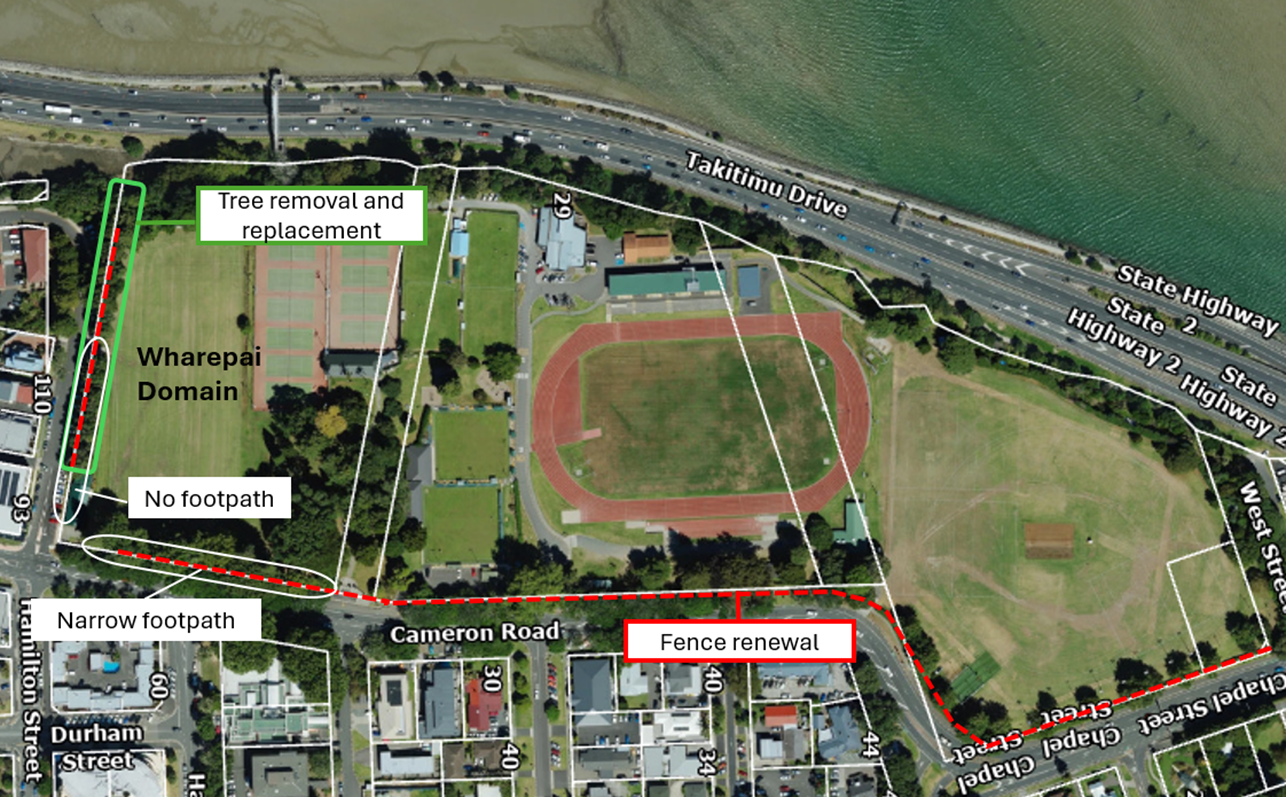
Figure 1, Wharepai Domain showing the
location of planned asset renewals and key accessible issues.
Problem
definition and reasons for investment
16. Reasons for investment
include desired outcomes, existing issues and timing with planned renewals.
Improving
amenity at a key gateway to the city centre
17. Wharepai Domain forms a major
gateway for those entering the city from Ōtūmoetai, the Mount, and
State Highway 2.
(a) The gravel carparks, uneven
surfaces, the lack of marked carparking spaces, and failing tree‑pit
edging create a low‑quality and untidy frontage.
(b) Enhance the Domain’s
appearance and usability by creating a more attractive, well‑kept edge with sealed
surfaces, clear carpark layouts, and high‑quality
tree‑pit surrounds,
lifting the presentation and function of this prominent inner‑city reserve.
(c) Strengthen the city’s
gateway experience by improving the quality of the Hamilton Street and Cameron
Road frontages and better showcasing the mature Pūriri avenue, that
strengthens a distinctive and valued gateway feature.
Poor
pedestrian access and need for accessibility improvements
18. Accessibility is critical for
users of the reserve, including event goers and people with mobility needs.
Current issues include:
(a) A 92m long missing footpath
section on Hamilton Street, limiting access to the reserve and requiring
temporary traffic management to manage access into events;
(b) The Cameron Road footpath is
narrow, limited on one side by a fence and overhanging cars on the other side
with restricted room for pedestrians to pass each other;
(c) No nearby mobility parking; and
(d) Unsealed carparks on Cameron
Road tripping hazards from loose gravel and tree roots.
Event
related constraints may prevent the development of more events in this location
19. Wharepai is the city’s premier outdoor event
venue, hosting concerts, festivals, and community sports events of up to
9,000 attendees. Other outdoor event venues are constrained by noise
restrictions or sporting events. While well‑used, there are several
issues at Wharepai Domain that reduce efficiency:
(a) Lack of a Hamilton Street
footpath forces some events to close the road for pedestrian access.
(b) The narrow Cameron Road
footpath outside Wharepai Domain cannot accommodate crowds arriving for large
events.
(c) The Hamilton Street vehicle
entrance is too narrow for event trucks, requiring reversing manoeuvres that
block traffic and create safety risks.
Tree
protection of the iconic 100-year-old Pūriri Avenue
20. The avenue of mature
Pūriri trees down Cameron Road is unique in the world as far as we know.
The trees were planted in the 1940s and are in good condition, despite being
located along a busy main road. These trees provide important
canopy cover in the city centre and a number of environmental,
ecological and human benefits which are important to maintain and protect. They
are a key feature of the entrance to the city centre and are valued by the
community. Measures in place to protect the trees are currently inadequate:
(a) The Gravel carparks between the
trees are untidy, uneven, and lack marked spaces, contributing to a lack of
amenity at a key gateway into the city centre for people coming from State
Highway 2, the Mount and Ōtūmoetai,
(b) Existing tree pits with low
timber edging are failing, cannot contain mulch, and offer little protection
from vehicles.
(c) Vehicles routinely park on
exposed tree roots causing compression and damage to trees.
Timing with planned
renewals
21. There is a strong opportunity
to address these issues now due to the alignment of renewal activities on both
road frontages. The boundary fences along Cameron Road are due for renewal this
financial year. In addition, the row of ageing cypress trees on Hamilton Street
requires removal and replacement due to ongoing limb‑failure risks and
their unsuitability for a high‑use urban reserve. These works are
supported by a resource‑consent requirement associated with the Monmouth
Redoubt remediation project, which includes a financial contribution to tree
removals and replacement along the Hamilton Street frontage.
22. In
response to the problems identified above, staff have identified four key
outcomes for the upgrade:
(a) Provide a more inclusive city
by improving accessibility for all.
(b) Support the growth of events at
Wharepai Domain which will in turn support community connection and enjoyment
and increase the vitality of the city centre.
(c) Protect existing trees by
defining space with tree pits that prevent vehicle damage and Improve the
gateway to the city: Tidy, visually appealing streets with pedestrians visible
on the footpath create an entrance to the city that feels vibrant, safe and
welcoming. improve maintenance.
23. This report puts forward three
options for consideration.
(a) Option 1 delivers on outcomes
(a) and (b) by:
(i) Constructing a new 3m
wide footpath on Hamilton Street between Cameron Road and the vehicle entrance
gate half way down the hill.
(ii) Widening of the footpath
on Cameron Road outside Wharepai Domain to 3m wide.
(iii) Provision of two accessible
carparks
(iv) Widening the vehicle access into
Wharepai Domain from Hamilton Street.
(b) Option 2 (recommended) includes
the scope from Option 1 and also delivers on outcomes (c) and (d) by:
(i) Constructing of new tree
pit surrounds that are more robust and attractive than existing
(ii) Sealing the carpark
surface on Cameron Road with a permeable paved product
(c) Option 3, the status quo,
renews fences and replaces trees but leaves critical accessibility, event‑flow,
and amenity issues unresolved.
24. A concept plan showing both
Options 1 and 2 is provided in Attachment 1.
25. Each of these three options are
discussed in further detail below with pros and cons identified.
26. Some further commentary on
Options 1 and 2:
(a) Further investigation and
design work is required prior to construction. As the design at this stage is
only at concept level, the cost estimates and programme are provisional.
(b) Both options provide a very
practical, value for money approach, using simple, robust, easy to maintain and
tried and tested materials.
(c) Both options can be delivered
in whole or in part, as a single package, or staged over a number of years as
budget allows, however in the case of the footpaths, the best value for money
outcome would be to construct the footpaths in this Financial Year to tie in
with the programmed renewal works.
27. Wharepai Domain is a valuable
but currently under‑utilised asset. Option 2 creates significantly better
connections to this green, leafy oasis in the heart of the city. Strengthening
these links would help activate the Domain and encourage more everyday use. By
tying more directly into the city’s “green necklace,” people
could enjoy a seamless experience—going for a run, then a
swim—offering an appealing alternative to Mauao and enhancing the
vibrancy of the city centre.
Statutory Context
28. The Wharepai Domain is
classified as a recreation reserve under the Reserves Act. The
Tauranga Reserves Management Plan states that Wharepai, while being used for
sports, must also be maintained as a space for major events and to provide
inner city green space.
29. There are a number of archaeological
features on and surrounding the reserve so an archaeological authority will be
required.
30. There are resource consent
conditions associated with the recent Monmouth Redoubt remediation works that
require the removal and replacement of trees along Hamilton Street as a
mitigation for the loss of three 100 year old trees at Monmouth Redoubt.
STRATEGIC ALIGNMENT
31. This contributes to the
promotion or achievement of the following strategic community outcome(s):
|
Contributes
|
|
We are an inclusive city
|
ü
|
|
We value, protect and enhance the environment
|
ü
|
|
We are a well-planned city that is easy to move
around
|
ü
|
|
We are a city that supports
business and education
|
☐
|
|
We are a vibrant city that embraces
events
|
ü
|
32. This project contributes to a
number of key objectives in the City Centre AIP including:
(a) An accessible city centre that
supports walking, cycling, micro-mobility and public transport for all ages and
abilities;
(b) A city centre with identity and
culture;
(c) An engaging city centre, that
is vibrant and inclusive, with exciting things to do for people of all ages,
stages and abilities; and
(d) A city in nature.
33. It also contributes to the
evolution of the area into the Sports and Events Precinct (City Centre
AIP) contributing to the priority actions of creating well-designed pedestrian
connections with good wayfinding that will eventually link to adjacent
precincts and city centre parking structures, facilitating efficient movement
to places of interest.
34. This proposal addresses the
selected community outcomes in the following ways:
(a) Providing sealed surfaces that
are wide enough for a mobility scooter to use and pass others (e.g. a person
pushing a pram) increases the accessibility of the city, and helps with
feelings of inclusion.
(b) Providing permeable paving
along Cameron Road and improving the tree pits protects the valuable avenue of
Pūriri trees, supporting the health and longevity of the trees.
(c) Enhancements to the footpath
network improves overall walkability in the area, making it simpler and more
convenient for people to move around—whether they are attending events,
walking down to the Waikareao Estuary walkway or simply travelling through the
neighbourhood.
(d) Improving footpaths and
widening the vehicle access on Hamilton Street makes it more affordable, easier
and safer to host events at Wharepai Domain.
Options Analysis
35. A comparison of the pros and
cons for each of these options is listed in the table below:
|
|
Pros
|
Cons
|
|
Option
1
Complete the following works in this Financial Year:
1. Construct a 3 m wide footpath on
Hamilton Street.
2. Widen Cameron Road footpath to 3 m.
3. Provide two accessible carparks adjacent to
Wharepai Domain.
4. Widen
the Hamilton Street vehicle access into Wharepai Domain.
|
Significantly improved accessibility for mobility users,
event attendees, and general pedestrians.
Improved event operations: safer manoeuvring at the
entrance and reduced need for road closures.
Highly likely that
construction can be completed within this Financial Year
|
Does not address gravel carpark amenity, tripping hazards,
or root protection on Cameron Road.
Tree‑pit failures and vehicle root damage likely to
continue without raised, robust surrounds.
Lower overall gateway quality than other options.
|
|
Cost Estimate
Approximately $500,000, including cultural monitoring,
design and project management costs. A 20% contingency would bring the total
to approximately $600,000.
There is currently $1,056,340 available in FY 25/26 which
could cover these costs.
There is a medium level of confidence for these costs.
|
|
Option 2 (Incl. Option 1)
Recommended
Commence the following in this financial year and
complete in the next Financial Year, and/or when the City Centre Green Spaces
budget is available.
5. Renewed raised tree pit surrounds for 33
Pūriri trees (both sides of Cameron Road). (Corten steel or timber
edging depending on available budget). Tree pit renewals can be
prioritised based on available budget, proximity to Domain gateways and
condition.
6. Permeable sealing of the gravel carpark
surface on both sides of Cameron Road. Sealing carparks will be
prioritised based on available budget, on accessibility needs and proximity
to Domain gateways.
|
Improved amenity and gateway presentation at a key city
entrance.
Best long‑term protection for the Pūriri avenue;
Note that corten has lower maintenance costs in comparison with timber.
Improved accessibility and parking efficiency through
sealed surfaces and clear delineation.
Strong alignment with “city in nature” and
green‑network aspirations.
Has budget available in this Financial Year to commence
works
|
Highest cost presented.
Will require a carry forward of approximately $600k of the
FY 25/26 budget
To complete the full scope of 33 trees and replacement of
gravel with a permeable paved product will require the FY26/27 budget.
Greatest construction disruption due to works required in
the road shoulder on both sides of the road. works on both sides.
|
|
Cost estimate for Option 1 + 2
Approximately $1,900,000 including cultural monitoring,
design and project management costs. A 10% contingency would bring the total
to approximately $2,100,000.
There is currently $1,056,340 available in FY 25/26, and
$1,102,827 which could cover these costs.
There is a low level of confidence with these costs.
The cost estimate for both options were arrived at via a
quote received from a contractor for the scope described in Option 1 plus
upgrades to the tree pits and paving as described in Option 2 – but
only for the ten trees in front of Wharepai Domain. The estimate for Option 2
was effectively extrapolated from the contractor quote.
|
|
Option 3
Retain the status quo
|
Lowest immediate cost.
Meets statutory
obligations regarding tree replacement.
No major construction
disruption beyond fence and tree works.
|
Does not address any
longstanding accessibility issues, including missing footpaths, narrow
footpaths, and lack of mobility parking.
Event challenges
persist, maintaining higher operating costs and continued need for road
closures. There are also higher staff costs in supporting event organisers.
No improvement to the
key gateway frontage, leaving the area looking tired and inconsistent with
city-centre aspirations.
Does not enhance
connectivity to the “green necklace” or leverage Wharepai
Domain’s potential as a major green asset.
|
|
Cost Estimate
The fences along
Cameron Road will be renewed using the Reserve Structures renewal budget and
the trees will be removed and replaced along Hamilton Street. This has a
combined cost of approximately $450,000.
|
36. In summary, Option 2 delivers
the greatest long-term value, accessibility, and city-centre amenity but at the
highest upfront cost. Option 1 offers moderate improvements but retains several
key problems that will limit future usability and require more maintenance.
Option 3 is lowest cost but fails to resolve the main issues and misses the
opportunity to better integrate Wharepai Domain into the city centre.
37. It is noted that there is
flexibility in how these options can be delivered subject to budget
availability. For example, the tree surrounds could be updated, but the paving
deferred, or alternatively, only some of the tree surrounds are updated. We
seek approval to spend the available budget, whether it is just FY25/26 or
FY25/26 and FY26/27.
Financial Considerations
38. The City Centre Green Spaces
budget has $1,056,340 in this Financial Year and $1,102,827 in FY26/27. This
budget was created to be to be spent on enhancement to green spaces within the
city centre, such as Aspen Reserve, the Domain, improvements to tree pits and
the Green Necklace.
39. If Option 1 is endorsed, it is
likely that works will get started in April/May. It is expected that
construction will take three to four months, so there is a chance that there
will be a small carry forward (potentially $200,000 - $300,000) into the next
financial year.
40. If Option 2 is endorsed, it is
expected that construction will take four to six months. Depending on the
prioritisation of work this may require the FY26/27 budget to be available to
spend. This would also require a larger carry forward, potentially in the order
of $600,000 - $700,000.
41. It is understood that
prioritisation work underway for the FY26/27 Financial Year indicates that the
City Centre Green Spaces budget is proposed to be deprioritised for the next
Financial Year and will not be available. If Council were to approve Option 2,
the completion of the tree pit and paving works could be delayed to a future
year subject to available budgets.
42. The tree removals and
replacement on Hamilton Street is funded through a financial contribution of
$220,000 from the Monmouth project, which is out of the City Centre Historical
and Cultural Precinct bulk fund.
Legal Implications / Risks
43. There are no legal
implications.
44. Key risks identified include:
(a) Road safety (High) - A road
safety risk of trucks reversing in Hamilton Street if neither Options 1 or 2
are selected.
(b) Tree health (Medium) - A risk
that the avenue of Pūriri trees could be undermined in the future as they
continue to mature if Option 2 is not endorsed.
(c) PowerCo box relocation (High) -
It is noted that there is currently a power box in the grass berm that would be
in the middle of a new footpath down Hamilton Street. We have been advised that
it will likely take six months before Powerco can process the application, and
if approved, it probably will take a year or more before construction can take
place. Despite this, we recommend installing the footpath now and relocating
the powerbox if approved by Powerco. The cost for relocation of the power box
is unknown, but could be anywhere between $80,000 and $250,000.
(d) Loss of carparks (Low) - If
Option 2 is approved, there is a small risk that there could be a reduction of
up to five carparks on Cameron Road. This is because the tree pits surrounds
haven’t been designed yet. Likewise, we need to do more investigation
into how the permeable seal is applied where there are exposed tree roots.
However we will work with the arborists and the transport team to keep any loss
of parking to an absolute minimum.
(e) Service relocation (High) -
There are a number of services beneath the berm on Hamilton Street where the
footpath is proposed. There are one to two infrastructure lids which will
likely require lowering. The condition of the pipes is currently unknown, and
there may also be unknown services. Further investigation is required if either
Option 1 or 2 are selected. Depending on findings, this may impact on project
cost and project timeframes.
(f) Programme Delay (High) -
Given the short time between Council decision making on March 10 and the end of
the Financial Year, the biggest project risks relate to the programme and
spending within the Financial Year. In addition to risks associated with services,
other programme related risks include getting the archaeological authority
approved, and securing a contractor to be ready to start works shortly after
Council approval.
TE AO MĀORI APPROACH
45. There are three hapū with an interest in the city centre area:
Ngāi Tamarāwaho, Ngāti Tapu and Ngāi Tukairangi. We have
informed the three hapū of the proposed project and let them know that it
requires approval by the City Delivery Committee before it can proceed.
46. There is an existing pou at the corner of Hamilton Street and
Cameron Road that has probably not been maintained since it was installed in
2013. Refurbishment of this pou is proposed as part of the project scope. We
intend to work with the hapū on refurbishment of the pou and the
application for an archaeological authority. There is also the potential to provide for additional cultural narrative through the application
of Mahi Toi.
47. The hapū
will also be invited to undertake cultural monitoring and a blessing
before and after the construction of the project.
CLIMATE IMPACT
48. The options presented have
potential climate impacts. Concrete is known to create greenhouse gas
emissions. On the other hand, the recommended options seek greater levels of
protection for the avenue of 45 Pūriri trees. The Pūriri trees
provide a variety of very important functions that relate to our changing
climate and environment. The Pūriri trees provide carbon storage and
sequestration, air pollution removal, stormwater interception, and they reduce
heat island effects. The Pūriri is also considered a cornerstone species
for native birds, because they provide a year-round, consistent food source.
Consultation / Engagement
49. Various staff currently have
relationships with a number of stakeholders (such as event organisers, sports
clubs and nearby businesses) and have received feedback from these stakeholders
about the issues that they currently experience. We will rely on some of these
relationships to engage on this project.
50. Staff have begun preparing a
Communications and Engagement plan for this project. Communication and
engagement activities pre-construction will also include the following:
(a) Engagement with the two sports
clubs (Tauranga Sports and Ōtūmoetai Football Club) that regularly
use Wharepai Domain.
(b) Engagement with nearby
businesses and residents such as Mag and Turbo, NZ Blood and the Courthouse
whose staff are high users of the parking along Hamilton Street and Cameron
Road.
(c) Communications with people that
use the area regularly – such as posters with QR codes, and flyers placed
under the wipers of parked cars.
(d) The Events team have started
speaking to community event organisers that are outgrowing other venues. It is
noted that engagement with event organisers has already taken place, which has
contributed to the scope of this project. We will reconnect with event
organisers as appropriate (via the events team).
51. We will work with the TCC Comms
team and the contractor to provide communications before and during
construction.
Significance
52. The Local Government Act 2002
requires an assessment of the significance of matters, issues, proposals and
decisions in this report against Council’s Significance and Engagement
Policy. Council acknowledges that in some instances a matter, issue,
proposal or decision may have a high degree of importance to individuals,
groups, or agencies affected by the report.
53. In making this assessment,
consideration has been given to the likely impact, and likely consequences for:
(a) the current
and future social, economic, environmental, or cultural well-being of the
district or region
(b) any persons who are likely to be
particularly affected by, or interested in, the proposal.
(c) the capacity of the local authority
to perform its role, and the financial and other costs of doing so.
54. In accordance with the
considerations above, criteria and thresholds in the policy, it is considered
that the proposal is of medium significance.
ENGAGEMENT
55. Taking into consideration the
above assessment, that the proposal is of medium significance, officers are of
the opinion that no further engagement is required prior to Council making a
decision. Council staff will engage with the relevant hapū and implement
the Communications and Engagement Plan outlined above in paragraph 53.
Next Steps
56. Following confirmation of the preferred
option and project budget, staff will:
(a) Implement the Communications
and Engagement Plan
(b) Complete detailed design of the
tree pits surrounds
(c) Engage a contractor to
undertake the tree removals and the footpath works.
(d) Work with the Asset Managers on
the planned renewals.
Attachments
1. Wharepai
Domain Concept design - A19773281 ⇩
|
City
Delivery Committee meeting Agenda
|
10
March 2026
|
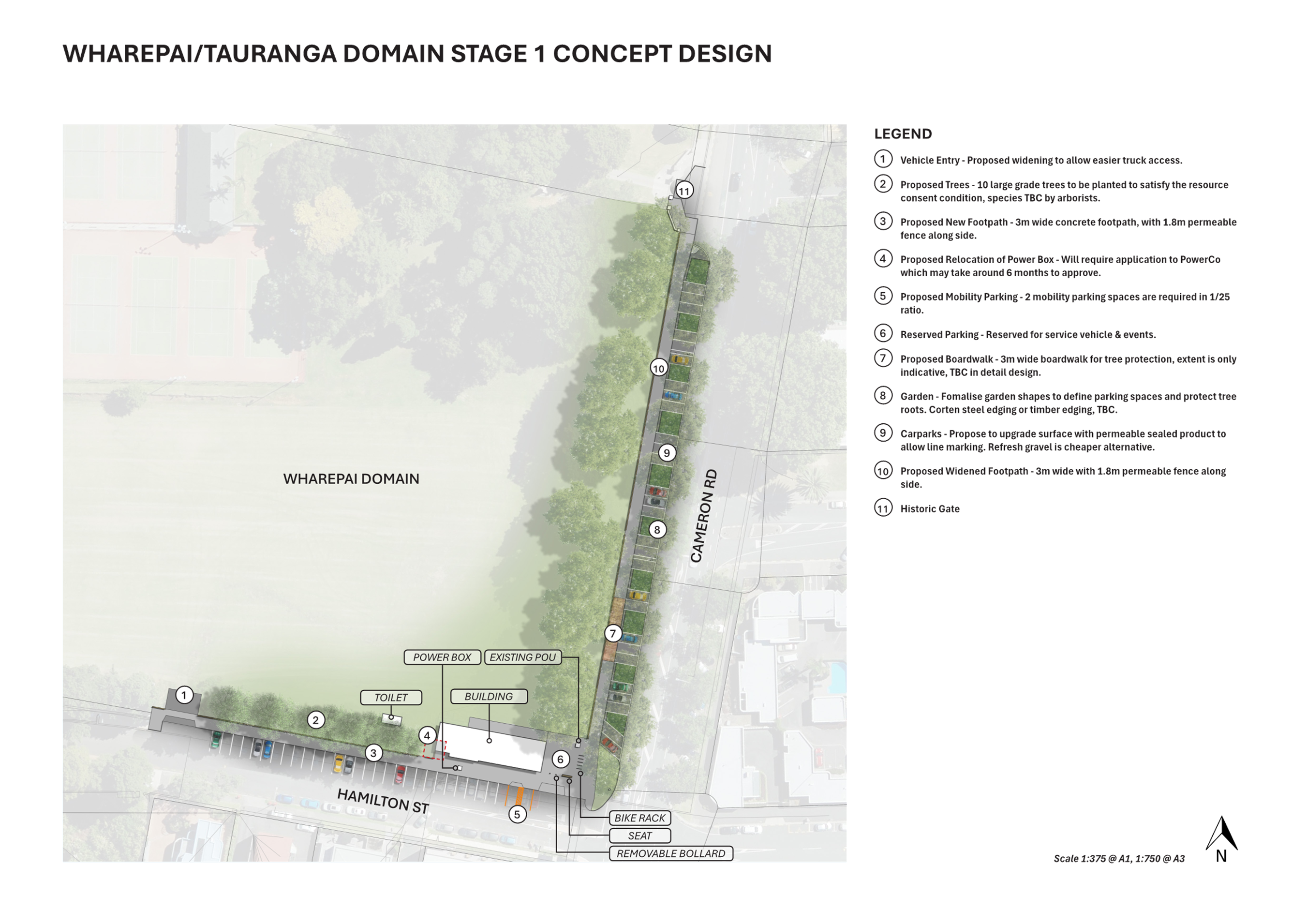
|
City
Delivery Committee meeting Agenda
|
10
March 2026
|
10.5 Play Space Investment
Programme - FY26-27
File
Number: A19498594
Author: Sonya
McCall, Open Space & Community Facilities Planner
Ross Hudson,
Manager: Strategic Planning and Partnerships, Spaces and Places
Authoriser: Reneke
van Soest, General Manager: Operations & Infrastructure
Purpose of the Report
1. The purpose of this
report is to complete the action for staff to bring the play programme back to
City Delivery Committee for confirmation/amendment prior to finalisation of
budgets for Annual Plan 2026/2027
|
Recommendations
That the City Delivery
Committee:
(a) Receives the report
"Play Space Investment Programme - FY26-27".
(b) Agrees the priorities for the
FY27 play investment programme, noting implementation timeframes will depend
on the finalisation of Annual Plan 2027.
(c) Agrees to progress with the
development of a new major play space at Sydenham Botanic Park and to engage
on an alternative option at Lees Park that does not include a young
children’s playground.
|
Executive Summary
2. Play spaces are a
core part of vibrant, inclusive communities, supporting physical activity,
social connection, and everyday use of reserves. Council invests in play
through a planned, citywide approach that prioritises safety, asset condition,
equity of access, and community outcomes.
3. This report returns
the play programme to the City Delivery Committee following the
Committee’s April 2025 decision to endorse the FY27 play investment
programme subject to confirmation or amendment prior to finalisation of Annual
Plan 2027 budgets. Since that time, Council’s fiscal environment has
changed significantly, with increased pressure on rates and a stronger focus on
reducing capital expenditure and ongoing operating costs.
4. As a result, while
the April 2025 programme provided a sound basis for engagement and early
project development, the recommended FY27 programme has been reviewed and
reshaped within a more constrained fiscal context.
5. All FY26 projects
are underway, with two projects (Hopukiore playground and Carlton Street
Reserve skatepark) requiring carry‑forward funding into FY27 due to
extended engagement and design phases. In reviewing the FY27 programme, staff
reassessed project readiness, engagement status, asset condition, delivery
timing, community expectations, and equitable provision of play across the
city. As a result, some projects are recommended to proceed or be carried
forward, while others are recommended for deferral and rephasing.
6. A key decision is
required for Brookfield. Engagement in 2025 identified a preference for
developing a new major play space at Sydenham Botanic Park rather than
upgrading Lees Park playground, driven by Sydenham’s larger footprint,
existing amenities, and ability to deliver a more inclusive, multi age play
experience. This option would require a higher capital investment
(approximately $1.3m) but would provide Brookfield with a major neighbourhood
play space. An alternative, lower cost option to upgrade Lees Park
(approximately $0.5m) would deliver a smaller scale, neighbourhood level
outcome if Council wishes to prioritise cost containment.
7. The recommended FY27
play programme capital budget is approximately $4.3m (excluding renewals
funding of approximately $180k). This represents a reduction from earlier
projections (of approximately 6.3m) through a combination of deferrals,
reprioritisation, the inclusion of approximately $1.7m in forecast carry
forward funding from FY26, deferral of approximately $2m previously identified
for commencing implementation of the updated Memorial Park site plan. This
total programme budget costs consist of a mix of detailed designs, concept
design and costs based on previous projects. Budgets include contingency and
will be designed to be delivered within budget.
8. While this approach
reduces FY27 capital expenditure and associated rates pressure, it is
acknowledged that deferring or downsizing projects has impacts on community
outcomes and carries reputational risk where engagement has already occurred.
To manage this risk, following today’s decisions, at an appropriate time
in the project lifecycle targeted communications will be undertaken to clearly
update affected communities and stakeholders on the outcomes, rationale, and
next steps. Other risks include dependency on external parties and potential
cost escalation through project deferrals.
9. The recommended
programme continues to align with the Play, Active Recreation and Sport and
Reserves and Open Space Action and Investment Plans, the Open Space Level of
Service Policy, and wider strategic outcomes relating to inclusion,
accessibility, wellbeing, and quality neighbourhood environments. Longer term
priorities and reflecting any changes to levels of service will be considered
through the Long Term Plan 2027-2037.
Background
10. On 7 April 2025, the City
Delivery Committee (the Committee) considered a report (Attachment A) on Play
Space Investment Prioritization for FY25-26. This report set out why we invest
in these activities and how prioritisation is undertaken.
11. The City Delivery Committee
resolved (CDC/25/2/7) that it:
(a) Receives the report
"Play Space Investment Prioritisation for FY25-26".
(b) Agrees the Financial Year
2026 play investment programme, which allocates existing budgets, and approves
engagement to commence following adoption of the Annual Plan 2026.
(c) Endorses the Financial Year
2027 play investment programme, which allocates existing budgets, pending
Annual Plan 2027, to enable engagement to commence.
12. While the City Development
Committee endorsed the FY27 programme in April 2025 to enable design and
engagement on some projects to occur in FY26, the Committee requested staff to
bring the programme back to Committee for confirmation/amendment prior to formation
of draft budgets for AP27.
Statutory Context
13. In line with resolution
CDC/25/2/7 all FY26 actions are in progress - refer Attachment B for a status
update.
14. Since the April 2025 report,
updated circumstances have led to a proposal that some projects originally
scheduled for FY27 be deferred, while others are recommended to be brought
forward to better align with current priorities and resource availability. Delays
have occurred for Hopukiore playground and Carlton Street Skate Park, primarily
due to extended engagement and design phases to allow time to fully consider
what we heard from the community and to ensure we could achieve what we needed
to within budget, resulting in the need to carry forward budgets into FY27.
Today’s decision on these will be reflected in the carry forward process
that will be actioned as part FY27 annual plan. This is explained in
Table 1 below, and options are provided in Attachment C.
15. As noted in the April 2025
report, the proposed programme for Financial Year 2027/2028 onwards will be
presented for consideration as part of the Long Term Plan 2027 process and will
reflect the outcome from the upcoming Open Space Level of Service Policy
Review.
Table 1: Status of projects with FY27 capex (per April 2025 report - CDC/25/2/7)
|
FY26 projects with forecast carry
forwards
|
|
Hopukiore Mount Drury Reserve, Mount
Maunganui - Play space Redevelopment and Reserve Enhancement
|
In progress – Carry forwards
required to complete
|
‘Love, Wish,
Wonder’ engagement and engagement on concept options has been
completed. Currently in design phase and reviewing costs. Construction
anticipated to commence later in 2026.
|
|
Carlton Street Reserve, Otumoetai -
skatepark redevelopment +/ pump track
|
In progress– Carry forwards
required to complete
|
Community engagement on the
location was undertaken in 2025. Engagement with schools and skatepark users
to be undertaken in Feb 2026. The design will provide additional certainty
into the required works. Construction anticipated to commence Oct/Nov 2026.
|
|
Play space and Reserve Enhancement -
Minor
|
|
|
Maungatapu play facility
|
Recommend defer
|
Council staff are working with Rangataua Sports Club
to look at opportunities there for the wider community. These discussions are
constructive and ongoing, but further work is required to understand the
opportunities and feasibility.
|
|
|
Parkdale Park, Papamoa
|
Recommend defer
|
Recent assessment has found a lifespan of
these assets longer than previously assessed. This has been extended due to
recent repairs and refurbishing, and the ability to
‘sweat’ the metal framed
equipment longer. Proposed to defer
renewal/enhancement to understand how this site is to be used following the
development of the Simpson Reserve playground.
|
|
|
NR13 The Lakes - Reserve and playground
development
|
Recommend defer
|
This reserve will not be vested by the developer in
time for reserve development to occur in FY27.
|
|
|
Playspace and Reserve Enhancement - Major
|
|
|
Brookfield - Major neighbourhood play
space (depending on investigations)
|
In progress – Decision on site
required
|
Engagement on whether to progress with an
upgraded play space at Lees Park or a new larger play space at Sydenham
Botanic Reserve was undertaken in 2025. A decision on which option to proceed
with is required. Refer paragraph 16 below for more information. Construction
at either site is scheduled for FY27.
It may be necessary to defer part of this budget to FY28 for
delivery resourcing purposes. If budget
reprioritisation is required through Annual Plan 2027 this could be deferred
– noting a key risk that community engagement has commenced.
|
|
|
Papamoa (proposed Simpson) new
destination playground development and reserve enhancement
|
In progress and recommended to phase
delivery over FY27 and FY28.
|
‘Love, Wish,
Wonder’ engagement was undertaken in 2025. Concept development is
underway. Engagement on the concept is expected in April/May 2027.
Construction scheduled for FY27.
It may be necessary to defer part of this budget to FY28 for
delivery resourcing purposes. If budget
reprioritisation is required through Annual Plan 2027 this could be deferred
– noting a key risk that community engagement has commenced.
|
|
|
Memorial Park
playground and surrounds
(note this was not included in the April
2025 report as it was on hold at that time, however funding was allocated in
the LTP commencing FY27)
|
Recommend re-commence planning
(engagement & design)
|
Many of the playground structures and
supporting assets at Memorial Park have reached or are nearing the end of
their useful life, with some - such as the bridge link - being removed due to
safety and structural deterioration. A new concept plan for the park was
developed with key stakeholders in 2023, and with the aquatic facility
footprint now confirmed, it is proposed to progress planning for the renewal
or replacement of the Memorial Park playground, including broader community
engagement.
|
|
Brookfield Play
16. The Play Active Recreation and Sport Action and
Investment Plan (PARS AIP) promotes the development of a major play
space within every suburban area. A major play space has a playground footprint
of approximately 600-800m² excluding areas of park
left open for informal play – examples include Te Papa o Takaro o
Tongaparo – Ila Park (Ohauiti) and Pacific Park (Arataki), compared to
neighbourhood play spaces which tend to have a playground footprint of <500m2.
This additional footprint provides space to provide a more diverse range of
playground equipment to meet a wider user group in terms of the number of
experiences for people of different ages and abilities, and the larger reserves
can accommodate more supporting infrastructure such as toilets and gathering
spaces. The Reserves and Open Space AIP has an action for Sydenham
Botanic Park, to support for the future development of the park to provide
amenity and passive space for the Brookfield neighbourhood. Engagement
indicated that the Brookfield community was seeking more and better play
opportunities than are currently provided, rather than simply retaining the
status quo.
17. While Lees Park provides neighbourhood open space in
Brookfield, it is too small and constrained to provide a play space at the
larger scale that allows retention of grassed open space for ball sports
and passive use. However, an upgraded neighbourhood playground at Lees Park
could still respond to community feedback by providing improved equipment,
safety, accessibility and play value within a local‑scale setting.
18. As such, staff considered whether a major play
space could be developed on nearby Sydenham Botanic Park. A play
space on that park would be located at the top of the park near the
existing toilets. While Council manages this
space, it is owned by Perpetual Guardian Trust. Perpetual Guardian Trust
have indicated their support for a play space that is appropriately designed in
such a way that it supports the botanical purposes of the park.
19. It is recognised that Te Kura o Mauanui is
located nearby (72 Millers Road). School staff have advised council staff that
they do not want the school play facilities promoted for community use, holding
concerns about visibility, damage, and littering. The Ministry of Education confirmed that the playgrounds at the former
Brookfield School are similarly unavailable for wider community use, with one
playground being used by Tauranga Special School. It is also noted that school
playgrounds do not deliver the same outcomes as a public reserve and play
space. For example,
(a) school playgrounds are not available during school hours
(b) they are often age specific, so they are not designed to
provide play experiences for pre-school children, which does not provide for an
inclusive family experience.
(c) the playgrounds are located for school design, rather than
being located with visibility or clear access from the street.
(d) school playgrounds tend not to have publicly available
supporting infrastructure or accessibility features such as toilets, access
pathways or accessible playground surfacing.
20. Engagement
with the tag-line ‘Pick your Place to Play’ asking the community
whether their preference is to progress with an upgraded play space at Lees
Park or a new play space at Sydenham Botanic Reserve was undertaken in 2025. The
engagement material made clear that both options could deliver improved play
outcomes, but at different scales and with different levels of diversity and
amenity.
21. Engagement
found that respondents
were dissatisfied with both parks, with particularly strong concern about
ageing equipment and dog issues at Lees Park. A majority (149 v 98) preferred
Sydenham Botanic Park for a new playground for reasons including its larger
footprint and better amenities, including nearby toilets. People emphasised the
need for improved safety, accessibility, and artificial shade. This preference
reflected a desire for a larger play space that could cater for a wider range
of ages and abilities and provide a broader set of play experiences. If
Sydenham were developed, respondents commonly suggested youth‑focused
features - such as a basketball hoop - for Lees Park. Refer to Attachment D for
a copy of the engagement report.
22. In
summary, the options for Brookfield are either an improved neighbourhood
playground at Lees Park that responds to calls for better local play, or a
larger, more diverse play space at Sydenham Botanic Park that integrates play
within a wider botanical park environment and supports a broader range of
experiences, ages and abilities. Development of initial concepts for engagement
will be developed once a decision on the site/s has been made. Engagement on
the concept design of the park/s will then be undertaken.
STRATEGIC ALIGNMENT
23. This contributes to the
promotion or achievement of the following strategic community outcome(s):
|
Contributes
|
|
We are an inclusive city
|
ü
|
|
We value, protect and enhance the environment
|
ü
|
|
We are a well-planned city that is easy to move
around
|
ü
|
|
We are a city that supports
business and education
|
☐
|
|
We are a vibrant city that embraces
events
|
☐
|
24. The programme aligns with the
community outcomes by improving accessible neighbourhood spaces, enhancing
environmental quality through nature‑based design, and supporting well‑planned,
easily navigable communities through equitable distribution of play
opportunities.
Options Analysis
25. There are two topics with
their own options:
(a) Topic 1: FY27 Play Programme
(b) Topic 2: Brookfield Play
26. Topic 1: FY27 Play
Programme. There are two options:
(a) Option 1: Proceed with the
recommended programme and engagement approach
(b) Option 2: Proceed with a
different programme and / or engagement approach.
27. Option 1: Proceed with the
recommended programme and engagement approach (recommended)
|
Benefits
|
The proposed programme:
· provides a coherent, city‑wide programme that
balances renewals, upgrades, and new provision rather than treating sites in
isolation.
· reduces reputational risk by delivering on completed
and ongoing engagement, maintaining community trust and confidence in Council
decision‑making
· Prioritises health and safety and equitable play
provision across the city and our communities
· is informed by Community Voice and past engagements
· takes into account demographics (age, population,
deprivation)
· provides for the diversity of play interests our
rangatahi have and increases the distribution of accessible play spaces
· is efficient in combining renewals with reserve
enhancements such as additional greening, pathways, and space for community
gathering
· we have heard from the community that supporting
amenities such as nature and other landscaping are important
· achieves cost savings compared to the
programme endorsed in April 2025.
|
|
Disbenefits
|
· Deferral of some projects and/or components still
occurs within the recommended programme, which carries community engagement
risk, particularly where expectations have been raised, will include
communication to manage perceptions of delay.
· Deferring a project delays the community receiving
the outcomes, meaning that current tamarki and rangataahi may miss out on the
benefits as they ‘grow out’ of the activity.
· Deferrals may create a backlog in project delivery,
increasing pressure in future years.
· Capital and associated operational expenditure
increases ongoing lifecycle and maintenance commitments.
· May not meet the expectations of the City Delivery
Committee
· Capital expenditure and associated operational
expenditure
|
|
Key Risks / Considerations
|
· Budget uncertainty: Implementation is dependent on
final AP27 budget decisions; any reduction in budgets or carry forward
approvals may require reprioritisation or deferral of recommended projects,
impacting planned delivery timeframes.
· Dependency on external parties: Projects involving
developers (e.g., NR13 The Lakes) or third‑party landowners (e.g.,
Sydenham Botanic Park) carry uncertainties around timing, approval processes,
and long‑term agreements.
· Cost escalation: Market volatility in construction
and play equipment may impact affordability, requiring scope refinement or re‑phasing.
|
28. Option 2: Proceed with a
different programme and / or engagement approach.
29. Should the full budget allocation
recommended be secured, the recommended programme can proceed as planned;
otherwise, adjustments will required based on final budget approvals. In
reprioritising, the focus should remain on safety and project readiness which
may involve decommissioning certain playground components prior to their
replacement or upgrade for safety purposes. However, this approach carries the
risk of delaying projects where community engagement is already underway. Refer to Attachment C which provides an options assessment on a
site-by-site basis.
|
Benefits
|
Would depend on what changes are made, for example:
· Meets the expectations of the City Delivery
Committee.
· Opportunity for cost savings
|
|
Disbenefits
|
Would depend on what changes are made, for example:
· If we just rely on the maintenance and renewals
programme, we cannot provide the additional experiences and amenities that
meet community expectation and ultimately increase patronage. For example,
the provision of pathways alongside a playground renewal provides for both
improved accessibility and a place for roller and wheely play.
· Deferring a project means that current tamarki and
rangataahi may miss out on the benefits as they ‘grow out’ of the
activity.
· Deferring a project delays the community receiving
the outcomes, meaning that current tamarki and rangataahi may miss out on the
benefits as they ‘grow out’ of the activity.
· Deferrals may create a backlog in project delivery,
increasing pressure in future years.
· Deferring a project that has a renewals funded
component may increase operational costs as more maintenance is required to
extend the life of the asset to keep it safe.
|
|
Key Risks / Considerations
|
· Project readiness and safety risks: Some assets are
nearing end of life; delaying renewals increases safety, maintenance, and
operational risks/costs.
· Engagement and expectation management: Several FY27
projects have already undergone community engagement. Changes to the
programme may create reputational risk if communities perceive that their
input is not being acted upon.
· Equity impacts: Deferring projects in high need
suburbs may exacerbate inequitable access to quality play spaces -
particularly where existing equipment is outdated or provides limited
accessibility. ‑need suburbs may exacerbate inequitable access to
quality play spaces
|
30. Topic 2: Brookfield Play. There
are two options:
(a) Option 1: Upgrade Lees Park as
a local neighbourhood play space only
(b) Option 2: Develop a new major
neighbourhood playground at Sydenham Botanic Park + add proceed to engagement
on installing a basketball hoop at Lees Park and other potential changes (with
a rangatahi/youth focus)
31. Engagement
undertaken in 2025 identified a community preference for developing a new major
neighbourhood play space at Sydenham Botanic Park over upgrading the existing
playground at Lees Park, largely due to Sydenham’s larger footprint,
existing amenities, and ability to support a more inclusive, multi‑age
play experience. However, this option requires a higher capital investment
(approximately $1 million) compared with upgrading Lees Park (approximately
less than $0.5 million). Given the current constrained fiscal environment and
the cost difference between the two options, staff consider this to be a matter
of direction and investment prioritisation for Council to determine. The
alternative options therefore present a trade‑off between cost
containment and the scale and quality of play outcomes delivered for the
Brookfield community.
32. Option 1: Upgrade Lees Park
as a local neighbourhood play space only
|
Benefits
|
· Lowest-cost option (up to $500k capital
investment incl. renewals)
· Responds to the longstanding community
desire to upgrade Lees Park and acknowledges its value and familiarity for
nearby residents, kindergarten and Plunket users.
· Addresses high dissatisfaction (81%) with
the current park – In particular the old/limited equipment and allows
for a refreshed but small-scale play offer.
· Maintains the fenced play environment
highly valued for safety, especially for toddlers and neurodiverse children.
· No dependency on third‑party
landowners.
· Avoids any perceived impacts on Sydenham
Botanic Park’s botanical character.
· Addresses community perception of lack of
investment in Lees Park and the wider Brookfield area relative to other
areas.
|
|
Disbenefits
|
· Does not align with the majority
preference: more respondents preferred Sydenham Botanic Park (149) vs Lees
Park (98), primarily because of its larger footprint and ability to provide a
broader, more inclusive play experience.
· Does not provide a major neighbourhood
play space for Brookfield/Bellevue within 1.5 km - a key strategic gap
and one reason many respondents preferred Sydenham Botanic Park.
· Site constraints limit the diversity of
play experiences, accessible play, and range for different ages — a
major engagement theme.
· Fewer supporting amenities (toilets,
community gathering spaces), which community strongly prioritised. Toilets
are not planned or proposed at Lees Park (as noted in the community
engagement material).
· Does not address perceptions that
Sydenham Botanic Park is underutilised or unsafe.
· Dog issues (off-leash use inside fenced
space near the playground) remain a challenge.
|
|
Key Risks / Considerations
|
· Continued conflict between dog use and
play – a dissatisfaction driver, and a barrier to kindergarten use.
· Risk of ongoing dissatisfaction if the
upgrade is perceived as minimal or insufficient for a growing suburb.
· Equity risk: the community continues
without a diverse multi-age play space.
· Design trade-offs inevitable due to the
limited site footprint.
|
33. Option 2: Develop a new
major neighbourhood playground at Sydenham Botanic Park + add a basketball hoop
(rangatahi focus) (recommended)
|
Benefits
|
· Aligns with the majority preference: more
respondents preferred Sydenham Botanic Park (149) vs Lees Park (98),
primarily because of its larger footprint and ability to provide a broader,
more inclusive play experience.
· Enables a high-quality, multi-age, major
play space with diverse equipment, good shade, nearby toilets, and space for
community gathering - all high-priority factors from engagement.
· Supports activation of Sydenham Botanic
Park, addressing current perceptions of underuse and improving safety by
increasing presence and visibility.
· Adds a basketball hoop at Lees Park -
directly responding to strong rangatahi feedback, where basketball was the
most suggested alternative use for Lees Park (noting basketball was listed as
an example alternative use in the engagement materials).
· Offers the opportunity for a design at
Sydenham Botanic Park that is sympathetic to botanical values and supports
horticultural learning.
|
|
Disbenefits
|
· Higher project cost and complexity
compared with upgrading Lees Park alone. Approximately $1.3M (including
non-play upgrades).
· Some residents wanting a full upgrade at
Lees Park may feel their preferred option is not fully met.
· Some respondents expressed a desire for
Sydenham Botanic Park to remain quiet/natural and worry a playground could
impact its tranquil character.
· Safety perception issues (secluded areas,
antisocial behaviour) must be addressed through design and CPTED.
· Expectations must be managed to avoid
misunderstanding that Lees Park is still a “full” playground.
· Some respondents liked that there was no
playground at Sydenham Botanic Park as they could exercise their dog in all
areas of the park.
|
|
Key Risks / Considerations
|
· Landowner approval risk; Sydenham Botanic Park is owned by the Perpetual
Guardian Trust; while the playground has been approved in principle subject
to being relocated outside the daffodil planting areas, the Perpetual
Guardian Trust will need to review and approve the plans.
· Investment on non-Council land that can
be managed via an appropriate agreement.
· Design must carefully integrate botanical
values - failure to do so may lead to opposition.
· Dog-use patterns may shift; both parks
already face dog-management issues and rule clarity challenges.
· Need to communicate clearly that Lees
Park will not continue to be a playground for young children.
· Need to engage on the updated concept
plan for the reserve with the inclusion of a basketball hoop.
|
Financial Considerations
34. This programme allocates
existing budgets in draft Annual Plan 2027 and Long Term Plan 2024-2034 that
are allocated for playground renewals and reserve upgrades – specifically
the Play AIP, and part of the Reserves AIP, Reserves and Open Space –
Space for Culture and Storytelling programme, Reserves and Open Space –
Investing in Spaces for Community programme, Playground Shade, Accessibility
Hotspots, TRMP (Tauranga Reserves Management Plan) ‘bulk fund’
budgets. In response to the current constrained fiscal environment, the
FY27 capital programme has been reviewed and reprioritised to reduce capital
expenditure while continuing to address safety, asset condition, and key
community needs.
35. The recommended FY27 play
programme capital budget is approximately $4.3 million (excluding renewals
funding of approximately $180,000) – opex, including repairs and
maintenance (R&M) and deprecation (approx $215,000pa) is assumed to
commence from FY28.
36. Planning for FY28 (through the
Long Term Plan) will include consideration of any additional operational
(R&M) expenditure arising from the FY27 play programme. Operational impacts
are assessed through the design phase, with a focus on durability, efficient
maintenance, and whole‑of‑life cost management, and are informed by
close collaboration with asset managers. Where projects involve renewal or
replacement of existing playgrounds, minimal or no additional R&M
expenditure is anticipated, noting that new assets typically require less
maintenance in the short term. However, increases in the quantity of equipment
or changes in use patterns, may result in some additional reactive maintenance
initially or over time. Any anticipated increases will be refined through
design and reflected in FY28 planning, with consideration for ongoing financial
pressures and any changes to levels of service. A new playground, such as
at Simpson Reserve or Sydenham Botanic Park is anticipated to require annual
R&M in the order of $20,000, which includes regular playground inspections.
37. Delays have occurred for
Hopukiore playground and Carlton Street Skate Park, primarily due to extended
engagement and design phases to allow time to fully consider what we heard from
the community and to ensure we could achieve what we needed to within budget,
resulting in approximately $1.67M in carry forwards in FY27 being forecast. The
resulting forecast carry forwards of approximately $1.67 million into FY27. Today’s decision on these will be
reflected in the carry forward process that will be actioned as part FY27
annual plan.
38. Table 2 below is based on the
recommended option. Alternative options for each site, with differing capital
and operational implications, have also been identified and are outlined in
Attachment B to inform decision‑making.
Table 2: Financial
considerations for recommended option
|
Site
|
Status
|
FY27 CAPEX Implications
|
|
1. Hopukiore Mount
Drury Play space Redevelopment and Reserve Enhancement
|
In progress
|
Approx. $537,000 is forecast to be spent in FY26,
with approx. $1.03M forecast as carry forwards into FY27.
|
|
2. Carlton Street -
skatepark redevelopment +/ pump track
|
In progress
|
Approx. $107,000 is forecast to be spent in FY26,
with approx. $674,000 forecast as carry forwards into FY27.
|
|
3. Brookfield - Major
neighbourhood play space (depending on investigations)
|
In progress
|
Progression of $1,343,349 (including $113,349
renewals + $300,000 for non play elements) - if Sydenham Botanic Park.
$500,000 – if Lees Park. If Sydenham Botanic Park proceeds, additional
R&M opex anticipated in the order of $20,000 annually – to be
considered in the design phase and included in LTP27 planning.
|
|
4. Simpson Reserve new
playground development and reserve enhancement
|
In progress
|
Progression of $2,332,909 (+$170,000 in FY26 as a
possible carry forward).
|
|
5. Maungatapu play facility playspace &
reserve enhancement
|
Recommend defer
|
Reduction of $350,000 capex
|
|
6. Parkdale Park playspace & reserve
enhancement
|
Recommend defer
|
Reduction of $285,000 capex (and deferral of $65,000
renewals)
|
|
7. NR13 The Lakes – New reserve and
playground development
|
Recommend defer
|
Reduction of $375,000 capex
|
|
8. Memorial Park
|
Recommend commence planning
|
Within S&P Planning operational
budgets. Existing capital budgets for delivery are included in FY27, but are
recommended to be deferred to commence in FY28.
|
Legal Implications / Risks
39. While managed by council,
Sydenham Park is owned by the Perpetual Guardian Trust. The development by
council of new assets on the park will require an update of current agreements
to reflect the council investment and enable appropriate maintenance. In
general, the Trust is supportive of initiatives that encourage greater use of
the park. As landowners, Perpetual Guardian may wish to be
made aware of health and safety protocols during construction.
TE AO MĀORI APPROACH
40. Te Rangapū o Mana Whenua o
Tauranga Moana provided input into the Play, Active Recreation and Sport AIP
which provides the strategic guidance for this programme of work. Early
engagement with mana whenua has been and will continue to be undertaken as projects
on this programme commence. Reserves are places where Tauranga’s culture
and history can be celebrated.
CLIMATE IMPACT
41. The programme enhances
biodiversity by integrating planting, shade trees, and, in some instances,
nature‑based design that strengthen ecological function across
neighbourhood reserves.
Consultation / Engagement
42. For projects scheduled /
proposed to be delivered in FY27, the following engagement has been undertaken
or is planned:
(a) Carlton Street Skatepark -
Community engagement on the within the park was undertaken in 2025. Engagement
with schools and skatepark users on the design is underway (commenced Feb
2026).
(b) Hopukiore (Mount Drury) Reserve
playground - Engagement was undertaken in 2025. The project is currently in
design phase and reviewing costs. Construction is anticipated in mid-late 2026.
(c) Simpson Reserve Playground
– Initial ‘Love, Wish, Wonder’ was undertaken in 2025.
Engagement on the concept is expected in April/May 2027.
(d) Brookfield play –
Engagement on whether to progress with an upgraded play space at Lees Park or a
new play space at Sydenham Botanic Reserve was undertaken in 2025. Engagement
on the design of the park/s will be undertaken.
Significance
43. The Local Government Act 2002
requires an assessment of the significance of matters, issues, proposals and
decisions in this report against Council’s Significance and Engagement
Policy. Council acknowledges that in some instances a matter, issue,
proposal or decision may have a high degree of importance to individuals,
groups, or agencies affected by the report.
44. In making this assessment,
consideration has been given to the likely impact, and likely consequences for:
(a) the current
and future social, economic, environmental, or cultural well-being of the
district or region
(b) any persons who are likely to be
particularly affected by, or interested in, the .
(c) the capacity of the local authority
to perform its role, and the financial and other costs of doing so.
45. In accordance with the
considerations above, criteria and thresholds in the policy, it is considered
that the matter of confirming the programme is of medium significance.
ENGAGEMENT
46. Taking into consideration the
above assessment, that the matter is of medium significance, officers are of
the opinion that no further engagement is required prior to Council making a
decision.
Next Steps
47. If the recommended option is
progressed, the following actions will be progressed.
(a) Hopukiore Mount Drury
play space redevelopment and reserve enhancement – finalise design and
progress to construction.
(b) Carlton Street Reserve -
skatepark redevelopment +/ pump track – finalise design and progress to
construction.
(c) Brookfield - Major
neighbourhood play space (depending on investigations) - progress with design
and round 2 engagement
(d) Simpson Reserve new
playground development and reserve enhancement – finalise concept designs
and progress to engagement in Autumn and construction in 2027.
(e) Memorial Park -
Re-commence planning, and report back as part of LTP planning for the FY28 play
programme.
Attachments
1. Attachment
A - CDC 10 March 2026- Report to the City Delivery Committee - 7 April 2025 -
A19767485 (Separate Attachments 1)
2. Attachment
B - CDC 10 March 2026 - FY27 Play Programme - Status Update - A19778388
(Separate Attachments 1)
3. Attachment
C - CDC 10 March 2026 - Site Specific Options - Play Programme FY27 - A19778399
(Separate Attachments 1)
4. Attachment D -
CDC 10 March 2026 - Brookfield 'Pick your place to play' Engagement Report -
A19778277 (Separate Attachments 1)
|
City
Delivery Committee meeting Agenda
|
10
March 2026
|
10.6 Major Projects Update
- Transport
File
Number: A19776084
Author: Chris
Barton, Portfolio Manager: Infrastructure
Authoriser: Marty
Grenfell, Chief Executive
Purpose of the Report
1. To provide an update to
Committee on the transport major projects in implementation and delivery
including Pāpāmoa East Interchange, SH29 Tauriko Enabling Works and Fifteenth Avenue to Welcome Bay.
|
Recommendations
That the City Delivery
Committee:
(a) Receives the report
"Major Projects Update - Transport".
|
Executive Summary
2. This is an update
report on the status and progress on the three major transport projects which
are in delivery phase, the Pāpāmoa East Interchange, SH29 Tauriko
Enabling Works and Fifteenth Avenue to Welcome Bay projects. The Cameron Road
Stage 2 and Connecting Mount Maunganui projects are being reported to City
Futures Committee.
3. This report is being
provided as the projects are high value, complex, and have a high risk profile
with potentially significant consequences.
4. Overview timeframes
for delivery of the five major transport projects are outlined below:
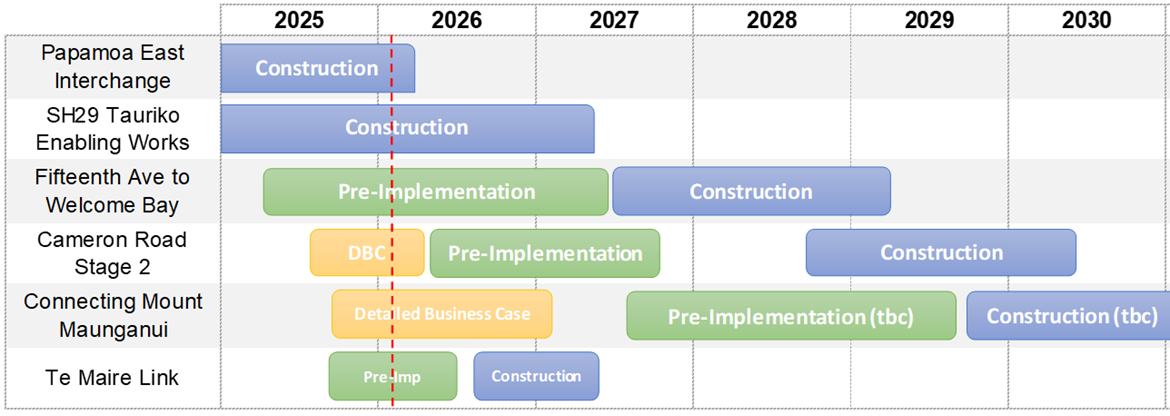
5. Overall the
construction of the Pāpāmoa East Interchange and SH29 Tauriko
Enabling Works projects are progressing well, and are being delivered on time,
within budget, safely and without significant stakeholder issues or traffic
disruption.
6. The
Pāpāmoa East Interchange is on-track for completion in late March.
7. At Tauriko, the SH29
/ Kaweroa Drive / Redwood Lane roundabout and Kaweroa Drive connection between
SH29 and the Tauriko Business Estate was completed in late 2025, and
significant progress has been made at the Tauriko Village and SH29 / Cambridge
Road intersection this year, with works on track for completion in 2027.
8. The Fifteenth Avenue
to Welcome Bay project is progressing through design development including
further assessment of the existing Hairini Bridge to inform structural capacity
and design options.
9. Key risks are
reflected in project updates with ‘amber’ status. The key current
risk for SH29 Tauriko Enabling Works is continuing to manage traffic and
disruption through remaining construction, and for Fifteenth Avenue to Welcome
Bay the key risk is scope and cost confirmation particularly regarding the
Hairini Bridge as the first phase of the design is developed.
Pāpāmoa East
Interchange
10. The Pāpāmoa East
Interchange is a key roading connection to improve network connectivity for
existing residents and also enable ongoing growth and continued residential
& commercial development.
11. Construction is progressing
well with works currently ahead of programme and costs forecast to be within
budget.
12. An overview of the project
status is as below:
|
|
Status
|
Comments
|
|
Cost
|
|
Original LTP Budget
$79.3m. Current estimates are within budget.
|
|
Time
|
|
Baseline completion
mid-2026. Currently ahead of programme, on track for completion in late March
/ early April 2026.
|
|
Safety
|
|
Appropriate safety
management with regular audits.
Over 140,000 worker
hours on site to date without any serious harm incidents.
|
|
Scope
|
|
Project scope confirmed
with no substantive changes.
|
|
Stakeholders
|
|
No current major
disruption or complaints.
Ongoing traffic
management on TEL required to facilitate final bridge works.
|
|
Risk
|
|
Active management of
live risks with contingencies in place.
With construction now
well progressed the residual risk profile continues to reduce, which has
enabled a recent contingency review and release.
|
13. Works are well advanced on all
interchange ramp connections, with the current focus on progressing the
overbridge. At the bridge site, abutments are now in place, the overbridge
beams have been installed and the bridge deck has been poured.
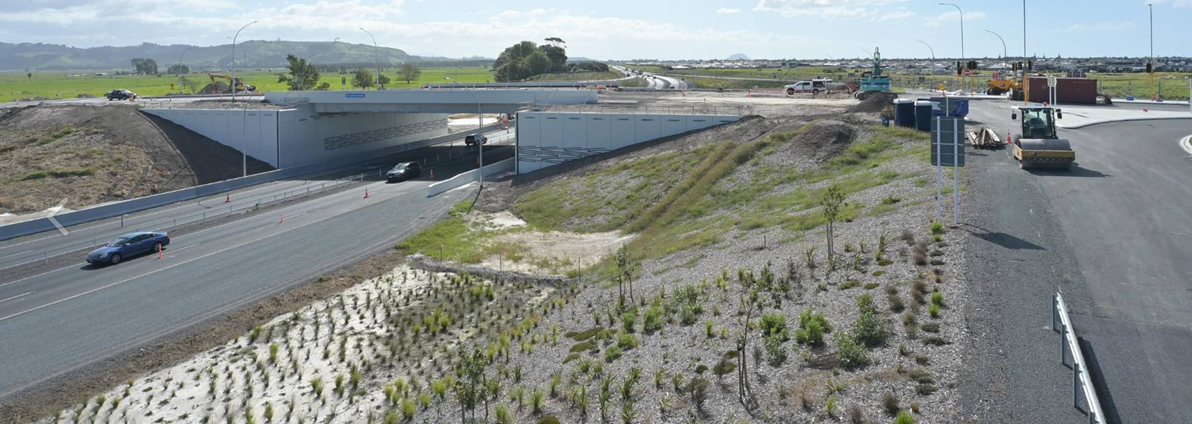
14. Following early opening in
August 2025, the TEL eastbound exit ramp connection to Te Okuroa Drive
continues to operate.
15. Through the design development,
procurement and delivery phases staff have optimised scope, procured smartly,
worked collaboratively with the Contractor to mitigate and avoid realisation of
risks and actively monitored residual risk, which has resulted in significant
savings and release of budgeted contingency.
16. The overall interchange is
programmed for completion and opening in late March / early April 2026. Final
completion is subject to progress with final works in completing bridge
construction, asphalting, road marking and commissioning.
17. Following project completion
and reviews a project close-out report is planned to be provided to the City
Delivery Committee in June 2026.
SH29 Tauriko Enabling Works
18. The Tauriko West Enabling Works
project supports both residential and industrial growth - it will directly
enable initial development of up to 2,400 new homes in
the Tauriko West development area and enable ongoing development of over 100
hectares of industrial land in the Tauriko Business Estate, which is
anticipated to provide up to 6,000 additional jobs within the city.
19. An overview of the project
status is as below:
|
|
Status
|
Comments
|
|
Cost
|
|
LTP Budget $240.8m.
Current estimates are within budget.
|
|
Time
|
|
Construction
progressing on programme:
- Redwood / Kaweroa / SH29
Roundabout – completed in 2025.
- Tauriko Village / Cambridge Rd
/ SH29 - scheduled to be complete in 2027.
|
|
Safety
|
|
Continuous safe
delivery – approx. 350,000 worker hours to date without any serious
harm incidents.
|
|
Scope
|
|
Scope confirmed with no
substantive changes.
|
|
Stakeholders
|
|
Actively working with
project neighbours and travelling public, however anticipate ongoing traffic
disruption during construction.
Temporary
SH29 single direction detour required in April (for up to 1 week) to
facilitate service installation and SH29 road crossings.. Plans currently
being confirmed.
|
|
Risk
|
|
Active management of
live risks and contingencies in place, however this remains a high-risk
project with significant residual risks.
Managing traffic
throughout construction to minimise disruption remains a key challenge and
risk.
|
20. At the Tauriko Village section
of the site, the new large retaining walls are now completed, waters
infrastructure installation is progressing well and SH29 road widening near
Tauriko School is well advanced, preparing for a traffic switch to the new pavement
in April.
21. Significant progress was made
in January at the SH29 / Cambridge Road intersection during a temporary
Cambridge Road lane closure, completing major pavement construction at the
intersection.
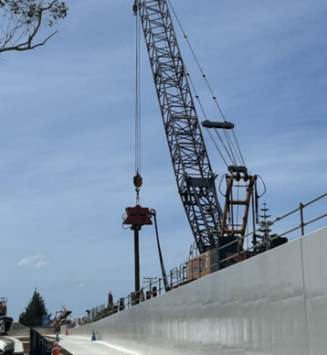
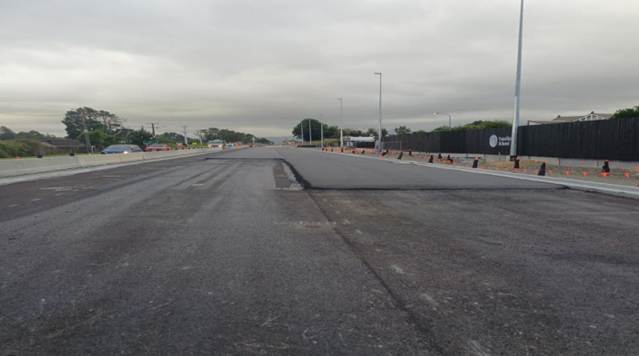
22. The infrastructure development
is well aligned with the recent confirmation of the Tauriko West plan change,
with both components working together to enable land development activities to
commence. Earthworks are now underway within the Tauriko West development area.
Fifteenth Avenue to WElcome Bay
Upgrade
23. This project seeks to address
current and growing issues with peak hour congestion, poor level of service,
access and safety problems, and walking and cycling deficiencies on the key
city arterial transport corridor of Fifteenth Avenue to Welcome Bay including
the Hairini Bridge.
24. An overview of the project
status is as below:
|
|
Status
|
Comments
|
|
Cost
|
|
LTP Budget $170.2m.
Current estimates are within budget.
NZTA co-funding
approved for pre-implementation phase.
|
|
Time
|
|
Progressing to
programme.
|
|
Safety
|
|
No current issues.
|
|
Scope
|
|
Some scope elements to
be further refined through the pre-implementation phase.
|
|
Stakeholders
|
|
Extensive further
engagement is planned through design phase in advance of construction.
Noting plans are
currently being refined, it is anticipated further stakeholder communication
and engagement will be completed at 30-50% and 85% design stages, which will
be indicatively mid and late 2026.
|
|
Risk
|
|
Some key risks remain
which will be further addressed through the pre-implementation phase.
It is noted that a key
project hold point remains confirmation of the Hairini Bridge structural
capacity.
Managing traffic
through construction to minimise disruption and staging works in alignment
with other networks activities is a key challenge and risk. This will be
further informed as the construction methodology is developed with the ECI
contractor.
There may be
opportunities to advance some construction enabling works in advance of
implementation co-funding approval gateway, however confirming NZTA
co-funding for these elements may be a risk.
|
25. The first phase of design works
are underway – with a current key focus on the Hairini Bridge structural
elements and confirmation of bridge structural capacity. A detailed update on
the bridge is planned to be provided to the City Delivery Committee in June.
26. The overall programme is for
designs to be complete and construction to commence from 2027, with
construction completion indicatively estimated in early 2029.
27. Coordination of construction
methodologies, staging and timing with other key projects affecting arterial
roading corridors (particularly the Cameron Road Stage 2 upgrade project) will
remain a key focus as designs and programmes develop to ensure overall traffic
disruption during construction is minimised as much as possible.
Next Steps
28. A major projects update report
will be provided to future City Delivery Committee meetings.
Attachments
Nil
|
City
Delivery Committee meeting Agenda
|
10
March 2026
|
10.7 Resource and Building
Consent: 6-monthly update
File
Number: A19777807
Author: Alex
Miller, Head of Environmental Planning
Steve Pearce, Head
of Building Services
Authoriser: Sarah
Omundsen, General Manager: Regulatory and Community Services
Purpose of the Report
1. This
report provides a regular update on Council’s performance in processing
building and resource consents for the period July to December 2025, and
expands on efforts to improve delivery of these services
2. This report is provided
at the request of the Committee, following the presentation of reports on
Council’s performance in building and resource consent processing on 4
June 2025 and on 22 July 2025.
|
Recommendations
That the City Delivery
Committee:
(a) Receives the report
"Resource and Building Consent: 6-monthly update".
|
Executive Summary
3. Council
received 1,003 building consent applications in the reporting period (July
– December 2025), down from 1,062 and 1,098 in the same period of the
previous two years. 932 were granted in the reporting period. Statutory
timeframe compliance improved to 94% in the last quarter, up from 83% and 75%
in prior years. During the reporting period 8,641 inspections were completed,
with 747 Code Compliance Certificates (CCCs) issued—both decreases from
previous years. A total of 337 new dwellings were consented, slightly below the
forecast, but up compared with last year, largely due to a number of medium
density (townhouse) developments in Pāpāmoa and Te Papa.
4. Resource
consent volumes showed a very small decline, with 277 received in the reporting
period, down from 286 in the same period last year. Timeliness remains strong,
with 96% of new decisions and 93% of all consents issued within statutory
timeframes. 95% of applications were approved, with 5% returned due to
insufficient information. The number of returned applications has decreased
from previous years, which may indicate a broader improvement in the quality of
applications. 98.5% of decisions have been issued on a non-notified basis,
which is consistent with long-term observations
5. Both
Building and Planning Activities have active continuous improvement programs in
place, which target consistency, efficiency, and customer experience along with
issues which arise through regular auditing and review.
6. Similarly,
both Activities are currently subject to significant focus from central
government, with ongoing updates to regulation, standards, direction, as well
as wider legislative reform.
7. Next
steps: Staff will provide performance and improvement updates every six months.
BUILDING CONSENTS
8. Council
received a total of 1003 applications for Building Consents (including
amendments) in the period July-December, which compares with 1062 and 1098 for
the same period in the two previous years. We granted 932 applications in that
same period compared with 1015 and 1039 in the two previous years.
9. Compliance
with statutory timeframes continues to improve. In the first quarter of the
financial year, we achieved an average of 90% of applications granted within
the statutory timeframes and in the second quarter we achieved an average of
94%. This is compared with an average of 83% and 75% for the last two financial
years.
10. We completed
8641 building inspections in the period July – December 2025, which is
also down compared with 8885 and 9573 for the same timeframe in the two
previous years. The number of granted CCCs follows the same pattern
– 747 last year, compared with 871 and 901 in the two previous
years. Inspection wait times remain low, generally sitting at 1-2 days,
and CCC timeframe compliance remains high at 98% for this period.
11. Council issued
building consents for 337 new dwellings and issued CCC for 278 in the period
July to December 2025. The forecast demand was 369 for this period. This
obviously remains below our forecast demand, however the volume consented is
higher than in the same period last year (247). This volume seems to have been
influenced by a large number of medium density (townhouse) developments
consented in October and November, particularly in the Te Papa and
Pāpāmoa wards but also to a lesser extent in Arataki and Otūmoetai.
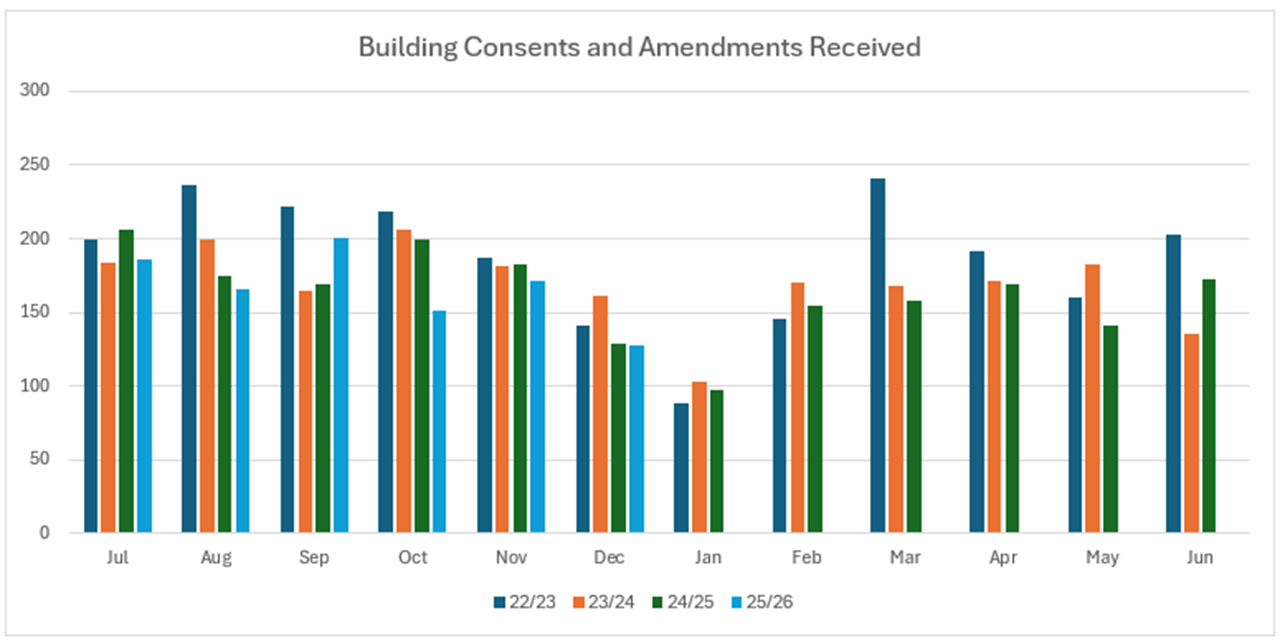
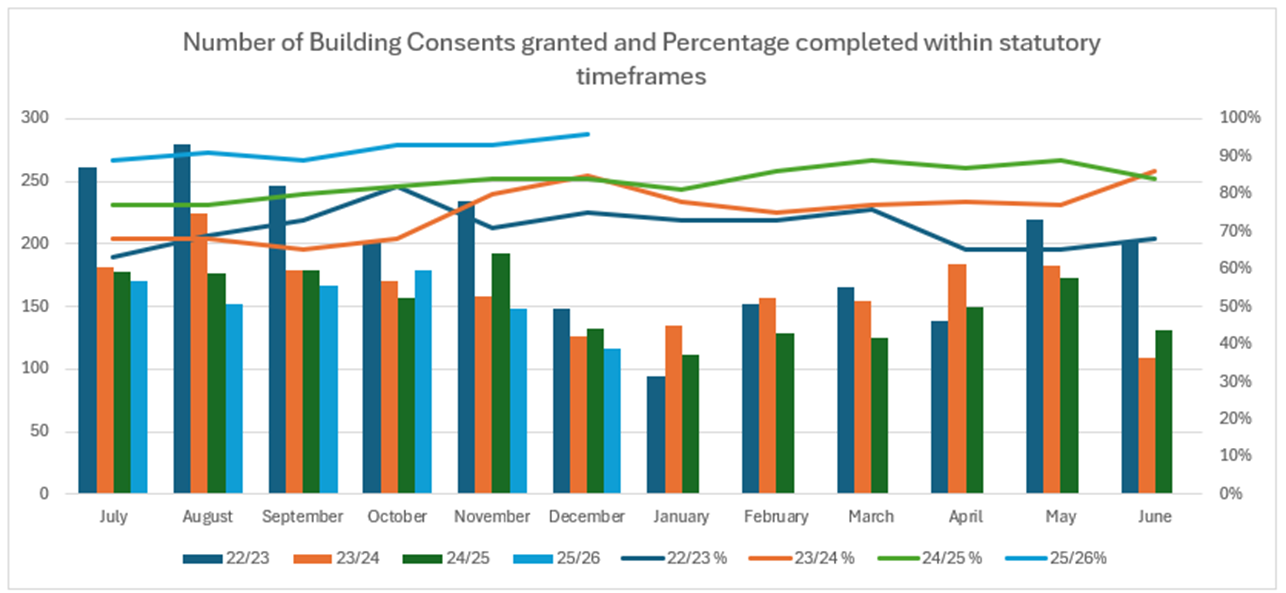
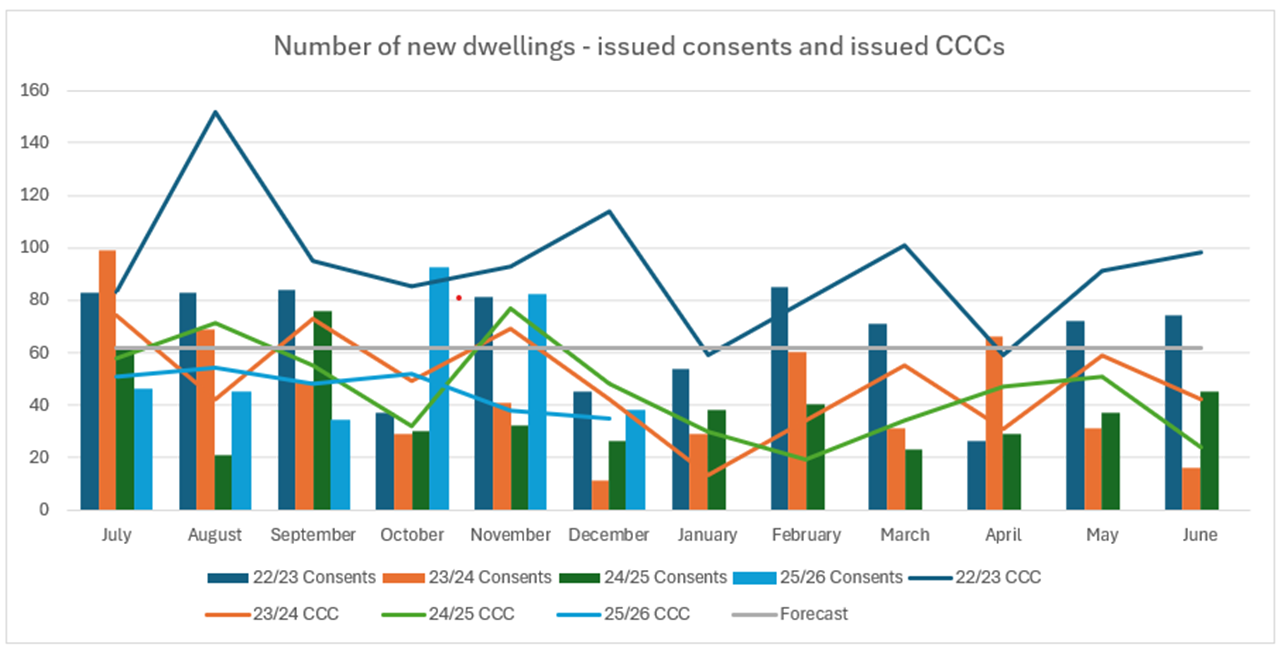
IANZ Assessment
12. Building
Consent Authorities must meet the Building (Accreditation of Building Consent
Authorities) Regulations 2006. These include requirements to have and implement
a number of systems in place. This includes a quality management system,
regular audits of both processes and technical decisions, ongoing training and
development, and systems in place to identify and act on improvements from
complaints, staff suggestions and any other issues identified, amongst other
things.
13. BCAs
are regularly audited by MBIE’s appointed assessor, International
Accreditation New Zealand (IANZ) to ensure that they are complying with all of
the requirements of the regulations. Tauranga’s BCA was assessed by IANZ
in September 2025 over a 5 day period.
14. The
audit result was the best result Tauranga has had with only three minor issues
identified, and all resolved satisfactorily within the required period.
Those issues related to the following:
(a) The recording of appropriate
reasons for decision on granting of extensions of time. This was resolved while
the assessment team were on site.
(b) The appropriate management of
the statutory clock on CCC applications. The assessors identified three CCC
applications where the clock hadn’t been managed as per the statutory
requirements, although noting that in all of these examples the issue did not
impact the compliance with the statutory timeframes. This was resolved by
updating some process documentation and additional training.
(c) One of our experienced
technical staff had been issued a second 5 year exemption from obtaining a
building qualification on the basis of their experience and other
qualifications/professional licences, and this was not considered appropriate.
This issue has since been resolved.
By comparison in 2023 seven minor issue and one repeat
issue were identified, and in the previous assessment in 2021 a total of 16
were identified. The number and scale of the issues identified in this
assessment compares very favourably with other BCAs around the country, and
places Tauranga City Council amongst the highest performing.
15. When
concluding on the compliance and risk category of the BCA the assessment report
notes the following.
Consideration,
as at the end of the on-site assessment phase of this assessment has determined
that the BCA is considered to pose a Low Risk. The main reasons for considering
this risk category were:
· Only three general non-compliances were raised,
and one of these was resolved during the assessment.
· The BCA had a highly engaged leadership team,
who demonstrated a good understanding of accreditation requirements.
· The BCA had a dedicated quality manager that
had good oversight of the BCA’s quality processes.
· The BCA had good internal audit and continuous
improvement systems in place to identify and manage issues as these arose.
· The BCA was seen to have taken actions to
address recommendations made during the previous assessment.
If
the BCA is able to demonstrate an equally good or better performance during its
next assessment in two years’ time it is likely that the BCA may be
categorised as extra low risk at that time.
16. The
next audit will be in September 2027, at which time we will be working hard to
achieve the “extra low risk” category; to date, only one BCA has
ever achieved this result.
Granny Flats / Detached Minor
Residential Units (DMRUs)
17. The
new Small Standalone Dwelling provisions were finalised and announced on 15
December 2025, effectively providing a pathway for property owners to have a
new small dwelling built on their property without obtaining a building
consent.
18. Changes
to the Building Act were supported by the introduction of a National Standard
for Detached Minor Residential Units, to provide an option for these builds to
proceed without a resource consent, noting that this largely enables the
additional building in a density context, and other city plan provisions
continue to apply.
19. Despite
a significant amount of communication through conventional and social media
platforms, it has not always been clear that there are still a number of steps
that must be followed before constructing a granny flat.
20. It
should also be noted that development contributions still apply to granny flats
built through the PIM / permitted process, and in some cases these can be
present a substantial cost.
21. A
basic set of plans and other information must be submitted to the Council prior
to works commencing. This application is assessed at a high level to confirm
that the building is new, standalone, single storey, and (very importantly)
unaffected by natural hazards. The detailed design and construction can only be
completed by Licensed Building Practitioners and there are a number of criteria
that the buildings must meet, but do not form part of the Council’s
assessment.
22. Importantly,
while the building must comply with the building code, the legislation
specifically prevents that council from assessing this. As a result, however,
the council is also not liable for any of these non-consented small standalone
dwellings.
23. At
the time of writing, Council has received three applications. One has been
issued, one was rejected for a lack of information, and the other was withdrawn
by the applicant partway through the process.
New dwelling numbers in October and November
24. As noted above, the number of new dwellings in
October and November was higher than in previous months. This stands out as a
possible sign of increasing house supply.
25. An analysis of the new dwellings in these months
(shown in the table below) shows that these numbers are driven by medium
density residential developments. The projects consented in these two months,
are mostly made up of two to three storey and in blocks of two to four
dwellings per block. The single storey dwellings tend to be more common in the
kaumatua/retirement village developments.
26. The
medium density residential development typology has become a much more common
consent type in the past few years, and these numbers suggest that this will
continue.
|
Acklam Avenue, Otūmoetai
|
Construct four three-bedroom and two two-bedroom units
across two blocks.
|
|
Nga Potiki Lane, Pāpāmoa
|
Construct 16 single-level two-bedroom dwellings across
four blocks
|
|
Devonport Road, Tauranga South
|
Construct two two-storey blocks with a total of 20
one-bedroom dwellings
|
|
Manson Street, Gate Pa
|
Construct two two-storey two-bedroom detached dwellings
and one two-storey block with three two-bedroom dwellings and one three
bedroom dwelling
|
|
Neil Place, Gate Pa
|
Construct five two-storey two-bedroom dwellings
|
|
Constellation Way, Pāpāmoa
|
Construct four two-storey three-bedroom dwellings
|
|
Henderson Crescent, Parkvale
|
Construct four single-level two-bedroom dwellings across
two blocks
|
|
Eighteenth Avenue, Tauranga South
|
Construct nine one bedroom dwellings over three floors.
|
|
Grange Road, Otūmoetai
|
Construct four two-storey two-bedroom dwellings and three
two-storey three bedroom dwelling across three blocks.
|
|
Briarley Street, Tauranga South
|
Construct six two-story two-bedroom dwellings and two
two-storey three-bedroom dwellings across three blocks.
|
|
Grenada Street, Arataki
|
Construct 15 single level two-bedroom dwellings and two
three-bedroom dwellings across seven blocks
|
rESOURCE cONSENTS
27. Council
has received 277 resource consent applications in the reporting period
(July-December), which is consistent with the same period in previous years
(2024/25: 286, 2023/24: 260). Resource consent applications continue to be
highly variable month-by-month.
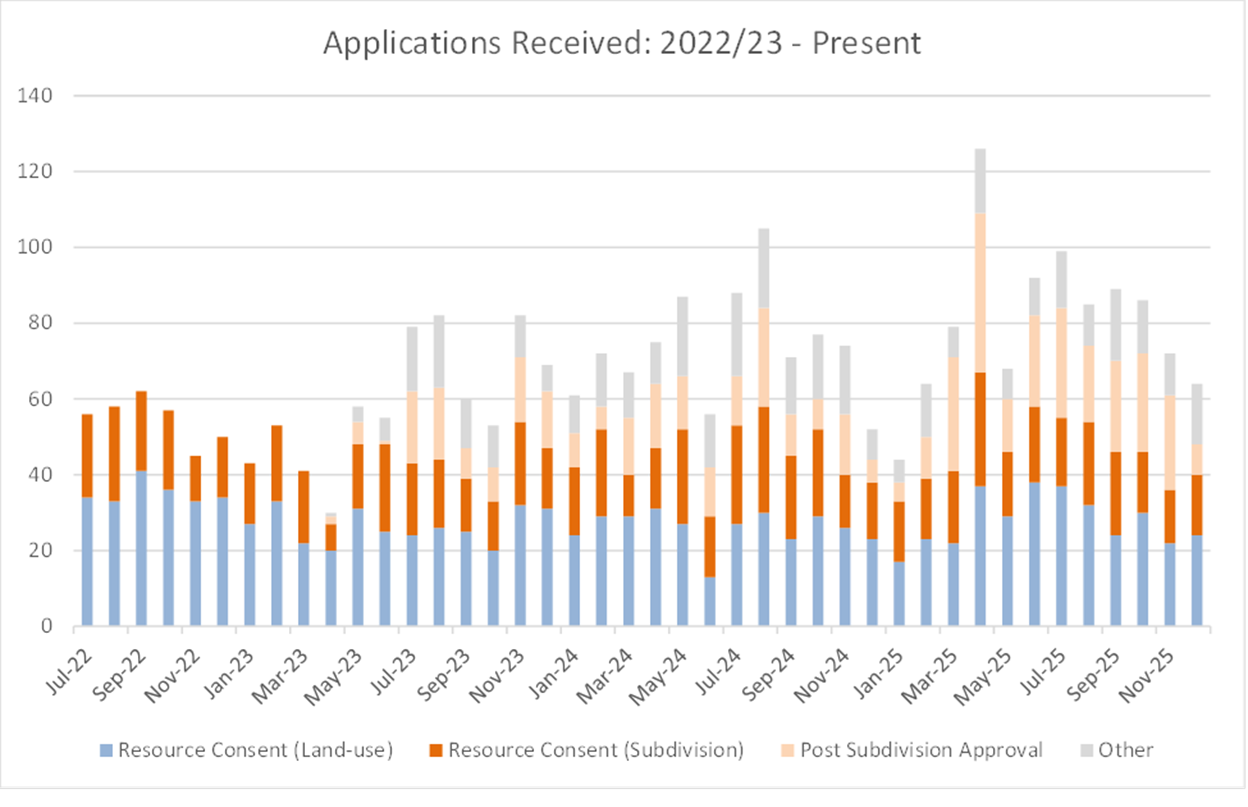
28. Council
has issued decisions for 278 resource consent applications in this period.
Compliance with regulatory timeframes remains strong, reflecting an ongoing
focus on timeliness and efficiency.
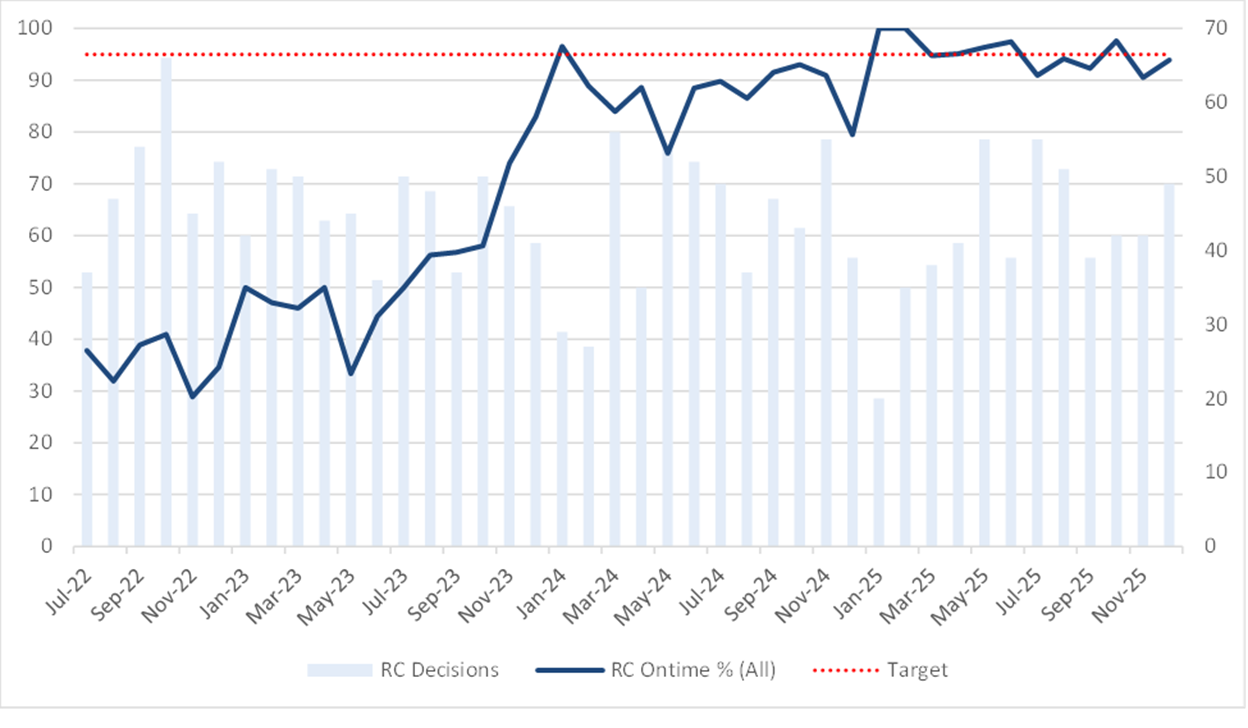
29. Within
this reporting period, and consistent with long term trends, the majority (95%)
of decisions were to approve the consent. The remaining 5% were returned as a
result of insufficient applications, with no refusals issued in this period.
30. Similarly,
98.5% of decisions have been issued on a non-notified basis, which is
consistent with long term observations.
31. This
committee has previously requested an update on the number of applications
relating to developments on land classified as Maori Owned, which is provided
below.
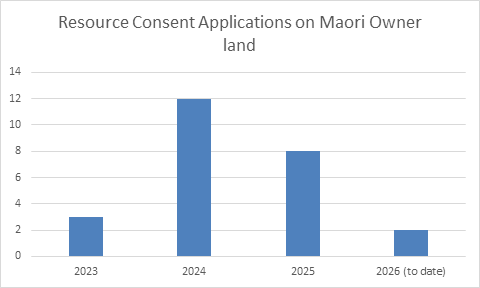
Notable applications:
32. Council
has received and processed (or is processing) applications in relation to a
number of significant developments across the city, including:
(a) Classic
Developments Ltd / Tauriko West:
Subdivision and land use consent to enable 360 lots. At the time or
writing, a decision for this application is imminent, pending agreement on
consent conditions.
(b)  Venture
Projects Smiths Ltd / Smiths Farm, Bethlehem: A subdivision and land
use consent to enable a 364 lot development in Tauriko. This application is
being processed externally, given Council’s involvement as the previous
land owner.
Venture
Projects Smiths Ltd / Smiths Farm, Bethlehem: A subdivision and land
use consent to enable a 364 lot development in Tauriko. This application is
being processed externally, given Council’s involvement as the previous
land owner.
(c) Camdon
Investments Ltd / Durham St: An application for student accommodation for the
University of Waikato, housing up to 72 students in the city centre (pictured
right)
(d) EL
Properties Ltd / Kaweroa Drive, Tauriko: An application to establish
accommodation facilities for up to 180 seasonal workers within the Tauriko
Industrial Zone.
Notification in relation to
housing density
33. In
December 2025, several members of the development/applicant community raised
concerns about Council’s approach to notification decisions, specifically
in relation to housing developments involving four or more dwellings. It was
suggested that there had been a significant increase in applications being
notified. A review of recent applications confirmed that there had been no
substantial increase in applications being notified.
34. Council
met with those members of the development community in order to better
understand their experiences.
35. Based
on concerns raised in these discussions, Council has reviewed and refined
it’s approach to notification decisions for these applications, in order
to ensure that it was implementing plan change 33 appropriately, and in line
with the intent of the MDRS.
36. As
a result of this engagement, a regular forum has been established between
Council planning staff and a group of local consultants active in housing
applications, in order to highlight issues
and work through them in a constructive and collaborative way.
National Direction and
Legislative Reforms
37. In
late December 2025, a suite of updated national directions were approved, in
the form of three new instruments and amendments for seven existing
instruments. These changes came into effect from 15 January 2026. Of particular
relevance:
(a) The
National Policy Statement for Natural Harzards (NPS-NH): this
requires Council’s to identify, assess and manage natural hazards through
planning decisions, introducing a new framework for risk assessment and a
requirement to utilise the “best available” information.
(b) National
Environmental Standards for Detached Minor Residential Units (NES-DMRU):
This NES is complimentary to the building act reforms for granny flats, and
provides a pathway for these builds to proceed as a permitted activity subject
to conditions being met.
(c) Amendments
to the National Policy Statement for Highly Productive Land (NPS-HPL):
Amendments include a pathway to enable development of LUC3 land, which had
previously been restricted. Note that these updated provisions favour density,
rather than large lot/lifestyle development, which provides a natural
limitation on it’s applicability.
38. In
late 2026, the RM reform programme progressed with the introduction of the
Planning Bill and the Natural Environment Bill as replacement legislation for
the Resource Management Act. Submissions on these bills closed on 13 February
2026, with a Select Committee process to follow and an expectation that new
legislation will be passed into law late 2026.
39. Staff
are working with colleagues from both the Western Bay subregion (BOPRC and
WBOPDC) and large metro Councils from across the country to identify
opportunities for collaboration, and development of consistent approaches to
implementation.
Statutory
Context
40. Building Consents and Resource
Consents are both regulatory functions with set processes, which are set out in
their respective legislation.
STRATEGIC ALIGNMENT
41. This contributes to the
promotion or achievement of the following strategic community outcome(s):
|
Contributes
|
|
We are an inclusive city
|
☐
|
|
We value, protect and enhance the environment
|
ü
|
|
We are a well-planned city that is easy to move
around
|
ü
|
|
We are a city that supports
business and education
|
ü
|
|
We are a vibrant city that embraces
events
|
☐
|
Financial Considerations
42. There are no financial
considerations or impacts as a result of this paper.
Legal Implications / Risks
43. There are no legal implications
or risks as a result of this paper.
TE AO MĀORI APPROACH
44. The RMA requires consideration
of cultural effects, and in many cases this will require applicants to consult
with relevant iwi and hapu.
45. Staff and applicants are guided
by Council’s ‘Consultation with Tangata Whenua on Resource Consent
Applications Policy’.
Significance
46. The Local Government Act 2002
requires an assessment of the significance of matters, issues, proposals and
decisions in this report against Council’s Significance and Engagement
Policy. Council acknowledges that in some instances a matter, issue,
proposal or decision may have a high degree of importance to individuals,
groups, or agencies affected by the report.
47. In making this assessment,
consideration has been given to the likely impact, and likely consequences for:
(a) the current
and future social, economic, environmental, or cultural well-being of the
district or region
(b) any persons who are likely to be
particularly affected by, or interested in, the issue.
(c) the capacity of the local authority
to perform its role, and the financial and other costs of doing so.
48. In accordance with the
considerations above, criteria and thresholds in the policy, it is considered
that the issue is of low significance.
ENGAGEMENT
49. Taking into consideration the
above assessment, that the issue is of low significance, officers are of the
opinion that no further engagement is required prior to Council making a
decision.
Click here to view the
TCC
Significance and Engagement Policy
Next Steps
50. Staff
will continue to provide regular updates on consent processing performance and
ongoing improvement on a six-monthly basis.
Attachments
Nil
|
City
Delivery Committee meeting Agenda
|
10
March 2026
|
10.8 Rapidly Deployable
Project Endorsement
File
Number: A19765679
Author: Karen
Hay, Team Leader: Engineering Services
Mike Seabourne, Head
of Transport
Authoriser: Reneke
van Soest, General Manager: Operations & Infrastructure
Purpose of the Report
1. This report seeks a
decision to progress the next tranche of rapidly deployable projects, using
budget savings.
2. Responds to council
action request that staff provide a regular report on which transport projects
might be uplifted for additional savings.
|
Recommendations
That the City Delivery
Committee:
(a) Receives the report
"Rapidly Deployable Project Endorsement ".
(b) Endorses delivery of the next
tranche of rapidly deployable projects, outlined in Figure 1 of this
report, with a total value of $753K. These include:
(i) Tweed Street zebra
crossings, which are scheduled for delivery over two financial years.
(ii) The Vale Street
project to progress through the design phase to position it for consultation
and potential delivery in FY27, pending funding approval.
(iii) The Monawai Street zebra
crossing and the Joyce Road footpath, which are targeted for completion
within this financial year.
(iv) Close‑out of residual works
from the previous LCLR programme, including the Maranui Street and Palm
Springs Boulevard/Papamoa Beach Road pedestrian crossings.
|
Executive Summary
3. Transport is essential to
how people move around Tauranga. Whether planning new projects
or maintaining current infrastructure, the primary goal is to enable
safe and efficient travel for everyone, regardless of their chosen mode of
transport.
4. On 10 February 2026,
Council resolved that an estimated $735K saving be re‑prioritised to deliver rapidly deployable
projects, consistent with the approved prioritisation framework.
5. Projects are ranked
using the Council‑approved
weighting model (safety exposure, active road user demand, community risk, and
ease of delivery). Staff will undertake targeted engagement before
construction.
6. Council has approved
funding for the FY26 Rapidly Deployable Programme totalling
$1.271 million ($536k and $735k respectively) across 10 projects.
Approval is now sought to progress the second tranche of projects, including an
$18k increase from $735k to $753k. The increase in
cost relate to expenses incurred from remaining low-cost, low-risk projects
that began in FY25.
7. Estimates are based on historical contractor rates. Value
for money is further explored during detailed design and tender evaluations.
Costs stay within the approved budget, with no impact on current or future
budgets or rates.
8. The risk assessment determined that most projects carry
minimal risk, making them suitable for rapid deployment. However, challenges
such as parking loss and delays in power connections have been identified,
resulting in extended timelines for certain projects until fiscal year 2027.
9. Alternatively,
Council may opt to retain these savings for this financial year, in which case
the identified projects would be prioritised for delivery within the
prioritised programme as funding becomes available in future periods.
10. Staff remain committed to
implementing value for money initiatives. Where feasible, design work has been
completed internally, while consultants have been engaged selectively for
specialist or independent assessments. This strategy has resulted in approximately
$85,000 in savings across five projects, and has contributed to the enhancement
of internal capability, accumulation of institutional knowledge, and staff
development.
Background
11. At its meeting on 10 February,
the Council considered the Miro Street report and resolved (CO/26/2/1) that the estimated saving of
$735,000, is re-prioritised to deliver rapidly deployable projects, in
accordance with City Delivery Committee Resolution CDC/25/0/7 (recommendation
(e) of the report “Transport Minor Safety and Accessibility Prioritisation
and Programme Status” from 15 December 2025).
12. During the City Delivery
meeting held on 15th December, the prioritisation matrix and corresponding
weightings for ranking small-scale projects within the bulk fund were also
approved. These include:
(a) Safety exposure –
45%
(b) Active road user demand
– 35%
(c) Community risk –
10%
(d) Ease of delivery –
10%
13. The following projects
were approved for rapid deployment with a total value of $538K
Including Grenada Street crossing, which is already committed
though previous Council resolution (CDC/25/6/9).
(a) James Cook Drive (near
Victory St) refuge island
(b) Enforcement CCTV cameras
at multiple high risk school locations
(c) Mt. Maunganui Primary
School Safety Improvements on Orkney Road
(d) Bethlehem College zebra
crossing on Elder Lane at the intersection of Moffat Road.
Statutory Context
14. The provision of safe and
accessible routes to schools, shops, and public transport in New Zealand is
guided by several key frameworks including:
(a) Land Transport Act 1998:
Establishes the legal basis for transport safety and infrastructure planning.
(b) Safer Journeys for Schools
Guidelines: Promotes a Safe System approach to improve safety around schools.
(c) NZTA’s Pedestrian Network
Guidance: Promotes a Safe System approach and inclusive design, encouraging
Road Controlling Authorities (RCAs) to consider the needs of all users,
particularly vulnerable road users, when planning and implementing pedestrian
facilities (paths and crossings).
STRATEGIC ALIGNMENT
15. This contributes to the
promotion or achievement of the following strategic community outcome(s):
|
Contributes
|
|
We are an inclusive city
|
ü
|
|
We value, protect and enhance the environment
|
ü
|
|
We are a well-planned city that is easy to move
around
|
ü
|
|
We are a city that supports
business and education
|
ü
|
|
We are a vibrant city that embraces
events
|
ü
|
16. Providing safe and accessible
routes aligns with Council’s vision of developing a well-planned city
that supports movement and offers a range of sustainable transport choices,
which also supports carbon emission reduction.
17. Safe and accessible crossings
help everyone in the community travel around the city easily, regardless of age
or ability.
Options Analysis
18. Given the previously approved
Rapidly Deployable projects prioritisation matrices and projects tabled, the
next tranche of projects is proposed for deployment.
19. Designing and
delivering all projects at once increases costs and places pressure on
available resources and market capacity – that demand increases cost.
20. A staggered
approach enables a steady, manageable flow of work through the supply chain,
managing our resources, helping maintain quality and affordability - creates
cadence and predictability.
21. An overview of the process for
the rapid deployment of projects is outlined in Figure1 below.



Figure 1: Overview of
rapid deployment of projects
22. Some projects may progress
ahead of other projects in the prioritised programme, as these are considered
low risk or designs have advanced to stage that makes them suitable for rapid
deployment.
23. To maintain delivery momentum,
the next tranche of projects will proceed through design and, where feasible,
either commence or complete construction within the current financial year.
Targeted community consultation will be undertaken where required and may
extend delivery timeframes for some projects.
24. Completing the design phase
within one financial year and commencing construction in the subsequent year
maintains project momentum and ensures preparedness for delivery as soon as
funding and approvals are secured.
25. Alternatively, Council may
choose to retain the savings for other Council priorities.
Financial Considerations
26. The
FY26 Rapidly Deployable Programme has a total approved budget of
$1.271 million, funded through realised savings, and supports the
delivery of 10 high‑community‑value projects.
27. Of the total budget, $536k and a further $735k were
approved through earlier Council resolutions. The estimated cost of the next
tranche of projects is $753k, representing an $18k increase on the previously
approved allocation
28. Figure 2 shows the tranche two projects. Further details of
current and proposed rapid deployment projects in the short term are outlined
in Attachment 1.
|
Project Name
|
Spend FY26
|
Spend FY27
|
Total Cost
|
|
Tweed Street zebra crossing (near #109)
|
$
83,178
|
$
61,822
|
$
145,000
|
|
Tweed Street zebra crossing (between
Orkney and Campbell)
|
$
83,178
|
$
61,822
|
$
145,000
|
|
Vale Street shared path between
Landscape Rd and Bureta Rd
|
$
55,788
|
$
441,212
|
$
497,000
|
|
Monowai St zebra crossing - at Grenada
St
|
$
170,000
|
$
-
|
$
170,000
|
|
Joyce Road footpath between Hanlow Place
and St Thomas Ave
|
 $
92,633 $
92,633
|
$
4,447
|
$
97,080
|
|
N.000046.36 Safe Network Programme
|
$
268,226
|
|
|
|
Total Tranche 2
|
$
753,003
|
$
569,303
|
$
1,054,080
|
Figure 2: Proposed uplifted projects for next tranche of rapidly deployable
projects
29. $268,226 is required under the
Safe Network Programme to close out residual works from the previous LCLR
programme, including (but not limited to) the Maranui Street crossing and
safety improvements on Papamoa Beach Road near Palm Springs.
30. The ongoing annual operating
costs for all projects amount to 3% of their value. If maximum savings are
achieved, the net additional operating cost will be $22.6K per year starting in
FY27. This proposal remains cost neutral because both the implementation of
replacement budgets and the net operating cost have already been accounted for
in the budget.
Value for Money
31. Staff continue to work to
progress value for money initiatives. The Transport Engineering Services Team
and Transport Project Delivery team have worked together to
steadily develop the expertise and depth of talent within their respective
areas.
32. The result has seen an
increasing portion of the projects of varying sizes and complexity been
delivered by our skilled, inhouse, transport designers and project managers.
Consultants are still used - for instance, where independent and/or
external reviews are required, for specialised design works, and for the
purposes of developing and training the inhouse team. This deliberate
engagement and delivery approach generates cost savings and an increase in
staff development opportunities.
33. Impact:
(a) Approximately $85k saved - so
far - across five projects
(b) Staff apply their training and
technical expertise and continue to build up knowledge and experience along the
way, leading to stretch opportunities and greater job satisfaction
(c) Consultant engagement is
carefully targeted to upskill the inhouse team and grow TCC’s
institutional knowledge
Legal Implications / Risks
34. The key risk to the programme
are:
(a) Projects are initiated and
assessed to confirm feasibility. While some would be approved for delivery
through annual plan processes, public consultation may not yet have taken
place. Balancing safety outcomes with parking availability during consultation
can be challenging. These discussions may lead to delays and in some cases,
projects are placed on hold. Early engagement is critical to minimise these
risks.
(b) Meeting community expectations
around project delivery can be challenging, particularly when some initiatives
take several years to implement. While funding constraints are a key factor,
having a fair and consistent process for evaluating projects helps support
clear communication about delivery timeframes and priorities
TE AO MĀORI APPROACH
35. Minor projects such as pedestrian
crossings support the principles as outlined in the Te Ao Māori
approach, including Manaakitanga, meaning care and safety of our people.
36. All projects are shared with
hapū as part of our regular engagement and consultation process to enable
feedback and due consideration.
CLIMATE IMPACT
37. These projects support the Climate Investment and
Action Plan as it supports walking, biking and micro-mobility transport modes
and improves access to public transport.
Consultation / Engagement
38. Targeted engagement with
directly affected parties will be carried out early in the process, as some
initial consultation occurred some time ago. This engagement will take place
before the projects move into implementation to ensure any views are considered.
Significance
39. The Local Government Act 2002
requires an assessment of the significance of matters, issues, proposals and
decisions in this report against Council’s Significance and Engagement
Policy. Council acknowledges that in some instances a matter, issue,
proposal or decision may have a high degree of importance to individuals,
groups, or agencies affected by the report.
40. In making this assessment,
consideration has been given to the likely impact, and likely consequences for:
(a) the current
and future social, economic, environmental, or cultural well-being of the
district or region
(b) any persons who are likely to be
particularly affected by, or interested in, the .
(c) the capacity of the local authority
to perform its role, and the financial and other costs of doing so.
41. Taking into consideration the above assessment, that the matter is of low
significance, officers are of the opinion that no further engagement is required prior to
Council making a decision.
ENGAGEMENT
42. Taking
into consideration the above assessment, that the matter is of low
significance, officers are of the opinion that no further engagement is
required prior to Council making a decision.
43. However,
targeted community engagement will be undertaken to ensure any views are taken
into account, prior to delivery of the project.
Next Steps
44. Continue with delivery of the
rapidly deployable projects.
45. Provide a further update on
progress to the City Delivery Committee June meeting.
Attachments
1. Attachment
1 - Approved and Proposed Rapidly Deployable Projects FY26/27 - A19773756 ⇩ 
|
City
Delivery Committee meeting Agenda
|
10
March 2026
|
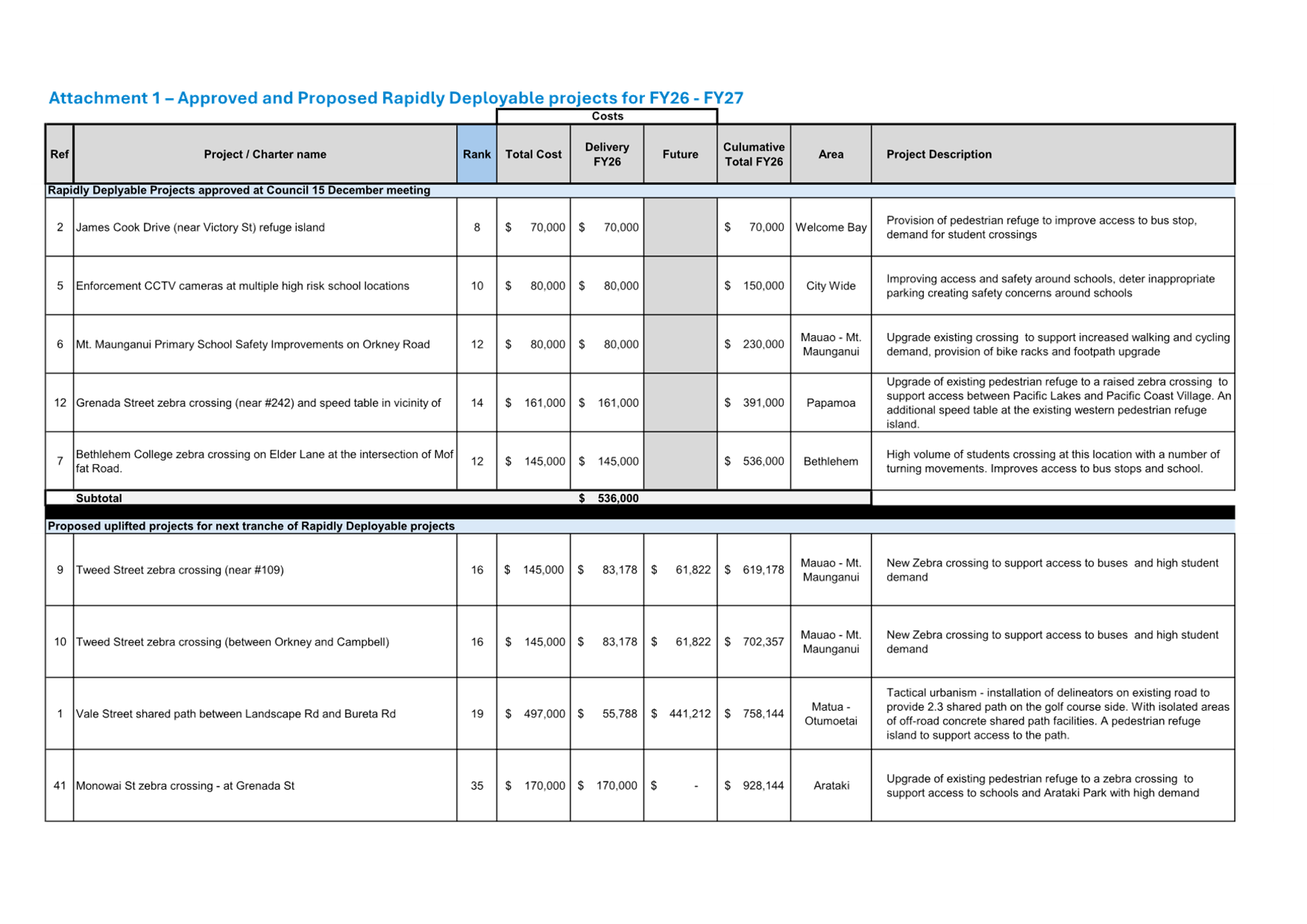
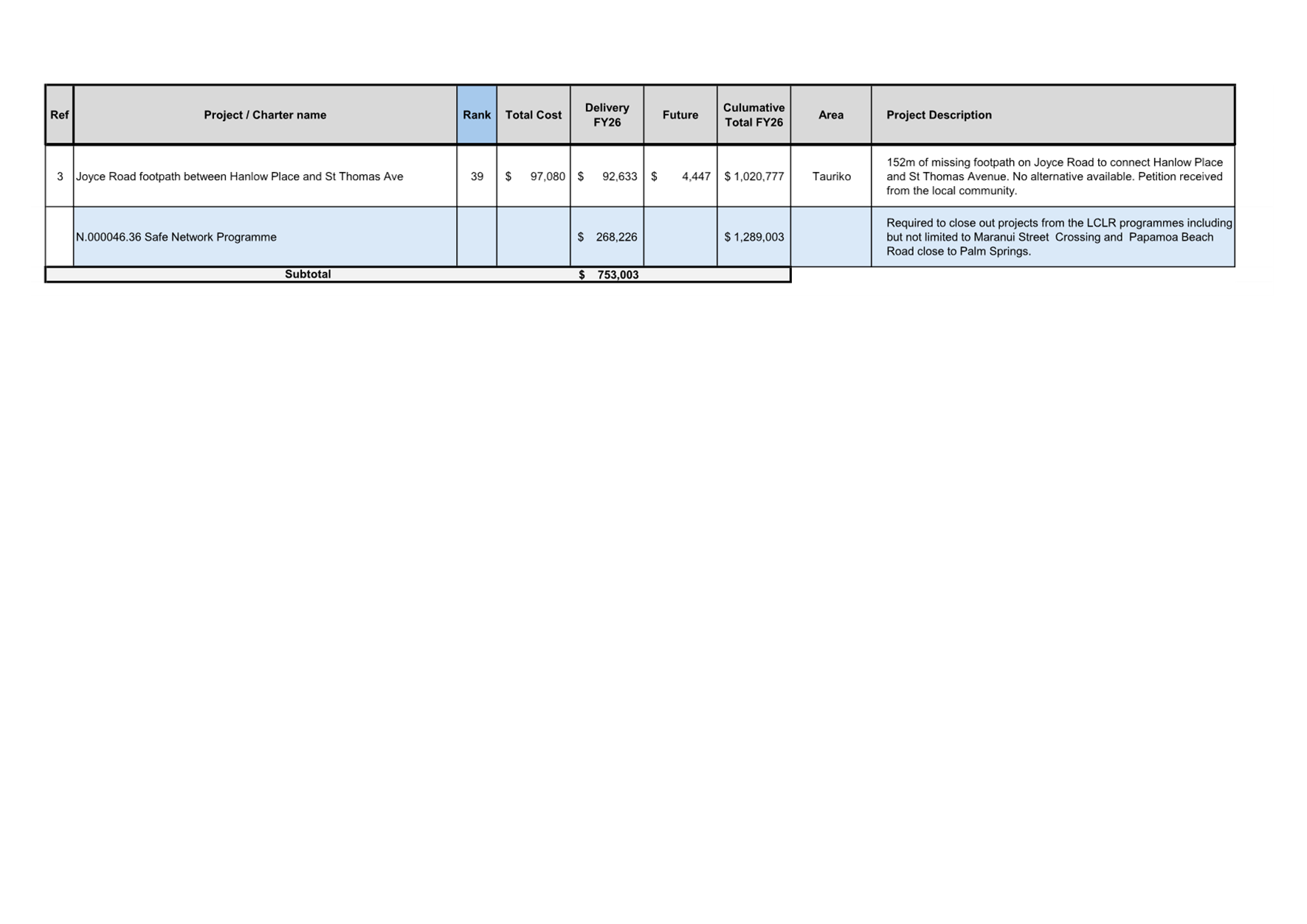
|
City
Delivery Committee meeting Agenda
|
10
March 2026
|
10.9 Hairini Slip Lane
Trial - Update
File
Number: A19711866
Author: Kurt
Graham, Project Manager
Authoriser: Reneke
van Soest, General Manager: Operations & Infrastructure
Purpose of the Report
1. To
provide the City Delivery Committee with an update on the Hairini Slip Lane
Trial and to seek approval to extend the trial until construction of the
Fifteenth Avenue to Welcome Bay Upgrade commences.
|
Recommendations
That the City Delivery
Committee:
(a) Receives the report
"Hairini Slip Lane Trial - Update".
(b) Approves extending the
current trial until construction of the Fifteenth Avenue to Welcome
Bay Upgrade commences.
|
Executive Summary
2. Following
longstanding requests from Ngāi te Ahi Hapū and Hairini residents,
the Hairini Slip Lane was reopened to traffic outside of the morning peak on a
trial basis beginning 20 October 2025. The trial was endorsed following a
report to the City Deliver Committee Meeting on 22 July 2025 (attachment 1).
The objective of the trial was to assess whether controlled reopening could
improve access for the local community without compromising safety, public
transport efficiency, or wider network performance.
3. Engagement prior to
the trial indicated strong local support, with 80% of surveyed Hairini
residents in favour. Feedback received approximately two months into the trial
has been overwhelmingly positive, with all but one respondent supporting
continuation. Ngāi te Ahi Hapū have also expressed satisfaction with
the operational outcomes and support an extension.
4. Monitoring to date
has shown only minimal increases in vehicle speeds and traffic volumes, with no
operational or safety concerns identified. Observations and feedback indicate
that time restrictions outside the morning peak are effectively discouraging use
of the residential network as a through‑route.
5. Given the positive
community feedback, the safe operation of the slip lane during the trial
period, and the upcoming Fifteenth Avenue to Welcome Bay Upgrade
works—which will alter traffic movements in the area—it is
recommended that the trial be extended until construction of those works
commences. This approach avoids premature permanent changes while ensuring the
community continues to benefit from improved access.
6. No further physical
works are required at this time. An independent Safe System Audit will be
undertaken (estimated cost $5,000) to ensure continued safe operation for the
extended period; this is funded within the existing project budget under the
annual plan.
Background
7. 
 For
the purposes of this report, the area referred to as “Hairini” is
that which is bordered by Turret Road, State Highway 29 and the Waimapu
Estuary. (Refer figure 1).
For
the purposes of this report, the area referred to as “Hairini” is
that which is bordered by Turret Road, State Highway 29 and the Waimapu
Estuary. (Refer figure 1).
8. The land upon which
the Hairini Slip Lane was constructed was originally acquired under the Public
Works Act for the purpose of creating the slip lane for egress out of Hairini.
However, following completion of the Welcome Bay Underpass the slip lane was
subsequently closed to general traffic and reserved for bus use only. This
decision was based on safety concerns of the three-lane merge as well as
operational efficiency.
9. Ngāi te Ahi
Hapū and a number of local residents opposed the full‑time closure. The matter
was raised at the April 2024 TW/TCC Committee meeting at Hairini Marae, where
Ngāi te Ahi proposed limited‑hours
reopening. At the June 2024 TW/TCC Committee meeting at Waikari Marae,
Commissioners committed to investigating a trial reopening.
10. Staff subsequently prepared an
initial design and began further engagement with the Hapū, including
holding meetings with the Hapū representatives and two engagement sessions
at Hairini Marae.
11. Staff also worked with
Hapū to develop options and a Communications and Engagement Plan for the
residents of Hairini. This targeted engagement included developing a survey to
understand the thoughts and wishes of Hairini residents.
12. The survey focussed on Hairini
only, as they were identified as the community that would be adversely impacted
the most by the trial. A letter with the survey link was sent to all residents
in Hairini, including property owners and businesses.
13. In total 92 responses were
received:
(i) 80% were in support or
strongly in support of a trial
(ii) 20% were against or
strongly against the trial
14. At City Delivery Committee
meeting on 22 July 2025 the committee resolved to undertake a 3-month trial.
15. The trial commenced on 20
October 2025 and was initially scheduled to conclude on 20 January 2026.
16. In December 2025 (approximately
two months into the trial) a follow-up email to respondents of the initial
survey sought feedback on the trial to date. 41 responses were received and all
but 1 was positive and expressed a desire to see the trial extended. The
resident in opposition who lives on Hairini Street, is concerned with the
additional traffic and feels that vehicles continue to speed through the area,
creating ongoing safety concerns. They are also concerned that as more members
of the public become aware of the opening and begin using this route, these
issues are likely to worsen.
17. Ngāi te Ahi Hapū who
have worked closely with TCC throughout this project, have expressed their
satisfaction with the outcome and wish to see the trial extended.
18. Monitoring throughout the trial
period from a radar camera between Haukore Street and Tamahika Street
indicated:
13.
Speeds: minimal increase in average daily operating speeds
(approximately 37 km/h → 40 km/h. While daily maximum speeds
remained between 56 and 60 km/h.)
14.
Volumes: The volume of traffic passing the monitoring location
(between Haukore Street and Tamahika Street) has increased by approximately 300
vehicles per day since the trial started. The bus lane has also seen volumes
increase to 250-300 vehicles per day. The monitoring shows approximately 130 of
these additional movements are generated by vehicles turning towards the bus
lane from Wickham Place and Haukore Street. Approximately 40 vehicles per day
from Tamahika Street and Hairini Street north of the camera are also using the
slip lane. Site observations also show a number of vehicles turning towards the
slip lane from Stephens Place, which the camera is unable to observe and count.
This suggests that external through‑traffic is minimal — estimated
in the order of 100 vehicles per day.
15.
Behavioural outcome: observations indicate time restrictions are
deterring through‑traffic (“rat‑running”) and no
adverse operational issues have been observed or reported to date. The only
safety concern noted to date was from the resident in opposition, who is
concerned with the additional traffic and feels that vehicles continue to speed
through the area, creating ongoing safety concerns. They are also concerned
that as more members of the public become aware of the opening and begin using
this route, these issues are likely to worsen
Statutory Context
19. The Hairini Slip Lane is
designated in Council’s Traffic & Parking Bylaw as a Bus Lane at all
times.
20. Consistent with the initial
trial, it is not proposed to amend the Bylaw for the extension. Instead,
Council will continue the trial on a discretionary non‑enforcement basis
outside weekday morning peak hours (6:30–9:30am), with the bus lane
remaining enforceable during morning peak. Clear signage and communications
will continue to mitigate user confusion.
STRATEGIC ALIGNMENT
21. This contributes to the
promotion or achievement of the following strategic community outcome(s):
|
Contributes
|
|
We are an inclusive city
|
☐
|
|
We value, protect and enhance the environment
|
☐
|
|
We are a well-planned city that is easy to move
around
|
ü
|
|
We are a city that supports
business and education
|
☐
|
|
We are a vibrant city that embraces
events
|
☐
|
22. Allowing time‑restricted
access improves local egress from Hairini at appropriate times of the day while
maintaining morning‑peak bus priority.
23. During off‑peak periods,
Welcome Bay Road / Turret Road traffic generally flows well and the bus lane is
used infrequently (approximately one bus every 20 minutes), indicating under‑utilisation
in those periods. Opening the slip lane outside morning peak supports better
utilisation of existing infrastructure and may slightly reduce demand at the
SH29 roundabouts.
Options Analysis
24. Three options were considered:
i. Option 1: Extend the trial until
commencement of the Fifteenth Avenue to Welcome Bay Upgrade physical works
(Recommended)
Rationale:
Strong community support; positive monitoring results; minimal
operational/safety impacts; pending network changes from the Fifteenth Avenue
to Welcome Bay Upgrade works mean a temporary approach is prudent.
How
it would work: Continue the current time restricted access and monitoring
regime; complete an independent Safe System Audit; report back prior to
construction commencing.
Key
risks & mitigations:
· Legal/Bylaw
perception risk: Continue clear communications and signage; ensure bus lane
enforcement remains during morning peak.
· Public
expectation risk: Emphasise that the extension is temporary and will be
reviewed after the Fifteenth Avenue to Welcome Bay Upgrade works.
(i) Safety risk: Address
through ongoing monitoring and the Safe System Audit; set early termination
triggers if adverse trends occur.
Indicative
triggers for review/termination of the trial:
· Statistically
significant increases in crashes or near‑misses;
· Observations
of increased risk such as significant increases in vehicle speeds or volumes;
· Adverse
impacts on bus operations during permitted hours.
ii. Option 2: End the trial and revert to
bus only access (not recommended)
Rationale:
Contradicts strong local support and positive trial feedback; reduces local
accessibility benefits; foregoes learnings ahead of Fifteenth Avenue to Welcome
Bay Upgrade works.
When
appropriate: If monitoring or the audit identifies a material safety or
operational concern.
iii. Option 3: Target resident only access to the
slip lane (not recommended)
As
per item C) of resolution CDC/25/4/3 from 22 July 2025, staff have investigated
options for creating resident only access through the slip lane.
Legal
position (summary): Legal advice stated that Section 22AB(1) of the Land
Transport Act sets out the matters that a Council can make a bylaw on.
There is a catch-all power in sub-paragraph (zk) as follows:
“regulating
any road-related matters not addressed by paragraphs (a) to (zj), including
(but not limited to) enhancing or promoting road safety or providing protection
for the environment”.
This
clause provides a general bylaw‑making power that could, in principle,
enable a bespoke restriction allowing public transport and residents while
excluding the wider public. However, the legal advice also noted that there
would still be a need to show that this restriction is reasonable in the
circumstances and there is a good chance that any Court (were such a bylaw ever
challenged) would carefully scrutinise whether any limits on the public use of
a road was reasonable. That is, the public’s use of a road is often seen
as an important right.
Conclusion:
not recommended at this time, as the current trial has been operating
successfully. Therefore, attempting to create resident only use of the bus lane
would expose Council to unnecessary legal risk. Additional legal costs for
further input into the bylaw would also be expected, and the consultation and
implementation of the bylaw would also take considerable time and effort.
Financial Considerations
25. No further works are expected.
An independent post construction Safe System Audit will be completed at an
estimated cost of $5,000 given this will be in place longer term than
originally planned. This can be met from existing budgets under the current Annual
Plan. Ongoing monitoring will be covered within business‑as‑usual
staff resources.
Legal Implications / Risks
26. It is proposed to continue
operating on a discretionary basis, whereby Council choose not to enforce the
bus lane Bylaw outside of the morning peak, rather than changing the existing
bylaw.
27. Legal and reputational risks
are mitigated by:
(i) Maintaining clear signage
and communications;
(ii) Ensuring enforcement
during morning peak;
(iii) Explicitly signalling the
temporary nature of the extension pending the Fifteenth Avenue to Welcome Bay
Upgrade;
(iv) Completing an independent Safe
System Audit and continuing monitoring;
(v) Clear triggers for review or
early termination (see Option 1).
TE AO MĀORI APPROACH
28. The extension of the trial is
expected to continue the benefits noted under this section in the initial
report to the City Delivery Committee on 22 July 2025.
29. The trial has been undertaken
in partnership with Ngāi te Ahi Hapū, with hui and targeted
engagement shaping the approach and time restrictions. Extending the trial is
expected to continue the positive outcomes identified in the initial report to
the City Delivery Committee on 22 July 2025. Hapū have expressed support
for the extension.
CLIMATE IMPACT
30. The extension of the trial is
not expected to have any negative environmental impacts. The trial enables
residents to minimise travel distances to the Turret Rd Bridge.
Consultation / Engagement
31. Extensive consultation was
undertaken in the leadup to the initial trial as noted in the Report dated 22
July 2025. In December 2025 approximately two months after the trial was
implemented an email was sent to all respondents of the initial survey,
requesting feedback on the trial to date. Ngāi Te Ahi Hapū were also
asked to provide feedback. The majority of feedback was very positive with all
except one respondent expressing desire for the trial to be extended.
Significance
32. The Local Government Act 2002
requires an assessment of the significance of matters, issues, proposals and
decisions in this report against Council’s Significance and Engagement
Policy. Council acknowledges that in some instances a matter, issue,
proposal or decision may have a high degree of importance to individuals,
groups, or agencies affected by the report.
33. In making this assessment,
consideration has been given to the likely impact, and likely consequences for:
(a) the current
and future social, economic, environmental, or cultural well-being of the
district or region
(b) any persons who are likely to be
particularly affected by, or interested in, the decision.
(c) the capacity of the local authority
to perform its role, and the financial and other costs of doing so.
34. In accordance with the
considerations above, criteria and thresholds in the policy, it is considered
that the decision is of medium significance.
ENGAGEMENT
35. Taking into
consideration the above assessment, that the decision is of medium significance,
officers are of the opinion that no further engagement is required prior to
Council making a decision.
Next Steps
36. If the trial is extended an
independent Safe System Audit will be undertaken. Monitoring will continue with
use of existing cameras.
Attachments
1. City
Delivery Committee 2025-07-22 13794 Report - 9.2 Hairini Slip Lane Trial -
Survey Results and Recommendations.DOCX - A18390246 ⇩
|
City
Delivery Committee meeting Agenda
|
10
March 2026
|
|
City
Delivery Committee meeting Agenda
|
10
March 2026
|
10.10 Six-Monthly Non-Financial
Performance Report 2025/26
File
Number: A19421641
Author: Rachel
Burt, Corporate Planner
Authoriser: Christine
Jones, General Manager: Strategy, Partnerships & Growth
Purpose of the Report
1. The purpose of this
report is to provide information on Council’s non-financial performance
for the first six months of 2025/26.
|
Recommendations
That the City Delivery
Committee:
(a) Receives the report
"Six-Monthly Non-Financial Performance Report 2025/26 ".
|
Executive Summary
2. This report,
together with the material in Attachment One, provides an overview of Council's
progress towards meeting the non-financial performance measures and achieving
the levels of service set in the Long-term Plan 2024-34.
3. Across the 82 non‑financial
performance measures set for the 2025/26 year, 54 measures (66%) are currently
on track. A further 3 measures (4%) are tracking within 5 percent of their
targets. Eighteen measures (22%) are off track at this point in the year, and
data for 7 measures (9%) is not yet available.
4. Performance measures
are reported against the five community outcomes adopted in the LTP
2024–2034. Reporting for the 2025/26 financial year remains aligned with
this existing framework and does not include the two new community outcomes
adopted at the 18 November 2025 Council meeting. Measures aligned to these new
outcomes will be incorporated into reporting from the 2026/27 financial year.
Background
5. The Long-term Plan
(LTP) sets out the levels of service that Council commits to delivering, as
determined through consultation with the community.
6. The Local Government
Act 2002 requires local authorities to report on how well they are performing
in delivering these agreed levels of service to their communities as measured
by non-financial performance measures.
7. The 2024-34
Long-term Plan includes 82 performance measures, 23 of which are mandatory
measures prescribed under section 261B of the Local Government Act 2002.
Discussion
8. The following charts
provide an overview of the 82 non-financial performance measures by overall
performance and by outcome.
9. Where data is not
currently available, the majority of these relate to measures which are only
surveyed or calculated at one point through the year. Comments within the
report indicate why and when results will become available.
10. The
3 measures that are off track but within 5% of their target are detailed below:
|
#
|
Outcome
|
Performance
Measure
|
Target
|
Result YTD
|
|
SSP13
|
An inclusive city – Tauranga Mataraunui
|
Percentage of known dogs that are registered
|
95%
|
92%
|
|
SSP36
|
A well-planned city –
Tauranga - Tātai Whenua
|
Percentage of building consent
applications approved within statutory timeframes
|
95%
|
92%
|
|
SSP58
|
A city we can move around
easily – Tauranga Ara Rau
|
Average quality of ride of the
sealed road network as measured by Smooth Travel Exposure e.g.
percentage of smooth travel exposure
|
92%
|
91%
|
11. The 18 measures that are off
track are within the following outcomes:
|
#
|
Outcome
|
Measure
|
Target
|
Result YTD
|
|
SSP03
|
An inclusive city –
Tauranga Mataraunui
|
Number of stakeholder
interactions with community organisations
|
1150
|
527
|
|
SSP08
|
An inclusive city –
Tauranga Mataraunui
|
Percentage of residents
satisfied with the range and frequency of event experiences in Tauranga
|
75%
|
50%
|
|
SSP09
|
An inclusive city –
Tauranga Mataraunui
|
Percentage of residents
satisfied with the accessibility and quality of Tauranga’s arts,
cultural, and events spaces.
|
75%
|
54%
|
|
SSP10
|
An inclusive city –
Tauranga Mataraunui
|
Percentage of households
that are within 500m of a neighbourhood area open space
|
95%
|
87%
|
|
SSP12
|
An inclusive city –
Tauranga Mataraunui
|
Percentage of animal
complaints involving a rush or attack on a person contacted within 60 minutes
where there is an ongoing risk to safety
|
95%
|
88%
|
|
SSP18
|
A city that values,
protects and enhances our environment – Tauranga Taurikura
|
Percentage of vegetation
canopy cover in Tauranga
|
≥22%
|
16%
|
|
SSP30
|
A well-planned city
– Tauranga - Tātai Whenua
|
There will be sufficient
residential zoned land provided with development capacity for at least: 1) 3
years 2) 10 years 3) 30 years
|
Not
achieved *
|
Not
achieved
|
|
SSP31
|
A well-planned city
– Tauranga - Tātai Whenua
|
There will be sufficient
business zoned land provided with development capacity for at least: 1) 3
years 2) 10 years 3) 30 years
|
Achieved
|
Not
achieved
|
|
SSP32
|
A well-planned city
– Tauranga - Tātai Whenua
|
Percentage of residents
satisfied with the city centre as the commercial and cultural heart of
Tauranga
|
50%
|
22%
|
|
SSP34
|
A well-planned city
– Tauranga - Tātai Whenua
|
The number of new civic
buildings delivered with a minimum Green Star rating of 5 stars
|
1
|
0
|
|
SSP46
|
A well-planned city
– Tauranga - Tātai Whenua
|
The percentage of
residents who are aware of ways they can conserve water and have taken steps
to do so
|
85%
|
78%
|
|
SSP56
|
A city we can move around
easily – Tauranga Ara Rau
|
Duration of peak across
the transport network (where traffic is travelling at 50% of free flow speed
of 59k/hr)
|
330
|
393
|
|
SSP57
|
A city we can move around
easily – Tauranga Ara Rau
|
Travel times are reliable
during peak hours (95% of trips should occur within +/- 25% of the average
duration)
|
A variation of
no more than 25%
|
38%
|
|
SSP64
|
A city we can move around
easily – Tauranga Ara Rau
|
The proportion of people
who journey to work by active modes (walking/jogging/cycling)
|
7%
|
5%
|
|
SSP65
|
A city we can move around
easily – Tauranga Ara Rau
|
The proportion of people
who journey to work by public transport
|
3%
|
2%
|
|
SSP66
|
A city we can move around
easily – Tauranga Ara Rau
|
Average weekday city
centre on-street and off-street parking occupancy rate
|
75%
|
71%
|
|
SSP70
|
A city that supports
business and education – Tauranga a te kura
|
Domestic and international
tourism spending in the city
|
Increasing
(>-2.2%)
|
-5.8%
|
|
SSP79
|
Organisational Capability
|
Percentage of residents who are satisfied or neutral that the
Council makes decisions in the best interests of the city
|
Increasing (≥55%)
|
52%
|

Financial Considerations
12. There are no financial
considerations in relation to this report as it is a monitoring report.
TE AO MĀORI APPROACH
13. The residents’ perception
survey referenced in this report is drawn from a demographically representative
sample of the area. This includes Māori and reflects the area’s
demographic profile across ethnicity, age, gender, geographic distribution and
socio-economic status.
Legal Implications / Risks
14. Risks are elevated for those
measures tracking below target as this is the midpoint mark for the reporting
year. Corrective action will need to be accelerated to turn around off track
measures.
Statutory Context
15. Monitoring non-financial
performance is a key function of the committee.
STRATEGIC ALIGNMENT
16. This contributes to the
promotion or achievement of the following strategic community outcome(s):
|
Contributes
|
|
We are an inclusive city
|
ü
|
|
We value, protect and enhance the environment
|
ü
|
|
We are a well-planned city that is easy to move
around
|
ü
|
|
We are a city that supports
business and education
|
ü
|
|
We are a vibrant city that embraces
events
|
ü
|
17. This report is reporting on the
six-month performance measures by community outcome.
Options Analysis
18. There are no options associated
with this report. The report is provided as information only.
Significance
19. The Local Government Act 2002
requires an assessment of the significance of matters, issues, proposals and
decisions in this report against Council’s Significance and Engagement
Policy. Council acknowledges that in some instances a matter, issue,
proposal or decision may have a high degree of importance to individuals,
groups, or agencies affected by the report.
20. In making this assessment,
consideration has been given to the likely impact, and likely consequences for:
(a) the current
and future social, economic, environmental, or cultural well-being of the
district or region
(b) any persons who are likely to be
particularly affected by, or interested in, the matter.
(c) the capacity of the local authority
to perform its role, and the financial and other costs of doing so.
21. In accordance with the
considerations above, criteria and thresholds in the policy, it is considered
that the matter is of low significance. The report is for monitoring
purposes and there are no decisions to be made.
ENGAGEMENT
22. Taking into consideration the
above assessment, that the matter is of low significance, officers are of the
opinion that no further engagement is required prior to Council making a
decision to receive this report.
Next Steps
23. This report ensures monitoring
of Council non-financial performance. The non-financial monitoring report
summary will be presented on the Council website.
Attachments
1. Six
Monthly Non-Financial Performance Report 2025-26 - A19767058 (Separate
Attachments 1)
|
City
Delivery Committee meeting Agenda
|
10
March 2026
|
10.11 Annual Residents Survey 2025/26 -
Wave Two Results
File
Number: A19485142
Author: Rachel
Burt, Corporate Planner
Authoriser: Christine
Jones, General Manager: Strategy, Partnerships & Growth
Purpose of the Report
1. The purpose of this
report is to provide an overview of the results from the Annual Residents
Survey for the second quarter of 2025/26 (Wave Two).
|
Recommendations
That the City Delivery
Committee:
(a) Receives the report
"Annual Residents Survey 2025/26 - Wave Two Results".
|
Executive Summary
2. The
Annual Residents Survey is conducted in four waves each year to capture
community perceptions of council services and initiatives. This report presents
the Wave Two results for 2025/26.
3. Wave 2 results show
encouraging improvement across most service areas, while reputation and
affordability remain areas of concern.
4. Overall performance
has lifted to 47% (net score +20), and reputation has improved to 29% (net
–21), still below neutral but trending upward.
5. Perceptions of value
for money have edged up to 31% (net –10), suggesting growing confidence
in council services.
6. Core services
continue to strengthen, with roads and footpaths showing the largest gain at
+10.2% year-on-year, and high-performing areas such as waste management (78%)
and outdoor spaces (80%) maintaining strong results.
7. Affordability
measures, while still challenging, show modest improvement: rates (25%), rent
(21%), and cost of living (21%).
8. Community feedback
highlights priorities around homelessness and housing, transport and
congestion, affordability, and safety in public spaces, alongside praise for
libraries, parks, and facilities.
9. Overall trend: the
city is showing solid progress in core services and infrastructure, supported
by improving perceptions of value and reputation. While affordability and
reputation remain below neutral, the upward trend provides a strong foundation
for continued improvement.
ANNUAL RESIDENTS SURVEY
10. The
Annual Residents Survey forms part of a wider set of information we have around
engagement with the Tauranga community and their wants, needs and perceptions
of council and of Tauranga as a place to live.
11. Survey
results help council staff assess the performance of council against a set of
pre-determined actions and performance levels, including those outlined in the
2024-34 Long-term Plan.
12. Using
a post-to-online method, surveys have been undertaken with Tauranga residents
during this second wave. An invitation letter, containing an embedded link to
an online survey, was sent to a random selection of residents, sourced from the
Electoral Roll, with a subsequent reminder follow up.
13. Wave
Two fieldwork was conducted from 3 November
2025 – 19 December 2025. The number of participants in Wave Two was 155.
14. A
summary of the high-level survey results for 2025/26 year-to-date (YTD)
compared to the full year 2024/25 and their trends is shown in the table below:
|
Measure
|
2024/2025 Result
|
Nett Score 2024/25
|
2025/2026 YTD Result
|
Nett Score 2025/26 YTD Result
|
Change from Previous Year (%)
|
|
Overall performance
|
44%
|
18%
|
47%
|
20%
|
6.8%
5
|
|
Overall reputation
|
26%
|
-23%
|
29%
|
-21%
|
11.5%
5
|
|
Overall value for money
|
30%
|
-16%
|
31%
|
-10%
|
3.3%
5
|
|
Overall core service deliverables
|
62%
|
49%
|
64%
|
52%
|
3.2%
5
|
|
Overall water management
|
59%
|
40%
|
59%
|
48%
|
0%
=
|
|
Overall roads and footpaths
|
49%
|
28%
|
54%
|
32%
|
10.2%
5
|
|
Overall waste management
|
76%
|
68%
|
78%
|
73%
|
2.6%
5
|
|
Overall outdoor spaces
|
76%
|
69%
|
80%
|
74%
|
5.3%
5
|
|
Overall public facilities
|
71%
|
64%
|
72%
|
72%
|
1.4%
5
|
15. Perceptions
of Council performance and services show broad-based improvement in the 2025/26
year-to-date results:
· Overall
performance rose to 47%, with the net score increasing from +18 to +20, while
reputation improved to 29% (net -23 → -21), remaining below neutral but
trending upward.
· Value for
money edged up to 31%, supported by a notable net improvement from -16 to -10,
signalling easing concerns.
· Core
operational measures strengthened, with overall core service delivery rising to
64% (net +49 → +52), water management holding steady at 59% but lifting
its net score from +40 to +48, and roads and footpaths recording the largest
gain at 54% (net +28 → +32; +10.2% year-on-year). High-performing areas
continued to improve, with waste management increasing to 78% (net +68 →
+73), outdoor spaces rising to 80% (net +69 → +74; +5.3%), and public
facilities improving to 72% (net +64 → +72).
· Overall, the
YTD results indicate steady gains across most dimensions—particularly in
infrastructure services—while reputation and value for money, though
improving, remain priority areas given their still negative net scores.
16. Verbatim comments from the
second wave reflects a broad range of community priorities across Tauranga.
· Many
comments highlighted the growing visibility of homelessness, particularly in
the city centre, and linked this to housing shortages, high living costs, and
limited social support.
· Affordability
was a recurring concern, with residents calling for better management of rates
and fees.
· Transport
and roading issues were frequently raised, including congestion, poor road
conditions, and parking challenges.
· While
libraries, parks, pools, and other facilities were generally praised,
respondents suggested upgrades and improved access. Water management also
featured, with comments on stormwater, flooding, and drinking water quality.
· Safety in
public spaces was a common theme, with calls for better lighting, CCTV, and
community policing.
· Waste
management and sustainability attracted attention, with suggestions for
improved rubbish collection and stronger environmental initiatives.
· Tourism
feedback focused on Tauranga’s beaches and natural attractions but noted
limited activities and high costs.
· Across all
topics, residents emphasised the need for clearer communication and
transparency from Council, alongside practical investment in core
infrastructure and services to support growth.
17. Further
information on each of the overall sections and the measures within, along with
a summary of the verbatim comments, are included in the report as Attachment
1.
RATES, RENT, AND LIVING AFFORABILITY
18. On
9 December 2024, Council resolved to add additional questions on household
rates affordability, rental affordability, and the cost of living in Tauranga
to the Annual Residents Survey. These have been included since Wave 3 2024/25.
19. Across
all three measures, perceptions of affordability have improved year-on-year,
though overall sentiment remains negative. The proportion of residents who
consider rates affordable increased from 21% (n=207) in 2024/25 (W3–W4)
to 25% (n=241) year-to-date in 2025/26—a 19% uplift. However, the nett
score eased slightly from -30 to -31, showing that rates are still viewed as
unaffordable by most respondents.
20. Rent
affordability rose from 18% (n=39) to 21% (n=40) (+16.7%), with a notable
improvement in the nett score from -43 to -36. This result should be
interpreted cautiously due to the small renter sample.
21. Perceived
cost-of-living affordability improved from 17% (n=265) to 21% (n=308) (+23.5%),
alongside a nett score shift from -44 to -36.
22. Overall,
these year-to-date results suggest modest easing in affordability pressures.
However, persistently negative nett scores highlight ongoing strain on
households and the need for continued measures to support affordability.
|
Measure
|
2024/2025
Result
(W3 & W4)
|
Nett Score
2024/25
|
2025/2026
Result YTD
|
Nett Score
2025/26 YTD Result
|
Change
vs
Last
Year
(% and Trend)
|
|
Rates in Tauranga are affordable for my household
|
21%
(n=207)
|
-30%
|
25%
(n=241)
|
-31%
|
19.0%
5
|
|
Rent in Tauranga is affordable for my household
|
18%
(n=39)
|
-43%
|
21%
(n=40)
|
-36%
|
16.7%
5
|
|
The cost of living in Tauranga is affordable for my household
|
17%
(n=265)
|
-44%
|
21%
(n=308)
|
-36%
|
23.5%
5
|
Table 1: Additional questions on household rates
COMPARISON TO PREVIOUS YEARS
23. To
provide the Council with a performance comparison against the last two
full-term elected Councils, a summary of the high-level survey results for the
2025/26 is presented in the table below. This responds to an elected member
request from a previous committee meeting. Also for comparative purposes is a
comparison of the average result from 2015/16 to 2018/19 and how the current
results compare are outlined below.
|
13/14 Result
|
14/15 Result
|
15/16 Result
|
16/17 Result
|
17/18 Result
|
18/19 Result
|
Avg 15/16-18/19
|
25/26 YTD Result
|
Change (% and Trend)
|
|
Overall performance
|
65%
|
67%
|
75%
|
74%
|
73%
|
66%
|
72%
|
47%
|
-34.7%
6
|
|
Overall reputation
|
-
|
-
|
55%
|
51%
|
53%
|
44%
|
51%
|
29%
|
-43.1%
6
|
|
Overall value for money
|
-
|
-
|
59%
|
57%
|
58%
|
48%
|
56%
|
31%
|
-44.6%
6
|
|
Overall core services deliverables
|
-
|
-
|
79%
|
79%
|
73%
|
71%
|
76%
|
64%
|
-15.8%
6
|
|
Overall water management
|
-
|
-
|
65%
|
68%
|
67%
|
64%
|
66%
|
59%
|
-10.6%
6
|
|
Overall road and footpaths
|
-
|
-
|
76%
|
68%
|
63%
|
56%
|
66%
|
54%
|
-18.2%
6
|
|
Overall waste management
|
-
|
-
|
75%
|
75%
|
61%
|
66%
|
69%
|
78%
|
+13.0%
5
|
|
Overall outdoor spaces
|
-
|
-
|
83%
|
86%
|
82%
|
81%
|
83%
|
80%
|
-3.6%
6
|
|
Overall public facilities
|
-
|
-
|
76%
|
79%
|
78%
|
73%
|
77%
|
72%
|
-6.5%
6
|
Table 2: 2025/26 results compared to previous years.
MEASURES OF INTEREST
24. The
2024/25 full year report highlighted two areas of council performance as
measures that have the highest impact on residents’ overall perception of
the Council combined with relatively low performance. The results for wave two
for these areas are discussed below and in the attached report.
25. The
below graphs used are XmR (Moving Range) charts. An XmR is a type of control
chart used in process improvement and statistical analysis to monitor the
variation in a single data series over time. The charts below track individual
data points, showing how each measurement compares to the overall average and
upper and lower control limits (shaded blue area), which define the expected
range of natural variation. The XmR chart helps identify trends, shifts, or
unusual variations in a process, making it useful for detecting changes and
ensuring that processes remain stable and predictable.
IMAGE AND REPUTATION
Graph 1: Image and Reputation Year to Date (YTD)
Graph
2: Image and Reputation by wave
26. Council’s
image and reputation has seen significant ups and downs over the past five
years, but the overall direction is positive. Satisfaction dropped sharply from
around 42% in 2019/20 to just 18% in 2020/21. Since then, results have steadily
improved, reaching about 29% in the 2025/26 year-to-date figures. Wave-to-wave
data shows short-term fluctuations within this broader trend, with scores
ranging between 18% and 32% since 2021/22. Recent waves in 2024/25 and early
2025/26 show modest gains, suggesting improvements are holding rather than
reversing. Although the long-term average is still below pre-2020 levels, the
consistent upward movement and reduced volatility point to growing stability in
public perception. Ongoing monitoring will confirm whether this shift is
lasting or part of a cycle.
VALUE FOR MONEY
Graph 3: Value for Money Year to Date (YTD)
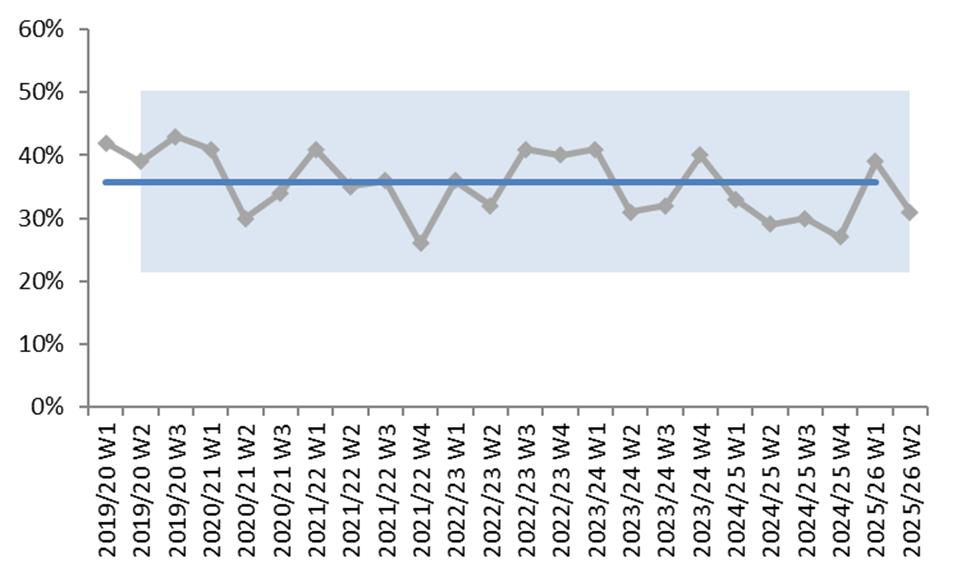
Graph 4: Value for Money by wave
27. Perceptions
of value for money have remained relatively stable over time, with some
moderate fluctuations. Satisfaction started at around 43% in 2019/20, dropped
to 35% in 2020/21, and then held close to the long-term average of 36–38%
through 2022/23. A gradual decline followed, reaching a low of about 31% in
2024/25, before rebounding to nearly 39% in the 2025/26 year-to-date result.
Wave-to-wave data shows short-term volatility, including a recent dip in the
latest wave (2025/26 W2) after a strong peak in W1. This pattern suggests that
while the overall trend is positive, perceptions remain sensitive to external
factors or specific council actions. Maintaining improvements will
require consistent delivery and clear communication of value to residents.
Statutory Context
28. The
Annual Residents Survey allows effective monitoring of performance and insights
to be gained to inform future planning.
STRATEGIC ALIGNMENT
29. This
contributes to the promotion or achievement of the following strategic
community outcome(s):
|
Contributes
|
|
We are
an inclusive city
|
ü
|
|
We
value, protect and enhance the environment
|
ü
|
|
We are a
well-planned city that is easy to move around
|
ü
|
|
We are a city that supports business and education
|
ü
|
|
We are a vibrant city that embraces events
|
ü
|
30. The
annual residents survey is a legislative requirement which is reported on
quarterly and produced as an annual report.
Options Analysis
31. There
are no options associated with this report. The report is provided as
information only.
Financial Considerations
32. There
are no financial implications or risks associated with this report.
Legal Implications / Risks
33. There
are no legal implications or risks associated with this report.
Consultation / Engagement
34. This
report is made public.
Significance
35. The
Local Government Act 2002 requires an assessment of the significance of
matters, issues, proposals and decisions in this report against Council’s
Significance and Engagement Policy. Council acknowledges that in some
instances a matter, issue, proposal or decision may have a high degree of
importance to individuals, groups, or agencies affected by the report.
36. In
making this assessment, consideration has been given to the likely impact, and
likely consequences for:
(a) the current and future
social, economic, environmental, or cultural well-being of the district or
region
(b) any
persons who are likely to be particularly affected by, or interested in, the
matter.
(c) the
capacity of the local authority to perform its role, and the financial and
other costs of doing so.
37. In
accordance with the considerations above, criteria and thresholds in the
policy, it is considered that the matter is of low significance, as it is
reporting results and no decisions are sought.
ENGAGEMENT
38. Taking
into consideration the above assessment, that the matter is of low significance,
officers are of the opinion that no further engagement is required prior to
Council making a decision.
Next Steps
39. The
next wave (Wave 3) for 2025/26 is due to be collected during February and March
2026 with the results scheduled to be reported to this committee in April 2026.
Attachments
1. Annual
Residents Survey 2025_26 - Wave 2 - Performance Report - A19594894 (Separate
Attachments 1)
|
City Delivery Committee meeting Agenda
|
10 March 2026
|
11 Discussion
of late items
|
City Delivery Committee meeting Agenda
|
10 March 2026
|
12 Public
excluded session
Resolution to exclude
the public
|
Recommendations
That the public be
excluded from the following parts of the proceedings of this meeting.
The general subject
matter of each matter to be considered while the public is excluded, the
reason for passing this resolution in relation to each matter, and the
specific grounds under section 48 of the Local Government Official
Information and Meetings Act 1987 for the passing of this resolution are as
follows:
|
General subject of each matter to be
considered
|
Reason for passing this resolution in
relation to each matter
|
Ground(s) under section 48 for the
passing of this resolution
|
|
12.1 - Public Excluded Minutes of the
City Delivery Committee meeting held on 15 December 2025
|
s7(2)(b)(ii) - The withholding of the information
is necessary to protect information where the making available of the
information would be likely unreasonably to prejudice the commercial
position of the person who supplied or who is the subject of the information
|
s48(1)(a) - the public conduct of the relevant
part of the proceedings of the meeting would be likely to result in the
disclosure of information for which good reason for withholding would exist
under section 6 or section 7
|
|
12.2 - Partnership Agreement
Renegotiation
|
s7(2)(b)(ii) - The withholding of the information
is necessary to protect information where the making available of the
information would be likely unreasonably to prejudice the commercial
position of the person who supplied or who is the subject of the information
s7(2)(i) - The withholding of the information is
necessary to enable Council to carry on, without prejudice or disadvantage,
negotiations (including commercial and industrial negotiations)
|
s48(1)(a) - the public conduct of the relevant
part of the proceedings of the meeting would be likely to result in the
disclosure of information for which good reason for withholding would exist
under section 6 or section 7
|
|
|
City Delivery Committee meeting Agenda
|
10 March 2026
|
13 Closing
karakia