|

|
|
AGENDA
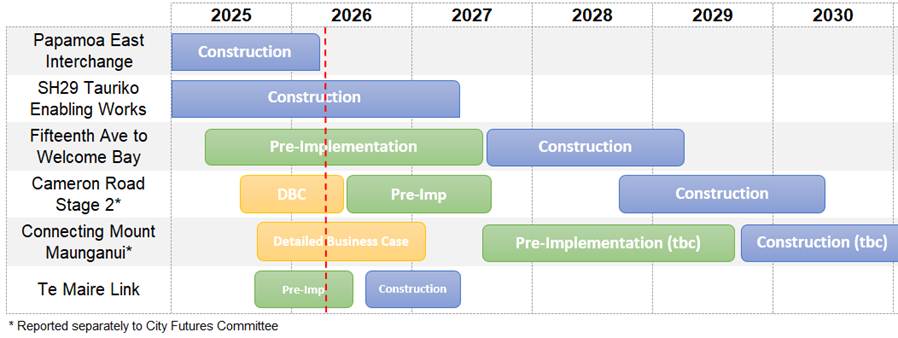
City Delivery Committee meeting
Tuesday, 28 April 2026
|
|
I hereby give notice that a City Delivery Committee
meeting will be held on:
|
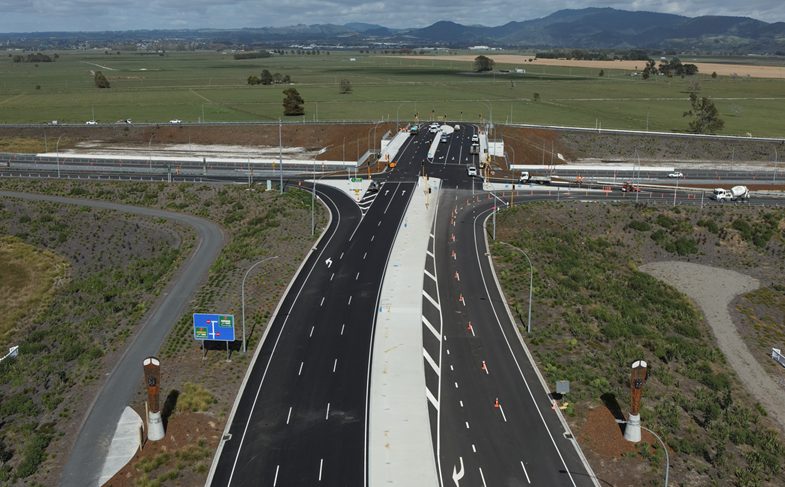
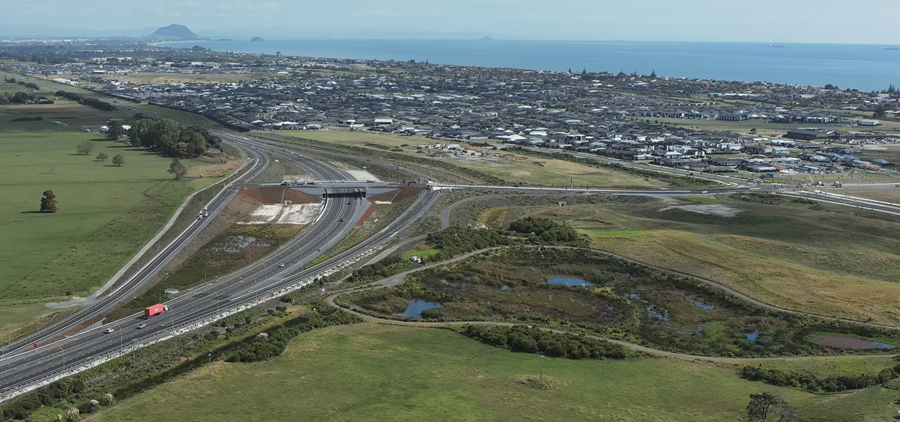
|
Date:
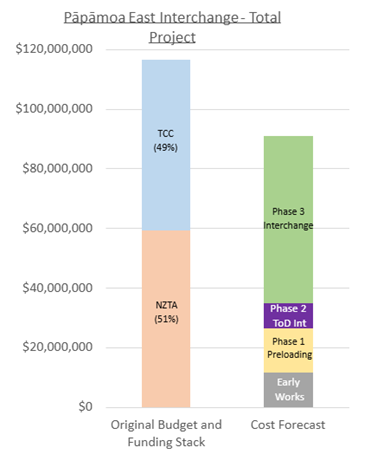
|
Tuesday, 28 April 2026
|
|
Time:
|
9:30 am
|
|
Location:
|
Tauranga City Council Chambers
Level 1 - 90 Davenport Road
Tauranga
|
|
|
|
Marty Grenfell
Chief Executive
|
Terms of reference – City Delivery Committee
Common
responsibility and delegations
The following common responsibilities and delegations apply
to all standing committees.
Responsibilities of standing committees
· Establish priorities and guidance on programmes relevant to the Role
and Scope of the committee.
· Provide guidance to staff on the development of investment options
to inform the Long Term Plan and Annual Plans.
· Report to Council on matters of strategic importance.
· Recommend to Council investment priorities and lead Council
considerations of relevant strategic and high significance decisions.
· Provide guidance to staff on levels of
service relevant to the role and scope of the committee.
· Establish and participate in relevant task forces and working
groups.
· Engage in dialogue with strategic partners, such as Smart Growth
partners, to ensure alignment of objectives and implementation of agreed
actions.
· Confirmation of committee minutes.
Delegations to standing committees
· To make recommendations to Council outside of the delegated
responsibility as agreed by Council relevant to the role and scope of the
Committee.
· To make all decisions necessary to fulfil the role and scope of the
Committee subject to the delegations/limitations imposed.
· To develop and consider, receive submissions on and adopt
strategies, policies and plans relevant to the role and scope of the committee,
except where these may only be legally adopted by Council.
· To consider, consult on, hear and make determinations on relevant
strategies, policies and bylaws (including adoption of drafts), making
recommendations to Council on adoption, rescinding and modification, where
these must be legally adopted by Council.
· To approve relevant submissions to central government, its agencies
and other bodies beyond any specific delegation to any particular committee.
· Engage external parties as required.
Terms of reference – City Delivery
Committee
Membership
|
Chair
|
Deputy
Mayor Jen Scoular
|
|
Deputy chair
|
Cr
Kevin Schuler
|
|
Members
|
Mayor Mahé Drysdale (ex officio)
Jacqui Rolleston-Steed - Tangata Whenua Representative
|
|
Non-voting members
|
(if any)
|
|
Quorum
|
Half of the members
present, where the number of members (including vacancies) is even;
and a majority of the members present, where the number of members
(including vacancies) is odd.
|
|
Meeting frequency
|
Six weekly
|
Role
The role of the City Delivery Committee is:
·
To ensure and report delivery against agreed
targets and benchmarks across capital investment, operating activity, and
engagement.
·
To ensure community involvement in, and support for, Council
projects, proposals, initiatives and services.
·
To monitor delivery of activity by community-led organisations
receiving Council funding, partnering with, or otherwise contracted to,
Council.
·
To determine the reporting frequency for financial performance
targets across the organisation, and to measure and regularly report on
delivery against those.
·
To review and improve public confidence and participation in
Council decision making processes.
·
To measure delivery of projects by ensuring that approved
projects are effectively planned and delivered in full, on time, in scope, and
within budget.
·
To determine the reporting frequency for performance measures for
non-financial activity and regularly report against those measures.
·
To ensure the Annual Report provides relevant, transparent and
accurate information.
Scope
·
All projects, both
capital and operating, where the business case has been approved are included
in the scope of the Delivery Committee.
·
Develop and monitor
delivery of a council-wide engagement and communications strategy.
·
Lead the development
of relationships with community organisations, schools, businesses and other
groups to broaden Council’s reach into the community and use of available
resources.
·
Receive and consider
feedback from the community including, but not limited to, the annual
residents’ survey.
·
Review statements of
intent and receive reporting of the Local Government Funding Agency.
·
Receive reporting
from all other Council-controlled organisations.
·
Receive reporting
from Priority One.
·
Receive reporting by
Mainstreet organisations as appropriate.
·
Receive reporting
against partnership agreements with key cornerstone organisations (as per the
Community Funding Policy) and from other community-led organisations as
appropriate.
·
Assess the
organisation’s processes to ensure these are not constraining the
organisation in delivering value for money.
·
Review the proposed
approach and options for procurement processes that the Committee considers
significant having taken into account value, risk, and public interest.
·
Take necessary steps
to ensure that procurement processes provide value-for-money.
·
Approval of tenders
and contracts that are outside of approved staff delegations.
·
Ensure that where
projects have a potential negative environmental impact, appropriate mitigation
is considered in design, delivery, and eventual operations.
·
Monitor the delivery
of projects. (Note that the development of future strategic and growth-related
projects, including future strategic transport projects, will be monitored by
the City Future Committee until the project purpose definition, business case,
and funding are in place).
·
Review regular
financial performance reporting, including reporting against strategic
outcomes, the Long-term Plan, the Annual Plan, and other strategic and
implementation documents.
·
Review non-financial
performance reporting.
·
Provide oversight on
the preparation of the Annual Report and other external financial reporting
required by legislation to ensure it not only meets legislative requirements,
but that it provides transparent, relevant and accurate information.
·
To reassess
financial reporting targets for the next Long-term Plan process and make
recommendations to Council accordingly.
Power to
Act
· To
make all decisions necessary to fulfil the role, scope and responsibilities of
the Committee subject to the limitations imposed.
· To
establish sub-committees, working parties and forums as required.
Power to
Recommend
· To
Council and/or any standing committee as it deems appropriate.
Chair and Deputy Chair acting as Co-Chairs
·
While the Chair and Deputy Chair of the Committee roles are
separately appointed it is the intention that they act as co-chairs.
○ Only
one person can chair a meeting at any one time. The person chairing the meeting
has the powers of the chair as set out in standing orders and has the option to
use the casting vote in the case of an equality of votes.
○ The rotation
of the meeting chairs is at the discretion of the Chair and Deputy Chair and
subject to their availability, however it is expected that they will alternate
chairing meetings when possible.
○ When the
Deputy Chair is chairing the meeting, the Chair will vacate the chair and
enable the Deputy Chair to chair the meeting. The Chair will be able to stay
and participate in the meeting unless they declare a conflict of interest in an
item, in which case they will not participate or vote on that item.
○ The Chair and
Deputy Chair will attend pre-agenda briefings and split any other duties
outside of meetings, e.g. spokesperson for the Committee.
○ The Chair and
Deputy Chair will jointly oversee and co-ordinate all activities of the
Committee within their specific terms of reference and delegated authority,
providing guidance and direction to all members and liaising with Council staff
in setting the content and priorities of meeting agendas.
○ The Chair and
Deputy Chair will be accountable for ensuring that any recommendations from the
Committee are considered by the Tauranga City Council.
|
City Delivery Committee meeting Agenda
|
28 April 2026
|
7 Confirmation
of minutes
7.1 Minutes
of the City Delivery Committee meeting held on 10 March 2026
File
Number: A19916848
Author: Caroline
Irvin, Governance Advisor
Authoriser: Sarah
Holmes, Team Leader: Governance & CCO Support Services
|
Recommendations
That the Minutes of the
City Delivery Committee meeting held on 10 March 2026 be confirmed as a true
and correct record.
|
Attachments
1. Minutes
of the City Delivery Committee meeting held on 10 March 2026
|
City
Delivery Committee meeting minutes
|
10 March 2026
|
|

|
|
DRAFT MINUTES
City Delivery Committee meeting
Tuesday, 10 March 2026
|
Order of
Business
1 Opening karakia. 3
2 Apologies. 3
3 Public forum.. 4
4 Acceptance of late items. 4
5 Confidential business to be transferred into the open. 4
6 Change to order of business. 4
7 Confirmation of minutes. 4
7.1 Minutes of the City Delivery Committee meeting held on 15 December
2025. 4
8 Declaration of conflicts of interest 4
9 Deputations, presentations, petitions. 5
9.1 Presentation: Strand Extension - Oil Spill Response Project Update
from Bay of Plenty Regional Council 5
10 Business. 5
10.1 Status Update on Actions from prior City Delivery Committee Meetings. 6
10.2 Quarter 2 Financial Monitoring. 6
10.3 2nd Quarter 2025/26 Capital Programme Performance. 7
10.4 Wharepai Domain. 7
10.5 Play Space Investment Programme - FY26-27. 8
10.6 Major Projects Update - Transport 9
10.7 Resource and Building Consent: 6-monthly update. 10
10.8 Rapidly Deployable Project Endorsement 10
10.9 Hairini Slip Lane Trial - Update. 11
10.10 Six-Monthly Non-Financial Performance Report 2025/26. 11
10.11 Annual Residents Survey 2025/26 - Wave Two Results. 11
11 Discussion of late items. 12
11.1 TMOTP Landscaping Report 12
12 Public excluded session. 12
12.1 Public Excluded Minutes of the City Delivery Committee meeting held
on 15 December 2025. 13
12.2 Partnership Agreement Renegotiation. 13
13 Closing karakia. 13
MINUTES OF Tauranga City
Council
City Delivery Committee meeting
HELD AT THE Tauranga City
Council Chambers, Level 1 - 90 Davenport Road, Tauranga
ON Tuesday, 10 March 2026 AT
9:30 am
|
MEMBERS
PRESENT:
|
Deputy Chair
Kevin Schuler (Chair), Deputy Mayor Jen Scoular, Mayor Mahé Drysdale,
Cr Hautapu Baker, Cr Glen Crowther (online), Cr Rick Curach, Cr Steve Morris,
Cr Marten Rozeboom, Cr Rod Taylor, Cr Hēmi Rolleston, Tangata Whenua
Representative Ms Jacqui Rolleston-Steed
|
|
IN
ATTENDANCE:
|
Marty Grenfell
(Chief Executive), Sarah Omundsen (General Manager: Regulatory &
Community Services), Craig Rice (Chief Operating & Financial Officer),
Reneke van Soest (General Manager: Operations & Infrastructure), Kathryn
Sharplin (Head of Finance), Tracey Hughes (Manager: Organisational Financial
Performance and Corporate), Sheree Covell (Treasury & Financial
Compliance Manager), Susan Braid (Finance Lead Capital Performance and
Community Investment), Alex Johnston (Capital Programme Assurance Division -
Team Lead), Ana Hancock (Team Leader: Design), Emily McLean
(Manager: Urban Centres Development), Sonya McCall (Open Space &
Community Facilities Planner), Ross Hudson (Manager: Strategic Planning and
Partnerships, Spaces and Places), Alison Law (Head of Spaces & Places),
Chris Barton (Portfolio Manager: Infrastructure), Alex Miller (Head of Environmental
Planning), Karen Hay (Manager: Transport Strategy & Assurance), Mike
Seabourne (Head of Transport), Graeme Frith (Major
Projects Director), Kurt Graham (Project Manager),
Josh Logan (Team Leader: Policy & Corporate Planning), Clare Sullivan (Senior Governance Advisor), Caroline Irvin
(Governance Advisor).
|
|
EXTERNAL:
|
Bay of
Plenty Regional Council staff:
·
Reuben Fraser, General Manager Regulatory
Services
·
Scott Robinson, Maritime Operations Team
Leader
·
Annabel Taylor, Manager Special Projects
·
Dan Rapson, Deputy Harbour Master
|
Timestamps are included at the start of
each item and signal where the agenda item can be found in the recording of the
meeting held on 10 March 2026 on Council's
YouTube Channel.
1 Opening
karakia
Cr Steve Morris opened the meeting with a
karakia.
2 Apologies
Nil
3 Public forum
Nil
4 Acceptance of
late items
That the City Delivery Committee:
accepts the following late item for
consideration at the meeting:
•
TMOTP Landscaping Report
The above item was not included in the
original agenda because it was not available at the time the agenda was issued,
and discussion could not be delayed until the next scheduled meeting of the
Committee because a decision was required in regard to this item.
|
acceptance of a late item
|
|
Committee Resolution CDC/26/0/1
Moved: Deputy
Chair Kevin Schuler
Seconded: Cr Rod Taylor
That the City Delivery Committee:
Accepts
the following late item for consideration at the meeting:
• TMOTP
Landscaping Report.
Carried
|
5 Confidential
business to be transferred into the open
Nil
6 Change to
order of business
Nil
7 Confirmation
of minutes
8 Declaration
of conflicts of interest
Nil
9 Deputations,
presentations, petitions
Timestamp: 8 minutes
|
9.1 Presentation:
Strand Extension - Oil Spill Response Project Update from Bay of Plenty
Regional Council
|
|
Bay
of Plenty Regional Council (BOPRC) staff:
·
Reuben Fraser, General Manager Regulatory
Services
·
Scott Robinson, Maritime Operations Team
Leader
·
Annabel Taylor, Manager special Projects
·
Dan Rapson, Deputy Harbour Master
PowerPoint Presentation: Waterfront Development for
Emergency Response Facility (attachment).
BOPRC staff
provided the Committee with an overview of the project and answered
questions:
·
The project aimed to improve emergency
response capabilities for oil spills in the harbour area and involved
upgrading maritime facilities, including a safer boat ramp, a berthing area
for emergency response vessels, and improved access for rapid deployment.
·
There was an increased risk to the environment
due to the shipping industry reverting to using low-sulphur fuel oil, which
was harder to clean up. Last year, the team responded to 74 oil spills, with
only one requiring full deployment of recovery gear.
·
Current response times for deploying oil spill
recovery equipment were two to three hours, mainly due to logistical
challenges in accessing and assembling gear at the port. There was no space
available to store equipment at the Bridge Marina.
·
The project would permanently moor two main
response vessels and the oil skimmer at a new pontoon, reducing response time
to as little as 15 minutes. Other upgrades included a boat wash-down bay (for
salt removal only), improved rock revetment to mitigate erosion, and public
access to the improved boat ramp.
·
The project was fully funded by the Bay of
Plenty Regional Council, with no exclusion of public use for the boat ramp.
·
Consultation had been undertaken with iwi,
local residents, and recreational users, including rowers, to address
concerns about environmental impacts and access. Based on feedback from
iwi, design changes had been made to avoid seabed drilling and the use of a
floating pontoon.
·
The project was awaiting a license to occupy
from Tauranga City Council (TCC) before proceeding to the consent process. If
granted, construction was expected to begin at the end of the year, following
tendering. If not, alternative options would be considered.
|
|
Attachments
1 Bay
of Plenty Regional Council Presentation - Maritime Emergency Response
Facility
|
10 Business
Timestamp: 29 minutes
|
10.1 Status
Update on Actions from prior City Delivery Committee Meetings
|
|
Staff Craig Rice, Chief Operating & Financial Officer
Action Follow-Ups
·
Communication to Residents:
o
Ensure clear communication to the community
about positive developments, especially reductions in Annual Plan costs,
consultant expenses, and in-housing of city operations.
o
Waiting on the new communication and
engagement strategy before closing this action.
·
Tauranga Māori Business Association
Engagement:
o
Staff to connect with Councillor Rolleston and
Councillor Schuler regarding a ‘business after 5 event’.
o
Action remains in progress; follow-up required
to confirm completion.
Actions
requested
·
Cost Saving Working Group:
o
That staff ensure the breakdown of cost
savings is distributed to all Elected Members, not just the working group,
and reported at every City Delivery Committee meeting.
o
That the updates and cost breakdowns be shared
with all Elected Members for transparency.
|
|
Committee Resolution CDC/26/0/3
Moved: Cr
Hautapu Baker
Seconded: Cr Rod Taylor
That the City
Delivery Committee:
(a) Receives the
report "Status Update on Actions from prior City Delivery Committee
Meetings".
Carried
|
Timestamp: 36 minutes
|
10.2 Quarter
2 Financial Monitoring
|
|
Staff
Kathryn Sharplin, Head of Finance
Tracey Hughes, Manager: Organisational Financial Performance and Corporate
Sheree Covell, Treasury & Financial Compliance Manager
Susan Braid, Finance Lead Capital Performance and Community Investment
|
|
Committee Resolution CDC/26/0/4
Moved: Deputy
Mayor Jen Scoular
Seconded: Mayor Mahé
Drysdale
That the City
Delivery Committee:
(a) Receives the
report "Quarter 2 Financial Monitoring".
(b) Agrees
that any additional spend in operating costs in 25/26 are met by reductions
in other areas unless approved by Council.
For: Deputy
Mayor Jen Scoular, Mayor Mahé Drysdale, Cr Hautapu Baker, Cr Glen
Crowther, Cr Rick Curach, Cr Steve Morris, Cr Hēmi Rolleston and Tangata
Whenua Representative Jacqui Rolleston-Steed.
Against: Cr
Kevin Schuler, Cr Marten Rozeboom and Cr Rod Taylor.
carried
8/3
|
Timestamp: 1 hour and 22 minutes
|
10.3 2nd
Quarter 2025/26 Capital Programme Performance
|
|
Staff Alex Johnston, Capital Programme Assurance Division - Team Lead
|
|
Committee Resolution CDC/26/0/5
Moved: Cr
Marten Rozeboom
Seconded: Cr Rod Taylor
That the City
Delivery Committee:
(a) Receives
the report "2nd Quarter 2025/26 Capital Programme Performance".
Carried
|
Timestamp: 1 hour 28 minutes
|
10.4 Wharepai
Domain
|
|
Staff Ana Hancock, Team Leader: Design
Emily McLean, Manager: Urban Centres Development
Actions
Requested:
That staff
:
·
Engage with local health and social service
providers to offer the fallen trees as firewood to community members in need,
prior to the material being removed from the site.
·
Look at options for working around the power
box.
·
Follow up with the arborist team regarding the London Plane
trees (directly outside the Court House) and their removal.
|
|
Committee Resolution CDC/26/0/6
Moved: Deputy
Chair Kevin Schuler
Seconded: Cr Marten Rozeboom
That the City
Delivery Committee:
(a) Receives the
report "Wharepai Domain".
(b) Endorses Option
2 for the upgrade of the Wharepai and Tauranga Domain frontage.
(c) Notes that
components may be delivered in stages depending on budget availability.
(d) Notes that
the FY26/27 budget is currently proposed for de‑prioritisation, which
impacts delivery timelines.
For:
Cr Kevin Schuler, Cr Hautapu Baker, Cr Steve Morris, Cr Marten Rozeboom, Cr
Rod Taylor, Cr Hēmi Rolleston and Tangata Whenua Representative Jacqui
Rolleston-Steed
Against: Mayor
Mahé Drysdale, Deputy Mayor Jen Scoular, Cr Glen Crowther and Cr Rick
Curach
carried
7/4
|
At 11.44am the meeting adjourned.
At 12.16pm the meeting resumed in open.
Timestamp: 2 hours and 49 minutes
|
10.5 Play
Space Investment Programme - FY26-27
|
|
Staff Sonya McCall, Open Space & Community Facilities Planner
Ross Hudson, Manager: Strategic Planning and
Partnerships, Spaces and Places
Alison Law, Head of Spaces & Places
|
|
Recommendations
That the City
Delivery Committee:
a)
Receives the report "Play Space
Investment Programme - FY26-27".
b)
Agrees the priorities for the FY27 play
investment programme, noting implementation timeframes will depend on the
finalisation of Annual Plan 2027.
c)
Agrees to progress with the development of a
new major play space at Sydenham Botanic Park and to engage on an alternative
option at Lees Park that does not include a young children’s
playground.
A MOTION WAS PROPOSED
Moved: Cr
Morris
Seconded: Cr
Curach
That the following sentence is added to
resolution (b):
i.
Aligns the play space and enhancement works at
Hopukiore / Mount Drury with the timing of future access arrangements for
Mauao.
For: Deputy
Mayor Jen Scoular, Mayor Mahé Drysdale, Cr Glen Crowther, Cr Rick
Curach,
Cr Steve Morris, Cr Marten Rozeboom, Cr Rod Taylor, Cr Hēmi Rolleston
and Tangata
Whenua Representative Jacqui Rolleston-Steed.
Against: Cr
Kevin Schuler and Cr Hautapu Baker.
carried 9/2
The substantive motion was put as
follows:
|
|
Committee Resolution CDC/26/0/7
Moved: Deputy
Chair Kevin Schuler
Seconded: Cr Rod Taylor
That the City
Delivery Committee:
a)
Receives the report "Play Space
Investment Programme - FY26-27".
b)
Agrees the priorities for the FY27 play
investment programme, noting implementation timeframes will depend on the
finalisation of Annual Plan 2027; and
i.
Aligns the play space and enhancement works at
Hopukiore / Mount Drury with the timing of future access arrangements for
Mauao.
c)
Agrees to progress with the development of a
new major play space at Sydenham Botanic Park and to engage on an alternative
option at Lees Park that does not include a young children’s
playground.
Carried
|
Timestamp: 3 hours and 34 minutes
|
10.6 Major
Projects Update - Transport
|
|
Staff
Chris Barton, Portfolio Manager: Infrastructure
|
|
Committee Resolution CDC/26/0/8
Moved: Cr
Steve Morris
Seconded: Cr Hautapu Baker
That the City Delivery Committee:
(a) Receives the
report "Major Projects Update - Transport".
Carried
|
Timestamp: 3 hours and 51 minutes
|
10.7 Resource
and Building Consent: 6-monthly update
|
|
Staff Alex Miller, Head of Environmental Planning
Sarah Omundsen, General Manager: Regulatory &
Community Services
At 1.20pm,
Mayor Mahé Drysdale withdrew from the meeting.
At 1.26pm,
Mayor Mahé Drysdale re-entered the meeting.
|
|
Committee Resolution CDC/26/0/9
Moved: Cr
Marten Rozeboom
Seconded: Cr Rick Curach
That the City
Delivery Committee:
(a) Receives the
report "Resource and Building Consent: 6-monthly update".
Carried
|
Timestamp: 4 hours
|
10.8 Rapidly
Deployable Project Endorsement
|
Staff
Karen Hay, Manager:
Transport Strategy & Assurance
Mike Seabourne, Head of Transport
|
|
Committee
Resolution CDC/26/0/10
Moved: Deputy
Mayor Jen Scoular
Seconded: Cr Marten Rozeboom
That the City
Delivery Committee:
(a) Receives the
report "Rapidly Deployable Project Endorsement ".
(b) Endorses
delivery of the next tranche of rapidly deployable projects, outlined in
Figure 1 of this report, with a total value of $753K. These
include:
(i) Tweed
Street zebra crossings, which are scheduled for delivery over two financial
years.
(ii) The
Vale Street project to progress through the design phase to position it for
consultation and potential delivery in FY27, pending funding approval.
(iii) The
Monawai Street zebra crossing and the Joyce Road footpath, which are targeted
for completion within this financial year.
(iv) Close‑out
of residual works from the previous LCLR programme, including the Maranui
Street and Palm Springs Boulevard/Papamoa Beach Road pedestrian crossings.
Carried
|
Timestamp: 4 hours 17 minutes
|
10.9 Hairini
Slip Lane Trial - Update
|
|
Staff Kurt Graham, Project Manager
Mike Seabourne, Head of Transport
|
|
Committee Resolution CDC/26/0/11
Moved: Cr
Hautapu Baker
Seconded: Cr Rod Taylor
That the City
Delivery Committee:
(a) Receives the
report "Hairini Slip Lane Trial - Update".
(b) Approves
extending the current trial until construction of the Fifteenth Avenue to
Welcome Bay Upgrade commences.
Carried
|
Timestamp: 4
hours and 25 minutes
|
10.10 Six-Monthly
Non-Financial Performance Report 2025/26
|
|
Staff Josh Logan, Team
Leader: Policy & Corporate Planning
|
|
Committee Resolution CDC/26/0/12
Moved: Deputy
Chair Kevin Schuler
Seconded: Cr Marten Rozeboom
That the City Delivery Committee:
(a) Receives the
report "Six-Monthly Non-Financial Performance Report 2025/26 ".
Carried
|
Timestamp: 4 hours and 35 minutes
|
10.11 Annual
Residents Survey 2025/26 - Wave Two Results
|
|
Staff Josh Logan, Team Leader: Policy & Corporate Planning
Action Requested:
·
That staff look into a
replication of table two ‘Comparison to Previous Years’ based on
net scores using change numbers – not exaggerating change in either
direction.
|
|
Committee Resolution CDC/26/0/13
Moved: Mayor
Mahé Drysdale
Seconded: Deputy Chair Kevin
Schuler
That the City
Delivery Committee:
(a) Receives the
report "Annual Residents Survey 2025/26 - Wave Two Results".
Carried
|
11 Discussion of late items
Timestamp: 4
hours and 47 minutes
|
11.1 TMOTP
Landscaping Report
|
|
Staff Graeme Frith, Major Projects Director
|
|
Committee Resolution CDC/26/0/14
Moved: Cr
Rod Taylor
Seconded: Cr Hēmi Rolleston
(a)
Receives the report “TMOTP Landscaping
Report”.
(b)
Notes the cost‑reduction
options assessed for the Stage 3 (Site A Landscape) and Stage 4 (Willow
Street) landscaping scope for Te Manawataki o Te Papa outlined in this report
and notes that the resulting cumulative impact is a reduction in the budget
of $4.85m.
(c)
Directs staff to proceed with the Civic Whare
roof-planting, Option 1 – full roof planting, noting that the resulting
cumulative impact is a reduction in the budget of $4.85m.
(d)
Notes that, in line with existing delegations,
the remaining stages 3 and 4 of the CWEM Contract will be progressed once
final tendered costs have been endorsed by the Te Manawataki o Te Papa
Limited Board.
(e)
Notes that the commercially sensitive
attachments to this report will remain in public excluded and will be
considered for release once negotiations have been concluded.
(f)
Attachments 1 and 2 can be transferred
into the open when all commercial arrangements have been completed and the
contract has been awarded.
Carried
|
12 Public excluded session
Resolution to exclude the public
|
Committee
Resolution CDC/26/0/15
Moved: Deputy
Mayor Jen Scoular
Seconded: Mayor Mahé
Drysdale
That the public be excluded from the
following parts of the proceedings of this meeting.
The general subject matter of each matter
to be considered while the public is excluded, the reason for passing this
resolution in relation to each matter, and the specific grounds under section
48 of the Local Government Official Information and Meetings Act 1987 for the
passing of this resolution are as follows:
|
General
subject of each matter to be considered
|
Reason
for passing this resolution in relation to each matter
|
Ground(s)
under section 48 for the passing of this resolution
|
|
12.1
- Public Excluded Minutes of the City Delivery Committee meeting held on 15
December 2025
|
s7(2)(b)(ii) -
The withholding of the information is necessary to protect information
where the making available of the information would be likely unreasonably
to prejudice the commercial position of the person who supplied or who is
the subject of the information
|
s48(1)(a) -
the public conduct of the relevant part of the proceedings of the meeting
would be likely to result in the disclosure of information for which good
reason for withholding would exist under section 6 or section 7
|
|
12.2
- Partnership Agreement Renegotiation
|
s7(2)(b)(ii) -
The withholding of the information is necessary to protect information
where the making available of the information would be likely unreasonably
to prejudice the commercial position of the person who supplied or who is
the subject of the information
s7(2)(i) - The
withholding of the information is necessary to enable Council to carry on,
without prejudice or disadvantage, negotiations (including commercial and
industrial negotiations)
|
s48(1)(a) -
the public conduct of the relevant part of the proceedings of the meeting
would be likely to result in the disclosure of information for which good
reason for withholding would exist under section 6 or section 7
|
Carried
|
At 2.33pm the meeting moved into public excluded.
At 3.30pm the meeting resumed in open.
13 Closing karakia
The meeting closed at 3.30pm.
The minutes of this meeting were
confirmed as a true and correct record at the City Delivery Committee meeting
held on 28 April 2026.
|
City Delivery Committee meeting Agenda
|
28 April 2026
|
8 Declaration
of conflicts of interest
|
City Delivery Committee meeting Agenda
|
28 April 2026
|
9 Deputations,
presentations, petitions
9.1 Petition:
Karen Wardill - Curbing Noisy and Reckless Driving in Mount Maunganui
Attachments
Nil
|
City Delivery Committee meeting Agenda
|
28 April 2026
|
10 Business
10.1 Status
Updates on Actions from prior City Delivery Committee Meetings
File
Number: A20121278
Author: Caroline
Irvin, Governance Advisor
Authoriser: Craig
Rice, Chief Operating and Financial Officer
Purpose of the Report
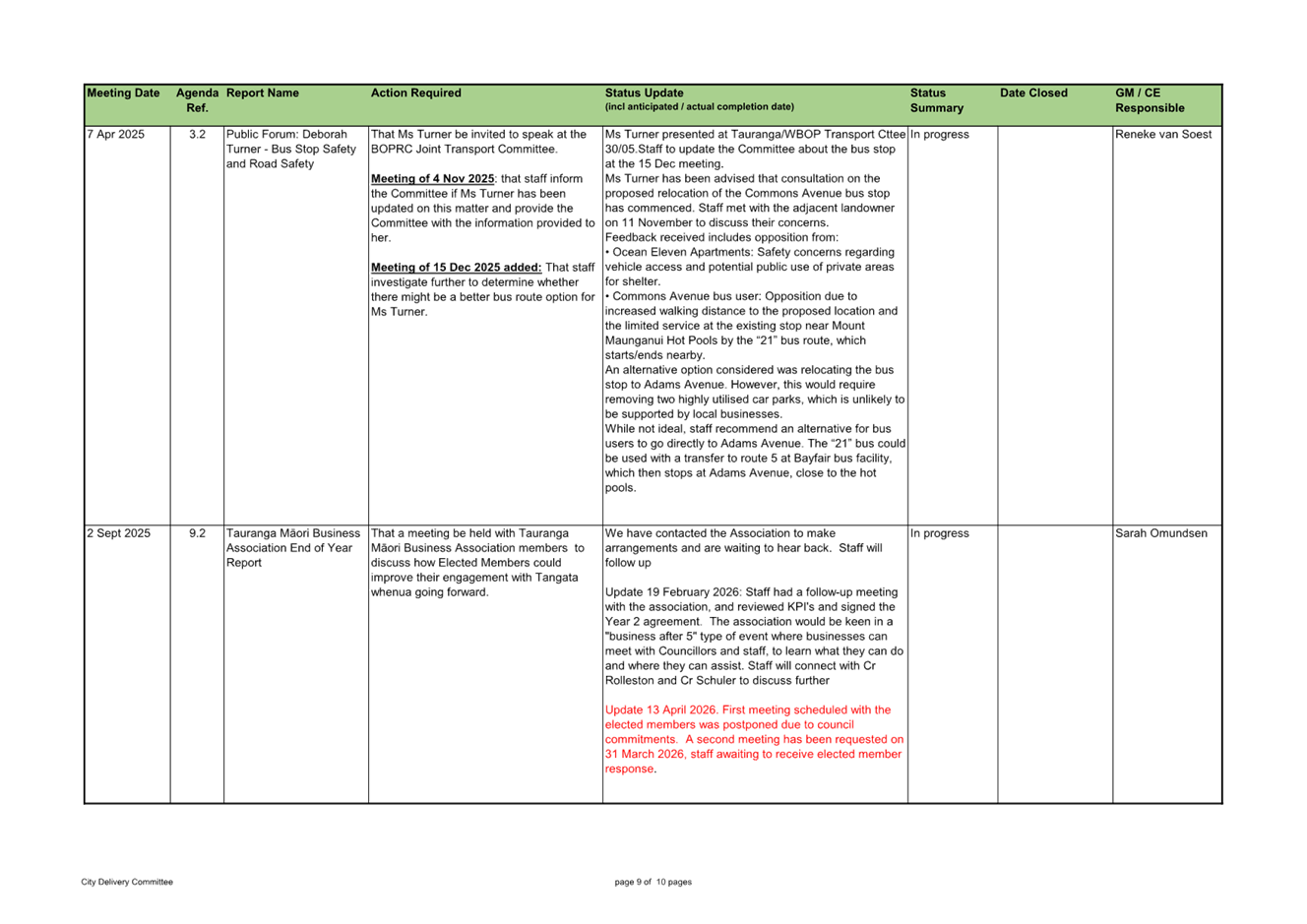
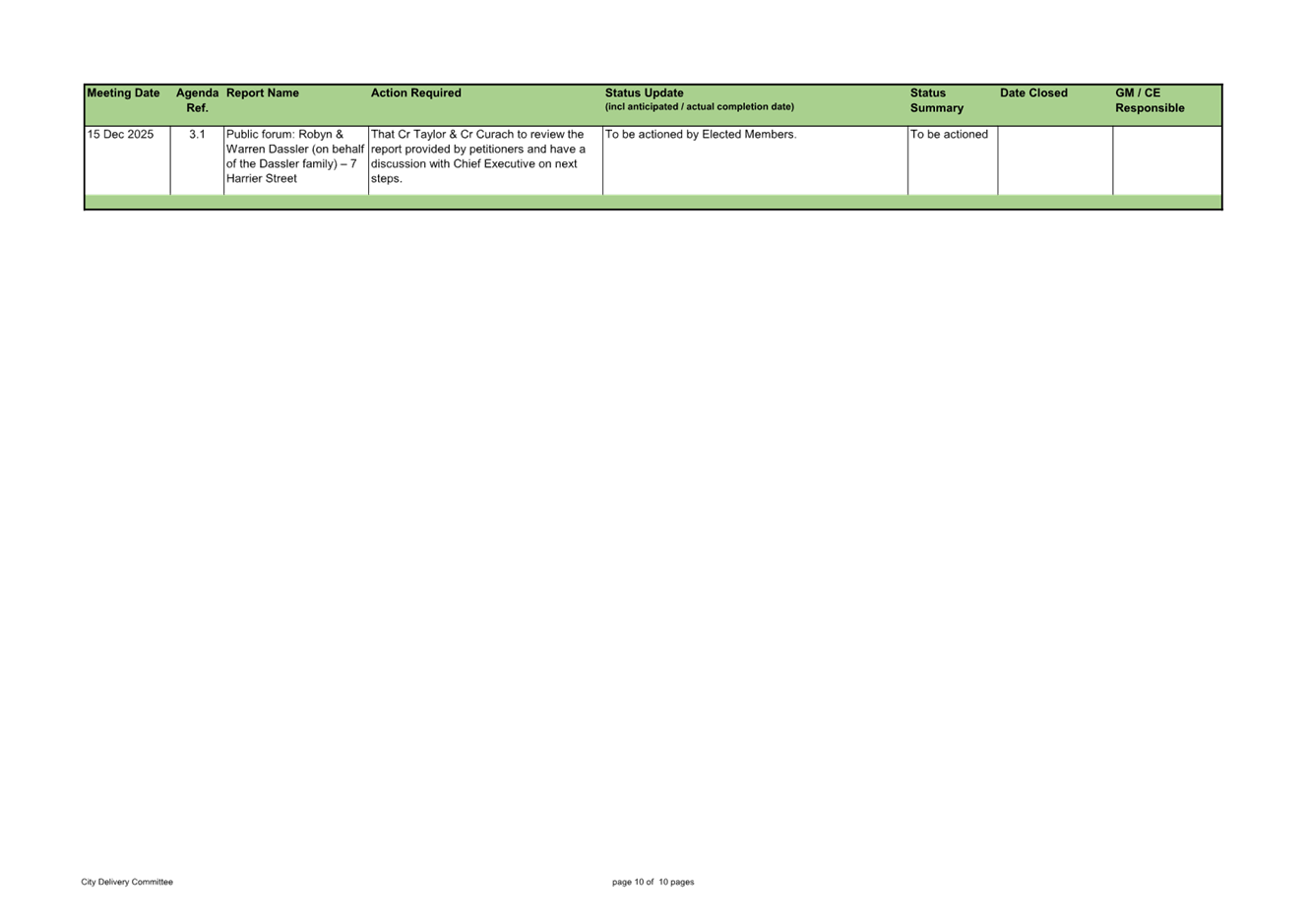
1. This report provides
a status update on actions requested during previous City Delivery Committee
meetings.
|
Recommendations
That the City Delivery
Committee:
(a) Receives the report
"Status Updates on Actions from prior City Delivery Committee
Meetings".
|
Background
2. This is a recurring
report provided to every City Delivery Committee meeting. The next report will
be to the 16 June 2026 meeting.
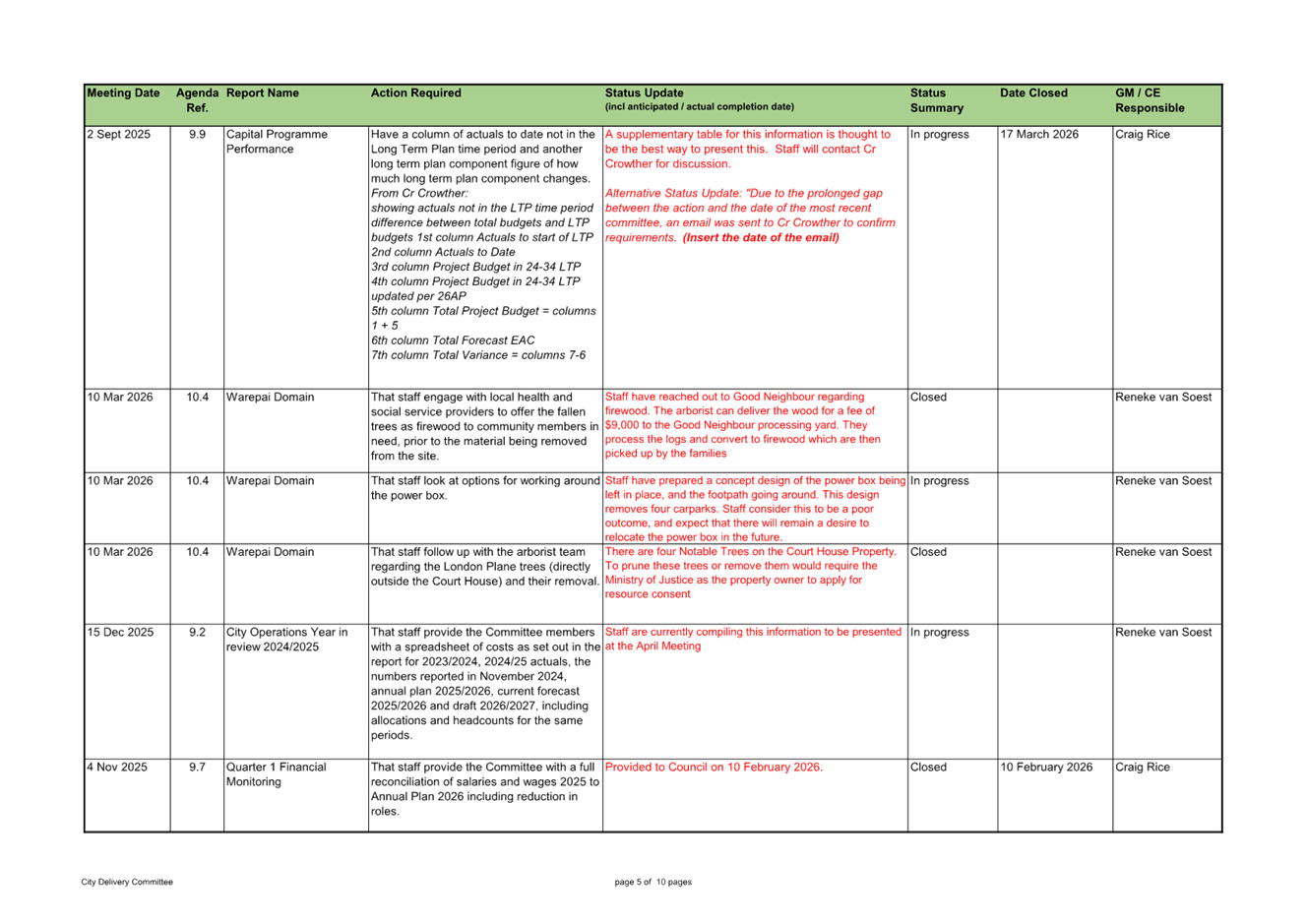
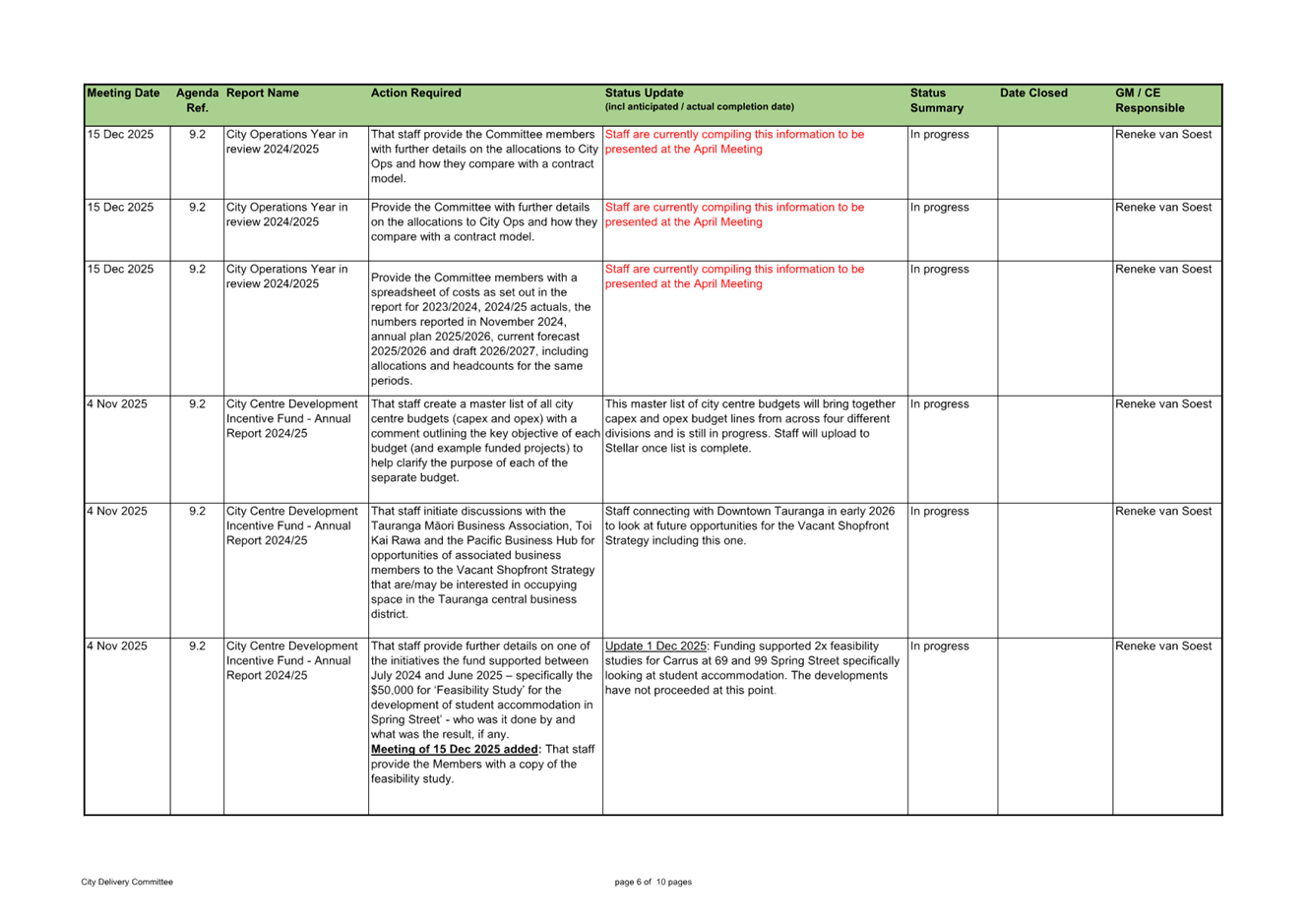
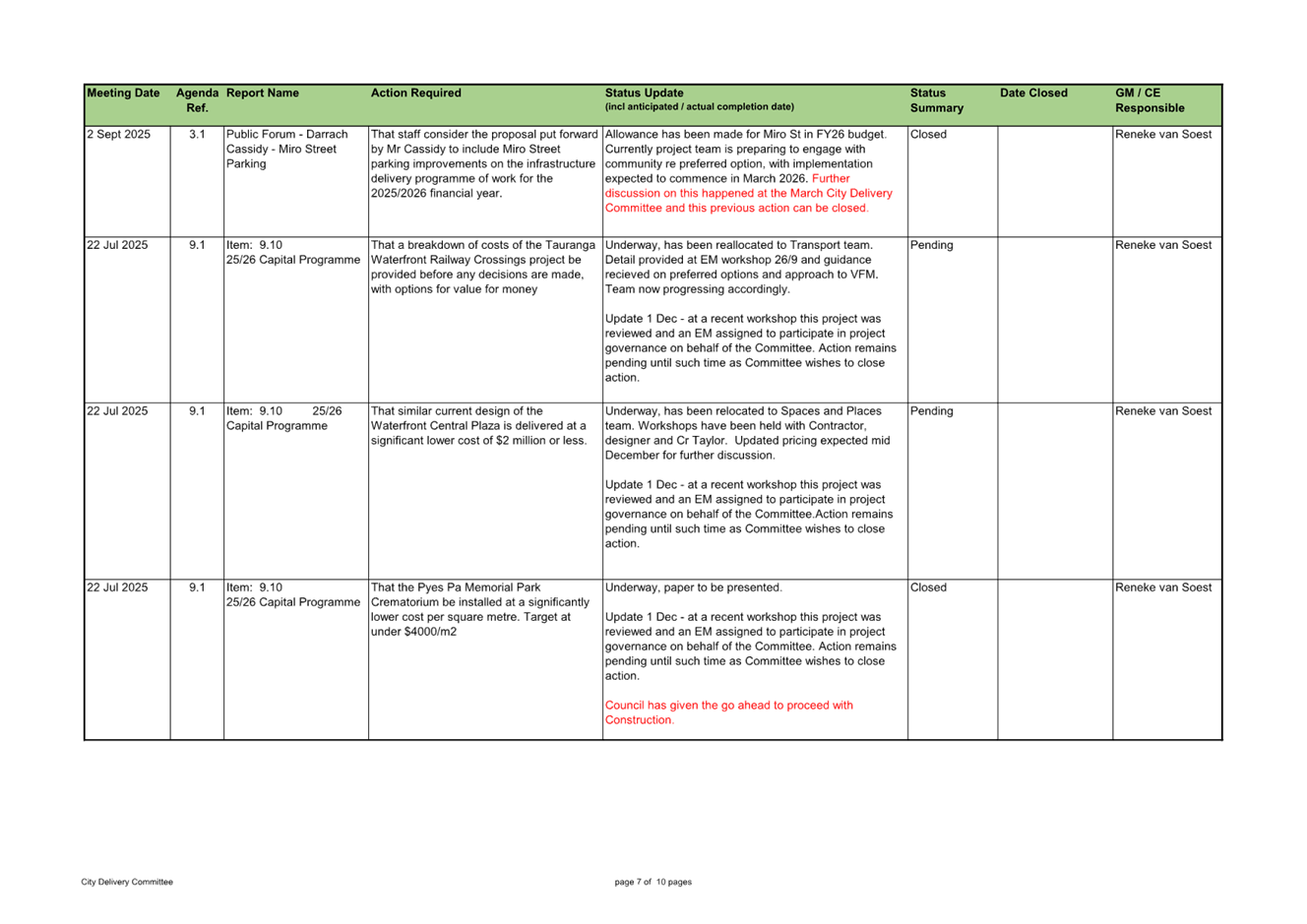
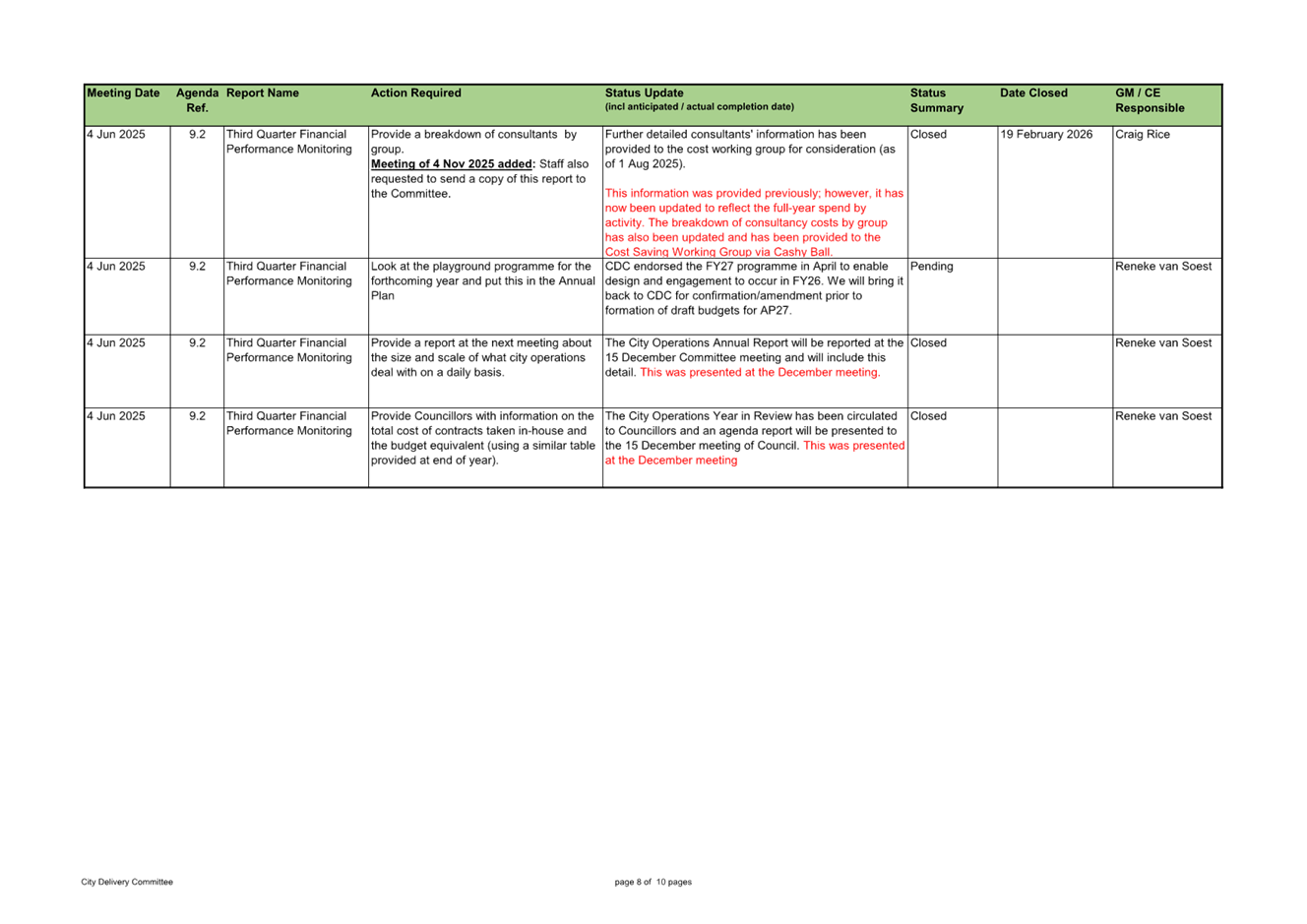
3. The attached update
includes all open actions and actions completed since the last report on 10
March 2026.
4. Once reported,
completed actions are archived and made available in the Stellar library[1].
discussion
5. The action status
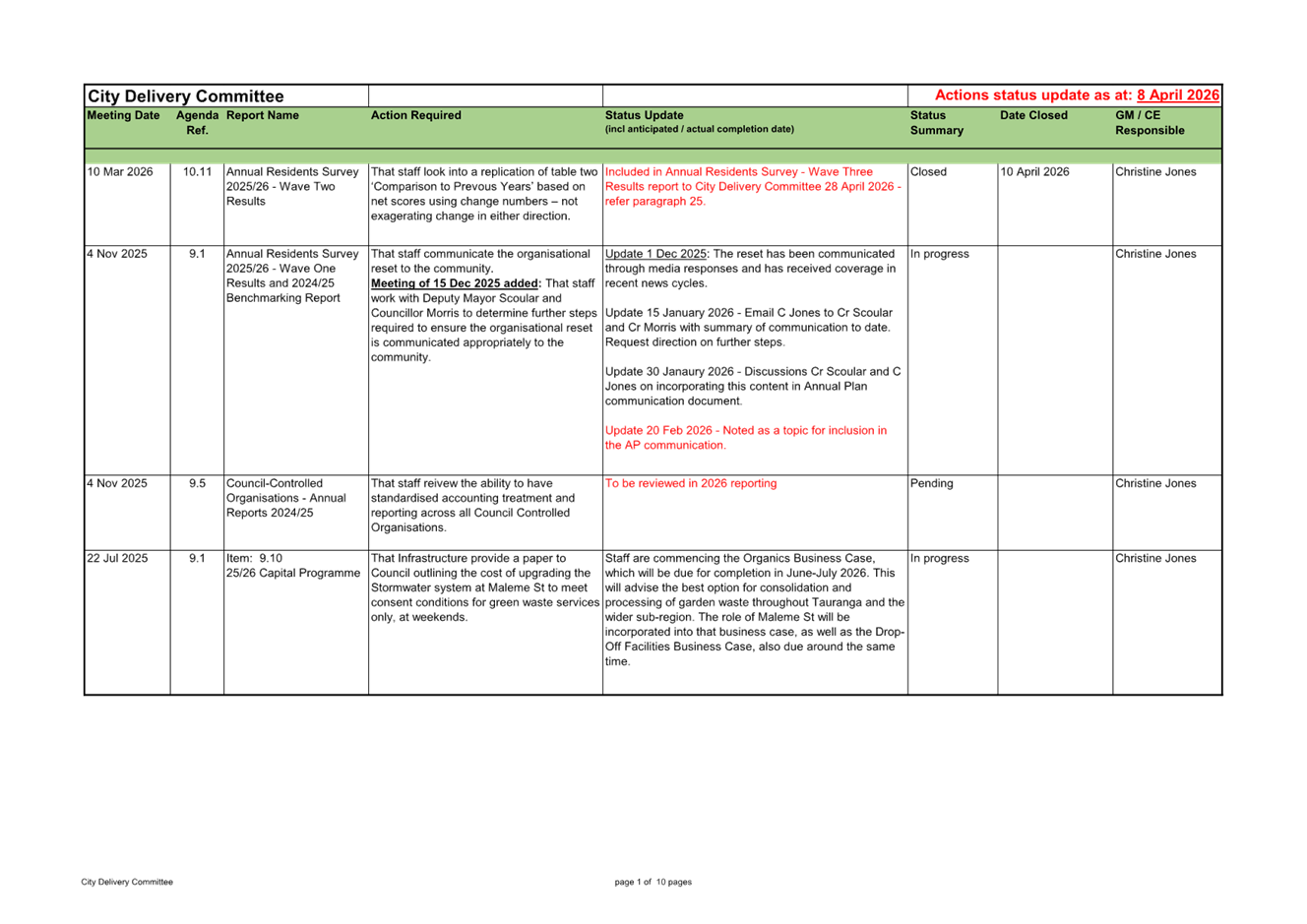
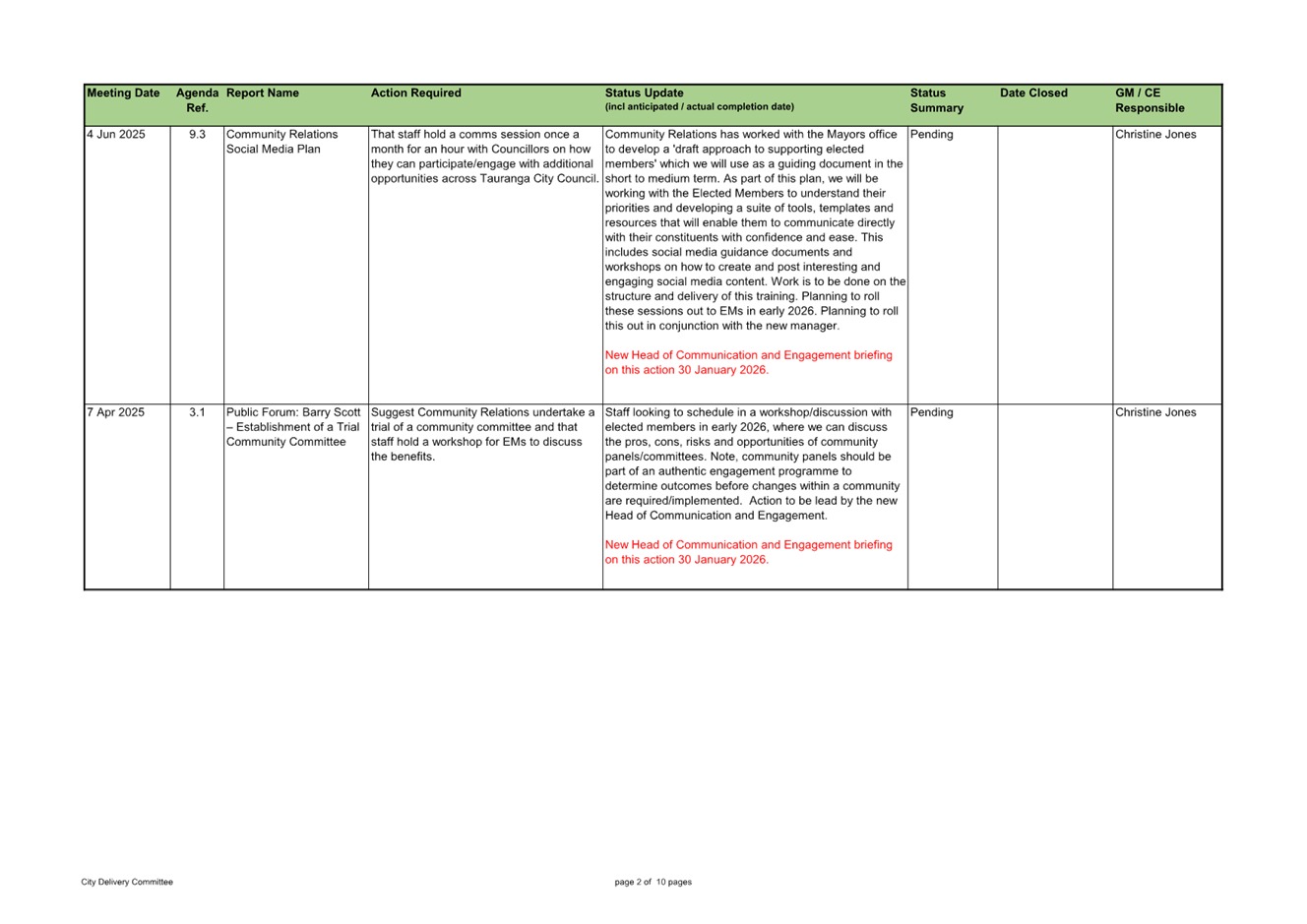
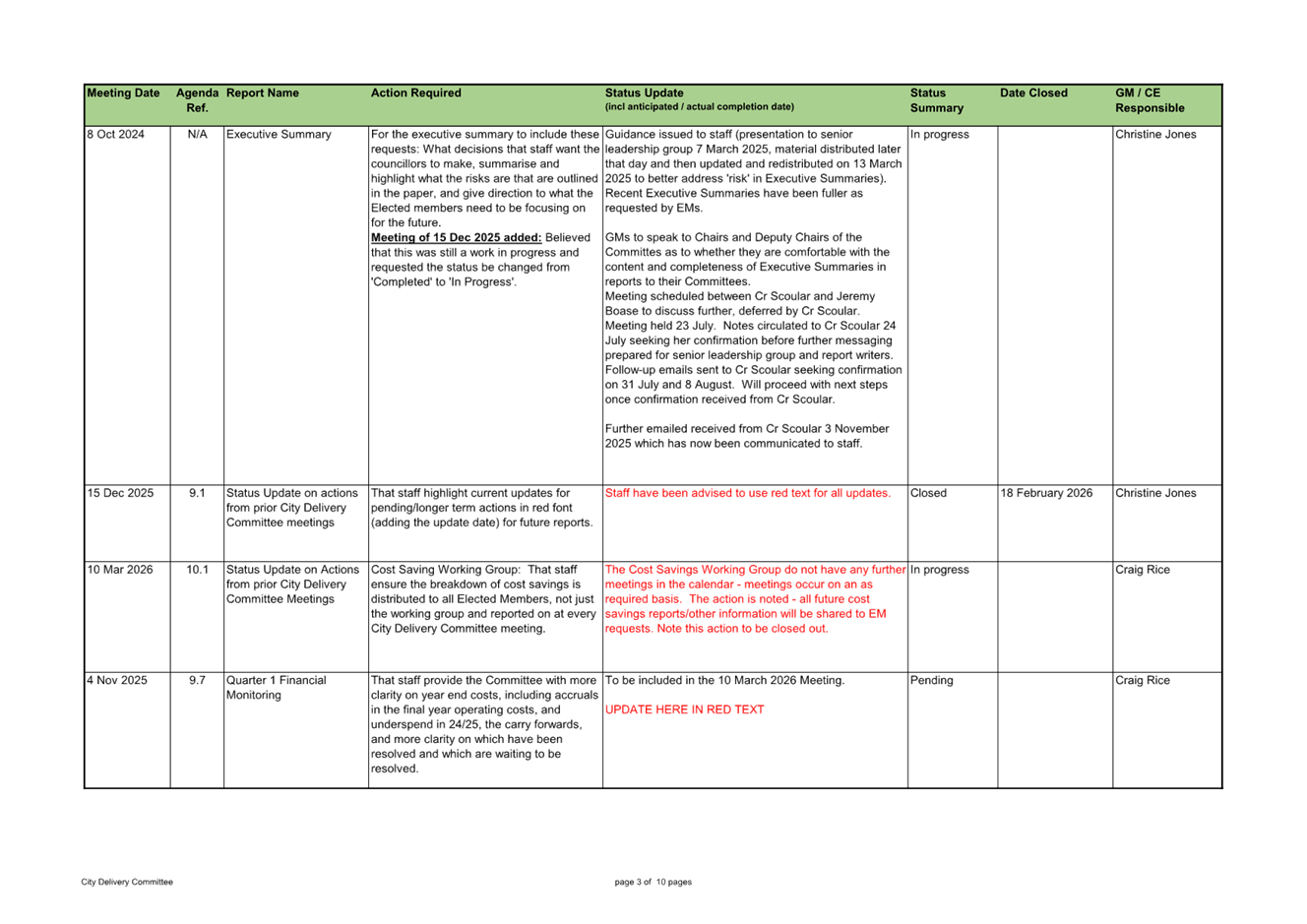
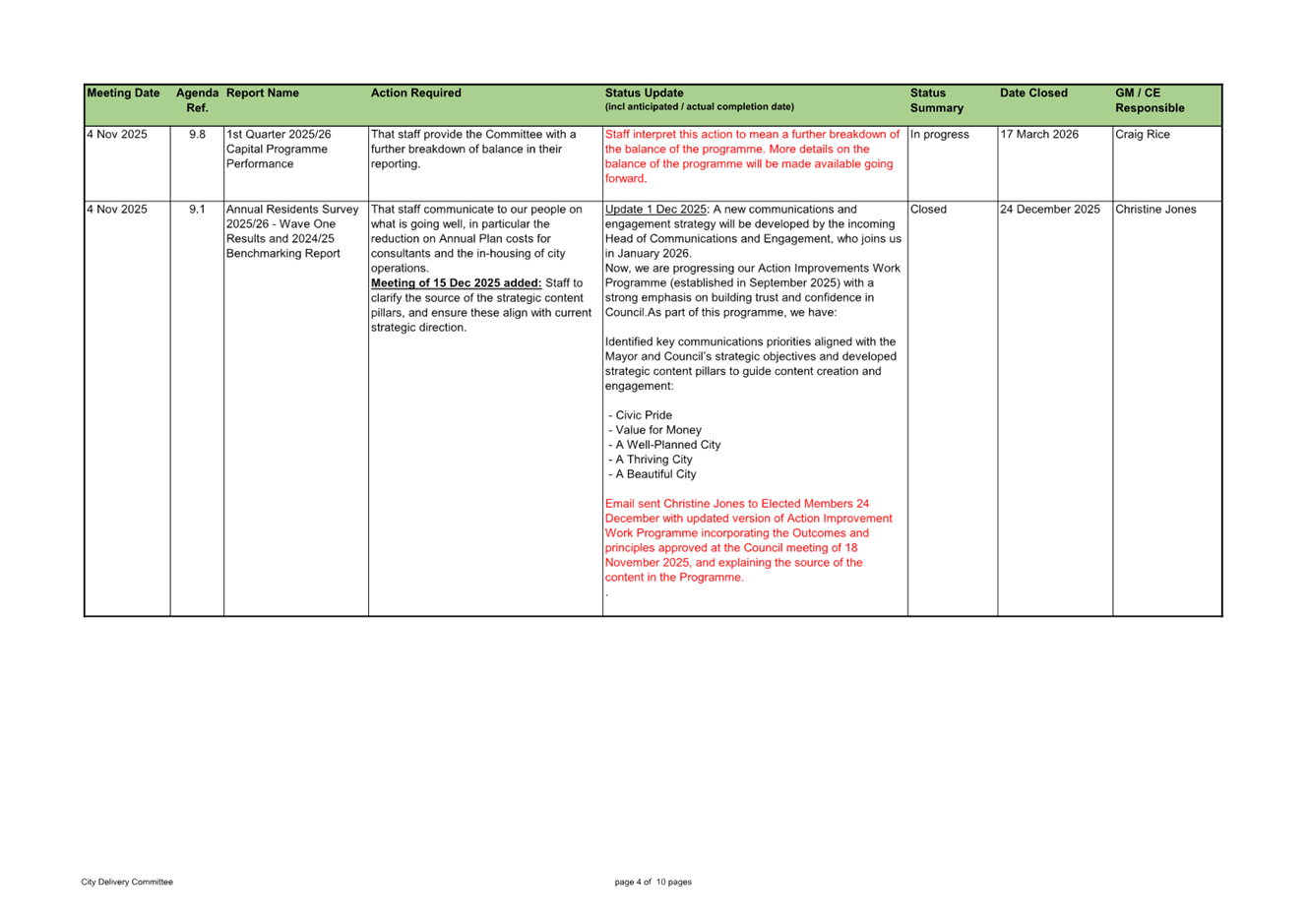
update report for the City Delivery Committee, as at 8 April 2026, is provided
as Attachment 1 to this report, and is summarised in the table below.
|
Status of actions
|
No. actions
|
|
Closed (completed
since the last report)
|
11
|
|
Pending (waiting on
something)
|
7
|
|
In progress
|
16
|
|
To be actioned
|
1
|
|
Total actions
included in this report
|
35
|
Attachments
1. Actions
from the City Delivery Committee Meeting as at 8 April 2026 - A20139192 ⇩ 
|
City
Delivery Committee meeting Agenda
|
28
April 2026
|
|
City
Delivery Committee meeting Agenda
|
28
April 2026
|
10.2 2025/26 Road
Resurfacing Update
File
Number: A20115513
Author: Martin
Taylor, Manager: Transport Network Operations
Authoriser: Reneke
van Soest, General Manager: Operations & Infrastructure
Purpose of the Report
This report is provided to:
a) Update the Committee on delivery of the
2025/26 road resurfacing programme
b) Present the indicative 2026/27 resurfacing
programme
c) Outline the staff position regarding the
property‑owner self‑funding option and ask the committee to endorse
the recommendations provided below.
|
Recommendations
That the City Delivery
Committee:
(a) Receives the report
"2025/26 Road Resurfacing Update".
(b) Approves that:
(i) confirms that a
property‑owner
self‑funding
option to retain asphalt surfacing will not be offered as part of the 2026/27
resurfacing programme; and
(ii) resolves that the
2026/27 resurfacing programme be delivered as a standard service in
accordance with existing asset management practices and approved funding
settings.
(iii) notes that any future
consideration of property‑owner‑funded asphalt
resurfacing will be considered, without commitment, through the 2027–37
Long‑term Plan
process, as previously signalled.
|
Executive summary
1. This report provides
an update on delivery of Tauranga City Council’s 2025/26 resurfacing
programme; outlines the indicative programme for the 2026/27 season and options
regarding whether to offer a property‑owner
self‑funding option
to retain asphalt on roads otherwise programmed for chipseal.
2. Staff recommend
option 1 based on very low uptake in 2025/26 and disproportionate
administrative effort of approx. 485 letters sent, for 6 sites, 30 responses
and 8 affirmatives for around 200k of staff effort.
3. Whilst this cost
will be significantly reduced as the process would be more efficient, the scale
of the task will quadruple as in encompasses the whole programme noting that
any longer‑term consideration is intended to occur through the
2027–37 Long Term Plan.
4. The 2025/26
programme resurfaced approximately 28 km of road network across around 180
sites, delivering planned preventative maintenance within the seasonal window
and within approved budgets. Currently 20 of these sites are chip-over-asphalt.
The programme supports long‑term pavement performance, with approximately
51% of costs supported through NZ Transport Agency Waka Kotahi co‑funding.
5. Heightened community
interest arose where residential asphalt roads were resurfaced with chipseal,
particularly in Papamoa. While this required additional communication and staff
effort, the works were completed successfully, and post‑construction
complaints have been limited.
6. The indicative
2026/27 programme proposes resurfacing approximately 23 km of road network
across 195 sites, continuing Council’s cost‑effective, preventative
approach to network maintenance. Chipseal remains the predominant treatment
that delivers value for money and meets NZTA funding requirements to manage
whole‑of‑life costs, with targeted use of asphalt and ongoing
surfacing trials where appropriate.
BACKGROUND
2. Tauranga City
Council’s 2025/26 resurfacing programme is part of its ongoing annual
maintenance strategy designed to:
(a) Extend the life of existing
roads
(b) Prevent potholes and water
damage
(c) Maintain safe, reliable
transport connections
(d) Maximise value for ratepayers
through NZTA co-funding
3. The resurfacing
season typically runs late September through to the end of March, with asphalt
works extending later if temperatures allow.
4. During the 2025/26
season, customer feedback was heavily concentrated in November–December,
with significant escalation to elected members, requiring enhanced response
processes and senior staff involvement.
5. As part of the
response to the work there was:
· 159
requests for information
· 122
referring to CoA only
· 14
CCMs to our contractor
· 2
drop-in session notices sent via PRRA social media and Council channels
· Over
60 people from the community attended 2 drop-in sessions at Papamoa Library
6. Council offered
residents the option to pay the full cost difference between chipseal and
asphalt resurfacing which was explicitly framed as a one‑off measure, alongside a commitment to
consider a more formal approach through the Long‑term
Plan 2027–37.
7. For the CoA funding
offer:
· 435
residents were invited to participate,
· 35
responded and
· only
eight indicated willingness to pay
· with
no street achieving sufficient commitment to proceed.
The 2026/27 Resurfacing season
8. The 2026/27 season
is based on good asset management practice and ensures our road pavements are
well protect from water damage. This is the primary cause of potholes and
premature failure of the road structure.
9. To keep roads safe
and provide a good level of service for drivers, on average 3-5% of the
city’s road surfaces are renewed annually. For the 2026/27 season, 23km
of road network distributed over 195 sites has been identified for resurfacing,
comprising the following.
|
Resurfacing
Type
|
Sites
|
Lane
km
|
|
Chipseal
over Chipseal
|
36
|
8.6km
|
|
Asphalt
over Asphalt
|
105
sites
|
8.5km
|
|
Asphalt
over Chipseal
|
9
sites
|
0.4km
|
|
Chipseal
over Asphalt
|
45
sites
|
5.8km
|
Property owner funding option to
retain asphalt
10. As part of the 2025/26
resurfacing programme, Council offered property owners the option to pay the
full cost difference between chipseal and asphalt, where their street was
currently asphalted. This followed Elected Members direction in
November 2025 and was implemented at short notice to avoid
delaying the resurfacing programme that was underway.
11. The option was explicitly
framed as a one‑off measure (for 25/26 and 26/27 resurfacing programmes),
alongside a commitment to consider a more formal approach through the Long‑term
Plan 2027–37.
12. In addition, Councill noted
that Staff should review channels used to deliver resurfacing information.
Council has published the 26/27 programme on our website and will add an extra
targeted letter to homeowners nearer to the programme start followed by a
letter immediately before construction.
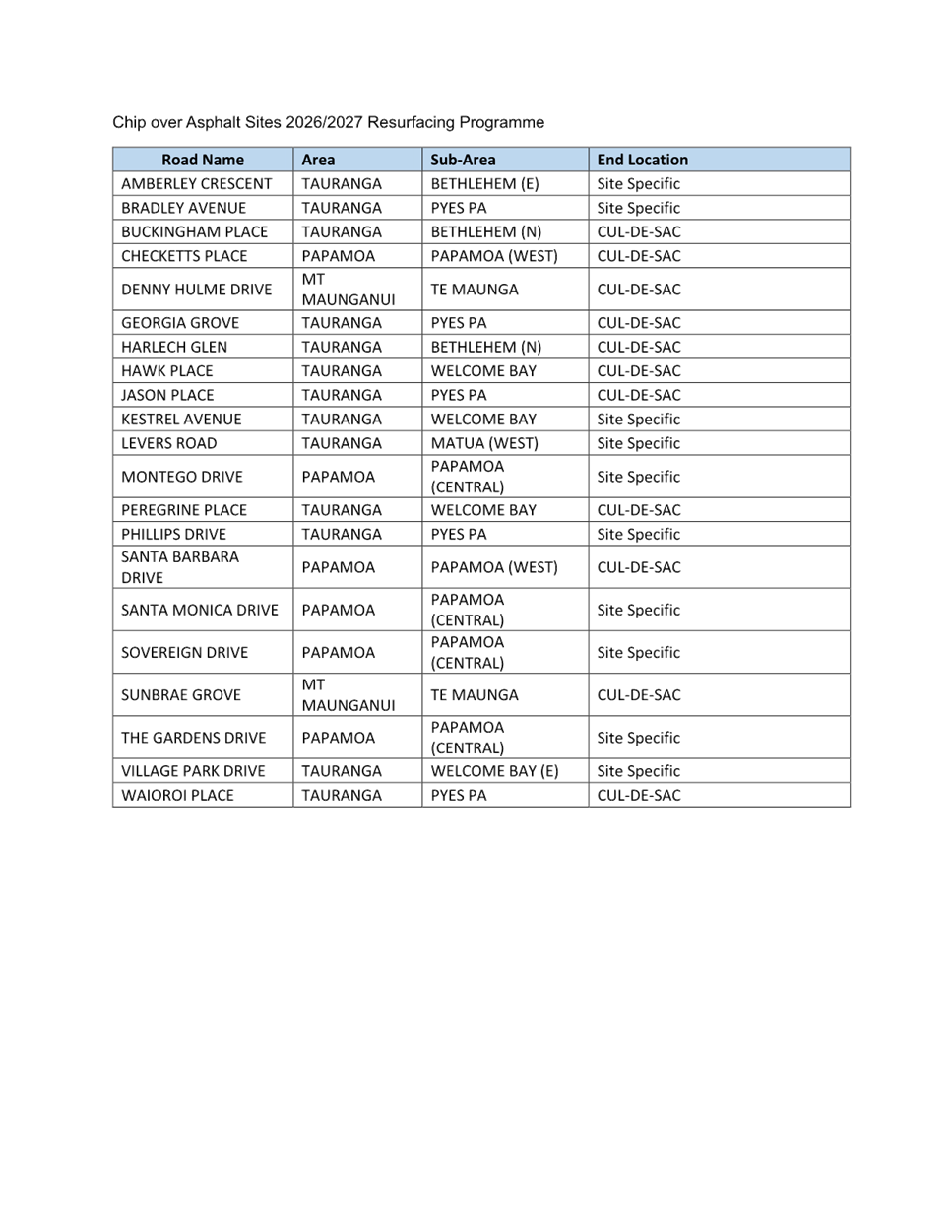
13. For more details, please see
Attachment 1
STATUTORY CONTEXT
14. Tauranga City Council is
authorised under the Local Government Act 2002 and Local Government Act 1974 to
maintain and manage the local road network.
15. The resurfacing programme is a
business‑as‑usual asset maintenance activity delivered in
accordance with Council‑approved funding and service levels through the
Long‑term Plan and Annual Plan, and in line with NZ Transport Agency Waka
Kotahi requirements for co‑funding.
16. This report does not propose
any changes to policy or bylaws, and no statutory consultation or special
consultative procedure is required.
strategic alignment
17. This contributes to the
promotion or achievement of the following strategic community outcome(s):
|
Contributes
|
|
We are an inclusive city
|
☐
|
|
We value, protect and enhance the environment
|
☐
|
|
We are a well-planned city that is easy to move
around
|
ü
|
|
We are a city that supports
business and education
|
☐
|
|
We are a vibrant city that embraces
events
|
☐
|
18. This recommendation supports
the community outcome by enabling the timely delivery of a planned, cost‑effective
resurfacing programme. Maintaining road surfaces through proactive, whole‑of‑life
asset management helps ensure a safe, reliable transport network that supports
everyday travel and long‑term network resilience.
Options ANALYSIS
Property owner funding options:
Option
1 – Do not offer property owners self-funding for the 2026/27
season (recommended).
19. Deliver the 2026/27 resurfacing
programme as a standard service, without offering property owners on streets
scheduled to move from asphalt to chipseal the opportunity to contribute the
full cost difference to retain asphalt. Clearly signal that any future
consideration of property owner funded asphalt resurfacing will occur through
the 2027–37 Longterm Plan, as planned.
|
Advantages
|
Disadvantages
|
|
Proportionate response
to the very low uptake achieved in 2025/26, where 435 property owners were
invited to participate, 35 responded and only eight indicated
willingness to pay, with no street achieving sufficient commitment to
proceed.
|
Removes a short term
option for a small number of property owners
|
|
Avoids repeating
disproportionate and unrecoverable staff effort across Transport, Finance,
Legal, Communications, Customer Services and Elected Member support.
|
Some continued
dissatisfaction until the LTP process
|
|
Maintains certainty of
delivery for a tendered, integrated resurfacing programme, avoiding risks to
sequencing, contractor efficiency and asset condition management that arise
from street‑by‑street opt‑in decisions.
|
|
|
Removes administrative
and legal complexity associated with lumpsum contributions
|
|
Option
2 – Offer property owners self-funding for the 2026/27 season.
20. Offer property owners on
streets scheduled to move from asphalt to chipseal in 2026/27 the opportunity
to contribute the full cost difference to retain asphalt.
|
Advantages
|
Disadvantages
|
|
Provides continuity
with the 2025/26 approach
|
High staff effort
relative to demonstrated and expected demand
|
|
Responds to ongoing
concern about asphalt retention
Signals openness ahead
of the LTP process
|
Roughly estimated
unrecoverable staff cost of approximately $5,000–$10,000 per week
anticipated at minimum 4-6 weeks and a fourfold increase in sites will put
the cost over the 100k mark for a smooth process.
|
|
Aligns with the
original intent of the self-funding option as a time limited measure prior to
the LTP - as the appropriate forum for longer term consideration
|
Introduces delivery,
cost and programme risk for the resurfacing programme
|
|
|
Introduces
administrative and legal complexity - including the need for full cost
recovery certainty and comprehensive legal agreements within tight timeframes
|
|
|
High likelihood of low
uptake
|
Financial Considerations
21. There are no financial
implications associated with this report in terms of business-as-usual
programme delivery. However, some implications exist associated with
options above, including:
(a) Option 1: avoids additional
unrecoverable staff costs and programme risks.
(b) Option 2: introduces ongoing
unrecoverable staff costs and potential impacts to programme efficiency, with
limited likelihood of achieving sufficient contributions to offset these costs.
Legal Implications / Risks
22. There are no legal implications
associated with the maintenance programme, however the following risks apply to
the self‑funding
option decision:
(a) Programme delivery risk:
Offering a street‑by‑street self‑funding option could
disrupt programme sequencing, contractor efficiency and asset condition
management. Mitigation: Deliver the 2026/27 programme as standard service.
(b) Staff cost risk: The self‑funding option requires
disproportionate staff effort across multiple teams, with estimated costs of
$5,000–$10,000 per week. Mitigation: Do not offer the option outside the
formal LTP process.
(c) Low uptake / value‑for‑money risk: Prior
experience showed very limited participation, with no streets achieving
sufficient commitment to proceed. Mitigation: Defer to the 2027–37 Long‑term Plan.
TE AO MĀORI APPROACH
23. This report relates to routine,
city‑wide road
resurfacing within existing road corridors and does not involve new land use or
changes to Council policy.
24. No specific engagement with
Tangata Whenua has been undertaken for this report, as the programme focuses on
standard asset maintenance and does not affect identified sites of cultural
significance. Where resurfacing works intersect with areas of known cultural
sensitivity, Council’s standard internal processes are followed to
identify and manage any risks, including engagement where appropriate.
25. The programme supports
responsible stewardship of infrastructure by extending asset life, minimising
the need for more invasive renewal works, and contributing to safe and reliable
transport outcomes for the community.
CLIMATE IMPACT
26. This report has considered
climate impacts in accordance with Tauranga City Council’s Climate Impact
guidance.
27. The resurfacing programme
supports climate resilience by protecting pavements from water ingress,
reducing the risk of premature failure and improving network performance under
more frequent and intense rainfall events.
28. The programme also contributes
to emissions reduction through a whole‑of‑life asset management
approach. Chipseal and targeted rejuvenation treatments are used where
appropriate as they require fewer materials and have lower embodied emissions
than full asphalt resurfacing, while extending pavement life and reducing the
frequency of major renewals.
29. The programme involves
maintenance within existing road corridors and does not introduce new land
disturbance. Environmental and biodiversity impacts are localised and short‑term and are managed
through standard construction controls.
Consultation / Engagement
30. Property owners participated in
the 2025/26 programme. Feedback showed strong opinions on surfacing types but
little interest in self-funding. The 2026/27 approach will be clearly
communicated, noting that long-term policies will be reviewed through the 2027–37
LTP process. Communication and engagement will be included during programme
delivery.
SIGNIFICANCE
31. The Local Government Act 2002
requires an assessment of the significance of matters, issues, proposals and
decisions in this report against Council’s Significance and Engagement
Policy. Council acknowledges that in some instances a matter, issue,
proposal or decision may have a high degree of importance to individuals,
groups, or agencies affected by the report.
32. In making this assessment,
consideration has been given to the likely impact, and likely consequences for:
(a) the current and future social,
economic, environmental, or cultural well-being of the district or region
(b) any persons who are likely to
be particularly affected by, or interested in, the decision
(c) the capacity of the local
authority to perform its role, and the financial and other costs of doing so.
In
accordance with the considerations above, criteria and thresholds in the
policy, it is considered that the decision is of medium significance.
33. While the matter is considered
to be of medium significance, it has high community interest.
ENGAGEMENT
34. Taking into consideration the
above assessment, that the decision is of medium significance, officers are of
the opinion that no further engagement is required prior to Council deciding
35. However, further engagement is
planned for the 2027–37 Longterm Plan process.
Click
here to view the TCC
Significance and Engagement Policy
Next Steps
36. Contingent on council decision,
staff do not plan to offer the self-funding option for the 2026/27 resurfacing
programme, and that the reseal programme continues to be delivered as planned.
37. Any future consideration of
property owner-funded asphalt resurfacing will occur through the 2027–37
Longterm Plan process through the consideration of a new policy position.
Attachments
1. Chip
over Asphalt Sites 2026/2027 Resurfacing Programme - A20133222 ⇩
|
City
Delivery Committee meeting Agenda
|
28
April 2026
|
|
City
Delivery Committee meeting Agenda
|
28
April 2026
|
10.3 Q3 2026 Financial
Monitoring Report
File
Number: A20139449
Author: Caroline
Irvin, Governance Advisor
Authoriser: Caroline
Irvin, Governance Advisor
Background
1. The
report accompanying this agenda item, ‘Q3 2026 Financial Monitoring
Report’, will be circulated separately prior to the meeting.
|
City
Delivery Committee meeting Agenda
|
28
April 2026
|
10.4 3rd Quarter 2025/26
Capital Programme Performance
File
Number: A20114431
Author: Alex
Johnston, Team Leader CPAD
Authoriser: Craig
Rice, Chief Operating and Financial Officer
Purpose of the Report
1. To
update the Committee on the progress of the capital programme.
|
Recommendations
That the City Delivery
Committee:
(a) Receives the report "3rd
Quarter 2025/26 Capital Programme Performance".
|
Executive Summary
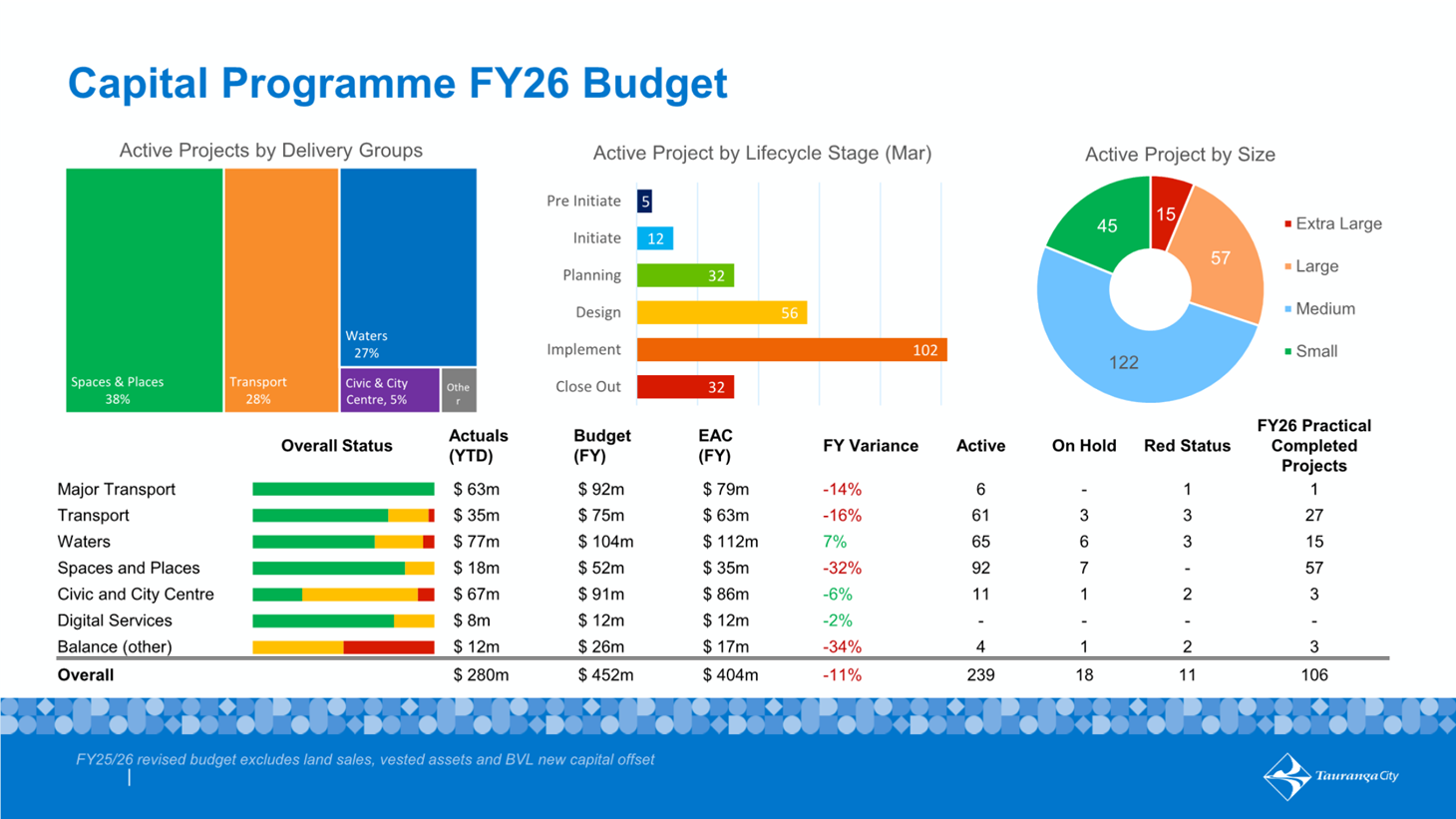
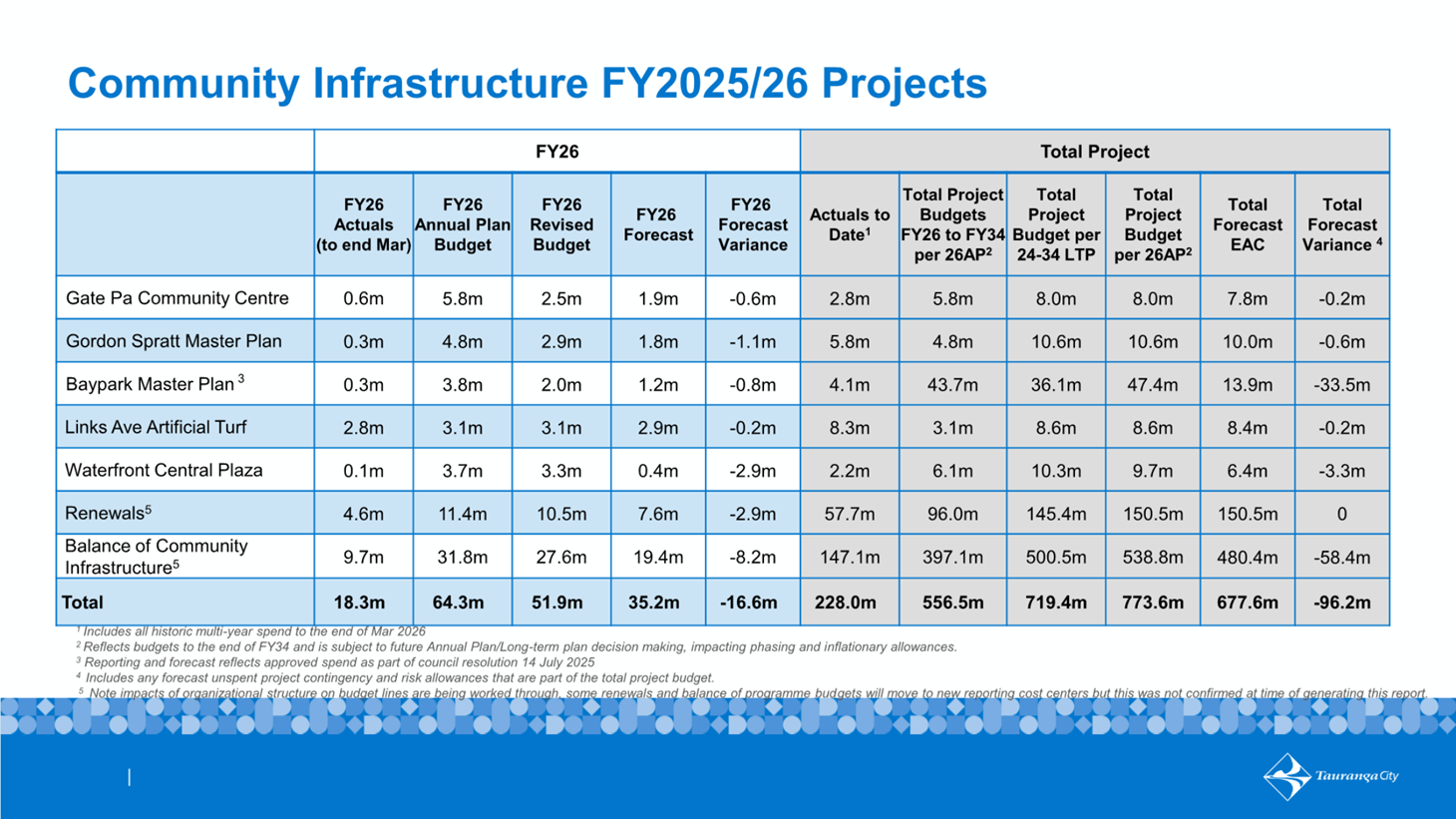
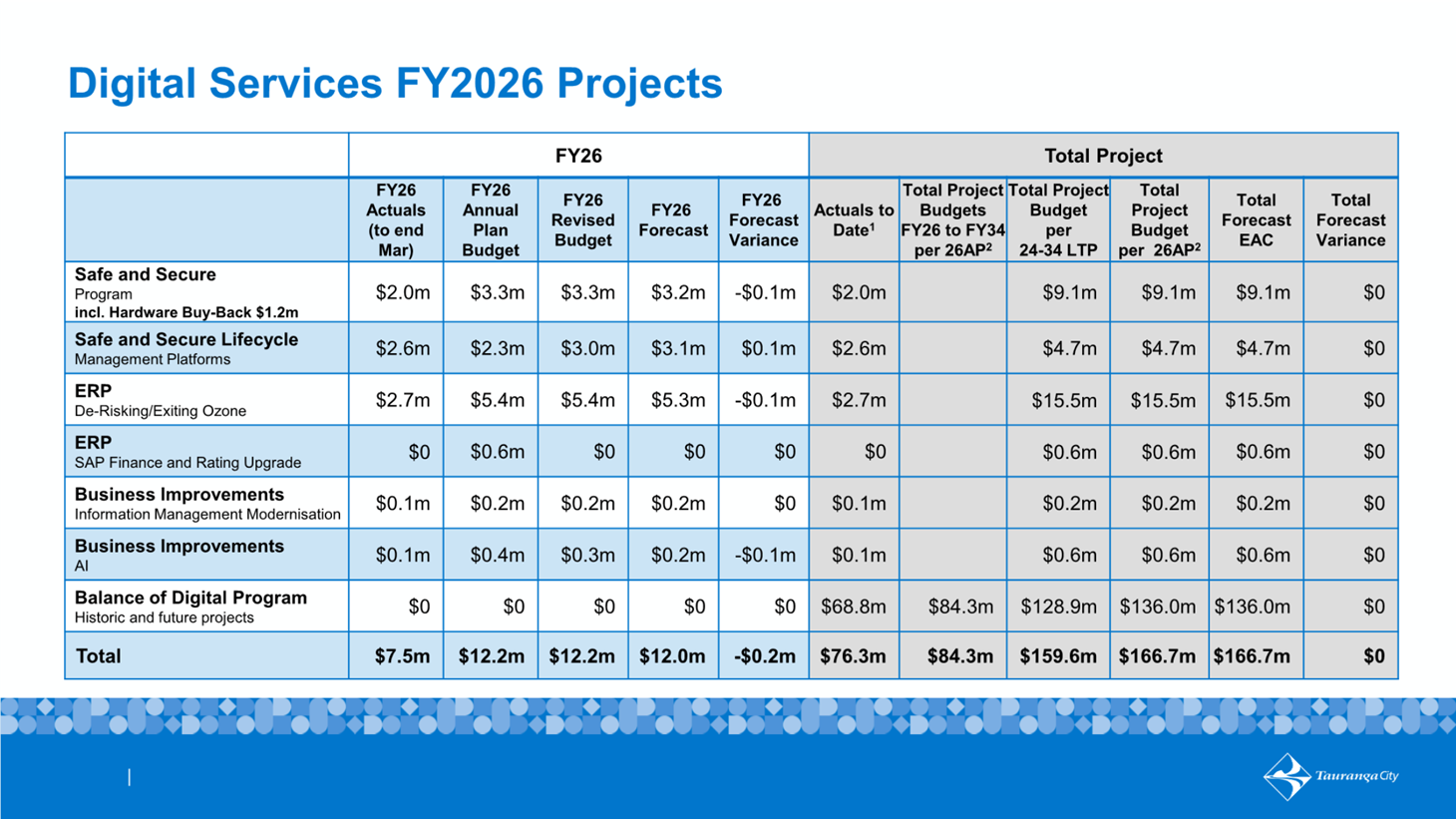
2. Project delivery is
aligned with the Revised Budget 2025/26 of $452.3 million.
As at the end of Quarter 3 (31 March), year‑to‑date expenditure
totalled $280.3 million.
Based on forecasts provided by project managers, the estimated expenditure at
financial year end is $403.5 million, being 89% of budget.
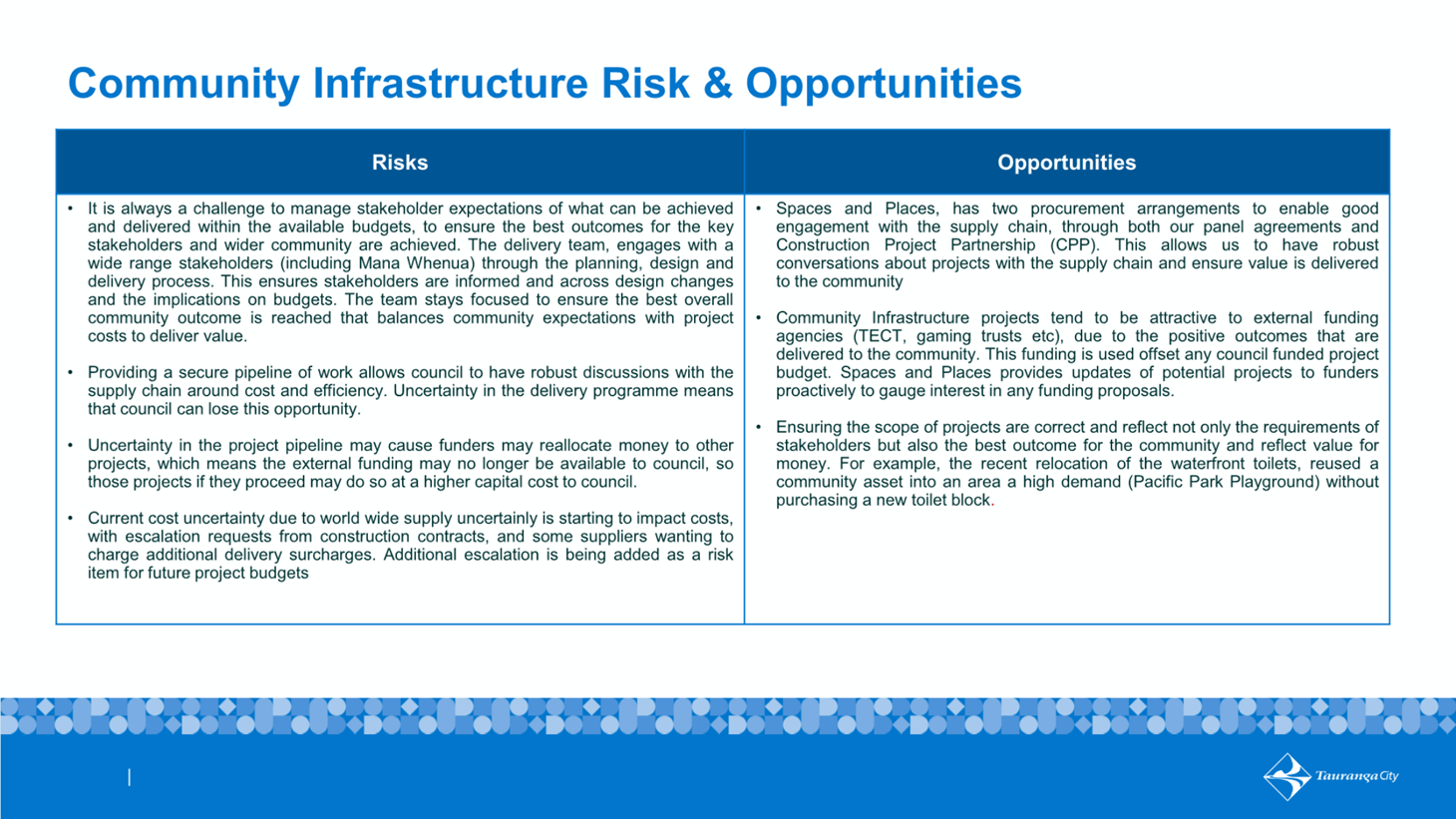
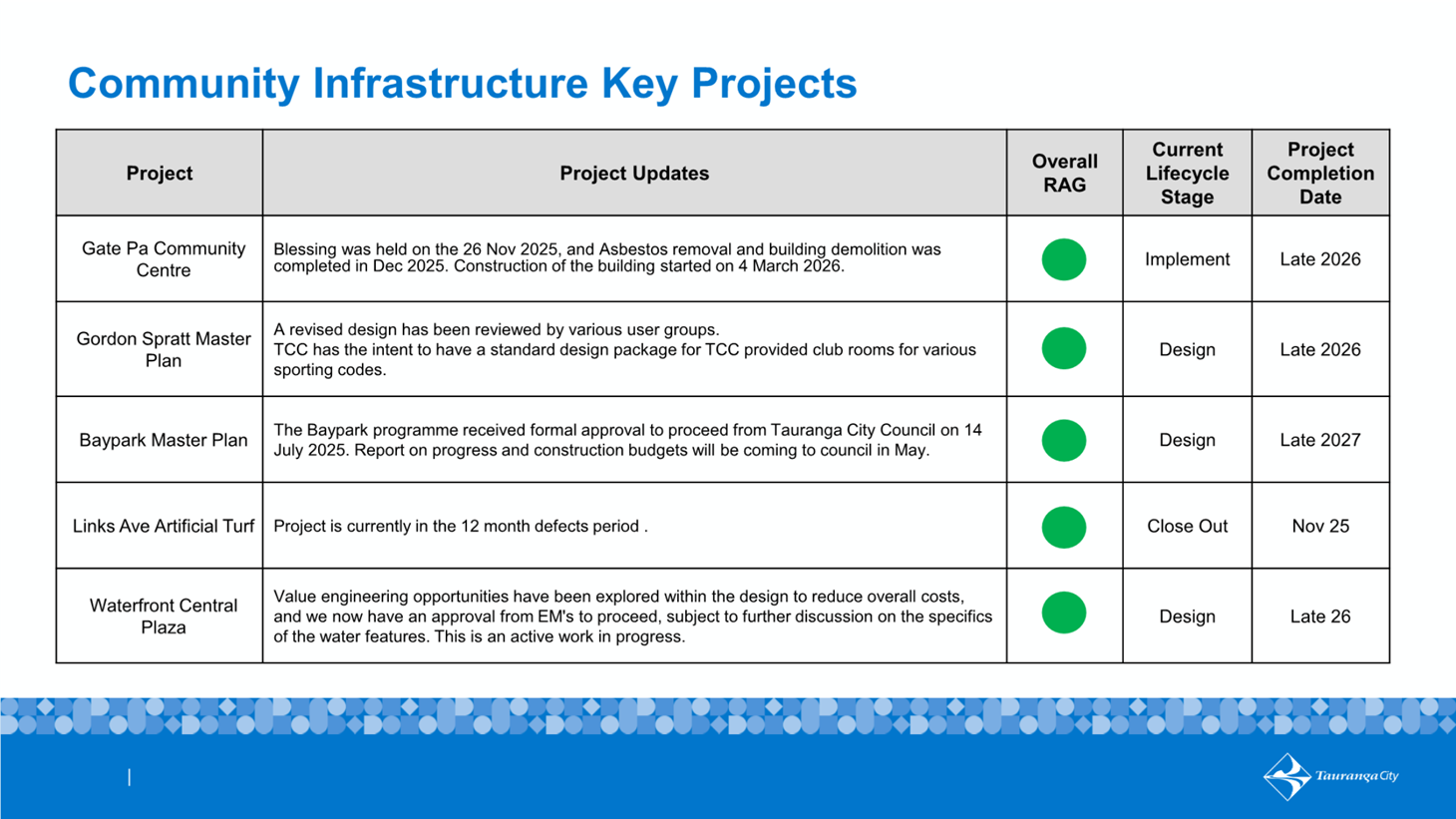
3. High‑level
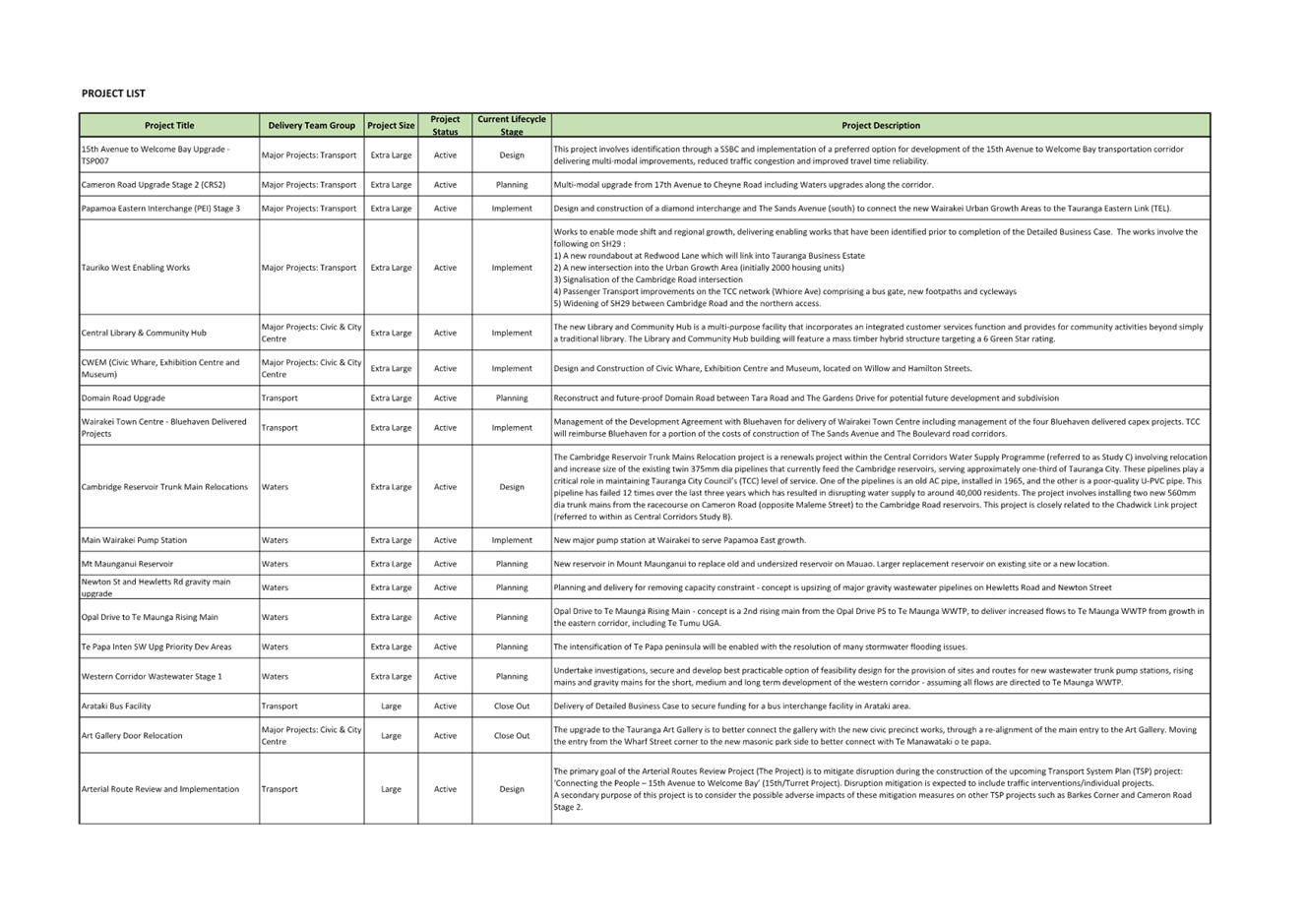
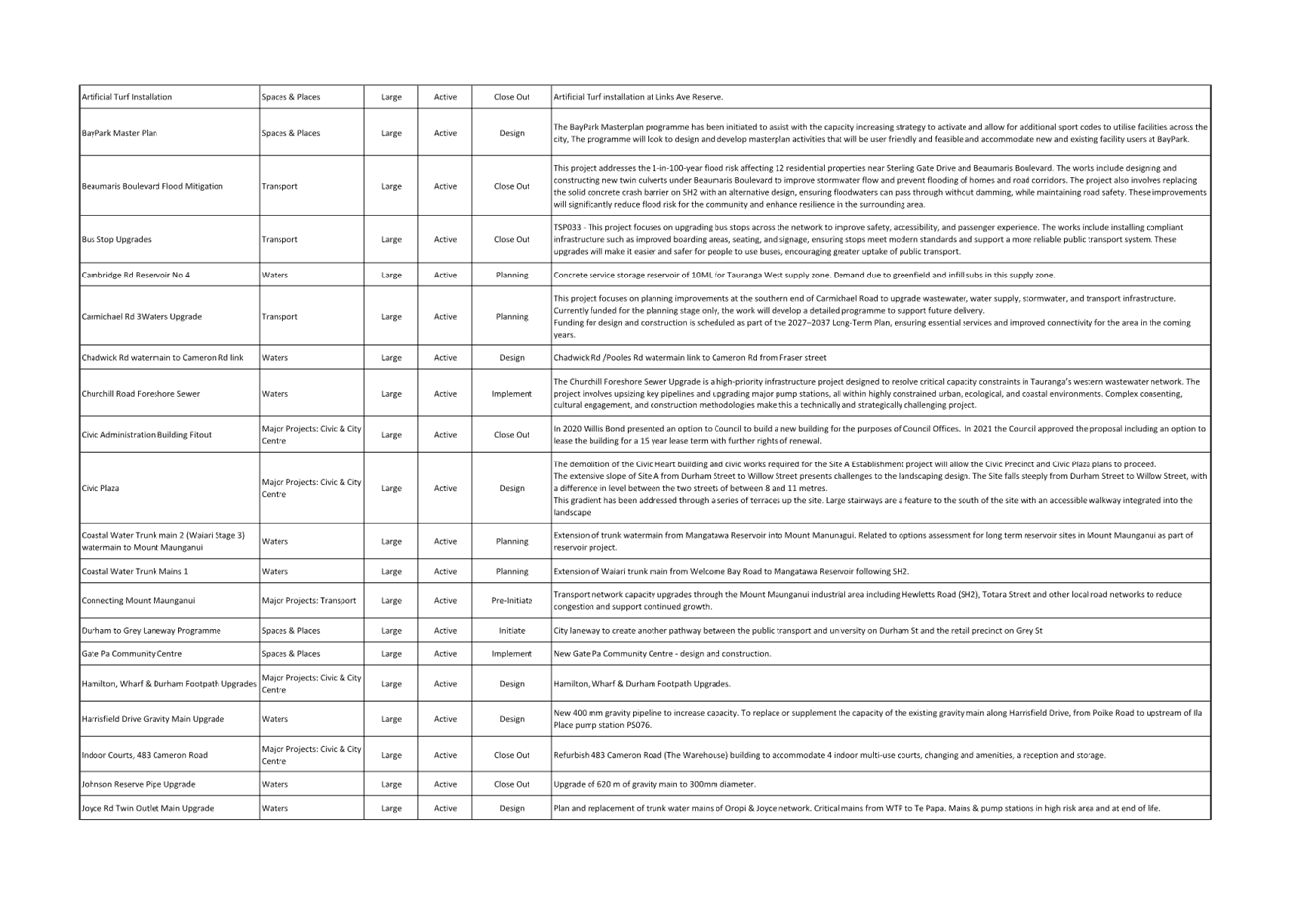
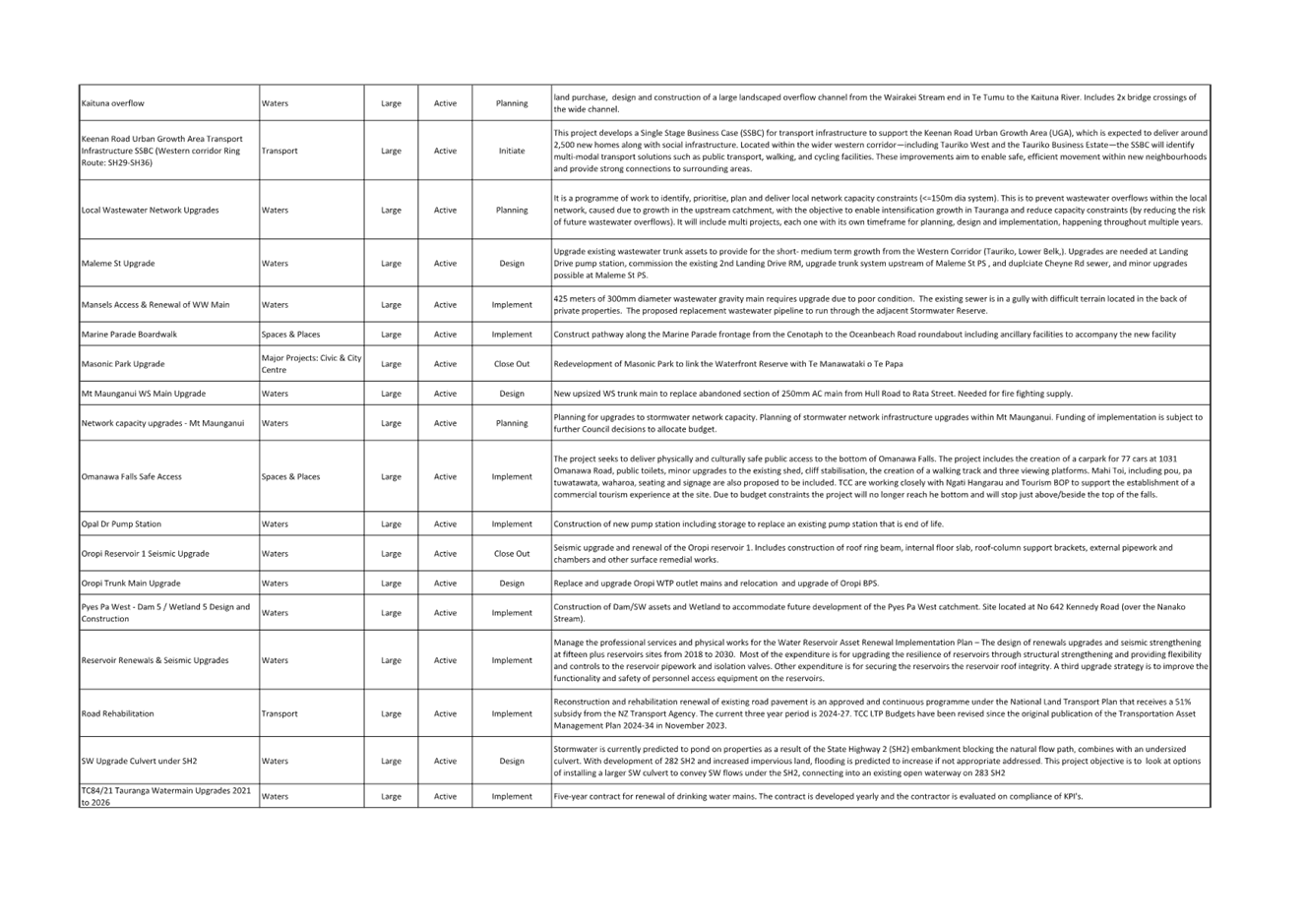
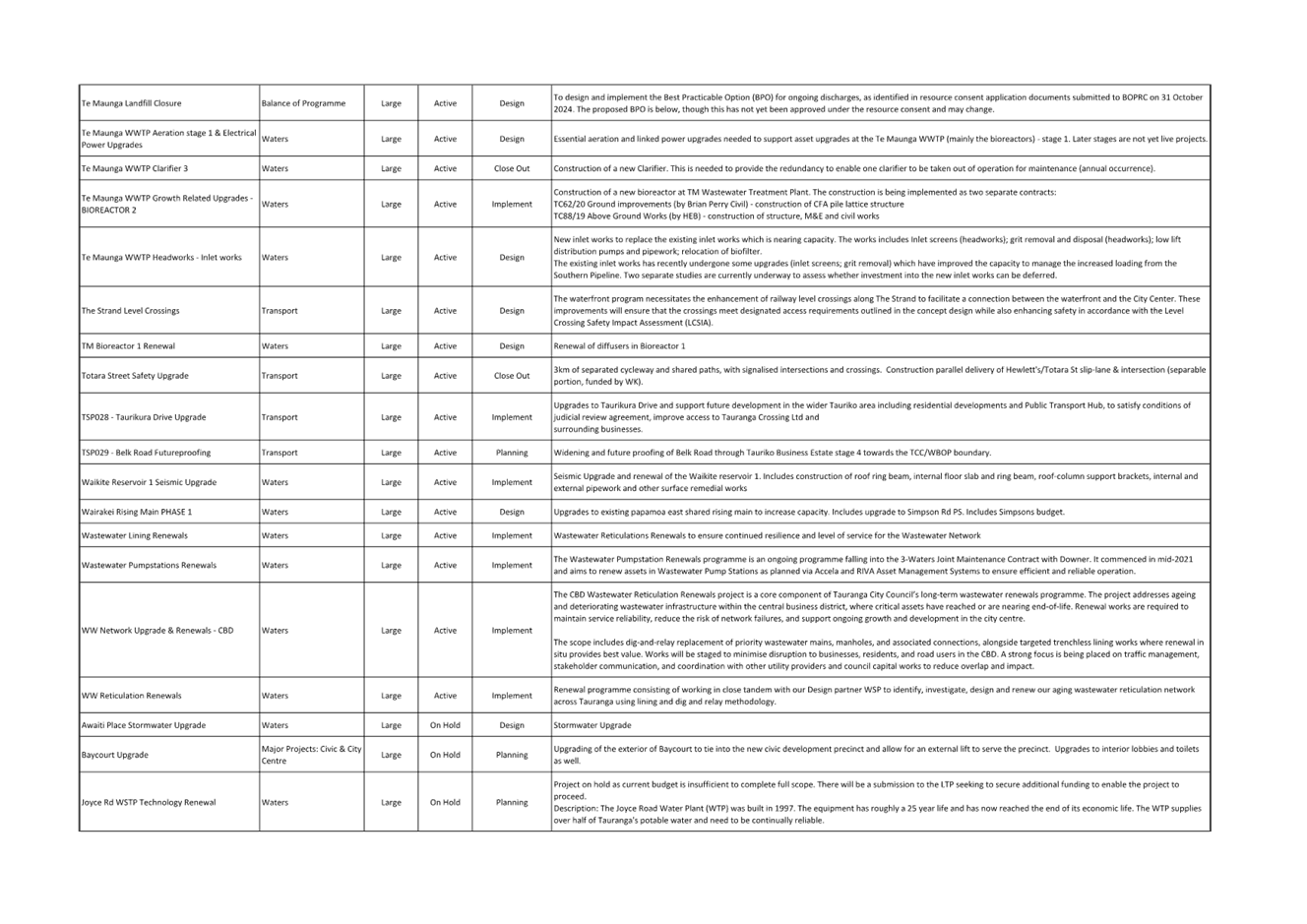
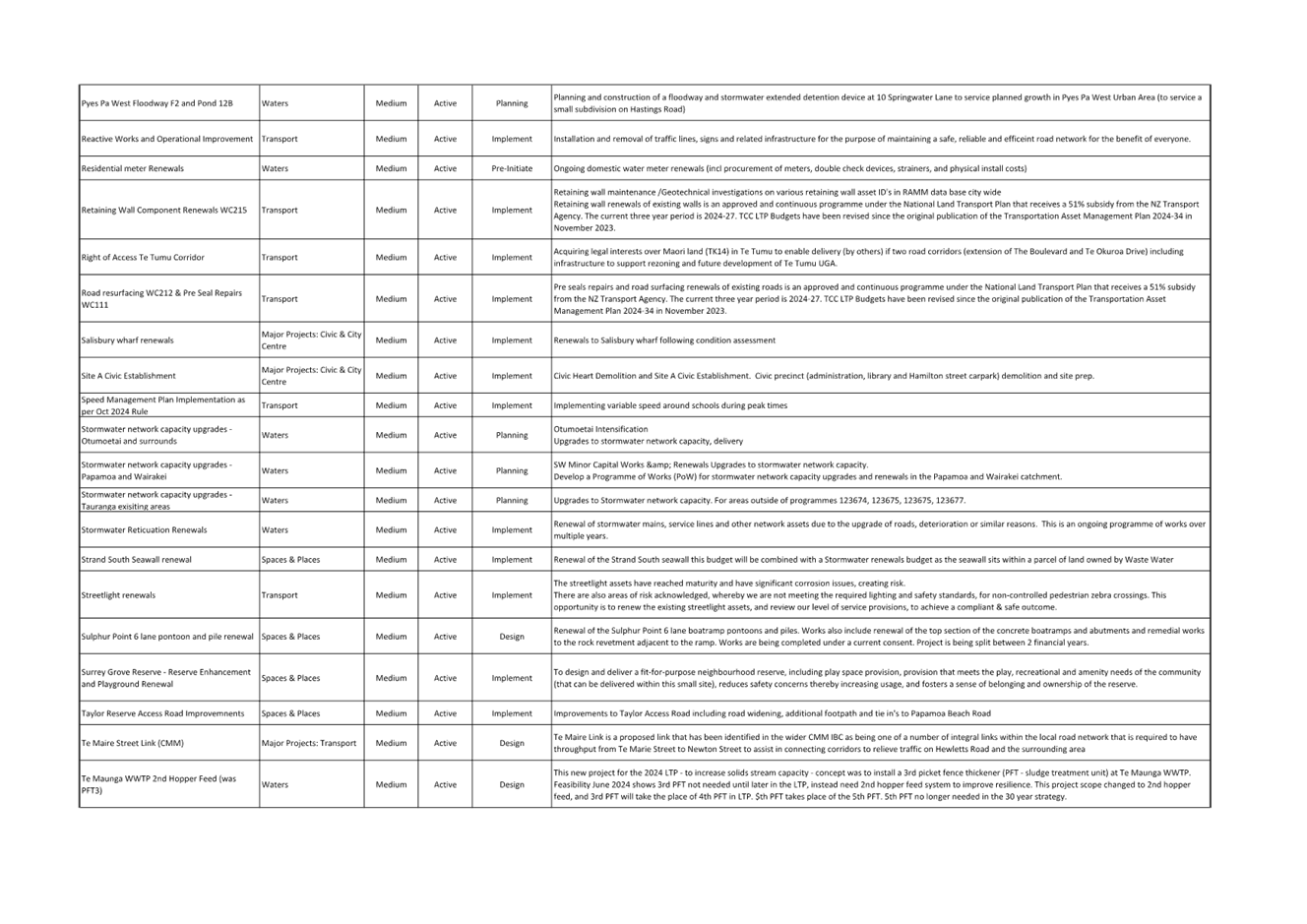
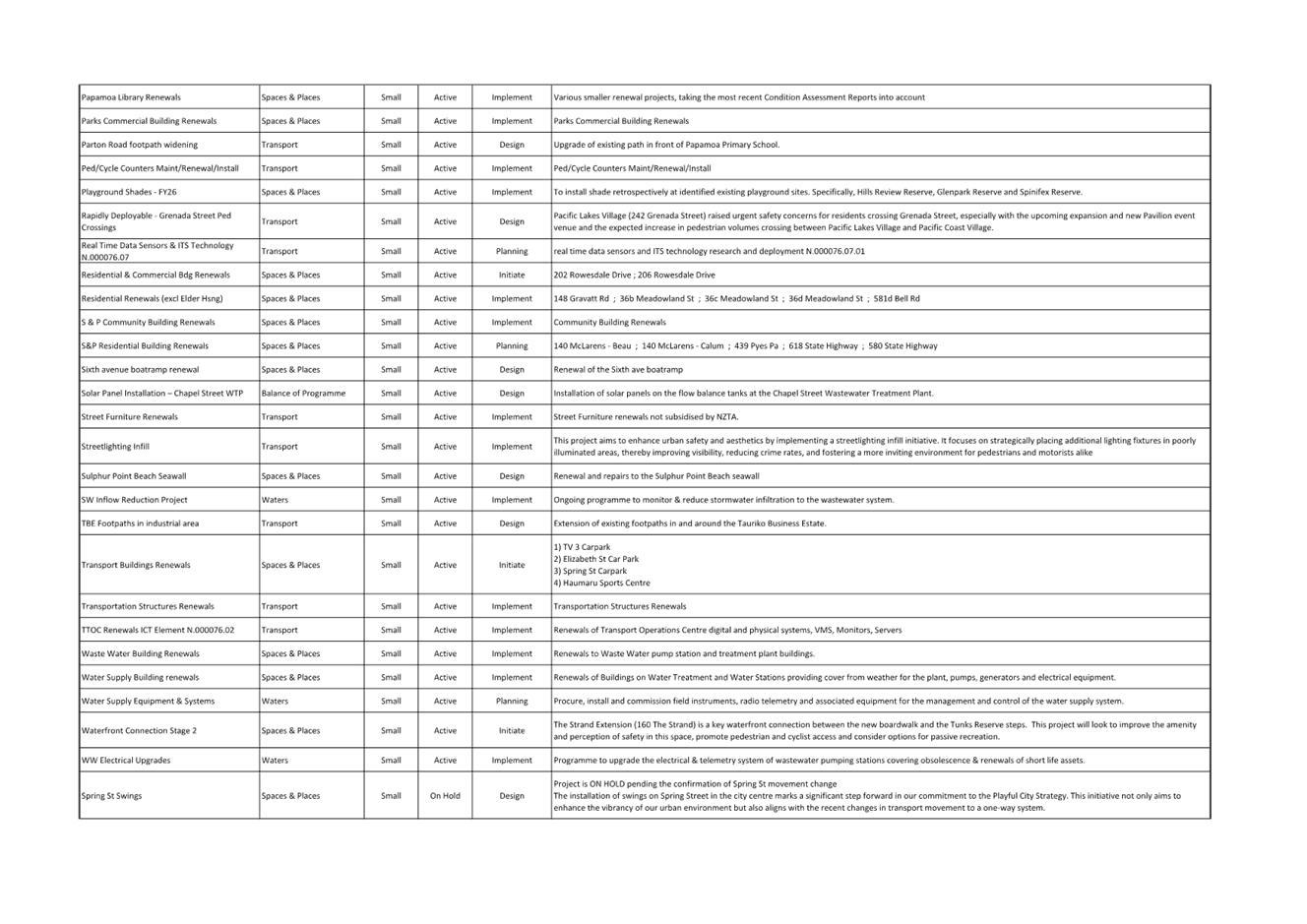
information on capital project performance is provided in Attachment 1
– Q3 Capital Programme Performance. Of the 239 active projects, nine
are currently assessed with an overall red status. Most of these projects
remain in the planning and design phase, where there are opportunities to
achieve value for money through scope refinement and procurement decisions. The
most significant risk to delivery of the capital programme continues to be cost
escalation, particularly driven by fuel price volatility. Additional
details on all red status projects can be found in Attachment 2 – Red
Status Projects
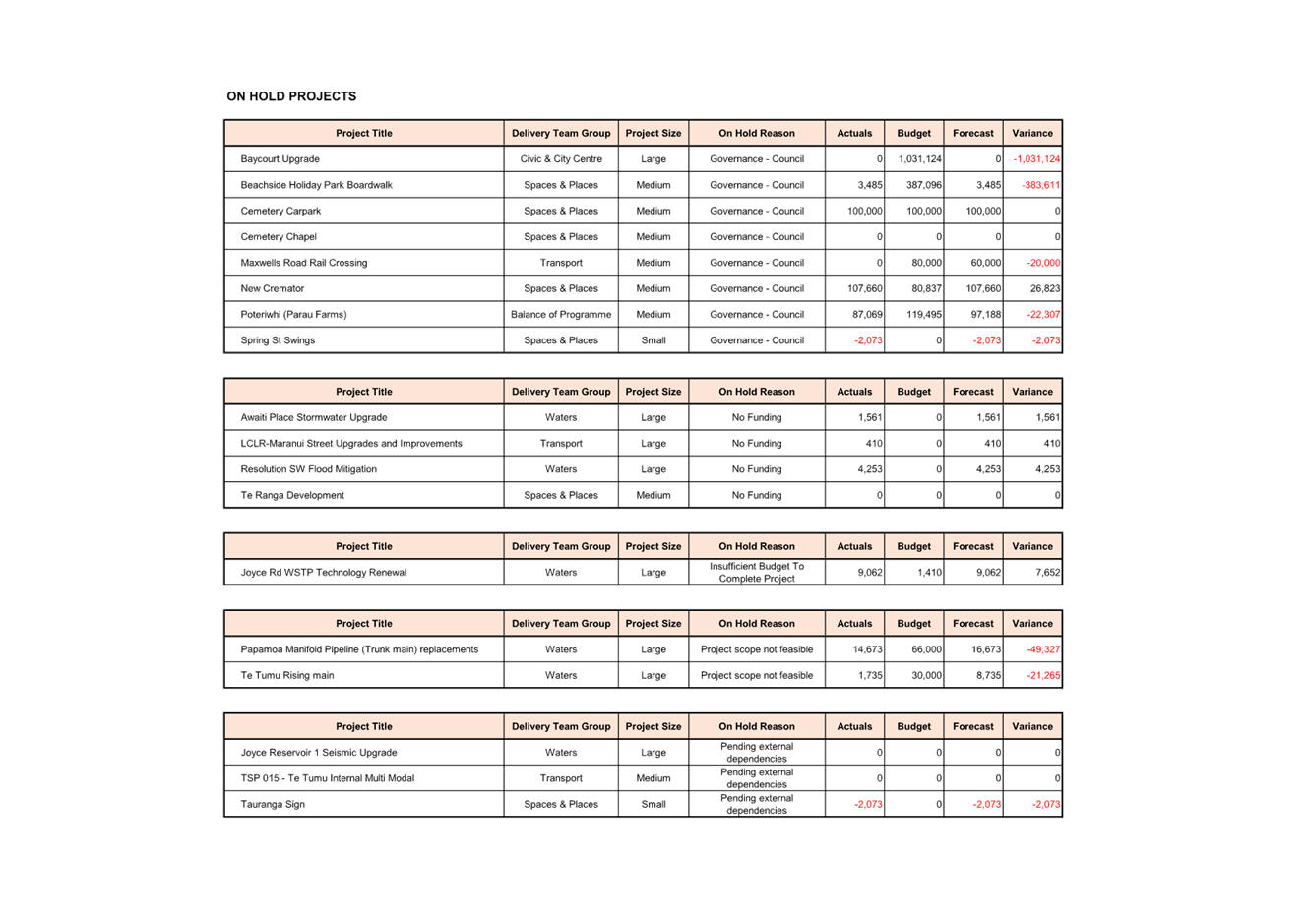
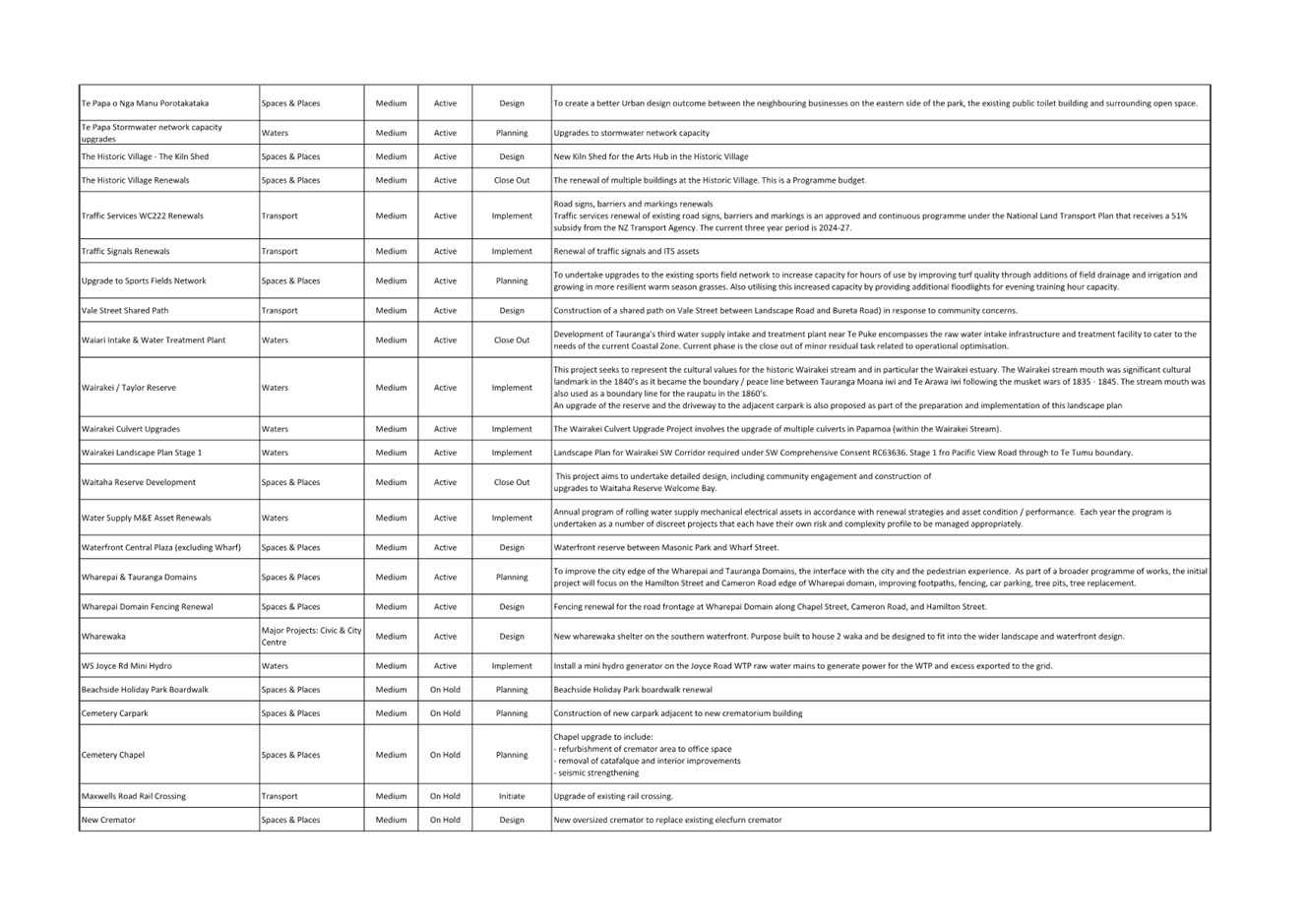
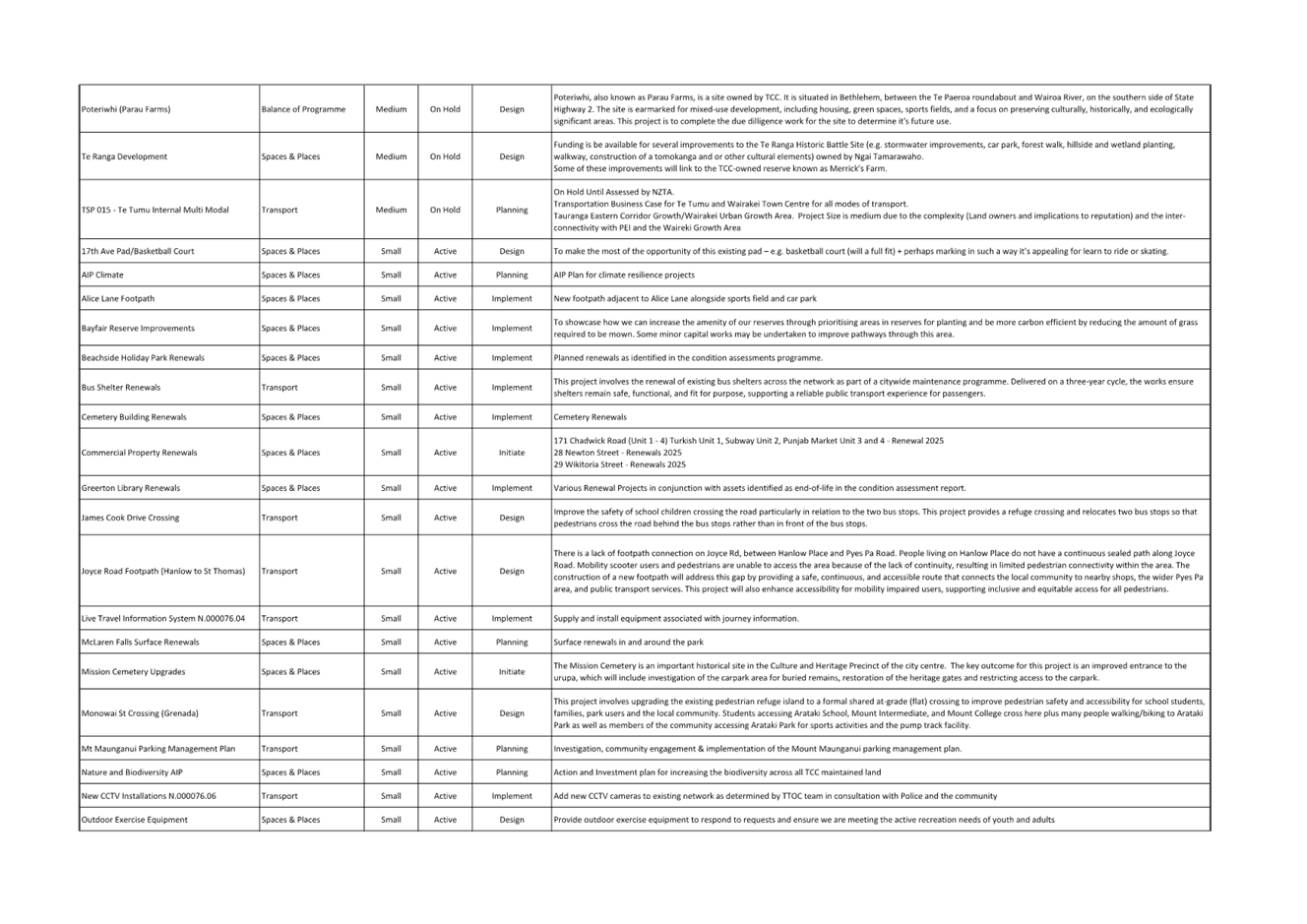
4. There are 18
projects on hold, pending funding or further decisions. The number of projects
on hold has increased since the last quarter by an additional five projects.
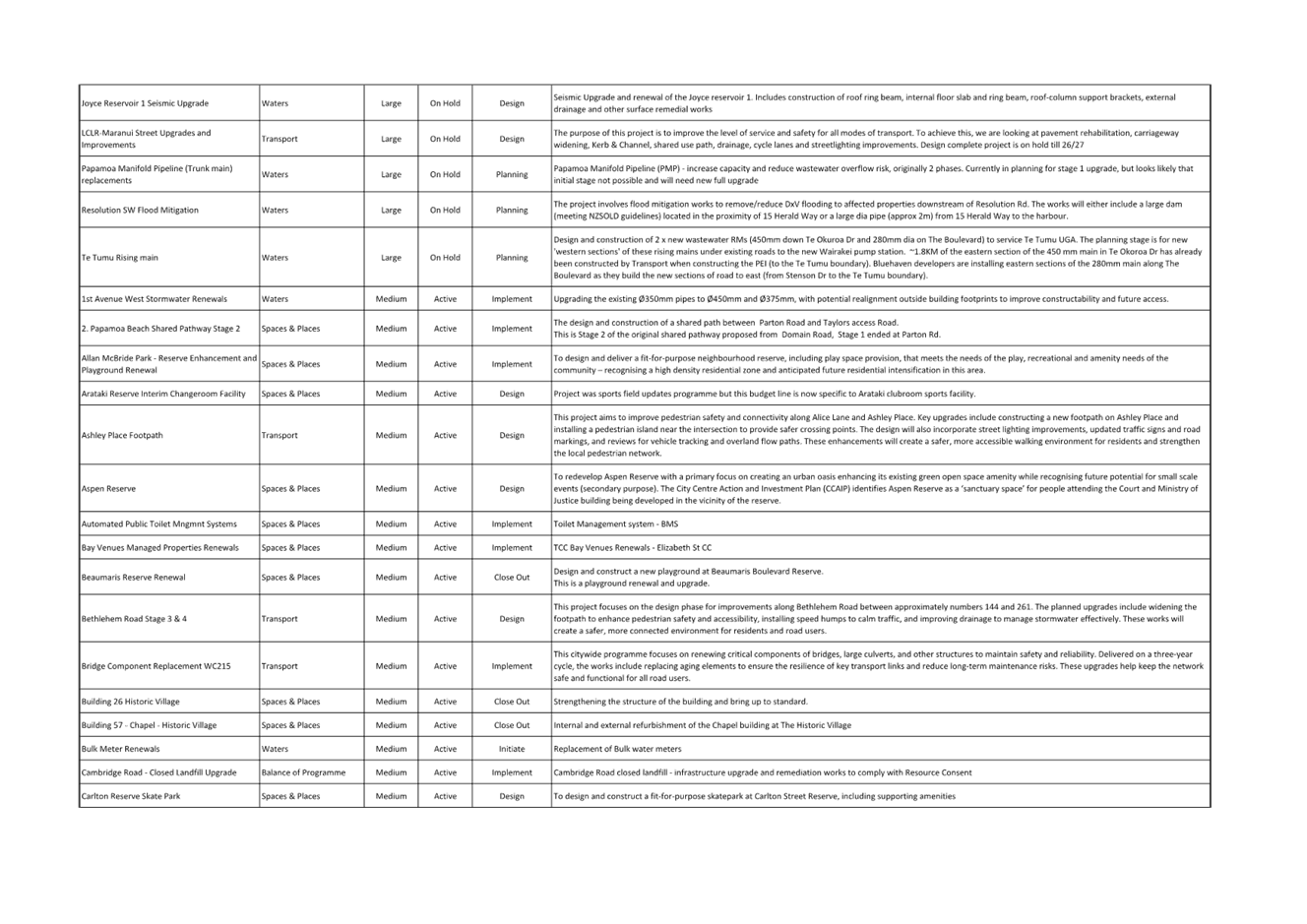
The list of on hold projects is provided in Attachment 3 - On Hold Projects
5. Attachment 4
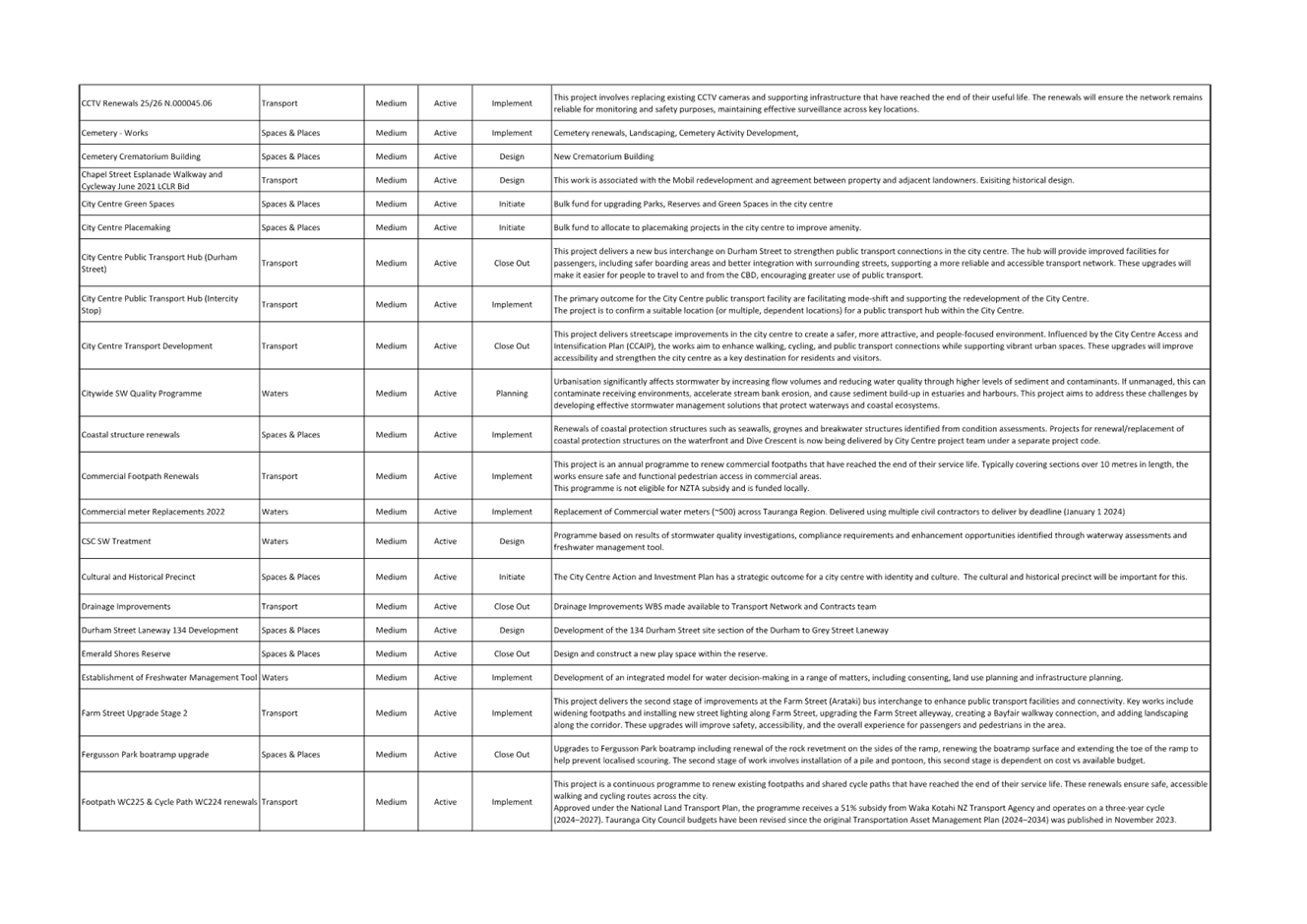
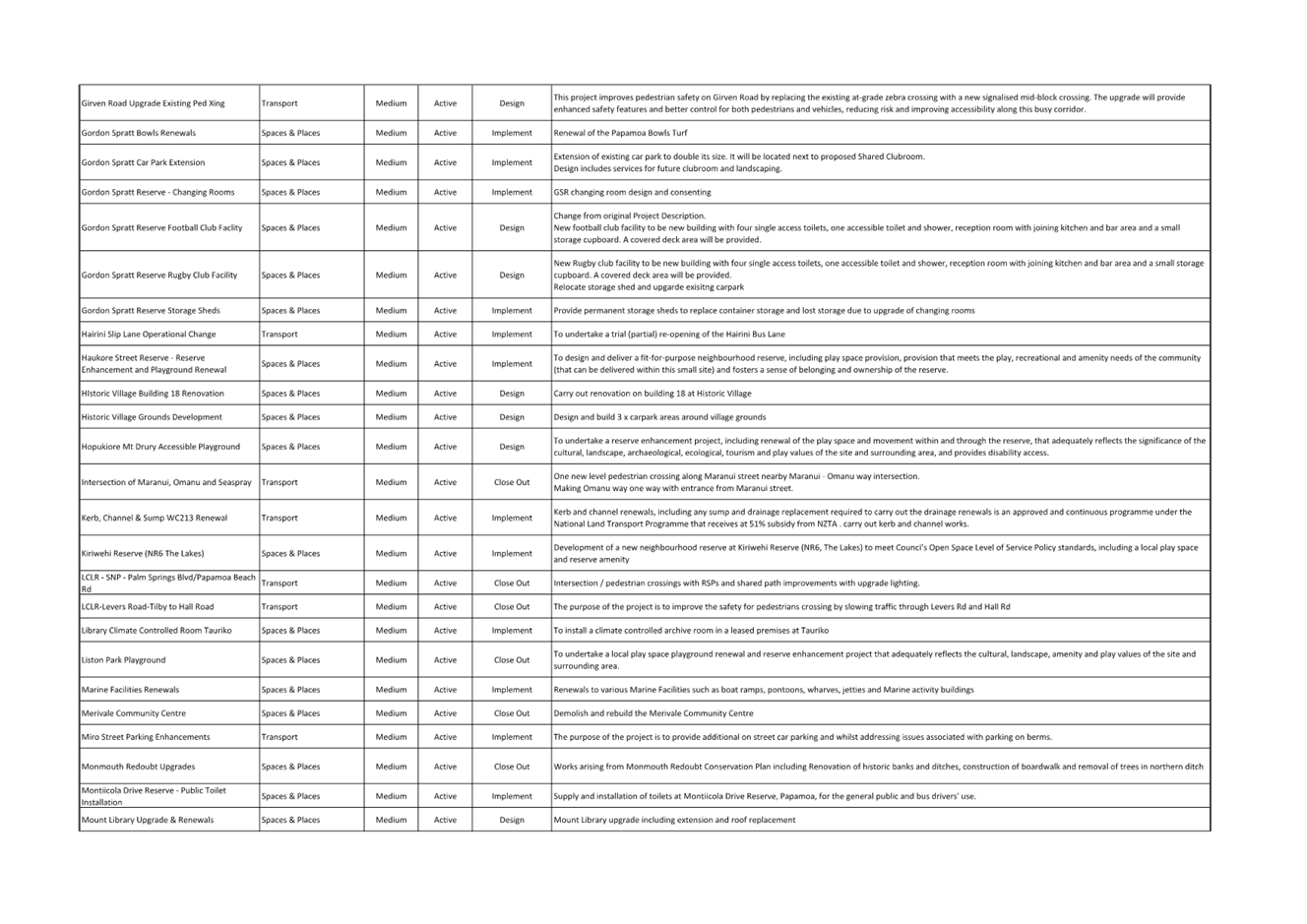
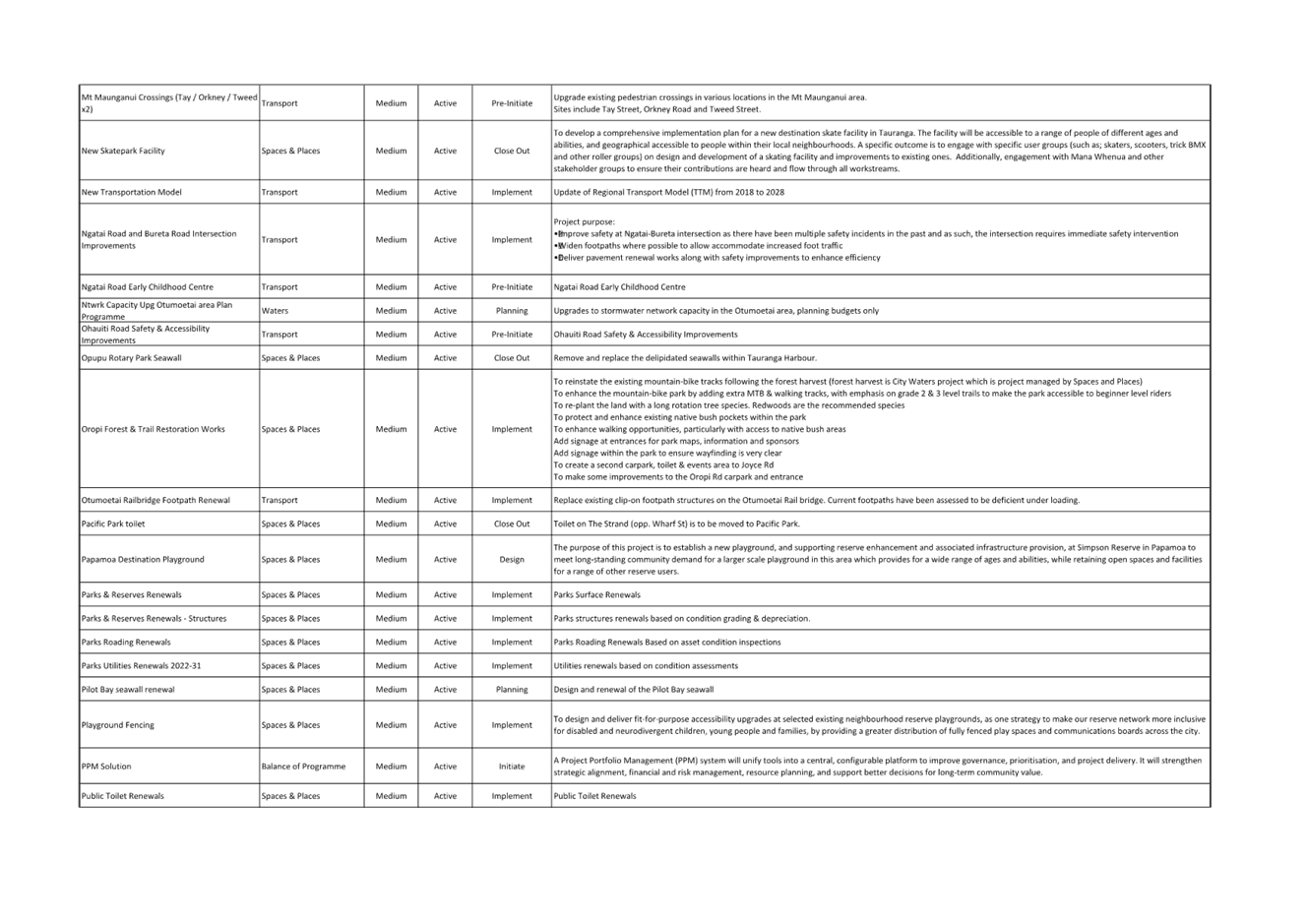
– Complete Project List provides a full list of all active projects
including their status for information purposes.
6. Over the past three
months, procurement activity has remained steady, with 26 procurement activities
completed, totalling approximately $10.37 million in contract value. The
procurement approaches utilised comprised three openly advertised procurements,
nine direct appointments, two closed contests, and 12 procurements delivered
through established panels. Contract values ranged from $38,000 to $2.53
million.
Looking
ahead to the forthcoming three-month period, 35 procurements are scheduled,
with an estimated total value of approximately $22 million. Most of this
expenditure is expected to be delivered through the CPP and the Waters
Framework Panel.
Overall,
procurement activity has increased in the recent period, with a further uplift
anticipated in the upcoming quarter due to revised budget allocations and the
financial year‑end approaching. Continued reliance on established panel
arrangements is supporting efficient, timely, and compliant procurement
delivery.
7. Fuel and petroleum‑linked
input costs (including diesel, freight, bitumen, fertiliser and petrochemical
products) have increased significantly due to international market disruption.
While the New Zealand Government has confirmed fuel supply remains stable and
the national response remains at Phase 1 – Watchful, sustained price
volatility is flowing through to Council delivery activities and creating
financial risk across both capital and operational programmes.
The
following figures remain a work in progress, subject to continued refinement
and challenge through Executive review.
Based
on the March 2026 cost escalation forecasts, preliminary modelling indicates
potential exposure of up to $8.8m in FY26 across existing capital contracts,
noting many are insulated through contractual terms and conditions. Looking
ahead, continued elevated fuel prices could create up to $20.8m (approximately
5%) of additional pressure on the FY27 capital programme, alongside potential
operating cost increases of up to $4m, primarily within City Operations.
Transport‑related
activities represent the most significant area of exposure, accounting for
approximately 54% of forecast FY27 fuel risk, reflecting the fuel‑intensive
nature of materials and construction processes. Renewal and Maintenance budgets
are particularly sensitive, with an assumed 8% uplift on the $36m transport‑weighted
programme potentially increasing costs by around $2.9m. Some areas, such as
Waters, have mitigated impacts through pre‑purchasing, though freight‑dependent
and fuel‑intensive services remain exposed.
Executive
has directed a centralised control and monitoring approach to manage these
risks. Project Managers are required to engage the Commercial Team before
agreeing to any fuel‑related contractor cost escalation outside Engineer‑to‑Contract
determinations, ensuring early visibility, consistency of treatment, and
protection of Council’s commercial position. Finance is also assessing
the ability to carry forward any unspent FY26 operational budget to offset
potential FY27 pressures.
Cross‑Council
monitoring arrangements have been established, including the rollout of a short
Fuel Questionnaire to better quantify contractual exposure and a working group
spanning capex, opex, risk and City Operations. A concise fuel‑risk
update will be included in regular Executive reporting while volatility
persists. Should elevated prices continue into FY27, further options may be
brought forward for Council consideration, ensuring a proportionate response
aligned with national settings and retaining flexibility as conditions evolve.
To
date, the Stage Gate Review Committee has reviewed three large projects, all of
which have been approved to proceed subject to conditions and improvement
actions. The key themes identified through these reviews relate to
documentation completeness, risk assessment, and value‑for‑money
considerations.
Over
the next three months, a further 15 projects are expected to progress through
the Stage Gate Review Committee. While only large and extra‑large
projects are reviewed by the Committee, all projects are still required to
undergo a Stage Gate process in accordance with council governance
requirements.
Background
This
report is for monitoring and reporting purposes to show Council’s
performance of projects against Annual Plan and Long-Term Plan budgets up to
the end of the 3rd Quarter (March).
TE AO MĀORI APPROACH
8. This report has no
direct impact on Council’s Te Ao Māori approach. It relates to
internal project performance monitoring and assurance arrangements, focusing on
governance, reporting, and executive oversight of project delivery. The matters
addressed do not change policy, decision-making frameworks, service delivery,
or engagement practices with mana whenua, and do not affect outcomes, rights,
or interests for Māori. As such, no specific Te Ao Māori
considerations are triggered by this report.
Consultation / Engagement
9. This report is made
public.
Significance
10. The Local Government Act 2002
requires an assessment of the significance of matters, issues, proposals and
decisions in this report against Council’s Significance and Engagement
Policy. Council acknowledges that in some instances a matter, issue,
proposal or decision may have a high degree of importance to individuals,
groups, or agencies affected by the report.
11. In making this assessment,
consideration has been given to the likely impact, and likely consequences for:
(a) the current
and future social, economic, environmental, or cultural well-being of the
district or region
(b) any persons who are likely to be
particularly affected by, or interested in, the matter.
(c) the capacity of the local authority
to perform its role, and the financial and other costs of doing so.
12. In accordance with the
considerations above, criteria and thresholds in the policy, it is considered
that the matter is of low significance.
ENGAGEMENT
13. Taking into consideration the
above assessment, that the matter is of low significance, officers are of the
opinion that no further engagement is required prior to Council making a
decision.
Click here to view the
TCC
Significance and Engagement Policy
Attachments
1. Q3
Capital Programme Performance - A20136802 ⇩
2. Red
Status Projects - A20136804 ⇩
3. On
Hold Projects - A20136824 ⇩
4. Complete Project
List - A20136822 ⇩
|
City
Delivery Committee meeting Agenda
|
28
April 2026
|
|
City
Delivery Committee meeting Agenda
|
28
April 2026
|
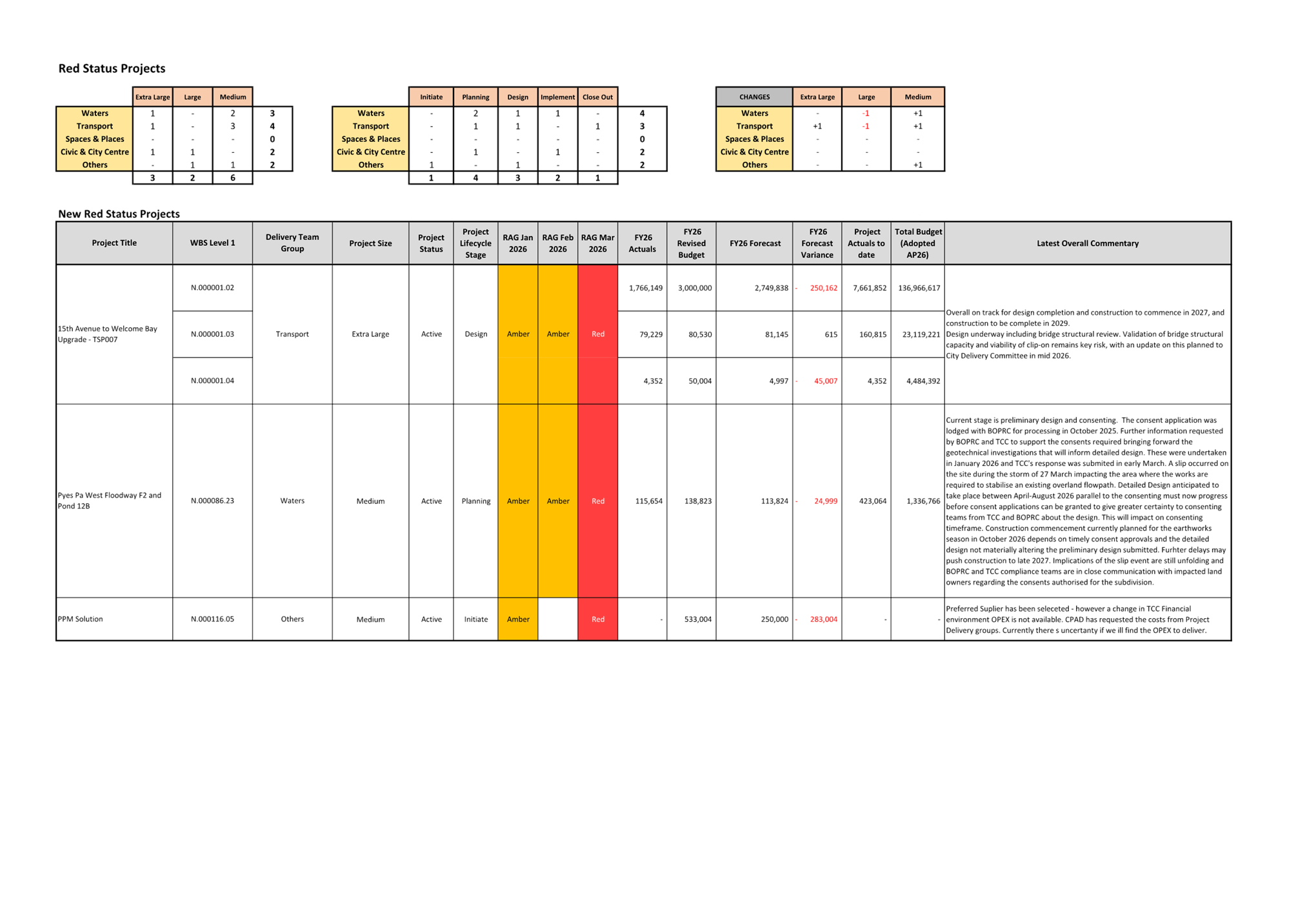
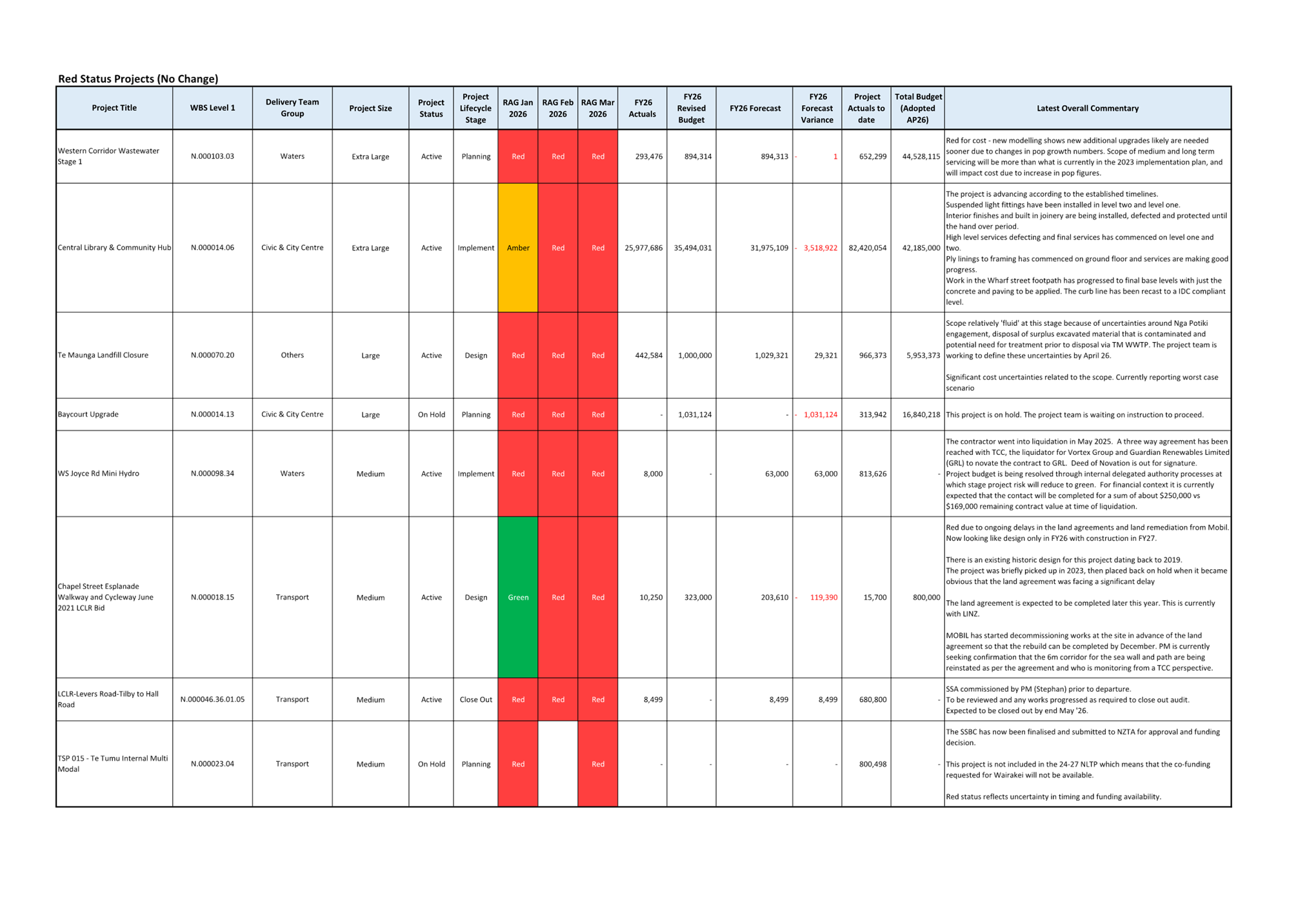
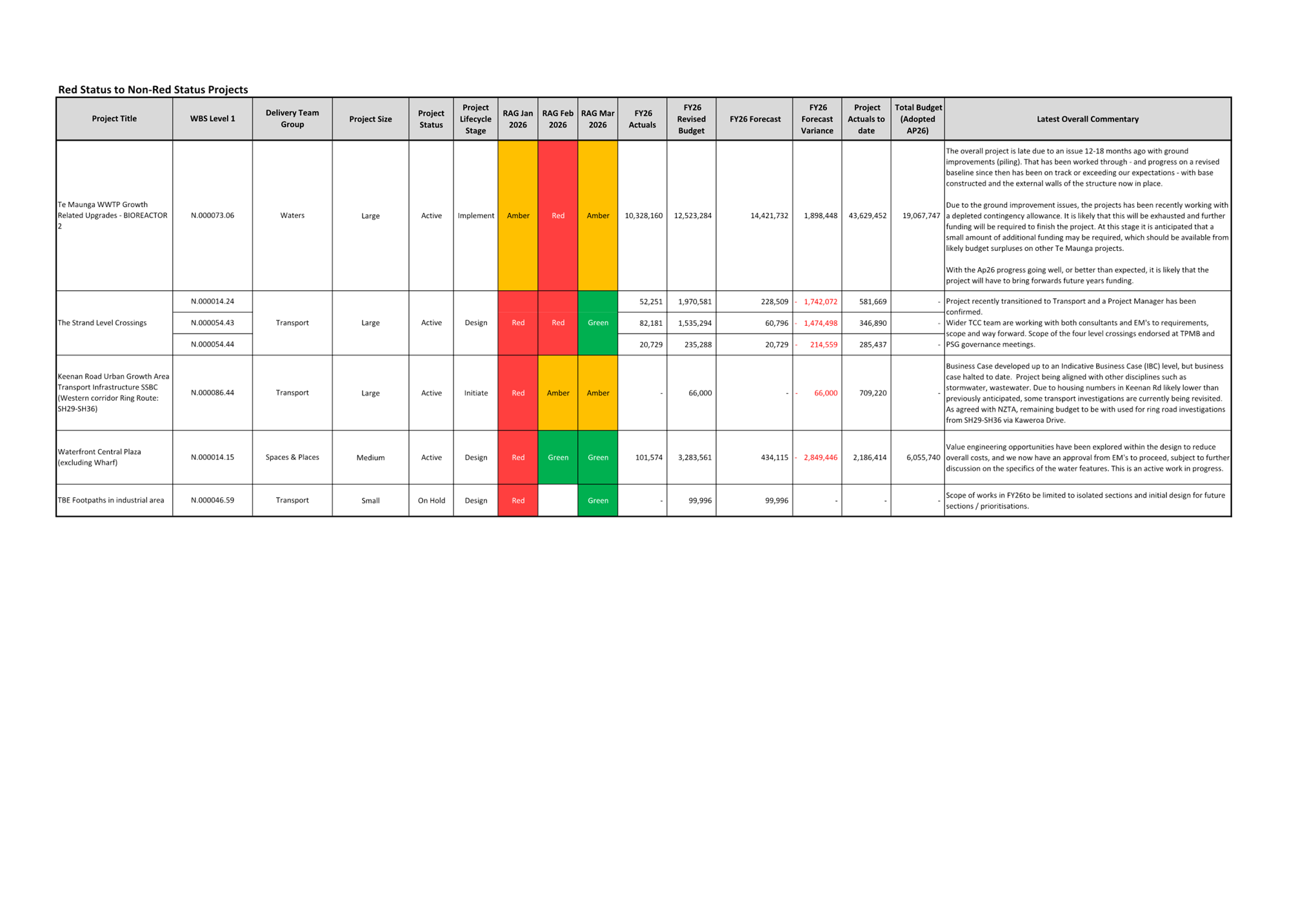
|
City
Delivery Committee meeting Agenda
|
28
April 2026
|
|
City
Delivery Committee meeting Agenda
|
28
April 2026
|

|
City
Delivery Committee meeting Agenda
|
28
April 2026
|
10.5 Major Projects Update
- Transport
File
Number: A20116363
Author: Chris
Barton, Portfolio Manager: Infrastructure
Authoriser: Jane
Small, Head of Major Projects
Purpose of the Report
1. To provide an update to
Committee on the transport major projects in implementation and delivery
including Pāpāmoa East Interchange, SH29 Tauriko Enabling Works and Fifteenth Avenue to Welcome Bay.
|
Recommendations
That the City Delivery
Committee:
(a) Receives the report
"Major Projects Update - Transport".
|
Executive Summary
2. This is an update
report on the status and progress on the three major transport projects which
are in delivery phase, the Pāpāmoa East Interchange, SH29 Tauriko
Enabling Works and Fifteenth Avenue to Welcome Bay projects. The Cameron Road
Stage 2 and Connecting Mount Maunganui projects are being reported to City
Futures Committee.
3. This report is being
provided as the projects are high value, complex, and have a high risk profile
with potentially significant consequences.
4. Overview timeframes
for delivery of the five major transport projects are outlined below:
5. Overall the
construction of the Pāpāmoa East Interchange and SH29 Tauriko
Enabling Works projects are progressing well, and are being delivered on time,
within budget, safely and without significant stakeholder issues or traffic
disruption.
6. Construction of the
Pāpāmoa East Interchange is now complete, and the new interchange was
opened to traffic on 2 April prior to the Easter weekend and school holidays.
7. At Tauriko, the SH29
/ Kaweroa Drive / Redwood Lane roundabout and Kaweroa Drive connection between
SH29 and the Tauriko Business Estate was completed in late 2025, and
significant progress has been made at the Tauriko Village and SH29 / Cambridge
Road intersection this year, with works on track for completion in 2027.
8. The Fifteenth Avenue
to Welcome Bay project is progressing through design development including
further assessment of the existing Hairini Bridge to inform structural capacity
and design options.
9. Key risks are
reflected in project updates with ‘amber’ status. The key current
risk for SH29 Tauriko Enabling Works is continuing to manage traffic and
disruption through remaining construction, and for Fifteenth Avenue to Welcome
Bay the key risk is scope and cost confirmation particularly regarding the
Hairini Bridge as the first phase of the design is developed.
Pāpāmoa East
Interchange
10. The Pāpāmoa East
Interchange is a key roading connection to improve network connectivity for
existing residents and also enable ongoing growth and continued residential
& commercial development.
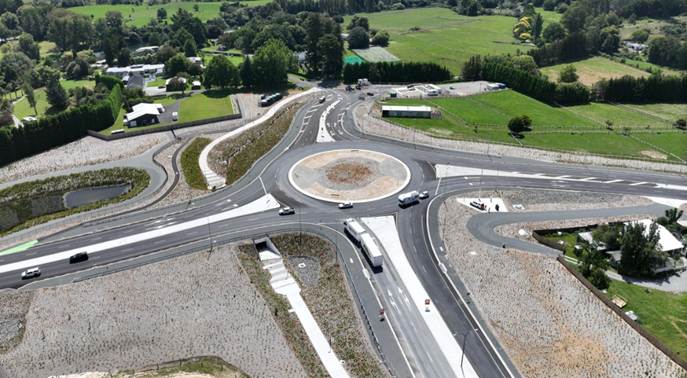
11. Construction is now complete,
with the full interchange opened to traffic on 2 April 2026. Construction was
completed ahead of programme and under budget.
Pāpāmoa East Interchange – aerial
perspective from The Sands Ave towards the new overbridge
 Pāpāmoa East Interchange – aerial
perspective from east of the new interchange
Pāpāmoa East Interchange – aerial
perspective from east of the new interchange
12. A completion ceremony and
blessing was held on-site on 30 March, where cultural artwork incorporated into
the project was also celebrated. This includes a pūhoro design
(representing speed, agility and movement) on the bridge abutments, a
triangular tāniko design (symbolising the gardens, marae, pā sites,
sacred sites and urupā in the area) on the bridge barriers, and pou in the
shape of two Huia feathers either side of the road with wooden carvings
representing important ancestors from the four local iwi: Tūtānekai
of Ngāti Whakaue, Takakopiri of Waitaha, Tatahau of Tapuika and Tamapahore
of Ngā Pōtiki.
13. The Papamoa East Interchange
total project was budgeted at $116.4m, with 51% co-funding by NZTA, and
supported by a 10-year interest-free Crown loan via the Housing Infrastructure
Fund. The project was delivered in four stages – early works (incl. concept
development and property acquisition), phase 1 bulk earthworks incl. preloading
of interchange ramps and bridge abutments, phase 2 construction of the
intersection between The Sands Ave and Te Okuroa Drive, and phase 3
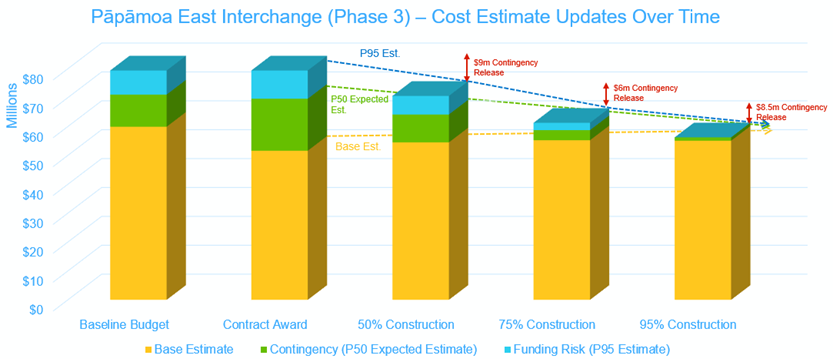
construction of the interchange. The estimated total project outturn cost is
$90.8m
14. For the Phase 3 works, savings
of over $20m of unspent risk and contingency funds have been realised –
with an estimated final outturn cost of $56m against the Phase 3 budget of
$79.2m.
15. An independent
post-construction safe systems assessment has been completed in April following
opening, with no significant issues identified.
16. A project close-out report is
planned to be provided to the City Delivery Committee in June 2026.
SH29 Tauriko Enabling Works
17. The Tauriko West Enabling Works
project supports both residential and industrial growth - it will directly
enable initial development of up to 2,400 new homes in
the Tauriko West development area and enable ongoing development of over 100
hectares of industrial land in the Tauriko Business Estate, which is
anticipated to provide up to 6,000 additional jobs within the city.
18. An overview of the project
status is as below:
|
|
Status
|
Comments
|
|
Cost
|
|
LTP Budget $240.8m.
Current estimates are within budget.
|
|
Time
|
|
Construction
progressing on programme:
- Redwood / Kaweroa / SH29
Roundabout – completed in 2025.
- Tauriko Village / Cambridge Rd
/ SH29 - scheduled to be complete in 2027.
|
|
Safety
|
|
Continuous safe
delivery – approx. 375,000 worker hours to date without any serious
harm or lost time incidents.
|
|
Scope
|
|
Scope confirmed with no
substantive changes.
|
|
Stakeholders
|
|
Actively working with
project neighbours and travelling public, however anticipate ongoing traffic
disruption during construction.
Temporary
SH29 single direction detour required in April (for up to 1 week) to
facilitate service installation and SH29 road crossings.. Plans currently
being confirmed.
|
|
Risk
|
|
Active management of
live risks and contingencies in place, however this remains a high-risk
project with significant residual risks.
Managing traffic
throughout construction to minimise disruption remains a key challenge and
risk.
|
19. At the Tauriko Village section
of the site, the new large retaining walls are now completed and waters
infrastructure installation is largely complete. Installation of significant
service across SH29 between Cambridge Road and Takitimu Drive were also completed
in early April during a temporary SH29 lane closure.
SH29 / Kaweroa Drive / Redwood Lane Roundabout -
Complete
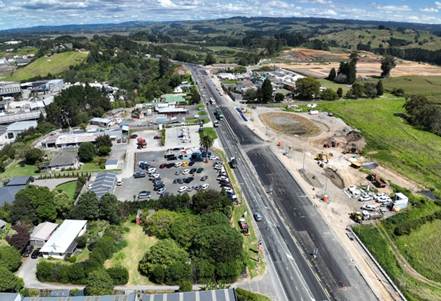
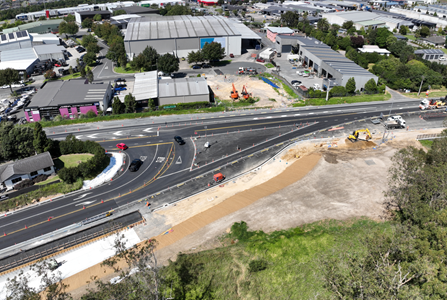 Tauriko Village area construction
20. SH29 traffic through the
Tauriko Village in front of Tauriko School was switched to the new pavement in
mid April. This is a significant milestone for the project, now enabling the
construction team to enter the final phase of works upgrading and widening the
existing SH29 corridor.
21. The infrastructure development
timing is well aligned with the Tauriko West residential land development
activities where earthworks are underway.
Fifteenth Avenue to WElcome Bay
Upgrade
22. This project seeks to address
current and growing issues with peak hour congestion, poor level of service,
access and safety problems, and walking and cycling deficiencies on the key
city arterial transport corridor of Fifteenth Avenue to Welcome Bay including
the Hairini Bridge.
23. An overview of the project
status is as below:
|
|
Status
|
Comments
|
|
Cost
|
|
LTP Budget $170.2m.
Current estimates are within budget.
NZTA co-funding
approved for pre-implementation phase.
|
|
Time
|
|
Pre-implementation
phase progressing to programme. Next key milestone is bridge go / no-go
decision in mid 2026.
|
|
Safety
|
|
No current issues.
|
|
Scope
|
|
Some scope elements to
be further refined through the pre-implementation phase.
|
|
Stakeholders
|
|
Extensive further
engagement is planned through design phase in advance of construction.
Noting plans are
currently being refined, it is anticipated further stakeholder communication
and engagement will be completed as part of the 50% design development in the
second half of 2026.
|
|
Risk
|
|
Some key risks remain
which will be further addressed through the pre-implementation phase.
It is noted that a key
project hold point remains confirmation of the Hairini Bridge structural
capacity.
Managing traffic
through construction to minimise disruption and staging works in alignment
with other networks activities is a key challenge and risk. This will be
further informed as the construction methodology is developed with the ECI
contractor.
There may be
opportunities to advance some construction enabling works in advance of
implementation co-funding approval gateway, however confirming NZTA
co-funding for these elements may be a risk.
|
24. The first phase of design works
are underway – with a current key focus on the Hairini Bridge structural
elements and confirmation of bridge structural capacity. A detailed update on
the bridge is planned to be provided to the City Delivery Committee in June.
25. The overall programme is for
designs to be complete and construction to commence from 2027, with
construction completion indicatively estimated in early 2029.
26. Coordination of construction
methodologies, staging and timing with other key projects affecting arterial
roading corridors (particularly the Cameron Road Stage 2 upgrade project) will
remain a key focus as designs and programmes develop to ensure overall traffic
disruption during construction is minimised as much as possible.
Next Steps
27. A major projects update report
will be provided to future City Delivery Committee meetings.
Attachments
Nil
|
City
Delivery Committee meeting Agenda
|
28
April 2026
|
10.6 Council-Controlled
Organisations - Half-Year Reports FY2026 (1 July-31 December 2025)
File
Number: A19395100
Author: Caroline
Lim, CCO Specialist
Jeremy Boase, Head
of Strategy, Governance & Climate Resilience
Authoriser: Christine
Jones, General Manager: Strategy, Partnerships & Growth
Purpose of the Report
1. For
Tauranga City Council to formally receive the Half-Year Reports FY26 (1 July-31
December 2025) from its Council Controlled Organisations (CCOs) as required by
the Local Government Act 2002.
|
Recommendations
That the City Delivery
Committee:
(a) Receives the report
"Council-Controlled Organisations - Half-Year Reports FY2026 (1 July-31
December 2025)".
(b) Receives the Half-Year
Reports 2025/26 for the six months to 31 December 2025 for:
i) Bay Venues Limited
ii) Tauranga Art Gallery Trust
iii) Tourism Bay of Plenty
iv) Te Manawataki o Te Papa Limited
v) Te Manawataki o Te Papa Charitable Trust
vi) Bay
of Plenty Local Authority Shared Services Limited; and
vii) Local
Government Funding Agency
(c) Receives the Tauranga City
Council and Entities comprehensive revenues and expenses financial
information Half-Year to 31 December 2025.
(d) Notes that as joint
shareholder of Tourism Bay of Plenty, Western Bay of Plenty District Council
will formally receive Tourism Bay of Plenty’s Half-Year Report at its
meeting scheduled on 28 May 2026.
|
Executive Summary
2. Bay Venues Limited
(Bay Venues), Tauranga Art Gallery Trust (TAGT), Tourism Bay of Plenty (TBoP),
Te Manawataki o Te Papa Limited (TMoTPL), Te Manawataki o Te Papa Charitable
Trust (TMoTP Charitable Trust), Bay of Plenty Local Authority Shared Services (BoPLASS)
and Local Government Funding Agency (LGFA) are required by the Local Government
Act (LGA) 2002 to provide Half-Year Reports regarding their financial and
non-financial performance, against the activities,
performance measures and financials outlined in their Statements of Intent
(SoIs).
3. These reports must
be submitted by 28 February each year (statutory deadline) and the City
Delivery Committee meeting scheduled on 28 April 2026 is the first suitable
meeting for the Half-Year Reports 2025/26 to be formally received.
4. Each CCO’s
report is provided as Attachments 1 to 7, and the CCOs’ half-year
performance against their statements of intent targets is summarised in the
table below:
|
Council-Controlled
Organisation
|
Total Target
|
 Target
achieved Target
achieved
|
 Target on
track Target on
track
|
 Target
work in progress Target
work in progress
|
 Target not
achieved Target not
achieved
|
|
Bay Venues
|
12
|
0
|
7
|
2
|
3
|
|
TAGT
|
16
|
3
|
12
|
0
|
1
|
|
TBoP
|
10
|
1
|
8
|
1
|
0
|
|
TMoTPL
|
17
|
0
|
17
|
0
|
0
|
|
TMoTP Charitable Trust
|
7
|
1
|
6
|
0
|
0
|
|
BoPLASS
|
6
|
0
|
6
|
0
|
0
|
|
LGFA
|
21
|
11
|
8
|
1
|
1
|
|
On track =
indicates this target is on track to be achieved by FY end.
Work in progress = indicates this target is being worked on but there’s no
guarantee it will be achieved by FY end.
|
5. A CCO’s
Half-Year Report is a key indicator of how well it’s performing for the
first half of a financial year, and how it’s tracking towards its end of
year performance. Overall, for the six months to 31 December 2025, the majority
of targets have either been ‘achieved’ or are ‘on
track’. The four ‘work in progress’ targets will be a key
focus for the CCOs in the second half of this financial year – more
information in the Background section below.
6. These half-year
reports have met the legislative requirements outlined in the LGA.
7. There are no
identified financial or legal risks associated with this cover report or the
half-year reports.
8. The following table
(a snippet) presents the consolidated financials for the CCOs where Council has
100% shareholding. This information was requested at the City Delivery
Committee meeting on 4 November 2025, with the expectation that it be included
in all half-year and annual cover reports going forward. Please refer to
Attachment 8 of this report for the full-size version.
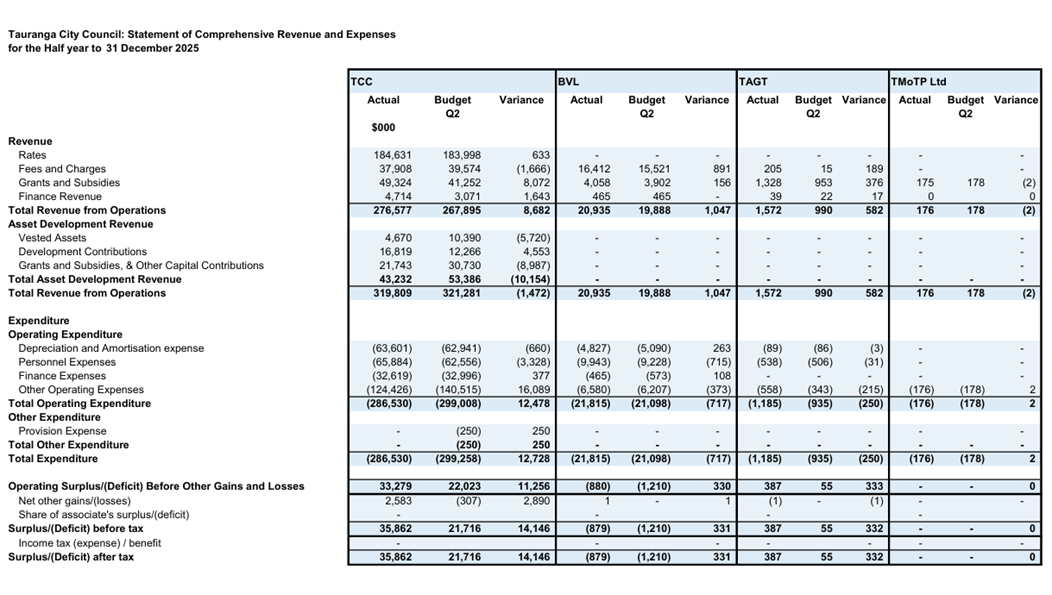
9. No decision or
options analysis is required as this cover report serves to formally present
the Half-Year Reports 2025/26 to the City Delivery Committee as part of the
CCOs’ ongoing reporting responsibilities. Note as joint shareholder of
TBoP, Western Bay of Plenty District Council (WBoPDC) will formally receive
TBoP’s Half-Year Report at its meeting scheduled on 28 May.
10. Once received by the Committee,
the next step is to publish these Half-Year Reports on Council’s
website.
Background
Council-Controlled
Organisation’s performance to 31 December 2025
Bay Venues Limited:
11. Bay
Venues report for the six months to 31 December 2025 is included as Attachment
1 of this report:
· Bay
Venues has a total of 12 performance targets for FY26.
· The three SoI targets not achieved related to a serious
near drowning incident at Baywave after a 3-year-old entered the leisure pool
unsupervised (the child was successfully resuscitated); a higher total energy
use reflecting increased venue utilisation, a strong events programme and
increased catering activity; and an annual staff engagement score of 63% which
was up 5% year-on-year but below the 65% target.
· Bay
Venues is now managing both the Dave Hume Pool in Katikati and the Te Puke
Memorial Pool on behalf of WBoPDC.
· The
following is Bay Venues’ KPI table as of 31 December 2025, against their
Statement of Intent FY26-28 targets:
|
Deliverables
|
2025-2026 performance target
|
Performance to 31 December 2025
|
|
Visitation.
|
Visitation to facilities is >2.1 million.
|
 Target on track. Target on track.
|
|
Significant events (500+ people).
|
Host >75 significant events.
|
Target on track.
|
|
Customer satisfaction.
|
An overall customer satisfaction rating >85%.
|
 Target work in progress. Target work in progress.
|
|
Preventable serious harm incidents.
|
Zero incidents.
|
Target not achieved.
|
|
Preventable unplanned facility closures.
|
Zero unplanned closures (>4 hours).
|
Target on track.
|
|
Capital programme budget.
|
Capital programme v budget (within 5% of budget).
|
Target on track.
|
|
Energy consumption.
|
5% reduction at key facilities.
|
Target not achieved.
|
|
Financial performance.
|
Net profit before tax.
|
Target on track.
|
|
Commercial partnerships.
|
Secure one commercial partnership.
|
Target work in progress.
|
|
Team engagement.
|
>65% team engagement score.
|
Target not achieved.
|
|
Staff turnover.
|
<30% staff turnover.
|
Target on track.
|
|
Stakeholder engagement.
|
Implement stakeholder engagement plan.
|
Target on track.
|
Tauranga Art Gallery Trust:
12. TAGT
report for the six months to 31 December 2025 is included as Attachment 2 of
this report:
· TAGT
has a total of 16 performance targets for FY26.
· The
SoI target of diversity framework completed and advisory group appointed
has not been achieved because of capacity and shifting work programme
priorities due to the reopening of the Gallery. This target has been
deferred to FY27.
· The
refurbished Gallery building opened on 15 November 2025 with a reorientation of
the entrance onto the Te Manawataki o Te Papa precinct, seismic and structural
strengthening, HVAC systems and refurbishment, with the addition of a retail
space and leased cafe to enhance the visitor experience and diversify revenue
streams.
· The following is
TAGT’s KPI table as of 31 December 2025, against their Statement of
Intent FY26-28 targets:
|
Deliverables
|
2025-2026 performance target
|
Performance to 31 December 2025
|
|
Deliver a variety of arts and culture offerings to our local,
regional and international visitors.
|
Annual programme of reopening exhibitions and enhanced experience
programmes is delivered.
|
Target on track.
|
|
Visitor experience strategy is implemented, and surveys and analytics
demonstrate diverse audience engagement and appreciation beyond 2023
reporting.
|
Target on track.
|
|
Building reopens offering enhanced visitor and art experiences.
|
Analytics show increased engagement in events, online and audio
experiences beyond 2023 reporting.
|
Target on track.
|
|
Māori Engagement Framework is implemented.
|
Māori advisory group Te Kāhu ō Hinewa deliver identified outcomes.
|
Target on track.
|
|
Diversity framework developed.
|
Diversity framework completed and Advisory Group appointed.
|
Target not achieved – deferred to FY27.
|
|
Effective storytelling clearly demonstrates how the Gallery provides
value for money.
|
Half-yearly and Annual Reports loaded onto website.
|
Target on track.
|
|
Audit report completed.
|
Target on track.
|
|
TCC is clearly recognised as the principal funder across various
platforms.
|
Public speeches, print and online platforms clearly communicate the
role of Tauranga City Council.
|
Target on track.
|
|
Implement and monitor prudent financial management and processes
including a savings of 7% in FY26 to meet operational grant reduction.
|
Approved annual budget and targets met.
|
Target on track.
|
|
Establish and diversify revenue streams that will achieve financial
sustainability.
|
Overseas visitor charges implemented.
|
Target achieved.
|
|
Work closely with Te Manawataki o Te Papa partners to grow the
profile of the precinct and city.
|
Demonstrated collaboration including works from the Gallery
collection installed in 90 Devonport Road.
|
Target on track.
|
|
Complete the upgrade, and work on air conditioning and lighting, as
part of the Gallery’s redevelopment, in alignment with Tauranga City
Council’s Climate Action and Investment Plan.
|
Upgrade completed and reported on.
|
Target achieved.
|
|
Building and infrastructure is properly maintained and fit for
purpose.
|
Target on track.
|
|
The Gallery continues to use environmentally sustainable means
through better sourcing of resources, reducing waste and recycling, and
continuing to provide the ArtBus for students to attend educational
programmes.
|
Waste Reduction Plan implemented and improves effectiveness.
|
Target on track.
|
|
ArtBus utilised by schools.
|
 Target on track. Target on track.
|
|
Host a voluntary board intern to increase diversity and fresh
thinking on the board.
|
Internship successfully completed.
|
Target achieved.
|
Tourism Bay of Plenty:
13. TBoP
report for the six months to 31 December 2025 is included as Attachment 3 of
this report:
· TBoP
has a total of ten performance targets for FY26.
· Note
the first SoI target outlined below – currently at risk due to economic
and geopolitical challenges impacting both domestic and international visitor
spend.
· The
following is TBoP’s KPI table as of 31 December 2025, against their
Statement of Intent FY26-28 targets:
|
Deliverables
|
2025-2026 performance target
|
Performance to 31 December 2025
|
|
Economic wellbeing – grow the value of tourism to the western
bay economy.
|
Increased visitor spend compared to previous year end.
|
Target work in progress.
|
|
Social wellbeing – enhance the value of tourism to our
community (according to the community).
|
TCC resident positive impact sentiment at 62%.
|
Target on track.
|
|
Cultural wellbeing – improving the cultural wellbeing of the
community through tourism.
|
Supported a minimum of three Māori tourism operators to connect their experience
offering to a digital platform.
|
Target on track.
|
|
Environmental wellbeing – improving the environmental wellbeing
of the region via environmental sustainability and regeneration projects.
|
Key actions and programmes are in place which build on climate change
mitigation and adaptation progress relating to tourism (connecting with
Tauranga City Council’s Climate Action and Investment Plan, where
relevant).
|
Target on track.
|
|
TBoP organisational wellbeing – enhance TBoP’s ability to
achieve its goals through high staff engagement.
|
Employee engagement score of at least 80%.
|
Target on track.
|
|
Destination marketing – elevate the region’s cycling
offering.
|
6,500 cycle trails booklets updated and printed.
|
Target achieved.
|
|
Destination marketing – elevate the region’s food story
and proposition.
|
Continued TBoP support of Flavours of Plenty, via key visitor
marketing channels, reaffirms the festival as a signature DNA™ event
for the region.
|
Target on track.
|
|
Destination management – build operator capability to enhance
the quality of the region’s tourism offering.
|
Operators supported to engage in capability building programmes, with
a minimum of five additional operators being endorsed with Qualmark
certification.
|
Target on track.
|
|
Destination marketing – promotion of the Western Bay region to
key target markets including cultural explorers, surf and beach lovers,
outdoor adventurers and eco-travellers).
|
Promote destination to target markets. Deliver on updated domestic
marketing campaign which incorporates the destination’s DNA elements
and is focused on the target markets.
|
Target on track.
|
|
Destination management – coordinate activity that attracts key
business events to the Western Bay region.
|
Facilitated 30 leads or bids for business events in the region and
won 10.
|
Target on track.
|
Te Manawataki o Te Papa Limited:
14. TMoTPL
report for the six months to 31 December 2025 is included as Attachment 4 of
this report:
· TMoTPL
has a total of 17 performance targets for FY26.
· The following is
TMoTPL’s KPI table as of 31 December 2025, against their Statement of
Intent FY26-28 targets:
|
Deliverables
|
2025-2026 performance target
|
Performance to 31 December 2025
|
|
Establish a health, safety, and wellbeing system to ensure all
involved with the projects are kept safe and well.
|
Comply with health, safety, and wellbeing system.
|
Target on track.
|
|
Manage critical hazards effectively, with baseline lead and lag
indicators monitored.
|
For all work, the programme of critical risk inspections carried out
on schedule and report that the critical controls are in place and are
effective.
|
Target on track.
|
|
Baseline lead and lag indicators are monitored to ensure safety for
all.
|
No serious harm (Level 3 and above) incidents during the PCS and
D&C phases.
|
Target on track.
|
|
Delegations.
|
Comply with delegations hierarchy.
|
Target on track.
|
|
Independence.
|
Comply with the Assurance Programme.
|
Target on track.
|
|
Recommend project delivery to Council.
|
Recommend developed and detailed design following stakeholder
consultation for each project within the broader Programme of projects.
|
Target on track.
|
|
Contract management and legal compliance.
|
Provide oversight of all contracts, expenditure, and progress during
all phases in 100% compliance with all standards.
|
Target on track.
|
|
Source local.
|
Consider local procurement opportunities through incorporating
Broader Outcomes assessments as per Council’s Procurement Policy.
|
Target on track.
|
|
Risk management and lessons learnt.
|
Proactive risk management through oversight of appropriate risk
registers, timely risk workshops and leadership of all delivery risks through
the Contract Oversight Group (COG). Complete and review lessons learnt to
ensure effective uptake across the lifetime of the Programme.
|
Target on track.
|
|
Delivery on time and at expected quality.
|
Ensure that the Programme is delivered within specification, approved
budget, and agreed timelines.
|
Target on track.
|
|
Deliver the Programme on or below budget.
|
Capital and whole of life costs optimised. Operational implications
considered. Future deviations to be proactively communicated to Council on a
no surprises basis at the earliest opportunity.
|
Target on track.
|
|
Reporting and consultation.
|
Any risk of budget being exceeded must be disclosed to and discussed
with Council prior to any approval for increased budget.
|
Target on track.
|
|
Advocate efforts by Council or other opportunities for third party
funding.
|
Third party funding opportunities advocated.
|
Target on track.
|
|
Prepare and agree regular reporting programme which ensures Council
is fully informed in a timely manner of all major issues, project progress
against PMP and opportunities for further enhancement.
|
100% compliance with reporting requirements outlined in SIO and major
issues are raised on a no surprise basis.
|
Target on track.
|
|
Nurture respectful, collaborative, and open relationships in the best
interests of the city and develop close and collaborative relationships.
|
Ensure all stakeholders, key regular users, tangata whenua and
community receive regular updates on progress towards completion of the
Programme. Evaluate, review and adhere to communications plan and strategy.
|
Target on track.
|
|
Cultural connection.
|
Consult with mana whenua that cultural design has been delivered.
|
Target on track.
|
|
Clear sustainability standards developed for the Programme during the
PCS and D&C phases.
|
Best practice sustainability building standards, long-term
operational sustainability delivered.
|
Target on track.
|
Te Manawataki o Te Papa Charitable Trust:
15. TMoTP
Charitable Trust’s report for the six months to 31 December 2025 is
included as Attachment 5 of this report (specifically on the financials):
· TMoTP Charitable
Trust has a total of seven performance targets for FY26.
· New chair: Ra
Winiata has been appointed by the Trustees as the new chair for the next 12
months, tenure ending November 2026. This appointment was ratified at this
CCO’s recent AGM on 24 November 2025. As per this CCO’s Trust Deed,
Trustees can select a new Chair at their AGMs.
· The work to
capture and share the history of the Te Papa Peninsula is progressing well,
with meaningful stories being carefully developed to honour the past and
preserve it for the future. These stories reflect the people, places, and
experiences that have shaped the peninsula over time. By recording these
histories now, TMoTP Charitable Trust is ensuring that future generations can
understand and connect with their heritage, strengthening a sense of identity,
belonging, and pride in the Te Papa Peninsula for years to come.
· This CCO’s
financials is $0 as it is a non-trading charitable trust.
17. The following is
TMoTP Charitable Trust’s KPI table as of 31 December 2025, against their
Statement of Intent FY26-28 targets:
|
Deliverables
|
2025-2026 performance target
|
Performance to 31 December 2025
|
|
Support and encourage the development of a vibrant civic precinct.
|
Quarterly meetings with Te Manawataki o Te Papa Limited Board.
|
Target on track.
|
|
Ensure that the project respects and reflects the significant history
and importance of the area to mana whenua.
|
Representative of Otamataha Trust to act as Cultural Advisor to the
Te Manawataki o Te Papa Limited Civic Development Advisory Group.
|
Target on track.
|
|
Stakeholder relationships.
|
Nurture respectful and open relationships in the best interest of the
community and the city.
|
Target on track.
|
|
Approach to governance.
|
Otamataha Trust and Tauranga City Council both have the power,
exercisable by deed, to appoint up to two persons as Trustees.
Te Manawataki o Te Papa Charitable Trust will have Half-Yearly and
Annual board meetings.
|
Target on track.
AGM took place 24 November 2025.
Half-Yearly meeting is coming up on 11 May 2026.
|
|
Accounting policies.
|
Te Manawataki o Te Papa Charitable Trust will adopt accounting
practices that comply with NZIFRS, the requirements of the Local Government
Act (2002), and the Financial Reporting Act (1993).
|
Target achieved.
|
|
Financial reporting.
|
Within three months after the end of each financial year, TMoTP
Charitable Trust will deliver audited financial statements in respect of that
financial year.
|
Target on track.
|
|
Ensure that the history of Te Papa is captured and protected for
future generations by establishing an archive of stories and knowledge.
|
Stories are being captured for future generations to access.
|
Target on track.
|
Bay of Plenty Local Authority Shared Services:
16. BoPLASS
report for the six months to 31 December 2025 is included as Attachment 6 of
this report:
· BoPLASS
has a total of six performance targets for FY26.
· The following is
BoPLASS’ KPI table as of 31 December 2025, against their Statement of
Intent FY26-28 targets:
|
Deliverables
|
2025-2026 performance target
|
Performance to 31 December 2025
|
|
Ensure supplier agreements are proactively managed to maximise
benefits for BoPLASS councils.
|
Contracts reviewed annually to test for market competitiveness. New
suppliers are awarded contracts through a competitive procurement process
involving two or more vendors where applicable.
|
Target on track.
|
|
Investigate new Joint Procurement initiatives for goods and services
for BoPLASS councils.
|
A minimum of four new procurement initiatives investigated.
Initiatives provide financial savings of greater than 5% and/or improved
service levels to the participating councils.
|
Target on track.
|
|
Identify opportunities to collaborate with other LASS in Procurement
or Shared Service projects where alliance provides benefits to all parties.
|
Quarterly reporting on engagement and a minimum of one new
collaborative initiative undertaken annually.
|
Target on track.
|
|
Implement Shared Services demonstrating best practice and added value
to participating councils and stakeholders.
|
Initiate at least one new Shared Service each year and no less than
two Shared Services successfully implemented within three years.
|
Target on track.
|
|
Communicate with each shareholding council at appropriate levels.
|
Information provided to elected members and feedback sought on
BoPLASS projects, benefits to local communities and value added to each
council.
|
Target on track.
|
|
Ensure current funding model is appropriate.
|
Performance against budgets reviewed quarterly. Company remains
financially viable.
|
Target on track.
|
Local Government Funding Agency:
17. LGFA
report for the six months to 31 December 2025 is included as Attachment 7 of
this report:
· LGFA
has a total of 21 performance targets for FY26.
· The
SoI target not achieved was the market share of council borrowing (79.4% vs.
80% target).
· Paul Anderson has
been elected as an independent director following the retirement of Linda
Robertson after ten years of service on the board, Sarah Houston Eastergaard is
the new Chair of the Shareholders’ Council (Kathryn Sharplin has stepped
down), and Philip Cory-Wright replaced Craig Stobo as the LGFA Board Chair.
· The following is
LGFA’s KPI table as of 31 December 2025, against their Statement of
Intent FY26-28 targets:
|
Deliverables
|
2025-2026 performance target
|
Performance to 31 December 2025
|
|
Comply with the Shareholder Foundation Policies and the
Board-approved Treasury Policy at all times.
|
No breaches.
|
Target achieved.
|
|
Maintain LGFA’s credit rating equal to the NZ Government
sovereign rating where both entities are rated by the same Rating Agency.
|
LGFA credit ratings equivalent to NZ Sovereign.
|
Target achieved.
|
|
LGFA’s total operating income, excluding unrealised gains /
(losses) on financial instruments, for the period to 30 June 2026.
|
>$44.7 million.
|
Target on track.
|
|
LGFA’s total operating expenses (excluding Approved Issuer
Levy) for the period to 30 June 2026.
|
<$12.1 million.
|
Target work in progress.
|
|
Share of aggregate long-term debt funding to the Local Government
sector.
|
>80%.
|
Target not achieved.
|
|
Conduct an annual survey of Participating Borrowers who borrow from
LGFA as to the value added by LGFA to the borrowing activities.
|
>85% satisfaction score.
|
Target achieved.
|
|
Successfully refinance existing loans to councils and LGFA bond
maturities as they fall due.
|
100%.
|
Target achieved.
|
|
Meet all lending requests from Participating Borrowers, where those
requests meet LGFA operational and covenant requirements.
|
100%.
|
Target achieved.
|
|
Health and safety.
|
No notifiable incidents.
|
Target achieved.
|
|
Maintain Toitū Carbon Zero certification.
|
Carbon-zero certification maintained.
|
Target achieved.
|
|
Meet reduction targets outlined in our carbon reduction management
plan.
|
<8.7 tCO2e annual per person GHG emissions.
|
Target on track.
|
|
Increase GSS lending book and Climate Action Loans.
|
Two new GSS loans undertaken.
Two new borrowers enter into CALs.
|
Target on track.
|
|
Develop a sustainable financing option for the water sector.
|
New sustainable financing option is available to water entities.
|
Target on track.
|
|
Enhance insight into climate-related risks through council lending.
|
Climate change is incorporated into LGFA’s credit risk
assessments.
|
Target on track.
|
|
Assess required governance skills for LGFA’s climate-related
risks and opportunities.
|
Develop a director skills matrix.
|
Target on track.
|
|
Review each Participating Borrower’s financial position.
|
100%.
|
Target achieved.
|
|
Arrange to meet each Participating Borrower over a 15-month period,
including meeting with elected officials as required, or if requested.
|
100%.
|
Target achieved.
|
|
Provide quarterly updates to shareholders and borrowers on sector
developments that are impacting LGFA.
|
Four quarterly updates to councils and CCOs.
|
Target on track.
|
|
Meet annually with Infrastructure Commission, Local Government NZ,
Taituara, Water NZ, Infrastructure NZ, Crown Infrastructure Partners,
Department of Internal Affairs, Treasury and Minister’s office to
discuss sector issues from an LGFA perspective.
|
Nine meetings across stakeholders.
|
Target on track.
|
|
Support councils with Local Water Done Well by providing timely and
responsible advice for on-boarding water CCOs.
|
On-boarding process is underway for all water CCOs who have requested
it.
|
Target achieved.
|
|
Provide a governance opportunity for a council or CCO staff member
under the LGFA Future Director Programme.
|
One Future Director appointed for an 18-month term.
|
Target achieved.
|
Council-controlled organisations’ core purpose:
18. The following table outlines
the core purpose of each CCO.
|
Council-controlled organisation
|
Core purpose
|
|
Bay Venues Limited
|
To connect the community with exceptional experiences through hosting
activities and events at community facilities across Tauranga including
aquatic centres, indoor sport and fitness facilities, event venues, community
centres and halls, and the Adams Centre for High Performance.
|
|
Tauranga Art Gallery Trust
|
To create and deliver exceptional
art experiences that engage, inspire, challenge and educate visitors through
exhibitions, public programmes and events.
|
|
Tourism Bay of Plenty
|
To lead the sustainable growth of the Western BoP visitor economy,
the management of the region as a visitor destination, and the management of
iSITE Visitor Information Centres at Tauranga, Mount Maunganui and the Port
of Tauranga (during the cruise season only).
|
|
Te Manawataki o Te Papa Limited
|
To govern the effective delivery of a suite of projects across
Tauranga city centre, to benefit the whole community.
|
|
Te Manawataki o Te Papa Charitable Trust
|
To own the land referred to as ‘Site A’ of the Te
Manawataki o Te Papa civic precinct, and to provide certainty on how the land
will be used in the future, so that everyone in the community benefits.
|
|
Bay of Plenty Local Authority Shared Services
|
To foster collaboration in the delivery of shared services and joint
procurement on behalf of the participating councils, maximising cost savings
and developing opportunities for sharing of services.
|
|
Local Government Funding Agency
|
To deliver efficient financing for local government to benefit local
communities.
|
Statutory Context
19. In accordance with the SoI and
the LGA, CCOs are required to report to Council on their financial and
non-financial performance six monthly and annually.
20. The Half-Year Reports are helpful with
tracking how Council’s CCOs have performed for the first six months of
the financial year, and how they are tracking towards achieving all of their
targets by the financial year end.
STRATEGIC ALIGNMENT
21. The
CCOs actively work in partnership with Council, mana whenua and our community
to achieve great community outcomes, and this is reflected in their half-year
performance:
|
Contributes
|
|
We are an inclusive city
|
ü
|
|
We value, protect and enhance the environment
|
ü
|
|
We are a well-planned city that is easy to move
around
|
☐
|
|
We are a city that supports business and education
|
ü
|
|
We are a vibrant city that embraces events
|
ü
|
22. Examples
include providing leisure, arts, cultural, aquatic, and event services that
foster connection and participation for people of all backgrounds, operating
community facilities sustainably, supporting businesses to be more
carbon-conscious, and aligning their work to Council’s action and
investment plans.
Options Analysis
23. There
are no options as Council is formally receiving the Half-Year Reports 2025/26
from the CCOs.
Financial Considerations
24. The consolidated financials are
included in this cover report and each CCO’s financial status is outlined
in their Half-Year Reports.
Legal Implications / Risks
25. There are no legal
implications.
26. The
Half-Year Reports 2025/26 meet the legislative requirements for the CCOs to
provide Council with an overview of performance for the first half of the year
against their SoIs 2025/26-2027/28 on both financial and non-financial
measures.
TE AO MĀORI APPROACH
27. Partnership with Tangata Whenua
is important to the CCOs. Their mahi in this space are outlined in their
Half-Year Reports, for example, TAGT is on track to implement its Māori
Engagement Plan through its Māori advisory group, Te Kāhu ō
Hinewa.
CLIMATE IMPACT
28. Climate issues are important to
the CCOs. Their mahi in this space are outlined in their Half-Year Reports, for
example, LGFA is on track to approve seven new Green and Social projects, and
six new Green and Social loans.
Consultation / Engagement
29. It is not required or expected
to consult on the Half-Year Reports 2025/26 under the LGA.
Significance
30. The Local Government Act 2002
requires an assessment of the significance of matters, issues, proposals and
decisions in this report against Council’s Significance and Engagement
Policy. Council acknowledges that in some instances a matter, issue,
proposal or decision may have a high degree of importance to individuals,
groups, or agencies affected by the report.
31. In making this assessment,
consideration has been given to the likely impact, and likely consequences for:
(a) the current
and future social, economic, environmental, or cultural well-being of the
district or region
(b) any persons who are likely to be
particularly affected by, or interested in, the matter.
(c) the capacity of the local authority
to perform its role, and the financial and other costs of doing so.
32. In accordance with the
considerations above, criteria and thresholds in the policy, as the report is
for information purposes only, it is considered that the matter is of low
significance.
ENGAGEMENT
33. Taking into consideration the
above assessment, the half-year reports, that this is a standard monitoring
cover report, and that the matter is of low significance, officers are of the
opinion that no further engagement is required prior to Council making a
decision.
Next Steps
34. The CCOs’ Half-Year
Reports will be made available to the public via Council’s website.
Attachments
1. Attachment
1: Bay Venues - Half Year Report 2025-26 - A19953102 (Separate Attachments
1)
2. Attachment
2: TAGT - Half Year Report 2025-26 - A19861778 (Separate Attachments 1)
3. Attachment
3: TBOP Half Year Report - 2025-26 - A19861772 (Separate Attachments 1)
4. Attachment
4: TMoTPL - Half-Year Report 2025-26 - A20102638 (Separate Attachments 1)
5. Attachment
5: TMoTP Charitable Trust - Half Year Report 2025-26 - A19952127 (Separate
Attachments 1)
6. Attachment
6: BOPLASS - Half Year Report 2025-26 - A19861744 (Separate Attachments 1)
7. Attachment
7: LGFA - Half Year Report - 2025-26 - A19861758 (Separate Attachments 1)
8. Attachment 8:
Tauranga City Council and Entities Comprehensive Revenues and Expenses
Half-Year to 31 Dec 2025 - A20083323 (Separate Attachments 1)
|
City
Delivery Committee meeting Agenda
|
28
April 2026
|
10.7 Local Government
Funding Agency - Draft Statement of Intent 2026/2027-2028/2029
File
Number: A19395133
Author: Caroline
Lim, CCO Specialist
Kathryn Sharplin,
Head of Finance
Authoriser: Craig
Rice, Chief Operating and Financial Officer
Purpose of the Report
1. The
purpose of this report is for Tauranga City Council to formally receive the
Local Government Funding Agency’s draft Statement of Intent
2026/27-2028/29.
|
Recommendations
That the City Delivery
Committee:
(a) Receives the report
"Local Government Funding Agency - Draft Statement of Intent
2026/2027-2028/2029 ".
(b) Receives
the Local Government Funding Agency’s draft Statement of Intent
2026/27-2028/29 (Attachment 1 of this report).
(c) Receives
the Local Government Funding Agency’s Letter to its Shareholders on its
draft Statement of Intent 2026/27-2028/29 (Attachment 2 of this report).
(d) Notes that Tauranga City
Council may provide feedback on the draft Statement of Intent either directly
to LGFA, or through the LGFA Shareholders’ Council if there are matters
it would like to be considered before the Statement of Intent is finalised.
|
Executive Summary
2. Tauranga
City Council (the Council) is one of 31 shareholders of the Local Government
Funding Agency (LGFA). LGFA is required by the Local Government Act (LGA) 2002
to prepare a draft Statement of Intent (SoI) and provide a copy to each of its
shareholders by 1 March each year.
3. The Council’s
28 April 2026 City Delivery Committee meeting is the first suitable meeting for
LGFA’s draft SoI 2026/27-2028/29 to be formally received
4. Feedback on the
draft SoI or expectations for the LGFA Board, will be provided to the Board by
1 May 2026, by the LGFA Shareholders’ Council. As the Council is one of
31 shareholder members of LGFA, it is not expected that the Council provides
LGFA with a letter of expectations or provides direct feedback to LGFA on its
draft SoI. However, if there are specific matters the Council would like to
raise, LGFA would welcome either direct feedback or feedback through the LGFA
Shareholders’ Council of which the Council is currently a member.
5. LGFA’s draft
SoI meets the legislative requirements outlined in the LGA.
6. Overall LGFA’s
draft SoI (Attachment 1 of this report) emphasises optimising financing for
local authorities, supporting sector reform (especially water services),
strengthening environmental and social responsibility, and maintaining high
governance standards.
7. The draft SoI has
been accompanied by a Letter to its Shareholders explaining the performance
targets / KPIs and financial projections over the next three financial years
(Attachment 2 of this report).
8. The draft SoI
outlines the performance targets / KPIs across its five strategic pillars of
governance, capability and business practice; optimising financing services;
environmental and social responsibility; effective management of loans; and
industry leadership and engagement.
9. There are no legal
implications / risks associated with this report or LGFA’s draft SoI.
10. Once formally received, LGFA
will be informed of the Council’s consideration of this report, the LGFA
Board will finalise and deliver its final SoI to its shareholders by 30 June
and the Council will formally receive the final document at the City Delivery
Committee meeting scheduled on 4 August 2026.
Background
11. The core purpose of LGFA is
benefiting communities through delivering efficient financing for the Local
Government sector.
12. LGFA has 31 shareholder members
(including the New Zealand Government), 77 council members and eight Council
Controlled Organisation (CCO) members. The LGFA’s 77 members represent
all councils except for Chatham Islands District Council.
13. The Council holds an 8.3%
shareholding in LGFA, which has a total equity of $121 million.
14. Feedback on the draft SoI or
expectations for the LGFA Board, will be provided to the Board by 1 May 2026,
by the LGFA Shareholders’ Council.
15. The Shareholders’ Council
is the body that has been created to monitor accountability and performance. It
comprises five to ten appointees from the Council Shareholders and the
Government.
16. As this council is one of 31
shareholder members of LGFA, it is not expected that Council provides LGFA with
Letters of Expectations (LoEs) or make direct feedback to this CCO’s
draft SoIs. However, it could provide direct feedback if the Council chooses or
suggests matters to be considered by the Shareholders’ Council of which
the Council is currently a member.
Alignment of LGFA’s
draft Statement of Intent FY7-29 with the Letter of Expectations
17. There was no change to the LGFA
Shareholders’ Council’s LoE from last year, so a new one
hasn’t been issued.
18. Overall, the draft SoI is
aligned to the current LoE in the following areas:
· Strong
governance focus – committed to best‑practice governance, sound
business operations, and the highest ethical standards;
· Maintaining
high credit quality – targeting and upholding a credit rating aligned
with that of the New Zealand Government;
· Transparent,
regular reporting – providing frequent updates and clear, accessible
performance reporting to shareholders;
· Climate
action commitments – prioritising emissions reduction and delivering
comprehensive climate-related disclosures;
· Local
Water Done Well – ensuring prudent, well‑managed participation in
water reform and supporting lending needs across the water sector;
· Prudent
lending and risk management – applying robust due diligence, actively
monitoring borrower financial health, and effectively managing lending risk;
and
· Sector
leadership and engagement – fostering proactive collaboration with
councils, the New Zealand Government, and sector organisations.
Things to be aware of with
regards to the LGFA’s draft Statement of Intent FY27-29
19. LGFA confirms it will finance
water CCOs established under the new Local Water Done Well (LWDW) reform
framework (this is a major expansion of its borrowing base).
20. LGFA is considering involvement
in the Ratepayer Assistance Scheme (RAS) programme including taking an equity
shareholding, providing debt facilities, providing support services and
managing debt issuance. This is a significant expansion beyond traditional
council lending, requiring shareholder oversight. Forecasts currently exclude
any impact of RAS.
21. LGFA is formally embedding
climate-related risk into credit assessments and scaling Green, Social &
Sustainability (GSS) loans and Climate Action Loans (CALs). Targets include two
new GSS loans and two new borrowers for CALs.
22. The draft SoI repeatedly
highlights material forecasting uncertainty due to the unknown timing and
mechanics of water CCO establishment and asset transfers. At the time of the
Half-Year Report being released, no Water Services Delivery Plans have been approved
yet.
23. LGFA continues to offer an
18-month Future Director governance development role.
Performance targets FY27-29
24. LGFA has outlined 20
performance targets (pages 4-8), across its five strategic pillars:
· Governance,
capability and business practice – four targets;
· Optimising
financing services – four targets;
· Environmental
and social responsibility – six targets;
· Effective
management of loans – two targets; and
· Industry
leadership and engagement – four targets.
25. Across all the targets, the
consistent themes are:
· A
high degree of emphasis on the readiness for the LWDW reforms;
· A
strong integration of climate considerations, not just in lending but also in
credit assessments and internal operations;
· Operational
excellence at all times (e.g. zero policy breaches, 100% eligible lending
fulfilment);
· Heavily
based on reliability and stability rather than growth (this is consistent with
LGFA’s risk‑averse mandate, e.g. maintaining a credit rating equal
to that of the New Zealand Government); and
· Market
leadership expectation i.e. maintaining >80% market share to ensure ongoing
dominance in the Local Government sector lending.
Statutory Context
26. The SoI is one of LGFA’s
key governance and planning documents.
27. Engaging with LGFA throughout
the development of its annual SoI is one of the main ways the Council as part
of the 31 shareholder members can influence this CCO.
STRATEGIC ALIGNMENT
28. LGFA
actively works in partnership with its council and CCO members to achieve great
community outcomes, and this is reflected in their SoI and their performance
against financial and non-financial measures:
|
Contributes
|
|
We are an inclusive city
|
ü
|
|
We value, protect and enhance the environment
|
ü
|
|
We are a well-planned city that is easy to move
around
|
☐
|
|
We are a city that supports business and education
|
ü
|
|
We are a vibrant city that embraces events
|
ü
|
29. Being
able to access optimal financing conditions enables the Council to better plan
and invest in the future infrastructure of Tauranga. Examples include the
Marine Parade Coastal Pathway and Te Manawataki o Te Papa Civic
Precinct.
Options Analysis
30. There are no options as the
Council is formally receiving the draft SoI 2026/27-2028/29 and the Letter to
LGFA’s Shareholders on its draft SoI.
Financial Considerations
31. LGFA has included in its draft
SoI, the financial forecasts for FY27, FY28 and FY29. The Council is a
guarantor of LGFA as are all borrowers from LGFA above $20 million. Noting that
as total lending grows, the value of the guarantee increases.
Legal Implications / Risks
32. There are no legal implications
with this report or the draft SoI.
33. The draft SoI meets the
legislative requirements of the LGA i.e. LGFA has provided the Council with an
overview of its activities, performance measures and financials across the
three-year period of FY27, FY28 and FY29, by the statutory deadline of 1 March.
TE AO MĀORI APPROACH
34. LGFA’s draft SoI does not
specifically include Māori-focused objectives, or Te Ao Māori
approach, or reference iwi/hapū/tangata whenua/mana whenua, or commit to
Māori engagement, partnership, or outcomes.
CLIMATE IMPACT
35. LGFA manages two specific loans
for borrowers promoting environmental and social wellbeing – Green,
Social & Sustainability and Climate Action. This CCO is aiming to expand
its environmental lending to its council and CCO members.
Consultation / Engagement
36. It is
not required or expected to consult on an SoI under the Local Government Act
2002.
Significance
37. The Local Government Act 2002
requires an assessment of the significance of matters, issues, proposals and
decisions in this report against Council’s Significance and Engagement
Policy. Council acknowledges that in some instances a matter, issue,
proposal or decision may have a high degree of importance to individuals,
groups, or agencies affected by the report.
38. In making this assessment,
consideration has been given to the likely impact, and likely consequences for:
(a) the current
and future social, economic, environmental, or cultural well-being of the
district or region
(b) any persons who are likely to be
particularly affected by, or interested in, the matter.
(c) the capacity of the local authority
to perform its role, and the financial and other costs of doing so.
39. In accordance with the
considerations above, criteria and thresholds in the policy, it is considered
that the matter is of low significance.
ENGAGEMENT
40. Taking into consideration the
above assessment, LGFA’s draft SoI, and that the matter is of low significance,
officers are of the opinion that no further engagement is required prior to
Council making a decision.
Next Steps
41. LGFA will be informed of the
Council’s consideration of this report.
42. The final SoI 2026/27-2028/29
is to be provided to the Council by 30 June 2026, and will be formally received
at the City Dellivery Committee on 4 August 2026.
43. The final SoI 2026/27-2028/29
will be made available on the Council’s website.
Attachments
1. Attachment
1: LGFA - Statement of Intent FY27-29 (DRAFT) - A19861836 ⇩
2. Attachment 2:
LGFA - Letter to Shareholders to accompany Statement of Intent FY27-29 (DRAFT)
- A19861838 ⇩
|
City
Delivery Committee meeting Agenda
|
28
April 2026
|
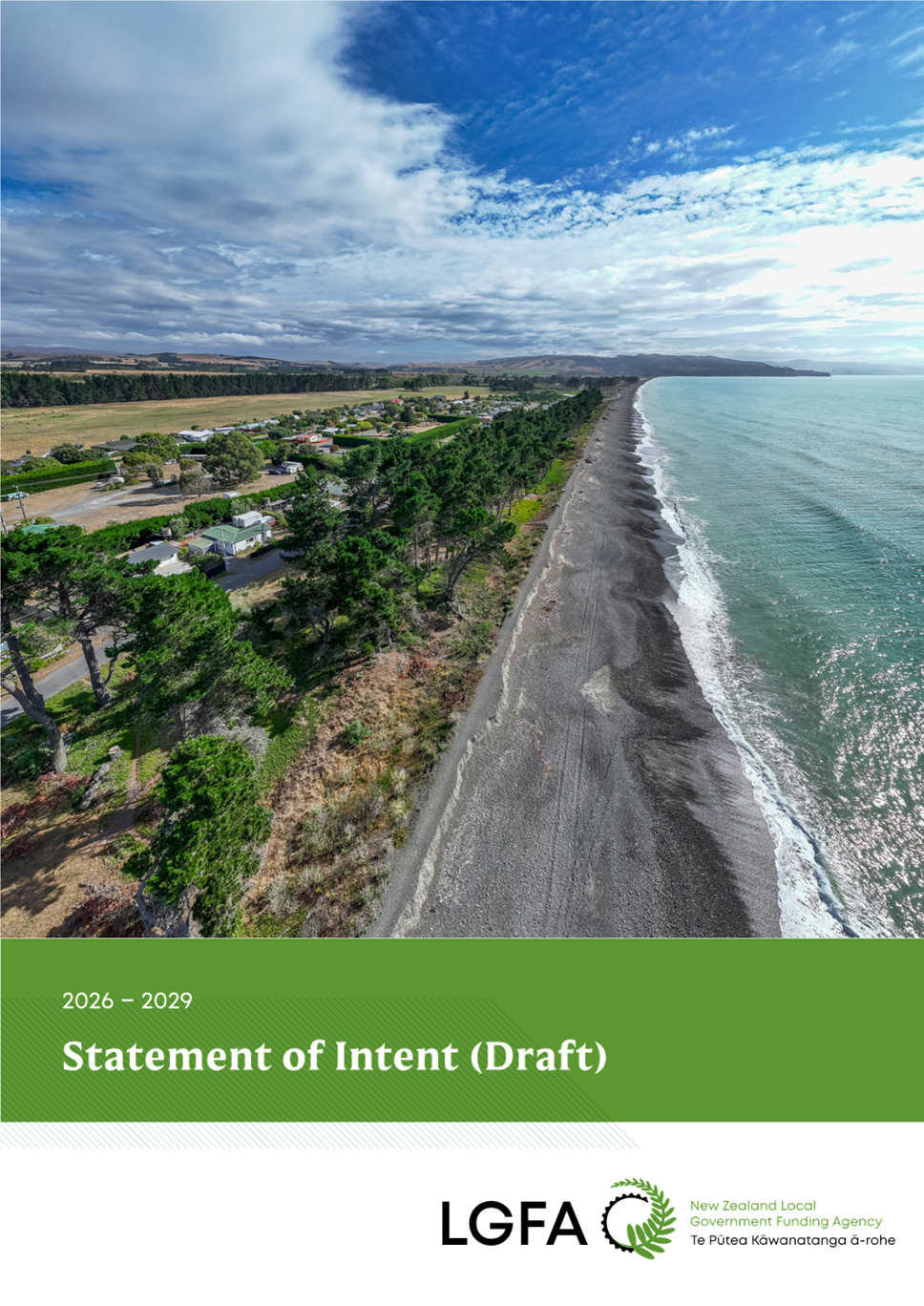
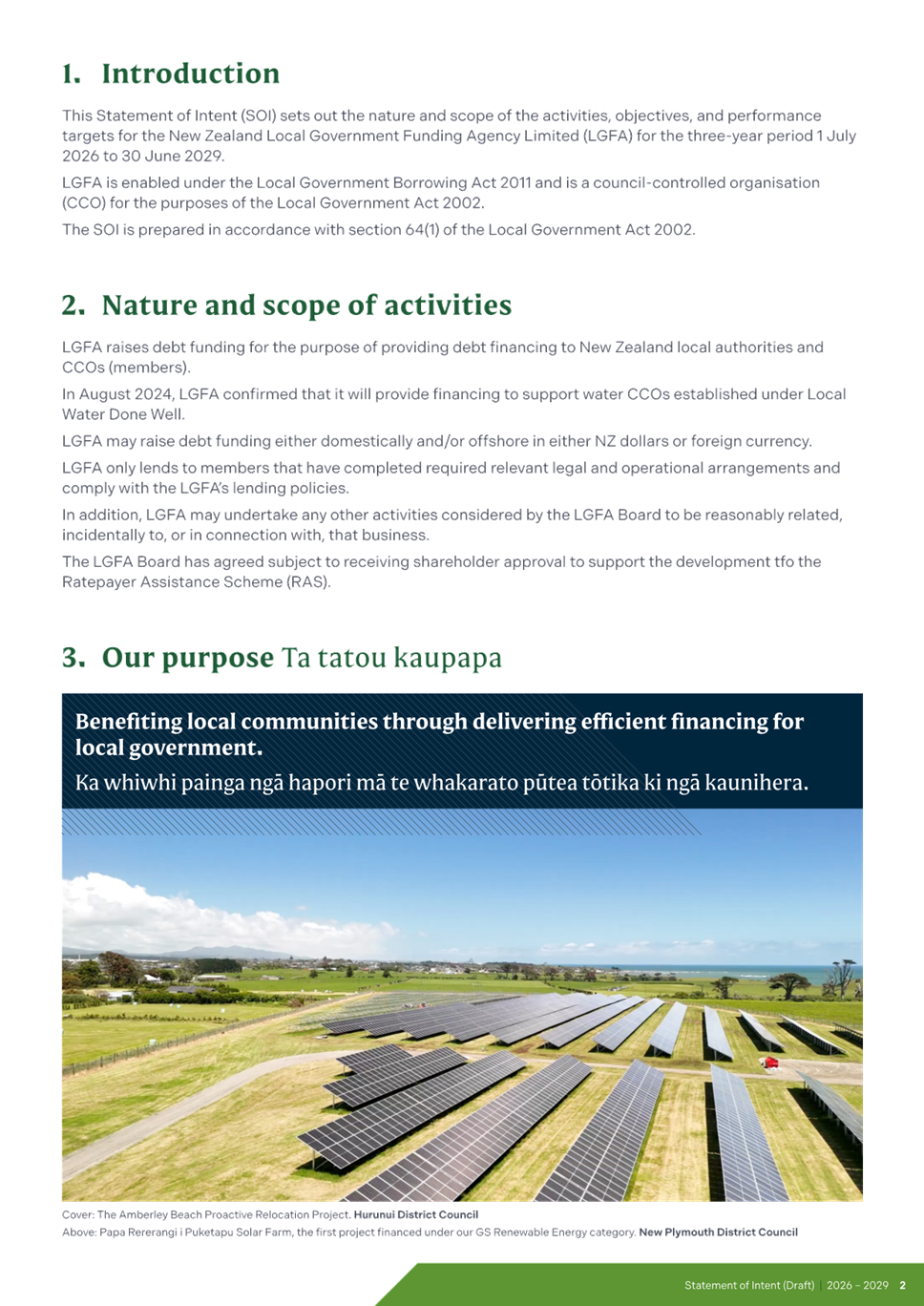
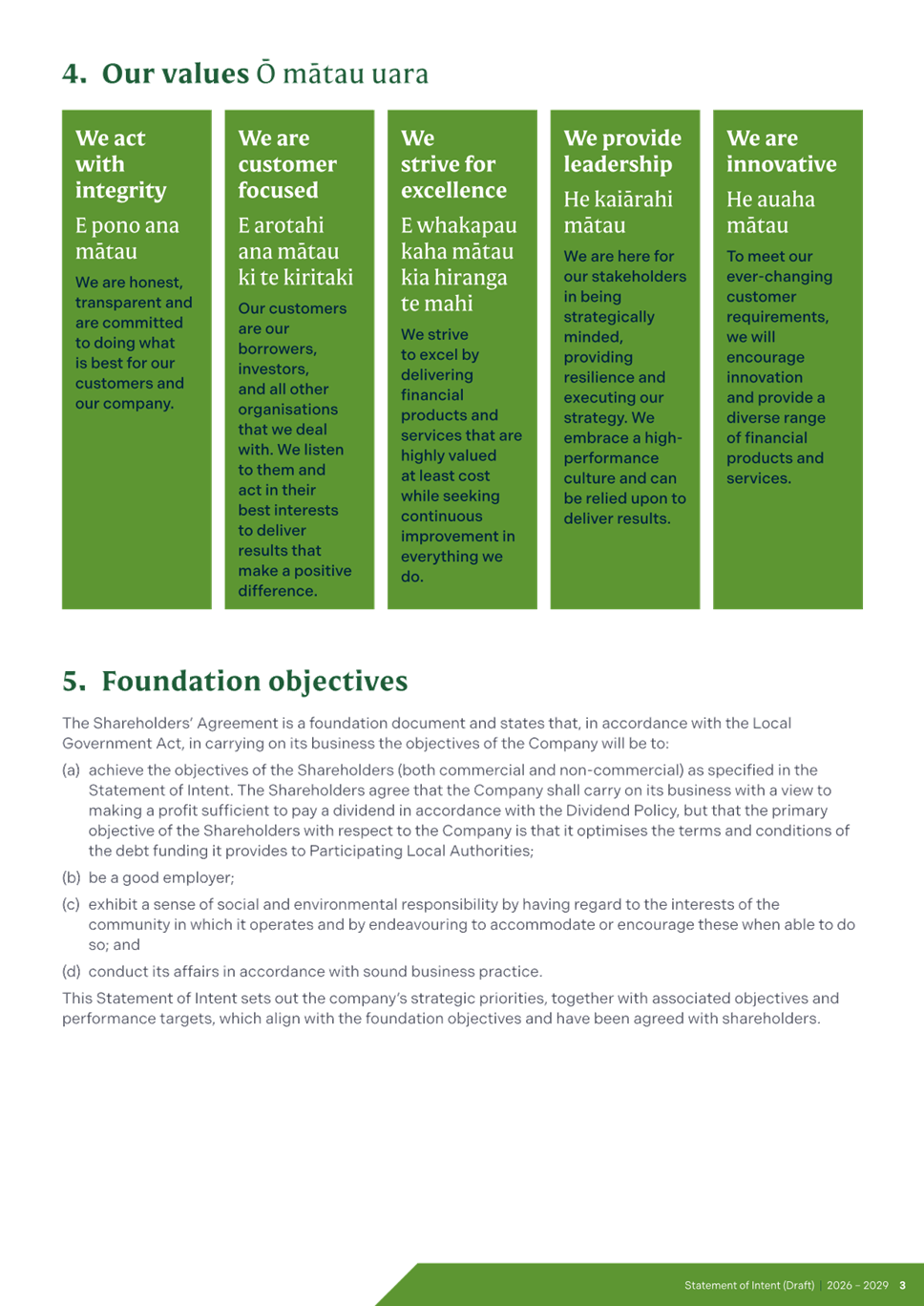
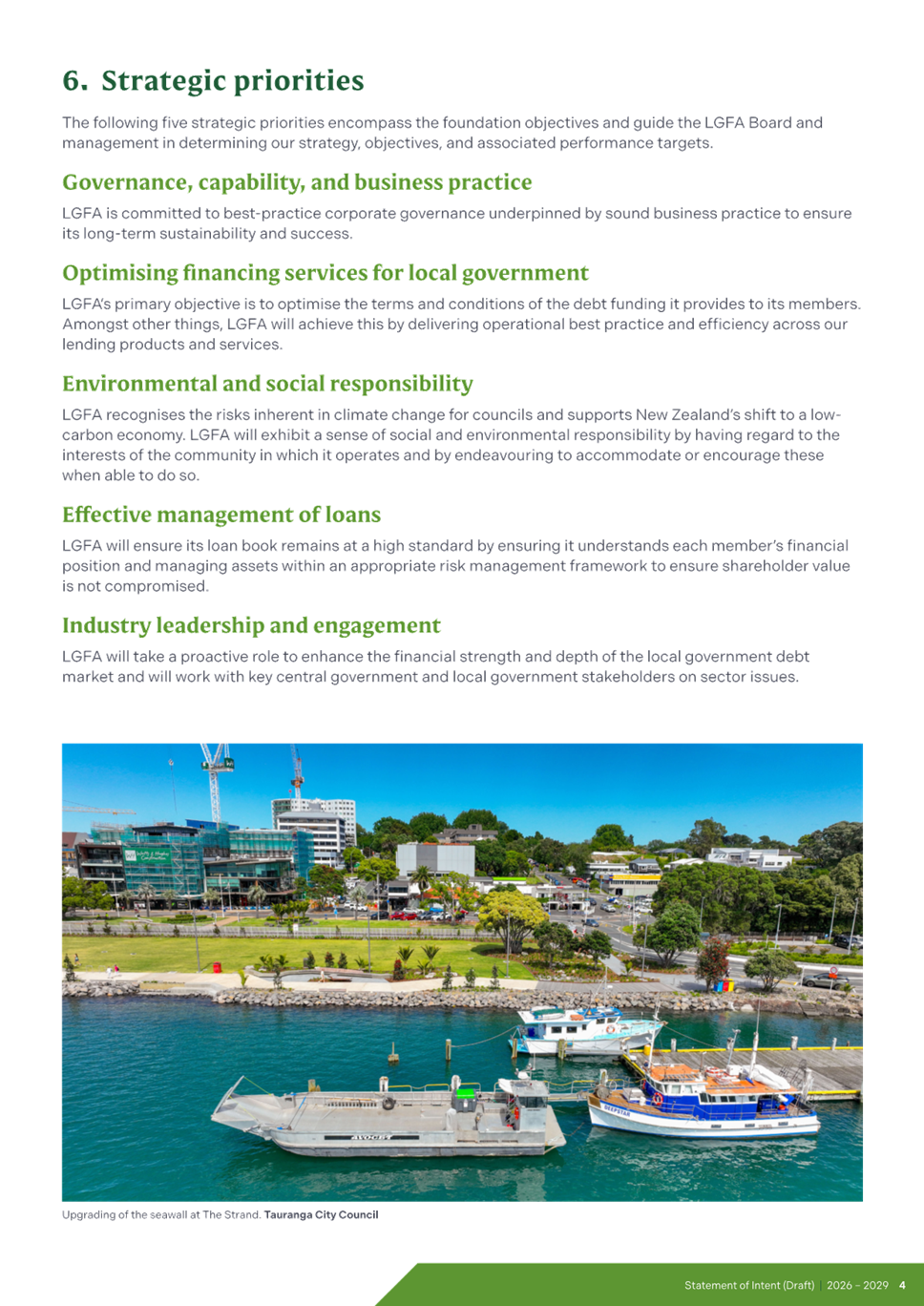
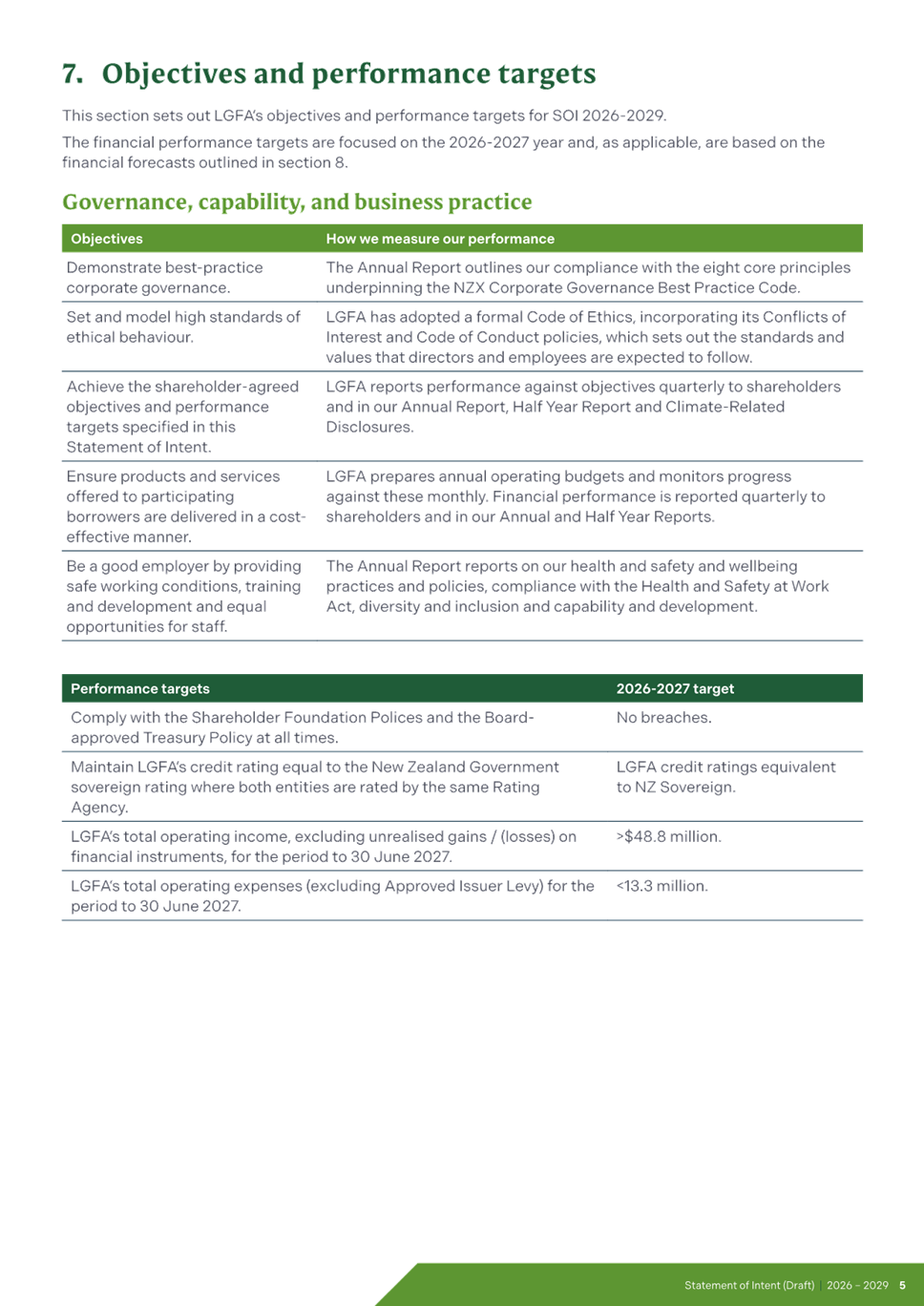
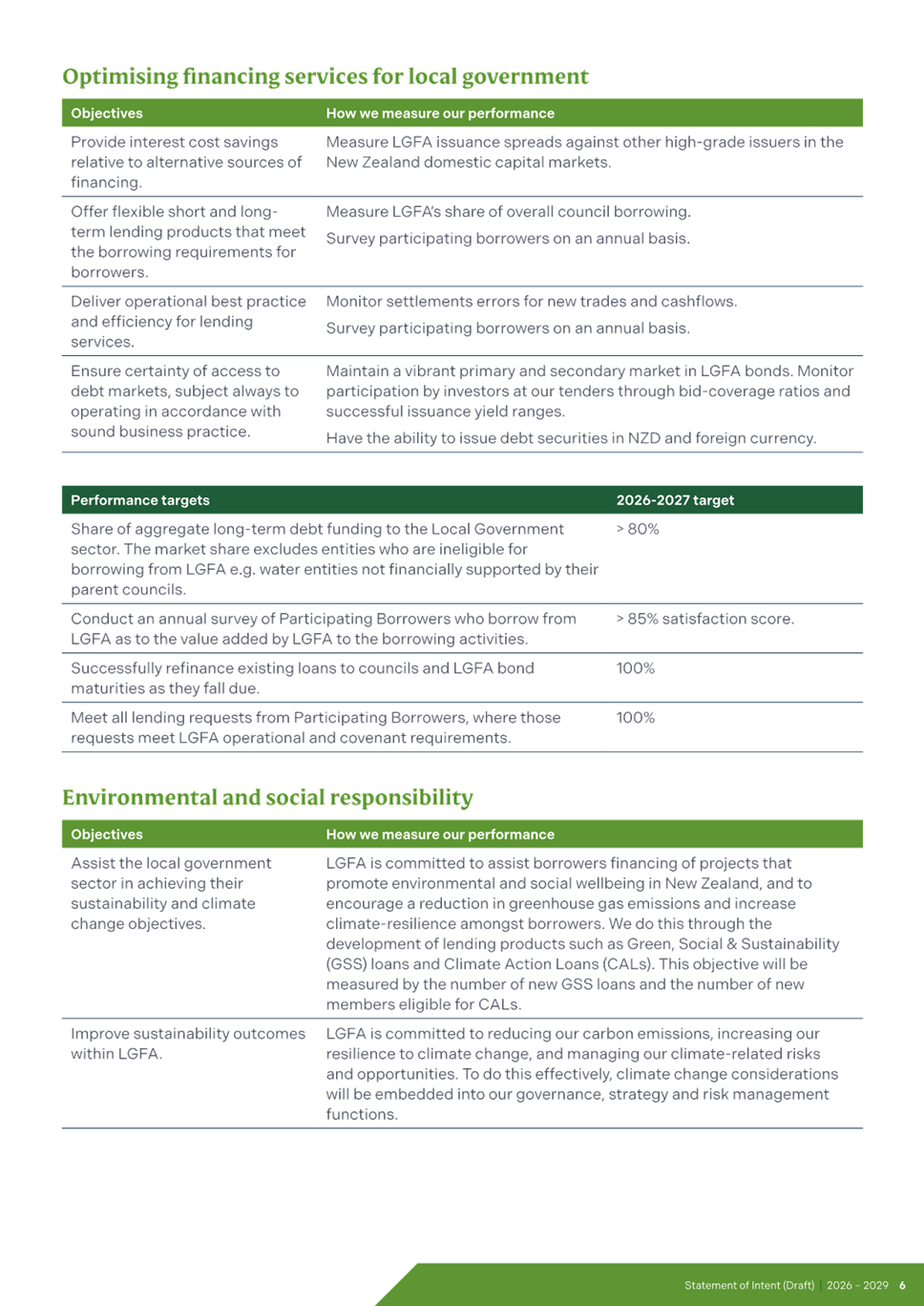
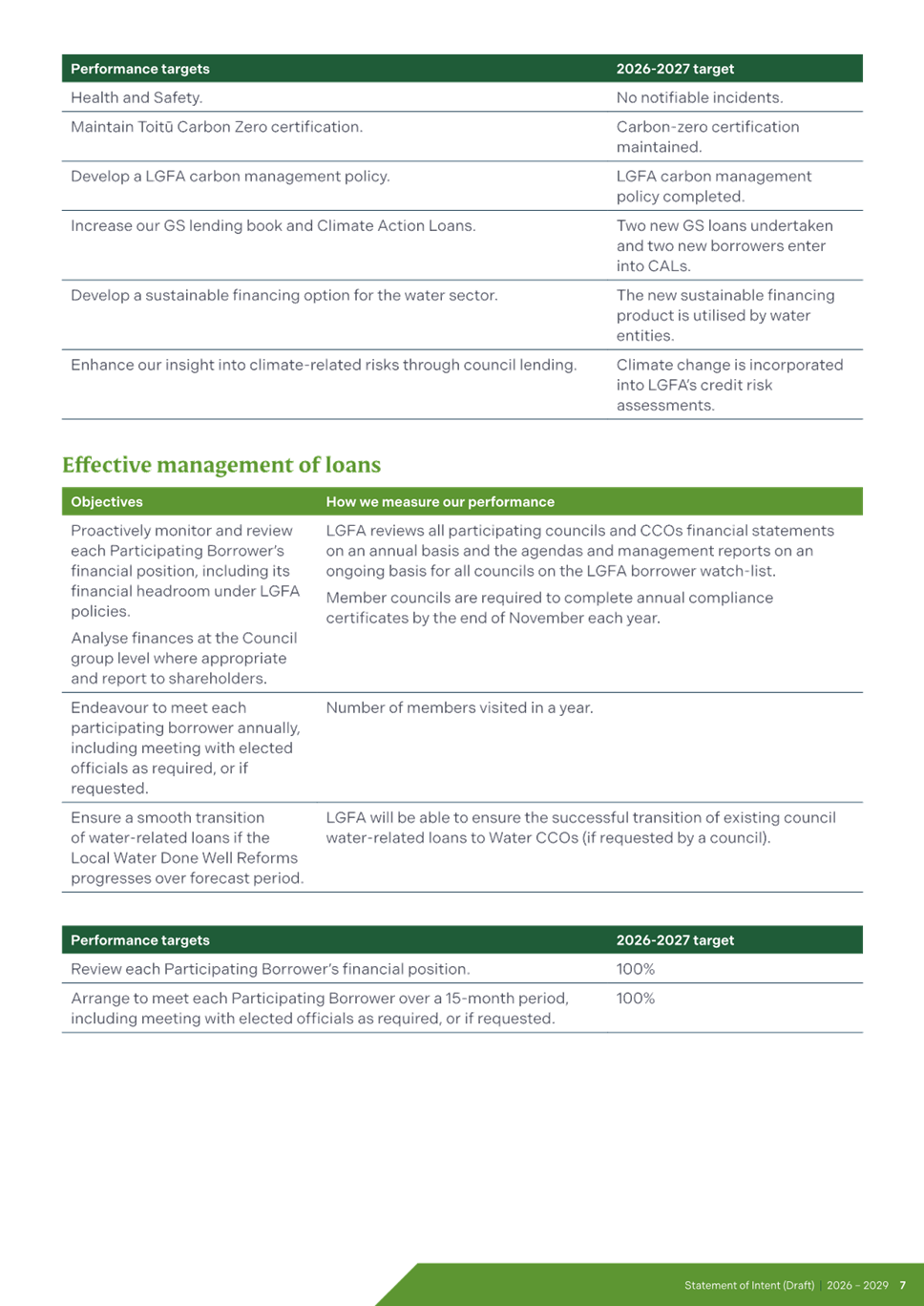
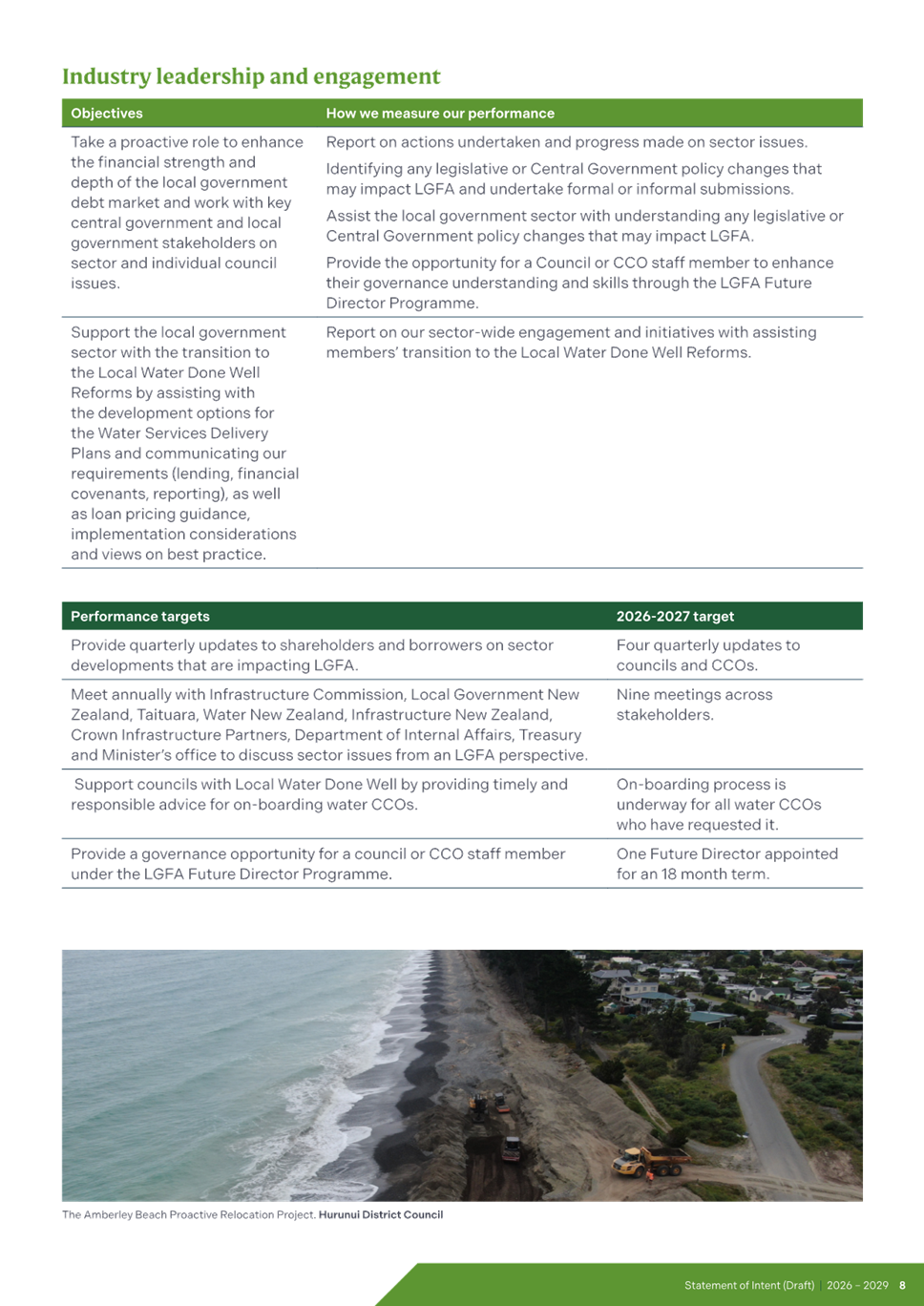
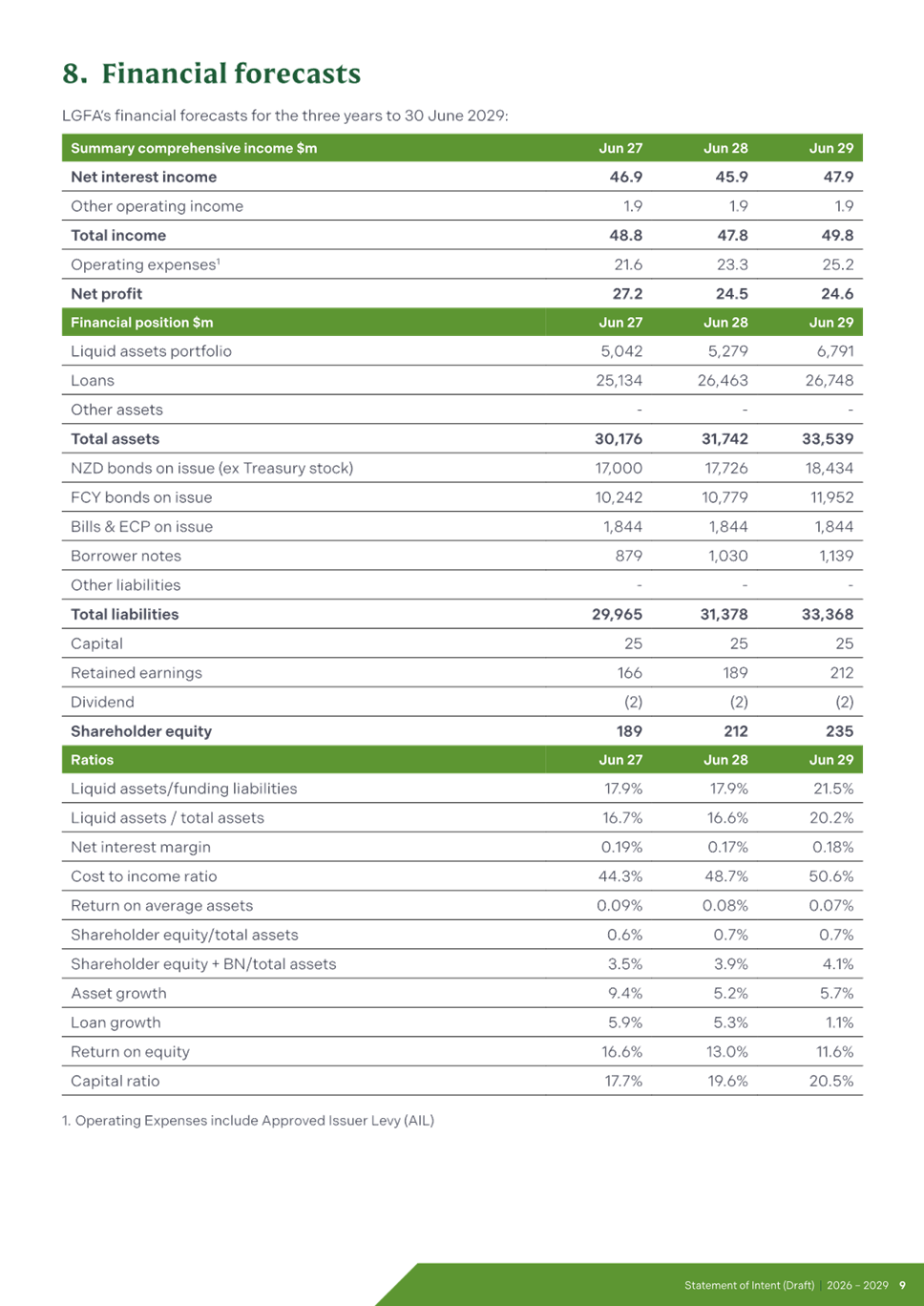
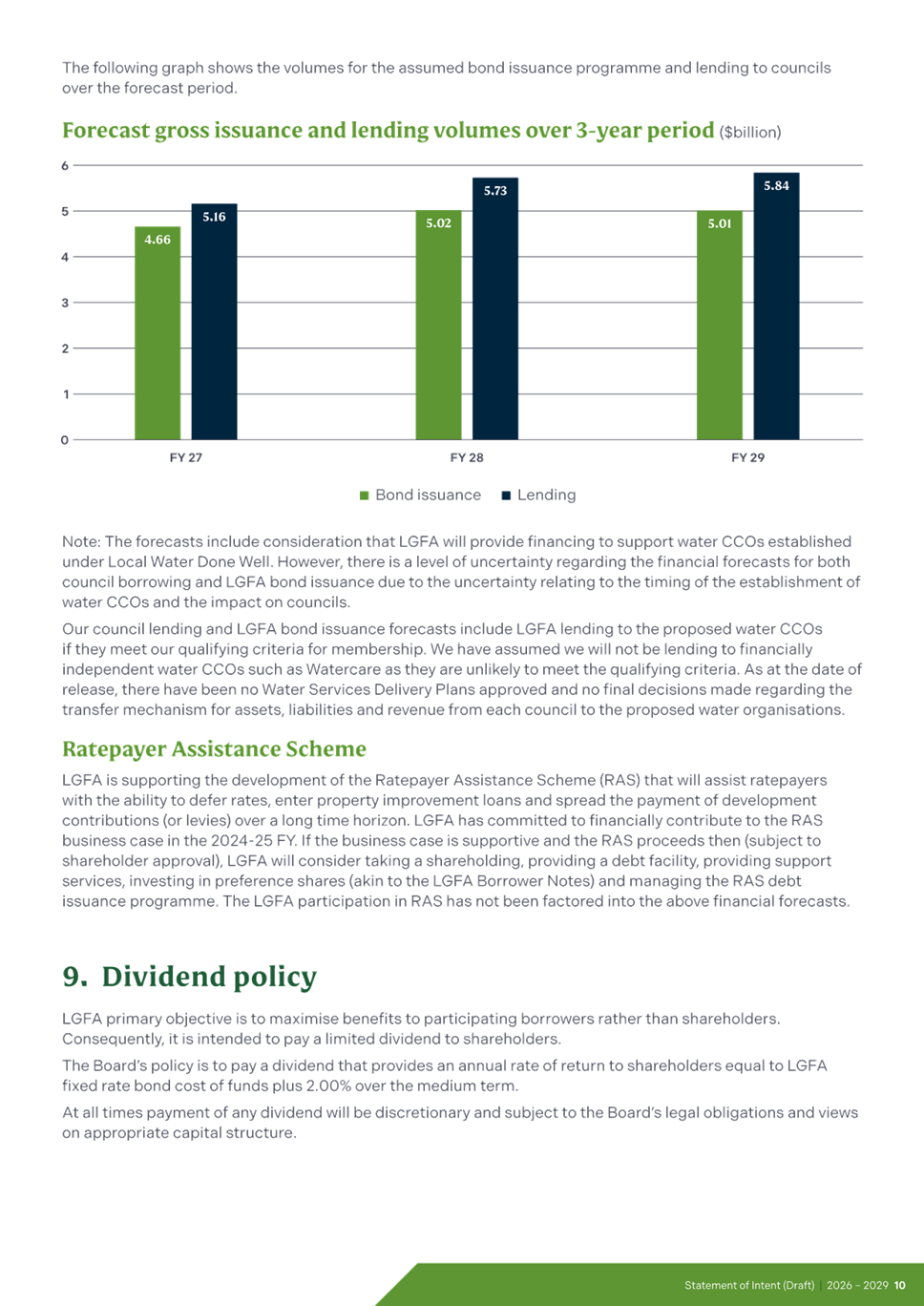
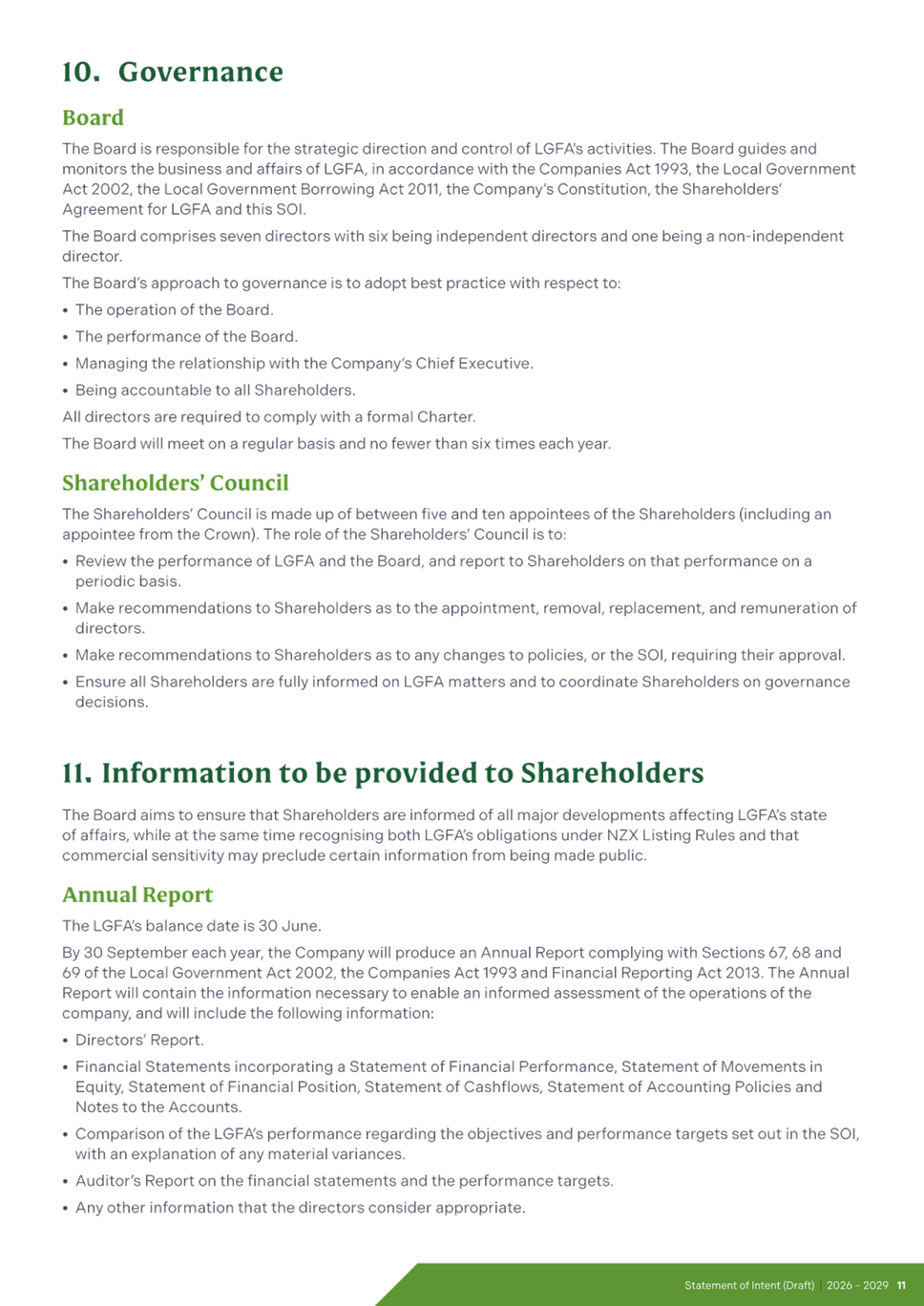
|
City
Delivery Committee meeting Agenda
|
28
April 2026
|

|
City
Delivery Committee meeting Agenda
|
28
April 2026
|
10.8 Annual Residents
Survey - Wave Three Results
File
Number: A19828337
Author: Rachel
Burt, Corporate Planner
Authoriser: Christine
Jones, General Manager: Strategy, Partnerships & Growth
Purpose of the Report
1. The purpose of this
report is to provide an overview of the results from the Annual Residents
Survey for the third quarter (Wave 3).
|
Recommendations
That the City Delivery
Committee:
(a) Receives the report
"Annual Residents Survey - Wave Three Results".
|
Executive Summary
2. The Annual Residents
Survey is conducted in four waves each year to capture community perceptions of
council services and initiatives. This report presents the Wave Three results
for 2025/26.
3. A total of 154
residents participated in this wave, bringing the year-to-date total to 463
responses across three waves. Response numbers remain on track to meet the
target of at least 600 responses across all four waves.
4. Overall satisfaction
has remained relatively stable at 47% YTD, representing an increase from 44% in
2024/25. This reflects gradual improvement across several service areas,
including outdoor spaces (79%, up from 76% in 2024/25) and public facilities
(73%, up from 71% in 2024/25). While concerns regarding roading and footpaths
persist in verbatim feedback, satisfaction in this area has improved slightly
to 51% (up from 49% in 2024/25), indicating a more positive trend overall.
5. Perceptions of
reputation (27%) up from 26% in 2024/25, and value for money (31%) up from 30%
in 2024/25 continue to show incremental improvement.
6. Waste management
remains a consistent area of strength at 76% in both YTD and in 2024/25.
7. Satisfaction with
the quality of Council services has increased to 53% YTD (from 47% in 2024/25),
indicating improving perceptions of service delivery.
8. Outdoor spaces
continue to perform strongly (79%) (from 76% in 2024/25), supported by high
satisfaction with access to parks, opportunities for physical activity, and the
natural environment
9. However, some areas
of decline are evident. Perceptions of cycling safety have decreased
significantly to 45% YTD (from 56% in 2024/25), with respondents highlighting
concerns about unsafe road conditions and a lack of dedicated cycling
infrastructure.
10. The city centre’s role as
the cultural and commercial heart of the city has also declined to 19% (from
25%), with feedback pointing to vacant shops, limited activities, and visible
homelessness, although there is some optimism regarding new civic developments.
ANNUAL RESIDENTS SURVEY
11. The
Annual Residents Survey forms part of a wider set of information we have around
engagement with the Tauranga community and their wants, needs and perceptions
of council and of Tauranga as a place to live.
12. Survey
results help council staff assess the performance of council against a set of
pre-determined actions and performance levels, including those outlined in the
2024-34 Long-term Plan.
13. Using
a post-to-online method, surveys have been undertaken with Tauranga residents
during this third wave. An invitation letter, containing an embedded link to an
online survey, was sent to a random selection of residents, sourced from the
Electoral Roll, with a subsequent reminder follow up.
14. Wave
Three fieldwork was conducted from 30 January
2026 – 01 March 2026. The number of participants in Wave Three was 154
bringing the year-to-date total to 463 responses across three waves.
15. A
summary of the high-level survey results for 2025/26 year-to-date (YTD) and
their trends is shown in the table below:
|
Measure
|
2024/2025
Result
|
Nett
Score
2024/25
|
2025/2026
YTD Result
|
Nett Score 2025/26 YTD Result
|
Change from Previous Year (%)
|
|
|
Overall performance
|
44%
|
18%
|
47%
|
19%
|
6.8%
5
|
|
|
|
Overall reputation
|
26%
|
-23%
|
27%
|
-22%
|
3.8%
5
|
|
|
|
Overall value for money
|
30%
|
-16%
|
31%
|
-10%
|
3.3%
5
|
|
|
Overall core service deliverables
|
62%
|
49%
|
63%
|
51%
|
1.6%
5
|
|
|
Overall water management
|
59%
|
40%
|
57%
|
45%
|
0%
=
|
|
|
Overall roads and footpaths
|
49%
|
28%
|
51%
|
30%
|
4.1%
5
|
|
|
Overall waste management
|
76%
|
68%
|
76%
|
71%
|
0%
=
|
|
|
Overall outdoor spaces
|
76%
|
69%
|
79%
|
73%
|
3.9%
5
|
|
|
Overall public facilities
|
71%
|
64%
|
72%
|
72%
|
1.4%
5
|
|
|
16. Perceptions
of Council performance and services show improvement in the 2025/26
year-to-date results:
· Overall, the
results indicate steady, incremental gains across most service areas
particularly core services while reputation and value for money remain priority
focus areas given their still negative net positions.
· Value for money
remained steady at 31%, signalling easing concerns, although affordability
remains a key issue.
· Core service
delivery strengthened overall, with incremental gains across infrastructure
areas. Roads and footpaths improved slightly to 51% (net +30), reflecting a
modest lift year on year, even though respondent feedback regarding
infrastructure issues and safety remain a key concern, while water management
saw an improvement in net score despite a small decline in result.
· High-performing
areas remained strong, with waste management steady at 76% and outdoor spaces
increasing to 79%. Public facilities improved to 72%, supported by strong
performance in libraries and mixed results across other facilities, including
some declines in pools and indoor sports facilities.
17. Verbatim comments from the
third wave reflects a broad range of community priorities across Tauranga these
are highlighted below with commentary pulled from the reporting.
· Many comments
highlighted the growing visibility of homelessness, particularly in the city
centre, and linked this to housing shortages, high living costs, and limited
social support. Safety in public spaces was a common theme, with calls for
better lighting, CCTV, and community policing.
“Quality lighting
upgrades to walkways for evening enjoyment even in the winter months.”
“There
is still a lot of homeless people in the city centre. I understand they need
some place to sleep but it certainly discourages me from going to the city and
the lack of businesses there at present.
· Affordability was
a recurring concern, with residents calling for better management of rates and
fees.
“I
would like to see less waste of rate money on projects that get scrapped
halfway through. I would also like to see commitment to increasing the city
infrastructure, such as hospitals, schools and roads to cope with increasing
number of residents. I would like to see future proofing focus, such as the
Cameron Road upgrade.”
· Transport and
roading issues were frequently raised, including congestion, poor road
conditions, and parking challenges. Cycleway safety was frequently highlighted.
“I feel scared to cycle on many local roads.
There’s a real lack of courtesy and dangerous driving.”
· While Libraries,
pools, Historic Village, Baycourt, and the Cargo Shed were generally valued,
with suggestions for, broader programming, and improved promotion.
“The Historic Village
needs to be celebrated and advertised more. There needs to be a broader range
of events to attract more people and visitors. For the cruise ships that go
there, it should have a lot more entertainment and in turn, that should attract
more locals to the village.”
· Water management
also featured, with comments on stormwater, flooding, and drinking water
quality.
“Less reactive
stormwater management planning. Better zoning and building rules in flood prone
areas. Use better quality data for flood zoning maps, latest survey information
to avoid mistakes and reducing public confidence.”
· Waste management
and sustainability attracted attention, with suggestions for improved rubbish
collection and stronger environmental initiatives.
“Rubbish collection is
excellent. This includes green waste collections. I am not aware of specific
initiatives to improve climate and sustainability that Tauranga City Council
have implemented and the success of these initiatives.”
· Across all topics,
residents emphasised the need for clearer communication and transparency from
Council, alongside practical investment in core infrastructure and services to
support growth.
“I would like to see
more public engagement, and clear, accessible advertising happening for key
decisions. Currently the only reason I know public consultation is happening is
because I’m subscribed to the newsletter.”
“Mt Maunganui and Mauao
is a huge drawcard for locals and visitors alike. I would support money being
spent in conjunction with consultation with Iwi to get Mauao open again as soon
as culturally acceptable. I would support the Mount Hot Pools being reopened
and the safer parts of the campground if there are any”
18. Further
information on each of the overall sections and the measures within, along with
a summary of the verbatim comments, are included in the report as Attachment
1.
RATES, RENT, AND LIVING AFFORABILITY
19. On
9 December 2024, Council resolved to add additional questions on household
rates affordability, rental affordability, and the cost of living in Tauranga
to the Annual Residents Survey. These have been included since Wave 3 2024/25.
20. Across
all three measures, perceptions of affordability have improved year-on-year,
though overall sentiment remains negative. The proportion of residents who
consider rates affordable increased from 21% (n=207) in 2024/25 (W3–W4)
to 23% (n=349) Year-to-date in 2025/26 a 9.5% uplift. However, the nett score
eased slightly from -30 to -33, showing that rates are still viewed as
unaffordable by most respondents.
21. Rent
affordability rose from 18% (n=39) to 20% (n=62) (+9.5%), with a notable
improvement in the nett score from -43 to -33. This result should be
interpreted cautiously due to the small renter sample.
22. Perceived
cost-of-living affordability improved from 17% (n=265) to 21% (n=457) (+23.5%),
alongside a nett score shift from -44 to -35.
23. Overall,
these year-to-date results suggest modest easing in affordability pressures.
However, persistently negative nett scores highlight ongoing strain on
households and the need for continued measures to support affordability.
|
Measure
|
2024/2025
Result
(W3 & W4)
|
Nett Score
2024/25
|
2025/2026
Result YTD
|
Nett Score
2025/26 YTD Result
|
Change
vs
Last
Year
(% and Trend)
|
|
Rates in Tauranga are affordable for my household
|
21%
(n=207)
|
-30%
|
23%
(n=349)
|
-33%
|
+9.5%
5
|
|
Rent in Tauranga is affordable for my household
|
18%
(n=39)
|
-43%
|
20%
(n=62)
|
-33%
|
+11.1%
5
|
|
The cost of living in Tauranga is affordable for my household
|
17%
(n=265)
|
-44%
|
21%
(n=457)
|
-35%
|
+23.5%
5
|
Table 1: Additional questions on household rates
COMPARISON TO PREVIOUS YEARS
24. To provide the Council with a
performance comparison against the last two full-term elected Councils, a
summary of the high-level survey results for 2025/26 is presented in the table
below. This responds to a request from elected members at a previous committee
meeting. For context, the table also includes the average results from 2015/16
to 2018/19, highlighting how the current results compare.
25. At the meeting on 10 March
2026, an action was agreed to include net results year-on-year for all
available data. Net results are available from 2016/17 onwards. These results
are provided in Table 2 below.
|
City
Delivery Committee meeting Agenda
|
28
April 2026
|
|
2016/17
Result
|
2016/17
Nett Score
|
2017/18
Result
|
2017/18
Nett Score
|
2018/19
Result
|
2018/19
Nett Score
|
Avg 15/16-18/19
|
25/26 YTD Result
|
2025/26 YTD Nett Score
|
Change (% and Trend)
|
|
Overall performance
|
75%
|
70%
|
74%
|
71%
|
66%
|
54%
|
72%
|
47%
|
19%
|
-34%
6
|
|
Overall reputation
|
53%
|
43%
|
55%
|
41%
|
46%
|
23%
|
51%
|
29%
|
-22%
|
-43.1%
6
|
|
Overall value for money
|
59%
|
50%
|
62%
|
48%
|
50%
|
31%
|
57%
|
31%
|
-10%
|
-45.6%
6
|
|
Overall core services deliverables
|
80%
|
77%
|
73%
|
69%
|
72%
|
66%
|
75%
|
64%
|
51%
|
-14.7%
6
|
|
Overall water management
|
74%
|
69%
|
72%
|
65%
|
69%
|
61%
|
72%
|
59%
|
45%
|
-18.1%
6
|
|
Overall road and footpaths
|
68%
|
61%
|
64%
|
58%
|
57%
|
41%
|
63%
|
54%
|
30%
|
-14.3%
6
|
|
Overall waste management
|
77%
|
71%
|
63%
|
49%
|
69%
|
57%
|
70%
|
78%
|
71%
|
+11.4%
5
|
|
Overall outdoor spaces
|
87%
|
84%
|
85%
|
80%
|
83%
|
78%
|
85%
|
80%
|
73%
|
-5.9%
6
|
|
Overall public facilities
|
82%
|
80%
|
85%
|
82%
|
77%
|
73%
|
81%
|
72%
|
65%
|
-11.1%
6
|
Table 2:
2025/26 results compared to previous years.
|
City
Delivery Committee meeting Agenda
|
28
April 2026
|
MEASURES OF INTEREST
26. The
2024/25 full year report highlighted two areas of council performance as
measures that have the highest impact on residents’ overall perception of
the Council combined with relatively low performance. The results for wave
three for these areas are discussed below and in the attached report.
27. The
below graphs used are XmR (Moving Range) charts. An XmR is a type of control
chart used in process improvement and statistical analysis to monitor the
variation in a single data series over time. The charts below track individual
data points, showing how each measurement compares to the overall average and
upper and lower control limits (shaded blue area), which define the expected
range of natural variation. The XmR chart helps identify trends, shifts, or
unusual variations in a process, making it useful for detecting changes and
ensuring that processes remain stable and predictable.
IMAGE AND REPUTATION
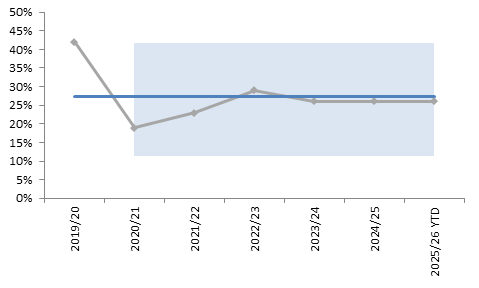
Graph 1: Image and Reputation Year to Date (YTD)
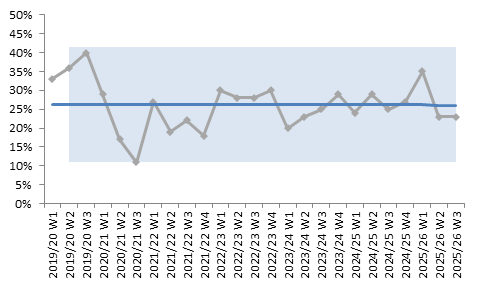
Graph
2: Image and Reputation by wave
28. Image
and reputation results have remained relatively stable over recent years,
following a sharp decline between 2019/20 and 2020/21. Since that low point,
performance has gradually recovered and broadly stabilised, sitting at around
the mid‑20 percent range. The 2025/26 year‑to‑date result is
consistent with the last two years, indicating no material improvement or
deterioration over the period. While the wave‑by‑wave results show
some short‑term fluctuation, overall perceptions of image and reputation
have remained steady, suggesting that public confidence has not significantly
shifted, despite ongoing changes and pressures across the organisation.
VALUE FOR MONEY
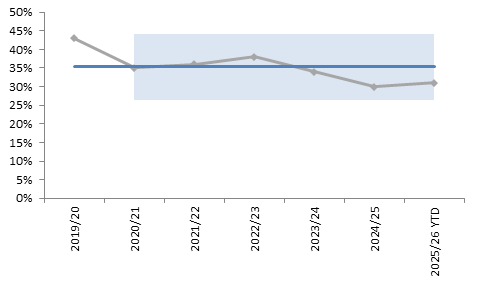
Graph 3: Value for Money Year to Date (YTD)
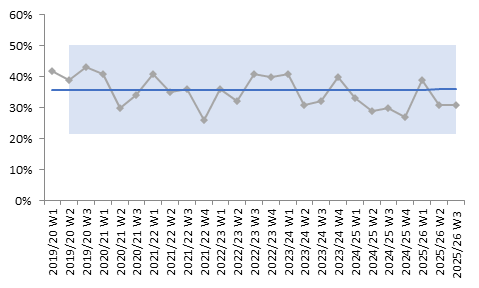
Graph 4: Value for Money by wave
29. Perceptions
of value for money have declined over time and now sit below earlier
performance levels. Following a relatively strong result in 2019/20, scores
dropped in 2020/21 and showed some fluctuation before trending downwards from
2023/24 onwards. The 2025/26 year‑to‑date result remains lower than
previous years, indicating ongoing concerns about whether services and
investments represent good value. While wave‑by‑wave results show
variability, the overall pattern suggests sustained pressure on value‑for‑money
perceptions, likely reflecting broader cost pressures and heightened
sensitivity to spending and rates among residents.
Statutory Context
30. The
Annual Residents Survey allows effective monitoring of performance and insights
to be gained to inform future planning.
STRATEGIC ALIGNMENT
31. This contributes to the
promotion or achievement of the following strategic community outcome(s):
|
Contributes
|
|
We are an inclusive city
|
ü
|
|
We value, protect and enhance the environment
|
ü
|
|
We are a well-planned city that is easy to move
around
|
ü
|
|
We are a city that supports
business and education
|
ü
|
|
We are a vibrant city that embraces
events
|
ü
|
32. The
annual residents survey is a legislative requirement which is reported on
quarterly and produced as an annual report.
Options Analysis
33. There are no options associated
with this report. The report is provided as information only.
Financial Considerations
34. There are no financial
implications or risks associated with this report.
Legal Implications / Risks
35. There are no legal implications
or risks associated with this report.
TE AO MĀORI APPROACH
36. The residents’ perception
survey referenced in this report is drawn from a demographically representative
sample of the area. This includes Māori and reflects the area’s
demographic profile across ethnicity, age, gender, geographic distribution and
socio-economic status.
Consultation / Engagement
37. This report is made public.
Significance
38. The Local Government Act 2002
requires an assessment of the significance of matters, issues, proposals and
decisions in this report against Council’s Significance and Engagement
Policy. Council acknowledges that in some instances a matter, issue,
proposal or decision may have a high degree of importance to individuals,
groups, or agencies affected by the report.
39. In making this assessment,
consideration has been given to the likely impact, and likely consequences for:
(a) the current
and future social, economic, environmental, or cultural well-being of the
district or region
(b) any persons who are likely to be
particularly affected by, or interested in, the matter.
(c) the capacity of the local authority
to perform its role, and the financial and other costs of doing so.
40. In accordance with the
considerations above, criteria and thresholds in the policy, it is considered
that the matter is of low significance.
ENGAGEMENT
41. Taking into consideration the
above assessment, that the matter is of low significance, officers are of the
opinion that no further engagement is required prior to Council making a
decision.
Next Steps
42. The
next wave (Wave 4) for 2025/26 is due to be collected during May 2026 with the
results of the report will inform reporting in the Annual Report 2025/26 and
will be published on our website.
Attachments
1. Annual
Residents Survey 2025_26 - Wave 3- Performance Report - A20112584 ⇩
|
City
Delivery Committee meeting Agenda
|
28
April 2026
|

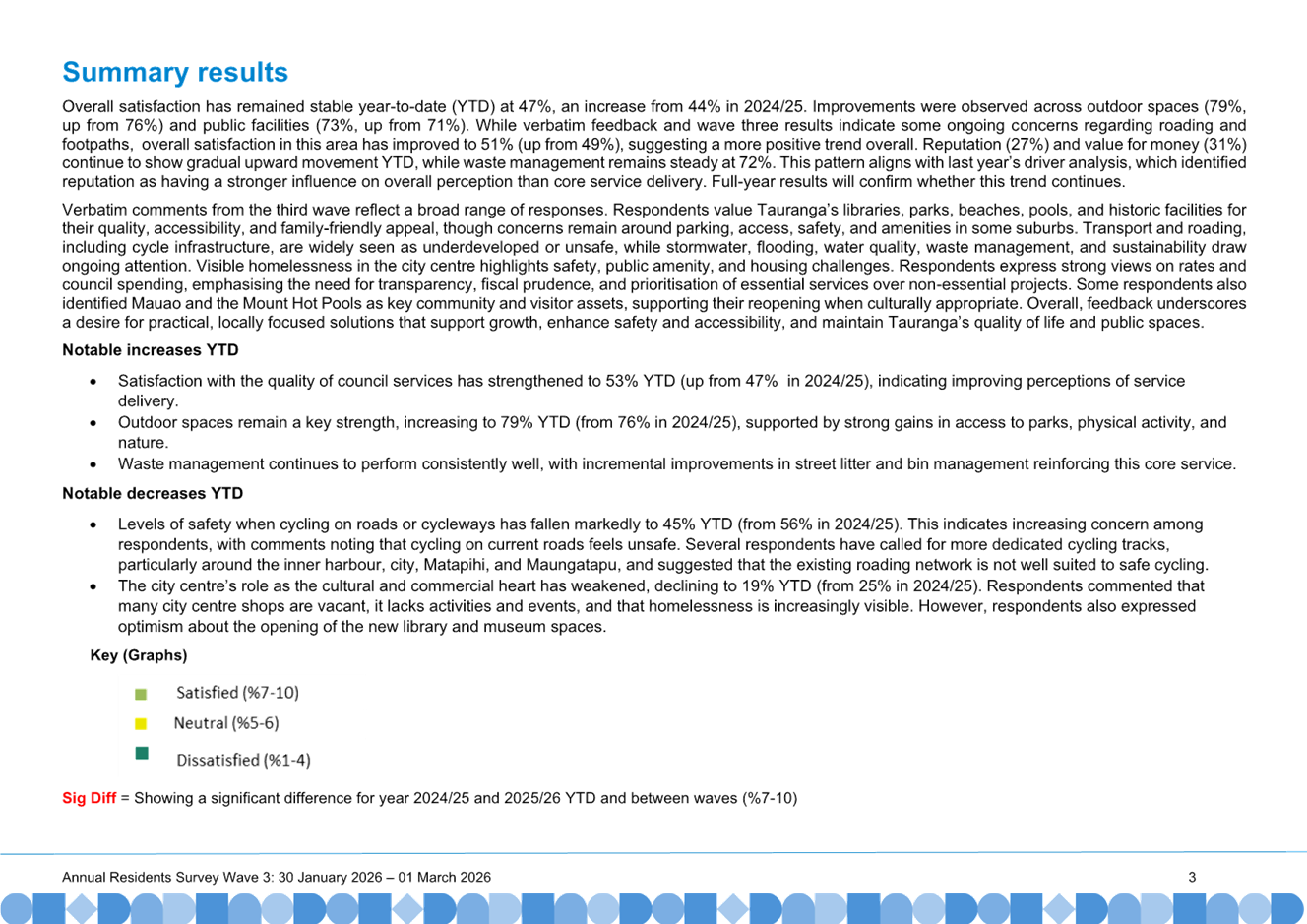
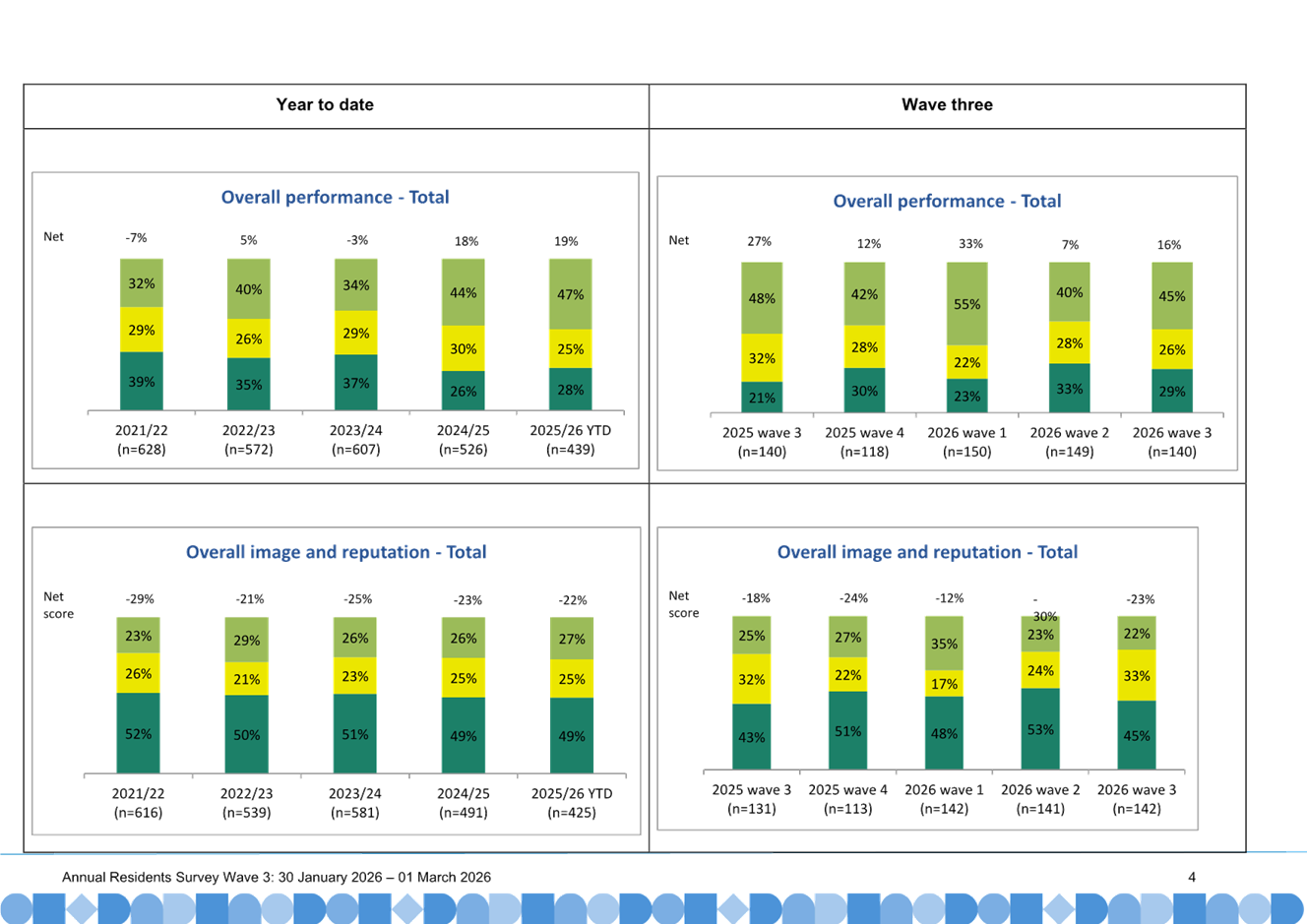
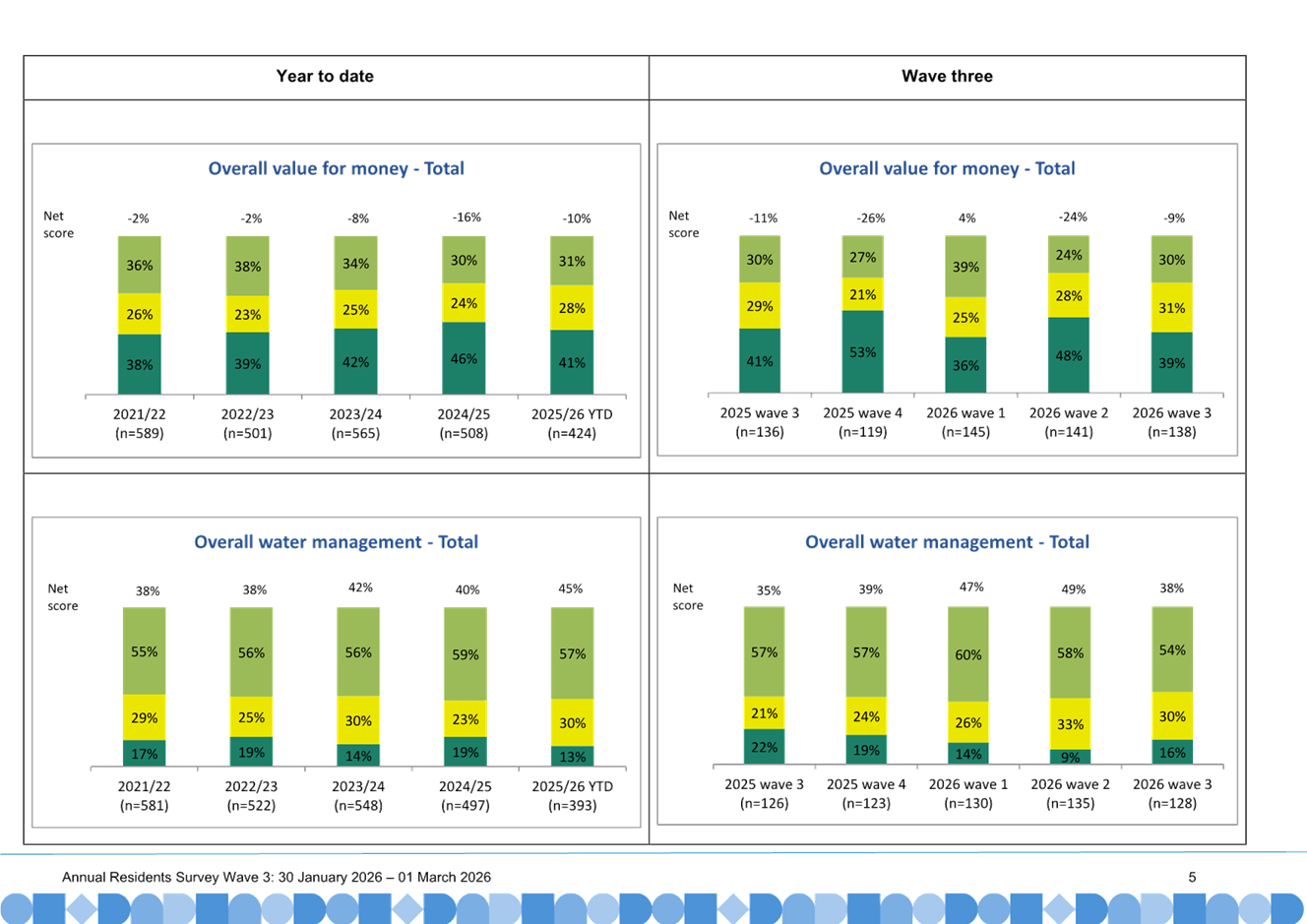
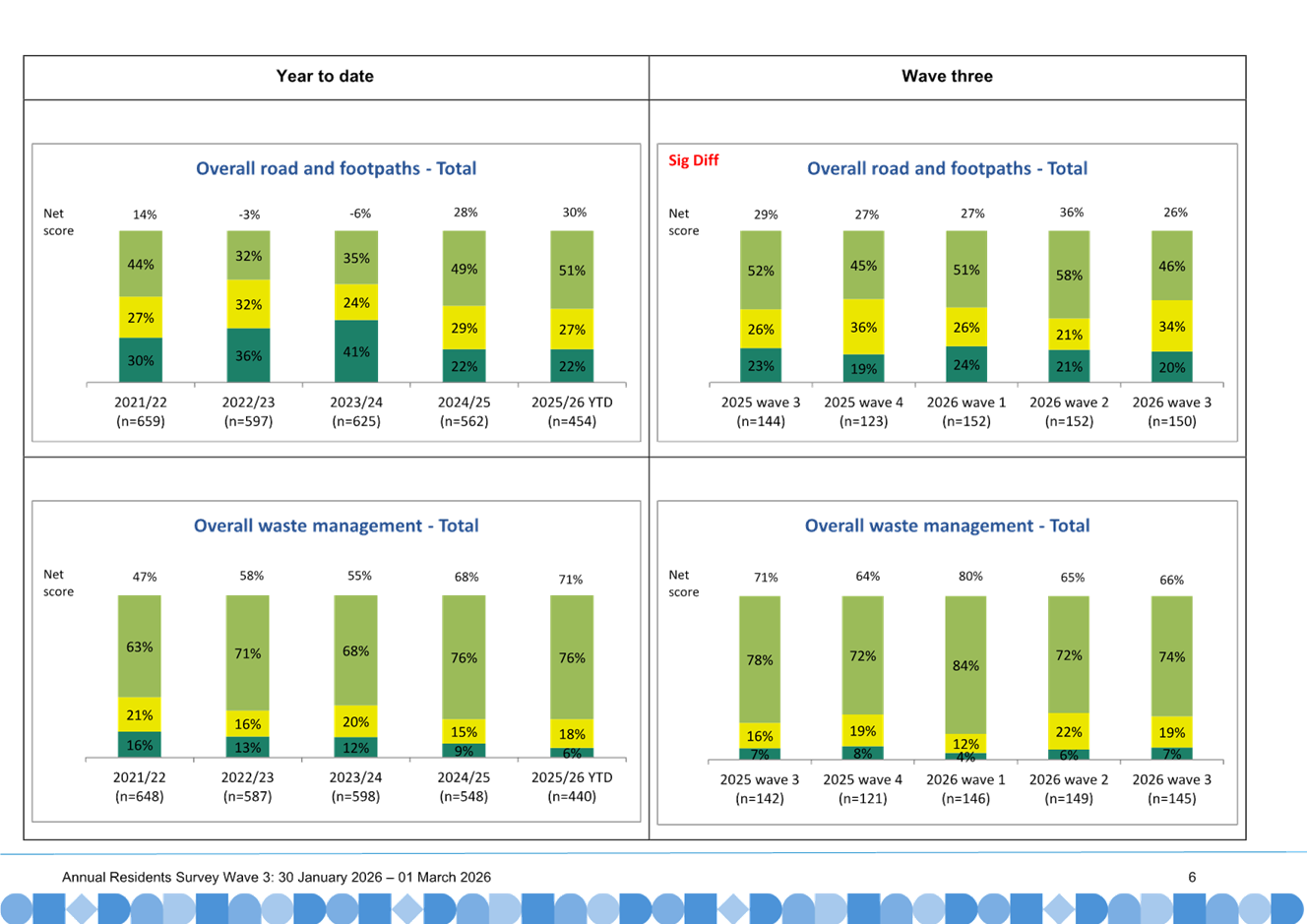
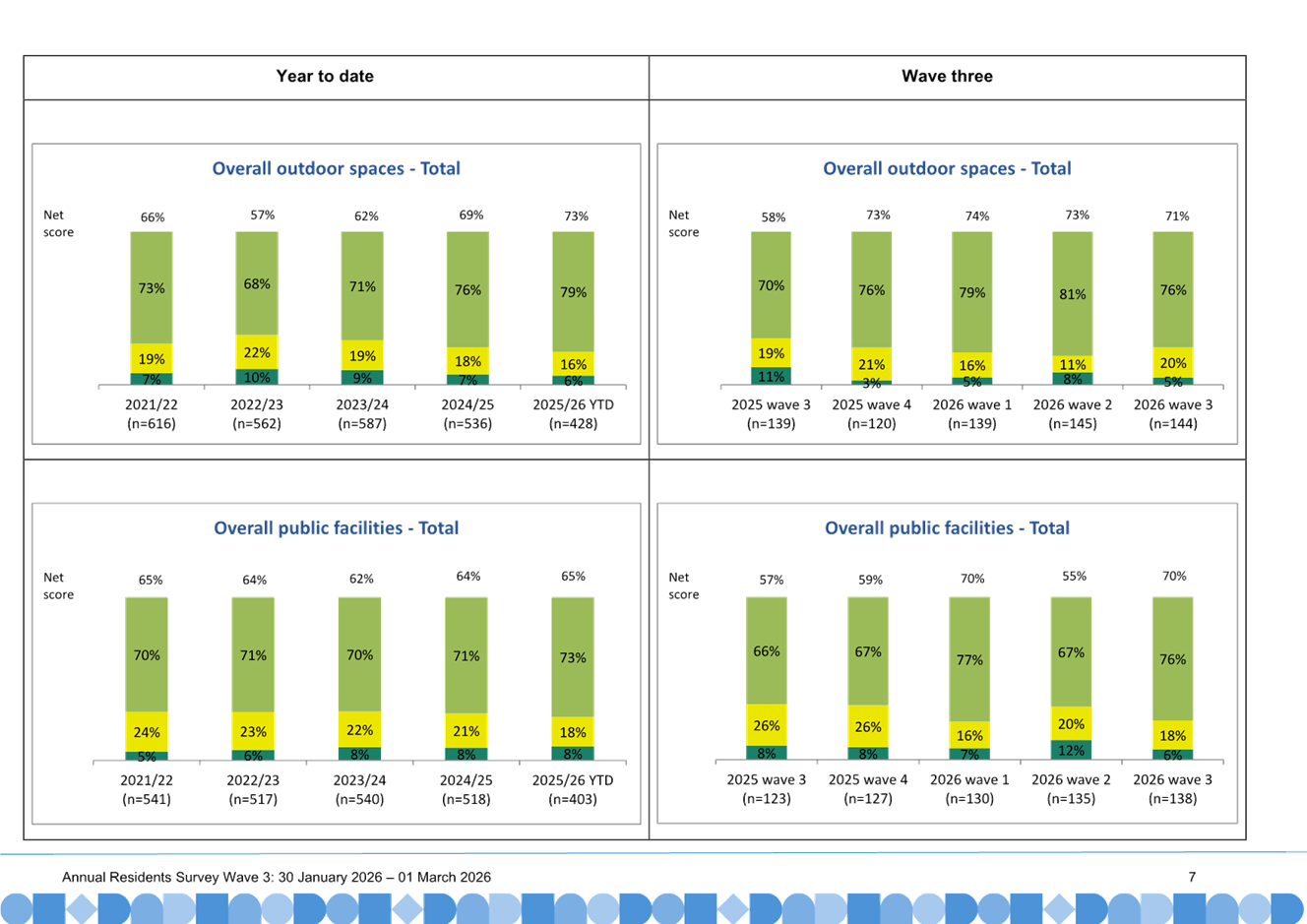
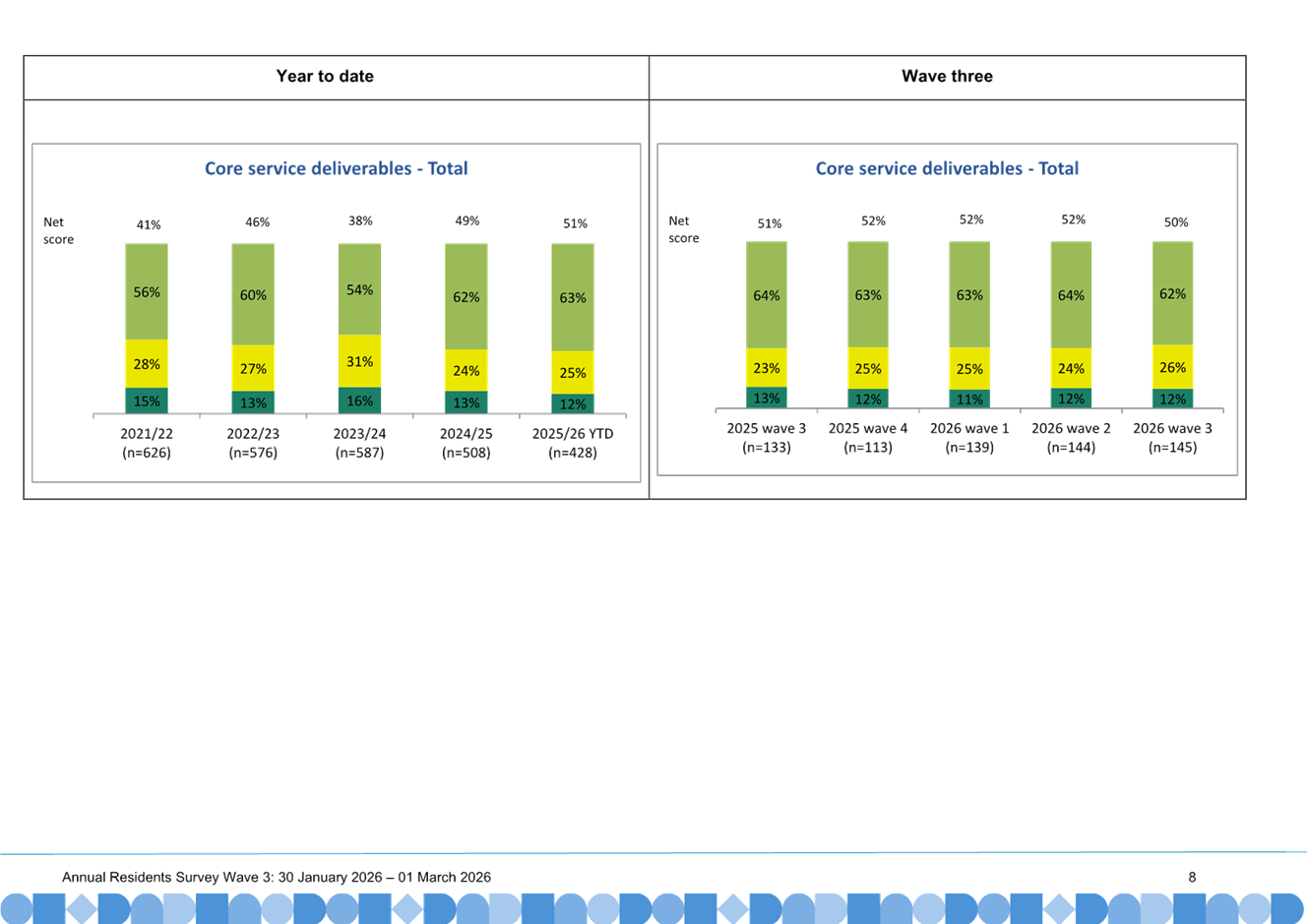
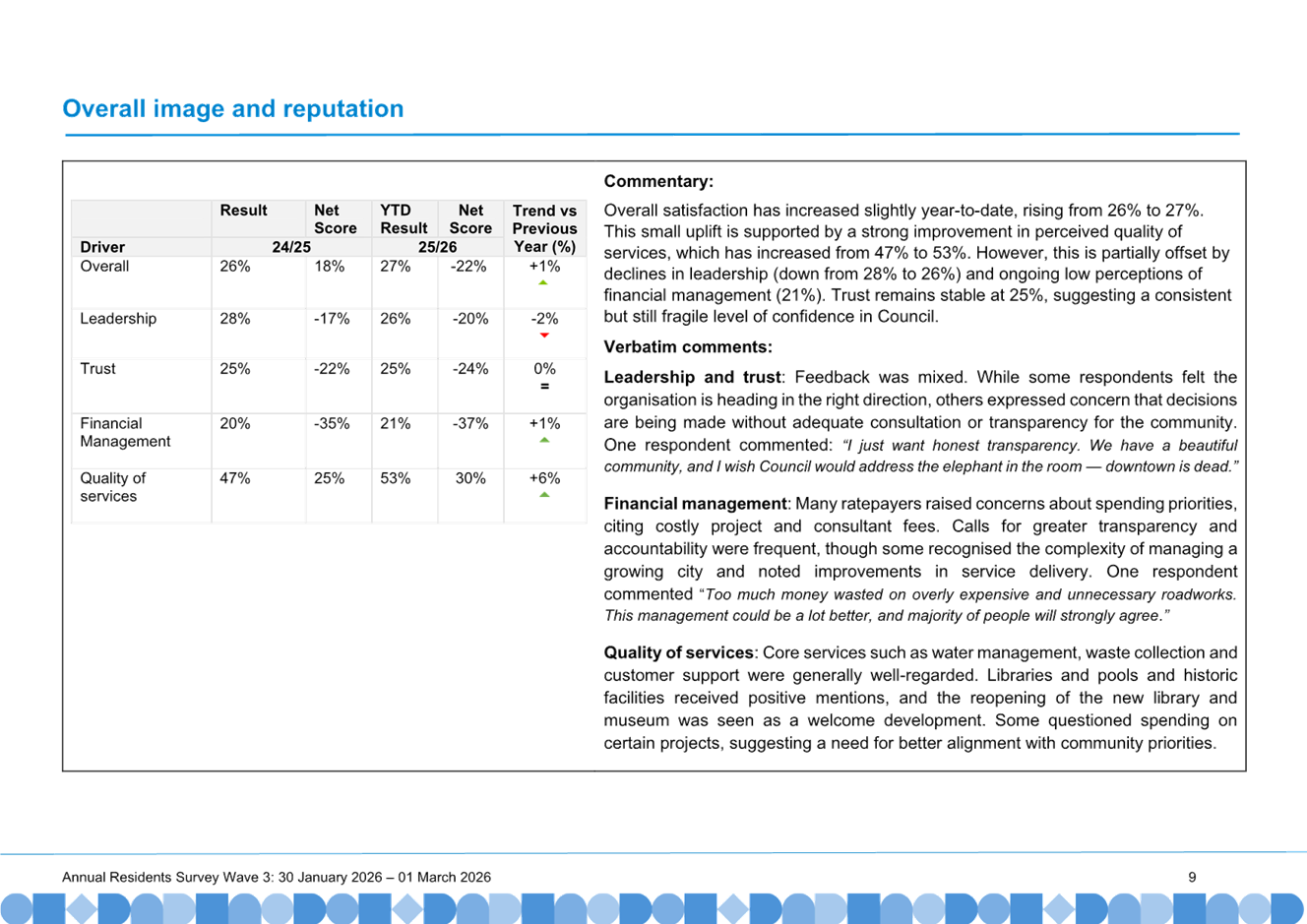
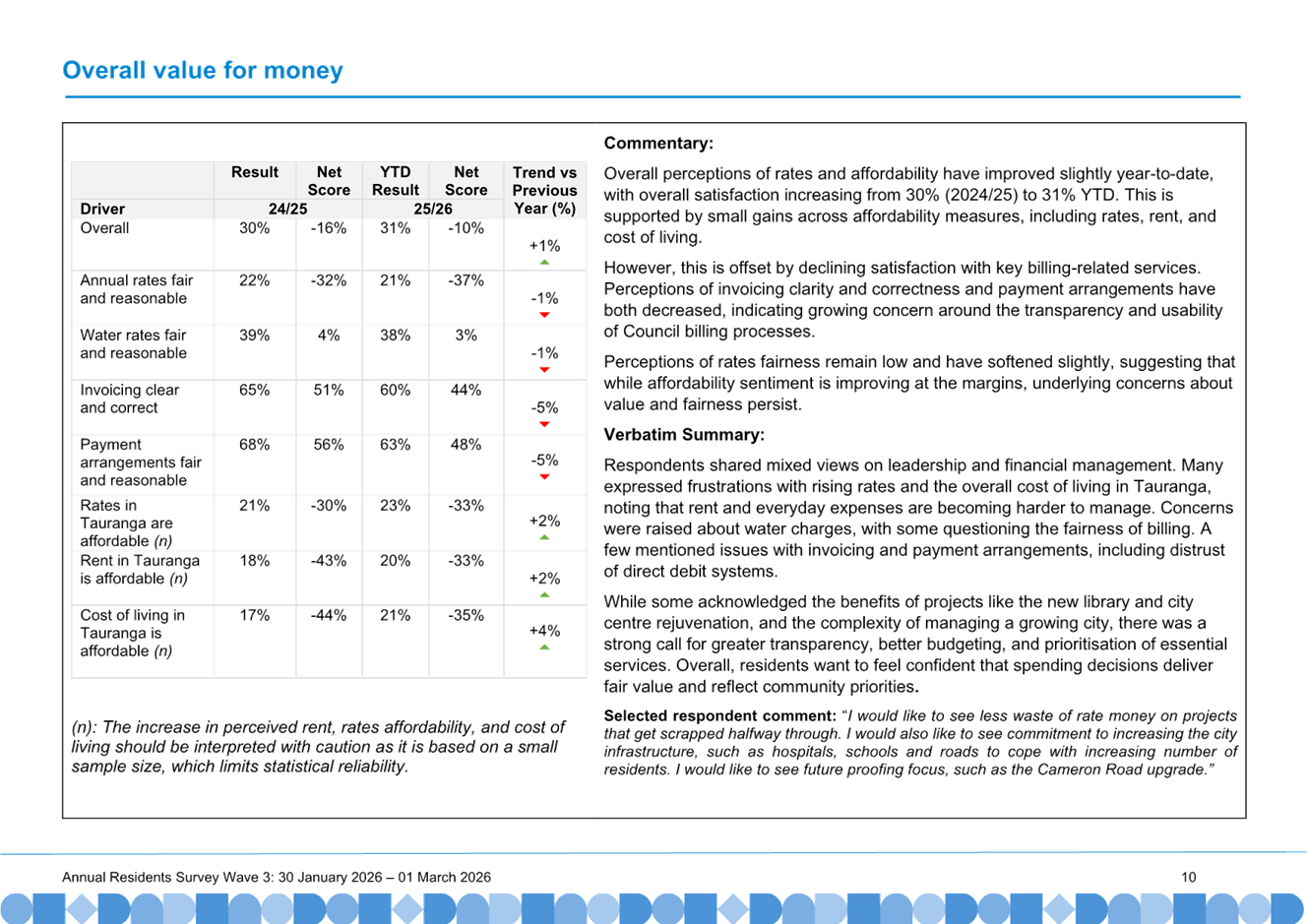
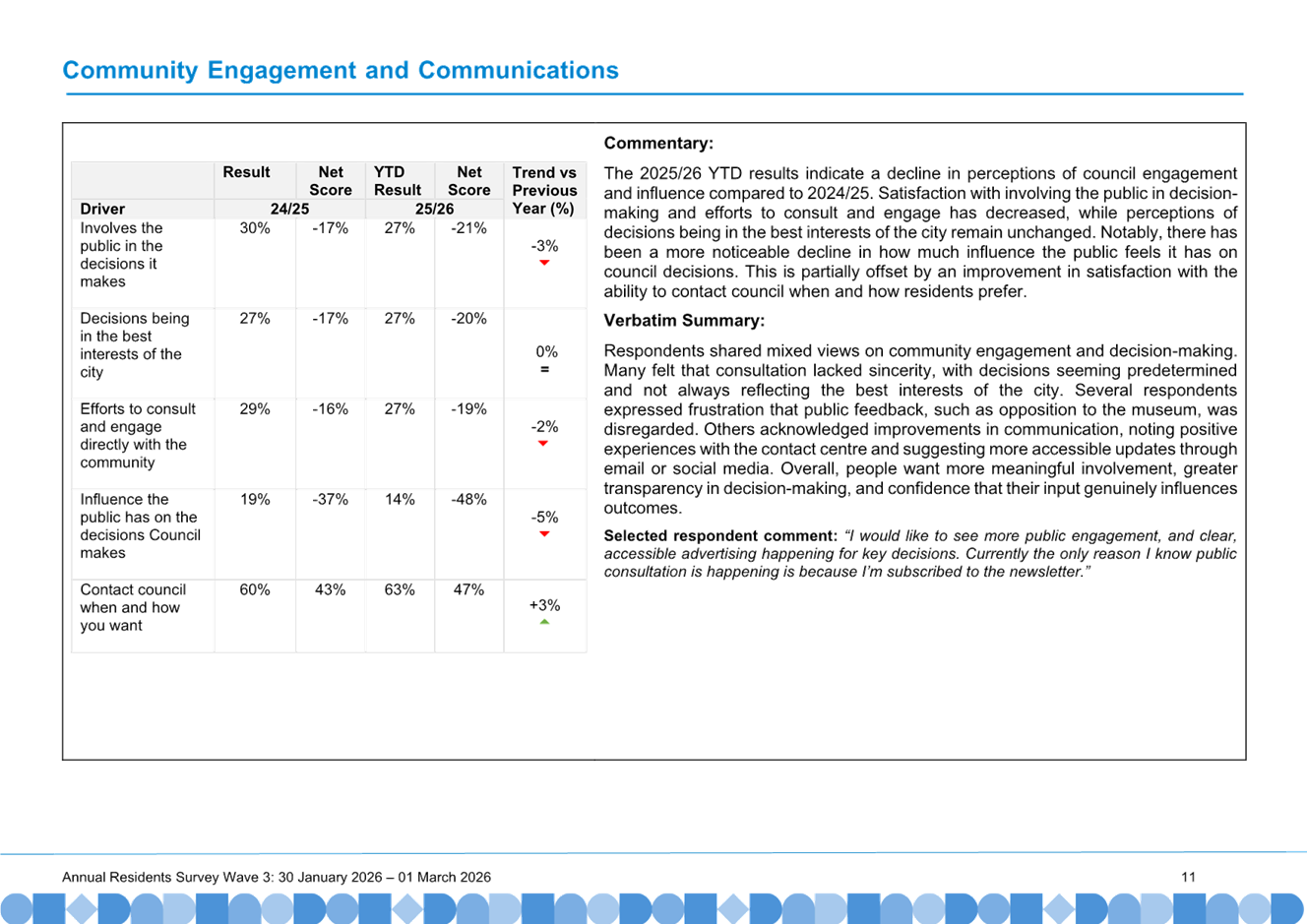
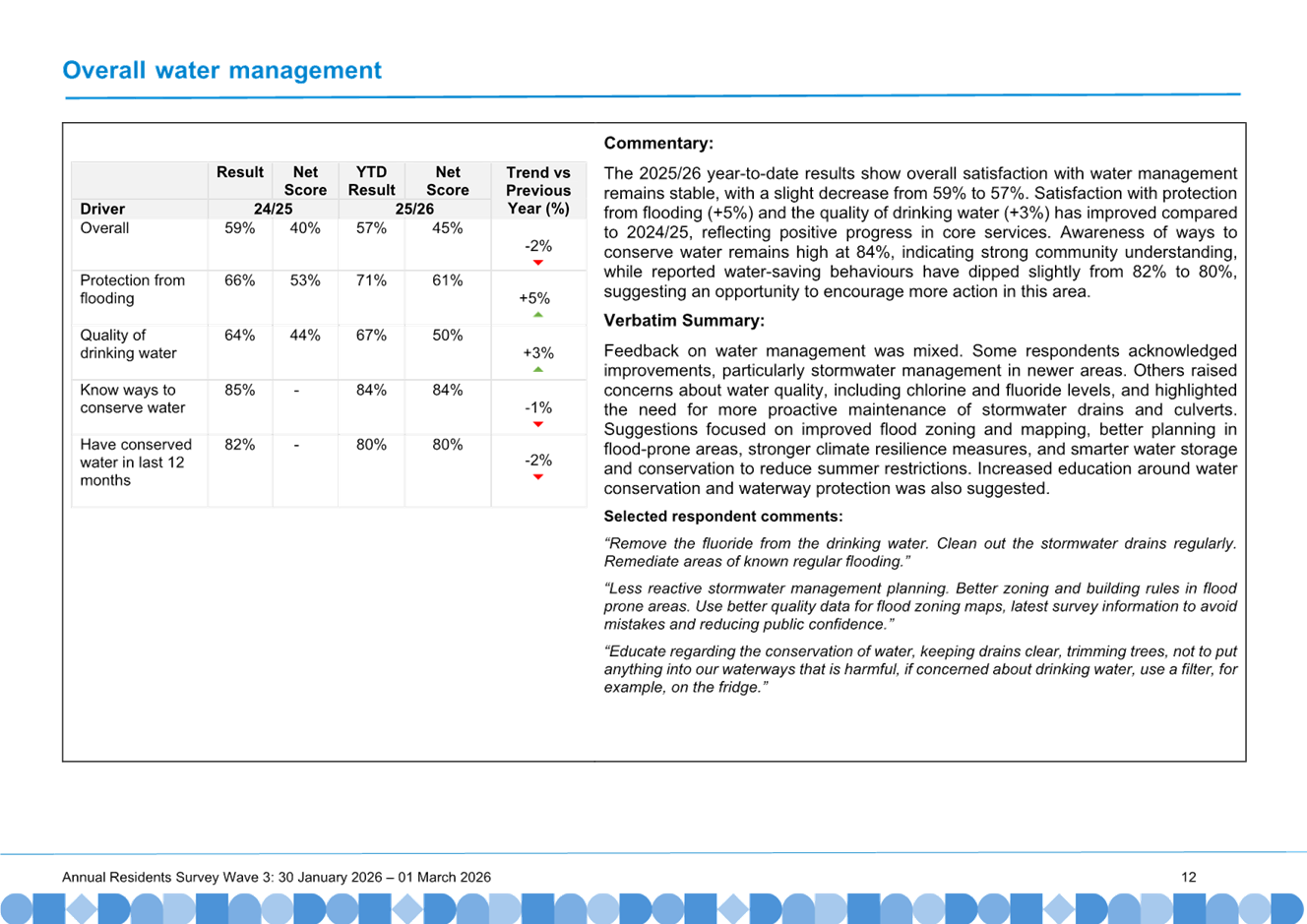
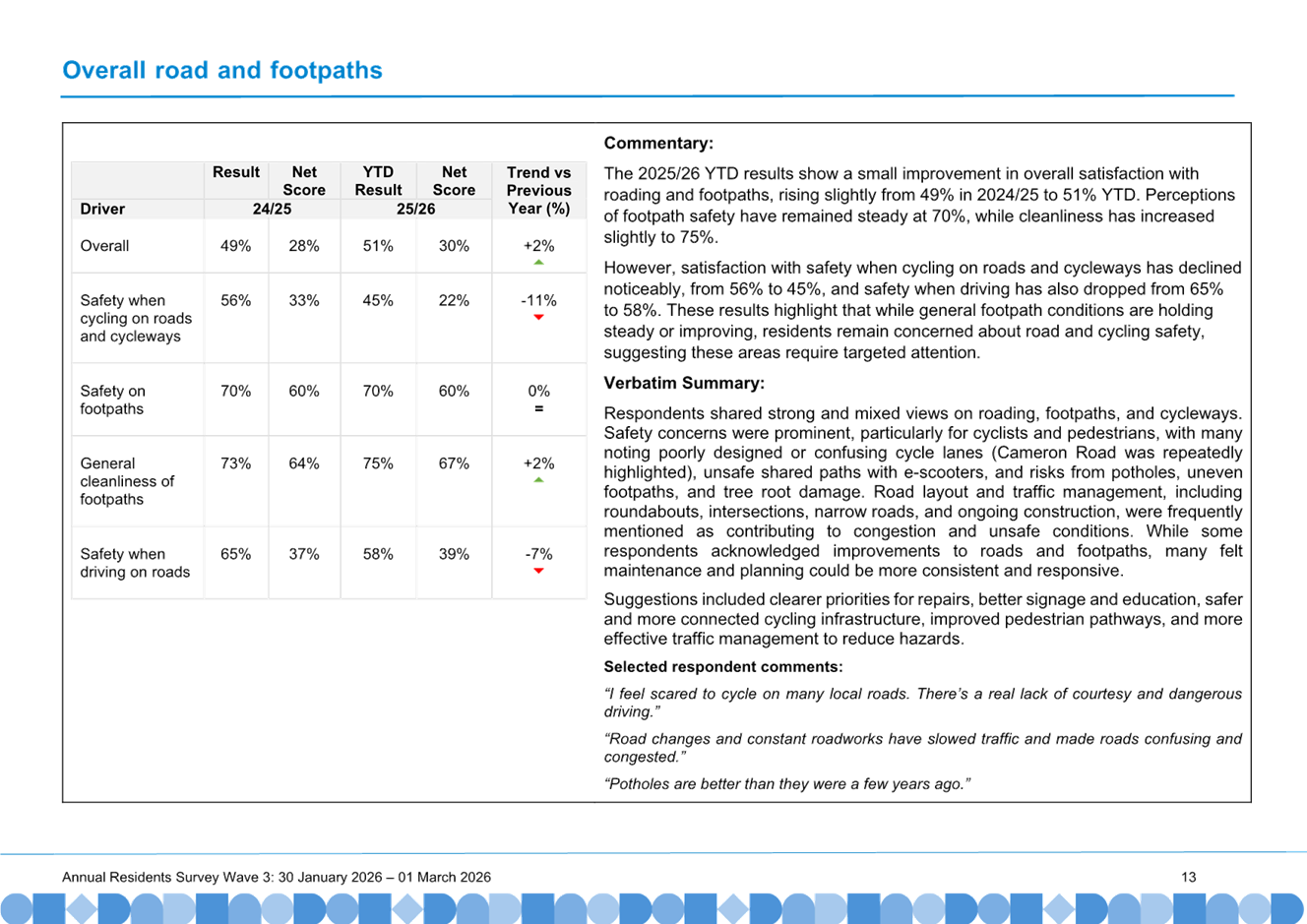
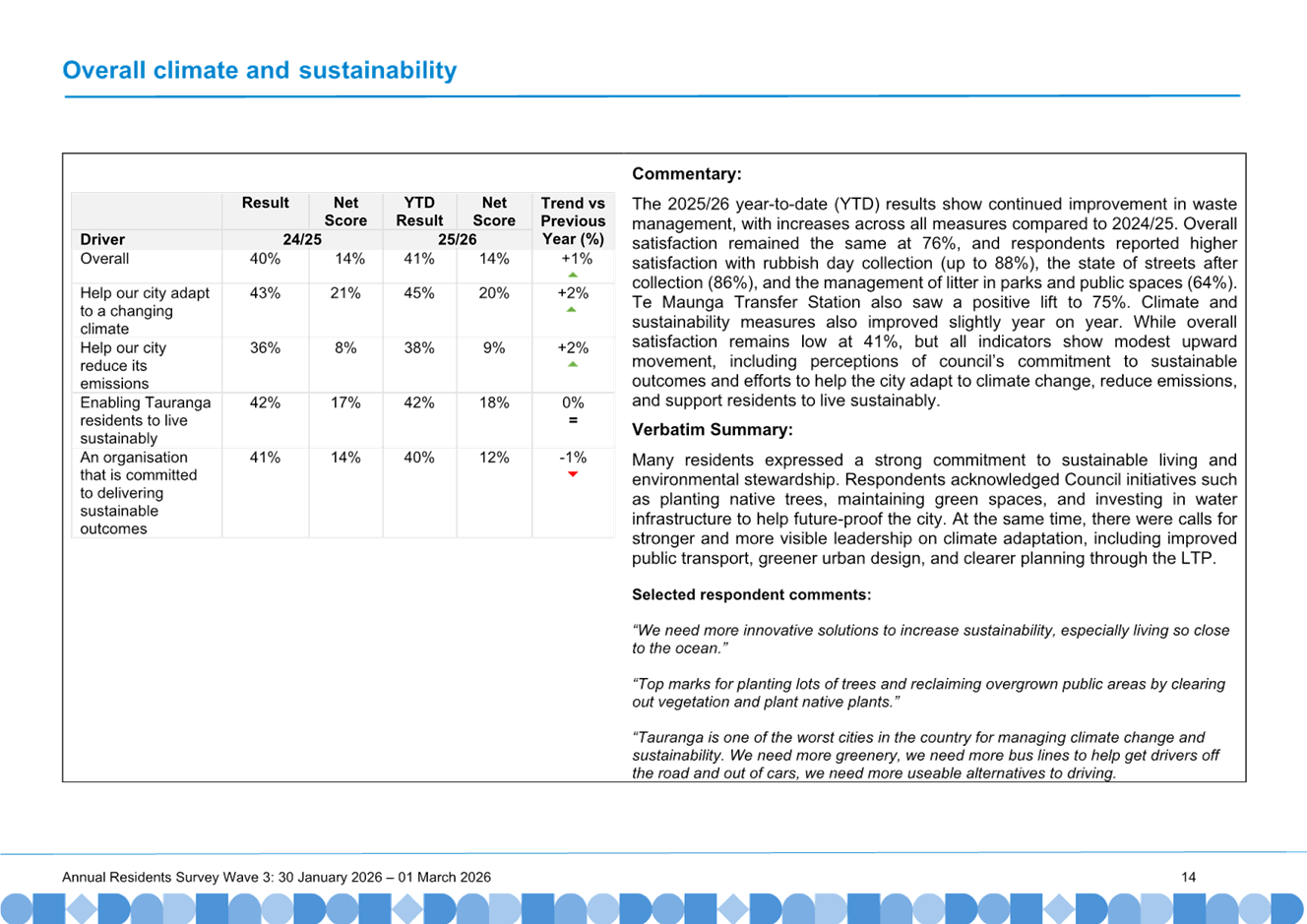
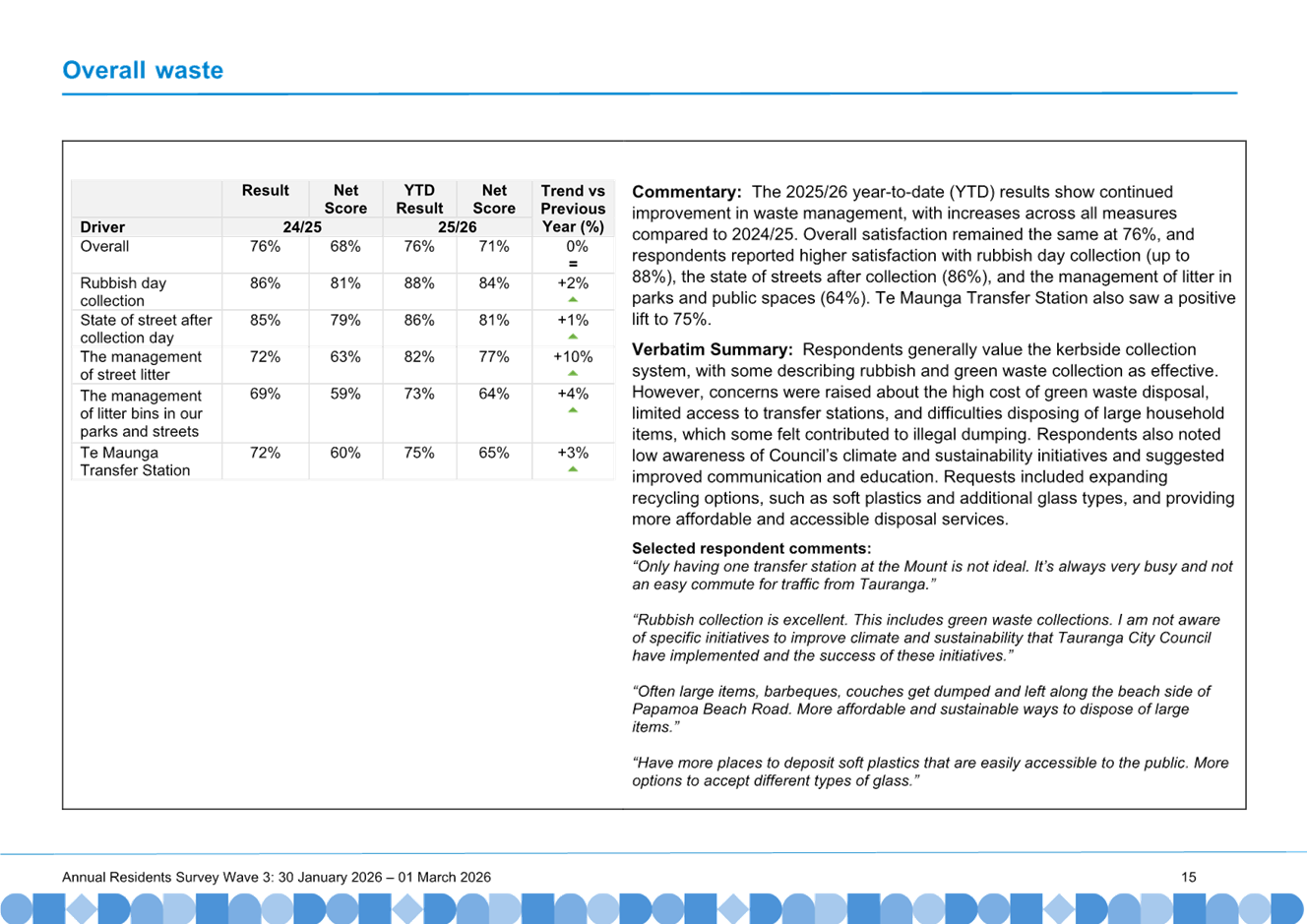
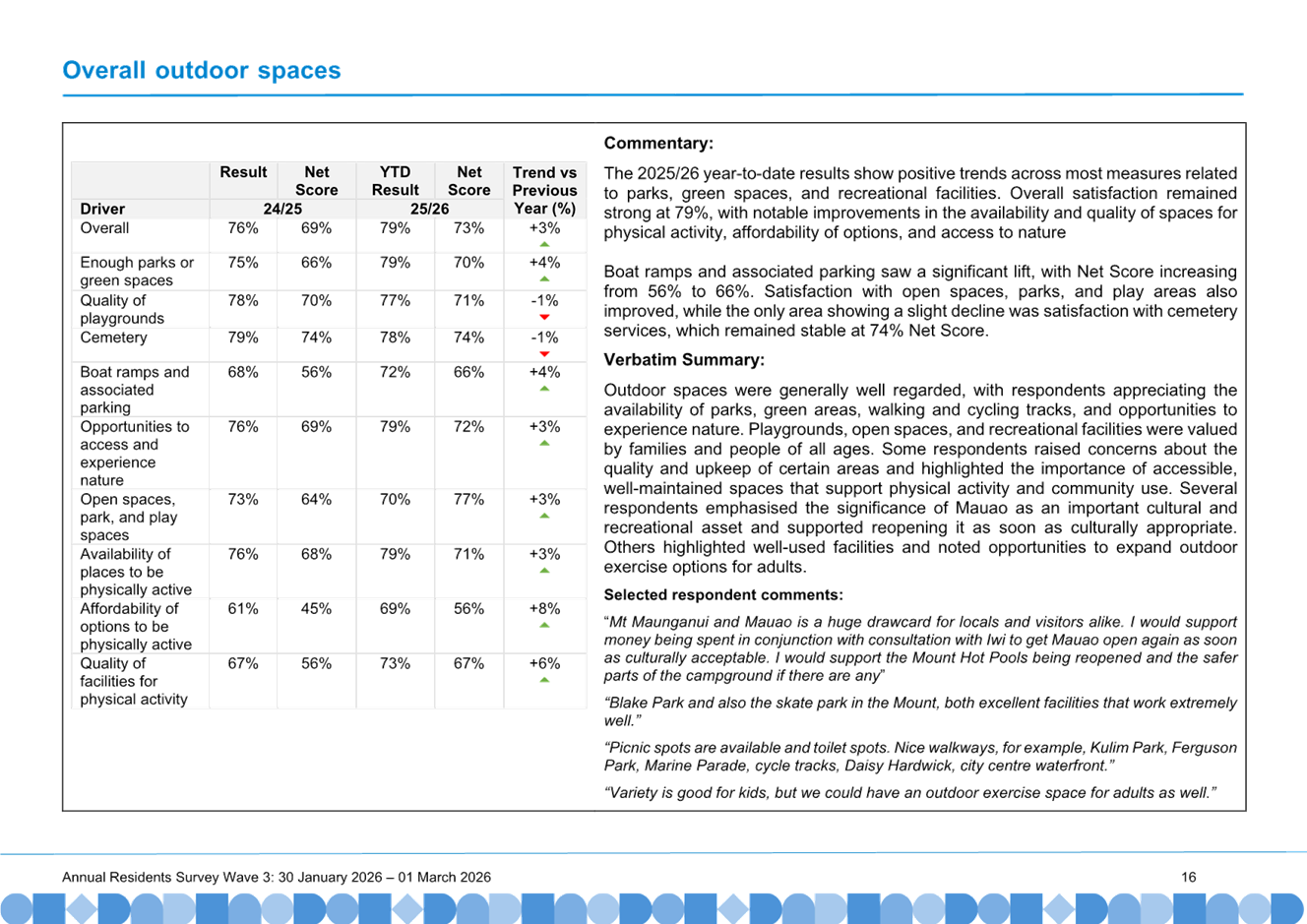
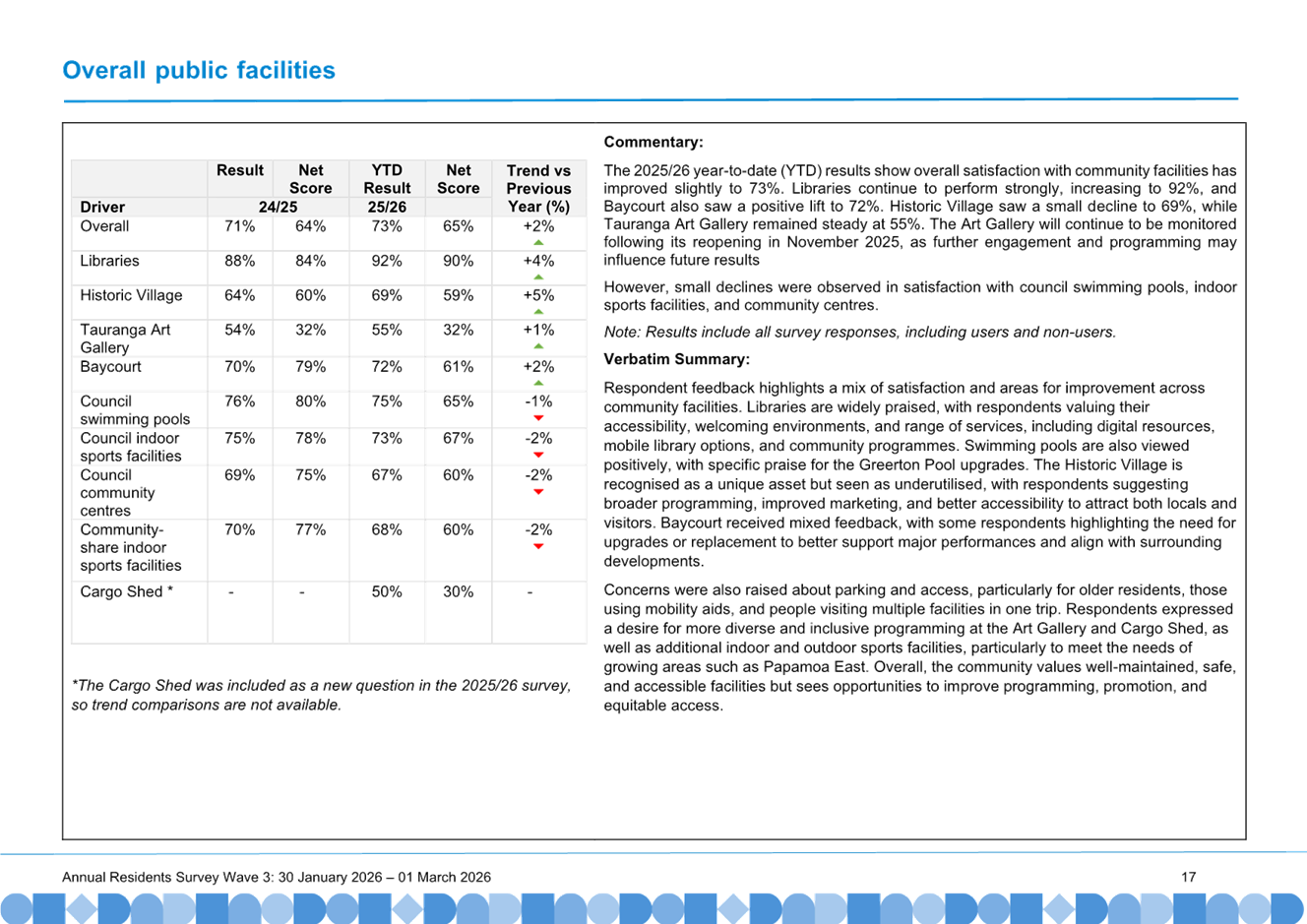

|
City
Delivery Committee meeting Agenda
|
28
April 2026
|
10.9 Mainstreets'
Monitoring Report for the period 1 July to 31 December 2025
File
Number: A19731380
Author: Kendyl
Sullivan, Team Leader: City Partnerships Specialist
Authoriser: Sarah
Omundsen, General Manager: Regulatory and Community Services
Purpose of the Report
1. For Mainstreet
organisations to report to Council on their activities for the period 1 July to
31 December 2025, to highlight issues, provide a financial update, and to
outline plans for upcoming activities.
|
Recommendations
That the City Delivery
Committee:
(a) Receives the report
"Mainstreets' Monitoring Report for the period 1 July to 31 December
2025".
(b) Receives the Mainstreet
Tauranga Report to 31 December 2025
(c) Receives the Mount Business
Association Report to 31 December 2025
(d) Receives the Papamoa
Unlimited Report to 31 December 2025
(e) Receives the Greerton
Business Association Report to 31 December 2025
|
Executive Summary
2. Council has funding
agreements with Mainstreet organisations to deliver services that promote
business interests, enhance local environments, and support economic activity
within their area.
3. Council pays for the
services delivered by the Mainstreet organisations through specific Mainstreet
Grants. These grants are funded by targeted commercial rates from the four
Mainstreet centres, to a total of $834,731 for FY 2025/26.
4. Mainstreet
organisations are required to be incorporated societies, which brings specific
obligations under the Incorporated Societies Act. Each Mainstreet organisation
is governed by its own independent Board, comprising predominantly volunteer
roles taken up by members of the organisation.
5. The Mainstreet
organisations have a range of obligations under their funding agreements with
the council, one of which is to provide half-year and full-year financial and
non-financial reports to the council. Half-year reports from each of the four
Mainstreet organisations are provided as attachments 1 to 4 to this report.
6. A summary of
performance, both financial and non-financial, is provided in the main body of
the report for Mainstreet Tauranga, Mount Business Association, Papamoa
Unlimited, and Greerton Business Association (collectively
“Mainstreets”).
7. An overview of each
Mainstreet organisation’s financial position for the six months to 31
December 2025 is provided in the table below:
|
|
Approx. number of members*
|
2025/26 Annual Mainstreet Grant from
TCC
(two instalments)
|
Operating Surplus / (deficit) (from all
sources as @ 31 Dec 25)
|
Total equity (as @ 31 Dec 25)
|
|
Mainstreet Tauranga
|
655
|
$398,355
|
($38,936)
|
$246,397
|
|
Mount Business Association
|
273
|
$207,876
|
($28,540)
|
$125,178
|
|
Papamoa Unlimited
|
155
|
$72,600
|
$27,773
|
$32,178
|
|
Greerton Business Association
|
140
|
$155,900
|
$22,450
|
$85,393
|
*Members based on number of
businesses in each Mainstreet area per ratepayer database, which is subject to
change. Ratepayers are also considered members of Mainstreet organisations.
Compliance and
operational issues identified by council staff
8. As outlined in
paragraph 54 to 63 of this report, issues include; governance and capacity
limitations — particularly around funding agreement compliance, clarity
of roles between Mainstreets and Council, organisational resilience and
succession planning, adequate support and training for volunteer boards and
managers, sound recruitment practices, timely delivery of agreed plans and
budgets, and consistent engagement as priority local stakeholders.
Upcoming review of the Mainstreets programme
9. Council is currently
determining the scope of a review of the Mainstreets programme, which is
considered timely now that most recommendations from the previous review in
2021 have been implemented. The Mainstreet organisations are aware of the
upcoming review and are aware that they, along with other key stakeholders,
will be involved throughout the process.
Background
10. There are agreements in place
between Council and the four Mainstreet organisations for the delivery of
Services. The objectives of the agreements are to the effect that the
Mainstreet organisations (in their respective areas) will:
(a) promote, encourage and advance
the interests of the businesses;
(b) promote and encourage the
appearance, ambience and services of the Area to make it more attractive,
interesting and inviting to shoppers, visitors and persons carrying on
business;
(c) develop economic activities
that benefit, support, and provide value to their members and the Mainstreet
business community;
(d) carry out the objects set out
in Mainstreet’s constitution and rules; and
(e) meet its obligations to the
Mainstreet members and third parties.
11. Council provides funding for
these Mainstreet services by way of a targeted rate on commercial property
within each of the Mainstreet business areas, subject to the conditions in
their funding agreements.
12. Mainstreet organisations are
incorporated societies and all business operators and (commercial) ratepayers
within their respective targeted rate areas are regarded as being a Mainstreet
member.
Discussion
Summary of half year reports provided
Overall Financial Compliance Reported
13. Mainstreet organisations held
their Annual General Meeting (AGM) during this reporting period and audited
financial accounts for the year ending 30 June 2025 have been received.
14. Audited accounts and AGM
documentation is available to view on the council
website.
15. Audited accounts for all
Mainstreet organisations show they ended the financial year with positive
equity.
16. Mount Business Association
Audit indicates partial non-compliance with reporting standards relating to two
key statements, which will be rectified in the current financial year. This is
the second year the organisation has been partially non-compliant, and it is a
focus of the new board to rectify this.
17. All Mainstreet financial
statements provided for the period 1 July – 31 December 2025 indicate
reserve funds remaining.
18. Financial statements provided
by Mainstreet Tauranga show a net loss of $38,936 over this period, with total
equity being $246,397.
19. The profit and loss statement
from Mount Business Association show a net loss of $28,540 over this period,
with total equity being $125,178.
20. Financial statements from
Papamoa Unlimited show a profit of $27,773 over this period, with total equity
being $32,178.
21. Financial statements provided
by Greerton Village Community Association show a profit of $22,450 over this
period. Total retained earnings are $85,393.
Mainstreet Tauranga (Downtown Tauranga)
22. The Mainstreet Tauranga
Monitoring Report and Financial Statements to 31 December 2025 are provided at
Attachment 1.
23. The current agreement for the
delivery of Mainstreet services has been in place since 1 July 2024. Funding of
$398,355 from
targeted rates is provided by council under the agreement for the year ending
30 June 2026.
24. Mainstreet Tauranga employs a
manager and an administration and engagement co-ordinator, who are responsible
to the organisation’s board for the day-to-day delivery of the Mainstreet
programme.
25. Mainstreet Tauranga have set
KPIs around; advocacy and engaged membership, collaborative partnerships, and
finance, operations and governance.
26. Highlights over this period
include collaborative partnerships, bus back campaign, Downtown Tauranga
voucher booklet and tote bags, advocacy relating to parking and waterfront
central plaza, activations and events including curated work do’s, discovery
trails, and Santa’s grotto, alongside positive sales data through
marketview.
27. Challenges for Downtown
Tauranga include learnings from the late-night shopping Christmas event, and
safety and security.
28. Mainstreet Tauranga is looking
forward to how vacant shops could be activated.
Mount Business Association
29. The Mount Business Association
Monitoring Report, including financial reporting, is provided at Attachment 2.
30. The agreement for the delivery
of Mainstreet services has been in place since 12 December 2023. Funding of
$207,876 from targeted rates is provided by council under the agreement for the
year ending 30 June 2026.
31. For most of this reporting
period, Mount Business Association contracted; a Business Improvement Manager
working 25 hours per week, serving as primary operational lead responsible for
successful execution of the Annual Plan, an Operations Manager working 2-4
hours per week providing a support and oversight role and a Delivery Manager on
10 hours per week driving strategic development and growth.
32. Mount Business
Association’s Key Performance Indicators (KPIs) for the 2025–26
financial year are guided by their Strategic Plan 2023–2028 and
structured around five strategic pillars; safety and security, member
community, advocacy, placemaking, and promotion.
33. Highlights over this period
include external funding growth, and the development of an events delivery
calendar.
34. Areas of concern include the
use of council land for commercial activities regarding frequency, scale, and
parking impacts, the Mount parking management plan, streetscape enhancements
relating to licence to occupy fees, and capability and security funding.
35. Mount Business Association are
looking forward to finalising a new strategic plan and improving operational
and governance systems to ensure organisational sustainability.
Papamoa Unlimited
(Visit Papamoa)
36. The Papamoa Unlimited
Monitoring Report, including financial reporting, is provided at Attachment 3.
37. Council continues to work
closely with Papamoa Unlimited, who have indicated through their Annual Plan,
their intention to proceed with initial consultation for an expansion of their
targeted rate area.
38. The current agreement for the
delivery of Mainstreet services has been in place since 1 July 2024. Funding of
$72,600 from targeted rates is provided by council under the agreement for the
year ending 30 June 2026.
39. Papamoa Unlimited is managed by
a volunteer chair, who engages a contractor to assist with delivering their
annual plan.
40. Papamoa set four KPIs for the
2025/26 financial year relating to; enhancing event participation, promoting
transparency and awareness, expanding membership engagement, and launching a
comprehensive website.
41. Highlights over this period
include the launch and rollout of the Visit Papamoa brand, delivering Halloween
on the waterways and the Papamoa Pak’ N Save Christmas Parade, lodging
event applications for the 26/27 financial year, and compliance obligations
relating to AGM and Incorporated Societies completed.
42. There were no issues raised in
the report.
43. Papamoa Unlimited is looking
forward to their upcoming events including the Polar Plunge, and Matariki Light
up the Waterways early in the new financial year, furthering the launch of the
Visit Papamoa brand including website development, and ongoing rollout of
social media and engagement.
Greerton Business Association
44. The Greerton Business
Association Monitoring Report, including financial reporting, is provided at
Attachment 4.
45. At the Greerton Business
Association AGM in October 2025, a rule change to the proposed constitution was
requested, necessitating the holding of a Special General Meeting (SGM) to
notify all members of the proposed change. The AGM then dropped below quorum,
so the proposed targeted rate and associated budget was also deferred to the
SGM.
46. Greerton Business Association
held a SGM in December to:
(a) Ratify two rule changes in
their new constitution relating to quorum at an SGM and adding an associate
membership category.
(b) To approve the targeted rate
for the 26/27 financial year.
Minutes
for this meeting can be found on the Council
website.
47. The agreement for delivery of
Mainstreet services has been in place since 14 November 2023. Funding of
$155,900 from targeted rates is provided by council under the agreement for the
year ending 30 June 2026.
48. For a portion of this reporting
period, Greerton Business Association operated without a manager in place.
During this time, the chairperson took on a mixed governance / management role
to ensure the compliance requirements of the funding agreement were met,
alongside baseline levels of service to members.
49. In late July, the recruitment
of a new part time Mainstreet Co-ordinator role was successful, and the
organisation looks forward to increased consistency and visibility.
50. Greerton Business Association
set two KPIs for the 2025/26 financial year; increase monthly spend and grow
member engagement.
51. Highlights over this period
include shop among the blossoms, Christmas in Greerton Village, WhatsApp
launch, and steady engagement.
52. Greerton raises an issue
relating to safety and anti-social behaviour and include their approach to
dealing with this through communication, collaboration with agencies, and
encouraging reporting. Greerton also raises an issue related to infrastructure
and streetscape concerns with a focus on improving accessibility safety, and
amenity.
53. Greerton is looking forward to
reinvigorating Greerton through murals, Autumn promotion, digital billboard
partnership and focusing on engagement.
Compliance and
operational issues Identified by council staff
54. Council’s expectation
that Mainstreets will operate according to the requirements of the Incorporated
Societies Act and their individual constitutions.
55. Lack of adherence to due dates
with compliance documentation. There is consistent inability to get compliance
documents through by the funding agreement deadlines. Obtaining compliance
documentation regularly requires reminding organisations of their upcoming
requirements and following up after the deadline has passed. There have
been several occasions where funding has been withheld / delayed due to
non-compliance.
56. Confusion and perception issues
relating to differentiation between council and Mainstreets; for example, in
relation to events.
57. Change in Mainstreet
organisational structure, either at governance or management level, can impact
the delivery of proposed plans due to the small size of these organisations.
58. A lack of succession planning
in respect to both staff and boards of organisations.
59. Mainstreet boards are
volunteers and could use further support with governance requirements.
60. It is strongly recommended by
council to use a recruitment company when appointing new staff and ensuring
good practices are in place relating to dealing with employees or contractors.
61. Council staff observe managers
experiencing workload stress and lack of clarity of responsibilities and
priorities, with little support or training available for these roles.
62. Carrying forward funding can
indicate that the organisation is unable to deliver their proposed plans,
whilst continuing to increase the targeted rate.
63. Ensuring Mainstreets are
engaged with as priority stakeholders in their respective areas and associated
communications.
STRATEGIC ALIGNMENT
64. This contributes to the
promotion or achievement of the following strategic community outcome(s):
|
Contributes
|
|
We are an inclusive city
|
ü
|
|
We value, protect and enhance the environment
|
☐
|
|
We are a well-planned city that is easy to move
around
|
☐
|
|
We are a city that supports
business and education
|
ü
|
|
We are a vibrant city that embraces
events
|
ü
|
65. Mainstreet organisations are
considered key strategic stakeholders in Council’s plans. They provide a
valuable link between businesses and Council and are involved in several
projects including numerous action and investment strategies, and policies.
66. In terms of council’s
framework that is outlined in Our Direction, well-run Mainstreet programmes can
make a worthwhile contribution to “a city that supports business and
education.”
Financial Considerations
67. Mainstreet organisations
receive a targeted rate through Council, as detailed above, totalling $834,731
in the 2025/26 financial year across the four organisations.
68. It is difficult to measure the
outcomes achieved by the Mainstreet programmes in economic terms. However,
informal measures, such as surveys, pedestrian counts, Eftpos data, and
estimated numbers of people at events, can be useful to ascertain the effectiveness
of Mainstreet events and promotions.
69. Eftpos spend data and
multi-modal camera reports are supplied to the Mainstreets, with further data
to be supplied if or when available.
70. Mainstreet organisations are
carrying forward funding and council staff have recommended clarity around
carry forward funds in proposed annual budgets.
Legal Implications / Risks
71. Each of the Mainstreet
organisations has met their funding agreement six-monthly reporting
requirements by providing Council with their half yearly reports (including
financials) for 1 July to 31 December 2025 and undertaking their Annual General
Meetings with Audited Accounts.
72. Mainstreets are asked to
consider their organisational risks and how those risks may impact on their
relationship with Council, with any risks being raised with the City
Partnerships Specialist and/or included in Council’s Risk Register.
Mainstreets have kept council staff appraised of potential and actual risks and
issues over this period.
TE AO MĀORI APPROACH
73. Although this is an
administrative report, some Mainstreets reference their Te Ao Māori
approach in their annual plans.
CLIMATE IMPACT
74. Mainstreet reports do not
specifically mention climate impacts.
Consultation / Engagement
75. It is not required or expected
to consult on Mainstreet organisation half yearly reports under the Local
Government Act 2002.
Significance
76. The Local Government Act 2002
requires an assessment of the significance of matters, issues, proposals and
decisions in this report against Council’s Significance
and Engagement Policy. Council acknowledges that in some
instances a matter, issue, proposal or decision may have a high degree of
importance to individuals, groups, or agencies affected by the report.
77. In making this assessment,
consideration has been given to the likely impact, and likely consequences for:
(a) the current
and future social, economic, environmental, or cultural well-being of the
district or region
(b) any persons who are likely to be
particularly affected by, or interested in, the matter.
(c) the capacity of the local authority
to perform its role, and the financial and other costs of doing so.
78. In accordance with the
considerations above, criteria and thresholds in the policy, it is considered
that the matter is of low significance.
ENGAGEMENT
79. Taking into consideration the
above assessment, that the matter is of low significance, officers are of the
opinion that no further engagement is required prior to Council making a
decision.
Next Steps
80. Feedback will be provided to
the Mainstreet organisations following the City Delivery Committee on 28 April
2026.
81. Council staff will continue to
support Mainstreets with their funding agreement reporting and compliance
requirements.
Attachments
1. Mainstreet
Tauranga six monthly report July - December 2025 - A20093936 (Separate
Attachments 1)
2. Mount
Business Association six monthly report July - December 2025 - A20106668
(Separate Attachments 1)
3. Papamoa
Unlimited six monthly monitoring report July - December 2025 - A19984798
(Separate Attachments 1)
4. Greerton Business
Association six monthly report July - December 2025 - A20094020 (Separate
Attachments 1)
|
City Delivery Committee meeting Agenda
|
28 April 2026
|
11 Discussion of late
items
|
City Delivery Committee meeting Agenda
|
28 April 2026
|
12 Public excluded
session
Resolution to exclude
the public
|
Recommendations
That the public be
excluded from the following parts of the proceedings of this meeting.
The general subject
matter of each matter to be considered while the public is excluded, the
reason for passing this resolution in relation to each matter, and the
specific grounds under section 48 of the Local Government Official
Information and Meetings Act 1987 for the passing of this resolution are as
follows:
|
General subject of each matter to be
considered
|
Reason for passing this resolution in
relation to each matter
|
Ground(s) under section 48 for the
passing of this resolution
|
|
12.1 - Public Excluded Minutes of the
City Delivery Committee meeting held on 10 March 2026
|
s7(2)(b)(ii) - The withholding of the information
is necessary to protect information where the making available of the
information would be likely unreasonably to prejudice the commercial
position of the person who supplied or who is the subject of the information
|
s48(1)(a) - the public conduct of the relevant
part of the proceedings of the meeting would be likely to result in the
disclosure of information for which good reason for withholding would exist
under section 6 or section 7
|
|
12.2 - Acquisition of Property
|
s7(2)(b)(ii) - The withholding of the information
is necessary to protect information where the making available of the
information would be likely unreasonably to prejudice the commercial
position of the person who supplied or who is the subject of the information
s7(2)(g) - The withholding of the information is
necessary to maintain legal professional privilege
s7(2)(h) - The withholding of the information is
necessary to enable Council to carry out, without prejudice or
disadvantage, commercial activities
s7(2)(i) - The withholding of the information is
necessary to enable Council to carry on, without prejudice or disadvantage,
negotiations (including commercial and industrial negotiations)
|
s48(1)(a) - the public conduct of the relevant
part of the proceedings of the meeting would be likely to result in the
disclosure of information for which good reason for withholding would exist
under section 6 or section 7
|
|
12.3 - Activity Group Report
|
s7(2)(a) - The withholding of the information is
necessary to protect the privacy of natural persons, including that of
deceased natural persons
|
s48(1)(a) - the public conduct of the relevant
part of the proceedings of the meeting would be likely to result in the
disclosure of information for which good reason for withholding would exist
under section 6 or section 7
|
|
|
City Delivery Committee meeting Agenda
|
28 April 2026
|
13 Closing
karakia