|

|
|
AGENDA
Ordinary Council meeting
Tuesday, 21 April 2026
|
|
I hereby give notice that an Ordinary meeting of
Council will be held on:
|
|
Date:
|
Tuesday, 21 April 2026
|
|
Time:
|
9:30 am
|
|
Location:
|
Tauranga City Council Chambers, Mareanui
L1, 90 Devonport Road
Tauranga
|
|
|
|
Marty Grenfell
Chief Executive
|
Terms of reference – Council
Membership
|
Chair
|
Mayor
Mahé Drysdale
|
|
Deputy Chair
|
|
|
Members
|
|
|
Quorum
|
Half of the members
present, where the number of members (including vacancies) is even;
and a majority of the members present, where the number of members
(including vacancies) is odd.
|
|
Meeting frequency
|
Three weekly or as required
|
Role
·
To ensure the effective and efficient governance
of the City.
·
To enable leadership of the City including
advocacy and facilitation on behalf of the community.
·
To review and monitor the performance of the
Chief Executive.
Scope
·
Oversee the work of all committees and
subcommittees.
·
Exercise all non-delegable and non-delegated
functions and powers of the Council.
·
The powers Council is legally prohibited from
delegating include:
○
Power to make a rate.
○
Power to make a bylaw.
○
Power to borrow money, or purchase or dispose of
assets, other than in accordance with the long-term plan.
○
Power to adopt a long-term plan, annual plan, or
annual report
○
Power to appoint a chief executive.
○
Power to adopt policies required to be adopted
and consulted on under the Local Government Act 2002 in association with the
long-term plan or developed for the purpose of the local governance statement.
○
All final decisions required to be made by
resolution of the territorial authority/Council pursuant to relevant
legislation (for example: the approval of the City Plan or City Plan changes as
per section 34A Resource Management Act 1991).
·
Council has chosen not to delegate the
following:
○
Power to compulsorily acquire land under the
Public Works Act 1981.
·
Make those decisions which are required by
legislation to be made by resolution of the local authority.
·
Authorise all expenditure not delegated to
officers, Committees or other subordinate decision‑making bodies of
Council.
·
Make appointments of members to the council-controlled
organisation Boards of Directors/Trustees and representatives of Council to
external organisations.
·
Undertake statutory duties in regard to
Council-controlled organisations, including reviewing statements of intent,
with the exception of the Local Government Funding Agency where such roles are
delegated to the City Delivery Committee. (Note that monitoring of all
Council-controlled organisations’ performance is undertaken by the City
Delivery Committee. This also includes Priority One reporting.)
·
Consider all matters related to Local Water Done
Well.
·
Consider any matters referred from any of the
Standing or Special Committees, Joint Committees, Chief Executive or General
Managers.
·
Review and monitor the Chief Executive’s
performance.
·
Develop Long Term Plans and Annual Plans
including hearings, deliberations and adoption.
Procedural matters
·
Delegation of Council powers to Council’s
committees and other subordinate decision-making bodies.
·
Adoption of Standing Orders.
·
Receipt of Joint Committee minutes.
·
Approval of Special Orders.
·
Employment of Chief Executive.
·
Other Delegations of Council’s powers,
duties and responsibilities.
Regulatory matters
Administration, monitoring and
enforcement of all regulatory matters that have not otherwise been delegated or
that are referred to Council for determination (by a committee, subordinate
decision‑making body, Chief Executive or relevant General Manager).
1 Opening
karakia
2 Apologies
|
Ordinary Council meeting Agenda
|
21 April 2026
|
3 Public
forum
3.1 Kathy
Webb - Neighbourhood Support Western Bay of Plenty
Attachments
Nil
|
Ordinary Council meeting Agenda
|
21 April 2026
|
7 Confirmation
of minutes
7.1 Minutes
of the Council meeting held on 3 March 2026
File
Number: A20115597
Author: Clare
Sullivan, Senior Governance Advisor
Authoriser: Sarah
Holmes, Team Leader: Governance & CCO Support Services
|
Recommendations
That the Minutes of the
Council meeting held on 3 March 2026 be confirmed as a true and correct
record.
|
Attachments
1. Minutes
of the Council meeting held on 3 March 2026
|
Ordinary
Council meeting minutes
|
3 March 2026
|
|

|
|
DRAFT MINUTES
Ordinary Council meeting
Tuesday, 3 March 2026
|
Order of Business
1 Opening
karakia. 3
2 Apologies. 3
3 Public
forum.. 4
3.1 Jessica
Walker from the SPCA will address their submission on the Draft Street Use
& Public Places Bylaw.. 4
3.2 Hayden
Duncan from Bower Real Estate will address their submission on the Draft Street
Use and Public Places Bylaw.. 4
3.3 Residents
from Nautilus Apartments. 4
4 Acceptance
of late items. 4
5 Confidential
business to be transferred into the open. 4
6 Change to
the order of business. 4
7 Confirmation
of minutes. 5
8 Declaration
of conflicts of interest 5
9 Deputations,
presentations, petitions. 5
10 Recommendations from
other committees. 5
11 Business. 5
11.1 Street
Use and Public Places Bylaw 2026 Deliberations. 5
11.2 Draft
Dog Management Bylaw and Policy and Keeping of Animals Bylaw for Adoption for
Consultation. 6
11.3 Elected
Members' Expenses and Resources policy - Home Security Allowance. 7
11.4 Status
update on actions from prior Council meetings. 7
12 Discussion of late
items. 8
13 Public excluded
session. 8
13.1 CCO
Board appointments - Bay Venues Limited and Te Manawataki o Te Papa Limited 8
13.2 University
of Waikato MoU and Student Accommodation. 8
13.3 Special
litigation report 8
Confidential Attachment 2............ 11.4 - Status update on
actions from prior Council meetings. 9
14 Closing karakia. 9
MINUTES
OF Tauranga City Council
Ordinary Council meeting
HELD
AT THE Tauranga City Council Chambers,
L1, 90 Devonport Road, Tauranga
ON
Tuesday, 3 March 2026 AT 9:30 am
|
MEMBERS PRESENT:
|
Mayor Mahé Drysdale,
Deputy Mayor Jen Scoular, Cr Hautapu Baker, Cr Glen Crowther, Cr Rick Curach,
Cr Steve Morris, Cr Marten Rozeboom, Cr Kevin Schuler, Cr Rod Taylor, Cr
Hēmi Rolleston
|
|
IN ATTENDANCE:
|
Marty Grenfell (Chief Executive),
Christine Jones (General Manager: Strategy, Partnerships & Growth), Sarah
Omundsen (General Manager: Regulatory & Community Services), Craig Rice
(Chief Operating & Financial Officer), Jeremy Boase (Head of Strategy,
Governance & Climate Resilience), Shawn Geard (Manager: Transport
System), Jane Barnett (Policy Analyst), Vicky Grant-Ussher (Policy
Analyst), Oscar Glossop (Team Leader: Animal Services), Clare Sullivan
(Senior Governance Advisor), Anahera Dinsdale (Governance Advisor),
|
Timestamps are included beside each of the items and relate
to the recording of the meeting held on 3 March 2026 on the Council's YouTube channel
1 Opening
karakia
Cr Hautapu Baker opened the meeting with a karakia.
Presentation to staff member
The Mayor made a presentation to Lance Barlow from the City
Waters Wastewater Treatment Plant team on the occasion of his 40 years of
service to Tauranga City Council. The Mayor noted that Mr Barlow had
played a critical role in keeping the treatment plants and pump stations
operating safely, efficiently and reliably at a time when the network had more
than doubled in size. He also noted the positive influence Lance had on
the wider City Waters team.
2 Apologies
Nil
3 Public
forum
|
3.1 Jessica
Walker from the SPCA will address their submission on the Draft Street Use
& Public Places Bylaw
|
|
·
Jessica represented SPCA in a national capacity as National
Science Manager. She advised that SPCA urged Council to consider
introducing clear restrictions on the use of fireworks in public places and
in streets. Introducing restrictions would be an important step in addressing
community concerns including nuisance, public safety, and fire
risk.
·
She noted that other councils had implemented a similar
approaches. For example, Auckland Council prohibited the setting off of
fireworks in public places without written approval.
·
SPCA acknowledged that Council could not control the private
use of fireworks on private property. She suggested that Tauranga could lead
by example and by introducing stronger protections
·
SPCA supported the continued use of controlled continued use of
notified public displays, but remained concerned about the unregulated
private use of fireworks, noting the significant safety and welfare issues
that these posed.
·
Jessical noted that fireworks regulation was a national issue.
SPCA submitted on three petitions presented to parliament, advocating at a
national level for a ban on the private sale and use of fireworks.
|
4 Acceptance
of late items
Nil
5 Confidential
business to be transferred into the open
Nil
6 Change
to the order of business
Nil
7 Confirmation
of minutes
Nil
8 Declaration
of conflicts of interest
Nil
9 Deputations,
presentations, petitions
Nil
10 Recommendations
from other committees
Nil
11 Business
Timestamp: 17 minutes
|
11.1 Street Use and Public
Places Bylaw 2026 Deliberations
|
|
Staff Sarah
Omundsen, General Manager: Regulatory & Community Services
Jane
Barnett, Policy Analyst
Shawn
Geard, Manager: Transport System
|
|
Resolution CO/26/3/1
Moved: Cr
Steve Morris
Seconded: Cr Glen Crowther
That the Council:
(a) Receives the report
"Street Use and Public Places Bylaw 2026 Deliberations".
(b) Approves the following
amendments to the draft Street Use and Public Places Bylaw:
(i) a maximum size
requirement of 1200mm high x 800mm wide for real estate signs
(ii) open home and auction signs
may only be displayed on the day of the open home or auction.
(c) Resolves, in accordance with
section 155 of the Local Government Act 2002 that the proposed Street Use and
Public Places Bylaw (Attachment One):
(i) is the most appropriate
way to help protect the community from public nuisance and offensive
behaviour, protect public health and safety, and protect council-controlled
public places and the environment from misuse
(ii) is the most appropriate form
of the bylaw
(iii) is not inconsistent with
the New Zealand Bill of Rights Act 1990, noting that any implications are
considered reasonable and demonstrably justifiable in a free and democratic
society as they are necessary to protect public safety, amenity and the
rights of others using public places.
(d) Adopts the final Street Use
and Public Places Bylaw 2026, to come into force on 1 July 2026.
(e) Authorises the General
Manager: Regulatory and Community Services to make any necessary minor final
edits to the Street Use and Public Places Bylaw 2026, prior to publication.
(f) Directs
staff to prepare a draft amendment to the bylaw to prohibit fireworks in all
Council owned and or controlled public places.
Carried
|
Timestamp: 40 minutes
|
11.2 Draft Dog Management
Bylaw and Policy and Keeping of Animals Bylaw for Adoption for Consultation.
|
|
Staff Sarah
Omundsen, General Manager Regulatory & Community Services
Vicky
Grant Ussher, Policy Analyst
Oscar
Glossop, Team Leader: Animal Services
|
|
Resolution CO/26/3/2
Moved: Cr
Marten Rozeboom
Seconded: Mayor Mahé Drysdale
That the Council:
(a) Receives the report
"Draft Dog Management Bylaw and Policy and Keeping of Animals Bylaw for
adoption for consultation."
(b) Agrees to the following
approaches to be included in the draft Bylaws, Policy and Statement of
Proposal for public consultation:
|
(i)
|
Issue 1 - Waterfront
Area
|
Option A
- Limit the leash restricted area to 1 Dive Cresent (the northern
waterfront park entrance) to the base of the Matapihi bridge.
|
|
(ii)
|
Issue 2
– Shark Alley boundaries
|
Option B
- Add dog restrictions to Shark Alley and encompass the adjacent dunes,
grassed area, boardwalk and greenspace up to the kerb of Marine Parade
opposite 31 Marine Parade
|
|
(iii)
|
Issue 3
– areas fenced for accessibility and inclusion
|
Option C
- Prohibit dogs from specified fenced public places – fenced area, as
well as tailored rules for exit, entry and transit specific to each space.
|
|
(iv)
|
Issue 4
– beach accessways
|
Option A
– Require dogs to be on leash through designated beach accessways.
|
|
(v)
|
Issue 5
– Bee Regulation
|
Option B
- Remove the specific bee provision and instead use the new general powers
clause where this is necessary to manage bee issues.
|
(c) Agrees to adopt for
consultation the attached draft Dog Management Bylaw (Attachment 1) and
Policy (Attachment 2) and draft Keeping of Animals Bylaw (Attachment 3) and
Statement of Proposal (Attachment 4).
(d) Resolves, in accordance with
section 155 of the Local Government Act 2002 (Attachment 5) that the draft
Dog Management Bylaw and draft Keeping of Animals Bylaw:
(i) are the most
appropriate ways to minimise danger, distress, and nuisance to the community
generally from dogs, and to protect public health and safety and minimise
nuisance from the keeping of animals
(ii) are the most appropriate
forms of the bylaw
(iii) are not inconsistent with
the New Zealand Bill of Rights Act 1990, noting that any implications are
considered reasonable and demonstrably justifiable in a free and democratic
society as they are necessary to protect public safety, amenity and the
rights of others using public places.
(e) Delegate to the General
Manager: Regulatory and Community Services authority to make any amendments
necessary to give effect to decisions in recommendation (b) and any minor or
typographic changes required prior to public consultation.
Carried
|
Timestamp: 1 hour and 7 minutes
|
11.3 Elected Members'
Expenses and Resources policy - Home Security Allowance
|
|
Staff Jeremy
Boase, Head of Strategy, Governance & Climate Resiliance
|
|
Resolution CO/26/3/3
Moved: Deputy
Mayor Jen Scoular
Seconded: Cr Kevin Schuler
That the Council:
(a) Receives the report
"Elected Members' Expenses and Resources policy - home security
allowance".
(b) Adopts the draft revised
Elected Members’ Expenses and Resources policy, incorporating the
addition of the home security section. (Attachment 1).
(c) Approves retrospective
reimbursement of any home security eligible under the Elected Members
Expenses and Resources Policy which was installed from 1 July 2025, being the
date the Local Government Elected Members (2025/26) Determination 2025 came
into force, where all requirements of the Policy have been met except for a
security threat and risk assessment being authorised prior to the
installation. The security threat and risk assessment must still be
completed and conclude that a security system is needed for reimbursement to
occur.
Carried
|
Timestamp: 1 hour and 8 minutes
|
11.4 Status update on
actions from prior Council meetings
|
|
Staff Christine
Jones, General Manager; Strategy, Partnerships & Growth
|
|
Resolution CO/26/3/4
Moved: Cr
Rod Taylor
Seconded: Cr Hēmi Rolleston
That the Council:
(a) Receives the report
"Status update on actions from prior Council meetings".
(b) Attachment 2 is to
remain in the public excluded section to maintain the privacy of natural
persons (as per s7(2)(a) of the Local Government Official Information and
Meetings Act 1987).
Carried
|
12 Discussion
of late items
Nil
13 Public
excluded session
Resolution to exclude the public
|
Resolution CO/26/3/5
Moved: Cr
Rod Taylor
Seconded: Deputy Mayor Jen Scoular
That the public be excluded from the following parts of
the proceedings of this meeting at 10.49am.
The general subject matter of each matter to be considered
while the public is excluded, the reason for passing this resolution in
relation to each matter, and the specific grounds under section 48 of the
Local Government Official Information and Meetings Act 1987 for the passing
of this resolution are as follows:
|
General
subject of each matter to be considered
|
Reason for
passing this resolution in relation to each matter
|
Ground(s)
under section 48 for the passing of this resolution
|
|
13.1 - CCO
Board appointments - Bay Venues Limited and Te Manawataki o Te Papa Limited
|
s7(2)(a) - The
withholding of the information is necessary to protect the privacy of
natural persons, including that of deceased natural persons
|
s48(1)(a) - the public
conduct of the relevant part of the proceedings of the meeting would be
likely to result in the disclosure of information for which good reason for
withholding would exist under section 6 or section 7
|
|
13.2 -
University of Waikato MoU and Student Accommodation
|
s7(2)(b)(ii) - The
withholding of the information is necessary to protect information where
the making available of the information would be likely unreasonably to
prejudice the commercial position of the person who supplied or who is the
subject of the information
|
s48(1)(a) - the public
conduct of the relevant part of the proceedings of the meeting would be
likely to result in the disclosure of information for which good reason for
withholding would exist under section 6 or section 7
|
|
13.3 -
Special litigation report
|
s6(a) - The making
available of the information would be likely to prejudice the maintenance
of the law, including the prevention, investigation, and detection of
offences, and the right to a fair trial
s7(2)(a) - The
withholding of the information is necessary to protect the privacy of
natural persons, including that of deceased natural persons
s7(2)(b)(ii) - The
withholding of the information is necessary to protect information where
the making available of the information would be likely unreasonably to
prejudice the commercial position of the person who supplied or who is the
subject of the information
s7(2)(f)(ii) - The
withholding of the information is necessary to maintain the effective
conduct of public affairs through the protection of Council members,
officers, employees, and persons from improper pressure or harassment
s7(2)(g) - The
withholding of the information is necessary to maintain legal professional
privilege
s7(2)(i) - The
withholding of the information is necessary to enable Council to carry on,
without prejudice or disadvantage, negotiations (including commercial and
industrial negotiations)
|
s48(1)(a) - the public
conduct of the relevant part of the proceedings of the meeting would be
likely to result in the disclosure of information for which good reason for
withholding would exist under section 6 or section 7
|
|
Confidential
Attachment 2 - 11.4 - Status update on actions from prior Council meetings
|
s7(2)(a) - The
withholding of the information is necessary to protect the privacy of
natural persons, including that of deceased natural persons
|
s48(1)(a) the public
conduct of the relevant part of the proceedings of the meeting would be
likely to result in the disclosure of information for which good reason for
withholding would exist under section 6 or section 7
|
Carried
|
14 Closing
karakia
Cr Hautapu Baker closed the meeting with a karakia.
The meeting closed at 1.30pm on Thursday 26 March.
The minutes of this meeting were confirmed as a true and
correct record at the Ordinary Council meeting held on 21 April 2026.
|
Ordinary
Council meeting Agenda
|
21
April 2026
|
7.2 Minutes of
the Council meeting held on 24 March 2026
File
Number: A20122534
Author: Clare
Sullivan, Senior Governance Advisor
Authoriser: Sarah
Holmes, Team Leader: Governance & CCO Support Services
|
Recommendations
That the Minutes of the
Council meeting held on 24 March 2026 be confirmed as a true and correct
record.
|
Attachments
1. Minutes
of the Council meeting held on 24 March 2026
|
Ordinary
Council meeting minutes
|
24 March 2026
|
|

|
|
DRAFT MINUTES
Ordinary Council meeting
Tuesday, 24 March 2026
|
Order of Business
1 Opening
karakia. 4
2 Apologies. 4
3 Public
forum.. 4
3.1 Matt
Cowley - Tauranga Business Awards. 4
3.3 Shad
Rolleston on behalf of the Tangata Whenua Working Group Members. 5
3.3 Sam
Allen. 5
4 Acceptance
of late items. 5
5 Confidential
business to be transferred into the open. 5
6 Change to
the order of business. 6
7 Confirmation
of minutes. 6
7.1 Minutes
of the Council meeting held on 10 February 2026. 6
8 Declaration
of conflicts of interest 6
9 Deputations,
presentations, petitions. 6
10 Recommendations from
other committees. 6
11 Business. 6
11.1 Local
Water Done Well - Project Update. 6
11.2 Local
Water Done Well - Commercial Terms. 7
11.3 Local
Water Done Well - Due Diligence. 9
11.4 Local
Water Done Well - Financial Implications. 10
11.5 Annual
Plan 2026-27 Update. 14
11.6 Annual
Plan 2026/27 - Levels of Service Options - part 1. 14
12 Public excluded
session. 15
13.2 Annual
Plan 2026/27 - Levels of Service Options - part 2. 15
13.4 Council-Controlled
Organisations - Tourism Bay of Plenty. 15
13.5 Regulatory
Hearings Panel Appointments and Terms of Reference. 15
13 Business continued. 16
11.5 Annual
Plan 2026-27 Update Continued. 16
11.7 January
2026 Weather Event and Subsequent Expenditure. 18
11.8 Draft
User Fees and Charges Schedule 2026/27. 19
11.9 Approval
of Draft Development Contributions Policy 2026/27. 20
11.11 Submission
to Bay of Plenty Regional Council's Long Term Plan Amendment 20
11.12 Transport
Resolutions Report No.60. 21
14 Public excluded
session. 21
13.1 Public
Excluded Minutes of the Council meeting held on 10 February 2026. 22
13.3 Application
for development contributions waiver at Tauriko West 22
13.6 Public
Art Framework. 22
Confidential Attachment 1 11.1 - Local Water
Done Well - Project Update. 22
Confidential Attachment 1 11.3 - Local Water
Done Well - Due Diligence. 22
Confidential Attachment 3 11.3 - Local Water
Done Well - Due Diligence. 22
Confidential Attachment 5 11.4 - Local Water
Done Well - Financial Implications. 23
15 Closing karakia. 23
MINUTES
OF Tauranga City Council
Ordinary Council meeting
HELD
AT THE Tauranga City Council Chambers,
L1, 90 Devonport Road, Tauranga
ON
Tuesday, 24 March 2026 AT 9:30 am
|
MEMBERS PRESENT:
|
Mayor Mahé Drysdale,
Deputy Mayor Jen Scoular, Cr Hautapu Baker, Cr Glen Crowther, Cr Rick Curach,
Cr Steve Morris, Cr Marten Rozeboom, Cr Kevin Schuler, Cr Rod Taylor, Cr
Hēmi Rolleston
|
|
IN ATTENDANCE:
|
Marty Grenfell (Chief Executive),
Christine Jones (General Manager: Strategy, Partnerships & Growth), Craig
Rice (Chief Operating & Financial Officer), Sarah Omundsen (General
Manager: Regulatory & Community), Reneke van Soest (General Manager:
Operations & Infrastructure), Charles Lane (Team Leader: Commercial
Legal), Tyler Buckley (Commercial Solicitor), Stephen Burton (Transformation
Lead – Water Services), Frazer Smith (Manager: Strategic Finance &
Growth), Cathy Davidson (Water Organisation Establishment Lead), Jeremy Boase
(Head of Strategy, Governance & Climate Resilience), Kathryn Sharplin
(Head of Finance), Tracey Hughes (Manager: Organisational Financial
Performance & Corporate Planning), Gareth Wallis (Head of Community Hubs,
Arts, Heritage & Events), Andrew Mead (Head of City Planning &
Growth), Mike Seabourne (Head of Transport), Shawn Geard (Manager: Transport
System), Caroline Lim (CCO Specialist), Clare Sullivan (Senior Governance
Advisor) Anahera Dinsdale (Governance Advisor), Caroline Irvin (Governance
Advisor)
|
Timestamps are included beside each of the items and relate
to the recording of the meeting held on 24 March 2026 on the Council's YouTube
channel - Part 1
and Part
2
1 Opening
karakia
Cr Hēmi Rolleston opened the meeting with a karakia.
2 Apologies
Nil
Deputy Mayor Jen Scoular arrived at 9.35 am.
3 Public
forum
|
3.1 Matt Cowley
- Tauranga Business Awards
|
|
·
Mr Cowley, Chief Executive of the Tauranga Chamber of Commerce,
addressed the Council regarding the Tauranga Business Awards 2026.
·
He noted that the awards had been the largest awards held in
over 10 years. More than half of the applicants were non-members of the
Chamber. An independent panel of judges was used.
·
Mr Cowley highlighted the exceptionally high standard of
finalists and acknowledged several award winners: JNP Aviation Limited who
supply ground crew support to 10 airports in New Zealand, based in Tauranga;
Archishade, based in Pāpāmoa, who design and manufacture outdoor
shade solutions and the overall winner of Business of the Year , SYOS
Aerospace, which specialised in air, land and sea drones. Its head research
and development operations were based in Tauranga and it was set to open a
large manufacturing plant in Mount Maunganui later this year.
·
Mr Cowley noted there is limited support for start-up
businesses and encouraged elected members and council staff, when next
reviewing the economic development portfolio, to continue strengthening
relationships within the sector to maximise the return from
Council’s investment.
|
|
3.3 Shad
Rolleston on behalf of the Tangata Whenua Working Group Members
|
|
·
Shad Rolleston and Hakopa Tapiata spoke on behalf of the tangata
whenua working group members on Local Waters Done Well.
·
Mr Rolleston noted that it was a privilege being part of the
working group. He acknowledged that one of the objectives was to deliver
water services efficiently while taking environmental demands into account. He
emphasised that from a te ao Māori perspective, water was valued in an
integrated way, and held mana reflecting on the intrinsic relationship
between people and the environment.
·
Delivering healthy water that supported community wellbeing
aligned with these values and was central to the outcomes. Water was an integral
part of Māori identity, and there was legislative responsibility for
local government to recognise and provide for Māori participation in
decision-making.
·
Mr Rolleston highlighted that rohe boundaries overlapped both Tauranga
City Council and Western Bay of Plenty District Council. Māori
governance structures were place-based and operated across both councils.
·
Mr Tapiata emphasised the importance of tangata whenua
governance and participation, moving beyond consultation to having a clear and
meaningful role in decision-making processes. He noted the joint working
group had achieved this, describing it as a positive, enabling and empowering
process. He expressed a desire for this approach to serve as a model
for best practice – moving beyond consultation toward genuine
partnership.
·
It was noted that iwi would continue to participate as long as
they saw value and felt their voices were heard, respected and listened to.
|
|
3.3 Sam Allen
|
|
·
Mr Allen, an artist, expressed his view by reading a
poem. He considered that there was a lot of pain and worry in the
community.
|
4 Acceptance
of late items
Nil
5 Confidential
business to be transferred into the open
Nil
6 Change
to the order of business
The agenda was taken in the following order.
7 Confirmation
of minutes
|
7.1 Minutes of
the Council meeting held on 10 February 2026
|
|
Resolution CO/26/4/1
Moved: Cr
Hēmi Rolleston
Seconded: Deputy Mayor Jen Scoular
That the Minutes
of the Council meeting held on 10 February 2026 be confirmed as a true and
correct record subject to clarifying the vote of Cr Crowther on Item 11.1
(part 3).
Carried
|
8 Declaration
of conflicts of interest
Nil
9 Deputations,
presentations, petitions
Nil
10 Recommendations
from other committees
Nil
11 Business
Timestamp: 52 minutes (Part 1)
|
11.1 Local Water Done Well -
Project Update
|
|
Staff Christine
Jones, General Manager: Strategy, Partnerships & Growth
|
|
Resolution CO/26/4/2
Moved: Cr
Marten Rozeboom
Seconded: Cr Hautapu Baker
That the Council:
(a) Receives the report
"Local Water Done Well - Project Update".
(b) Notes that future project
updates will be provided via the quarterly reporting against the Water
Services Delivery Plan (beginning April 2026) to the Department of Internal
Affairs.
(c) Adopts the principle of
maintaining Tangata Whenua participation, engagement and arrangements, with
existing commitments and practices either retained or bettered during, and following,
the transition to a Water Organisation. Notes that involvement by
tangata whenua in this process will require a new terms of reference and a
review of remuneration.
(d) Notes the future key
milestones in this report, and the list of topics scheduled for consideration
and further work post-April 2026 as provided by Attachment 3.
(e) Attachment 1 can be
transferred into the open following negotiations with affected staff and
IAWAI
Carried
|
Timestamp: 1 hour and 21 minutes (Part 1)
|
11.2 Local Water Done Well -
Commercial Terms
|
|
Staff Christine
Jones, General Manager: Strategy, Partnerships & Growth
Charles
Lane, Team Leader: Commercial Legal
Tyler
Buckley, Commercial Solicitor
Actions Requested:
That staff:
·
Look at options around transparency regarding publicly
available agendas
·
Note as part of recruitment process that the Chief Executive is
advised of the preferred request for transparency
The motion was taken in parts.
|
|
Resolution CO/26/4/3
Moved: Cr
Marten Rozeboom
Seconded: Cr Kevin Schuler
Part 1
That the Council:
(a) Receives the report "Local
Water Done Well - Commercial Terms" and Attachment 1.
CARRIED
Motion
Moved: Cr
Marten Rozeboom
Seconded: Cr Kevin Schuler
That the Council:
(b) Approves and endorses the
Commercial Term Sheet at Attachment 1:
(i) With no exceptions;
For: Mayor
Mahé Drysdale, Cr Marten Rozeboom, Cr Kevin Schuler and Cr Rod Taylor
Against: Deputy
Mayor Jen Scoular, Cr Hautapu Baker, Cr Glen Crowther, Cr Rick
Curach, Cr
Steve Morris and Cr Hēmi Rolleston
LOST
4/6
Part 2
That the Council:
(c) Subject to a decision by both
Tauranga City Council and Western Bay Of Plenty District Council to approve
the Local Water Done Well due diligence (proposed for 24 March 2026), and a
decision by both Tauranga City Council and Western Bay Of Plenty District
Council to establish the Water Organisation (proposed for 2 April 2026):
(i) Tauranga City Council and
Western Bay Of Plenty District Council shall work together in good faith to
resolve any outstanding commercial terms not yet approved by both Tauranga
City Council and Western Bay Of Plenty District Council.
(ii) Notes that staff will
prepare the Water Organisation’s Shareholders’ Agreement and
Company Constitution:
(1) In
a manner that is consistent with the approved Commercial Term Sheet and any
additional commercial terms subsequently agreed by Tauranga City Council and Western
Bay Of Plenty District Council; and
(2) To
enable incorporation of the Water Organisation by 1 July 2026, with
operations commencing on 1 July 2027.
CARRIED
(d) In relation to whether Tangata
Whenua may hold Class A (voting) shares in the Water Organisation, confirms
that Class A (voting) shares in the Water Organisation may:
(ii) be held only by shareholding
councils.
For: Mayor
Mahé Drysdale, Deputy Mayor Jen Scoular, Cr Glen Crowther, Cr Rick
Curach, Cr Steve Morris, Cr Marten Rozeboom and Cr Kevin Schuler
Against: Cr
Hautapu Baker, Cr Hēmi Rolleston and Cr Rod Taylor
CARRIED 7/3
Part 3
That the Council:
(e) Notes all parties on the
Joint Working Group have reached a consensus on all terms within the
Commercial Term Sheet at Attachment 1, with the exception of whether Tangata
Whenua should hold Class A (voting) shares in the Water Organisation.
For: Mayor
Mahé Drysdale, Deputy Mayor Jen Scoular, Cr Rick Curach, Cr Steve
Morris, Cr Hēmi Rolleston Cr Marten Rozeboom, Cr
Kevin Schuler and Cr Rod Taylor
Against: Cr
Hautapu Baker, Cr Glen Crowther,
CARRIED 8/2
Part 4
That the Council:
(f) Notes staff will report
back to Tauranga City Council and Western Bay Of Plenty District Council in
relation to the draft Shareholders’ Agreement and Company Constitution
for the Water Organisation for endorsement and approval prior to execution by
the Mayor and Chief Executive.
(g) Notes
that the Joint Committee’s role is recommendatory only, and that final
decision- making
authority rests with Class A Shareholders.
(h) That
Council’s position is that the Water Organisation’s draft
Statement of Expectations will
incorporate transparency provisions governing how the organisation conducts
its business.
carried
|
|
At 12.40pm the meeting adjourned.
At 1.30pm the meeting resumed in open.
|
|
Resolution CO/26/4/4
Moved: Cr
Glen Crowther
Seconded: Deputy Mayor Jen Scoular
Part 5
That the Council:
(b) Approves and endorses the
Commercial Term Sheet at Attachment 1:
(ii) With the exception of
commercial term:
(1) 17,
Joint committee membership. Members representing Tauranga City Council
must be elected members.
For: Deputy
Mayor Jen Scoular, Cr Hautapu Baker, Cr Glen Crowther, Cr Rick Curach, Cr Steve
Morris, and Cr Hēmi Rolleston
Against: Mayor Mahé
Drysdale, Cr Marten Rozeboom, Cr Kevin Schuler and Cr Rod Taylor
CARRIED 6/4
Part 6
That the Council:
(b) Approves and endorses the
Commercial Term Sheet at Attachment 1:
(ii) With the exception of
commercial term:
(2) 44,
Selection of Chair of Board of Directors - Option B Councils select and
appoint the Chair
For: Mayor
Mahé Drysdale, Deputy Mayor Jen Scoular, Cr Hautapu Baker, Cr Glen Crowther,
Cr Rick Curach, Cr Steve Morris, Cr Hēmi Rolleston and Cr Rod Taylor
Against: Cr Marten Rozeboom and Cr
Kevin Schuler
CARRIED 8/2
|
Timestamp: 4 hours and 27 minutes (Part 1)
|
11.3 Local Water Done Well -
Due Diligence
|
|
Staff Christine
Jones, General Manager: Strategy, Partnerships & Growth
|
|
Resolution CO/26/4/5
Moved: Cr
Marten Rozeboom
Seconded: Cr Hautapu Baker
That the Council:
(a) Receives the report
"Local Water Done Well - Due Diligence".
(b) Notes the contents of the due
diligence reports for legal, people and workforce and AMOS (asset management,
operations and stormwater).
(c) Accepts that no issues or
risks were identified which jeopardise the feasibility of proceeding to
establish a joint Water Organisation with Western Bay of Plenty District
Council. Notes that cross boundary issues are being addressed through a
separate paper.
(d) Notes that implementation
actions recommended by the due diligence reports will be incorporated into
the forward work programme, if Council decides to proceed with establishing
of a joint Water Organisation with Western Bay of Plenty District Council.
(e) Attachment 1 will not
be transferred to public as it is legally privileged, a redacted version is
available as Attachment 2 to this Council report.
(f) Attachment 3 can
be transferred into the open once workforce negotiations are completed.
Carried
|
Timestamp 4 hours and 35 minutes (Part 1)
|
11.4 Local Water Done Well -
Financial Implications
|
|
Staff Christine
Jones, General Manager Strategy, Partnerships & Growth
Craig
Rice, Chief Operating & Financial Officer
Kathryn
Sharplin,Head of Finance
Frazer
Smith, Manager: Strategic Finance and Growth
Action Requested:
·
That as part of the LTP development, the CEO brings a paper to
Council prior to Dec 2026 with a proposal to fund and mitigate the stranded
overheads estimated at $9-$10m recognising that rates capping is on its way.
|
|
Motion
Moved: Cr Marten Rozeboom
Seconded: Mayor Mahé
Drysdale
That the Council:
(a) Receives the report
"Local Water Done Well - Financial Implications".
(b) Notes that updated financial
modelling has delivered results consistent with the previous results reported
to Council, and that a multi-council Water Organisation remains the most
cost-effective option for the community.
Financial Due Diligence Report
(c) Accepts, noting (g) to (j)
below, that the financial due diligence report identified no issues which
would jeopardise the successful establishment and operation of the proposed
Water Organisation
(d) Notes that implementation of
next steps recommended by the financial due diligence report will be
incorporated into the forward work programme if Council decides to proceed
with establishing a joint Water Organisation with Western Bay of Plenty
District Council.
Cost Impacts
of Establishing a Water Entity
(e) Notes there are likely to be
an estimated $9m to $10m pa of costs remaining in Council, which were
previously allocated as overheads to the water services activity, which will
need to be managed downwards as part of the transition to a Water
Organisation and right sizing of Council.
(f) Approves the following
principles to guide the exit of water services from Council and the right
sizing of the remaining corporate functions at Council.
(i) Set the Water
Organisation up for success.
(ii) De-risk the transfer of
functions.
(iii) Ensure the costs of set-up
for the organisation and reset for the remaining Councils are minimised.
(iv) Follow a process that is fair to
staff affected by the change.
(v) Have a medium-term view that
the water organisation will be an efficient standalone Organisation.
Cross-boundary
(g) Approves
progressing good faith negotiations with Western Bay of Plenty District
Council to agree two separate growth-related comprehensive funding agreements
by 31 March 2027 for future and current (to be specifically defined)
infrastructure, one agreement for each of:
(i) Waters infrastructure
and services
(ii) Non-water infrastructure and
services
(h) Agrees
to the good faith negotiations being guided by the principles of:
(i) Growth pays for growth
(ii) everyone pays their fair share
(iii) Water organisation
foundation documents only deal with water growth issues (not other
infrastructure issues)
(iv) Water organisation set up for
success
(i) Agrees
to the good faith negotiations process steps to include the following:
(i) Problem statement
definition developed and agreed
(ii) Perspectives of each Council
shared, listened to, and develop pathway options together
(iii) Define the principles,
process and arrangements that will be applied going forward.
(j) Commits
to best endeavours negotiation to reach agreement with Western Bay of Plenty
District Council, and in the event that a resolution is unable to be reached
by 31 March 2027, Tauranga City council will consider options to preserve its
financial interests and ensure a fair and equitable position.
(k) Attachment 5 can be
reviewed for potential transfer into public after 12 months.
AN AMENDMENT WAS
PROPOSED:
Moved: Cr
Hēmi Rolleston
Seconded: Deputy Mayor Jen Scoular
That the Council:
Amends
the dates in recommendation (g) and (j) to 31 May 2026
For: Deputy
Mayor Scoular, Cr Glen Crowther, Cr Rick Curach, Cr Steve Morris and Cr
Hēmi Rolleston
Against: Mayor
Mahé Drysdale, Cr Hautapu Baker, Cr Marten Rozeboom, Cr Kevin Schuler
and Cr Rod Taylor
Tied
5 all
The Mayor decided not to use his
casting vote. LOST
The motion was taken in parts.
|
|
Resolution CO/26/4/6
Moved: Cr
Marten Rozeboom
Seconded: Mayor Mahé Drysdale
Part 1
That the Council:
(a) Receives the report
"Local Water Done Well - Financial Implications".
(b) Notes that updated financial
modelling has delivered results consistent with the previous results reported
to Council, and that a multi-council Water Organisation remains the most
cost-effective option for the community.
Financial Due Diligence Report
(c) Accepts, noting (g) to (j)
below, that the financial due diligence report identified no issues which
would jeopardise the successful establishment and operation of the proposed
Water Organisation
(d) Notes that implementation of
next steps recommended by the financial due diligence report will be
incorporated into the forward work programme if Council decides to proceed
with establishing a joint Water Organisation with Western Bay of Plenty
District Council.
Cost Impacts
of Establishing a Water Entity
(e) Notes there are likely to be
an estimated $9m to $10m pa of costs remaining in Council, which were
previously allocated as overheads to the water services activity, which will
need to be managed downwards as part of the transition to a Water
Organisation and right sizing of Council.
(f) Approves the following
principles to guide the exit of water services from Council and the right
sizing of the remaining corporate functions at Council.
(i) Set the Water
Organisation up for success.
(ii) De-risk the transfer of
functions.
(iii) Ensure the costs of set-up
for the organisation and reset for the remaining Councils are minimised.
(iv) Follow a process that is fair to
staff affected by the change.
(v) Have a medium-term view that
the water organisation will be an efficient standalone Organisation.
CARRIED
Part 2
That the Council:
Cross-boundary
(g) Approves progressing good
faith negotiations with Western Bay of Plenty District Council to agree two
separate growth-related comprehensive funding agreements by 31 March 2027 for
future and current (to be specifically defined) infrastructure, one agreement
for each of:
(i) Waters
infrastructure and services
(ii) Non-water
infrastructure and services
(h) Agrees to the good faith
negotiations being guided by the principles of:
(i) Growth
pays for growth
(ii)
everyone pays their fair share
(iii) Water
organisation foundation documents only deal with water growth issues (not other
infrastructure issues)
(iv) Water
organisation set up for success
(i) Agrees to the good
faith negotiations process steps to include the following:
(i) Problem
statement definition developed and agreed
(ii) Perspectives
of each Council shared, listened to, and develop pathway options together
(iii) Define
the principles, process and arrangements that will be applied going forward.
(j) Commits to best endeavours
negotiation to reach agreement with Western Bay of Plenty District Council,
and in the event that a resolution is unable to be reached by 31 March 2027,
Tauranga City council will consider options to preserve its financial interests
and ensure a fair and equitable position.
(k) Attachment 5 can be
reviewed for potential transfer into public after 12 months.
For: Mayor
Mahé Drysdale, Cr Hautapu Baker, Cr Rick Curach, Cr Steve Morris, Cr
Marten Rozeboom, Cr
Kevin Schuler and Cr Rod Taylor
Against: Deputy Mayor Jen Scoular, Cr
Glen Crowther and Cr Hēmi Rolleston
Carried 7/3
|
|
Attachments
1 LWDW
Finance Presentation
|
At 3.38pm the
meeting adjourned.
At 4.02pm the
meeting resumed in open.
|
Extension of Meeting Time
|
|
Resolution CO/26/4/7
Moved: Cr
Marten Rozeboom
Seconded: Cr Glen Crowther
That the Council meeting of 24 March extends past six
hours.
Carried
|
Timestamp: 6 hours and 32 minutes (Part 1)
|
11.5 Annual
Plan 2026-27 Update
|
|
Staff Craig
Rice, Chief Operating & Financial Officer
Kathryn
Sharplin, Head of Finance
Tracey
Hughes, Manager: Organisational Financial Performance & Corporate
Planning
Discussion commenced on this
item but was adjourned until later in the meeting.
|
Timestamp: 7 hours and 7 minutes (Part 1)
|
11.6 Annual
Plan 2026/27 - Levels of Service Options - part 1
|
|
Staff Jeremy
Boase, Head of Strategy, Governance and Climate Resilience
Gareth
Wallis, Head of Community Hubs, Arts, Heritage & Events
The motion was taken in parts.
|
|
Resolution CO/26/4/8
Moved: Cr
Marten Rozeboom
Seconded: Cr Rick Curach
Part 1
That the Council:
(a) Receives the report
"Annual Plan 2026/27 - Levels of Service Options - part 1".
(b) Approves the following option
for 2026/27 for each of the levels of service identified in this paper:
Climate engagement, education & public awareness
(Attachment 1)
(i) Option 2 – Reduce
budget to $100,000 and allocates 0.1 FTE Communications support
Climate-related
grants and funding (Attachment 2)
(ii)
Option 2 – Reduce each of the three external grant funds to 50%
of the 2025/26 value (being an additional saving of $85,000 above the
$50,000 saving previously made),
leaving a total remaining budget of $135,000.
CARRIED
Part 2
That the Council:
Event
funding (Attachment 3)
(iii) Option
3 – Reduce the amount of rates funding needed in 2026/27 by $500,000
and top up the available funds with $300,000 from the Event Reserve.
For: Cr
Hautapu Baker, Cr Glen Crowther, Cr Rick Curach, Cr Steve Morris, Cr Marten Rozeboom,
Cr Hēmi Rolleston and Cr Rod Taylor
Against: Mayor Mahé Drysdale,
Deputy Mayor Jen Scoular and Cr Kevin Schuler
Carried 7/3
|
12 Public
excluded session
Resolution to exclude the public at 5.02 pm
|
Resolution CO/26/4/9
Moved: Deputy
Mayor Jen Scoular
Seconded: Cr Rod Taylor
That the public be excluded from the following parts of
the proceedings of this meeting.
The general subject matter of each matter to be considered
while the public is excluded, the reason for passing this resolution in
relation to each matter, and the specific grounds under section 48 of the
Local Government Official Information and Meetings Act 1987 for the passing
of this resolution are as follows:
|
General
subject of each matter to be considered
|
Reason for
passing this resolution in relation to each matter
|
Ground(s)
under section 48 for the passing of this resolution
|
|
13.2 -
Annual Plan 2026/27 - Levels of Service Options - part 2
|
s7(2)(a) - The
withholding of the information is necessary to protect the privacy of
natural persons, including that of deceased natural persons
s7(2)(i) - The
withholding of the information is necessary to enable Council to carry on,
without prejudice or disadvantage, negotiations (including commercial and
industrial negotiations)
|
s48(1)(a) - the public
conduct of the relevant part of the proceedings of the meeting would be
likely to result in the disclosure of information for which good reason for
withholding would exist under section 6 or section 7
|
|
13.4 -
Council-Controlled Organisations - Tourism Bay of Plenty
|
s7(2)(a) - The
withholding of the information is necessary to protect the privacy of
natural persons, including that of deceased natural persons
|
s48(1)(a) - the public
conduct of the relevant part of the proceedings of the meeting would be
likely to result in the disclosure of information for which good reason for
withholding would exist under section 6 or section 7
|
|
13.5 -
Regulatory Hearings Panel Appointments and Terms of Reference
|
s7(2)(a) - The
withholding of the information is necessary to protect the privacy of
natural persons, including that of deceased natural persons
|
s48(1)(a) - the public
conduct of the relevant part of the proceedings of the meeting would be
likely to result in the disclosure of information for which good reason for
withholding would exist under section 6 or section 7
|
Carried
|
At 6.32pm the meeting resumed in open.
At 6.32pm the meeting adjourned.
At 7.15pm the meeting resumed in open.
13 Business
continued
Timestamp 1 minute (Part 2)
|
11.5 Annual
Plan 2026-27 Update Continued
|
|
Staff Craig
Rice, Chief Operating & Financial Officer
Kathryn
Sharplin, Head of Finance
Tracey
Hughes, Manager, Organisational Financial Performance & Corporate
Planning
|
|
Motion
Moved: Deputy
Mayor Jen Scoular
Seconded: Mayor Mahé Drysdale
That the Council:
(a) Receives the report
"Annual Plan 2026-27 Update ".
(b) Confirms the capital budget
of $400m for projects in 2026/27 and the list of deferred projects to be
reprioritised through the LTP per Attachment 1. A further $50m of
carry forwards from 2025/26 is anticipated.
(c) Agrees to the annual plan
budgets for waters as set out in Attachment 2 with a rates requirement
of $96m excluding water by meter charges. This is an increase after
growth of 7.5%. The water by meter charge has increased by 7.5% from
$3.87 per cubic metre to $4.16 per cubic metre, including GST.
(d) Notes that based on decisions
from 10 February 2026 and, including recommendations (b) and (g) in this
report, the rates requirement for 2026/27 excluding waters would be $260m,
which is a rates increase of 9.7% after growth if no placeholder budget for
the Māori ward is included or 9.9% if it is.
(e) Notes that currently no
budget for Māori ward consultation is included in the draft financials
in this report.
(f) Agrees regarding a
Māori ward referendum budget to
(i) include $500,000 as a
placeholder expenditure budget for a referendum on the Te Awanui Māori
ward if future Council decision-making leads to a need for such a referendum
which would have a rates impact of $350k.
(g) Agrees that additional
budgets are included in the 2026/27 Annual Plan for the January 2026 weather
event recovery and review of $2.6m to be funded from the risk reserve, which
has a net impact on debt for the year of $2.6m with only the cost of
borrowing impacting rates (up to $100k).
(h) Notes the risk reserve has a
balance at 30 June 2025 of $5m, with a further $1m per annum budgeted to be
contributed to the reserve in 2025/26 and in 2026/27 and that the balance
would be reduced by costs arising in 2025/26 that are funded from the reserve.
(i) Notes
that for capital expenditure the placeholder budget currently included for
the January weather event is $6m.
(j) Notes that the above
weather event expenditure of $2.6m for opex funded from the risk reserve, and
$6m capex funded from loans is currently included in the draft financials in
this report.
(k) Notes that the remaining
challenge to meet 7.5% rates increase is a rate-funded amount of $5.6m.
(l) Agrees to request the
CE to consider further savings and options to achieve 7.5 percent plus any
Council approved costs for Mauao and/or cost increases due to the global
situation.
(m) Notes that the financial prudence
balanced budget measure is currently 97.8% which will need to be disclosed to
LGFA as our lender under the terms of the bespoke covenant.
AN AMENDMENT WAS
PROPOSED
Moved: Cr
Steve Morris
Seconded: Cr
Hēmi Rolleston
That the Council
amends (l) to read:
Requests
the Chief Executive to consider further savings and options to achieve 7.5
percent plus any Council approved costs for Mauao.
For: Cr
Glen Crowther, Cr Rick Curach, Steve Morris and Cr Hēmi Rolleston
Against: Mayor
Mahé Drysdale, Deputy Mayor Jen Scoular, Cr Hautapu Baker, Cr Marten Rozeboom,
Cr Kevin Schuler and Cr Rod Taylor
LOST 4/6
|
|
Resolution CO/26/4/10
Moved: Deputy
Mayor Jen Scoular
Seconded: Mayor Mahé Drysdale
That the Council:
(a) Receives the report
"Annual Plan 2026-27 Update ".
(b) Confirms the capital budget
of $400m for projects in 2026/27 and the list of deferred projects to be
reprioritised through the LTP per Attachment 1. A further $50m of
carry forwards from 2025/26 is anticipated.
(c) Agrees to the annual plan
budgets for waters as set out in Attachment 2 with a rates requirement
of $96m excluding water by meter charges. This is an increase after
growth of 7.5%. The water by meter charge has increased by 7.5% from
$3.87 per cubic metre to $4.16 per cubic metre, including GST.
(d) Notes that based on decisions
from 10 February 2026 and, including recommendations (b) and (g) in this
report, the rates requirement for 2026/27 excluding waters would be $260m,
which is a rates increase of 9.7% after growth if no placeholder budget for
the Māori ward is included or 9.9% if it is.
(e) Notes that currently no
budget for Māori ward consultation is included in the draft financials
in this report.
(f) Agrees regarding a
Māori ward referendum budget to
(i) include $500,000 as a
placeholder expenditure budget for a referendum on the Te Awanui Māori
ward if future Council decision-making leads to a need for such a referendum
which would have a rates impact of $350k.
(g) Agrees that additional
budgets are included in the 2026/27 Annual Plan for the January 2026 weather
event recovery and review of $2.6m to be funded from the risk reserve, which
has a net impact on debt for the year of $2.6m with only the cost of
borrowing impacting rates (up to $100k).
(h) Notes the risk reserve has a
balance at 30 June 2025 of $5m, with a further $1m per annum budgeted to be
contributed to the reserve in 2025/26 and in 2026/27 and that the balance
would be reduced by costs arising in 2025/26 that are funded from the reserve.
(i) Notes
that for capital expenditure the placeholder budget currently included for
the January weather event is $6m.
(j) Notes that the above
weather event expenditure of $2.6m for opex funded from the risk reserve, and
$6m capex funded from loans is currently included in the draft financials in
this report.
(k) Notes that the remaining
challenge to meet 7.5% rates increase is a rate-funded amount of $5.6m.
(l) Agrees to request the
CE to consider further savings and options to achieve 7.5 percent plus any
Council approved costs for Mauao and/or cost increases due to the global
situation.
(m) Notes that the financial prudence
balanced budget measure is currently 97.8% which will need to be disclosed to
LGFA as our lender under the terms of the bespoke covenant.
For: Mayor
Mahé Drysdale, Deputy Mayor Jen Scoular, Cr Hautapu Baker, Cr Rick
Curach, Cr Steve
Morris, Cr Hēmi Rolleston, Cr Kevin Schuler and Cr Rod Taylor
Against: Cr Glen Crowther and Cr
Marten Rozeboom,
Carried 8/2
|
|
Attachments
1 Annual
Plan presentation
|
Timestamp: 44 minutes (Part 2)
|
11.7 January 2026 Weather
Event and Subsequent Expenditure
|
|
Staff Craig
Rice: Chief Operating & Financial Officer
Kathryn
Sharplin, Head of Finance
|
|
Resolution CO/26/4/11
Moved: Cr
Rod Taylor
Seconded: Mayor Mahé Drysdale
That the Council:
(a) Receives the report
"January 2026 Weather Event and Subsequent Expenditure".
(b) Agrees retrospectively to the
expenditure that has been incurred to date of $2m committed primarily through
the emergency response stage, but also at the commencement of recovery and
review including the mayoral fund expenditure.
(c) Notes that in addition to
these costs internal productivity costs arising from staff redirected to the
Emergency Operations Centre (EOC) was $150k.
(d) Agrees to delegate to the
chief executive the financial authority to undertake further expenditure up
to $2.425m this financial year consistent with Table 1 in this report.
(e) Notes the forecast full year
deficit for the Beachside Holiday Park of $689k for which loss of profit
compensation is being sought from our insurers.
(f) Agrees to fund the
expenditure in 2025/26 from the risk reserve.
(g) Notes that costs will
continue into 2026/27 and this expenditure is incorporated in additional
budget requested in the “Annual Plan 2026-27 Update” report to
this meeting.
Carried
|
Timestamp: 53 minutes (Part 2)
|
11.8 Draft
User Fees and Charges Schedule 2026/27
|
|
Staff Craig
Rice: Chief Operating & Financial Officer
Jeremy
Boase: Head of Strategy, Governance & Climate Resilience
Alison
Law: Head of Spaces & Places
The motion was taken in parts.
|
|
Resolution CO/26/4/12
Moved: Cr
Glen Crowther
Seconded: Cr Hautapu Baker
Part 1
That the Council:
(a) Receives the report
"Draft User Fees and Charges Schedule 2026/27".
(c) Adopts the draft User Fees
and Charges 2026/27 and Statement of Proposal as set out in Attachments 1 and
2, as a draft for public consultation, incorporating any amendments directed
by Council at this meeting subject to the changes tabled at the meeting related
to Baycourt and burials under Cemeteries.
(d) Delegates the Chief Operating
and Financial Officer to approve the final wording of amendments (as per
Council direction) prior to public consultation.
CARRIED
Part 2
That the Council:
(b) Approves Option 1, which
adjusts the cost of cremations to cost including inflation and would increase
the cost of burials and chapel fees by a total of 6 % (3% increase and 3%
inflation) to be included in the draft User Fees and Charges 2026/27 for
consultation.
For: Cr
Hautapu Baker, Cr Glen Crowther, Cr Rick Curach, Cr Steve Morris, Cr Hēmi
Rolleston, Cr Kevin Schuler
Seconded: Mayor Mahé
Drysdale, Deputy Mayor Jen Scoular, Cr Marten Rozeboom and Cr Rod Taylor
Carried 6/4
|
Timestamp: 1 hour and 19 minutes
(Part 2)
|
11.9 Approval of Draft
Development Contributions Policy 2026/27
|
|
Staff Christine
Jones: General Manager Strategy, Partnerships & Growth
|
|
Resolution CO/26/4/13
Moved: Cr
Glen Crowther
Seconded: Mayor Mahé Drysdale
That the Council:
(a) Receives the report
"Approval of Draft Development Contributions Policy 2026/27".
(b) Agrees to incorporate the
proposed updates to local and citywide development contributions in the draft
Development Contributions Policy 2026/27.
(c) Approves the draft
Development Contributions Policy 2026/27 including:
(i) Revision of the
definition of “bedroom” for the purpose of assessing the citywide
development contribution to clarify that second living rooms including
multi-purpose rooms like media rooms or rumpus rooms which are capable of
functioning as a bedroom will be treated as a bedroom;
(ii) A drafting note to clarify
that local development contributions are generally payable for minor
dwellings developed in residential zones; and
(iii) Further detail of the
calculation methodology used for the Tauriko West, Tauriko Business Estate
Stage 4 and Upper Ohauiti catchments.
(d) Adopts the Statement of
Proposal and draft Development Contributions Policy 2026/27 for the purposes
of public consultation.
(e) Delegates authority to the
General Manager: Strategy, Partnerships & Growth to make amendments to
the draft Development Contributions Policy 2026/27 to correct minor errors in
wording or financial information as required.
Cr Baker abstained from voting on this item.
Carried
|
Timestamp: 1 hour and 25 minutes (Part 2)
|
11.11 Submission
to Bay of Plenty Regional Council's Long Term Plan Amendment
|
|
Resolution CO/26/4/14
Moved: Mayor
Mahé Drysdale
Seconded: Cr Marten Rozeboom
That the Council:
(a) Receives the report
"Submission to Bay of Plenty Regional Council’s Long-term Plan
Amendment".
(b) Approves the draft submission
“Tauranga City Council Submission to Bay of Plenty Regional
Council’s Long Term Plan Amendment 2024-34” included as
Attachment 1 to this report, for lodging with the Bay of Plenty Regional
Council.
(c ) Delegates authority to the Mayor
to approve any minor drafting, typographical or presentation amendments as
required prior to lodging the submission ahead of the 2 April 2026
deadline.
Carried
|
Timestamp: 1 hour and 31 minutes (Part 2)
|
11.12 Transport Resolutions Report No.60
|
|
Staff Reneke
van Soest: General Manager Operations & Infrastructure
|
|
Resolution CO/26/4/15
Moved: Cr
Steve Morris
Seconded: Cr Hautapu Baker
That the Council:
(a) Receives the report
"Transport Resolutions Report No.60".
(b) Resolves
to implement the proposed traffic and parking controls for general safety,
operational, or amenity purposes as detailed in Attachment A -
including Attachments 2, 7.1, 7.2, 7.4 ,7.7, 7.8,7.9,7.16, 7.19.
(c) Approves
these changes taking effect on or after 25 March 2026, subject to the
installation of appropriate signs and road markings where necessary.
Carried
|
|
Items 11.10 Long Term Plan 2027-2037 – Project Plan
and 11.13 Ōmanawa Falls Reserve Name Change were not dealt with at this
meeting.
|
|
14 Public
excluded session
|
|
Resolution to exclude the public at 8.49 pm
|
|
Resolution CO/26/4/16
Moved: Deputy
Mayor Jen Scoular
Seconded: Cr Steve Morris
That the public be excluded from the following parts of
the proceedings of this meeting.
The general subject matter of each matter to be considered
while the public is excluded, the reason for passing this resolution in
relation to each matter, and the specific grounds under section 48 of the
Local Government Official Information and Meetings Act 1987 for the passing
of this resolution are as follows:
|
General
subject of each matter to be considered
|
Reason for
passing this resolution in relation to each matter
|
Ground(s)
under section 48 for the passing of this resolution
|
|
13.1 -
Public Excluded Minutes of the Council meeting held on 10 February 2026
|
s7(2)(a) - The
withholding of the information is necessary to protect the privacy of
natural persons, including that of deceased natural persons
|
s48(1)(a) - the public
conduct of the relevant part of the proceedings of the meeting would be
likely to result in the disclosure of information for which good reason for
withholding would exist under section 6 or section 7
|
|
|
13.3 -
Application for development contributions waiver at Tauriko West
|
s7(2)(i) - The withholding
of the information is necessary to enable Council to carry on, without
prejudice or disadvantage, negotiations (including commercial and industrial
negotiations)
|
s48(1)(a) - the public
conduct of the relevant part of the proceedings of the meeting would be
likely to result in the disclosure of information for which good reason for
withholding would exist under section 6 or section 7
|
|
13.6 -
Public Art Framework
|
s7(2)(a) - The withholding
of the information is necessary to protect the privacy of natural persons,
including that of deceased natural persons
s7(2)(b)(ii) - The
withholding of the information is necessary to protect information where the
making available of the information would be likely unreasonably to prejudice
the commercial position of the person who supplied or who is the subject of
the information
|
s48(1)(a) - the public
conduct of the relevant part of the proceedings of the meeting would be
likely to result in the disclosure of information for which good reason for
withholding would exist under section 6 or section 7
|
|
Confidential
Attachment 1 - 11.1 - Local Water Done Well - Project Update
|
s7(2)(a) - The withholding
of the information is necessary to protect the privacy of natural persons,
including that of deceased natural persons
s7(2)(i) - The withholding
of the information is necessary to enable Council to carry on, without
prejudice or disadvantage, negotiations (including commercial and industrial
negotiations)
|
s48(1)(a) the public
conduct of the relevant part of the proceedings of the meeting would be
likely to result in the disclosure of information for which good reason for
withholding would exist under section 6 or section 7
|
|
Confidential
Attachment 1 - 11.3 - Local Water Done Well - Due Diligence
|
s7(2)(g) - The withholding
of the information is necessary to maintain legal professional privilege
|
s48(1)(a) the public
conduct of the relevant part of the proceedings of the meeting would be
likely to result in the disclosure of information for which good reason for
withholding would exist under section 6 or section 7
|
|
Confidential
Attachment 3 - 11.3 - Local Water Done Well - Due Diligence
|
s7(2)(a) - The withholding
of the information is necessary to protect the privacy of natural persons,
including that of deceased natural persons
|
s48(1)(a) the public
conduct of the relevant part of the proceedings of the meeting would be
likely to result in the disclosure of information for which good reason for
withholding would exist under section 6 or section 7
|
|
Confidential
Attachment 5 - 11.4 - Local Water Done Well - Financial Implications
|
s7(2)(a) - The withholding
of the information is necessary to protect the privacy of natural persons,
including that of deceased natural persons
|
s48(1)(a) the public
conduct of the relevant part of the proceedings of the meeting would be
likely to result in the disclosure of information for which good reason for
withholding would exist under section 6 or section 7
|
CARRIED
At 1.30pm on Thursday 26 March the meeting resumed in open.
15 Closing
karakia
Cr Hautapu Baker closed the meeting with a karakia.
The meeting closed at 1.30 pm on Thursday 26 March.
The minutes of this meeting were confirmed as a true and
correct record at the Ordinary Council meeting held on 21 April 2026.
|
Ordinary
Council meeting Agenda
|
21
April 2026
|
7.3 Minutes of
the Council meeting held on 2 April 2026
File
Number: A20126043
Author: Clare
Sullivan, Senior Governance Advisor
Authoriser: Sarah
Holmes, Team Leader: Governance & CCO Support Services
|
Recommendations
That the Minutes of the
Council meeting held on 2 April 2026 be confirmed as a true and correct
record.
|
Attachments
1. Minutes
of the Council meeting held on 2 April 2026
|
 Ordinary Council
meeting minutes Ordinary Council
meeting minutes
|
2 April 2026
|
|

|
|
DRAFT MINUTES
Ordinary Council meeting
Thursday, 2 April 2026
|
Order of Business
1 Opening
karakia. 3
2 Apologies. 3
3 Public
forum.. 3
4 Declaration
of conflicts of interest 4
5 Business. 4
5.1 Local
Water Done Well - Progressing the delivery of water services. 4
5 Public
excluded session. 6
13.1 Local
Water Done Well - Appointment of an Establishment Chief Executive. 6
6 Closing
karakia. 7
MINUTES
OF Tauranga City Council
Ordinary Council meeting
HELD
AT THE Location: This meeting will be
held in the Western BOP Council Chambers, Address: Barkes Corner, 1484 Cameron
Road, Tauranga
ON
Thursday, 2 April 2026 AT 9.35 am
|
MEMBERS PRESENT:
|
Mayor Mahé Drysdale,
Deputy Mayor Jen Scoular, Cr Hautapu Baker, Cr Glen Crowther, Cr Rick Curach,
Cr Steve Morris, Cr Marten Rozeboom, Cr Kevin Schuler, Cr Rod Taylor, Cr
Hēmi Rolleston
|
|
IN ATTENDANCE:
|
Marty Grenfell (Chief Executive),
Christine Jones (General Manager: Strategy, Partnerships & Growth), Craig
Rice (Chief Operating & Financial Officer) Reneke van Soest (General
Manager: Operations & Infrastructure), Wally Potts (Head of City Waters),
Charles Lane (Team Leader: Commercial Legal), Kathryn Sharplin, (Head of
Finance) Cathy Davison (Waters Organisation Establishment Lead), Clare
Sullivan (Senior Governance Advisor), Anahera Dinsdale (Governance Advisor),
|
|
ALSO PRESENT:
|
Western Bay of Plenty Mayor,
Councillors and staff
|
Mr Chris Nepia opened with a karakia and a mihi whakatau.
Timestamps are included beside each of the items and relate
to the recording of the meeting held on 2 April 2026 on the Council's Youtube
Channel 2 April 2026
1 Opening
karakia
Cr Rolleston opened the meeting with a karakia.
2 Apologies
Nil
At 9.44am the meeting adjourned.
Timestamp 14 minutes
3 Public
forum
Nessie Kuka - Matakana Island
·
Did not support Thames Coromandel District Council joining the
Tauranga City Council/Western Bay of Plenty District Council Water Services
organisation if formed.
Representatives from the
Tangata Whenua Working Group
·
Shad Rolleston, Kylie Smallman, Roanna Bennett, and Hakopa
Tapiata addressed the Councils on behalf of the wider Working Group
acknowledging the contributions of all its members.
·
They highlighted the alignment of outcomes in establishing the
waters organsiation, emphasising its significance for Māori communities
and the Taiao (environment). Water was described as a taonga, valued
holistically rather than in separated or compartmentalised parts.
·
They supported a broader view of democracy – one that is
more inclusive and diverse – emphasising the importance of wider
participation as a foundation for long-term sustainability.
Thames Coromandel District
Council
·
The Mayor, Deputy Mayor and Chief Executive thanked the councils
for the opportunity to address the meeting and acknowledged the comments of the
other speakers.
·
They acknowledged the work completed to date and noted that they
were spectators in the process but would appreciate the opportunity to work
with the two councils. They added that joining the water organisation (if
formed) would make a material difference to their ratepayers.
At 12.59pm the meeting resumed.
At 12.59pm the meeting adjourned.
At 1.32pm the meeting resumed.
4 Declaration
of conflicts of interest
Nil.
5 Business
Timestamp: 3 hours and 11 minutes
|
5.1 Local Water
Done Well - Progressing the delivery of water services
|
|
Staff Christine
Jones , General Manager Strategies, Partnerships & Growth
Kathryn
Sharplin, Head of Finance
|
|
Motion
Moved: Mayor
Mahé Drysdale
Seconded: Cr Marten Rozeboom
That the Council:
(a) Receives the report
"Local Water Done Well - Progressing the delivery of water
services".
(b) Confirms
that a robust due diligence process has been completed and notes that several
matters identified through this process (including key terms) require further
development. These matters will be progressed through good‑faith
partnership discussions as part of establishing and transitioning to a
multi-Council Water Organisation and agrees these will be included in a
forward work programme.
(c) Approves the establishment of
multi-council Water Organisation with Western Bay of Plenty District Council,
with a proposed ‘go-live’ date of 1 July 2027.
(d) Notes that Council remains
open to working with other councils that may wish to consider joining the
multi‑council Water Organisation in the future, subject to appropriate
due diligence and Council approval .
AN AMENDMENT WAS PROPOSED
Moved: Cr
Hautapu Baker
Seconded: Cr Glen Crowther
That the Council:
Amend
recommendation (d) by adding the following words after the words
“Council approval” :
,
including the need to appropriately recognise cross‑boundary iwi
relationships.
For: Deputy
Mayor Jen Scoular, Cr Hautapu Baker, Cr Glen Crowther, Cr Rick Curach,
Cr
Steve Morris, Cr Hēmi Rolleston, Cr Kevin Schuler and Cr Rod Taylor
Against: Mayor
Mahé Drysdale and Cr Marten Rozeboom
CARRIED
8/2
A FURTHER AMENDMENT WAS PROPOSED
Moved: Cr
Glen Crowther
Seconded: Cr Rick Curach
That the Council:
Amend
recommendation (c) by changing the ‘go live’ date to 1 July 2028.
For: Cr
Hautapu Baker, Cr Glen Crowther, Cr Rick Curach and Cr Hēmi Rolleston,
Against: Mayor
Mahé Drysdale, Deputy Mayor Jen Scoular, Cr Steve Morris, Cr Kevin
Schuler Cr Marten Rozeboom and Cr Rod Taylor
LOST
4/6
The substantive motion was then put
to the meeting.
|
|
Resolution CO/26/5/1
Moved: Mayor
Mahé Drysdale
Seconded: Cr Marten Rozeboom
That the Council:
(a) Receives the report
"Local Water Done Well - Progressing the delivery of water
services".
(b) Confirms
that a robust due diligence process has been completed and notes that several
matters identified through this process (including key terms) require further
development. These matters will be progressed through good‑faith
partnership discussions as part of establishing and transitioning to a
multi-Council Water Organisation and agrees these will be included in a
forward work programme.
(c) Approves the establishment of
multi-council Water Organisation with Western Bay of Plenty District Council,
with a proposed ‘go-live’ date of 1 July 2027.
(d) Notes that Council remains
open to working with other councils that may wish to consider joining the
multi‑council Water Organisation in the future, subject to appropriate
due diligence and Council approval, including the need to appropriately
recognise cross‑boundary iwi relationships.
For: Mayor
Mahé Drysdale, Deputy Mayor Jen Scoular, Cr Hautapu Baker, , Cr Rick
Curach, Cr Steve Morris, Cr Hēmi Rolleston, Cr Marten Rozeboom, Cr Kevin
Schuler and Cr Rod Taylor
Against: Cr
Glen Crowther
Carried 9/1
|
5 Public
excluded session
Resolution to exclude the public at 3.13pm
|
Resolution CO/26/5/2
Moved: Deputy
Mayor Jen Scoular
Seconded: Cr Marten Rozeboom
That the public be excluded from the following parts of
the proceedings of this meeting with the exception of Western Bay of Plenty
Elected Members, relevant staff and Hakopa Tapiata.
The general subject matter of each matter to be considered
while the public is excluded, the reason for passing this resolution in
relation to each matter, and the specific grounds under section 48 of the
Local Government Official Information and Meetings Act 1987 for the passing
of this resolution are as follows:
|
General
subject of each matter to be considered
|
Reason for
passing this resolution in relation to each matter
|
Ground(s)
under section 48 for the passing of this resolution
|
|
5.1 -
Local Water Done Well - Appointment of an Establishment Chief Executive
|
s7(2)(a) - The
withholding of the information is necessary to protect the privacy of
natural persons, including that of deceased natural persons
s7(2)(i) - The
withholding of the information is necessary to enable Council to carry on,
without prejudice or disadvantage, negotiations (including commercial and
industrial negotiations)
|
s48(1)(a) - the public
conduct of the relevant part of the proceedings of the meeting would be
likely to result in the disclosure of information for which good reason for
withholding would exist under section 6 or section 7
|
Carried
|
Resumption of meeting in open at 3:24pm.
At 3.24pm the meeting adjourned.
At 3.45pm the meeting resumed in open.
6 Closing
karakia
Cr Hēmi Rolleston closed the meeting with a karakia.
The meeting closed at 3.47pm.
The minutes of this meeting were confirmed as a true and
correct record at the Ordinary Council meeting held on 21 April 2026.
|
Ordinary Council meeting Agenda
|
21 April 2026
|
8 Declaration
of conflicts of interest
|
Ordinary
Council meeting Agenda
|
21
April 2026
|


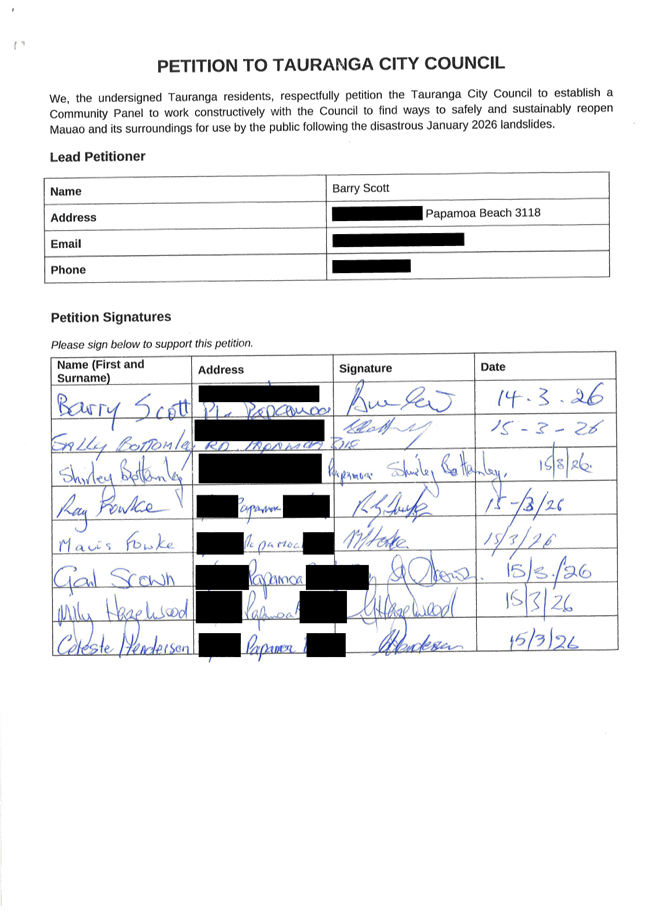
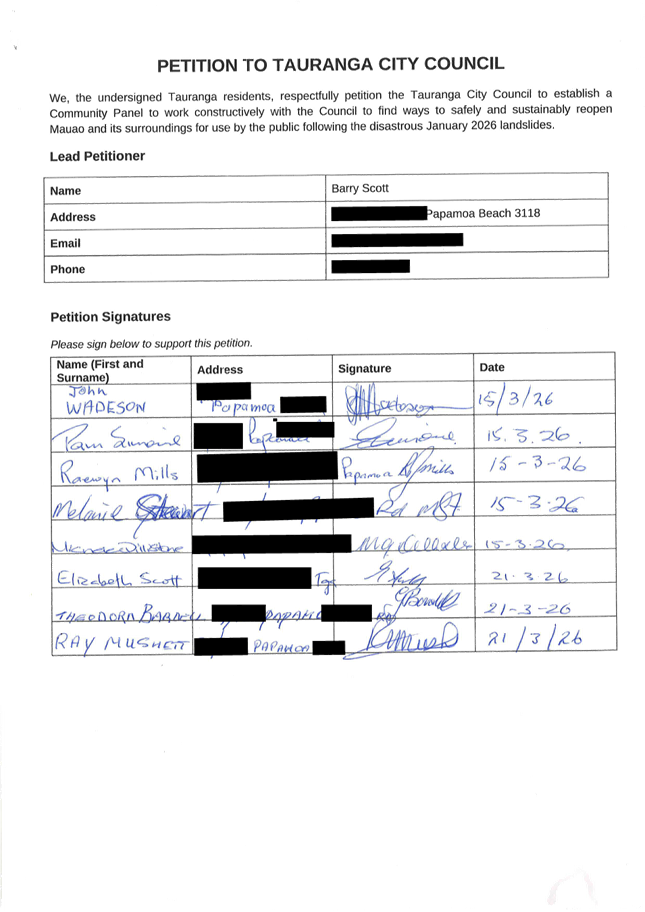
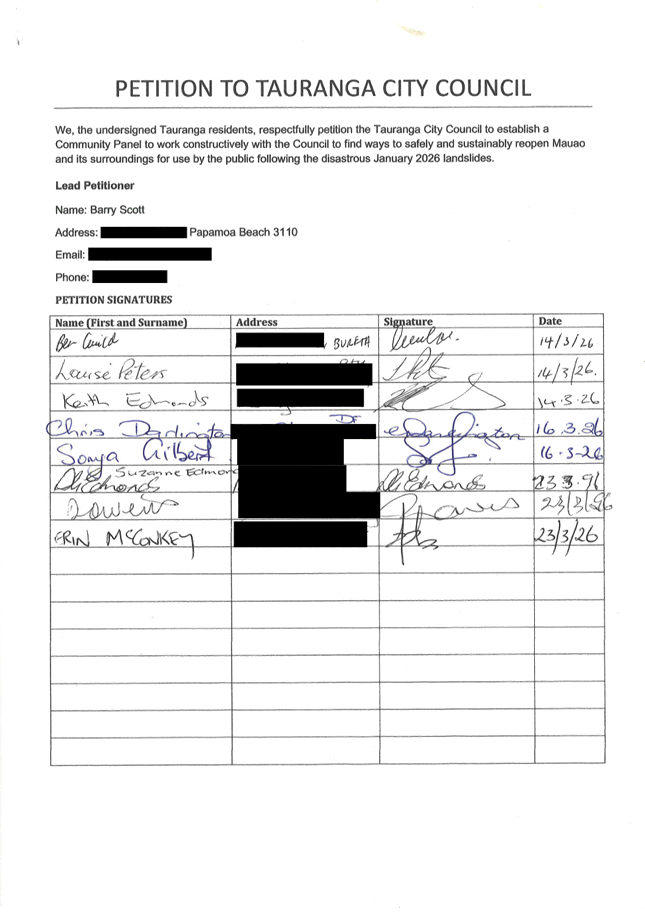
|
Ordinary Council meeting Agenda
|
21 April 2026
|
10 Recommendations
from other committees
10.1 Recommendatory
Report from the Waiāri Kaitiaki Advisory Group - Appointment of new
Council Co-Chair
File
Number: A19975651
Author: Caroline
Irvin, Governance Advisor
Authoriser: Sarah
Holmes, Team Leader: Governance & CCO Support Services
Purpose of the Report
1. The purpose of this
report is to bring a recommendation from the Waiāri Kaitiaki Advisory
Group to Council for consideration. At its meeting on 11 March 2026, the
Advisory Group passed the following resolution which includes a recommendation
to Council:
Committee Resolution WA/26/0/1
Moved: Cr
Laura Rae
Seconded: Cr
Steve Morris
That
the Waiāri Kaitiaki Advisory Group:
(a) Receives the report
"Appointment of Co-Chair to the Waiāri Kaitiaki Advisory Group".
(b) Recommends to Tauranga City
Council and Western Bay of Plenty District Council that
· Luke
Whare
be
appointed as the iwi/hapū representative Co-chair of Waiāri Kaitiaki
Advisory Group.
and
(c) Recommends to Tauranga City Council and
Western Bay of Plenty District Council that
·
Western Bay of Plenty District Council Councillor Darlene Dinsdale
be
appointed as the consent holder Co-chair of Waiāri Kaitiaki Advisory
Group.
Carried
Terms of reference
2. The Terms of
Reference for Waiāri Kaitiaki Advisory Group state that:
Co-chair
selection process
· Co-chairs
will be appointed every three years in alignment with the local government
election cycle.
· The
appointments will take place as soon as is reasonably practical following local
government elections.
· The
Co-chair representing the consent holder will be appointed by the Tauranga City
Council and Western Bay District Councils.
· The
Co-chair representing iwi/hapū will be appointed by the iwi/hapū
representatives.
3. Council is now asked
to endorse the appointment of Luke Whare as the iwi/hapū representative
Co-chair of Waiāri Kaitiaki Advisory Group and appoint Western Bay of
Plenty District Council Councillor Darlene Dinsdale as the Co-chair
representing the consent holder.
|
Recommendations
That the Council:
(a) Receives the report
"Recommendatory Report from the Waiāri Kaitiaki Advisory Group -
Appointment of new Council Co-Chair".
(b) Appoints Western Bay of
Plenty District Council Councillor Darlene Dinsdale as the consent holder
Co-chair of the Waiāri Kaitiaki Advisory Group; and
(c) Endorses the appointment of
Luke Whare as the iwi/hapū Co-chair of Waiāri Kaitiaki Advisory
Group.
|
Attachments
Nil
|
Ordinary Council meeting Agenda
|
21 April 2026
|
11 Business
11.1 Draft
2026-27 Annual Plan - Update at April 2026
File
Number: A20128739
Author: Clare
Sullivan, Senior Governance Advisor
Authoriser: Sarah
Holmes, Team Leader: Governance & CCO Support Services
Background
1. The
report accompanying this agenda item, ‘Draft 2026-27 Annual Plan - Update
at April 2026’, will be circulated separately prior to the meeting.
|
Ordinary
Council meeting Agenda
|
21
April 2026
|
11.2 Draft User Fees and
Charges Schedule 2026/27
File
Number: A20104614
Author: Holly
Riddell, Corporate Planner
Authoriser: Craig
Rice, Chief Operating and Financial Officer
Purpose of the Report
1. The purpose of this
report is to present the proposed draft User Fees and Charges for Council to
adopt as a draft for consultation and to provide options for cemetery and
cremation fees.
|
Recommendations
That Council:
(a) Receives the report
"Draft User Fees and Charges Schedule 2026/27 ".
(b) Approves either:
(i) Option 1: Reduce the
cost of cremations to cost recovery, increase burials and other related fees
halfway to cost recovery and to make further adjustments through the
Long-term Plan, or
(ii) Option 2: Fees are
reflective of actual costs and moves to a full user pay approach with a
zero-operating deficit.
(c) Adopts the draft User Fees
and Charges 2026/27 and statement of proposal as set out in Attachments 1 and
2, for public consultation, incorporating any amendments directed by Council
at this meeting.
(d) Delegates the Chief Operating
and Financial Officer to approve the final wording of amendments (as per
Council direction) prior to public consultation.
|
Executive Summary
2. As part of the
2026/27 Annual Plan process, Council staff have undertaken a review of user
fees and charges to ensure they remain fair, equitable, financially
sustainable, and aligned with the Revenue and Financing Policy.
3. At its meeting on 10
February 2026, Council resolved to defer the broader comprehensive review of
fees and charges to the upcoming Long-term Plan, while proceeding with standard
annual updates, including a 3% CPI adjustment. Accordingly, most proposed changes
for the 2026/27 financial year reflect minor increases in line with inflation.
However, it was requested that options relating to cemeteries be provided.
4. At its meeting on 24
March 2026, Council resolved to approve the draft User Fees and Charges
Schedule for consultation to begin on 1 April to 1 May 2026. This included a
decision to reduce the cost of cremations to cost and increase burial fees by
6% (3% for inflation and an additional 3% to recover further costs).
5. As requested, this
report has been prepared to provide Council with the opportunity to present
options relating to cemeteries to revisit and confirm what will be consulted
on.
6. Through this review,
staff have determined the cost of providing adult cremations, adult casket
burials and rose garden ash burials. This is provided in the table below. These
fees make up ~87% of the total revenue generated within this service.
7. User fees and
charges for each option within this report:
|
Service
|
Current
fees
|
Option
1 (halfway to cost)
|
Option
2
(cost)
|
Option
3
(cremation at cost, 6% increase on other fees)
|
|
Adult
cremation
|
$979
|
$777
|
$777
|
$777
|
|
Adult
casket burial
|
$4,256
|
$5,449
|
$6,388
|
$4,511
|
|
Rose
garden ash burial
|
$1,500
|
$3,220
|
$4,850
|
$1,590
|
8. Consultation is now
planned for 22 April to 22 May 2026.
Background
9. User fees and
charges have been reviewed and updated by staff as part of the comprehensive
review requested by Council through the Annual Plan. Staff assessed all fees
and charges activity areas to identify those with the greatest potential for
improved cost recovery or financial impact. Council subsequently approved
in-depth reviews of nine activity areas: Baycourt, Libraries, Parks and
Recreation, Use of Council Land, Cemetery Parks and Crematorium, Alcohol
Licensing, Animal Services, Building Services, and Trade Waste. Each detailed
review included analysis of cost recovery, historical consultation feedback,
service usage, inflation and affordability impacts, market context, and
benchmarking against other councils.
10. In addition to these reviews in
specific activity areas, staff have completed a standard annual review of all
other fees and charges.
11. This review has been guided by
principles in the Revenue and Financing Policy; ensuring fees are fair and
equitable, consistent across Council, simple to administer and understand, and
reflective of both capital investment and the value of assets and the
environment.
12. At its meeting on 10 February
2026 which presented issues and options papers on all comprehensive review
areas, Council resolved to defer the comprehensive review to the upcoming
Long-term Plan process. For the 2026/27 financial year, standard updates would
continue, including the application of a 3% CPI adjustment. In addition,
Council requested that options relating to cemeteries be presented to the 24
March Council meeting.
13. At the 24 March Council
meeting, the draft User Fees and Charges and Statement of Proposal were
presented and approved for consultation which was set to commence on 1 April to
1 May 2026. Three options relating to cemeteries were also provided, from which
Council decided that cremation fees would move to cost, and burials and all
other fees would increase by 6%. This would increase the annual deficit to
around $750,000.
14. Consultation was put on hold
and Council asked to revisit cemetery fee options. These have been provided
within the options section of this report below.
15. Attachment 1 to this
report sets out the proposed changes within the current user fees and charges
and the proposed changes for the 2026/27 financial year which were approved at
the 24 March Council meeting.
16. Attachment 2 to this
report sets out the proposed changes within the Statement of Proposal and the
proposed submission form which will be used in consultation with the community.
These will be updated based on the decisions made from this report.
17. A separate report for Adoption
of Dog Registration Fees and Charges (under the Dog Control Act 1996) for
2026/27 will be presented to Council at its meeting on 12 May 2026.
discussion
18. Cemeteries and cremations were
one of the activity groups that were requested by Council for a comprehensive
review. Staff undertook this review and presented findings to workshops on 4
September and 27 November 2025. Issues and options were presented to Council on
10 February and 24 March 2026.
19. As a local authority, Council
must meet statutory requirements of the Burials and Cremations Act 1964 which
includes providing for and maintaining cemeteries and land to bury people.
20. Council’s Revenue and
Financing Policy currently does not allow for rates funding of cemeteries, so
requires user fee increases each year, which are already relatively high
compared to other councils. Cremations make up much of the cemetery revenue and
our cremation prices are ~30% higher than other nearby providers’ prices.
21. The population growth Tauranga
has experienced has put pressure on capital development with 140-170 burials
annually. It is forecast that current burial plot land will be full by 2031
(depending on demand) and capital development is required in prior years to
prepare land for future burials as required by the Burials and Cremations Act.
22. The current cemetery business
model requires user fees and charges to cover operations, maintenance and the
capital programme. When user fees don’t cover these costs, the operating
deficit is added to debt, further exacerbating the need to increase user fees
and charges. This operating deficit under the current capital programme, is
forecasted to reach $24m by 2034.
23. Financial modelling determined
Council costs are greater than revenue for casket burials, ash burials and
chapel/tui lounge services, resulting in an operational deficit that is funded
through debt. This modelling also determined that the cremation price is more
than the cost of cremations.
24. Through this review, staff have
determined the cost of providing adult cremations, adult casket burials, and
rose garden ash burials. This is provided in the table below. These fees make
up ~87% of the total revenue generated within this service.
25. Cost to provide services:
|
Service
|
Current
fees
|
Cost
|
%
change
|
Hamilton’s
fees*
|
|
Adult
cremation
|
$979
|
$777
|
-21%
|
$695
|
|
Adult
casket burial
|
$4,256
|
$6,388
|
50%
|
$5,315
|
|
Rose
garden ash burial
|
$1,500
|
$4,850
|
223%
|
$1,395
|
* Between 20–40% of Hamilton Cemetery &
Crematorium revenue is funded through general rates, with the remainder
recovered through user fees and charges.
26. Through the Revenue and
Financing Policy review within the Long-term Plan, Council will assess the
funding sources of this activity and determine whether general rates funding is
appropriate. Should Council introduce rates funding, this has the potential to
reduce the cost of cemetery services to users. The process for this is set to
begin in the coming months and therefore a decision to change fees to cost
could be better made within the LTP year and the comprehensive review.
27. To support this upcoming
process, staff have included a question on rates funding within the draft
submission form. This will give Council insight into the community's views on
how cemetery services should be funded as it heads into the LTP process. The draft
submission form has been included as Attachment 2.
Statutory Context
28. Setting user fees and charges
at the correct level enables the funding of Council’s
activities. These activities help deliver our community outcomes and
facilitate improved quality of life, quality of economy and sound city
foundations.
29. The recommendation meets the
requirements of the Local Government Act 2002.
30. Council is authorised to set
user fees and charges under specific legislation, including:
- Local Government Act 2002
- Resource Management Act
1991
- Dog Control Act 1996
- Building Act 2004
- Reserves Act 1977
- Waste Minimisation Act
2008
- Local Government Official
Information and Meetings Act 1987
- Food Act 2014
- Food Hygiene Regulations
2015
- Impounding Act 1955
- Health Act 1956
- Sale of Alcohol Act 2012
STRATEGIC ALIGNMENT
31. This contributes to the
promotion or achievement of the following strategic community outcome(s):
|
Contributes
|
|
We are an inclusive city
|
ü
|
|
We value, protect and enhance the environment
|
ü
|
|
We are a well-planned city that is easy to move
around
|
ü
|
|
We are a city that supports
business and education
|
ü
|
|
We are a vibrant city that embraces
events
|
ü
|
32. This review supports all
strategic community outcomes by ensuring user fees and charges are fair,
transparent, and aligned with the financially sustainable delivery of Council
services that benefit the community.
Options Analysis
Issue 1: Options for Cemetery Parks and Crematorium
Option 1: Reduce cost
of cremations to cost recovery, increase burials and other related fees halfway
to cost recovery and to make further adjustments through the Long-term Plan
33. Under this option, Council
would adjust the cost of cremations to cost recovery and increase burials
halfway to cost recovery and move towards a full user pays approach by 2027/28
within the LTP review.
34. This option would also allow
Council time to do further analysis and review the funding bands within the
Revenue and Financing Policy during the Long-term Plan and potentially allow
for general rates funding to keep user fee increases lower than full cost.
35. Chapel and Tui Lounge hire fees
will increase in line with CPI. Given the current limited utilisation of these
facilities, this approach ensures pricing remains affordable and in line with
other chapels while the long-term future of the chapel is under consideration.
|
Example
of fee
|
2025/26
fees
|
2026/27
fees
|
|
Adult
cremation (13 years and over)
|
$979
|
$777
|
|
Pyes
Pa adult casket burial (13 years and over)
|
$4,256
|
$5,449
|
|
Rose
garden ash burial
|
$1,500
|
$3,220
|
|
Chapel
hire (1 hour plus 30 min set up)
|
$357
|
$367
|
|
Deficit
(2026/27 FY)
|
-
$501,000
|
- $433,000*
|
* The
deficit for all three options has been estimated using previous years’
figures and demand. It is subject to change as demand patterns and usage
respond to the updated pricing.
|
Advantages
|
Disadvantages
|
|
· Works toward a user pays approach.
· Potential for increased volume of cremations due to price
increase of burials.
· Increases are phased in over the next two years.
· Reduces operating deficit.
· Allows additional time for cost analysis.
· Allows Council to consider general rates funding of the
activity to alleviate high increases to user fees.
|
· Unknown effects on demand for services.
· Significant chapel hire increase will likely reduce
demand.
· Substantial increase in burial prices will impact
communities who bury for religious or cultural reasons or prefer to bury.
· Puts additional cost pressure on families during
difficult economic conditions.
|
Option 2: Fees are
reflective of actual costs and moves to a full user pay approach with a
zero-operating deficit
36. Under this option, Council
would move to a full user pays approach to create a zero-operating deficit.
This would mean adult cremations would decrease, while burial and other fees
would increase.
37. This is calculated by
understanding the cost of our highest revenue generating services as included
below and applying the same percentage increase across similar fees.
38. Chapel and Tui Lounge hire fees
will increase in line with CPI. Given the current limited utilisation of these
facilities, this approach ensures pricing remains affordable and in line with
other chapels while the long-term future of the chapel is under consideration.
|
Example
of fee
|
Status
quo
|
2026/27
fees
|
|
Adult
cremation (13 years and over)
|
$979
|
$777
|
|
Pyes
Pa adult casket burial (13 years and over)
|
$4,256
|
$6,388
|
|
Rose
garden ash burial
|
$1,500
|
$4,850
|
|
Chapel
hire (1 hour plus 30 min set up)
|
$357
|
$367
|
|
Deficit
|
-
$501,000
|
~$0*
|
* The
deficit for all three options has been estimated using previous years’
figures and demand. It is subject to change as demand patterns and usage
respond to the updated pricing.
|
Advantages
|
Disadvantages
|
|
· User pays approach.
· If demand stays the same, Council will achieve a
zero-operating deficit.
|
· The effect of proposed price increases on service demand
is unknown. A reduction in demand would decrease revenue, potentially
increasing the operating deficit.
· Significant chapel hire user fee may reduce demand.
· Substantial increase in burial prices may impact
communities who bury or prefer to bury.
· Puts pressure on families in a cost-of-living crisis.
|
Option 3: Cremations
at cost, burials and all other fees increase by 6% (this option was adopted
by Council on 24 March 2026)
39. Under this option, Council
would adjust the cost of adult cremations to cost including inflation and would
increase the cost of burials and chapel fees by a total of 6% (3% increase and
3% inflation) as shown in the table below:
|
Example
of fee
|
Status
quo
|
2026/27
fees
|
|
Adult
cremation (13 years and over)
|
$979
|
$777
|
|
Pyes
Pa adult casket burial (13 years and over)
|
$4,256
|
$4,511
|
|
Rose
garden ash burial
|
$1,500
|
$1,590
|
|
Chapel
hire (1 hour plus 30 min set up)
|
$357
|
$378
|
|
Deficit
|
-
$501,000
|
-
$752,000*
|
* The
deficit for all three options has been estimated using previous years’
figures and demand. It is subject to change as demand patterns and usage
respond to the updated pricing.
|
Advantages
|
Disadvantages
|
|
· Applies
a moderate, manageable increase to burial and chapel fees (6%), rather than a
larger jump, helping maintain affordability for bereaved families.
· Potential
for increased demand on cremation services due to a reduction in cost.
|
· Burial
and other fees remain below full cost recovery, meaning Council continues to
subsidise burial services and the overall activity still carries a large
deficit ($752,000 pa).
· Does
not fully address long-term financial gaps, requiring additional increases or
further review in future years.
· Potential
for perceived inequity between service types, as cremations reduce to cost
while burials only increase moderately.
· Does
not fully align fees with true service costs, which may create challenges in
explaining the continued cross-subsidisation to the community.
|
Issue 2: Approves draft User Fees and Charges and
statement of proposal for consultation
Option 1: Council
approves the draft user fees and charges and statement of proposal for
consultation
40. Under this option, Council
approves the draft User Fees and Charges Schedule as proposed in Attachment
1, and the Statement of Proposal and submission form in Attachment
2, with inclusion of a decision on cemeteries.
|
Advantages
|
Disadvantages
|
|
· Managers
have reviewed existing fees and charges and have made recommendations based
on actual and reasonable costs.
· Engagement
and communications planning can be finalised.
|
· Potential
opportunities for other fees and charges may not have been considered.
|
Option 2: Council
requests further changes to the draft User Fees and Charges Schedule
41. Council does
not approve the draft User Fees and Charges Schedule and either rejects
suggested changes or requests further analysis be undertaken.
|
Advantages
|
Disadvantages
|
|
· Other
opportunities for fees and charges changes may be raised and considered.
|
· Delays
in finalising the draft annual plan budgets.
· No
time to consult with the community ahead of adoption in June.
|
Financial Considerations
42. The
financial implications of the proposed user fees and charges are included in
the draft 2026/27 Annual Plan.
Legal Implications / Risks
43. The proposed changes to user
fees and charges must comply with the Local Government Act 2002 and any other
legislation relevant to specific fees. Council is required to ensure that all
fees are lawful, transparent, consistent with its Revenue and Financing Policy,
and do not exceed reasonable cost recovery.
44. Significant increases in fees
carry the risk of negative community perception and may result in reduced
service uptake.
TE AO MĀORI APPROACH
45. The
proposed updates to user fees and charges do not include any changes that
affect Council’s Te Ao Māori approach. Feedback will be gathered
through the upcoming consultation.
CLIMATE IMPACT
46. The
proposed updates to user fees and charges do not include any changes that
affect Council’s Climate Impact Statement.
Consultation / Engagement
47. The
draft user fees and charges represent fees proposed to be charged to the
community.
48. After
approval for consultation today, the draft user fees and charges will be
consulted on with the community for one month in accordance with sections 83
and 150 of the Local Government Act.
Significance
49. The Local Government Act 2002
requires an assessment of the significance of matters, issues, proposals and
decisions in this report against Council’s Significance and Engagement
Policy. Council acknowledges that in some instances a matter, issue,
proposal or decision may have a high degree of importance to individuals,
groups, or agencies affected by the report.
50. In making this assessment,
consideration has been given to the likely impact, and likely consequences for:
(a) the current
and future social, economic, environmental, or cultural well-being of the
district or region
(b) any persons who are likely to be
particularly affected by, or interested in, the decision.
(c) the capacity of the local authority
to perform its role, and the financial and other costs of doing so.
51. In accordance with the
considerations above, criteria and thresholds in the policy, it is considered
that the decision is of medium significance.
ENGAGEMENT
52. Taking into consideration the
above assessment, that the decision is of medium significance, officers are of
the opinion that the following consultation/engagement is suggested/required
under section 83 of the Local Government Act.
Next Steps
53. Pending decisions from this
Council meeting, key steps are:
(a) 22 April to 22 May:
Community feedback sought on the draft User Fees and Charges.
(b) May: Staff will
analyse feedback and make recommendations on changes.
(c) Council 26 May: Hearings
will be held for submitters who wish to speak.
(d) 2 June: Deliberations.
(e) 23 June: Adopt a final
version of the User Fees and Charges.
54. Once finalised, updated fees
will come into effect on 1 July 2027.
Attachments
1. 2026-27
User Fees and Charges - Statement of Proposal - A19870421 (Separate Attachments
1) 
2. 2026-27 User Fees
and Charges Schedule 21 April PDF (Tracked Changes) - A20112705 (Separate
Attachments 1) 
|
Ordinary
Council meeting Agenda
|
21
April 2026
|
11.3 Local Water Done Well
- Governance and Recruitment
File
Number: A19866205
Author: Cathy
Davidson, Water Organisation Establishment Lead
Tyler Buckley,
Commercial Solicitor
Fiona Nalder,
Principal Strategic Advisor
Authoriser: Christine
Jones, General Manager: Strategy, Partnerships & Growth
Please
note that this report contains confidential attachments.
|
Public Excluded Attachment
|
Reason why Public Excluded
|
|
Item 11.3 - Local Water
Done Well - Governance and Recruitment - Attachment 3 - Water Organisation
Board of Directors Recruitment Including Costs
|
s7(2)(b)(ii) - The
withholding of the information is necessary to protect information where the
making available of the information would be likely unreasonably to prejudice
the commercial position of the person who supplied or who is the subject of
the information.
|
Purpose of the Report
1. The purpose of this
report is to seek Council decisions to approve:
· Terms
of Reference for the Water Organisation Joint Committee
· Water
Organisation Board Skills Matrix, and
· Commencement
of the recruitment process for the initial Water Organisation Board members.
|
Recommendations
That the Council:
(a) Receives the report
"Local Water Done Well - Governance and Recruitment".
(b) Establishes the Water
Organisation Joint Committee, giving effect to the Commercial Term Sheet
approved by Council on 24 March 2026.
(c) Adopts the Terms of Reference
for the Water Organisation Joint Committee, provided as Attachment 1 to this
report.
(d) Appoints the following
Tauranga City Council elected members as members of the Water Organisation
Joint Committee:
(i) _________________
(ii) _________________
(iii) __________________
(e) Appoints the following
Tauranga City Council elected members as alternate members of the Water
Organisation Joint Committee:
(i) _________________
(ii) _________________
(iii) __________________
(f) Notes that the full
Terms of Reference for the Water Organisation Joint Committee will be updated
with the names of all Committee members following confirmation of the
Committee members by Western Bay of Plenty District Council and appointment
of Tangata Whenua representatives.
(g) Approves the Water
Organisation Board Skills Matrix, provided as Attachment 2 to this report.
(h) Approves commencing
recruitment for three Water Organisation Board members, including the Chair,
utilising the services of the external recruitment agency JacksonStone &
Partners.
(i) Notes that Council and
Western Bay of Plenty District Council approval is required to appoint
recommended candidates to the Board of the Water Organisation and a further
report will be brought to Council to seek this approval.
(j) Notes that a further
report will be presented to Council and Western Bay of Plenty District
Council to consider recommended remuneration for Tangata Whenua
representatives of the Water Organisation Joint Committee after an
independent job sizing and market benchmarking process has been completed.
(k) Attachment 3 is to be
retained in confidential due to commercial sensitivity.
|
Executive Summary
2. On 2 April 2026
Council decided to establish a multi‑council
Water Organisation with Western Bay of Plenty District Council (WBOPDC). This
report seeks Council decisions required to progress the next governance and
establishment steps for the proposed Water Organisation (WO).
3. The matters for
decision include endorsement of the draft Terms of Reference for a Joint
Committee, approval of a Board Skills Matrix, and commencement of the
recruitment process for the initial Board members of the Water Organisation:
(a) The Joint Committee will
provide an advisory forum for Shareholder and Tangata Whenua engagement during
the establishment phase and has no decision‑making
powers.
(b) The proposed Board Skills
Matrix has been developed to ensure compliance with statutory requirements and
to support a transparent, competency‑based
recruitment process.
(c) The report recommends engaging
an external recruitment agency to recruit up to three initial Board members,
including the Chair, to enable the Water Organisation to be incorporated in mid‑2026 and to provide
early governance oversight. Any appointments to the Board will be subject to
further approval by Council and WBOPDC.
Background
4. This report follows
the 2 April 2026 decision to form a WO with WBOPDC. It seeks Council decisions
required to progress:
(a) Establishment of the Joint
Committee.
(b) Approval of the Board Skills
Matrix; and
(c) Recruitment of the WO Board.
Establishment of a Joint Committee
5. Council and WBOPDC
(the Shareholders) have agreed to establish a Joint Committee consisting of
three elected members from each Shareholder (six elected members in total,
three per council) and three Tangata Whenua representatives.
6. This report seeks
adoption of the Joint Committee’s Terms of Reference (see Attachment 1)
and approval to establish the Committee. The Terms of Reference have been
developed:
(a) Based on the Local Water Done
Well Commercial Terms approved by the Shareholders on 24 March 2026[1]; and
(b) Consistently with other terms
of reference documents that TCC and WBOPDC have developed for other joint
committees.
7. Key points to note:
(a) Consistent with previous
resolutions, the Joint Committee has no decision-making powers; it is a
recommendatory body only.
(b) The range of matters to be
considered by the Joint Committee is included within the “Scope”
section of the Terms of Reference, and that range of matters was previously
approved by the Shareholders on 24 March 2026. The Terms of Reference also
empowers the Shareholders to direct the Joint Committee to consider additional
matters.
(c) The Shareholders can review the
Joint Committee’s Terms of Reference as and when the Shareholders see
fit, and the Terms of Reference can evolve over time as the Shareholders wish.
The Shareholders must revisit the functions of the Joint Committee at the
earlier of either:
(i) another shareholder
joining the WO; or,
(ii) at the beginning of the
triennium for any new incoming Council, at which point the Joint Committee will
prepare a report for consideration by the incoming Council; or
(iii) otherwise as determined by a
majority of the Water Organisation’s shareholders, or
(iv) any substantive legislative change
or other significant matter impacting treaty settlements.
(d) The Shareholders have the power
to appoint (or remove) an Independent Chair to the Joint Committee. The members
of the Joint Committee may recommend that the Shareholders appoint an
Independent Chair, but the decision remains with the Shareholders.
Approval of the Board Skills Matrix
8. This report
recommends commencing approving the Board Skills Matrix that is included as
Attachment 2 of this report and summarised below.
Figure
1: Skills Matrix
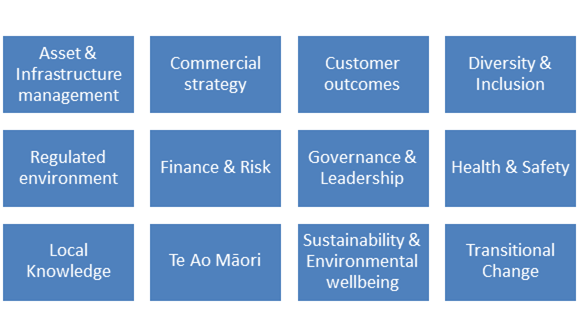
9. The Local Government
(Water Services) Act 2025 requires that, in appointing directors to the board
of a water organisation, councils must bear in mind the following:
(a) Directors must be appointed
based on their competency to perform the role;
(b) Directors must collectively
have an appropriate mix of skills, knowledge and experience in relation to
providing water services; and
(c) Elected members of shareholding
councils, employees of shareholders, and employees of the water organisation
cannot be appointed as directors.
10. With the above in mind, the
Board Skills Matrix has been prepared. The Matrix was presented to
representatives of TCC, WBOPDC and Tangata Whenua through the “Joint
Working Group” in the lead-up to Council’s 2 April 2026 decision to
form a Water Organisation. The feedback provided by the three parties (TCC,
WBOPDC and Tangata Whenua) has been incorporated into the Board Skills Matrix
as Attachment 2.
11. A director may cover one or
more of the skills required for the Board, but there is no expectation that any
one director would have all, or a majority, of the skills set out in the Board
Skills Matrix. For clarity, not all skills as set out in the Board Skills
Matrix are required to be met at any given time (by directors either
individually or collectively as a Board); some skills may be deemed irrelevant
at a particular stage, or suitable candidates with specific skills that are
required for the Board may not be able to be recruited.
12. If a particular skill is not
possessed across the Board of directors, that skill can be fulfilled through
other means (such as external consultancy or the skillset of Water
Organisation’s executive staff).
13. Approval of the Board Skills
Matrix will assist with recruiting the first Water Organisation Board. It will
help to inform the advertisements, longlist, interview, and shortlist
process.
Recruitment of the Water Organisation Board
14. This report recommends
commencing recruitment for up to three Board members, including the Chair, for
the WO. Approval is sought to appoint external consultants, JacksonStone &
Partners, to run this process.
15. A proposal from JacksonStone
& Partners is provided as Confidential Attachment 3, and this provides a
fee estimate. JackstonStone & Partners recently completed the recruitment
process for the Establishment Chief Executive of the Water Organisation and
through that process have gained an understanding of the Water Organisation.
16. The current timeline will see
the WO incorporated (i.e. formally established and registered) in early July
2026. A company (including this Water Organisation) cannot be registered
without a Board of Directors. With this timeframe in mind, it is proposed that
recruitment and appointment of Board members is completed no later than
mid-June 2026.
17. The proposed process and
approximate timeline to appoint the Board members is set out below.
(a) Detailed brief developed in
consultation with Shareholders - late April to early May
(b) Advertising - May
(c) Longlist, interviews and
shortlist – late May to early June
(d) Interviews, reference check and
negotiation of offer – mid to late June
18. The Board Skills Matrix at
Attachment 2 will inform the recruitment process. Similarly to the recruitment
of the Establishment Chief Executive role, it is intended that:
(a) the Chief Executives and
General Managers responsible for the waters transition within both Councils
will be involved in the recruitment process.
(b) The interview panel will be
made up of one representative from each of the Shareholding Councils (likely to
be a person who has been appointed to the Joint Committee), with the option of
an independent advisor
19. As a reminder, the Council
resolved on 24 March 2026 (as part of the Water Organisation’s Commercial
Term Sheet) that the Board can comprise up to 5 directors. The Council also
resolved that at commencement there may well be less than 5 directors appointed,
with the Board only growing to its full size in due course.
20. This report recommends
initially appointing only three Board members. One of the successful
candidates will fulfil the role of the Chair. Remaining Board members can be
recruited as the Shareholders see fit, either before or after the ‘go live’
date of 1 July 2027.
21. The Joint Committee will make
recommendations to the Shareholders, and the Shareholders will appoint the
Board members and the Chair via Council decision.
Remuneration of Tangata Whenua representatives on the
Joint Committee
22. TCC currently has Tangata
Whenua representatives on standing committees of Council. Remuneration
for these appointees is set by TCC based on an external assessment of the role
and market benchmarking for similar sizes roles. TCC has previously used
Strategic Pay to undertake this process.
23. It is proposed that Strategic
Pay will undertake a job sizing and market benchmarking process (based on the
approved role and scope of the Committee). It will also be useful for
Strategic Pay to connect with Kevin Lavery, given that with his IAWAI Chair
role he has a good understanding of the likely requirements and workload of a
Joint Committee member. The outcome of the independent review and advice
will be reported back to both Councils for consideration and approval of a
remuneration level.
Statutory Context
24. The Joint Committee will be
established under clauses 30 and 30A of Schedule 7 of the Local Government Act
2002.
25. The Board of Directors will be
established under section 48 of the Local Government (Water Services) Act 2025,
which requires the following:
(a) Directors must be appointed
based on their competency to perform the role; and
(b) Directors must collectively
have an appropriate mix of skills, knowledge and experience in relation to
providing water services; and
(c) Elected members of shareholding
councils, employees of shareholders, and employees of the water organisation
cannot be appointed as directors.
STRATEGIC ALIGNMENT
26. This contributes to the
promotion or achievement of the following strategic community outcomes:
|
Contributes
|
|
We are an inclusive city
|
ü
|
|
We value, protect and enhance the environment
|
ü
|
|
We are a well-planned city that is easy to move
around
|
ü
|
|
We are a city that supports
business and education
|
☐
|
|
We are a vibrant city that embraces
events
|
☐
|
27. The Water Organisation is being
set up to deliver sustainable, affordable, well-planned and maintained water
services for the sub-region.
Options Analysis
The Joint Committee
28. Option 1: Adopt the Terms of
Reference (Attachment 1), appoint Council Committee members and establish the
Joint Committee. (RECOMMENDED)
|
Advantages
|
Disadvantages
|
|
Enables the timely
establishment of the Joint Committee, allowing workstreams supporting the
Water Organisation to progress.
Provides a clear and
agreed framework for the Joint Committee’s purpose, scope, and
operating arrangements.
Is consistent with the
Local Water Done Well Commercial Terms approved by the Shareholders on 24
March 2026.
Reflects existing joint
committee precedents used by TCC and WBOPDC, reducing governance and process
uncertainty.
Preserves Shareholder
control, as the Joint Committee is advisory only and does not have decision‑making powers.
Is flexible, allowing
the Shareholders to amend the Terms of Reference over time as circumstances
change.
It is a legal
requirement for Joint Committees to have Terms of Reference.
Continues to support
the processed required for Water Organisation establishment by 01 July 2027.
Operates under the
LGOIMA requirements for meeting, being open and public.
|
None identified.
|
29. Option 2: Do not adopt the
Terms of Reference, do not appoint Council Committee members, and do not
establish the Joint Committee (NOT RECOMMENDED)
|
Advantages
|
Disadvantages
|
|
None identified.
|
Proceeding with the
Joint Committee without Terms of Reference would be contrary to legal
requirements within the Local Government Act 2002.
Failing to confirm
Terms of Reference will prevent the establishment of the Joint Committee,
contrary to the agreed Commercial Terms and prior Shareholder decisions.
Risks delays in
progressing matters intended to be considered by the Joint Committee.
May undermine alignment
and confidence between the Shareholders and Tangata Whenua.
Risks delays in the
establishment of the Water Organisation which may impact the go live date of
01 July 2027.
Does not provide for
any joint pathway to work through matters on key documents such as the
Constitution and Shareholders Agreement before being approved by Council
|
The Board Skills Matrix for the Water
Organisation’s Board of Directors
30. Option 1: Approve the Board
Skills Matrix (Attachment 2). (RECOMMENDED)
|
Advantages
|
Disadvantages
|
|
Ensures the Board
recruitment process is aligned with the requirements of the Local Government
(Water Services) Act 2025.
Provides a transparent,
structured and defensible basis for assessing candidates.
Reflects recommendatory
input from TCC, WBOPDC and Tangata Whenua through the Joint Working Group.
Supports the
appointment of a Board with a balanced mix of governance, technical,
financial, regulatory and cultural capability.
Improves efficiency and
consistency throughout recruitment, from advertising to shortlisting and
interview assessment.
|
The approved Matrix may
limit flexibility to respond to unexpected candidate strengths that sit
outside the defined skill areas.
Any future changes in
strategic direction may require the Matrix to be reviewed and updated.
|
31. Option 2: Do not approve the
Board Skills Matrix. (NOT RECOMMENDED)
|
Advantages
|
Disadvantages
|
|
Retains full
flexibility to assess candidates without reference to a formal skills
framework.
|
Increases the risk that
Board appointments do not fully meet statutory competency requirements.
Reduces transparency
and consistency in the recruitment process.
Makes it more difficult
to demonstrate that appointments are merit‑based
and collectively appropriate.
May result in delays to
recruitment while alternative assessment criteria are developed.
|
Recruitment of Board members to the Board of the Water
Organisation
32. Option 1: Commence the
recruitment process for the initial three Board members via an external
recruitment process. (RECOMMENDED)
33. The external agency
JacksonStone & Partners is appointed to manage the recruitment process.
This agency has recently completed the Chief Executive recruitment process, has
in-depth of knowledge of both Councils, the set-up of the new WO and is offering
competitive costing for the recruitment process. The LWDW project People &
Workforce Workstream’s independent contractor would oversee this
process.
|
Advantages
|
Disadvantages
|
|
Is independent (i.e.
not led by either Shareholder)
The external agency can
use their networks to target potential candidates.
High level of
confidentiality.
Provides an independent
and objective recruitment process.
Enables access to wider
national recruitment networks and experienced governance candidates.
Supports a confidential
and professional process, appropriate for senior governance appointments.
Builds on JacksonStone
& Partners’ recent involvement and knowledge of the Water
Organisation and Shareholders.
Reduces the risk of
perceived or actual bias by either Shareholder.
Provides assurance to
regulators and funders that the Board has the capability to govern a
high-risk, highly regulated organisation.
|
Higher direct cost than
an internal recruitment process.
Reduced direct control
by Council over day‑to‑day recruitment
activities.
|
34. Option 2: Commence the
recruitment process for the initial three Board members via an internal
recruitment process. (NOT RECOMMENDED)
35. The recruitment process is led
internally, managed by the People & Workforce Workstream independent
contractor with oversight by Council’s General Manager: Strategy,
Partnerships & Growth and WBOPDC’s Programme Director – Water Organisation.
36. This option will remove an
external agency from the process and be run by advertising externally and
contacting potential candidates directly. This option is likely to require the
support of Council’s Human Resources recruitment team to provide an online
recruitment system and to assist with the long list and short list process.
This process may reduce the cost of recruitment. However, it is unknown at this
stage what the final internal cost will be.
37. Following the recruitment
process, a report would be brought to Council seeking approval to appoint the
recommended candidates.
|
Advantages
|
Disadvantages
|
|
Lower external
consultancy costs.
Greater direct control
over the recruitment process.
|
Limited access to
specialist governance recruitment networks.
Increased risk of
perceived lack of independence or objectivity.
Higher demand on
internal resources during a period of significant establishment activity.
Internal costs and
resourcing impacts are uncertain and may offset any savings.
Would need to manage
the inter-relationship with WBOPDC in the recruitment process.
|
38. Option 3: Do not commence
the recruitment process for Board members. (NOT RECOMMENDED)
39. Delay recruitment until a later
date, at which point the full Board is appointed.
|
Advantages
|
Disadvantages
|
|
Avoids immediate
recruitment and establishment costs.
Defers the need for
director remuneration and associated support costs.
|
Delays the
establishment of the Water Organisation (the Water Organisation cannot
legally be incorporated without a Board) and delays the WO’s governance
arrangements.
Reduces early Board
input into key establishment decisions and oversight.
Increases delivery and
transition risk as the go‑live
date approaches.
Compresses future
recruitment timelines, increasing the risk of sub‑optimal appointments.
Risks delays in the
establishment of the Water Organisation which may impact the go live date of
01 July 2027.
While delaying Board
recruitment reduces short‑term costs, it transfers governance,
delivery, and leadership risk into later stages of the programme when
flexibility is reduced and consequences are greater.
Elevates change‑management
and workforce risk - Staff transition, organisational culture, and
stakeholder confidence benefit from visible governance leadership in the
transition process.
|
Financial Considerations
40. These costs form part of the
establishment budget for the project and are debt funded opex. They will be
transferred to the WO following establishment.
41. The recruitment cost will also
be met by the approved establishment budget and will be jointly shared with
WBOPDC.
Legal Implications / Risks
42. The establishment of the Joint
Committee and the proposed approach to Board recruitment are consistent with
the Local Government Act 2002 and the Local Government (Water Services) Act
2025. The Joint Committee is advisory only, with no delegated decision‑making powers, which
preserves the statutory responsibilities and decision‑making authority of the Shareholders. The
Terms of Reference are aligned with the Commercial Terms previously approved by
Council and can be reviewed or amended by the Shareholders as required over
time.
43. The recruitment of directors
based on an approved Board Skills Matrix and through an independent external
process supports compliance with the statutory requirements relating to
director competency, independence, and conflicts of interest. Legal risk is primarily
mitigated through adherence to established governance processes, transparency
in decision‑making,
and alignment with statutory obligations. Any appointments to the Board will be
subject to further Council approval, at which point legal considerations will
be reassessed as part of the relevant Council report.
TE AO MĀORI APPROACH
44. Council is working in
partnership with Tangata Whenua on the establishment of the proposed WO,
ensuring that Council’s Te Ao Māori principles are considered and
integrated into project work.
45. The membership of the Joint
Committee includes three Tangata Whenua representatives. Including Tangata
Whenua representatives enables their continued involvement in governance
discussions.
46. Tangata Whenua representation
on the Joint Working Group provided the opportunity for direct input into the
Board Skills Matrix. That Matrix requires the Board to possess the following
skills:
(a) Deep understanding of Treaty of
Waitangi (Te Tiriti o Waitangi) and an ability implement Treaty of Waitangi (Te
Tiriti o Waitangi) principles in governance, decision-making and engagement.
(b) Knowledge of the iwi and hapu
in the Tauranga and Western Bay of Plenty and the impact of the water
infrastructure on the iwi and hapu.
(c) A strong understanding of iwi
and hapu governance arrangements and existing relationships, commitments and
obligations including Treaty settlement arrangements and obligations.
(d) Ability to integrate Māori
values and mātauranga Māori into strategic planning, monitoring and
operational frameworks.
(e) Strong cultural competency and
extensive experience in relationship management with iwi and hapu.
CLIMATE IMPACT
47. This report has no direct
climate impacts, however the WO will enable an integrated sub-regional approach
to the management and delivery of water, wastewater and stormwater services,
providing opportunities for improved climate and environmental outcomes over
time.
Consultation / Engagement
48. Engagement regarding
Council’s preferred option for water services delivery, establishing a
multi-council WO, occurred alongside Council’s 2025/2026 Annual Plan
consultation process.
Significance
49. The Local Government Act 2002
requires an assessment of the significance of matters, issues, proposals and
decisions in this report against Council’s Significance and Engagement
Policy. Council acknowledges that in some instances a matter, issue,
proposal or decision may have a high degree of importance to individuals,
groups, or agencies affected by the report.
50. In making this assessment,
consideration has been given to the likely impact, and likely consequences for:
(a) the current
and future social, economic, environmental, or cultural well-being of the
district or region
(b) any persons who are likely to be
particularly affected by, or interested in, the decisions.
(c) the capacity of the local authority
to perform its role, and the financial and other costs of doing so.
51. In accordance with the
considerations above, criteria and thresholds in the policy, it is considered
that the decisions are of low significance.
52. The decision to endorse the Terms
of Reference and delegate its finalisation to the Mayor is assessed as of low
significance as the Terms of Reference is based on the Commercial Terms which
were already approved by Council on 24 March 2026.
53. The decision to commence
recruitment of the Board is assessed as of low significance. Note that
appointment of the recommended candidates to the Board will occur via Council
decision following completion of the recruitment process (and the significance
of that decision will be assessed as part of the Council report at that time).
ENGAGEMENT
54. Taking into consideration the
above assessment, that the decisions are of low significance, officers are of
the opinion that no further engagement is required prior to Council making a
decision.
Next Steps
55. Following Council approval,
officers will establish the Joint Committee that will support the WO, commence
Board recruitment, and continue other establishment activities. A further
report will be brought to Council seeking approval of the recommended Board
appointments.
Attachments
1. Draft
Terms of Reference Water Organisation Joint Committee - A20122689 ⇩ 
2. Water
Organisation Board Skills Matrix - A20107531 ⇩ 
3. Water
Organisation Board of Directors Recruitment Including Costs - A20107653 -
Public Excluded
|
Ordinary
Council meeting Agenda
|
21
April 2026
|
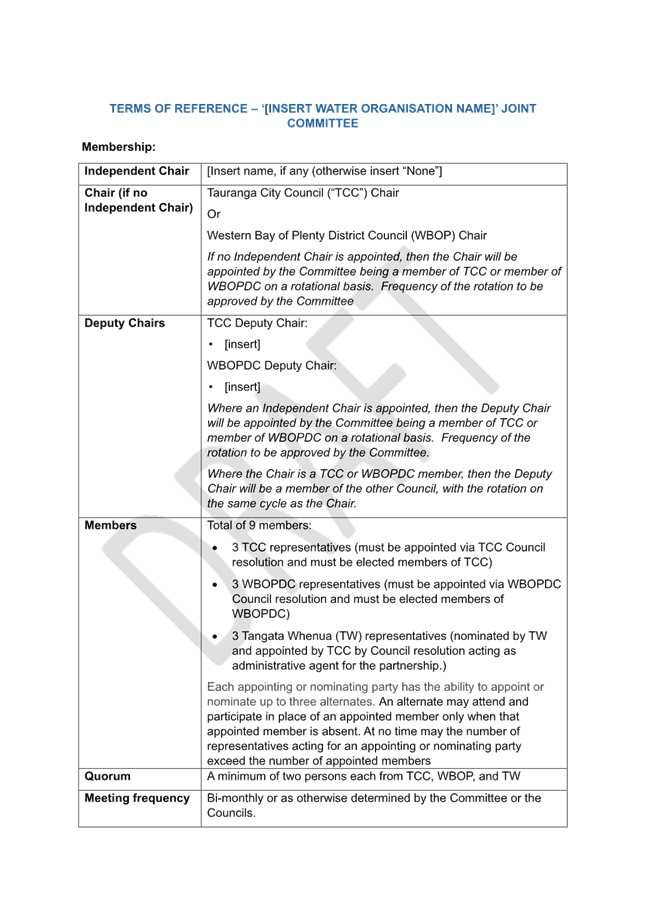
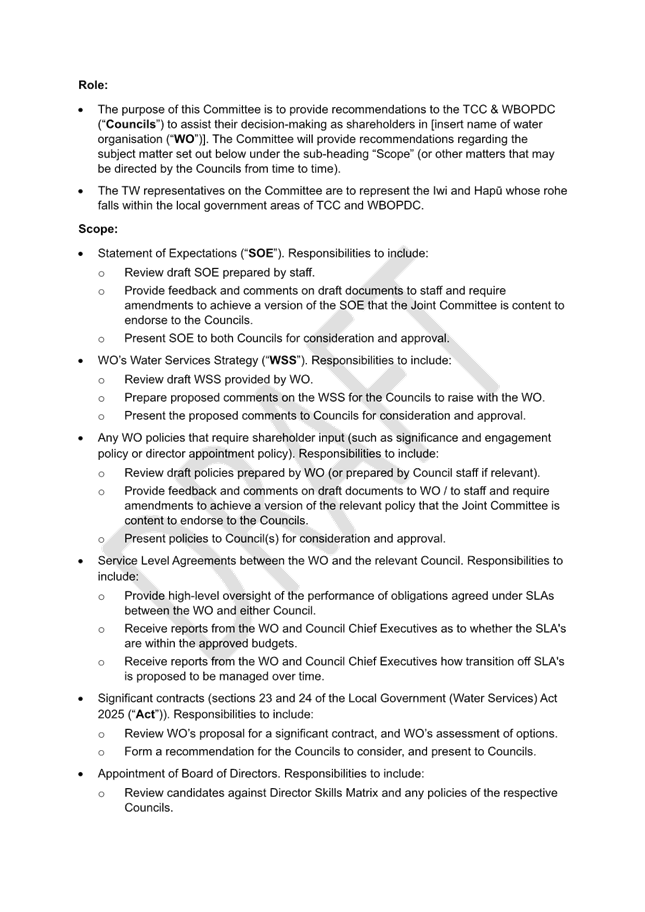
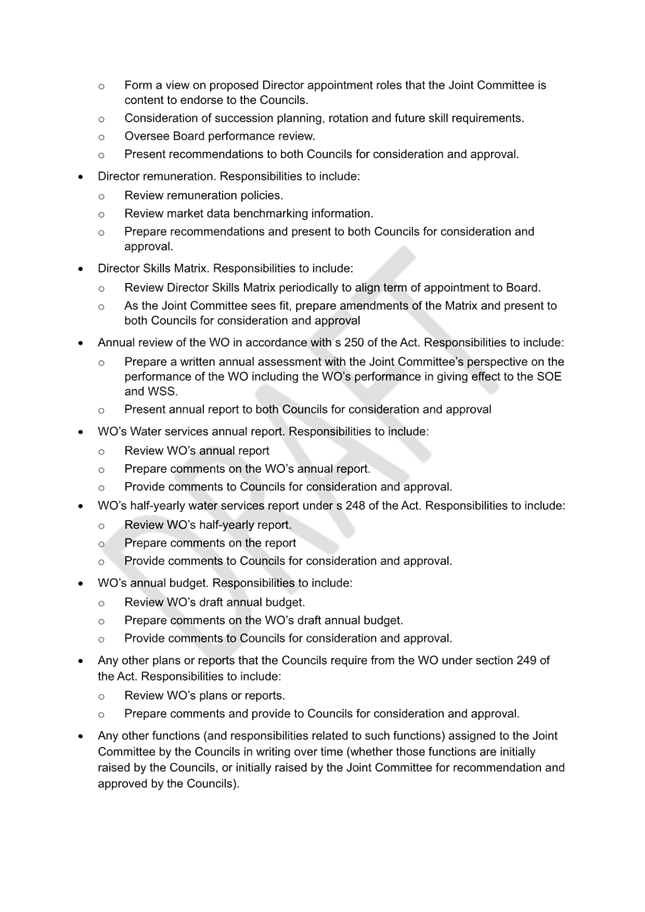
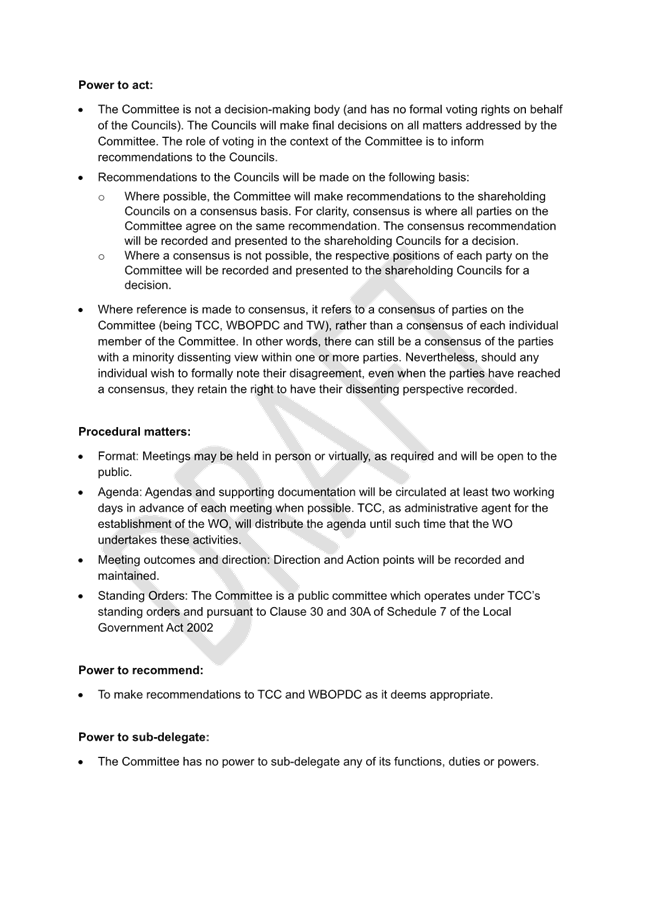
|
Ordinary
Council meeting Agenda
|
21
April 2026
|
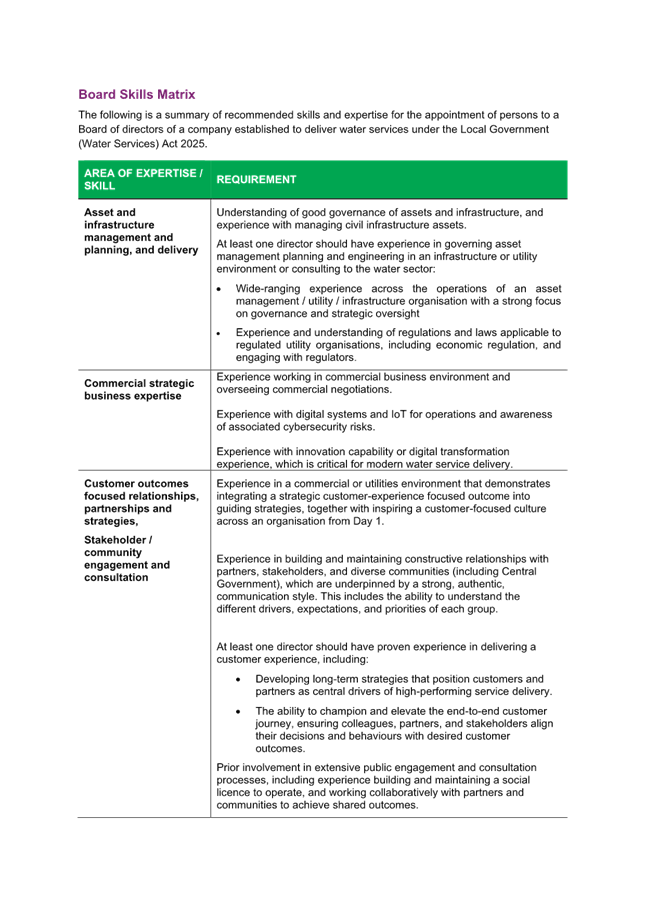
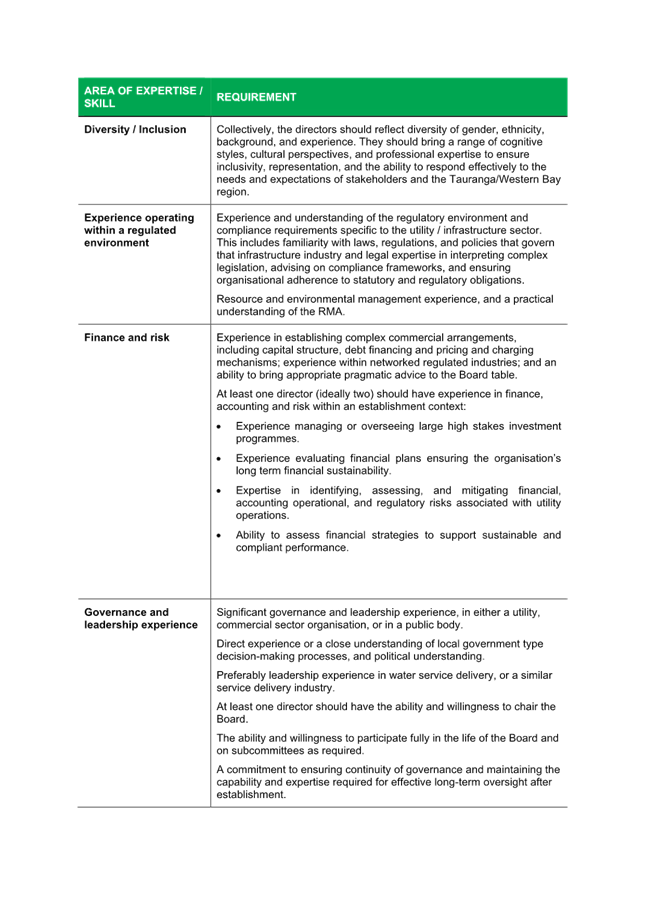
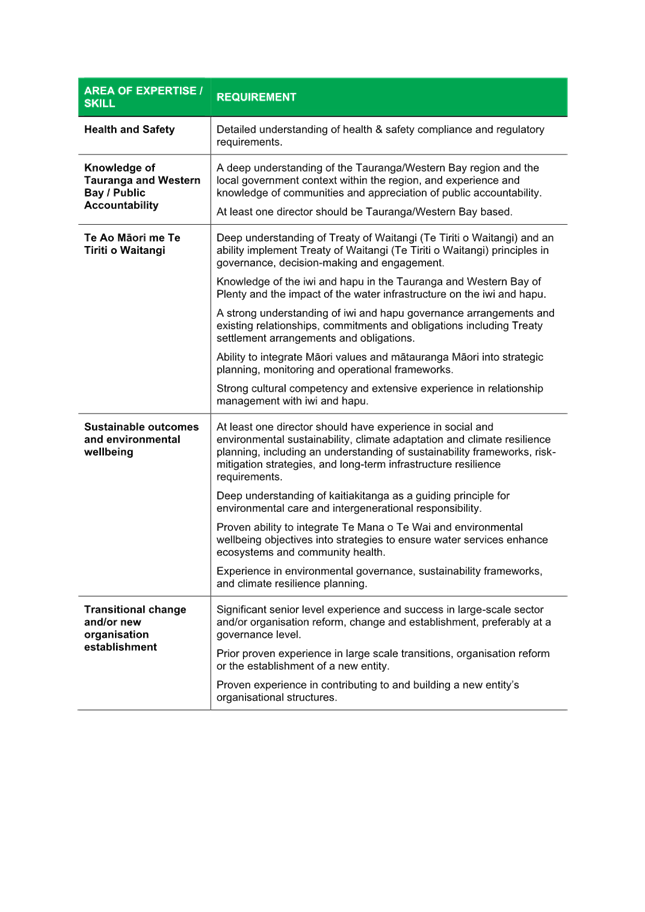
|
Ordinary
Council meeting Agenda
|
21
April 2026
|
11.4 Council-Controlled
Organisations: Shareholder Feedback on Draft Statements of Intent
2026/2027-2028/2029
File
Number: A19395080
Author: Caroline
Lim, CCO Specialist
Jeremy Boase, Head
of Strategy, Governance & Climate Resilience
Authoriser: Christine
Jones, General Manager: Strategy, Partnerships & Growth
Purpose of the Report
1. To
seek approval on the shareholder feedback for the Council-Controlled
Organisations’ draft Statements of Intent 2026/27-2028/2029, as required
by the Local Government Act 2002.
|
Recommendations
That the Council:
(a) Receives the report
"Council-Controlled Organisations: Shareholder Feedback on Draft
Statements of Intent 2026/2027-2028/2029".
(b) Receives the draft Statements
of Intent 2026/27-2028/29 for Bay Venues Limited, Tauranga Art Gallery Trust,
Tourism Bay of Plenty, Te Manawataki o Te Papa Limited, Bay of Plenty Local
Authority Shared Services Limited and Bay of Plenty Local Authority Shared
Services Limited’s Letter to its shareholders about its draft Statement
of Intent.
(c) Approves the shareholder
feedback for Bay Venues Limited, (detailed in paragraph 16 of this report) on
the following matters:
(i) Council brand and
alignment with community outcomes of “A vibrant city that embraces
events”.
(ii) Staff safety and anti-social
behaviour.
(iii) Mount Hot Pools language to
ensure community not unnecessarily concerned or that any future decisions are
not pre-empted.
(iv) Financial stewardship, prudency,
and capital programme.
(v) Partnership with Tangata
Whenua.
(vi) Staff inflationary adjustments.
(d) Approves the shareholder
feedback for Tauranga Art Gallery Trust, (detailed in (paragraph 16 of this
report) on the following matters:
(i) Comfort with growth
benchmark but would like visitor numbers prior to Toi Tauranga Art
Gallery’s closure.
(ii) Acknowledgement of Council
feedback.
(iii) Visitor satisfaction and
data capture.
(iv) Specific reporting about the
reopening of the gallery.
(v) Budget information.
(e) Approves the shareholder
feedback for Tourism Bay of Plenty, (detailed in paragraph 16 of this report)
on the following matters:
(i) Tourism Bay of Plenty
Working Group’s comfort with the document and supportive of the
direction this council-controlled organisation is taking.
(ii) Key focus for Council being
the decision-making paper to be presented on 21 April regarding Tourism Bay
of Plenty’s three funding requests.
(f) Approves the
shareholder feedback for Te Manawataki o Te Papa Limited, (detailed in
paragraph 16 of this report) on the following matters:
(i) Te Manawataki o Te Papa
Limited Working Group’s comfort with the document.
(ii) The targets are well-aligned
and clearly presented.
(g) Notes that as joint
shareholder of Tourism Bay of Plenty, Western Bay of Plenty District Council
has approved their separate shareholder feedback on Tourism Bay of
Plenty’s draft Statement of Intent 2026/27-2028/29 at its Council
workshop on 16 April 2026.
|
Executive Summary
2. Under the Local
Government Act (LGA) 2002, Council-Controlled Organisations (CCOs) are required
to prepare a draft Statement of Intent (SoI) each year. The SoI must outline
the organisation’s planned activities, performance measures, and
financial forecasts for the upcoming three-year period. Each CCO board is
responsible for preparing and adopting its own SoI.
3. Draft SoIs must be
submitted to the shareholder, Tauranga City Council (Council), by 1 March each
year. Council then reviews the documents and provides feedback before the final
SoIs are adopted by the CCO boards and delivered to Council by 30 June. Shareholder
comments must be provided no later than 1 May. These dates are statutory
deadlines.
4. All draft SoIs,
except those from Tourism Bay of Plenty (TBoP) and Te Manawataki o Te Papa
Limited (TMoTPL), were submitted by the 1 March deadline. These two CCOs
requested additional time to ensure accuracy and to allow for final Chair
sign-off. Given this context, TCC staff did not consider the short delay to be
an issue.
5. The Council meeting
on 21 April 2026 is the first suitable opportunity for Council to formally
receive the draft SoIs and approve shareholder feedback. At the time of
writing, the Local Government Funding Agency’s (LGFA’s) draft SoI
is scheduled to be presented to the City Delivery Committee on 28 April 2026.
As a joint shareholder of TBoP, Western Bay of Plenty District Council (WBoPDC)
has approved its feedback at its Council workshop on 16 April.
6. Draft SoIs for Bay
Venues Limited (Bay Venues), Tauranga Art Gallery Trust (TAGT), TBoP, TMoTPL,
and Bay of Plenty Local Authority Shared Services (BoPLASS) are provided as
Attachments 1-5 of this report. All draft SoIs meet the legislative
requirements of the LGA as outlined in the Background section below.
7. As one of nine
shareholders in BoPLASS, Council does not issue Letters of Expectations (LoEs)
or provide feedback on this CCO’s draft SoI unless significant concerns
arise. BoPLASS’ draft SoI is provided as Attachment 5 of this report,
alongside its Letter to its shareholders about its draft SoI (Attachment 6 of
this report). Similarly, because Council jointly governs the TMoTP Charitable
Trust with the Otamataha Trust, Council does not issue LoEs or provide feedback
on this CCO’s draft SoI. Note TCC staff will be working with the
Otamataha Trust to finalise TMoTP Charitable Trust’s new SoI for
2026/27–2028/29, which will be delivered by 30 June 2026.
8. Feedback on the
draft SoIs has been sought from the Elected Member Working Groups for Bay
Venues, TAGT, TBoP, and TMoTPL, as well as from TCC staff who work closely with
these CCOs. This feedback is outlined in the Background section below.
9. This report outlines
the following matters relating to the draft SoIs of Council’s substantive
CCOs:
· Alignment
of the draft SoIs FY27-29 with the LoEs FY27;
· Potential
impact on levels of service (LoS), given Council’s 18 November 2025
decision not to increase operating grants for CCOs (including no CPI
adjustments);
· CCO
Working Groups’ feedback and proposed amendments to the draft SoIs.
10. A summary of the draft SoIs,
their alignment with the LoEs, and potential LoS impacts is provided below,
with further detail in the Background section:
|
CCO
|
Summary –
overall, draft SoIs show strong alignment with the LoEs
|
|
Bay Venues
|
Bay Venues shows a strong commitment to operate with financial
discipline, deliver more for less, prioritise essential renewals, and balance
commercial revenue generation with accessible, community‑focused
services.
Bay Venues also demonstrates a strong commitment to inclusion,
accessibility, transparent reporting, and partnership with mana whenua, all
of which are explicitly highlighted in the LoE.
The draft SoI signals that constrained funding and the potential
prolonged closure of the Mount Hot Pools will likely place pressure on
service levels. Potential impacts include reduced pool operating hours, the
early seasonal closure of Memorial Pool, and temporary capacity challenges
during planned major maintenance closures such as Baywave. While efficiency
initiatives and targeted fee increases may soften the effects, the draft SoI
acknowledges that some service level reductions may be unavoidable.
|
|
TAGT
|
TAGT and Toi Tauranga Art Gallery demonstrate firm commitments to
financial prudence, community engagement, inclusive programming, iwi
partnerships, and participation in and being part of the Te Manawataki o Te
Papa precinct.
However, service level impacts are likely due to constrained funding,
increased depreciation, and city centre disruption. These pressures may
require adjustments to programming, operating models, or service volumes
unless additional revenue or efficiencies are achieved.
|
|
TBoP
|
TBoP is operating within Council’s “deliver more for
less” expectation, protecting core services while reshaping priorities.
Overall levels of service are maintained and core services protected,
but three areas present material service risks if unfunded: Our Tauranga
Region Place Brand, iSITE Visitor Services capital expenditure, and the
Digital Content management required to support the digital wayfinding
network.
|
|
TMoTPL
|
Expectations for value for money, sustainability leadership, cultural
partnership, risk management, transparency, and delivery excellence, are
clearly outlined in
COdraft SoI.
TMoTPL’s work programme will significantly enhance levels of
service across cultural, recreational, community, and civic domains through
the delivery of major new assets and public realm improvements.
The CCO has identified potential service risks and outlined
appropriate mitigations through strong governance, risk management, and
financial prudency.
|
11. While there are no legal
implications arising from this report or the draft SoIs, other potential risks
may arise, as outlined in the Background section below.
12. TCC staff recommend that
Council receives the draft SoIs and approves the proposed feedback. This
approach ensures compliance with legislative requirements, alignment with
Council’s strategic priorities, and continued transparency and
accountability to the people of Tauranga.
13. If Council does not provide
shareholder feedback, there is potential for misalignment between Council and
the CCOs, particularly in an environment of increased uncertainty.
14. If approved, Council’s
feedback will be provided to the substantive CCOs by 1 May, final SoIs will be
received by 30 June, and final SoIs will be formally acknowledged at the
Council meeting scheduled on 21 July 2026.
Background
Alignment between the draft Statements of Intent FY27-29
and Letters of Expectations FY27, and the potential impact on levels of service
15. The following table outlines
the alignment with the LoEs and the potential impact on LoS across Bay Venues,
TAGT, TBoP and TMoTPL:
|
CCO
|
Alignment with the Letter of Expectations FY27
|
Impact on Levels of Service
|
|
Bay Venues
(Attachment 1 of this report)
|
There is strong alignment, including:
· Financial stewardship through cost‑reduction
focus, efficiency initiatives, renewals aligned to Council’s Long-term
Plan and options to maintain surplus via fees and service level adjustments.
· Emphasising commercial activity as a vehicle to
subsidise community access, balancing affordability with revenue initiatives
and increasing commercial growth initiatives (e.g. events, catering,
partnerships, billboards).
· Commitment to accessibility, inclusion, diverse
programming and high levels of customer satisfaction.
· Commitment to strengthening iwi/hapū
relationships.
· Prioritising renewals and essential capital works,
and support for major projects like the Memorial Park Aquatic Centre and
Netball Centre relocation.
· Continued commitment to reporting, transparency and
“no surprises”.
|
Note Bay Venues’ draft SoI signals that levels
of service are potentially at risk, mainly due to the constrained funding
environment and the unexpected closure of the Mount Hot Pools. It has also
signalled a net operating deficit of $232,167.
Impact on LoS, including:
· Potential reduction in pool opening hours[2].
· Potential early closure of Memorial Pool ahead of
redevelopment, reducing community aquatic capacity (achieving cost savings of
$100,000 - $250,000) [3].
· Network pressure and reduced aquatic availability
due to the unexpected closure of Mount Hot Pools, affecting both service
capacity and financial performance.
· Temporary loss of service during major planned
renewals, including Baywave’s planned maintenance closure.
· Mitigation options outlined include increasing user
fees (achieving additional revenue of $55,000 - $130,000) and continuing
efficiency initiatives, but the draft SoI is clear that further savings will
likely affect service levels if additional revenue cannot be generated[4].
|
|
TAGT (Attachment 2 of this report)
|
There is strong alignment, including:
· Clear financial prudence but pressure exists due to
depreciation and $0 increase grant.
· Clear commitments to broaden reach and maintain
programme quality e.g. delivering a minimum of 15 exhibitions and delivering
education programmes to at least 7,000 primary school students.
· Community centric outcomes, inclusiveness and
diversity demonstrated through performance targets and event programming.
· Partnerships with iwi, art sector, donors, community
funders, and the Te Manawataki o Te Papa Civic precinct.
· Sustainability across all areas (social, economic,
cultural and environmental) demonstrated throughout the document and in
particular, the performance targets.
|
Note TAGT’s draft SoI signals a deficit of
circa $250,000 per annum for the next three years allowing for increased
depreciation on the refurbished gallery and reduced Council funding.
Potential impact on LoS, including:
· Potential need to scale back exhibitions or
programmes.
· Reliance on external funding may affect programme
certainty (e.g. educational programmes, community events).
· Potential of straining staff capacity and financial
resources.
|
|
TBoP (Attachment 3 of this report)
|
There is strong alignment, including:
· Clear response to the financial constraints and
operational expectations.
· Comprehensive marketing and destination programmes
and operationalised through multiple programme streams.
· Clear delivery of inclusive, sustainable, vibrant
tourism that benefits residents.
· Commitment to maintaining active relationships with
2–3 iwi/hapū, supporting Māori tourism operators, and
integrating cultural stories.
· Commitment to major capital project alignment (e.g.
Te Manawataki o Te Papa, Ōmanawa Falls, TECT Park), and multi-agency
coordination across cruise, events and trade networks.
|
Note TBoP’s draft SoI has signalled three
additional funding requests critical to achieving the objectives of this CCO,
but sit outside TBoP’s funded work programme – Our Tauranga
Region Place Brand, iSite Visitor Services capital expenditure and Digital
Wayfinding Network Content Executive role. (These are addressed in a separate
report on this 21 April 2026 Council agenda.
Potential impact on LoS, including:
· Reduced scope of campaigns (fewer markets or
activations).
· Reduced ability to expand visitor services (e.g.
kiosk network, physical presence at events).
· Limited innovation due to focus on protecting core
services.
· Potential delays in destination development
initiatives, cultural product development, and sustainability programmes.
· Levels of service could decline in visitor
servicing, digital communications, and brand integration if these three items
remain unfunded.
|
|
TMoTPL (Attachment 4 of this report)
|
There is strong alignment, including:
· Council’s requirement for value for money and
prudent financial management, including cost‑saving reviews, whole‑of‑life
cost thinking, and maintaining delivery within approved budgets.
· Commitment to a balanced development approach,
covering sustainability, cultural inclusion, and community engagement.
· Fully aligned with Council’s community‑centric
outcomes, including creating vibrant, inclusive, accessible public facilities
aligned to the city’s strategic vision.
· High‑trust partnership, transparency, and a
“no surprises” approach, with structured reporting and open
communication.
· Consideration of sustainability commitments such as
6 Green Star and WELL certification targets and long‑term operational
sustainability.
· Partnership with mana whenua, including cultural
design integration and regular governance‑to‑governance
engagement.
· Risk management and assurance (including a high
focus on enabling a positive safety culture), with detailed risk registers,
workshops, and oversight processes.
|
Note TMoTPL is not a service‑delivery CCO but
a project delivery governance entity, so its impact on LoS is indirect but
significant. The draft SoI indicates both positive impacts and potential
risks.
Positive impacts on LoS, including:
· New and upgraded public facilities for the community
to use and enjoy e.g. Library and Community Hub, and the Museum.
· Improved accessibility and inclusion e.g. universal
design principles and improved public spaces.
· Enhanced user experience with design fundamentals
focussing on vibrancy, enjoyment, welcoming spaces, and connection to place.
· Embedding cultural narratives, partnerships with
mana whenua, and culturally aligned design increases the cultural richness of
this city.
· Increased capacity for community events and economic
activation e.g. new facilities support greater variety, quality, and volume
of events, exhibitions, gatherings, and commercial activity, elevating LoS
across arts, culture, tourism, and recreation sectors.
Potential impacts on LoS, including:
· Construction disruptions could temporarily reduce
access or usability of spaces. The draft SoI mitigates through early
identification of emerging risks, stakeholder engagement and implementing
controls to minimise disruption.
· Failure to meet timelines would delay LoS
improvements. The draft SoI strongly emphasises DIFOTIS (delivery in full, on
time, in spec).
· Misalignment with future operating models could
affect service quality. The draft SoI mitigates through whole‑of‑life
design and cross‑team capex integration with Council’s new Major
Projects team.
|
Shareholder feedback on the
draft Statements of Intent 2026/27-2028/29
16. The following table outlines
the CCO Working Groups’ feedback on the draft SoIs for Bay Venues, TAGT,
TBoP and TMoTPL:
|
CCO
|
CCO Working Groups – feedback on the draft
Statements of Intent
|
Minor edits required
|
|
Bay Venues
|
Council brand and alignment with community outcome
of ‘A vibrant city that embraces events’
· Strengthen visibility of the Council brand to better
reflect and align with Council’s community outcome of embracing events
and helping to create a vibrant city.
· Encourage Bay Venues to broaden the visibility and
promotion of facilities across the city, not only those directly managed by
Bay Venues, to reinforce a city‑wide perspective focused on community
benefit for the people of Tauranga and alignment with the community outcome.
· Current strategic pillars appear somewhat inward‑looking
(e.g. focusing on internal teams or partnerships). Bay Venues should adopt a
more holistic view that emphasises the provision of facilities for the city
and its people, again ensuring a strong connection to Council’s
community outcome around events, activation, and vibrancy.
Staff safety and anti‑social behaviour
· With the increasing incidence of anti‑social
behaviour, staff safety must remain paramount.
· Request that Bay Venues outline proposed options and
initiatives to support staff safety in their final Statement of Intent.
Mount Hot Pools
· Bay Venues should review the draft Statement of
Intent to ensure there is no alarming or premature language regarding the
unexpected closure of the Mount Hot Pools.
· It is important that the community is not
unnecessarily concerned or that any future decisions are not pre‑empted.
Financial stewardship, prudency, and capital
programme
· Strengthen clarity and explicitness around financial
stewardship, prudency, and the capital projects programme –
specifically on:
· Bay Venues to contribute to the development of the sport and
recreation investment programme to meet Council’s priorities, in
respect of the facilities it is involved with, for the Long‑Term Plan
2027-2037.
· Bay Venues to provide input to support consideration
of whole‑of‑lifecycle investment impacts for relevant sport and
recreation facilities.
Partnership with Tangata Whenua
· The partnership with Tangata Whenua should be
further strengthened, including progressing the Memorandum of Understanding
(MoU).
· Staff inflationary adjustments
· Bay Venues to provide staff inflationary adjustments
in the final Statement of Intent.
Information required for Council decision‑making
on 21 April
Bay Venues to provide the following papers to support decision‑making
– details on the funding gap of approximately $320k (annual facility
painting programme and operating the Queen Elizabeth Youth Centre facility).
|
N/A.
|
|
TAGT
|
Comfort with growth benchmark
Council is comfortable with TAGT using a baseline of 5% growth as the
benchmark for the next financial year, but would like visitor numbers prior
to closure to also be reported.
Acknowledgement of Council feedback
Council is satisfied that both the Board and the gallery have responded
constructively to its previous feedback, for example:
· Aligning with the Te Manawataki o Te Papa precinct
family and branding.
· Ensuring diversity and inclusiveness are embedded
across programming and events.
Visitor satisfaction and data capture
Council requires robust and reliable data to inform future decision-making
and would like more detail on the gallery’s customer satisfaction
survey, specifically:
· Whether the survey methodology aligns with other
galleries nationally.
· Who is being surveyed and how respondents are
selected.
· How statistics are collected, how surveys are
administered, and how visitor contact details and demographic information are
captured.
Specific reporting about the reopening of the
gallery
Council would like the Board and the gallery to undertake reporting
against the exhibitions set out in their launch presentation. This will
support the CCO in reporting back with specific, meaningful insights about
the reopening of the gallery.
Budget information
Council would appreciate receiving the final budget statements as soon as
they are available. There was concern about the quantum of the currently
reported deficits.
Regarding page 19, Council seeks clarification on:
· Other income:
The movement from $600k to $56k, what was the source of the original $600k?
· Other expenses: The decrease from $179k to $117k, does this relate to the reopening?
|
· Page 10 – add Dave Guruge as a
Trustee (section 4.2).
· Page 11 – replace ‘HAVC’ systems
with ‘HVAC’ systems (section 5).
|
|
TBoP
|
Overall, this is a good document.
The working group is comfortable with the draft Statement of Intent
and supportive of the direction this CCO is taking.
The key focus for Council will be the paper being presented on 21
April, which outlines the three projects requiring funding: Our Tauranga
Region Place Brand, iSite Visitor Services capital expenditure, and the
Digital Wayfinding Network Content management.
|
· Page 6 – replace ‘joint’ with
‘separate’ letter of expectation (section 4).
|
|
TMoTPL
|
Overall, the working group is comfortable with the
draft Statement of Intent.
The targets are well‑aligned and clearly
presented.
|
· Page 4 – replace Letter of Expectations dated
‘13 April 2023’ with ‘17 December 2025’
(Chair’s foreword section).
· Page 4 – replace for the years ‘1 July
2025 to 30 June 2028’ with ‘1 July 2026 to 30 June 2029’
(Chair’s foreword section).
· Page 4 – replace ‘Civil’
Development with ‘Civic’ Development (Chair’s foreword
section).
· Page 4 – replace ‘2007 to 2009
period’ with ‘2027 to 2029 period’ (Chair’s foreword
section).
· Page 5 – replace 1 July ‘2027’
with 1 July ‘2026’ (introduction section).
|
Potential risks if Council
does not provide shareholder feedback to the CCOs
17. If Council decides not provide
shareholder feedback, there is a material risk that the final SoIs may not
adequately reflect Council’s strategic priorities, performance
expectations, or policy settings. This may result in:
· Misalignment
with strategic direction – CCO work programmes may diverge from
Council’s long‑term plans and community outcomes.
· Financial
risk – inaccurate or unchallenged financial forecasts may compromise
Council’s budgeting or funding decisions.
· Governance
risk – Council may not meet its obligations under the LGA to provide
oversight and ensure that CCOs operate efficiently, effectively, and in the
interests of the community.
· Reduced
accountability – without clear, Council‑endorsed expectations,
performance monitoring may be weakened, making it more difficult for Council to
hold CCOs to account over the next three financial years.
· Reputational
risk – perception that Council has not provided adequate governance
direction could undermine stakeholder and community confidence.
Potential risks relating to
reduced levels of service and community impact
18. The reduced levels of service
and associated impacts on the community, as identified in the draft SoIs and
outlined above, will require both Council and the CCOs to work closely together
and keep each other informed. The potential key risks include:
· Operational
risk – service reductions may lead to performance shortfalls, deferred
maintenance, reduced programme delivery, or delayed projects.
· Community
impact – lower service levels could affect community wellbeing, customer
satisfaction, access to services, and public trust in both the CCOs and
Council.
· Escalation
of issues – if reduced service levels are not closely monitored, minor
issues may develop into larger operational or financial problems requiring
future corrective action.
· Long‑term
sustainability risk – prolonged service reductions may create backlogs or
degrade asset condition, resulting in higher future costs.
Purpose of a Statement of Intent as per the Local
Government Act 2002:
19. The legislative requirements
are set out in Section 64 of the LGA. The legislation states that the purpose
of a statement of intent is to:
a) state publicly the activities and
intentions of the council-controlled organisation for the year and the
objectives to which those activities will contribute; and
b) provide an opportunity for shareholders to
influence the direction of the organisation; and
c) provide a basis for the accountability of
the directors to their shareholders for the performance of the organisation.
20. In essence, an SoI sets out how
a CCO intends to create increasing value for its customers and the ratepayers
of Tauranga over the short to medium term. It provides the CCO board with a
mechanism to publicly set out the entity’s strategic objectives and how
it will achieve these over the next three financial years.
Council-controlled organisations’ core purpose:
21. The following table outlines
the core purpose of each CCO:
|
Council-controlled organisation
|
Core purpose
|
|
Bay Venues Limited
|
To connect the community with exceptional experiences through hosting
activities and events at community facilities across Tauranga including
aquatic centres, indoor sport and fitness facilities, event venues, community
centres and halls, and the Adams Centre for High Performance.
|
|
Tauranga Art Gallery Trust
|
To create and deliver exceptional
art experiences that engage, inspire, challenge and educate visitors through
exhibitions, public programmes and events.
|
|
Tourism Bay of Plenty
|
To lead the sustainable growth of the Western BoP visitor economy,
the management of the region as a visitor destination, and the management of
iSITE Visitor Information Centres at Tauranga, Mount Maunganui and the Port
of Tauranga (during the cruise season only).
|
|
Te Manawataki o Te Papa Limited
|
To govern the effective delivery of a suite of projects across
Tauranga city centre, to benefit the whole community.
|
|
Te Manawataki o Te Papa Charitable Trust
|
To own the land referred to as ‘Site A’ of the Te
Manawataki o Te Papa civic precinct, and to provide certainty on how the land
will be used in the future, so that everyone in the community benefits.
|
|
Bay of Plenty Local Authority Shared Services
|
To foster collaboration in the delivery of shared services and joint
procurement on behalf of the participating councils, maximising cost savings
and developing opportunities for sharing of services.
|
Statutory Context
22. The Statement of Intent is one
of the CCO’s key governance and planning documents.
23. Engaging with the CCOs
throughout the development of the annual Statements of Intent is one of the
main ways Council can influence its CCOs while ensuring they are aligned with
Council’s strategic priorities and outcomes.
STRATEGIC ALIGNMENT
24. The
CCOs actively work in partnership with Council, mana whenua and our community
to achieve the following community outcomes, and this is reflected in their
SoIs and their performance against financial and non-financial measures:
|
Contributes
|
|
We are an inclusive city
|
ü
|
|
We value, protect and enhance the environment
|
ü
|
|
We are a well-planned city that is easy to move
around
|
☐
|
|
We are a city that supports business and education
|
ü
|
|
We are a vibrant city that embraces events
|
ü
|
25. Examples
include providing leisure, arts, cultural, aquatic, and event services that
foster connection and participation for people of all backgrounds, operating
community facilities sustainably, supporting businesses to be more
carbon-conscious, and aligning their work to Council’s action and
investment plans.
Options Analysis
26. There is one issue to be
considered and the advantages and disadvantages are outlined below:
Issue 1: To provide shareholder feedback on the draft
SoIs
Option 1A (recommended): Receive the draft Statements
of Intent FY27-29 and provide feedback to the Council-Controlled Organisations:
|
Advantages
|
Disadvantages
|
|
· Council
meets its legislative requirements under the LGA by formally receiving the
draft SoIs and providing feedback within the required timeframe.
· Providing
feedback ensures CCOs understand Council priorities and performance
expectations.
· Final SoIs are aligned with Council’s strategic
direction and expectations.
· Demonstrates to the public that Council is actively
guiding CCOs toward the same strategic outcomes.
· Feedback allows CCOs to make timely changes before final
SoIs are adopted.
· Early engagement fosters stronger relationship between
Council and CCOs.
|
· None.
|
Option 1B: Receive the draft Statements of Intent
FY27-29 and do not provide feedback to the Council-Controlled Organisations:
|
Advantages
|
Disadvantages
|
|
· None.
|
· Council doesn’t meet its legislative requirements
under the LGA.
· Final SoIs may contain inaccurate information, be
misaligned with Council’s strategic direction and expectations, and may
result in wasted resources or duplication of effort.
· Public might perceive Council as not fulfilling its
stewardship/governance role.
|
Financial Considerations
27. Budgets for all CCOs, including
Council’s contributions, are included in the draft SoIs.
Legal Implications / Risks
28. There are no legal implications
with this report and the draft SoIs.
29. The risks if Council does not
provide shareholder feedback and the risks relating to the potential of reduced
LoS and community impact, are outlined above in the Background section.
TE AO MĀORI APPROACH
30. Te Ao Māori approach is
important to the CCOs and are included in their draft SoIs.
31. For example, TMoTPL is
committed to continue working with representatives of the Otamataha Trust, who act
as Cultural Advisor to the Te Manawataki o Te Papa Limited Civic Development
Advisory Group.
CLIMATE IMPACT
32. Climate
issues are important to the CCOs and are included in their draft SoIs.
33. For
example, Bay Venues is committed to reducing energy consumption across the
network of facilities.
Consultation / Engagement
34. It is not required or expected
to consult on a Statement of Intent under the LGA.
Significance
35. The Local Government Act 2002
requires an assessment of the significance of matters, issues, proposals and
decisions in this report against Council’s Significance and Engagement
Policy. Council acknowledges that in some instances a matter, issue,
proposal or decision may have a high degree of importance to individuals,
groups, or agencies affected by the report.
36. In making this assessment,
consideration has been given to the likely impact, and likely consequences for:
(a) the current
and future social, economic, environmental, or cultural well-being of the
district or region
(b) any persons who are likely to be
particularly affected by, or interested in, the decision.
(c) the capacity of the local authority
to perform its role, and the financial and other costs of doing so.
37. In accordance with the
considerations above, criteria and thresholds in the policy, it is considered
that the decision is of medium significance.
ENGAGEMENT
38. Taking into consideration the
above assessment, the draft SoIs, the advantages and disadvantages outlined
above, the feedback from the Elected Member CCO Working Groups and key TCC
staff, and that the decision is of medium significance, officers are of the
opinion that no further engagement is required prior to Council making a
decision.
Next Steps
39. A copy of this report and the
resolutions will be provided to each CCO by 1 May 2026.
40. Any feedback provided in this
report should be given consideration by the CCO Boards when producing their
final SoIs.
41. The final SoIs are to be
provided to Council by 30 June 2026, and will be formally received at the
Council meeting scheduled on 21 July 2026.
Attachments
1. BV
Draft SoI FY27-29 - A19861808 (Separate Attachments 1) 
2. TAGT
- Draft SoI FY27-29 - A19861810 (Separate Attachments 1) 
3. TBoP
- Draft SoI FY27-29 - A19861817 (Separate Attachments 1)
4. TMoTPL
- Draft SoI FY27-29 - A19889429 (Separate Attachments 1)
5. BoPLASS
- Draft SoI FY27-29 - A19861825 (Separate Attachments 1)
6. BoPLASS - Letter
to TCC re Draft SoI - A19861829 (Separate Attachments 1)
|
Ordinary
Council meeting Agenda
|
21
April 2026
|
11.5 Council-Controlled
Organisations: Bay Venues Limited and Tourism Bay of Plenty funding requests
File
Number: A20003137
Author: Caroline
Lim, CCO Specialist
Jeremy Boase, Head
of Strategy, Governance & Climate Resilience
Authoriser: Christine
Jones, General Manager: Strategy, Partnerships & Growth
Please
note that this report contains confidential attachments.
|
Public Excluded Attachment
|
Reason why Public Excluded
|
|
Item 11.5 -
Council-Controlled Organisations: Bay Venues Limited and Tourism Bay of
Plenty funding requests - Attachment 4 - TBoP - Digital Wayfinding Network
Operations - Issues and Options
|
s7(2)(a) - The
withholding of the information is necessary to protect the privacy of natural
persons, including that of deceased natural persons.
|
Purpose of the Report
1. To
decide on funding requests recommended to Council by Bay Venues Limited and
Tourism Bay of Plenty, and the associated rates implications for inclusion in
the Annual Plan FY27.
|
Recommendations
That the Council:
(a) Receives the report
"Council-Controlled Organisations: Bay Venues Limited and Tourism Bay of
Plenty funding requests".
Bay Venues Limited
(Attachment 1 of this report – Bay Venues funding request)
(b) Approves a request of
re-allocation of renewal funding to operating funding of $271,000 (FY27) to
ensure the planned annual facility painting programme continues.
(c) Approves a request of $46,390
per annum to support continued operation of the Queen Elizabeth Youth Centre
facility.
(d) Approves a net annual rates
impact of $61,138 arising from a request of re-allocation of $365,000
(one-off amount) from renewal funding to operating funding to replace end of
life Leisure Management System. This will be debt funded over the life of the
asset.
Tourism Bay of
Plenty (Attachment 2 of this report – Our Tauranga Place Brand
Project)
(e) Approves a request of
$450,000 (bridging year FY27 funding) contribution towards the implementation
of the Our Tauranga Place Brand project.
Tourism Bay of
Plenty (Attachment 3 of this report – iSITE Visitor Services Capital
Expenditure)
(f) Approves a request
towards improving the effectiveness, visibility and reach of the current
iSITE visitor service programme through:
(i) $150,000 contribution
to iSITE fitout at the Te Manawataki o Te Papa site; and
(ii) $85,000 for the new build of
a versatile, mobile iSITE caravan.
Tourism Bay of Plenty (Attachment 4 of this report
– Digital Wayfinding Network Operations)
(g) Approves a request for
$93,000 funding per annum towards managing the ongoing development of the
city’s digital visitor kiosk network and associated visitor and
emergency information systems.
(h) Attachment 4 can be
transferred into the open once all those directly affected by the matters
covered by the decision have been appropriately informed.
|
Executive Summary
2. This report covers a
number of matters raised by Bay Venues Limited (Bay Venues) and Tourism Bay of
Plenty (TBoP) that will have budget implications for the Annual Plan FY27.
3. Each identified
matter where a clear decision is required by Tauranga City Council (Council)
has been covered in separately attached issues and options papers to this
report. These issues and options papers include financial considerations
relevant to the specific matter.
4. The recommendations
made by the Chief Executive of each council-controlled organisation (CCO)
within each issues and options paper have been brought forward into the above
recommended resolutions for Council’s consideration. Note Attachment 4
can be transferred to open once all affected parties have been informed of
Council’s decision. Council may alternatively select a different option
from within the issues and options paper or craft its own resolution.
5. This is a
compilation report. While two authors are identified above, the
attachments to this report and associated recommendations have been prepared by
Bay Venues and TBoP.
Background
6. Council’s
elected members provided direction to the CCO’s through the Letter of
Expectation process to present a budget with no net request for rates
increases. At that time the elected members position was that the CCO’s
could present any requests for increased funding through the draft Annual Plan
submission process. As the Council subsequently decided not to proceed with a
public consultation process, the CCO’s have submitted additional funding
requests directly to Council through this report.
7. In Attachments 1, 2,
3 and 4, Bay Venues and TBoP have outlined the background and context on the
request for funding.
8. Attachment 5
provides the floor plan for TBoP’s iSITE Visitor Services as part of the
Te Manawataki o Te Papa Civic Precinct.
9. From Bay
Venues’ perspective, their request for funding is necessary to achieve a
breakeven budget for FY27.
10. From TBoP’s perspective,
their request is critical to successful destination management.
11. To continue meeting the
expectations and strategic direction of its shareholder, both CCOs are seeking
clarity and certainty regarding funding for each of these matters.
12. Further information on these
six matters is provided in the attachments to this report.
Statutory Context
13. Section 78 of the Local
Government Act 2002 states that Council “must, in the course of its
decision-making process in relation to a matter, give consideration to the
views and preferences of persons likely to be affected by, or to have an
interest in, the matter”. Section 78 further states that Council
“is not required by this section alone to undertake any consultation
process or procedure”.
14. The matters covered by this
report and the attachments are considered to be ones where Council will be
individually and collectively able to give consideration to the likely views
and preferences of affected and interested parties without conducting formal
consultation.
STRATEGIC ALIGNMENT
15. Where appropriate, relevant
strategic context is provided in the individual attachments, and the various
matters covered by the attachments contribute to the promotion or achievement
of the following strategic community outcome(s):
|
Contributes
|
|
We are an inclusive city
|
ü
|
|
We value, protect and enhance the environment
|
ü
|
|
We are a well-planned city that is easy to move
around
|
☐
|
|
We are a city that supports
business and education
|
ü
|
|
We are a vibrant city that embraces
events
|
ü
|
Options Analysis
16. Please refer to the options
provided in each issues and options paper attached to this report (Attachments
1-4).
Financial Considerations
17. Financial considerations are
provided for each issue in Attachments 1-4 of this report.
18. The following table outlines
each request and its impact on rates and debt:
|
Matter
|
Recommended CCO
option ($)
|
Funding source
|
Rates impact ($)
|
Debt impact ($)
|
|
Facility painting
|
271,000
|
Rates
|
271,000 (FY27)
|
0
|
|
QEYC operations
|
46,390
|
Rates
|
46,390 per annum
|
0
|
|
Leisure Management
System
|
365,000
|
Loan/Rates
|
61,138 per annum
|
365,000
|
|
Brand implementation
|
450,000
|
Rates
|
450,000 (FY27)
|
0
|
|
iSITE capital
expenditure
|
235,000
|
Rates
|
235,000 (FY27)
|
0
|
|
Digital wayfinding
network operations
|
93,000
|
Rates
|
93,000 per annum
|
0
|
|
Total
|
|
|
1,156,528
|
365,000
|
Legal Implications / Risks
19. Any legal implications or risks
are identified in the attachments to this report.
20. The Statutory Context section
above has consideration of the Local Government Act 2002 requirements for
decision-making.
TE AO MĀORI APPROACH
21. Where applicable, the
attachments to this report address matters relevant to Council’s Te Ao
Māori approach.
CLIMATE IMPACT
22. Where applicable, the
attachments to this report address matters relevant to Council’s climate
impact.
Consultation / Engagement
23. There has been no specific
pre-engagement with the community on any of the matters covered by the
attachments to this report.
Significance
24. The Local Government Act 2002
requires an assessment of the significance of matters, issues, proposals and
decisions in this report against Council’s Significance and Engagement
Policy. Council acknowledges that in some instances a matter, issue,
proposal or decision may have a high degree of importance to individuals,
groups, or agencies affected by the report.
25. In making this assessment,
consideration has been given to the likely impact, and likely consequences for:
(a) the current
and future social, economic, environmental, or cultural well-being of the
district or region
(b) any persons who are likely to be
particularly affected by, or interested in, the decision.
(c) the capacity of the local authority
to perform its role, and the financial and other costs of doing so.
26. In accordance with the
considerations above, criteria and thresholds in the policy, it is considered
that the decision is of medium significance.
ENGAGEMENT
27. Taking into consideration the
above assessment, the information provided in the attachments, and that the decision
is of medium significance, officers are of the opinion that no further
engagement is required prior to Council making a decision.
Next Steps
28. For each matter covered by this
report, TCC and CCO staff will action the resolutions made by Council.
Attachments
1. BV
- Funding requests - Issues and Options - A20105791 ⇩ 
2. TBoP
- Our Tauranga Place Brand Project - Issues and Options - A20099711 ⇩
3. TBoP
- iSITE Visitor Services Capital Expenditure - Issues and Options - A20099712 ⇩
4. TBoP
- Digital Wayfinding Network Operations - Issues and Options - A20099714 -
Public Excluded
5. TBoP - iSITE
floor plan - A20107619 ⇩
|
Ordinary
Council meeting Agenda
|
21
April 2026
|
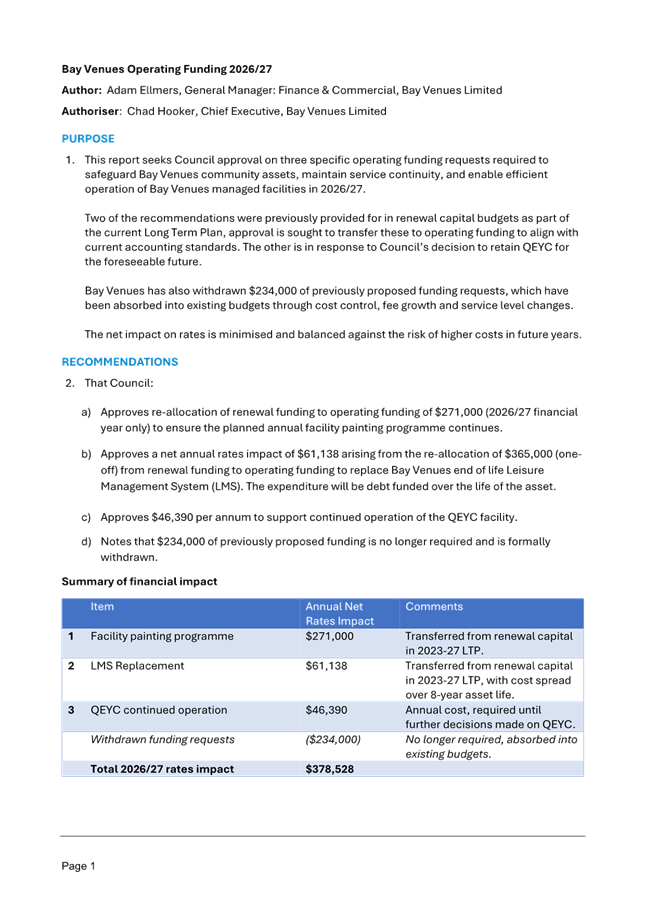
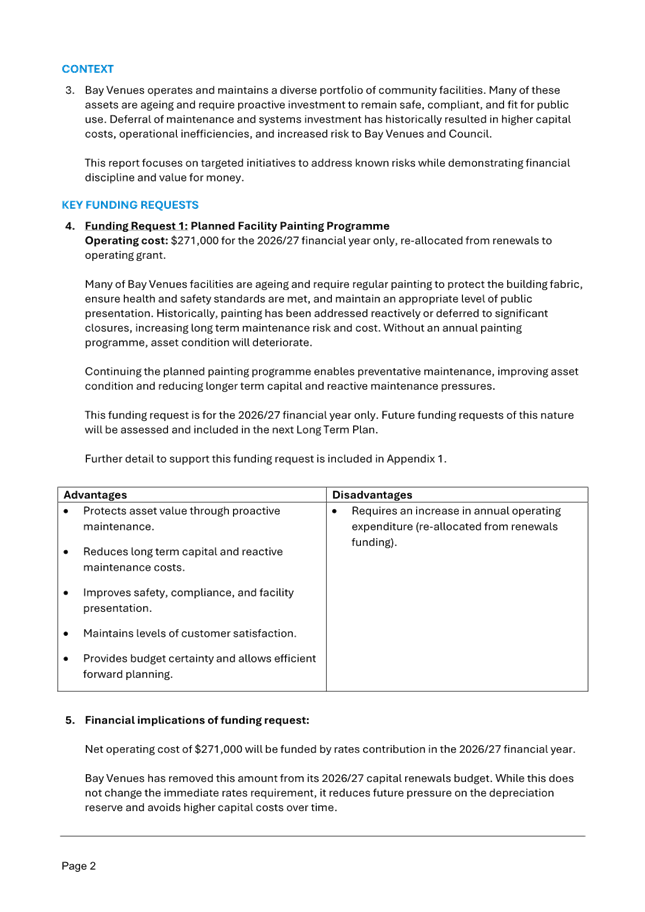
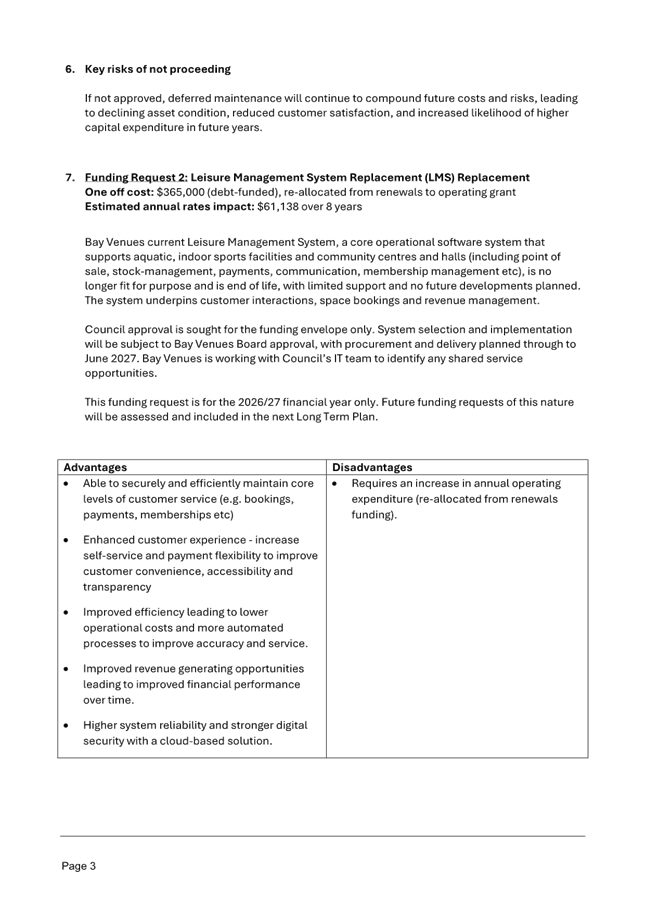
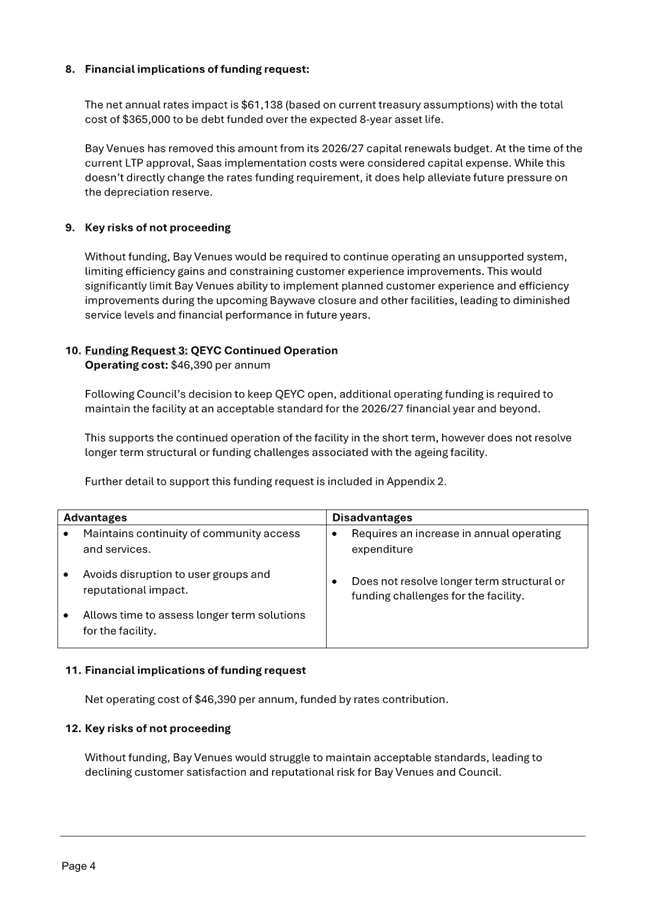


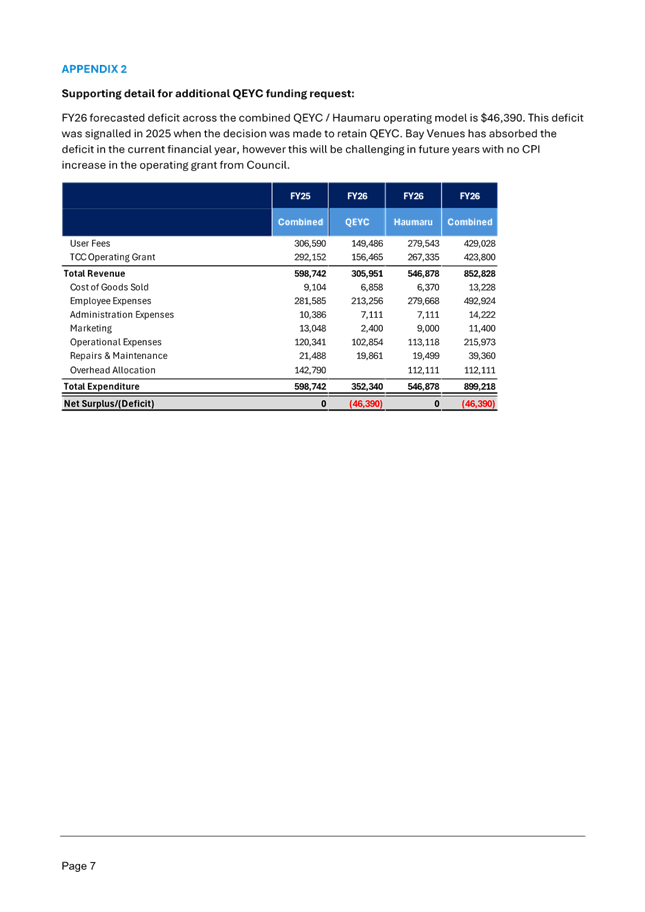
|
Ordinary
Council meeting Agenda
|
21
April 2026
|
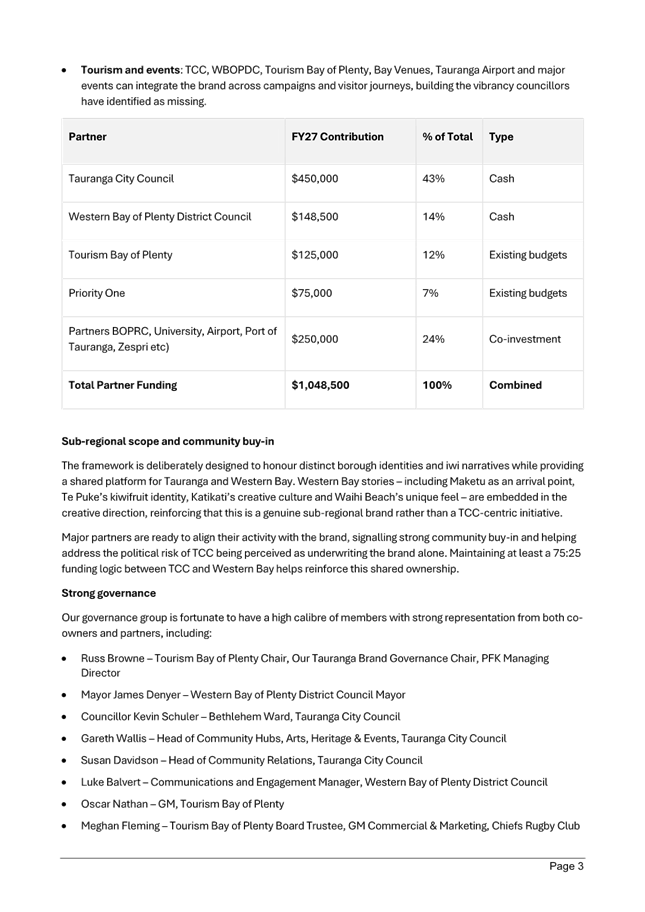
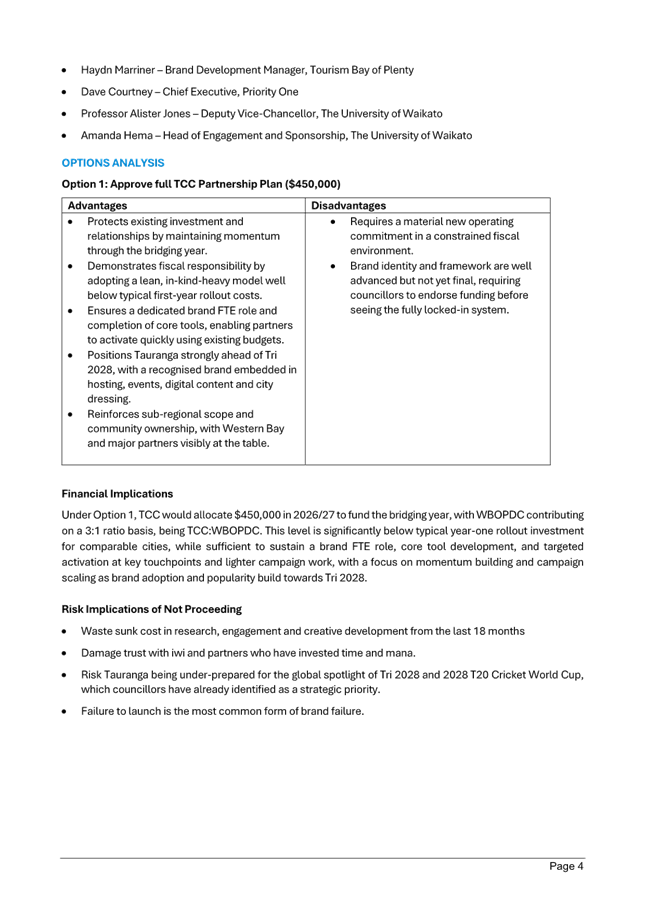
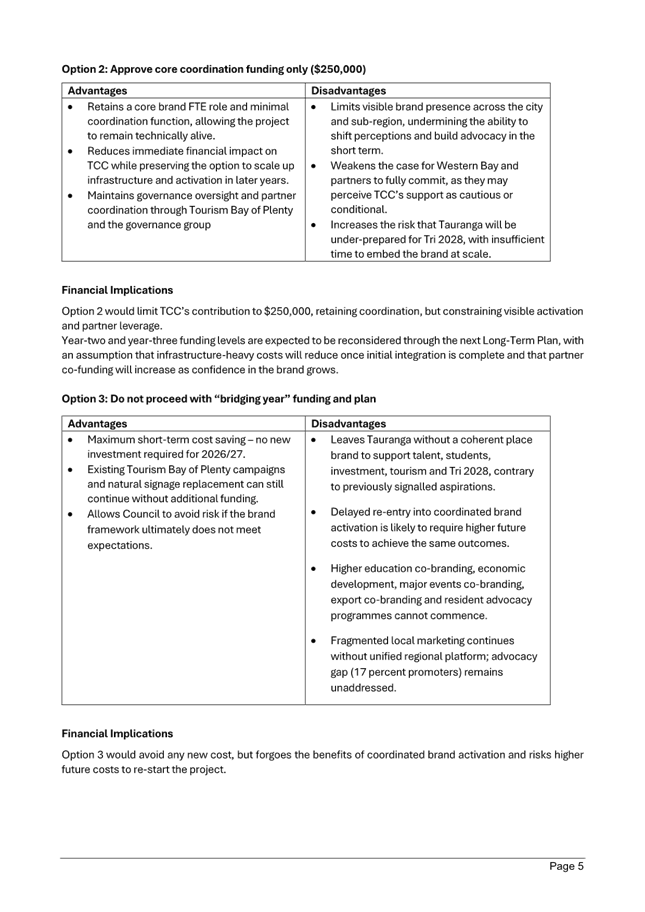
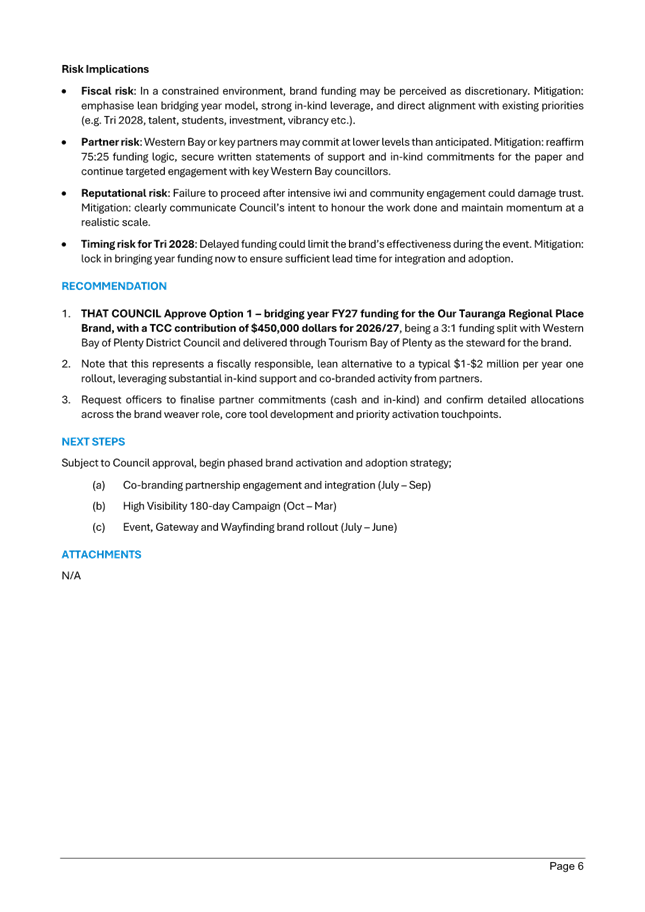
|
Ordinary
Council meeting Agenda
|
21
April 2026
|
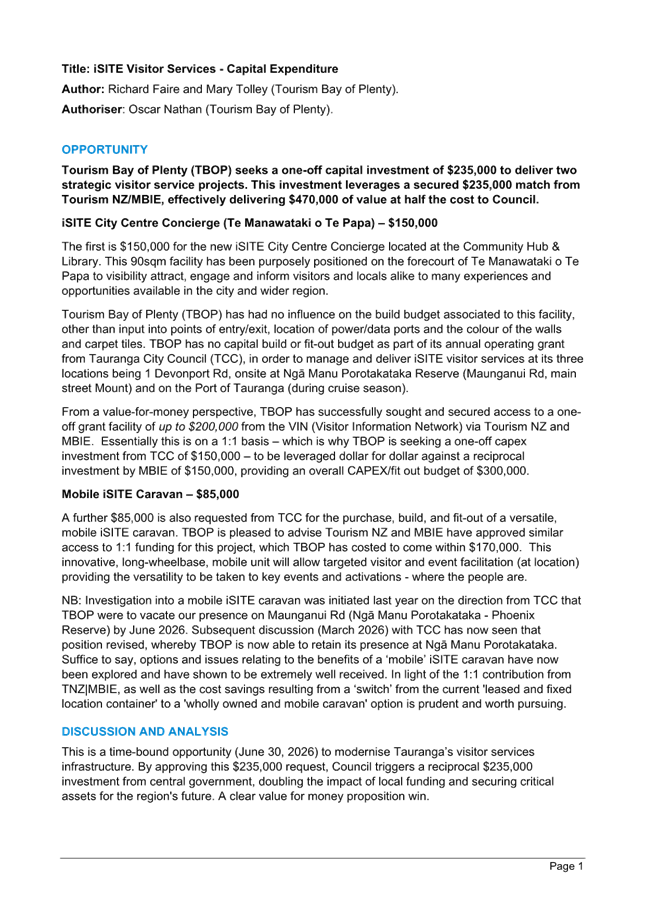
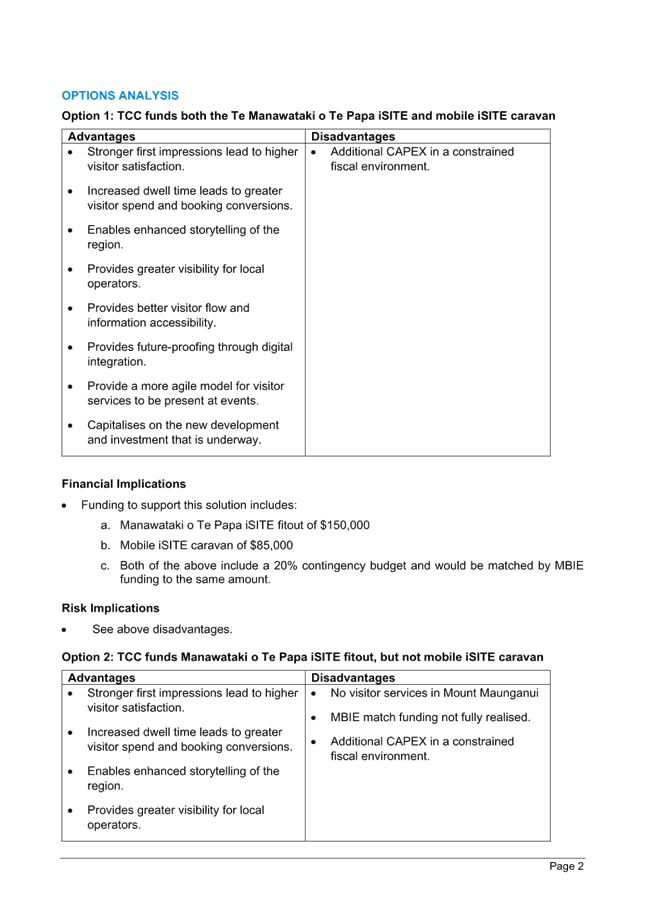
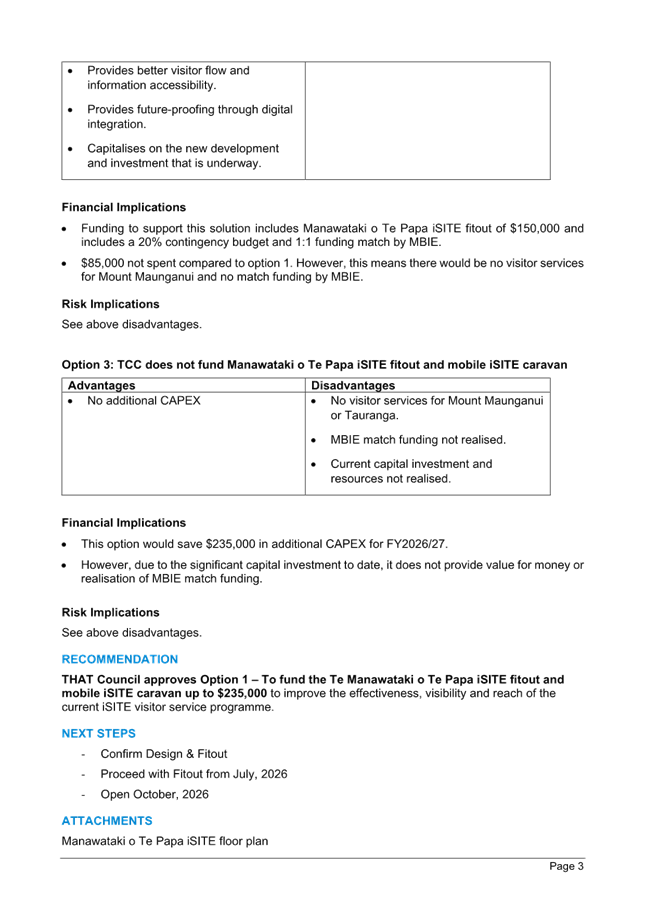
|
Ordinary
Council meeting Agenda
|
21
April 2026
|
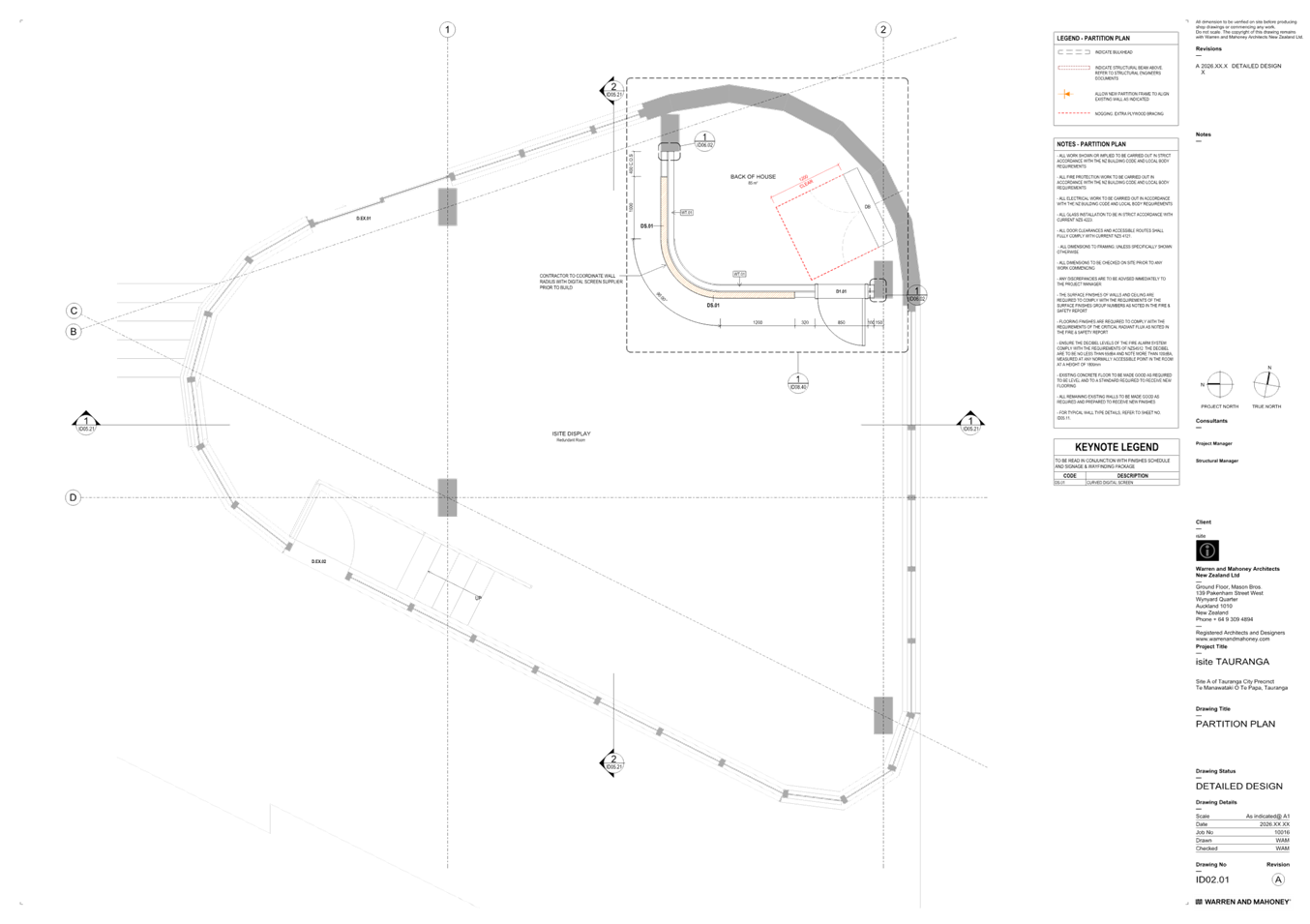
|
Ordinary
Council meeting Agenda
|
21
April 2026
|
11.6 Long-term Plan
2027-2037 - Project Plan
File
Number: A19836770
Author: Josh
Logan, Team Leader: Policy & Corporate Planning
Authoriser: Christine
Jones, General Manager: Strategy, Partnerships & Growth
Please
note that this report contains confidential attachments.
|
Public Excluded Attachment
|
Reason why Public Excluded
|
|
Item 11.6 - Long-term
Plan 2027-2037 - Project Plan - Attachment 4 - Confidential List of emerging
issues for the LTP 2027-2037
|
s7(2)(h) - The
withholding of the information is necessary to enable Council to carry out,
without prejudice or disadvantage, commercial activities.
|
Purpose of the Report
1. This report seeks to meet
one of the Chief Executive’s KPIs set by Council to provide a detailed
timeline for the Long-term Plan 2027-2037 by the end of quarter three in
2025/26.
|
Recommendations
That the Council:
(a) Receives the report
"Long-term Plan 2027-2037 - Project Plan".
(b) Endorses Attachments 3 and 4
(confidential) as the initial schedule of issues to be considered through the
Long-term Plan 2027-2037. Notes that items will be added to or
removed from the schedule through the Long-Term Plan development process.
(c) Attachment 4 can be
transferred into the open after discussions with affected parties has taken
place.
|
Executive Summary
2. The Long-term Plan
(LTP) is the most significant planning and decision-making process for the
mayor and councillors for their term of council. It sets out what Tauranga City
Council will do over the next 10 years and how we’ll pay for it. This
includes everything from major infrastructure projects to the services we
provide every day. The project budget is $285,789.
3. A new LTP is developed
and adopted every three years by the mayor and councillors, in the middle year
of the normal local government election cycle. Each plan must include a
financial strategy that shows how we’ll manage our finances over the long
term.
4. The next LTP is due
for adoption by 30 June 2027.
5. This report and its
attachments provide the mayor and councillors a high-level overview of the
standard LTP process and a detailed timeline that starts from now and runs
through to June 2027.
Background
6. Council
is required to prepare a long-term plan (“LTP”) every three
years. The purpose[5]
of the LTP is to:
a) describe
the activities of the local authority; and
b) describe
the community outcomes of the local authority’s district or region; and
c) provide
integrated decision-making and co-ordination of the resources of the local
authority; and
d) provide
a long-term focus for the decisions and activities of the local authority; and
e) provide
a basis for accountability of the local authority to the community.
7. The
LTP covers ten years and also incorporates an infrastructure strategy with a
30-year timeframe.
8. The
LTP brings together a large number of processes and topics and requires content
input from all Council activities. Coordinating this, including providing
appropriate content to the mayor and councillors for direction-setting and
decision-making is a significant task. Some workstreams have been
underway for a few months, others commence later in the process.
9. This
report continues on from the report to Council from 18 November 2025 which
outlined the high-level process that an LTP takes over its creation. This
report can be found at: https://infocouncil.tauranga.govt.nz/Open/2025/11/CO_20251118_AGN_2765_AT.PDF
10. Attachment
1 to this report includes the project plan for the LTP 2027-2037 which
outlines the four phases this LTP will go through in its creation and when
these phases are likely to occur.
11. Attachment
2 gives a high-level month by month breakdown from now till June 2027 of
when each of the content and process pieces of the LTP identified in the 18
November 2025 report are currently scheduled to occur.
12. Attachment 2 also
provides the dates for when all eight workshops relating to the LTP have been
booked with mayor and councillors from May 2026 to December 2026.
Additional workshops may be required and will be scheduled based on elected
member direction on specific matters for which workshops are an appropriate
approach to consider issues.
13. Attachment 3 and 4 include
a schedule of issues to be considered through the 2027-37 LTP. The issues
in this staff complied list are over and above the usual approach of Strategy
Stocktake (including AIP review), Asset Management Plan reviews, Activity Area
Plan reviews.
14. The issues identified in the
attached lists are topic specific matters that are likely to progress to issues
and options papers over the course of the development of the LTP. The intent is
that these lists are also a live document that gets updated as issues are
identified. Where appropriate workshops will be scheduled to address
specific issues.
Mayor and Councillors
LTP direction
15. As identified above there are
currently eight scheduled workshops starting in May 2026 going to December
2026. The dates are identified in Attachment 2.
16. The first workshop will aim to
present some background of the environment that the LTP will be formed in. The
discussion will then be asking mayor and councillors to think about what type
of LTP that they want the organisation to deliver for them. The two key areas
which staff wish to focus the discussion on will be:
· The
financial strategy for developing the LTP
· What
do the mayor and councillors want to achieve in this LTP
17. Also to note in Attachment 2 is
the timeline for when key decisions need to be made in regard to the draft
long-term plan. It should be noted that there will be key decisions required
from the mayor and councillors on the LTP at Council’s meeting on 1
December 2026 and then also the first meeting of the year in February 2027. It
is critical that decisions are made at these meetings in order for the project
to meet the audit and statutory deadlines of this project.
Statutory Context
18. Legislative issues are
considered in the Background section to this report.
STRATEGIC ALIGNMENT
19. This contributes to the
promotion or achievement of the following strategic community outcome(s):
|
Contributes
|
|
We are an inclusive city
|
ü
|
|
We value, protect and enhance the environment
|
ü
|
|
We are a well-planned city that is easy to move
around
|
ü
|
|
We are a city that supports
business and education
|
ü
|
|
We are a vibrant city that embraces
events
|
ü
|
20. The LTP seeks
to enable Council to achieve its community outcomes.
Options Analysis
21. This report has no options for
Council to consider.
Financial Considerations
22. This report has no financial
implications.
Legal Implications / Risks
23. This report has no other legal
implications or risks.
TE AO MĀORI APPROACH
24. The LTP process does not affect
TCC’s ambitions to align with the Te Ao Māori approach. However,
future funding decisions in the process may have an impact on individual
projects or programmes that are specifically working towards fulfilling the
approach. Council staff will connect with the Rangapu through the LTP
development process where appropriate.
CLIMATE IMPACT
25. The LTP process does not affect
TCC’s ambitions to align with the Climate Impact Statement. However,
future funding decisions in the process may have an impact on individual
projects or programmes that are specifically working towards fulfilling this
ambition.
Consultation / Engagement
26. An
engagement approach and programme will be one of the key aspects of the LTP
programme of work.
27. The
mayor and councillors will be further involved in the development of that
approach and programme over coming months.
28. The
LTP consultation document will be formally consulted on in March/April
2027.
Significance
29. The Local Government Act 2002
requires an assessment of the significance of matters, issues, proposals and
decisions in this report against Council’s Significance and Engagement
Policy. Council acknowledges that in some instances a matter, issue,
proposal or decision may have a high degree of importance to individuals,
groups, or agencies affected by the report.
30. In making this assessment,
consideration has been given to the likely impact, and likely consequences for:
(a) the current
and future social, economic, environmental, or cultural well-being of the
district or region
(b) any persons who are likely to be
particularly affected by, or interested in, the matter.
(c) the capacity of the local authority
to perform its role, and the financial and other costs of doing so.
31. The
matter of the LTP and its contents have a high degree of significance.
However, the decision to receive this report and the project plan (Attachment
1) and outline month by month work programme (Attachment 2) is of low
significance as they are predominantly procedural and work is already underway.
ENGAGEMENT
32. Taking into consideration the
above assessment, that the decision is of low significance, officers are of the
opinion that no further engagement is required prior to Council making a
decision.
Next Steps
33. Work
will continue or commence on each of the phases and workstreams included in
Attachments 1 and 2. Workshops and formal Council and Committee meetings
will be scheduled to bring these LTP workstreams to the mayor and councillors
for direction-setting and decision-making throughout 2026.
34. Emerging
issues identified in Attachments 3 and 4 will progress to workshops, discussion
papers and/or issues and options papers to Council between now and December
2026.
Attachments
1. Project
Management Plan - 2027-37 Long-term Plan - A19864889 ⇩ 
2. 2026-27
Month by Month View of LTP 2027-37 - A19864886 ⇩ 
3. List
of emerging issues for the LTP 2027-2037 - A19871457 ⇩
4. Confidential List
of emerging issues for the LTP 2027-2037 - A19872488 - Public Excluded
|
Ordinary
Council meeting Agenda
|
21
April 2026
|
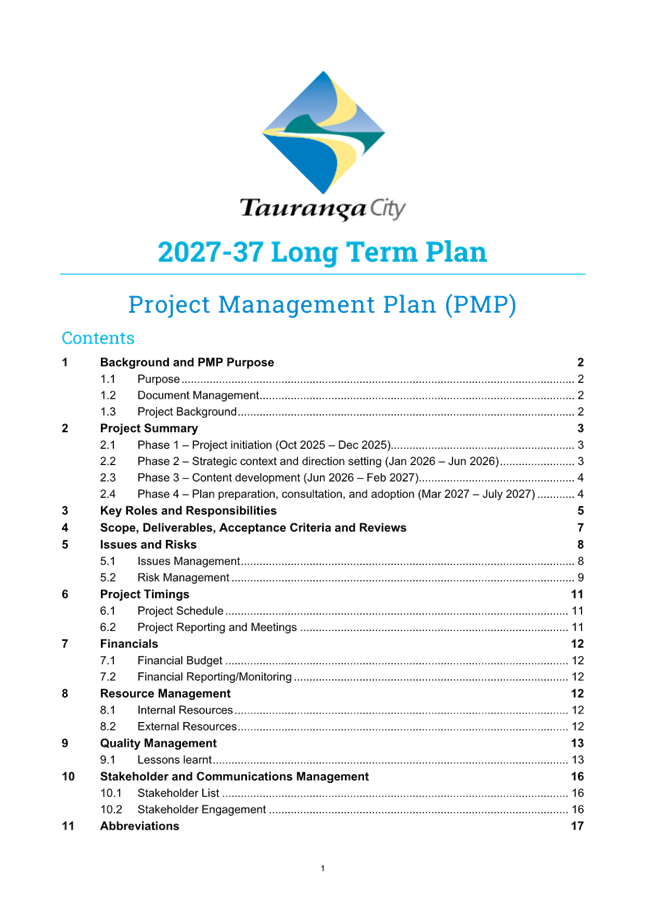
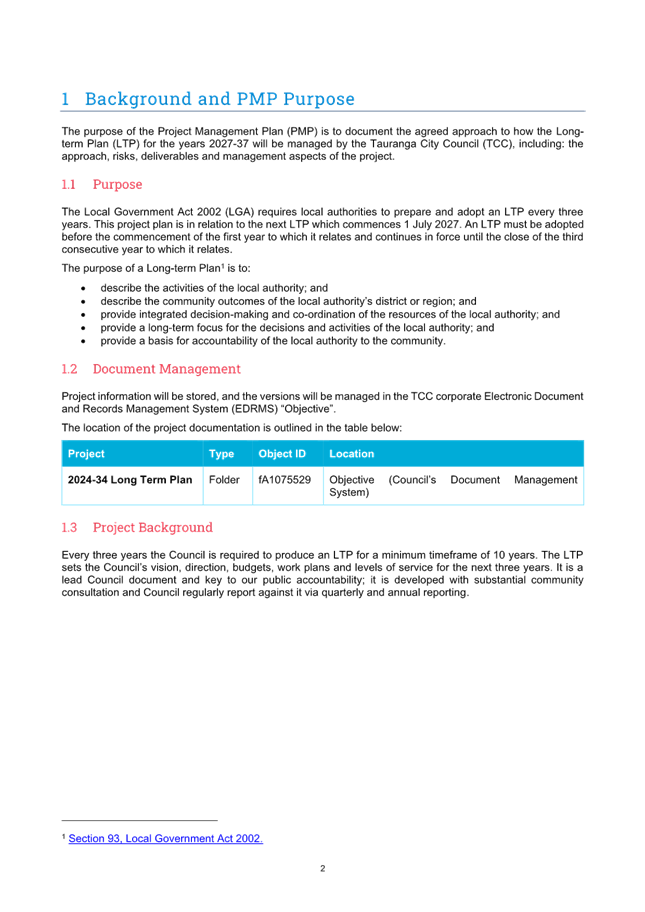
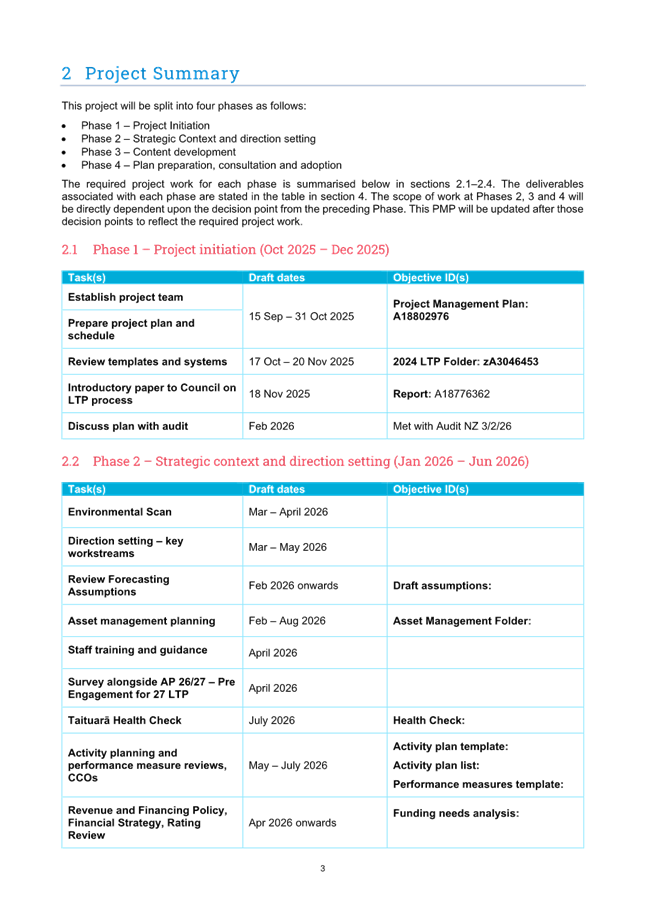
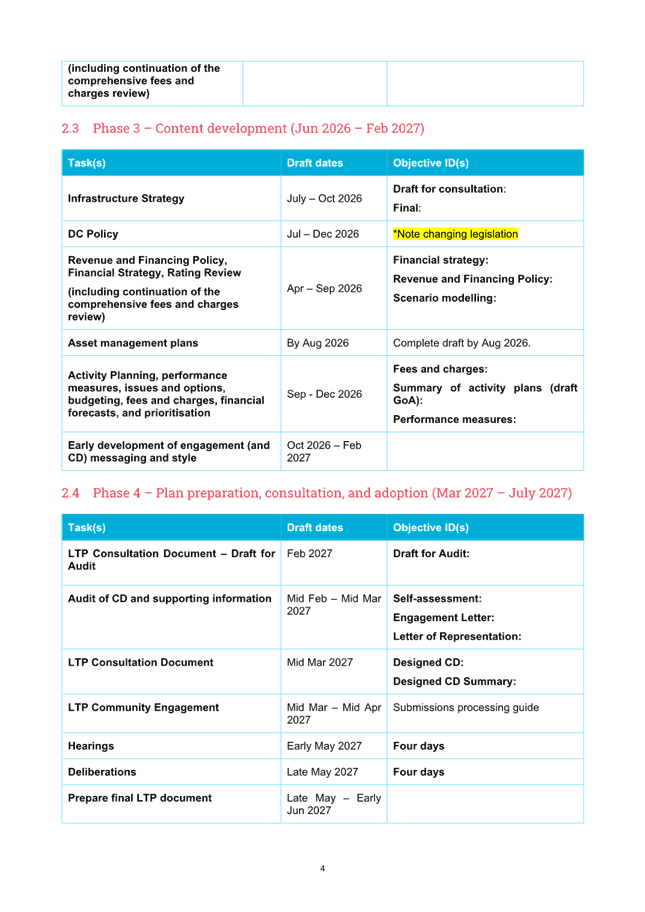
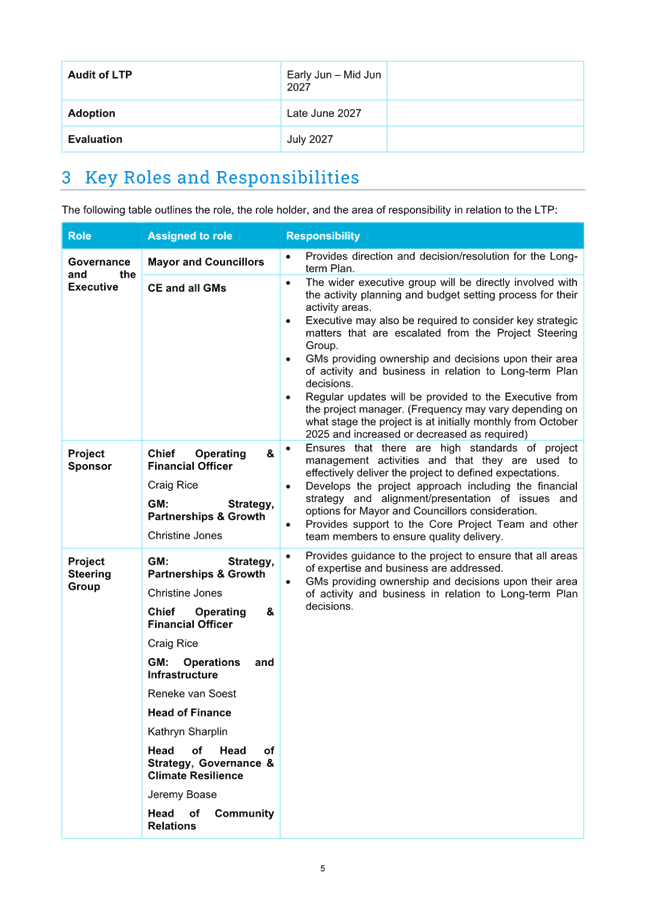
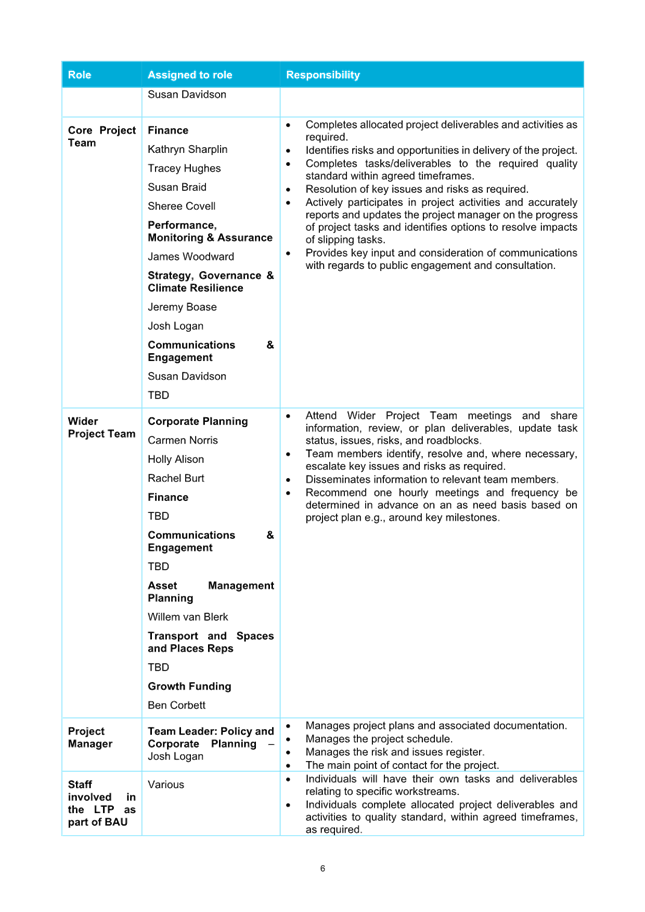
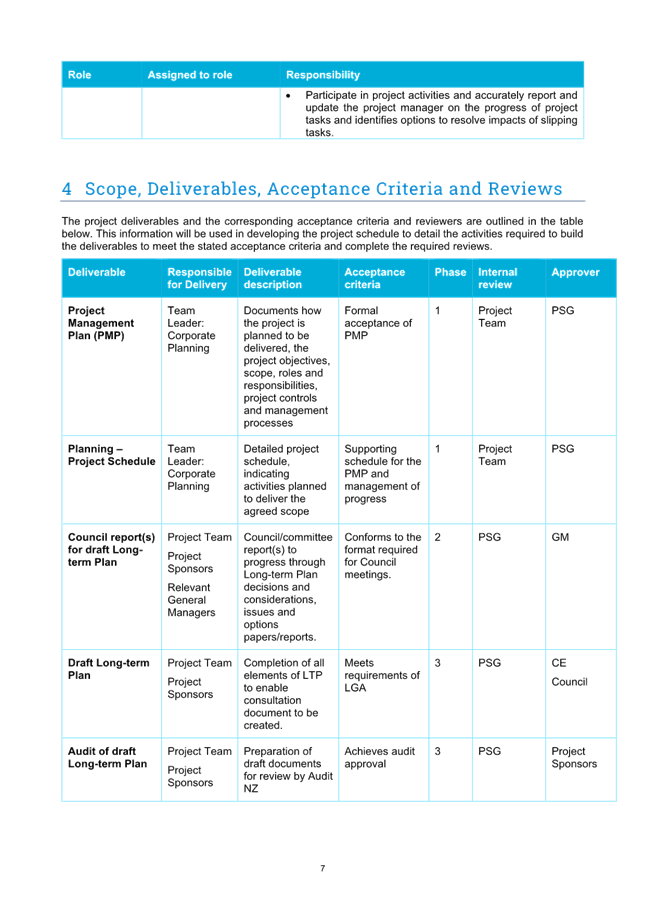
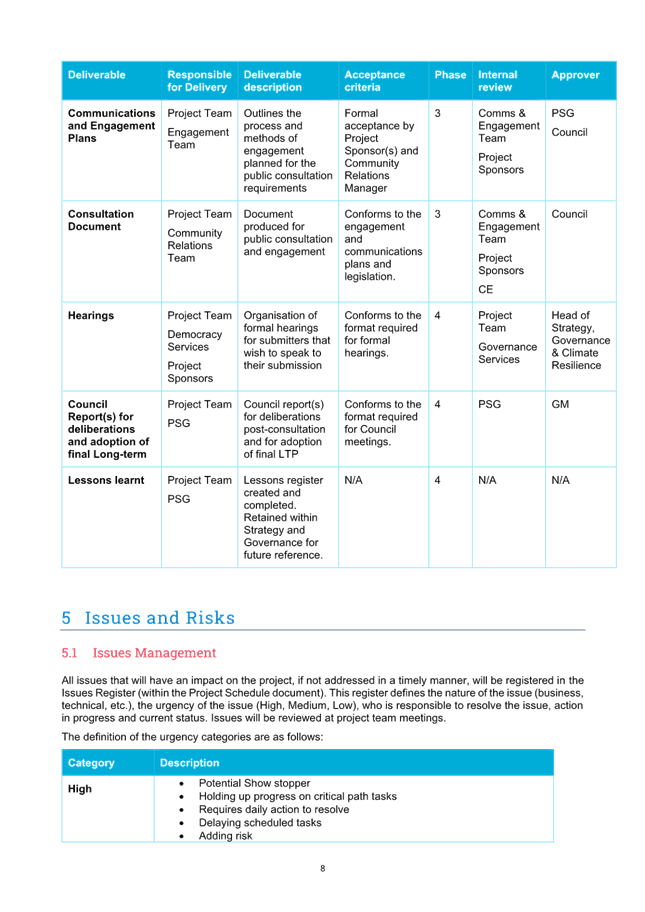
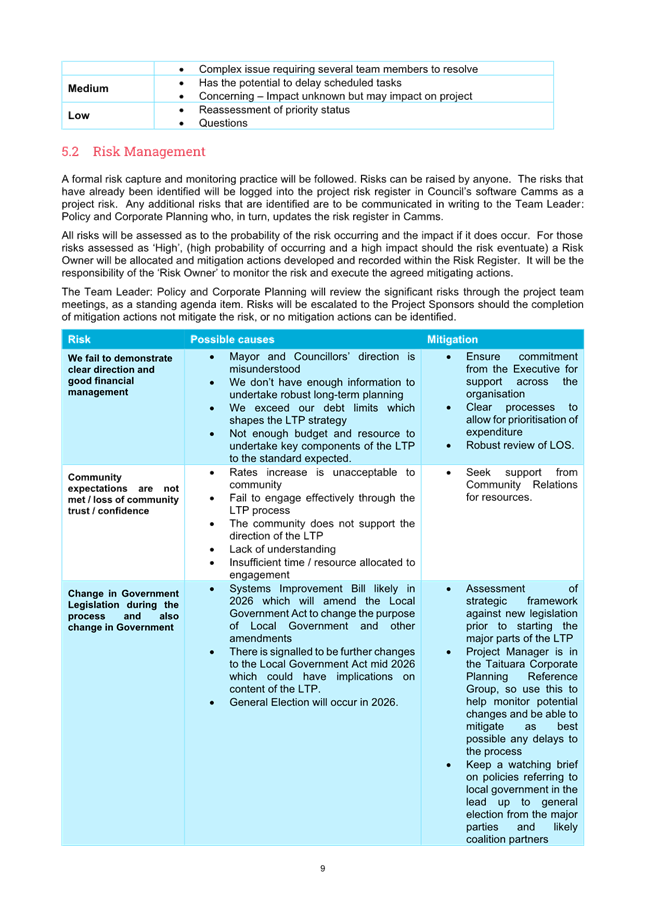
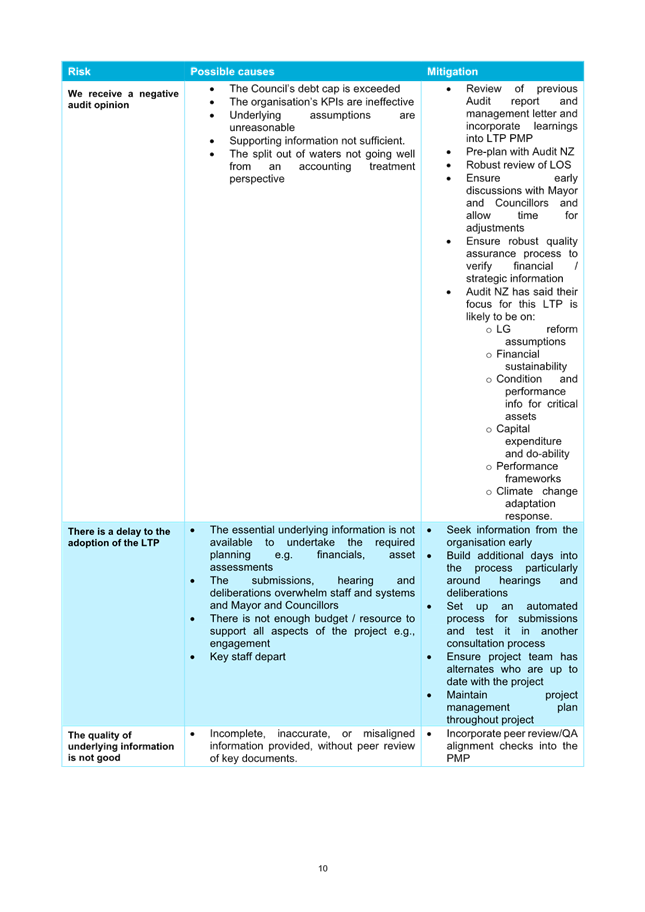
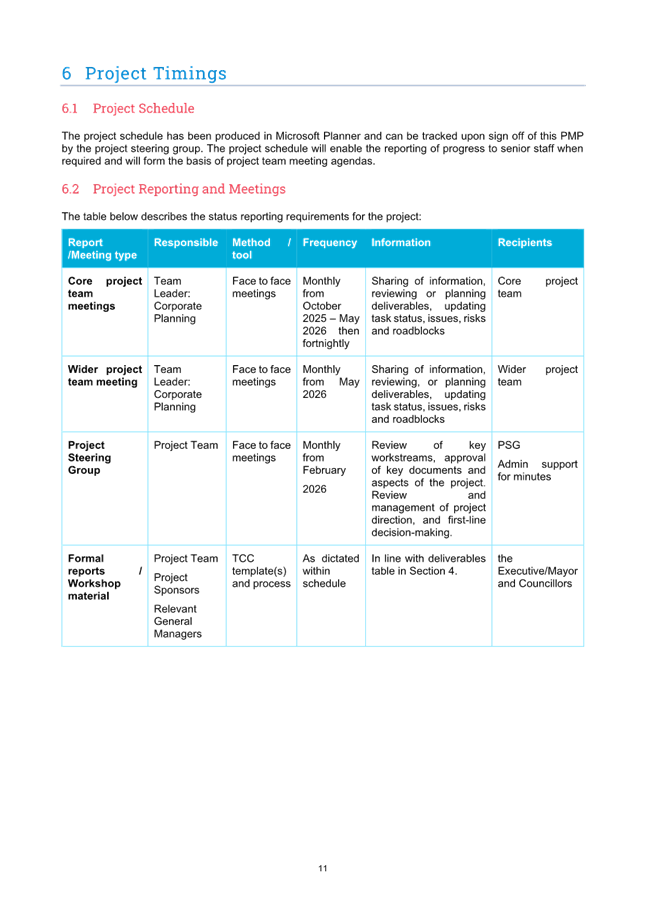
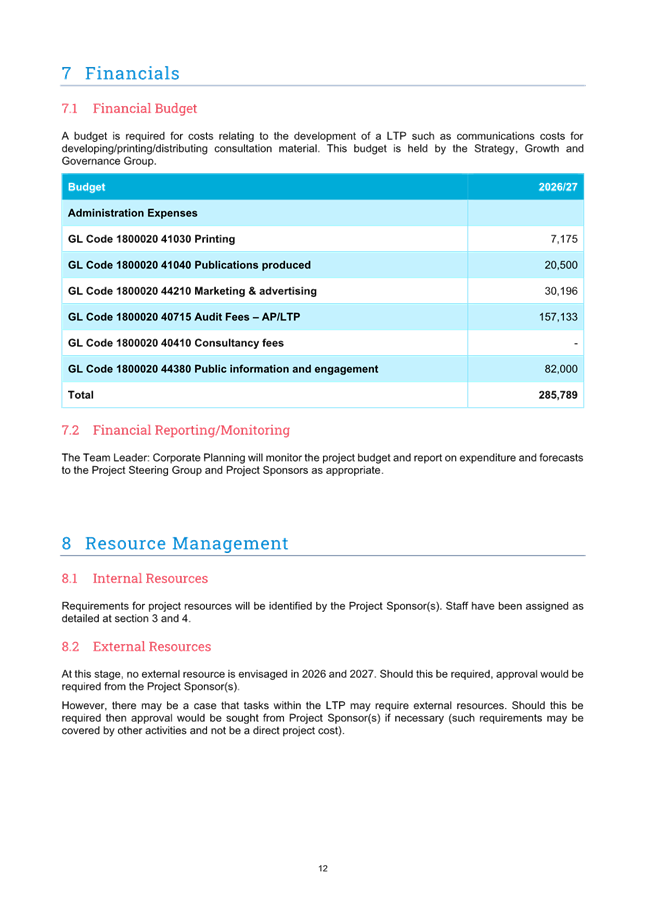
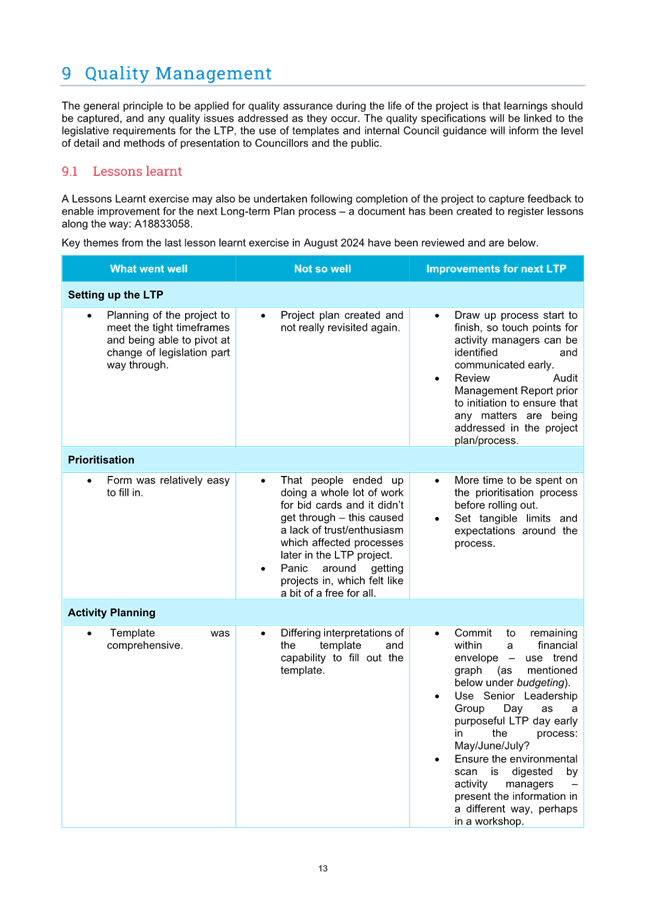
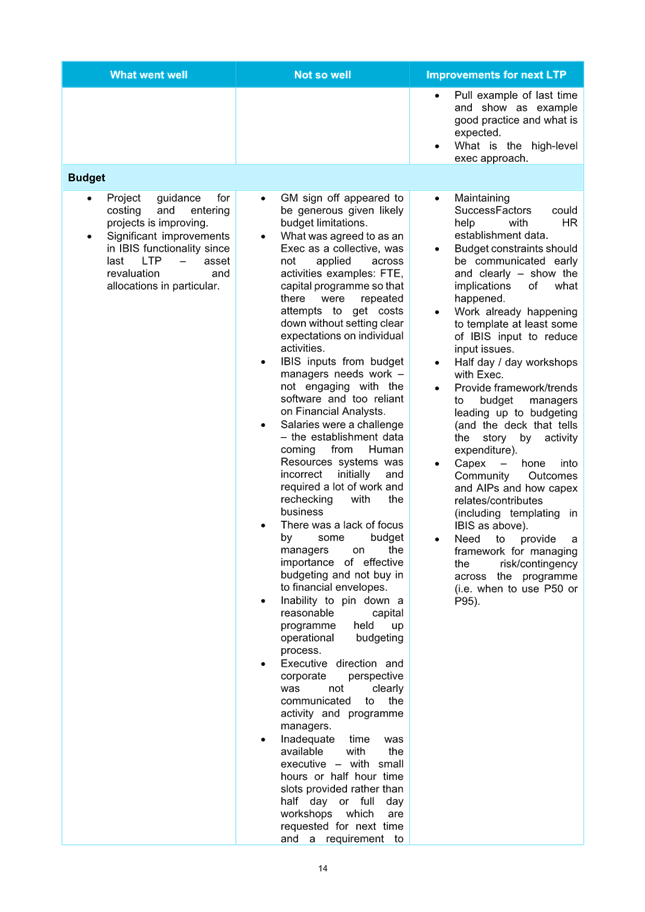
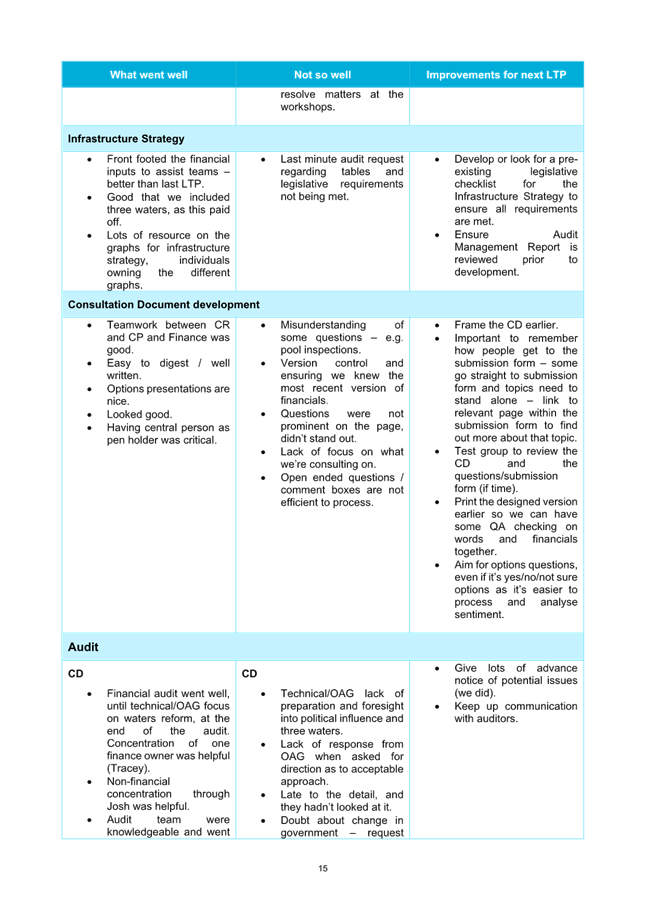
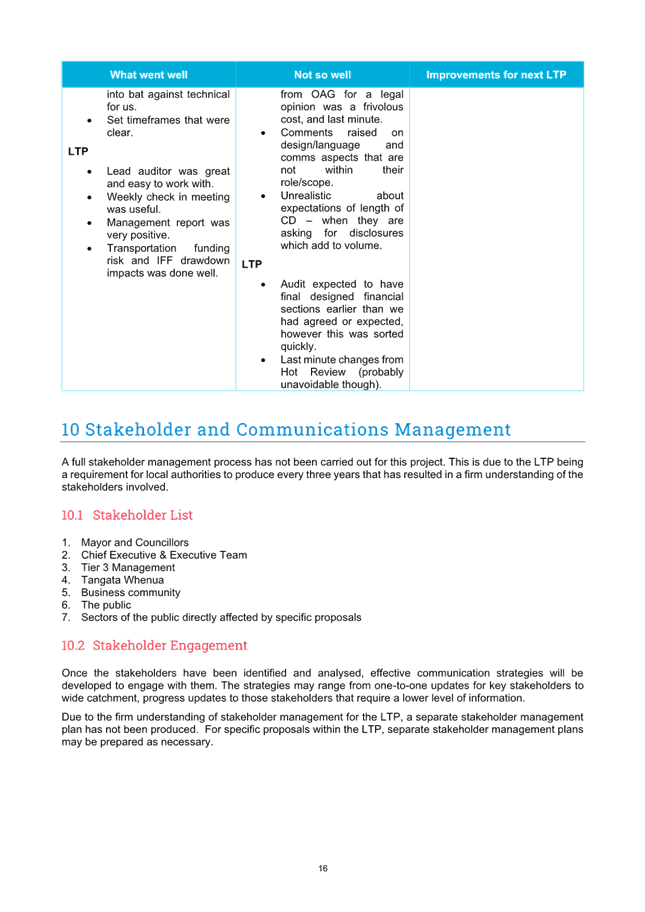
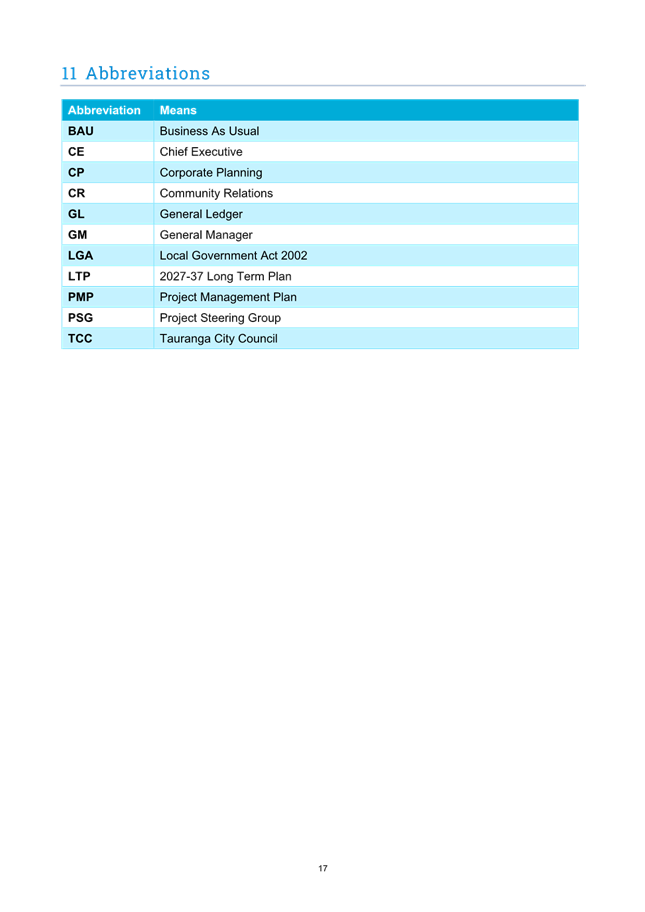
|
Ordinary
Council meeting Agenda
|
21
April 2026
|
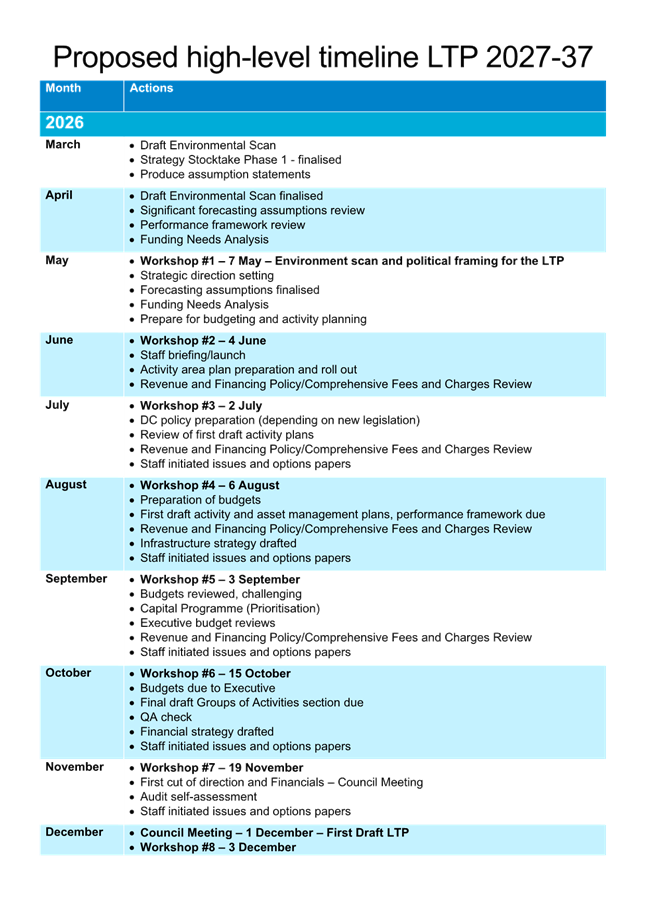
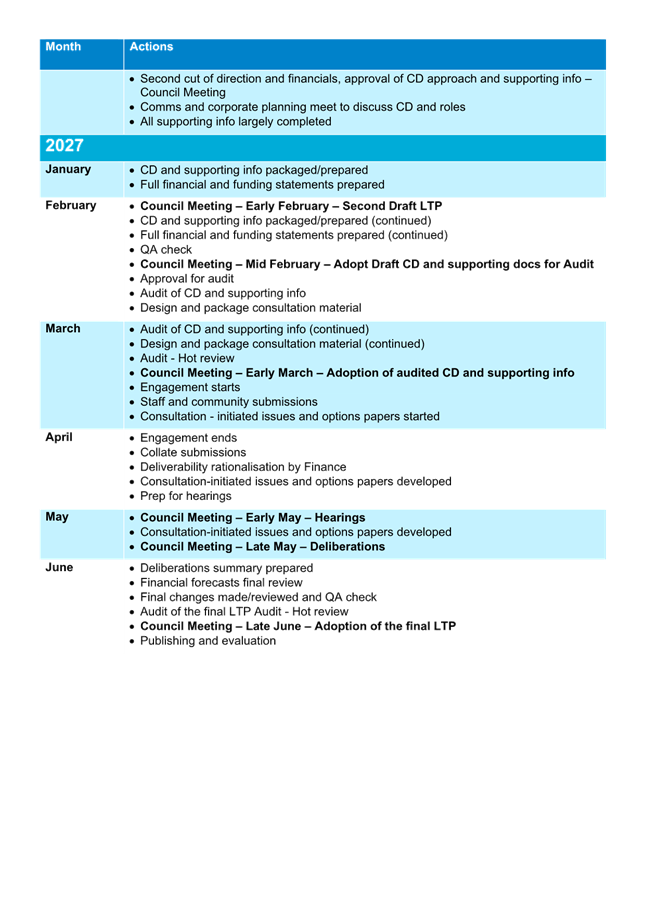
|
Ordinary
Council meeting Agenda
|
21
April 2026
|
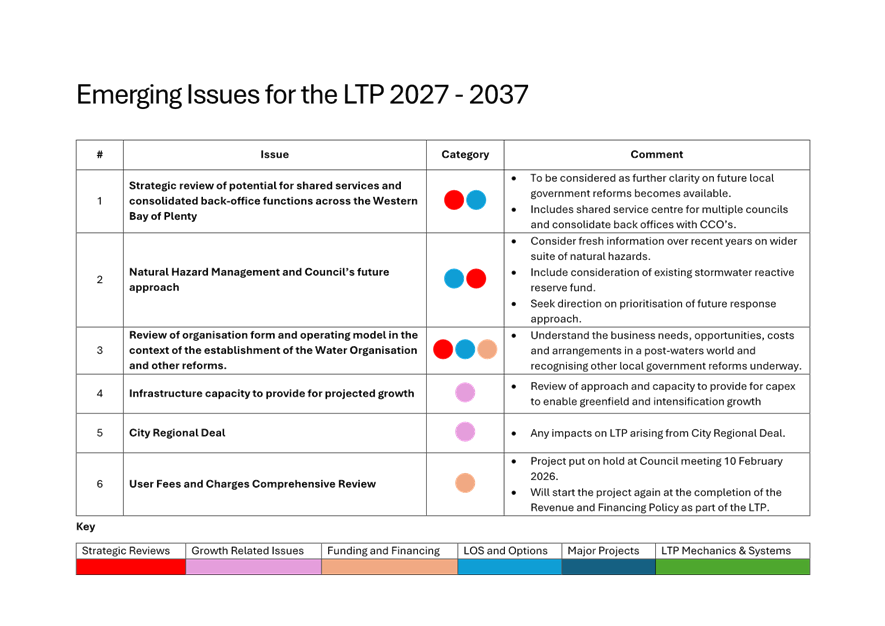
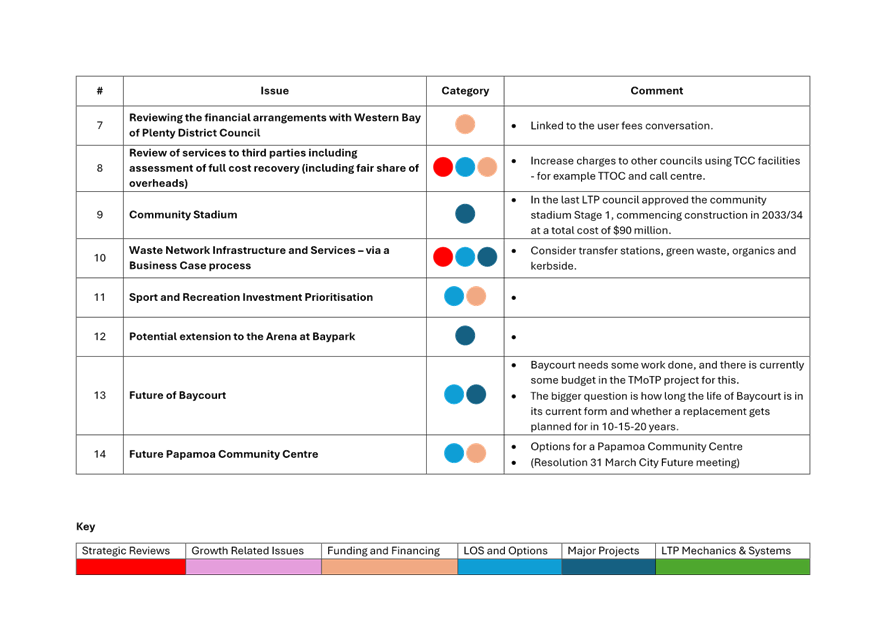
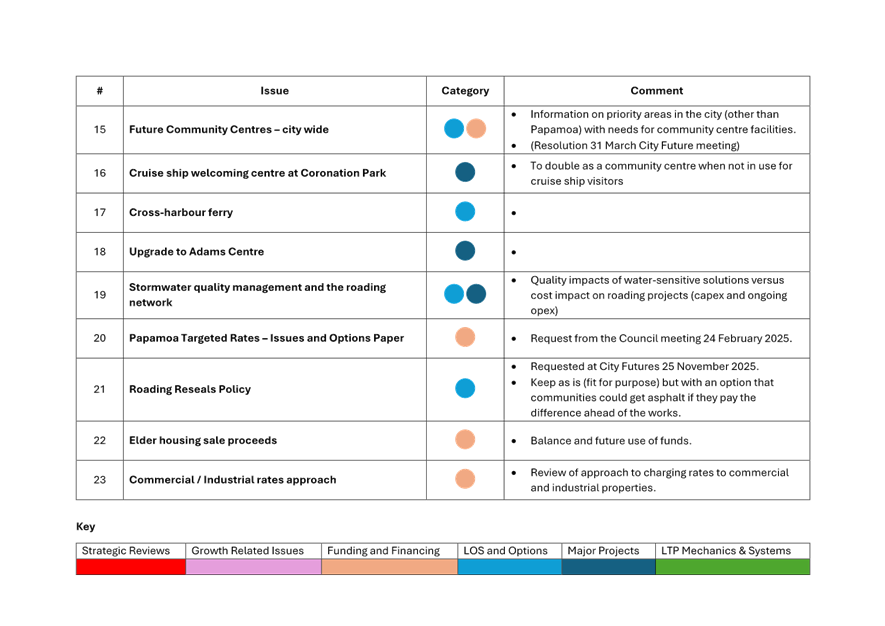
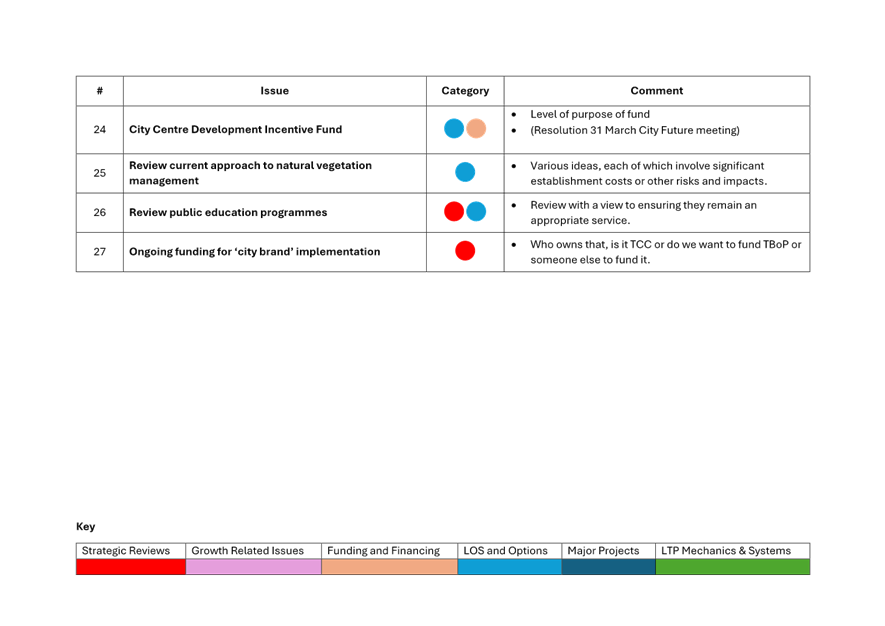
|
Ordinary
Council meeting Agenda
|
21
April 2026
|
11.7 Report
for the adoption of draft Trade Waste Bylaw for consultation
File
Number: A17659688
Author: Radleigh
Cairns, Manager: Drainage Services
Jennifer Ross,
Policy Analyst
Authoriser: Reneke
van Soest, General Manager: Operations & Infrastructure
Purpose of the Report
1. To approve the draft
Trade Waste Bylaw 2026 and Statement of Proposal for consultation.
|
Recommendations
That the Council:
(a) Receives the report
"Report for the adoption of draft Trade Waste Bylaw for
consultation".
(b) Notes the Bylaw Review Plan
for Trade Waste Bylaw (Attachment One) developed to meet the
requirements of section 263(4)(d) of the Local Government (Water Services)
Act 2025.
(c) Approves the proposed draft
Trade Waste Bylaw (Attachment Two) and the Statement of Proposal (Attachment
Three) for community consultation.
(d) Delegate to the General
Manager: Operations & Infrastructure the ability to make any minor edits
or amendments to the draft Trade Waste Bylaw 2026 or Statement of Proposal to
correct any identified errors or typographical edits prior to consultation.
|
Executive Summary
2. Tauranga City
Council’s Trade Waste Bylaw (Trade Waste Bylaw) was first adopted
in 2004 and was last reviewed in 2019. The bylaw aims to protect the wastewater
network by regulating the discharge of contaminants, ensuring it protects
public health and the environment from the effects of trade waste discharges,
manages the capacity of the wastewater network, and enables compliance with
Tauranga City Council’s resource consents relating to the discharges
associated with wastewater. The bylaw empowers the council to require treatment
works, charge for additional demand on wastewater treatment plant, monitor
discharges, enforce consents (now called permits under the Local Government
(Water Services) Act 2025 (Act)), and impose penalties for breaches.
3. This review of the
Trade Waste Bylaw has been completed in accordance with the Act which came into
effect on 27 August 2025.
4. The power to make a
Trade Waste Bylaw remains with Tauranga City Council under the Act, regardless
of whether the wastewater services it relates to are provided directly by
Tauranga City Council or a separate entity.
5. The Act requires
that Tauranga City Council undertake a review of the bylaw and develop a Bylaw
Review Plan. It is proposed that this bylaw review be completed in accordance
with the Bylaw Review Plan for Trade Waste Bylaw (Attachment One).
6. The updated bylaw
will strengthen trade waste operations now and into the future. It also
supports continuity in how we deliver trade waste and wastewater services
during any transition to a new water organisation.
7. Processing trade
waste through the wastewater network and treatment plants incurs higher costs
than domestic waste, yet under the current bylaw, only the largest contributors
pay trade waste fees, resulting in domestic users subsidising business waste processing.
To promote fairer cost allocation, the proposed bylaw introduces a new
“controlled discharges” category, requiring businesses with higher
volumes of permitted trade waste to obtain permits and pay fees that help
recover the associated processing and administration costs (clauses 5 and 6.1
of the draft bylaw). The permit fees form part of the User Fees and Charges
Review which is currently under public consultation.
8. A number of other
trade waste management challenges and opportunities have also been identified
through this review therefore the following changes are proposed to address
these, including:
(a) Updating terminology for
consistency with the Act, for example, using the term water service provider[6] and replacing
consents with permits (clause 5 definitions).
(b) Introducing provisions to
administer the permit process, including applications, granting, renewing,
reviewing, transferring, terminating and transitioning from consents to permits
(clauses 7 to 12 and 17).
(c) Clarifying requirements for the
management of hazardous materials and tankered wastes (clauses 13 and 14).
(d) Being more prescriptive about
pre-treatment requirements and mass limits on trade waste discharges (clause
15).
(e) Providing clarity on sampling,
analysis and monitoring of trade waste discharges (clause 16).
(f) Strengthening
requirements for reporting of accidents and responses to them and incorporating
infringement offences, to encourage compliance with the bylaw, in accordance
with section 269 of the Act (clause 18).
(g) Updating provisions for
prescribing and recovering fees and charges to reference both the Act and
continuing Local Government Act 2002 requirements (clause 19).
(h) Empowering the use of
compliance orders under the Act (clause 20).
(i) Updating the technical
schedules to reflect current best practice and industry standards (Schedules).
9. Based
on the proposed classification of trade waste discharges into four categories,
a revised fee structure for Trade Waste permits and discharges is proposed.
Introducing a more equitable, graduated user-pays approach. If adopted
following consultation, this new structure and associated fees are projected to
generate additional revenue from controlled discharge permits - approximately
$130,000 in 2027, increasing to $210,000 in 2028 and $300,000 in 2029. While
these changes will improve cost recovery for managing Trade Waste, they will
also have a financial impact on smaller businesses that currently do not
contribute to the costs associated with assessing and monitoring their trade
waste discharges and treatment devices.
10. Emerging
contaminants, including persistent organic pollutants such as PFAS[7], can persist in the
environment and accumulate in biosolids if discharges are not controlled. The
draft bylaw strengthens requirements for managing trade waste that includes
these substances to support continuing consent compliance, and future-proof the
safe disposal and beneficial reuse of the biosolids produced through the
wastewater treatment process.
11. Staff feedback indicates that
updates in the bylaw will require new pre-treatment for some trade waste
discharges, potentially driving capital upgrades over time for some businesses
and council operations.
12. The
Council are asked to adopt the proposed draft Trade Waste Bylaw for
consultation using the special consultative procedure, as required by the Act.
13. If the Council decides to adopt
the draft Trade Waste Bylaw (Attachment Two) and Statement of Proposal (Attachment
Three), the consultation will be carried out in May 2026. Depending on the
outcome of the consultation, hearings, deliberations and the date of adoption
of the Trade Waste Bylaw, staged implementation of the bylaw is targeted to
commence August 2026.
Background
14. Tauranga City Council is
responsible for ensuring that the wastewater network is managed in a way that
meets our regional consent conditions, protects the environment and maintains
public health and safety. Trade Waste Bylaw provisions help to manage discharges
into the wastewater network by regulating potential pollutants and protecting
wastewater assets from damage or exceeding wastewater treatment plant capacity
to comply with our regional consent conditions.
15. Trade Waste Bylaw provisions
also help to manage the potential pollutants in the biosolid residuals that are
produced through wastewater treatment. The biosolid residuals are disposed of
cost effectively through vermicomposting and then land application. In 2025
Water New Zealand released updated Guidelines for Beneficial Reuse of Biosolids
on Land[8]
which signalled concerns about emerging contaminants such as persistent organic
pollutants and noted “implications for contamination of biosolids if such
discharges are not controlled”.
16. Under the Act, Tauranga City
Council retains the power to make waters bylaws for this city, however the
wastewater services will be delivered by a water services provider, which may
be either Tauranga City Council directly or through a separate water services
organisation. Regardless of who the water service provider is, bylaw provisions
help to manage the public wastewater network by regulating potential pollutants
and protecting public wastewater assets from damage or misuse.
17. As part of the transition of
water services and associated bylaws to the Act, sections 263(4)(d) and 263(6)
of the Act require that a Bylaw Review Plan be developed. The draft Bylaw
Review Plan for Trade Waste Bylaw (Attachment One) has been prepared for
compliance with the Act and provides details and dates of the steps for
completing this review process.
18. The updated bylaw is designed
to ensure trade waste discharges into Tauranga City Council’s wastewater
network remain managed in accordance with new legislative requirements,
regardless of future changes to water service delivery structures.
19. Our review involved input from
internal business units including Water Drainage Services, City Waters
Planning, Waste Operations and Compliance, and Takawaenga Māori Unit.
Additionally, we emailed businesses that have had a Trade Waste consent or inspection
to request input into the review and met with the Te Rangapū Mana Whenua o Tauranga Moana policy
subcommittee (Te Rangapū policy subcommittee).
Bylaw issues
20. The review process was
initiated to address key issues with:
(a) the allocation and recovery of
costs for processing trade waste through the wastewater network, and
(b) alignment with current industry
best practices for managing trade waste discharges.
21. Processing trade waste through
the wastewater network and wastewater treatment plants is more expensive than
processing domestic waste. Under the current bylaw, only the businesses that
produce the highest volume and load of trade waste discharges are paying trade
waste fees. In effect, domestic users are subsidising businesses for the cost
of processing their trade waste through the wastewater network.
22. To more fairly share the cost
of processing trade waste, it is proposed that discharges of higher volumes of
permitted trade waste will be part of a new category of discharges called
“controlled discharges” and businesses will be required to obtain a
permit to make controlled discharges. Subject to the User Fees and Charges
Review in 2026, a fee may be set to help recover the costs associated with
these controlled trade waste discharges.
23. Through the review process, the
other identified issues with the bylaw include:
(a) outdated legislative references
with the introduction of the Act
(b) challenges with recovering the
increased costs of monitoring and inspecting business sites
(c) inadequate guidance on tankered
waste discharges, hazardous materials, and pre-treatment requirements
(d) delayed or incomplete reporting
of accidents and breaches.
24. The opportunities associated
with this review of the bylaw include:
(a) updating the approach to
classification and management of trade waste discharges for industry best
practice
(b) enabling fairer allocation of
the costs of processing trade waste to the businesses discharging trade waste
(c) future proofing the disposal of
biosolid residuals from wastewater treatment by addressing emerging
contaminants, specifically persistent organic pollutants such as PFAS (polyfluoroalkyl
substances) that have been identified as a concern in recent updates to
guidelines, to ensure cost effective disposal of biosolids can continue
(d) incorporating the newly
legislated powers to issue:
(i) trade waste permits,
(ii) compliance orders, and
(iii) infringement notices
(e) acknowledging the relationship
between the strategies Tauranga City Council has developed in collaboration
with tangata whenua and how trade waste is managed to ensure the quality of
wastewater discharges into the environment.
Proposed changes to bylaw
25. A number of changes to the
bylaw are proposed to address the issues identified through the review and
ensure alignment with best practice. Those changes are incorporated into the
draft Trade Waste Bylaw (Attachment Two). The details of change from the
three category consent process to the four category permit process are
highlighted in Table One. An overview of the changes to the bylaw is presented
in Table Two.
Table One: Change to Permitted Categories
|
Current Bylaw
|
Draft Bylaw
|
|
Council Consents Issued
|
Trade Waste Permits
Issued
|
|
Three categories of
Trade Waste:
1. Permitted (no consent required)
Includes discharges that have permitted characteristics.
2. Conditional (consent required)
Includes discharges with high flow or high loading above the allowed
discharge characteristics that put additional pressure on the network and
treatment plant processes.
3. Prohibited (never consent) Any
discharge that may cause harm to the wastewater network, staff, be toxic to
fish, animals or plant life after treatment or cause breaches of resource
consents.
|
Four categories of
Trade Waste Discharges:
1. Allowed (no permit required) Includes
discharges that have permitted characteristics and are in low volumes.
2. Controlled (permit required) Includes
discharges with characteristics that require pre-treatment such as grease
traps and wastewater interceptors to manage impact on the network. E.g.
restaurants and those with wash bays.
3. Conditional (permit required) Includes
discharges with high flow or high loading above the allowed discharge
characteristics that put additional pressure on the network and treatment
plant processes.
4. Prohibited (never permit) Any discharge
that may cause harm to the wastewater network, staff, be toxic to fish,
animals or plant life after treatment or cause breaches of resource consents.
|
Table
Two: Key Proposed Changes to the Trade Waste Bylaw
|
Proposed Change
|
Reason
|
|
Change references from
the Local Government Act 2002 to the Local Government (Water Services) Act
2025 as applicable.
|
The Local Government
(Water Services) Act 2025 came into force on 27 August 2025.
|
|
Update clause 4.
Reframe the purpose of
the bylaw.
|
To better reflect how
this bylaw aligns with Tauranga City Council strategies, includes industry
best practice for trade waste management and encourages a proactive approach
to protecting our wastewater network. Responding to feedback received from
stakeholders.
|
|
Modify clause 5.
Insert and update
definitions.
|
To align with current
practice, define new discharge categories, and the terminology of the Act.
For example, referring to a water service provider which may be either
Tauranga City Council or a separate organisation.
|
|
Modify clauses 5 and
6.1.
Classification of
discharges.
|
To enable fairer
allocation of the costs of processing trade waste through the wastewater
network using a more graduated classification system for trade waste
discharges and utilising the introduction of permits under the Act. Table One
details this change.
|
|
Insert clauses 7, 8, 9,
10 and 17.
Modify clauses 11 and
12.
Permit administration.
|
To introduce provisions
to administer the new permit process in accordance with the Act, including
applications, granting, renewing, reviewing, transferring, terminating and
transitioning from consents to permits.
|
|
Insert clause 13.
Hazardous Materials.
|
To clarify requirements
for the management of hazardous materials to protect the wastewater network.
|
|
Insert clause 14.
Tankered Waste.
|
To clarify requirements
for the management and discharge of tankered waste to protect the wastewater
network.
|
|
Insert clause 15.
Pre-treatment and mass
limits.
|
To be more prescriptive
about pre-treatment requirements and mass limits on trade waste discharges,
encouraging cleaner production and protection of the wastewater network.
|
|
Insert clause 16.
Monitoring.
|
To provide greater
clarity about sampling, analysis and monitoring of trade waste discharges.
|
|
Insert clause 18.1.
Accidents.
|
To encourage better
reporting of accidents and responses to them.
|
|
Insert clause 18.3.
Infringement offences.
|
To enable Tauranga City
Council or the water service provider to issue infringement notices and fees,
encouraging compliance with the bylaw, in accordance with section 269 of the
Act.
|
|
Update clause 19.
Fees and charges.
|
Updating provisions for
better recovery of costs, fees and charges. To reference both the Act and
continuing Local Government Act 2002 requirements.
|
|
Insert clause 20.
Compliance orders.
|
To enable Tauranga City
Council or the water service provider to serve compliance orders under
section 297 of the Act.
|
|
Update Schedule One.
Characteristics of
Allowed Discharges.
|
Moved from the body of
the bylaw and updated to reflect the refined classification categories for
trade waste discharges and provide current description of the technical
characteristics of allowed trade waste discharges.
|
|
Update Schedule Two.
Characteristics of
Prohibited Discharges.
|
Moved from the body of
the bylaw. Updated to reflect current descriptions and technical
characteristics of prohibited discharges.
|
|
Insert Schedule Three.
Permit criteria and
conditions.
|
To support transparency
in the permit process. Including considerations and conditions to address
persistent organic pollutants.
|
Statutory Context
26. The
ability for Council to make a bylaw comes from legislation, this bylaw is made
under section 258 of the Act. This new act directs territorial authorities to
the Local Government Act 2002 in respect of the bylaw making process and
consultation requirements.
27. The legislation requires that
the special consultative procedure must be used when amending a bylaw unless
the proposed changes are minor or are correcting errors.
STRATEGIC ALIGNMENT
28. This contributes to the
promotion or achievement of the following strategic community outcome(s):
|
Contributes
|
|
We are an inclusive city
|
☐
|
|
We value, protect and enhance the environment
|
ü
|
|
We are a well-planned city that is easy to move
around
|
ü
|
|
We are a city that supports business and education
|
ü
|
|
We are a vibrant city that embraces events
|
☐
|
29. The bylaw aligns with three of
the above community outcomes. It contributes to:
(a) valuing, protecting and
enhancing the environment by ensuring that trade waste is managed to support an
effective wastewater network;
(b) a well-planned city by setting
the expectation that our trade waste is managed in accordance with trade waste
and wastewater industry standards; and
(c) being a city that supports
business by providing the framework for Tauranga City Council to work with
businesses that operate using appropriate trade waste management methods to
ensure effective wastewater treatment.
Options Analysis
30. The
table below sets out the advantages and disadvantages of approving the proposed
draft amended Trade Waste Bylaw and Statement of Proposal for consultation.
Table Three: Trade Waste Bylaw
Options
|
Option
|
Advantages
|
Disadvantages
|
|
1
|
Approve the draft
updated Trade Waste Bylaw and Statement of Proposal for community
consultation.
Recommended
|
· Provides
opportunity for wider community to give feedback on the draft Trade Waste
Bylaw.
· Allows
Council to continue to support trade waste management and protect the
wastewater network.
· Responds
to feedback received from key stakeholders, including Te Rangapū policy subcommittee.
· Meets
obligations, in relation to wastewater, to protect, promote and maintain
public health and safety, protect the local environment, and to comply with
the conditions of our resource consents.
· Supports
greater cost recovery from those that place higher demands on the wastewater
network or do not comply with bylaw provisions.
· Ensures
legal requirements of reviewing the bylaw are met.
|
· Resources
will be used for the required consultation process.
· The
costs to businesses producing trade waste will increase where they require a
Permit under the new trade waste discharge category.
· The
costs to trade waste dischargers may increase where they are required to
introduce pre-treatment processes.
· The
costs to trade waste dischargers that do not comply with bylaw provisions may
increase.
· Bylaws
under the Act are new and untested.
|
|
2
|
Retain the current
bylaw and do not approve the draft updated Trade Waste Bylaw and Statement of
Proposal for community consultation.
|
· No
resources will need to be used for consultation.
· The
draft Trade Waste Bylaw could be approved later if more analysis or research
is required prior to approving a draft for consultation.
· Allows
time to determine the future organisation for the delivery of wastewater
services.
· Allows
time for further development of scientific understanding and treatment
technology for persistent organic pollutants.
|
· No
amendments from the outcome of the review will be included.
· Potential
improvements in cost recovery will be delayed.
· Delays
the initial bylaw review which must be done by 26 August 2027 to meet
statutory timeframes under the Act.
· Requires
amendment of the Bylaw Review Plan for the Trade Waste Bylaw.
|
Financial Considerations
31. The costs of developing the
bylaw will be funded from the existing policy and bylaws budget.
32. Subject to the outcomes of
consultation, the proposed updates to the bylaw provide a more graduated
approach to managing and charging for the costs associated with processing and
managing trade waste from the businesses that making trade waste discharges
into the wastewater network.
33. A new fee structure is also
proposed in 2026 for Trade Waste permits and discharges to be more equitable by
providing a more graduated user pays approach. Subject to the new fee structure
being adopted following the User Fees and Charges Review, extra revenue from
controlled discharge permits for the following financial years is expected to
be in the vicinity of $130,000 in 2027, rising to $210,000 in 2028 and $300,000
in 2029. While better recovering the costs associated with managing Trade
Waste, this will have a financial impact on smaller businesses who currently do
not pay anything towards the costs of assessing and monitoring their trade
waste discharges and treatment devices.
Legal Implications / Risks
34. The review of this bylaw is
well within the statutory timeframes set under the Act which requires that the
Trade Waste Bylaw be reviewed by 27 August 2027.
35. While there is always legal
uncertainty complying with a new piece of legislation, the legal risk
associated with this proposed Trade Waste Bylaw is generally the same as any
bylaw. This includes the risk of the repeal of the empowering act.
36. As Tauranga City
Council’s Water Services Strategy is still under development, there is a
risk of misalignment with that strategy. However, any bylaw is at risk of
requiring a review due to future strategic or political change.
37. There is a risk that the bylaw
will be perceived negatively by businesses and the wider community as it
imposes permit and compliance requirements and associated costs on them. This
risk will be managed through effective engagement and consultation, together
with an education approach to enforcement where reasonable.
TE AO MĀORI APPROACH
38. In our meetings with the Te Rangapū policy
subcommittee the committee members identified a lack of recognition of
tangata whenua voice and te ao Māori in the Trade Waste Bylaw 2019. Their feedback is summarised
in the Report on Feedback Received from Te Rangapū policy subcommittee (Attachment Four). This
feedback has been incorporated into the updated bylaw and further feedback may
be provided during the public consultation process.
39. By
its pollution prevention nature, the Trade Waste Bylaw supports Kaitiakitanga
of the built environment (Taiaohanga) and the health of the wai and waterways.
This support will be recognised in the updated bylaw by incorporating
terminology that acknowledges it into the purpose clause.
40. The
approach set out in the proposed draft bylaw aligns with the principles of
Manaakitanga – a strong duty of care and safety for our people, keeping
our wastewater network effective and ensuring the discharges from our
wastewater network to the environment are safe, and Kaitiakitanga –
stewardship of the natural environment, protecting it from contaminated
wastewater discharges. Acknowledging the relationship between the strategies
Tauranga City Council has developed in collaboration with tangata whenua and
the way Tauranga City Council will protect our environment from contaminated
wastewater discharges.
CLIMATE IMPACT
41. This bylaw supports the
protection of wastewater infrastructure which contributes to Tauranga’s
ability to be resilient to the changing weather conditions associated with a
changing climate.
42. Broader climate adaptation
efforts outlined in the Tauranga Climate Action & Investment Plan 2023-2033
include protecting wastewater infrastructure as part of Tauranga’s
critical assets vulnerable to climate-induced hazards like flooding and coastal
inundation. This emphasises the importance of resilient infrastructure
planning, including wastewater networks, to manage risks from extreme weather
events and changing rainfall patterns.
43. Ensuring that Trade Waste is
discharged responsibly into Tauranga’s wastewater infrastructure prolongs
the life and efficiency of these infrastructure assets.
Consultation / Engagement
44. As noted in paragraph 19,
initial consultation and engagement has sought feedback from staff, mana whenua
representatives, as well as many businesses in our community with existing
trade waste consents or monitoring.
45. Given the technical nature of
this bylaw, feedback from businesses and mana whenua representatives has been
limited. These groups will have further opportunity to provide their insights
on the Trade Waste Bylaw during the public consultation process which is
required prior to the adoption of a bylaw.
46. Staff feedback on the draft
Trade Waste Bylaw noted that it introduces new treatment requirements for trade
waste prior to discharge into the wastewater network. To meet these standards,
certain businesses and sections of council operations may need to invest in
capital improvements to install appropriate treatment devices. Staff working on
matters related to a closed landfill in the city have identified additional
capital costs to enable the proposed treatment requirements for the leachate
from that landfill.
Significance
47. The Local Government Act 2002
requires an assessment of the significance of matters, issues, proposals and
decisions in this report against Council’s Significance and Engagement
Policy. Council acknowledges that in some instances a matter, issue,
proposal or decision may have a high degree of importance to individuals,
groups, or agencies affected by the report.
48. In making this assessment,
consideration has been given to the likely impact, and likely consequences for:
(a) the current
and future social, economic, environmental, or cultural well-being of the
district or region
(b) any persons who are likely to be
particularly affected by, or interested in, the matter.
(c) the capacity of the local authority
to perform its role, and the financial and other costs of doing so.
49. In accordance with the
considerations above, criteria and thresholds in the policy, it is considered
that the matter is of medium significance.
ENGAGEMENT
50. Taking into consideration the
above assessment, that the matter is of medium significance, and the
consultation requirement in the Act, consultation using the special
consultative procedure is required.
Next Steps
51. Following your decision public
consultation would commence in May 2026, with hearings and deliberations
scheduled following this in June or July 2026.
Attachments
1. Bylaw
Review Plan for Trade Waste Bylaw - A19106749 ⇩ 
2. Draft
Trade Waste Bylaw 2026 - A20107378 ⇩ 
3. Draft
Statement of Proposal - A19437749 ⇩
4. Report on
Feedback from Te Rangapu Mana Whenua o Tauranga Moana policy subcommittee -
A19421968 ⇩
|
Ordinary
Council meeting Agenda
|
21
April 2026
|
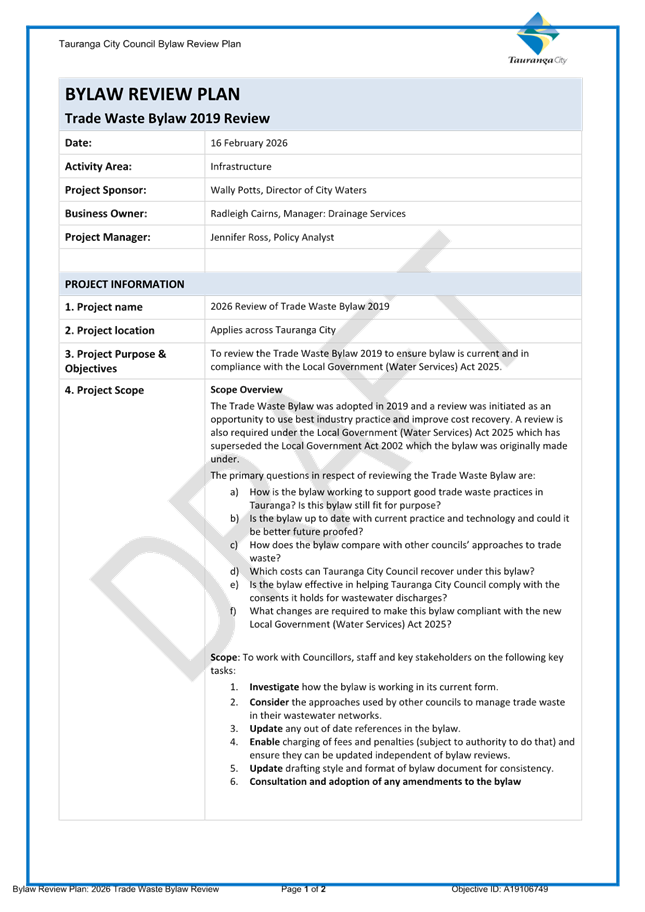
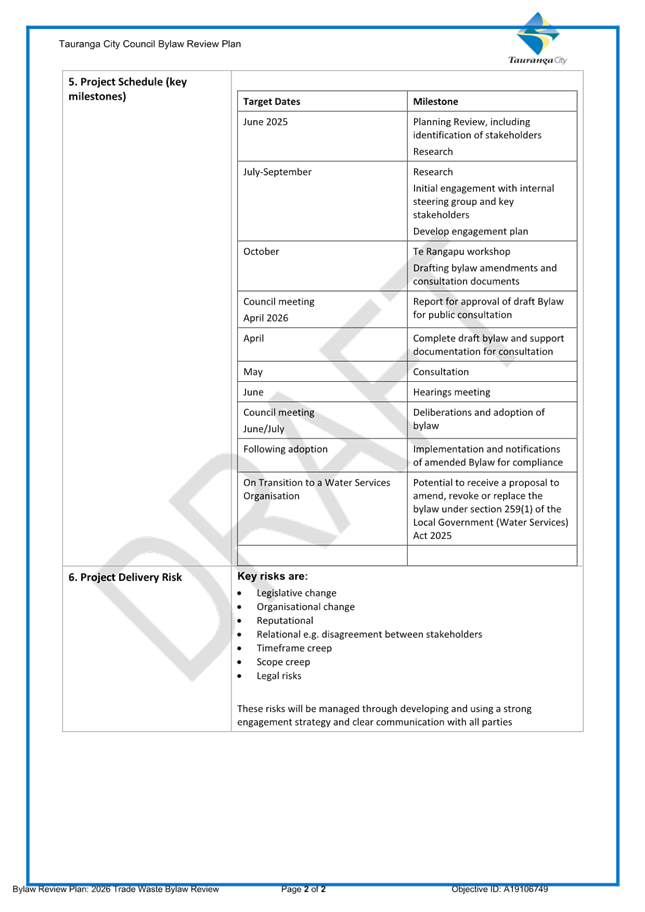
|
Ordinary
Council meeting Agenda
|
21
April 2026
|
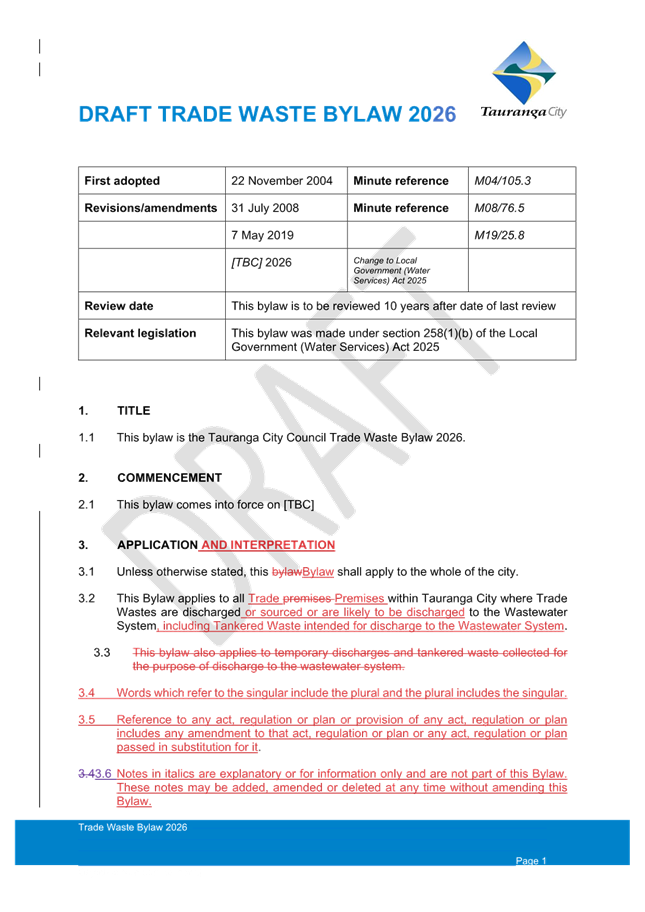
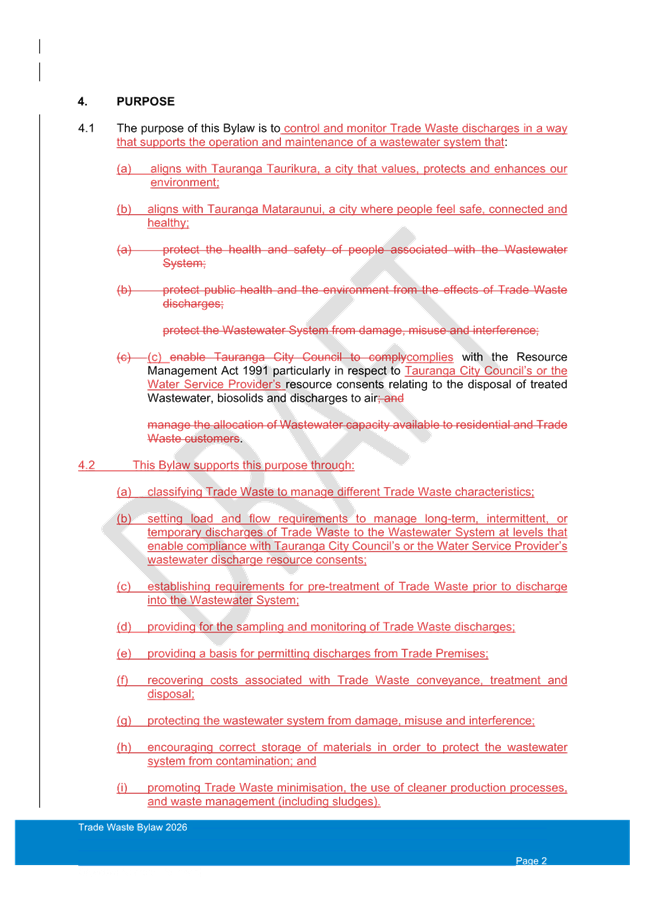
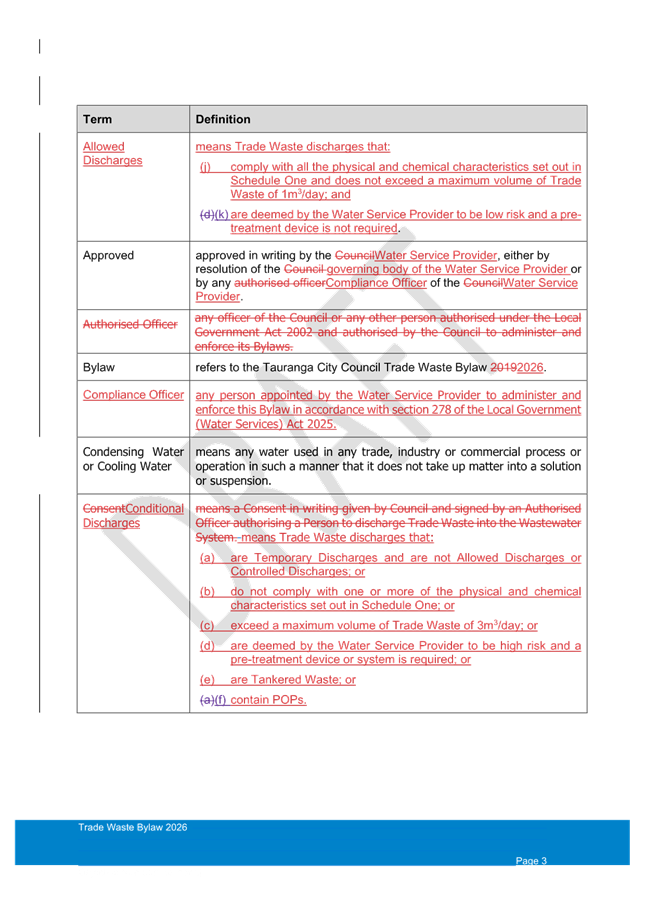
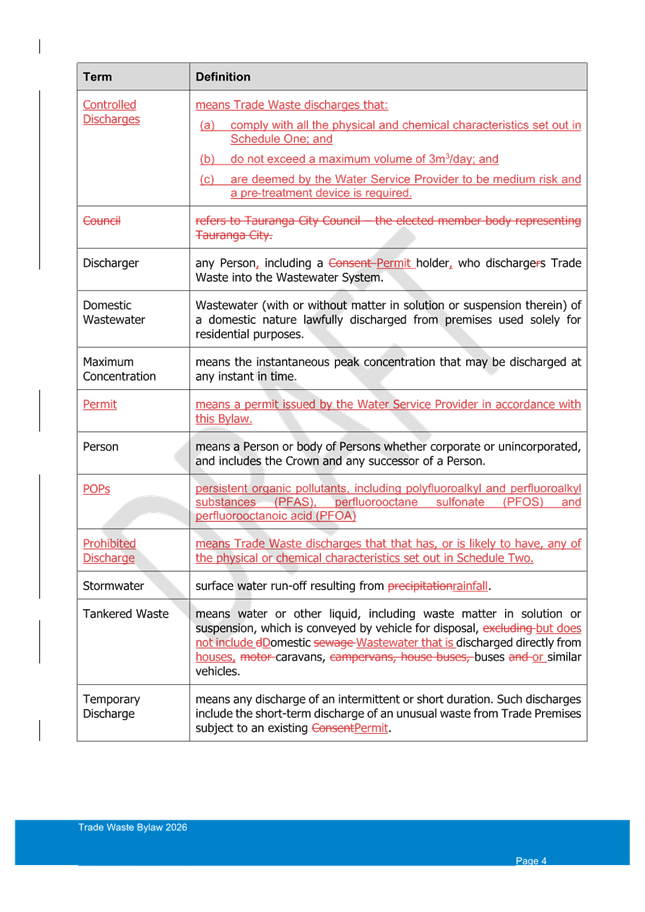
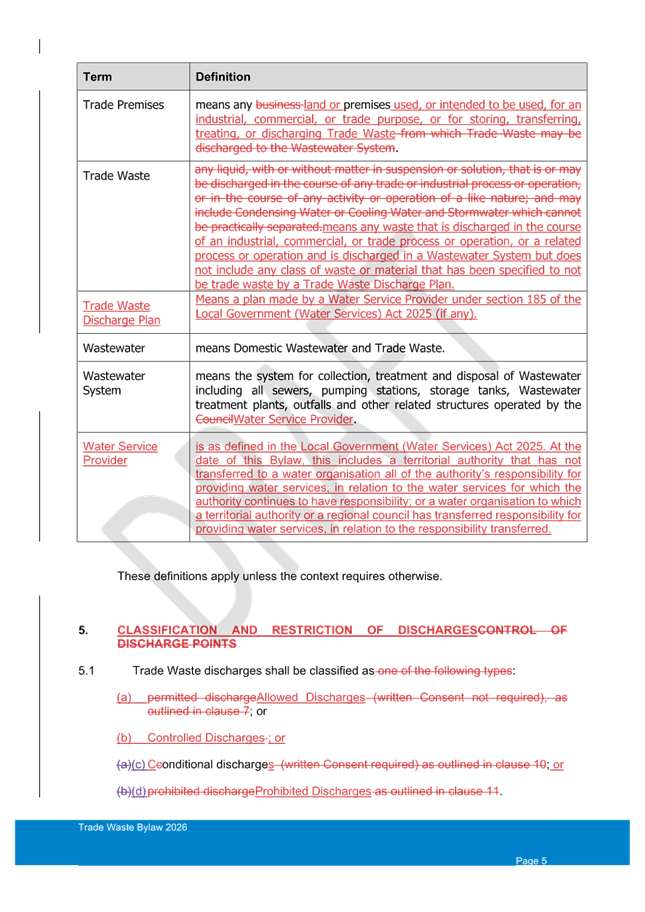
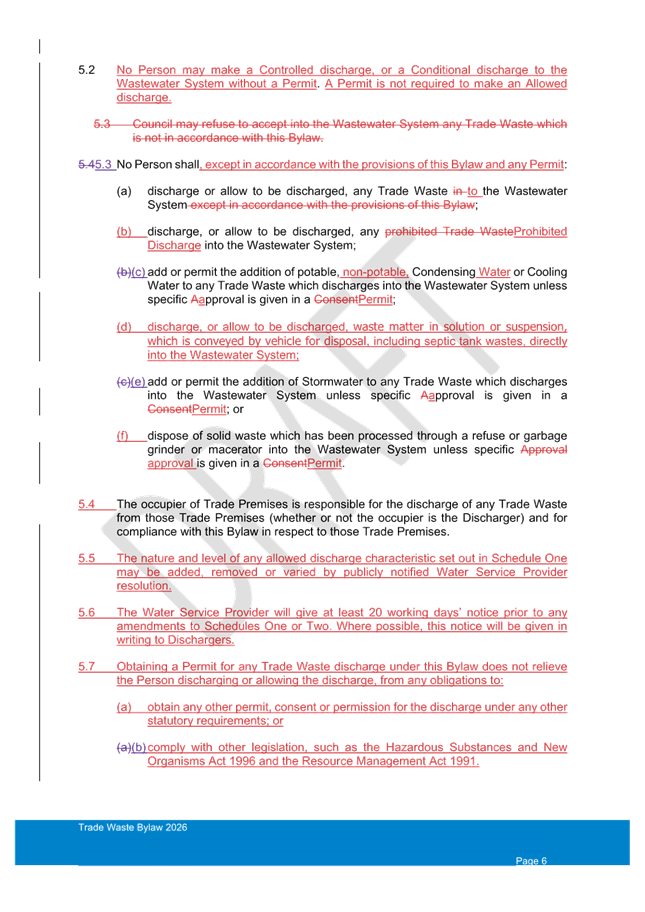
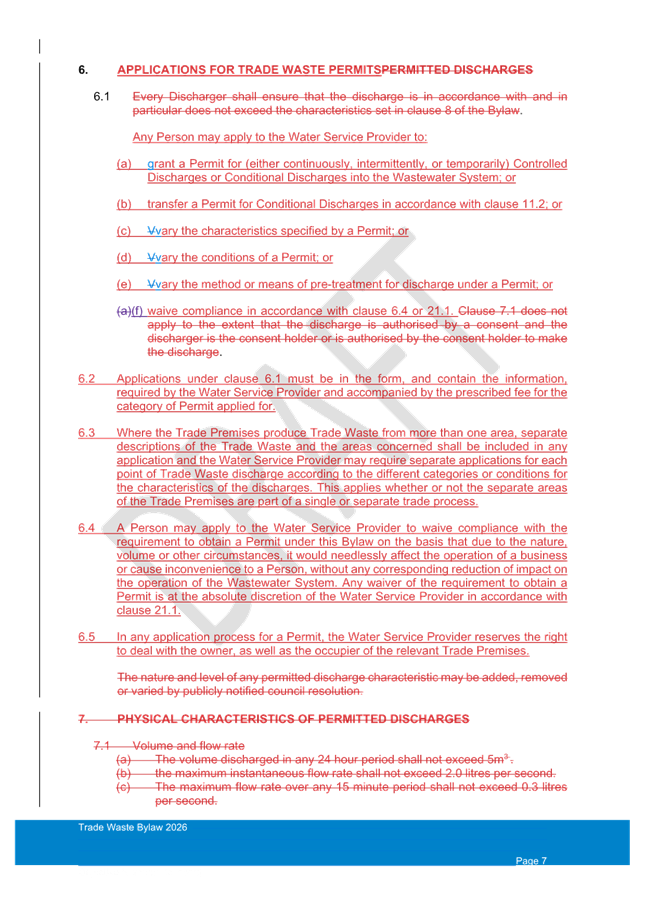
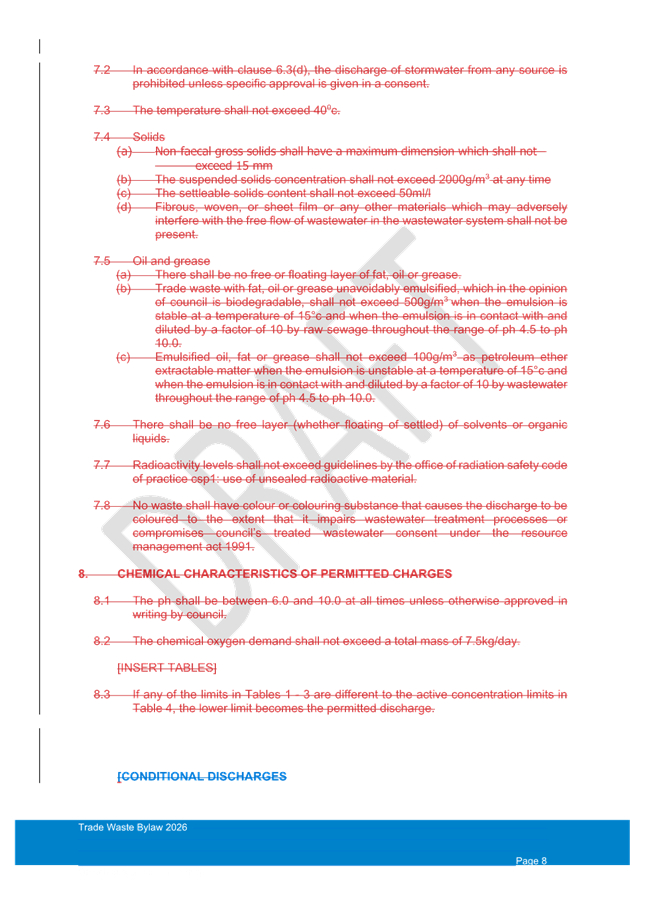
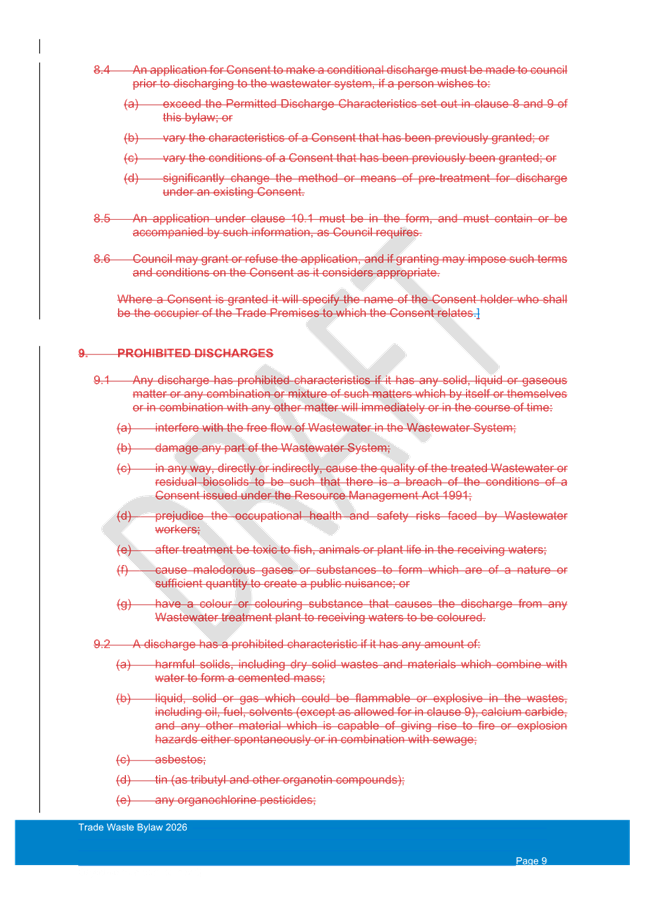
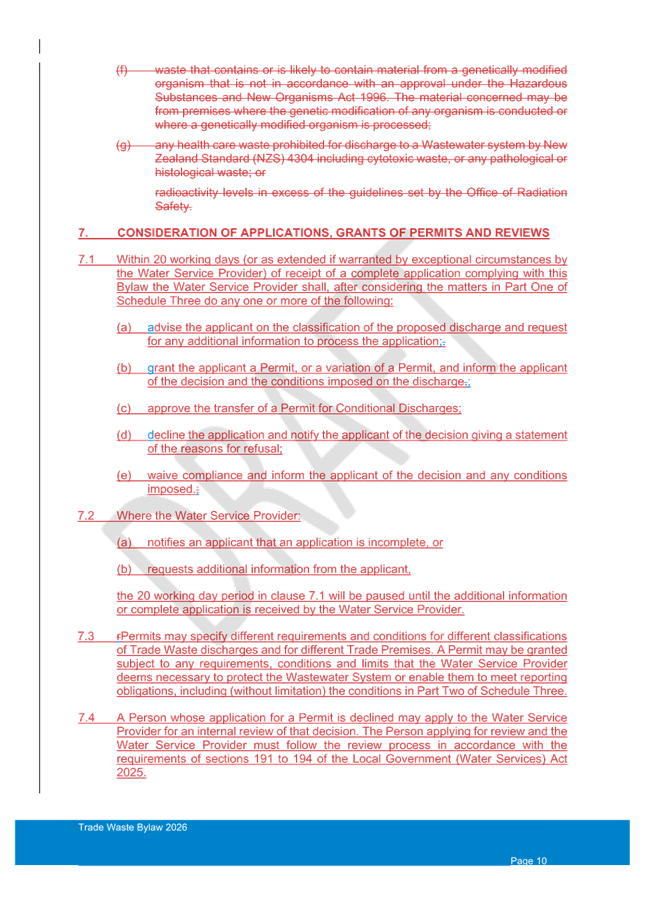
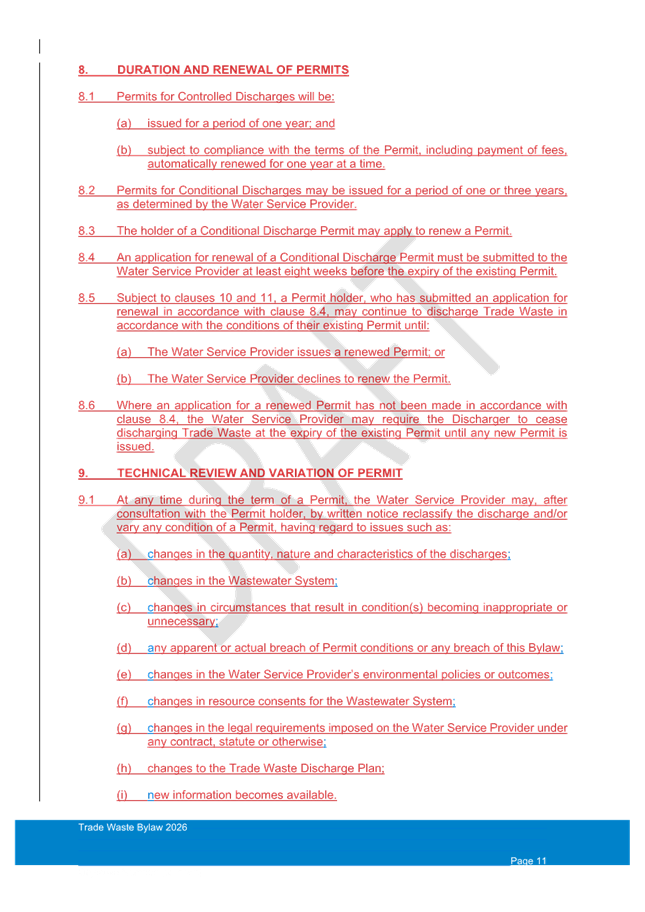
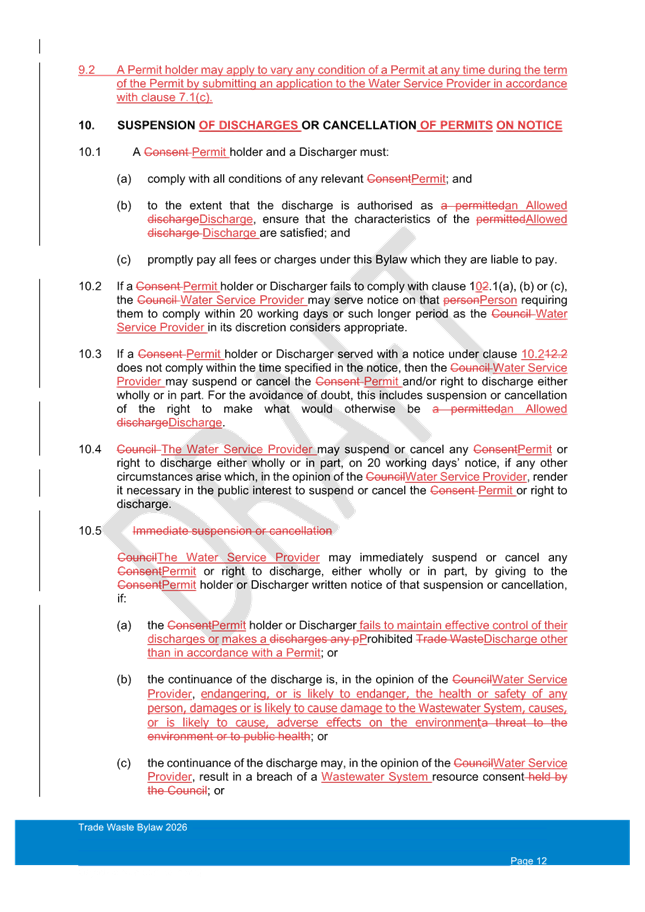
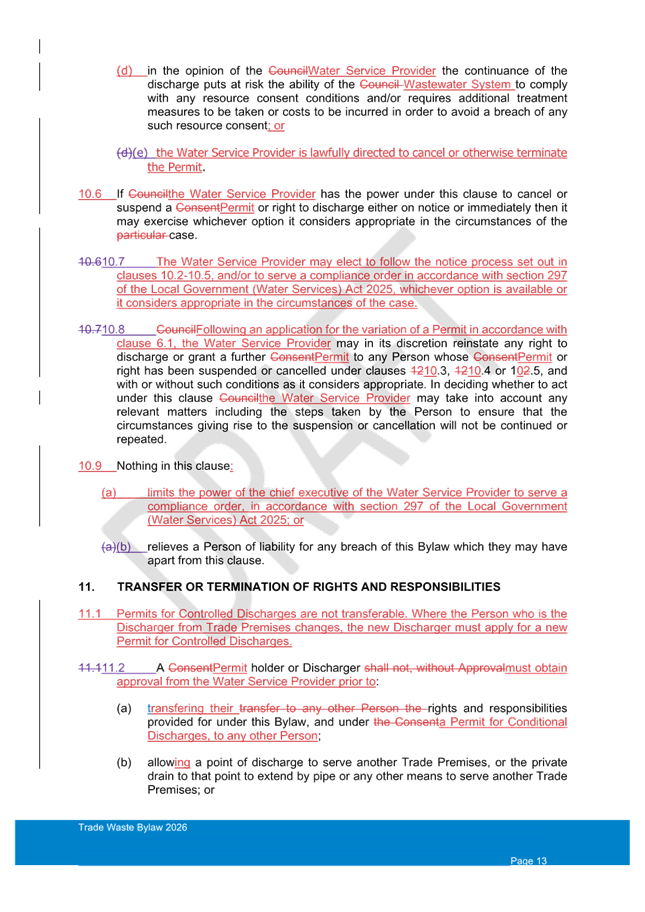
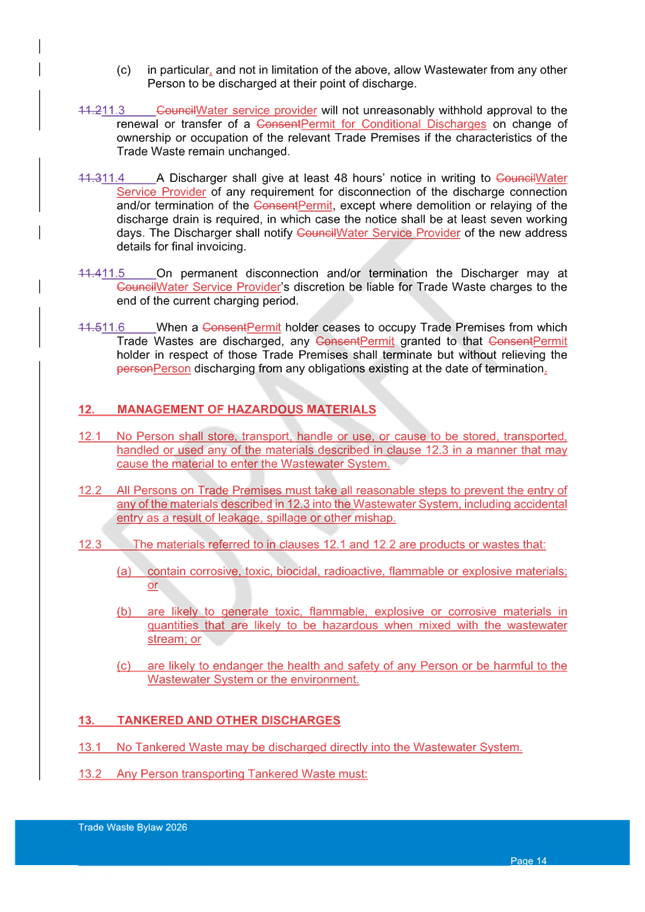
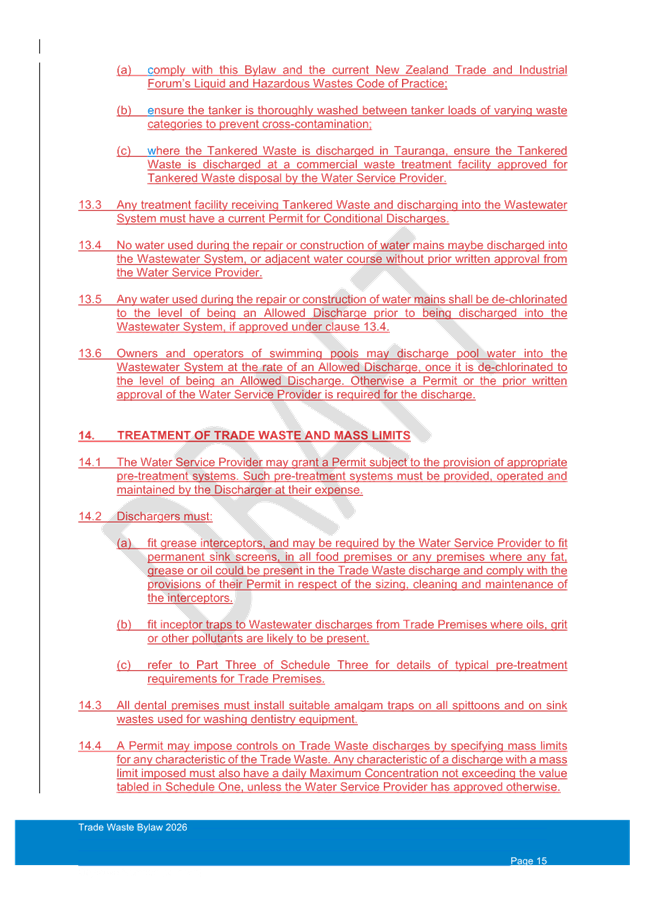
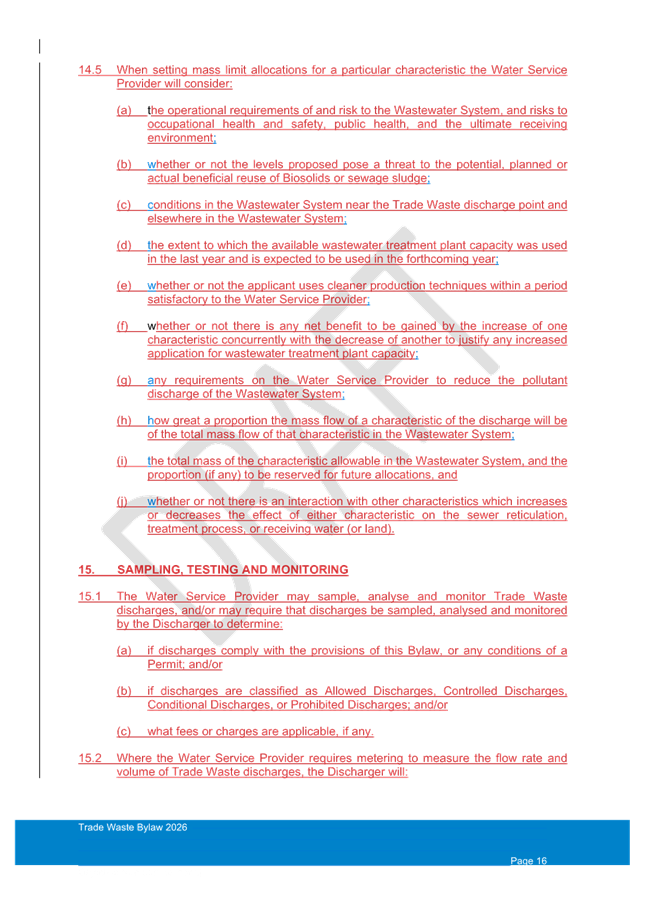
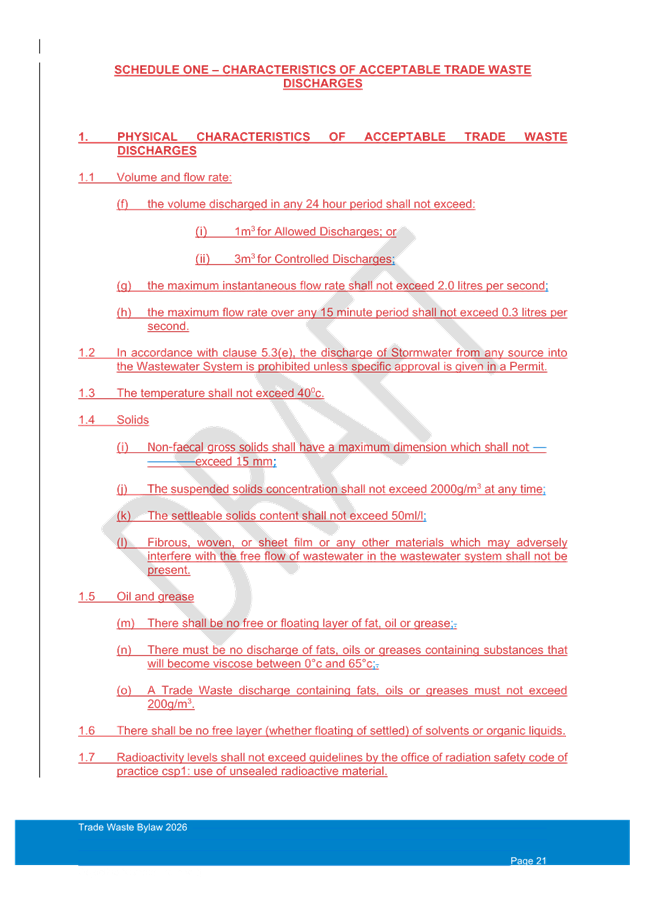
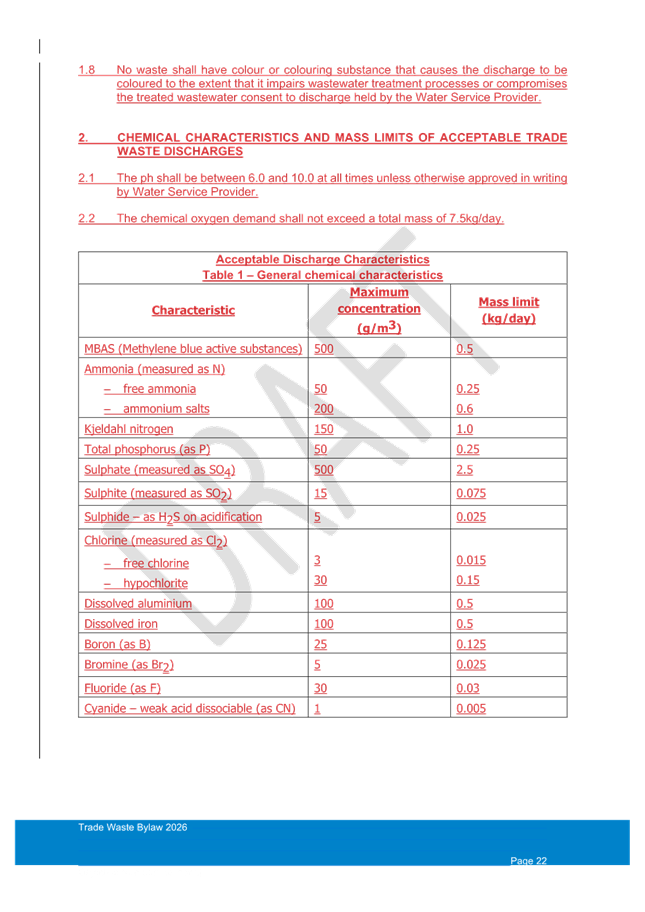
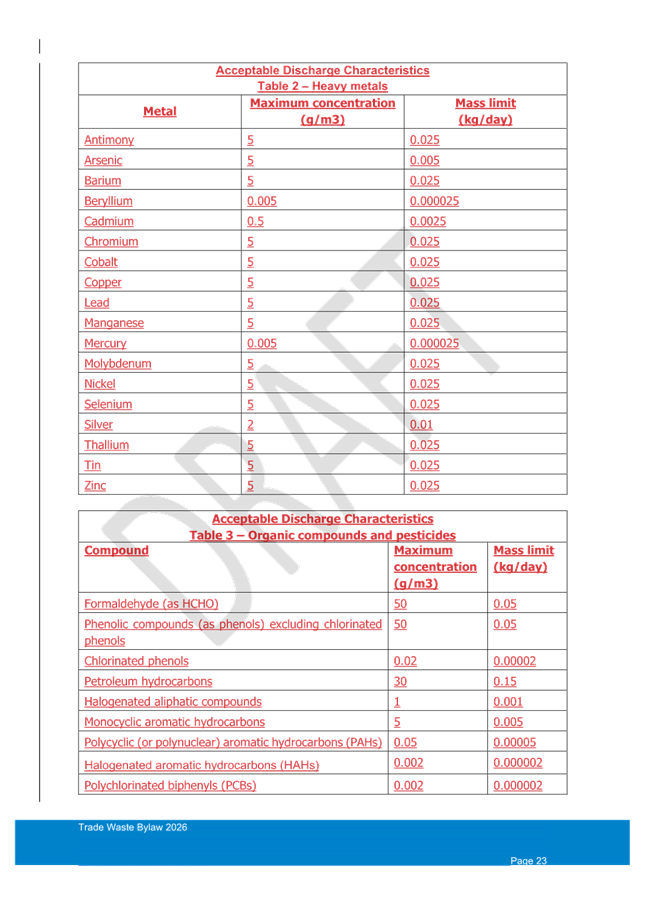
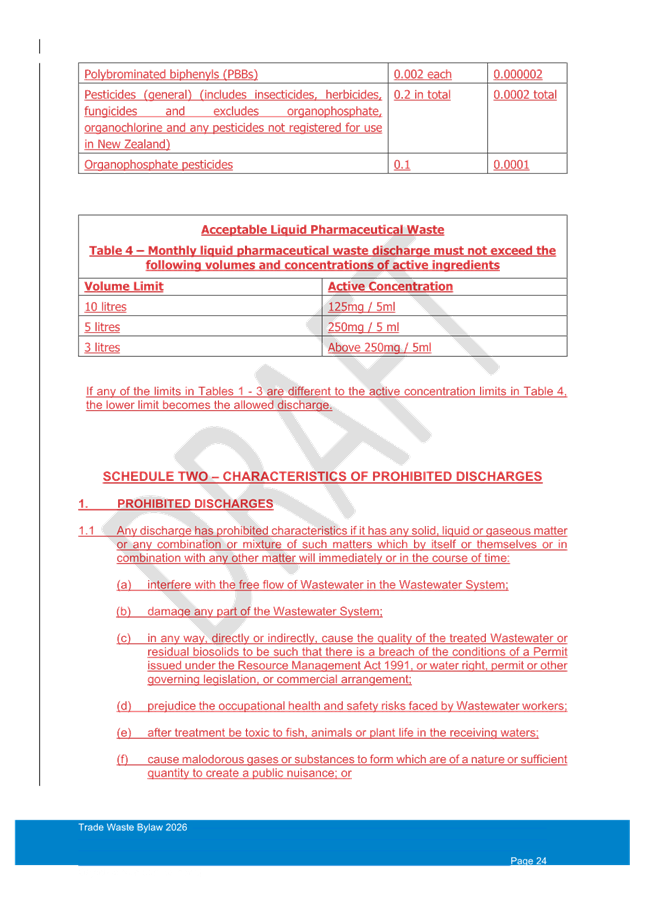
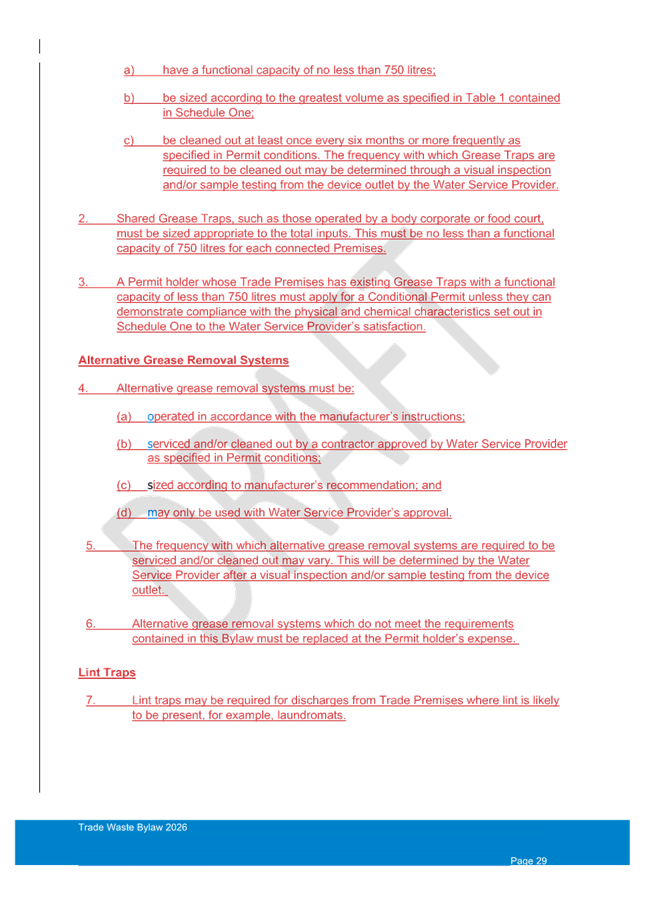
|
Ordinary
Council meeting Agenda
|
21
April 2026
|
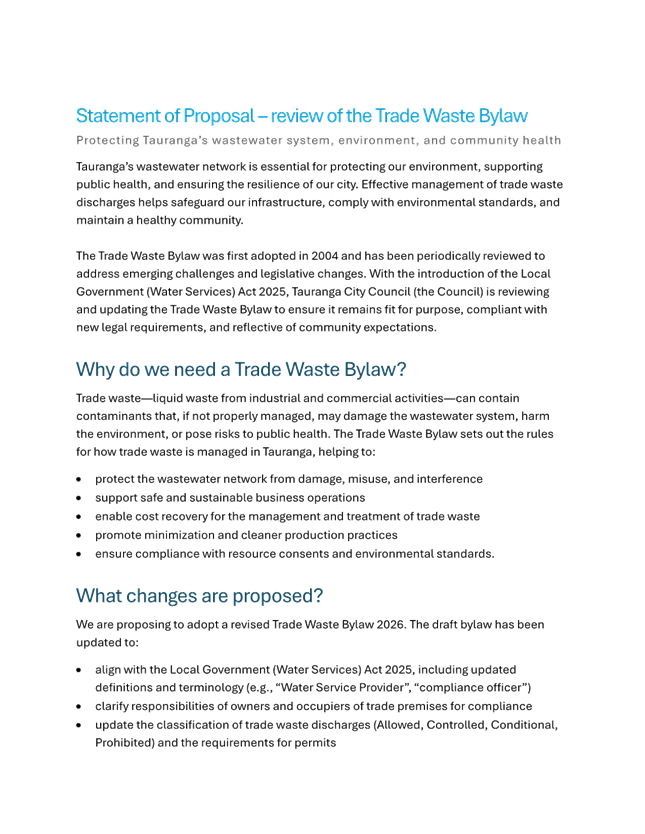
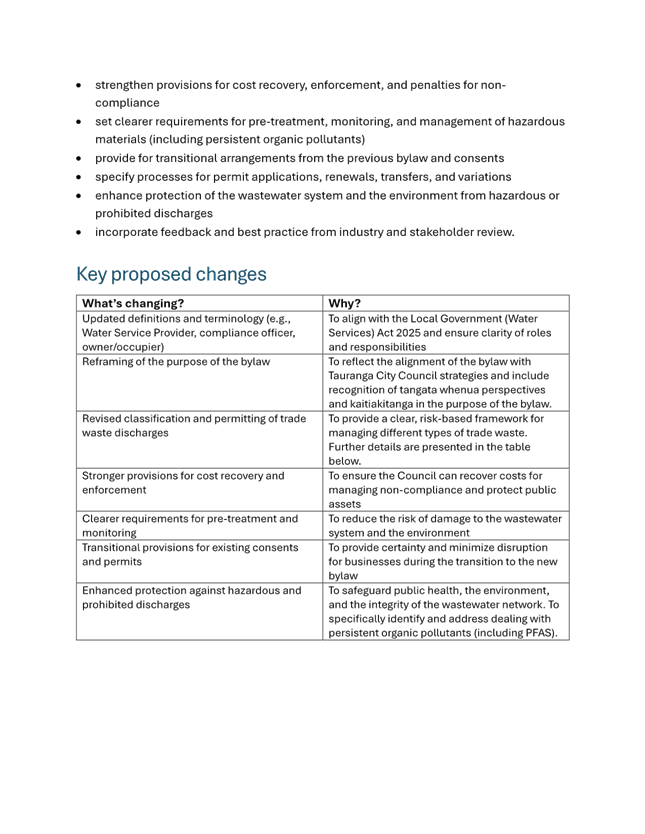
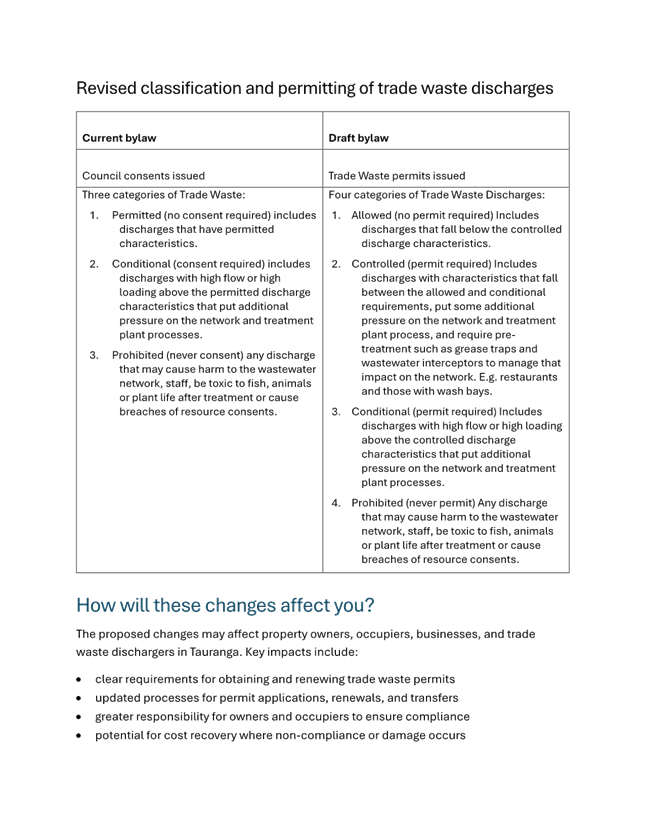
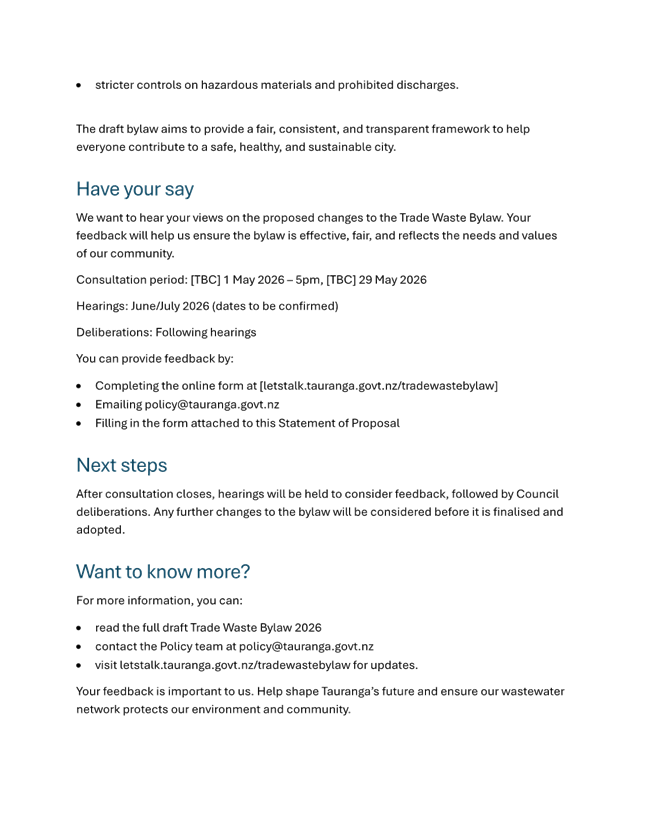
|
Ordinary
Council meeting Agenda
|
21
April 2026
|
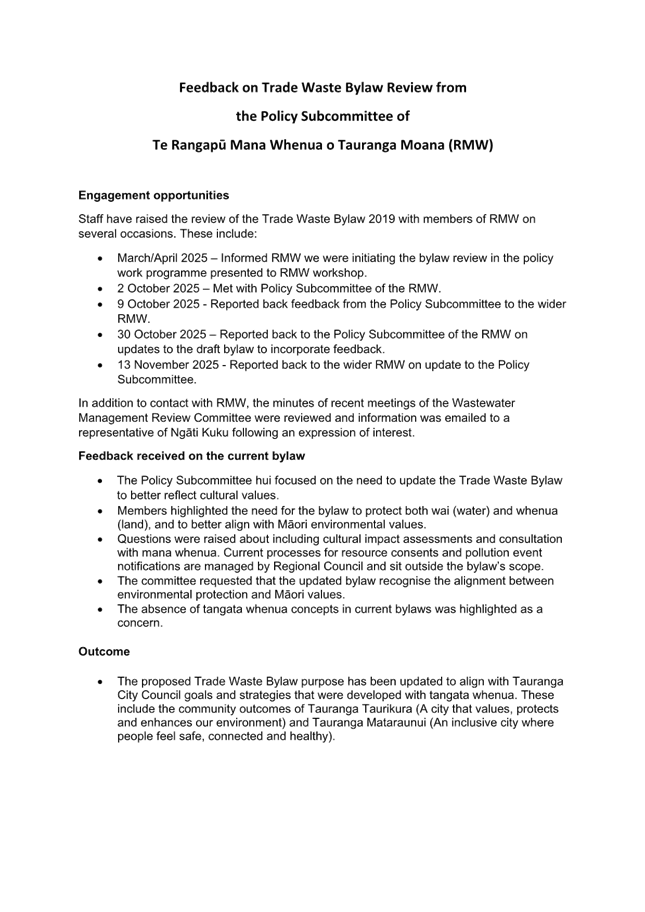
|
Ordinary
Council meeting Agenda
|
21
April 2026
|
11.8 Ōmanawa Falls
Reserve name change
File
Number: A15393616
Author: Ana
Hancock, Team Leader: Design
Authoriser: Reneke
van Soest, General Manager: Operations & Infrastructure
Purpose of the Report
1. To request approval
to rename Ōmanawa Falls Reserve to Te Rere o Ōmanawa in accordance
with Council’s Naming Policy 2020.
|
Recommendations
That the Council:
(a) Receives the report
"Ōmanawa Falls Reserve name change".
(b) Approves
changing the official name for “Ōmanawa Falls Reserve” to
“Te Rere o Ōmanawa”, supported by translation in any
communications.
|
UPDATE SINCE THE LAST MEETING
2. This report was
previously brought to this Council at the 7 October Council meeting. The report
was left to lie on the table as Elected Members requested that Ngāti
Hangarau and Tourism Bay of Plenty be in attendance. Since this meeting Staff
has met with Ngāti Hangarau and Tourism Bay of Plenty and proposed a
refined approach: that renaming Ōmanawa Falls Reserve is supported by a
communications approach that presents the translation of Te Rere o Ōmanawa
alongside the new name as we go through a period of transition.
3. To assist with
Council decision making, this report has been edited to present three options
for the Council to consider: (1) – Rename with a comms approach, (2)
– Dual name, (3) No change to name.
Background
4. The
Ōmanawa Falls Reserve is owned and managed by Tauranga City Council (“Council”)
and lies within Western Bay of Plenty District, and within the
rohe of Ngāti Hangarau.
5. Ōmanawa Falls
Reserve is managed as a Heritage Reserve under the Tauranga Reserves Management
Plan (TRMP), although is not formally classified as a reserve under the
Reserves Act.
6. Council has been
working closely with Ngāti Hangarau on the Ōmanawa Falls Safe Access
project since 2019. The three streams of this project included providing
physically and culturally safe public access to the falls, supporting the
development of a cultural tourism experience and working towards co-management
and/or co-governance. All three streams are guided by the Ōmanawa
Principles (provided in Attachment 1). The Ōmanawa Principles were
developed by Ngāti Hangarau in 2020 with support from Council’s Pou
Takawaenga team and first shared with Council at the 27 October meeting in
2020.
7. The Ōmanawa
Falls Governance Group, made up of Ngāti Hangarau, Tourism Bay of Plenty
and Council recommend that Ōmanawa Falls Reserve is renamed as Te Rere o
Ōmanawa which is supported by the Ōmanawa Principles.
‘Ōmanawa’ translates into English as ‘of the
heart’, and the full name means ‘the waterfall of the heart’.
Strategic / Statutory Context
8. Council adopted a
revised Naming Policy in May 2020. The policy encourages locally significant
Māori names for streets, reserves, community facilities and other public
places in Tauranga and to enable greater visibility of mana whenua connections
to Tauranga. Since adoption of the policy, Council staff have placed greater
emphasis on identifying and promoting historically and culturally significant
names in our public places.
9. Council’s
Naming Policy allows for the renaming of existing reserves where a new name
would better meet the objectives of the policy to promote local identity and
mana whenua connections. Council is responsible for all decisions to approve or
decline requests to rename or dual name existing streets, reserves, community
facilities and other public places.
10. Appropriately recognising known
cultural values is included in the mission statement of the Tauranga Reserve
Management Plan which has management statements for Ōmanawa Falls Reserve.
DISCUSSION
Significance of Ōmanawa Falls to Ngāti
Hangarau
11. The name for the falls existed
before European arrival, the development of the hydro power station and the
creation of the reserve.
12. The Ōmanawa Falls are of
particular importance to Ngāti Hangarau as explained in
‘Significance of Ōmanawa Falls - Excerpts from a statement prepared
by Ngāti Hangarau offered as evidence for the resource consent hearing for
the Ōmanawa Falls project’ (Attachment 2). In summary, Ōmanawa
means of the heart. Unlike some of the other waterfalls in the rohe,
Ōmanawa Falls were a sign of good luck and were a place for fortune
telling and for healing, as such the waterfall and the pool of water below are
recognised by Ngāti Hangarau as wāhi tapu.
13. Ngāti Hangarau have
provided the name Te Rere o Ōmanawa for use on the site signage (as well
as te reo names for viewing platforms and the like). Renaming the Ōmanawa
Falls Reserve to Te Rere o Ōmanawa, and the use of other Mana Whenua names
is supported by the Ōmanawa Principles (Section 2):
2.
WHAKAPAPA: NAMES & NAMING
i)
Restoration of Mana Whenua names at Ōmanawa, acknowledging significant
sites, whenua/waterways and heritage including historic networks, interactions
and relationships.
ii)
Mātauranga ā hapū acknowledged. - Inspiration for names is drawn
from Ngāti Hangarau knowledge base and systems.
iii)
Education to support the uptake of mātauranga ā hapū. - Names,
whakapapa and heritage education will be supported with resource/content
creation onsite at Ōmanawa, online and in the wider community.
Why
renaming is proposed instead of dual naming
14. Renaming the reserve is
proposed for the following reasons:
(a) Ōmanawa Falls was
originally a te reo name which was then anglicised. Renaming Ōmanawa Falls
Reserve to Te Rere o Ōmanawa reverts to the original name however will
continue to be recognisable to the local community as the Ōmanawa name is
retained in both versions.
(b) The Ōmanawa Falls Safe
Access Project has created a space with a strong cultural presence, with
pouwhenua, a tomokanga and palisade fencing. The signage also has a distinctive
cultural presence, with te reo names for each of the three lookouts. Renaming
the reserve to Te Rere o Ōmanawa is in keeping with the look and feel of
the site.
(c) Te Rere o Ōmanawa has
already been in use on site signage, the council webpage and in media releases.
Officially changing the name will formalise this existing use.
(d) The reserve has not had a
long-standing relationship with the community. Up until about 2011 the reserve
and the Falls themselves were not well known with the exception of the
immediate Ōmanawa community and adventurous tourists. The reserve was closed
in January 2016 and reopened on 1 December 2023.
(e) Under the naming policy
(section 5.3.3) dual naming may be preferable in some circumstances to maintain
local identity. In this case it is considered that the local identity for the
reserve as a reserve is not high, as outlined above.
15. The Ōmanawa Falls
Governance Group considers that renaming the reserve supports Mana Whenua
connections and does not diminish local identity.
16. The Naming Policy specifies
that the naming of heritage reserves will reflect the historical significance
of the area. Renaming Ōmanawa Falls Reserve to Te Rere o Ōmanawa is
considered to enhance those historic values.
17. It is proposed that renaming
Ōmanawa Falls Reserve is supported by a communications approach that
presents the translation of Te Rere o Ōmanawa alongside the new name as we
go through a period of transition. For example, in all communications such as
on webpages, social media posts etc the name can be communicated as follows: Te
Rere o Ōmanawa (Ōmanawa Falls Reserve). At the point where there is
wide take up of the name, the translation can be dropped without needing to go
through a formal renaming process. This may only be a few years, or may take a
generation.
18. It was raised in the previous
Council meeting that there were concerns from some in the community about the
proposed name change. To be clear, the proposed name change affects only the
name of the Council owned property. The name of the falls is outside of
Council’s jurisdiction. In order to rename the waterfall, an application
needs to be made to the New Zealand Geographic Board. This would require a
letter of support from the Western Bay District Council. If the NZ Geographic
Board accept the proposal, they will it publicly notify it allowing one month
for the public to make submissions. If approved by the NZ Geographic Board, the
Minister for Land Information makes the final decision.
19. Ngāti Hangarau have
advised that they intend to apply to the New Zealand Geographic Board to rename
the waterfall. The Governance Group has offered to provide a letter
of support to Ngāti Hangarau as part of their application and provide any
other assistance as required. The Council may also wish to lend their
support to Ngāti Hangarau in seeking this name change.
OPTIONS ANALYSIS
20. Three options are presented:
Option
1 (Recommended)
(a) Rename Ōmanawa Falls
Reserve to Te Rere o Ōmanawa, and support with a communications approach
that presents the translation of Te Rere o Ōmanawa alongside the new name.
Option
2
(b) Dual name Ōmanawa Falls
Reserve to Te Rere o Ōmanawa – Ōmanawa Falls Reserve.
Option
3
(c) Do not rename Ōmanawa
Falls Reserve.
|
Options
|
Pros
|
Cons
|
|
Option 1
Rename supported with a
comms approach for translation
|
Best meets Mana Whenua
objectives and addresses Elected Members concerns around causing confusion
for visitors.
Is in alignment with
current signage and approach taken with comms
|
|
|
Option 2
Dual name Ōmanawa
Falls Reserve to Te Rere o Ōmanawa – Ōmanawa Falls Reserve
|
Provides both
names in perpetuity
|
Less desirable for Mana
Whenua
|
|
Option 3
Do not rename
Ōmanawa Falls Reserve
|
|
Does not meet Mana
Whenua objectives
|
significance / Engagement
21. Ngāti Hangarau and Tourism
Bay of Plenty have been engaged in the renaming proposal for Te Rere o
Ōmanawa and provide their full support.
22. Western Bay Council have also
provided a letter of support for the name change which is included in
Attachment 3.
23. Councils Naming Policy was
adopted on 5 May 2020 following a public and stakeholder engagement process.
24. Further consultation and
engagement with the wider public is not required as per clause 5.1.2 of the
Naming Policy:
“In
order to recognise the significance of names provided by mana whenua, Council
does not consult on names proposed by mana whenua for the purposes of obtaining
wider community approval.”
25. Renaming Ōmanawa Falls to
Te Rere o Ōmanawa does not meet the test of significance in the
Significance and Engagement Policy requiring consultation. While it is of
medium significance, due to the reasons outlined in paragraph 14 above,
officers are of the opinion that no further engagement is required prior to
Council making a decision.
Next Steps
26. If approved, the name Te Rere o
Ōmanawa will be formally recognised on supporting documents and records.
The new name will be supported by the translation of the name for the next few
years and as long as required.
27. The Ōmanawa Falls
Governance Group and potentially Council will support Ngāti Hangarau with
their planned application to the New Zealand Geographic Board to officially
rename the waterfall to Te Rere o Ōmanawa.
Attachments
1. Omanawa
Principles - A15459791 ⇩
2. Significance
of Omanawa Falls - Excerpts from Ngati Hangarau Statement - A15459792 ⇩ 
3. Letter of Support
for name change from Western Bay - A18767046 ⇩
|
Ordinary
Council meeting Agenda
|
21
April 2026
|
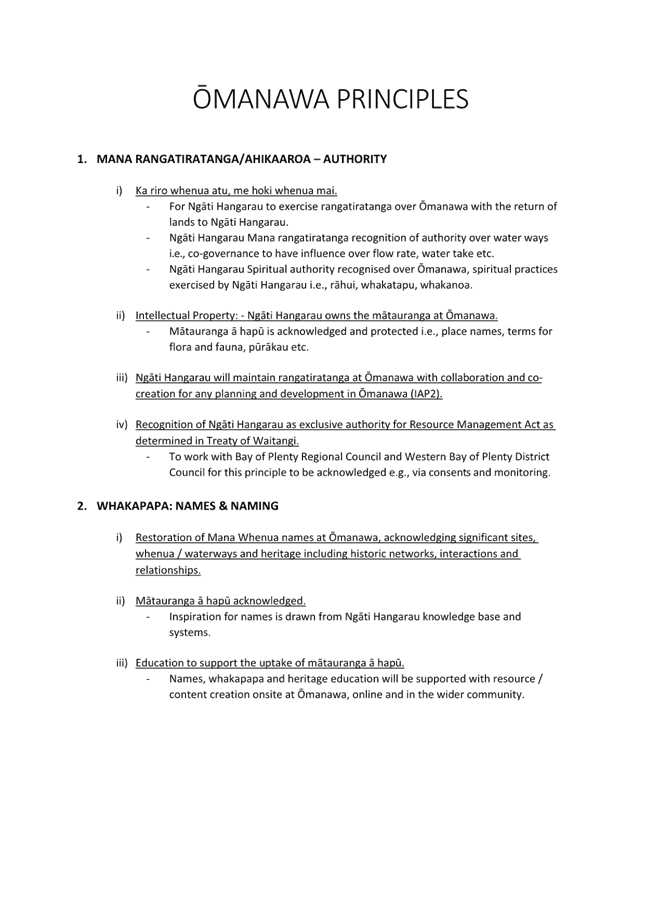
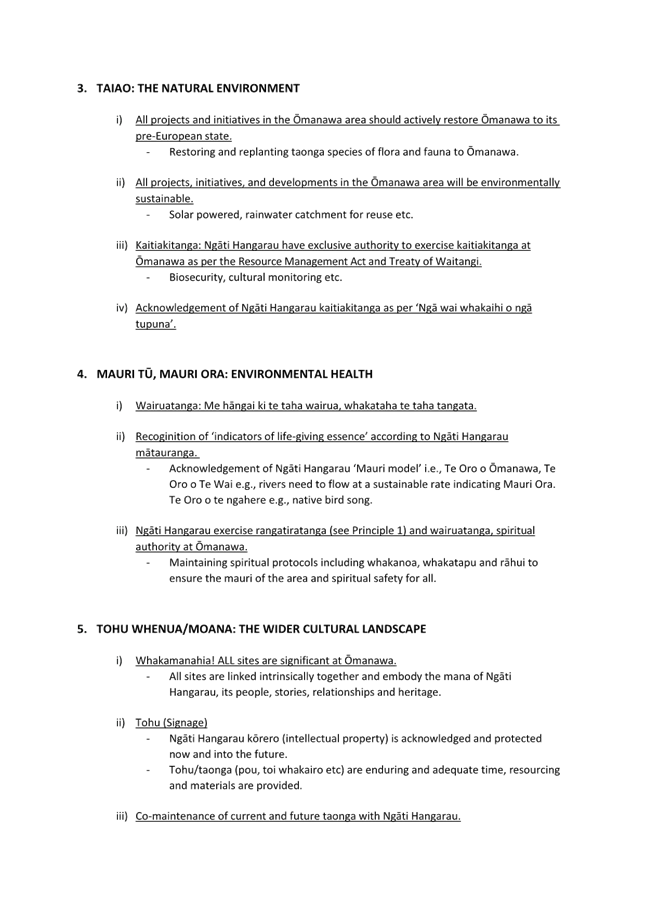
|
Ordinary
Council meeting Agenda
|
21
April 2026
|

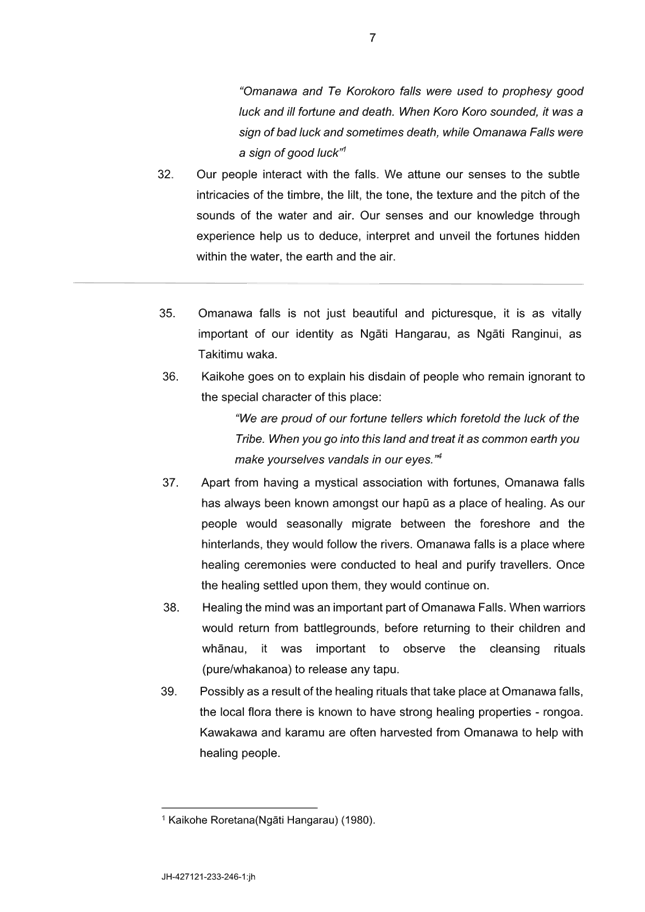
|
Ordinary
Council meeting Agenda
|
21
April 2026
|
|
Ordinary
Council meeting Agenda
|
21
April 2026
|
11.9 Papakāinga
housing funding support
File
Number: A20098854
Author: Keren
Paekau, Team Leader: Takawaenga Māori
Anne Payne,
Principal Strategic Advisor
Authoriser: Christine
Jones, General Manager: Strategy, Partnerships & Growth
Please
note that this report contains confidential attachments.
|
Public Excluded Attachment
|
Reason why Public Excluded
|
|
Item 11.9 -
Papakāinga housing funding support - Attachment 2 - Papakāinga
projects overview - 31 March 2026
|
s7(2)(b)(ii) - The
withholding of the information is necessary to protect information where the
making available of the information would be likely unreasonably to prejudice
the commercial position of the person who supplied or who is the subject of
the information.
|
|
Item 11.9 -
Papakāinga housing funding support - Attachment 3 - Papakāinga
projects map - 31 March 2026
|
s7(2)(b)(ii) - The
withholding of the information is necessary to protect information where the
making available of the information would be likely unreasonably to prejudice
the commercial position of the person who supplied or who is the subject of
the information.
|
Purpose of the Report
1. To confirm
Council’s approach to distribution of the Papakāinga Fund, which
aims to help reduce barriers to papakāinga housing development on
multiple-owned Māori land.
2. The
proposed approach has implications for the Grant Fund for Development
Contributions on Papakāinga Housing.
|
Recommendations
That the Council:
(a) Receives the report
"Papakāinga housing funding support".
(b) Approves distribution of the
Papakāinga Fund as follows (Option 1A):
(i) Eligibility criteria to
include threshold eligibility (meets definition of papakainga of Development
Contributions grants policy, located in Tauranga City Council boundaries,
appropriate governance arrangements and commitments, multi-dwelling project
at detailed planning and consent stage), readiness to
progress, readiness to build, funding use planning and resource
consent services (including land use resource consent costs for enabling
works & infrastructure); engineering and technical investigations;
surveying and geotechnical work and reporting requirements.
(ii) Process to include an
Expression on Interest (April / May 2026), staff Assessment Panel, with
recommendations from Assessment Panel considered and decided on by the
General Manager Strategy, Partnerships and Growth.
(iii) Any remaining balance being
unallocated from the Papakainga Fund will rollover to the following financial
year.
(iv) Release of the second tranche of
the Papakāinga Fund budget, being a further $200,000, for the 2026/27
financial year, to be applied in accordance with resolutions (b)(i) to (b)
(iii) above.
(c) Approves changes to the Grant
Fund for Development Contributions on Papakāinga Housing as follows
(Option 2A):
(i) Transfer budget to the
Papakāinga Fund on an as-needed basis, ensuring an acceptable balance
remains in the Grant Fund for Development Contributions on Papakāinga
Housing to meet its purpose.
(ii) Reduce the proportion of
development contributions funded from 100% to 50-75% (level to be determined
subsequent to engagement process).
(iii) Receive an annual outcome
and process review undertaken by council staff to ensure the aims of both
funds are being achieved, and to improve the process over time.
(iv) Notes that staff will update the
Grants for Development Contributions on Papakāinga Housing Policy,
including undertaking appropriate engagement, for consideration and approval
by Council or the City Future Committee by 30 June 2026.
(d) Delegates
financial authority to the Chief Operating and Financial Officer (COFO) to
transfer the budget from the Grant Fund for Development Contributions on
Papakainga Housing to the Papakainga Fund (on advice from the GM: Strategy,
Partnerships & Growth).
[Resolution
only required if (c)(i) approved]
(e) Notes that staff will provide
options for continuation or otherwise of both funds (Papakāinga Fund and
Grant Fund for Development Contributions on Papakāinga Housing) for
Council consideration during the Long-term Plan 2027-2037 development process.
(f) Notes that should the
Papakāinga Fund continue post-2026/27, a guiding framework or policy
will be developed by 1 July 2027 to ensure a structured and transparent
approach to the fair distribution of this fund.
(g) Attachment 2 is to
remain in the public excluded section as it contains confidential financial
and other information relating to other parties.
(h) Attachment 3 is to
remain in the public excluded section as it contains confidential financial
and other information relating to other parties.
|
Executive Summary
3. For the purposes of
this report, ‘papakāinga housing’ refers to housing on
multiple-owned Māori land. Establishing authentic papakāinga is
viewed by tangata whenua as a source of wellbeing for whānau and the wider
community.[9]
Context
4. Māori
landowners face specific challenges to developing their land for any activity.
These primarily arise from the land being multiple-owned (requirements to
identify and contact all owners, to build consensus, and to establish
collectively owned management entities), financing limitations (difficulty
raising capital on land that cannot be sold, and for not-for-profit
developments such as papakāinga housing), and lack of a significant asset
base to leverage or offset risk related to development.
5. The development
steps for delivery of papakāinga housing, used throughout this report, are
shown in the diagram below, which is taken from Te Keteparaha
mo ngā Papakāinga (the toolkit for Papakāinga
development):
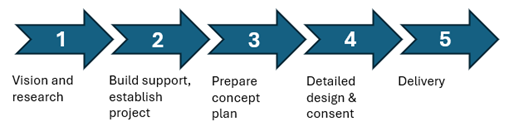
6. Contextual
information was provided to Elected Members through a staff briefing on 4
December 2025, updated extracts are provided as Attachment 1 to this
report.
Background
7. Over time, the
Council has sought to support papakāinga housing development within the
city by focusing on reducing barriers that are within the council’s
sphere of influence. These include navigating council processes, capacity and
capability limitations, and financial barriers at most stages of the
development process.
8. The Grant Fund for
Development Contributions (DCs) on Papakāinga Housing was established in
2021, through the 2021-2031 Long-term Plan. This fund has a total value over
six years to 2026/27 of $3m, and:
· Can
only be used to provide 100% subsidies for citywide DC costs on papakāinga
housing developments. It operates on a first-come-first-served basis and has
clear eligibility criteria within its underpinning policy.
· Continues
to be underutilised because developments are rarely able to raise sufficient
funding to get to the build stage. By July 2026, it is likely that less than
$500,000 of the total $3m six-year budget will have been distributed.
9. The Papakāinga
Advisor role is a contracted part-time role established from existing
operational budgets in mid-2023, to address gaps in current service delivery.
The key focus of the role is to create a pipeline of papakāinga housing
projects and stimulate progress to add housing supply on Māori land. The
role requires a strong background in planning and construction on Māori
land, and strong relationship building skills as it works closely with local
Māori land entities. The Papakāinga Advisor is currently contracted
for 15-20 hours per month and has provided the project information included in
this report.
10. Ongoing council staff support
for papakāinga housing is provided particularly from Te Pou Takawaenga and
the City Planning & Growth, Environmental Planning, and Building Services
teams.
Direction from the
current Council
11. In late 2024 – early
2025, several ward councillors attended hui and/or site visits with Māori
land entities working to progress papakāinga housing projects in their
constituencies.
12. Council established the
Papakāinga Fund through the Annual Plan 2025/26, approving a total budget
of $400,000 in two tranches over two years (requiring a review prior to release
of the second $200,000 for 2026/27). This fund:
· Aims
to work with Tangata Whenua to reduce barriers to papakāinga housing
development, such as funding detailed design and technical reports – i.e.
barriers faced earlier in the development process than the Grant Fund for DCs
on Papakāinga Housing.
· Staff
delegation to approve expenditure from this fund was not considered at its
establishment, as staff were directed to first develop criteria and a process
for distribution of the fund. No distributions have yet been made from this
fund.
13. On 18 November 2025, Council
approved four priorities for development of the 2027-2037 Long-term Plan,
including “delivering for our people: enabling housing”.
14. On 4 December 2025, staff
briefed Elected Members on papakāinga housing development and a potential
approach to allocating the Papakāinga Fund, including potential
eligibility and assessment criteria. Direction from Elected Members has been
incorporated into the proposed approach put forward in this report.
Proposed approach
to distribution of the Papakāinga Fund
15. Assessment criteria for the
fund have been refined, with review from Te Rangapū Mana Whenua o Tauranga
Moana and Cr Rolleston. The criteria include specifications for eligibility,
readiness to progress, readiness to build, how the funds may and may not be
used, and accountability requirements.
16. In short, the Papakāinga
Fund is proposed to be targeted to enabling larger-scale papakāinga
housing developments to progress from concept plan (Step 3) to ‘shovel
ready’ stage (Step 4), by providing funding for detailed design, technical
reports and land-use resource consents for enabling earthworks and
infrastructure. Enabling works and actual build costs, including building
consent fees and DCs would not be eligible for the Papakāinga Fund.
17. The proposed process is:
(a) Open invitations to be issued
for expressions of interest (EOI) in applying to the Papakāinga Fund.
Council staff (primarily the Papakāinga Advisor) would then work with EOI
applicants over a two-month period to clearly identify what type and level of
support would be of most benefit in progressing their projects. Working
together would also enable potential operational efficiencies to be identified
and acted on to reduce costs for all involved. For the initial round, EOIs
would be requested by 31 May 2026.
(b) A staff-based assessment panel
(excluding the Papakāinga Advisor) would assess each project against the
criteria, and make allocation recommendations to the GM: Strategy, Partnerships
& Growth for approval. For the first round this would by 31 July 2026.
(c) Approved allocations would then
be distributed to successful applicants within one month of approval. Staff
recommend that the GM: Strategy, Partnerships & Growth is delegated
financial authority to release payments from the Papakāinga Fund.
18. Principles proposed for the
Papakāinga Fund are that: the council has discretion over the amount
approved for each successful application (not necessarily 100% of costs);
allocations would be for gst-inclusive amounts unless the Māori land entity
is gst-registered, in which case allocations would be gst-exclusive; and any
unallocated fund balance at year-end would be rolled over to the following
year.
19. Alongside approval of this
approach, staff also propose that Council approves the 2026/27 Papakāinga
Fund budget of $200,000 so that it can be distributed within the initial
funding round.
Papakāinga housing projects currently at concept
plan stage: potentially eligible
20. The Papakāinga Advisor has
identified five papakāinga housing development projects that aim to
deliver a total of 61 new homes, which could be ready to build by early 2027.
All five developments are at concept plan stage and are facing financial
barriers preventing progress through the detailed design and land-use consent
stages. Applications for funding for these professional services costs across
all five developments are estimated to come to around $842,000 (incl gst).
21. In the Papakāinga
Advisor’s view, and without pre-empting the EOI or assessment processes,
these five developments are all potentially eligible for Papakāinga Fund
support and would be ready to move as soon as funding was received.
22. A summary of financial and
timeline information for these five developments is provided as (public
excluded) Attachment 2 to this report, and a map showing the location of
the developments is provided as (public excluded) Attachment 3.
Proposed amendments
to the Grant Fund for DCs on Papakāinga Housing
23. Staff are seeking Council
approval to transfer sufficient budget from the Grant Fund for DCs on
Papakāinga Housing to the Papakāinga Fund to meet approved
Papakāinga Fund distribution in any given year. If all five of the
projects identified in (public excluded) Attachment 2 are approved, an
initial transfer of around $442,000 is anticipated to be required in 2026/27.
24. Staff are also seeking Council
approval to reduce the proportion of citywide DCs that can be funded from this
grant fund from 100% to 50 – 75%, with the exact proportion to be
determined subsequent to engagement on proposed policy amendments. The rationale
for this proposed reduction is to benefit a greater number of developments, to
recognise that the council is now also supporting projects earlier in the
process, and that the financial barriers are lower for smaller scale
papakāinga housing projects.
25. To implement these changes,
should Council approve them, the underpinning Grants for DCs on Papakāinga
Housing Policy would need to be amended. Council staff would engage with key
stakeholders, including Māori land entities and Te Rangapū Mana
Whenua o Tauranga Moana, and bring the amended policy to Council or the City
Future Committee for approval by 30 June 2026.
Longer term
26. Longer term, there is currently
no budget for either the Grant Fund for DCs on Papakāinga Housing or the
Papakāinga Fund post-2026/27. Both were funded from the Elder Housing
Reserve.
27. Council staff recommend that
options for continued support for papakāinga housing are considered
through the upcoming Long-term Plan development process.
Next steps
28. If the Council approves the
proposed approach outlined in this report, next steps would be:
(a) By 30 April 2026, council staff
to invite expressions of interest (EOIs) for applications to the
Papakāinga Fund. EOIs to be received by 31 May 2026, decisions confirmed
by 31 July 2026, and approved funding – with associated terms and conditions
– to be released by 31 August 2026; and
(b) By 30 June 2026, council staff
to provide proposed amendments to the Grant Fund for DCs on Papakāinga
Housing Policy to the City Future Committee or Council for approval.
Background
29. Papakāinga is used to
refer to housing on ancestral Māori land, but may also refer to other
related activities such as kohanga reo, kura kaupapa, horticulture or
agriculture, sports and/or recreational areas, urupā etc. For the purposes
of this report, ‘papakāinga housing’ refers to housing on
multiple owned Māori land.
30. Over time, the Council has
sought to support papakāinga housing development within the city by
focusing on reducing barriers that are within the council’s sphere of
influence. These include navigating council processes, capacity and capability
limitations, and financial barriers at most stages of the development process.
31. Support the council currently
provides for papakāinga housing development includes:
(a) The Grant Fund for Development
Contributions (DCs) on Papakāinga Housing, established in 2021/22 with a
total value over six years to 2026/27 of $3m. This fund can only be used to
provide 100% subsidies for citywide DC costs and has clear eligibility criteria
within its underpinning policy.
(b) The contracted, part-time
Papakāinga Advisor role, approved in 2023/24, with a key focus of creating
a pipeline of papakāinga housing projects and stimulating progress to add
housing supply on Māori land. This role is currently contracted for 15-20
hours a month, around a third of the initial two years’ contracts.
(c) Ongoing council staff support
for papakāinga housing is provided particularly from Te Pou Takawaenga and
the City Planning & Growth, Environmental Planning, and Building Services
teams.
(d) The Papakāinga Fund,
established by this Council for 2025/26 – 2026/27 with a total value of
$400,000 over two years. Further information on this fund is provided below.
32. Further information about
development of papakāinga housing and the support currently provided by
the council is provided in Attachment 1.
Direction from the current Council
33. In late 2024 – early
2025, several ward councillors attended hui and/or site visits with Māori
land entities working to progress on papakāinga housing projects in their
constituencies.
34. Council established the
Papakāinga Fund through the Annual Plan 2025/26, with a total budget of
$400,000 over two years. This fund’s purpose is to help reduce barriers
to building papakāinga housing within the Tauranga City Council area.
35. On 27 May 2025, Council
resolved (CO/25/14/18)[10] to:
· ‘Allocate
$400,000 to establish a Council managed fund focused on assisting Tangata
Whenua to progress papakāinga [housing] development, being $200,000 in
2025/26 funded from the unapplied allocation of elder housing proceeds included
in the 2024/25 budget, with a review before allocating a further $200,000 in
2026/2027 also funded from the elder housing sale proceeds.
· Approve
staff also undertaking further work to identify the criteria on when and how
the fund will be allocated to provide assistance for tangata whenua to overcome
current barriers to develop papakāinga [housing].’
36. Staff delegation to approve
expenditure from the Papakāinga Fund was not considered at that time, and
no funding has been distributed to date.
37. On 18 November 2025, Council
considered the 2027-2037 Long-term Plan process (Agenda item 11.4), and
approved “delivering for our people: enabling housing” as one of
its four priorities that are to guide the Long-term Plan development (CO/25/27/9).
38. On 4 December 2025, council
staff briefed Elected Members on a potential approach to distribution of the
Papakāinga Fund. Direction from Elected Members following the briefing has
been incorporated into the proposed approach presented for consideration in
this report.
discussion
39. Elected Members have signalled
their interest in the council providing targeted project-specific support to
help remove barriers to getting papakāinga housing built, recognising that
the council can influence only some of the barriers faced.
40. The Papakāinga Advisor,
and other teams within council, support Māori land entities as far as
possible to navigate their proposed papakāinga housing developments
through to concept plan stage (Steps 1 – 3 of the papakāinga toolkit).
41. Council staff’s view is
that the best use of the Papakāinga Fund will be to support multi-dwelling
developments that have reached concept plan stage (Step 3) but are prevented
from progressing to detailed design and consent stage (Steps 4 – 5) due
to financial constraints.
42. This would ensure that the
council’s focus is clearly on the areas that it can influence and which
will provide the greatest benefit, as summarised in the table below:
|
Barriers encountered
|
Lead agency (solutions)
|
Challenge / Solution
|
|
Access to land
|
Māori Land Court
|
Backlog
|
|
Feasibility &
concept design
|
Te Puni Kōkiri
|
Fund exhausted
|
|
Finance
|
Banks
|
Criteria
unachievable
|
|
Technical reports incl
land use resource consents
|
Māori land entity
with potential TCC financial support.
|
Papakāinga Fund (proposal)
|
|
Detailed design
|
Māori land entity
with potential TCC financial support.
|
Papakāinga Fund (proposal)
|
|
Civil construction
works
(e.g. enabling earthworks, transportation & utilities infrastructure)
|
Māori land entity
(potentially MHUD)
|
Financing
|
|
Building consents
|
Māori land entity
/ Homeowner
|
Financing
|
|
Development
contributions
|
TCC + Māori land
entity / Homeowner
|
Grant Fund for DCs on Papakāinga Housing
(proposal)
|
|
Home build
|
Māori land entity
/ Homeowner
|
Financing
|
Proposed approach to
administration of the Papakāinga Fund
Assessment criteria
43. Council staff have refined the
assessment criteria for the Papakāinga Fund, incorporating direction
received from Elected Members following the December 2025 briefing. The
assessment criteria have been reviewed by Te Rangapū Mana Whenua o Tauranga
Moana and Cr Rolleston, and are outlined below:
(a) Threshold eligibility (must
meet all) – papakāinga housing, as defined in the Grants for DCs
on Papakāinga Housing Policy; located within TCC boundaries; appropriate
governance in place; formal governance commitment made to progress;
multi-dwelling project stage; project at Step 4 (detailed planning and consent)
of the papakāinga toolkit.
(b) Readiness to progress
(assessment considerations) – early groundwork completed; clear
barrier identified; funding will remove the identified barrier; ability for the
project to progress once funding is provided.
(c) Readiness to build (priority
considerations) – credible pathway to construction; staged delivery
approach where applicable; level of scale and impact; infrastructure
considerations understood.
(d) Use of funds and
accountability –
(i) funding to be used
for: planning and resource consent services (including land use resource
consent costs for enabling works & infrastructure); engineering and
technical investigations; surveying and geotechnical work.
(ii) funding not to be used for:
civil construction works (earthworks, transportation & utilities
installation to site); building consent fees; development contributions; house
construction works; retrospective costs; general operating expenses.
(iii) Requirement to provide
progress updates and outcomes reporting to the council.
Proposed approach
– process, timelines and principles
44. Staff are now seeking Council
approval of the following proposed approach to allocation and distribution of
the Papakāinga Fund, with improvements to be incorporated into any funding
rounds that may occur in the future.
45. The proposed process, with
timeframes for the initial round, is outlined in the table below:
|
Initial Round Timeframe
|
Process
|
|
By 30 April 2026
|
Council staff call for
expressions of interest (EOI) in applications to the Papakāinga Fund
|
|
By 31 May 2026
|
EOI period closes.
Papakāinga
Advisor, and other council staff as required, work with EOI parties to
ascertain the projects’ requirements and, for those meeting the
eligibility thresholds, assist wherever possible with progress towards
achieving the Papakāinga Fund criteria.
During this period,
operational efficiencies are to be identified and taken up wherever possible,
while also ensuring that the EOI parties continue to be empowered to lead and
manage their projects (e.g. sharing information across projects*, or TCC
commissioning or facilitating consultancy services from one provider on
behalf of multiple projects)
* noting that
Māori land entities already share some information, such as house
designs, to achieve cost efficiencies.
|
|
By 31 July 2026
|
Assessment Panel
decisions on Papakāinga Fund allocation confirmed and applicants
notified.
· Assessment
Panel to comprise relevant staff, e.g. representatives from the planning,
building and Takawaenga Māori teams.
o The
Papakāinga Advisor role will not be part of the Assessment Panel, as
this role will support applicants throughout the process.
· Recommendations
from the Assessment Panel approved by GM: Strategy, Partnerships &
Growth.
· All
applicants to be notified of their result.
|
|
By 31 August 2026
|
Approved
Papakāinga Fund allocations released to successful applicants, with
associated terms and conditions.
· Delegated
financial authority to the GM: Strategy, Partnerships & Growth to release
payments from the Papakāinga Fund
· Successful
applicants provide progress updates and outcome reporting to the council at
specified frequency.
|
|
By 30 November 2026
|
Papakāinga Fund
status update, including learnings identified to date, provided to Council.
|
46. Papakāinga Fund principles
are proposed as follows:
(a) Distribution from the
Papakāinga Fund to be at the council’s discretion – amounts
approved for individual projects may not fund 100% of eligible costs,
particularly where the Papakāinga Fund is oversubscribed.
(b) Allocations from the
Papakāinga Fund will be for gst-inclusive amounts unless the applicant is
registered for gst, in which case allocations will be gst-exclusive.
(c) In line with the Grant Fund for
Development Contributions on Papakāinga Housing, any remaining balance in
the Papakāinga Fund at year-end will roll over to the following year.
Papakāinga
housing projects currently at concept plan stage: potentially eligible
47. The Papakāinga Advisor has
identified five developments for a total of 61 homes that are at concept plan
stage (Step 3) but cannot proceed further due to financial barriers. Total
costs to enable all five developments to proceed through to ‘shovel
ready’* stage (Step 4) is estimated to be $842,000 (incl gst).
*
'Shovel ready’ means ready to proceed with civil construction
(development site earthworks and installation of transportation and utilities
infrastructure), including having the land use resource consents in place for
these works.
48. Building consent and
development contribution costs, at an estimated total cost of $791,000 and
$2.5m (incl gst) respectively, would then be required to reach ‘build
ready’ stage for all five developments. The Papakāinga Fund is not
proposed to be used for these costs, or for enabling infrastructure works.
(a) Note that three of the five
developments are for licence to occupy (LTO) homes. In these cases, the
Māori land entity will develop the site only, enabling individual whanau
to build their own homes which includes payment for enabling infrastructure works,
building consent fees and development contributions. The ‘build
ready’ timeframes also indicate the earliest dates, as each LTO homeowner
will build as their personal circumstances allow.
(b) A summary of relevant cost and
timing estimates for these five papakāinga housing developments is
provided as (public excluded) Attachment 2. These costs exclude costs
already incurred to reach detailed the current detailed design stage, civil
construction costs, and costs to build the homes once the development site is
‘build-ready’.
(c) An aerial map showing the
location of each development is provided as (public excluded) Attachment 3.
49. Clearly $842,000 is more
funding than the $200,000 currently available in the Papakāinga Fund.
50. Options for Council’s
consideration are to release the remainder of the Papakainga Fund budget, and
to reallocate the remaining shortfall from the under-allocated Grant Fund for
Development Contributions on Papakāinga Housing.
Proposed release of the remaining $200,000 budget for
the Papakāinga Fund
51. Council staff propose that the
Council approves the second, 2026/27, tranche of $200,000 budget for the
Papakāinga Fund.
52. The information provided in
this report (project-specific information, clear assessment criteria, proposed
process and principles for allocation and distribution) is considered to
provide Council with sufficient assurance that there is both the need for the
funding and that robust guardrails will be in place to administer the
Papakāinga Fund appropriately.
Proposed amendments to
the Grant Fund for DCs on Papakāinga Housing
Proposed transfer to Papakāinga Fund
53. As noted in the supporting
information to this report (Attachment 1), uptake of the Grant Fund for
DCs on Papakāinga Housing has been low due to difficulties larger scale
papakāinga housing developments face in getting to the build stage. There
is currently just over $2m in this Fund, and the final year’s allocation
in 2026/27 will bring that to just over $2.5m.
54. However, this Grant Fund has
proven very helpful for individual papakāinga housing developments and, in
future, larger-scale developments (including some or all of the five discussed
in this report) might apply to this fund if they can get to that stage of the
process.
55. For this reason, staff suggest
that any reallocation of budget from this fund to the Papakāinga Fund
should be driven by identified need and should be formally approved
independently from the Papakāinga Fund application approvals.
56. In the current case, the
recommended transfer would initially be to address the estimated $442,000
shortfall in the Papakāinga Fund for 2025/26 – 2026/27 (assuming the
2026/27 Papakāinga Fund budget of $200,000 has been released).
Proposed reduction in
proportion of DCs funded
57. A second consideration is that
the Grants for DCs on Papakāinga Housing Policy currently specifies that
100% of DCs are funded for eligible applicants, on a first come first served
basis. These principles were agreed when developing the approach with key
stakeholders in 2021. With the additional Papakāinga Fund now in place,
larger-scale developments are likely to proceed through to the building consent
and development contribution stage, with a flow-on risk of over-subscription to
the Grants for DCs on Papakāinga Housing Fund under the current Policy.
58. Council staff propose that the
proportion of DCs funded is reduced from 100% to somewhere between 50% - 75%
(exact proportion to be confirmed) for all applicants, with approvals still
being on a first come first served basis. Rationale for this proposed reduction
is to benefit a greater number of developments; to recognise that the council
is now supporting Māori land entities earlier in their multi-dwelling
papakāinga housing development process; and that the financial barriers
are lower for individual or smaller papakāinga housing projects.
Policy update required
59. Proceeding with the proposed
approach (enabling transfer of budget and reducing the proportion of DCs
funded 100% to a lower amount) would require the underpinning Grants for
Development Contributions on Papakāinga Housing Policy to be amended.
Engagement with potentially affected parties would be undertaken by council
staff before determining final draft amendments. Draft amendments would then be
reported to Council or the City Future Committee before the end of June 2026
for approval. This timing is to enable the updated Policy to be approved before
any transfer between funds was required.
LTP consideration of continued support for
papakāinga housing
60. Currently, there is no budget
for either the Grant Fund for Development Contributions on Papakāinga
Housing or the Papakāinga Fund post-2026/27. Both were funded from the
Elder Housing Reserve. Council staff recommend that options for continued
support are considered through the upcoming Long-term Plan development process.
61. Should the Papakāinga Fund
be extended through the Long-term Plan process, a guiding framework or policy
will be developed and implemented by 1 July 2027 to ensure a structured and
transparent approach to the fair distribution of this fund over time.
Statutory Context
62. Council support to help enable
papakāinga housing development contributes to the core purpose of local
government under the Local
Government Act 2002 (Part 2, Section 10(1)(b)), being to ‘promote
the social, economic, environmental and cultural well-being of communities in
the present and for the future’.
STRATEGIC ALIGNMENT
63. This contributes to the
promotion or achievement of the following strategic community outcome(s):
|
Contributes
|
|
We are an inclusive city
|
ü
|
|
We value, protect and enhance the environment
|
ü
|
|
We are a well-planned city that is easy to move
around
|
ü
|
|
We are a city that supports
business and education
|
☐
|
|
We are a vibrant city that embraces
events
|
☐
|
64. Supporting development of
papakāinga housing aligns with three of the council’s community
outcomes and primary strategies, including Tauranga Mataraunui (an inclusive
city), Tauranga Taurikura (a city that values, protects and enhances our environment),
Tauranga – Tātai Whenua (a well-planned city) and Tauranga Ara Rau
(a city we can move around easily) – through the SmartGrowth Strategy.
Options Analysis
65. There two, potentially three,
related but separate issues presented for Council’s consideration as
outlined below:
Issue 1: Approach to
distribution of the Papakāinga Fund
66. Option 1A (Recommended):
Approve the proposed approach outlined in this report, including the process,
timelines, principles, release of 2026/27 Papakāinga Fund budget, and
financial delegation to the GM: Strategy, Partnerships & Growth to release
payments to successful applicants.
|
Advantages
|
Disadvantages
|
|
Enables prompt action
to start the fund distribution process.
|
Insufficient budget in
the approved Papakāinga Fund of $400,000 to fully remove current
financial barriers for all five developments identified as ‘likely to
be eligible’.
|
|
With the additional
funding proposed under Issue 2, would remove financial barriers currently
faced by the five identified ‘likely to be eligible’
developments.
|
|
|
Aims of the
Papakāinga Fund more likely to be realised, assisting progress for 61
new homes on multiple-owned Māori land within Tauranga City.
|
|
|
Would help build trust
between mana whenua and the council.
|
|
67. Option 1B: Approve in
part the proposed approach outlined in this report, directing staff to bring
back advice on changes sought at the next available opportunity.
|
Advantages
|
Disadvantages
|
|
Opportunity to improve
the proposed approach
|
Distributing the
Papakāinga Fund would be later than proposed in this report, delaying
progress on developments that are otherwise ready to proceed.
|
68. Option 1C: Do not
approve the proposed approach outlined in this report, and provide staff with
direction on how the Council wishes to proceed.
|
Advantages
|
Disadvantages
|
|
Opportunity to improve
on the proposed approach
|
Potentially may slow
down the council’s ability to act.
|
Issue 2: Amendments to
the Grant Fund for DCs on Papakāinga Housing
69. Option 2A (Recommended):
Approve the proposed approach as outlined in this report to transfer budget
from the Grant Fund for DCs on Papakāinga Housing to the Papakāinga
Fund on an as-needed basis, ensuring an acceptable balance remains in the
former to meet its purpose, and to reduce the amount of DCs funded from
100% to 50-75% (level to be determined through engagement process). To also
undertake an annual outcome and process review to ensure the aims of both funds
are being achieved and improve the process over time.
|
Advantages
|
Disadvantages
|
|
Enables larger scale
papakāinga housing developments to proceed to ‘shovel ready’
stage, while balancing the need to retain a sufficient balance in the Grant
Fund for DCs on Papakāinga Housing.
|
Reducing the proportion
of DCs funded below 100% may create risk for developments that have budgeted
at this level of funding and may face difficulties in finding alternative
means of financing the shortfall.
|
|
Mitigates the risk of
over-subscription to the Grant Fund for DCs on Papakāinga Housing (by
reducing the proportion of DCs funded), as larger-scale developments will be
enabled by the Papakāinga Fund to get to the building consent and DCs
stage.
|
Moving budget from the
DC Grants Fund to the Papakāinga Fund may expose the council to greater
risk of losing this funding if a project fails – as there tends to be
greater risk of project failure earlier in the project lifecycle.
|
|
Annual outcome and
process review will mitigate risk of unintended consequences (‘unknown
unknowns’) over time.
|
|
70. Option 2B: Approve the
proposed approach as outlined in this report on a one-off basis to provide
additional funding if required to meet approved applications from the first EOI
round and reduce the amount of DCs funded from 100% to 50-75% (level to
be determined through engagement process). Review the benefits of this approach
prior to a Council decision on a continuation or otherwise for the Long-term
Plan by 30 June 2027.
|
Advantages
|
Disadvantages
|
|
Review would mitigate
risk of unintended consequences that may become apparent through the initial
round.
|
Uncertainty for
Māori land entities with papakāinga housing developments earlier in
the ‘pipeline’, more difficult to plan ahead with confidence.
|
|
|
May not have sufficient
data to make a ‘go’ / ‘no go’ decision for all years
after the initial round of applications.
|
71. Option 2C (Status Quo):
Do not approve the proposed approach to transfer budget from the Grant Fund for
DCs on Papakāinga Housing to the Papakāinga Fund or to reduce
the amount of DCs funded from 100% to 50-75% (level to be determined through
engagement process).
|
Advantages
|
Disadvantages
|
|
|
Most eligible
papakāinga housing developments will be unable to progress to
build-ready stage due to financial constraints.
|
|
|
Aims of the
Papakāinga Fund not met.
|
|
|
Grant Fund for DCs on
Papakāinga Housing will continue to be under-utilised, as developments
will be unable to get to build-ready stage.
|
Issue 3: Financial
delegation to approve budget transfer from the Grant Fund for DCs on
Papakāinga Housing to the Papakāinga Fund
72. This issue will require
Council’s direction only if Option 2A or 2B above are approved.
73. If this is the case, council
staff seek direction on where the Council wishes approval to transfer budget
from one fund to the other should sit. Options include:
74. Option 3A (Recommended):
Council delegates financial authority to the Chief Executive OR Chief
Operating and Financial Officer to transfer budget from the Grant Fund for DCs
on Papakāinga Housing to the Papakāinga Fund (on advice from the
Assessment Panel with the approval of the GM: Strategy, Partnerships &
Growth).
|
Advantages
|
Disadvantages
|
|
Creates a separation of
staff duties by separating Papakāinga Fund allocation and authority to
release funds (GM: Strategy, Partnerships and Growth), from authority to
transfer budget into the Papakāinga Fund from the Grant Fund for DCs on
Papakāinga Housing (CEO or COFO)
|
Elected Members do not
necessarily have visibility of transfers from one fund to the other before a
transfer is approved/made.
|
|
Financial delegation to
staff remains at senior management level.
|
|
|
Operational and
governance efficiency – recognising that this is simply a transfer of
budget from one fund to another, both of which have the same aims, and both
of which are funded from reserves, so a transfer does not impact on rates.
|
|
75. Option 3B: Council must
approve any transfer of budget from the Grant Fund for DCs on Papakāinga
Housing to the Papakāinga Fund (transfer amounts being recommended by the
Assessment Panel and approved by the GM: Strategy, Partnerships & Growth).
|
Advantages
|
Disadvantages
|
|
Provides visibility of
proposed transfers from one fund to the other before they occur, and to
approve proposed transfers or not should this be deemed necessary.
|
Less efficient from
both an operational and governance perspective, when this is a simple budget
transfer from one reserve fund to another, both with the same aims and no
impact on rates.
|
Financial Considerations
76. There are no major financial
considerations from the recommendations in this report.
77. Both the Papakāinga Fund
of $400,000 by 2026/27 and the Grant Fund for DCs on Papakāinga Housing of
$3m by 2026/27 were established through the annual or long-term plan processes.
78. Both funds have the same
overall aim of supporting papakāinga housing development in Tauranga city,
and both are funded by the Elder Housing Reserve rather than through rates.
79. Council staff have worked
closely with Māori land entities to identify and support papakāinga
housing development projects. This has enabled clear identification of the
project pathways and estimated costs, barriers to progress, and areas where the
council might best target its financial support.
80. The recommendations in this
report would enable both funds to be better utilised for their intended purpose
of removing barriers to development of papakāinga housing in the city.
Legal Implications / Risks
81. There are no legal implications
identified for the recommendations in this report, with the Grants for DCs on
Papakāinga Housing Policy changes ensuring alignment between the policy
and the distribution of this fund.
82. There is a risk that the
budgets established for these funds may be under-utilised if the
recommendations in this report are not approved and no alternative distribution
approach is agreed. However, the Council’s discussion of the issues and
options presented should mitigate this risk.
83. There is a risk that the Grant
Fund for DCs on Papakāinga Housing may be over-subscribed if larger-scale
eligible developments can proceed to the build-ready stage as a result of
support from the Papakāinga Fund. The proposal in this report to reduce
the Grant Fund for DCs on Papakāinga Housing amounts payable to eligible
applicants from 100% to somewhere between 50 – 75% (to be finalised)
should mitigate this risk. This change would be included in engagement on
proposed changes to the Grants for DCs on Papakāinga Policy, with approval
required from Council or the City Delivery Committee by 30 June 2026, as
outlined earlier in this report.
84. There is also a reputational
and trust risk for the council in targeting the Papakāinga Fund to
multi-dwelling projects at a specific stage of the development process (Step
4), as other Māori land entities trying to progress papakāinga developments
may feel overlooked. Council staff and Elected Members can mitigate this risk
through clear, fact-based communication, and a well-managed process.
TE AO MĀORI APPROACH
85. The recommendations made in
this report align most closely with the following principles in the
council’s Te Ao Māori Approach:
(a) Rangatiratanga – mana
motuhake (self determination). The recommendations support Māori land
entities to progress multi-dwelling papakāinga housing developments,
enabling whanau to return to and live on their whenua. The Papakāinga Fund
was established in 2025 in response to annual plan submissions seeking funding
to assist Tangata Whenua to progress papakāinga on multiple owned
Māori land. TCC’s Papakāinga Advisor role has been in place for
several years, providing active engagement with Māori land entities to
understand and support their aspirations to develop papakāinga housing on
their whenua. This work has enabled identification and support of a pipeline of
papakāinga housing projects across city.
(b) Kaitiakitanga –
stewardship of the natural environment. The recommendations support
papakāinga development on multiple owned Māori land, which enables
whanau to live on and actively care for their whenua.
(c) Wairuatanga – mana
atua & whakapono (a well-grounded belief system that supports instinct
and intuition in line with whāia te tika, the pursuit of the right
way forward). The recommendations support greater connection to whenua by
enabling papakāinga housing developments.
(d) Tūmanako – the
objectives and aspirations of the community, whai rawa/ōhanga
(financial sustainability, economic health and business strategy). The
recommendations assist tangata whenua by reducing financial barriers, which
improve their ability to progress multi-dwelling papakāinga housing
developments. The recommendations contribute to ‘levelling the playing
field’ slightly in terms of home ownership for tangata whenua, helping to
improve wellbeing outcomes.
CLIMATE IMPACT
86. The recommendations of this
report do not specifically contribute to the city’s ability to adapt to
climate change, reduce emissions, or enhance nature and biodiversity. However,
the recommendations do promote economic and social sustainability for tangata
whenua who would be enabled to return to and live in their own homes on their
whenua.
Consultation / Engagement
87. Council staff have engaged with
a range of Māori land entities over the past year to assist proposed
papakāinga developments with advice and support. The Papakāinga
Advisor has identified developments that would likely be able to progress to
build-ready stage if their current financial barriers to detailed design and
land-use consent were removed.
88. The assessment criteria have
been reviewed by Cr Rolleston, and by Te Rangapū Mana Whenua o Tauranga
Moana earlier this year.
Significance
89. The Local Government Act 2002
requires an assessment of the significance of matters, issues, proposals and
decisions in this report against Council’s Significance and Engagement
Policy. Council acknowledges that in some instances a matter, issue,
proposal or decision may have a high degree of importance to individuals,
groups, or agencies affected by the report.
90. In making this assessment,
consideration has been given to the likely impact, and likely consequences for:
(a) the current
and future social, economic, environmental, or cultural well-being of the
district or region
(b) any persons who are likely to be
particularly affected by, or interested in, the decision.
(c) the capacity of the local authority
to perform its role, and the financial and other costs of doing so.
91. In accordance with the
considerations above, criteria and thresholds in the policy, it is considered
that the decision (to approve the proposed approach to distribution of the
Papakāinga Fund) is of low significance. This is low assessment is influenced
by the fact that this report seeks a redistribution of funds previously
approved by Council resolution to be applied to papakainga housing, and to
establish the processes for that distribution. The report does not
seek a net increase in funding previously approved.
ENGAGEMENT
92. Taking into consideration the
above assessment, that the decision (to approve the proposed approach to
distribution of the Papakāinga Fund) is of low significance, officers are
of the opinion that no further engagement is required prior to Council making a
decision.
Next Steps
93. If the Council approves the
proposed approach outlined in this report, next steps for the initial
Papakāinga Fund allocation would be:
(a) Council staff to call for
expressions of interest (EOI) in applications to the Papakāinga Fund by 30
April 2026.
(b) EOIs to be received by 31 May
2026.
(c) Papakāinga Fund decisions
to be confirmed and all applicants advised by 31 July 2026.
(d) Approved funding, with
associated terms and conditions, to be released by 31 August 2026.
94. Associated next steps for the
Grant Fund for DCs on Papakāinga Housing would be:
(a) Council staff to begin
engagement with potentially affected parties (including Māori land
entities and Te Rangapū Mana Whenua o Tauranga Moana) regarding proposed
amendments to the Grants for DCs on Papakāinga Housing Policy by 30 April
2026.
(b) Council staff to provide
proposed amendments to the Grant Fund for DCs on Papakāinga Housing Policy
to Council or the City Future Committee for approval by 30 June 2026.
Attachments
1. Papakāinga
background - extracts 4 December 2025 - A20116853 ⇩
2. Papakāinga
projects overview - 31 March 2026 - A20113165 - Public Excluded
3. Papakāinga
projects map - 31 March 2026 - A20108224 - Public Excluded
|
Ordinary
Council meeting Agenda
|
21
April 2026
|
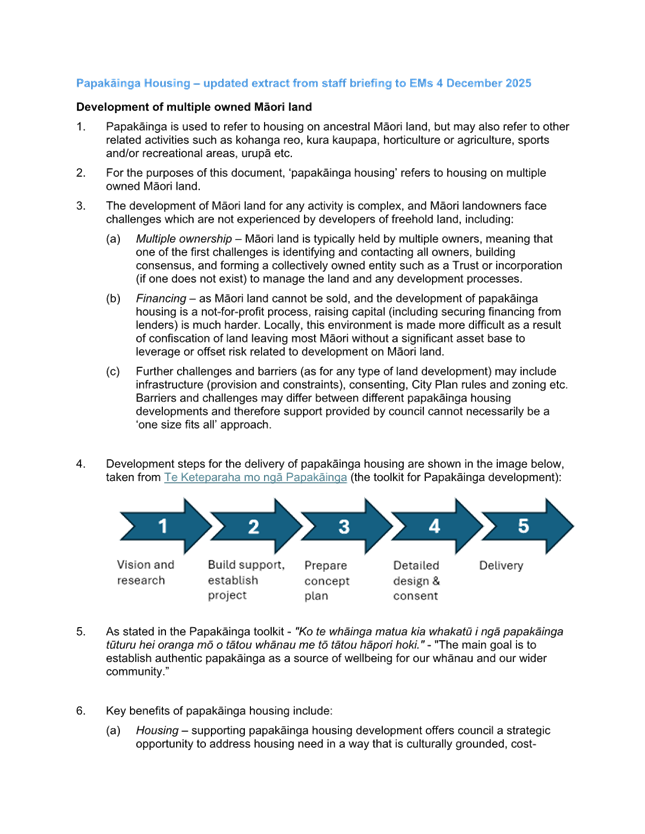
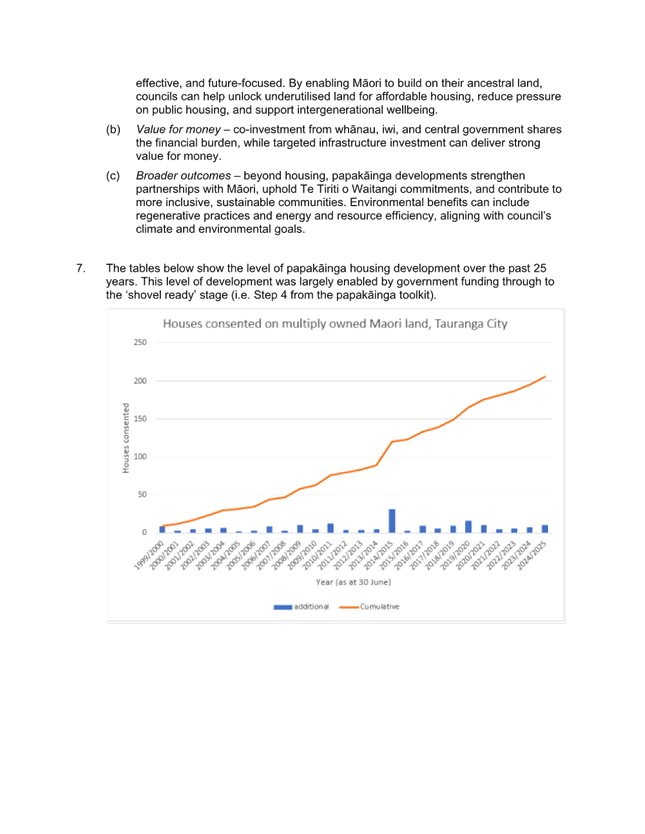
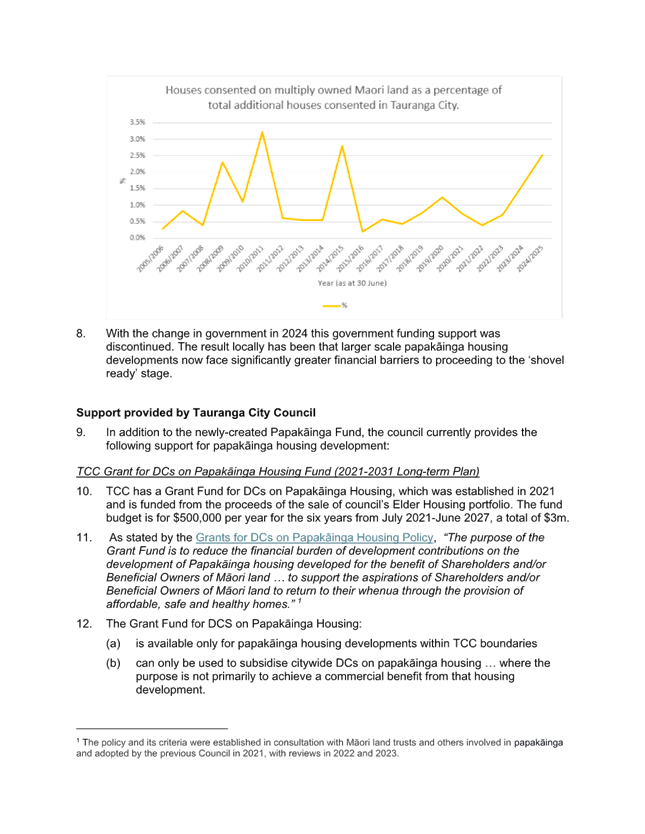
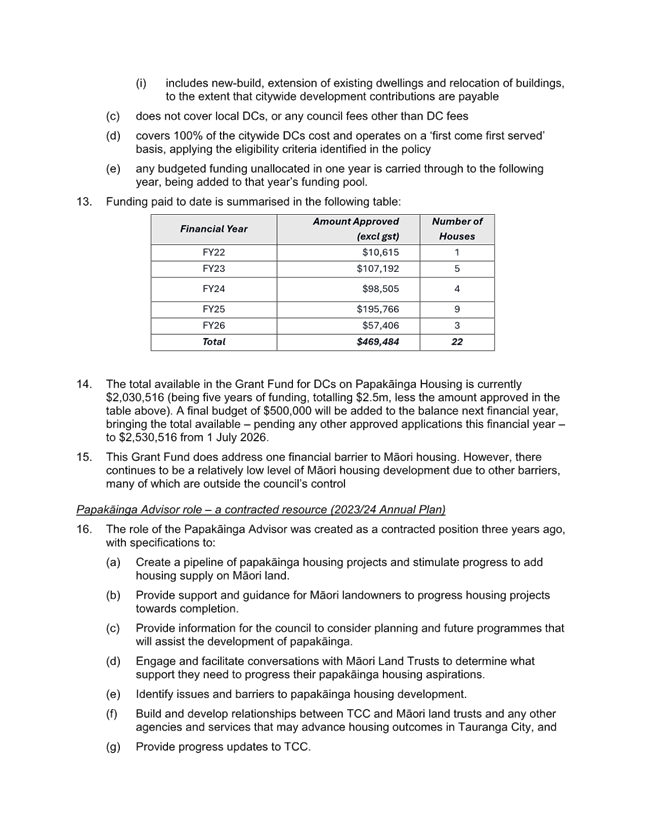
|
Ordinary
Council meeting Agenda
|
21
April 2026
|
11.10 New Years Eve Level of Service
Decision
File
Number: A20127758
Author: Clare
Sullivan, Senior Governance Advisor
Authoriser: Sarah
Holmes, Team Leader: Governance & CCO Support Services
Background
1. The
report accompanying this agenda item, ‘New Years Eve Level of Service
Decision’, will be circulated separately prior to the meeting.
|
Ordinary
Council meeting Agenda
|
21
April 2026
|
11.11 Status update on actions from
prior Council meetings
File
Number: A20115795
Author: Clare
Sullivan, Senior Governance Advisor
Authoriser: Christine
Jones, General Manager: Strategy, Partnerships & Growth
Purpose of the Report
1. This report provides a
status update on actions requested during previous Council meetings.
|
Recommendations
That the Council:
(a) Receives the report
"Status update on actions from prior Council meetings".
|
Discussion
2. This is a recurring
report provided to every second Council meeting. The next report will be to the
2 June 2026 meeting.
3. The attached update
includes all open actions and actions completed since the last report on 3
March 2026.
4. Once reported,
completed actions are archived and made available to Elected Members in their
Stellar library.
5. A summary of
outstanding and recently closed actions, as at 10 April 2026, is provided in
the table on the following page.
|
Status of actions
|
No. actions
|
|
Closed (completed since
the last report)
|
11
|
|
Pending (waiting on
something)
|
4
|
|
In progress
|
4
|
|
To be actioned
|
0
|
|
Total actions
included in this report
|
19
|
Next Steps
6. The full status
update information is provided as Attachment 1 (19 actions from public agenda
items).
Attachments
1. Status
Update report as at 13 April 2026 - A20121268 ⇩
|
Ordinary
Council meeting Agenda
|
21
April 2026
|
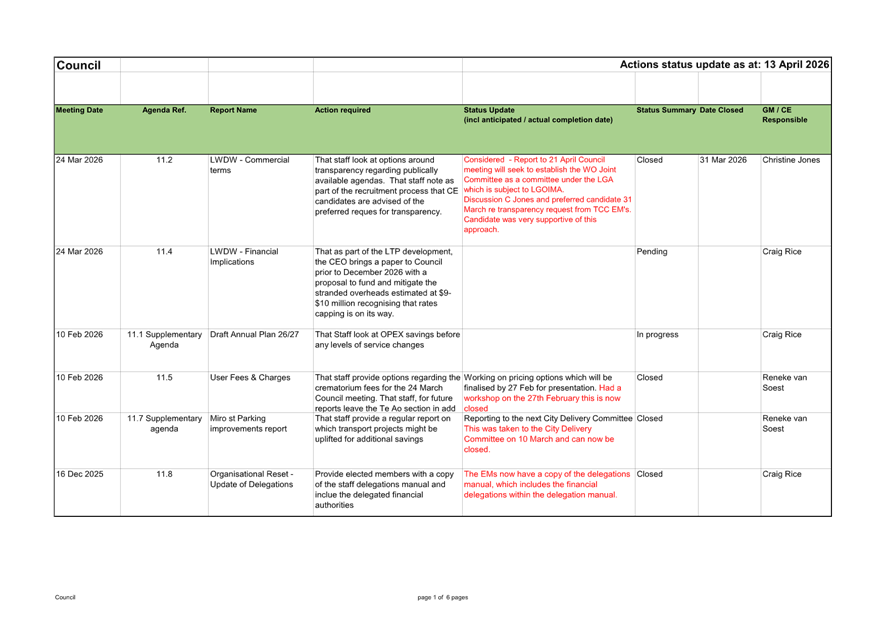
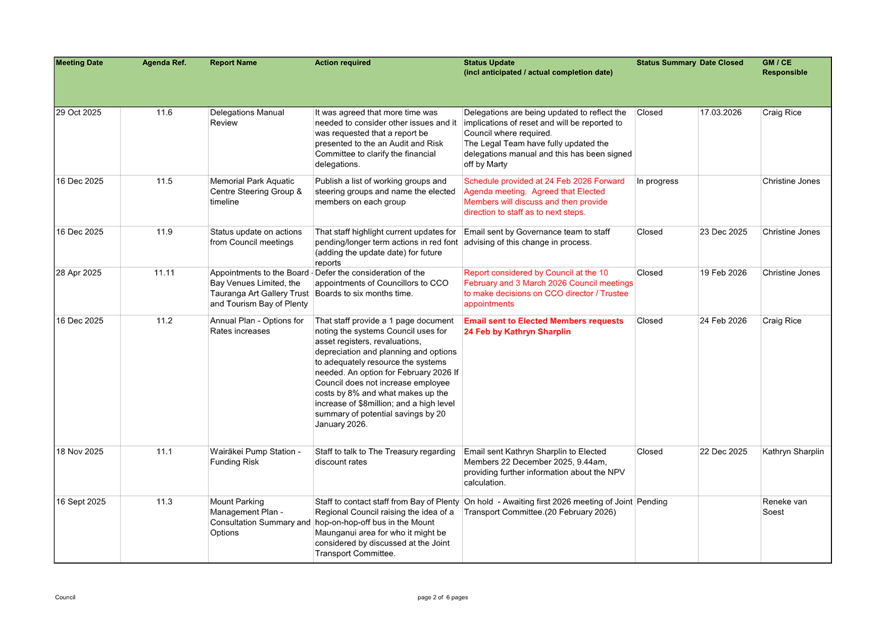
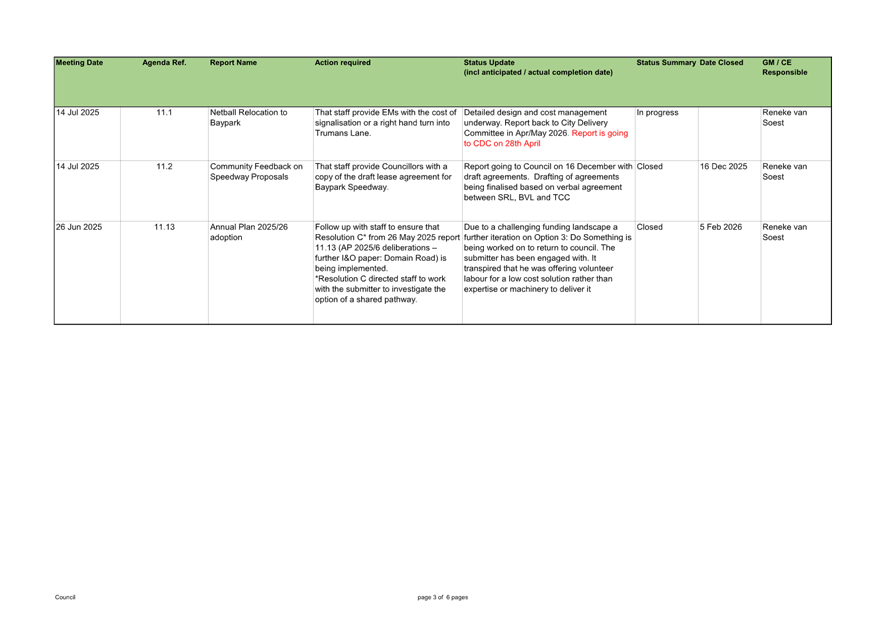
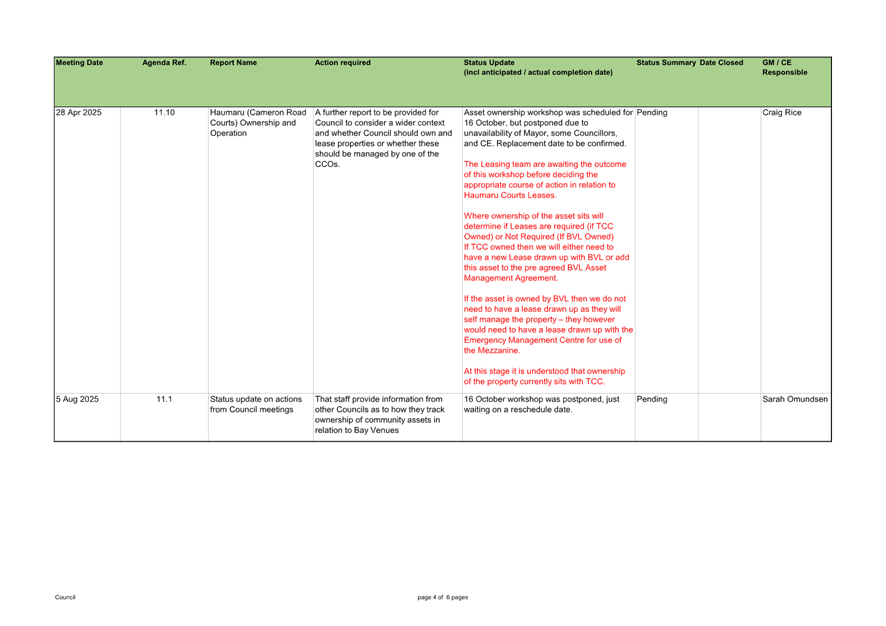
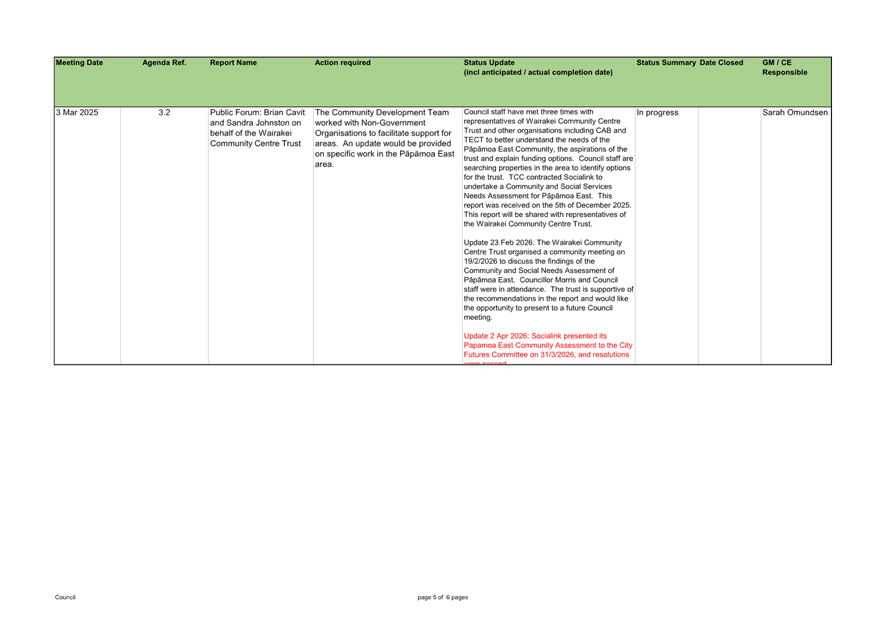
|
Ordinary Council meeting Agenda
|
21 April 2026
|
12 Discussion
of late items
|
Ordinary Council meeting Agenda
|
21 April 2026
|
13 Public
excluded session
Resolution to exclude
the public
|
Recommendations
That the public be
excluded from the following parts of the proceedings of this meeting.
The general subject
matter of each matter to be considered while the public is excluded, the
reason for passing this resolution in relation to each matter, and the
specific grounds under section 48 of the Local Government Official
Information and Meetings Act 1987 for the passing of this resolution are as
follows:
|
General subject of each matter to be
considered
|
Reason for passing this resolution in
relation to each matter
|
Ground(s) under section 48 for the
passing of this resolution
|
|
13.1 - Public Excluded Minutes of the
Council meeting held on 3 March 2026
|
s6(a) - The making available of the information
would be likely to prejudice the maintenance of the law, including the
prevention, investigation, and detection of offences, and the right to a
fair trial
s7(2)(a) - The withholding of the information is
necessary to protect the privacy of natural persons, including that of
deceased natural persons
s7(2)(b)(ii) - The withholding of the information
is necessary to protect information where the making available of the
information would be likely unreasonably to prejudice the commercial
position of the person who supplied or who is the subject of the information
|
s48(1)(a) - the public conduct of the relevant
part of the proceedings of the meeting would be likely to result in the
disclosure of information for which good reason for withholding would exist
under section 6 or section 7
|
|
13.2 - Public Excluded Minutes of the
Council meeting held on 24 March 2026
|
s7(2)(a) - The withholding of the information is
necessary to protect the privacy of natural persons, including that of
deceased natural persons
s7(2)(b)(ii) - The withholding of the information
is necessary to protect information where the making available of the
information would be likely unreasonably to prejudice the commercial
position of the person who supplied or who is the subject of the information
s7(2)(g) - The withholding of the information is
necessary to maintain legal professional privilege
s7(2)(i) - The withholding of the information is
necessary to enable Council to carry on, without prejudice or disadvantage,
negotiations (including commercial and industrial negotiations)
|
s48(1)(a) - the public conduct of the relevant
part of the proceedings of the meeting would be likely to result in the
disclosure of information for which good reason for withholding would exist
under section 6 or section 7
|
|
13.3 - Public Excluded Minutes of the
Council meeting held on 2 April 2026
|
s7(2)(a) - The withholding of the information is
necessary to protect the privacy of natural persons, including that of
deceased natural persons
s7(2)(i) - The withholding of the information is
necessary to enable Council to carry on, without prejudice or disadvantage,
negotiations (including commercial and industrial negotiations)
|
s48(1)(a) - the public conduct of the relevant
part of the proceedings of the meeting would be likely to result in the
disclosure of information for which good reason for withholding would exist
under section 6 or section 7
|
|
13.4 - Asset Realisation Reserve (ARR)
- Further Properties for Disposal Classification
|
s7(2)(b)(ii) - The withholding of the information
is necessary to protect information where the making available of the
information would be likely unreasonably to prejudice the commercial
position of the person who supplied or who is the subject of the information
s7(2)(h) - The withholding of the information is
necessary to enable Council to carry out, without prejudice or
disadvantage, commercial activities
|
s48(1)(a) - the public conduct of the relevant
part of the proceedings of the meeting would be likely to result in the
disclosure of information for which good reason for withholding would exist
under section 6 or section 7
|
|
Confidential Attachment 3 - 11.3 -
Local Water Done Well - Governance and Recruitment
|
s7(2)(b)(ii) - The withholding of the information
is necessary to protect information where the making available of the
information would be likely unreasonably to prejudice the commercial
position of the person who supplied or who is the subject of the information
|
s48(1)(a) the public conduct of the relevant part
of the proceedings of the meeting would be likely to result in the
disclosure of information for which good reason for withholding would exist
under section 6 or section 7
|
|
Confidential Attachment 4 - 11.5 -
Council-Controlled Organisations: Bay Venues Limited and Tourism Bay of
Plenty funding requests
|
s7(2)(a) - The withholding of the information is
necessary to protect the privacy of natural persons, including that of
deceased natural persons
|
s48(1)(a) the public conduct of the relevant part
of the proceedings of the meeting would be likely to result in the
disclosure of information for which good reason for withholding would exist
under section 6 or section 7
|
|
Confidential Attachment 4 - 11.6 -
Long-term Plan 2027-2037 - Project Plan
|
s7(2)(h) - The withholding of the information is
necessary to enable Council to carry out, without prejudice or
disadvantage, commercial activities
|
s48(1)(a) the public conduct of the relevant part
of the proceedings of the meeting would be likely to result in the
disclosure of information for which good reason for withholding would exist
under section 6 or section 7
|
|
Confidential Attachment 2 - 11.9 -
Papakāinga housing funding support
|
s7(2)(b)(ii) - The withholding of the information
is necessary to protect information where the making available of the
information would be likely unreasonably to prejudice the commercial
position of the person who supplied or who is the subject of the information
|
s48(1)(a) the public conduct of the relevant part
of the proceedings of the meeting would be likely to result in the
disclosure of information for which good reason for withholding would exist
under section 6 or section 7
|
|
Confidential Attachment 3 - 11.9 -
Papakāinga housing funding support
|
s7(2)(b)(ii) - The withholding of the information
is necessary to protect information where the making available of the
information would be likely unreasonably to prejudice the commercial
position of the person who supplied or who is the subject of the information
|
s48(1)(a) the public conduct of the relevant part
of the proceedings of the meeting would be likely to result in the
disclosure of information for which good reason for withholding would exist
under section 6 or section 7
|
|
|
Ordinary Council meeting Agenda
|
21 April 2026
|
14 Closing
karakia
