|
Ordinary Council meeting Agenda
|
21 April 2026
|
11 Business
11.1 Draft
2026-27 Annual Plan - Update at April 2026
File
Number: A20107632
Author: Kathryn
Sharplin, Head of Finance
Tracey Hughes,
Manager: Organisational Financial Performance and Corporate Planning
Authoriser: Craig
Rice, Chief Operating and Financial Officer
Purpose of the Report
This report provides an
update of the 2026/27 draft annual plan identifying changes proposed to achieve
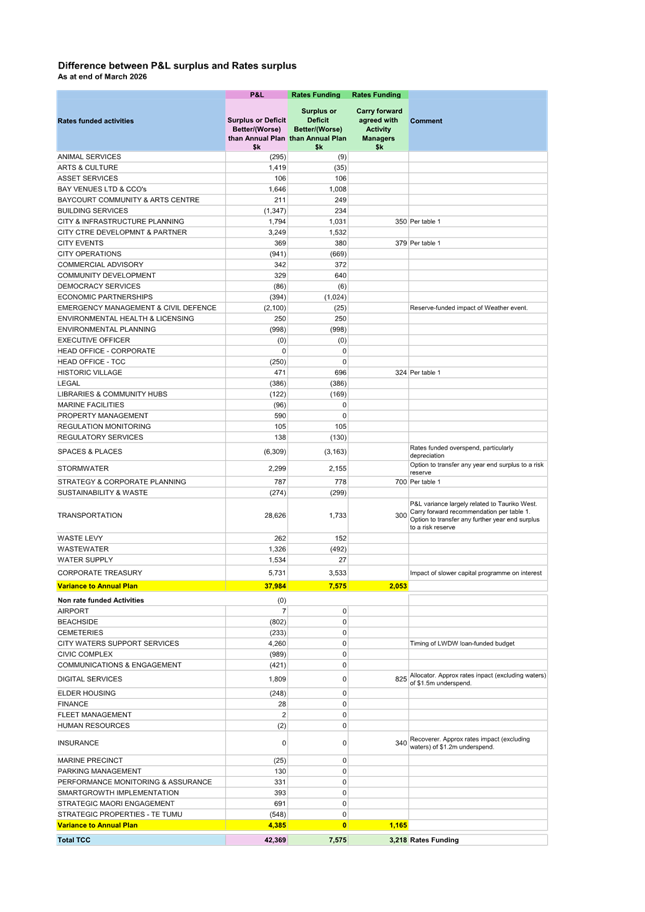
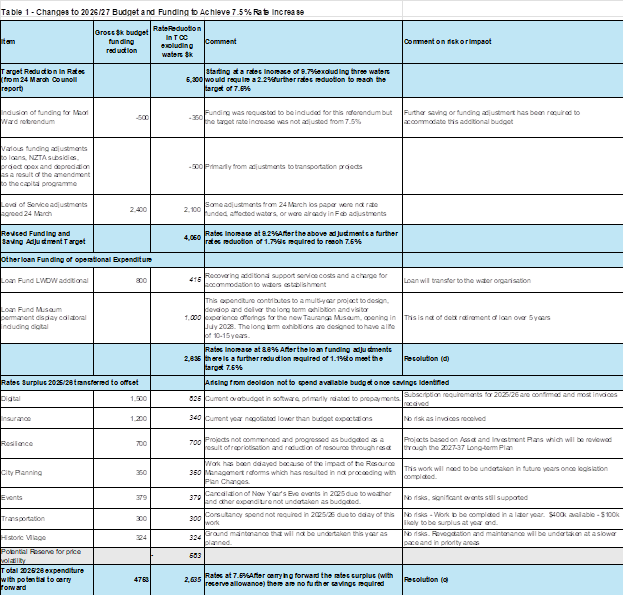
Council’s target 7.5% rate increase.
|
Recommendations
That the Council:
(a) Receives the report
"Draft 2026-27 Annual Plan - Update at April 2026".
(b) Notes that the 2025/26
organisational reset reduced expenditure budgets in the organisation by $39m
with these reductions carried through to the 2026/27 draft Annual Plan.
Development of the 2026/27 Annual Plan since 16 December 2025, has further reduced
expenditure budgets by $21m. This results in a reduction in rates
requirement across Council activities excluding three waters of $12m.
Either
(c) Agrees to funding adjustments
to reach a 7.5% rates requirement for 2026/27 by:
(i) changing the funding of
$800k of support service budgets including accommodation for 2026/27 from
allocator funding to loan-funded budget for water organisation establishment,
which is a rate reduction of $415k.
(ii) amending museum budgets for
one-off display set up costs to be loan funded, reducing rates by $1m.
(iii) carrying forward rate
surplus from the current year of $3.2m and including a reserve to buffer for
price volatility as outlined in Table 1 of this report.
Or
(d) Agrees to the following
adjustments to loan funding which will achieve a rates increase of 8.6% for
the 2026/27 Annual Plan by:
(i) changing the funding of
$800k of finance and executive leadership budget and accommodation for
2026/27 from allocator funding to loan-funded budget for water organisation
establishment, which is a rate reduction of $415k.
(ii) amending museum budgets for
one-off display set up costs to be loan funded, reducing rates by $1m.
|
.
Executive Summary
1. The Chief Executive
has led an organisational reset to support reduction of Council budgets for the
2025/26 Annual Plan. This reset reduced budgets by $39m including the
reduction of 106.7 funded positions. From direction provided as part of the
10 February 2026 and 24 March 2026 Council meetings a further $12m of rates
funding in areas excluding three waters has been removed from draft budgets for
the 2026/27 Annual Plan.
2. On 24 March 2026
Council requested the Chief Executive to consider further savings and options
to achieve a 7.5% rate increase plus any Council approved costs for Mauao
and/or cost increases due to the global situation. The required reduction in
the rates requirement in 2026/27 is $4m.
3. No further reduction
in expenditure has been recommended by the Chief Executive for this year to
reach the draft budget for 2026/27. This is because higher resourcing levels in
the short term are required to meet requirements of central government reform
including establishment of the Water Organisation (WO), the delivery of the LTP
and other efficiency and risk mitigation requirements. The alternative
would be to utilise consultants at a higher cost for these areas of work.
4. The most pressing
reform relates to establishment of the new WO from 1 July 2027. Council
will need to work closely with the new organisation to understand what support
services it requires and for how long. As part of the waters reform some support
staff are expected to transfer to the WO. Alongside transitional support,
Council will also need to consider its own internal and ongoing support
needs. This will inform resource requirements and organisational
structure during the early years of the LTP.
5. Funding adjustments
have been identified to achieve the requested rate increase of 7.5%.
These adjustments will flow through to permanent budget adjustments in
subsequent years once the WO transitional work has been completed, staff
transferred to the WO and the remaining organisation right-sized.
6. The funding changes
proposed in this report include:
(a) Loan funding more of the work
undertaken by TCC staff to support establishment of a WO. This change
will increase the WO establishment budget and therefore debt to transfer to the
WO by $800k. It reduces the allocation of support costs to council
activities by the same amount, with an estimated rates reduction of $415k
excluding waters.
(b) Funding museum set up costs of
$1.5m for long-term exhibition and visitor experience through loans, with rates
funding only of interest and debt retirement over 5-10 years as
appropriate. This change reduces rates requirement by $1m.
(c) Carrying forward to 2026/27 of
current-year rate surpluses as outlined in Table 1 to a total of $3.2m with a
portion carried through to a buffer (reserve) to help manage price volatility
arising from geopolitical uncertainty,
7. The forecast rate
surplus in Table 1 is unusually high and reflects delays and cancellation of
areas of budgeted work during the year for the reasons outlined. There
has been a directive to staff from the Executive not to find alternative use of
these budgets in favour of producing a rate surplus to support a lower rates
requirement next year.
8. A rate surplus is
not the same as a Profit and Loss surplus as shown in the financial accounts.
The profit and loss variance to budget by activity is compared with the rates
variance to budget by activity in Attachment 1.
9. The draft budgets at
this stage do not include additional funding requirement related to costs for
Mauao or cost increases due to the global situation. Further information
on these areas will be included in the final update in May prior to adoption of
the annual plan in June.
Background
10. On 24 March 2026 Council
considered “Report 11.5 Annual Plan 2026-27 Update”. As part of
this report, Council agreed a rate increase of 7.5% for three waters
activities, with total rates requirement of $145m (this includes water by meter
price per cubic metre increasing at 7.5%).
11. The rest of council excluding
three waters had a draft rate requirement of $260m, an increase over the
previous year of 9.7% after assumed growth of 0.5%.
12. Options to reduce the rate
requirement through level of service changes were proposed in a separate report
to the same meeting “Report 11.6 Annual Plan 2026/27 Levels of Service
Options”. Council agreed to total rates reduction through level of
service changes equivalent to approximately $2.1m of rates, which left a draft
rates increase of $258m. Additional costs were added in to fund the
Māori Ward referendum and recognising the operating impacts associated
with the revised capital programme.
13. After decisions from both
reports on 24 March (reports 11.5 and 11.6), Council agreed:
14. (l) to request the CE to
consider further savings and options to achieve 7.5 percent plus any Council
approved costs for Mauao and/or cost increases due to the global situation.
discussion
Expenditure Reductions
Through Resets, Efficiency Savings and LOS reduction
15. Council has already undertaken
a significant reduction in staff and operating expenditure across the
organisation both through the 2025/26 reset and in reaching the April draft
Annual Plan for 2026/27.
16. The Chief Executive has led an
organisational reset to support reduction of Council budgets for the 2025/26
Annual Plan. This reset reduced budgets by $39m including the reduction
of 106.7 funded positions. From direction provided as part of the 10
February 2026 and 24 March 2026 Council meetings a further $12m of rates
funding in areas excluding three waters has been removed from draft budgets for
the 2026/27 Annual Plan.
17. There are several initiatives
requiring significant support staff input over the next 18 months including:
(a) Establishment of the WO.
(b) Development of shared services
to support the WO for a transitional period and the transfer of some support
staff.
(c) Organisational reset post
establishment of the WO once service level agreements are in place and with a
view to future state of core council.
(d) Development of the 2027-37
Long-term Plan
(e) Advice on and then
implementation of proposed Government reform including regional council
governance, planning and regulation, rates capping and changes to reporting
requirements
(f) Efficiency improvements
and risk mitigation including migrating off ozone
18. No further adjustments to
budgets and staffing are recommended by the Chief Executive at this stage
because of the above work programme. The organisation needs to be
sufficiently resourced to meet the additional work required. The
alternative would be to engage more costly consultants to undertake this
work. The proposal to fund the water transition work through loans
reduces the operational funding of support services base budgets from
2026/27. These changes will flow through as part of the organisational
reset post WO transition.
Funding Review to reduce rates requirement to 7.5%
19. Council staff have identified
areas of rate funded expenditure this year that have not been spent to date as
planned. There has been a directive not to find alternative uses of these
budgets in favour of producing a rate surplus to support a lower rates
requirement next year. Key areas of underspend which activity managers have
committed to are identified in Table 1 below. For the 9 months to 31 March
2026, Council activities have underspent on rate-funded expenditure by $7.6m
(Attachment 1). Not all this underspend is expected to translate into a
rate surplus at year end.
20. Table 1 also presents two loan
funding recommendations for next year’s budget.
21. The first is funding $800k of
support service expenditure including accommodation budgets as additional
loan-funded waters transition budget, reflecting the significant amount of work
to be undertaken as part of stage 2 establishment. This change will reduce
overall rates requirement by 415k. It will increase the debt to transfer to the
water organisation by $800k.
22. The second loan funded proposal
is in relation to one-off museum set up costs of exhibition displays and
customer experience expenditure. In the March 2026 draft, all this
one-off expenditure was funded by rates. However, because most of this
expenditure relates to set up costs including interactive digital displays that
will last 5 to 10 years, it is more appropriate to be loan funded with rates
used to retire the debt over an appropriate timeframe.
23. Use of 2025/26 unspent rates to
fund 2026/27 expenditure will impact the rate-funding increase required in
2027/28, unless further expenditure reduction is achieved in that year.
Expenditure Risks
24. Transportation and
stormwater activities are currently significantly underspent on rates
funded expenditure. Transportation is forecasting to be fully spent by
year end other than the consultancy budget identified in Table 1. Stormwater
may not be fully spent in areas related to open drain clearing. There
would be opportunity at year end to consider options for carrying forward
significant unspent maintenance budget in stormwater including to a risk
reserve in response to higher costs associated with fuel prices.
25. Interest rates will also
be affected by any long-term disruption to fuel and oil supplies from the
Middle East conflict. At present the Reserve Bank is looking through
short term price impacts but has signalled inflation will be responded to by a
raising of interest rates. Markets are now forecasting multiple increases
in the OCR from July. No change has yet been made to interest rate assumptions
in the Annual Plan. There is currently a rate surplus relating to
debt levels and interest costs this year. Options for carrying forward a
surplus to a reserve will be considered in June.
Rates surplus compared with Operating Surplus
26. A rate surplus is not the same
as a Profit and Loss surplus as shown in the financial accounts (Statement of
Comprehensive Revenue and Expenses – SOCRE). The profit and loss variance
to budget by activity is compared with the rates variance to budget by activity
in Attachment 1.
27. Rates are not the only funding
source for operating expenditure. Other sources include subsidies and fees and
charges as well as reserves and in some cases loan funding consistent with the
Revenue and Financing Policy.
28. The Statement of Comprehensive
Revenue and Expense (SOCRE) presents all “operational” expenditure
as defined by accounting standards that is recognised in the year, regardless
of whether it is funded from operational revenue (rates and charges), loans,
reserves (which represent funding from previous years) or is simply a non-cash
accounting entry. Mark to market adjustments for interest rate swaps are
an example of gains or losses recorded against the surplus that are not
realised losses. Expenditure that has occurred in the past that cannot be
capitalised is required to be written back in the SOCRE against operating costs
even though no expenditure has occurred in the year and the work has been loan
funded in the past. Both these items will impact recorded expenditure and
operating surplus but not rates funding.
29. Therefore, it is possible to
have a rate surplus while recording an operating deficit in the SOCRE.
Key Financials
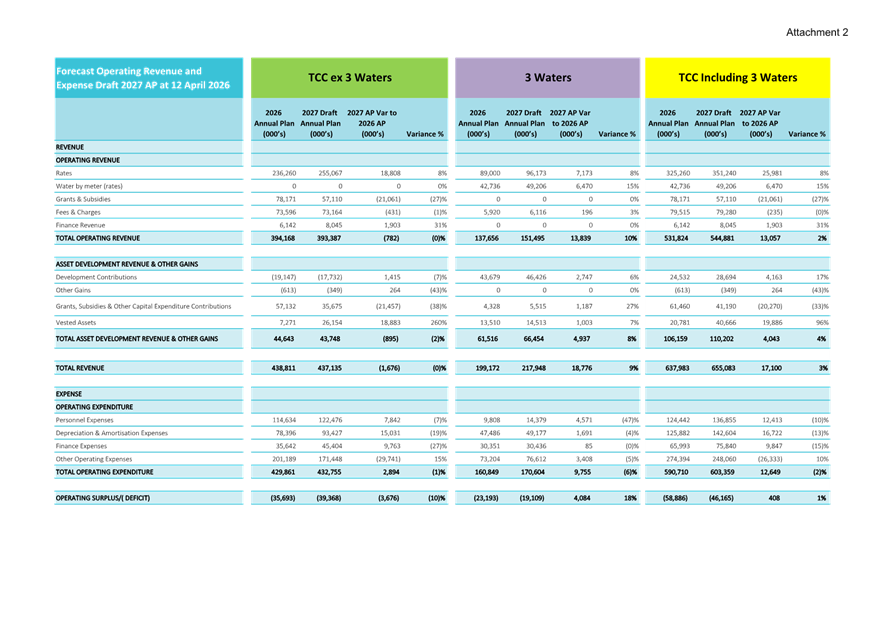
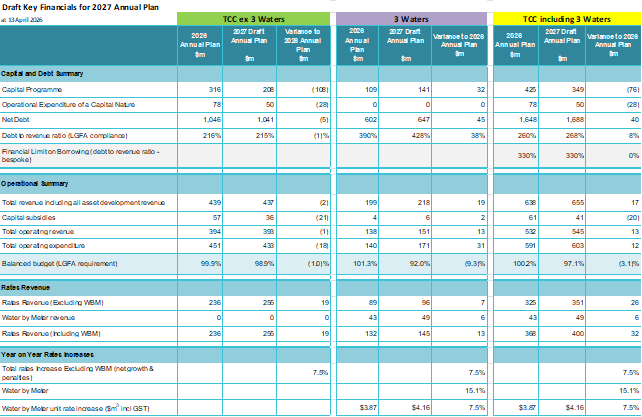
The following table of
key financials for TCC excluding three waters, three waters and whole of
council shows the 7.5% rate increase achieved as requested by Council.
The higher unbalanced budget shown reflects the reliance on current year
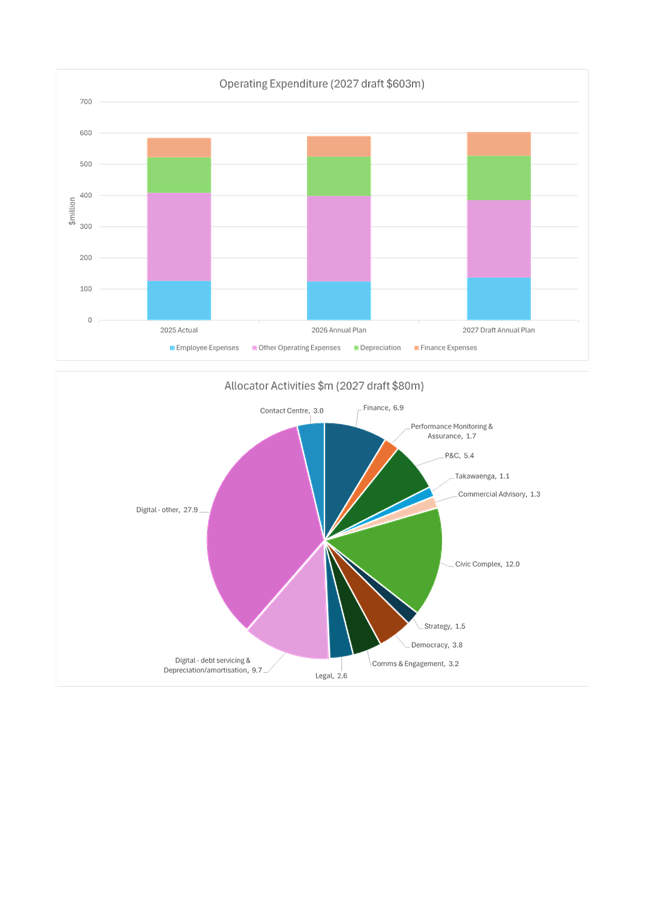
surpluses and loans to fund expenditure. The complete Statement of
Comprehensive Revenue and Expense along with graphs of operational and capital
expenditure are included as Attachment 2.
Table 2 – Key
Financials
Statutory Context
30. The Local Government Act 2002
requires Council to produce an Annual Plan. The plan is required to be
financially prudent and prepared in accordance with requirements of the Act.
STRATEGIC ALIGNMENT
31. This contributes to the
promotion or achievement of the following strategic community outcome(s):
|
Contributes
|
|
We are an inclusive city
|
ü
|
|
We value, protect and enhance the environment
|
ü
|
|
We are a well-planned city that is easy to move
around
|
ü
|
|
We are a city that supports
business and education
|
ü
|
|
We are a vibrant city that embraces
events
|
ü
|
32. The Annual Plan aligns with all
community outcomes as it represents the resources Council commits to run the
organisation and deliver services grants to other organisations and capital
investments to achieve these outcomes
Options Analysis
33. The options to be considered in
this report are either to accept all of the funding adjustments proposed to
reach a target rate increase of 7.5% or to accept only the loan funded
adjustments to achieve a rate increase for TCC excluding three waters of up to
8.6%.
Option 1 - Accept all the proposed funding adjustments to
achieve a rate increase of 7.5%
|
Summary
|
Advantages
|
Disadvantages/Risks
|
|
Agree to
Loan funding of LWDW
additional establishment expenditure,
Loan funding of museum
display set up costs, and
Carry forward of rate
surpluses as outlined in Table 1.
|
Enables a lower rates
increase of 7.5%.
Carry forward of rates
surplus ensures rates collected for an activity are spent on that activity.
Loan funding of support
service and accommodation costs in the establishment of the new water
organisation reflects the true costs of waters transition.
Loan funding of the
museum display set up reflects that this expenditure will provide benefit
over 5 to 10 years not just the year it occurs.
|
Funding 2026/27-year
expenditure from carry forward of rate surplus means 2027/28 budgets would
require larger rate increase to achieve the same level of expenditure in
future and will encourage further efficiency savings.
There is a risk that
over expenditure elsewhere may reduce the rates surplus although this is
being carefully monitored
Loan funding of
expenditure and use of previous years funding will bring the balanced budget
measure further below 100%
Not meeting the
prudence benchmark would need to be explained to the Board of Local
Government Funding Agency (LGFA) and could put at risk the bespoke borrowing
covenant. Current debt levels are within standard LGFA borrowing limits
so TCC does not require the bespoke covenant in 2026/27.
|
Option 2 – Agree to the amendment to loan funding but
not the carry forward of current year rates surplus to achieve a rate increase
of 8.6%.
|
Summary
|
Advantages
|
Disadvantages/Risks
|
|
|
|
|
Agree to
Loan funding of LWDW
additional establishment expenditure, and
Loan funding of museum
display set up costs
|
The balanced budget
metric is still less than 100% but more favourable than in option 1. Advice
to LGFA would still be required.
The rate base would be
higher going forward if a rate cap were to be applied for the following year.
Any rate surplus could
be used to retire debt or fund reserves for the purpose of managing future
rate requirements.
|
The rate increase would
be higher at 8.6%, which increases the cost to ratepayers over option 1.
The unmet balanced
budget benchmark would still require explanation to the Board of LGFA as
required under the conditions of the bespoke covenant and could risk the
bespoke covenant being withdrawn. Current debt levels are within
standard LGFA borrowing limits so TCC does not require the bespoke covenant
in 2026/27.
|
|
|
|
Financial Considerations
34. Carry forward of rates surplus
from areas underspent this year enables the budgeted level of expenditure for
next year to be funded at a lower rate increase than otherwise. It uses
the rates collected for the purpose intended in the 2025/26 Annual Plan when
the rates were struck. Loan funding of one-off expenditure that provides
benefit over a number of years is appropriate funding for this type of
expenditure under the Council’s Revenue and Financing Policy. The true
costs of setting up a water organisation include the additional costs to be
funded through increased loan funded budget proposed.
35. However, use of debt to fund
expenditure creates an unbalanced budget under the balanced Budget measure as
set out in the Financial Regulations 2014. It also requires that Council
explain to the Board of LGFA why the budget is unbalanced. It is noted
that Council’s debt to revenue ratio does not utilise the additional
borrowing capacity of the bespoke covenant as total debt to revenue remains
within the ratios under the standard LGFA covenants.
Legal Implications / Risks
36. There are no specific legal
implications associated with the update on the annual plan. However,
decisions on resourcing, which are actioned through the Annual Plan, may have
an impact on the level of risk associated with the organisation’s operations
and delivery.
37. The Middle East conflict is
having an immediate impact on fuel and interest costs which have not been
incorporated in interest and opex and capex costs in this Annual Plan
update. The update in May prior to adoption of the Annual Plan will
incorporate the latest assumptions at that time.
38. There is a risk that the LGFA
Board may require Council to increase its revenue to ensure a balanced budget
measure above 100% to retain the bespoke covenant.
TE AO MĀORI APPROACH
39. The Annual Plan represents
resourcing to include the outcomes agreed by Council. The outcomes are
addressed through decisions on activities, capital expenditure and
services. These should align with Council’s Te Ao Māori
approach. The level of resourcing for the Annual Plan should have regard
to the agreed outcomes and deliverables the expenditure aims to achieve.
CLIMATE IMPACT
40. The Annual Plan includes both
operating and capital expenditure to adapt to a changing climate, reduce
emissions and enhance nature and biodiversity. These initiatives are
included in the Groups of Activity information
Consultation / Engagement
41. Council has resolved not to
consult on the 2026/27 Annual Plan, but that it would like material to be
available related to this draft to support a survey to be undertaken in April
2026, commencing 14 April. The material associated with this report will
be available on the agenda to the 21 April Council meeting from 15 April 2026.
Significance
42. The Local Government Act 2002
requires an assessment of the significance of matters, issues, proposals and
decisions in this report against Council’s Significance and Engagement
Policy. Council acknowledges that in some instances a matter, issue,
proposal or decision may have a high degree of importance to individuals,
groups, or agencies affected by the report.
43. In making this assessment,
consideration has been given to the likely impact, and likely consequences for:
(a) the current
and future social, economic, environmental, or cultural well-being of the
district or region
(b) any persons who are likely to be
particularly affected by, or interested in, the matter.
(c) the capacity of the local authority
to perform its role, and the financial and other costs of doing so.
44. In accordance with the
considerations above, criteria and thresholds in the policy, it is considered
that the matter is of medium significance.
ENGAGEMENT
45. Taking into consideration the
above assessment, that the matter is of medium significance, officers are of
the opinion that no further engagement is required prior to Council making a
decision.
Next Steps
46. Council will receive a further
update on financials at the 25 May Council meeting. It is required to
adopt the Annual Plan 2026/27 in June 2026, noting the draft is expected to be
updated for:
(a) changes to the delivered
capital programme and proposed carry forward and 2026/27 capital budgets
(b) changes to proposed opex
budgets as a result of Council decisions or other significant events
(c) changes to costs of capital or
operational budgets as a result of costs for Mauao or cost increases due to the
global situation.
Attachments
1. Difference
between P&L Surplus and Rates Surplus - A20123725 ⇩ 
2. Updated Operating
Revenue and Expense - A20123767 ⇩