|
Tauranga
and Western Bay of Plenty Transport Committee meeting Agenda
|
5
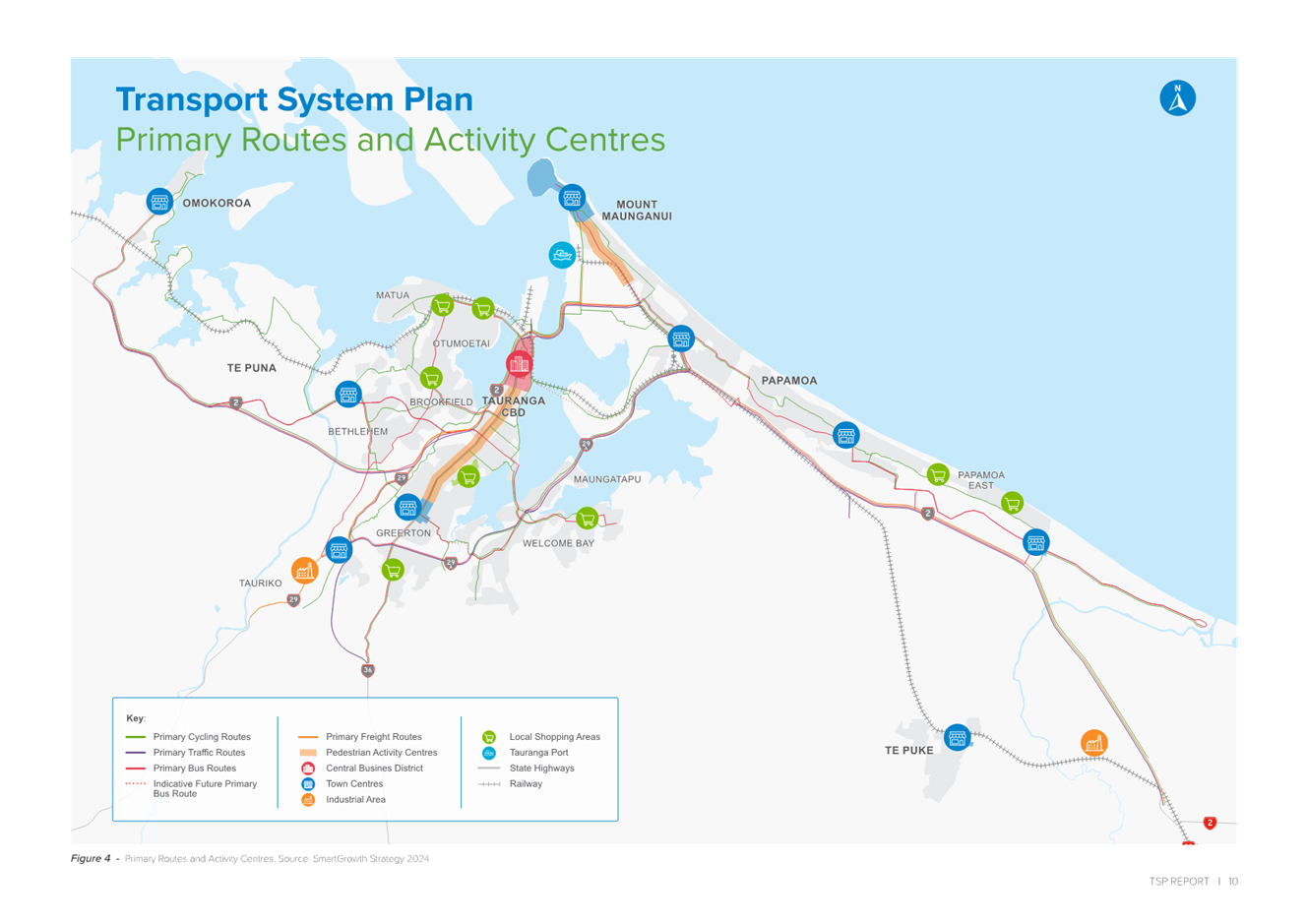
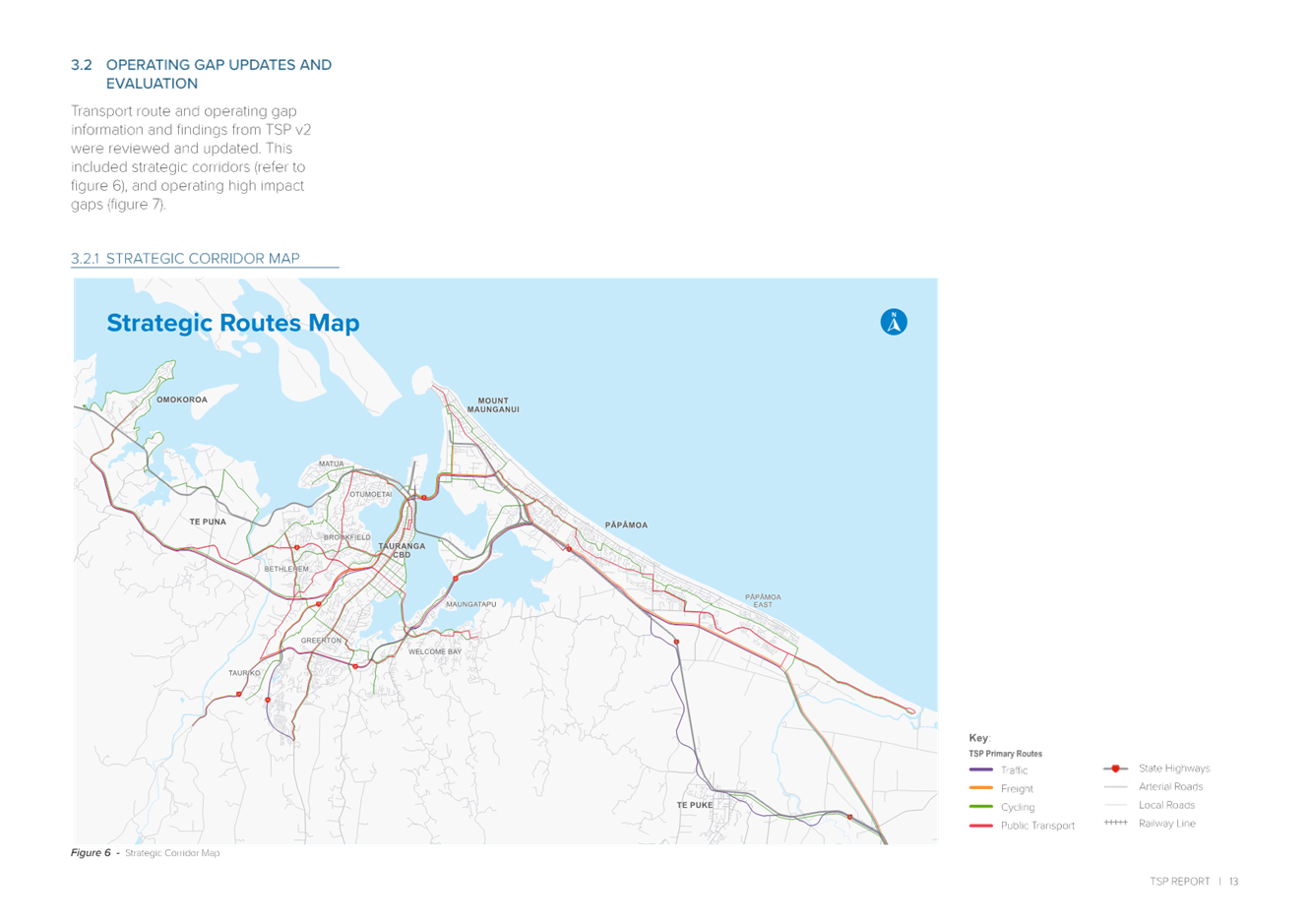
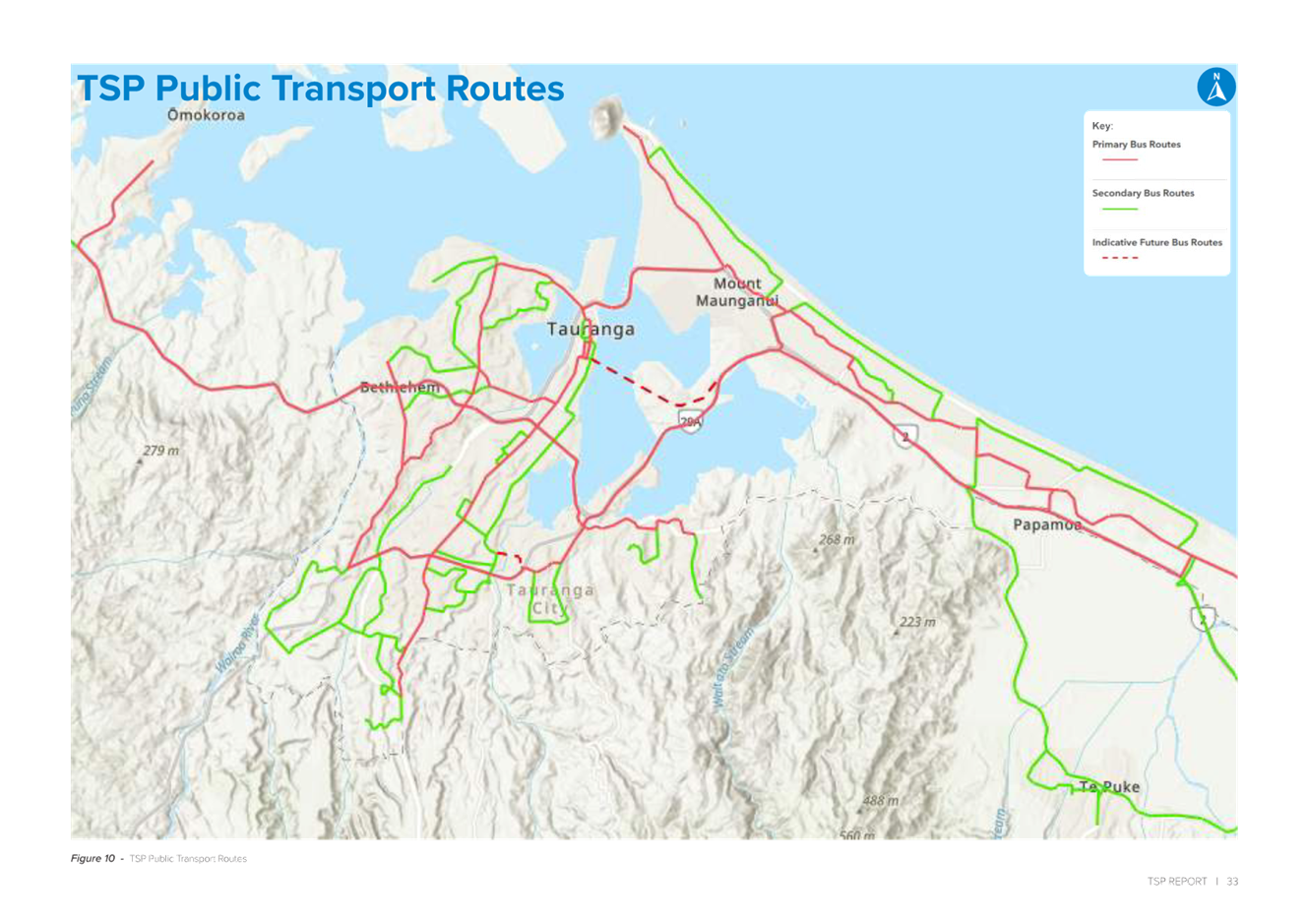
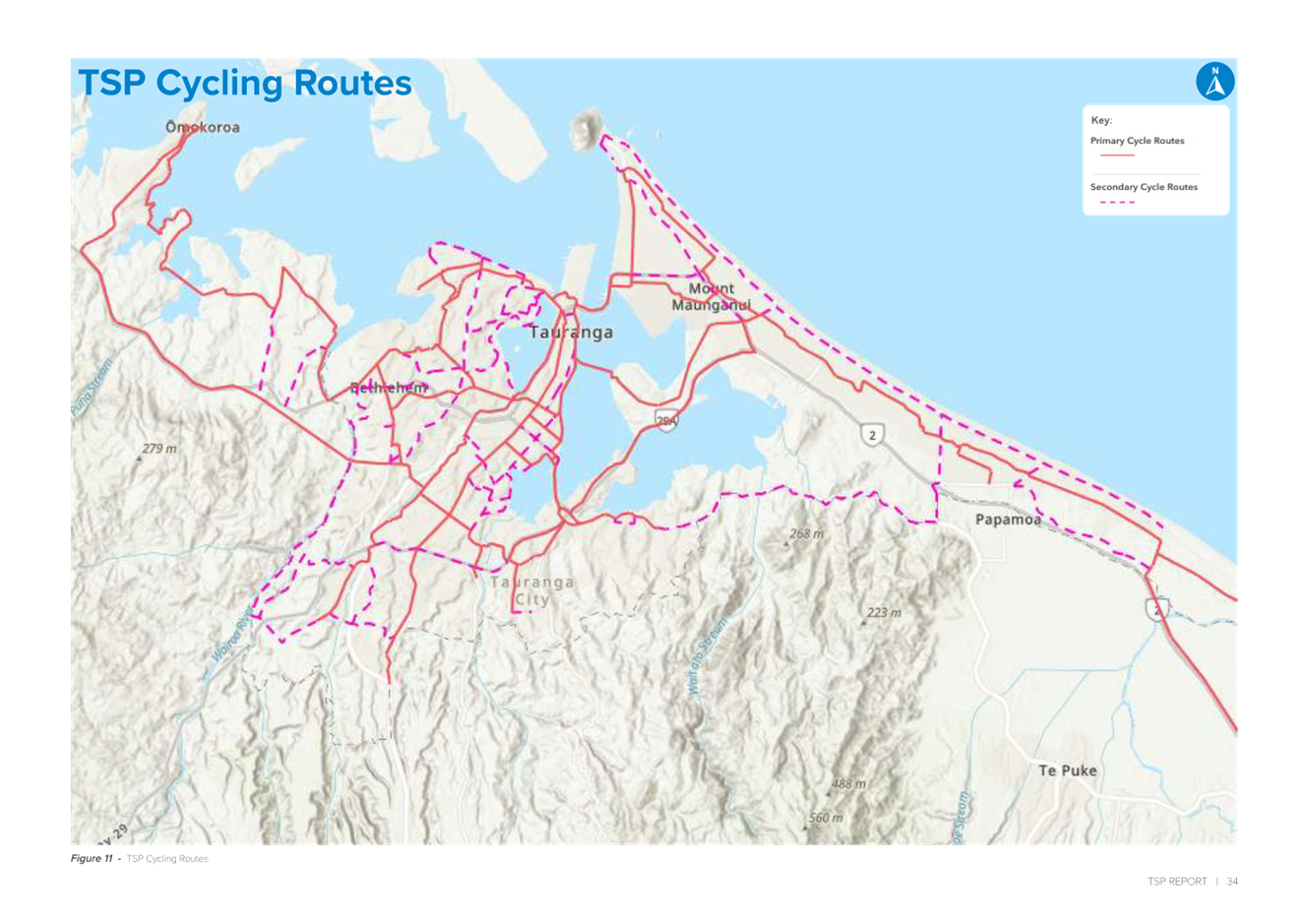
June 2026
|
9.2 Chair's
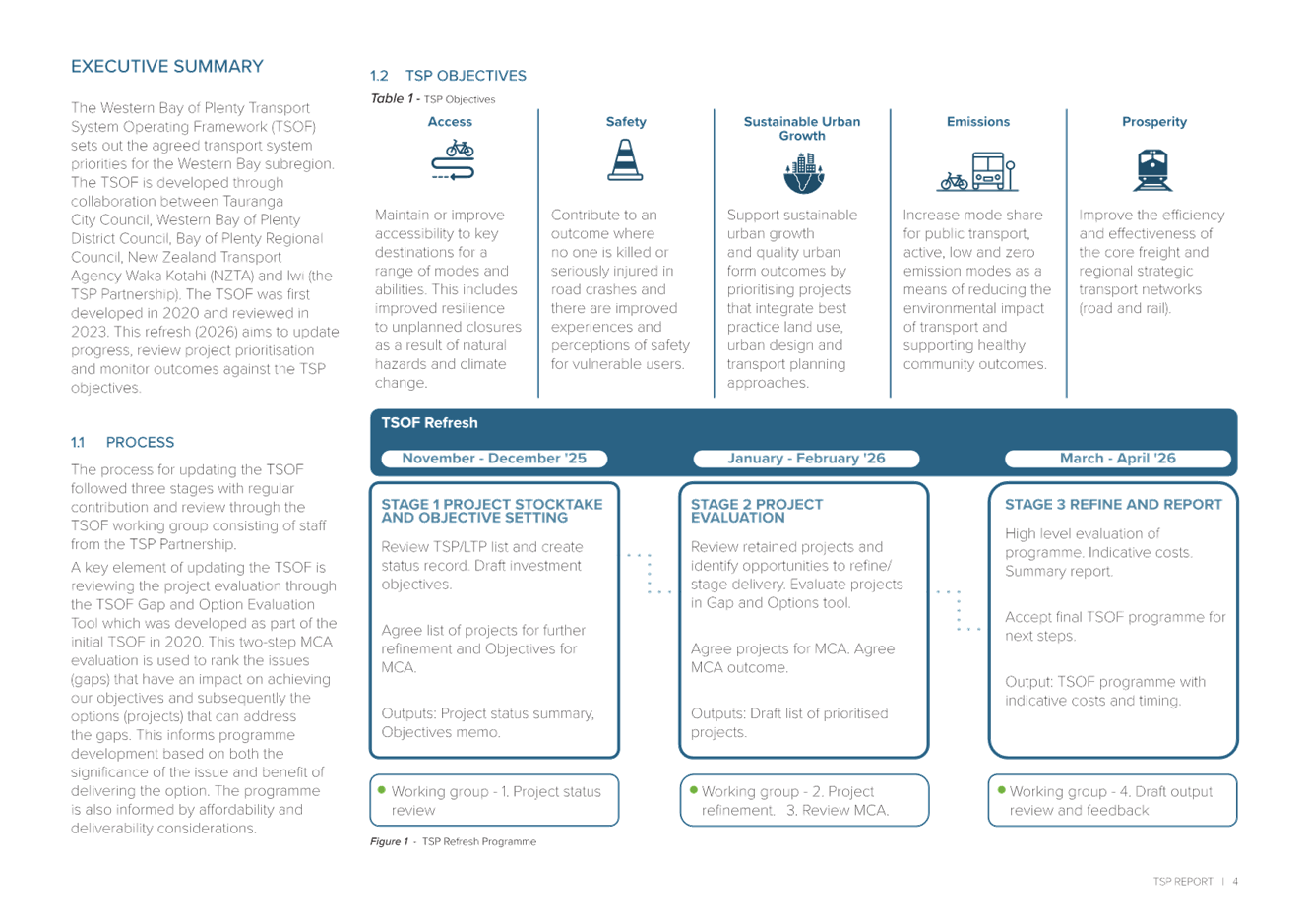
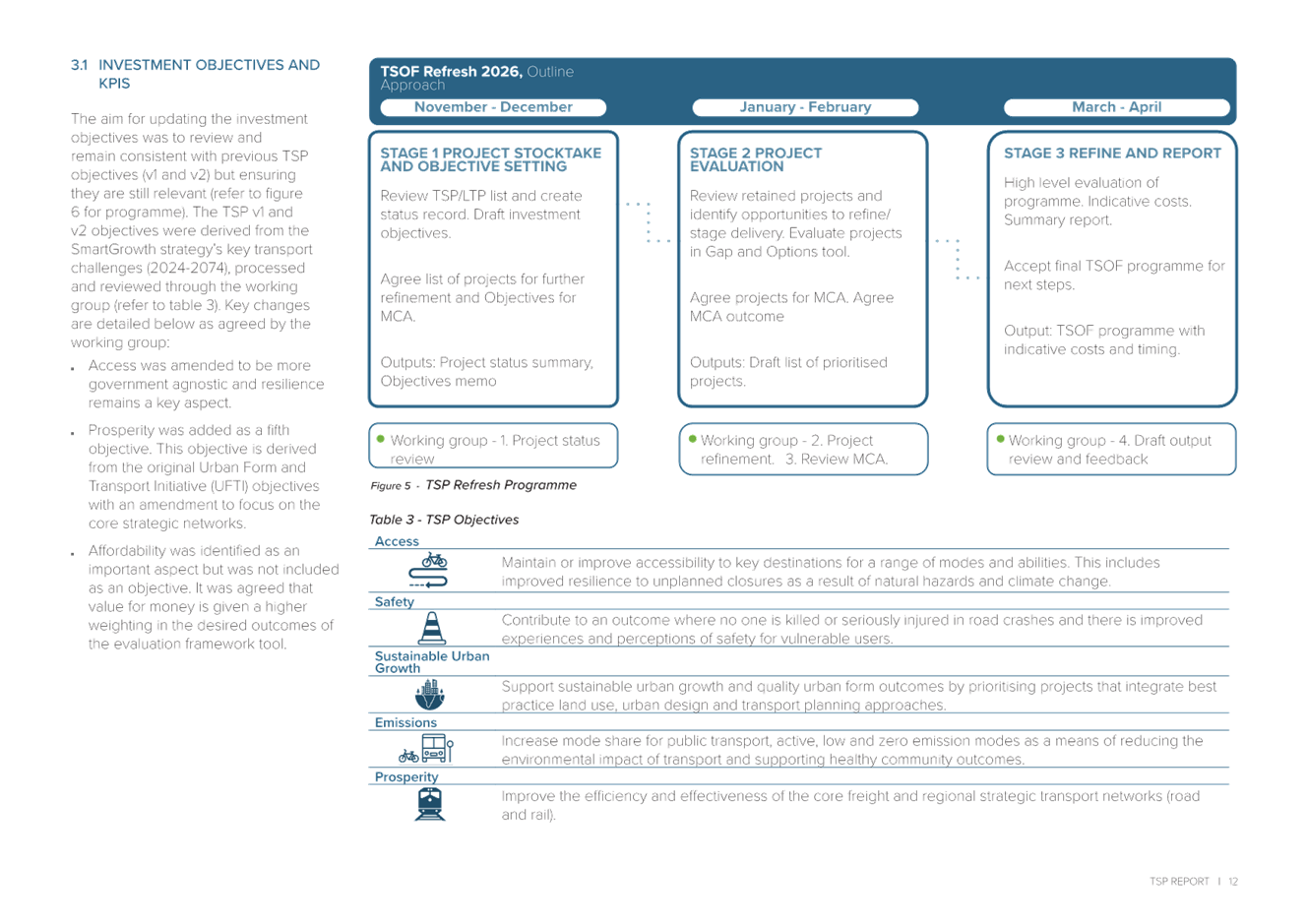
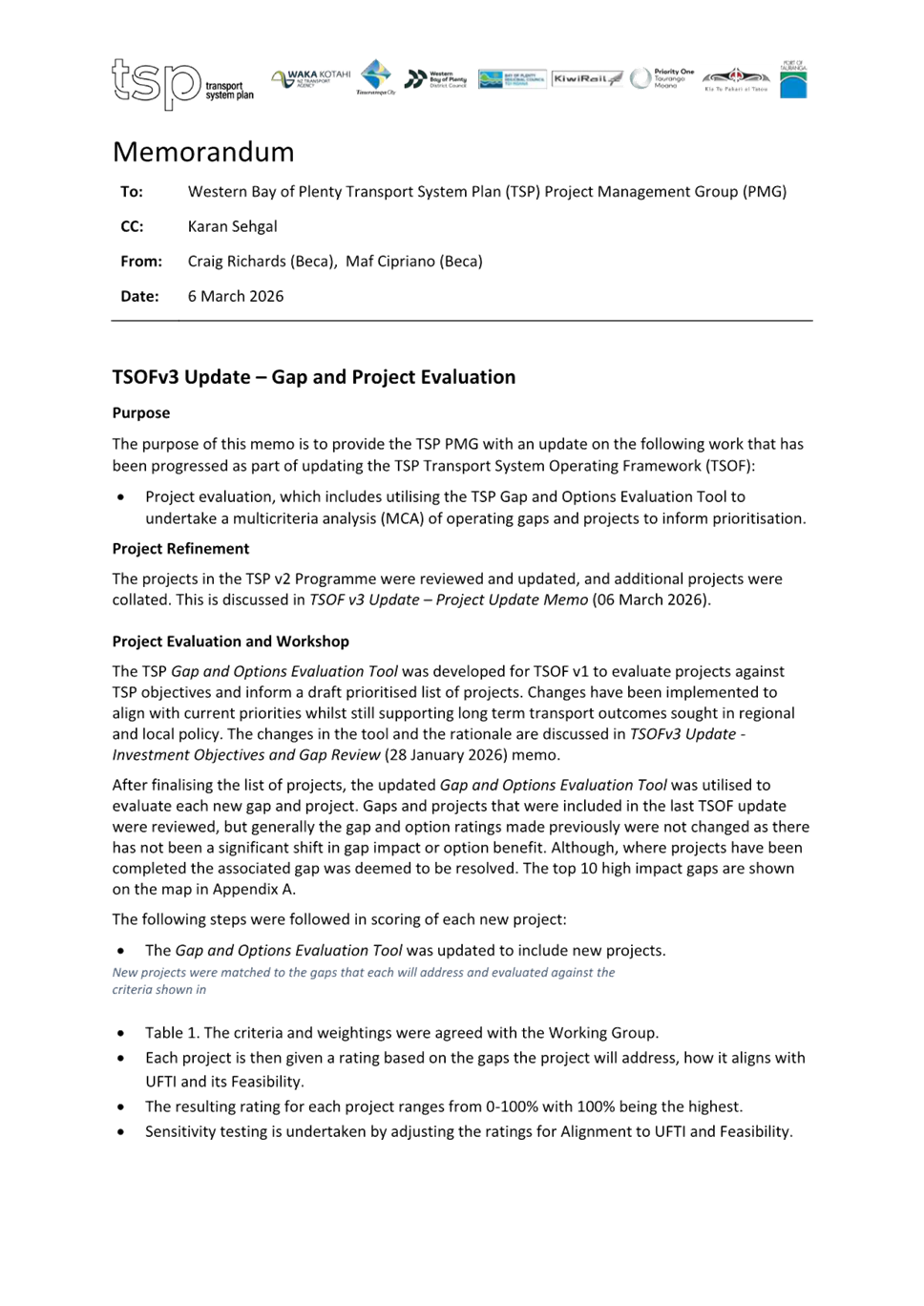
Report
File
Number: A20349877
Author: Niki
Carling, Team Leader, Transport Planning (BOPRC)
Andrew Williams,
Manager, Transport Strategy (BOPRC)
Authoriser: Oliver
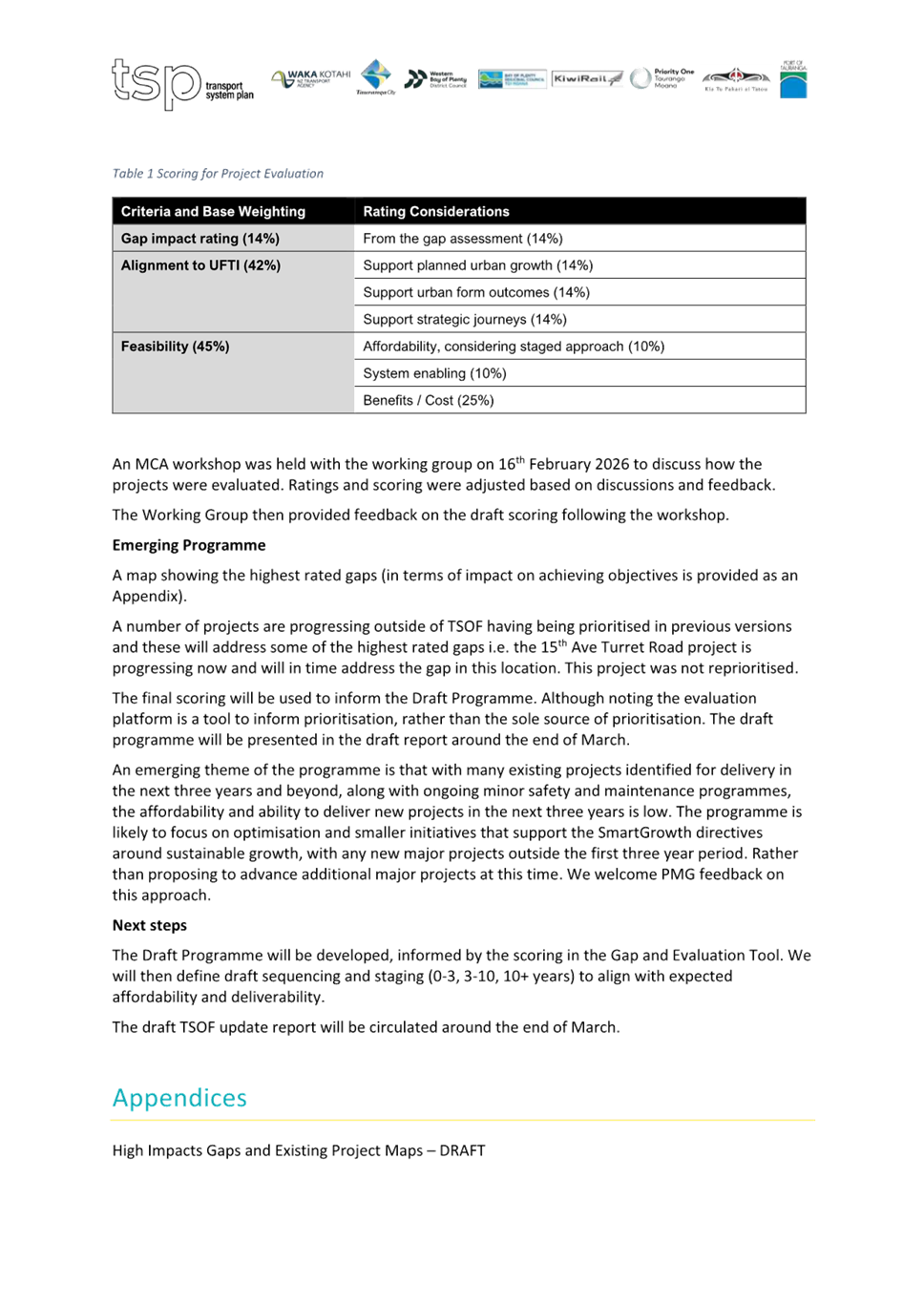
Haycock, Director, Public Transport (BOPRC)
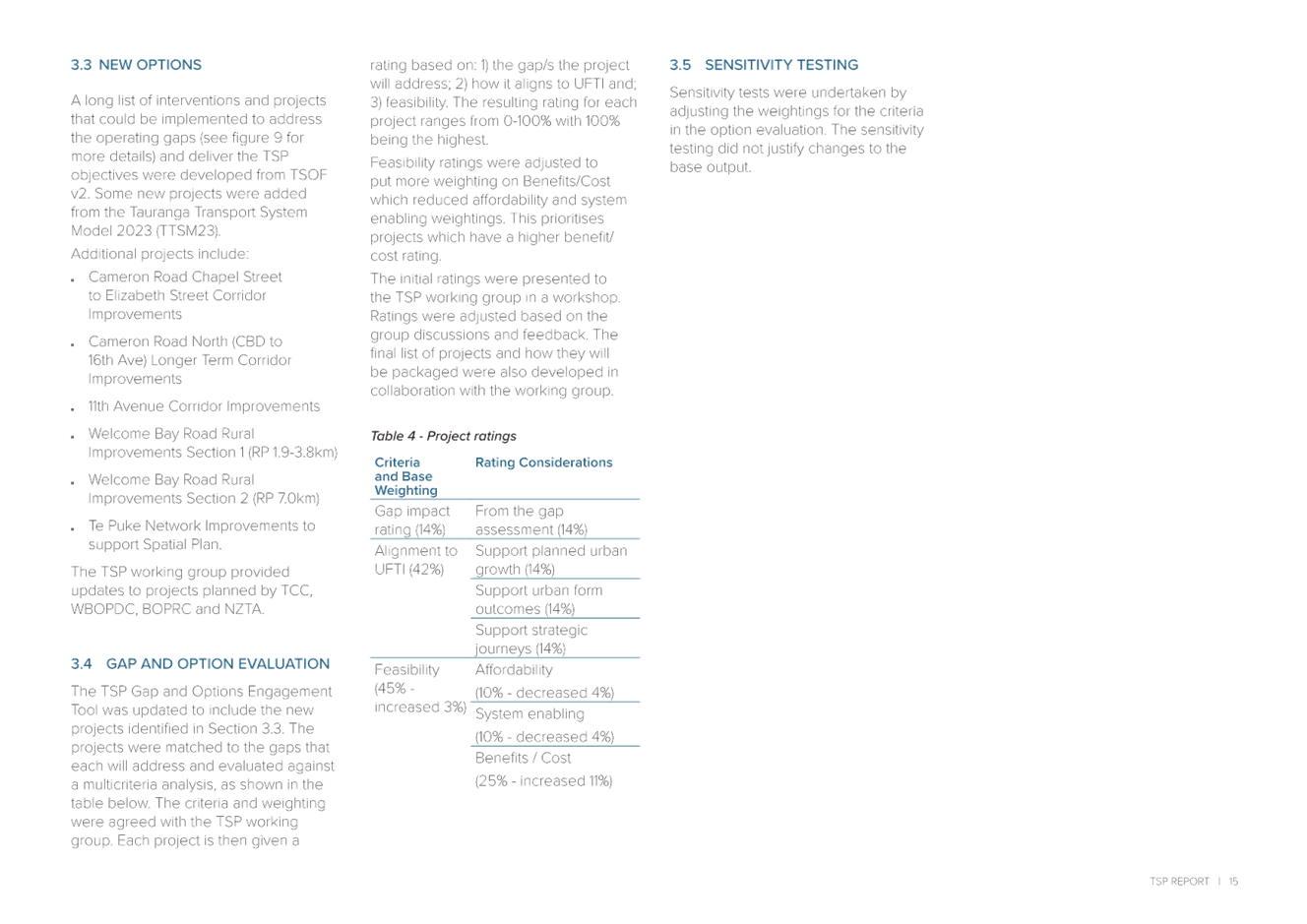
Purpose of the Report
1. Provides an update
on matters of interest for Committee members.
|
Recommendations
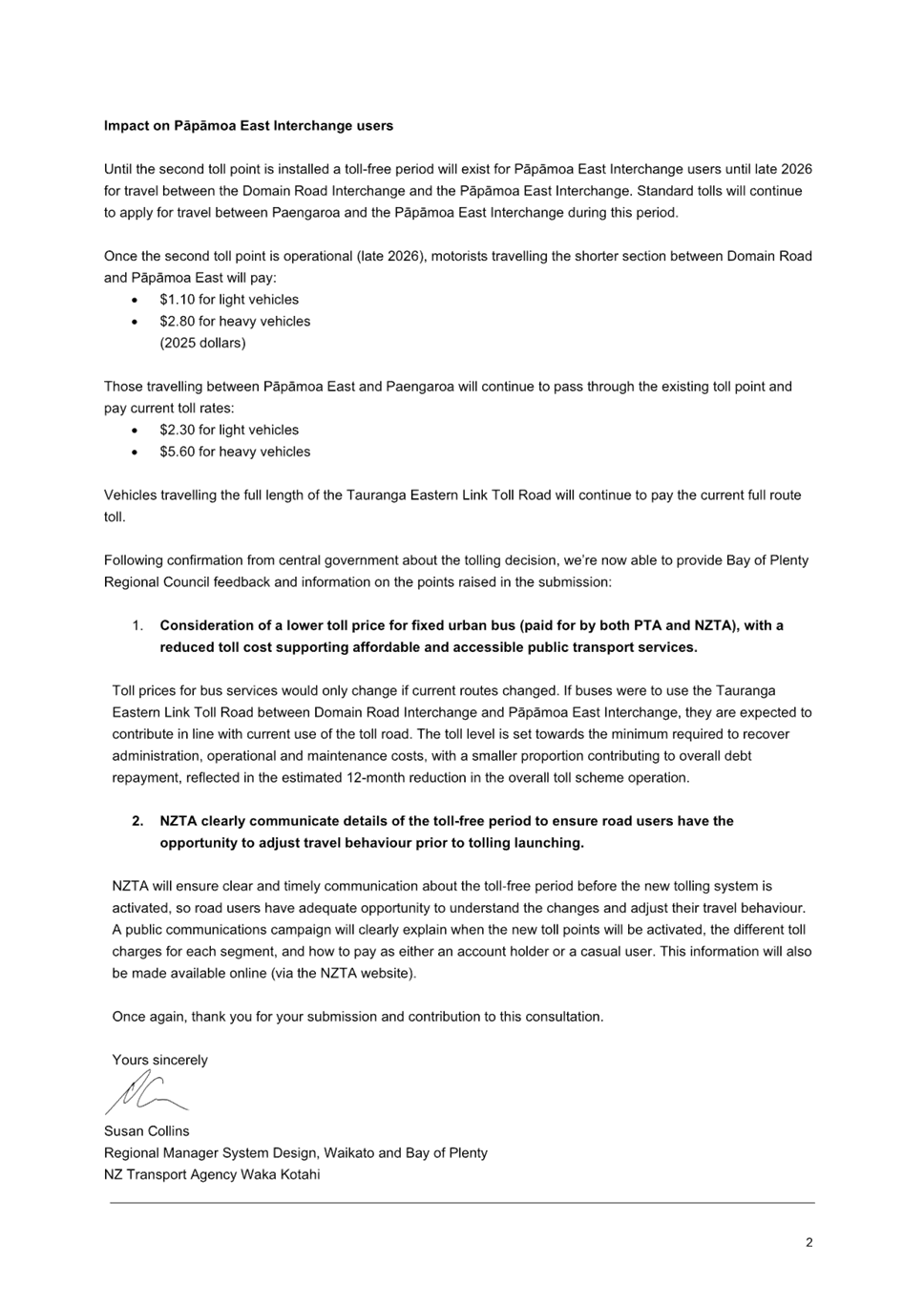
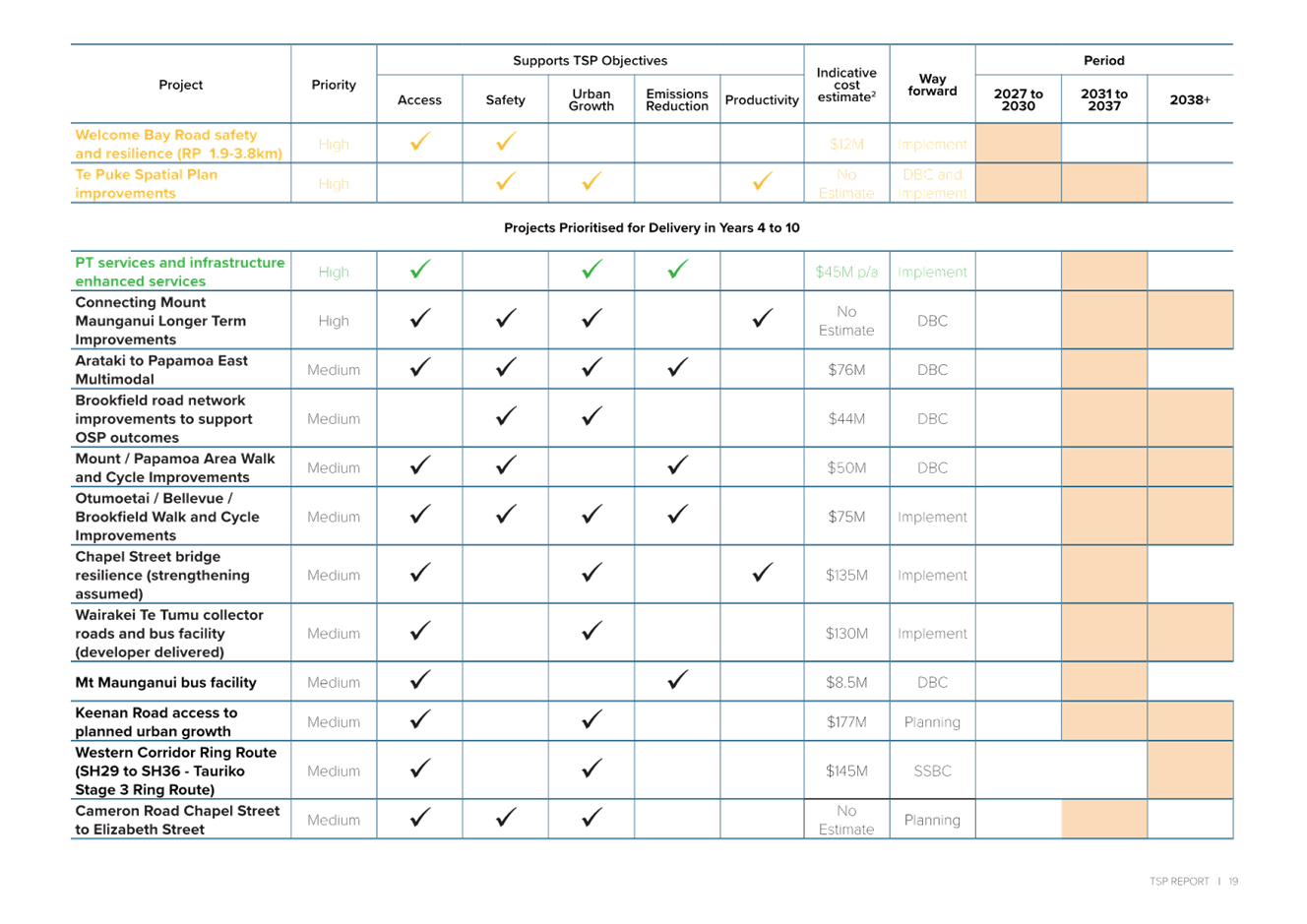
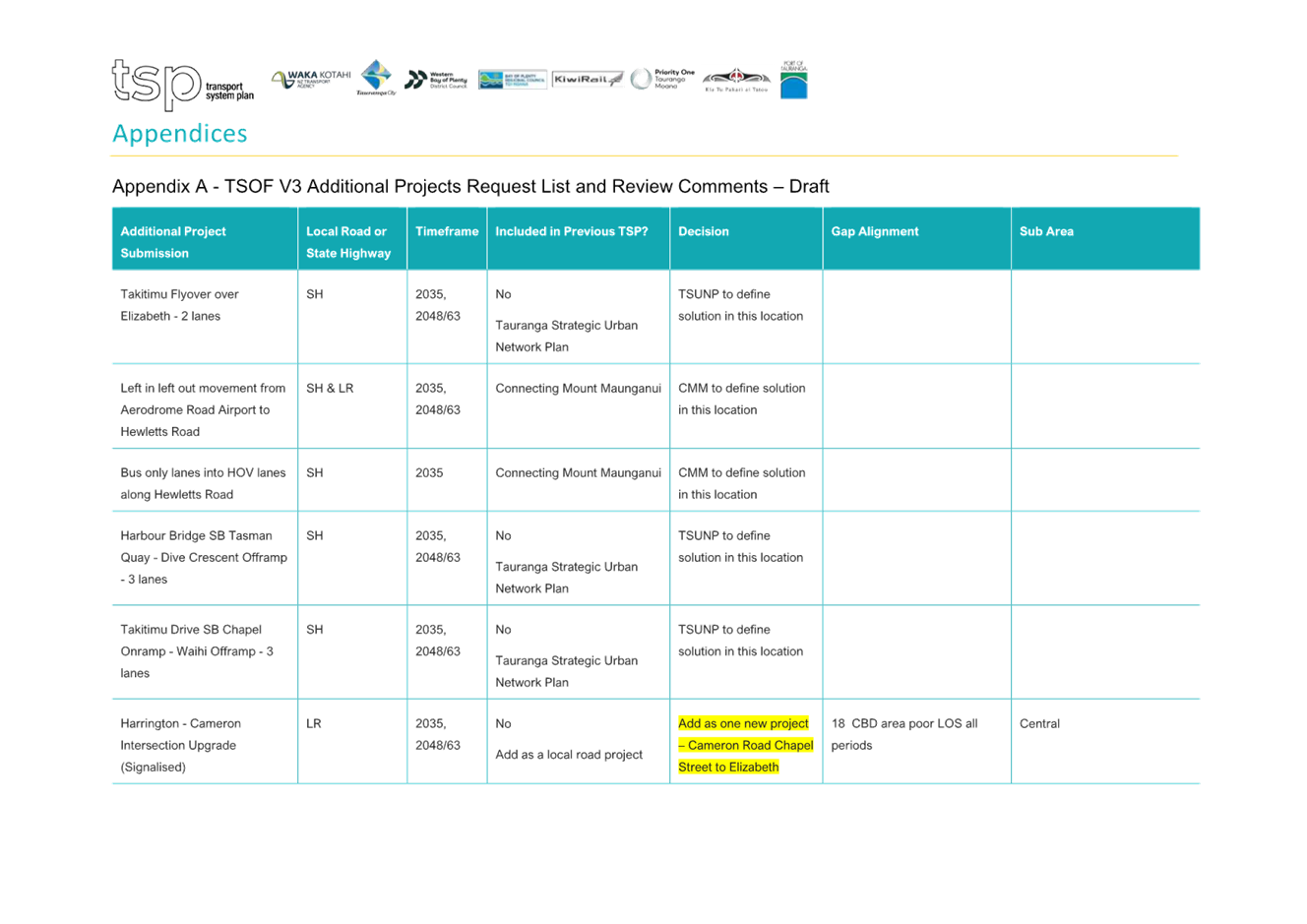
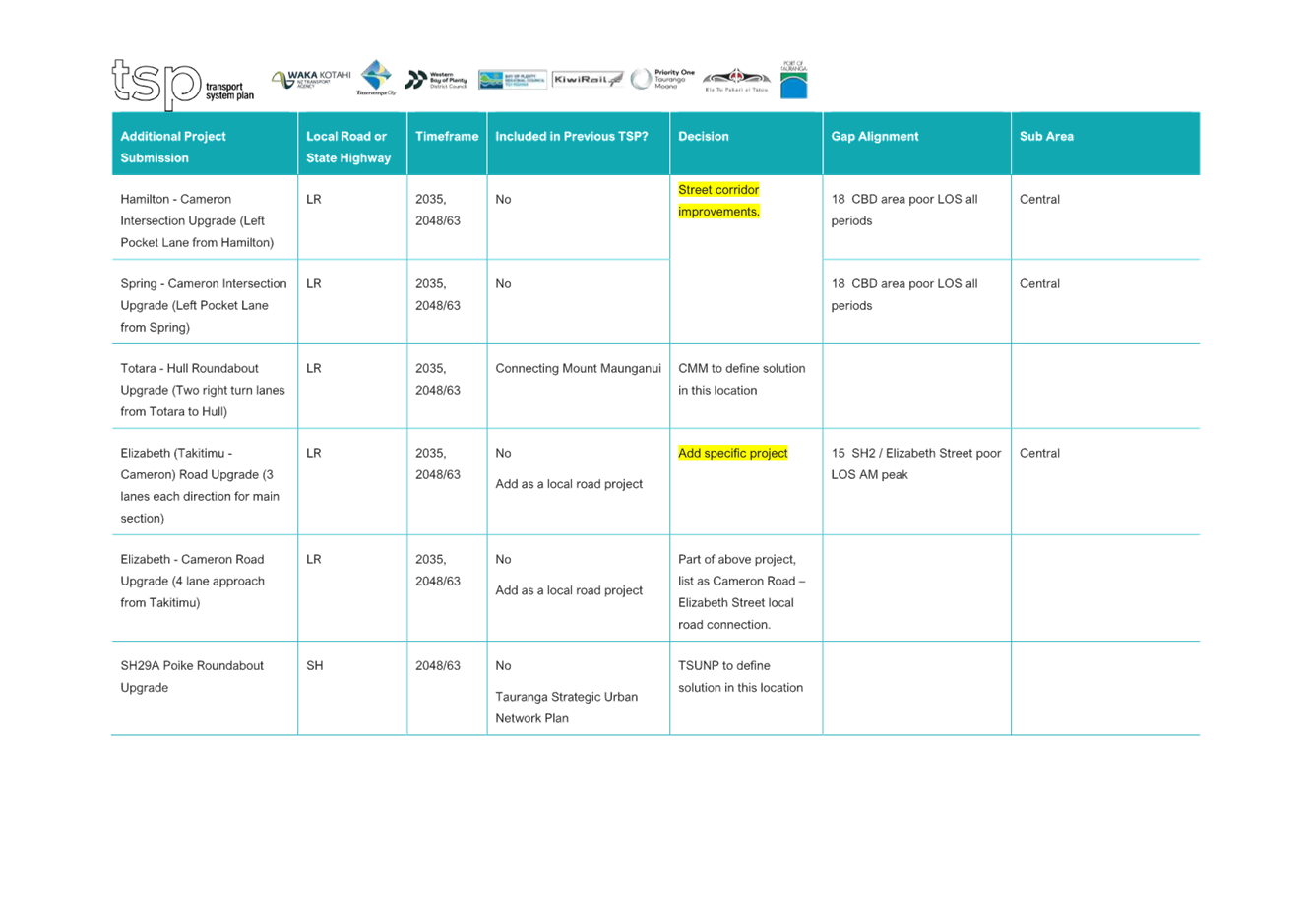
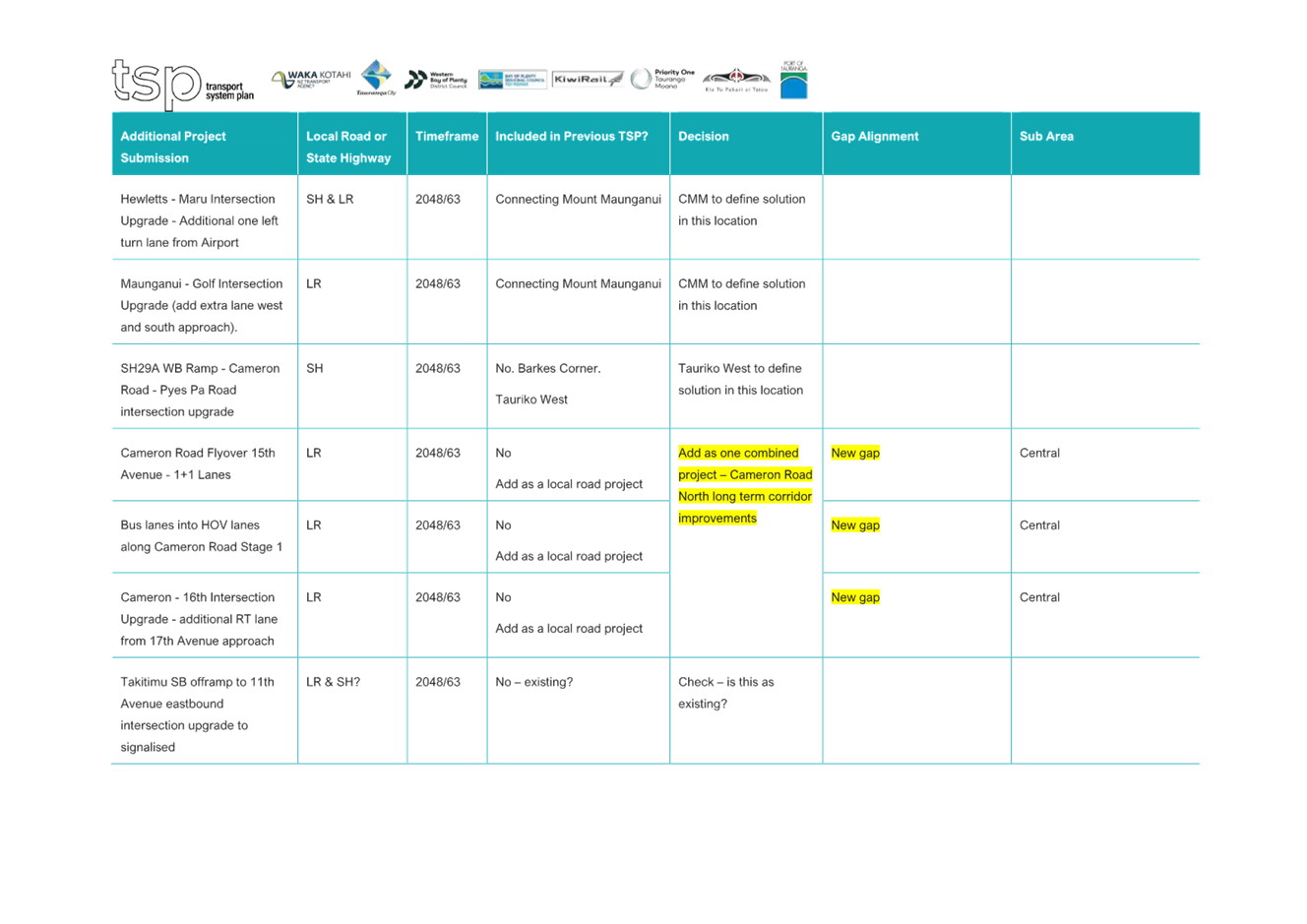
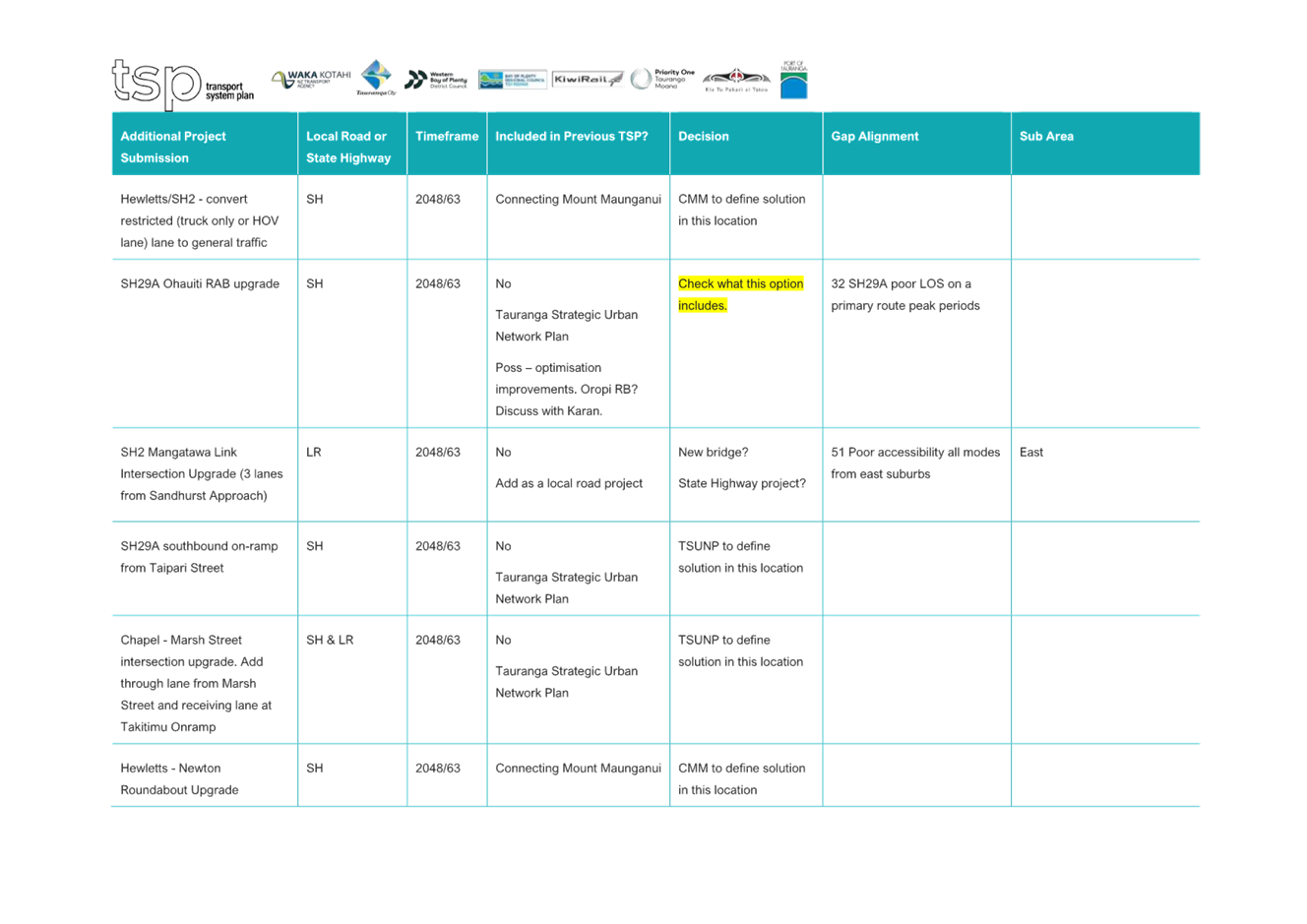
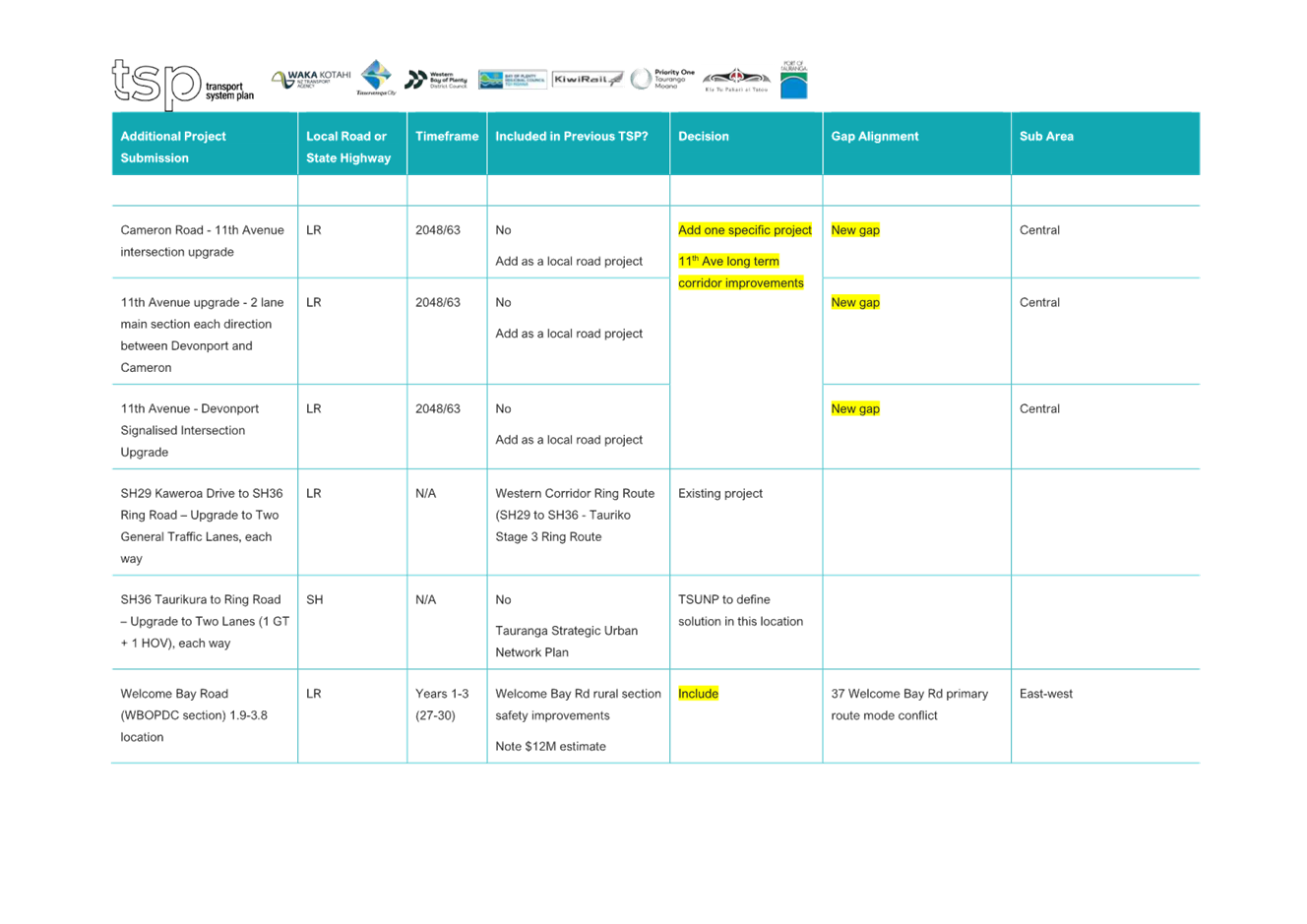
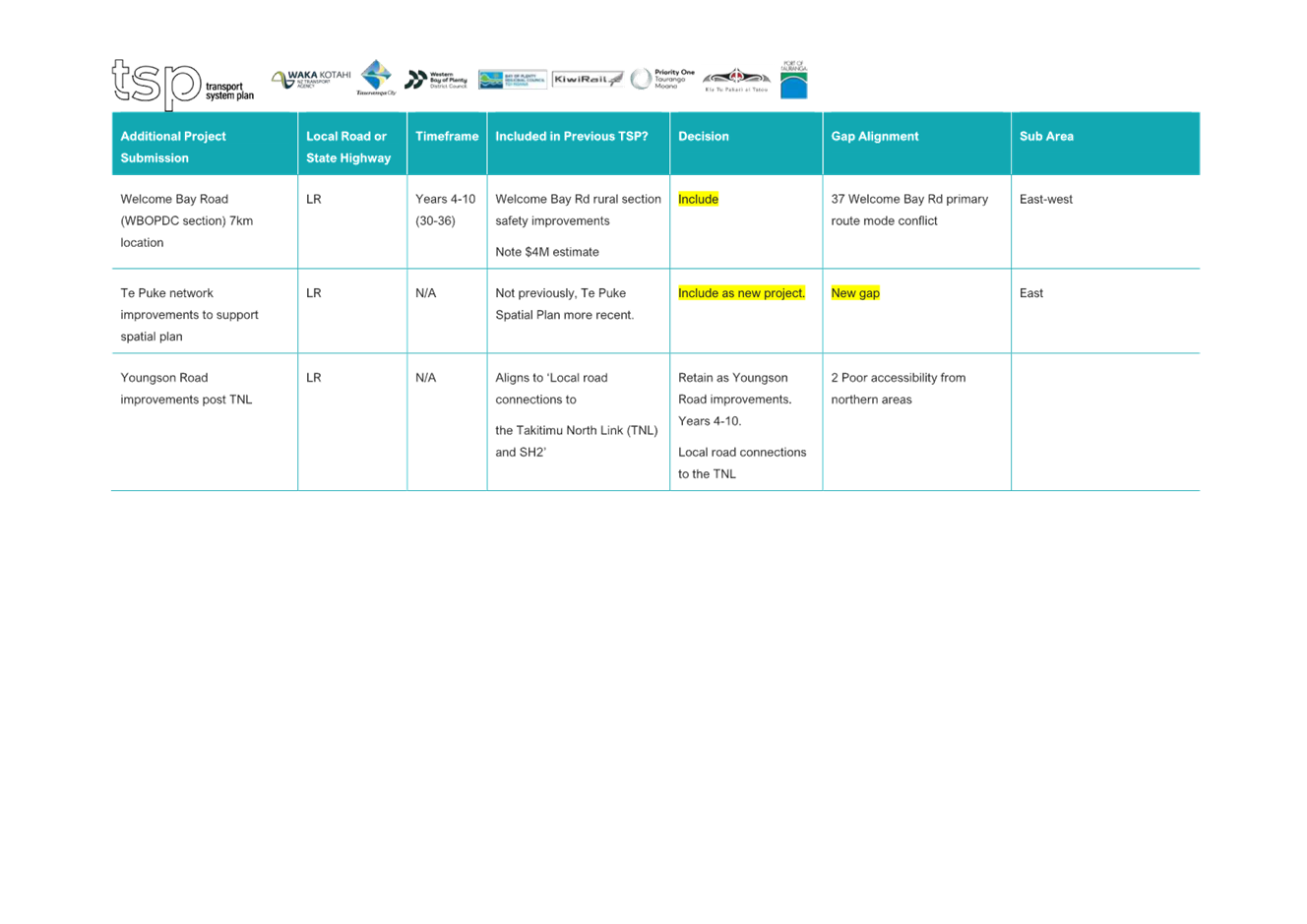
That the Tauranga Western Bay of Plenty Transport
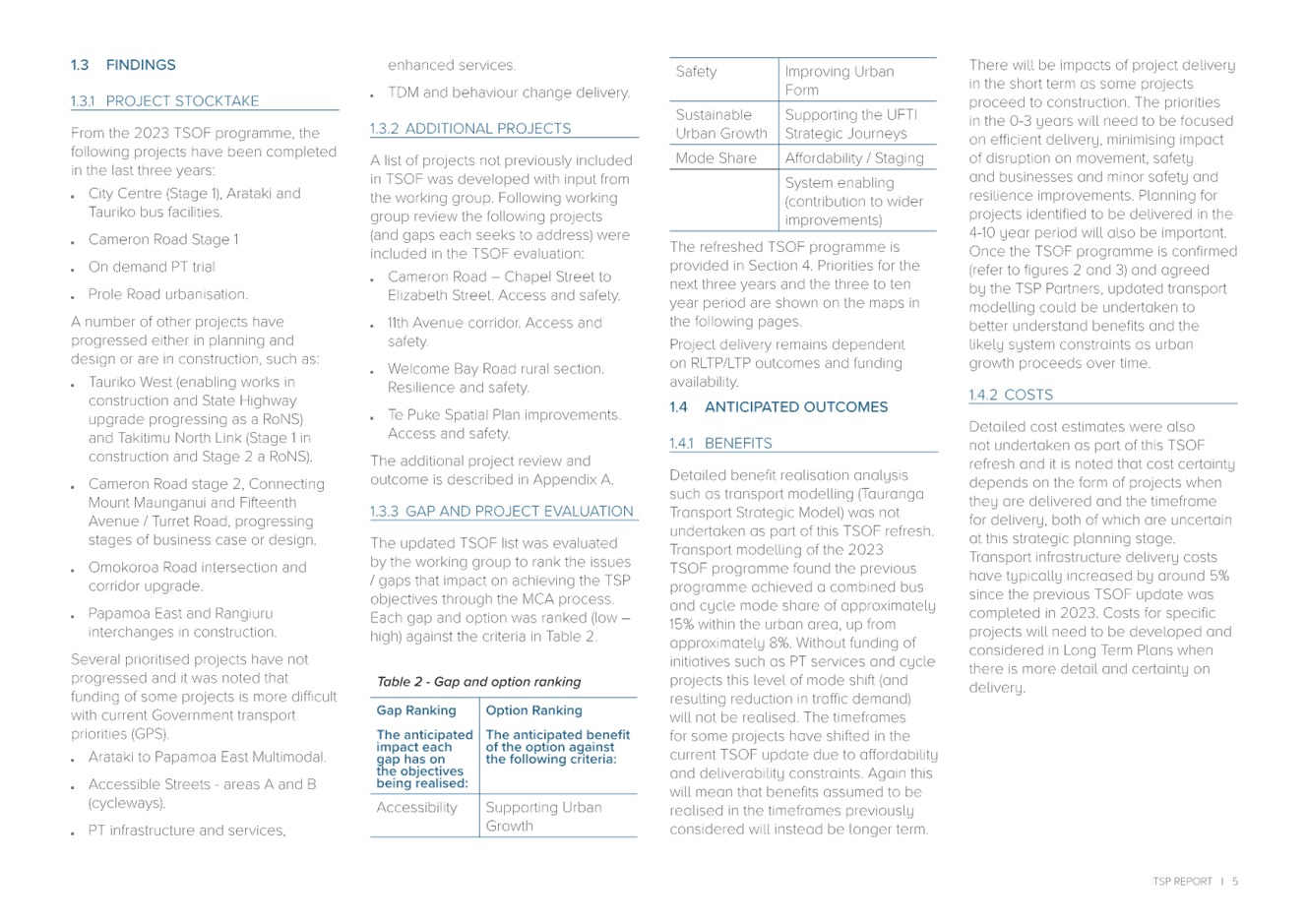
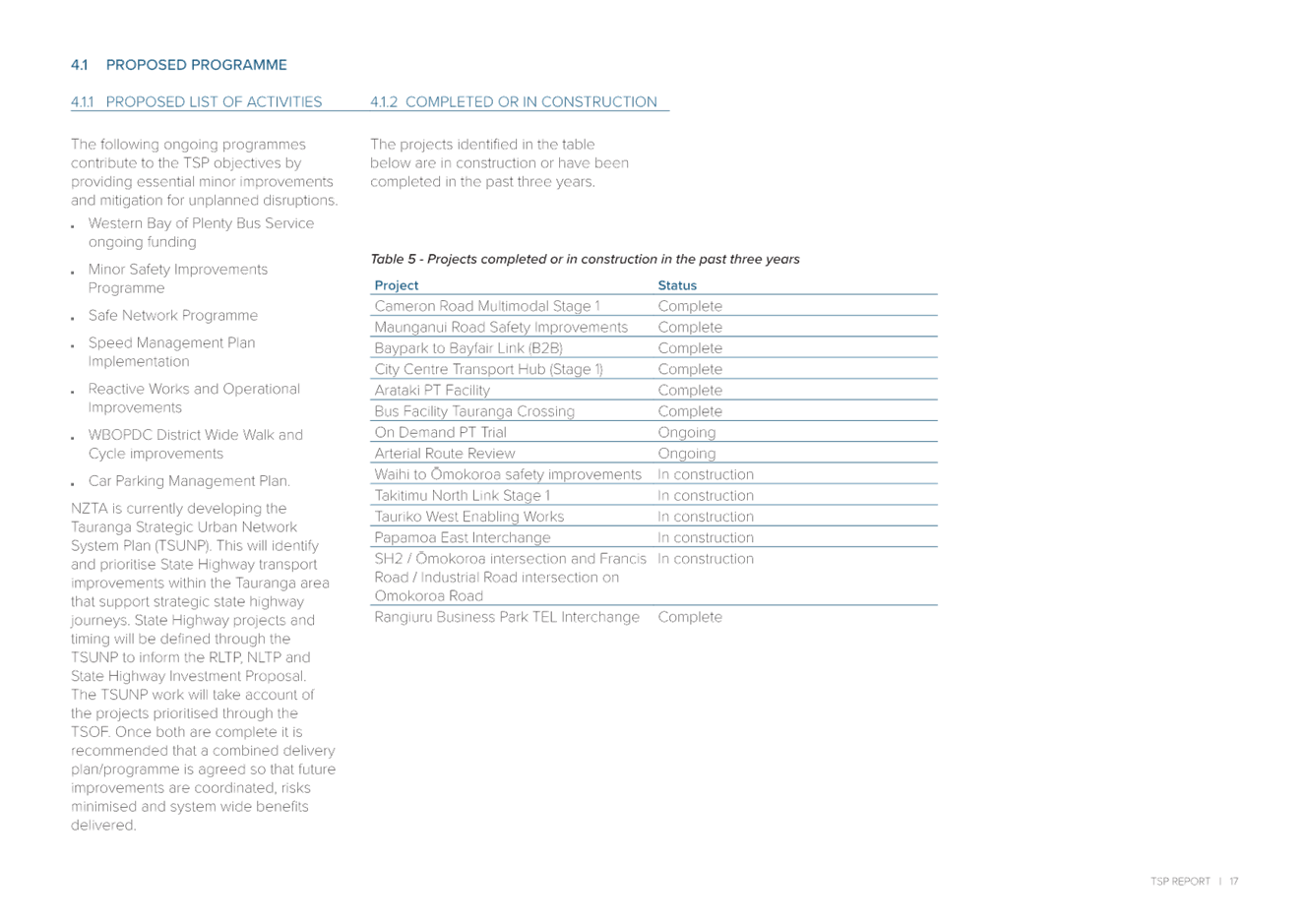
Committee:
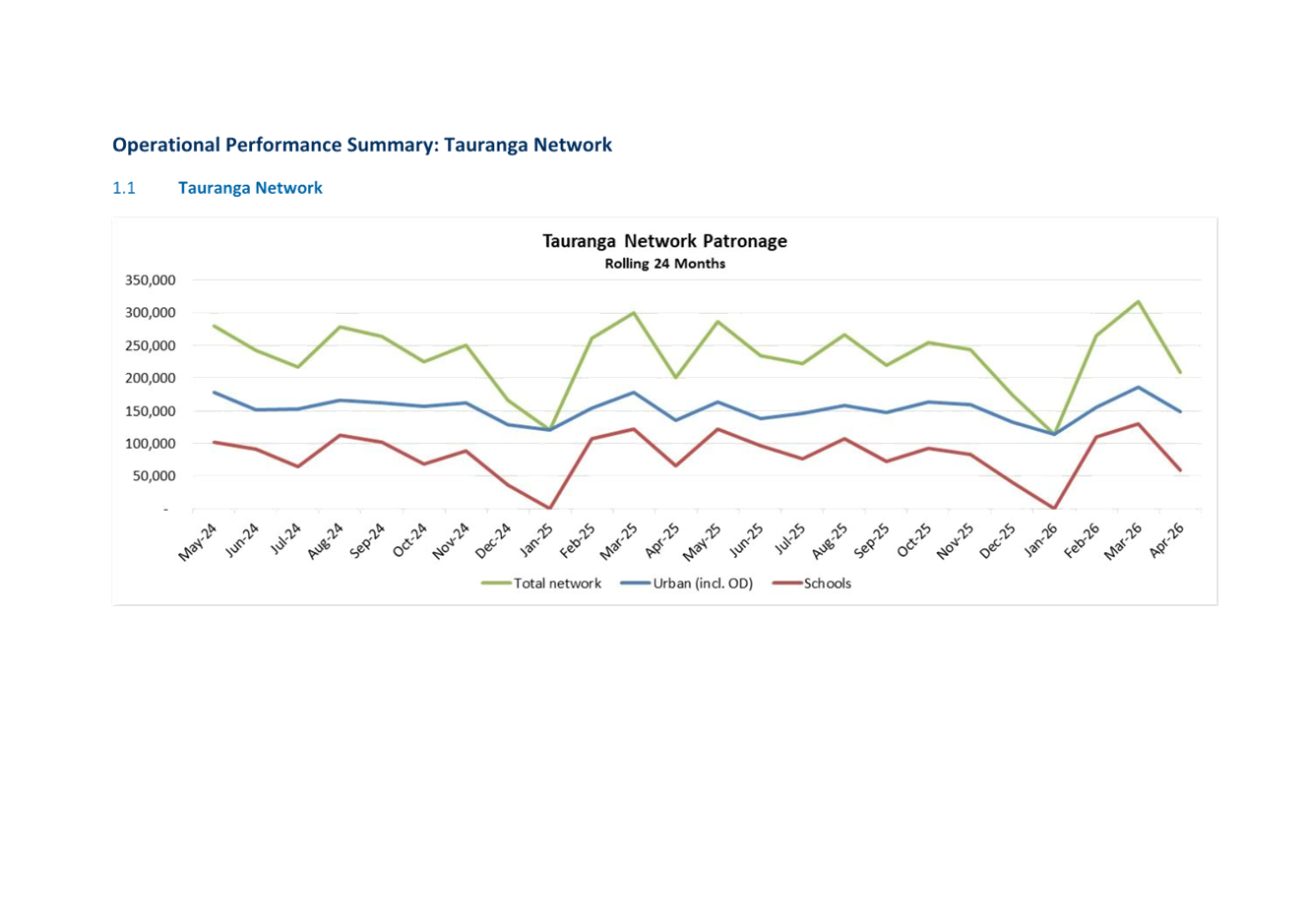
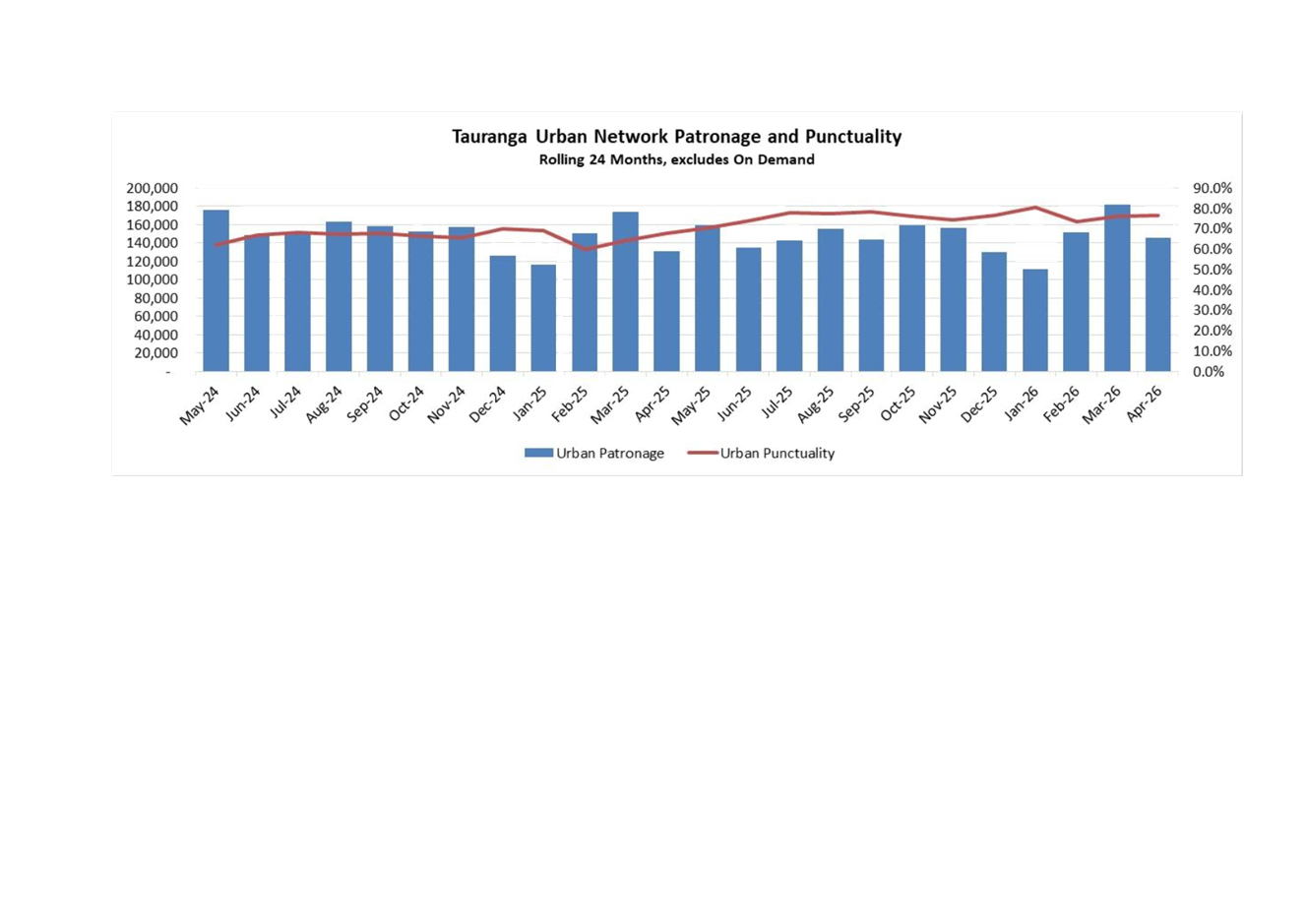
(a) Receives the report
"Chair's Report".
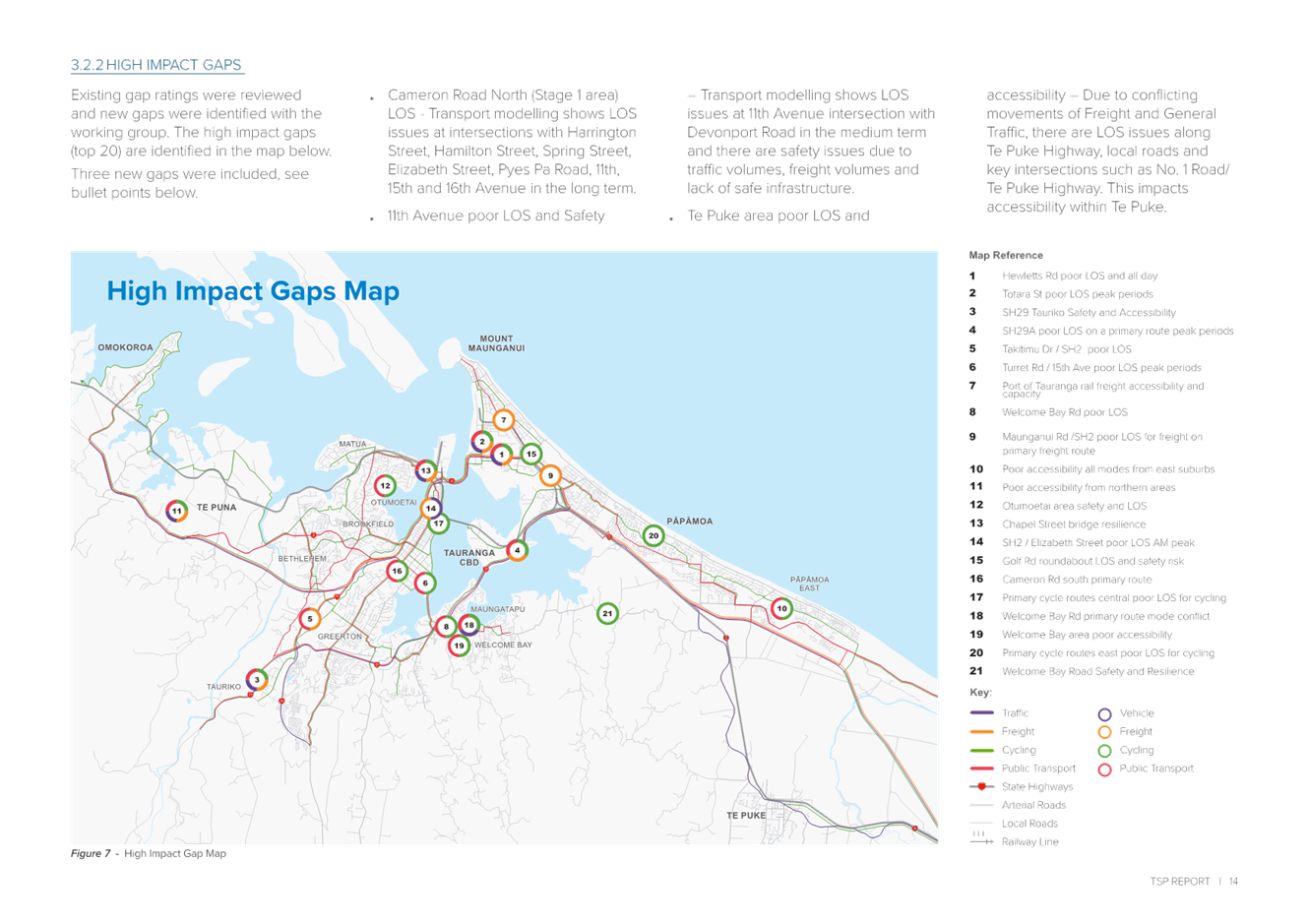
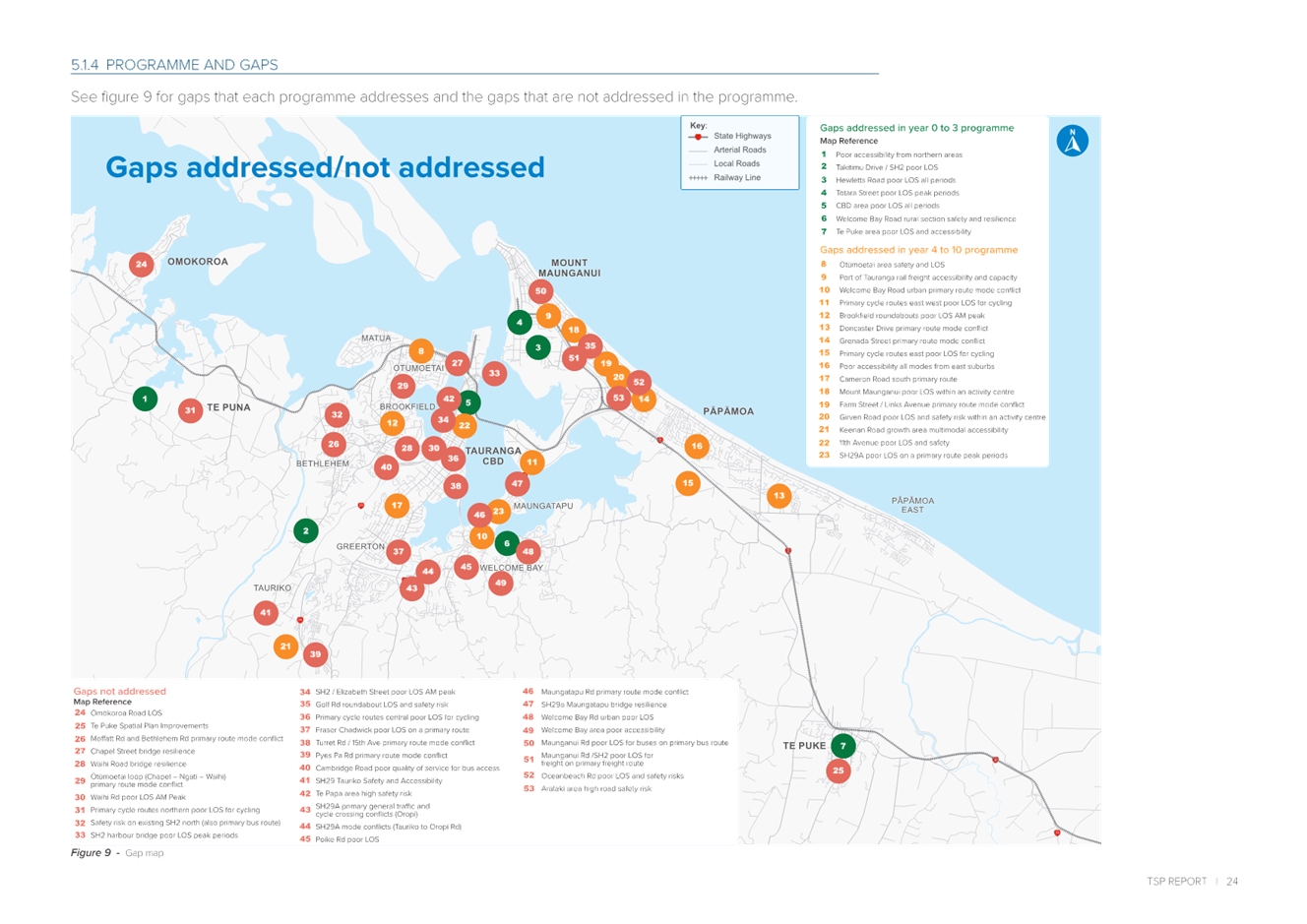
|
2.
Executive
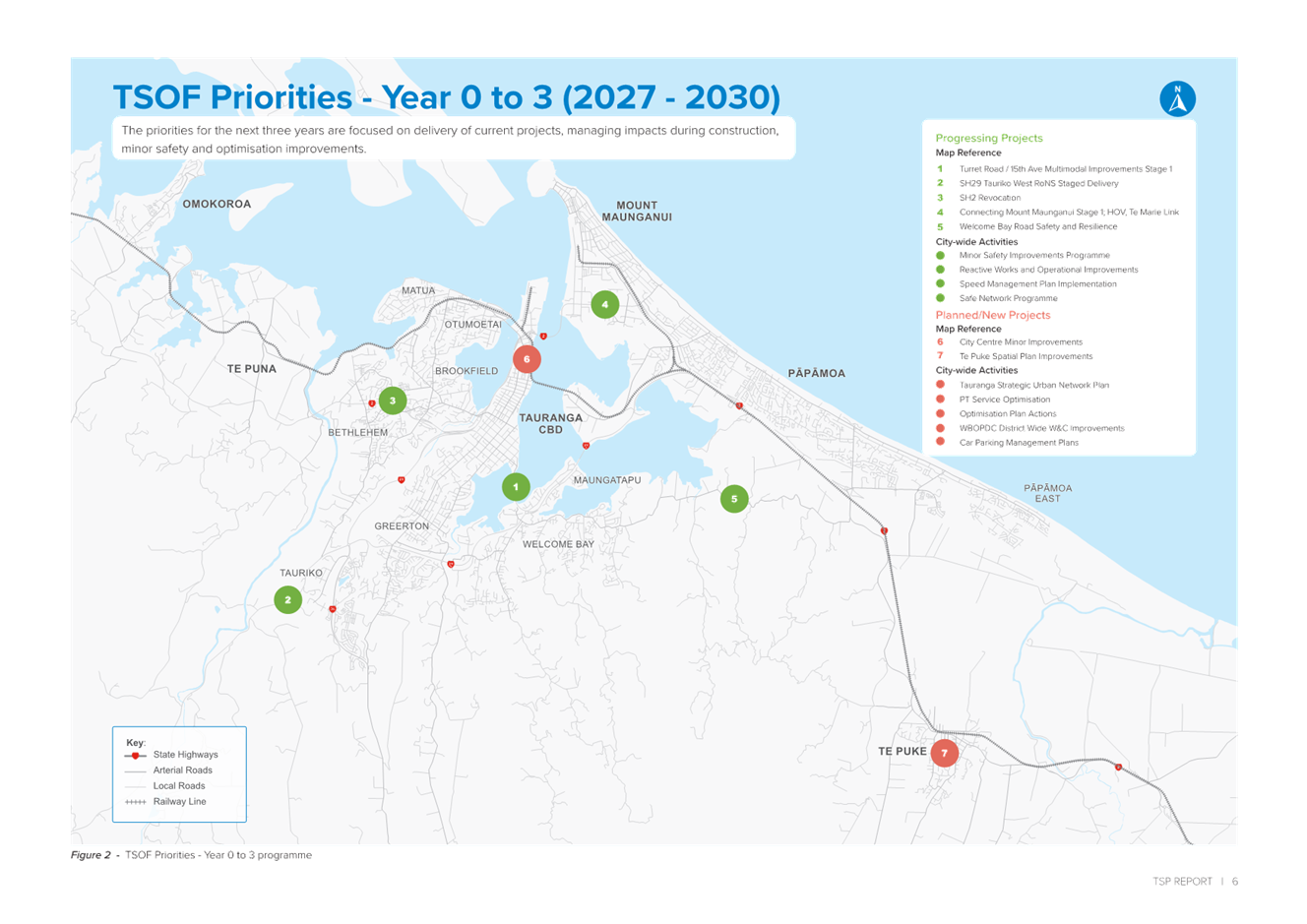
summary
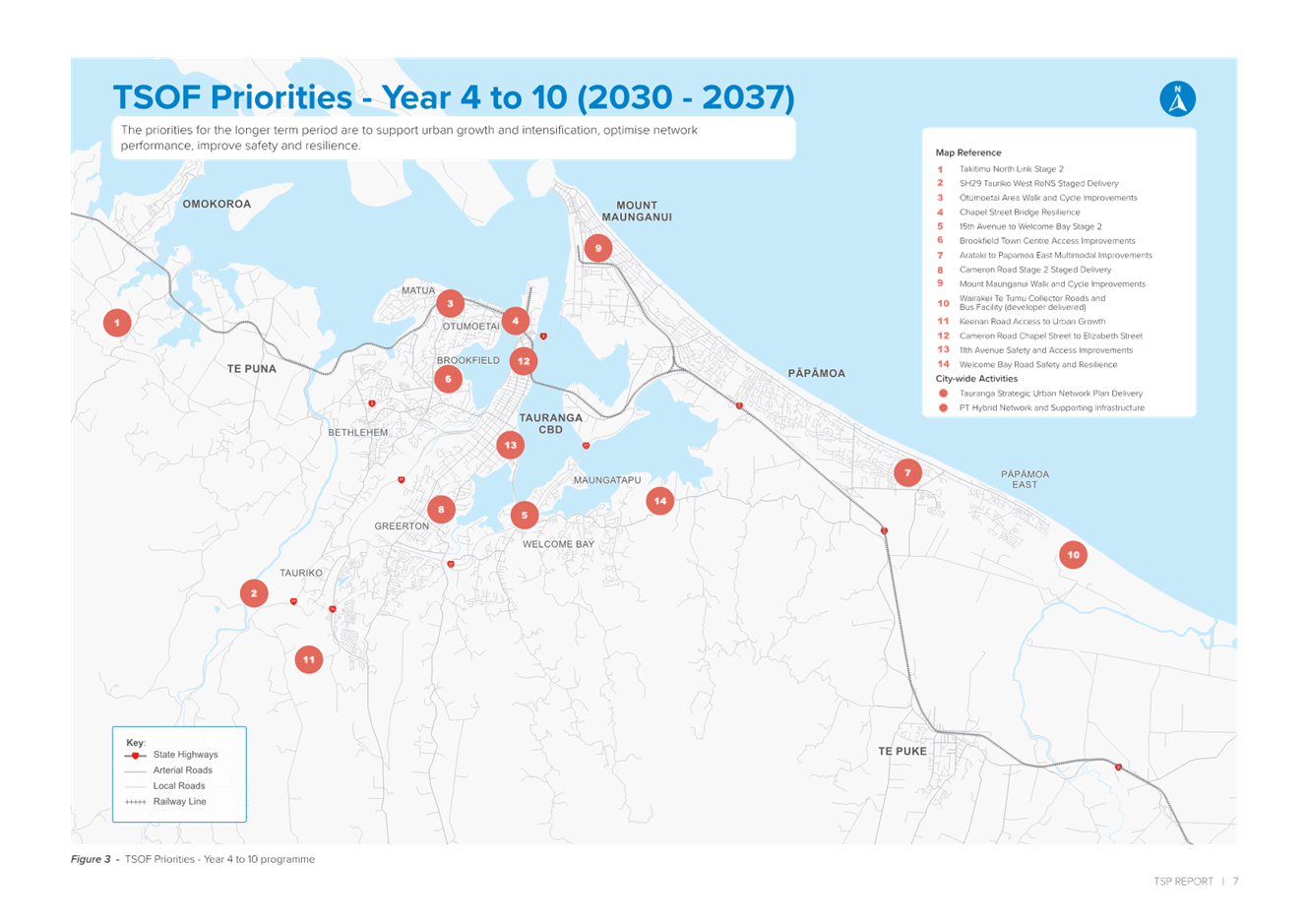
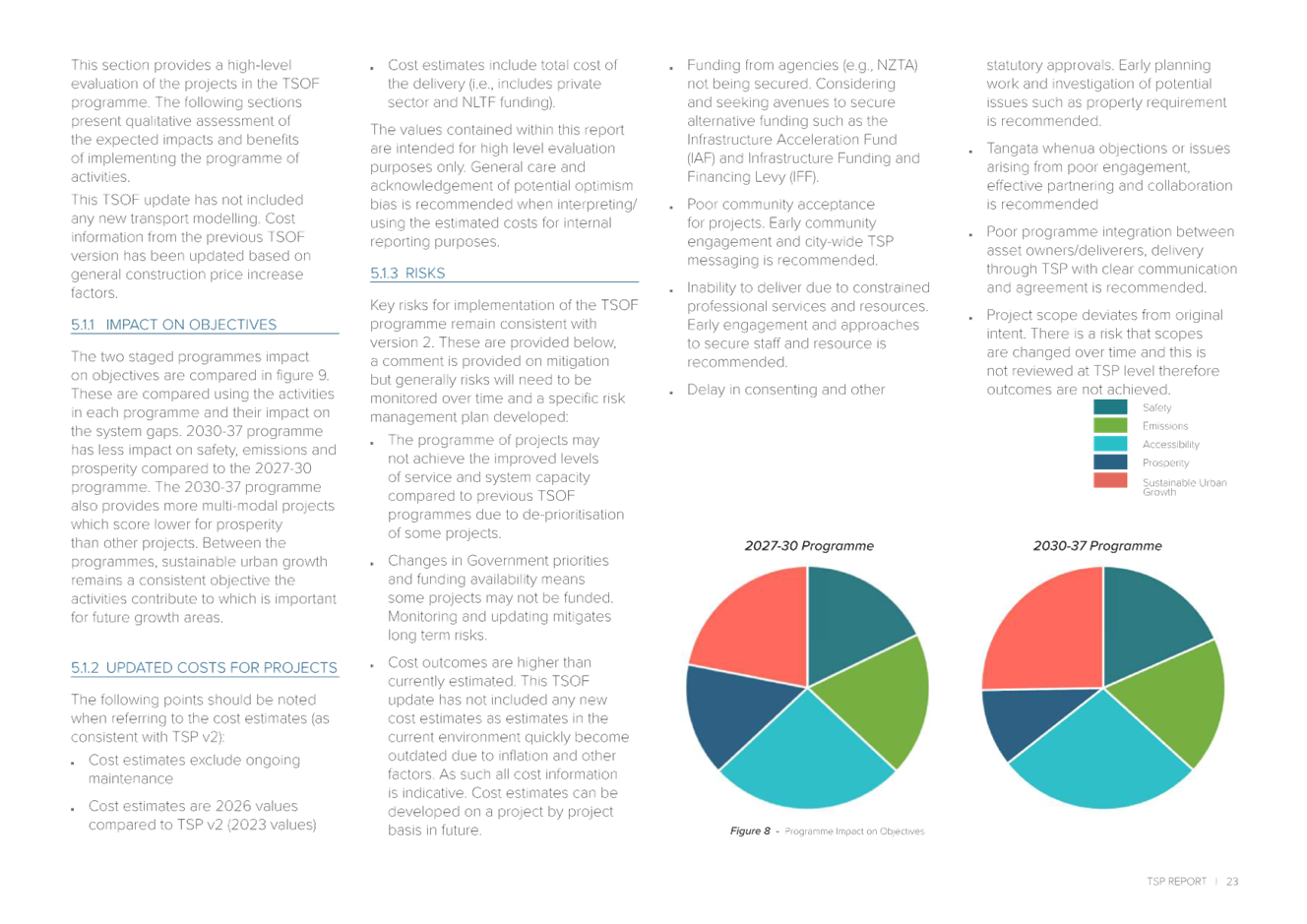
2. This report provides
updates on the following items:
(a) BOPRC Annual Plan transport
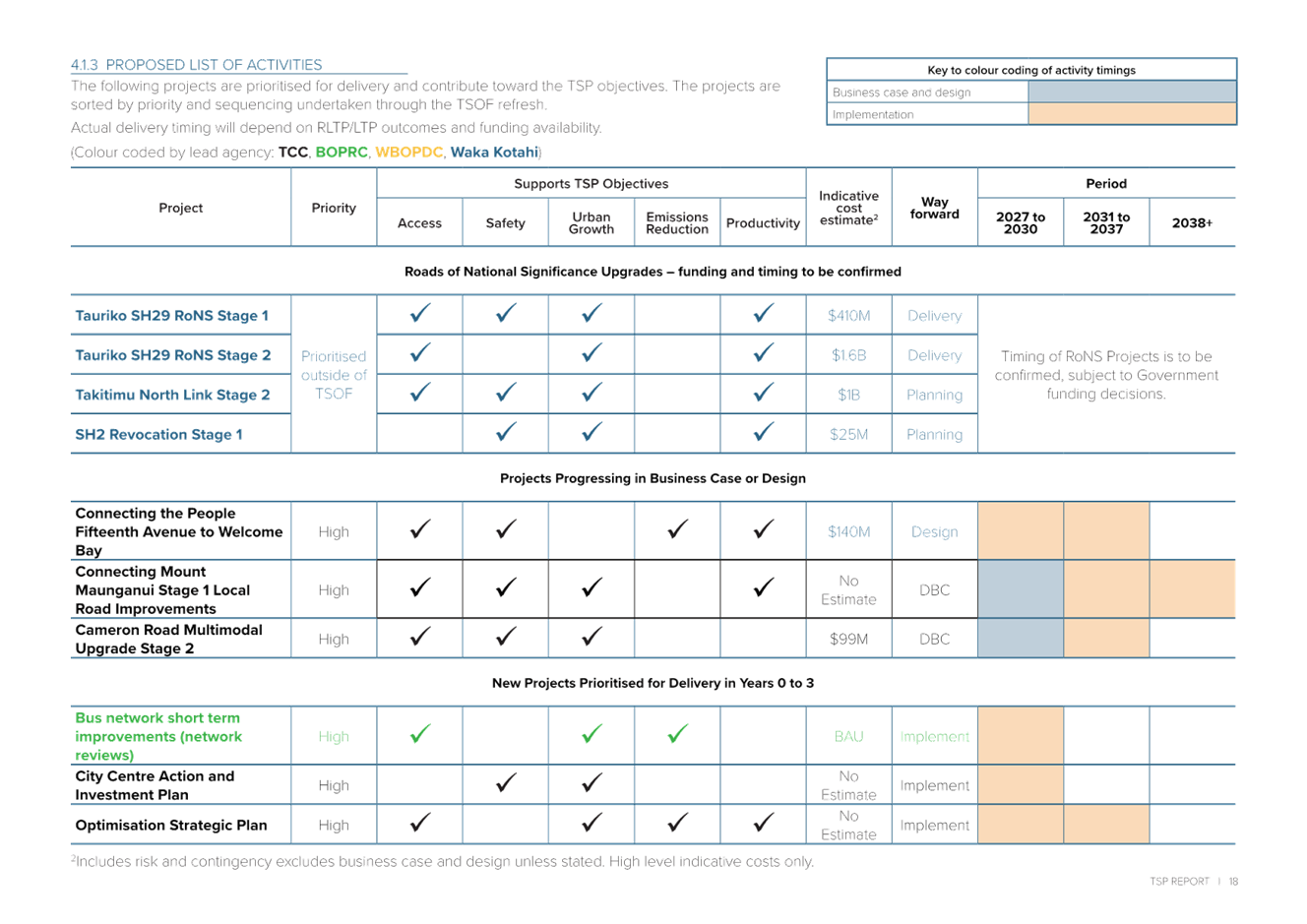
decisions
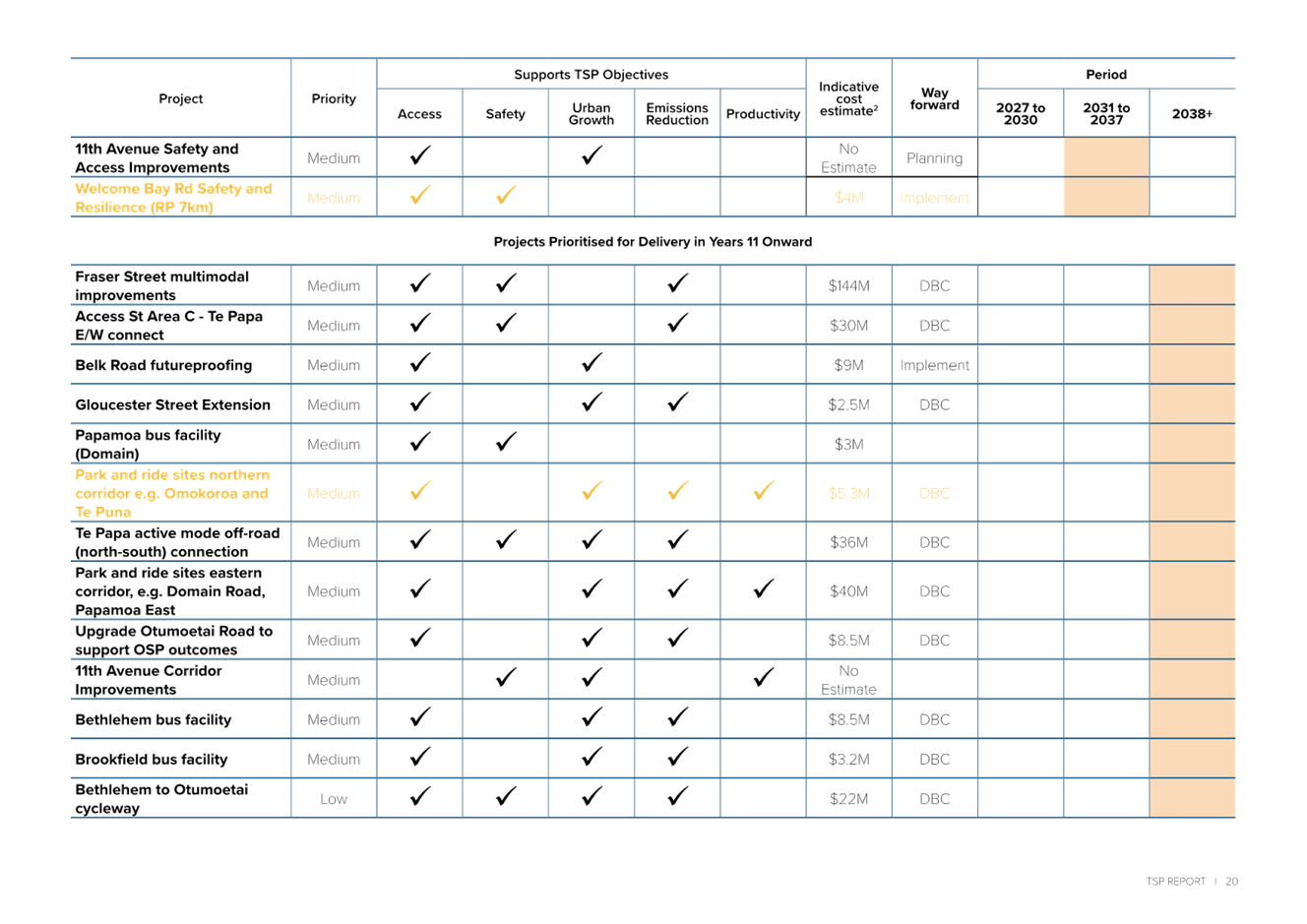
(b) Public transport security
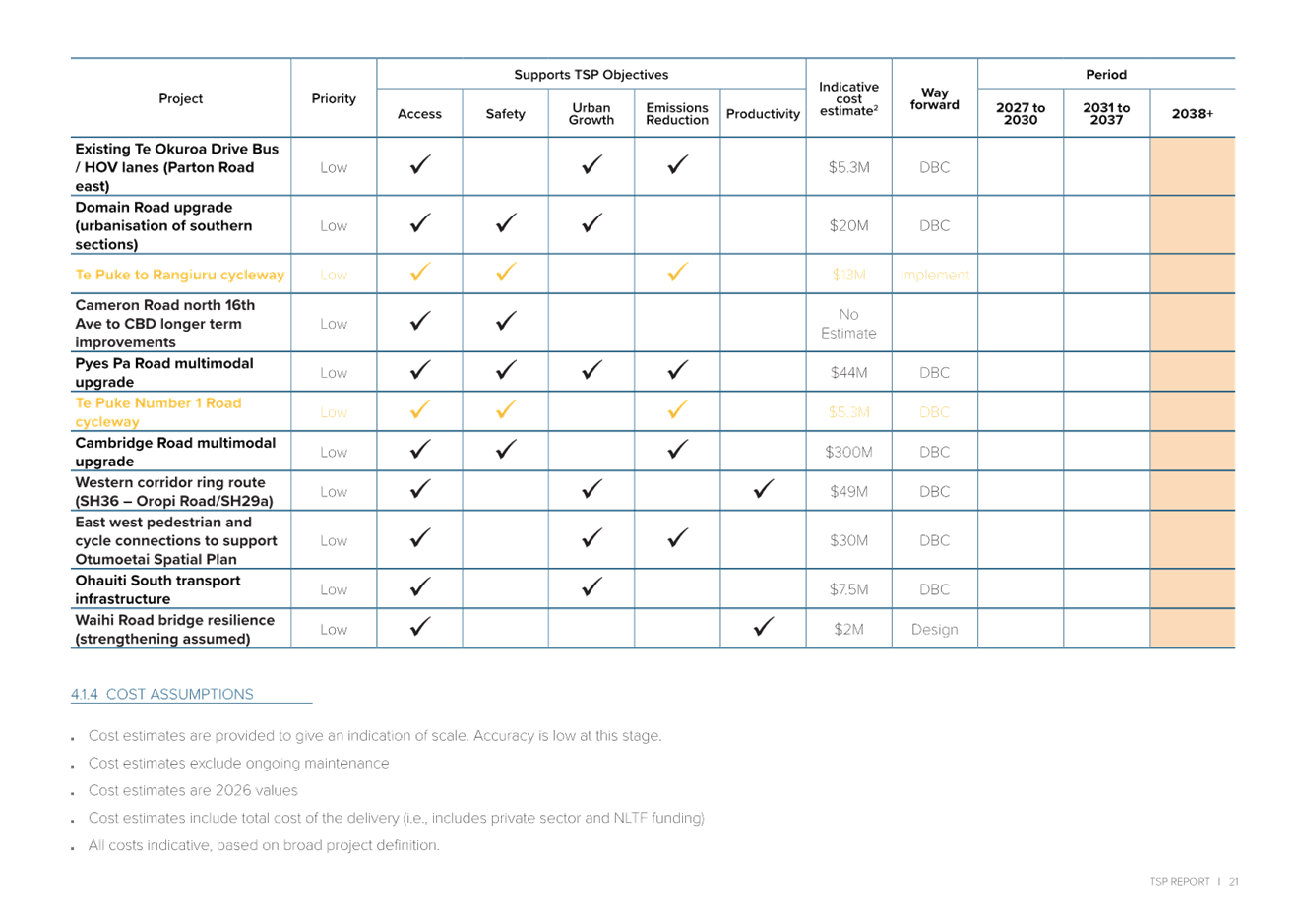
procurement
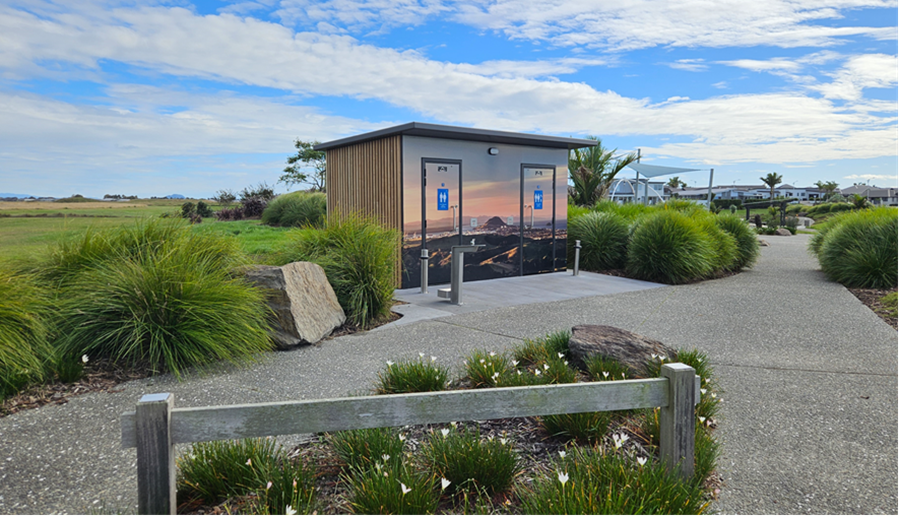
(c) Bus Driver Fund: Montiicola
toilets
(d) Tauranga Public Transport
Layover: Completion
(e) Eastern Link Toll Road: NZTA
Response (Attachment 1)
(f) Public Transport
Operational Performance Summary (Attachment 2)
BOPRC Annual Plan Transport
Decisions
Tauranga Timetable Improvements
3. New contracts for the
provision of bus services in Tauranga will be required at the end of the
current contract period (December 2028). Procuring new contracts brings the
opportunity to review networks to ensure that they are fit for purpose and are
providing value for money.
4. In the interim, provision
has been made in Regional Council’s draft Annual Plan for some targeted
network changes, primarily to support reliability and punctuality challenges.
It is proposed that these changes be implemented in December 2026.
Tauranga School Network Capacity
5. The continued popularity
of the dedicated school network has seen several services operating at or close
to capacity, which has constrained the ability for patronage growth. The
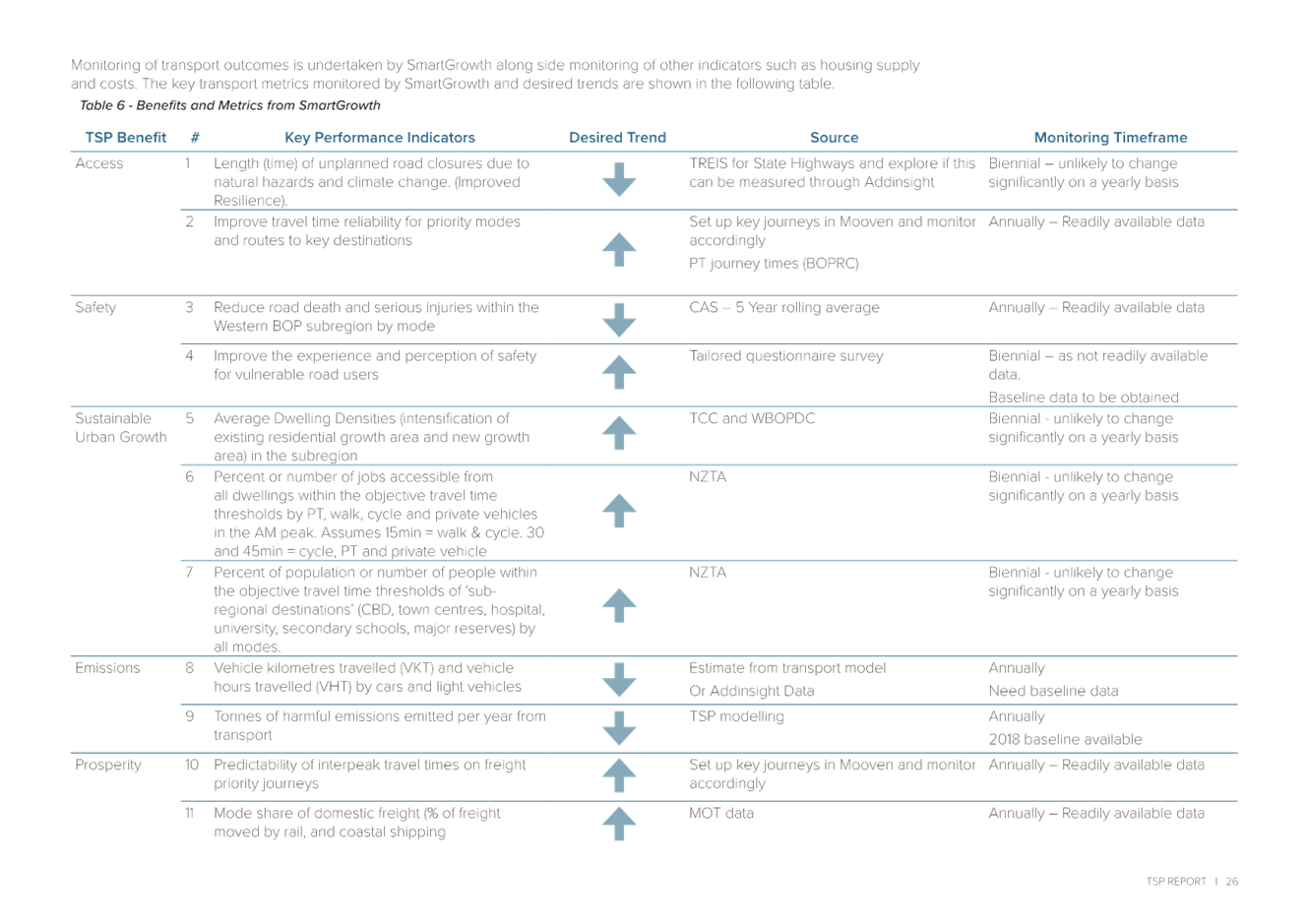
commencement of the 2026 academic year saw instances of children being left behind
due to buses being full; which required additional and higher capacity vehicles
to be added into the school fleet.
6. Provision has been made
in Regional Council’s draft Annual Plan for 8 additional vehicles to
enter the fleet in 2027.
Baybus OnDemand Trial Extension
7. The Baybus OnDemand trial
has been operating in Tauranga South for over two years, since March 2024. The
aim of the trial has been to better understand how an on-demand service can
complement and/or replace fixed-route public transport (in this case Route 51)
and increase patronage.
8. The trial has
demonstrated a clear improvement in service performance and user outcomes
relative to the fixed Route 51, while showing gradual, though still limited
progress toward financial sustainability.
9. Financial provision has
not been made in Regional Council’s draft Annual Plan for the trial to
continue beyond December 2026. When the trial ends, a fixed route service will
be reinstated to provide coverage.
Public Transport Fare Increases
10. Public Transport Authorities are
required by NZTA to conduct fare pricing reviews on an annual basis. Council
last reviewed fare pricing on 9 September 2025, where a blanket 10% increase
was endorsed. This was implemented in January 2026.
11. To simplify procedures, it was
proposed to incorporate fare pricing reviews into Council’s Annual
Planning process, with any direction to alter fares then implemented at the
commencement of the next financial year.
12. In 2024, Council undertook a
detailed review of fares and products, to inform the fares structure that will
be introduced when the National Ticketing Solution, “Motu Move” is
rolled out in the Bay of Plenty. This is currently programmed for 2027.
13. Regional Council’s draft
Annual Plan contains a fares increase of 3.1%, (the increase in CPI over the
past 12 months), rounded up to the nearest 10c. This increases the adult fare
in Tauranga and the Eastern Bay to $3.10, and $2.60 in Rotorua.
Public
Transport Security Procurement
14. Following direction from Regional
Council, work began in September 2025 on a comprehensive procurement process to
secure static security guarding services for a further two-year period,
effective from 1 July 2026. In May 2026, Armourguard was identified as the
successful tenderer and awarded the contract; mobilisation is now underway in
preparation for commencement.
15. The procurement process has
delivered several positive outcomes, including improved value for money,
strengthened service delivery standards, and a more robust performance and
reporting framework. The new contract also provides greater clarity around service
expectations, enhanced responsiveness to operational issues, and increased
alignment with Council’s safety and customer experience objectives.
Bus
Driver Fund: Montiicola Toilets
16. The NZTA-administered Bus Driver
Fund is a $15M fund for bus driver safety and wellbeing initiatives, primarily
one-off capital investments (e.g. toilets, break facilities, CCTV and driver
screens). In mid–2025, Regional Council was successful in obtaining
funding towards the construction of new toilet facilities in Montiicola
Reserve, Pāpāmoa East.
17. The new toilet location was
identified to support people using the park, those using bus services on Route
2 and importantly bus drivers. Access to toilets during scheduled breaks is a
standard workplace requirement for drivers, which had been challenging to
provide for Route 2 drivers working at the far extent of the network. Delivery
of the toilet block saw strong collaboration between TCC, BOPRC and NZTA.
18.
The toilets were completed in April 2026. Driver feedback has noted their
appreciation of the facility which was much-needed, also highlighting the
quality and usability of the amenity.
Tauranga
Public Transport Layover: Completion
19. The Tauranga Public Transport
Operations Facility (Bus Layover) was completed and became operational in
December 2025. The project was delivered on time, within budget and to scope.
20. The original cost was due to be
funded 100% by Regional Council, however, since delivery, NZTA have agreed to
pay 51% of the operating costs. Additionally, the capital cost allocation of
$1.8M saw an underspend of over $250K, much of which came from the efficient
delivery and a competitive procurement process.
21. The role of the layover in the
broader delivery model for Tauranga’s public transport network is being
considered as part of the Regional Public Transport Plan (RPTP) development and
associated Action Plan.
Eastern
Link Toll Road: NZTA Response
22. In August 2025, BOPRC submitted to
NZTA on the proposed amendment to the tolling scheme to allow for an additional
toll point to be installed on the Tauranga Eastern Link Toll Road. In the
main this letter supported the addition of a second toll point; a 12-month
toll-free period, clearly communicated by NZTA; and careful monitoring of the
toll price point to understand the impact on traffic, behaviour change and
network reliability. In addition, the submission requested consideration
of a lower toll price for fixed urban buses to use the road.
23. In its response on 1 May 2026
(Attachment 1), NZTA committed to clear and timely communication of the
toll-free period and the new system. However, they did not support a lower toll
price for fixed urban buses unless the current routes were to change.
Public
Transport Operational Performance Summary
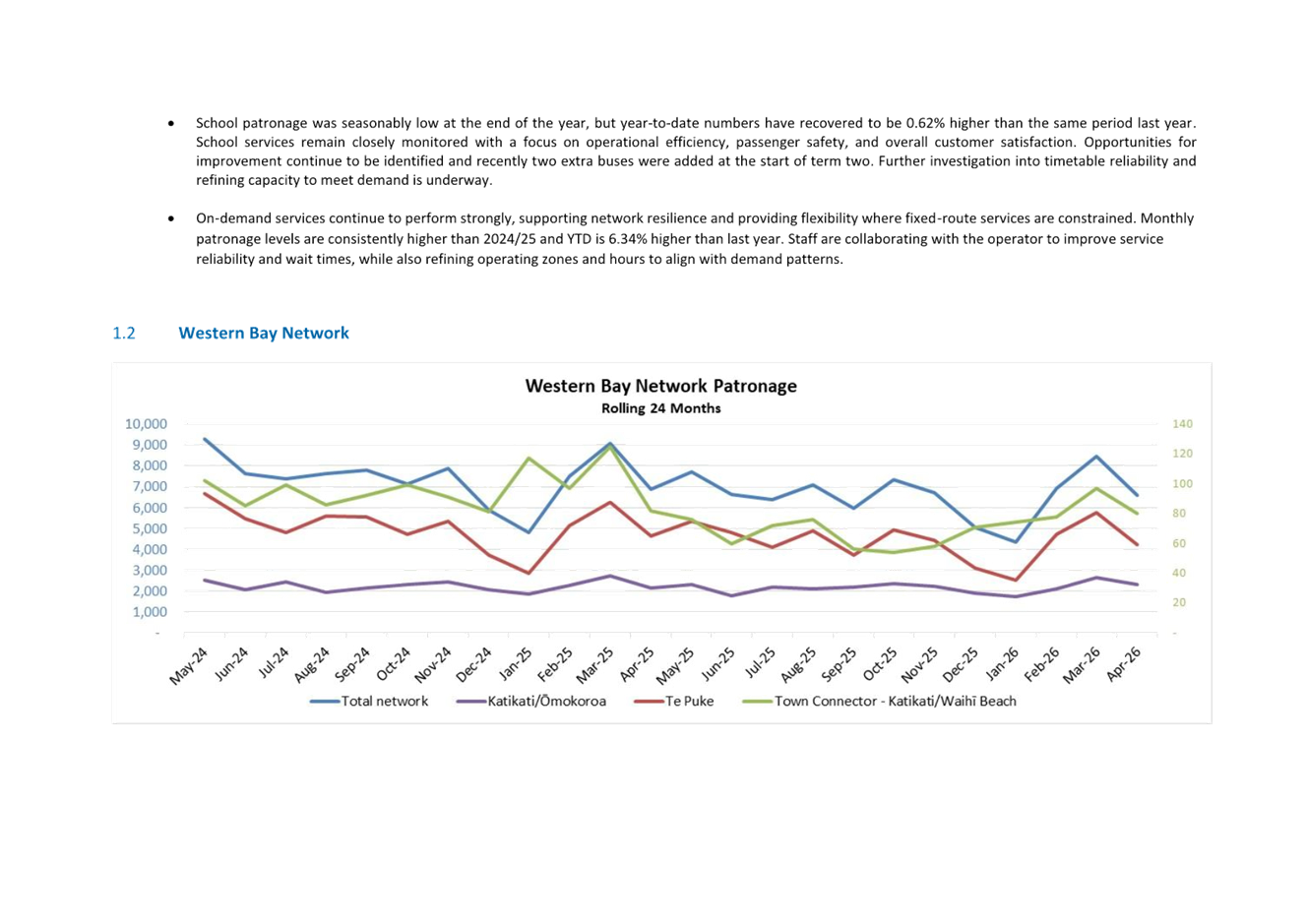
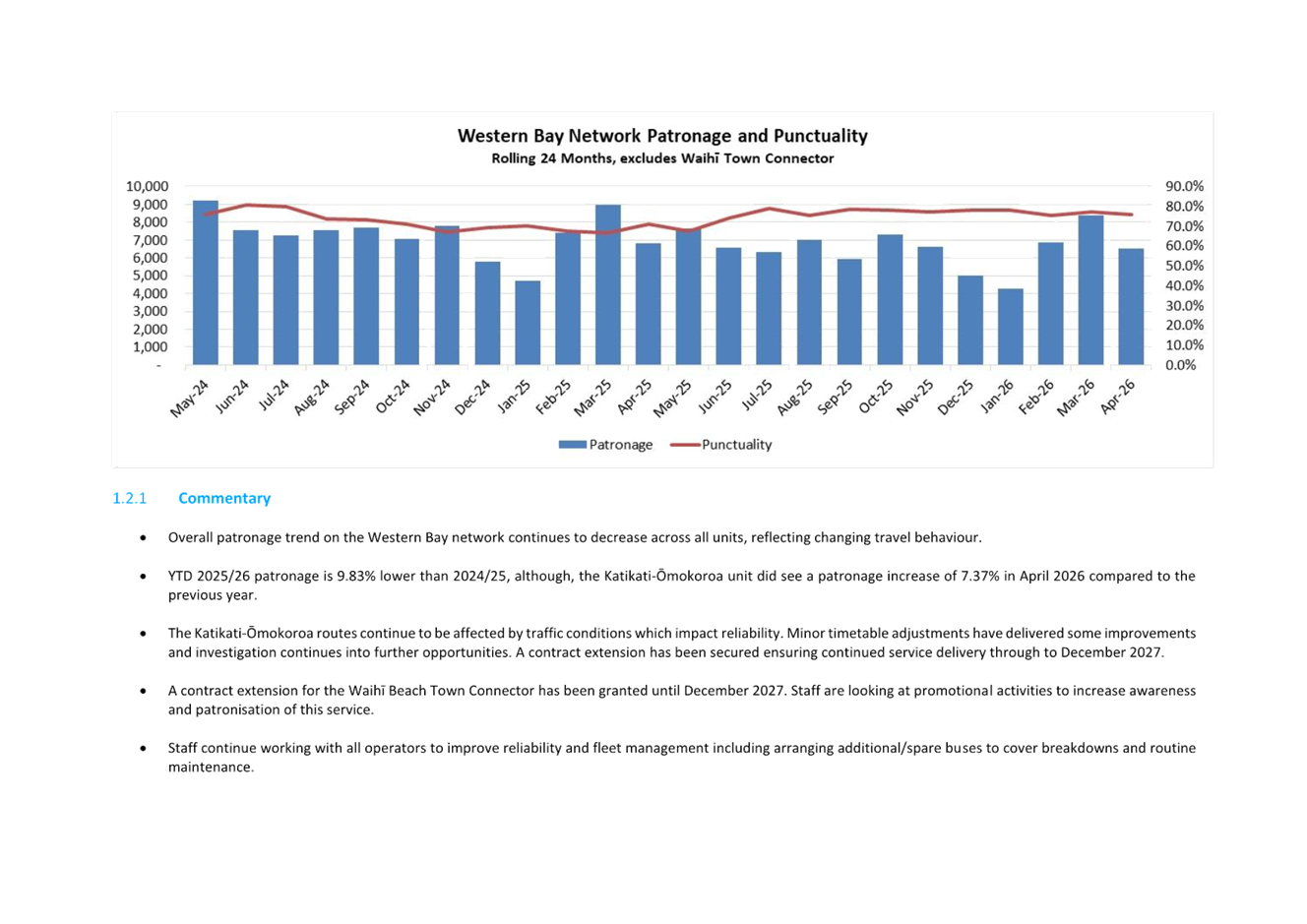
24. Attachment 2 provides rolling data
from May 2024 to April 2026 for public transport performance. In summary, it
notes:
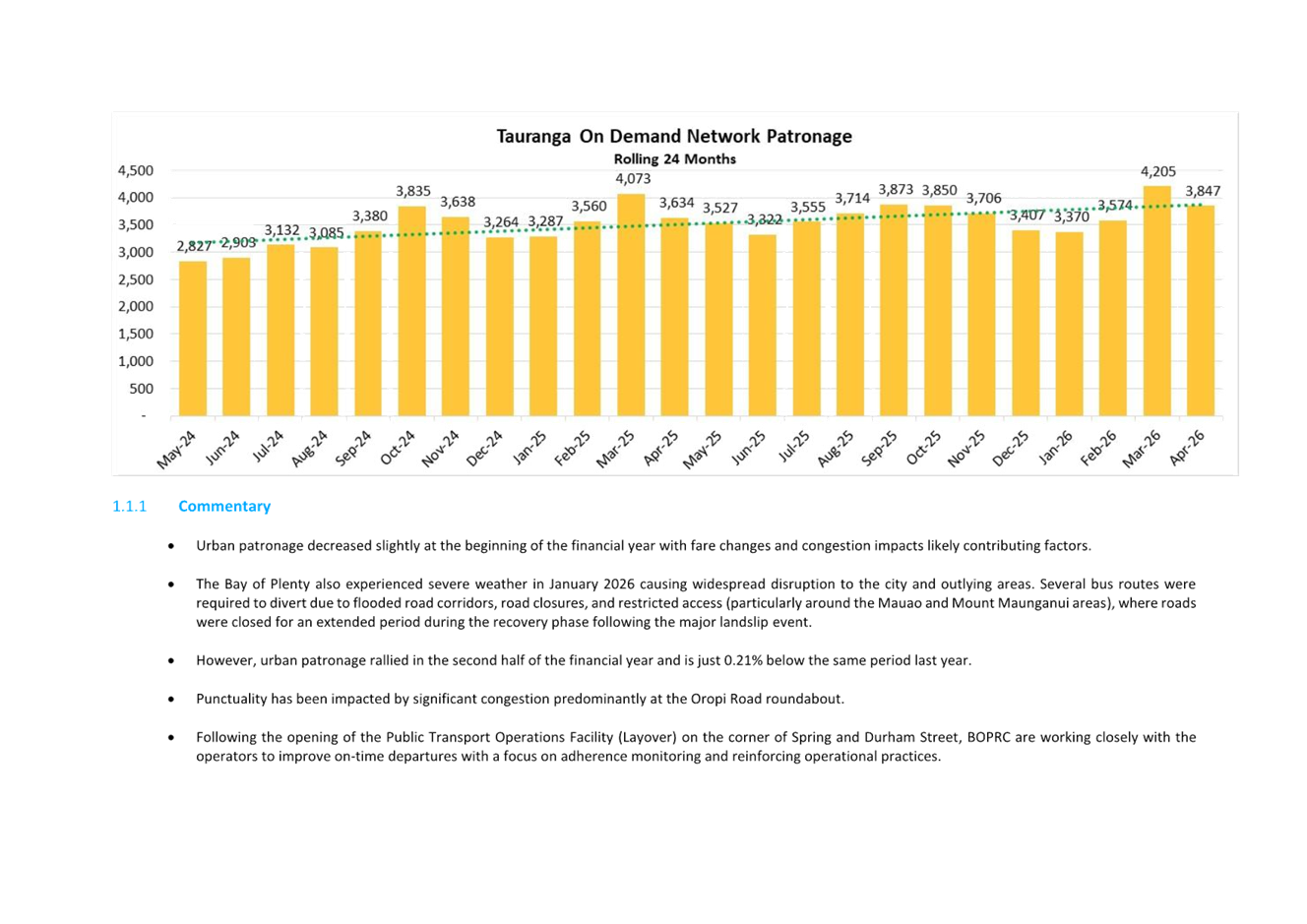
(a) Tauranga patronage remains
broadly stable.
(b) Recent patronage declines
following the January fare increase and ongoing cost‑of‑living
pressures, have stabilised following a nationwide increase in fuel costs.
(c) Punctuality continues to show
gradual improvement, reflecting sustained operational focus across the network.
25. Overall, performance remains
consistent with trends observed across comparable councils.
Attachments
1. BOPRC
- response to TEL PEI toll submission - A20349872 ⇩ 
2. Summary
Operational Performance Update - Tauranga and Western Bay (Arotake) - A20351614
⇩
|
Tauranga
and Western Bay of Plenty Transport Committee meeting Agenda
|
5
June 2026
|
9.3 Transport
System Operating Framework
File
Number: A20317214
Author: Parth
Sheshodia, Team Leader: Transport Planning
Authoriser: Reneke
van Soest, General Manager: Operations & Infrastructure
Mike Seabourne, Head
of Transport
Purpose of the Report
1. This report seeks
endorsement of the Western Bay of Plenty Transport System Operating Framework
(TSOF) 2026, noting that final timing of investment and consultation will be
undertaken by respective Councils.
|
Recommendations
That the Tauranga Western Bay of Plenty Transport
Committee:
(a)
Receives the report "Transport System Operating Framework".
(b)
Endorses the Western Bay of Plenty Transport System Operating
Framework (TSOF) 2026 Update as the agreed sub-regional framework for
transport system prioritisation.
(c)
Notes that the Transport System Operating Framework 2026 Update has
been developed collaboratively through the Transport System Plan Partnership,
comprising Tauranga City Council, Western Bay of Plenty District Council, Bay
of Plenty Regional Council, NZ Transport Agency Waka Kotahi, and iwi
partners.
(d)
Agrees that the Transport System Operating Framework 2026 Update will
inform the Regional Land Transport Plan (RLTP) and Long-Term Plan (LTP)
processes and provide the basis for funding prioritisation through the
National Land Transport Fund (NLTF).
(e)
Notes that the indicative cost estimates within the Transport System
Operating Framework are high-level and will be refined through future
project-specific business case processes.
|
Executive Summary
2. The SmartGrowth
partnership brings together Western Bay of Plenty District Council, Tauranga
City Council, Bay of Plenty Regional Council, iwi partners, and central
government. Together, these organisations align planning, funding, and delivery
to support coordinated regional growth.
3. Through this
partnership, The Urban Form and Transport Initiative (UFTI) was agreed as the
long-term spatial and transport strategy for the Western Bay of Plenty. It
integrates housing, land use, and transport to support planned growth.
4. From a Transport
perspective, UFTI focuses on connected centres and a multi modal transport
system, enabling most daily transport needs to be met within 15 minutes, and
regional travel within 30–45 minutes. This approach supports more compact
growth, better access to jobs and services, and a shift to multi-modal
transport.
5. Underpinning UFTI,
the Transport System Plan (TSP) was developed and sets how people will travel
across the Western Bay. It defines key corridors and identifies its key use,
considers network-wide impacts, and applies a clear, consistent approach
aligned with national policy.
6. The Western Bay of
Plenty Transport System Operating Framework (TSOF) is a technically focussed
document that supports delivery by providing an evidence-based approach to
prioritising transport investment.
7. The draft 2026 TSOF
updates earlier versions to reflect current conditions, project progress, and
the 2024 Government Policy Statement on Land Transport. (Attachment 1 –
Draft Transport System Operating Framework).
8. The TSOF was
developed through three stages: project stocktake and setting objectives,
evaluation using multi-criteria analysis, and programme refinement.
9. It is guided by five
investment objectives: Access, Safety, Sustainable Urban Growth, Emissions, and
Prosperity. The programme is staged across short (0–3 years), medium
(4–10 years), and long-term horizons.
10. Endorsement by the Regional
Transport Committee is sought to confirm the TSOF as the agreed framework for
prioritising transport investment. This will guide RLTP and LTP processes,
support coordinated investment, and strengthen the sub-region’s case for
NLTP funding.
11. Following this, approval will
be sought from each council. Each council would consider projects, its timing
and associated investment through their LTP process. Public consultation
on specific investments will occur through each council’s LTP and RLTP
processes.
Background
12. The TSOF was first developed in
2020 as the main sub-regional planning tool for turning the Urban Form and
Transport Initiative (UFTI) Connected Centres vision into a prioritised
investment programme. It was updated in 2023. This 2026 update is the third
version and responds to major changes in transport policy, funding, and
delivery since the last update.
13. The purpose of the 2026 update
is to:
(a) consider the effects of GPS
2024, which shifts national transport investment toward economic growth,
productivity, and the Roads of National Significance (RoNS) programme.
(b) update the prioritised list of
transport activities to guide the RLTP and LTP processes;
(c) balance sub-regional outcomes
with partner strategic priorities; and
(d) ensure the programme is
affordable and can be delivered within current funding limits.
14. The
TSOF is built around five investment objectives. These were refined in this
update so they remain consistent with earlier versions while reflecting the
current policy environment. The objectives guide both the identification of
transport system gaps and the evaluation of project options through the MCA
framework as outlined in Figure 1 below:
|
Objective
|
Description
|
|
Access
|
Maintain or improve accessibility to key
destinations for a range of modes and abilities, including improved
resilience to unplanned closures resulting from natural hazards and climate
change.
|
|
Safety
|
Contribute to an outcome where no one is
killed or seriously injured in road crashes, and where the experience and
perception of safety for vulnerable road users is improved.
|
|
Sustainable Urban Growth
|
Support sustainable urban growth and
quality urban form outcomes by prioritising projects that integrate
best-practice land use, urban design, and transport planning approaches.
|
|
Emissions
|
Increase mode share for public
transport, active transport, and low and zero emission modes as a means of
reducing the environmental impact of transport and supporting healthy
community outcomes.
|
|
Prosperity
|
Improve the efficiency and effectiveness
of the core freight and regional strategic transport networks (road and
rail). [New objective added in 2026 update.]
|
Figure
1: TSOF investment objectives
Multi-Criteria
Analysis Framework
15. The TSOF evaluation uses a
two-step multi-criteria analysis (MCA) approach. It first ranks transport
system gaps by their effect on the investment objectives, then ranks project
options by how well they address those gaps. This approach helps ensure programme
priorities are based on both the size of the problem and the likely benefit of
the solution.
16. The MCA (multi-criteria
analysis) weightings were developed collaboratively through the TSP working
group during the TSOF refresh process. The criteria and weighting were reviewed
as part of Stage 2 of the methodology and agreed through workshops and working
group discussions.
17. The weighting for alignment to
UFTI (42%) was considered as needing a much higher weighting to ensure projects
support the strategy and avoid sprawl, car dependence, and poor outcomes.
18. The weighting for feasibility
was weighted higher (45%) given that value for money is prioritised, with
increased weighting on BCR, affordability, staging, and system benefits,
reflecting funding and delivery constraints and recognising that not all aligned
projects can be delivered.
19. Projects are then assessed
against three criteria as outlined in Figure 2 below:
|
Criteria
|
Weighting
|
Rating Considerations
|
|
Gap Impact Rating
|
14%
|
Magnitude of the gap's impact on
achieving TSP objectives
|
|
Alignment to UFTI
|
42%
|
Support for planned urban growth (14%),
urban form outcomes (14%), and strategic journeys (14%)
|
|
Feasibility
|
45%
|
Benefits/Cost ratio (25%), affordability
and staged approach (10%), system enabling contribution (10%)
|
Figure
2: Assessment Criteria multi criteria analysis
20. In this update, the
Benefits/Cost weighting within Feasibility increased by 11 percentage points
compared with the previous version. This gives more weight to projects that
deliver high benefit for their cost. Sensitivity testing confirmed that the
base results were robust.
Project
Stocktake
21. Each project was assigned to
the relevant agency for a status update. Projects were then grouped as
complete, underway, progressing outside the TSOF, or retained for review in the
updated TSOF.
New
Options
22. Additional projects were
identified through partner input and transport modelling outputs from the
Tauranga Transport Strategic Model 2023 and were assessed for inclusion in the
TSOF evaluation. After Working Group review, the following new projects were
added:
(a) Cameron Road – Chapel
Street to Elizabeth Street corridor improvements (access and safety)
(b) 11th Avenue Safety and Access
Improvements (access and safety)
(c) Welcome Bay Road – Rural
section safety and resilience improvements (resilience and safety)
(d) Te Puke Spatial Plan
improvements (access and safety)
(e) Three new transport system gaps
were also added to the gap register. These reflect modelling evidence of level
of service issues at Cameron Road North, 11th Avenue / Devonport Road, and Te
Puke Highway.
Key Findings from the 2026 Update – Proposed TSOF
Programme
Project
Progress Since 2023
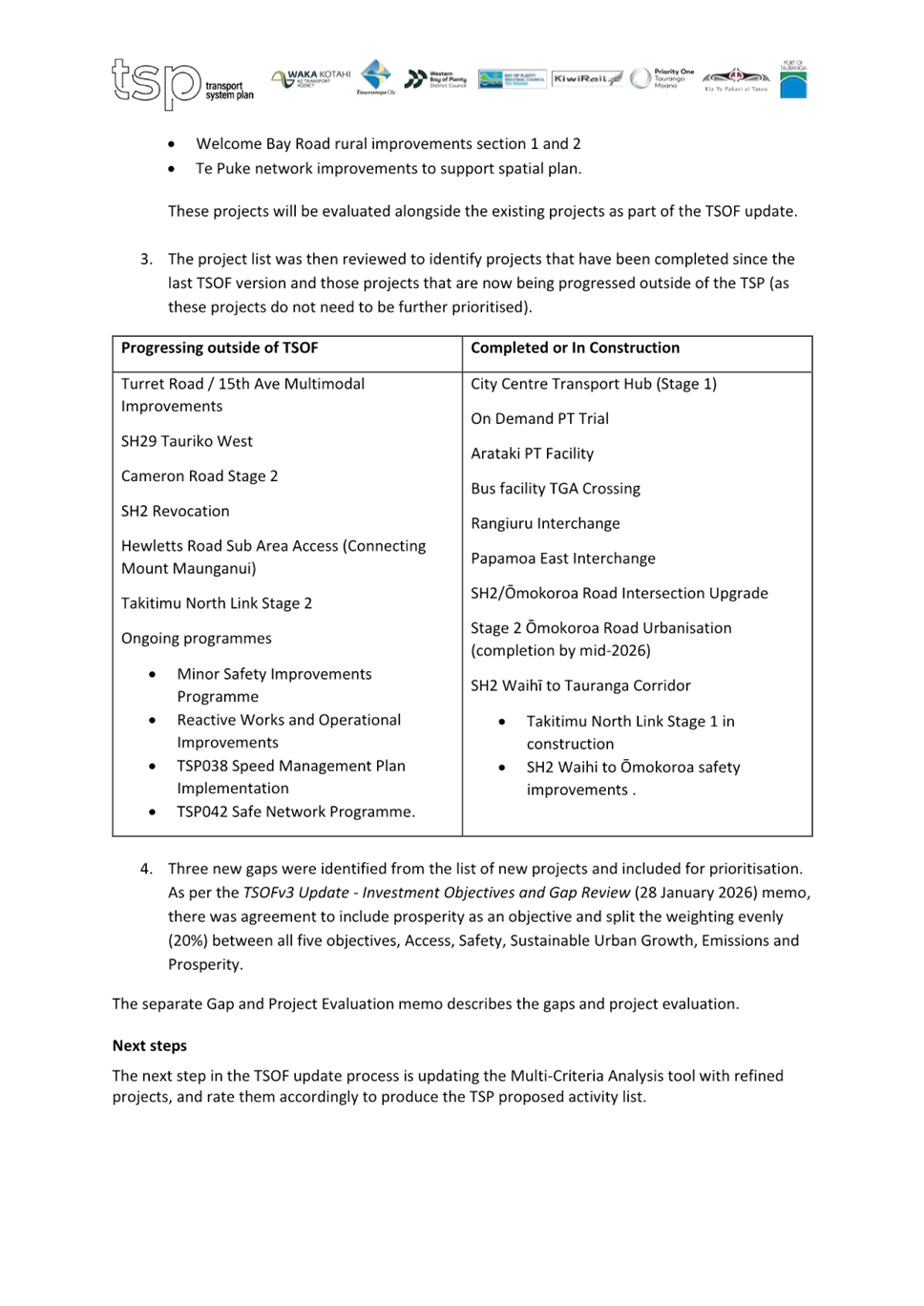
23. The following projects from the
2023 TSOF programme have been completed:
(a) City Centre Transport Hub
(Stage 1), Arataki PT Facility, and Bus Facility at Tauranga Crossing
(b) Cameron Road Multimodal Upgrade
Stage 1
(c) On Demand PT Trial (ongoing)
(d) Prole Road urbanisation
24. Several projects are under
construction or are moving through business case and design:
(a) Tauriko West (SH29 RoNS
enabling works in construction; State Highway upgrade progressing as a Roads of
National Significance project)
(b) Takitimu North Link Stage 1 (in
construction); Stage 2 (a RoNS)
(c) SH2 / Ōmokoroa Road
intersection and Ōmokoroa Road corridor upgrade (in construction)
(d) Papamoa East and Rangiuru
Business Park interchanges (in construction)
(e) Cameron Road Stage 2,
Connecting Mount Maunganui, and Fifteenth Avenue / Turret Road –
progressing through business case or design
25. Several projects prioritised in
2023 have not progressed, mainly because of funding limits and changes in
Government transport priorities under GPS 2024, including:
(a) Arataki to Papamoa East
Multimodal improvements
(b) Accessible Streets –
Multimodal (Areas A and B)
(c) Public transport infrastructure
and enhanced services
(d) Travel Demand Management and
behaviour change delivery
High-Impact
Transport System Gaps
26. Twenty high-impact transport
system gaps were identified across the network. The top five gaps, based on
their effect on TSP objectives, are:
(a) Hewletts Road – poor
level of service (LOS) across all periods
(b) Totara Street – poor LOS
during peak periods
(c) SH29 Tauriko – safety and
accessibility deficiencies
(d) SH29A – poor LOS on a
primary route during peak periods
(e) Takitimu Drive / SH2 –
poor LOS
27. Three new gaps were added in
this update: Cameron Road North intersection level of service, 11th Avenue
level of service and safety, and Te Puke area level of service and
accessibility. A full gap map is included in the TSOF Summary Report
(Attachment A).
Programme
Themes
28. Several programme themes
emerged from the evaluation:
29. With many projects already
committed in the near term, affordability and capacity to deliver new major
projects within the 0–3 year window is limited. The near-term programme
appropriately focuses on completion of committed works, network optimisation,
and minor safety improvements.
30. The 2030–37 programme
reflects a stronger multimodal character, with public transport, walking, and
cycling investments featuring more prominently. These projects score lower for
the Prosperity objective compared to the near-term programme, but higher for
Sustainable Urban Growth.
31. Sustainable Urban Growth is a
consistent objective contribution across both programme periods, reflecting the
enduring importance of supporting planned growth areas.
32. Transport infrastructure costs
have increased by approximately 5% since the 2023 TSOF update. All costs in
this update are indicative 2026 values.
Proposed TSOF Programme
Short
Term: 0–3 Years (2027–2030)
33. The near-term programme focuses
on delivering committed projects efficiently, managing construction effects,
and putting optimisation and safety improvements in place. Key priorities
include:
|
Project / Activity
|
Type
|
Status
|
|
Turret Road / 15th Ave Multimodal Improvements Stage 1
|
Progressing
|
Design
|
|
SH29 Tauriko West RoNS – Staged Delivery
|
Progressing (RoNS)
|
Delivery
|
|
SH2 Revocation Stage 1
|
Progressing
|
Planning
|
|
Connecting Mount Maunganui Stage 1 (HOV, Te Marie Link)
|
Progressing
|
Detailed business case
|
|
City Centre Minor Improvements
|
New / Planned
|
Implement
|
|
Te Puke Spatial Plan Improvements
|
New / Planned
|
Detailed business case & implementation
|
|
Bus Network Short-Term Optimisation
|
City-wide
|
Implement
|
|
Minor Safety Improvements Programme
|
City-wide (ongoing)
|
BAU
|
|
Speed Management Plan Implementation
|
City-wide (ongoing)
|
BAU
|
|
Tauranga Strategic Urban Network Plan (TSUNP)
|
City-wide
|
Planning
|
|
PT Service Optimisation
|
City-wide
|
Implement
|
|
WBOPDC District-Wide Walk & Cycle Improvements
|
City-wide
|
Implement
|
|
Car Parking Management Plans
|
City-wide
|
Implement
|
|
Welcome Bay Road Safety and Resilience (rural section)
|
New / Planned
|
Implement
|
Medium
Term: 4–10 Years (2031–2037)
34. The medium-term programme
supports urban growth and intensification, delivers multimodal improvements,
and addresses key resilience and safety gaps. Key priorities include:
|
Project
|
Priority
|
Indicative Cost ($000000)
|
Way Forward
|
|
Takitimu
North Link Stage 2 (RoNS)
|
Prioritised
|
1,000
|
Planning
|
|
SH29 Tauriko West RoNS Stage 2
|
Prioritised
|
1,600
|
Delivery
|
|
Connecting
Mount Maunganui Stage 2
|
High
|
600–700
|
Detailed
Business Case
|
|
Cameron Road Multimodal Upgrade Stage 2
|
High
|
99
|
Detailed
Business Case
|
|
Connecting
the People – 15th Ave to Welcome Bay
|
High
|
140
|
Design
|
|
PT Services and Infrastructure – Enhanced Services
|
High
|
45
p/a
|
Implement
|
|
Welcome
Bay Road Safety and Resilience (15th Ave Stage 2)
|
High
|
TBC
|
Implement
|
|
Arataki to Papamoa East Multimodal Improvements
|
Medium
|
76
|
Detailed
Business Case
|
|
Ōtūmoetai
Area Walk and Cycle Improvements
|
Medium
|
75
|
Implement
|
|
Chapel Street Bridge Resilience
|
Medium
|
135
|
Implement
|
|
Keenan
Road Access to Urban Growth
|
Medium
|
177
|
Planning
|
|
Mount Maunganui Walk and Cycle Improvements
|
Medium
|
50
|
Detailed
Business Case
|
|
Wairakei
Te Tumu Collector Roads and Bus Facility (developer delivered)
|
Medium
|
130
|
Implement
|
|
Cameron Road – Chapel Street to Elizabeth Street
|
Medium
|
TBC
|
Planning
|
|
11th
Avenue Safety and Access Improvements
|
Medium
|
TBC
|
Planning
|
|
Brookfield Town Centre Access Improvements (OSP)
|
Medium
|
44
|
Detailed
Business Case
|
|
Western
Corridor Ring Route (SH29 to SH36 – Stage 3)
|
Medium
|
145
|
Single-Stage
Business Case
|
Longer-Term
Projects (2038+)
35. Projects planned for delivery
beyond 2037 include major corridor upgrades, strategic growth infrastructure,
and more investment in the public transport network, including:
(a) Fraser Street multimodal
improvements ($144M)
(b) Cambridge Road multimodal
upgrade ($300M)
(c) Pyes Pa Road multimodal upgrade
($44M)
(d) Te Papa active mode off-road
connections and park-and-ride sites
(e) PT Hybrid Network and
Supporting Infrastructure
(f) Tauranga Strategic Urban
Network Plan delivery
(g) Domain Road upgrade and eastern
corridor park-and-ride ($40M)
(h) Bethlehem, Brookfield, and
Papamoa bus facilities
36. Longer-term projects will need
further business case work, cost refinement, and future funding decisions
through the RLTP and LTP processes.
Coordination
with Tauranga Strategic Urban Network Plan
37. NZTA is developing the Tauranga
Strategic Urban Network Plan (TSUNP), which will identify and prioritise State
Highway improvements in the Tauranga urban area. The TSOF programme will inform
the TSUNP. Once both are complete, it is recommended that a combined delivery
plan be agreed to coordinate improvements, reduce risks, and deliver
system-wide benefits.
Statutory Context
38. The TSOF is not a statutory
document. However, it helps align statutory planning and funding processes by:
(a) informing the RLTP and LTP,
which are statutory processes under the Land Transport Management Act 2003 and
the Local Government Act 2002;
(b) supporting prioritisation for
the NLTP, where Government funding is allocated against GPS priorities;
(c) responding to GPS 2024, which
prioritises economic growth, productivity, and major infrastructure delivery;
and
(d) bringing together the land use
and transport outcomes identified through SmartGrowth and UFTI into one
investment programme.
39. The TSOF does not create
decision-making powers. Council endorsement confirms it as the agreed basis for
prioritising transport investment across the sub-region and supports a
coordinated approach to statutory planning, funding bids, and delivery
STRATEGIC ALIGNMENT
40. This contributes to the
promotion or achievement of the following strategic community outcome(s):
|
Contributes
|
|
We are an inclusive city
|
ü
|
|
We value, protect and enhance the environment
|
ü
|
|
We are a well-planned city that is easy to move
around
|
ü
|
|
We are a city that supports
business and education
|
ü
|
|
We are a vibrant city that embraces
events
|
☐
|
41. The TSOF sits within a clear
strategic planning hierarchy:
(a) SmartGrowth Strategy (2024): A
30-year sub-regional growth strategy that sets eight transport growth
directives, focusing on integration of land use and transport, compact urban
development, efficient freight and public transport, and safety and accessibility
for all users.
(b) UFTI Business Case (2020):
Establishes the Connected Centres scenario, which forms the basis for transport
investment prioritisation by emphasising mode shift, urban intensification, and
reduced private vehicle dependence.
(c) GPS 2024: The national policy
statement directing transport investment toward economic growth, productivity,
and the RoNS programme. The TSOF programme has been adjusted to reflect current
government priorities while maintaining alignment with long-term sub-regional
outcomes.
(d) RLTP and LTP Processes: The
TSOF directly informs both the regional and local statutory planning and
funding processes.
Options Analysis
42. Two options are presented for the Regional
Transport Committee to consider.
|
Option
|
Advantages
|
Disadvantages / Risks
|
|
Option 1: Endorse TSOF 2026
Update (Recommended)
|
· Provides a coordinated, evidence-based
framework for sub-regional transport investment
· Aligns partner agencies on shared
priorities, reducing duplication and improving programme efficiency
· Strengthens the sub-region's position in
NLTP funding applications
· Enables informed, consistent inputs into
RLTP and LTP processes
|
Funding and delivery of individual
projects remains subject to future decisions
|
|
Option 2: Do Not Endorse
|
No immediate resource implications
|
· Reduces alignment across partner
agencies and limits the ability to prioritise investment effectively
· Weakens the strategic and evidential
basis for NLTP funding applications
· Undermines the sub-region's ability to
present a coordinated programme to Government
|
43. Staff
recommend Option 1. Endorsing the TSOF 2026 Update is the best course of action
to ensure the sub-region is well placed for the upcoming RLTP and LTP processes
and can advocate effectively for NLTP funding.
Financial Considerations
44. The TSOF does not commit Council to capital
spending by itself. The cost estimates are high-level and were prepared only to
assess the programme.
45. Key financial considerations are:
(a) All cost estimates are in 2026
dollars and reflect about 5% construction cost escalation since the 2023 TSOF.
(b) Total programme costs cover all
funding partners, including TCC, WBOPDC, BOPRC, NZTA/NLTF, and private or
development contributions. They are not Council-only costs.
(c) Project costs will be refined
through future business cases and considered through Long Term Plans when scope
and timing are clearer.
(d) Delivery depends on available
funding from the NLTF, local government, and developer contributions where
relevant.
(e) The TSOF reflects affordability
limits, which is why major new capital projects are largely deferred beyond the
first 0–3 years.
Legal Implications / Risks
46. The main implementation risks
are summarised below and are consistent with earlier TSOF versions:
|
Risk
|
Mitigation
|
|
Strategic and funding risk: Changes in
Government priorities or GPS settings may affect funding availability for key
projects.
|
Maintain alignment of programme with
RLTP and GPS priorities. Maintain strong partner advocacy. Explore
alternative funding mechanisms (Infrastructure Acceleration Fund,
Infrastructure Funding and Financing Levy).
|
|
Financial risk: Cost outcomes may exceed
indicative estimates due to inflation, scope changes, or market conditions.
|
Stage project delivery. Refine cost
estimates through business cases. Prioritise high benefit/cost ratio
projects. Avoid optimism bias in planning assumptions.
|
|
Delivery risk: Constrained professional
services capacity and statutory approval delays may affect project timelines.
|
Early engagement of professional
services. Proactive planning and consenting work. Maintain resourcing focus
through TSP partnership governance.
|
|
Community and stakeholder risk: Poor
community acceptance of projects may affect delivery.
|
Early and ongoing community engagement
through LTP and project processes. Clear sub-regional messaging on benefits
and trade-offs.
|
|
Tangata whenua risk: Insufficient
engagement with iwi may result in objections or delays.
|
Effective partnering and early
collaboration with tangata whenua through established TSP Partnership
relationships.
|
|
Programme integration risk: Poor
coordination between asset owners and deliverers may compromise system-wide
outcomes.
|
Delivery through TSP Partnership
governance with clear communication protocols and agreed programme
milestones.
|
|
Scope creep risk: Individual project
scopes may deviate from original intent without TSP-level review,
compromising intended outcomes.
|
Maintain TSOF scope review as part of
regular TSP governance. Schedule next TSOF refresh for 2029.
|
|
Future central government reform,
funding policy changes, or fiscal constraints may materially impact the
affordability, timing, prioritisation, or deliverability of the TSOF
programme.
This includes potential reforms such as
rates caps (e.g. a proposed 4% rates cap), changes to local government
funding mechanisms, transport investment priorities, co-funding arrangements,
or wider infrastructure reform.
For Tauranga City Council, significant
constraints on rates revenue could require substantial reprioritisation,
deferral, scaling back, or cancellation of planned transport projects and
programmes.
|
Maintain regular programme reviews and
refreshes through the TSP partnership to ensure the programme remains aligned
with changing government policy and Tauranga Council’s potential
funding constraints.
Prioritise staged and scalable delivery
approaches, continue advocating collectively through LTP, RLTP and NLTP
processes.
Councils actively investigate
alternative funding and financing mechanisms (e.g. IAF, IFF, developer
contributions, partnerships, and targeted funding opportunities).
|
TE AO MĀORI APPROACH
47. The TSOF was developed through the TSP
Partnership, which includes iwi as a formal partner. The framework supports
outcomes that reflect Te Ao Māori principles:
(a) Manaakitanga – The
programme promotes safe, accessible, and inclusive transport networks that
support the wellbeing of all people within the sub-region, including
whānau and communities across urban and rural areas.
(b) Kaitiakitanga – The
framework supports sustainable transport outcomes through mode shift, emissions
reduction, and integration of land use and transport planning, contributing to
the health of the environment for future generations.
(c) Whanaungatanga – The TSOF
has been developed through genuine collaboration with iwi and partner agencies,
fostering a shared sense of responsibility for transport outcomes across the
sub-region.
48. The TSOF aligns with the
SmartGrowth Strategy, which is itself a partnership between governing bodies
and tāngata whenua, and with its transport growth directives. Effective
iwi engagement will remain a priority during project-level business case and
design work.
CLIMATE IMPACT
49. The TSOF supports Council's
climate objectives by promoting transport investment that reduces reliance on
private vehicles and increases mode shift to more sustainable transport
options.
50. The framework contributes to
emissions reduction through:
(a) Prioritisation of public
transport infrastructure and service improvements, including the PT Hybrid
Network investment in the medium to long term;
(b) Investment in walking and
cycling networks across priority corridors, including Ōtūmoetai,
Mount Maunganui, and Papamoa;
(c) Integration of land use and
transport planning to enable compact, connected urban development that reduces
trip lengths; and
(d) Support for travel demand
management and behaviour change initiatives to reduce vehicle kilometres
travelled (VKT).
51. Transport modelling for the
2023 TSOF programme showed that the programme could lift combined bus and cycle
mode share in the urban area to about 15%, compared with a baseline of about
8%. However, some public transport and cycling investments have been delayed
because of funding constraints, so this level of mode shift is unlikely in the
near term. Achieving these benefits will depend on delivery of the medium to
long-term programme.
Consultation / Engagement
52. The TSOF 2026 update was
developed through structured engagement with all TSP partners including,
Tauranga City Council, Western Bay of Plenty District Council, Bay of Plenty
Regional Council, and NZTA Waka Kotahi. This included project reviews, MCA workshops,
and review of draft outputs.
53. Broader community engagement
will occur through:
(a) Long Term Plan (LTP)
consultation processes, where the TSOF programme will inform capital programme
proposals;
(b) Regional Land Transport Plan
(RLTP) development, which will involve public consultation on regional
investment priorities; and
54. Project-level engagement as
individual activities progress through business case and design phases.
Significance
55. The Local Government Act 2002
requires an assessment of the significance of matters, issues, proposals and
decisions in this report against Council’s Significance and Engagement
Policy. Council acknowledges that in some instances a matter, issue,
proposal or decision may have a high degree of importance to individuals,
groups, or agencies affected by the report.
56. In making this assessment,
consideration has been given to the likely impact, and likely consequences for:
(a) the current
and future social, economic, environmental, or cultural well-being of the
district or region
(b) any persons who are likely to be
particularly affected by, or interested in, the .
(c) the capacity of the local authority
to perform its role, and the financial and other costs of doing so.
57. In accordance with the
considerations above, criteria and thresholds in the policy, it is considered
that the matter is of medium significance.
58. The matter is considered low as
this matter is endorsing the TSOF but will be considered high for local
Councils and its communities when deciding on, and consulting on proposed
projects through LTP.
ENGAGEMENT
59. The TSOF was developed in
partnership with all agencies, with community input to be sought through
Long-Term Plan consultation and project delivery processes.
Next Steps
60. Subject to endorsement, the
TSOF will:
(a) Inform development of the
Regional Land Transport Plan (RLTP)
(b) Support prioritisation within
the Long-Term Plan (LTP)
(c) Provide a coordinated framework
for funding applications to the National Land Transport Programme (NLTP)
(d) Enable ongoing monitoring of
transport outcomes against defined objectives and key performance indicators.
Attachments
1. Attachment
1 WBOP Transport System Operating Framework Update 2026 - A20336303 ⇩